Friday, August 29, 2014
Adventures On Holiday In Hospital
It’s the end of Summer – traditionally, as Doctor Who’s back – so how was your holiday? Did you go anywhere nice? We went to North Yorkshire for a week, which is relatively usual, then I spent all of mine in hospital, which isn’t. When I’ve not blogged for a while it’s often due to some of my many long-term health problems, so I’ll try to make light of it by saying afterwards that “my health has been worse than usual – as usual”. That week and all the last seven weeks have made this weak gag rather less funny.
I’ve been so ill – and still not quite back even to my normal levels – that I’ve not really known what to write to explain it when I eventually got back to the point when I could. At one point I determined to let absolutely everything out, and drafted a long blog post going into all the gruesome details, including the things that are always wrong with me and how they all fed into each other… But in the end I bottled it. I felt too exposed, and as an excuse told myself that no-one would enjoy reading it. But I’m aware some people have been worrying, and probably more since Richard outed my hospitalisation this time last week, so here’s the very long but hopefully more entertaining and definitely less soul-and-body-baringly invasive version. Are you sitting uncomfortably? I am…
This Is the Important Paragraph – You Should Probably Skip the Rest
The first thing I should say is that while this was intensely awful at its worst, like all my other miserable long-term conditions (and the bonus ones that frequently pop up to join them), its effect was low quality of life rather than life-threatening. So that’s one awkward question you don’t have to ask. The worst effect of it was that my lovely Richard, who has more than enough to cope with anyway, had to work seven hours a day visiting me and more in his ‘time off’ answering all the questions from family and friends that I wasn’t able to cope with. So he deserves a medal and really, really needs an actual holiday. If you happen to be in touch with Richard, please be especially nice to him, as he’s been having a particularly knackering time and, unlike me, can’t spend days in bed after swallowing fourteen pills (my apogee combination of antibiotics, painkillers, especially good hospital painkillers and ordinary prescriptions – I’m down to a smaller number now).
It hasn’t been terribly pleasant for me, either. The week in hospital – for all my terrible health, the first actual hospitalisation of my adult life, though I spent months there as a kid – was of course the worst, involving amongst other things very, very much more pain than I’m used to coping with, almost complete physical incapacitation, humiliation and discovering that I do have some physical vanity after all on getting an unexpected and upsetting blow to it – which like several other things is still not mended. But in some ways the most difficult thing to deal with wasn’t the most intense part but the very slow recovery.
One of my ways of coping with the way ill health usually knocks me out at random is, after the Ray Milland alcoholism film The Lost Weekend, to tell myself my incapacitated time was a Lost Morning, or a Lost Day, or a Lost Week, so that by naming it I can mentally file it away and not dwell on it. I can’t just dismiss a ‘Lost Month And A Half’, especially when both Richard and I are getting rather stressed now that our preparation time for our wedding, which had been going all right, has been cut in half. I suspect this may make me still more wary in future of booking anything; other than my income being technically zero (sorry, Richard, again), I am forced to miss so many things that I’ve paid out for even with my ordinary health problems that I sometimes get to the point where I rarely leave the flat – or get too stressed that I might not be able to when needed (yes, I am listening to the complete works of Kate Bush and feeling jealous as I type). So if you’ve ever wondered why I don’t seem to be about at a Lib Dem Conference, say, then tell me I’m looking well when you eventually see me, there’s a strong chance that I may have been mostly knocked out in a hotel room for the previous forty-eight hours and, on getting out for an evening or an afternoon, be what’s technically termed ‘faking it’. That’s when I don’t just turn entirely inward as a way of coping, a strategy that did at least get me through a week in hospital without going berserk.
I said there’d be entertaining bits, so I’ll tell you that I’ve learned two ‘Be careful what you wish for’ lessons that many a man would grip a monkey’s paw for: one of them isn’t printable in this less TMI version, but the other is ‘I wish it would seem like time on holiday went more slowly’. Well, it certainly did that.
So, Back in Mid-July… The Prologue and the Hotel From Hell
OK, preliminary rambling over, here’s the abridged version of what’s been going on. Back on Sunday July 13th, I started feeling ill, painful and swollen, recognised the symptoms as a nasty infection I’d had once before (though as it turned out to a tiny fraction of the severity), and rather than putting it off as usual because I tend to hope anything new will just go away, decided to deal with it if it hadn’t passed by after I’d slept on it. So on the Monday, with it all much worse, I got a taxi – with a non-stop-gabbling taxi driver so loudly and horribly a Kipper that I wondered if he was a method-actor testing out a stereotype – to seek medical advice, seeing a very nervous doctor who gave me what turned out to be seriously feeble antibiotics. Still, I spent the week mainly trying to rest in order that we’d be able to go on our holiday. I didn’t go out; I missed a pre-booked book evening in town with Neil the Husband In Space and Jenny Colgan; the swelling got worse, but with the (duff) antibiotics, constant paracetamol and not moving the heavy flu-like symptoms seemed to be retreating slightly. What could possibly go wrong? Having fooled myself things were improving, Richard drove us up to Stockport in a nightmare journey of traffic jams in order to see my parents, for whom I looked much better (see ‘faking it’).
The next twenty-four hours were when everything that could went rather wrong at once. As well as getting increasingly feverish as a side-effect during the journey up, the main infection was getting more and more painful while swollen and constricted in a car seat, and I wasn’t able to get any sleep. So that night I was pretty much exhausted – which was unfortunate, as we’d chosen a hotel at random and turned out to have booked into the worst hotel in Stockport. It seemed almost funny at the time. It looked astoundingly like the hotel from Doctor Who – The God Complex, complete with the same cream doors and red paisley carpet, except that even they’d not been able to find a hotel so stuck in the 1950s that it still had a lift with hand-pulled outer shutters and inner cage. It must be thirty years since I was last in one of those (probably not since they pulled the old Hazel Grove Co-op down). It was absolutely sweltering that night, and the place had no air-conditioning, so I did what any rather odd person running a fever and feeling rather out of it would do: reeled around the place after midnight Tweeting that I was trapped in a Sapphire and Steel story. You can read this improbable timeline here: one, two, three, four, five, six, seven, eight, nine and ten (three, five and eight are my favourites).

Not the most entertaining of the photos, but the one that shows lift, carpet and cream.
It got a lot less funny when we tried to sleep. However loud the storm outside, even with the window propped open the crack it would allow, the temperature in the tiny room was soaring and so was mine, so despite my pain and tiredness I was only able to get a few short stretches of sleep. Now, I ordinarily tend to sleep badly, but most days keel over for a couple of hours in the afternoon to deal with it; when I’m short of sleep even in relatively normal health I tend towards testy, headachey, incoherent, unsteady and vomiting (and all without touching a drop). This will all be a bonus later in the day.
The Day It All Went Down
And so we crawled out of bed on the morning of Saturday July 19th, me in a much worse state but Richard also deprived of sleep both by the heat and a feverish fiancé, and more worryingly the one who had to do all the driving. We planned to take some stops along the way from Stockport to Sutton-Under-Whitestonecliffe; as it turned out, the traffic again did that for us, with more massive tailbacks, another long trip taking twice as long as it should, and my trying not to say anything about the effect it was having on me when there was nothing either of us could do about it. One thing I should have done was taken off my shoes and towelled my feet; we’d been out in heavy rain for a couple of minutes in the morning, and I was very soggy. But even bending was by this point excruciating, so I suspect I also caught a chill which may not have helped later.
At long last we arrived at our destination. I got out of the car and went into the office to say hello and get the keys to our self-catering cottage. I was aware at the back of my mind that I was feeling very unwell indeed, but kept standing, bantered – faked it – and it was fine. I was fine. I’d just get my clothes off, dry off and have a sit-down without being jammed into a car seat, have some water and a couple of paracetamol and I’d be fine. We’d got there. We could relax.
I literally collapsed within two minutes of opening the cottage door.
Now, I’m frequently tired and ill and in pain and have to lie down for a couple of hours. Most afternoons, probably. And I label this ‘collapsing’. I think I need to find a new word. Because having held off the worst while doing the bits I absolutely needed to, like travelling, seeing my side of the family and being in public, something suddenly snapped. I fell onto the bed and couldn’t get up.
For two hours I couldn’t move except to weakly reel about when being in one position was too much. I was in suddenly unbearable pain of several types (one of the worst of my usuals, stomach like a bag of knives, coming in just when I didn’t need it). For the first half-hour I couldn’t get my teeth to stop chattering enough to speak. I was shaking, sweating and running a high fever. I threw up the painkillers within minutes of taking them, babbled incoherent guilt to Richard when I could get words out through my shudders, and kept telling myself that I was just too exhausted and if I could only get to sleep, I would get better.
That didn’t happen.
After two hours of this, I gave in and rang 111, because I didn’t want to trouble them with something that wasn’t very serious. I could still barely speak and hardly move at all, and they sent an ambulance immediately. It turns out they thought I was very ill indeed, and it turned out they were right. I’ve only once before been taken off in an ambulance as an adult, when quite a few years earlier I was having several hours of chest pains (which fortunately were just a combination of asthma and muscle spasms). I was given gas and air that time, which relieved the pain and was very jolly (for me, at least. They didn’t give Richard any to relax him, so he was dreadfully worried). So I was a bit disappointed when the gas and air this time made the pain only slightly less intolerable, and that only in the moments I was actually breathing it in. They offered me morphine, which I’ll admit I was wary of but was fantastic (kids: don’t listen). Or at least let me slowly start to cope. I was rushed to the hospital in Northallerton, with Richard – who fortunately knows the area – following in the car (not a great time for him after two days of horrible drives). He stayed with me through all the initial hours of pokes and proddings until I was consigned to a ward about 1am.
I didn’t take any photos that evening, or for the next few days, which is just as well.
Hospital #1
I was given rather a lot of drugs through two different drip-feeds and as a consequence got more sleep that night. In fact I can’t tell you a great deal about the Sunday, as I was constantly dipping in and out of consciousness, and couldn’t actually move without a lot of help – still less make much sense – until the Monday. I do remember using the counter on the electronic box that combined my twin feeds to calculate the time and then counting slowly for the half an hour until three o’clock when I was sure Richard would come. He was stuck in the car park and got in about two minutes past; he was the first to arrive at visiting hours (and the last to leave, but I won’t talk about an excessively rude nurse noting that as the others were very much nicer), but I was not at that point coping well and nearly cried when he didn’t appear on the dot, as I wasn’t up to devising any other coping strategy, then nearly cried again when he appeared to look after me. It’s startling how much hope you can build up on one tiny thing when you’re in an awful state.
The Saturday night and through the Sunday was pretty much all a blur, often a distressing one, certainly an uncomfortable one, but above all a relief. Asked by the ambulance crew to rate my pain level out of ten, I’d given a nine because, you know, nothing’s perfect and you always have to assume something better can come along. My gratitude at it settling to between a five and a seven – and I often get a five at home – was inexpressible. Even when I found myself turning my list of all the things usually wrong with me and all my prescription medication into a sort of ritual chant I could repeat while semi-conscious as what seemed an endless file of doctors and nurses would ask the same questions and be taken aback at the length of the litany detailing my long-term health issues from literally head to toe…
…Even when – throughout the week – they’d always wait impatiently to the end and then say, “Are you diabetic?” (the politer ones) or “Aren’t you diabetic?” (the more supercilious ones), because, y’know, that’s one that’s really easy to forget, isn’t it? Well, no, I’m not, and as I have so many things wrong with me I have regular blood tests – and still many more in the hospitals – I’m regularly aware that I’m still not. And as the various consultants ruled out more and more potential causes of what was wrong with me, despite diabetes actually having no possible bearing on my infections, over and over they kept asking, “Are you diabetic?” and I kept hearing, ‘We are frustrated and feel we lack control of the situation because we should know what’s causing this and don’t, but you are very fat and we wish to reassert our control of the situation by blaming you for it.’ And over and over I kept saying, “No, I’m not diabetic,” and I kept meaning, ‘I am in hospital and very ill and feeling that I have very little control over my life at the moment, but I assert control over at least being adjusted to being very fat, and up yours.’
“‘The sky appears to be reflective,’ Holmes replied, more hesitantly than usual. ‘Perhaps, like Dante’s inner circle of Hell, we have ice above us. If you look closely, you will see a reflected glow from something over the horizon. The nearest Earthly equivalent would be the lights of a town or city.’ He coughed. ‘I am merely speculating, of course. It could be an incandescent chicken the size of the North Riding for all I know.’”That’s a line from Andy Lane’s very entertaining Doctor Who: The New Adventures – All-Consuming Fire that would go through my head each time, stranded in the North Riding with far less mental faculty than me, let alone Sherlock Holmes, and feeling the same overwhelming fish-out-of-water helplessness, with a certain degree of satisfaction that the doctor was similarly stumped. The spontaneous combustion plot was rather less comforting to think of, with the fever I was running (but you can’t have everything, and oh look, I was prefiguring another Victorian spontaneous combustion Doctor Who story just last weekend).
Another sudden collapse of self-image: usually I eat to cope. A lot. The doctors may have deduced this. Richard brought grapes, chocolate, goodies of various kinds (and two very lovely cards), and I just had to ask him to take most of them away again. Not because I was ordered not to eat them (except for the points when I was), but because I realised that I had absolutely no appetite whatsoever and it was too distressing to be reminded of it. I have a massive amount of stomach problems, but this was the only week I can remember when my appetite just went utterly flat. I was aware that with every hospital meal I had to force myself with every forkful, and still left bits (I do not leave food), simply because I was aware I had to eat and willed myself sternly to do it. Not even a giant incandescent chicken could tempt me. The week’s single happiest moment when Richard wasn’t there was being woken at 6am on the Thursday and realising that I’d been in a vivid dream of food, which meant that there was a chance I was becoming me again.
One thing that I held onto – other than Richard – was my befuddled brain playing Doctor Who. One story above (literally, it occurs to me) all: another from the same range as All-Consuming Fire, this time Russell T Davies’ brilliant first official Doctor Who, 1996’s novel Doctor Who: The New Adventures – Damaged Goods. There will be spoilers if you’ve not read it. Because I was surrounded my curtains and full of drugs and exhausted, and until Richard brought in my phone I had no distractions or diversions, all I could do was fall asleep, or lie awake looking up. Looking up at the large panels of the ceiling, like a big noughts and crosses board. And vividly remember how noughts and crosses keep featuring through the book with what eventually turns out to be exactly the same hallucinatory importance I was experiencing. Although it was published the same year my most bedevilling health problem started, at least as a long-term health issue it’s a better one to have than young Steven Jericho’s: in a story of terrible bargains, happy blow jobs, families, death and war, the most haunting aspect is the endless visions of noughts and crosses that Gabriel Tyler receives without rest from his separated, unknown, hospitalised twin who can do nothing every day but stare up at his own noughts and crosses board. Uncannily, not only is the bulk of the book set during the same week of the year that I was in hospital, but it was during that very week this year that Big Finish announced they’re adapting it as an audio play. But like Gabriel’s, my visions of noughts and crosses came first, and knowledge of their significance afterwards.

Noughts and crosses – filled in one nought and crossed drip-feeds (only one showing)
By the Monday, my brain and body were starting to function. Though I preferred being on average more conscious than unconscious, this wasn’t all good. The worst moment… Worse than when I was admitted – because that was a relief from pain. Worse than grumpy nurses trying to take my two gowns and telling me off for not bringing my own pyjamas – because I don’t have pyjamas, doubly not when on holiday, because I was too swollen to get anything over my legs, and I needed two backless, impossible-to-fasten-yourself gowns for courtesy’s sake, as I’m a naturist but am aware non-nudists didn’t want me flashing or mooning them as I tottered to the loo. Worse even than Tuesday when I hit ‘peak swelling’ at a huge, painful and absurd size – because I’d been inured to this being what I was ill with. The worst moment of all when I was in hospital came because I was able to clean myself. I’d been drenched in fever-sweat and unable to move for two days; when, in not a great twist, the cannula on the back of my hand ripped free while I was dozing, it at least meant there was a point when they had to disconnect my drip-feeds and I seized the moment to ask if I could have a shower. I was terribly weak but just determined enough to stagger to a bathroom, pull off my gown, and… Though I’d been conceptually aware of it, this was when I got the real blow to my vanity: there is just one part of my body that I like, and I’d never realised just how much of my limited self-esteem balances on it until I suddenly saw what a wreck the hospital had made of it. It’s still not right, but that initial shock in the mirror nearly stopped me coping. It’s the bits you’re not prepared for that tip you off the deep end. Partly as a way of mentally striking back with a physical change under my own control, and partly just because I didn’t have the energy and co-ordination to use a razor for several days, I decided then to grow a beard until I’d recovered. I have, of course, still got it. Sorry, Richard.
Monday was also the day I changed hospitals. The one in Northallerton had mostly very friendly nurses and a cheerier ward, but it did turn out to have one serious disadvantage: a great many specialists all coming to see me and none, apparently, talking to each other (several of them even to me in my enfeebled state worryingly but plainly not having a clue). So let’s say that I wasn’t very happy when one decided seemingly at random that they should operate and told me, as if that wasn’t enough, that I couldn’t be sewn up but would just have to have a nurse pack the wound daily for a fortnight until it healed of its own accord. And let’s also say that I wasn’t very confident when another sent me for an ultrasound scan (on top of the x-rays, direct physical examinations of every kind and everything else I’d had) and those scan results said that there was absolutely no need to have an operation, because the assumption on which they’d based that decision was entirely wrong. And I wasn’t very happy at all when I was told I’d still be having the operation, pointed out the contrary information from later in the day, and was told that the doctors knew what they were doing.
It turns out it was rather lucky that they didn’t have a theatre available and sent me to a larger sister hospital.
Hospital #2
Almost everything about the second hospital in Middlesbrough was less good. Twenty-five miles further north, in a town neither of us knew, so that rather than Richard being able to drive there in ten minutes it would take an hour, making a full seven-hour day for him to visit me for my five hours of blessed company. The hospital itself bigger and grimmer and the ward much more – disrupted, I’ll call it, and not say anything of the distressed or distressing other patients. The bed… I’ll come back to the bed. The hour’s ambulance ride there, which was excessively painful just as I was levelling out (though the paramedics were lovely).
None of that matters. Because the best thing about the second hospital is that there was one consultant who saw me each time. One consultant, rather than half a dozen who only saw me once or twice each and made on-the-spot contradictory decisions. One consultant, who took the time to explain what was going on at every stage. One consultant, and this is less important but reassuring, who looked rather like Roy Marsden’s before he was eaten by vampires. One consultant, who most importantly of all had a f*****g clue and who on taking the notes from the hospital that had referred me for what I’d already weakly suggested and which his actually reading and cross-referencing them confirmed was a wholly unnecessary and dangerous operation, came remarkably close to expressing his professional opinion of some of the previous hospital’s personnel’s judgement and told me that I would definitely not be going into theatre that night, and detailed precisely why not.
So the second hospital was able to tell me that I had two infections, named, interrelated and both very bad and with pretty horrible direct effects and heavily flu-like side-effects, but that I didn’t in fact also have the other one that a random consultant had just guessed at. Reassuring to know precisely and definitely what was wrong. Slightly less reassuring that, after they also ran all the possible tests all over again to see what caused it, I predictably came up zero on the forty-six or so most common possibilities, which at least means they were able to confirm I’m not at all infectious to anyone else but also means I don’t know what esoteric cause to avoid and so that it might just strike again at random.
By contrast, perhaps the least appealing thing about the second hospital was the bed. Every bed in the ward had a whiteboard with the patient’s name above it. Every bed was a modern grey plastic creation with a wide frame and remote control elevation the patient could operate to get out of bed more easily or raise their pillows. You can see where this is going, can’t you? I was put in Bed 13, which unlike all the others in the ward never had my name put above it, and again uniquely was a narrow old iron frame which I had to clamber out of before they lowered it to change the bedclothes because the crank was too violent. Not that that occurred to the student nurse who, bored with listening in on rounds, idly kicked at it until the constant jolts of pain across my face prompted the senior nurse to stop her.
My slightly thoughtless way of coping was to tell Richard this was because in 1958 the last person whose name had been put on the board over Bed 13 had died before the night was out, and they’d never changed it again. He didn’t think this was very funny. The number, the nameless horror and the ancient frame did give me the sense that I was incarcerated in a half-finished Christmas script by Mark Gatiss, though.

In bed in hospital
The bed’s plastic mattress and pillows were no doubt practical for cleaning, but when I tend to get quite sweaty just as a matter of course and was mostly feverish while incarcerated, it meant the plastic would heat up against my skin like a furnace and I’d simply pour. One night I woke and was so sopping wet with sweat I had to plead with a nurse to change the sheets at 3am, which was one of my more mortifying moments and made rather worse when it transpired there were no spare pillowcases. I said I couldn’t sleep with a sodden rag under my head, so… They took it and left just the bare plastic pillow. That didn’t help. Should you ever find yourself in a similarly untenable position, here is my tip: ask for a large towel. Pillowcases they may not have had, but an intrepid nursing assistant found me a proper bath towel rather than the tea-towels they give you to dry with in the bathroom and I wrapped it snugly round both plastic pillows. Being considerably thicker than the cases, it was much more comfortable too, and psychologically it was a small victory.
Things I Learned From Hospitalisation
Gosh, I’m going on a bit, aren’t I? It’s therapy.
Much like discovering that Carry On Doctor is still a documentary.
It was a small, private act of protest. Both hospitals were festooned with signs saying that mobile phones were not to be used. Stern admonitions were given on admission. And I couldn’t get a signal in the first one, anyway. But after Richard tried to ring me on the ward phone number he was given and was told off because he should have rung my mobile – seriously – I relaxed a bit about occasional surfing to relieve the stupefaction, though I’m afraid I didn’t look at any messages because I just didn’t feel I could cope. And part of this was finding a rogue copy of Carry On Doctor online and slowly buffering it through the night as cheer in my most miserable moments.
For me, Carry On Doctor’s one of the best of the series, and definitely the best of the non-historicals – though the ending is in some ways more disturbing than chopping the villains’ heads off. It makes a brilliant use of a brilliant ensemble cast, and you can really see it as a big relaunch for the series at a new studio but doing what they’d been most famous for. You can see it this Sunday morning on Film4 (and no doubt every other week on some channel).

I saw that film!
What I didn’t realise until I watched it illicitly in hospital was how half a century later it’s still uncannily Cinéma Vérité. Though the thermometers are smaller these days, even the wards still look the same, only split into half-length and with Sky Sports screens dangling above you that I would regularly switch off and that orderlies would be commanded to switch on to try and get me to pay for them. I even had one of the original beds. The only thing that let down the documentary realism was Frankie Howerd being woken at 6am. No, not that part – I was woken every night at at least 2 and 6 (or 12 ½ p in new money) as part of having my blood pressure checked every four hours, which they’d always be surprised to see going sharply up or down but which I could reliably chart by how close they measured it to my last having had fabulous morphine derivatives and whether my pain score was a manageable four or a pump-popping seven. What I found incredible was Mr Francis Bigger wanting to get back to sleep (“Sleep’s good for you!”) only to be interrupted immediately by more crashing about from the guy doing the washes, and the vacuuming and the tea. It’s nothing like real life! They always gave you at least twenty minutes to start to nod off again before the next noisy interruption. Though our tea ladies were always very kindly, and I was always very apologetic when I couldn’t force myself through a full meal. Oh, and that sadly the only seriously hot nurse I saw was only in my ward for a couple of minutes while he was helping transfer a patient, and at a point where I was physically about as far from a Sid James reaction as I’ve ever felt. So no lovely pair there.
On a related note, day staff seem to have no idea what night staff do, as the question “Did you have a good sleep?” is one you can’t answer politely when you’re not only deliberately woken through the night on hospital policy but also constantly woken by patients being trollied in, patients being ferried out or patients being distressing in any number of ways (especially one night, where the suffering of one man was too near the knuckle and I had to go and sit in a loo down the corridor for half an hour because otherwise I couldn’t have dealt with my own). At no point did I ever have anything approaching a good sleep, though in the first night and day there was a long stretch of intermittently blessed unconsciousness and really excellently hazy painkillers.
In hospitals there is also a different meaning of “comfortable”: you are never remotely comfortable, but what they want to know if your pain level is copeable or if they have to hit you on the head with a mallet to stop you screaming the place down (see ‘distressing patients’).
If you have many prescriptions, you must remember to bring all the right drugs in in the right combinations on admission even if you’re passing out with pain.
The nearest I had to a proper row was with the pharmacist in the first hospital. I’d just grabbed one of everything to illustrate what I take, not expecting to be kept in for a week. This meant that the drug that I use in an unusually small dose because I’m prescribed it for something completely different to most people confused her. And then, as I take 2.5-3mg (depending on how badly I’m doing) in a combination of 1mg from one bottle and 0.5mg from another, she only let me take 0.5mg as I’d not actually picked up both bottles. As I need a small but not that small esoteric dose for an esoteric condition, that was no bloody use at all. I preferred the pharmacist in the second hospital, who I first saw scurrying about bent over in an amazingly disreputable manner before he eventually introduced himself. I remain suspicious, not least because he was the only staff member there in the sort of white with green flashes uniform seen in the likes of Doctor Who – The Ark In Space or The Invisible Enemy, and looked uncannily like a cross between Ewen Solon and Charles Kay, who acted in just that sort of TV in just that sort of period. So perhaps he didn’t actually work there, and was just a ’70s method actor pretending to be on set. Or, as he claimed to be a pharmacist, on drugs.
Richard – My Lifeline and Escape Line
I have always known that Richard is the most marvellous person and the most perfect partner in the entire world, but now I have objective factual evidence.
He gave up his holiday to spend every minute (and more) of the five hours allowed each day to come and comfort me – even when I really wasn’t in a good state for company, hospitalised 250 miles from home, and an hour’s drive each way for him. I am still pathetically grateful, to say nothing of what a lifeline he was at the time. He was always the first to arrive and the last to leave, and every day the only visitor who stayed right through. He is, objectively, better than everyone else and the most attentive visitor by a mile. Subjectively, he talked when I wanted him to, he was silently supportive when I needed him to be, and he was adorably affectionate. And from what I could hear of everyone else, he had far, far better conversation. Though I probably can’t go into detail on the parents I wanted to scream at to shut up, or the elderly sister who got bored of an old man just out of surgery not being a performing seal and told her husband to prod him to wake him up. Luckily for her, I was too feeble to prod her by hurling the bedside cabinet I had to hand.
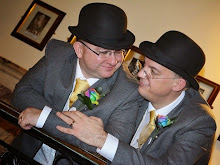
And on one night I was greeted by an older gay man who’d had no visitors and was in a lot of pain talking on the phone to a friend about how the only thing that helped him cope was the gay couple in the opposite berth who were being lovely in holding each other and talking all evening and generally being the most couply couple possible.
Perhaps the thing I should be most grateful to my beloved for is the bit I didn’t see. I absolutely couldn’t cope with anyone else when I was in hospital, however much I love them – though it has been nice to see some of my family since, along with two lovely men who’ve visited me in my lonely flat – and he stopped me having to do so. He stopped well-meaning but just too much people contacting me in hospital, only brought in the messages he knew I’d want, and spent most of the remaining hours of his precious ‘rest’ time when back at the cottage on the phone or on Facebook updating people, reassuring people and answering endless questions from people, all so that I never had to. I love him so much.
I think of him standing at the ward doors him wielding his iPhone and roaring,
“You shall not pass!”

And yet I’m the bearded one in the abyss.
Absolute proof that Richard is the best. Please be lovely to him.
I take back what I said about pharmacists and the worst part in hospital, though.
On the Friday morning, the helpful and competent specialist told me they were going to discharge me. He told me that they’d have kept me in had I lived locally, but that he knew we were on holiday (ho ho) and that we were only booked in where we were staying until Saturday morning. On balance, he thought it would be better for me to get home on Saturday rather than Richard have to find somewhere else to stay, get time off work and them not really be able to do much more for me in hospital except pump me full of drugs and rest. So I was warned not even to think of doing anything for a fortnight (and my usual recovery time is twice medical estimates, because I have so many things wrong with me ordinarily, which has of course been proven again since) and that I was being discharged not for being better but for being on balance manageable. At the time, I was much less feverish than when I was admitted, but actually much more swollen (that having got much worse before starting to improve) and still just as weak.
Where the hitch came was with the ‘pumping me full of drugs’ part. I was told I’d need three different sorts of painkillers and antibiotics to take away with me, and that the hospital pharmacy would send them up. This was about 9am. I was told to expect them between 12pm and 2pm, and a kind nurse said Richard could come in early. This was fortunate, as he ended up staying longer than any of the other days as the time dragged on, and on. They stripped my bed and remade it, as I’d be out straight away… Which became a problem as it got later into the afternoon, when I got weaker and shakier but had nowhere to sleep, caught in a no man’s land where I was neither discharged nor not discharged. Or, as Richard described me, as I changed from patient to impatient. It was the promise being broken: I’d coped with being there all week, the first time I’d been hospitalised for about thirty years as opposed to all the many times going in for tests and consultants, and it was immensely draining but I could shut off enough bits of my mind to get through. But so close to escape, and just finding that always out of reach, that drove me up the wall.
When 4.45pm and the pills eventually came and I tottered weakly out of the hospital to see it for the first time – and disappointingly find that what looked like a scrap-metal sculpture of Gonzo from the window was just an interestingly-but-less-interestingly-shaped tree from more accurate angles – I was more than slightly frustrated. Tip for unblocking hospital beds: don’t let hospital pharmacies delay patients from being discharged by eight hours for no reason at all.
Still, you wouldn’t believe the sense of escape when Richard drove me away from there, despite all the pain. Just seeing anywhere else. Now there was an adrenalin rush.
Aftermath Still-during-math
I had hoped we might get one tiny smidgeon of holiday on the Saturday morning by visiting York – lovely town, our favourite chippie, the Fudge Kitchen – but I was very evidently in no fit state, and still in way too much pain, quite apart from still having a severely suppressed appetite. On the bright side, by leaving early, we seemed to miss most of the traffic and to our great relief had a far less hellish journey going back to London.
That, of course, was only the end of week two of my double-infection. It’s now nearly the end of week seven. I’m looking a little more me, and feeling a lot more me. I’m back to eating far too much food – but still not really up to much of the walking I’d been doing to try and keep my weight in check. It’s been pretty rough in between, though.
Week three I went out just once that wasn’t to the doctor, and of course overdid it with catastrophic results. Much the same happened in week four, but the swelling was a lot less as I moved onto my fourth course of antibiotics (same as the third course I got from the hospital pharmacy, far more effective than the utterly rubbish first week’s variety, and I never knew what the serious second stuff they pumped in intravenously was), so I was quite confident I could be getting out more. Obviously, in week five I moved from merely still weak and feverish to the full-on flu-type attack and was far more ill than I’d been at any time since about the third day in hospital. So that was… Bloody terrible, actually. Week six I was still very knocked out but got a few things done, and at last the multiple massive cannula bruises all along my left hand and arm have vanished.
Now late on in week seven, the former massive cannula bruise on my left hand has even stopped hurting. The swelling hasn’t, though. Both types of swelling are much better, but they’re still ‘tender’ (or just plain sore, depending), and while about a twentieth the absurd / horrific volume at peak, still noticeably inflamed. I finished the fourth course of antibiotics last week; I saw the doctor again this week; I’m on the fifth course of antibiotics. He’ll see how I’m doing in a fortnight.
On the bright side, I’ve managed to get some things done this week though still very far from catching up any of The Lost Month And A Half, and most of the ill hours I’ve had to write off as ‘Lost Time’ this week have been my standard, familiar illnesses and not the one that slaughtered me a month and a half ago, so that’s encouraging, isn’t it?

In our own bed one month after hospital
Whatever the doctor says, maybe this’ll work: the beard’s coming off tomorrow.
Labels: Carry On, Doctor Who, Food, Health, Matt Smith, Naturism, New Adventures, NHS, Personal, Pictures, Richard, Sherlock Holmes, Sylvester McCoy, Twitter


Wednesday, August 07, 2013
Doctor Who 50 Great Scenes – 36: The Krotons. Featuring Patrick Troughton, Robert Holmes and the Double Act
Counting down towards the fiftieth birthday of Doctor Who with Fifty great scenes… Now we have a new Doctor and look forward to a new direction for the series, today it’s a celebration of two people who did those things brilliantly: second Doctor Patrick Troughton and lead writer Robert Holmes, both still regarded as patron saints by Doctor Who actors and writers today. Paired together here from 1969, this scene (and more) offers the sort of double act both men were famous for, a warning about computer games, and proof that nobody’s perfect:
“Oh, Doctor! You’ve got it all wrong!”

By the time The Krotons was first broadcast at the tail end of the ’60s, Patrick Troughton was approaching the tail end of his time as the Doctor, while Robert Holmes was just starting out on his career in the series – one which would see him write for five Doctors over nearly twenty years, become the series’ most prolific writer during the Twentieth Century with scripts that ran from comedy to horror and nicking from everything in sight, and establish himself as Doctor Who’s greatest ever script editor (the equivalent of today’s showrunners like Russell T Davies and Steven Moffat, without the money), defined by great dialogue and great wickedness. The Krotons is a bit smaller than all that and not the greatest story in which either Mr Troughton or Mr Holmes would be involved, but right from the first Bob writes perfectly for the Doctor and Pat runs with it superbly. You can see why so many actors who’ve played the Doctor since cite him as their favourite, from Peter Davison on BBC1’s So You Think It’s Capaldi… It Is Now! programme last Sunday night to still-current incumbent Matt Smith: not only is Patrick Troughton pretty much unbeatable when he’s giving his best, but he’s obviously the patron saint of ‘the impossible job of following the big success and making it work’. And one of the things both Pat and Bob made their own in their different ways can be checked by asking long-term Who fans, ‘Which Doctor / which writer was brilliant for comedy double acts…?’
Half-way into Episode Two, the Doctor (Patrick Troughton) and his friends Jamie (Frazer Hines) and Zoe (Wendy Padbury) are trying to work out the secret of the Krotons, legendary beings long-unseen and perhaps best left that way* who rule from their great crystal machine over the locals, known as the Gonds. The Krotons have for centuries demanded tribute of the Gonds’ best and brightest delivered to them, and in a neat critique of instant gratification, by the time our heroes arrive the Gonds are predictably no longer best or bright. As the Krotons need mental energy to revive themselves, their own not exactly high-brain short-termism means perpetual slumber for them and perpetual slavery for the Gonds. Unless someone very bright indeed turns up and puts their foot in it, of course…
Zoe is a brilliant teenage computer programmer from the Twenty-first Century who, when the Doctor bumbles off to look elsewhere, is drawn to the Krotons’ teaching machines and all the games installed on them. Stop me if you can see where this is going. She’d have been a demon with ‘Tomb Raider of the Cybermen’, and even though ‘Selris’ only involves a completely inanimate block that has to be winched into place, she’s soon more than doubling the previous high score and flooded with endorphins. The Doctor wrenches off her headphones, but the Gonds’ dreary leader has already spotted the score. The Doctor’s not impressed:
“Yes, well, Zoe is something of a genius. Of course, it can be very irritating at times.”That’s nothing to his reaction when a gong sounds from the great crystal machine and a message from the sleeping Krotons demands that Zoe join them as a special extra companion. As Zoe and the Doctor have both already witnessed that round the back of the great crystal machine there’s an exit where the ‘honoured’ companions are unceremoniously ejected and disintegrated after having their brains sucked out, the usually mildest of Doctors snaps to his friend in sudden fury and fear:
“Now do you see what you’ve done? Fooling around with this stupid machine!”He stomps off to take the test himself, unwilling either to let the Kroton machine massacre the Gonds for disobedience or let Zoe go into danger alone. And that’s what I really love about this scene, because the Doctor’s palpable concern, and Zoe wanting to make up for her getting them into trouble, and looming certain death, all obviously create a situation which is both tense and terrifically funny.
“But I’m not a Gond!”
“But the machine doesn’t know that!”
The Doctor sits down at the teaching machine and their positions are suddenly reversed: he’s the one with the headset on and Zoe’s the responsible one telling him what to do. And on top of both wanting him to succeed, they’re absurdly competitive about it. She tells him to press the button to start, then tells him again, because he can’t hear with his phones on; he answers back too loudly, and with a storm of testy words that get her going, and coming, and them both rushing about:
“All right, there’s no need to shout! Now go away and don’t fuss me – no, come back, what’s this? – It’s all right, I know – right, fire away. I’m ready.”At which an exasperated Zoe now mimes that he has to press the button to set it going. Not much of The Krotons looks good, but there’s some fabulous design here for the circling computer symbols (absolutely not CGI) assembling, breaking and reforming, all to great sound design, too, an ominous low chattering hum. Brian Hodgson’s soundtrack – a radiophonic mixture of electronic effects, textures and near-music – is now available to buy, and so fascinating that Richard has instructed me never again to play it in his presence (look, it’s shorter than The Sea Devils…).
So does the brilliant Doctor at once beat Zoe’s high score? No. He makes a clever person’s error and, rather than reading the instructions properly, works it out on the wrong basis and scores zero. The Gond leader worries to Zoe:
“This is the most advanced machine. Perhaps he can’t answer the questions.”So the Doctor gets it all wrong again, as Zoe jumps in frustration. That is, until he gets into the swing of it and, at last, the score battering over the upper limit, he turns very smug and she turns very cold:
“Of course he can. The Doctor’s almost as clever as I am.”
“I think I’ve scored more than you have, Zoe.”Before long, the “dinner gong” sounds again for them to enter the great machine, and even as the danger reaches its pitch, the Doctor’s deadpan polite thanks when Selris the Gond leader dolefully tells him his people will remember him is a scream…
“You answered more questions!”
*On another not entirely stunning visualisation, Alan and Fiona have recently covered The Krotons on Kaldor City and I laughed at their all-too appropriate “The Gond village looks like someone has dropped a packet of chips and a Scotch egg on a gravelled drive” – this is not among Doctor Who’s more lavish productions.
Bonus Great Patrick Troughton and Robert Holmes Doctor Who Quotation – The Space Pirates
If The Krotons is not the most fêted of Doctor Who stories, Bob Holmes’ second script, The Space Pirates, can be a bit of a slog. Of all the stories I’ve watched when prospecting for the Fifty, this was the hardest work to pry anything precious from: for me, it’s easily Bob’s weakest script, badly structured, thinly plotted, and with most of it junked by the BBC so only the soundtrack is left, not even visually diverting. With Bob’s entertaining but unexpectedly queasy final treatment of Patrick Troughton’s Doctor not until a 1985 guest reunion, though, this is the only other time they paired up. But the great thing about Doctor Who – and about Pat and Bob – is that even in the most exhausted parts you really can still find something marvellous. And here it’s not in the endless, plotless space chases but in the second half of the story, where the Doctor (Patrick Troughton) and his longtime partner in the double act Jamie (Frazer Hines) finally get to meet people from across the plot and to do plenty of their perfectly timed schtick. A terrible gag with drawing pins that’s terribly funny; the Doctor’s favourite marble; and the bit that I’m afraid always makes me laugh – trying to break out of a cell with an audio lock, the Doctor gets out a tuning fork and, endlessly, twangs it. Jamie:
“Which end did he land on when you fell down that shaft?”Confronted with a three-inch-steel door later:
[After driving them all nuts…]
“Oh, look, Doctor, will you stop it?”
“You want to get out of here, don’t you?”
“Oh, that’s not going to get us out…”
“Yes, Jamie, it is! An audio lock is a simple solenoid switch which is only activated by a particular sound. It’s just a question of finding it, that’s all.”
“Oh, look – I can’t stand any more!”
[He grabs the fork off him… Chucks it against the wall… And as the Doctor wails, the cell door opens.]
“Jamie! Jamie! …Jamie, you found the right note!”
“It’s not an audio lock, is it?”And there you go – sifting out the good bits of The Space Pirates.
“No, Jamie, it isn’t.”
“Ah, that’s a relief.”
“Jamie, I think you don’t appreciate all I do for you.”
Admittedly I do find one line from the old comedy character without much comedy to him very appealing, too – here’s Milo Clancey up against the New Labour space police:
“You know it’s an offence to operate without a feedback to CFI?”
“An offence?”
“Right.”
“I didn’t realise that, sonny, no. Oh dear, oh dear, oh dear. There are so many offences these days.”
Bonus Great Patrick Troughton Doctor Who Quotation – The Moonbase
The Doctor had begun as a figure who intended only to observe and who learned only gradually the moral instinct to interfere: moral outrage had long topped non-intervention by the time of his first regeneration, but it’s when the new Doctor (Patrick Troughton) faced the early return of the Cybermen that he gave the clearest declaration that he fights monsters now, and fighting monsters is cool. It’s part-way into Episode 2, with the Doctor and his friends having a bit of a time of it up on a Moonbase about a century after the story’s 1967 broadcast. The base commander is fed up with the Doctor’s antics and wants him gone; the Doctor’s friends are mostly fed up with being injured and threatened and might just do that; but the Cybermen appear to be on the prowl, and the playful Doctor suddenly puts his foot down with sober gravitas and issues his manifesto. This is the moment where this Doctor finds himself. Later Doctors found a more nuanced moral compass, but this one took two very firm and uncompromising if not completely complementary stances: anarchic freethinking meddling; and destroy all monsters…
“There are some corners of the Universe which have bred the most – terrible things. Things which act against everything that we believe in. They must be fought.”
Bonus Great Robert Holmes Doctor Who Quotation – The Time Warrior
One of Robert Holmes more influential scripts, The Time Warrior introduced Sarah Jane Smith (Elisabeth Sladen): in Episode Four, broadcast early in 1974, Sarah Jane has snuck into a medieval castle to knock out a nasty robber baron and his entire garrison while the Doctor deals with the alien in the cellar. It’s a scene that shows how very resourceful she is, how very feminist she is, and how very funny she can be. Caught in the kitchens by Meg the fearsome – well, I suppose in a posher castle she’d be called the châtelaine, but here ‘lead serving wench that bullies the other serving wenches into getting the job done’ – Sarah Jane first bluffs that she’s a lady and will have her flogged, then, that failing, turns on a groat to wheedling pauper needing food and is put to preparing some, after which if she’s lucky she might get some bread, cheese or oatmeal – meat only being for the men. Exasperated at the downtrodden kitchen women, Sarah Jane confronts them about their situation and gets carried away…
“You should set yourselves free.”Next along, half of what will much later become a famous double act with Sarah Jane…
“Oh? And how should we do that?”
“Don’t you want to be free?”
“Women will never be free while there are men in the world, girl. We have our place.”
“What subservient poppycock. You’re still living in the Middle Ages!”
Extra Bonus Great Robert Holmes Doctor Who Quotation – The Sun Makers
After three sublime years of scaring the kiddies (I was that kiddie) in the mid-’70s, the BBC itself took fright of Doctor Who (and of far right anti-TV ideologues), sacked the producer and demanded a change of tone. And lead writer Robert Holmes, who’d been half of the brilliant creative team behind all the horror, stayed on long enough to come up with the next new wave, too – to use Tom Baker’s enormous charisma as a springboard to a much funnier style. 1977’s The Sun Makers has the iconic line-up: the man in the incredibly long scarf (Tom Baker); the woman in the leather bikini (Louse Jameson); the tin dog (John Leeson). While the TARDIS is still in flight, we join the travellers playing chess. There are other great Doctor-machine chess games to come, from the Doctor’s return match with K9 a year later in which he cheats again but steals from the wrong game, to his playing chess against himself within the Cyberiad just this year, and facing Fenric along the way, but this is the first and, in its own way, as much a statement as the Doctor’s famous line on The Moonbase. The Doctor (Tom Baker) will now be funny and outrageous and often get caught out; K9 will be not just a blaster-cum-database on wheels, but bitchy and pedantic and with a touch of robotic venom when his “master” tries it on. And Leela, moving the pieces for K9, will be the straight man.
“Even simple one-dimensional chess exposes the limitations of the machine mind.”
[The Doctor laughs]
“Bishop to queen six. Mistress.”
“There?”
“Affirmative. Check, master.”
“What?”
“Machine mind computes mate in six moves.”
“Rubbish!”
“…Your move, master.”
“I know it’s my move. Don’t flash your eyes at me.”
“Wrong square.”
“What?”
“Your king, master. Wrong square.”
“Really? Are you sure?”
“Affirmative.”
Doctor Who and the Double Act
I don’t know which Doctor Who critic first wrote about the “Holmesian Double Act,” but they nailed one of the most striking things about the series’ arguably greatest writer, and everyone familiar with Robert Holmes’ scripts suddenly knew exactly what they meant. Yet these took a little while to appear; you don’t really get double acts in Bob’s two earliest scripts – there are functional teams (the plotters in The Krotons, the police in The Space Pirates), but they’re not amusing and they’re not memorable. The exception is, of course, the Doctor and Jamie (or the Doctor and Zoe), who’d perfected a brilliant relationship over the years.
So, while Bob was finding his voice, I wonder how much he looked at the team he was writing for in 1969 and was influenced by them – with Pat and Frazer’s fantastic on-screen chemistry displaying a great way to bring out character. The Doctor, highly intelligent, easily flustered, always getting his friend into trouble; the young Scot from 1745, uneducated but canny enough to always watch out for the Doctor getting it wrong; both devoted to each other (and with Zoe coming in to be exasperated and constantly one-upping on both).
The way Robert Holmes writes his own double acts is never the same each time, but still distinctive: two people who are clearly meant to be together but through some imbalance of age, position or outlook constantly snipe at each other, which moves the plot along, informs and entertains us and comments on the story. The earliest version is in 1970’s Spearhead From Space with, archetypally, a husband and wife – and once he’d written the Seeleys always trying to get one over on each other, the key to all the rest is that they’re husband and wife / odd couple sketches transposed into a serious setting. And while Sam Seeley was just a bit shifty, a great many of them raise the stakes by being explicitly villains.
The partners in a Holmesian Double Act can be anywhere along the dial from out-and-out comedy characters to comedy-drama to downright dangerous and very blackly comic indeed, from supporting to central characters in the plot, and from ‘loveable rogue’ with ‘disapproving wife’ all the way up to ‘mad scientist’ paired with both ‘war criminal’ and ‘brutish servant’, which makes the insults all the grander and crueller (“You chicken-brained biological disaster!”) and at their darkest where each might grow to regard the other as disposable. Some double acts are only temporary, just for a scene or two within a story, some an inseparable chorus, but many are deeply celebrated partnerships – to the extent that many other Doctor Who authors consciously emulate the idea, with one writer’s best story features not just Bob Holmes Tribute Band double acts of his own, but even lampshades the term (as does later still writer Paul Cornell. In iambic pentameter).
In 1971’s Terror of the Autons, the Master and Rex Farrel (Michael Wisher) get to play master and servant so archly that it’s amazing so few people spot the husband-wife origins, but the point at which Bob really finds his voice and the double act springs fully formed for every critic to identify is 1973’s Carnival of Monsters, in which we don’t just get gossipy alien fascists Kalik (Michael Wisher) and Orum as the villains but dodgy travellers Vorg and Shirna to mirror the Doctor and his companion. As the series gets scarier, the pairs get more serious – Nyder and Davros (Michael Wisher… Look, he’s awfully good, and very versatile, and they did employ other people in the ’70s, honestly) – but there are vestigial double acts even in comedy exchanges that are going to turn murderous like Warlock and Namin in Pyramids of Mars or Federico and Hieronymous in The Masque of Mandragora, soaring to the nastiest but almost the funniest of the lot in The Brain of Morbius, with unhinged Dr Solon sparking off both his brutish servant and his obsessed master. There’s a spin on the buddy movie not with butch young things but cynical old codgers in The Deadly Assassin (plus The Clue of the Murdered Double-Act that we don’t even get to meet), and in later, less serious times double acts with outrageously evil capitalists before Bob launches another fabulous the Doctor and companion double act, this time an impossibly arch fellow Time Lord. And that’s not the half of them.
Still to come in the Fifty: from Bob Holmes’ big comeback, one of several especially nastily dysfunctional double acts – but will it be the disturbed homoerotic one, the other disturbed homoerotic one, the in-your-face twisted and murderous one, or the only one that’s clearly productive until…? Plus Bob’s deconstruction of his own trope and, shockingly, of his own inspiration – and, of course, the most beloved and famous double act of them all, who each try out various partners before finding each other.
Extra Bonus Great Robert Holmes Doctor Who Double Act Quotation – The Ribos Operation
On, for an irresistible last bonus, to one of Robert Holmes’ most celebrated double acts, broadcast in 1978. I know I quoted The Ribos Operation just last time, but full of such marvellous characters and dialogue that I can’t help coming back to it (and beside, Bob Holmes probably didn’t write that bit, but he definitely wrote this one). It’s half-way into Part Four, and scurrilous con-men Garron (Iain Cuthbertson) and Unstoffe (Nigel Plaskitt) are stuck in a labyrinth. Garron has three aims: avoid the big bad soldiers; avoid the Doctor and Romana; get out with the loot. The more innocent young Unstoffe is shocked by the second aim, and to find that his grizzled old partner has none of the ‘It’s not all about the money’ code of Hustle: having teamed up with Romana in order for each of them to find their friends, Garron’s nicked her vital detector and left her stranded…
“Money isn’t everything, Garron.”
“Well, who wants everything? I’ll settle for 90%.”
“…You cavilling old hypocrite. How could you?”
“Well, I admit I had a great trouble with me conscience. Fortunately, I won.”
Next Time… Monsters from the deep. But which?
Labels: Comedy, Doctor Who, Doctor Who 50, Jon Pertwee, Matt Smith, Patrick Troughton, Sarah Jane Smith, The Krotons, Tom Baker
Sunday, August 04, 2013
Doctor Who 50 Great Scenes – 37: The Two Doctors
Counting down towards the fiftieth birthday of Doctor Who with Fifty great scenes… Last time I unleashed the scene-stealing megalomania of the seven TV Masters. Who could follow that but the Doctor simply being Doctorish – not rising to universal glory, but an individual who’s endlessly fascinated, fascinating and fun. So here are some tips for whoever gets tonight’s blessing on how to do it… Accompanied by a supporting selection of other Doctorish Doctors that spring to mind (but which?), in the lead today it’s Colin Baker, summing up the Doctor in a perfect moment:
“I am interested in everything…”

It’s been too long, hasn’t it, since the last one of these? And it’ll need more than getting back each Saturday to catch up. But never mind all that – the best thing is just to get on with it. I saw Colin Baker at an event three weeks ago today and he was, as ever, a delight: friendly, interesting and very funny. Today it’s common to praise Colin’s Doctor for his Big Finish audio adventures*, and it’s true that he has a finely tuned voice and an especially erudite way with words (and an occasionally bombastic style that greatly influenced my early public speaking). But it does him a disservice to do that at the expense of his TV portrayal. What’s rarely mentioned is how fabulously watchable he is, not just being one of the sexiest Doctors, not just in big actions, but in small but intriguing moments, constantly worth keeping your eye on – even when, all right, sometimes he has to play against the scripts – in always giving the impression of being interested in everything.
That, for me, is a defining trait in the Doctor, and whenever you watch Colin’s incarnation, you can see it even before The Two Doctors author Robert Holmes (someone who understood the Doctor about as well as any writer ever has) came along to give him lines that went with his flow and then asserted that character point explicitly. And for those who find this Doctor less watchable for one particular visual reason, in this scene he’s even got out of that coat.
Paired with a popular former Doctor, Patrick Troughton, you’d expect Colin’s Doctor either to have the show stolen from him or be frenetically overcompensating throughout The Two Doctors. Instead, he gets to be more confidently the Doctor than in any of his previous stories. It’s not just because Colin’s working harder to compete – while he certainly rises to the challenge, he seems counter-intuitively far more relaxed in his portrayal than he had been until now, and it’s because Bob Holmes instinctively knows how to write for the Doctor and Colin’s happily in harmony with that.
Half-way into Part Two, the Doctor (Colin Baker) has sensed echoes of a previous self (Patrick Troughton) in trouble and leapt, electrified, to his aid. But when the TARDIS materialises rather strikingly in a Spanish grove, the Doctor emerges with his enthusiasm tightly focused. Taking in everything around him, he strikes exactly the right note with a useful witness who takes the TARDIS for a branch of Interpol – a washed-up ham actor and restaurateur, accompanied by his braver and more practical companion…
“Officer! We have to report a tragedy. Stark disaster has struck this – simple countryside.”And, all right, I always laugh at that bit. Oscar and Anita are another of Mr Holmes’ sly mirrors of the Doctor and companion – Oscar goes on a bit, and we bet she’s not his girlfriend – but his florid digressions about clothes, groves and moth-hunting give Colin a marvellous opportunity to make his own performance smaller while still fascinating, and as the ‘concerned copper’ prompt the lily-livered thespian’s sense of public service. In my favourite part of the exchange, you can help but know that the Doctor’s reply, though gently guiding Oscar back to the point, is the absolute truth:
“Has it indeed? What manner of disaster, Mr…?”
“Botcherby. Oscar Botcherby at your service, sir, and this dark-eyed naiad is named Anita.”
“Oh, come on, Oscar. There’s been a plane crash.”
“Well, of course, it may not be your department. I – I can see from your raiment that you obviously belong to the plain clothes branch.”
“Are you interested in Lepidoptera at all?”It’s a small but perfectly formed scene in which I always share the Doctor’s evident delight at having found the trail – and at having found someone else whose life will never be the same again…
“I am interested in everything, Mister Botcherby – but mainly, at the moment, in this ‘crash’ you heard.”
*Big Finish have just announced a permanent price cut to some of their ranges, including now offering their first fifty Doctor Who stories at just £5 for the CDs or £2.99 on download: happily if you want to experience the Colin renaissance, this includes several of his very best, from The Marian Conspiracy, an historical adventure that introduces a companion and cake, to The One Doctor, which is an absolute scream, more of his definitive sparring with Terry Molloy as Davros, and of course two brilliantly uncomfortable black comedies from later Doctor Who TV writer Rob Shearman which I would thoroughly recommend – The Holy Terror, just reviewed by Andrew Hickey, and my own personal favourite of the range, Jubilee.
Extra-Doctorish Doctor Who Quotation 1 – Marco Polo
Inspired by tonight – and by being the antithesis of the Master – I let several other especially Doctorish moments simply spring to mind. This one has perhaps my favourite Doctor in one of the Doctor’s first and still most arrestingly unpredictable moments. On my previously long-derelict Doctor Who story-by-story blog Next Time, I Shall Not Be So Lenient! I’ve finally been getting back into the swing over the last few weeks with a preposterously wide array of random one-liners about the early story Marco Polo. In Marco Polo Episode One, the TARDIS has broken down in the Himalayas and the time-travellers’ lives saved by Messr Marco. But, determined above all else to get home to Venice, the self-serving git shows he’s not taken them and the Ship along for altruistic reasons. He wants to bribe his master the Mighty Kublai Khan into releasing him from his service with no less a stolen ‘gift’ than “a caravan that flies”. The thief holds our heroes at swordpoint and lectures them on why his need is greater than theirs, an argument he upholds by refusing to let them answer back. The Doctor’s reaction is much that you’d expect: impatience; blazing fury; incredulity at Polo’s blithe suggestion he can build a new TARDIS in Thirteenth-Century Venice. But after Polo stalks off, refusing to be made to feel guilty merely for committing armed robbery and stranding people, the travelling companions turn to the Doctor (William Hartnell) for an answer. He hasn’t got a clue. So in one of the most endearing moments in fifty years of our hero, they all have to stand by in appalled resignation as he does the only thing he can when faced with such utter calamity: he sees the funny side and collapses into uncontrollable giggles.
“Grandfather – Grandfather!”
“Yes. Go by sea, he says!”
“Why are you laughing?”
“Ooh, hoo hoo hoo!”
“He means it!”
“Doctor, he’s serious!”
“I know he is, yes!”
“But what are you going to do?”
“Oh, ho, ho! I haven’t the faintest idea!”
Extra-Doctorish Doctor Who Quotation 2 – The Enemy of the World
By ten minutes into Episode 1, our heroes have landed for a paddle at a deserted Australian beach, found it less deserted when they’re shot at by assassins in a hovercraft and rescued by an even more dangerous woman in a helicopter on orders from a mysterious superior who seems to been in charge of the others, too. So when they take a breather, the Doctor (Patrick Troughton) senses that however friendly she may seem, the band of gunmen may have had an ulterior motive for trying to kill him and she may have an ulterior motive for saving him. He gives very little away until he knows more, and this time he makes her laugh as he cleans her flesh wound while quietly parrying all her questions with an undercurrent of questions of his own – and it’s not long before he finds out just how ruthlessly efficient she is, nor what everyone suddenly sees in him…
“Oh, you’re a doctor?”But we still haven’t.
“Well, not of any – medical significance.”
“Doctor of law? Philosophy?”
“Which law? Whose philosophies, eh?”
“Oh, I see. You’re determined to be mysterious.”
“Am I?”
“Um… Doctor of science?”
“Septic spray. That should be right.”
“A Doctor of divinity, then!”
“You’ll run out of Doctors in a minute.”
Extra-Doctorish Doctor Who Quotation 4 – The Ribos Operation
The Doctor (Tom Baker) is all set to go on holiday when interrupted by thunder. Well, that much is typical. What’s less typical is that the thunder is inside the TARDIS, and that after the lights go out, suddenly the place blazes with light, organ music bellows, and a mighty voice asks if he really needs to know who’s calling. He might use the name “Guardian”, but we know who this is, and you do have to wonder how much of an influence it was on Time Bandits for a loud, scary God to then be revealed as a quiet, much more scary character actor giving understated orders and threats. That is, if all those people taking him at his word that he is the nice one are right: he is, after all, something of a bastard, and not only does he not offer the Doctor any of the drink he’s sipping, sat on his chair in his white suit and hat, but the green liquor in carafe looks like absinthe, and you know another word for that. But whether to God or Devil, the Doctor’s response is the same – he’d prefer to make his own choices rather than be ordered about, thank you very much. The Doctor is more annoyed by having an assistant foisted on him than by being ordered on a mission: people are more important to our hero than the big things from the first… Our hero doesn’t preen at being chosen as The Hero for a mighty quest; he’s not after glory. He’s after mucking about and seeing what he fancies – interested in everything. The deceptively mild-mannered higher power knows what makes the Doctor tick, too, and in a steely aside, makes one of the most effective threats ever heard in the series:
“Look, I’m sure there must be plenty of other Time Lords who’d be delighted…”
“I have chosen you.”
“Yes, I was afraid you’d say something like that. Ah! You want me to volunteer, isn’t that it?”
“Precisely.”
“And if I don’t?”
“Nothing.”
“Nothing? You mean nothing will happen to me?”
“Nothing at all. Ever.”
Extra-Doctorish Doctor Who Quotation 7 – Remembrance of the Daleks
The Doctor (Sylvester McCoy) has been cross-luring Daleks around 1960s after a terrible Time Lord totem. But he’s at his most Doctorish for me at the end of Part Three, when plans don’t really quite work after all. Thinking he’s got most people evacuated from the dangerous bit of Shoreditch and the remainder safely out of the way in a local school, he aims to let two warring sets of Daleks fight it out for him to deal with later. But even to this day there are few more visually impressive moments in Doctor Who than the Doctor’s getting it ever-so-slightly wrong as a great big honest-to-goodness spaceship comes down in the school playground, not CGI but actually there, blowing out all the windows and blowing his plans. He even has the good grace to blink and duck out of his own cliffhanger crash-zoom.
“Doctor, we’ve had a report of a radar contact.”
“On a re-entry curve from low orbit?”
“Yes.”
“That’ll be the Imperial Dalek shuttlecraft.”
“What? They’re not landing a spaceship here?”
“Here? No. They’re much too far from the main action.”
[Roar of engines]
“You’re sure?”
“Whoa!”
“Ace, get away from the window! Down!
“…I think I might have miscalculated.”
Extra-Doctorish Doctor Who Quotation 11 – A Town Called Mercy
And for the last few minutes when we all think of him as the Doctor (Matt Smith), the marvellously Doctorish current incarnation has been a real pleasure. Not least in strolling through the American Old West, eyeing up the town called Mercy: to quiet, plucking strings, he sees an animal-skull “KEEP OUT” sign and stone-piled boundary and does exactly what the Doctor always does with a boundary. Crosses it, points out the electric street lamp about ten years too early, and as mothers hold their children back in fear at the windows, blazes with enthusiasm:
“Anachronistic electricity; ‘Keep Out’ signs; aggressive stares… Has someone been peeking at my Christmas list?”
Next Time… From The Two Doctors to the double act of double acts.
Update: We’re both absolutely delighted with the announcement of Peter Capaldi. Hurrah! And of course he’s already had a scene for the 50, in at Number 41 – just a shame I didn’t include a photo of him and look as prescient as his character’s daughter, damn damn damn… But it’s not only one of the series’ finest stories, it’s also an impressive source of future casting, isn’t it?
Labels: Big Finish, Colin Baker, Doctor Who, Doctor Who 50, Matt Smith, Patrick Troughton, Peter Capaldi, Sylvester McCoy, The Two Doctors, Tom Baker, William Hartnell
Sunday, March 31, 2013
Doctor Who 50 Great Scenes – 38: Asylum of the Daleks
Counting down towards the fiftieth birthday of Doctor Who with Fifty great scenes… This one’s the newest entry in the Fifty and, improbably, from the first in the current TV season. That’s because Doctor Who returned last night for the second half of its thirty-third season (having skipped a few years along the way). It was broadcast last Autumn, and though that was the first time since 2005 that a new season hadn’t premiered at Easter, looking back at it now, what could be more festive than…
“Eg – eg – eg – eg – eg – eg – egs—”
“What? Sorry, what?”
“Eg – eg – eg – eg – eg – egs—”
“Eggs? You mean those things?”

OK, I’ll confess: Doctor Who may have been forced to skip a few years of its fifty when it came to TV, but with less of an excuse I’ve skipped a few of my Fifty to get to this one – and while most will be renumbered, I’d already published the “Next Time…” for Number 39, so that’s a piece of rescheduling that can’t hide. It’ll be along soon. But meanwhile, a happy Easter to all of you at home!
The Doctor (Matt Smith) has been lured and captured by the Daleks, who are using human corpses as part of their evil scheme. To save the Daleks – perhaps, though read Richard’s review on Millennium’s Fluffy Diary for an idea of what they might really be after – the Doctor and his companions are sent down to the planet where the Daleks seal away their mad (madder). Strange things happen: the dead rise; Carmen plays; a young woman called Oswin makes soufflés, but – spoilers – it’s obvious by the end of the episode that she’s not going to be significant. While the Doctor and Amy wander the planet’s surface, Rory has fallen right through to the decaying chambers below, where the Daleks’ unloved ones sleep the sleep of the rusted…
Rory’s unnerved wandering the dim-lit deep, Daleks all around him. Many Daleks. All, we hear, deranged. Most damaged – burned, battered, balls missing. Daleks of all designs and varieties, ancient Skaro to Special Weapons Abomination to bronze-studded Russell T Dalek, almost to a mutant more popular than certain later models a celebration of the best of Doctor Who shouldn’t mention. But his fear mixes with fascination and a nurse’s care for the injured – which leads him to examine one with his pen-torch, as if testing for common eye problems. The Dalek’s eye lights up. That’s a problem. It starts, stutteringly, to speak.
Rory finds bronze spheres in the dust. The Dalek’s missing some of its globes. He picks one up and offers it.
“Egggggs.”The others’ eyes are beginning to glow, too. They’re starting to fidget, as they come out of their long sleep. Rory thinks they want a fry-up for breakfast. What do you think, boys and girls?
“Eggs… Stir… Min… Ate.”It’s that word again. The first energy blast comes close to frying Rory. Then his legs stir, as fast as they can carry him.
“Exterminate.”
“Exterminate!”
Bonus Great Doctor Who Quotation – Revelation of the Daleks
The Doctor (Colin Baker) has been lured and captured by… The Daleks’ creator Davros (Terry Molloy), this time, but also exploiting human corpses, and even more thoroughly, in another jolly food-related moment. It’s the ’80s – first broadcast 28 years ago last night – so Davros, short of a Dalek army for a while, has set up on his own in a very profitable business: his genius for science offers the promise of making death just a temporary condition for the galaxy’s rich “resting ones” flocking to his graveyard planet of Necros. This ferocious black comedy isn’t just writer Eric Saward being the Robert Holmes Tribute Band, but Davros styling himself after the Doctor – “the Great Healer”, in fact, borrowing from his enemy but unable not to make himself just that bit bigger (and there’ll be another of those in the missing Number 39 when that turns up). But, being the ’80s, there’s not much altruism in this promise of resurrection. The Great Healer charges a very high price while the hopeful dead await medical breakthroughs in their frozen tombs, but that’s not the half of it. The families are happier spending their inheritances than having them returned to life and control, so it’s in their interests for them to stay on ice, while Davros has his own plans for the loved ones – especially the Yuppies. What are the two popular ideas of immortality? Being born again, or living on through those you leave behind? Be careful what you wish for…
“Do you never do anything but kill?”Colin’s Doctor and Davros make a terrific pairing, and this deliciously horrible bit of dialogue (sponsored by the Soylent Corporation) never fails to make me laugh.
“There you are mistaken, Doctor. I am known as ‘the Great Healer’. A somewhat flippant title, perhaps – but not without foundation. I have conquered the diseases that brought their victims here. In every way, I have complied with the wishes of those who came in anticipation of one day being returned to life.”
“But never, in their worst nightmares, did any of them expect to come back as Daleks.”
“All the resting ones I have used were people of status. Ambition. They would understand – especially as I have given them the opportunity to become masters of the Universe!”
“With you as their emperor. But what of the lesser intellects? Or will they be left to rot?”
“Ahhh. You should know me better than that, Doctor. I never waste a valuable commodity. The humanoid form makes an excellent concentrated protein. This part of the galaxy is developing quickly. Famine was one of its major problems.”
“You’ve turned them into food?”
“A scheme that has earned me great acclaim!”
“But did you bother to tell anyone they might be eating their own relatives?”
“Certainly not. That would have created what I believe is termed – consumer resistance.”
As this one’s jumped ahead, its “Next Time…” would just have been “Happy Easter!” – and it’s once again:
Next Time… Hiding behind… Oh, no, hiding from…
Labels: Asylum of the Daleks, Colin Baker, Daleks, Doctor Who, Doctor Who 50, Matt Smith
Wednesday, March 20, 2013
Doctor Who 50 Great Scenes – 40: The Rebel Flesh / The Almost People
Counting down towards the fiftieth birthday of Doctor Who with Fifty great scenes… This one’s from 2011 and the Twenty-Second Century, and it’s one of my favourite moments for Matt Smith’s Doctor – an almost perfectly formed cliffhanger. So expect rather large spoilers, deep themes, and the enemy within…?
“This is insane. We’re fighting ourselves.”
“Yes, it’s insane, and it’s about to get even more insanerer. Is that a word? Show yourself, right now!”
“Doctor, we are trapped in here and Rory’s out there with them. Hello? We can’t get to the TARDIS and we can’t even leave the island!”
“Correct in every respect, Pond. It’s frightening, unexpected, frankly a total, utter splattering mess on the carpet, but I am certain, one hundred per cent certain, that we can work this out. Trust me. I’m the Doctor.”

It’s the answer to accidents at work. Working in a dangerous environment? Worried you might fall into a pool of seething acid and bubble to a hideous dissolution? Robots too expensive and covered by pesky artificial intelligence regulations? Then meet the Flesh: reformable, reusable, disposable, and you. Just sit back in comfort and control your Flesh “Ganger” self through all the sticky bits, and if you’re a bit more careless than you would be with your usual body and it happens to die in screaming agony, just withdraw your consciousness from it and form another from the vat of gloop. It’s not as if anyone’s hurt, right? And if you get it wrong, you can just be born again. Again.
The Rebel Flesh / The Almost People is the 2011 Doctor Who story that felt most traditional to me – that is, of all the many, many thematic traditions of Doctor Who, this chimed with those that most deeply speak to me. Traditional, then, though not at all reassuring. The Flesh vat from which life can rise at will – eventually, its own, after a spark from the heavens – is only the font of the religious imagery, housed, of course, in the old Chapel. Free will and the created rebelling against the creator? Frankenstein is positively a modern influence in that context, here given a kick by a solar storm as its lightning. There are existential crises, cruelty begetting cruelty, conflicts between people who are basically (and never more so here) the same, all shot in dark, shadowy corridors. And with Matt Smith’s Doctor arriving to investigate and the actor’s love for Patrick Troughton’s time in the role, it’s not inappropriate that the story evolves into one of base under siege.
The cliffhanger brings all of this to a head in a way that’s predictable if you’ve been watching, yet deeply satisfying, a terrific ‘What’s going to happen next?’ moment of horror, revelation and just a little of challenging the viewer. On arrival, the Doctor (Matt Smith) scans the Flesh pool and finds himself disconcerted – as if it’s scanning him in return. It pulls his hand down to touch it, and they share a moment of understanding when
“I felt it in my mind. I reached out to it, and it to me.”There’s no such awe for the creators. They simply don’t care. They pile their personalities and lives directly into it, yet they don’t expect it to be alive. Naturally, the Doctor’s feelings are with the exploited Flesh, urging one of the team whose face suddenly slides into incoherence – revealed as Ganger – to trust him, appealing to bridge the gap between natural and new human as the differences between the bodies and personalities of each become ever more indistinct, only for the ever-careless human team leader to do what she’s always done and ‘dispose’ of Gangers in her way… Prompting the Gangers to decide on the same strategy of “us or them”. Where once they touched, now he’s guilty by association of betrayal and death, how can even the Doctor become an intercessor between creators and created? Though, racing about the place as he does, he did pop back into the Chapel alone to scan – or prompt – the pool of Flesh once more, the vat forming lips in reaction, and practicing the words: “Trust me.”
Events approach crisis. The humans see the Gangers as nothing. The Flesh rebel. The TARDIS sinks beneath an acid mulch. The greatest solar storm of all is building to baptise all with fire. There’s a thrilling, throbbing, backwards pulse of music as people run down dark stone passageways. And a figure staggers from the vat, muttering “Trust me…” as its clammy hand holds itself up against the wall…
The TARDIS crew splits apart as Rory rushes out in concern for the team member-Ganger-person he’s been talking to – perhaps showing himself (while everyone here clearly passes the Turing Test) the only ‘human’ of either creation capable of passing a Voight-Kampff Test – while Amy’s left behind, fearing the unlike and the too-alike, shocked that Rory is with another woman. And the Doctor can’t hold her together now, because he’s heard a voice from the shadows of the Chapel, asking “Why?” “Show yourself!” the Doctor commands, but whose self is it (and hasn’t a son of the Doctor asked “Why?” before)? His face the bloated Flesh of a not-quite-controlled Ganger, the Doctor (Matt Smith) steps forward to reassure Amy just as he always does, characteristically straightening his bow tie and giving that crooked smile. Trust him. He’s the Doctor.
Bonus Great Doctor Who Quotation – Amy’s Choice
I did warn you there were spoilers, didn’t I?

In this especially fine sci-fi short story of a Doctor Who episode, the Doctor (Toby Jones) is much less friendly an other Doctor than the Doctor (Matt Smith) above is going to be to the Doctor (Matt Smith). Introducing himself as “the Dream Lord”, he flits between the Doctor, Amy and Rory’s confusing, conflicting realities of the happy, domestic life that Rory’s always wanted, settled as a doctor, or of the scary, exciting life in the TARDIS, settled with the Doctor. He tells them to pick the real one, or die. But which is Amy’s dream outcome? And what a sly other self the Doctor has – where Rory dreams of at last drawing equal as a proper doctor, this one promotes himself to Consultant to put him down again:
“Now then, the prognosis is this: if you die in the dream, you wake up in reality. Healthy recovery in next to no time. Ask me what happens if you die in reality.”Toby Jones is deliciously bitchy as he sneers that he could always see through the Doctor; Matt Smith matches him secret smile for secret smile, knowing only one person could hate him that much. But is he a person in his own right, like both Doctors above? I think Richard’s talked me round, in his review for Millennium’s Fluffy Diary. And what about the next one…?
“What happens?”
“You die, stupid. That’s why it’s called reality.”
Extra Bonus Great Not Doctor Who Quotation – Human Nature / The Family of Blood
This is arguably the best Doctor Who story since it returned to TV in 2005, but not for John Smith (David Tennant). He spends the first half of it happy with his life as a teacher, his burgeoning relationship with Joan the Matron, and his exciting dreams of adventure, though his faithful maid Martha seems to be getting a little strange. But in his Journal of Impossible Things we see for the first time all his past selves, and everything turns inside-out when he finds those dreams are real and his life’s become a nightmare. The local dance ends in death. People he thought he knew become an uncanny Family led by a pupil with wild eyes now styling himself Son of Mine, and they want something from him he doesn’t know he has. Martha’s become an unsettling mixture of protector and threat, and she, too, wants something from him he doesn’t know he has. To him, he’s an ordinary man, with unreliable memories but real feelings. To both pursuers and protector, he’s a walking placeholder, not the Doctor but just an inferior mind and body walking around in exactly the form and place the Doctor would usually occupy, all of them for different reasons looking forward to his erasure. He despairs that even the woman he hoped to marry thinks he’s not enough – though she’s the only person who sees him for who he feels he is. At the story’s half-way point, as people suddenly demand the Doctor of him, there’s a “Next Time…” trailer in which he declares “I am not the Doctor.” It’s a sign of how little control he has of his life that he doesn’t get to say that in the second episode – even his denial just gets written out. And yet his plight prefigures not only the sinister echoes of his role (and Martha’s) in the three-part season finale, but the existential crises and self-loathing of the other Doctors above.

John Smith runs from the Family, but they call him back, holding the TARDIS the Doctor loves as hostage. Martha loves the Doctor and tries to wake him into his dream to save them – and doom him. Joan loves John Smith and tries to reassure – but can’t lie to him. And poor John breaks under the responsibility all of them put on his human shoulders.
“You recognise it, don’t you?”
“Come out, Doctor! Come to us!”
“I’ve never seen it in my life.”
“Do you remember its name?”
“I’m sorry, John, but you wrote about it. The blue box. You dreamt of a blue box.”
“I’m not – I’m John Smith. That’s all I want to be. John Smith. With his life – and his job – and his love. Why can’t I be John Smith? Isn’t he a good man?”
“Yes. Yes, he is.”
“Why can’t I stay?”
“But we need the Doctor!”
“So what am I then? Nothing. I’m just a story.”
And there might just be more dodgy Doctors to come (though another, much as I enjoy this scene half-way down, doesn’t quite make the Fifty). The next scene up’s not just a but the man who is not the Doctor, though…
Next Time… Hiding behind… Oh, no, hiding from…
Labels: David Tennant, Doctor Who, Doctor Who 50, History, Matt Smith, New Adventures, Religion, The Almost People, The Rebel Flesh