Thursday, May 07, 2020
Why I Want to Publish Fragmentary Ideas, and Asking For Your Help #Fragments
TL;DR – I’ve published something. It’s hard. I’d like to do it again. I’m scared. You can help by suggesting what next. If you’re occasionally interested in my writing, please consider it.
Today’s the fifteenth anniversary of the Doctor Who story The Long Game, and I’ve said something about it.
Two other anniversaries of sorts have just flown by. I noticed today that it’s now just over a year since I set up a Patreon, which up until now I have been too ashamed even to mention in public, and it’s more than a month since I tried to prod myself into activity by posting a Twitter thread asking whether anyone might be interested in reading peculiar side-fragments when I’m not up to proper reviews.
For all too many reasons I don’t publish much. In my head I love writing huge, sprawling, fabulously comprehensive and toweringly ambitious articles. In actuality the very prospect of them fills me with terror of failure, while writing anything less fills me with acute actual failure (this is a very abbreviated precis and I have to fight the urge to commit to a deep-dive comprehensive article examining all my self-defeating instincts and behaviours that I will reassuringly never finish rather than publishing this). But I can’t stop myself writing. And sometimes, just occasionally, I accidentally manage to finish something by fooling my brain into thinking that it will never see the light of day and then, horror! Stealing itself from my echoing vaults of notes and publishing before I can stop it. But my brain gets wise to this, and even things I write just for myself are rarely quite finished… Just in case.
Last month I had an idea and plunged it into Twitter, shivering and splashing and trying not to drown. My ambition is to write fantastic long articles again. My practical possibility is that I do actually write peculiar side-fragments when I spot something in, say, a Doctor Who episode and examine it far more closely than sensible. These are extraordinarily unlikely ever to become proper articles, still less coherent parts of the reviews that might justify their existence, but, I thought – and then, intimidatingly, asked – should I blog some of them as fragmentary asides? To which a dozen people encouragingly replied, yes! I should (and as many again pressed ‘Like’). Which was lovely. And utterly terrifying, and I hid, and came up with all sorts of things I should just do first. Though, to give myself an excuse that stands up better than most, right now I am coping rather less well with life in general even than usual.
Today it’s the anniversary of The Long Game, and I found myself reading through some of my notes on it over the years, and I thought, you know, it’s really rather good, and some of my notes aren’t bad, and perhaps rather than my usual single cheering On This Day Tweet I might turn them into a thread?
And after I published it, I realised to my surprise that I’d accidentally done what I’d suggested doing a month ago. Not quite, obviously – my thought was to just grab something slightly interesting and publish it without adding context or polishing it up (laudable ideals that would make it more readable in theory while making it never happen in practice). I couldn’t make myself do that this time (gestures helplessly upwards). But – astoundingly – despite all these delaying ‘improvements’, I still wrote the thread, then published here too.
What Next?
I know! The usual answer is: panicked by the idea of having actually published something, I will curl into a ball gibbering while my brain works out new strategies to prevent this happening again.
But it might just be something different this time.
If you’d like me to share more of these – I’m tempted to call them ‘Lost Toast’, but I’m tagging them ‘Fragments’ for now – there is a way you can help.
I’ve written a lot of this stuff, in countless files. No, really. You have no idea. And one of the most paralysing things for me is just choosing which to go next. What’s any good? What’s almost nearly potentially oh no not really very ready to publish? What might people like to read? What is least likely to make me feeling exposed and stupid when none of it’s any good? And so on. When people say, ‘Don’t second-guess yourself’, I think, second? Who are the lucky people whose reasons for outvoting themselves are only in single (or double, or quintuple) figures?
So, look. I know that you don’t actually know what I’ve written sort-of interesting things about. But take it from me, that makes it much easier for you to choose, not less.
Please – Suggest the Next One
Ask me. Do I have anything worth saying about—? And I just might.
To prompt you in prompting me, I’ve written an awful lot of observations from an awful lot of angles about an awful lot of Doctor Who.
Pick a story. Could be anything from 1963 to 2020. Definitely won’t be everything from 1963 to 2020. The newer it is the more unlikely I’ll have something thought-provoking written down. This is not for lack of enthusiasm (though my deteriorating mental health doesn’t help there) but because the more I’ve watched, read or listened to a story, the more I’ve read other reviews and bounced off them in completely contrary directions, and simply the more decades I’ve had for an idea to simmer, the more likely it is that I’ll have something insightful or entertaining to say. But like all generalisations, that’s only roughly true. So test your luck.
You’re also quite likely to find I’ve gone into depth on aspects of – off the top of my head (and by ha ha ha no means comprehensive) – other TV, films and books I know I’ve written observations about, from only a couple to very many, including:
- Blake’s 7
- The Avengers
- JRR Tolkien
- 2000AD
- James Bond
- Douglas Hill’s Last Legionary
- Dracula
- Thomas Covenant
- Sapphire & Steel
- The Hitchhiker’s Guide to the Galaxy
And far, more than I can mention right now. Even, occasionally, Miss Marple, Shakespeare and other greats of which, frankly, I know very little but which won’t stop me. Oh. Help. I’ve suddenly fallen into masculinity.
Seriously, I am petrified and I know that it will be hard for me to push myself, but this is the most likely way to get myself to publish anything. Suggestions, requests and a bit of hand-holding really might help. Please comment, email or tweet and I will try to appreciate it.
And if you’re wondering how I managed to write this? I was turning the Twitter thread on The Long Game into an article, and this is the couple of paragraphs of brief explanatory notes. No, it is.
The Next Ones – Published #Fragments
I carried on writing more of them, after all. Here they are (so far):
Doctor Who – The Long Game and Why It’s Better Than You Remember
In the future, fascists and media hostility to immigrants have turned society on itself, crushed asking questions and made life crap. Imagine. It’s funny, scary, clever, political. And yet no-one loves it very much. How ‘the best’ gets in the way.
The Avengers – The Lost Episodes: The Springers
Steed has such an appalling cover name I laughed like a hyena, how early Avengers can seem like an optical illusion, and the biggest difference between TV and Big Finish Dr Keels (it’s not the beard).
Doctor Who – The Savages: SJW Since 1966
Doctor Who has always been political, yet media and some fans explode it’s now ‘ruined’ by ‘suddenly’ turning Social Justice Warrior. Back in 1966, the Doctor upset a bunch of fans who just didn’t get it, condemned an unequal society, and gave the villain a piece of his mind.


Tuesday, January 16, 2018
Blake’s 7 – Cygnus Alpha
Forty years ago tonight, the third episode of dystopian BBC sci-fi Blake’s 7 was broadcast. For me, Cygnus Alpha is both where Blake’s 7 becomes Blake’s 7 and where it definitively spoke to me.
This article is a mix of review of that episode and personal perspective on Blake’s 7. A tale of religion, freedom and BRIAN BLESSED. Of how human nature has to embrace a lot of contradictions while totalitarian systems have to deny them. And of Richard and me, and Stockport and London.
Blake’s 7 is remembered after all these years because it opened more bleakly than any other TV sci-fi and finished more bleakly still. But along the way, it’s somehow still immensely enjoyable. If you’re not familiar with the series, here’s the story so far:
The Way Back opens on a future Earth under a drably authoritarian Administration like 1984 slogging on to centuries later. Roj Blake is an apparently ordinary person who finds his life is a lie, his memory is a lie and the whole system is a lie, which then lies about him in the most horrible way to destroy his credibility as a political threat. From suddenly awakened political activist to convicted criminal, he’s transported to prison world Cygnus Alpha with, well, a bunch of criminals. In Space Fall, their prison freighter London encounters en route a mysterious abandoned spacecraft and prisoners Blake, Jenna and Avon board and take it, but this crew won’t be a clean-cut bunch in starched uniforms. No, the people in uniforms are the ruthless galactic Federation Blake’s fighting, while his allies are thieves and murderers who don’t necessarily share his revolutionary ideals. Cygnus Alpha sees him get used to his spectacular ship the Liberator – while Avon and Jenna have to decide whether it’s going to be his ship. And taking the Liberator to future-Botany Bay Cygnus Alpha itself in search of new recruits to his crusade, Blake finds from the start that even the most desperate won’t necessarily flock to his cause…
Cygnus Alpha and Omega

“Come. Follow us. God has prepared a place for you.”
There are at least a dozen episodes – as early as The Way Back, as late as Blake – that you could point to and say, ‘There. That’s it. That’s what makes Blake’s 7 really Blake’s 7’. Of all of them, while it may not be the most dazzling, the most deep or the most distinctive, the most practical single point at which Blake’s 7 comes together as a series is Cygnus Alpha.
Cygnus Alpha is where it all came together for me, too, and not just for the obvious functional reasons that by the end of the story Blake has in place a dysfunctional crew, a super-functional ship and a messianic mission statement, ready to start.
I had started watching Doctor Who aged three, at the beginning of 1975 and the beginning of Tom Baker (with 1963 and 2005, one of the three perfect moments so far to join the series). It captivated me instantly and has shaped an enormous amount of my life, from learning to read, to my politics, to introducing me to the man I love. So when three years later another BBC science fiction series came along, a little bit later in the evening, a little bit more grown-up, I was determined to see it. Wasn’t I twice as grown up now, and allowed to stay up a little bit later too?
I can still see in my mind’s eye – perhaps wholly hallucinatory, after four decades of unreliable memory – the grubby, grim Radio Times picture of Gareth Thomas and Robert Beatty on a tower block roof or car park to promote the series’ first episode, and remember wondering what it would all be about. My other most vivid memory of The Way Back was also one that involved Robert Beatty’s character, but with absolute certainty: a brutal massacre that both thrilled and shocked me, and provided at the time the most compelling answer to what Blake’s 7 would be all about. That, and the nature of the charges framing Blake, tell me in hindsight that my Dad watched the opening episode with my brother and me while my Mum was listening to the radio in the kitchen. Had she come into the living room for either detail, there would have been the inevitable cry of “The things you let them watch!” (my Mum’s superpower in my childhood being to sense the most ‘unsuitable’ moment of anything on the TV to make her entrance) and that would have been the end of it. Though, despite her disdain for all science fiction, I do remember Mum positively choosing to come through for a couple of minutes each week after that to see what frivolities Jenna was wearing.

Aside: I wrote the passage above about the Radio Times picture back in 2014. Since then, I’ve at last seen again what was almost certainly the original entry that my memory mangled over the years. It’s actually of Gareth Thomas and Michael Keating, which makes more sense, but I can understand how I’d have watched the first episode, been enthralled, and put the two most important characters in it together, even if one of them was quite unlikely to be a continuing cast member by that point.
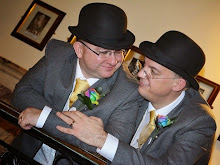
The photo isn’t even in a particularly identifiable setting, but I was born in 1970s Stockport with plenty of concrete and car parks around and clearly read ‘vaguely urban and like the places I know’ into the shot. After many years away, since I wrote the original version of this article I’ve also been living back in Stockport again – though the way back was less hard work than Blake’s. I moved back there with my husband Richard, who (unknown to each other at the time) was also watching Blake’s 7 all those years ago, and not that far away…
One of the absurd moments in Cygnus Alpha comes when, faced with the alien technological marvel of matter transmission, Blake and Avon immediately grasp it because – by an unbelievable coincidence – they had both worked on the same failed Federation “Aquatar” teleport project. “Small world.” They didn’t meet each other then. “Large project.” Not until the start of this series, with both of them on the prison ship London. I remember scoffing at two people with such different skillsets and backstories both having worked on the same useless project, never meeting, just so that years later the concept could come in so expositionarily useful in understanding technology that no-one on any world they knew had ever mastered. Absurd! A decade and a half after we each watched Blake’s 7 as boys, Richard and I found each other through our fluency in that series, Doctor Who and other tongues while I happened to be staying for a few weeks (or so I thought) in the East End. Our ‘Aquatar moment’ came not on the Liberator but on the almost as shiny and exciting Docklands Light Railway. What an absurd coincidence it would be for us to have both grown up in the same town but only to find each other in… London.
The Radio Times picture was posted by the quite extraordinary Twitter account @MakingBlakes7, which is the most brilliant continuing documentary project I’ve ever seen on Twitter. You can see that Radio Times Tweet by clicking here.
“Prisoners? New souls for the Faith.”
For this episode, it helps that it all looks rather stylish. I’ll admit that I often find something of the ‘that’ll do’ about Vere Lorrimer’s direction in his later work for the series, but here the night filming is striking and the projected backgrounds (yellow moon, forbidding citadel) as fantastic an effect as the series ever delivers. But it’s my Mum and Dad’s influence that really primed me to love Cygnus Alpha, though they’d roll their eyes at quite why. They’re both deeply religious, and I grew up going to two churches every Sunday, Catholic and Baptist. Add two competing versions of the same faith and a bright boy who read a lot, and I became steeped in religion, but at the same time asking a lot of questions and curiously open-minded about different flavours that all claimed to be the one true faith. Perhaps that’s why I was just as happy with two ‘rival’ sci-fi shows.
Doctor Who had gone through a year of dark religion that’s still to this day my favourite just before Blake’s 7 came along, and Cygnus Alpha spoke to me in just the same way. This was my world! Religion in all its scary but fascinating glory! My strange personal mix of free-thinking and immersion in dogma meant I was always more compelled by terror in the pews than Yeti in the loos. So, as much as day-after-1984 dystopia had grabbed my attention, it was Cygnus Alpha that was speaking my language and told me this was absolutely my sort of series.
“My word is law. My followers obey without question.”
For all that the Federation, like communist regimes of the time, has banned religion, Cygnus Alpha’s theocratic society is the Federation in miniature (though distinguished by a greedily ambitious figurehead rather than a faceless bureaucracy, Vargas prefiguring über-villain-to-be Servalan). The script is full of parallels between them, from the cruder version of Blake’s show-trial in this world’s “SO PERISH UNBELIEVERS” to the subtler point that, for all his cowardice, it’s Vila who’s still by nature the most wary of going along with authority, whatever form it takes – or clever juxtapositions like “the place of rebirth” and “Berthing sequence automatic”.
Perhaps the unambiguous connection of this theocracy with that already established totalitarianism is what gives the attack on religion such force. Even by the standards of science fiction using other worlds to get away with social critiques that would provoke too many complaints in a modern-day setting, this one pulls no punches (though the institutional child abuse was the Federation rather than the Faith). It’s not a case of using religious trappings to save on money or world-building, using historical window-dressing to tell a different story. One of the reasons this so appealed to little religious me was, ironically, what I’d expect to offend other believers most. It was about the ideas, not just the imagery. Underneath all the monk-like robes, the blasphemous crucifixion, the cruel crusader bust, the Inquisition torture imagery and echoing chants familiar from Gothic horror films, the script really is making a bitter attack on the very concept of organised religion.
“So you and those before you built your power on fear and ruled them with it.”

We saw back on Earth that the Administration maintain their power by surveillance and brute force, fear and drugs, suppression of ideas and the Big Lie. That mirrored totalitarian regimes of the time; now this mirror of the Federation in turn mirrors religious power. If there’s ever a daytime on this world, we don’t see it. Cygnus Alpha is symbolically in the Dark Ages, and for generations its people have been kept in the dark of ignorance. Just like Earth under the Federation, on Cygnus Alpha under the Faith you are always watched. Literally by guards in both, but where the Administration uses cameras everywhere, the Faith uses its God, explicitly invented as a tool of social control.
My husband Richard points out that the constellation of Cygnus is also known as the Northern Cross: both a religious allusion in itself and a reflection of the Southern Cross which is the symbol of Australia, a striking setting for a theocratic space-Botany Bay.
This mini-Australian mini-Federation doesn’t just swipe at religion in general but, true to its Gothic trappings, is as specifically anti-Catholic as any fevered Gothic text. It’s not just taking the fear of an invented death for the fear of an invented hell and proclaiming that the Faith is your only salvation. The Saruman-like hand is one of the production’s few symbols that isn’t obviously Christian, perhaps deliberately to make you focus on a fictional symbol and not on the words and their meaning: “Only from this hand comes life” coupled with a priest handing you a small, round, white thing to swallow that claims to be salvation but is in fact nothing at all? Could it get any more blatant? To look at the “life” held out and see a Trebor mint is to miss the point, but perhaps the very cheapness and obvious solution helps distract and avert complaints. Later dystopia V For Vendetta offered one poisonously satirical communion wafer, but this is a gob-smacking polemic against the whole idea of transubstantiation.
And the Curse of Cygnus (a near-homophone for ‘sickness’) catechised as divine punishment on every wretched inhabitant of Cygnus Alpha – all deserving it as either criminals in their previous life or descended from offenders by birth – from which they can only be saved through the Faith? That’s Original.
After this story’s impact, there’s no real follow-up to the theme; Blake’s 7 is never this savagely critical of religion again. It’s background colour in a few more stories, but they don’t have anything that feels so real. Cygnus Alpha does act as a prototype for more generic Blake’s 7 stories, such as generally the Liberator turning up at a planet of the week and bringing down the regime (or, in this case, leaving it in chaos and having to run away) or more particularly the primitive planet with a primitive people and a twist about something more advanced, usually involving a quarry and a more interesting B-plot in which the crew bitch at each other. Modern BBC sci-fi watchers might call that the ‘Utopia style’, though Russell T Davies’ Blake’s 7 homage brought an altogether rougher beast for its second coming. Perhaps the real thematic legacy of this episode isn’t equating the fierce religion of Cygnus Alpha with the totalitarianism of the Federation, though. Fittingly for my own complicated view of religion as both good and bad, there’s a parable here that’s closer to home.
“The architectural style is early maniac.”
These days I wonder if the whole thing’s not a great big warning about Blake.

If aged six, getting into the series, Cygnus Alpha confirmed that it was my sort of show, I was delighted by how it grew when watching the whole TV series right through again in 2014, aged forty-two. It wasn’t an episode I often chose to watch when I felt like a bit of Blake’s 7 (though I always loved it more than I expected when I did), but I’d thought it was one of the ones I had the clearest picture of in my head: the end of the beginning, fabulous Pamela Salem and Brian Blessed, evil religion plot with a different tone to the rest of the show, entertaining but a bit cheesy. It may well be all those things, but with a more critical brain and knowing the show well enough to put the whole thing in context, I suddenly felt there was a lot more to it.
Blake’s the hero and Vargas is the villain, so they must be opposites, right? Except that it doesn’t play that way at all. If the society of Cygnus Alpha is a mirror of the Federation, the extent to which its leader was not a contrast to but an explicit counterpart to Blake seems so striking that it’s hard not to see it as deliberate (with all the implicit consequences should Blake ever get into power that that entails). Blake getting a messiah complex in Series Two? This story more than any other reads like he’s been off on one since the beginning. Vargas and Blake face off, Brian Blessed and Gareth Thomas with similar intensity, their demands incompatible because the two of them both want the same thing: souls as currency to spread their belief, the power of their word, across the galaxy. Blake takes up his special handgun for the first time; the first to use it? Vargas. Avon’s warning to Jenna about Blake? “He’s a crusader.” Vargas rules by the Big Lie and forced ‘conversion’; Blake tells his followers they have a free choice, but keeps the truth from his first, sceptical disciples (“Did you see anything while you were down there?” “Not much”) and like Vargas gives the next batch of converts the choice of his way or death:
“Only from this hand comes life.”Three different characters this week all state that the prisoners have no choice, and in the end they don’t – whoever they follow, they’re still going to be followers.
Back on the London, Blake was willing to sacrifice himself so that his followers might live. Now we see the flip-side of that: if you’re not with him, you’re against him. He’s come to find new converts, but when they deny him in fear of the rival Faith, he rages at them instead: “You’re pathetic! …slaves! …I’m better off without you.” For all his rhetoric of freedom, Blake demands a positive choice to follow him – a leap of faith. Offering salvation to his own followers is one thing, but rather than sacrifice his messianic ideals he’ll let everyone else die. Vargas and Kara had watched the Liberator in the sky – a light in the darkness. They called it a sign, and it’s a guiding star heralding the new messiah, but we all know who that is, and it’s not the Blessed One whose hard certainty will be driving death after death in this series.
“A little more practice, we should be able to put you down with precision.”

In the context of the whole series, Avon’s appeal to Jenna that Blake would only use all the ship’s treasures to fight the Federation – though it turns out that Blake is never bright enough to realise how effective wealth would be as a weapon, and Avon is bright enough never to tell him – seems like foreshadowing.
“And he can’t win. You know he can’t win. What do you want to be – rich, or dead?”From almost the very beginning, you can see in hindsight warnings, prefigurings, fetches of much later events in the series, and perhaps it’s appropriate that this religious episode seems the most prophetic. Avon even aims his gun at Blake first chance he gets (though it’s only once he’s become a believer that he’ll fire). But Avon needn’t have been foresighted enough to see Blake coming down the road. I realise this time that he could just have watched where Blake’s been, already fighting to the last drop of their blood. Consider…
- Blake’s first rebellion, the series’ backstory: everyone else gets killed and he has his brain knackered.
- Blake’s second rebellion, the series’ opening: he only has to turn up out of vague interest and everyone else is massacred (while several children have their brains knackered).
- Blake’s third rebellion, last week: everyone’s rounded up and several of them get shot though, remarkably, most of them live. In chains.
- This week, Blake’s fourth rebellion: they’re only up against knives and knuckles on Cygnus Alpha, but he still manages to be one of only three survivors who leg it.
- Never mind the “Curse of Cygnus”; Blake is such a jinx that he only has to express a passing interest in a particular rebellion and 99% of them will die. On which subject, tune in next week…
“It didn’t answer any of your questions. More than that – it deliberately ignored them.”
There may be a certain irony in my having gradually given up belief in religion but gained a passion for politics in my teens, but I remain a free-thinker and just as ready to question my leaders as I was scriptures, and unlike Blake I’m more than wary of imposing my beliefs on others. For me, there was nothing like seeing how two competing church hierarchies that theoretically professed the same beliefs were both much more obsessed with control of individuals than individual belief to tip my own beliefs towards Liberal individualism, if not a hint of anarchism in observing that the best way to kill a belief is to set up a rigid structure to enforce it.
Though I wrestled with the theology for years afterwards, it was perhaps inevitably a confrontation with church authority which precipitated my eventual teenage crisis with religion. The surprise might be that it turned out to be with the smaller ‘free’ church rather than the more top-down hierarchy; the ‘Cygnus Alpha’ Baptists rather than the ‘Federation’ of Catholicism. Aged eighteen, I was teaching Sunday School for the kids; one Sunday I came in with a noticeable bruise and, asked what had happened by one boy, replied with the truth: I’d been walking down the road with my boyfriend and someone had hit us. The next week I found I wasn’t teaching Sunday School any more and that a tight-lipped “You know why” was the only explanation. My own moment of liberation came in realising not my fear, but theirs in their own repression; that they couldn’t bring themselves to talk to me, nor even do what a decent human being would do and ask if I was all right after I’d been attacked. The truth shall set you free, indeed, but not in the way they or I had expected it. That was the moment I lost all respect for that particular church because, after all, what was there to respect? And, fortunately, it wasn’t such a long walk back.
“That would have been very disarming if I didn’t know that you meant it.”

Zen and Jenna offer an intriguing alternative here, both a different angle on (explicitly non-Christian) religion and on what the series might have been had each of them kept such significant roles. How much does each affect the other when enigmatic ship’s computer Zen gets into its new pilot’s head? Jenna’s “to be completely known. It’s like – innocence” is more like a revealed religious experience than anything else in the episode, and without it, would she have hesitated to head off with Avon? Zen is characterised as a superior and evasive oracle with less obvious reactions – except one – but, taking its name and the ship’s from Jenna’s thoughts, does it make itself in her image?
“Wisdom must be gathered; it cannot be given.”Zen is a very different religious text to the certainties of Vargas and Blake, but how much of Zen’s resistance to direct is inspired by its pilot’s resistance to being dominated, as “the Liberator” it plucks from her desires suggests?
The best piece of bitching among the crew is an understated one from Zen, as it says in turn to the three of them:
“Welcome, Jenna Stannis.”It’s a masterclass in how to be an oracle while making it absolutely bleedin’ obvious what you think; Avon only gets a neutral reply when he prompts it. Clearly, it’s read his mind last week and Jenna’s here and decided it’s not going to like him well before he starts saying it’s “just a machine”. It’s a shame that Zen’s telepathy is lost to another crewmember long before it loses prime spot as ‘bitchy super-computer’. The series also swiftly drops this week’s attempts to pretend they know what they’re talking about on scientific ideas – Aquatar, negative hyperspace, the anti-matter interface – which is no great loss. It feels much more Blake’s 7 when the crew don’t know what they’re talking about, like Blake stumbling on using the teleport because he’s not used to it.
“Welcome, Roj Blake.”
That is all.
I do feel a little wistful about some of the other interpersonal dynamics that the story appears to set up: judging by Cygnus Alpha, there are now going to be three charismatic leads setting the direction, Jenna being the swing vote, with willingly violent killer Gan and his little friend Vila as wild cards, but it doesn’t work out that way… You can see here that Jenna has so much potential. Blake’s 7 began broadcast just as Star Wars first opened in Britain, so it’ll take a while for the film to start having any impact on the series, but compare and contrast even from the first the clean versus the dirty-handed rebels. One of this series’ great lost opportunities is still that its ‘Han Solo’ is a woman – which may be why she gets elbowed out of the way. But, still to come, Blake’s 7’s ‘Tarkin’ figure will be a woman too – and once she appears, their ‘Darth Vader’-equivalent won’t stand a chance.
“You’re a free man.”
In 2014 I watched Blake’s 7 right through with my beloved Richard. But much as we enjoyed the series all over again, we’ll always remember 2014 for something much more significant to our lives together. We went back, not to the Dome – there’s one just across the river from our flat in London – but to Stockport. On our twentieth anniversary together, we got married at Stockport Town Hall.
I’d say that this was my personal triumph of freedom over dark religion, but freedom won for me so long ago that religion was barely a footnote. Though I still find stories powerful when they make strong use of religion, for good or ill, it’s only as I write this that I realise Stockport Baptist Church is a couple of minutes’ walk from the Town Hall. It’s not something that crossed my mind on the day (though I probably quoted Blake’s 7 at some point). When we made the most important decision of our lives, we were surrounded by believers in several kinds of politics and faiths and in none, including my very proud and happy Mum and Dad, but we chose each other and we chose all the people we invited for love and belief in ourselves.
The Apocrypha: Trevor Hoyle’s Blake’s 7
“Hands reached up and pushed back the cowl to reveal Kara’s evil, haunting beauty – a face that was disfigured by a kind of lustful greed… a smile that was rapturous and yet somehow obscene…”

There’s another alternative world of Blake’s 7, and of Cygnus Alpha. I was already a voracious reader when Blake’s 7 turned up, but though my memories of Cygnus Alpha are thoroughly entangled in Trevor Hoyle’s first Blake’s 7 novelisation (like the first VHS release, compressing the first four episodes), I didn’t return to it as nearly often as Target’s Doctor Who range. Wondering why, I accompanied my 2014 rewatch by buying the audiobook versions, with this part now read by Paul Darrow… And, yes, I can understand why; Hoyle’s writing style tries to be hard-boiled and usually just about hits pedestrian. The CD readers liven him up, but the main interest is the differences from the TV versions – it seems that the first book is from early drafts of the scripts, and without having seen most of the actors, while the Liberator is described backwards. My guess is that these are unadulterated script writer Terry Nation, before script editor Chris Boucher came along; there are notably fewer sharp one-liners and a much smaller part for Avon. The biggest point of interest, unexpectedly, may be his take on Time Squad, for a very different backstory to both Gan and the assassins (though Zen is far less intriguing); the biggest wasted opportunity that Hoyle seems to stick too rigidly to the scripts rather than, say, establishing Arco and Selman with roles in the London rebellion now the actors don’t need paying for an extra episode.
The very ’70s stylistic tic that most sticks out today, though, is that suddenly we’re plunged into an alternate version of Blake’s 7 where (speaking of adultery) every woman is there to be leered at. Men get sexually neutral or ugly descriptions – let’s hope he’d not seen poor Michael Keating when Vila’s a “gargoyle” – but every woman is objectified at length and, if they’re baaad girls, all the more titillating! I suspect this may have put me off when I was a boy, but hearing Gareth Thomas and Paul Darrow having to read all this first made me wince, then laugh. Though I’ll give Hoyle the benefit of the doubt that there’s an earlier Gareth Thomas series in-joke in there, I did actually laugh aloud as Paul Darrow purred:
“Avon casually looked round and then sat up straight, his eyes popping out of his head. His first thought was to wonder how a beautiful and sexy star maiden had managed to get aboard the Liberator and it took all of ten seconds to realise that it was Jenna, attired in the most magnificent – and rather revealing – space-age costume.”Or, ‘Why, Miss Jenna, you’re beautiful!’
Avon follows this by swallowing in “goggling admiration” and “real appreciation”, her with “impish seductiveness” as she’s “coyly” “posing for him”. Later, Cally will be a “young”, “stunning-attractive girl”, “incredibly beautiful”, “athletically supple”, and Blake will be unable to fathom why a “beautiful girl” should be wearing combat gear. Dear [ Blessed ]GOD![ /Blessed ] She will also have amazing eyes the like of which Blake has never seen but which the author won’t describe, so they might boggle out on springs for all we know. At least Blake won’t actually ask her what she’s doing in a place like this.
But where Hoyle really gets excited is the female villains, who are beautiful – but evil, but sexy – but evil! What a mix. And a minx.
“His companion turned towards him… and in the flickering firelight it was a face of evil, the lips twisted in a rapacious snarl, yet even so with a fascinating, hypnotic beauty.Oh, put it away. The strangest thing is that the Terry Nation draft of the script forgets about her at – forgive me – the climax, and so bizarrely does Mr Hoyle. You’d think he’d have been faster to write her an unconvincing last moment than the one Chris Boucher seems to have stuck in. ‘Only the love of a good violent criminal she’s kissed once could free her from being the Sexy Nun of Evil…’
“‘New souls for the Faith,’ said Kara in a throaty whisper, her eyes alight with sly rapture.”
Paul Darrow clearly enjoys all this schlock too, as well as capturing Gareth Thomas’ intensity rather well for Blake and compensating for half Avon’s part not having been written yet with a compelling emphasis on his own character’s lines that makes his every. Word. Twice. As. Avonnn. The whole thing is hammy as hell but very entertaining, and far more so than the prose deserves.
So it’s a good job that the TV version was so absolutely perfect – not perhaps entirely perfect as a piece of television, but perfect to broadcast directly into my six-year-old world and open up a new one.
“Let’s all go! Er… No, on the other hand, let’s all stay.”

Last year I found that I couldn’t bear blogging any more. I wish I could say that, with the pressure off, I’ve been able to write plenty of articles for my own pleasure and that this is the herald of more to come. I’m sorry. I haven’t. It isn’t. So this is perhaps a coda – something I’ve not previously published, but which isn’t technically new.
Cygnus Alpha and Omega was first published in 2015 in the book Blake’s Heaven, a collection of personal perspectives on every episode of Blake’s 7. I was delighted to be a part of it and surprised I managed to write something, though that delight has since been marred by the horrible circumstances in which the book has been withdrawn and which I don’t want to think about. But with the fortieth anniversary of the series this year, I re-read my contribution and decided it was worthwhile enough not to go to waste. It’s more personal than most of my writing, and I found as I was putting it together the first time that how resonant the themes – and some of the coincidences – were to my life. Well, bits of it.
I’ve spent a ridiculous amount of time re-reading, re-watching and re-writing in tiny perfectionist polishes preparing for tonight, some of it no doubt procrastinating to avoid having to make the decision whether or not to put something else on my blog. I have. I hope you enjoy it.
I am, at least, enjoying Blake’s 7 all over again. For what it’s worth, though Cygnus Alpha has its own special place for me, my particular highlights of the series are:
- Rumours of Death
- Star One
- Sand
- The Way Back
- Terminal
- Orbit
I’m sorry this isn’t my way back to blogging. For something cheerier, you might look up another great piece of BBC sci-fi; first broadcast on TV thirty-seven years ago this week – though, like this article, it had already done the rounds in other media – I find myself thinking of The HitchHiker’s Guide to the Galaxy Episode 3. Magrathea doesn’t properly revive from its long slumber, merely turning in its sleep to put a new spin on a previous work, but that too is about religion and, for all that I know how badly everything turned out, that it’s a cosmic joke and that the new beginning isn’t going anywhere, there is a moment at the end of that episode that still moves me more than almost any other piece of television. This piece of writing is nothing like that. But I am quite fond of the crinkly bits round the edges.
Labels: Bigotry, Blake’s 7, Books, Brian Blessed, Gay, Personal, Religion, Richard, Star Wars, The Hitchhikers Guide To the Galaxy
Monday, January 02, 2017
Doctor Who 52: 07 – Ten Reasons to Watch The Rescue (SE)
Introducing Doctor Who – The Rescue…
A poor orphaned waif with a forbidding guardian, waiting to see if their ship will ever come in. The sinister figure that terrorises her while claiming to be her protector. This is Doctor Who at its most Dickensian – set on an alien world four hundred years in the future, first on TV fifty-two years ago today. Time for New Year stress and resolution in this 1965 tale that’s small but perfectly formed at the length of a 2017 episode. Maureen O’Brien debuts as the series’ first ‘new companion’, comforted by William Hartnell’s Doctor at his most delightful and menaced by Sydney Wilson’s dastardly Koquillion…
I’m anxious but excited. As chance would have it, a story from exactly fifty-two years ago marks the turning point in my Doctor Who 52. I initially started offering an exciting variety of Doctor Who stories in an idiosyncratic order to run through the year, one every week, inspired by the fifty-second anniversary in November 2015. When my health collapsed beyond even its usual state, that all juddered to a halt. I started again in November 2016, only to end up in hospital soon after. I’m still in a lot of pain, I’m still very unhappy about it, and my health has still yet to recover anywhere near pitiful Alex-normal. But not wanting to be beaten, I somehow buckled down and have now very nearly caught up to where my calendar tells me I should be (Ten Reasons and one Extra still waiting). So far, most of the blog posts I’ve published in this series have been ones that I originally wrote a year ago, which I’ve re-read, rewritten and republished as
The Rescue is available on DVD and through BBC Store. Read on here, or just press Play. If you’ve never seen it but my first few reasons to watch it entice you, then, really, press Play. And while usually I’d take the DVD over BBC Store like a shot (extras, picture quality, not seizing up and needing a restart every time you pause it…), one very good reason simply to press Play this time and one advantage BBC Store has by missing something is the DVD menu. Usually the menus on Doctor Who DVDs have a mix of tantalising moments from the story, like an ambient trailer; that’s how the main menu works here, but the Special Features sub-menu is just one continuous clip of the climax. There are some preposterous decisions elsewhere in the range, but this probably wins the ‘What were they thinking‽’ award for most random and complete spoiler. So when I say there are spoilers lower down my list this time, I mean it…

Ten Reasons To Watch The Rescue (warning: spoilers lower down the list)
1 – It’s the ideal Doctor Who for New Year.
The Rescue is a bit of a new start, but not too much. It’s not too complicated, but has a refreshing twist. It’s small and manageable both in the scale of the action and in lasting just fifty minutes across two snack-sized episodes. And even our heroes get to sleep some of it off.
While The Rescue didn’t start a new season, it was first broadcast on January 2nd, 1965, and it’s perfectly pitched for new viewers to jump on board with the new companion. We see the TARDIS materialise – literally a beacon of light throughout – before we see within, always crucial in making us appreciate that it’s bigger on the inside than the outside, and the small cast gives us much more time with all the characters. Most of all, we get to know newcomer Vicki, and we get to know the Doctor all over again. Written by original Doctor Who lead writer David Whitaker, this is quietly the series’ first relaunch. Of course, the honest New Year Doctor Who would be Resurrection of the Daleks (massive overindulgence followed by regret and resolutions that you’ll break immediately and double down instead) then The Twin Dilemma (the awful hangover)…
“We can travel anywhere and everywhere in that old box, as you call it. Regardless of space and time.”
“Then it is a time machine?”
“And if you like adventure, my dear, I can promise you an abundance of it.”
2 – Vicki is the first new companion.
…And the story goes as far as it can to make that easy on the viewers – or, rather, to make us go easy on her. When we first met the Doctor, it was through his granddaughter Susan, a mystery for her schoolteachers Ian and Barbara to follow. But Susan fell in love and out of the TARDIS in the previous story. How would the Doctor take to someone else? How would we get used to a new teenage face in the show? And what could bring her on board? She’s not another relative, and while the Doctor effectively kidnapped Ian and Barbara, that was bundled up with the role-reversal on teachers who know nothing, and not something a kinder, gentler Doctor could do to a teenage girl. The producers nearly brought on board a gutsy young freedom-fighter from the previous story, but instead chose to go quite the other way. They pull out all the stops to make us feel sorry for her and want her looked after.
Vicki seems, to begin with, much younger and less capable than Susan. Maureen O’Brien – here beginning an impressive career, though thanks to a forgotten early work of Andrew Davies’ I grew up thinking of her as an evil witch-nun – plays her with huge eyes, a waif-like form and outfit, and just enough pluck that she doesn’t make the audience wonder why on Dido she’d want an abundance of adventure after spending every scene cowering. Today Vicki is easy to read as abused or at least crushed by her multiple bereavements and oppressive semi-guardian – she’s young and full of hope that’s ever cowed, he’s dark and brooding and rains on every parade – and to see how after being adopted into a friendlier sort of family she’s going to gain the self-confidence of a cheeky teen anarchist (though inconsistent writing – or PTSD – will give her wild mood swings between the two as her stories continue).
But for now, Vicki sets a template that will often be repeated for new companions, and which I once sarcastically labelled ‘Daddy was a lord, but he’s dead now’. Her mother has died, so her father takes her away to make a new home on a colony world. But their ship crashes on the inhospitable planet Dido, so they don’t get to their new home. And then her father dies too. Not just him, but a massive explosion that takes out every other person she knows, except one. And he doesn’t like her. So there is literally no-one on this planet who loves and will look after her. She seems the most thoroughly orphaned person possible (until the show eventually takes this to extremes with Nyssa), and the Doctor and his friends spend most of the story getting to know and befriend her, so by the end of the story there can be no possible objection to her choosing – and she is very carefully given a choice and time to choose it – to leave on the TARDIS. Just to make sure we get the point that she is utterly and totally destined to be the new companion, she even introduces herself to Barbara twice. The second time spelling out her name, letter by letter.

3 – The Rescue reintroduces the Doctor too.
Even more effectively than it introduces Vicki, The Rescue gives us fresh angles on the Doctor. In a subtly reworked role that retains all of William Hartnell’s intelligence and authority but allows him to be kindlier and funnier, suddenly the Doctor twinkles. This is a great place to start for Mr Hartnell, showcasing just how versatile the Doctor could be and will be from now on – stern, affectionate, vulnerable, incisive, embarrassed, and often comic here, too. People often dismiss the youngest Doctor – the one looking like the oldest man – as a grumpy old thing, not least because when we first see him he’s terrific but not kind in running rings round his companions. He takes a while to warm or warm to, and longer to seem trustworthy. Yet I can’t think of another Doctor with more facets. This story doesn’t so much soften the Doctor’s character as give him a chance to shine in many different ways, not least as the only person who sees everything that’s going on in the story. I love Billy for his speeches and his passion, and there’s plenty of that here. At the climax of the story, he follows previous ‘courtroom’ triumphs with a stunning confrontation in a majestic Hall of Judgement. But by then he’s already charmed budding companion Vicki with his understanding, then been chuffed to bits overhearing how much she already likes and trusts him. He promises her he’ll be diplomatic… Which last about ten seconds before – though he’s the last Doctor of whom you’d expect it – he picks up a girder to use as a battering ram and determines on breaking a door down.
William Hartnell turned a powerful acting presence learned as the stern sergeants and ruthless crooks of his film career into the perversely authoritative anti-establishment Doctor… But he also had great comic timing, and his vulnerability in a character role inspired producer Verity Lambert to make him the Doctor. Both are on full display here. The show needs us to move on from Susan, but the Doctor can’t forget his granddaughter just yet; rarely do we see the Doctor so quietly hurt as when he starts to ask her to open the doors here, and falters, Barbara gently offering help instead. Before long he’s showing he’s sharp as ever to Ian, then wondering if he can get away with pretending he landed on Dido deliberately before remembering that he did it in his sleep, playfully undercutting the danger of his becoming a know-it-all. On the surface, The Rescue may be designed to repair the ensemble cast by introducing a replacement fourth member, but compare it with a year earlier and it’s not just the teenager who’s changed, nor even the Doctor’s character that’s evolved – it’s not an ensemble any more. He’s the Doctor. The ‘new companion’ makes it clear that the others are just that: his companions. If there was ever a doubt who was the star, there isn’t now.

4 – Alien Design.
This is a small, cheap story, but designer Raymond Cusick – who created the series’ first alien world – carefully chooses where to put detail that fills in a civilisation. Though his big alien beastie here isn’t a patch on his Daleks, the various stylised representations of it are fabulous. Massive carvings draw your attention from bare rock walls; pillars give shape and purpose to the Hall of Judgement, transforming it from a big empty space to the eerie, majestic heart of the story, aided by smoke and (reused but atmospheric) musique concrète. And the alien figure of Koquillion, all leering tarantula-faced bristles and tusks with the manner and mendacity of a wicked Dickensian stepfather, is decidedly creepy every time he comes to call and tell Vicki not to go far from the crashed ship, or he might not be able to protect her from his people…
5 – The Doctor’s sympathy versus Barbara’s exasperation.
One of the biggest changes in the Doctor since the series started a year before is that he’s now much more concerned for and tactile with his companions, no longer just with his departed granddaughter. In their first scene together here, the two teachers are worried; she’s noticed that the vibration of flight has ceased, meaning that for the first time, the Doctor’s slept through a landing. They rouse him and he comes to, embarrassed but charmingly tactile with his friends, pretty much giving each of them a hug, so when Barbara breaks his flow to try and tell him what’s happened, he jumps wonderfully to the wrong conclusion and clasps her hand to his breast in concern and delight. Then he’s more embarrassed when he realises what she actually meant…
“Oh, but Doctor, the trembling’s stopped.”
“Oh, my dear! I’m so glad you’re feeling better. Hmm!”
“No, not me – the Ship!”
“Oh, the— Oh, my dear, I’m so sorry.”

6 – The Doctor’s knowledge versus Ian’s exasperation.
Ian and Barbara have developed since the of the series, too. This time, everyone’s favourite Coal Hill Schoolteachers go off exploring, while the Doctor dozes in the Ship. But when they’re menaced by Koquillion, Barbara’s toppled from a cliff and Ian caught in a rock fall, the Doctor springs out to help… Only to wind Ian up by knowing considerably more than he does, despite as far as Ian is concerned having only been outside for a moment while he was out risking his neck exploring.
“Oh, there was this – thing, this repulsive thing with a – hideous face.”The Doctor gives him a quick glance up and down and tells him no bones broken, but somehow Ian doesn’t seem to mean it on thanking him for “The most thoroughgoing medical I’ve ever had.”
“With hands and feet like claws?”
“Yes, that’s it. How do you know?”
“Well, this is the planet Dido. I’ve been here before. I know them very well.”
“What?”
“They’re very friendly people.”
“Friendly?”
“Yes.”
“Oh! It wasn’t friendly to us.”
“…This thing. Was it armed?”
“No, no, it wasn’t. Wait a minute… It was carrying – some sort of – jewelled club. About so long.”
“With a big head? Resembling a spanner?”
“I don’t know why you bother to ask.”
Though the Doctor gets an exasperated moment of his own later, as the two of them clamber across a narrow rock face in the dark and then, as if that wasn’t enough to put up with, hear a roar from ahead of them. Ian sticks the torch right in the Doctor’s face.
“What was that?”
“Well, it’s not me, is it? Shine the torch down there!”
7 – Making you think about time travel (and tact) for yourself.
Charmed by the Doctor, Vicki has started to bond with Ian and Barbara, so they start to exchange confidences: Vicki about her loneliness, and the two teachers about their travels. Ian tells Vicki that their spaceship travels through time as well. Barbara tells her that they left in 1963, instantly regretting it.
“1963! But that means you’re about – five hundred and fifty years old!”The camera lingers first on Vicki calculating, then Barbara trying not to look monstrously offended – in the fragile moment of still feeling very in the wrong just after Vicki’s forgiven her – while Ian covers his mouth and chokes with laughter in the background. And all neatly reintroducing the series’ concepts, and letting the viewer go, ‘Hang on – no – that’s not right – let me work it out…’ while Babs is writhing in embarrassment and elbowing her long-term companion in the ribs, before Vicki drops another clanger on the contemporary audience, too:
“Well, yes, I – I suppose I am. Yes, it’s a way of looking at it, but I’ll try not to look at it too often.”
“They didn’t have time machines in 1963. They didn’t know anything then.”The same conversation gets one of my favourite moments in the book, similarly making us think:
“‘Oh, come on, you’re imagining things, Barbara Wright,’ Ian laughed. ‘You’re as bad as that awful little Tracey Pollock in 3B!’
‘Tracey Pollock . . .’ Barbara murmured. Coal Hill School suddenly seemed a million miles away. In fact it was a great deal further and long since buried beneath the Metropolitan Disposal Plant.”
8 – The double (or single) entendre.
Ian Chesterton at one point calls the villain “Cocky-lickin’”. I suspect it’s only that William Russell seems so sober and respectable and that Ian is written as the most reassuringly ‘straight’ of all the Doctor’s companions that he ever got away with it. It’s almost as bare-faced as one of the stories in the first ever Dr Who Annual, published the same year, being titled The Fishmen of Kandalinga. In later years The Rescue was also described by one infamous guidebook as being set on the planet “Dildo”, which I knew people were finding funny some time before I understood why. But it’s Ian Marter’s novelisation that’s mostly likely to make you gasp. It was the book he was writing just before his untimely death, and I can’t help but wonder if he inserted some passages as a gag, expecting his editor to take them out, and then the editor didn’t want to change any of his last book. Right on the first page, a character sniggers at the script’s time-reading of “sixty-nine” flying hours until they reach Dido, which was so blatant that I spotted it even as a surprisingly innocent teenager, while in Chapter 5 there’s so much manipulating of oily, lubed rings that when I re-read the novel later in life I immediately re-re-read it back again to be sure those were really the words.
9 – A very Doctor Who moral: don’t judge by appearances.
The Doctor and Ian struggle to avoid a howling Sand Beast at the cliffhanger (both episodes end with pretty much literal cliffhangers). We see a Sand Beast staring at Vicki with its big shining eyes on stalks as she innocently goes about finding shrubs to eat, then lumbering forward. And Barbara sees that too. So she seizes the crashed ship’s flare gun and runs out of the wreck to blast it in the head (which Ian Marter’s novelisation describes tastefully as a “smouldering toffee-like blob”, after cheating rather in the build-up). Its keening death wail is rather distressing for the viewer, but worse for Vicki: “Sandy” was herbivorous and her only comfort as a pet, and now this becardiganed murderer has killed him! Alien-looking doesn’t mean nasty, human-looking doesn’t mean nice, Barbara and Vicki between them have to learn both lessons, then poor Vicki is slowly brought to understand and forgive her by the Doctor listening to and trusting the orphan to make her own choices. You can see her realising how much better an alternative guardian he’d make…
10 – The two-faced guardian.
And finally, the big twist. The Rescue is sometimes described as a whodunnit, but of course the point is that it only becomes that once you know who’s done it. You don’t even think of it like that when you can see the monster Koquillion played, as always, by a man in a monster suit all the way through. The glowering Victorian authority figure, the only other survivor after the wicked alien natives killed all the crew at a feast of welcome – but somehow managed to kill all their own people in the explosion too – had murdered a crew member on the voyage and everything else was his attempt to rescue himself. Vicki was ill in her cabin and didn’t know, so he dressed in Didoi robes made from local animal skulls to menace her as Koquillion, personification and maligner of the beastly natives, setting her up as witness to Dido’s cruel, murderous and conveniently unable to answer back inhabitants for when a ship arrives from Earth to rescue them both. It’s an entertaining dual performance from Ray Barrett – double-credited behind a portmanteau pseudonym of Sydney Newman and Donald Wilson, two of Doctor Who’s co-creators – though outshone by William Hartnell. The Doctor’s been enchanting right through the story – but now he sits like a marble statue in the Hall of Judgment of a slaughtered people to wait for the killer. And while the murderer made me think of Dickens throughout, the Doctor’s intellect and the plot he unmasks reminds me of Conan Doyle’s The Norwood Builder.
There are few scenes in Doctor Who that make me sit up and pay attention so keenly as when the Doctor, not turning but eyes racing as Koquillion enters the Hall, calls for him to come in. The atmosphere’s already electric, and then – casually, conversationally, because both of them know, so there’s no need to announce it, and because that way the audience is all the more likely to go ‘What? What did he say?’ – the Doctor informs him by his real name that such robes are only for absolutely ceremonial occasions. And from then on everything about the scene is relentless.
The Doctor doesn’t shrink from the ‘alien’, but he backs away as something far more sinister – an evil man – closes in on him. A betrayer, a cruel tormenter, a genocidal mass murderer, a rotten heart of darkness. Someone who always finds the ‘other’ to blame to cover up his own foulness, who exploits the person he poses as protecting and terrifies them into siding with him, who will throw aside anyone at all for his own gain. Under the pretence, this is someone horribly familiar. Though ironically the man in a monster suit looks far more effective than the monster of the week, fans have often speculated why, in a later story, the Doctor’s visions of past monsters as part of his inner fears should include an image of Koquillion, because he wasn’t even a monster. I wonder if they’ve ever watched it.

What Else Should I Tell You About The Rescue?
I’ve always thought The Rescue a lovely little story, not quite one I’d put in my ‘best of’ countdowns but played, written and directed so neatly that I can’t help enjoying myself more every time I watch it. It was only the second William Hartnell story I ever saw – brought along by an older friend to a bootleg showing by some university club in Manchester – and it opened my eyes to how endearing a character he was. I still remember falling in love with his comedy scenes at the start, and his shy delight on overhearing Vicki talking about him. There are a couple of moments that don’t work – a monster that tries to break up the human form and really doesn’t succeed, and the Didoi being defined as another ‘Planet of the Hats’ people who all think the same way – but it’s a neatly-formed story, well-told, and gently relaunches the Doctor and the series while handling its first big change, all at the length of a modern Doctor Who episode, a rarity in the Sixties. You can buy it in a double-DVD set with the more comedy-toned The Romans which I’ve heard called, but which you sadly won’t find labelled as, ‘Veni, Vidi, Vicki’.
Ian Marter’s novelisation has a very different flavour to the TV version – where 1965’s The Rescue is a small-scale story with an innocence that’s marred by one terrible betrayal, 1987’s reworking takes place in a much more cynical universe and expands the action considerably. The rescue ship is very of its time, going from an occasional voice on the radio to scenes on an explicitly American spacecraft – a “heap of Reaganium” – whose crew are shaken by the TARDIS and snap, “Don’t press my button!” It all makes the subtext of the damage done by ‘settlers’ to Native Americans much more the text, linking it to gung-ho ’80s US military clichés and, with the author seizing on the original serial’s New Year broadcast dates, giving a bitter festive commentary on the show’s hopeful ending. Not all the humour is so black – the Tracey Pollock moment always makes me smile, and the Doctor gets several new entertaining lines, particularly an incisively bitchy comment on the villain’s story and at the TARDIS’ next destination – while Dido is given a feel of ruined grandeur and horror at the end of a civilisation well beyond the TV’s budget. The science is rather dodgy, but the main flaw for me is that the structure falls down badly in the second half; as with the innuendos, I suspect Target Books’ editor didn’t want to alter the text of Ian Marter’s final book, but when the story comes to a head and the climax is then deferred for forty pages of sub-sub-Tolkien ruins and giant beasties, it could have done with another draft. You can buy it on audiobook, read by Maureen O’Brien in a warm, intimate style, with a vulnerable Vicki and an endearingly querulous Doctor.
And, if you need one, my score:
8/10
If You Like The Rescue, Why Not Try…
The Evil of the Daleks, utterly marvellous, another script from David Whitaker, introducing the exemplar of the companion as Victorian orphan innocent of her sinister sort-of-guardian. And much more. Voyage of the Damned, another Christmas hangover with an ill-fated ship and a blatant companion audition piece, with a twist. The Ambassadors of Death, another tale of aliens who aren’t really hostile being used as cover by scheming humans. Dragonfire, a refreshing change to the timid Victorian orphan companion trope and another fearsome monster concealing something unexpected. But to stay with something short for the New Year…
The Sontaran Experiment. Another brisk two-part story set on a rocky wasteland of a world where the population’s extinct – or is it? – and we meet the survivors of a destroyed spaceship, one of whom is not what they seem, all of which is later greatly extended by an Ian Marter novelisation.
Next Time…
The Christmas hangover’s not quite over yet – but assuming I go back to finish a couple of still-tasty leftovers, and with the still bigger assumption that I manage to go on writing…
Another new companion is caught up in a whodunnit that’s not really a whodunnit and finds both that humans can be more alienating than the aliens and that stepping on board the TARDIS and leaving it all behind was only the start of her problems.
Labels: Doctor Who, Doctor Who 52, New Year, Personal, Repeats Er I Mean Special Editions, The Rescue, William Hartnell
Tuesday, December 27, 2016
Five Reasons to Listen To Home Truths – Doctor Who 52 Extra: E (SE)
Introducing Doctor Who – Home Truths…
A ghost story for Christmas featuring one of Doctor Who’s shortest-lived companions as the heartbeat of one of its most intimate and personal tales. Jean Marsh recreates Sara Kingdom for this creepy Big Finish audio two-hander (3.05 in their Companion Chronicles series) where she poses a challenge to church, state and listener simply by being there. For all that she and the visiting Night Constable scoff at fairy tales, she embodies perhaps the oldest fairytale lesson of all…
“There’s a house across the waters at Ely where an old woman tells a strange story.”

Five Reasons To Listen To Home Truths (warning: spoilers lower down the list)
1 – Sara Kingdom.
From the beginning of December 1965 to the end of January 1966 – but also from the year 4000 – Jean Marsh played Space Security Agent Sara Kingdom in Doctor Who. It may have been a short time for her character on TV, but she made an impact. Ms Marsh is possibly the Doctor Who star with the most glittering career; Agent Kingdom was a startling change from the Doctor’s other companions; and the end of her story is still talked about today, even though it’s long gone and you can no longer see it, just listen. Sara Kingdom reluctantly teamed up with William Hartnell’s Doctor and his friend Steven Taylor, after first being sent to kill them – and in a sort of shocking sort of The Apprentice twist, killing another of the Doctor’s companions to get there, who haunts her still. In many ways she seems a New Adventures companion long before her time: hard as nails; personal tragedy and betrayal; always the shadow of the Daleks and death hanging over her; but some part of her always remains, because she travelled with the Doctor. Sara died an old woman, but there’s still no time after her travels for the Doctor for more adventures. So the most obvious way to bring her back is to give her an exciting Space Security Agent adventure before she ever met the Doctor (see “Lost Story” The Destroyers, also from Big Finish). Older, sadder, gentler, Home Truths is not the obvious way to bring Sara back…

2 – Is she or isn’t she?
“Hear the old woman’s story. Then decide her fate.”Fans argue. And one of the oldest fan debates in Doctor Who is whether or not Sara Kingdom counts as a ‘real’ companion. She travelled in the TARDIS. But only for one story. But it was a very long one. But not even for all of that. But she deserves it. And so on. Or in later years, are the Doctor Who stories that begin as books or, here, CDs ‘real’ stories? To ask the question is to miss something about stories, for me, and while I make lists and write about esoteric story points too, those two questions aren’t ones that engage me, so perhaps I’m predisposed to take one side within this story. Because Home Truths itself takes such questions and ambiguities and weaves a story out of the very criticisms that people are bound to come up with before they’ve even heard it.
So the story starts with Robert the Night Constable, the sceptical listener, arriving with the intention of judging Sara, not of enjoying her company. Jean Marsh is enchanting as she tells her story for him, remembering pain and excitement long ago, gently sparring with him as he concentrates on finding fault. Home Truths has much in common with Ghost Light, though with a very different feel in its sparse settings, adrift from any one time: the stories are confined within a house; there’s a hint of M R James, with a religious scientist investigating the unknown; and like the ultimate villain in Ghost Light and like the fans this story is challenging, Robert has a list of categories that count and, because she doesn’t fit into them, he can’t accept her. It’s not real if you can’t see it. Can he, and the sort of fans who police the list, give her a chance by listening? And so their frame story, and the mystery found by the Doctor, Steven and Sara, and the meta-story of the listeners interweave as he questions what to him are her unreliable narrative devices, and says that he won’t allow the bits that contradict his continuity of facts, without being aware of the gaps in any of his own assumptions, the ghosts of his own superstitions, even as he unconsciously echoes the old wariness of eating ‘fairy food’. He’s putting her on trial as a danger to church and state while not really believing in the church side of his role, but you can see how although he doesn’t like the superstition built into the law, following its rigid doctrine has warped his ability to ask questions and do his job. The rules have even made science into a dogma of its own rather than akin to his sense of enquiry – which makes her real threat more to his own worldview than to his world, and all the harder for him to listen without prejudice.
“Well? What’s it going to be?”
3 – Asking questions about human nature.
The discussion between Miss Kingdom and Robert isn’t just about the people in the stories she’s telling, but about how we’re all wired – and tangentially between the two of them, both night constables of a sort, the conflict between orders and individuality, duty and empathy, and how all choices have consequences for which we must take responsibility. You have to ask questions, even if it’s hard: Sara’s original sin and Robert’s choice can’t be passed off as just obeying orders, and perfection doesn’t suit humanity. These are ideas that go to my wider political fear that utopias never have room for people who complicate things and that if you don’t count, you can’t exist, just as the story within the story speaks to inner fears of thoughtlessness (or of thoughts). And, ultimately, throughout this poignant tale, Miss Kingdom in Jean Marsh’s beautiful voice is the soul of it all, someone with reason to empathise with murderers who don’t really wish to be murderers, and in reaching out to them, might save herself.
4 – Opening up more stories.
Sara Kingdom’s original story, The Daleks’ Master Plan, was Doctor Who’s longest TV adventure (subject, naturally, to debate). So it’s a cheeky ambition for Home Truths to put another story into the middle of it and open it out to be even longer, with a promise of more in there still. Author Simon Guerrier’s Doctor Who writing keeps coming back to William Hartnell’s Doctor, captured here in many facets – loving to explore, treating his companions as children but like a mischievous child himself, irritable when made to look foolish but almost serene at the end – and for Big Finish he’s created several rather marvellous adventures for the Doctor and neglected companions Sara and Steven (Peter Purves). Home Truths itself has two sequels (though not necessarily in that order), The Drowned World and The Guardian of the Solar System.
While the events of Home Truths are resolved as far as the Doctor, Steven and Sara’s travels go, not only is the story of Sara and Robert left unresolved, but the hints of the world they inhabit fire the imagination. It’s far in the future, but after war, flood and disasters we can only guess at. What might have caused the downfall of the civilisation after next? And how did another rise, seeing A Canticle for Leibowitz through a crooked glass, in the stern dogma of strictly defined church and science, though tantalisingly neither defined for the listener? Is this strangely past-future even Earth, or have names been carried over the stars like Robert across the fens? And why is he a Night Constable? Does this world ever see the light? Miss Kingdom herself tells Robert that she has a hundred stories to tell about the people who have stayed with her – though he’s deliberately asked to hear one he doesn’t believe. It’s no wonder that her conversation with him has more than a hint of Scheherazade, and the whole thing a sense of The Twilight Zone (a series in which Jean Marsh herself starred in another lonely two-handed psychological horror story / psychological character study).
5 – This creeps me out more personally than any other Doctor Who story.
“The corridor in which the woman lay led to a wide staircase, littered with flowers and paper-wrapped gifts. The Doctor examined the labels: they were wedding presents for Richard and Alex.”Did you ever think idly how gratifying it might be to find yourself in Doctor Who, in whatever small way? I imagine I did. As the fairy tales warn us, be careful what you wish for.
Home Truths author Simon Guerrier is a friend of ours and gave us a wedding present. Nothing of Home Truths, though, which is perhaps for the best (his lines that we weaved into our wedding reading weren’t from here, either). My husband is a careful driver, and the only time I can remember him swerving the car in shock was on a dark and stormy night coming up to Christmas 2008 and driving up to see our parents. The story is quite creepy enough, with the mysteriously, suddenly dead bodies of two newlyweds in their ideal home. We were already feeling for them, and then Sara Kingdom told us their names in track seven. Thanks, Simon. Of course, they’re not a perfect match: Simon’s been to our place and knows it is not in all honesty uncannily pristine; Alex has been gender-swapped (thinking about it, the story itself might have a trans character, from a certain point of view).

What Else Should I Tell You About Home Truths?
You can buy it on CD or download from Big Finish Productions here.
This is where I often mention things other fans don’t like about a story and turn them on their head, but I’m not as familiar with reviews for extra-televisual Doctor Who. So my contrary view on Home Truths is that the opening mystery and the aftermath are both brilliant, but some of what would ordinarily be the climax (to the ‘old’ story, at least) doesn’t engage me as much, though it captures the Doctor well and I can see how it’s a necessary bridge. Perhaps it’s just because in some ways it’s an extended ‘action’ sequence, which despite being a harrowing moment for Sara, those are always less effective on the radio, and though she has to ‘earn’ the resolution, I can see it coming and am impatient to get there once I think I know the answer (one of them, anyway).
Simon Guerrier is also the author, with Dr Marek Kukula, of a less fictional book on The Scientific Secrets of Doctor Who. A lot of people who don’t review his stories have nevertheless found this fascinating, so you might still find him popping up on the radio or at your local library to talk about Doctor Who and science and things, and he’s always worth listening to (and questioning). Whatever you think of this pair’s scientific views, at least they don’t wield them with the authority to unperson you if you disagree.
And, if you need one, my score:
8/10
If You Like Home Truths, Why Not Try…
More Sara Kingdom: The Daleks’ Master Plan. This is a thrilling epic from 1965-66, including in the middle Doctor Who’s first ever Christmas special episode (which isn’t very M R James at all). Unfortunately the BBC burnt most of it, but you can buy the whole soundtrack on CD, and see the three complete surviving episodes on the Lost In Time DVD set. You might also look out for Reconstructions online, which combine the soundtrack with photos to make the missing episodes easier to follow. I recommend Simon Guerrier’s sequels to Home Truths, too, and just this month he has a new Early Adventure out from Big Finish where the Doctor, Sara and Steven face the Sontarans as played by Dan “Strax” Starkey, bringing together some of the oldest and newest Doctor Who.
For more Jean Marsh, there’s the 1965 historical adventure The Crusade (for which most of the same limitations apply), and 1989’s Battlefield (all of which, thankfully, you can see on DVD or download from BBC Store). Ms Marsh plays different characters in all three stories, though all three have complicated relationships with their brothers – see especially her soliloquy at the end of Battlefield, her coldness in the middle of The Daleks’ Master Plan and a terrific The Crusade scene in which she tears strips off Julian Glover.
Labels: Big Finish, Doctor Who, Doctor Who 52, Fandom, Home Truths, Personal, Repeats Er I Mean Special Editions, William Hartnell
Friday, December 23, 2016
Five Reasons to Read Doctor Who and the Auton Invasion – Doctor Who 52 Extra: D (SE)
Introducing Doctor Who and the Auton Invasion…
Shop window dummies that come to life, the Doctor given a new ‘family’ on Earth and a touch of bitchy soap opera… No wonder this was such an influence on Russell T Davies that he wrote the introduction for the new edition. Terrance Dicks’ first book novelises the thrilling TV story Spearhead From Space, making it more thrilling still from the title on through – one of the best Doctor Who novels ever written, and creating an irresistible monster that never quite made it to TV: “something between spider, crab and octopus…”
Robert Holmes’ 1970 adventure Spearhead From Space is one of the best-known Doctor Who stories – it introduced Jon Pertwee’s Doctor, the Autons and even colour to the series, was among the first to be released in video, DVD and book form, and with its mixture of action, horror, comedy and really aggressive department store sales windows, inspired 2005’s even more radical relaunch, Rose. It was first broadcast before I was born, so I grew up loving the Third Doctor’s adventures in their Target Books adaptations, and only caught up with the TV versions on VHS about two decades after transmission. The Pertwee books are arguably Target’s golden age; the TV originals rarely matched the pictures the novels had conjured in my head. I still think of this as the ‘Pertwee gap’ where this Doctor’s novelisations far outstripped his TV stories, and Spearhead From Space, too, gains a great deal by becoming The Auton Invasion… But in this case, it doesn’t mean that Spearhead From Space is a disappointment. It’s one of my favourite TV Doctor Who stories. The first two books Target commissioned were for me the two best Third Doctor stories, and they made them better still. The Pertwee gap here means that The Auton Invasion is simply fantastic.
These days you might call The Auton Invasion and some of those other remarkable Target novels as Special Editions… And as this is another of those pieces I first wrote last year and, after admittedly not quite as dramatic a health crisis as the Doctor has here, they then trailed off a few down the line, you might think of this a Special Edition of sorts, too. Just not quite as Special as Terrance’s.

Five Reasons To Read – or Listen To – Doctor Who and the Auton Invasion (warning: spoilers lower down the list)
1 – The Nightmarish Nestene.
If you see this story on TV, you remember the Autons. If you read the book, you imagine the Nestene. You might say this is a spoiler to start with, save for it being on the cover and difficult to miss (and not just on Chris Achilleos’ original 1974 cover, either)…
“Standing towering over them was the most nightmarish creature Liz had ever seen. A huge, many-tentacled monster something between spider, crab and octopus. The nutrient fluids from the tank were still streaming down its sides. At the front of its glistening body a single huge eye glared at them, blazing with alien intelligence and hatred.”Much of Terrance Dicks’ book description simplifies: the not-meteorite energy units are green spheres rather than complex polyhedrons; the factory receptionist expressionlessly doll-like; the walking dummy Autons much more blank. It’s effective. The repeated emphasis on Autons looking like half-finished waxworks, or having an enormous but peculiarly horrible hand – “It was completely smooth and white, and there were no fingernails” – that drops away to fire sizzling bolts of energy from the empty wrist instantly conjure mental images without complicated detail. The exception is deep within the factory that builds the Autons, where a body is growing to house the controlling majority of the Nestene Consciousness, the group mind animating all the living plastic for the invasion. The book teases this repeatedly to build anticipation, most effectively at the close of Chapter 6, where the Autons become more threatening yet and a series of short, understated sentences at the end give closure to an earlier attack. The audiobook version has much less in the way of music and sound effects than later Target CDs, but both steady narration by Caroline John (fabulous scientist Dr Liz Shaw on TV) and a strange alien glugging sound build up particularly eerily there too.
The book climaxes with the Doctor and Liz Shaw reaching the heart of the factory, where something enormous heaves, seethes and bubbles in a great tank (which the fascinated Doctor walks round “as if contemplating a swim in it”). On TV, a few limp tentacles emerge – then, in the sequel a year later, just a fuzzy video effect – without being entirely convincing. In the book, there’s no disappointment when the whole side of the tank shatters open and the “huge, many-tentacled monster something between spider, crab and octopus” rears unforgettably into our imaginations.
Where the cover paintings of most Doctor Who novelisations take pictures from the TV show as their model, Terrance Dicks’ Nestene created not just a nightmare but a challenge impossible for many artists to resist. Chris Achilleos paints one lurking on the cover, then gives it much more detail in a starring eruption as the finale to his internal illustrations, followed by other artists competing with further editions. The first sequel, Terror of the Autons, took similarly vivid descriptions from Terrance and let Peter Brookes’ imagination soar into a comic-book Cthulhoid horror that wraps its way around the front of the book, with Alan Willow having a go of his own inside the pages – then the second edition boasted Alun Hood’s horribly photo-realistic glaring eye, writhing tentacle and ickily teeth-like suckers. Even the back cover excitedly talks up
“a malignant, squid-like monster of cosmic proportions and indescribably hideous appearance.”And yet Terrance’s description provides what’s still the most unforgettable mental image of all the Target books, inspiring artist after artist and proving that however powerful the design in front of your eyes, the most memorable horrors remain the ones you imagine.

2 – All Doctors Are Gits.
The Doctor and the Autons both look human, but the book goes to even greater lengths than the TV version to emphasise that neither really is – from the very first, poacher Sam Seeley sees both the ‘meteorites’ and the Doctor landing, and it’s the Doctor that frightens him more. But that’s not my favourite parallel for the Doctor here. The comatose Doctor is brought in to the local cottage hospital, and suddenly the story has a sort of fun that’s rarely found in Twentieth-Century Who. It’s no surprise to have tea and bullying bosses as signatures of normality, but when there’s so much more than those on top you begin to remember that Terrance had written soap opera, too. The original script had plenty of hospital scenes, but the book expands them with full-on soap gossip, rivalries, and everybody on the make (just like Sam, a doomed businessman and even an army corporal later in the book).
A nurse gets the worst of it to start with, trembling at Dr Henderson’s sharp tongue when he shrieks with anger over the two hearts on the Doctor’s X-ray, then when Henderson’s “old enemy” Dr Lomax in Pathology rings to complain too, she “almost dropped the ’phone from pure terror”. In just a few pages, Terrance sketches in a history of bullying medical horrors, with Caroline John’s reading on CD making it all even more entertaining. But that’s nothing to when the hospital’s senior Surgical Consultant Mr Beavis shows up with his “high-handed, lordly manner” that terrifies even the doctors – not least our own favourite one, when he overhears that Beavis regards him as “some kind of interesting freak. Probably plans to open him up and sort out his innards for him.” Which rather reminds me of some of the more careless consultants not just when I was hospitalised this very month but also and still more disturbingly hack-happily in 2014, so it serves him right when the Doctor nicks his car to get away. If it came to it, I might have legged it too.
I always wonder, though – are we being lulled into liking the new Doctor because every other doctor in this is a total git or a complete monster? Or are we being warned by implication that this Doctor’s imprinted on them just after rebirth and thinks doctors ought to be arrogant workplace bullies?

3 – Terrance Dicks.
One of Doctor Who’s most significant writers, Terrance Dicks wrote several TV stories and was the show’s script editor (similar to today’s lead writer) for five years, but it’s with Doctor Who and the Auton Invasion that his even greater role began: he went on to write nearly half the Target novelisations – and hundreds of books altogether.
Terrance’s first novel is still for me his best. He puts in enormous creativity, and you can see immediately that he’s a natural prose as well as script writer – people often talk about his ‘deceptively easy’ style, but I’ve read an awful lot of Doctor Who authors and few of the others manage Terrance’s ‘effortless’ flow even when trying for all they’re worth. His style’s all the more effective for having plenty of action and humour, but understating both. Crisp, dry and with deft touches of horror and sketched-in one-line character backgrounds to help us empathise (often immediately before they’re blasted down), he’s aware that he’s writing in part for children but is never patronising, though occasionally simplifying, such as calling the more advanced doppelgänger Autons “Replicas” rather than “facsimiles” (it would be another decade before the term facsimile would be in common use, but even then associated with sinisterly smooth businessmen who want to take over the world). He’s responsible for generations finding how exciting reading can be.
One of Terrance’s best-known devices is his use of simple, memorable descriptions – and reusing them. Chapter 6 contrasts a comedy car sequence with a very different action-based one, and here we get the first but not the last outing in one of Terrance’s books of a soldier emptying a full clip of bullets into a monster, plainly seeing a line of holes appearing across its chest – but there’s no blood, and the thing just keeps on coming (Terrance considerately also has the man recognise that it’s not human, to reassure us that the army don’t just fill you full of lead when spooked). The Doctor’s driving, by contrast, is already ridiculously accomplished and appalling for the passengers. But it’s not just set pieces like those that recur, but phrases: fanatical alien villains are already “exultant”; doomed characters already stare “in horrified fascination” or react “with unbelieving horror”; multiple ‘Doctor who?’ puns even come with in-character laugh-tracks. All these will become very familiar, though he’s not yet settled into a pattern of short, punchy chapters each ending in their own mini-cliffhanger: compared to the rest, the final chapter is enormous and would make at least three in one of his later books. But his most famous description is here, when the TARDIS materialises right back in Chapter 1:
“…a strange wheezing and groaning filled the air.”

4 – The Auton Invasion.
You can probably tell from the title where the book’s heading, and it’s a stunning tour-de-force. Like the similarly outstanding Remembrance of the Daleks novelisation, it makes even the series’ most thrilling action sequences seem broader, bigger-budget, and more compelling. Auton dummies coming to life behind high street windows is such a vivid image that it relaunched Doctor Who twice on TV – as well as being remade in multiple pop videos and even Pringles ads – but for me the one that still most enthralls me is on the page.
The Doctor and Liz have worked through the night on a device that could disrupt the Nestenes, but in the London dawn the city is coming to life in more than the ordinary way:
“Soon a normal, bustling London day would be in full swing. But this day, in London, and in cities all over the country, was to be like no other. This was the morning of the Auton invasion.One street and one copper draw us in, but the action telescopes swiftly out to the whole country. Autons blast people down in the streets of every major city; the police are overwhelmed by thousands of calls; it’s so serious that Terrance even mentions ITV as well as the BBC issuing urgent warnings to stay inside and barricade your home, before Autons destroy transmitters along with phone exchanges and fire stations. But the really effective part is when he widens the scope to full-on fifth columnist paranoia, with every response going wrong as ministers and senior officers give confusing or deliberately damaging orders – before their hands drop away to reveal Auton guns. It’s leavened by a few scattered examples of ‘hope in the ordinary people’s pluck and bravery’, but for the most part the invasion is pages of grim despair:
“In the shop windows and in the department stores the mannequins stood waiting. A policeman patrolling along Oxford Street cast a casual eye at the window display in one of the big stores. A group of window dummies, dressed in bright, casual sports clothes, sat under a beach umbrella in a cheerful seaside setting. The policeman thought longingly of his own holidays. Only another two weeks… As he passed on his way the mannequins posing round the table stirred and came to life. Jerkily at first, they rose from their beach chairs and rugs. The tallest raised its hand in a pointing gesture. The hand dropped away on its hinge to reveal a gun nozzle.”
“Chaos… panic… confusion… Then, one by one, the outside ’phones went dead.”

5 – Where Do Autons Come From? …Actually, I wish you’d not told me.
“And Channing smiled a terrible smile.”The book’s main villain is “Channing”, the new partner at a plastics factory. On TV the guest star makes him eerie and detached, perfectly alien. Here he’s an unnaturally smooth businessman, immaculately dressed, with regular, handsome features, utterly bland until he looks at you with those blazing eyes – as if he’s empty but for an animating will inside him. Like a waxwork come to life, the book suggests, or like Tony Blair with Margaret Thatcher’s eyes. He spends the novel dominating factory manager Hibbert with his alien will and revering the thing in the tank that is to come after him. And however terrific the Auton Invasion itself, for me the most gripping moment in the book is the revelation when Hibbert finally manages to free his mind enough to ask him a question…
“‘But what’s going to happen to us—to Man?’ The full horror of it suddenly came over Hibbert. ‘You’ll destroy us.’That always gave me a thrill of horror when I was a boy – and others, too. Russell T Davies’ lovely Introduction to the 2011 edition not only talks about meeting his first fan through Target books (though his “doomed to never marry” shows how far we’ve come already since), confesses to childhood theft and praises Sir Terrance, as he should be, but picks that same line as the one that gave him chills and thrills. Can you spot the lines in Rose that came directly from this book, rather than the TV version? A young Alan Moore uses the same terror at the heart of his Auton tale Business As Usual (pairing him with Alan Davis before V For Vendetta). And the Terrance turns of phrase that I’m willing to bet stuck in a young JK Rowling’s head aren’t just stock descriptions like Professor Flitwick’s Pertwee-like “shock of white hair”; at the climax of Harry Potter and the Goblet of Fire, Voldemort, too, smiles a terrible smile…
“Channing’s voice was soothing. ‘Not you, Hibbert. You are our ally. You have helped us.’
Hibbert said dully: ‘And you… you’re not human.’
“‘I am part of the whole, Hibbert. Nestenes have no individual existence. This body is merely a container, Hibbert. You should know that. You made me.’
“And Channing smiled a terrible smile.”

What Else Should I Tell You About Doctor Who and the Auton Invasion?
You can probably tell that I’d put this in my two or three favourite Target novels, and often still simply my favourite of the lot. But it isn’t entirely perfect. This was the book that introduced me to Dr Liz Shaw. When I was a boy, I loved the way she, the Brigadier and the Doctor worked together. Like Polly, Ben and Jamie and Barbara, Ian and Susan, they’re a team from stories that were broadcast before I was born but sang off the page in the novelisations, each group a mix of men and women, but especially each with one woman who shows she’s got a brain and some gumption, who can stand up to the Doctor. They felt so utterly right and I’ve adored them ever since. And yet now I know the TV version too so well, the book is at just a slight disadvantage for each of them. The obvious is that it can’t help missing something that the actors gave it on TV. Liz still comes out of it well – well, after all that, I would say that, wouldn’t I? Lacking Caroline John’s sarky brilliance, but neatly emphasising her scientific ability and curiosity as the outsider finding her way into this weird set-up, the proof of the pudding is that I went to primary school with two Elizabeth Shaws, but I still thought this one was fantastic. Brigadier Lethbridge-Stewart’s characterisation, though, is more confused.
On TV, this is possibly Nicholas Courtney’s best performance and probably his best part as Alistair Gordon Lethbridge-Stewart, the leader of the army UNIT tasked with investigating uncanny happenings. For the first half of the story, he’s the lead, and he’s an intelligent young officer, an urbane, incisive, highly efficient professional, briskly in charge and pedeconferencing decades before it was fashionable. Terrance Dicks wrote this four years later, by which time the Brig was more a comforting fixture and never threatening to steal the show from a domineering Doctor who’d often treat him as the comic relief (though with Nick always retaining some dignity). And in the novel the Brigadier keeps switching between these two poles. He’s never quite a buffoon, but we get internal monologues about what a cushy job he’d been expecting, or his moustache bristling with military fervour when he thinks he’ll get the chance to bomb something, and he loses his own sardonic jokes as he becomes the butt of the narrator’s instead. Crucially, you can see why ambitious, modern TV Brigadier would pick Liz as a scientific adviser, but not how fuddy-duddy stereotype book Brigadier would. But then his best television scene, surrounded by journalists, comes off nearly as well with a very different treatment here, while he has stone-cold serious moments silently spotting the villain or even calmly awaiting death after running out of the machine-gun bullets he’s been blazing away with to cut Autons in two. And for a character that Terrance instinctively thinks of as cosy, it’s noticeable that four chapters out of ten begin with him tearing a strip off his captain (no wonder that one doesn’t come back). The book has a similarly contradictory attitude to the army in general, even more than the script does: on the one hand they turn out to be the Doctor’s friends and shoot up Johnny Alien; on the other, a tired, jumpy sentry shoots up Doctor Alien, too, and they’re not just problematic by human frailty – an Auton Replica hijacking the chain of command implicitly suggests soldiers are brave but too easily misused by abrogating moral responsibility to the group.
Even the most establishment Doctor here gets several anti-establishment moments, starting with a Mr Benn joke, so despite Terrance Dicks overseeing most of the Doctor’s time as UNIT’s scientific adviser, you can credit him with still pointing out that it should never be an easy fit.
And, if you need one, my score:
10/10.

If You Like Doctor Who and the Auton Invasion, Why Not Try…
More Terrance Dicks, obviously. He’s gone down an astonishing long path with Doctor Who, with scripts from 1969’s The War Games to 1994’s Shakedown – Return of the Sontarans, probably the most successful of the straight-to-video while-it’s-off-the-air spin-offs. Mainly, though, it’s other books, his own ‘original’ novels – which usually have fun with elements from his own TV scripts, though World Game playfully rewrites the Prologue of The Auton Invasion – and the legion of Target adaptations. So I’m going to pick…
Doctor Who and the Terror of the Autons. Terrance’s 1975 Auton sequel novelisation established them as Big Monsters for a generation of readers who, like me, hadn’t been born when they were on TV. This too is from a script by Robert Holmes, who Terrance has often said inspired his best books because he was simply Doctor Who’s best writer, and has nastier jokes, the Master and a much greater improvement on the TV version. I’ve previously written about it in considerable detail (and with a picture of me as a little boy, as it was something like the second book I ever bought).
Doctor Who – Made of Steel. This one’s from 2007, with David Tennant’s Doctor and the Cybermen. It’s one of Terrance’s most recent books, and the best of his original novels in about the last twenty years. Short and crisp, this “Quick Read” is hugely entertaining: Terrance does a brilliant job writing a punchy new series adventure, with a London landmark in trouble, absolutely nailing Mr Tennant’s speech and persona, borrowing its opening from the first Doctor Who story I ever saw – by Terrance – and, if you read with the right eye, giving simple but elegant put-downs along the way to both Primeval and Torchwood.
Though also see if you can find Alan Moore and David Lloyd’s Business As Usual, a 1980 Doctor Who Weekly comic strip of the nastily ironic final ‘The End, dot dot dot question mark’ kind (think Saki, or Tharg’s Future Shocks), that does a very similar little Auton plot as some kind of macabre joke.
Labels: Books, Chris Achilleos, Comics, Doctor Who, Doctor Who 52, Doctor Who and the Auton Invasion, Harry Potter, Health, Jon Pertwee, Personal, Pictures, Repeats Er I Mean Special Editions, Terrance Dicks