Wednesday, October 18, 2006
Present: One Small Blog For Me, One Giant Blog With Everyone Else
It’s coming to the end of October 17th, and I’ve drawn my diary entry together. What’ll they make of it in a hundred years? Written mostly in free flow… After seeing the ‘History Matters: Pass it on’ mass blog mentioned by Welsh Assembly Member Peter Black this morning, I’ve been looking for historical connections all over the place. Well, I say all over; I didn’t get out much today, so most of the history I encountered was of the personal kind. Next week, it’ll be Richard and my twelfth anniversary, and I spent some time online looking for more presents. Twelve years ago I’d not discovered the internet, and could barely type (today only a sore arm is slowing me down). There wasn’t a Welsh Assembly, and I’d never heard of blogging. I was rather more healthy, and probably around two-thirds my current bodymass. We were in the tired last years of a nasty, failed, illiberal government that I’d never voted for; well, not everything changes. And being without Richard is now a bizarrely alien concept. More than anything else, most of my conversations now revolve as much around ‘we’ as ‘I’, and, well, with Richard I’m in love and happy.
There are other things in life, though. I wasn’t even four years old when I first saw a terrific little Doctor Who story called The Sontaran Experiment, which (before videos) I loved to replay in my nightmares. By twelve years ago, both Richard had it on tape. This morning, after the waking-up ritual of shouting at the Today programme, we finished watching the newly-released DVD of this story. A ‘budget’ release with few extras, that still means subtitles, production notes, commentary, documentary and photo gallery; with the VHS it was just murky picture and sound. I love this tale’s sense of ‘future history’, an aside to great events implied elsewhere – the Earth’s a wasteland, the most important place in the Universe to sleeping survivors, an irrelevant legend to others. It’s 15,000AD, and everyone still argues about land. The cast look back to 1975 and remember the lead actor breaking his collarbone, so I feel a bit guilty complaining about my arm, but still visit my real doctor; by mid-morning it’s medical history instead. This year’s innovation: after consultation, booking your own hospital appointment. Better for getting the time you want, worse for having to navigate all the bureaucracy.
Back home, I put chapters into a home-made DVD of Saturday’s Robin Hood, an 800-year-old story with modern production and modern politics. Well, if modern politicians decide to dodge the rule of law by creating Guantánamo ‘outlaws’, they can hardly blame the Twelfth Century for satirising them. Last week my Dad discussed a family tale that we’re descended from another outlaw, Rob Roy; neither of us believe it. There might be MacGregors in our colourful history (Scotland, America, Yorkshire), but we only know for sure about the MacParlanes / MacParlands, so today I check online to see just how unattractive the tartan I’m entitled to wear is. Hmm. Not in a hurry.
I type a couple of blog pieces for Love and Liberty, backwards and forwards into history (my interest in the subject, forthcoming TV speculation), then give in to temptation and order the new Heaven 17 album. Ten years since their last, Bigger Than America, seem to have passed very quickly. I pop it on. ‘Designing Heaven’ and ‘We Blame Love’ are still fantastic singles, and I was still the only person on Earth who bought them. Then Richard gets home from work, I cook, and we watch two episodes of The West Wing back-to-back on DVD. We’re into the final season of this US political drama, and though we thought it had slowed down for a few years, suddenly we’re back to being desperate to find out what happens next. And unlike real history, we can rush the pace.
This wasn’t as happy an experience as I’d anticipated. Forewarned by Peter saying his entry had been rejected, I kept mine to within 4000 characters (and including spaces). It was rejected as invalid. I checked everything was correct, and resubmitted it. Same again. I shaved a bit more out of the text, and cleared my cookies, and reloaded the page. No joy. Each time, the page wipes everything, gives bright red instructions that I’ve already followed precisely, but doesn’t say which bit is read as ‘wrong’. An hour later (I first sent at 11.40), still at 3718 characters (this’ll have changed slightly for the above version and its urls), very tired and exceedingly frustrated, I’ve lost count of my attempts and have sent it by e-mail instead. But resisted the temptation to add ‘and your sodding web page doesn’t accept entries its instructions say are valid’ as an addendum to the diary entry sent to them. At this stage, I realise I failed to mention the large and chocolatey muffins I bought after visiting the doctor. In serious need of chocolate, I lunge for the surviving one now…
Also…
Past: History Matters
Future: Torchwood
There are other things in life, though. I wasn’t even four years old when I first saw a terrific little Doctor Who story called The Sontaran Experiment, which (before videos) I loved to replay in my nightmares. By twelve years ago, both Richard had it on tape. This morning, after the waking-up ritual of shouting at the Today programme, we finished watching the newly-released DVD of this story. A ‘budget’ release with few extras, that still means subtitles, production notes, commentary, documentary and photo gallery; with the VHS it was just murky picture and sound. I love this tale’s sense of ‘future history’, an aside to great events implied elsewhere – the Earth’s a wasteland, the most important place in the Universe to sleeping survivors, an irrelevant legend to others. It’s 15,000AD, and everyone still argues about land. The cast look back to 1975 and remember the lead actor breaking his collarbone, so I feel a bit guilty complaining about my arm, but still visit my real doctor; by mid-morning it’s medical history instead. This year’s innovation: after consultation, booking your own hospital appointment. Better for getting the time you want, worse for having to navigate all the bureaucracy.
Back home, I put chapters into a home-made DVD of Saturday’s Robin Hood, an 800-year-old story with modern production and modern politics. Well, if modern politicians decide to dodge the rule of law by creating Guantánamo ‘outlaws’, they can hardly blame the Twelfth Century for satirising them. Last week my Dad discussed a family tale that we’re descended from another outlaw, Rob Roy; neither of us believe it. There might be MacGregors in our colourful history (Scotland, America, Yorkshire), but we only know for sure about the MacParlanes / MacParlands, so today I check online to see just how unattractive the tartan I’m entitled to wear is. Hmm. Not in a hurry.
I type a couple of blog pieces for Love and Liberty, backwards and forwards into history (my interest in the subject, forthcoming TV speculation), then give in to temptation and order the new Heaven 17 album. Ten years since their last, Bigger Than America, seem to have passed very quickly. I pop it on. ‘Designing Heaven’ and ‘We Blame Love’ are still fantastic singles, and I was still the only person on Earth who bought them. Then Richard gets home from work, I cook, and we watch two episodes of The West Wing back-to-back on DVD. We’re into the final season of this US political drama, and though we thought it had slowed down for a few years, suddenly we’re back to being desperate to find out what happens next. And unlike real history, we can rush the pace.
This wasn’t as happy an experience as I’d anticipated. Forewarned by Peter saying his entry had been rejected, I kept mine to within 4000 characters (and including spaces). It was rejected as invalid. I checked everything was correct, and resubmitted it. Same again. I shaved a bit more out of the text, and cleared my cookies, and reloaded the page. No joy. Each time, the page wipes everything, gives bright red instructions that I’ve already followed precisely, but doesn’t say which bit is read as ‘wrong’. An hour later (I first sent at 11.40), still at 3718 characters (this’ll have changed slightly for the above version and its urls), very tired and exceedingly frustrated, I’ve lost count of my attempts and have sent it by e-mail instead. But resisted the temptation to add ‘and your sodding web page doesn’t accept entries its instructions say are valid’ as an addendum to the diary entry sent to them. At this stage, I realise I failed to mention the large and chocolatey muffins I bought after visiting the doctor. In serious need of chocolate, I lunge for the surviving one now…
Also…
Past: History Matters
Future: Torchwood
Labels: Blogs, Doctor Who, History, Music


Tuesday, October 17, 2006
Past: History Matters
I saw from Peter Black this morning that several charities have chosen today to raise awareness of history. They’re encouraging people to create ‘the biggest blog in history’ by writing about their day; everyone who says what they were doing on October 17th, 2006 will have their entry logged with the British Library as a sort of time capsule, and – by talking about the impact of history on our daily lives – help build interest and support in looking after our heritage. I’ll sign up later to ‘One Day in History’, and I’d encourage you to do the same.
Apparently every school in the country has been invited to join in (there are 29,000 of them – gosh), as well as various celebs. Good job Peter mentioned it, though, as all the other publicity had entirely passed me by. I’ve always been fascinated by history; though I didn’t study it past GCSE, I’ve often read around the subject out of sheer interest, whether it’s reading one of Conrad Russell’s books on the Civil Wars in Britain, enthusing about I, Claudius or just getting distracted on Wikipedia and spending an hour or two looking up obscure period details while quite losing track of what I’d gone there for. Of course, for anyone interested in politics a sense of history is vital. It’s a cliché to say that you should learn history’s lessons or repeat them, but it’s still true. When our world and our culture is changing so rapidly, though, it’s important to remember that history is a living thing and not just the fossil record. Know where you come from, cherish the best bits and remember the worst, but don’t hang onto them like grim death and let them prevent you going on anywhere else. Perhaps more importantly still, with so many of the world’s more intractable problems mired in history and grievances that sometimes go back centuries, in many cases the most important lesson of history isn’t who did what and who’s to blame, but that, if you can see that it’s all gone on so long and still nobody’s happy with it, perhaps it’s time to let go at last. History isn’t just the past; it’s about the future, too.
I’ve been interested in history since long before I was interested in politics, though, and perhaps a lot of one interest grew out of the other. But where did the interest in history start? I suspect it’s tied in with my love of stories, and wanting to know more than just the beginning, the middle and the end – where did these people come from, what happened to them afterwards, and how did their society fit together? Even stories where the history isn’t real have always had a greater appeal to me if they’ve had a sense that they’re telling a part of a larger story, rather than a perfunctory tale that’s made up exactly as much as is needed and not a scrap of an idea more. Perhaps that accounts for the popularity of The Lord of the Rings, a mere part of an epic imaginary worldview, or explains why I’m so fond of the Doctor Who stories by Robert Holmes, an author who not only peppered his dialogue with characterful anachronisms but often set his adventures on the fringes of great events. Even touches of imaginary history seem more real, and add greater fire to the imagination, than stories where everything is neatly laid out at the beginning and wrapped up at the end.
If you asked me to say what the perfect sort of Doctor Who story was, though, I’d say the ones set in real history but challenging what we know – perhaps it’s no surprise that my favourite of the Doctor’s companions is an archaeologist. There’s something uniquely Who-ish in the historical anachronisms of aliens or time meddlers, and there are few set-ups closer to my heart than when the Doctor travels back to a well-known period of Earth’s history, meets both exactly the sort of people we’d expect him to and some outer space people we really wouldn’t, and they all have larks together. I loved the stories that educated me about real events and tried their best to get them right, but for me an even more effective way to fire an interest in history is to give some of the real details alongside something that’s so ostentatiously fictional. In part it’s the excitement of aliens, naturally, but it’s not because they ‘liven up’ history – it’s because the historical detail whets your appetite to know more, and the out-of-kilter elements make you certain there’s more to be discovered. Tell someone a set piece of history and they’re in danger of thinking that’s all there is, but that mixed-up Doctor Who angle positively encourages asking questions. What could be a better approach for a budding historian than to want to find it out for yourself, rather than thinking history is a dead issue where you just believe everything you’re told?
Also…
Present: One Small Blog For Me, One Giant Blog With Everyone Else
Future: Torchwood
Apparently every school in the country has been invited to join in (there are 29,000 of them – gosh), as well as various celebs. Good job Peter mentioned it, though, as all the other publicity had entirely passed me by. I’ve always been fascinated by history; though I didn’t study it past GCSE, I’ve often read around the subject out of sheer interest, whether it’s reading one of Conrad Russell’s books on the Civil Wars in Britain, enthusing about I, Claudius or just getting distracted on Wikipedia and spending an hour or two looking up obscure period details while quite losing track of what I’d gone there for. Of course, for anyone interested in politics a sense of history is vital. It’s a cliché to say that you should learn history’s lessons or repeat them, but it’s still true. When our world and our culture is changing so rapidly, though, it’s important to remember that history is a living thing and not just the fossil record. Know where you come from, cherish the best bits and remember the worst, but don’t hang onto them like grim death and let them prevent you going on anywhere else. Perhaps more importantly still, with so many of the world’s more intractable problems mired in history and grievances that sometimes go back centuries, in many cases the most important lesson of history isn’t who did what and who’s to blame, but that, if you can see that it’s all gone on so long and still nobody’s happy with it, perhaps it’s time to let go at last. History isn’t just the past; it’s about the future, too.
I’ve been interested in history since long before I was interested in politics, though, and perhaps a lot of one interest grew out of the other. But where did the interest in history start? I suspect it’s tied in with my love of stories, and wanting to know more than just the beginning, the middle and the end – where did these people come from, what happened to them afterwards, and how did their society fit together? Even stories where the history isn’t real have always had a greater appeal to me if they’ve had a sense that they’re telling a part of a larger story, rather than a perfunctory tale that’s made up exactly as much as is needed and not a scrap of an idea more. Perhaps that accounts for the popularity of The Lord of the Rings, a mere part of an epic imaginary worldview, or explains why I’m so fond of the Doctor Who stories by Robert Holmes, an author who not only peppered his dialogue with characterful anachronisms but often set his adventures on the fringes of great events. Even touches of imaginary history seem more real, and add greater fire to the imagination, than stories where everything is neatly laid out at the beginning and wrapped up at the end.
If you asked me to say what the perfect sort of Doctor Who story was, though, I’d say the ones set in real history but challenging what we know – perhaps it’s no surprise that my favourite of the Doctor’s companions is an archaeologist. There’s something uniquely Who-ish in the historical anachronisms of aliens or time meddlers, and there are few set-ups closer to my heart than when the Doctor travels back to a well-known period of Earth’s history, meets both exactly the sort of people we’d expect him to and some outer space people we really wouldn’t, and they all have larks together. I loved the stories that educated me about real events and tried their best to get them right, but for me an even more effective way to fire an interest in history is to give some of the real details alongside something that’s so ostentatiously fictional. In part it’s the excitement of aliens, naturally, but it’s not because they ‘liven up’ history – it’s because the historical detail whets your appetite to know more, and the out-of-kilter elements make you certain there’s more to be discovered. Tell someone a set piece of history and they’re in danger of thinking that’s all there is, but that mixed-up Doctor Who angle positively encourages asking questions. What could be a better approach for a budding historian than to want to find it out for yourself, rather than thinking history is a dead issue where you just believe everything you’re told?
Also…
Present: One Small Blog For Me, One Giant Blog With Everyone Else
Future: Torchwood
Labels: Blogs, Doctor Who, History
Future: Torchwood
People have accused my last post of triskaidekaphobia, but, no, I’m not even paraskavedekatriaphobic; I was just a bit weary of having a bad day, and found the timing ironic. I do, however, have a bit of a thing about some days – I like a bit of history, and enjoy bringing up anniversaries. Russell T Davies’ first Doctor Who story (the stunning New Adventures novel Damaged Goods) was published ten years ago today, and I bet he wouldn’t have thought that ten years later his Doctor Who spin-off series would be on the cover of the new Radio Times. Torchwood looks set to be closer in tone to that very adult novel than any of his Doctor Who scripts so far, sold as “The X-Files meets This Life” and featuring rather more horror than Doctor Who TV has had since the mid-1970s, and certainly a lot more sex.
You’ve probably seen the dark, glossy trailers, with that eerily echoing bit of theme and promoting the glamorous leads, out-of-her-depth policewoman Gwen and hunky action man Captain Jack (we’ve only caught the minute-long trailer once, incidentally, but I reckon it’s much better cut together than the thirty-second one that’s on constant rotation). You might even have caught them on a bus. And after all the anticipation, it finally starts with a double episode on Sunday night at 9 on BBC3, with what appears to be a regular repeat slot for the digitally challenged on BBC2 on Wednesdays.
So what’s it all about? Well, we’ve been trying to avoid most of the details, but the basics have already been established in Doctor Who. It’s a hi-tech modern-day group hunting aliens through the mean streets (and having sex with each other) for the good of dear of old Blighty, basically like Spooks with more googly monsters. Torchwood is a secret paramilitary organisation, founded by Queen Victoria, to defend and expand Britain’s borders against (and by exploiting) extraterrestrials. If you want to see what happened to the Torchwood base in Canary Wharf, tune in to BBC3 at 7 tomorrow night for another showing of the outstanding Doctor Who season finale, but evidently there were more of them out there. The Torchwood group for this new show is, to no-one’s great surprise, based in Cardiff and all unfeasibly good-looking. I don’t yet know how they come to be led by the Doctor’s erstwhile companion from the future, the immensely shaggable Captain Jack. I’m fairly certain, though, that there’ll soon be a Jack-based drinking game: so much for when he has sex with a woman; so much for sex with a man; so much for sex with several men and / or women at the same time; so much for sex with an alien from another world… So, I suspect sex may be the series’ extra selling point on top of Doctor Who (as it were), and what brings it closer to This Life or Buffy. I’m also particularly looking forward to scripts from Doctor Who’s Mickey Smith, actor / author Noel Clarke, and thrilling Sapphire and Steel creator PJ Hammond.
Despite his American accent, John Barrowman was of course born in Scotland before moving to the States – meaning that although they’re both made by BBC Wales, both Who-ish series now have Scottish leads who play their characters without Scottish accents. Perhaps I find that more amusing than most because I’m half-Scottish and half-American and sound remarkably English… Like Torchwood and Doctor Who, I feel very British. Oh, and if you can’t be bothered looking up ‘triskaidekaphobia’, it’s fear of the number 13 – just the sort of hokey superstition you might expect a sci-fi explanation for from the British X-Files, but in fact Doctor Who’s beaten Torchwood to it; you’ll find the ‘terrifying truth’ behind our horror of thirteen in the series’ very finest Halloween ghost story, Image of the Fendahl, but it’s still hokum to me.
Roll on Torchwood!
Also…
Past: History Matters
Present: One Small Blog For Me, One Giant Blog With Everyone Else
You’ve probably seen the dark, glossy trailers, with that eerily echoing bit of theme and promoting the glamorous leads, out-of-her-depth policewoman Gwen and hunky action man Captain Jack (we’ve only caught the minute-long trailer once, incidentally, but I reckon it’s much better cut together than the thirty-second one that’s on constant rotation). You might even have caught them on a bus. And after all the anticipation, it finally starts with a double episode on Sunday night at 9 on BBC3, with what appears to be a regular repeat slot for the digitally challenged on BBC2 on Wednesdays.
So what’s it all about? Well, we’ve been trying to avoid most of the details, but the basics have already been established in Doctor Who. It’s a hi-tech modern-day group hunting aliens through the mean streets (and having sex with each other) for the good of dear of old Blighty, basically like Spooks with more googly monsters. Torchwood is a secret paramilitary organisation, founded by Queen Victoria, to defend and expand Britain’s borders against (and by exploiting) extraterrestrials. If you want to see what happened to the Torchwood base in Canary Wharf, tune in to BBC3 at 7 tomorrow night for another showing of the outstanding Doctor Who season finale, but evidently there were more of them out there. The Torchwood group for this new show is, to no-one’s great surprise, based in Cardiff and all unfeasibly good-looking. I don’t yet know how they come to be led by the Doctor’s erstwhile companion from the future, the immensely shaggable Captain Jack. I’m fairly certain, though, that there’ll soon be a Jack-based drinking game: so much for when he has sex with a woman; so much for sex with a man; so much for sex with several men and / or women at the same time; so much for sex with an alien from another world… So, I suspect sex may be the series’ extra selling point on top of Doctor Who (as it were), and what brings it closer to This Life or Buffy. I’m also particularly looking forward to scripts from Doctor Who’s Mickey Smith, actor / author Noel Clarke, and thrilling Sapphire and Steel creator PJ Hammond.
Despite his American accent, John Barrowman was of course born in Scotland before moving to the States – meaning that although they’re both made by BBC Wales, both Who-ish series now have Scottish leads who play their characters without Scottish accents. Perhaps I find that more amusing than most because I’m half-Scottish and half-American and sound remarkably English… Like Torchwood and Doctor Who, I feel very British. Oh, and if you can’t be bothered looking up ‘triskaidekaphobia’, it’s fear of the number 13 – just the sort of hokey superstition you might expect a sci-fi explanation for from the British X-Files, but in fact Doctor Who’s beaten Torchwood to it; you’ll find the ‘terrifying truth’ behind our horror of thirteen in the series’ very finest Halloween ghost story, Image of the Fendahl, but it’s still hokum to me.
Roll on Torchwood!
Also…
Past: History Matters
Present: One Small Blog For Me, One Giant Blog With Everyone Else
Labels: History, New Adventures, Torchwood
Friday, October 13, 2006
Fortune Vomits on My Eiderdown Again
Hmm. For someone who has a remarkable lack of superstition, I’m having an hilariously ghastly Friday 13th (I suspect the hand, or possibly tentacle, of Cuddly Cthulhu). First, however, I should mention there’s an Avengers repeat with lots of spies-and-doubles-related fun at 11.30 tonight, which I’ve not as yet reviewed but would recommend (note for your diary: next week’s is unseasonal but unmissable). This relates to comedy misfortune number one, my strong right arm. Well, OK, it’s usually my wimpish right arm, but today it’s an entertaining mixture of ‘numb’ and ‘agonising’, due to a recurring nerve problem flaring up. So that’s rather slowed my typing, and means pain from the neck down. Woo hoo! But that’s not all. My ISP chose today to go down for seven hours, so by early afternoon I was so frustrated and in such discomfort that I took some painkillers and went to bed, in the hope that after half an hour’s sleep my Internet connection might be restored or at least my arm more useful. Within 20 seconds of my head touching the pillow, however, our burglar alarm had gone off, along with every other one in the block. This was because the power cut had tripped them all.
Seriously, I’m not making this up.
So, they went on for a good hour, in a sort of symphony, and I didn’t get a huge amount of sleep. But eventually power came back on, and the alarms stopped, and even our steam-powered dial-up connection made an effort to reconnect rather than merely re-route the steam out of my ears. Of course, I still found any significant typing was livid agony, so I decided to do something useful with my Internet connection that I could mainly operate with my left hand. No, steady on. I thought, ‘Lots of things are going wrong, and I’ve just had an e-mail to say my virus scan thingy is out of date. That’s asking for trouble, isn’t it? Why don’t I buy the upgrade?’
It turns out that the answer to that question is in fact ‘Because it’ll uninstall your old one, which means Outlook will lose the .dlls associated with it and you’ll be then unable to open it and all your e-mails with it, even after an hour and a half of tinkering with the bleeding ‘not responding’ thing.’ But the Royal Mail hasn’t bollocksed anything up that I noticed today, so that’s a plus.
So, The Avengers, then…
Seriously, I’m not making this up.
So, they went on for a good hour, in a sort of symphony, and I didn’t get a huge amount of sleep. But eventually power came back on, and the alarms stopped, and even our steam-powered dial-up connection made an effort to reconnect rather than merely re-route the steam out of my ears. Of course, I still found any significant typing was livid agony, so I decided to do something useful with my Internet connection that I could mainly operate with my left hand. No, steady on. I thought, ‘Lots of things are going wrong, and I’ve just had an e-mail to say my virus scan thingy is out of date. That’s asking for trouble, isn’t it? Why don’t I buy the upgrade?’
It turns out that the answer to that question is in fact ‘Because it’ll uninstall your old one, which means Outlook will lose the .dlls associated with it and you’ll be then unable to open it and all your e-mails with it, even after an hour and a half of tinkering with the bleeding ‘not responding’ thing.’ But the Royal Mail hasn’t bollocksed anything up that I noticed today, so that’s a plus.
So, The Avengers, then…
Sunday, October 08, 2006
Getting Grumpy With the Royal Mail
Richard and I haven’t had a good week with the Post Office. We live in a small set of flats, with eight households all sharing the same downstairs letter box and eight bells to ring if something’s too big to push through. Yet in one week we’ve had four different problems with whoever is delivering our post, all while we were in, all avoidable by just ringing the bell. I’m trying to work out just how many complaints to make, though Stephen Tall’s article about 14,185 complaints to the Royal Mail in his neck of the woods doesn’t inspire confidence.
It started last Saturday; I went down to sort out the post, and found something jammed in the letterbox. It was a package, a little wider than A4, in a reinforced card envelope marked ‘Please do not bend’ in large red letters. It was jammed because, rather than the deliverer pushing the bell, it had been bent nearly in two.
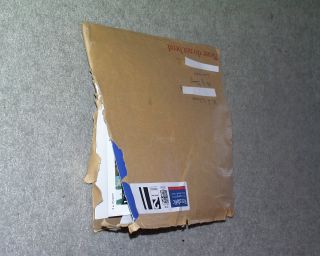
‘Please do not bend’. As if.
Whether in the process of bending it or in whatever threshing machines the Post Office had previously put it through, it was ripped almost completely open. There are various papers and pens in there, but I have no idea what’s gone missing from it.
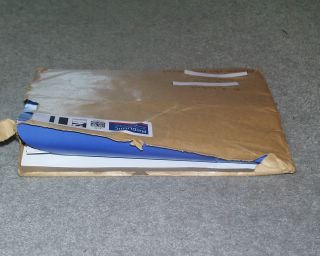
Ripped open!
Whether it’s shocking incompetence or some hilarious conspiracy aimed at the contents – clearly labelled as from Republic, the campaigning group for an elected head of state – by MI5 or overly literal enforcers of the ‘Royal’ Mail, I neither know nor care. I’m just cheesed off that my property has been carelessly shredded.
I wouldn’t have gone into such a public grump, but on Wednesday morning, while I was sitting at the computer typing – a fairly quiet occupation, impossible not to hear the doorbell (we’ve recently had a new intercom fitted, and it’s rather loud) – someone, perhaps the same deliverer, who knows, decided to save a few seconds by cursorily filling out a ‘Sorry, you were out’ slip. In fact, they filled out two, which would almost certainly have taken more time than ringing the bell and getting me to take the parcels. They probably just filled out all of them for their round before setting off; that would explain it. I was in, I wasn’t deaf, and I was up – it wasn’t there when Richard left for work, so it hadn’t been a surprise delivery at 6am instead of about 11, while we were asleep. Yet still I found that I’d been ‘out’ when I went down for the post, and that I’d have to go miles out of my way to pick up something because whoever the Royal Mail sent round wasn’t doing their job, and this made me rather cross.
Particularly when exactly the same thing happened on Friday.
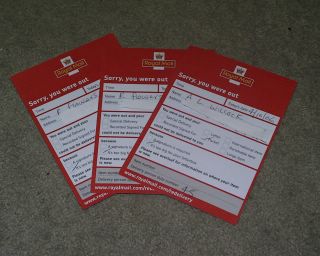
Sorry, I was in…
I’m off to Stockport this morning for a few days with that side of my family, so I won’t be online for a while. I’ll make those complaints on my return, as when we went to the main sorting office a couple of miles away yesterday morning to pick up our packages, I was told I couldn’t make a complaint in person. Of course not. Oh, and of course when I sorted through yesterday’s post there was another ‘Sorry, you were out’ slip there. Helpfully, it doesn’t have a name or number on it, so whoever the postie failed to deliver to can whistle for it, can’t they, when it’s pot luck between eight households as to whose package it was?
Still, we enjoyed Robin Hood yesterday (and the exciting Torchwood trailer following it), and no doubt Millennium Dome will have had a few things to say about it before I get back…
It started last Saturday; I went down to sort out the post, and found something jammed in the letterbox. It was a package, a little wider than A4, in a reinforced card envelope marked ‘Please do not bend’ in large red letters. It was jammed because, rather than the deliverer pushing the bell, it had been bent nearly in two.

‘Please do not bend’. As if.
Whether in the process of bending it or in whatever threshing machines the Post Office had previously put it through, it was ripped almost completely open. There are various papers and pens in there, but I have no idea what’s gone missing from it.

Ripped open!
Whether it’s shocking incompetence or some hilarious conspiracy aimed at the contents – clearly labelled as from Republic, the campaigning group for an elected head of state – by MI5 or overly literal enforcers of the ‘Royal’ Mail, I neither know nor care. I’m just cheesed off that my property has been carelessly shredded.
I wouldn’t have gone into such a public grump, but on Wednesday morning, while I was sitting at the computer typing – a fairly quiet occupation, impossible not to hear the doorbell (we’ve recently had a new intercom fitted, and it’s rather loud) – someone, perhaps the same deliverer, who knows, decided to save a few seconds by cursorily filling out a ‘Sorry, you were out’ slip. In fact, they filled out two, which would almost certainly have taken more time than ringing the bell and getting me to take the parcels. They probably just filled out all of them for their round before setting off; that would explain it. I was in, I wasn’t deaf, and I was up – it wasn’t there when Richard left for work, so it hadn’t been a surprise delivery at 6am instead of about 11, while we were asleep. Yet still I found that I’d been ‘out’ when I went down for the post, and that I’d have to go miles out of my way to pick up something because whoever the Royal Mail sent round wasn’t doing their job, and this made me rather cross.
Particularly when exactly the same thing happened on Friday.

Sorry, I was in…
I’m off to Stockport this morning for a few days with that side of my family, so I won’t be online for a while. I’ll make those complaints on my return, as when we went to the main sorting office a couple of miles away yesterday morning to pick up our packages, I was told I couldn’t make a complaint in person. Of course not. Oh, and of course when I sorted through yesterday’s post there was another ‘Sorry, you were out’ slip there. Helpfully, it doesn’t have a name or number on it, so whoever the postie failed to deliver to can whistle for it, can’t they, when it’s pot luck between eight households as to whose package it was?
Still, we enjoyed Robin Hood yesterday (and the exciting Torchwood trailer following it), and no doubt Millennium Dome will have had a few things to say about it before I get back…
Thursday, October 05, 2006
Ben Aaronovitch and Doctor Who
Ben Aaronovitch was one of the exciting young writers of the late ’80s whose ideas shook up and reinvigorated Doctor Who. To Lib Dems reading: yes, he is the brother of journalist David Aaronovitch, but don’t hold that against him. He scripted two Who stories for TV, the first of which started broadcasting eighteen years ago today. Goodness, that makes me feel old; it still seems like the beginning of something new. Right from the start, you can see favourite themes like racism versus cultural diversity, though for me he really took off in print rather than on the screen. I’d still love him to do another script, whether for Big Finish or for Doctor Who on the telly; sometimes I don’t like what he comes up with, but I’d jump at the risk for the chance of him being really on form. He’s not the most prolific or swift of writers, but with only two novels in Virgin’s New Adventures range and a novelisation before that so good that it helped inspire that new range of books, he helped shape the New Adventures into one of the greatest, most beautiful, most imaginative periods of Doctor Who. He also started a third original Who novel, So Vile a Sin, an uneven epic of love, death, war and empires, interrupted by a hard disk crash and eventually finished off by Kate Orman for publication only just in time before Virgin lost their Doctor Who licence. After a long hiatus and a short story or two, he’s just had Genius Loci published, and I’ve discussed recurring themes such as mixing cultures and his love-hate relationship with soldiers in my review of the new book. You’ll find the same themes explored in the Who stories he previously completed…
When this began – eighteen years ago – it seemed to be where everything came together for Sylvester McCoy’s Doctor, making intelligent use of the past right from the opening sequence of the Earth, its historical period established by transmissions of Jack Kennedy and Martin Luther King Jnr, framed on the screen as a huge spacecraft closes in… Right through to the stunning cliffhanger where a Dalek, for the first time, rises up a set of stairs. In between those two points, the direction, acting, production values and indeed the script all hit the mark. Yet this ended up being the sole Seventh Doctor television story that I disliked intensely as soon as I saw the climax, despite many others of the period displaying far less talent in each of those elements.
Much of it made the Doctor seem unlikeably self-aggrandising, as if he thought he was God mixing it for a bit, and that was an ethos that made me uncomfortable. I’ve always felt that when he uses a weapon to solve the situation, it’s a failure; when he sets up a huge booby trap to blow up a planet at the end of this story, he just doesn’t feel remotely like the Doctor to me. When he spends so much of the rest of his time here criticising people for carrying guns, it makes him seem not just a mass murderer but a hypocritical one. So I’ve always had hugely mixed feelings about this story, instinctively on-side with its anti-racist morality, but reacting with sick horror to the Doctor’s actions at the end.
Making it more complicated still is Mr Aaronovitch’s novelisation of the story, which is… Wonderful. If you ever see an old second-hand copy of Target Books’ Remembrance of the Daleks, pick it up. The verve, the passion, the sheer imagination easily makes it a contender for the best they ever published, capturing emotion, pace and even the thoughts of Daleks. On TV, this was the original series’ biggest special effects extravaganza, but the book’s supercharged Dalek battles give the lie to claims that action sequences only work on screen. Nope, with a sufficiently brilliant author, they can come even more alive on the page. The writing is so marvellous that, to this day, I can’t sort out my feelings about the story – associating the TV version with revulsion for its climax (and irritated by an ostentatious fault on the DVD), but looking at all the style and creativity of the book and still being lost in wonder at it.
On TV this goes wrong in so many ways, but it’s not just down to weaker performances and direction, nor terrible design (though it has all those, and a shockingly poor musical score. It really is ghastly). Though there are flashes of brilliance in the script, these are more obvious when they come out in Ben’s later work and you think, ‘Ah, so that’s what Battlefield should have been like’ – the strong women soldiers, the subtle undermining of this darker Doctor, making UNIT properly multinational, or even the archaeology. The novelisation, as it happens, turns a lot more of it brilliant, but it’s written by another author; very talented, but I can’t help wishing for Mr Aaronovitch’s prose. There’s even an original Doctor Who novel by new series author Paul Cornell, The Shadows of Avalon, which is absolutely magnificent and makes use of so many of the same mythic and emotional themes as Battlefield that it’s a curious mixture of love letter and literary criticism.
It seems like it should have been a mix of Quatermass and King Arthur, one of the BBC’s greatest imaginative triumphs and the other great (mostly) English myth, and the myth even has a great twist in it. So what went wrong, other than it looking so shoddy? The structure is all over the place (apparently it was originally written in three parts rather than four, so I always wonder where the breaks were meant to be), but my main problem is the morality. It sets out to be about the horrors of war, conventional and nuclear, but is fatally compromised throughout. Even the good guys who aren’t in the army love blowing things up; cringe-makingly, the bomb made by the Doctor’s companion has a CND sign on it. Bless. There’s a climactic battle, feebly staged but producing lots of dead bodies – yet none of the ‘characters’ with speaking parts die in it, meaning the ‘horrors of war’ moral is never brought home to us by killing anyone we ‘know’.
The biggest moral failure is that the finger-wagging lecture about the nastiness and dishonour of nuclear weapons that talks the witch-queen from another dimension out of unleashing an atomic holocaust appears totally clueless; it’s meant to show how much better she is than we Earthlings who would build such terrible things. Yet this is only her back-up plan, when she’s already unleashed a demon called the Destroyer to, yes, destroy the Earth; it’s a personification of Oppenheimer's quoting of the Bhagavad-Gita, and the exact equivalent of an enormous nuclear bomb, so she’s metaphorically set off the nukes already but the author hasn’t even noticed. When I mentioned ‘undermining’ the darker Doctor, what I meant was partly the welcome bits of teasing seen here, but also the way his own words are quoted back at him as the deadly, terrifying moral certainty of the previous year’s ‘Doctor as judgmental God’ is questioned. The New Adventures would go on to look at the moral grey areas in more depth, but some of the lines I like in Battlefield seem to be struggling towards this recognition. One of the things that sticks in my throat about the Doctor’s nuclear speech is that there’s no hint of contrition, only an appeal from one ‘higher being’ to another not to sink to the level of humanity; there’s no hint of self-knowledge that, in the previous year and the author’s previous story, he was himself the destroyer of worlds. It’s as if Mr Aaronovitch’s morality has been caught here in mid-evolution, with the Doctor forced by the plot to give a lecture before he’s had time to think through the moral implications of what he’s saying. Before that, though, the way the Destroyer itself is stopped gives the story its main saving grace. Dialogue and performances are a mix of cracking and terrible throughout, but largely it’s the older characters who work. The one who emerges with the most dignity is the Brigadier, so it’s appropriate that when he’s called out of retirement to face a demon, alone, his demand that it “Get off my world” is so heart-punchingly effective. Whatever I think of the rest of it, that’s a fantastic scene.
An early New Adventures novel and the one that pushed what you could feature in Doctor Who just about as far as it would go, this is a dystopian piece of cyberpunk set roughly a century in the future that I admit I hated first time round. Huge amounts of sex and swearing, but none of it between characters that were remotely engaging, and not much of a story to pull it together. It simply put me off. It’s all very futuristically ‘street’ and depressing, the Doctor’s hardly in it, and Bernice’s character is largely missing, too – in only her second book, I suspect Mr Aaronovitch hadn’t seen much beyond a character outline and played it safe by having her possessed or suffering lots of ‘Dalek air-raid orphan angst’ straight out of her biographical notes. Understandable, but at the time I wanted to read more of the new companion who’d so sparkled in her first novel, and it added to the feeling of let-down.
I re-read it a couple of years back, and though it didn’t quite win me over, I appreciated it a lot more. I had dozens of adventures with Benny to hand by then, so didn’t feel starved of her, and my Who horizons had broadened a long way in the decade since, not least as a result of books like this nurturing my imagination. I still found the characters brutish and off-putting, though, and I still found the story an unengaging and over-familiar piece of cyberpunk, so I’m still not going to rave about it; there’s an interesting idea in a transit system becoming so huge and complex that it develops sentience, but it seems too little to hang a whole novel on.
On the bright side, I’d mellowed into more of a mood to appreciate its strengths. If the plot is mediocre, the writing isn’t; it’s not as polished as Ben’s other books, but there are still some beautiful stretches and the jokes, though rare, are good ones. I laughed when the Doctor catches Battlefield showing in operatic form on one channel, something I’d either forgotten or missed altogether first time round. The world(s) it depicts may be unpleasant, but it’s compelling. Huge corporations wield power, with multicultural slums strung from one end of the solar system to the other and a mix of languages as global power and money balances tip away from the West and towards Africa (much more noticeably in the Earth Empire aristocracy of the later New Adventures). It’s peppered with intriguing snatches of future history, such as the fate of Paris. And, more personally appealingly, some of it’s set on the Isle of Dogs, and though I didn’t know the place when Transit was published, since a couple of years after then I’ve lived there. It was strangely endearing to walk round to an unimpressive block of maisonettes ten minutes’ stroll from home and think of it as a glamorous set from Doctor Who, a century in the future.
Mr Aaronovitch’s novelisation of Remembrance of the Daleks had been so stunning that I suspect Transit bore the brunt of criticism less for its individual failings and more because it simply didn’t live up to his promise. With The Also People, though, he delivered another book that cruised to the top. Some authors are equally good on the page and on the screen; others seem to excel in one medium and struggle in another. Chris Boucher, for example, is for me one of the best Who scriptwriters, but his novels seem lifeless by comparison. Ben seems almost the other way round, with flashes of brilliance in his scripts but novels lifted by breadth of vision and a writing style that seems effortless but makes just about every other Who author look clumsy. The Dalek novelisation was more innovative and breathlessly exciting, but this is better-plotted, with crisper dialogue and the breezy confidence to take its time in exploring a huge, impossible world. Even the cover painting is great, well-composed and capturing one of the most striking moments in the book (to be found on page 182, should you have it to hand).
This really shows the New Adventures at their peak; this is one of the great periods of Doctor Who, despite the disadvantage of not reaching a wider audience. The regular characters are a line-up perhaps only beaten to my mind by the original TARDIS crew, with the Seventh Doctor accompanied by now old friend Professor Bernice Summerfield and tough future police officers Chris Cwej and Roz Forrester, one young, innocent and impossibly attractive, the other a cynical veteran who’s turned her back on her aristocratic family. All of them are such fine characters and so perfectly captured here that they all at different points steal the book: Roz multi-layered and a damn’ good cop, with not a few shadows of mortality; Chris blossoming into a sexy Biggles type; Benny being handed some of the Doctor’s responsibility; and the Doctor trying to do the right thing and really just wanting to juggle. Together, they’ve come to the closest thing to paradise, a supremely advanced civilisation made up of organic people and super-evolved machines that are also people living on an immense sphere enclosing a sun, where there’s no such thing as need or violence.
Where better to set the Doctor Who equivalent of film noir?
This book is so good that it manages to create one of those futuristic utopias where no-one has money and yet at no point bores your socks off (Star Treks, take note). Critics claim that much of this novel pays homage to Iain M. Banks’ ‘the Culture’, a set of books which, with hundreds of others, still glare unread at me from the shelf; so what? Doctor Who has always borrowed from everything in sight, and I love that I can instantly recognise one of my favourite movies in many of the lines making up the heart-stopping final confrontation (imagine Roz – a short, black woman – being played to perfection by Humphrey Bogart, as a clue). It’s sheer pleasure to read and classy as hell, all the characters from simple, surprising humans to mile-long, very aggressive spaceships carefully interwoven, making up an immensely clever murder mystery and a breathtaking feat of imagination. And despite the huge sci-fi ideas, it’s not those that stay in the mind, but the raw emotions, the inspired mythical vignettes in the style of African legends, and of course the funny bits. At last, the author’s relaxed enough for some superb comedy: the suspicious yellow dip at parties; the Doctor getting buried; the dream of a drinking Dalek with its serious moral – because the thing that I most love about this gorgeously written book is its moral evolution, as it takes just the same sort of problem as ‘How do you deal with the Daleks?’ from Remembrance of the Daleks and, as if Ben had finally made up his mind what was so wrong with his earlier story, finds a more Doctorish solution than ‘Exterminate!’
Just as I finish writing all this, I’m told that Ben Aaronovitch will be at Tenth Planet for a signing on Saturday and I’ll be pointed out to him. Mixture of fannish excitement and nervous ‘Aaagghh’. Fingers crossed that he reacts better to the mixture of ‘this is brilliant, but this other bit… Not so much’ than one or two other authors…
Remembrance of the Daleks
When this began – eighteen years ago – it seemed to be where everything came together for Sylvester McCoy’s Doctor, making intelligent use of the past right from the opening sequence of the Earth, its historical period established by transmissions of Jack Kennedy and Martin Luther King Jnr, framed on the screen as a huge spacecraft closes in… Right through to the stunning cliffhanger where a Dalek, for the first time, rises up a set of stairs. In between those two points, the direction, acting, production values and indeed the script all hit the mark. Yet this ended up being the sole Seventh Doctor television story that I disliked intensely as soon as I saw the climax, despite many others of the period displaying far less talent in each of those elements.
Much of it made the Doctor seem unlikeably self-aggrandising, as if he thought he was God mixing it for a bit, and that was an ethos that made me uncomfortable. I’ve always felt that when he uses a weapon to solve the situation, it’s a failure; when he sets up a huge booby trap to blow up a planet at the end of this story, he just doesn’t feel remotely like the Doctor to me. When he spends so much of the rest of his time here criticising people for carrying guns, it makes him seem not just a mass murderer but a hypocritical one. So I’ve always had hugely mixed feelings about this story, instinctively on-side with its anti-racist morality, but reacting with sick horror to the Doctor’s actions at the end.
Making it more complicated still is Mr Aaronovitch’s novelisation of the story, which is… Wonderful. If you ever see an old second-hand copy of Target Books’ Remembrance of the Daleks, pick it up. The verve, the passion, the sheer imagination easily makes it a contender for the best they ever published, capturing emotion, pace and even the thoughts of Daleks. On TV, this was the original series’ biggest special effects extravaganza, but the book’s supercharged Dalek battles give the lie to claims that action sequences only work on screen. Nope, with a sufficiently brilliant author, they can come even more alive on the page. The writing is so marvellous that, to this day, I can’t sort out my feelings about the story – associating the TV version with revulsion for its climax (and irritated by an ostentatious fault on the DVD), but looking at all the style and creativity of the book and still being lost in wonder at it.
Battlefield
On TV this goes wrong in so many ways, but it’s not just down to weaker performances and direction, nor terrible design (though it has all those, and a shockingly poor musical score. It really is ghastly). Though there are flashes of brilliance in the script, these are more obvious when they come out in Ben’s later work and you think, ‘Ah, so that’s what Battlefield should have been like’ – the strong women soldiers, the subtle undermining of this darker Doctor, making UNIT properly multinational, or even the archaeology. The novelisation, as it happens, turns a lot more of it brilliant, but it’s written by another author; very talented, but I can’t help wishing for Mr Aaronovitch’s prose. There’s even an original Doctor Who novel by new series author Paul Cornell, The Shadows of Avalon, which is absolutely magnificent and makes use of so many of the same mythic and emotional themes as Battlefield that it’s a curious mixture of love letter and literary criticism.
It seems like it should have been a mix of Quatermass and King Arthur, one of the BBC’s greatest imaginative triumphs and the other great (mostly) English myth, and the myth even has a great twist in it. So what went wrong, other than it looking so shoddy? The structure is all over the place (apparently it was originally written in three parts rather than four, so I always wonder where the breaks were meant to be), but my main problem is the morality. It sets out to be about the horrors of war, conventional and nuclear, but is fatally compromised throughout. Even the good guys who aren’t in the army love blowing things up; cringe-makingly, the bomb made by the Doctor’s companion has a CND sign on it. Bless. There’s a climactic battle, feebly staged but producing lots of dead bodies – yet none of the ‘characters’ with speaking parts die in it, meaning the ‘horrors of war’ moral is never brought home to us by killing anyone we ‘know’.
The biggest moral failure is that the finger-wagging lecture about the nastiness and dishonour of nuclear weapons that talks the witch-queen from another dimension out of unleashing an atomic holocaust appears totally clueless; it’s meant to show how much better she is than we Earthlings who would build such terrible things. Yet this is only her back-up plan, when she’s already unleashed a demon called the Destroyer to, yes, destroy the Earth; it’s a personification of Oppenheimer's quoting of the Bhagavad-Gita, and the exact equivalent of an enormous nuclear bomb, so she’s metaphorically set off the nukes already but the author hasn’t even noticed. When I mentioned ‘undermining’ the darker Doctor, what I meant was partly the welcome bits of teasing seen here, but also the way his own words are quoted back at him as the deadly, terrifying moral certainty of the previous year’s ‘Doctor as judgmental God’ is questioned. The New Adventures would go on to look at the moral grey areas in more depth, but some of the lines I like in Battlefield seem to be struggling towards this recognition. One of the things that sticks in my throat about the Doctor’s nuclear speech is that there’s no hint of contrition, only an appeal from one ‘higher being’ to another not to sink to the level of humanity; there’s no hint of self-knowledge that, in the previous year and the author’s previous story, he was himself the destroyer of worlds. It’s as if Mr Aaronovitch’s morality has been caught here in mid-evolution, with the Doctor forced by the plot to give a lecture before he’s had time to think through the moral implications of what he’s saying. Before that, though, the way the Destroyer itself is stopped gives the story its main saving grace. Dialogue and performances are a mix of cracking and terrible throughout, but largely it’s the older characters who work. The one who emerges with the most dignity is the Brigadier, so it’s appropriate that when he’s called out of retirement to face a demon, alone, his demand that it “Get off my world” is so heart-punchingly effective. Whatever I think of the rest of it, that’s a fantastic scene.
Transit
An early New Adventures novel and the one that pushed what you could feature in Doctor Who just about as far as it would go, this is a dystopian piece of cyberpunk set roughly a century in the future that I admit I hated first time round. Huge amounts of sex and swearing, but none of it between characters that were remotely engaging, and not much of a story to pull it together. It simply put me off. It’s all very futuristically ‘street’ and depressing, the Doctor’s hardly in it, and Bernice’s character is largely missing, too – in only her second book, I suspect Mr Aaronovitch hadn’t seen much beyond a character outline and played it safe by having her possessed or suffering lots of ‘Dalek air-raid orphan angst’ straight out of her biographical notes. Understandable, but at the time I wanted to read more of the new companion who’d so sparkled in her first novel, and it added to the feeling of let-down.
I re-read it a couple of years back, and though it didn’t quite win me over, I appreciated it a lot more. I had dozens of adventures with Benny to hand by then, so didn’t feel starved of her, and my Who horizons had broadened a long way in the decade since, not least as a result of books like this nurturing my imagination. I still found the characters brutish and off-putting, though, and I still found the story an unengaging and over-familiar piece of cyberpunk, so I’m still not going to rave about it; there’s an interesting idea in a transit system becoming so huge and complex that it develops sentience, but it seems too little to hang a whole novel on.
On the bright side, I’d mellowed into more of a mood to appreciate its strengths. If the plot is mediocre, the writing isn’t; it’s not as polished as Ben’s other books, but there are still some beautiful stretches and the jokes, though rare, are good ones. I laughed when the Doctor catches Battlefield showing in operatic form on one channel, something I’d either forgotten or missed altogether first time round. The world(s) it depicts may be unpleasant, but it’s compelling. Huge corporations wield power, with multicultural slums strung from one end of the solar system to the other and a mix of languages as global power and money balances tip away from the West and towards Africa (much more noticeably in the Earth Empire aristocracy of the later New Adventures). It’s peppered with intriguing snatches of future history, such as the fate of Paris. And, more personally appealingly, some of it’s set on the Isle of Dogs, and though I didn’t know the place when Transit was published, since a couple of years after then I’ve lived there. It was strangely endearing to walk round to an unimpressive block of maisonettes ten minutes’ stroll from home and think of it as a glamorous set from Doctor Who, a century in the future.
The Also People
Mr Aaronovitch’s novelisation of Remembrance of the Daleks had been so stunning that I suspect Transit bore the brunt of criticism less for its individual failings and more because it simply didn’t live up to his promise. With The Also People, though, he delivered another book that cruised to the top. Some authors are equally good on the page and on the screen; others seem to excel in one medium and struggle in another. Chris Boucher, for example, is for me one of the best Who scriptwriters, but his novels seem lifeless by comparison. Ben seems almost the other way round, with flashes of brilliance in his scripts but novels lifted by breadth of vision and a writing style that seems effortless but makes just about every other Who author look clumsy. The Dalek novelisation was more innovative and breathlessly exciting, but this is better-plotted, with crisper dialogue and the breezy confidence to take its time in exploring a huge, impossible world. Even the cover painting is great, well-composed and capturing one of the most striking moments in the book (to be found on page 182, should you have it to hand).
This really shows the New Adventures at their peak; this is one of the great periods of Doctor Who, despite the disadvantage of not reaching a wider audience. The regular characters are a line-up perhaps only beaten to my mind by the original TARDIS crew, with the Seventh Doctor accompanied by now old friend Professor Bernice Summerfield and tough future police officers Chris Cwej and Roz Forrester, one young, innocent and impossibly attractive, the other a cynical veteran who’s turned her back on her aristocratic family. All of them are such fine characters and so perfectly captured here that they all at different points steal the book: Roz multi-layered and a damn’ good cop, with not a few shadows of mortality; Chris blossoming into a sexy Biggles type; Benny being handed some of the Doctor’s responsibility; and the Doctor trying to do the right thing and really just wanting to juggle. Together, they’ve come to the closest thing to paradise, a supremely advanced civilisation made up of organic people and super-evolved machines that are also people living on an immense sphere enclosing a sun, where there’s no such thing as need or violence.
Where better to set the Doctor Who equivalent of film noir?
This book is so good that it manages to create one of those futuristic utopias where no-one has money and yet at no point bores your socks off (Star Treks, take note). Critics claim that much of this novel pays homage to Iain M. Banks’ ‘the Culture’, a set of books which, with hundreds of others, still glare unread at me from the shelf; so what? Doctor Who has always borrowed from everything in sight, and I love that I can instantly recognise one of my favourite movies in many of the lines making up the heart-stopping final confrontation (imagine Roz – a short, black woman – being played to perfection by Humphrey Bogart, as a clue). It’s sheer pleasure to read and classy as hell, all the characters from simple, surprising humans to mile-long, very aggressive spaceships carefully interwoven, making up an immensely clever murder mystery and a breathtaking feat of imagination. And despite the huge sci-fi ideas, it’s not those that stay in the mind, but the raw emotions, the inspired mythical vignettes in the style of African legends, and of course the funny bits. At last, the author’s relaxed enough for some superb comedy: the suspicious yellow dip at parties; the Doctor getting buried; the dream of a drinking Dalek with its serious moral – because the thing that I most love about this gorgeously written book is its moral evolution, as it takes just the same sort of problem as ‘How do you deal with the Daleks?’ from Remembrance of the Daleks and, as if Ben had finally made up his mind what was so wrong with his earlier story, finds a more Doctorish solution than ‘Exterminate!’
“Tsuro turned to the woman. ‘Well,’ he asked, ‘are you going to let her out?’”Of course, it’s not perfect. It… (drums fingers) …It’s not very well-bound, as between us we’ve got four copies now, and the pages are falling out of three of them, so I hardly dare touch the fourth. Any chance of an eBook? And even with the aid of the Notes on the Pronunciation of Proper Nouns, I still have problems with some of the character names.
Just as I finish writing all this, I’m told that Ben Aaronovitch will be at Tenth Planet for a signing on Saturday and I’ll be pointed out to him. Mixture of fannish excitement and nervous ‘Aaagghh’. Fingers crossed that he reacts better to the mixture of ‘this is brilliant, but this other bit… Not so much’ than one or two other authors…
Labels: Books, Doctor Who, In-Depth Doctor Who, New Adventures, Professor Bernice Summerfield, Reviews, Sylvester McCoy, The Brigadier
The Avengers – Man-Eater of Surrey Green
At last Steed and Emma return to BBC4 – tonight at 7.10, or tomorrow at 11.30. It’s an unusually science-fiction-styled episode, as they face off against a carnivorous alien plant that’s growing to giant size, and controlling the minds of the local horticulturalists to accomplish this fiendish design. If you think it sounds like the later Doctor Who story The Seeds of Doom ripped it off shamelessly, you won’t be far wrong. It’s not stunning but not bad, with Athene Seyler’s batty plant expert particularly worth the money and Steed winning extra-special beastliness points for how he beats the plant… magic scientific properties of a transistor stuck in your ear. Hmm. I suspect this is the only Avengers episode to feature three people who just happen to wear hearing aids, and it does rather stand out that they’re only there because the plot requires it – you know when one appears before the title that it’s going to be ‘Chekhov’s hearing aid’. It only reminded me of a deaf friend who’s very fond of The Avengers, and how cross he was when this particular series was released on DVD without subtitles (so, should you ever be writing to a DVD manufacturer, do remind them to put the things on).
The other unusual element that’s usually overlooked here is how romantic a lot of it is, and how little protection romance affords against hideous death. It’s surprisingly rare to have people gently ‘courting’ (rather than ostentatiously flirting) in The Avengers, but the first people we see are young lovebird horticulturalists Laura and Alan, set amongst their flowers, but they have just one scene where everything’s rosy together. Though much of the plot is driven by Alan’s desperation to get Laura back when she mysteriously wanders off (despite, it must be said, neither of the actors really setting the world alight) and in most fiction you’d expect them to be joyfully reunited at the end, both in fact die in peculiarly pitiless ways, one of them ‘off’. It’s a bit grim. On the other hand, there’s a particularly good characterisation of Steed and Emma, with more than a few romantic overtones there. He’s first seen looking surprisingly good in a polo-neck, offering her a rose he’s grown, Morning Sunrise. She’s cutting.
The 1976 Doctor Who story The Seeds of Doom is often said to draw heavily on this, and… Well, obviously, it does. It’s written by Robert Banks Stewart, who also wrote a couple of Avengers episodes in this very same black and white Mrs Peel period, and in it, too, a seed pod from space grows to giant size over a leading horticulturalist’s mansion, our heroes are helped by the military and an eccentric older lady, and the chauffeur doesn’t doff his cap politely. The Doctor and Sarah are even said to be more like Steed and Emma than usual, written as more tough, hard-quipping and even amoral. Despite all that, don’t take people’s word for it when they say ‘…and therefore The Seeds of Doom is like an episode of The Avengers’. The feel of it is quite different, thanks to both the script and the director: it’s far more grim in tone, with a far more macho style than you’d get in The Avengers (or in any other Doctor Who), built on emotion and horror that goes back not to Surrey Green, but the original Quatermass.
Some Avengers fans are put off it by the science fiction elements, and though I don’t think they’re pulled off particularly well – the inadequate special effects of thrusting vines, Mrs Peel spouting so much scientific hokum here that she’s undermined by you starting to wonder if every time she seems so assured and expert she’s really just making it all up (vegetation on the Moon, indeed) – it’s the way the whole thing’s done that lets it down for me. Pretty much all the guest actors are rather dull, in particular the world’s most boring RAF man, though the exception is Athene Seyler’s marvellously batty plant expert Dr Sheldon, who’s an absolute scream:
On the bright side, the climax is otherwise very satisfying, with a splendid if slightly overextended fight between Steed and a possessed Emma; he even gets to throw her over his shoulder, and it’s appropriate that neither ‘win’ but that it’s finished by accident, as their heads knock together and she’s knocked out. And before Steed’s aforementioned shocking solution, there’s some less comic mayhem in the form of his chopping at vines with a machete, and possibly the most violent moment in The Avengers, when the chauffeur is blown away by a shotgun. In the end, though, it’s really rather a mundane episode. I know that sounds a little strange, but very little of the story on screen really grabs your attention: it’s much more memorable for ‘being a bit sci-fi’ than for its actual content. Still, the lead characters are much more interesting than The Outsiders…
Steed kills a climber – Emma becomes a vegetableOn the face of it this isn’t quite a usual episode of The Avengers, if there can be such a thing, and, yes, the giant plant from outer space has a lot to do with it. With that, the way it’s brought back to Earth by a doomed astronaut and so many humans falling under its spell at a secret establishment that kills observers, it’s difficult not to suspect this is attempting to spoof The Quatermass Experiment. The trouble is, once they’d come up with that idea they plainly didn’t know where to go with it; it’s rather less amusing than most other Avengers, with the killer cactus on Steed’s car seat the only bit that made me smile – well, at least before Steed comes up with his caddish way to defeat the plant, of which Cornelltoppingday’s The Avengers Dossier says, “Bastard!” I just hope, for his sake, that Emma doesn’t hear how he did it. Quatermass rather implies something intelligent and challenging, but this ends up rather more B-Movie. So is the way to resist the alien’s telepathic control; we hear a strange oscillating note as it exerts its influence, and initially it seems that deafness is the answer. Later, though, it appears that deaf people can still ‘hear’ the control signal, and that to resist you actually need the
The other unusual element that’s usually overlooked here is how romantic a lot of it is, and how little protection romance affords against hideous death. It’s surprisingly rare to have people gently ‘courting’ (rather than ostentatiously flirting) in The Avengers, but the first people we see are young lovebird horticulturalists Laura and Alan, set amongst their flowers, but they have just one scene where everything’s rosy together. Though much of the plot is driven by Alan’s desperation to get Laura back when she mysteriously wanders off (despite, it must be said, neither of the actors really setting the world alight) and in most fiction you’d expect them to be joyfully reunited at the end, both in fact die in peculiarly pitiless ways, one of them ‘off’. It’s a bit grim. On the other hand, there’s a particularly good characterisation of Steed and Emma, with more than a few romantic overtones there. He’s first seen looking surprisingly good in a polo-neck, offering her a rose he’s grown, Morning Sunrise. She’s cutting.
“I sense a bribe… What nasty situation have you got me into this time? …Ah! The missing horticulturalists.”There’s an awfully sweet closing scene, too, as they exit in a very blissed-out way on the back of a haycart.
The 1976 Doctor Who story The Seeds of Doom is often said to draw heavily on this, and… Well, obviously, it does. It’s written by Robert Banks Stewart, who also wrote a couple of Avengers episodes in this very same black and white Mrs Peel period, and in it, too, a seed pod from space grows to giant size over a leading horticulturalist’s mansion, our heroes are helped by the military and an eccentric older lady, and the chauffeur doesn’t doff his cap politely. The Doctor and Sarah are even said to be more like Steed and Emma than usual, written as more tough, hard-quipping and even amoral. Despite all that, don’t take people’s word for it when they say ‘…and therefore The Seeds of Doom is like an episode of The Avengers’. The feel of it is quite different, thanks to both the script and the director: it’s far more grim in tone, with a far more macho style than you’d get in The Avengers (or in any other Doctor Who), built on emotion and horror that goes back not to Surrey Green, but the original Quatermass.
Some Avengers fans are put off it by the science fiction elements, and though I don’t think they’re pulled off particularly well – the inadequate special effects of thrusting vines, Mrs Peel spouting so much scientific hokum here that she’s undermined by you starting to wonder if every time she seems so assured and expert she’s really just making it all up (vegetation on the Moon, indeed) – it’s the way the whole thing’s done that lets it down for me. Pretty much all the guest actors are rather dull, in particular the world’s most boring RAF man, though the exception is Athene Seyler’s marvellously batty plant expert Dr Sheldon, who’s an absolute scream:
“And think of the tendrils!”This isn’t a bad episode, but rather too much just isn’t quite good enough. There are some splendid moments of direction, such as the high shots from the plant’s-eye-view or the sudden darkness as the mansion is covered by vines, but too much of it is rather pedestrian. Much of the music is recycled from other episodes, with most of it that’s new being an ill-advised tuba motif that sounds organic but in a more risible than sinister way; it’s never re-used. The quips are sparse and generally below par (a “herbicidal maniac.” Please). Emma keeps being put in rather frumpy outfits that don’t succeed in making her look businesslike, though her leather dungarees for the climax look a lot better than they sound (Steed, I should say, has that rather natty Edwardian huntsman look again). And suspicious horticulturalist Sir Lyle Peterson initially appears behind the disappearances, and might as well wear a sign saying ‘I’m a maniac’ through his trying-too-hard-to-be-strange mansion with its ivy-covered dollybird mannequins (albeit leading to one of Steed’s few funny quips in this one) with their ‘pretty hair’ – “Yes, real, too,” at which even Steed looks slightly ill. By mid-way, though, he’s established to be under the plant’s control, and while we hear that all the innocent horticulturalists he’s brought under its spell are gruesomely consumed by it, he survives and avoids any comeuppance, despite having evidently been a rather unpleasant character even before the plant got its roots into him.
On the bright side, the climax is otherwise very satisfying, with a splendid if slightly overextended fight between Steed and a possessed Emma; he even gets to throw her over his shoulder, and it’s appropriate that neither ‘win’ but that it’s finished by accident, as their heads knock together and she’s knocked out. And before Steed’s aforementioned shocking solution, there’s some less comic mayhem in the form of his chopping at vines with a machete, and possibly the most violent moment in The Avengers, when the chauffeur is blown away by a shotgun. In the end, though, it’s really rather a mundane episode. I know that sounds a little strange, but very little of the story on screen really grabs your attention: it’s much more memorable for ‘being a bit sci-fi’ than for its actual content. Still, the lead characters are much more interesting than The Outsiders…
Labels: Doctor Who, Quatermass, Reviews, The Avengers, The Avengers Season 4, Tom Baker, Triffids
Genius Loci: Ben and Benny
If you’re at all familiar with Doctor Who, you’ll know that the Doctor has had quite a few travelling companions over the years. Those I’ve been most drawn to tend to be the intelligent, mature, strong women: schoolteacher Barbara Wright, scientist Dr Liz Shaw, archaeologist Professor Bernice Summerfield… Now the latest novel featuring Professor Summerfield is just out, and it has quite a weight of expectations on it. Genius Loci not only relaunches Benny’s fictional career, but is the first Whoish novel for nine years by Ben Aaronovitch, who writes the most gorgeous prose of any Doctor Who author going. Of course, even if you’ve watched a lot of Doctor Who, you might not recognise Benny. She joined the Doctor in the novels, and though the first TV spin-off series is due to start this month, Professor Summerfield has starred in her own books and audio plays for nearly a decade. A hard-drinking, fast-quipping archaeologist from the 26th Century, Benny may not have been on the telly, but has earned a remarkable following among her viewer- and readership (with something over 300,000 novels sold), and of course archaeology is a way to travel in time without a TARDIS, a way in to intelligent storytelling about other cultures, and a passport to Indiana Jones-style thrills and spills…
This latest book, though, is something special, and like many special things had the potential to go belly-up in a spectacular way. It’s the start of a relaunched, redesigned range from independent company Big Finish (yes, the ones doing Doctor Who on BBC7); it’s by an author whose previous works were so loved – and occasionally hated – that his ‘comeback’ has a crushing weight of expectations on it; and rather than fitting in with Benny’s ongoing adventures as we’ve come to know her, it goes back to the beginning of her archaeological career at the age of 21, long before she met the Doctor. Stories that pick a favourite character and make them younger, brasher, blander and less rounded aren’t uncommon in fictional ‘franchises’, but I can’t think of any off the top of my head that haven’t made me cringe. So, the Muppet Babies Benny was a brave decision. On top of all that, the new producer of Big Finish’s Bernice Summerfield range is my friend Simon Guerrier, who was kind enough to send me a review copy. And being such an instinctively genteel reviewer, I did worry that if I didn’t like it I’d offend him hugely because, naturally, while I don’t get personal, neither do I pull my punches, and I’ve managed to upset people I know in the past. So I anticipated making a start on all this a little nervously.
Fortunately, the book made things easy for me by being terribly good.
It makes the gradual uncovering of history, in a properly scientific way, as tense as any thriller… And then, of course, it turns into a gripping thriller. I don’t want to give away too much of the plot, as much of the pleasure in it lies in its twists and turns (though hurrah that the most obvious villains, or at least the ones I most suspected from early on, surprised me by turning out mostly nice). Like archaeology, new discoveries are made and assumptions overturned as you gently lift away another layer; or, like some of the archaeology in this book, occasionally there’ll be a plot development so huge it’s like you’ve dug down with a bomb instead of a trowel. Well before the end of the first chapter, though – which you can read here, as a free sample – I knew I was enjoying this immensely. Look out in particular there for the love story of the two giant robots, which is simply great.
The plot is rich, complex and satisfying; the characters are strongly drawn, especially our hero, who has yet to acquire even a fake Professorship; the prose is striking; but where the book really succeeds, and reminds me of just why Ben Aaronovitch is rated so highly, is in its ‘worldbuilding’. He has a huge gift for creating a believable world with words, both getting inside alien environments and thought processes and making them instantly comprehensible. Benny has been called to help unearth possible evidence of extinct alien civilisation on the planet Jaiwan, settled by humans hundreds of years ago. While one of Mr Aaronovitch’s two really gobsmackingly superb books infamously had to have the foreword Notes on the Pronunciation of Proper Nouns, here the world’s been colonised by humanity and things have been given straightforward names; you might not know exactly what sort of alien fauna potfish, spindly killerfish, helmet crabs, potfish spiders or wide-mouthed frogs are, but in each case you’ve already got an idea. Like the architecture he describes, they summon up vivid mental pictures, while at the same time personal names, invented slang and relationships make both his humans and his aliens ethnically and culturally diverse.
The story is also continually intertwined with ethical questions. Human archaeology is now very well-grounded; how do you start making assumptions about an alien civilisation, and on whose behalf? One of Doctor Who’s most memorable morality tales concerned reptile people who had evolved long before humanity, but took to shelters to sleep through a global catastrophe, only to find we’d usurped ‘their’ world while they hibernated; this book examines how that moral dilemma might influence the rules set for colonising new worlds. Pretty much Doctor Who’s founding moral is a hatred of fascism, but Mr Aaronovitch is one of the authors who makes that most explicit, both in his cultural and ethnic eclecticism and in his nakedly fascist and racist villains. His first Doctor Who script made for television mixed human racists with the series’ ultimate fascists, the Daleks, and while the New Adventures books of the 1990s that saw Benny travel with the Doctor technically never had a Dalek story, they cast a shadow across almost the whole range. It’s the same here, as the backdrop to it all remains that humanity has been threatened by an unnamed galactic superpower, reflected in at least two of the major plot elements. Richard drew to my attention that the alien civilisations discovered here have strong echoes of the Daleks’ own history, with what appears to be a rigidly righteous and genocidal culture set against more freewheeling groups, but while that’s a relatively subtle metaphor, it’s impossible to miss the heavy militarisation of so many people we meet.
Ben is a particularly good writer for Benny in part because so much of his writing displays a love-hate relationship with the military, with characters from the armed forces very much on our side but also people to be wary of, and Benny is almost the personification of that feeling – an Admiral’s daughter and now draft-dodger (another of the moral questions that comes up). She has many striking memories of her father, with one saying of his instantly springing to mind:
And, yes, I know I keep calling this Doctor Who, when it doesn’t have the Doctor in it and technically it’s not part of Big Finish’s Doctor Who franchise, but their ‘New Worlds’. Well, I’m not a writer, lawyer or publicist for Big Finish, so of course Bernice Summerfield is part of the Doctor Who universe, even with the serial numbers filed off. She was first introduced by meeting the Doctor in the New Adventures novels, her travels with the Doctor were a big part of Benny’s life, she was orphaned by the Daleks as a girl, she keeps encountering (individually licensed) aliens from Doctor Who in her spin-off adventures… So it’s easier just to call it all Doctor Who, even if the ‘brand’ you should look for happens to be called something else at times, OK?
In Genius Loci, of course, it’s nearly a decade before Benny meets the Doctor, so here we encounter her archaeological mentor Professor Ankola and her strangely convenient team. With Indiana Jones one of Benny’s most obvious influences, homage is paid by the 26th-Century archaeologists still watching the movies and their many remakes, and that’s not the only George Lucas reference in there (not least that, as well as Benny and Ben, there’s a startling ‘Ben Kenobi moment’). As you might expect with such antecedents, there’s plenty of action and excitement to ‘combat archaeology’, but deaths are sudden and affecting, and some of the near-death experiences owe more than a little to Alien; I’ve not been regularly scared by Doctor Who since 1977, so congratulations to Mr Aaronovitch for making me read the scary giant spider attacks right the way through because I didn’t want to have to put the book down and find myself imagining the worst.
I don’t want you to think it’s all moral seriousness and violent death, though. Some of the jokes are very funny. Appropriately, a lot of them – the one about Google springs to mind – are based on how people mix up their history; some are very stylish moments, like the person crawling out into a firefight who’s asked to bring a couple of bottles and the fruit basket; and it has a Teletubby joke almost as much fun as the one in Ghost Devices, another Benny novel. My favourite is probably what she thinks of the Earth colony ‘New Atlantis’, which calls to mind a famously hokey Doctor Who story in which inhabitants of a water world tempt fate by calling it ‘Aridius’. And, with telling yarns as if they’re old campfire stories another of Mr Aaronovitch’s specialities, watch out for the tale about a mermaid. Oh, and it’s the first Doctor Who book I’ve read that mentions blogging. Apparently this’ll last at least another 600 years. Hurrah!
With stories, as in politics, one of the most irritating feelings is the ‘I could do better’ factor. Richard and I occasionally write stories, less often these days for each of us but Richard in any case more prolifically and with more talent. None of them really got anywhere, though I can vividly remember the TV series where all the wheels came off the plot in its fourth year, at which point Richard sighed ‘I could do better,’ and came up with a much more interesting set of ideas; then there are the many stories we’ve read or seen over the years with an idea similar to one we’d once thought up, and we’ve grumbled, ‘It’s not that we mind them getting there first, so much as that they made such a mess of it.’ One of the pleasures of this book is ticking off two elements in common with one of our favourite stories we came up with together, and this time thinking, ‘Ooh, what he’s done with that is really good’ (I could, however, have done a lot better at the proofreading). There’s so much Doctor Who about today that it’s a struggle to watch, listen to or read it all just once, and there are plenty of offshoots where I’ve got behind. Despite that, if I’ve really enjoyed something, I still make time occasionally to read (or watch, or listen to) it again after a while, rather than let it join hundreds of others in the mulch that passes for my memory. At some point, I’ve no doubt I’ll read this again.
If I were to make a shortlist of the very, very best of Doctor Who novelisations, and the best original Doctor Who novels – a proper shortlist, mind, just a handful and not my usual shortlist of 73 – Ben would be the only author on both lists (here’s one I prepared earlier, down at the bottom). He also wrote the New Adventure I most hated on first reading, and the only TV story with Sylvester McCoy as the Doctor that I disliked intensely from first viewing (though polls frequently suggest it’s his most popular with other fans). You can see why I’m a bit wary when he does something new, can’t you? I’m either going to think it’s the greatest thing since sliced bread, or it’ll feel completely wrong. Well, Genius Loci is not the greatest thing since sliced bread, and it’s not going to knock his greatest books off the top spots. It’s much more straightforward, not as brilliantly inventive, eclectic and epic as he has been on a couple of outstanding occasions. But it’s still a terrific book, and louder, braver, drunker and more loving than most other new stories I’ve come across for a long while.
And there’s more on Ben and Benny to come later, but as Mr Strange is now using ‘Wilcockian’ in the sense that Mr Lovecraft used ‘Cyclopean’, just this once I’ll split the articles up and do something else in between…
Genius Loci
This latest book, though, is something special, and like many special things had the potential to go belly-up in a spectacular way. It’s the start of a relaunched, redesigned range from independent company Big Finish (yes, the ones doing Doctor Who on BBC7); it’s by an author whose previous works were so loved – and occasionally hated – that his ‘comeback’ has a crushing weight of expectations on it; and rather than fitting in with Benny’s ongoing adventures as we’ve come to know her, it goes back to the beginning of her archaeological career at the age of 21, long before she met the Doctor. Stories that pick a favourite character and make them younger, brasher, blander and less rounded aren’t uncommon in fictional ‘franchises’, but I can’t think of any off the top of my head that haven’t made me cringe. So, the Muppet Babies Benny was a brave decision. On top of all that, the new producer of Big Finish’s Bernice Summerfield range is my friend Simon Guerrier, who was kind enough to send me a review copy. And being such an instinctively genteel reviewer, I did worry that if I didn’t like it I’d offend him hugely because, naturally, while I don’t get personal, neither do I pull my punches, and I’ve managed to upset people I know in the past. So I anticipated making a start on all this a little nervously.
Fortunately, the book made things easy for me by being terribly good.
It makes the gradual uncovering of history, in a properly scientific way, as tense as any thriller… And then, of course, it turns into a gripping thriller. I don’t want to give away too much of the plot, as much of the pleasure in it lies in its twists and turns (though hurrah that the most obvious villains, or at least the ones I most suspected from early on, surprised me by turning out mostly nice). Like archaeology, new discoveries are made and assumptions overturned as you gently lift away another layer; or, like some of the archaeology in this book, occasionally there’ll be a plot development so huge it’s like you’ve dug down with a bomb instead of a trowel. Well before the end of the first chapter, though – which you can read here, as a free sample – I knew I was enjoying this immensely. Look out in particular there for the love story of the two giant robots, which is simply great.
The plot is rich, complex and satisfying; the characters are strongly drawn, especially our hero, who has yet to acquire even a fake Professorship; the prose is striking; but where the book really succeeds, and reminds me of just why Ben Aaronovitch is rated so highly, is in its ‘worldbuilding’. He has a huge gift for creating a believable world with words, both getting inside alien environments and thought processes and making them instantly comprehensible. Benny has been called to help unearth possible evidence of extinct alien civilisation on the planet Jaiwan, settled by humans hundreds of years ago. While one of Mr Aaronovitch’s two really gobsmackingly superb books infamously had to have the foreword Notes on the Pronunciation of Proper Nouns, here the world’s been colonised by humanity and things have been given straightforward names; you might not know exactly what sort of alien fauna potfish, spindly killerfish, helmet crabs, potfish spiders or wide-mouthed frogs are, but in each case you’ve already got an idea. Like the architecture he describes, they summon up vivid mental pictures, while at the same time personal names, invented slang and relationships make both his humans and his aliens ethnically and culturally diverse.
The story is also continually intertwined with ethical questions. Human archaeology is now very well-grounded; how do you start making assumptions about an alien civilisation, and on whose behalf? One of Doctor Who’s most memorable morality tales concerned reptile people who had evolved long before humanity, but took to shelters to sleep through a global catastrophe, only to find we’d usurped ‘their’ world while they hibernated; this book examines how that moral dilemma might influence the rules set for colonising new worlds. Pretty much Doctor Who’s founding moral is a hatred of fascism, but Mr Aaronovitch is one of the authors who makes that most explicit, both in his cultural and ethnic eclecticism and in his nakedly fascist and racist villains. His first Doctor Who script made for television mixed human racists with the series’ ultimate fascists, the Daleks, and while the New Adventures books of the 1990s that saw Benny travel with the Doctor technically never had a Dalek story, they cast a shadow across almost the whole range. It’s the same here, as the backdrop to it all remains that humanity has been threatened by an unnamed galactic superpower, reflected in at least two of the major plot elements. Richard drew to my attention that the alien civilisations discovered here have strong echoes of the Daleks’ own history, with what appears to be a rigidly righteous and genocidal culture set against more freewheeling groups, but while that’s a relatively subtle metaphor, it’s impossible to miss the heavy militarisation of so many people we meet.
Ben is a particularly good writer for Benny in part because so much of his writing displays a love-hate relationship with the military, with characters from the armed forces very much on our side but also people to be wary of, and Benny is almost the personification of that feeling – an Admiral’s daughter and now draft-dodger (another of the moral questions that comes up). She has many striking memories of her father, with one saying of his instantly springing to mind:
“The navy likes to be elegant, the army likes to be sneaky and the Marines like to SMASH IT WITH A HAMMER.”I’m aware that some of my blog posts recently have been more grumpy than usual, and when Richard has gently pointed this out for a couple of them I have, of course, cried “Smash it with a hammer!” as my new catchphrase (sorry, Andy). I have to admit, I share some of that equivocation about the allure of the military, as in addition to those capable, intelligent women companions I’m deeply fond of Brigadier Lethbridge-Stewart, who gets some of his finest moments in one of Mr Aaronovitch’s Doctor Who TV stories. So this, too, is a strange mix of individualistic and being impressed by regimentation, of sensitive and macho. If there’s a failing in the writing, it’s Ben’s predisposition for things to be solved not merely by intelligence and heroism, but by intelligence, heroism, and a tendency towards ‘might is right’ in handily having something – in this case several varieties of somethings – bigger and more powerful than the baddies to come in and sort it all out.
And, yes, I know I keep calling this Doctor Who, when it doesn’t have the Doctor in it and technically it’s not part of Big Finish’s Doctor Who franchise, but their ‘New Worlds’. Well, I’m not a writer, lawyer or publicist for Big Finish, so of course Bernice Summerfield is part of the Doctor Who universe, even with the serial numbers filed off. She was first introduced by meeting the Doctor in the New Adventures novels, her travels with the Doctor were a big part of Benny’s life, she was orphaned by the Daleks as a girl, she keeps encountering (individually licensed) aliens from Doctor Who in her spin-off adventures… So it’s easier just to call it all Doctor Who, even if the ‘brand’ you should look for happens to be called something else at times, OK?
In Genius Loci, of course, it’s nearly a decade before Benny meets the Doctor, so here we encounter her archaeological mentor Professor Ankola and her strangely convenient team. With Indiana Jones one of Benny’s most obvious influences, homage is paid by the 26th-Century archaeologists still watching the movies and their many remakes, and that’s not the only George Lucas reference in there (not least that, as well as Benny and Ben, there’s a startling ‘Ben Kenobi moment’). As you might expect with such antecedents, there’s plenty of action and excitement to ‘combat archaeology’, but deaths are sudden and affecting, and some of the near-death experiences owe more than a little to Alien; I’ve not been regularly scared by Doctor Who since 1977, so congratulations to Mr Aaronovitch for making me read the scary giant spider attacks right the way through because I didn’t want to have to put the book down and find myself imagining the worst.
I don’t want you to think it’s all moral seriousness and violent death, though. Some of the jokes are very funny. Appropriately, a lot of them – the one about Google springs to mind – are based on how people mix up their history; some are very stylish moments, like the person crawling out into a firefight who’s asked to bring a couple of bottles and the fruit basket; and it has a Teletubby joke almost as much fun as the one in Ghost Devices, another Benny novel. My favourite is probably what she thinks of the Earth colony ‘New Atlantis’, which calls to mind a famously hokey Doctor Who story in which inhabitants of a water world tempt fate by calling it ‘Aridius’. And, with telling yarns as if they’re old campfire stories another of Mr Aaronovitch’s specialities, watch out for the tale about a mermaid. Oh, and it’s the first Doctor Who book I’ve read that mentions blogging. Apparently this’ll last at least another 600 years. Hurrah!
With stories, as in politics, one of the most irritating feelings is the ‘I could do better’ factor. Richard and I occasionally write stories, less often these days for each of us but Richard in any case more prolifically and with more talent. None of them really got anywhere, though I can vividly remember the TV series where all the wheels came off the plot in its fourth year, at which point Richard sighed ‘I could do better,’ and came up with a much more interesting set of ideas; then there are the many stories we’ve read or seen over the years with an idea similar to one we’d once thought up, and we’ve grumbled, ‘It’s not that we mind them getting there first, so much as that they made such a mess of it.’ One of the pleasures of this book is ticking off two elements in common with one of our favourite stories we came up with together, and this time thinking, ‘Ooh, what he’s done with that is really good’ (I could, however, have done a lot better at the proofreading). There’s so much Doctor Who about today that it’s a struggle to watch, listen to or read it all just once, and there are plenty of offshoots where I’ve got behind. Despite that, if I’ve really enjoyed something, I still make time occasionally to read (or watch, or listen to) it again after a while, rather than let it join hundreds of others in the mulch that passes for my memory. At some point, I’ve no doubt I’ll read this again.
If I were to make a shortlist of the very, very best of Doctor Who novelisations, and the best original Doctor Who novels – a proper shortlist, mind, just a handful and not my usual shortlist of 73 – Ben would be the only author on both lists (here’s one I prepared earlier, down at the bottom). He also wrote the New Adventure I most hated on first reading, and the only TV story with Sylvester McCoy as the Doctor that I disliked intensely from first viewing (though polls frequently suggest it’s his most popular with other fans). You can see why I’m a bit wary when he does something new, can’t you? I’m either going to think it’s the greatest thing since sliced bread, or it’ll feel completely wrong. Well, Genius Loci is not the greatest thing since sliced bread, and it’s not going to knock his greatest books off the top spots. It’s much more straightforward, not as brilliantly inventive, eclectic and epic as he has been on a couple of outstanding occasions. But it’s still a terrific book, and louder, braver, drunker and more loving than most other new stories I’ve come across for a long while.
And there’s more on Ben and Benny to come later, but as Mr Strange is now using ‘Wilcockian’ in the sense that Mr Lovecraft used ‘Cyclopean’, just this once I’ll split the articles up and do something else in between…
Labels: Big Finish, Books, Doctor Who, In-Depth Doctor Who, New Adventures, Professor Bernice Summerfield, Reviews
This is Not a Poem
They say I’m a liar…It’s an advert. Robin Hood begins on Saturday evening on BBC1, and I’m expecting great things of it. The to-camera monologue is from a trailer I saw the other night, made in the charismatic ‘Do you want to come with me?’ Doctor Who style, and it looks great; now Will’s announced that it’s National Poetry Day today with the theme of ‘Identity’ and, well, this is close enough, isn’t it? All the bits that aren’t flaming arrows, anyway (‘Flaming arrows?’ you ask? Yes, and bleeding swords).
A criminal
A thief
With no respect for anyone, or anything.
Listen…
I don’t go looking for trouble.
Trouble comes looking for me.
The Doctor Who-style trailer is not in any way a coincidence. The thrilling miniature monologues from Mr Eccleston and then Mr Tennant did a fantastic job of accomplishing the seemingly impossible: making a huge hit for the BBC on a Saturday night, with a family drama, and one that didn’t fit into the usual modern-day cop / hospital pattern. Robin Hood takes the same three elements (and at least one of the same writers), and hopes to have the same success. I hope so, too. I usually have a slightly law-and-order bias against cheeky crook heroes, and feel far more British than English, but Robin Hood has always been the big exception to both of those instincts. Whether it’s been Errol Flynn, Richard Greene, Michael Praed or a couple of Connerys, I’ve always been firmly on Robin’s side, and he’s one of the two great English myths. Let’s hope the BBC’s new series does the principles and the myth justice (or at least gets me agreeing with it more than The Amazing Mrs Pritchard).
Oh, and if the Liberal Democrats are still looking for some popular way to sell the message that you can be ‘green’ and cut taxes for the poor…
Wednesday, October 04, 2006
Popping Mrs Balloon
The Amazing Mrs Pritchard is supposed to be the BBC’s new ‘political comedy drama’, but it failed dreadfully on all three counts. Something positive first, though. Jane Horrocks is very engaging as the supermarket manager whose gobbiness suddenly catapults her into power, despite the unbelievably crass script she was given. I’m also all for saying that sitting at home and complaining is no good if you’re unsatisfied with how things are; if you want to change the world, get off your arse and do something about it. My problem was with what she thought the problem was, and her ‘solution’. The problem with politics is apparently that there are not enough ideas, just aggression to disguise essential similarities; so the solution is to have no ideas at all, but be fluffy and nice (as long as you’re a woman, and white, and sufficiently bland and malleable to appeal to a multi-millionaire business tycoon). I know I’m a policy wonk who’s unusually set on the notion that you need ideas to change the world, but I suspect you don’t have to be as involved as me to see the problem there.
So far this morning, I’ve seen the views of two usually excellent Lib Dem bloggers:
Andy Strange rather liked it, while Richard Huzzey didn’t, offering instead some thoughtful criticism on models of national leaders as father- and mother-figures. I don’t know what other viewers thought, but I’m in the critical camp too. With an election campaign built entirely on a single personality and with no hint of a political direction, Mrs Pritchard appears to be a female version of David Cameron, exaggerated to such a ridiculous extent that he seems a model of substance. True, he may not have a single policy to his name, but I have an idea of what his general direction is. All I’ve been able to glean of Mrs Pritchard’s political direction is from her backers, and while that’s pretty disturbing so far she herself apparently manages to become Prime Minister without ever expressing an opinion on a single issue (except that the existing politicians are, gosh, all the same).
Before I offer a detailed political critique, I’d like to take the programme on its own terms, as ‘satirical drama’ and as offering a more people-friendly, touchy-feely style of politics. One scene stands out as showing up how utterly clueless it was as satire, how shallow as drama and, perhaps most damningly, how nasty and cold-hearted its ‘feelings’ actually were. So, the point at which it really jumped the shark for me was the ‘bottom pinch’. It’s most of the way through the episode, and Mrs Pritchard seems on course for Downing Street, and the nasty press (which appeared to consist entirely of The Sun; certainly, it gushed all over most media people, particularly on how nice the BBC are to broadcast on, er, the BBC) unleashed their full venom in a terrible personal intrusion of scandal. Are you ready for this? Well, seven years earlier, her husband pinched a younger woman’s bottom while slightly inebriated at the office party. Strong stuff, eh?
Never mind other people’s bums. This was the point when I had to pinch myself to check I really was watching a post-watershed programme aimed at allegedly mature people, and hadn’t drifted off and woken at 4.30 to see something on CBBC that was really talking down to the children. I’ve stood for Parliament a couple of times, in seats somewhere around the 400th-500th target mark for a party expected to get a tenth as many MPs as that, and before then in students’ union elections at university. In terms of public elections, then, if I’m lucky I might be in the top few, er, thousand ‘high fliers’ in the country. Yet I’ve had far worse things thrown at and – gosh, what a thing to say of our honest and lovely press – made up about me over the years than the best that can apparently be chucked over someone heading to be Prime Minister. Give me strength! I’ve never seen such a feeble ‘dirty trick’. Yet the bigger problem I had was when she flew into a hurt rage at her husband for this terrible, awful behaviour. Gosh, again. She’s surrounded by family and friends to try and contrast her with the heartless and contemptible male ‘politicians’ (none of whom are allowed family or friends by the script, and who might as well go about wearing horns and pantomime capes), but the thing that struck me was how badly she treated them, particularly her husband, while the script and direction all assumes the audience should be siding with her.
Politicians inevitably make prats of themselves when they tell other people how to run their family lives, but I couldn’t help but think of mine when she stood for Parliament without so much as a word to her alleged partner for life, and spent a load of their money doing so. I’ve always talked over standing for anything very carefully with Richard, and I know plenty of people active in politics – women and men – who’ve not gone for something because it would make life too difficult for their partner. So while I wouldn’t tell a real-life Mrs Pritchard how to run her life, it made me recoil from what a git she was. Perhaps it all boils down to this question: if your partner a) was found out as having once pinched the bottom of someone they found attractive, several years ago, while in a state of inebriation, or b) made an expensive and completely life-changing decision that would turn both your lives upside-down without mentioning it to you, still less actually consulting you, which option would make you feel hurt and worthless, and which would make you roll your eyes and tut for a moment? Because I know what my answer would be, and I can’t imagine being in a relationship so unequal, unpleasant and control-freakish as Mrs Pritchard considers puts her in the right. You see, real politicians do have family lives, and pretty much all the ones I know treat them better than this ‘nice’ woman does.
Now, fair’s fair, as the story is all about emotion rather than ideas, yes, I admit I felt got at, and felt people I know and like – even know and dislike – were being got at unfairly. It opened with her breaking up a fight between Labour and Tory candidates at the supermarket she manages, and who couldn’t like such a bit of slapstick, or hasn’t thought a strict headmistressy type should go into the baying yobs at Prime Minister’s Question Time and tell them they should be ashamed of themselves? But it’s a long way from that to presenting every single ‘politician’ as a slimy, worthless piece of scum all the same as each other. I got into politics because I wanted to change the world, and so did most others. I’ve never made a penny out of politics – quite the reverse, in fact, it can cost you loads – and neither have the vast majority of other people involved in politics. We get involved because we want to achieve something. So, yes, I was offended by this incredibly self-satisfied show that presented her as the first person ever to want to change things, and everyone else as exactly the same. Do they think political parties are grown in vats? It’s not an uncommon feeling to look at a politician and think, ‘I could do better’. I know it’s been the spur to an awful lot of the things I’ve worked at over the years. But it takes breathtaking arrogance and misanthropy to say ‘Not only could I do better than every one of them, but I’m entirely right and every one of them is entirely bad.’
And, sorry, but once you stand for election, when you found your own party, you’re a politician. So when she said, “I’m not a politician. Politicians lie,” she was, and she was. Because most politicians aren’t liars, but, goodness, believe different things to each other. She seemed to think all right-thinking people could only believe the same (alarm bells ringing here), but at the same time that everyone else was “all the same”. Well, those can’t both be true. There was a very disturbing undercurrent to all this. Because what she says – whatever it is – is only ‘common sense’, she didn’t have to listen to anyone else.
I’ve already established that she appears to treat her husband’s views as beneath consideration or, indeed, contempt, and though he’s presented as bad for not voting for her, funnily enough, she never bothered asking him to. He tells her of her bossy control-freakery “This is the problem with you. You can’t trust people to get on with their own – thing,” but it gets swallowed up by his rubbish argument, set to comedy music, that she’s not up to it when she so patently is. Like all the men in the programme, he’s weak, corrupt and self-serving, so when he’s the only one who hits the damning critique on the head, he’s easily dismissed. But it’s not that she just doesn’t bother listening to the person she’s sworn to love. She listens to absolutely no-one (she gets a cheer for refusing to speak to a Lib Dem in the first scene)… No-one, that is, except the high-flying journalist who spins for her, and the business tycoon who bankrolls her.
I’ve always been suspicious of political parties that are in hock to rich individuals or rich organisations, and when the Lib Dems were able to compete at the last election by having, say, one-tenth the money of the other two parties, the Michael Brown donation didn’t exactly work out brilliantly for us in the end. We took two and a half million pounds – much more than we’ve ever had before – from someone who later turned out to be a crook. Whoops. But on the bright side, the party still raised many, many individual donations from its members, and Mr Brown was never offered nor put up for a peerage, and once he’d given us the money and we’d spent it, his ‘leverage’ over us was, er, spent. Mrs Pritchard gets ten million pounds (four times as much, and with no background checks at all) from one donor, and that’s the only money we hear about for her campaign. The donor is an incredibly rich business tycoon, and she is in fact Mrs Pritchard’s employer. Mr Brown couldn’t sack Charles Kennedy – that was some other people, and it wasn’t over money – but Mrs Pritchard could at any stage have been sacked and her whole campaign wound up by one person, on a whim. The first time I stood for Parliament I was unemployed and had very little help in terms of money or people, against a huge, professional campaign by a millionaire. Which of us was the plucky outsider, and which the Mrs Pritchard? Pardon me if I don’t see this as ‘clean’ politics.
Now, let’s imagine for a moment that Mrs Pritchard was real. I know, anyone who’s got the faintest clue even about how the law works, let alone a campaign, will be shrieking, ‘But it’s all rubbish!’ but try and hang, draw and quarter your disbelief for a moment. She’s got no policies, no positions, but people rushing to stand ‘on her platform’ all over the country, and her campaign consists entirely of a personality cult – her face plastered all over every poster, literally all about image. What would she be like? Well, who knows, as there’s only one scene with one word about her ‘Manifesto’, and we don’t hear a word of what’s in it, or we might have to make our minds up about what she stands for other than Poujadism (ironically, my spell-check offers ‘pluralism’ for that). It’s implied that she thinks policies are a bad thing, but what do you have instead? How do we know what she believes, what she stands for, what she’d do in a crunch? At least with a political party you have some idea of their philosophy, so even if events knock their manifesto completely off course, you have some idea of which way they’ll jump. Not her. And, of course, it’s not in the interests of the writer to give her any actual policies, even if the plot had needed them: she’s got to be sympathetic, and lovable, and appeal to everyone with her self-evident common sense goodness, and because any fool knows that politics is about choices and there is no such thing as a programme of self-evident, common-sense, painless policies, as soon as she set out a single idea, the viewers would start to say, ‘Well, if that’s what she’s about, I wouldn’t vote for her.’ At one stage we hear her spin guru talk of positioning her as a ‘centrist’, but if the problem she rants about at the start is that everyone’s crowding into the middle so there’s no choice, how will that improve anything? Though ‘centre’ isn’t exactly the position that most of her followers seem to fall into. Let’s see; there’s that millionaire supermarket tycoon, and though it’s implied that women backbenchers of several parties defect to her, suggesting that either they’re devoid of principle or she’s in for a problem, the only ones we actually hear identified are Tories. And she head-hunts a brilliant and ambitious Tory to be her Chancellor, while all identifiable members of all other parties are scorned. So forgive me if a few more alarm bells start to ring.
All the defectors to her and all of her candidates are women, of course, just as all the other politicians are men and all the men are slimy, weak, corrupt and self-serving. This is the bit I’ve been putting off writing, because the ‘battle of the sexes’ is my least favourite rubbish science fiction cliché. By a series of miracles, it’s one Doctor Who almost entirely avoided (though run screaming from any Blake’s 7 story by Ben Steed, as they’re all like that and uniformly god-awful). Science fiction? Well, actually, a lot of The Amazing Mrs Pritchard is sat somewhere between really bad sci-fi and really bad 1970s sit-com trying to get a grip on how frightening it thinks feminism is. It sits in that other well-known sci-fi cliché, the ‘parallel world’ (or, if Duncan Brack is writing it and trying to sound serious, the ‘counterfactual’), as it appears to be an alternative version of the 2001 General Election, with its boring campaign, terrible turnout and rubbish ability of the opposition parties to get women elected turned round by a new party out of nowhere that unseats Tony Blair. But, really, when Mrs Pritchard sounds off about how men are all the same, they all lie, and how only women can run the place with straight-talking and common sense, it’s a wonder that this isn’t being beamed directly from 1972. There’s admiring talk of Mrs Thatcher (quelle surprise), but, goodness, why not mention those inspiring individuals, those paragons of excitement, principle and straight-talking who are actually in government, like Harriet Hewitt, or Tessa Harman, or Patricia Jowell? Er… Oh, because the idea that women are all thrilling and men all loathsome is just Horrocks. If this sort of tedious sexist blather had come from a male politician in any party other than the nuttier fringes of UKIP, their political career would be over before they could say ‘pretty little head’, because no-one would vote for a bigoted shit who calls half the population worthless. So what, exactly, is Mrs Pritchard?
Oh, yes, UKIP. Well, I was thinking about how Mrs Pritchard’s government might be if it was real, and the kindest example I could come up with was government by Jamie Oliver; well-meaning celebrity stunts with supermarket money. But if I was living in Mrs Pritchard’s Britain, I’d be petrified she’d be like Kilroy. A celebrity face that’s all image, and doing everything in the name of common sense because naturally everyone agrees with you, and anyone who doesn’t is obviously just being Evil. We know, because we’ve watched the programme, that she is ‘nice’ (‘nice’ being defined as a caring, compassionate bigot who treats her husband like dirt, but leave that to one side), but if I was just someone living under her ‘Purple Alliance’, I wouldn’t have that insight. I’d just be praying that her coalition of people with their own argumentative agendas would fall apart before it could do too much damage, because the only parties I can think of that have ever ridden to power on the sort of populist cult of personality seen in The Amazing Mrs Pritchard are fascist ones. I know; who could possibly think of that nice Jane Horrocks as a fascist? But if I wasn’t in the privileged viewer’s position of knowing how ‘nice’ she is, all I could go by is my historical knowledge of what demagogues do in power and that, as well as no men in her team, there are no black or Asian faces, no-one I know is gay, and that because no-one who disagrees with her could possibly be worth considering, when interviewers say, “If only more people thought like you,” she declares, “Oh, most people do.” ‘Are you thinking what I’m thinking?’
This show could easily have appealed to me. I believe, for example, that politicians should be less slavishly on-message – though having no message at all is rather a turn-off – that there should be more women involved in politics and that there are under-performing men who face no serious challenge (sorry, Simon). If I sound as grumpy as Victor Meldrew about all this, perhaps it’s because Mrs Pritchard is only Victor Meldrew in cuddlier form. Did she have any ideas? Any passion? Other than being wholly negative about every single one of her opponents, who were, to a man and woman, smeared as liars, until some of the women were suddenly redeemed by defecting to her? Presented as fresh and inspiring, the irony is that hers was the single most wholly negative political campaign I’ve ever seen. The story could have been funny; it wasn’t. It could have had something interesting to say about how political parties are seen as too establishment, and the small but noticeable rise of Independent MPs beginning with Martin Bell in 1997; it didn’t. It could have encouraged people to get involved and change things, but by tarring every single person who’s already doing that as a cynical, horrible shit and saying ‘politics will mess up your family’, it can only make things worse. People will say, ‘They’re all horrid, but what can I do? I don’t know any millionaires and I’d get shafted.’ Besides, what little ray of hope has come of the sudden revolution of the first episode will swiftly vanish; she’s on top, so there’s only one way for the story to go now. When it all goes horribly wrong, any people inspired by her message that ‘Politics isn’t rocket science’ will just be put off, thinking they can’t change anything after all, but you can. It wants to be a political comedy drama, but it’s not funny, it’s pitiful drama and it’ll only pour politics further down the toilet. I just think it’ll make the work of all those of us who actually do want to change the world rather than sneer at it more difficult, and what a missed opportunity that is.
So far this morning, I’ve seen the views of two usually excellent Lib Dem bloggers:
Andy Strange rather liked it, while Richard Huzzey didn’t, offering instead some thoughtful criticism on models of national leaders as father- and mother-figures. I don’t know what other viewers thought, but I’m in the critical camp too. With an election campaign built entirely on a single personality and with no hint of a political direction, Mrs Pritchard appears to be a female version of David Cameron, exaggerated to such a ridiculous extent that he seems a model of substance. True, he may not have a single policy to his name, but I have an idea of what his general direction is. All I’ve been able to glean of Mrs Pritchard’s political direction is from her backers, and while that’s pretty disturbing so far she herself apparently manages to become Prime Minister without ever expressing an opinion on a single issue (except that the existing politicians are, gosh, all the same).
Before I offer a detailed political critique, I’d like to take the programme on its own terms, as ‘satirical drama’ and as offering a more people-friendly, touchy-feely style of politics. One scene stands out as showing up how utterly clueless it was as satire, how shallow as drama and, perhaps most damningly, how nasty and cold-hearted its ‘feelings’ actually were. So, the point at which it really jumped the shark for me was the ‘bottom pinch’. It’s most of the way through the episode, and Mrs Pritchard seems on course for Downing Street, and the nasty press (which appeared to consist entirely of The Sun; certainly, it gushed all over most media people, particularly on how nice the BBC are to broadcast on, er, the BBC) unleashed their full venom in a terrible personal intrusion of scandal. Are you ready for this? Well, seven years earlier, her husband pinched a younger woman’s bottom while slightly inebriated at the office party. Strong stuff, eh?
Never mind other people’s bums. This was the point when I had to pinch myself to check I really was watching a post-watershed programme aimed at allegedly mature people, and hadn’t drifted off and woken at 4.30 to see something on CBBC that was really talking down to the children. I’ve stood for Parliament a couple of times, in seats somewhere around the 400th-500th target mark for a party expected to get a tenth as many MPs as that, and before then in students’ union elections at university. In terms of public elections, then, if I’m lucky I might be in the top few, er, thousand ‘high fliers’ in the country. Yet I’ve had far worse things thrown at and – gosh, what a thing to say of our honest and lovely press – made up about me over the years than the best that can apparently be chucked over someone heading to be Prime Minister. Give me strength! I’ve never seen such a feeble ‘dirty trick’. Yet the bigger problem I had was when she flew into a hurt rage at her husband for this terrible, awful behaviour. Gosh, again. She’s surrounded by family and friends to try and contrast her with the heartless and contemptible male ‘politicians’ (none of whom are allowed family or friends by the script, and who might as well go about wearing horns and pantomime capes), but the thing that struck me was how badly she treated them, particularly her husband, while the script and direction all assumes the audience should be siding with her.
Politicians inevitably make prats of themselves when they tell other people how to run their family lives, but I couldn’t help but think of mine when she stood for Parliament without so much as a word to her alleged partner for life, and spent a load of their money doing so. I’ve always talked over standing for anything very carefully with Richard, and I know plenty of people active in politics – women and men – who’ve not gone for something because it would make life too difficult for their partner. So while I wouldn’t tell a real-life Mrs Pritchard how to run her life, it made me recoil from what a git she was. Perhaps it all boils down to this question: if your partner a) was found out as having once pinched the bottom of someone they found attractive, several years ago, while in a state of inebriation, or b) made an expensive and completely life-changing decision that would turn both your lives upside-down without mentioning it to you, still less actually consulting you, which option would make you feel hurt and worthless, and which would make you roll your eyes and tut for a moment? Because I know what my answer would be, and I can’t imagine being in a relationship so unequal, unpleasant and control-freakish as Mrs Pritchard considers puts her in the right. You see, real politicians do have family lives, and pretty much all the ones I know treat them better than this ‘nice’ woman does.
Now, fair’s fair, as the story is all about emotion rather than ideas, yes, I admit I felt got at, and felt people I know and like – even know and dislike – were being got at unfairly. It opened with her breaking up a fight between Labour and Tory candidates at the supermarket she manages, and who couldn’t like such a bit of slapstick, or hasn’t thought a strict headmistressy type should go into the baying yobs at Prime Minister’s Question Time and tell them they should be ashamed of themselves? But it’s a long way from that to presenting every single ‘politician’ as a slimy, worthless piece of scum all the same as each other. I got into politics because I wanted to change the world, and so did most others. I’ve never made a penny out of politics – quite the reverse, in fact, it can cost you loads – and neither have the vast majority of other people involved in politics. We get involved because we want to achieve something. So, yes, I was offended by this incredibly self-satisfied show that presented her as the first person ever to want to change things, and everyone else as exactly the same. Do they think political parties are grown in vats? It’s not an uncommon feeling to look at a politician and think, ‘I could do better’. I know it’s been the spur to an awful lot of the things I’ve worked at over the years. But it takes breathtaking arrogance and misanthropy to say ‘Not only could I do better than every one of them, but I’m entirely right and every one of them is entirely bad.’
And, sorry, but once you stand for election, when you found your own party, you’re a politician. So when she said, “I’m not a politician. Politicians lie,” she was, and she was. Because most politicians aren’t liars, but, goodness, believe different things to each other. She seemed to think all right-thinking people could only believe the same (alarm bells ringing here), but at the same time that everyone else was “all the same”. Well, those can’t both be true. There was a very disturbing undercurrent to all this. Because what she says – whatever it is – is only ‘common sense’, she didn’t have to listen to anyone else.
I’ve already established that she appears to treat her husband’s views as beneath consideration or, indeed, contempt, and though he’s presented as bad for not voting for her, funnily enough, she never bothered asking him to. He tells her of her bossy control-freakery “This is the problem with you. You can’t trust people to get on with their own – thing,” but it gets swallowed up by his rubbish argument, set to comedy music, that she’s not up to it when she so patently is. Like all the men in the programme, he’s weak, corrupt and self-serving, so when he’s the only one who hits the damning critique on the head, he’s easily dismissed. But it’s not that she just doesn’t bother listening to the person she’s sworn to love. She listens to absolutely no-one (she gets a cheer for refusing to speak to a Lib Dem in the first scene)… No-one, that is, except the high-flying journalist who spins for her, and the business tycoon who bankrolls her.
I’ve always been suspicious of political parties that are in hock to rich individuals or rich organisations, and when the Lib Dems were able to compete at the last election by having, say, one-tenth the money of the other two parties, the Michael Brown donation didn’t exactly work out brilliantly for us in the end. We took two and a half million pounds – much more than we’ve ever had before – from someone who later turned out to be a crook. Whoops. But on the bright side, the party still raised many, many individual donations from its members, and Mr Brown was never offered nor put up for a peerage, and once he’d given us the money and we’d spent it, his ‘leverage’ over us was, er, spent. Mrs Pritchard gets ten million pounds (four times as much, and with no background checks at all) from one donor, and that’s the only money we hear about for her campaign. The donor is an incredibly rich business tycoon, and she is in fact Mrs Pritchard’s employer. Mr Brown couldn’t sack Charles Kennedy – that was some other people, and it wasn’t over money – but Mrs Pritchard could at any stage have been sacked and her whole campaign wound up by one person, on a whim. The first time I stood for Parliament I was unemployed and had very little help in terms of money or people, against a huge, professional campaign by a millionaire. Which of us was the plucky outsider, and which the Mrs Pritchard? Pardon me if I don’t see this as ‘clean’ politics.
Now, let’s imagine for a moment that Mrs Pritchard was real. I know, anyone who’s got the faintest clue even about how the law works, let alone a campaign, will be shrieking, ‘But it’s all rubbish!’ but try and hang, draw and quarter your disbelief for a moment. She’s got no policies, no positions, but people rushing to stand ‘on her platform’ all over the country, and her campaign consists entirely of a personality cult – her face plastered all over every poster, literally all about image. What would she be like? Well, who knows, as there’s only one scene with one word about her ‘Manifesto’, and we don’t hear a word of what’s in it, or we might have to make our minds up about what she stands for other than Poujadism (ironically, my spell-check offers ‘pluralism’ for that). It’s implied that she thinks policies are a bad thing, but what do you have instead? How do we know what she believes, what she stands for, what she’d do in a crunch? At least with a political party you have some idea of their philosophy, so even if events knock their manifesto completely off course, you have some idea of which way they’ll jump. Not her. And, of course, it’s not in the interests of the writer to give her any actual policies, even if the plot had needed them: she’s got to be sympathetic, and lovable, and appeal to everyone with her self-evident common sense goodness, and because any fool knows that politics is about choices and there is no such thing as a programme of self-evident, common-sense, painless policies, as soon as she set out a single idea, the viewers would start to say, ‘Well, if that’s what she’s about, I wouldn’t vote for her.’ At one stage we hear her spin guru talk of positioning her as a ‘centrist’, but if the problem she rants about at the start is that everyone’s crowding into the middle so there’s no choice, how will that improve anything? Though ‘centre’ isn’t exactly the position that most of her followers seem to fall into. Let’s see; there’s that millionaire supermarket tycoon, and though it’s implied that women backbenchers of several parties defect to her, suggesting that either they’re devoid of principle or she’s in for a problem, the only ones we actually hear identified are Tories. And she head-hunts a brilliant and ambitious Tory to be her Chancellor, while all identifiable members of all other parties are scorned. So forgive me if a few more alarm bells start to ring.
All the defectors to her and all of her candidates are women, of course, just as all the other politicians are men and all the men are slimy, weak, corrupt and self-serving. This is the bit I’ve been putting off writing, because the ‘battle of the sexes’ is my least favourite rubbish science fiction cliché. By a series of miracles, it’s one Doctor Who almost entirely avoided (though run screaming from any Blake’s 7 story by Ben Steed, as they’re all like that and uniformly god-awful). Science fiction? Well, actually, a lot of The Amazing Mrs Pritchard is sat somewhere between really bad sci-fi and really bad 1970s sit-com trying to get a grip on how frightening it thinks feminism is. It sits in that other well-known sci-fi cliché, the ‘parallel world’ (or, if Duncan Brack is writing it and trying to sound serious, the ‘counterfactual’), as it appears to be an alternative version of the 2001 General Election, with its boring campaign, terrible turnout and rubbish ability of the opposition parties to get women elected turned round by a new party out of nowhere that unseats Tony Blair. But, really, when Mrs Pritchard sounds off about how men are all the same, they all lie, and how only women can run the place with straight-talking and common sense, it’s a wonder that this isn’t being beamed directly from 1972. There’s admiring talk of Mrs Thatcher (quelle surprise), but, goodness, why not mention those inspiring individuals, those paragons of excitement, principle and straight-talking who are actually in government, like Harriet Hewitt, or Tessa Harman, or Patricia Jowell? Er… Oh, because the idea that women are all thrilling and men all loathsome is just Horrocks. If this sort of tedious sexist blather had come from a male politician in any party other than the nuttier fringes of UKIP, their political career would be over before they could say ‘pretty little head’, because no-one would vote for a bigoted shit who calls half the population worthless. So what, exactly, is Mrs Pritchard?
Oh, yes, UKIP. Well, I was thinking about how Mrs Pritchard’s government might be if it was real, and the kindest example I could come up with was government by Jamie Oliver; well-meaning celebrity stunts with supermarket money. But if I was living in Mrs Pritchard’s Britain, I’d be petrified she’d be like Kilroy. A celebrity face that’s all image, and doing everything in the name of common sense because naturally everyone agrees with you, and anyone who doesn’t is obviously just being Evil. We know, because we’ve watched the programme, that she is ‘nice’ (‘nice’ being defined as a caring, compassionate bigot who treats her husband like dirt, but leave that to one side), but if I was just someone living under her ‘Purple Alliance’, I wouldn’t have that insight. I’d just be praying that her coalition of people with their own argumentative agendas would fall apart before it could do too much damage, because the only parties I can think of that have ever ridden to power on the sort of populist cult of personality seen in The Amazing Mrs Pritchard are fascist ones. I know; who could possibly think of that nice Jane Horrocks as a fascist? But if I wasn’t in the privileged viewer’s position of knowing how ‘nice’ she is, all I could go by is my historical knowledge of what demagogues do in power and that, as well as no men in her team, there are no black or Asian faces, no-one I know is gay, and that because no-one who disagrees with her could possibly be worth considering, when interviewers say, “If only more people thought like you,” she declares, “Oh, most people do.” ‘Are you thinking what I’m thinking?’
This show could easily have appealed to me. I believe, for example, that politicians should be less slavishly on-message – though having no message at all is rather a turn-off – that there should be more women involved in politics and that there are under-performing men who face no serious challenge (sorry, Simon). If I sound as grumpy as Victor Meldrew about all this, perhaps it’s because Mrs Pritchard is only Victor Meldrew in cuddlier form. Did she have any ideas? Any passion? Other than being wholly negative about every single one of her opponents, who were, to a man and woman, smeared as liars, until some of the women were suddenly redeemed by defecting to her? Presented as fresh and inspiring, the irony is that hers was the single most wholly negative political campaign I’ve ever seen. The story could have been funny; it wasn’t. It could have had something interesting to say about how political parties are seen as too establishment, and the small but noticeable rise of Independent MPs beginning with Martin Bell in 1997; it didn’t. It could have encouraged people to get involved and change things, but by tarring every single person who’s already doing that as a cynical, horrible shit and saying ‘politics will mess up your family’, it can only make things worse. People will say, ‘They’re all horrid, but what can I do? I don’t know any millionaires and I’d get shafted.’ Besides, what little ray of hope has come of the sudden revolution of the first episode will swiftly vanish; she’s on top, so there’s only one way for the story to go now. When it all goes horribly wrong, any people inspired by her message that ‘Politics isn’t rocket science’ will just be put off, thinking they can’t change anything after all, but you can. It wants to be a political comedy drama, but it’s not funny, it’s pitiful drama and it’ll only pour politics further down the toilet. I just think it’ll make the work of all those of us who actually do want to change the world rather than sneer at it more difficult, and what a missed opportunity that is.
Labels: Bigotry, British Politics, Reviews, Stupid Ideas
Monday, October 02, 2006
Five Unkind Ways to Mock Poor Mr Cameron
Imagine my surprise when after yesterday’s Mr Balloon cartoon I noticed four more mickey-takes of Mr Cameron. On the Spitting Image principle, he must be delighted that he’s being noticed, though he’s probably jealous that the vidcasts competing with his own are each from men considerably younger and more handsome than he is (take a bow, Will, and of course Stephen, who’s now definitively laid to rest any rumour that he’s a flirt*). Then there’s the BBC(ish), but my personal favourite was a real news report – well, ITV, anyway – broadcast last night. Missed it? Then here’s a transcript.
Mr Cameron then, of course, tried to encourage comparisons between himself and John F Kennedy, a claim bolstered by the Conservatives’ big guest of the day, Senator John McCain, a man from the party ofPresident Kennedy Richard Nixon and George Bush (some mistake, surely?).
Actually, I thought of a famous American comparison too when I heard Mr Cameron’s bold initiative to “let sunshine win the day” (though of course “let moonlight win the day” would have been bolder, if more astronomically improbable). It immediately called to mind ‘Let the Sunshine In’ from the musical Hair. So, is Mr Cameron encouraging the assembled Tories to embrace their inner hippy, throw off their clothes and surgical appliances and rush naked into the sea? Or has he gone back to his old habits and taken a little pick-me-up before his speech, channelling the Age of Aquarius in his starry-eyed rhetoric?
*Stephen Tall has, of course, been accused of being a ‘flirt’ by someone whose identity I shall disguise by assigning him the codename ‘Mr Fibwick’. To prove just how wrong this charge is, Stephen has appeared in his new video chatting to camera from the sink with his shirt mostly unbuttoned, then leaning seductively over the ironing board to allow the best view inside his t-shirt. Doesn’t sound flirty at all, does it?
Look, it could have been more flirty:
“People say David Cameron is obsessed by image, but that is, clearly, utter nonsense. Just look at today. Early this morning he was dressed soberly in a cream shirt and red tie. [On-screen time for clip: 09:02] Admittedly, he arrived in Bournemouth a little later in jeans and funky trainers, [11:21] and, between the photocall and the hotel, he did manage to slip back into the suit, but this time with a blue, rather than cream, shirt, [12:03] and then there was the moment he emerged half an hour later, Samantha still sensibly in yellow but Dave now in a white shirt and tie. [12:39] Still, four changes before lunchtime doesn’t mean you’re concerned about your image. This is ‘hunt-a-policy week’ – no sign of one yet… Tom Bradley, ITV News, in Bournemouth.”Richard found this in the bulletin after Cracker, which he’d recorded, and showed it to me afterwards; if anyone else did the same, and feels like YouTubing it… I should point out that, for the benefit of those not seeing the pictures, he wore his blue shirt open at the collar, but had an indigo tie with the white shirt. I wouldn’t want you to think he didn’t bother picking out a different collar ‘look’ for each outfit.
Mr Cameron then, of course, tried to encourage comparisons between himself and John F Kennedy, a claim bolstered by the Conservatives’ big guest of the day, Senator John McCain, a man from the party of
Actually, I thought of a famous American comparison too when I heard Mr Cameron’s bold initiative to “let sunshine win the day” (though of course “let moonlight win the day” would have been bolder, if more astronomically improbable). It immediately called to mind ‘Let the Sunshine In’ from the musical Hair. So, is Mr Cameron encouraging the assembled Tories to embrace their inner hippy, throw off their clothes and surgical appliances and rush naked into the sea? Or has he gone back to his old habits and taken a little pick-me-up before his speech, channelling the Age of Aquarius in his starry-eyed rhetoric?
*Stephen Tall has, of course, been accused of being a ‘flirt’ by someone whose identity I shall disguise by assigning him the codename ‘Mr Fibwick’. To prove just how wrong this charge is, Stephen has appeared in his new video chatting to camera from the sink with his shirt mostly unbuttoned, then leaning seductively over the ironing board to allow the best view inside his t-shirt. Doesn’t sound flirty at all, does it?
Look, it could have been more flirty:
Meanwhile, anyone who wishes to borrow my Mr Balloon cartoon may do so. It’s not as pretty or witty as Will or Stephen’s videos, but it’s much easier to put on a Focus. Like many people, I don’t even know how to save a YouTube / Google video clip (which will no doubt aid sales of the forthcoming Will Howells / Stephen Tall / Nick Clegg ‘Lib Dem hunks’ DVD compilation. You heard it here first).Stephen could have taken off his shirt altogether, rather than just leaving it open
Oh – actually he does that after the other two…Stephen could have been “unexpectedly caught” shaving
Oh – actually he came up with that idea on Will’s blog……Or in bed
Oh – actually he came up with that idea on Will’s blog, too…
Instead of just standing at the sink, Stephen could have “accidentally” covered himself in water and confided to the camera, “Look… I’m – all wet…”
Ah, he missed a trick there. Quick, Will! Now’s your chance to compete in your next one! Though, to be fair, Will’s ‘Webcameraon 3’ is particularly racy anyway.
Sunday, October 01, 2006
Mr Balloon: A Political Heavyweight
When I wrote earlier that Mr Cameron’s pronouncements on climate change are just hot air, I was of course inspired by Millennium thinking of him as ‘Mr Balloon’. Liberal Review reveals today that The Observer has joined those reading Millennium… The media people at Newsnight are already fans. Millennium’s simple theory (with evidence) on where Mr Balloon’s message comes from in the absence of any ideas of his own is the basis of this nomenclature, and I’ve drawn a graphic representation. It’s not as colourful as the Observer cartoon, but should anyone wish to borrow it, you have my blessing.

Mr Balloon - Tory Leader
Mr Balloon - Tory Leader
Labels: Conservatives, Pictures, Top Tips
The Tories – Just a Blip, or Self-Destructing?
The opinion polls haven’t given a happy start to the Tory Conference, with their temporary lead over Labour gone and Mr Cameron’s popularity falling sharply. It seems that, after a full year of Mr Cameron’s spin that nice noises are enough, people have noticed he has no policies and there’s no substance to him at all. However, I don’t think much of polls, so what about the substance? Well, that’s even less cheering for the Conservatives, because there really isn’t any there at all, and as a result Mr William Hague has just self-destructed messily on The World This Weekend. You can ‘Listen Again’ to it for the next week. Is this just a bad day, or are they starting to lose it? When your Leader’s faffed around doing nothing of substance all year but increase your opinion poll ratings slightly, and then the opinion polls sink like an overdone soufflé, it can’t leave you feeling exactly chuffed.
I always thought Mr Hague was one of the cleverest performers in the Tory Party. He’s not as smooth a spin merchant as Mr Cameron, but he does much better under a demanding interview. If I were in charge of the Tory Party (gets out garlic), I’d put up Mr Hague in preference to Mr Cameron if something more than a slick soundbite is required; while there’s nothing but hot air inside Mr Cameron, Mr Hague has quite a clever brain and can answer the questions. I usually disagree with the answers he gives, of course, but at least his answers sound like they have some substance to them.
Hearing Mr Hague get into such a panic and fall apart under pressure was quite a shock – I suspect even he’s finding it difficult to work with Mr Cameron’s likeable but vacuous nothings any more. After all, it has been a full year of Mr Cameron with nothing to show for it, so Mr Hague must wish he had even some of his old, unpopular policies to cling to rather than be sent naked into the interview studio. Mr Hague, of course, was Welsh Secretary in the fatally split Conservative Government of the 1990s, where he took over from John Redwood; Mr Redwood has been in the news today calling for the Conservatives to promise tax cuts, and it’s obvious Mr Hague would be happier doing the same. We all know that’s what Mr Hague used to say back when he was Conservative Leader, and it’s what both of them actually believe – slash public services, cut taxes and do what Tories like to do. Instead, he has to go on the radio and say that he believes people are probably being taxed too much… But he can’t say what, if anything, he wants do about it. Not much to go on, is it? No wonder he sounded so fed up. If Tories as important as their Shadow Foreign Secretary and once (and future?) Leader are getting restive, what must morale be like with the membership? Good job they don’t get to vote on policy. Even if there was any policy to vote on.
If you listen again to today’s The World This Weekend, you’ll hear senior Conservative George Walden criticising them for being run entirely by a ‘social elite’, with the Shadow Cabinet being more socially exclusive than at any time since the 1960s – certainly not the ‘Cabinet of the talents’ that Mrs Thatcher formed when she came to power. Did you know that just five of Mr Cameron’s top team went to comprehensive schools? More than that went to Eton alone! Out of nearly two dozen people in the Conservatives’ Shadow Cabinet, fewer than half a dozen were educated the way 90% of the population are. You can see why Mr Walden was a bit worried that the Conservatives have turned their backs on listening to ordinary people, can’t you?
Putting Mr Hague on to be interviewed was exactly the right move. Not only is he clever enough to think on his feet, but he’s one of the less-than-a-quarter who didn’t go to a top private school. Shaun Ley knows his stuff, but he’s not a Paxman-style interrogator; if he’s given a solid answer, he tends not to fight and fight to tear it to pieces. Mr Ley’s very good at putting you at your ease, though, which I reckon is a more effective interview technique than constant aggression. I thought Mr Hague started very well by using his own experience to laugh off the ‘social elite’ charge. ‘Ask him a follow-up about all the others!’ I was thinking, but no, Mr Hague got away with that one rather well. I thought the interview was going to be a good moment for the Tories. And then Mr Ley asked about tax…
Now, like Mr Hague, I’ve done an extended interview with Mr Ley for The World This Weekend, in my case a fortnight ago, and like Mr Hague I was asked about my party’s tax plans. The new Liberal Democrat tax plans are well-thought-out to make a green tax switch from taxing people to taxing pollution, but complicated enough in the detail to make them easy to attack. I know – we hadn’t passed them at the time, and when I was interviewed I came up with several of the attacks I thought our opponents would make, and how I’d counter them (if you’re a Conservative and want to hear them, sorry, but the ‘Listen Again’ feature only works for a week). And it’s easy enough for a Tory with a brain to defend against charges they have no policies – they want to think about them carefully and get them right, not come out with a constant stream of gimmicky laws that turn out to be rubbish and have to be changed, like Labour do. Easy, isn’t it? So if he couldn’t even come up with an answer that obvious, but only get shirty instead, what conclusion can you draw other than that Mr Hague is so fed up with the lack of substance he’s supposed to sound excited by that he’s not bothering to try any more. I don’t blame him. I couldn’t sound enthusiastic about having nothing to say, either.
Why else did Mr Hague fall to pieces when he was asked why they didn’t have any policies, and why if he thought people were taxed too much he couldn’t say he wanted tax cuts? He started to talk about possible green taxes, but he couldn’t say what, and “sharing the proceeds of growth,” the very words dismissed by Ming Campbell a week ago as “a slogan, not a policy”. As a recent satirical video has suggested, Mr Cameron’s hot air won’t fix climate change. Mr Ley pressed Mr Hague for details: the Liberal Democrats, he said, thought ordinary working people were taxed too much, so they had specific green taxes they wanted to raise, and they’d use the money to cut income tax. Why couldn’t the Tories just say the same?
But all Mr Hague could do was sound flustered, panicky and cross, twice more try and say “sharing the proceeds of growth,” and he couldn’t find anything he disagreed with in the Lib Dem tax policies. I mean, I can come up with an attack on our policies, and with no Lib Dem on the programme to defend them, Mr Hague had an open goal – but scored straight into his own net. What was the only irritable answer he had to the Lib Dem tax cuts? That we weren’t going to win. He couldn’t disagree with a word of them. He was so petulant about it that it was obvious he must be upset he can’t have any tax-cutting policies like ours, or any policies to offer at all.
If that’s the best you can do, Mr Hague, your party isn’t going to win, either.
Newer› ‹Older
I always thought Mr Hague was one of the cleverest performers in the Tory Party. He’s not as smooth a spin merchant as Mr Cameron, but he does much better under a demanding interview. If I were in charge of the Tory Party (gets out garlic), I’d put up Mr Hague in preference to Mr Cameron if something more than a slick soundbite is required; while there’s nothing but hot air inside Mr Cameron, Mr Hague has quite a clever brain and can answer the questions. I usually disagree with the answers he gives, of course, but at least his answers sound like they have some substance to them.
Hearing Mr Hague get into such a panic and fall apart under pressure was quite a shock – I suspect even he’s finding it difficult to work with Mr Cameron’s likeable but vacuous nothings any more. After all, it has been a full year of Mr Cameron with nothing to show for it, so Mr Hague must wish he had even some of his old, unpopular policies to cling to rather than be sent naked into the interview studio. Mr Hague, of course, was Welsh Secretary in the fatally split Conservative Government of the 1990s, where he took over from John Redwood; Mr Redwood has been in the news today calling for the Conservatives to promise tax cuts, and it’s obvious Mr Hague would be happier doing the same. We all know that’s what Mr Hague used to say back when he was Conservative Leader, and it’s what both of them actually believe – slash public services, cut taxes and do what Tories like to do. Instead, he has to go on the radio and say that he believes people are probably being taxed too much… But he can’t say what, if anything, he wants do about it. Not much to go on, is it? No wonder he sounded so fed up. If Tories as important as their Shadow Foreign Secretary and once (and future?) Leader are getting restive, what must morale be like with the membership? Good job they don’t get to vote on policy. Even if there was any policy to vote on.
If you listen again to today’s The World This Weekend, you’ll hear senior Conservative George Walden criticising them for being run entirely by a ‘social elite’, with the Shadow Cabinet being more socially exclusive than at any time since the 1960s – certainly not the ‘Cabinet of the talents’ that Mrs Thatcher formed when she came to power. Did you know that just five of Mr Cameron’s top team went to comprehensive schools? More than that went to Eton alone! Out of nearly two dozen people in the Conservatives’ Shadow Cabinet, fewer than half a dozen were educated the way 90% of the population are. You can see why Mr Walden was a bit worried that the Conservatives have turned their backs on listening to ordinary people, can’t you?
Putting Mr Hague on to be interviewed was exactly the right move. Not only is he clever enough to think on his feet, but he’s one of the less-than-a-quarter who didn’t go to a top private school. Shaun Ley knows his stuff, but he’s not a Paxman-style interrogator; if he’s given a solid answer, he tends not to fight and fight to tear it to pieces. Mr Ley’s very good at putting you at your ease, though, which I reckon is a more effective interview technique than constant aggression. I thought Mr Hague started very well by using his own experience to laugh off the ‘social elite’ charge. ‘Ask him a follow-up about all the others!’ I was thinking, but no, Mr Hague got away with that one rather well. I thought the interview was going to be a good moment for the Tories. And then Mr Ley asked about tax…
Now, like Mr Hague, I’ve done an extended interview with Mr Ley for The World This Weekend, in my case a fortnight ago, and like Mr Hague I was asked about my party’s tax plans. The new Liberal Democrat tax plans are well-thought-out to make a green tax switch from taxing people to taxing pollution, but complicated enough in the detail to make them easy to attack. I know – we hadn’t passed them at the time, and when I was interviewed I came up with several of the attacks I thought our opponents would make, and how I’d counter them (if you’re a Conservative and want to hear them, sorry, but the ‘Listen Again’ feature only works for a week). And it’s easy enough for a Tory with a brain to defend against charges they have no policies – they want to think about them carefully and get them right, not come out with a constant stream of gimmicky laws that turn out to be rubbish and have to be changed, like Labour do. Easy, isn’t it? So if he couldn’t even come up with an answer that obvious, but only get shirty instead, what conclusion can you draw other than that Mr Hague is so fed up with the lack of substance he’s supposed to sound excited by that he’s not bothering to try any more. I don’t blame him. I couldn’t sound enthusiastic about having nothing to say, either.
Why else did Mr Hague fall to pieces when he was asked why they didn’t have any policies, and why if he thought people were taxed too much he couldn’t say he wanted tax cuts? He started to talk about possible green taxes, but he couldn’t say what, and “sharing the proceeds of growth,” the very words dismissed by Ming Campbell a week ago as “a slogan, not a policy”. As a recent satirical video has suggested, Mr Cameron’s hot air won’t fix climate change. Mr Ley pressed Mr Hague for details: the Liberal Democrats, he said, thought ordinary working people were taxed too much, so they had specific green taxes they wanted to raise, and they’d use the money to cut income tax. Why couldn’t the Tories just say the same?
But all Mr Hague could do was sound flustered, panicky and cross, twice more try and say “sharing the proceeds of growth,” and he couldn’t find anything he disagreed with in the Lib Dem tax policies. I mean, I can come up with an attack on our policies, and with no Lib Dem on the programme to defend them, Mr Hague had an open goal – but scored straight into his own net. What was the only irritable answer he had to the Lib Dem tax cuts? That we weren’t going to win. He couldn’t disagree with a word of them. He was so petulant about it that it was obvious he must be upset he can’t have any tax-cutting policies like ours, or any policies to offer at all.
If that’s the best you can do, Mr Hague, your party isn’t going to win, either.