Thursday, June 21, 2012
What Doctor Who – The New Adventures Mean To Us: Alex
Doctor Who’s Lifeline
The first New Adventure was published on June 20th, 1991. A year and a half earlier, Sylvester McCoy’s Doctor and Sophie Aldred’s Ace had walked off into the sunset at the end of Survival, the last Doctor Who TV story of the original run. And then Virgin Publishing saw them walk back into the TARDIS for what turned out to be sixty-one New Adventures (fewer with Ace, more without the Doctor).
I was probably the perfect audience for the New Adventures; part of probably the second generation of Doctor Who fans, I’d always followed both the TV series and the Target novelisations – since I was three and five respectively, a decade and a half by then – and with both versions of Doctor Who equally important to me, with no new TV stories what could be more natural than to continue the Doctor’s travels on the page?
“When is a lightning bolt not a lightning bolt?”The first three books were all written by established novelisers for the Target range (which had itself by the end been taken over by Virgin, establishing a continuing thread from 1973 into the new books): John Peel, Nigel Robinson and, most importantly, Terrance Dicks. For the more conservative fans – and I started off more towards that direction – it was reassuring that the second novel was written by Terrance Dicks (then the grand middle-aged man of Who, writing for the seventh of seven Doctors), giving his blessing. It was also a help that Terrance’s Timewyrm: Exodus was clearly the best of the three, as well as notably experimental in its time-hopping. Within the next few books published, outstanding TV authors from the Sylvester McCoy era had joined the range – Marc Platt, Andrew Cartmel, Ben Aaronovitch (with a new book out today that’s set to be another bestseller) – to make it clear that this was taking up where the TV series had left off with the BBC’s official stamp, all three not just providing continuity but driving on with the books’ original tagline of “Full-length, original novels, too broad and too deep for the small screen”.
But what really kept these Doctor Who stories exciting and made them the most brilliant, influential and coherent continuation of Doctor Who between 1989 and 2005 was the extraordinary influx of eager new writers, most writing their first novels, full of ideas, determined to make an impression. Kate Orman, Andy Lane, Jim Mortimore – and people who have worked on the TV series since its return in 2005 like Paul Cornell, Mark Gatiss, Gareth Roberts, Gary Russell and Simon Winstone. Even, towards the end, a book each from the two biggest creative forces behind the next two big waves of Doctor Who – Lawrence Miles and Russell T Davies.
“Everything is history, if you look at it from the right perspective.”Nothing dates like “New”, and it’s a bit startling to think that when they began I was a few months away from turning twenty, and now they’ve just turned twenty-one. I remember Paul Cornell at a signing about five years ago exclaiming with a shock that they’ve yellowed and started to smell like old books. But though it seems odd to look back from more than half my life ago at “New”, they still justify the title for always keeping the series going forward, rather than just dwelling comfortably on Doctor Who ‘as it used to be’ – because it never used to be just unoriginal, repetitive and comforting. The New Adventures opened up new vistas; I didn’t always like them, but I realised that when Doctor Who can go anywhere and do anything, it can’t sit still. Fans talked about Doctor Who’s own version of the Political Compass, with “Rads” vs “Trads”, “Frocks” vs “Guns”, and I found myself opening up with the NAs from Trad-Gun tastes to preferring Rad-Frocks. From the start, the New Adventures favoured story arcs before Babylon 5 made them fashionable, and as they increased in breadth and confidence they told cyberpunk future histories, turned the series inside-out with a new, old mythology and introduced the series’ defining companion, archaeologist Professor Bernice Summerfield, then later the Thirtieth Century police officers blond, heroic Chris Cwej and grumpy Xhosa aristocrat Roz Forrester, all with the Daleks seeming more powerful than ever by never appearing but always casting their shadow across the stories. And, yes, the books came to define their own clichés (Ace shooting and shagging, Benny drinking, Sylv’s angst and killer eyes, and lots of Kate Bush), yet they remain one of the series’ most creative ever periods. And traditionalists and radicals, Target-lovers and experimenters were all part of the same run, all playing in the same sandbox, and that made the series so much stronger striking out into the future.
Part of My Lifetime
The New Adventures are a far more evocative memory for me than any other non-TV Doctor Who line, in part because for me they were so much better than any other, and in part because of the time they spanned, a uniquely transitional few years in my life. From Tom through to Sylv on TV, the stories are powerful memories but the setting usually at my parents’ in Stockport; from Chris to Matt so far on TV, the stories are powerful memories but the setting almost without exception with Richard in our Isle of Dogs flat. But the NAs summon up memories of the bookshops where I bought them (Colchester where I studied, or didn’t, London for politics or partners, strangely often the WH Smiths at Liverpool Street Station as I travelled in between), of starting to mix with fans, and much more so of university, people or politics. And as I spent a lot of my time at uni hitch-hiking up and down the country to help out the Liberal Democrats at by-elections back when I still had the health to do it, many NAs for me crystallise into reading them late at night while crashing on people’s floors in between days of leafleting and canvassing in different campaigns.
“You mean I’m dead?”So amongst the most vivid memories for me – among many others – are Timewyrm: Revelation in Lancaster for a few days with a brief fling; being frightened by Doctor Who for the first time since 1977 by Nightshade in a very tall, very dark room at friends’ in Portsmouth; Deceit at the Newbury by-election; Lucifer Rising in my physical office and at the end of my term of office as a students’ union President, sometimes surreptitiously, under the desk, because I’d much rather be reading a brilliant Who book than organising a handover; White Darkness at the Christchurch by-election; Shadowmind in East London, as my then relationship was breaking up; Conundrum at a local by-election in rural St Neot’s; Theatre of War at the Eastleigh by-election; a god-awful hitch-hike to Bradford South with only All-Consuming Fire to keep me warm in long, lonely hours stuck outside service stations along the way; St Anthony’s Fire being a very disappointing book but still a vividly exciting memory of finding my way on bus round the Isle of Dogs as I started going out with Richard (or, as I’m sure he’d prefer me to remember, reading the far better The Also People in what was by then our flat); Christmas on a Rational Planet in a coach back from giving a speech in Utrecht, having forced myself to put it to one side and write the speech on the way there; Damaged Goods at the Wirral South by-election and around Merseyrail; The Dying Days in short breaks as I was being driven from place to place as the candidate myself, strangely appropriate as a finale, in Stevenage on General Election day, then late at night when I should have been getting a nap in before the count…
“…Oxygen starvation, brought about from finding yourself on the moon having believed the place to be Norfolk. I do believe that’s unique.”
Brilliant
My favourite eras of Doctor Who have long been Robert Holmes and Philip Hinchcliffe’s, my first and still the best, then discovering William Hartnell’s early days… And the New Adventures, most of all as they really get into their stride from about 1994-96. There’s much more Who that I love – 1978, 1980-81, 1989, 2005, 2007 all spring to mind; oh, really, the whole lot of it – but those are the benchmarks for quality I keep returning to. With the New Adventures in particular, I can simply think of more terrific books from that range than I can from all the other book ranges put together. Every set of books has its ups and downs, but the NAs were both unambiguously the Doctor’s continuing adventures and fortuitously had more consistent depth and inspiration than any other non-TV line of Who.
“‘In that case,’ said Bernice, ‘I’ll have an exaggerated sexual innuendo with a dash of patriot’s spirit and extra mushrooms. Roz?’A few years ago, I wrote a series of short pieces on Why Is Doctor Who Brilliant? Several New Adventures featured prominently. We hope to be reviewing the whole range in time – that’s the plan – but in lieu of you reading every NA to discover for yourself how brilliant they are (though you should), here are a few of the standouts, should you happen across them in your local second-hand bookshop:
“‘I’ll have the same,’ said Roz. ‘But with an umbrella in it.’
“‘Coming right up,’ said the table.”
- The cream of the crop for me are Andy Lane and Jim Mortimore’s Lucifer Rising, in which the TARDIS crew get a fair bit of character development, oodles of future history is explored, there are huge sci-fi ideas and it’s a murder mystery that’s sometimes very funny into the bargain;
- …And Ben Aaronovitch’s The Also People, for which I could write a similar précis – more confident character exploration than development, but with other huge sci-fi ideas, another murder mystery and much funnier – but which is a very different book, a small-scale film noir at heart amidst the epic setting and with arguably the most gorgeous prose in the series;
- The most influential novel was the fourth NA published, Paul Cornell’s Timewyrm: Revelation, which exploded the boundaries and showed that you could write something very different to the TV series; like the following book, Marc Platt’s equally brilliant Cat’s Cradle: Time’s Crucible, it’s a journey of sorts to the Doctor’s heart, one metaphysical, one technological, both in their own ways mythological. With the NAs’ penchant for pop culture references, I think of them as Blue Monday and West End Girls, the one that luckily came out first setting the standard for a new wave;
- Then there’s Andrew Cartmel’s intense ‘War’ trilogy, with its dystopian near future and übermanipulative Doctor;
- Paul Cornell’s Love and War, just as political and striking out boldly with the introduction of Professor Bernice Summerfield, who celebrates her -528th birthday tomorrow and is still going strong in her own series;
- Mark Gatiss’ scary Nightshade, where nostalgia kills;
- Gareth Roberts’ The Highest Science and Andy Lane’s Sherlock Holmes crossover All-Consuming Fire (he now writes his own bestselling Holmes series), both of which are enormous fun;
- Jim Mortimore’s Blood Heat and Kate Orman’s The Left-Handed Hummingbird, both of which put everyone through the wringer;
- Paul Cornell, again’s, Human Nature, which tells an intimate, compelling story that was successfully made part of the TV series over a decade later;
- Andy Lane’s Original Sin, introducing Adjudicators Roz and Chris;
- Lance Parkin’s Just War, with appalling real-world horrors but one pricelessly funny moment;
- Lawrence Miles’ Christmas on a Rational Planet, which overturns much of the NAs’ own mythology with an alternate look at the History of the universe;
- Russell T Davies’ urban, gripping Damaged Goods that finally makes the NAs as gay as their detractors complain;
- Ben Aaronovitch and Kate Orman’s So Vile a Sin, a big climax, followed by Matt Jones’ moving Bad Therapy;
- And the ultimate New Adventure, Marc Platt’s Lungbarrow, in which the seventh Doctor goes back home for his swansong and many questions are answered (with just as many new ones posed).
Loved or hated, the New Adventures were massively important; neither the BBC Books Doctor Who line that took over from them nor Big Finish’s Doctor Who audios would be around without them, and the TV series that returned, had it returned at all, would probably look very different. I loved these groundbreaking adventures that dragged Doctor Who into the ’90s and cast the Doctor as “Time’s Champion”, the books becoming his own champions striding into an exciting future.
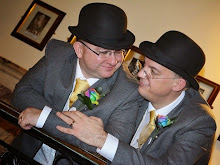
“At the far end of the street, hostile armed men came to the party, and twenty minutes passed.”Richard and I were both in the middle of following and loving the New Adventures when we met and fell in love with each other, so the NAs have an even more special place in our hearts. We started re-reading them this time last year, starting each New Adventure all over again on its twentieth birthday; for the series’ twenty-first today, we’re starting this new blog to look at them all in turn.
This is cross-posted from Richard’s and my new blog, Time’s Champions, a day later – so, happy -528th birthday, Bernice Summerfield!
You can read Richard’s heartfelt paean to the New Adventures here.
Incidentally, the new blog’s still very much a work in progress as we decide what to make of it, so should anyone have a Blogger template that looks like the New Adventures front and back cover designs, could you get in touch?
Labels: Big Finish, Blogs, Books, Doctor Who, New Adventures, Personal, Professor Bernice Summerfield, Reviews, Richard, Sylvester McCoy, Why Is Doctor Who Brilliant?


Sunday, January 17, 2010
DVD Taster: Doctor Who – Peladon Tales
Lost Kingdoms of Africa: Ethiopia
You might expect me to recommend the new series of Hustle, which is as inventive and fun as ever, or Being Human’s black comedy thriller, possibly the best new drama on right now, or even Survivors, which is still well worth watching despite its lack of killer vegetation (being essentially The Day of the Triffids with more tedious gardening) – the new series has now run out of Terry Nation’s original Survivors plotlines, so ironically last week’s lifted large chunks from his Destiny of the Daleks – but the TV show that most gripped me last week was, improbably, not big-budget drama but archaeology on BBC4. Gus Casely-Hayford’s knowledgeable, enthusiastic and kind of hot real Indiana Jones (though he wasn’t allowed in to see the Ark of the Covenant) is in the middle of a series exploring Africa’s lost civilisations, and while I was only half-watching the one about Nubia, perhaps because it’s so lost that there was relatively little to see, the latest on Ethiopia was extraordinary.
You can see the Ethiopian documentary again tonight at eight on BBC4, or on iPlayer until the series finishes, and I thoroughly recommend it. Perhaps urging you to watch a real history programme with jaw-dropping pictures of actual ancient buildings is unwise before suggesting you visit a studio-bound medievalesque Doctor Who planet of suspiciously regular caves, but really, this is too good to miss. I knew a little about the Aksûmite Empire and the Ethiopian Kingdom said to have lasted three thousand years, claiming descent from King Solomon and the Queen of Sheba, but I didn’t realise how awesome – in the best sense – the architecture it left behind actually was. Tune in for the churches carved, incredibly, out of solid rock (to bolster a usurper’s credentials), or the far older giant Stelae jutting into the sky to mark the graves of ancient kings.
If you’re still looking for a Doctor Who connection, incidentally, one of Professor Bernice Summerfield’s most intense, inspired and insane adventures, The Sword of Forever, is steeped in Aksûmite legends; as that’s long out of print, though, it might be easier simply to watch Lost Kingdoms of Africa: Ethiopia and see what strikes you (stop reading now if you want to test this theory). Perhaps it’s just me, but one of the architectural features repeated over hundreds of years in royal and religious buildings made me start the first time it appeared, then began to get unsettling as more and more examples were displayed. It’s described as an emblem of “the rising sun,” and consists of a semi-circle set – on a small connecting piece – above a tall oblong block. As it wasn’t just a semi-circle alone, the first time I saw one it struck me as a representation of a figure. And as it wasn’t just one emblem but many, it didn’t strike me as a representation of many suns in a row, but of several figures. The first pair of them, I have to confess, immediately brought to mind a stylised pair of Time Lords in their ceremonial collars (set, appropriately, above a double cross). The centuries-older pair we saw next had a far more tapered oblong below it, its stepped edges looking for all the world like shoulders and hips. And the oldest, topping the Stelae like the heads of giants, even had pointed edges to the ‘rising sun’, like the downward points of a collar. But it could be just me.
Anyway, back to the Doctor properly.
The Curse of Peladon
With most Doctor Who stories already released on DVD and rumours that some of the remaining ‘fan favourites’ are being held back ’til the end of the range – approximately the close of 2012 – this year’s release schedule is looking a bit patchy. This story, however, is one I’ve always loved. It’s relatively unusual for a Jon Pertwee story in that it’s set entirely on an alien planet; at the end of Patrick Troughton’s reign, the Time Lords caught up with the Doctor and turned out to be bastards (yes, it’s happened before), executing the Second Doctor and, in a fate worse than death,
This was only the second proper trip for the Third Doctor, yet the planet Peladon on which he found himself was home if anything to an even more internationalist moral (and one I took very much to heart on reading the book when I was little). In Pertwee’s era, Earth’s future involved getting an Empire, losing it, then joining up with a Galactic Federation. Unlike Star Trek’s version, in which
The star of the show, though, is the Federation delegate from Alpha Centauri, known imaginatively as “Alpha Centauri,” who is one of the most utterly loveable aliens ever presented in Doctor Who. An hermaphrodite hexapod, Centauri is tall, green, one-eyed, and it’s your own guess where the female bits are, as this is an alien that famously looks like a phallus with tentacles. No, I said tentacles. Centauri is a camp, panicky snob appalled at being sent to some medieval backwater, shrilling in response to:
“There has been a new development?”…but despite that, rather sympathetic, and completely endearing. Alpha Centauri’s finest moments come in the sequel, but more on that later.
“Something dreadful, no doubt. This barbarous planet!”
That Golden Moment
“The facts point to one thing – a unilateral blood alliance between Peladon and Earth!”It’s easy to pick out great scenes from The Curse of Peladon – perhaps because several of the characters are so well-drawn, and there are real issues behind their arguments. Naturally, then, the one that most fans will think of instantly as their favourite involves the Doctor crooning a Venusian lullaby to a big shaggy monster. I love that bit too, of course, but I’ll pick instead a sequence of scenes that takes place almost concurrently, but with rather more meaningful dialogue.
“It is unusual to celebrate such an event with an execution.”
The scene – or, rather, set of scenes – that spring to mind for me are in Episode Three, in theory the story’s most disposable. You could argue that the plot hardly moves along at all between the end of Episode Two and the very end of Episode Three, and though you’d not be wrong, you’d miss a lot of the story’s best characterisation and dialogue. I’ve always enjoyed the way the Federation delegates bicker when the Doctor’s banged up, entertaining the viewer and driving Jo to distraction. The great thing about them is that, though it’s not impossible to read in national stereotypes made green and alien, they behave hugely against type for Doctor Who ‘monsters’ of the time; they’re far more engaging characters than most of the rather wooden badger-haired ‘humans’. Arcturus – basically an alternative design for a Dalek – stirs up trouble with scurrilous gossip. Izlyr – a big butch brutal Ice Warlord expected to be the main villain – defuses the situation with dry wit. And Alpha Centauri delights everyone by waving shocked tentacles in the air and screaming. Jo loses her temper with everyone arguing round in circles, but after she walks out on them the ‘old enemy’ saves the situation, and sets out to save the Doctor’s life. It’s a turnaround in our view not just of one character, but of his entire people.
At the same time, the Doctor’s talking with the high priest: one’s liberal and arguing in favour of working with other peoples; the other’s afraid of losing his past and his power, and setting up the other to be killed. No prizes for working out which is which, nor for who sounds scarily like a modern-day Eurosceptic. The two sequences dovetail when Izlyr finds the Doctor missing from his cell (off in search of that shaggy monster) – and, ironically, it’s only on confronting the possibility that the Doctor’s been killed that the sardonic Ice Lord finally reveals a flash of the deadly aggression for which his race was once known.
“They’ll exploit us for our minerals, enslave us with their machines, corrupt us with their technology. The face of Peladon will be changed, the past swept away, and everything that I know and value will have gone.”
“The progress that they offer – that we offer – isn’t like that.”
“I would rather be a cave-dweller, and free.”
“Free? With your people imprisoned by ritual and superstition?”
Something Else To Look Out For
The first episode has a marvellous stage-setting scene where the Doctor and Jo are dragged into the throne room, apparently to have their heads chopped off, and are instead taken as the late-running delegates from Earth and introduced to the rest of the cast. Naturally, they take full advantage of this with some inspired blagging (I suspect that blagging my own way into several meetings and buffets I had no business at were inspired by reading such Doctorish scenes as a boy). Highlights include the local theocratic bigot mixing it by telling the very nervous delegate from Alpha Centauri about a mysterious murder and threatening legend, which climaxes in a prophecy of a stranger bringing peril to the land… On the stroke of which, the Doctor appears. Anyone would think he was the personification of peril to theocratic bigots everywhere, and rightly, though this story famously exposes some of the Doctor’s own prejudices too (as well as giving him a terrible line about aristocracy being democratic; you forgive a swashbuckler for being pro-monarchy, but there are limits). Jo suddenly proclaiming herself a princess and saying how deplorable her pilot was is also a scream.
One comedy hypnotism scene apart, this is one of Jo Grant’s strongest stories. Brought in to replace the fabulous Liz Shaw – too brainy to be a companion, thought the producer – she was dimmer and ditzier, and Katy Manning often had very little to work with to bring her part to life. Here, for once, she’s allowed to be brave, bright and put Pertwee down on several occasions, which is a blessed relief. In fact, as the Doctor spends much of the story incarcerated, she’s more like the lead character, and seizes the opportunity. She gets raw emotion and interplanetary politics between her fake princess and the young king falling for her, with all the farcical gossip that arises from that situation. For me, though, Jo really shines in the scenes in the final episode where the Doctor’s swanned off to arrange a deus ex specus and she’s left as the voice of reason, paired up with a ferocious Martian warlord detective, with an outrageously camp space octopus panicking in the background. Alpha Centauri’s ‘vote’ may be extracted improperly, but it’s very funny, and who couldn’t love a character who in one online transcript of the story is given the stage direction “To Ssorg, hysterically” nine times in one scene?
That part of the final episode follows a brilliant subversion of the murder mystery that’s taken up much of the story so far. The Doctor does the old ‘I’ve called you all here today’ bit that ought to wrap up the plot, but instead of that solving things in the Agatha Christie way, it simply pushes the real enemy into mobilising his real power. The whole thing’s one of those legendary ghost stories with a scheme underneath, having more than a passing nod to The Hound of the Baskervilles, and the way it’s carried off tells you a lot about the series at the time. Had it been made for William Hartnell as the Doctor, David Whitaker would have written more intricate court plotting and far richer dialogue; if Robert Holmes and Philip Hinchcliffe had made it with Tom Baker’s Fourth Doctor, its main aim would have been to go for the jugular as a ghost story to scare the pants off little kids like me watching at the time. Under Barry Letts, it’s less literate on the one hand, and less scary on the other, but cosily enjoyable, full of character, and – crucially – with a political allegory for the kids and masses of memorable, colourful monsters for the adults.
Incidentally, the story exists in a couple of other versions, too (as does its sequel, less memorably): it was released on CD a couple of years ago with narration from Katy Manning where, just as in the days when she was playing Jo, she’s better than the script – there are some good lines, but far too many of them treading across the soundtrack. Within the first couple of minutes, the words “The beast’s roars echo back along the corridor” entirely drown out the roar itself, for example, and while it’s useful to have the action on the mountainside narrated, do we really need to be told about Jo tugging the Doctor’s arm and shaking her head, when we’re just about to hear her telling him that she can’t go on any further? Then there are additions we wouldn’t have by watching the story: Arcturus may well have a helium-filled dome, but is this a talking book with hastily-squeaked frills, a radio play or TV show with occasional stage directions? The uneasy mix of all three does it no favours, though I do enjoy the slightly tongue-in-cheek
“The delegates bow to the King, and then shuffle, walk and trundle towards the doors.”Brian Hayles’ novelisation was also a particular favourite of mine as a boy – no doubt strongly contributing to my political indoctrination – with an excitingly monster-packed cover (the sacred beast Aggedor may sometimes look a bit iffy under studio lights, but in pictures, as a statue and as a thrillingly threatening legend he’s fantastic), a strong narrative told solidly with flashes of inspiration, and above all, Alpha Centauri, a favourite alien long before I ever saw the show from little flashes of character such as diplomatically praising the harsh, barbaric décor from which the delegate inwardly yearns to shy away to the way Centauri’s green tentacles turning milky blue or even mauve in distress were endlessly fascinating (now, come on, if there’s an alien to bring back for the new Doctor, fully realised at last…).
The Monster of Peladon
This story’s half as long again as the original; definitive proof that it’s not how big it is, but what you do with it that matters. Obviously, the longer adventure has fewer interesting characters – you can guess which one I’m going to praise – and a far thinner plot, with court politics, contemporary political allegory and murder mystery all much dumber and less involving this time around. Most of the Ice Warriors are physically at their least impressive – in their final appearance, their costumes are shoddy and ill-fitting – but wheezily voiced, uncredited, by producer Barry Letts and with rather a splendid leader, as usual. The rest of the design ranges from a terrific Aggedor statue to the Universe’s largest screw (no, steady) for the Doctor to wave his sonic at. The latter is more representative. The story’s BBC production code was “YYY”: make up your own jokes.
There are three things to notice about The Monster of Peladon, and they’re all about mining. Back in 1974, when this was transmitted, mining was big news – so much so that this is all about a mining dispute. Except that I shouldn’t pay it the compliment of calling it an allegory, when the boss is a murderous, stupid bully who doesn’t listen to anyone, the miners are all incredibly dim and do exactly what the last person who spoke to them says (whether it’s the Scargill-a-like revolutionary, the dull but worthy ‘moderate’ or even their evil boss: “All right, Chancellor, we’ll trust you this time”), and the Doctor is cast in the role of ACAS as action hero. No, really. Second, this story and its predecessor were the only two Pertwee stories made with no location filming – so, in a stroke of genius, they make it all about mining, so have to build a quarry in the studio. And thirdly, it seemed very exciting to me when I was a boy because of Weetabix. No, hear me out – this comes back to mining, eventually. I hated Weetabix. Loathed it. It did, in fact, make me sick. But we got boxes of the revolting stuff, because when I was very little they did a range of cardboard Doctor Who figures (as seen on TV), and because The Monster of Peladon had been on TV a couple of years earlier, several of them were based on characters from it. It was a story from just before I started watching, and the figures were thrilling, so naturally I was far more excited by them as little cut-out standees than I’ve ever been since seeing them on screen. One was the Queen’s Champion, Blor, who in the actual story gets to wear a remarkably silly hat, grunt “Uh!” about nine times and then cry “Aargghh!” I remember thinking, ‘And he gets a Weetabix for that?’ But the really exciting one was the wide-eyed, faun-like mining engineer (from a Star Trek-esque planet made up entirely of mining engineers, apparently), Vega Nexos. He won’t last long, either, but he’s far more interesting and Weetabix-worthy than Blor, so he’s remembered much more fondly than the usual ‘first alien to be brutally murdered’.
Fortunately, The Monster of Peladon isn’t the only sequel to Curse; I suspect the first story grabbed many young fans’ attention for being the only decent alien world for years under Pertwee, so you can find several books and audio plays that return to Peladon in later years. The most entertaining for me remains one that strictly isn’t a sequel at all – not only is it not set on Peladon, but it features not one of the Alpha Centauri but the even less butch and naughtily copyright-skirting Beta Centauri. If you get hold of the Bernice Summerfield short story collection A Life of Surprises (edited by Paul Cornell), you must read Nev Fountain’s Beedlemania aloud, and read out all the Beta Centauri lines in an hysterical high-pitched voice. It’s the law. It’s also killingly funny. 2005’s Russell T Davies story The End of the World has more than a touch of The Curse of Peladon about it, too…
That Golden Moment
“The Citadel of Peladon, Sarah. One of the most interesting and –”It’s another adventure, and the TARDIS materialises in another dingy tunnel (to be fair, some of the tunnels look all right, but it’s quite glaringly obvious which are shot on film and which on video). The Doctor steps out in full tour guide fashion, introducing Sarah Jane Smith to the Citadel of Peladon – it’s before the days when people would say of him (and Martha say to his face) that he always takes his new dates to the same old places, but you may find the style familiar, even though this is in fact the first time he ever successfully takes a companion to the alien world he’s aiming for without the controls blowing up – and falters slightly on seeing where he’s parked.
“Oh no it isn’t, is it, Doctor?”
“Well, no. Not exactly.”
“No! It’s not your precious Citadel at all. It’s another rotten, gloomy old tunnel.”
“Yes, well, with the scanner still on the blink, there was no way I could really check…”
“There’s more than the scanner on the blink.”
Unlike some of the Doctor’s companions, Sarah Jane is fabulously unwilling to put up with his cock-ups, and tells him so. She’s also dressed rather better than he is, in a black leather jacket rather than his green-as-poison jacket (itself an improvement on his moss-green outfit a couple of stories earlier and his nasty green and red plaid in Curse). He’ll pick up the leather jacket a few lives later. In the meantime, he locks the TARDIS door and puts the key away, transparently to stop her going back inside and tapping her foot ’til he turns round. He only gets his way by pleading with her, when she finally breaks and humours him, alternating between getting cross and pissing herself as he first gets them lost and then tries his usual name-dropping act to big himself up again. She really is just what he needs – brilliant at taking him down a peg or two. And wait until he’s optimistically pleased to see the palace guard…
Something Else To Look Out For
It’s not just Sarah Jane that takes this Doctor down a peg in his penultimate and rather tired story. While he’s become a legendary figure in these parts in the fifty years since the previous story, opinion on him is divided. The Queen virtually asks for his autograph, while the jealous Chancellor / High Priest / power in front of the throne would prefer a lock of his hair with the head thrown in, reckoning himself the keeper of the sacred beast and not wanting any competition for living legends (to the point where, predictably and again blasphemously, he ignores all his own sacred rules). The main villain, once revealed, is all for killing the Doctor at once – but gets talked out of it. The most satisfying moment for Pertwee-non-fanciers, though, comes at the end of Episode Four, when Scargillesque local nutter Ettis beats the stuffing out of him. Or, more accurately, beats the stuffing out of an hilariously visible stuntman – in full close-up! I met actor Ralph Watson (and his son Alex) recently, and he’s still very proud of getting to duff up the Doctor. In other stunt-related fun, watch out for the stuntman-cum-bit-player who dies several times in this one story…
Sarah Jane gets some other good moments – notably, mourning for the Doctor as well as mocking him, in some of the powerfully emotional (but never hysterical) scenes for one of his companions. Naturally, each time he turns out not to be dead after all, he takes the piss out of her for worrying, the cad. I have to admit, though, my ‘you go, girl!’ reaction to Sarah Jane snatching up a gun may be at odds with my distaste for the Doctor slaughtering battalions with a remote-controlled death-ray. Perhaps Miss Smith’s best-known moment here is telling the sopping wet Queen (in her primary school stiff card and tin foil crown) that she should stand up to her Chancellor, because “There’s nothing ‘only’ about being a girl!” Not only is it a clumsy and patronising stab at ‘Women’s Lib,’ but it’s a sign of the times that no-one noticed anything remotely incongruous about Sarah Jane repeating this advice mere seconds before the Doctor prattles on and on about Gebek being the right “man”. You want Mr Watson’s character to come back to life and slap him again.
There’s some fun to be had with the almost Tom Baker-like laid-backness of engineer Eckersley (his first name’s William), but you know who I really watch this for. And, unlike the first story, Alpha Centauri’s most of the reason to watch this one at all. Now the Federation Ambassador and with an expanded role – effectively taking much of Izlyr’s place in the story, too – Alpha Centauri is, like all the characters here, occasionally very dim (though the Queen is so stupid that Centauri has to dramatically reveal to her the oh-so-secret traitor’s identity twice), but even more entertaining than before. Now, some fans say Alpha Centauri looks and sounds silly, and so is a ‘silly monster’. Not only does this show an appalling humour failure, but on a planet of overacting people in badger-striped afros that make Jon Pertwee’s bouffant seem restrained, ‘silly’ hardly bears mentioning. Alpha Centauri is outrageously camp and outrageously out of place, but magnificent. If it didn’t give the game away, I’d have picked as my “Golden Moment” Centauri’s piercing thanks to the traitor at a moment of revelation – simultaneously polite and damning, and prompted by sheer civil servant’s outrage – but there are many others. Describing treasonous thuggery as “most reprehensible,” or the outstandingly flouncy act of bravery “I shall summon assistance. Help! Guards! Aaahh!” On finding out about a traitor, the Ambassador exclaims, “I find it hard to believe that ----- could do something so wicked!” Bless you, Alpha Centauri. You’re too good for this world. In several senses.
Finally, it’s an impressive DVD set from a technical point of view; they’ve gone to remarkable lengths to restore the two tales, and the two stories get three discs, packed with extras. There are the usual full commentaries (with a bonus ‘fan commentary’ including writer Rob Shearman on one episode of Monster; I’m particularly looking forward to that, as I’ve heard him be even ruder about it than I am) and text notes on the stories themselves, photo galleries, pdfs, and several documentaries – two on The Peladon Saga, its making and its socio-political background, one on the Ice Warriors, one on Jon Pertwee and Katy Manning. There’s even a deleted scene. I suspect I’m most looking forward to another piece on Target Books, however, this time focusing on Terrance Dicks, who wrote nearly as many Doctor Who novelisations as everyone else put together (and previously the subject of a DVD retrospective on his wider Doctor Who work). The set’s exciting trailer is only available online…
Update: Whoops! I forgot to plug the detailed and insightful episode-by-episode reviews of Curse and Monster by the lovely John Dorney. Take a look, and – as, though he got a lot further than me, his reviews tailed off with the penultimate episode featured in this set – I’ll give him a little prod to say I’d like to read more. I bet you would, too.
Labels: Being Human, Books, Doctor Who, DVD, DVD Tasters, European Politics, History, Jon Pertwee, Personal, Professor Bernice Summerfield, Religion, Reviews, Sarah Jane Smith
Sunday, August 30, 2009
Wuthering, Wuthering, Wuthering…
It’s many years since I’ve been to Manchester Pride – perhaps even before that was its name. And tempting as it was to pop along yesterday while we were in town, we drove back home instead; it was a lovely couple of days with parents, and friends, and sister, and brother, and nephew, and niece, but unfortunately set off with a dental visit involving lots of drilling, infection, and having to make three follow-up appointments. So with the pain, the painkillers and the antibiotics, Richard sensed I was a little woozy and not up to much. Don’t be too surprised, then, if I only write little nibbles this evening.
On a special Pride note, though, I refer you to John Abrams, who I’m certain was there and who wrote three excellent pieces at the end of last week: on gay people’s progress; celebrating the life of Alan Turing; and, yay for John, winning an apology and a correction from Auntie Beeb when they talked provable rubbish!
Wuthering Heights
I know what you’re thinking. ‘Alex is going to do a 4000-word review of a 162-year-old book. I can’t wait!’ Well… No, sorry. It’s, oh dear, about twenty years since I read it, which means that my main memory of the book is just about the only exam in my life I’ve really enjoyed. It was largely because it was my final A-Level exam (yikes, nineteen years ago! And congratulations to our sixteen-year-old nephew, who we saw this week after doing rather well on his GCSEs), the second General Studies paper, but also because it gave me a chance to camp it up with a bit of creative writing (must have gone down well, too: they gave me an A). I answered all the questions bar one, then entertained myself with all the time I had left writing an essay which asked for an assessment of works of art in different media – so I compared the Emily Brontë book, the Laurence Olivier film and the Kate Bush song. Happy days!
You’ll probably remember, as I do, the famous video of shimmering white Kate dancing against black for her first and biggest hit. You may not be so familiar, though, with the alternative video of our Kate weirding it up in red, in the forest.
And I’m willing to bet that you haven’t seen Robert and Alistair Lock’s rather fabulous, tasteless home-made version, Mothering Swines. You should.
In the meantime, the big question for tonight and tomorrow’s new adaptation is – will they do the whole book, or just the bits people usually remember? The key thing I remember from reading the novel is being surprised that half of the book is Wuthering Heights: The Next Generation. Oops! Is that a spoiler? Depends if they put it in…
…So I’d better not write anything about A Pocket Full of Rye, the first Agatha Christie I’ve ever read – on an impulse from our local library, picking up the first Miss Marple for which I couldn’t remember the story from the TV – as, though the differences between the book and the Joan Hickson adaptation are fascinating, ITV1 are mounting a new version of that next week. Even though they rudely name the series after a place I used to walk to all the time in my teens, rather than Miss Marple the character. All I’ll say is that: surprisingly, Mrs Christie’s novel is very funny in parts (and far less abbreviated); that for a couple of years, I used to live in the same Essex village that Joan Hickson did, and she wasn’t as loveable as the hard-eyed angel of vengeance that she played; that the person behind the murders was indeed one of the three I mentally shortlisted, though (again surprisingly) one of them didn’t make it to the 1985 TV at all; and that the probable reason I didn’t remember their identity from TV is that, though they have the same name and basic place in the narrative, their character is hugely different.
A Reckoning?
…Er, has been moved!
Professor Bernice Summerfield’s The Joy Device
“I want to be happy.”Ten years ago, Doctor Who was looking a bit shaky. The series had been dropped by the BBC, and the 1996 TV Movie (Time Waits For No Man) hadn’t been picked up for more. The most brilliant, influential and coherent continuation of Doctor Who between 1989 and 2005 – Virgin’s New Adventures novels – had lost their licence, too, and nothing else had really taken off instead. The BBC’s own series of novels was producing flashes of inspiration and long stretches of dreck, and Big Finish’s Doctor Who audio dramas had only just started, not yet hitting their heights. One of the saddest competing shards of Doctor Who were the Doctorless continuing New Adventures novels with the fabulous companion Professor Bernice Summerfield – unloved by the publishing house, constantly on the brink of cancellation, and reading like a grudge war between the two incompatible authors handling most of what was left of the range. Now Benny’s got a large and successful range of Big Finish audios that are still fun and still carrying on, but back in 1999 her book series apparently died with a whimper. And yet just before the end there was a return to fun and quality, entirely unexpectedly, in Justin Richards’ The Joy Device.
If you can track down this novel – which wasn’t so much released as escaped – it’s one of Benny’s most entertaining adventures, despite expectations. By all accounts, Justin Richards was writing half the books at enormous speed (though I’m waiting to get hold of Simon Guerrier’s big book of Benny to find out The Inside Story), and most of his, ah, passed the time adequately, usually with walking corpses. But you wouldn’t rave about them. But then came The Joy Device, the penultimate book of the range, which I read while having a joyless time staying at a god-awful hotel in New Brighton for the job I was in at the time. And it cheered me up enormously. Put simply, Benny decides that being an academic who spends her life sorting through an art collection doesn’t sound thrilling, and goes off on a trip to the Rim of known space for excitement, adventure and really wild things, with her own pet Indiana Jones as a tour guide (yes, he is a male version of Benny). What could possibly go wrong?
Well, of course there are muggers, murderers and a Maltese Falcon-like collection of gangsters hunting a mysterious artefact, but Benny pretty much misses all of that. Because the thing I really enjoyed about this book, and have just enjoyed all over again on grabbing a book to comfort myself with when off to the dentist, is that her friends worry that she’ll either get herself killed or like it too much back on the edge, and set off after her to get there before her and, essentially, spoil all her fun. And, yes, that in itself is a spoiler, but it’s not the biggest challenge to work out: every peril’s defused, every threat moved out of the way, all to make sure that before she gets into a thrilling situation it’s been made as boring as possible. And it’s very funny. Particularly the very literal angel (though don’t look at the pretty cover too closely).
The bit I always remember is – unsurprisingly to anyone who’s followed Benny’s adventures – in a bar, though coffee’s a bigger threat. There’s a lot of fun here. Boredom is, of course, by definition not that exciting, but having to stretch every sinew to set up boredom is very entertaining indeed. Yes, it’s full of appalling clichés (mainly from self-buffing adventurer Harper Dent), but only to send them all up mercilessly, and there’s an inspired idea at the heart of it all, too. Dorpfeld’s Prism, the MacGuffin everyone’s chasing, has the effect of blinding you to reality and making everything seem so much rosier than it really is – which is exactly what Benny’s friends are arranging to happen to her. It’s just that while the gangsters and wheeler-dealers want it as an escape from their vicious existences, it’s boring Bernice senseless.
Pretty much every contemporary review I remember reading of this said how dreadfully clichéd it was. I suspect by that time too many of the books had spiralled into such a grim ordeal that everyone had forgotten they were meant to be amusing. If you read it, don’t make the same mistake. If you want grim and horrid, grab a Brontë.
Labels: Bigotry, Blogs, Books, Conservatives, Gay, Music, New Adventures, Personal, Professor Bernice Summerfield
Friday, January 23, 2009
Doctor Who 45th Anniversary – Why Was 2006 Brilliant?
Army of Ghosts / Doomsday
“I’m – the Doctor…”Edge-of-the-seat viewing as Torchwood rises under a fabulous villain, then falls to the Cybermen – thrilling music, tense build-up, electrifying cliffhanger and an action-packed climax to an epic season finale. Then the haunting last three scenes… Oh, and five million Cybermen against four Daleks? Easy. “Exterminate!”
“Oh, I should say! Hooray!”
Two forty-five-minute episodes, making one story, out on four DVD releases: a vanilla DVD along with Fear Her; in a box set of the whole 2006 season, complete with extras (including cut-down versions of Doctor Who Confidential); each on their own, once, as tabloid freebies; and in Summer 2009, paired respectively with Fear Her and The Runaway Bride, each with magazines as part of the newly-launched Doctor Who DVD Files.
Labels: Big Finish, Daleks, David Tennant, Doctor Who, DVD, Faction Paradox, Fandom, Music, Patrick Troughton, Professor Bernice Summerfield, Recons, Reviews, Torchwood, Toys, Why Is Doctor Who Brilliant?
Wednesday, January 21, 2009
Doctor Who 45th Anniversary – Why Was 2004 Brilliant?
Death and the Daleks
“Why were you in the Secure Zone?”Resolving the cliffhanger to 2003’s Secret Army-toned anthology-novel Life During Wartime, Benny discovers the secret behind the suspiciously advanced, history-changing occupation of her home. The Daleks have overshadowed her whole history from childhood through the New Adventures; now it’s about family. With gratuitous nudity. Yay!
“Bit of a misnomer, actually…”
“Is it too late to say I don’t agree with anything she says? I like Daleks – the design sense; spot on. That noise you keep going in here? Actually very calming. Ambient.”
This Big Finish drama, like all the others, is available on CD. As well as completing Life During Wartime and drawing together all of Benny’s life since her very first meeting with the Doctor (and before), this forms a very direct climax to Big Finish’s monster-heavy Series 4 of the Professor Bernice Summerfield Adventures. To keep the ultimate enemy a secret until the story was released, it was originally advertised not as Death and the Daleks but as “The Axis of Evil” – but, of course, there was no such thing. The rediscovered Day of Armageddon, incidentally, was the last Twentieth Century Doctor Who I got to see ‘new’ before the 2005 series began, as it was swiftly released as one of the three surviving (and beautifully restored) TV episodes of The Daleks’ Master Plan you can see on the Lost In Time DVD set.
Oh, and Lib Dem readers of a certain age may understand that, while the wonderful Lisa Bowerman is now absolutely the definitive Professor Bernice Summerfield, in my head Benny always used to look and sound like Helen Bailey.
Labels: Big Finish, Books, Christopher Eccleston, Daleks, David Tennant, Doctor Who, DVD, Faction Paradox, Professor Bernice Summerfield, Reviews, Secret Army, Why Is Doctor Who Brilliant?, William Hartnell
Monday, January 19, 2009
Doctor Who 45th Anniversary – Why Was 2002 Brilliant?
Faction Paradox – The Book of the War
“The coolest character is the one whose face you never get to see.”Lawrence Miles masterminds this metatextual Time War encyclopaedia, spinning some of the most inspired Who novels into a rich, bewildering tapestry of imagination. Amid distorted reflections of Ada Lovelace, Heaven, vampires, James Whale, The Phantom Menace, Morbius and the Bible, the most extraordinary reimagining’s ignored…
At last! The easiest way to get hold of this isn’t second-hand, for once, but still today by ordering direct from independent publisher Mad Norwegian – and, as if to show off that I’m finally recommending a book that isn’t out of print, it’s available in hardback and in paperback editions. We have both, of course, one particularly well-thumbed and with six pages of notes stuck into it. It’s described as “part story, part history and part puzzle-box,” you see, and though the A-Z structure means you tend to meander through stories in a distinctly non-linear way, there is a pathway of references that’ll take you through every entry but one and make – well, not sense, but slightly more coherence out of it. If you can’t find the ‘order’ online, drop me a line… As for the identity of the other side of the War from the
Labels: Big Finish, Books, Comedy, Daleks, Faction Paradox, History, Paul McGann, Peter Davison, Professor Bernice Summerfield, Reviews, Star Wars, The Master, Toys, Why Is Doctor Who Brilliant?
Wednesday, January 14, 2009
Doctor Who 45th Anniversary – Why Was 1999 Brilliant?
The Curse of Fatal Death
“He was never cruel, and never cowardly. And it’ll never be safe to be scared again.”Steven Moffat’s four mini-episodes, each better than the last: very funny; rather loving; fart gags; breast gags; and a brilliant gag against Charlie Brooker (I’ll explain later). The Master’s augmented by superior Dalek technology, and five Doctors regenerate all the way to Joanna Lumley. Hurrah!
This was released on BBC Video, oddly re-edited, but there’s no sign of it yet on DVD, despite introducing many of our new timey-wimey overlord’s themes and featuring a mass of famous actors (including two who also play Doctors in other decades, a long-rumoured candidate and another actually offered the job). There was a little of it on last Christmas’ Doctor Who Confidential the other week, though.
Sadly, as I mark the last thrilling Twentieth Century appearance of the Daleks on TV, news has broken this week that the man who inhabited more Dalek casings than any other, actor John Scott Martin, has died at the age of 82. He played a host of roles with his own face on, too (next Monday evening will be the fiftieth anniversary of his second TV appearance, and the first with which I’m familiar, in Quatermass and the Pit), my favourite of which is probably the slightly deranged granddad Rico Vivaldi in Russell T Davies’ Mine All Mine; suddenly revealed at the climax of the first episode, it’s impossible not to see it as a fantastic joke on the Part One cliffhanger always being a Dalek.
Labels: Big Finish, Books, Daleks, Doctor Who, Faction Paradox, Joanna Lumley, Obituary, Patrick Troughton, Paul McGann, Professor Bernice Summerfield, Reviews, The Master, Why Is Doctor Who Brilliant?
Tuesday, January 13, 2009
Doctor Who 45th Anniversary – Why Was 1998 Brilliant?
Doctor Who – The Witch Hunters
“Rebecca Nurse, you have been brought here to answer accusations that you are a practitioner in the black art of witchcraft.”Steve Lyons takes us to Salem Village’s tragedy to put the TARDIS crew, the accused villagers and the reader through the emotional wringer – but the Doctor can’t interfere. I’m in the States, Fall ’98; on one of two days off, I visit the Danvers Memorial.
This is yet another one you’ll have to track down second-hand to read; once again, Billy’s Doctor gets the best from ‘his’ original novels.
Oh, and – this is getting to be a habit – popping back to real time for a moment, at this very minute (and I suspect for the whole of the last day, so it’ll probably still be there when you wake up and read this) the BBC are showing Doctor Who At the Proms on one of their red button channels. It’s much more full version than the one BBC1 showed on New Year’s Day, running at over an hour and a half rather than an hour, and a lot of it’s rather good. Other than the Doctor Who Theme, my favourite’s probably All the Strange, Strange Creatures, myself, though in our household it’ll always be known as ‘Dance of the Macra’. Anyway, on Freeview (it doesn’t seem to be there on Freesat) the appropriate red button channel is 301. Happy promenading!
Labels: Big Finish, Books, Comics, Doctor Who, History, Music, Patrick Troughton, Paul McGann, Peter Davison, Professor Bernice Summerfield, Reviews, Why Is Doctor Who Brilliant?, William Hartnell
Monday, January 12, 2009
Doctor Who 45th Anniversary – Why Was 1997 Brilliant?
Doctor Who – Alien Bodies
“It was a dead body! Dead! Its biodata was of no use!”A hearts-rending requiem. A laugh-out-loud comedy. A carnival of invention, from four-dimensional voodoo-cults and reverse-linear structure through reimagined monsters and crosswords to a new form of TARDIS, it’s remembered for its big idea: the future. The Time Lords are heading for a massive Time War…
“A legend never dies, Cousin. You should know that.”
Another one that’s out of print and that you’ll need to search for, I’m afraid. You can’t read this one online, but you can read three of the Virgin novels I’ve tipped, so try them out, won’t you?
Labels: BBC, Books, Christopher Eccleston, Doctor Who, Faction Paradox, New Adventures, Paul McGann, Professor Bernice Summerfield, Reviews, Sylvester McCoy, Tom Baker, Why Is Doctor Who Brilliant?
Friday, January 09, 2009
Doctor Who 45th Anniversary – Why Was 1995 Brilliant?
Doctor Who: The New Adventures – The Also People
“When is a lightning bolt not a lightning bolt?”The other best New Adventure breezes through extraordinary prose, imagination, bread, techno-utopia, African legends, comedy, moral theology, drinks and very aggressive spaceships. The Doctor, Benny and Chris each have perfect roles, but it’s Roz’s noir murder mystery that captivates. And there’s a price to pay…
“‘In that case,’ said Bernice, ‘I’ll have an exaggerated sexual innuendo with a dash of patriot’s spirit and extra mushrooms. Roz?’
“‘I’ll have the same,’ said Roz. ‘But with an umbrella in it.’
“‘Coming right up,’ said the table.”
Once again, this is one you’ll have to track down second-hand to read, and you really should. And e-mail the BBC, too. Come on, BBC website – please could you dust off your ‘Classic Series’ website and add this to the eBooks, eh? Particularly as we’ve got three copies between us, yet all are peculiarly susceptible to their pages falling out, which is a bind.
Today – returning to the real year for a moment – is the one hundred and first anniversary of William Hartnell’s birth. Cheers, Billy, for starting it all so brilliantly, and isn’t it marvellous that last Saturday’s second-largest audience of the day was for a programme that said, in detail and very firmly, how wonderful you were? And quite right too. In fact, everything people said about each of the Doctors was praise; a bit like someone writing about how brilliant Doctor Who is, really.
Labels: Books, Doctor Who, Film Noir, New Adventures, Professor Bernice Summerfield, Reviews, Sylvester McCoy, Tom Baker, Utopia, Why Is Doctor Who Brilliant?, William Hartnell
Sunday, January 04, 2009
Doctor Who 45th Anniversary – Why Was 1994 Brilliant?
Doctor Who: The Missing Adventures – Venusian Lullaby
“‘Remember us, Doctor,’ he breathed. ‘I beg of you, remember us all.’”What would you do if your world was doomed? Paul Leonard offers black humour, desperation, horror and acceptance from the series’ most perfectly alien race and culture in a perfect novel for William Hartnell’s Doctor, a grand historical tragedy from the history of another world.
This is one you’ll have to track down second-hand to read, and you really should, you know. For some reason, Billy’s Doctor seems to be the most author-proof of the first six Doctors in print, with more of ‘his’ original novels succeeding than for the others, and this is the best of the lot.
Labels: Books, Doctor Who, Gay, New Adventures, Personal, Professor Bernice Summerfield, Reviews, Richard, Sherlock Holmes, Sylvester McCoy, Why Is Doctor Who Brilliant?, William Hartnell
Saturday, January 03, 2009
Doctor Who 45th Anniversary – Why Was 1993 Brilliant?
Doctor Who: The New Adventures – Lucifer Rising
“Everything is history, if you look at it from the right perspective.”Jim Mortimore and Andy Lane open with probably the best New Adventure: a murder mystery; breathtakingly imaginative alien worlds; Gladstone; ending in hope; exploring the Doctor (a sublime introduction, comic moments, his darker side)… And, as across the whole series, the shadow of the Daleks.
Here’s another one that’s long out of print and well worth tracking down, though to whet your appetite the Prelude written for Doctor Who Magazine is available online.
Labels: Books, Daleks, Doctor Who, Jon Pertwee, New Adventures, Professor Bernice Summerfield, Reviews, Sylvester McCoy, Why Is Doctor Who Brilliant?
Friday, January 02, 2009
Doctor Who 45th Anniversary – Why Was 1992 Brilliant?
Doctor Who: The New Adventures – Nightshade
“In her shock, Betty could have been forgiven for not recognising the creature. But, in point of fact, over twenty years late, her brother Alf had come home to stay…”A Christmas ghost story from Mark Gatiss. Imagine! A Quatermass evocation of ageing actors, ancient evil and radio telescopes, this is the first Doctor Who since 1977 to scare me (read in a dark, strange room). What could terrify a fan more than killer nostalgia?
This is one of the easiest New Adventures to track down – long out of print, but available for free as a BBC eBook, with new illustrations, notes by the author and, most excitingly of all, even MP3s of the ‘soundtrack’ from Cybertech, who released CDs of superb Doctor Who-inspired music in 1994 and 1995. I could have lauded them under those years, but the one that always stood out most for me was the ‘Nightshade TV Theme’… This was also the first novel to have a special Prelude written for Doctor Who Magazine, and that’s available online, too.
Labels: Books, Doctor Who, Music, New Adventures, Professor Bernice Summerfield, Quatermass, Reviews, Sylvester McCoy, Why Is Doctor Who Brilliant?
Friday, October 26, 2007
2007’s Doctor Who DVDs To Buy (or: Get The Key To Time!)
I suppose I shouldn’t have been surprised that The Key To Time has been selling so fast, though even people working for the BBC’s commercial arm have admitted they underestimated the demand. The release rate of DVDs from the old series has shot up this year from about seven or eight stories to seventeen, several of them bundled together; partly because they’ve decided they’d like to get them all out ready for repackaging in the 50th anniversary of the show (2013), and partly because they’ve been selling so much better since the new series has been on TV and a big hit. Oh, and there are plenty of new series releases out this year, too, but I can’t review everything at once. And then there are a pile of repackaged and reissued stories as well, which’ll have to wait for another post, if at all! The biggest change this year, though, has been in the number of stories you can buy for Tom Baker, the longest-running Doctor with over forty adventures broadcast. In seven years of Who DVD releases to the end of last year, ten of his stories had become available – by the end of this year, there’ll be twenty-one of them on the shelves (possibly with a gap of six where The Key To Time’s out of stock). Having rather scarily not written a Doctor Who piece on here for half the year, I thought it was more than time that I caught up…
So, by way of updating my last year’s ‘Choosing Doctor Who DVDs Made Easy’, here are all the Doctor Who DVD releases of 2007 – in a very vague order of merit:
The Key to Time Boxed Set
A compelling Doctor and companion having masses of fun, witty scripts, emotion, magic, a ‘story arc’ (in those days less portentously called an ‘umbrella theme’), vivid women characters and even filming in Wales… This 1978-9 set of six stories making up the show’s Sixteenth Season could almost be the new series – well, all right, without the pace, budget or all the old enemies. How much you enjoy this may depend on how much you like The Tom Baker Show, but if you see a sparkly pinky-blue box on sale, I’d recommend it. Tom is accompanied by Mary Tamm’s Romana (surely his most beautiful companion) and the tin dog… And I’d say this is the one year where K9 really worked, so you’ll see him at his best. It’s surprisingly short of monsters, and towards the end noticeably short of cash, but it has wit, character and imagination in abundance, as well as a fabulous set of villains. Striking out into science fantasy with castles and royals and the Doctor as a wizard on a quest, this is the series at its most fairy-tale, but with a darker undertone that gods aren’t to be trusted. The stories are by some of the best writers ever to work on Doctor Who: famous Douglas Adams; Robert Holmes, who Russell T Davies says wrote “the best dialogue ever written”; David Fisher, who for my money gets the best balance of character and wit, and quite grown-up about sex; and Bob Baker and Dave Martin, never as highly rated, but then, Bob’s the only Who writer with an Oscar, so don’t knock him…
I was aged six and seven when this lot was first broadcast – when it took six months to watch, rather than eleven hours (excluding the commentaries, text notes, documentaries, deleted scenes…) – so perhaps it’s unsurprising that I love it so. It was the first Doctor Who season I saw in colour; my Mum tells me that I’d pleaded for us to get a colour TV on the grounds that “having to watch the Multi-coloured Swap Shop in black and white is the mark of a deprived childhood.” So rather than just gush, I’ve written a paragraph on what’s to like in each of the six stories. Before then, on the first disc you’ll find an in-depth documentary covering the 1977-1980 years of Doctor Who produced by Graham Williams, when the series moved from horror and movies towards wit and books – it’s the heart of the extras, and has some great contributions, including actors, writers, directors, new series writer Gareth Roberts and archive footage of the late Graham Williams and Douglas Adams. Even three decades later, it’s still a period that divides fans: for those who didn’t like it, this does a good job of explaining the curses it was under… Such as Mary Whitehouse, runaway inflation destroying the budget, and Tom Baker eating directors for breakfast. My only complaints are that it gives away one of the best gags in The Power of Kroll, and that for fear of shocking parents it doesn’t include the most famous out-take of the time, when Tom Baker snaps at K9 that
“Yeah, you never fucking know the answer when it’s important.”If that hasn’t convinced you to read on, try this smashing trailer for the DVD, which sums up all the stories and even includes an explosion that BBC health and safety said was too dangerous for the studio – so they filmed it in a nuclear power station instead. Halcyon days!
The Ribos Operation
The Doctor is rather unwillingly sent on a mission to find the scattered parts of the all-powerful ‘Key to Time’, by someone who may or may not be God but is pretty scary either way… So off he goes to a brilliantly conceived world in its medieval times, surrounded by such vivid characters as a conman, a brutal old general and a psychotic deposed prince, though for many the story’s stolen by this world’s version of Gallileo, tortured for saying the stars are suns and not ice crystals in the sky. It’s funny, intelligent, has impressive music and a lovely Russian-esque design – though new viewers might find it lacks action and that the monster’s a bit rubbish, the season starts with a winner, and the commentary by Tom Baker and Mary Tamm is delightfully bitchy. I’ve written an in-depth review of this one, by the way, but as it refers to the final story, too, you might not want to read it until you’ve watched the lot; the same applies for Millennium’s contrary and rather brilliant theory of who Tom Baker thinks is god.
The Pirate Planet
Douglas Adams’ first TV script, and K9 as a hero… What could possibly go wrong? Well, surprisingly little. This is a brilliantly structured story, with a great mystery that moves gradually and seamlessly from being very silly to being very serious, and Tom Baker is terrific. On the downside, it starts a little slowly, and it’s evident that the budget’s not been spent on the crowd scenes or the video effects. There are two commentaries here, one rather dry one a few years old from the US release (which had little restoration work and very few extras, while this one is packed with them from deleted scenes, to a charming ‘making of’, to a rather overlong and unwise comedy feature that really can’t compete with Mr Adams) and a new commentary in which Tom Baker tests the limits of what he can say for a PG-rated release. Of all these stories, this is the one where the old film and video stock has been polished up most impressively, though some fans are up in arms about an effect that’s been microscopically changed (actually, I spotted a more blatant one that’s been replaced altogether, wrongly, but I’d better not mention it for fear of starting another flame war). The cyborg Pirate Captain looks terrific, too; the local population are quite happy with their murderous dictator because he makes them rich; despite looking very ‘sci-fi,’ it’s still at heart a fairy tale with a wicked old witch and a giant in a castle. And you might notice that the mysterious Mentiads are all male, appear to live in a rave club, and a suburban conservative says he’s glad his son was shot rather than become “one of those – those…” Yes, they’re the Daily Mail’s worst nightmare: young people today who are gay hoodies.
The Stones of Blood
There’s rather a good little documentary about Hammer movies as an influence on Doctor Who here, appropriately enough when this is the story that combines Celtic mythology with two direct steals from Hammer (watch closely: they’re The Mummy and The Hound of the Baskervilles). It’s even got that very horror film but very rare for Doctor Who ‘have sex and die’ attitude, in the scene Russell T Davies thinks is the scariest ever. So, is this a return to the Doctor Who horror movie? Well… No. It starts off that way, but twists around into something quite different, and both approaches partly work. Rather than just gothic horror, this is definitely female gothic, with very strong parts for women and (after the gay Mentiads) blatant lesbians. What’s brilliant about it is its wit and cleverness, its actors, and that it beats off several other stories this season to be the campest Doctor Who of the lot. What’s less brilliant is that the first half is plagued by erratic and obviously fake ‘night’ shots that suggest the sun’s bungee-jumping, while the second half is less inconsistent in look but lets itself down with some terribly inconsistent trial ‘rules’. Still, it has some occasionally scary living rocks, a deleted scene that inspired a League of Gentlemen sketch, and proof in another extra that Blue Peter was telling untruths to the nation’s youth as long ago as 1978…
The Androids of Tara
My favourite story of the season is wonderfully light and engaging, like a summer holiday week off from more serious things, running around the countryside, and having the most extraordinary fun for a show that’s never short of fun in the first place. Peter Jeffrey makes a fantastic moustache-twirling villain for an adventure that has a lot in common with The Prisoner of Zenda, but (for people who can only make lists of similarities rather than pay attention to the characters) has almost none of the same themes. Many fans hate this because it’s just light-hearted swashbuckling fluff, while I love it for much the same reason. Oh, and there’s a rubbish monster, but that’s polished off in five minutes for a joke. Among the extras, the ‘making of’ feature is stolen by one very animated, funny actor and another who’s a stylish old gentleman sort, and there’s a rather basic but jolly feature on doubles in Who that’s like an incomplete list illustrated by clips – probably to appeal to younger viewers. But the whole thing’s great fun. Sit back, enjoy K9 playing chess, Romana being disdainful, and a wicked Count exclaiming “Next time, I shall not be so lenient!” on his inevitable defeat. And there’s swordfighting with electric swords, too. Cool (says the seven-year-old me).
The Power of Kroll
New series viewers who were disappointed when the BBC refused to show Captain Jack’s buttocks may be surprised just how much rear flesh is on display here – albeit covered in green paint, and really not very attractive. On a water world, the oppressed ‘Swampies’ are fighting some human exploiters, while their giant squid god that occasionally looks rather exciting and occasionally rather absurd takes them in turns to eat. There’s a lot of King Kong here, and we can never resist singing along to ‘The Kroll Song’ (there aren’t many words), but though there’s some good location filming and some amusing moments in the script, the plot, sets and many of the actors are a bit flat. The most enjoyable person to watch if you know the gossip is Philip Madoc (who gets a little documentary to himself), who was originally offered the main villain part, couldn’t do it, suddenly became free, took the job… And found out too late that part had been cast, so he was now just the sidekick. His character’s visible winces at much of the villain’s acting give a perfect performance of a man who knows he can do a better job than his rubbish boss because he knows he could give a better performance as the boss.
The Armageddon Factor
This double-disc release includes the longer final story and a host of extras, of which the most intriguing are a set of short horror stories read by Tom Baker (one of them, Saki’s Sredni Vashtar, which was never broadcast… Because of a strike, rather than because it was too terrifying. As far as I know). There’s also a pdf of The Dr Who Annual 1979, which has some rather striking pictures of Tom Baker but obviously didn’t have any pictures of ‘Leela’, and is a bit thin; still, I remember finding The Planet of Dust and Terror on Tantalogus suitably eerie. Anyway, there’s a lot that’s brilliant in The Armageddon Factor, with a planet grimly at war, a superbly played character who echoes Churchill and Hitler at the same time, and another who eerily anticipates Princess Diana. Even K9 is great, by turns bitchy, sinister or disturbingly chummy with a talking WMD. Unfortunately, there’s a lot that’s far from brilliant, too; one of the actors is so unconvincing he could be a Tory MP, and the plot structure’s a mess, starting well and recovering by the end but meandering tediously in some beige corridors for a fortnight in the middle. It doesn’t help that all the serious bits are at the start, after which it gets less rather than more doom-laden, and that the ‘comic relief’ appears too late, not in the middle episodes that desperately needed a diversion but towards the end when it’s starving for some drama. But the Doctor does make entirely the Doctorish decision at the very end, and that’s what matters…
If you think you could do better, of course, you can assemble your very own Key to Time here.
New Beginnings Boxed Set
Way back at the beginning of the year, a boxed set of three stories re-introduced the Master, saw out Tom Baker and introduced Peter Davison, all in considerable style. This is another terrific release – with The Key To Time and last year’s The Beginning Box Set, the boxed sets have been strong contenders for the best in the range. Again, there are some superb documentaries, some lovely music that you can play separately, and you also get a pdf of The Doctor Who Annual 1982, which was clearly done in a hurry and without a lot of Peter Davison photos… Most of it’s not up to much, but the poorly-drawn comic strip satirising the publishers is quite amusing, as is the speculative feature inviting you to “Imagine… some hundred years from now” that everyone in the world might have their own private computer and something like GPS. Shame the giant hovercraft didn’t come about, though. I always rather liked hovercraft.
The Keeper of Traken
A marvellous rationalist fairy story in Shakespearean dress and Art Nouveau sets, with a creepy walking statue. It’s a spellbinding tale of evil in Eden, with a sense of impending doom that’s only let down by the actress at the heart of the tragic love story being hammier than you can possibly believe. I wrote an extended review of it earlier in the year, so I’ll skip to the extras: several rather intriguing documentaries, with evil Geoffrey Beevers very watchable; a lumbering trailer from the time; the writer trying to remember which bits he wrote and which he didn’t on the commentary…
Logopolis
Tom Baker’s final story is thoroughly laden with doom and captivating – I wrote most of an in-depth review earlier in the year, but became slightly terrified when the writer found and commented on it! A threat to the Doctor unfolds into a threat to the Universe in a story informed by these new-fangled computers that manages to do three very unlikely things: make the TARDIS scary; make the Master scary; and make Maths interesting. It’s slow, packed with ideas and compelling. There’s another great documentary, particularly with Tom admitting what a monster he was, and the commentary is striking – with Tom Baker, Janet Fielding (Tegan) and writer Jesus H Bidmead, Richard exclaimed “When Egos Collide!” as they introduced themselves. And they’re all pretty… forthright (though Mr Bidmead has a tendency to say ‘That bit’s very clever. But that bit’s rubbish, and it was someone else’s fault’). The best extra for me, surprisingly, is the score: you can press a button to play just the music, and it’s gorgeous.
Castrovalva
I should say up front that the music for this is extraordinarily lovely too, so have a listen; there are even some deleted scenes to watch, too. With this one, I was feeling slightly intimidated and never quite got round to the in-depth review, as it’s a beautiful and character-driven tale with an air of wonder that reflects both the innocence and the darkness of a fairy story, but it’s not quite up to the standard of the other two. There are interesting games with gender and with identity, with one ‘he must be the villain’ character seeming harsh and sinister but turning out to be the crucial ‘inside man’ (these days we’d call him ‘Snape’). Peter Davison is at his best here, giving us a Doctor that turns from reverie to sudden fierceness – he’s very revealing on the commentary, seeming both proud and embarrassed.
Planet of Evil
This earlier, much scarier Tom Baker story came out just last week – it’s from 1975 and the show’s Thirteenth Season, so it would be an ideal thirteenth anniversary present… Except that I think it’s great, and Richard doesn’t. Oh well. Anyway, it’s another science-as-fairy-tale story, borrowing from Shakespeare, Jekyll and Hyde, Forbidden Planet and werewolf legends, though it was so terrifying to kids at the time – I was one of them, and I still remember the ‘sci-fi burial alive’ nightmares – that viewers of the new series may find it eerily familiar, having evidently inspired the writers of The Impossible Planet and 42. Sarah Jane Smith’s in it, too. What most people talk about, though, is the alien jungle, and it looks absolutely awesome… Except in the scenes recorded on video rather than film, which look surprisingly flat. Not looking good at any point are the guest actors’ costumes; people say this season’s all Hammer films, but the only time we get people with seriously plunging necklines, they’re all men. And they’re really not worth it, either. Extras include behind-the-scenes footage, an impressive line-up on the commentary, a ‘making of’ and a slightly odd feature on the actors… If you want to see more, there’s a brilliant (if sometimes amusing for its over-the-topness) trailer on The Key to Time DVDs.
Robot
Tom Baker’s first story, and the first I ever saw; a middle-range story, but well worth seeing (and not unlike a sort of ‘Junior Avengers’ story). Sarah Jane Smith and the Brigadier are lovely, and fascist villain Miss Winters is fabulous, but this has two stars: Tom Baker, instantly seizing the show with hugely energetic performance; and the robot, which is huge and still looks terrific today. Until the last episode, that is, when several things go a little bit wrong (the script fizzles a bit, the characters get dafter, the special effects… Well, let’s say it’s unwise to move from Frankenstein to King Kong, and that we can sing along the ad jingle of a well-known toy of the time that’s used in a model shot). But on the whole, I’m very fond of it: it’s got such heart, humour and energy, it got me hooked, and it’s cleverer than Isaac Asimov, complete with a critique of utopianism. Again, Tom gives a good DVD commentary, there’s an informative mini-documentary on the definitive Doctor Who title sequence and a great one on the making of the story and how Tom started off as the Doctor.
Survival
From a first to the last; this double-disc release contains the final story of the original series, starring Sylvester McCoy as the Doctor in 1989. It’s good, solid, average Who: story-driven, with something familiar, a few surprises, mostly rather well done drama and the odd let-down. Londoners are being abducted by giant cat people on horseback, a strikingly effective sight, and carried off to their stormy home world… Where the Master waits. The modern setting prefigures the new series, though the council estate is rather less well done – and the little cat ‘familiars’ badly betray the budget (it’s easier to suspend your disbelief with an alien cat-person than with a stuffed moggie that everyone can look at and know doesn’t look right). The alien world casts a strange spell in this allegorical tale which shows no love for machismo and ’80s values… It’s difficult to tell if the score is mocking or overdoing screaming ’80s guitars, too. The Master is underplayed and threatening, though, and one of the extras features him being really rather good for a computer game, as well as cut scenes from this story. As for the other extras… Well, there are a lot of them, and the making of and story of what might have happened next if the series hadn’t been cancelled are interesting (though the ‘fan commentary’ is a disappointment), but – despite the presence of Lisa Bowerman, Professor Bernice Summerfield herself – it leaves a sour taste that there’s nothing about the New Adventures, the magnificent book series that carried Doctor Who on through the ’90s. So, in the end, the DVD is a disappointment, though the story ends with a beautiful, elegiac speech from the Doctor that still echoes today…
The Time Warrior
Jon Pertwee stars in the story that introduces both Sarah Jane Smith and moderately well-known monsters the Sontarans – both new arrivals are great from the start, and Pertwee’s not bad either (terribly sexist at times, but also occasionally charming). Like Survival, this is a ‘kidnap’ story, though here the alien is dragging people into the past rather than to another planet, and it’s a lot funnier. There’s even a gag about the Doctor finding “a young girl” (the first time someone says what everyone thinks about him) and a marvellous line from Sarah about the Middle Ages. Oh, and it’s got Dot Cotton and Boba Fett in it! On the downside, and despite some rather fab location shooting at a real castle (well, a real folly), the direction is very flat and dull, and it’s very poorly edited, so the story doesn’t always flow too well. You won’t be impressed by the robot knight, either. As well as a commentary, interesting but badly proofread text notes and another so-so Annual, the extras include rather a fine ‘making of’ – despite producer Barry Letts getting some ratings facts entirely wrong – and new CGI effects, which are all good bar, unfortunately, the climax in which a dragon apparently sneezes through some slightly singed gates. I suspect The Invasion of Time may get a DVD release next year, so that they can flog it in a ‘Sontaran box set’ with this, The Sontaran Experiment, The Two Doctors and Horror of Fang Rock (featuring their arch-enemies)…
Destiny of the Daleks
Due out a month from today, the last of this year’s old series releases stars Tom Baker in the sequel to the smashing Genesis of the Daleks, and it doesn’t compare all that well. It follows directly from The Key To Time, and like The Armageddon Factor is a mixture of great bits and rather feeble bits. Romana regenerates into a new body (rather unsteadily), and she and the Doctor have amusing dialogue and instant chemistry; there’s some superb hand-held camerawork and an intriguing ‘planet of the dead’ feel that doesn’t quite come off. More original but more flawed is the logical impasse of the latter half of the story, which is a good idea but requires the Daleks and their beautiful disco opponents to be a bit thick. And Davros… Well, the actor, the script and the mask all suffer by comparison to his first story: he’s a ranting maniac rather than a brilliantly persuasive fascist. I’m looking forward to the commentary (not reuniting Tom Baker and his ex-wife for a chat, sadly), the documentary about dependable Dalek writer Terry Nation and, of course, the thrilling new CGI effects. Still, I like it in the right mood, and if you watch the Coming Soon Trailer for it on the Planet of Evil DVD (and not yet added to YouTube, apparently), it looks fantastic.
There are still the two poorest releases to do, and the exciting new series, but it's late, I'm feeling very ill, and my lovely Richard wants to look after me!
…And at long last I’ve come back to it, after a month of illness, procrastination, doing other things, more illness and more procrastination. Why wasn’t I filled with enthusiasm for the next two releases? Read on.
Time-Flight and Arc of Infinity Box
Ah well. The straight run of really impressive stories making up the boxed set releases had to end somewhere, and it ended with a small box of two adjoining stories starring Peter Davison as the Doctor and Janet Fielding as Tegan (and Sarah Sutton as Nyssa, but she’s less gobby). There’s quite a nice picture of Tegan on the front, but the covers for the individual stories inside are far poorer designs than usual. And the stories?
Time-Flight
Written by an impressive director, directed by a… less impressive one, you really want to know what it looked like in the writer’s head, with an intriguingly weird Arabian Nights-flavoured fantasy. The dialogue and ‘climax’ by lots of made-up technical gubbins would still be terrible, though. It’s another kidnap through time story, and this time the Master (cementing his image as ‘the camp one’ and with a truly barking plan) is taking Concordes to prehistory to try and rip off an alien ‘super-race’. The Doctor behaves like a credulous idiot, too, and sides with one half of the self-styled super-race to crush individuality and freedom of choice for the other half. Uh huh? Even the music’s terrible (though it’s still a shame it’s not included as a separate track). The commentary is mean-spirited in the extreme, too, though there are some deleted scenes to let you know how much more it could have gone on. Um… The aircraft crew actors are quite jolly, as is some of the Concorde
Arc of Infinity
This story follows straight on, and while it’s not very good, it is at least a lot better, though the director makes no better use of Amsterdam than he did Concorde. It’s got an impressive set of extras, led by glowy new CGI, two excellent documentaries – I particularly like the one on Omega, linking to the Big Finish audio play – and boasts an amusing commentary by two Doctors, as this is the Peter Davison story with a bit part made ever so much larger by Colin Baker (plus, though the music’s not great, at least you can listen to it separately on this one). In its favour, the villain’s got a great gravelly voice and is nicely designed, though most of the other design is a bit naff: a monster like a man-sized chicken; Time Lords with little horns; Gallifrey not as the stately citadel glimpsed in the new series but more of a bland wine bar. Meanwhile, the similarity of some of it to a porn flick is emphasised by the typo-packed text notes quoting extensively from Freudian slip-packed original script. And you can be inappropriately amused by the ‘murder mystery’ with a High Councillor creeping about in a huge ceremonial collar, which is rather like a Peer of the Realm committing a stealthy murder while wearing a coronet and a long robe trimmed with real cat with a signed donation to the Labour Party pinned to the back of it.
Timelash
As you know, I love Doctor Who. All Doctor Who. And I would of course encourage you to purchase every Doctor Who DVD release, as we do. It’s just that there are some I might encourage you to buy… Once you’ve already bought all the others. Well, you might consider getting 180 or so other stories before you pick up this one but, oh, I’m beyond redemption and can still find things to enjoy about it. Colin Baker is always entertaining, though this is one of his least sympathetic scripts as the Doctor, with rather too much squabbling; Paul Darrow, Avon from Blake’s 7, gives one of the most over-the-top performances ever allowed to be broadcast; and both are fun on the commentary and ‘making of’ (few extras, and again the music is omitted), one trying to look on the bright side, the other mercilessly up-front about how bad it was. The budget is non-existent, the alien Bandrils are hilarious Grant Shapps-like creations and the script is packed with characters telling each other things they must know in such a clumsy way that only the most wooden of actors could deliver them. And they do. Featuring a young HG Wells, these days it would be called a ‘celebrity historical’, but makes a shocking mess of it: not only is he depicted as a prat; not only is it ludicrous to claim his great stories were inspired by this; but the writer of Timelash makes the Calvinist / atheist Mr Wells into a Catholic spiritualist. The only explanation for which is that he mixed HG Wells up with Arthur Conan Doyle. Sigh. Our lovely friend Simon has a moderately more generous review here.
Labels: Colin Baker, Doctor Who, DVD, Jon Pertwee, New Beginnings, Peter Davison, Peter Jeffrey, Philip Madoc, Professor Bernice Summerfield, Reviews, Richard, Sylvester McCoy, The Key To Time, Tom Baker