Tuesday, January 16, 2018
Blake’s 7 – Cygnus Alpha
Forty years ago tonight, the third episode of dystopian BBC sci-fi Blake’s 7 was broadcast. For me, Cygnus Alpha is both where Blake’s 7 becomes Blake’s 7 and where it definitively spoke to me.
This article is a mix of review of that episode and personal perspective on Blake’s 7. A tale of religion, freedom and BRIAN BLESSED. Of how human nature has to embrace a lot of contradictions while totalitarian systems have to deny them. And of Richard and me, and Stockport and London.
Blake’s 7 is remembered after all these years because it opened more bleakly than any other TV sci-fi and finished more bleakly still. But along the way, it’s somehow still immensely enjoyable. If you’re not familiar with the series, here’s the story so far:
The Way Back opens on a future Earth under a drably authoritarian Administration like 1984 slogging on to centuries later. Roj Blake is an apparently ordinary person who finds his life is a lie, his memory is a lie and the whole system is a lie, which then lies about him in the most horrible way to destroy his credibility as a political threat. From suddenly awakened political activist to convicted criminal, he’s transported to prison world Cygnus Alpha with, well, a bunch of criminals. In Space Fall, their prison freighter London encounters en route a mysterious abandoned spacecraft and prisoners Blake, Jenna and Avon board and take it, but this crew won’t be a clean-cut bunch in starched uniforms. No, the people in uniforms are the ruthless galactic Federation Blake’s fighting, while his allies are thieves and murderers who don’t necessarily share his revolutionary ideals. Cygnus Alpha sees him get used to his spectacular ship the Liberator – while Avon and Jenna have to decide whether it’s going to be his ship. And taking the Liberator to future-Botany Bay Cygnus Alpha itself in search of new recruits to his crusade, Blake finds from the start that even the most desperate won’t necessarily flock to his cause…
Cygnus Alpha and Omega

“Come. Follow us. God has prepared a place for you.”
There are at least a dozen episodes – as early as The Way Back, as late as Blake – that you could point to and say, ‘There. That’s it. That’s what makes Blake’s 7 really Blake’s 7’. Of all of them, while it may not be the most dazzling, the most deep or the most distinctive, the most practical single point at which Blake’s 7 comes together as a series is Cygnus Alpha.
Cygnus Alpha is where it all came together for me, too, and not just for the obvious functional reasons that by the end of the story Blake has in place a dysfunctional crew, a super-functional ship and a messianic mission statement, ready to start.
I had started watching Doctor Who aged three, at the beginning of 1975 and the beginning of Tom Baker (with 1963 and 2005, one of the three perfect moments so far to join the series). It captivated me instantly and has shaped an enormous amount of my life, from learning to read, to my politics, to introducing me to the man I love. So when three years later another BBC science fiction series came along, a little bit later in the evening, a little bit more grown-up, I was determined to see it. Wasn’t I twice as grown up now, and allowed to stay up a little bit later too?
I can still see in my mind’s eye – perhaps wholly hallucinatory, after four decades of unreliable memory – the grubby, grim Radio Times picture of Gareth Thomas and Robert Beatty on a tower block roof or car park to promote the series’ first episode, and remember wondering what it would all be about. My other most vivid memory of The Way Back was also one that involved Robert Beatty’s character, but with absolute certainty: a brutal massacre that both thrilled and shocked me, and provided at the time the most compelling answer to what Blake’s 7 would be all about. That, and the nature of the charges framing Blake, tell me in hindsight that my Dad watched the opening episode with my brother and me while my Mum was listening to the radio in the kitchen. Had she come into the living room for either detail, there would have been the inevitable cry of “The things you let them watch!” (my Mum’s superpower in my childhood being to sense the most ‘unsuitable’ moment of anything on the TV to make her entrance) and that would have been the end of it. Though, despite her disdain for all science fiction, I do remember Mum positively choosing to come through for a couple of minutes each week after that to see what frivolities Jenna was wearing.

Aside: I wrote the passage above about the Radio Times picture back in 2014. Since then, I’ve at last seen again what was almost certainly the original entry that my memory mangled over the years. It’s actually of Gareth Thomas and Michael Keating, which makes more sense, but I can understand how I’d have watched the first episode, been enthralled, and put the two most important characters in it together, even if one of them was quite unlikely to be a continuing cast member by that point.
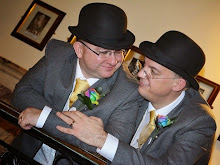
The photo isn’t even in a particularly identifiable setting, but I was born in 1970s Stockport with plenty of concrete and car parks around and clearly read ‘vaguely urban and like the places I know’ into the shot. After many years away, since I wrote the original version of this article I’ve also been living back in Stockport again – though the way back was less hard work than Blake’s. I moved back there with my husband Richard, who (unknown to each other at the time) was also watching Blake’s 7 all those years ago, and not that far away…
One of the absurd moments in Cygnus Alpha comes when, faced with the alien technological marvel of matter transmission, Blake and Avon immediately grasp it because – by an unbelievable coincidence – they had both worked on the same failed Federation “Aquatar” teleport project. “Small world.” They didn’t meet each other then. “Large project.” Not until the start of this series, with both of them on the prison ship London. I remember scoffing at two people with such different skillsets and backstories both having worked on the same useless project, never meeting, just so that years later the concept could come in so expositionarily useful in understanding technology that no-one on any world they knew had ever mastered. Absurd! A decade and a half after we each watched Blake’s 7 as boys, Richard and I found each other through our fluency in that series, Doctor Who and other tongues while I happened to be staying for a few weeks (or so I thought) in the East End. Our ‘Aquatar moment’ came not on the Liberator but on the almost as shiny and exciting Docklands Light Railway. What an absurd coincidence it would be for us to have both grown up in the same town but only to find each other in… London.
The Radio Times picture was posted by the quite extraordinary Twitter account @MakingBlakes7, which is the most brilliant continuing documentary project I’ve ever seen on Twitter. You can see that Radio Times Tweet by clicking here.
“Prisoners? New souls for the Faith.”
For this episode, it helps that it all looks rather stylish. I’ll admit that I often find something of the ‘that’ll do’ about Vere Lorrimer’s direction in his later work for the series, but here the night filming is striking and the projected backgrounds (yellow moon, forbidding citadel) as fantastic an effect as the series ever delivers. But it’s my Mum and Dad’s influence that really primed me to love Cygnus Alpha, though they’d roll their eyes at quite why. They’re both deeply religious, and I grew up going to two churches every Sunday, Catholic and Baptist. Add two competing versions of the same faith and a bright boy who read a lot, and I became steeped in religion, but at the same time asking a lot of questions and curiously open-minded about different flavours that all claimed to be the one true faith. Perhaps that’s why I was just as happy with two ‘rival’ sci-fi shows.
Doctor Who had gone through a year of dark religion that’s still to this day my favourite just before Blake’s 7 came along, and Cygnus Alpha spoke to me in just the same way. This was my world! Religion in all its scary but fascinating glory! My strange personal mix of free-thinking and immersion in dogma meant I was always more compelled by terror in the pews than Yeti in the loos. So, as much as day-after-1984 dystopia had grabbed my attention, it was Cygnus Alpha that was speaking my language and told me this was absolutely my sort of series.
“My word is law. My followers obey without question.”
For all that the Federation, like communist regimes of the time, has banned religion, Cygnus Alpha’s theocratic society is the Federation in miniature (though distinguished by a greedily ambitious figurehead rather than a faceless bureaucracy, Vargas prefiguring über-villain-to-be Servalan). The script is full of parallels between them, from the cruder version of Blake’s show-trial in this world’s “SO PERISH UNBELIEVERS” to the subtler point that, for all his cowardice, it’s Vila who’s still by nature the most wary of going along with authority, whatever form it takes – or clever juxtapositions like “the place of rebirth” and “Berthing sequence automatic”.
Perhaps the unambiguous connection of this theocracy with that already established totalitarianism is what gives the attack on religion such force. Even by the standards of science fiction using other worlds to get away with social critiques that would provoke too many complaints in a modern-day setting, this one pulls no punches (though the institutional child abuse was the Federation rather than the Faith). It’s not a case of using religious trappings to save on money or world-building, using historical window-dressing to tell a different story. One of the reasons this so appealed to little religious me was, ironically, what I’d expect to offend other believers most. It was about the ideas, not just the imagery. Underneath all the monk-like robes, the blasphemous crucifixion, the cruel crusader bust, the Inquisition torture imagery and echoing chants familiar from Gothic horror films, the script really is making a bitter attack on the very concept of organised religion.
“So you and those before you built your power on fear and ruled them with it.”

We saw back on Earth that the Administration maintain their power by surveillance and brute force, fear and drugs, suppression of ideas and the Big Lie. That mirrored totalitarian regimes of the time; now this mirror of the Federation in turn mirrors religious power. If there’s ever a daytime on this world, we don’t see it. Cygnus Alpha is symbolically in the Dark Ages, and for generations its people have been kept in the dark of ignorance. Just like Earth under the Federation, on Cygnus Alpha under the Faith you are always watched. Literally by guards in both, but where the Administration uses cameras everywhere, the Faith uses its God, explicitly invented as a tool of social control.
My husband Richard points out that the constellation of Cygnus is also known as the Northern Cross: both a religious allusion in itself and a reflection of the Southern Cross which is the symbol of Australia, a striking setting for a theocratic space-Botany Bay.
This mini-Australian mini-Federation doesn’t just swipe at religion in general but, true to its Gothic trappings, is as specifically anti-Catholic as any fevered Gothic text. It’s not just taking the fear of an invented death for the fear of an invented hell and proclaiming that the Faith is your only salvation. The Saruman-like hand is one of the production’s few symbols that isn’t obviously Christian, perhaps deliberately to make you focus on a fictional symbol and not on the words and their meaning: “Only from this hand comes life” coupled with a priest handing you a small, round, white thing to swallow that claims to be salvation but is in fact nothing at all? Could it get any more blatant? To look at the “life” held out and see a Trebor mint is to miss the point, but perhaps the very cheapness and obvious solution helps distract and avert complaints. Later dystopia V For Vendetta offered one poisonously satirical communion wafer, but this is a gob-smacking polemic against the whole idea of transubstantiation.
And the Curse of Cygnus (a near-homophone for ‘sickness’) catechised as divine punishment on every wretched inhabitant of Cygnus Alpha – all deserving it as either criminals in their previous life or descended from offenders by birth – from which they can only be saved through the Faith? That’s Original.
After this story’s impact, there’s no real follow-up to the theme; Blake’s 7 is never this savagely critical of religion again. It’s background colour in a few more stories, but they don’t have anything that feels so real. Cygnus Alpha does act as a prototype for more generic Blake’s 7 stories, such as generally the Liberator turning up at a planet of the week and bringing down the regime (or, in this case, leaving it in chaos and having to run away) or more particularly the primitive planet with a primitive people and a twist about something more advanced, usually involving a quarry and a more interesting B-plot in which the crew bitch at each other. Modern BBC sci-fi watchers might call that the ‘Utopia style’, though Russell T Davies’ Blake’s 7 homage brought an altogether rougher beast for its second coming. Perhaps the real thematic legacy of this episode isn’t equating the fierce religion of Cygnus Alpha with the totalitarianism of the Federation, though. Fittingly for my own complicated view of religion as both good and bad, there’s a parable here that’s closer to home.
“The architectural style is early maniac.”
These days I wonder if the whole thing’s not a great big warning about Blake.

If aged six, getting into the series, Cygnus Alpha confirmed that it was my sort of show, I was delighted by how it grew when watching the whole TV series right through again in 2014, aged forty-two. It wasn’t an episode I often chose to watch when I felt like a bit of Blake’s 7 (though I always loved it more than I expected when I did), but I’d thought it was one of the ones I had the clearest picture of in my head: the end of the beginning, fabulous Pamela Salem and Brian Blessed, evil religion plot with a different tone to the rest of the show, entertaining but a bit cheesy. It may well be all those things, but with a more critical brain and knowing the show well enough to put the whole thing in context, I suddenly felt there was a lot more to it.
Blake’s the hero and Vargas is the villain, so they must be opposites, right? Except that it doesn’t play that way at all. If the society of Cygnus Alpha is a mirror of the Federation, the extent to which its leader was not a contrast to but an explicit counterpart to Blake seems so striking that it’s hard not to see it as deliberate (with all the implicit consequences should Blake ever get into power that that entails). Blake getting a messiah complex in Series Two? This story more than any other reads like he’s been off on one since the beginning. Vargas and Blake face off, Brian Blessed and Gareth Thomas with similar intensity, their demands incompatible because the two of them both want the same thing: souls as currency to spread their belief, the power of their word, across the galaxy. Blake takes up his special handgun for the first time; the first to use it? Vargas. Avon’s warning to Jenna about Blake? “He’s a crusader.” Vargas rules by the Big Lie and forced ‘conversion’; Blake tells his followers they have a free choice, but keeps the truth from his first, sceptical disciples (“Did you see anything while you were down there?” “Not much”) and like Vargas gives the next batch of converts the choice of his way or death:
“Only from this hand comes life.”Three different characters this week all state that the prisoners have no choice, and in the end they don’t – whoever they follow, they’re still going to be followers.
Back on the London, Blake was willing to sacrifice himself so that his followers might live. Now we see the flip-side of that: if you’re not with him, you’re against him. He’s come to find new converts, but when they deny him in fear of the rival Faith, he rages at them instead: “You’re pathetic! …slaves! …I’m better off without you.” For all his rhetoric of freedom, Blake demands a positive choice to follow him – a leap of faith. Offering salvation to his own followers is one thing, but rather than sacrifice his messianic ideals he’ll let everyone else die. Vargas and Kara had watched the Liberator in the sky – a light in the darkness. They called it a sign, and it’s a guiding star heralding the new messiah, but we all know who that is, and it’s not the Blessed One whose hard certainty will be driving death after death in this series.
“A little more practice, we should be able to put you down with precision.”

In the context of the whole series, Avon’s appeal to Jenna that Blake would only use all the ship’s treasures to fight the Federation – though it turns out that Blake is never bright enough to realise how effective wealth would be as a weapon, and Avon is bright enough never to tell him – seems like foreshadowing.
“And he can’t win. You know he can’t win. What do you want to be – rich, or dead?”From almost the very beginning, you can see in hindsight warnings, prefigurings, fetches of much later events in the series, and perhaps it’s appropriate that this religious episode seems the most prophetic. Avon even aims his gun at Blake first chance he gets (though it’s only once he’s become a believer that he’ll fire). But Avon needn’t have been foresighted enough to see Blake coming down the road. I realise this time that he could just have watched where Blake’s been, already fighting to the last drop of their blood. Consider…
- Blake’s first rebellion, the series’ backstory: everyone else gets killed and he has his brain knackered.
- Blake’s second rebellion, the series’ opening: he only has to turn up out of vague interest and everyone else is massacred (while several children have their brains knackered).
- Blake’s third rebellion, last week: everyone’s rounded up and several of them get shot though, remarkably, most of them live. In chains.
- This week, Blake’s fourth rebellion: they’re only up against knives and knuckles on Cygnus Alpha, but he still manages to be one of only three survivors who leg it.
- Never mind the “Curse of Cygnus”; Blake is such a jinx that he only has to express a passing interest in a particular rebellion and 99% of them will die. On which subject, tune in next week…
“It didn’t answer any of your questions. More than that – it deliberately ignored them.”
There may be a certain irony in my having gradually given up belief in religion but gained a passion for politics in my teens, but I remain a free-thinker and just as ready to question my leaders as I was scriptures, and unlike Blake I’m more than wary of imposing my beliefs on others. For me, there was nothing like seeing how two competing church hierarchies that theoretically professed the same beliefs were both much more obsessed with control of individuals than individual belief to tip my own beliefs towards Liberal individualism, if not a hint of anarchism in observing that the best way to kill a belief is to set up a rigid structure to enforce it.
Though I wrestled with the theology for years afterwards, it was perhaps inevitably a confrontation with church authority which precipitated my eventual teenage crisis with religion. The surprise might be that it turned out to be with the smaller ‘free’ church rather than the more top-down hierarchy; the ‘Cygnus Alpha’ Baptists rather than the ‘Federation’ of Catholicism. Aged eighteen, I was teaching Sunday School for the kids; one Sunday I came in with a noticeable bruise and, asked what had happened by one boy, replied with the truth: I’d been walking down the road with my boyfriend and someone had hit us. The next week I found I wasn’t teaching Sunday School any more and that a tight-lipped “You know why” was the only explanation. My own moment of liberation came in realising not my fear, but theirs in their own repression; that they couldn’t bring themselves to talk to me, nor even do what a decent human being would do and ask if I was all right after I’d been attacked. The truth shall set you free, indeed, but not in the way they or I had expected it. That was the moment I lost all respect for that particular church because, after all, what was there to respect? And, fortunately, it wasn’t such a long walk back.
“That would have been very disarming if I didn’t know that you meant it.”

Zen and Jenna offer an intriguing alternative here, both a different angle on (explicitly non-Christian) religion and on what the series might have been had each of them kept such significant roles. How much does each affect the other when enigmatic ship’s computer Zen gets into its new pilot’s head? Jenna’s “to be completely known. It’s like – innocence” is more like a revealed religious experience than anything else in the episode, and without it, would she have hesitated to head off with Avon? Zen is characterised as a superior and evasive oracle with less obvious reactions – except one – but, taking its name and the ship’s from Jenna’s thoughts, does it make itself in her image?
“Wisdom must be gathered; it cannot be given.”Zen is a very different religious text to the certainties of Vargas and Blake, but how much of Zen’s resistance to direct is inspired by its pilot’s resistance to being dominated, as “the Liberator” it plucks from her desires suggests?
The best piece of bitching among the crew is an understated one from Zen, as it says in turn to the three of them:
“Welcome, Jenna Stannis.”It’s a masterclass in how to be an oracle while making it absolutely bleedin’ obvious what you think; Avon only gets a neutral reply when he prompts it. Clearly, it’s read his mind last week and Jenna’s here and decided it’s not going to like him well before he starts saying it’s “just a machine”. It’s a shame that Zen’s telepathy is lost to another crewmember long before it loses prime spot as ‘bitchy super-computer’. The series also swiftly drops this week’s attempts to pretend they know what they’re talking about on scientific ideas – Aquatar, negative hyperspace, the anti-matter interface – which is no great loss. It feels much more Blake’s 7 when the crew don’t know what they’re talking about, like Blake stumbling on using the teleport because he’s not used to it.
“Welcome, Roj Blake.”
That is all.
I do feel a little wistful about some of the other interpersonal dynamics that the story appears to set up: judging by Cygnus Alpha, there are now going to be three charismatic leads setting the direction, Jenna being the swing vote, with willingly violent killer Gan and his little friend Vila as wild cards, but it doesn’t work out that way… You can see here that Jenna has so much potential. Blake’s 7 began broadcast just as Star Wars first opened in Britain, so it’ll take a while for the film to start having any impact on the series, but compare and contrast even from the first the clean versus the dirty-handed rebels. One of this series’ great lost opportunities is still that its ‘Han Solo’ is a woman – which may be why she gets elbowed out of the way. But, still to come, Blake’s 7’s ‘Tarkin’ figure will be a woman too – and once she appears, their ‘Darth Vader’-equivalent won’t stand a chance.
“You’re a free man.”
In 2014 I watched Blake’s 7 right through with my beloved Richard. But much as we enjoyed the series all over again, we’ll always remember 2014 for something much more significant to our lives together. We went back, not to the Dome – there’s one just across the river from our flat in London – but to Stockport. On our twentieth anniversary together, we got married at Stockport Town Hall.
I’d say that this was my personal triumph of freedom over dark religion, but freedom won for me so long ago that religion was barely a footnote. Though I still find stories powerful when they make strong use of religion, for good or ill, it’s only as I write this that I realise Stockport Baptist Church is a couple of minutes’ walk from the Town Hall. It’s not something that crossed my mind on the day (though I probably quoted Blake’s 7 at some point). When we made the most important decision of our lives, we were surrounded by believers in several kinds of politics and faiths and in none, including my very proud and happy Mum and Dad, but we chose each other and we chose all the people we invited for love and belief in ourselves.
The Apocrypha: Trevor Hoyle’s Blake’s 7
“Hands reached up and pushed back the cowl to reveal Kara’s evil, haunting beauty – a face that was disfigured by a kind of lustful greed… a smile that was rapturous and yet somehow obscene…”

There’s another alternative world of Blake’s 7, and of Cygnus Alpha. I was already a voracious reader when Blake’s 7 turned up, but though my memories of Cygnus Alpha are thoroughly entangled in Trevor Hoyle’s first Blake’s 7 novelisation (like the first VHS release, compressing the first four episodes), I didn’t return to it as nearly often as Target’s Doctor Who range. Wondering why, I accompanied my 2014 rewatch by buying the audiobook versions, with this part now read by Paul Darrow… And, yes, I can understand why; Hoyle’s writing style tries to be hard-boiled and usually just about hits pedestrian. The CD readers liven him up, but the main interest is the differences from the TV versions – it seems that the first book is from early drafts of the scripts, and without having seen most of the actors, while the Liberator is described backwards. My guess is that these are unadulterated script writer Terry Nation, before script editor Chris Boucher came along; there are notably fewer sharp one-liners and a much smaller part for Avon. The biggest point of interest, unexpectedly, may be his take on Time Squad, for a very different backstory to both Gan and the assassins (though Zen is far less intriguing); the biggest wasted opportunity that Hoyle seems to stick too rigidly to the scripts rather than, say, establishing Arco and Selman with roles in the London rebellion now the actors don’t need paying for an extra episode.
The very ’70s stylistic tic that most sticks out today, though, is that suddenly we’re plunged into an alternate version of Blake’s 7 where (speaking of adultery) every woman is there to be leered at. Men get sexually neutral or ugly descriptions – let’s hope he’d not seen poor Michael Keating when Vila’s a “gargoyle” – but every woman is objectified at length and, if they’re baaad girls, all the more titillating! I suspect this may have put me off when I was a boy, but hearing Gareth Thomas and Paul Darrow having to read all this first made me wince, then laugh. Though I’ll give Hoyle the benefit of the doubt that there’s an earlier Gareth Thomas series in-joke in there, I did actually laugh aloud as Paul Darrow purred:
“Avon casually looked round and then sat up straight, his eyes popping out of his head. His first thought was to wonder how a beautiful and sexy star maiden had managed to get aboard the Liberator and it took all of ten seconds to realise that it was Jenna, attired in the most magnificent – and rather revealing – space-age costume.”Or, ‘Why, Miss Jenna, you’re beautiful!’
Avon follows this by swallowing in “goggling admiration” and “real appreciation”, her with “impish seductiveness” as she’s “coyly” “posing for him”. Later, Cally will be a “young”, “stunning-attractive girl”, “incredibly beautiful”, “athletically supple”, and Blake will be unable to fathom why a “beautiful girl” should be wearing combat gear. Dear [ Blessed ]GOD![ /Blessed ] She will also have amazing eyes the like of which Blake has never seen but which the author won’t describe, so they might boggle out on springs for all we know. At least Blake won’t actually ask her what she’s doing in a place like this.
But where Hoyle really gets excited is the female villains, who are beautiful – but evil, but sexy – but evil! What a mix. And a minx.
“His companion turned towards him… and in the flickering firelight it was a face of evil, the lips twisted in a rapacious snarl, yet even so with a fascinating, hypnotic beauty.Oh, put it away. The strangest thing is that the Terry Nation draft of the script forgets about her at – forgive me – the climax, and so bizarrely does Mr Hoyle. You’d think he’d have been faster to write her an unconvincing last moment than the one Chris Boucher seems to have stuck in. ‘Only the love of a good violent criminal she’s kissed once could free her from being the Sexy Nun of Evil…’
“‘New souls for the Faith,’ said Kara in a throaty whisper, her eyes alight with sly rapture.”
Paul Darrow clearly enjoys all this schlock too, as well as capturing Gareth Thomas’ intensity rather well for Blake and compensating for half Avon’s part not having been written yet with a compelling emphasis on his own character’s lines that makes his every. Word. Twice. As. Avonnn. The whole thing is hammy as hell but very entertaining, and far more so than the prose deserves.
So it’s a good job that the TV version was so absolutely perfect – not perhaps entirely perfect as a piece of television, but perfect to broadcast directly into my six-year-old world and open up a new one.
“Let’s all go! Er… No, on the other hand, let’s all stay.”

Last year I found that I couldn’t bear blogging any more. I wish I could say that, with the pressure off, I’ve been able to write plenty of articles for my own pleasure and that this is the herald of more to come. I’m sorry. I haven’t. It isn’t. So this is perhaps a coda – something I’ve not previously published, but which isn’t technically new.
Cygnus Alpha and Omega was first published in 2015 in the book Blake’s Heaven, a collection of personal perspectives on every episode of Blake’s 7. I was delighted to be a part of it and surprised I managed to write something, though that delight has since been marred by the horrible circumstances in which the book has been withdrawn and which I don’t want to think about. But with the fortieth anniversary of the series this year, I re-read my contribution and decided it was worthwhile enough not to go to waste. It’s more personal than most of my writing, and I found as I was putting it together the first time that how resonant the themes – and some of the coincidences – were to my life. Well, bits of it.
I’ve spent a ridiculous amount of time re-reading, re-watching and re-writing in tiny perfectionist polishes preparing for tonight, some of it no doubt procrastinating to avoid having to make the decision whether or not to put something else on my blog. I have. I hope you enjoy it.
I am, at least, enjoying Blake’s 7 all over again. For what it’s worth, though Cygnus Alpha has its own special place for me, my particular highlights of the series are:
- Rumours of Death
- Star One
- Sand
- The Way Back
- Terminal
- Orbit
I’m sorry this isn’t my way back to blogging. For something cheerier, you might look up another great piece of BBC sci-fi; first broadcast on TV thirty-seven years ago this week – though, like this article, it had already done the rounds in other media – I find myself thinking of The HitchHiker’s Guide to the Galaxy Episode 3. Magrathea doesn’t properly revive from its long slumber, merely turning in its sleep to put a new spin on a previous work, but that too is about religion and, for all that I know how badly everything turned out, that it’s a cosmic joke and that the new beginning isn’t going anywhere, there is a moment at the end of that episode that still moves me more than almost any other piece of television. This piece of writing is nothing like that. But I am quite fond of the crinkly bits round the edges.
Labels: Bigotry, Blake’s 7, Books, Brian Blessed, Gay, Personal, Religion, Richard, Star Wars, The Hitchhikers Guide To the Galaxy


Friday, December 23, 2016
Five Reasons to Read Doctor Who and the Auton Invasion – Doctor Who 52 Extra: D (SE)
Introducing Doctor Who and the Auton Invasion…
Shop window dummies that come to life, the Doctor given a new ‘family’ on Earth and a touch of bitchy soap opera… No wonder this was such an influence on Russell T Davies that he wrote the introduction for the new edition. Terrance Dicks’ first book novelises the thrilling TV story Spearhead From Space, making it more thrilling still from the title on through – one of the best Doctor Who novels ever written, and creating an irresistible monster that never quite made it to TV: “something between spider, crab and octopus…”
Robert Holmes’ 1970 adventure Spearhead From Space is one of the best-known Doctor Who stories – it introduced Jon Pertwee’s Doctor, the Autons and even colour to the series, was among the first to be released in video, DVD and book form, and with its mixture of action, horror, comedy and really aggressive department store sales windows, inspired 2005’s even more radical relaunch, Rose. It was first broadcast before I was born, so I grew up loving the Third Doctor’s adventures in their Target Books adaptations, and only caught up with the TV versions on VHS about two decades after transmission. The Pertwee books are arguably Target’s golden age; the TV originals rarely matched the pictures the novels had conjured in my head. I still think of this as the ‘Pertwee gap’ where this Doctor’s novelisations far outstripped his TV stories, and Spearhead From Space, too, gains a great deal by becoming The Auton Invasion… But in this case, it doesn’t mean that Spearhead From Space is a disappointment. It’s one of my favourite TV Doctor Who stories. The first two books Target commissioned were for me the two best Third Doctor stories, and they made them better still. The Pertwee gap here means that The Auton Invasion is simply fantastic.
These days you might call The Auton Invasion and some of those other remarkable Target novels as Special Editions… And as this is another of those pieces I first wrote last year and, after admittedly not quite as dramatic a health crisis as the Doctor has here, they then trailed off a few down the line, you might think of this a Special Edition of sorts, too. Just not quite as Special as Terrance’s.

Five Reasons To Read – or Listen To – Doctor Who and the Auton Invasion (warning: spoilers lower down the list)
1 – The Nightmarish Nestene.
If you see this story on TV, you remember the Autons. If you read the book, you imagine the Nestene. You might say this is a spoiler to start with, save for it being on the cover and difficult to miss (and not just on Chris Achilleos’ original 1974 cover, either)…
“Standing towering over them was the most nightmarish creature Liz had ever seen. A huge, many-tentacled monster something between spider, crab and octopus. The nutrient fluids from the tank were still streaming down its sides. At the front of its glistening body a single huge eye glared at them, blazing with alien intelligence and hatred.”Much of Terrance Dicks’ book description simplifies: the not-meteorite energy units are green spheres rather than complex polyhedrons; the factory receptionist expressionlessly doll-like; the walking dummy Autons much more blank. It’s effective. The repeated emphasis on Autons looking like half-finished waxworks, or having an enormous but peculiarly horrible hand – “It was completely smooth and white, and there were no fingernails” – that drops away to fire sizzling bolts of energy from the empty wrist instantly conjure mental images without complicated detail. The exception is deep within the factory that builds the Autons, where a body is growing to house the controlling majority of the Nestene Consciousness, the group mind animating all the living plastic for the invasion. The book teases this repeatedly to build anticipation, most effectively at the close of Chapter 6, where the Autons become more threatening yet and a series of short, understated sentences at the end give closure to an earlier attack. The audiobook version has much less in the way of music and sound effects than later Target CDs, but both steady narration by Caroline John (fabulous scientist Dr Liz Shaw on TV) and a strange alien glugging sound build up particularly eerily there too.
The book climaxes with the Doctor and Liz Shaw reaching the heart of the factory, where something enormous heaves, seethes and bubbles in a great tank (which the fascinated Doctor walks round “as if contemplating a swim in it”). On TV, a few limp tentacles emerge – then, in the sequel a year later, just a fuzzy video effect – without being entirely convincing. In the book, there’s no disappointment when the whole side of the tank shatters open and the “huge, many-tentacled monster something between spider, crab and octopus” rears unforgettably into our imaginations.
Where the cover paintings of most Doctor Who novelisations take pictures from the TV show as their model, Terrance Dicks’ Nestene created not just a nightmare but a challenge impossible for many artists to resist. Chris Achilleos paints one lurking on the cover, then gives it much more detail in a starring eruption as the finale to his internal illustrations, followed by other artists competing with further editions. The first sequel, Terror of the Autons, took similarly vivid descriptions from Terrance and let Peter Brookes’ imagination soar into a comic-book Cthulhoid horror that wraps its way around the front of the book, with Alan Willow having a go of his own inside the pages – then the second edition boasted Alun Hood’s horribly photo-realistic glaring eye, writhing tentacle and ickily teeth-like suckers. Even the back cover excitedly talks up
“a malignant, squid-like monster of cosmic proportions and indescribably hideous appearance.”And yet Terrance’s description provides what’s still the most unforgettable mental image of all the Target books, inspiring artist after artist and proving that however powerful the design in front of your eyes, the most memorable horrors remain the ones you imagine.

2 – All Doctors Are Gits.
The Doctor and the Autons both look human, but the book goes to even greater lengths than the TV version to emphasise that neither really is – from the very first, poacher Sam Seeley sees both the ‘meteorites’ and the Doctor landing, and it’s the Doctor that frightens him more. But that’s not my favourite parallel for the Doctor here. The comatose Doctor is brought in to the local cottage hospital, and suddenly the story has a sort of fun that’s rarely found in Twentieth-Century Who. It’s no surprise to have tea and bullying bosses as signatures of normality, but when there’s so much more than those on top you begin to remember that Terrance had written soap opera, too. The original script had plenty of hospital scenes, but the book expands them with full-on soap gossip, rivalries, and everybody on the make (just like Sam, a doomed businessman and even an army corporal later in the book).
A nurse gets the worst of it to start with, trembling at Dr Henderson’s sharp tongue when he shrieks with anger over the two hearts on the Doctor’s X-ray, then when Henderson’s “old enemy” Dr Lomax in Pathology rings to complain too, she “almost dropped the ’phone from pure terror”. In just a few pages, Terrance sketches in a history of bullying medical horrors, with Caroline John’s reading on CD making it all even more entertaining. But that’s nothing to when the hospital’s senior Surgical Consultant Mr Beavis shows up with his “high-handed, lordly manner” that terrifies even the doctors – not least our own favourite one, when he overhears that Beavis regards him as “some kind of interesting freak. Probably plans to open him up and sort out his innards for him.” Which rather reminds me of some of the more careless consultants not just when I was hospitalised this very month but also and still more disturbingly hack-happily in 2014, so it serves him right when the Doctor nicks his car to get away. If it came to it, I might have legged it too.
I always wonder, though – are we being lulled into liking the new Doctor because every other doctor in this is a total git or a complete monster? Or are we being warned by implication that this Doctor’s imprinted on them just after rebirth and thinks doctors ought to be arrogant workplace bullies?

3 – Terrance Dicks.
One of Doctor Who’s most significant writers, Terrance Dicks wrote several TV stories and was the show’s script editor (similar to today’s lead writer) for five years, but it’s with Doctor Who and the Auton Invasion that his even greater role began: he went on to write nearly half the Target novelisations – and hundreds of books altogether.
Terrance’s first novel is still for me his best. He puts in enormous creativity, and you can see immediately that he’s a natural prose as well as script writer – people often talk about his ‘deceptively easy’ style, but I’ve read an awful lot of Doctor Who authors and few of the others manage Terrance’s ‘effortless’ flow even when trying for all they’re worth. His style’s all the more effective for having plenty of action and humour, but understating both. Crisp, dry and with deft touches of horror and sketched-in one-line character backgrounds to help us empathise (often immediately before they’re blasted down), he’s aware that he’s writing in part for children but is never patronising, though occasionally simplifying, such as calling the more advanced doppelgänger Autons “Replicas” rather than “facsimiles” (it would be another decade before the term facsimile would be in common use, but even then associated with sinisterly smooth businessmen who want to take over the world). He’s responsible for generations finding how exciting reading can be.
One of Terrance’s best-known devices is his use of simple, memorable descriptions – and reusing them. Chapter 6 contrasts a comedy car sequence with a very different action-based one, and here we get the first but not the last outing in one of Terrance’s books of a soldier emptying a full clip of bullets into a monster, plainly seeing a line of holes appearing across its chest – but there’s no blood, and the thing just keeps on coming (Terrance considerately also has the man recognise that it’s not human, to reassure us that the army don’t just fill you full of lead when spooked). The Doctor’s driving, by contrast, is already ridiculously accomplished and appalling for the passengers. But it’s not just set pieces like those that recur, but phrases: fanatical alien villains are already “exultant”; doomed characters already stare “in horrified fascination” or react “with unbelieving horror”; multiple ‘Doctor who?’ puns even come with in-character laugh-tracks. All these will become very familiar, though he’s not yet settled into a pattern of short, punchy chapters each ending in their own mini-cliffhanger: compared to the rest, the final chapter is enormous and would make at least three in one of his later books. But his most famous description is here, when the TARDIS materialises right back in Chapter 1:
“…a strange wheezing and groaning filled the air.”

4 – The Auton Invasion.
You can probably tell from the title where the book’s heading, and it’s a stunning tour-de-force. Like the similarly outstanding Remembrance of the Daleks novelisation, it makes even the series’ most thrilling action sequences seem broader, bigger-budget, and more compelling. Auton dummies coming to life behind high street windows is such a vivid image that it relaunched Doctor Who twice on TV – as well as being remade in multiple pop videos and even Pringles ads – but for me the one that still most enthralls me is on the page.
The Doctor and Liz have worked through the night on a device that could disrupt the Nestenes, but in the London dawn the city is coming to life in more than the ordinary way:
“Soon a normal, bustling London day would be in full swing. But this day, in London, and in cities all over the country, was to be like no other. This was the morning of the Auton invasion.One street and one copper draw us in, but the action telescopes swiftly out to the whole country. Autons blast people down in the streets of every major city; the police are overwhelmed by thousands of calls; it’s so serious that Terrance even mentions ITV as well as the BBC issuing urgent warnings to stay inside and barricade your home, before Autons destroy transmitters along with phone exchanges and fire stations. But the really effective part is when he widens the scope to full-on fifth columnist paranoia, with every response going wrong as ministers and senior officers give confusing or deliberately damaging orders – before their hands drop away to reveal Auton guns. It’s leavened by a few scattered examples of ‘hope in the ordinary people’s pluck and bravery’, but for the most part the invasion is pages of grim despair:
“In the shop windows and in the department stores the mannequins stood waiting. A policeman patrolling along Oxford Street cast a casual eye at the window display in one of the big stores. A group of window dummies, dressed in bright, casual sports clothes, sat under a beach umbrella in a cheerful seaside setting. The policeman thought longingly of his own holidays. Only another two weeks… As he passed on his way the mannequins posing round the table stirred and came to life. Jerkily at first, they rose from their beach chairs and rugs. The tallest raised its hand in a pointing gesture. The hand dropped away on its hinge to reveal a gun nozzle.”
“Chaos… panic… confusion… Then, one by one, the outside ’phones went dead.”

5 – Where Do Autons Come From? …Actually, I wish you’d not told me.
“And Channing smiled a terrible smile.”The book’s main villain is “Channing”, the new partner at a plastics factory. On TV the guest star makes him eerie and detached, perfectly alien. Here he’s an unnaturally smooth businessman, immaculately dressed, with regular, handsome features, utterly bland until he looks at you with those blazing eyes – as if he’s empty but for an animating will inside him. Like a waxwork come to life, the book suggests, or like Tony Blair with Margaret Thatcher’s eyes. He spends the novel dominating factory manager Hibbert with his alien will and revering the thing in the tank that is to come after him. And however terrific the Auton Invasion itself, for me the most gripping moment in the book is the revelation when Hibbert finally manages to free his mind enough to ask him a question…
“‘But what’s going to happen to us—to Man?’ The full horror of it suddenly came over Hibbert. ‘You’ll destroy us.’That always gave me a thrill of horror when I was a boy – and others, too. Russell T Davies’ lovely Introduction to the 2011 edition not only talks about meeting his first fan through Target books (though his “doomed to never marry” shows how far we’ve come already since), confesses to childhood theft and praises Sir Terrance, as he should be, but picks that same line as the one that gave him chills and thrills. Can you spot the lines in Rose that came directly from this book, rather than the TV version? A young Alan Moore uses the same terror at the heart of his Auton tale Business As Usual (pairing him with Alan Davis before V For Vendetta). And the Terrance turns of phrase that I’m willing to bet stuck in a young JK Rowling’s head aren’t just stock descriptions like Professor Flitwick’s Pertwee-like “shock of white hair”; at the climax of Harry Potter and the Goblet of Fire, Voldemort, too, smiles a terrible smile…
“Channing’s voice was soothing. ‘Not you, Hibbert. You are our ally. You have helped us.’
Hibbert said dully: ‘And you… you’re not human.’
“‘I am part of the whole, Hibbert. Nestenes have no individual existence. This body is merely a container, Hibbert. You should know that. You made me.’
“And Channing smiled a terrible smile.”

What Else Should I Tell You About Doctor Who and the Auton Invasion?
You can probably tell that I’d put this in my two or three favourite Target novels, and often still simply my favourite of the lot. But it isn’t entirely perfect. This was the book that introduced me to Dr Liz Shaw. When I was a boy, I loved the way she, the Brigadier and the Doctor worked together. Like Polly, Ben and Jamie and Barbara, Ian and Susan, they’re a team from stories that were broadcast before I was born but sang off the page in the novelisations, each group a mix of men and women, but especially each with one woman who shows she’s got a brain and some gumption, who can stand up to the Doctor. They felt so utterly right and I’ve adored them ever since. And yet now I know the TV version too so well, the book is at just a slight disadvantage for each of them. The obvious is that it can’t help missing something that the actors gave it on TV. Liz still comes out of it well – well, after all that, I would say that, wouldn’t I? Lacking Caroline John’s sarky brilliance, but neatly emphasising her scientific ability and curiosity as the outsider finding her way into this weird set-up, the proof of the pudding is that I went to primary school with two Elizabeth Shaws, but I still thought this one was fantastic. Brigadier Lethbridge-Stewart’s characterisation, though, is more confused.
On TV, this is possibly Nicholas Courtney’s best performance and probably his best part as Alistair Gordon Lethbridge-Stewart, the leader of the army UNIT tasked with investigating uncanny happenings. For the first half of the story, he’s the lead, and he’s an intelligent young officer, an urbane, incisive, highly efficient professional, briskly in charge and pedeconferencing decades before it was fashionable. Terrance Dicks wrote this four years later, by which time the Brig was more a comforting fixture and never threatening to steal the show from a domineering Doctor who’d often treat him as the comic relief (though with Nick always retaining some dignity). And in the novel the Brigadier keeps switching between these two poles. He’s never quite a buffoon, but we get internal monologues about what a cushy job he’d been expecting, or his moustache bristling with military fervour when he thinks he’ll get the chance to bomb something, and he loses his own sardonic jokes as he becomes the butt of the narrator’s instead. Crucially, you can see why ambitious, modern TV Brigadier would pick Liz as a scientific adviser, but not how fuddy-duddy stereotype book Brigadier would. But then his best television scene, surrounded by journalists, comes off nearly as well with a very different treatment here, while he has stone-cold serious moments silently spotting the villain or even calmly awaiting death after running out of the machine-gun bullets he’s been blazing away with to cut Autons in two. And for a character that Terrance instinctively thinks of as cosy, it’s noticeable that four chapters out of ten begin with him tearing a strip off his captain (no wonder that one doesn’t come back). The book has a similarly contradictory attitude to the army in general, even more than the script does: on the one hand they turn out to be the Doctor’s friends and shoot up Johnny Alien; on the other, a tired, jumpy sentry shoots up Doctor Alien, too, and they’re not just problematic by human frailty – an Auton Replica hijacking the chain of command implicitly suggests soldiers are brave but too easily misused by abrogating moral responsibility to the group.
Even the most establishment Doctor here gets several anti-establishment moments, starting with a Mr Benn joke, so despite Terrance Dicks overseeing most of the Doctor’s time as UNIT’s scientific adviser, you can credit him with still pointing out that it should never be an easy fit.
And, if you need one, my score:
10/10.

If You Like Doctor Who and the Auton Invasion, Why Not Try…
More Terrance Dicks, obviously. He’s gone down an astonishing long path with Doctor Who, with scripts from 1969’s The War Games to 1994’s Shakedown – Return of the Sontarans, probably the most successful of the straight-to-video while-it’s-off-the-air spin-offs. Mainly, though, it’s other books, his own ‘original’ novels – which usually have fun with elements from his own TV scripts, though World Game playfully rewrites the Prologue of The Auton Invasion – and the legion of Target adaptations. So I’m going to pick…
Doctor Who and the Terror of the Autons. Terrance’s 1975 Auton sequel novelisation established them as Big Monsters for a generation of readers who, like me, hadn’t been born when they were on TV. This too is from a script by Robert Holmes, who Terrance has often said inspired his best books because he was simply Doctor Who’s best writer, and has nastier jokes, the Master and a much greater improvement on the TV version. I’ve previously written about it in considerable detail (and with a picture of me as a little boy, as it was something like the second book I ever bought).
Doctor Who – Made of Steel. This one’s from 2007, with David Tennant’s Doctor and the Cybermen. It’s one of Terrance’s most recent books, and the best of his original novels in about the last twenty years. Short and crisp, this “Quick Read” is hugely entertaining: Terrance does a brilliant job writing a punchy new series adventure, with a London landmark in trouble, absolutely nailing Mr Tennant’s speech and persona, borrowing its opening from the first Doctor Who story I ever saw – by Terrance – and, if you read with the right eye, giving simple but elegant put-downs along the way to both Primeval and Torchwood.
Though also see if you can find Alan Moore and David Lloyd’s Business As Usual, a 1980 Doctor Who Weekly comic strip of the nastily ironic final ‘The End, dot dot dot question mark’ kind (think Saki, or Tharg’s Future Shocks), that does a very similar little Auton plot as some kind of macabre joke.
Labels: Books, Chris Achilleos, Comics, Doctor Who, Doctor Who 52, Doctor Who and the Auton Invasion, Harry Potter, Health, Jon Pertwee, Personal, Pictures, Repeats Er I Mean Special Editions, Terrance Dicks
Monday, December 19, 2016
Five Reasons to Read Doctor Who In An Exciting Adventure With the Daleks – Doctor Who 52 Extra: B (SE)
Introducing Doctor Who In An Exciting Adventure With the Daleks…
…as it was named when first published. Remarkably, the title’s still true. Even more remarkably, it’s now back in print in two different editions, one of them under the original title and the other simply as Doctor Who and the Daleks.
David Whitaker’s 1964 novelisation of the Doctor’s original encounter with the Daleks on their dead planet Skaro was the first ever Doctor Who novel. But on the page here William Hartnell’s original Doctor is less the lead character than one of many threats faced by first-person narrator-hero Ian Chesterton – a stylistic choice which both adds depth and feeling and gives the book an unusually ‘rugged adventure’ flavour.
Fifty-three years ago this Wednesday, the TARDIS first landed on Skaro and the Doctor and the viewers thrilled to explore the Dalek City with no idea what they would find there. This book came a year later, at the height of Dalekmania, and while by then everyone knew what a Dalek was, the book is its own way another go at starting the series rather than a straightforward adaptation – though it was another decade before the novel series really took off, spearheaded again by Doctor Who and the Daleks.
This blog post is also a sort of reprint or Special Edition, once again from a celebratory series I began last year. That was largely brought to a halt by my terrible health. Now it came to a standstill again a few weeks ago when I was hospitalised, and I’ve fallen behind, and my mojo’s fallen further. But I blench at the thought of starting it all a third time next year, so I’m making an effort to catch up. I hope…

Five Reasons To Read Doctor Who In An Exciting Adventure With the Daleks (warning: spoilers lower down the list)
1 – The first person.
“I began to feel better. The Doctor had told me the wisest thing to do would be to open my mind and accept what had happened.Reviewers tend to talk about how influential the first ever Doctor Who novel was. By definition, of course – it started the lot, twice. Its Target Books 1973 reprint spearheaded a massively successful series of novelisations over the next two decades. But the moment you start reading, one thing jumps out that sets it apart from almost all the others – the first-person narration by Ian Chesterton gives it much more of a different feel to the TV version even than the many changes of story detail. It was more than twenty years and nearly a hundred more novelisations until Target published another first-person narrative, and though Donald Cotton’s three books (The Myth Makers, The Gunfighters and The Romans) also featured William Hartnell’s Doctor they’re played for comedy, and that’s nothing like the tone here.
“I did.”
This novel starts starkly: Ian is in a savage mood after a terrible day, and it’s about to get worse than he can possibly imagine. Where on TV Ian was paired with fellow teacher Barbara and they discovered the mystery behind their pupil Susan together, here he begins utterly alone, trusting nothing and nobody he encounters, with even Barbara a stranger to him. All of this makes the book far more about Ian and his feelings, perceptions and prejudices than any other, seeing the Doctor in particular as incredibly alienating and even malevolent, in contrast to the TV’s more impish mischief (down both to Mr Whitaker rewriting the Doctor’s lines and actions and losing Mr Hartnell’s irrepressible fun in the role even when he’s playing Doctor Git). It’s a great relief when he eventually starts to relax a bit.
2 – The first person being read by the first person.
Back in 2005, this was also the first Doctor Who novel released (in various formats) in what’s become a continuing audiobook series. Perfectly, the reader is William Russell, who played Ian on TV and many years later inhabits the role again vividly. He still has a marvellous voice and sounds like they’re his thoughts, rather than just reading them, and it’s still one of the best, despite its music and sound design being much more minimalist electronica than later releases.
3 – Author David Whitaker was Doctor Who’s original lead writer.
David Whitaker was one of the main creative forces at the very start of Doctor Who, its first Story Editor, and this novel breathes with his understanding of ideas for the series. One of his fascinations was the TARDIS itself. For TV he wrote scenes of its fabulous food machine; given a novel to play with, he adds more of it – plus similar details for the Thal people, who serve hot Ratanda because every civilised race must have something like tea – along with a little buzzing barber robot and the TARDIS home appliance I most wanted, the oil and water shower that cleans and tones you and exercises your muscles without your having to do anything. It’s this more than anything else that seems at last to start rubbing Ian up the right way, so to speak.
4 – The pictures.
Published all over the world and with many different covers, the most memorable and the one on the current paperback edition is Chris Achilleos’ striking image used to launch the Target Books range. It isn’t technically a great likeness of William Hartnell, with fabulous comic strip-influenced Daleks and a stylised TARDIS… But for all that, it’s one of the most iconic covers in the series, thrillingly composed with flaming Dalek gunfire and a Doctor that contains all the swirling galaxies, making him mysterious, dangerous and unforgettable.
The early novelisations also had internal illustrations, and this is the only one to have had two contrasting sets. Arnold Schwartzman’s are detailed sketches based on BBC photos and have lasted from the first edition through to the current ones – but for me the unique 1965 Armada paperback wins with its odd pictures out, Peter Archer’s less ‘correct’ but more excited drawings inspired by the book rather than based on the TV. He gives us a very buff Temmosus dying in a blaze of Dalek fire – the first – for example, and a memorable glass Dalek…
5 – The glass Dalek.
Terry Nation’s TV script was given massive boosts by the actors, by Brian Hodgson and Tristram Cary’s eerie soundscapes and, above all, by Ray Cusick’s fantastic designs both for the petrified jungle and metal city that make up the world of Skaro and for creating the Daleks themselves. David Whitaker is stripped of all these advantages and just left with the script. So, like the writers of several Doctor Who adaptations after him (perhaps most notably Malcolm Hulke), he makes sweeping changes, not just obviously cutting scenes where Ian’s not present – losing much of both the Doctor’s and the Daleks’ roles – but changing story and characters to fit his own.
The most famous change is the book’s opening. The Daleks had been Doctor Who’s second story on TV, but with novelisation (let alone video release) in prospect of the first, An Unearthly Child, Mr Whitaker offers an alternative beginning, starting with a meeting in the fog on Barnes Common, dangerous from the first in a very earthbound death followed by an unearthly twist. It offers none of the plot of An Unearthly Child but a similarly abrupt coming together of Ian, Barbara, Susan and the Doctor (with several of the same lines, suggesting dialogue Mr Whitaker had added to the initial scripts).
The most pervasive changes are in the characters, with the relationship between Ian and Barbara here developing from resentment to romance (‘Women are strange!’) and in the Thals, the other race on Skaro, who here are much more physically ‘perfect’ for Boys’ Own adventures like climbing the impossible cliff, with Kristas promoted from ‘Thal at the back with a few lines’ on TV to a giant with the most magnificent musculature and so the most lines to go with it (‘Men have admirable bodies!’). Mr Whitaker also has a very different conception of their pacifism than Mr Nation: in this version, Ian arranges a boxing match to teach them to be suitably manly which then goes hilariously wrong, and there’s none of the TV story’s ‘dirty coward who must redeem himself by dying like a Man should’.
But the most memorable change is in the Daleks. The book’s erratic descriptions of their machines and their voices pale next to the TV, but Mr Whitaker revels in more ghastly descriptions, none more effective than their leader in a glass casing, jumping up and down in constant fury before being smashed in the book’s own far more effective climax. One of the most strikingly influences Doctor Who In An Exciting Adventure With the Daleks had was in inspiring a glass Dalek design that finally appeared on TV more than two decades later, though it had a little earlier success in influencing other novelisations: the chapter title Escape Into Danger becomes iconic and much-repeated (for some reason The Last Despairing Try didn’t catch on).

What Else Should I Tell You About Doctor Who In An Exciting Adventure With the Daleks?
From the 1964 edition first published by Frederick Muller, through launching the Target Books range in 1973 that carried on for another hundred and fifty novelisations and many New Adventures beyond, to the 2011 BBC Books ‘special edition’ with background notes and an introduction by Neil Gaiman, Doctor Who In An Exciting Adventure With the Daleks has been republished more often than any other Doctor Who book. Just last month, the latest reissue went right back to the beginning with a hardback facsimile of the original Frederick Muller. And no wonder. It’s still a cracking adventure story, and it was based on one of the most important Doctor Who stories: The Daleks (sometimes called The Dead Planet or, by pedants, “The Mutants”), the Doctor’s second ever adventure with the first monsters, the reason why the series is still going strong today. You can buy the TV version as part of the Doctor Who – The Beginning DVD Box Set and in several other releases.
The book’s downside is that its attitudes sometimes show its age, magnified by giving us Ian’s inner thoughts and making it all that heroically physical Boys’ Own adventure. Women are stranger creatures than the Daleks at times, and while Ian is attracted to Barbara he finds heavily muscled Thal men far easier to bond with (Thal women getting about a paragraph and likened to precious jewels). On the bright side, just because Ian doesn’t understand Barbara doesn’t mean she doesn’t have a personality, even if we have to infer the bits Ian misses and she’s a long way short of Jacqueline Hill’s terrific character on screen. I’m still taken aback every time he meets an injured “girl” in the fog and it’s not teenage Susan but grown woman Barbara, though. Even to set up threats with petrol and introduce the Doctor’s “everlasting matches,” Ian’s cigarettes are briefly startling and won’t be found anywhere else (just as the Doctor only ever smokes a pipe in An Unearthly Child, which in this case I’ll call the television alternative first story). Perhaps the element of the adaptation that works least well is in Mr Whitaker’s enthusiastically hideous descriptions of what lives inside a Dalek casing, and the reactions he has the Doctor and Ian give to it. There’s always been a tension between Doctor Who’s wonder in the alien and ‘green scaly rubber people are people too’ ethos and its presenting ugly monsters to scare us, and rarely is that more blatant than in The Daleks, the first time viewers were given that contradiction. On screen, the Doctor says it doesn’t matter what form an intelligence takes and the Daleks are evil because they dislike the unlike – but they’re also physically repugnant, while the Thals are presented as attractively Aryan. In the novel the awkward subtext becomes the text, as on seeing the slimy, hideous thing inside the Dalek machine, the Doctor confirms that if he’d not made up his mind about them, one look at it tells him it’s evil! So that rather undermines the moral.
And, if you need one, my score:
9/10.
If You Like Doctor Who In An Exciting Adventure With the Daleks, Why Not Try…
Practically any Doctor Who novel owes a debt to this in one way or another, most immediately the other two 1960s novelisations, Doctor Who and the Zarbi and David Whitaker’s own Doctor Who and the Crusaders (each now also back in print both in paperback ‘special editions’ and in hardback nostalgics). And of course the original TV version, the feature film adaptation and even the colouring book adaptation of the film version. The 1985 TV story Revelation of the Daleks finally brings a glass Dalek to the screen, and is brilliant. They should have built another one to be the Dalek Prime Minister in 2012’s Every Dalek Ever Except the Ones That Aren’t story…
But I’m going to point out Mark Gatiss’ docudrama about the early years of Doctor Who, An Adventure in Space and Time, starring David Bradley as William Hartnell, for its opening on a police box in the fog on Barnes Common.
Labels: Books, Chris Achilleos, Daleks, Doctor Who, Doctor Who 52, Doctor Who In An Exciting Adventure With the Daleks, Pictures, Repeats Er I Mean Special Editions, The Daleks, William Hartnell
Sunday, November 27, 2016
Five Reasons to Read Doctor Who and the Cybermen – Doctor Who 52 Extra: A (SE)
Introducing Doctor Who and the Cybermen…
After some of my reasons to love the first Doctor Who I ever saw, what could follow but the first book I ever read? Gerry Davis novelises Patrick Troughton’s fight with Cybermen on the Moon – or, as the back cover puts it with charmingly oblivious self-deprecation,
“Can the Doctor defeat an enemy whose threat is almost as great as that of the mighty Daleks?”Can I find five reasons you should read ‘Invasion of the Also-Rans’? It’s time to sit down, mix yourself a celebratory Cocktail Polly, and curl up with a book.
This is another Special Edition post, complete with a new photo from this very June (or from 1975, depending on where you stand). About this time last year I had the brilliant idea of choosing an exciting variety of Doctor Who stories in an idiosyncratic order to run through the year, one every week, inspired by the fifty-second anniversary – and, just to make it still more unlikely, I planned an erratic series of sidesteps away from television Doctor Who. This was originally one of the pieces I managed to write before hitting the horror that is 2016. I’m not promising to get through the whole list this time, but at least I’ve made it to the second one…

Five Reasons To Read – or Listen To – Doctor Who and the Cybermen (warning: spoilers lower down the list)
1 – Prologue: The Creation of the Cybermen
“Centuries ago by our Earth time, a race of men on the far-distant planet of Telos sought immortality. They perfected the art of cybernetics—the reproduction of machine functions in human beings. As bodies became old and diseased, they were replaced limb by limb, with plastic and steel.When this story was shown on TV in 1967, it was called The Moonbase. When Target Books published it in 1975 as one of their first Doctor Who novelisations, they gave it a more sales-friendly title but picked a 1967 hand to write the rest of it in his functional but endearing prose. Author Gerry Davis had been Doctor Who script editor for the TV version of this story, and though it’s credited to Kit Pedler, Gerry Davis worked with him as co-author and as co-creator of the Cybermen. So before the Cybermen enter the text as stealthy presences, then unleashing terrible Cyber-chops or gruesomely electrocuting Cyber-weapons, Mr Davis makes an appropriate start here with a two-page Cyber-mission statement (just as his TV script gave the Second Doctor his own manifesto about terrible things which must be fought). It’s later borrowed to introduce two more Cybermen novelisations, adding to its legendary quality. For all its hyperbole and even inaccuracy, there’s still something terribly thrilling about it, and you imagine Mr Davis was only disappointed that it wasn’t read in portentous tones as it scrolled down a screen full of flaming space battles and legions of Cybermen marching across the stars with the strength of ten men! The Twelfth Doctor sniffing last year that nobody adds the prefix “Space”? If you want someone who does, Gerry Davis is your man. He gives you Earth-things. He gives you Space-things. And most of all, he gives you TERRIBLE CYBER-THINGS.
“Finally, even the human circulation and nervous system were recreated, and brains replaced by computers. The first Cybermen were born.”
Many of the more marvellous Target Books add much more to the stories that were seen on TV. Gerry Davis doesn’t add much, but he adds this. It’s enough.
2 – Anneke Wills reading the Audiobook.
Anneke Wills was marvellous as the Doctor’s companion Polly in 1967, and she’s just as marvellous reading the 2009 audiobook. She has a great storyteller’s voice: slightly deep, intimate and reassuring, with a compelling array of characters (though her accents are variable). Her Polly is of course perfect, and her rather breathy Doctor is especially compelling in his determination towards the climax. Interestingly, she uses higher registers for the Doctor’s other companions, the cute young men Jamie and Ben (hearing the line “they were able to follow Ben’s keen gaze” read aloud, I thought, ‘Yes, I know quite a few of those’). She breathes new life into the book with one of the best of the readings. There’s just one slightly flubbed line which tickles me, when she invents a rather unusual colour as a side-effect of a word being split across two lines in the original printing as Moonbase ‘night’ falls and we hear about “red-
dish-coloured lights”.
Half-way through the audiobook Ms Wills is joined by Nick Briggs as the voices of the Cybermen. He’s known for a great many Doctor Who monster voices and recreates those of the TV version. The two big Cyber-reveals are also my favourite pieces of the score, where the music climbs into an electronic rasp not unlike the Space Adventure theme that accompanied the Cybermen in 1967’s TV stories (and gets a bit of bagpipes mixed in when Jamie defies them!). They also get a tensely scored ‘stalking’ sequence towards the end of the first CD, and in a later chase sequence there’s a very effective echoing boom, which stands for both the terrible Cyber-tread and their desperately running victim’s heart.
3 – The Doctor.
Patrick Troughton was a very visual actor, constantly fascinating to watch, which makes it even more frustrating that the BBC junked so many of his performances. This book was my first experience of his Doctor, and it does a remarkable job of evoking him. The text introduces his famous “terrible things” speech with Polly seeing a “far-horizons” look in his blue-green eyes, making us pay extra attention, but it’s the first half of this Doctor’s famous mixture of ‘Free-thinking fun’ and ‘Destroy all monsters’ that’s surprisingly more vivid here. Losing control of the TARDIS like a ship in a stormy sea; miscalculating the date, provoking applause and laughter from a tense Moonbase crew, and still being pleased with himself for being just twenty years out, then being suddenly brought down when asked to do some work; his “relieved, almost silly grin”; all these stuck in my head as characteristics of the Second Doctor. But what most appealed to me were the passages in which the Doctor is trying to trace a mysterious Space Plague that’s struck the Moonbase personnel.
“It was into this scene of concentrated activity that the Doctor, armed with a bottle of swabs, specimen tubes and a large pair of scissors entered and immediately began to disrupt. He was doing what he enjoyed best; research for a scientific, or in this case, a medical truth. With a mad gleam in his eye, he moved quickly round the room snipping off pieces of the men’s overalls and putting them into bottles. Scraping their shoes and boots and taking swabs from their hands. He seemed not at all put out by the irritated gestures of his victims.”I think the author tells us an explicit moral for the Doctor’s favourite thing so parents wouldn’t cop that investigation isn’t what the Doctor loves most at all. It’s being disruptive. It’s the “mad gleam”, the winding people up, and the nodding happily a few pages later when accused of turning the base upside-down. That’s what appealed to kids reading this, and the way we remember him. It’s anyone’s guess why Gerry Davis talks about his “long legs”, though…
4 – The Space-Food.
Even when I was thin and tiny I loved references to food almost as much as I liked food. So what could be better than food as a major plot point? Gerry Davis’ vision of the future was full of Space-age ‘food concentrate’ that were always off-putting to the Doctor’s companions from the Twentieth, Nineteenth and Eighteenth Centuries and a sign of dehumanising Cybermen on your plate. It didn’t work. They fascinated me decades before I ever touched a microwave. So I’m still fascinated by the story’s use of – sugar. Not sugar spray, or reconstituted sugar pellets, but actual bags of it. It sounds reassuring and familiar amid all the suspicious Space Food. But how are the Cybermen spreading their not-really-a-space-plague to weaken the base whose controller, to fans’ delight, actually says “from our point of view, we’re under siege”? Spoilers and spillages: it turns out to be the good, old-fashioned, comforting sugar that’s betraying them. Though personally I’m always more suspicious of the cream, given they have to wait a month for a rocket even for medical samples.
5 – Polly.
“‘Here’s our holy water,’ said Polly, holding up the small bottle of nail varnish remover. ‘I’m going to do an experiment… Voilà cocktail Polly!’”Context makes such a difference. When I read this book as a boy, I noticed and was influenced by the multi-national Moonbase crew and lack of jingoism. Four decades later, the progressive message is obscured by interloper Polly being the only woman (other than a bureaucrat on the radio) and the black guy dying first. People always cite Polly being told to make the coffee here, too. But then there’s the context. Feminism, like science, is not a language Gerry Davis writes fluently, but there’s no doubt who’s the lead companion here. Fellow sexy, modern (both he and Polly updated from 1960s to 1970s in the book) youth Ben is sent off to help with the ‘shopping’, wash the cups and fetch drinks first (he calls himself “the official Moonbase coffee-boy”); Jacobite Highlander Jamie’s injured and in bed; the main action each of them take is following Polly’s plan, which is the only successful attack on the Cybermen until the climax. This isn’t to put down Ben or Jamie. For me Polly, Ben and Jamie were the business, but Polly is obviously first among equals.
The Cybermen are both deeply weird and nearly robots in this book, as befits dead bodies walking around enclosed in metal and plastic and embalmed in circuitry. I once sketched an appropriately B-Movie Cyberman poster with the tagline “Mummy-wrapped zombies from the vampire planet”, perhaps inspired by the Doctor’s famous musings on their eldritch elements in Lawrence Miles’ Christmas On A Rational Planet. Using techno-holy water to dissolve their plastic unlife-support units is the most explicit of all of these. But on a base full of male scientists, none of them come up with the solution. It’s a very female-gendered idea from the only woman. Polly is the companion that the Doctor keeps by his side here to have the intelligent conversations with. In one of my favourite scenes, she basically asks him whether he’s up to it, hilariously spotting potential gaps in his qualifications. And in the book, marvellously, she does it as an aside while examining her nails. Then the Cybermen have a container like a giant powder compact. It’s the only Doctor Who book with Chekhov’s make-up kit.
When the Doctor patronises Polly, the text tells us he’s being patronising; when she’s finally asked to make the coffee, it’s when the Doctor’s run out of any other strategy to get the base commander off his back and several chapters after he sent Ben to do it; and when Ben and Jamie are sexist to her, she just ignores them and does what she was going to do anyway. Which is to use a mixture of solvents, inspired by nail varnish remover, to melt the Cybermen’s plastic vital systems into gruesome goo. A story with only one woman does at least have her save everyone’s life by weaponising Clarins and, to cap the Deb striking back, Anneke Wills puts a lot of joy into her exclamation, “A cocktail!”

What Else Should I Tell You About Doctor Who and the Cybermen?
If you’ve read my first TV entry in this fitful series, you’ll probably guess why I picked this book as my first sidestep. My primary school had a little bookshop in a corridor. You saved up 5p Wise Owl Stamps to buy them. This was eight stamps, and the first book I ever bought. It was Doctor Who! There was a Cyberman on the cover! And I couldn’t read. But buying my first book wasn’t the only thing that happened when I was five. I also fell seriously ill and was hospitalised… Which (unlike most of my long-term health problems) turned out to be one of the best things that ever happened to me. The various primary school books I’d been meant to be learning to read on had been having precisely zero impact on me through their banal ‘narratives’ of going to school, sometimes by bus, sometimes in the rain; I did that. Why would I want to read about it? But when my Mum, who’s never loved Doctor Who, eventually gave in and brought along my copy of Doctor Who and the Cybermen. The ‘If you go to the sickbay you’ll be carried off and possessed’ plot didn’t put me off at all, but it didn’t appeal as much to her. Half-way through reading this book to her little invalid, she could stand no more and did something that changed my life (and, within a couple of months, changed my measurable reading age from ‘off the bottom of the scale’ to well over double my actual age). Thanks, Mum; thanks, Gerry Davis. She told me to read it myself.
I did.
The TV Doctor Who story The Moonbase is one of many that suffered through BBC short-sightedness, so the DVD has two fully existing episodes and two recreated using animation and the soundtrack. The book was published in February 1975, two months before a new Cyberman story on TV which Gerry Davis had been working on at around the same time as this novelisation. Readers of Doctor Who and the Cybermen will spot several similarities with Revenge of the Cybermen as seen on TV, though the novel is more unadulterated Gerry Davis – despite his getting sole writer credit, parts of his later script were heavily rewritten. I wonder if that’s why the book keeps in the lines where Cybermen sneer about how silly “revenge” is. He does give us a preview here of Cyberleaders with black helmets, though, so that’s one ultra-modern 1975 touch.
Chris Achilleos’ cover boasts a threatening closer-to-1975-than-1967-look Cyberman, as well as a thrilling fizz around the Moon and a great Patrick Troughton. In Spring of this year, the Cartoon Museum in Bloomsbury held an exhibition of Target Books Doctor Who Artwork, and – fabulously – this was one of the paintings on display. Thirty-nine years after I read my first book, I was enthralled to be able to see the original art up close. You had to be there to admire the sheer detail in the Doctor’s face and the Moon’s surface, or the vibrancy of the colours, but it was a real treat for me (and I’m sure for a great many other visitors besides). Alan Willow’s internal illustrations can be found right through to the 2011 BBC Books edition, though sadly for the audiobook they’re printed the size of postage stamps in its apologetic little insert. Gerry Davis always struggled slightly with the science – trying valiantly, but despite, say, using vacuum as a major threat, occasionally forgetting that the Moon doesn’t have air, or that a laser beam isn’t the same as a flaming torch. Then the editors of the 2011 BBC Books edition pay tribute to Gerry Davis’ trying really hard but sometimes making a howler by seriously informing us that the Kit Pedler and Gerry Davis-inspired Doctor Who story The War Machines was scripted not by Ian Stuart Black but by slightly more famous television writer Ian Kennedy Martin…
This is not the best Doctor Who book ever, but it’s still a load of fun, and I love it. My Mum hates it. Take your pick.
And, if you need one, my score:
7/10, or 9/10 when Anneke Wills is reading it.

If You Like Doctor Who and the Cybermen, Why Not Try…
Two other novelisations of stories pitting Patrick Troughton’s Doctor against more of his iconic monsters: Terrance Dicks’ Doctor Who and the Abominable Snowmen and Brian Hayles’ Doctor Who and the Ice Warriors. Each of them is also available in modern BBC Books editions, and as audiobooks – both David Troughton and Frazer Hines give quite uncanny readings of their Doctor. But there’s a suddenly topical and high-profile tie-in with a more iconic monster still…
Doctor Who – The Power of the Daleks is currently high in the new DVD charts (amongst a wide array of formats, led by BBC Store). One frustration to my love of Ben and Polly is that so little of their time with the Doctor still fully exists; well, it’s some consolation as well as excitement that to celebrate its fiftieth anniversary, the BBC have just released one of their most thrilling adventures. Ben and Polly are crucial in coping, alongside the audience, with the Doctor’s very first regeneration. This is Patrick Troughton’s first story as the Doctor – but in new and rather stylish animated form. Though the BBC destroyed many of Doctor Who’s early episodes a few years after broadcast, Doctor Who inspired such fascination from the very first that some viewers made home sound recordings of all the TV stories later short-sightedly exterminated. So although no episodes of The Power of the Daleks survive to be seen as they were in 1966, you can now watch the whole thing remade to the original soundtrack in the most ambitious Doctor Who animation project yet. If that puts you in the mood for more Ben and Polly, I’d also recommend the DVDs of The Moonbase itself and original Cyberman story The Tenth Planet, each of which can now be seen in full but in a mixture of existing episodes and similarly recreated ones of animation and audio to fill in the ones the BBC destroyed.
The only story where Michael Craze and Anneke Wills’ original performances as Ben and Polly survive in full on screen as well as in their voices, however enticing their cartoon versions, is their first – The War Machines, where they join the TARDIS with William Hartnell’s Doctor. Fortunately, it’s a good one, but it’s still dispiriting that this wonderful team has just a single ‘complete’ outing. But my favourite story for Ben, Polly and Jamie is one you can only get as a soundtrack, as there’s almost nothing left of the TV bar a few dozen still images (though it’s worth searching online for Reconstructions combining those photos and even a little CGI with the soundtrack to aid the storytelling). It’s The Macra Terror, and it’s eerily glorious and super-liberal fun. That’s the story that originally followed The Moonbase on TV, and if there’s one thing this book’s missing, it’s ending with a giant claw…
Labels: Books, Chris Achilleos, Doctor Who, Doctor Who 52, Doctor Who and the Cybermen, Food, Patrick Troughton, Personal, Pictures, Repeats Er I Mean Special Editions, The Moonbase