Tuesday, March 31, 2015
Doctor Who Anniversary Special – An Interview With Martha Jones
Originally published in Wonderful Books’ The Doctor Who 8th Anniversary Special… To celebrate the tenth anniversary of Doctor Who’s return to our screens, and today the eighth anniversary of her first appearance in Smith and Jones, here’s my interview with the Doctor’s friend Martha Jones:

“I LEFT THE TARDIS WITH MY HEAD HELD HIGH!”
“I chose my vocation a long time ago, and even meeting the Doctor was never going to change that,” says Dr Martha Smith-Jones. “With a family like mine, you grew up learning to make your own mind up – or Mum made it up for you! But the Doctor certainly widened my career development, it’s fair to say.
“There aren’t many doctors who’ve been swept off into time and space and then come home to work for two different secret alien-fighting organisations. Even the Doctor’s only worked for one! I met my husband through him, of course, and now we deal with them ourselves. Though my Mickey has a slightly more aggressive approach. He shoots, I patch them up. Or him, more often.
“I’ll always be grateful to the Doctor. Some men only give you crabs – well, his were giant! No, no, don’t tell him I said that. He says they’re no such thing.
“After that year of the Master I just decided it was time to move on. I mean, I wasn’t going to keep trailing around with the Doctor for ever. I had my own life to lead. I left the TARDIS with my head held high! Of course, he was the one who came back. Not that it’s not nice to see him, but those Daleks were terrible… And doctors who wring their hands questioning euthanasia don’t know they’re born. They should try deciding whether to blow up the whole planet.
“We still meet up for a gossip, some of us who knew the Doctor. Not Colonel Mace, after Mum slapped him, but she gets on very well with Jack. Well, who doesn’t? Dad, too. I think he’s helped bring them closer. He’s so generous – he’ll take them for weekends away, and after the three of them get together they always come back with such a glow. Mickey pretends not to like him, of course, but secretly he does. Sometimes they go fishing. Mickey says he got a taste for it in that alternative Universe.
“And the Doctor? Oh, I’m completely over him. Hardly ever even mention him these days.”

Wonderful Books
Paul Smith has produced a fabulous array of Doctor Who publications, which you can find out more about at Wonderful Books (there’s a new one out this week). All of them look gorgeous and are immensely readable, but only some are completely factual – and I have to admit, the ones that most appeal to me are those with the most unfactual ‘facts’, the ones that are both deeply loving and taking the piss outrageously.
My Wonderful Books favourite is the one he didn’t write all himself, though it’s not because I’m one of the contributors. I’ve rhapsodised before about the Radio Times Doctor Who Tenth Anniversary Special, a treasured and tattered possession passed on to me when I was a boy and still perhaps the most thrilling Doctor Who magazine ever published. Before websites or guidebooks, this was the unique source of thrilling photos and details of stories all from before I started watching (that is, prehistory). So I was utterly thrilled when Paul asked me out of the blue to write a piece for his version in the fiftieth anniversary year.
Paul’s concept was to give it a similar feel and length to the original Radio Times Doctor Who Tenth Anniversary Special by recreating it as if celebrating not the fiftieth but the eighth anniversary of a Doctor Who series that started for the first time in 2005. And to give it the range of voices of the original’s interviews, he approached other fans to provide some of the artwork and comment pieces.
In the 1973 Special, double-page spreads about past stories alternated with newly shot double-page photo spreads and interview columns for past companions with pull-out quote headlines like “THE NUTCASE PROFESSOR SWEPT ME OFF MY FEET”. For a column like that, I was given only 350 words to play with – imagine – and a couple of other rules which I contrived to bend subtly (such as the ban on alluding to pre-2005 Who). I was asked which companion I’d like to write about, and though several tempted me – Rose and Jack were terrific in 2005, and I loved Jackie and Wilf – I instantly thought of Martha Jones, or rather Martha Smith-Jones as she is now. Had I written Mickey and Martha as a pair, obviously, he’d have mentioned Rose in every paragraph before saying he was completely over her (and had I written for Rory, it would have been a one-joke piece where he dies at the end of each paragraph and then gets better).
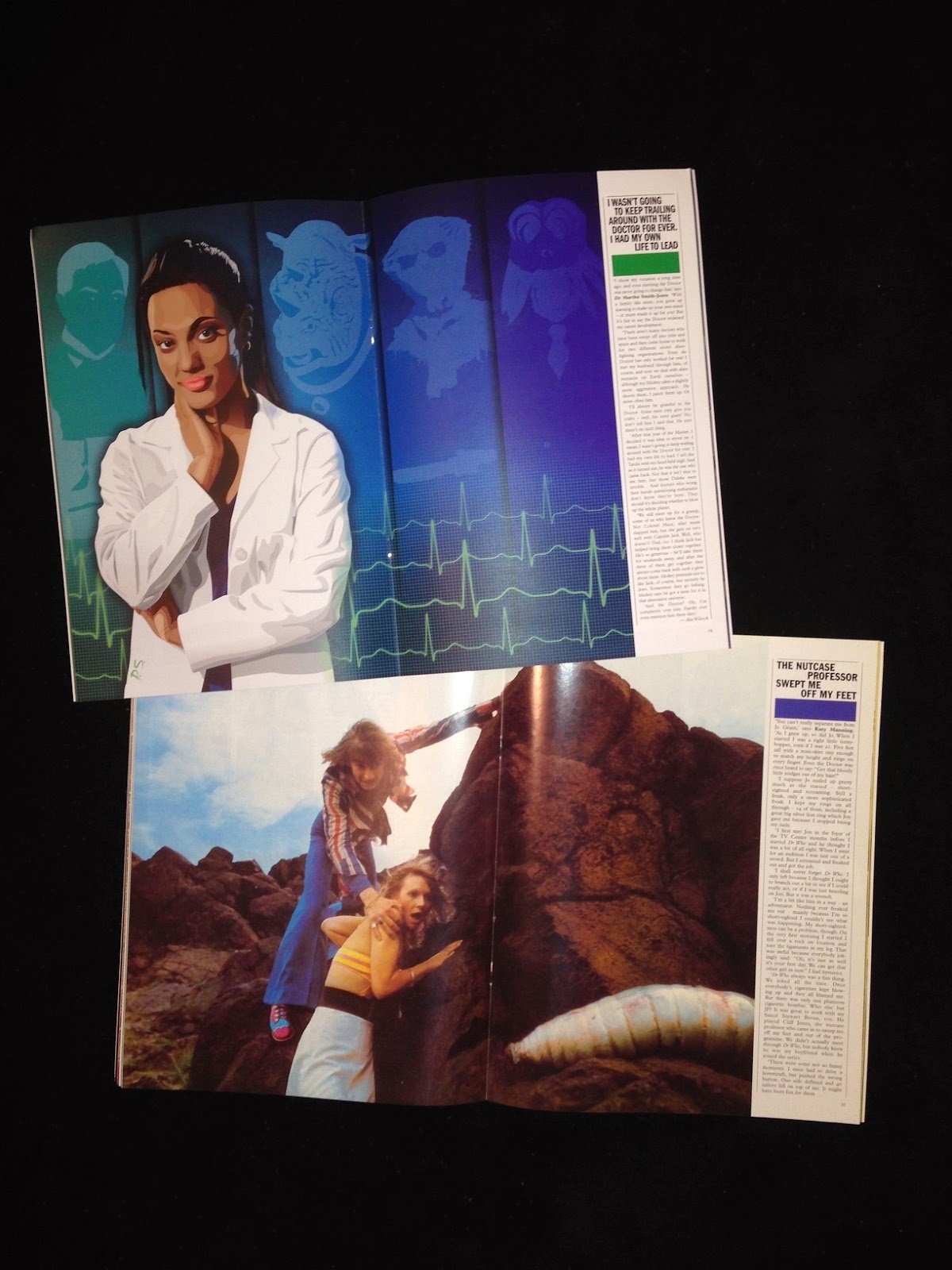
From her first appearance in Smith and Jones, eight years ago today – making it the most appropriate day to publish my own piece from the 8th Anniversary Special – Martha was a breath of fresh air for me. It wasn’t just Freema Agyeman’s performance and giving as good as she got to the Doctor (and him not being interested), nor just that she was the Doctor’s first full-time TV companion who was black (after Sharon, Roz and others elsewhere), but that she wasn’t going off with the Doctor only because her life was a bit rubbish. Martha is the only TV companion since Sarah Jane Smith with a decent, fulfilling, even exciting career – and for all of us who are so utterly gripped by the Doctor and his adventures, that’s a more inspiring example than the implicit suggestion that travelling in the TARDIS is only slightly better than being in a dead-end job you’re bored by or hate, or than having your parents killed in front of you (and going off with the first available surrogate dad). If you’re an achiever with a lot to give up, but the TARDIS is still so exciting you’d go off in it without a second thought – well, you would, wouldn’t you? And, for me, she has by far the most satisfying (and self-chosen) exit from the new TARDIS, too, again after impressive achievements in her own right.
Other contributors took their own approaches, writing critical assessments or celebrations of their chosen characters, but with the Radio Times Special so deeply ingrained in me, I knew immediately that I wanted to write an ‘After the Doctor’ interview in that style, for the character rather than the actor, and that though I was going to be tongue-in-cheek in several ways (her earnestness, the Doctor) as well, I was going to set out first to say ‘She’s a strong, brilliant character’. And while it may have taken some time to think of all the other words, then edit them all back down again, my starting point leapt into my head fully-formed on reading Paul’s initial email to me:
“I LEFT THE TARDIS WITH MY HEAD HELD HIGH.”Though, as you can see from the interview as published, Paul picked a different pull-out quote, though with a very similar feel.

As it turned out, Paul’s wickedly pointed ‘story summaries’ didn’t mention Martha at all, so mine was the only piece that featured her in the whole magazine, and I’m very happy to have done her justice (if thankfully not in an entirely strait-laced way). Happy anniversary, new Who and Martha Jones!
Labels: David Tennant, Doctor Who, Doctor Who Magazine, Fandom, Martha Jones, Obscure Doctor Who Jokes, Personal, Smith and Jones


Sunday, September 08, 2013
Doctor Who – UNIT: Dominion
Have you heard the Doctor Who adventure with the future Time Lord from The Thick of It? Not that one – the other one. Alex MacQueen stars in UNIT: Dominion as the Other Doctor, alongside Sylvester McCoy as the Doctor and Tracey Childs as fabulous antihero Elizabeth Klein – sometime companion, sometime scientist from an alternate Nazi future. Available in boxed set or download from Big Finish, this is an epic audio drama, not unlike a movie remake of Doctor Who (but which?), and the threat of total dimensional chaos has been cheering me up today.
“Ahhh, the giddy joy.”I have had an unremittingly crapulent day. Booked to go to a one-day Doctor Who event from Fantom Films, I’ve been horribly ill all the way throughout the night and from dawn to dusk, so I’ve missed out on seventh Doctor-themed excitement and meeting the likes of Lisa Bowerman (Professor Bernice Summerfield), Tracey Childs and Sylvester McCoy. However, having spent much of August catching up with a ton of Big Finish’s Doctor Who audio plays from several years, and particularly those featuring Sylvester – including twenty-six in a fortnight of an especially fine story arc of A Death in the Family and Gods and Monsters – I’ve turned to a special release (and much chocolate) to winch my spirits off the floor. Spoilers follow…
Dr Elizabeth Klein (Take I)

Readers familiar with Big Finish’s CDs or who listen to Radio 4 Extra will have a head start for Elizabeth Klein, the BBC station having broadcast a trilogy of her stories with (or against) the Doctor. There’s more to hear in the Big Finish originals, as well as the story from, goodness me, twelve years ago now that set the whole thing off: Doctor Who – Colditz. In 2001 it seemed a relatively average historical adventure for the Doctor and Ace, but with a twist, and slightly let down by being one of the few Big Finishes where something went wrong in the production (bits sound like they’re recorded in a tin can), it was always a decent enough tale, with the main thing I remembered from it at the time being Klein, an interesting character and concept: when the Doctor and Ace accidentally change history, she’s the dedicated scientist who travels back from the future Nazi timeline they created… And is stranded in our world, determined to single-handedly restore what to her is the ‘real’ history. Clearly, though, only a twist in the story and a loose end they’d never return to. These days, Colditz stands out in story terms as the first Doctor Who to feature the much more substantial figure of Klein – and in production terms as the first Doctor Who to feature the even more substantial figure of David Tennant, though here playing a villain and not another Doctor. And, shh, Tracey Childs’ cold intelligence and charisma made more of an impression then than David’s bullying Nazi…
Tracey Childs later appeared with David Tennant’s Doctor on television, too, in the fantastic The Fires of Pompeii. Colditz was about a future timeline coming back to see you unexpectedly – where Tracey Childs co-starred with David Tennant, the next Doctor but one. The Fires of Pompeii was about predictions of the future – where Tracey Childs co-starred with Peter Capaldi, the next Doctor but one. Keep an eye on her co-stars, that’s all I’m saying. And listen if she suggests you cross her palm with silver.
When Big Finish eventually asked Tracey Childs to return nearly nine years later, they’d put a lot of work into making Klein’s story something special, though, and it shows (not least in the fabulous, furious vignette of that name). A Thousand Tiny Wings reintroduces Klein in 1950s Kenya, never able to go home, with sweltering heat, terrific characterisation and never quite being sure where you stand with anyone. Survival of the Fittest is better still, with both Klein’s point of view and the alien culture well-sketched, building to a great ending. She’s a match for him. The only shame is that there’s only one story with the original Klein as the Doctor’s ‘companion’, as their mutual talent, strong convictions and tendency to knock sparks off each other was something I’d’ve liked to have heard more of. But, no, there’s no time to get comfortable: for both of them, the story drives on into The Architects of History. In this ‘Fall and De-Klein’, not only are a quiet, dangerous Sylvester and a ruthless Tracey clamping down on her underlying despair both terrific, but we even get another companion for the Doctor, in Being Human’s Lenora Crichlow. It’s easy for stories in which time is rewritten to unravel, either shooting up themselves or becoming merely pointless, but this pulls it off in making the events matter by nailing them to the effects on the people involved. There’s just a hint of the subtext of the Doctor as Nazi-hunter and who the looming Nuremberg would be – then I surprised myself by getting a little misty-eyed at the shot at redemption.
Big Finish is in the middle of releasing a new trilogy starring the seventh Doctor and Klein – Persuasion, Starlight Robbery and Daleks Among Us – with the alternative, rewritten re-Klein who doesn’t hail from the Nazi universe; Richard and I are waiting to listen to them all together. But in between the two trilogies, Big Finish last year brought out a new development for the DVD season box age, not monthly single releases but a boxed set containing one big story. UNIT: Dominion isn’t just the Doctor re-united / starting off with a new Klein, but a story so big it has another companion (or more) and an Other Doctor, too. Plus the title protagonists in UNIT, the UN-run special services that sometimes work with the Doctor. The story works better for some of its five competing leads than for others…
UNIT: Dominion – An Epic That Delivers
UNIT: Dominion is something of an epic. It sounds much more visual, if that’s not a contradiction in terms, than most Big Finish plays, and in a boxed set of four hour-long episodes (plus a ‘making of’) it runs to a fairly epic length as well. But while the extraordinary sound design and cast grab your attention, I’d give the strongest praise to the writers Nicholas Briggs and Jason Arnopp: it’s generally a strong story, though as ever I can find flaws along the way, but what’s really impressive about it is that they manage to keep it all together: a four-hour disaster movie teeming with different characters, locations and extradimensional beings could very easily have descended either into incomprehensible mulch or constantly had to stop for the forced dialogue of ‘Look, Doctor, at that [four lines of description] doing that terrible [four more lines of description]!’ Instead, they take a story that seems not at all suited to the intimacy of the audio play and make it work.
There will be spoilers, so I’ll tell you now that UNIT: Dominion is fun, and huge, and in quite a few ways, not what I was expecting – though predictably with Klein and the Other Doctor stealing much of it. I recommend it. But be careful reading on, as the further you get towards the end, the more spoilertastic detail there’ll be.
The first episode is the best, with lots of new ideas; the second’s the weirdest, mainly everyone caught with different extradimensional ooglies which have the feel of very early Twentieth Century weird sci-fi (but Mind Leeches, Skyheads and lava spiders work as terms that instantly sketch in the sort of thing they are), with Sylv entirely sidelined; the third is the most disturbing, as Sylv gets back into the story but someone else forces everyone’s hands; and the fourth, the several big finishes, including shocking codas and Klein’s second and so slightly less effective ‘happy ending’ that sets her up for the new trilogy.
With the Doctor, the Other Doctor, Klein, Raine and UNIT all vying for attention, and four hours for them to play in, there are large stretches for which different ‘lead’ characters are to the fore and others disappear into the background. So which of the five potential protagonists make it?
The Doctor

Sylvester McCoy is the Doctor, and marvellous he is, too. It’s always a pleasure to hear him back again, particularly now he’s a big movie star: in a curious way, he’s one of the actors who always feels most like the Doctor, in his case I suspect because the New Adventures gave him such a long and compelling reign, the actor always in my head even when he wasn’t actually in employment for the role. It’s even true that, while if asked to pick out my favourite arrangements of the Doctor Who Theme Keff McCulloch’s would not be near the top of the pile, Sylvester remained the Doctor throughout such an influential part of my life that his Theme always gives me the shivers when I hear it from Big Finish, far more than others that my head says I prefer.
This time the Doctor – the seventh Doctor – gets his best material in the opening and closing episodes of the story, as the relationship between him and the Other Doctor is so incendiary that they can’t be together too often. That means the one we know is not so much sidelined as stranded in a different dimension and almost a different story. This inevitably means he’s a smaller presence for much of the story, which makes you appreciate him all the more when he breaks back into the narrative – and he finds a terrific resolution in the finale. Along the way, Sylvester rises to some great material, and while the ‘main story’ feels like a major reimagining of one old story in particular, there are subtler echoes of many other stories in this Doctor’s scenes in particular. Like Big Finish’s Project Lazarus, it dodges around making this a ‘two Doctors story’ by mostly keeping them apart and separating the Doctor, too, from the suspicious scientific-military organisation. There’s a hint of Russell T Davies’ early story Damaged Goods in Sylv as sinister Umbrella Man, and of Russell’s late story The Stolen Earth in Ace’s flickering cameo warning messages and all realities breaking down (the idea of Ace being on Gallifrey also having their cake and eating it as regards the Lost Stories, and yet more of the Time Lords’ sinister secrets, if not the Othering Other himself).
There are a few weak points in the treatment of the Doctor too, though; not so much all the time when he’s not in the loop, but the elements where he’s rather behind the audience in working things out, and most of all the weirdly out-of-character moments where he of all Doctors goes on and on about how would never interfere in his own time stream. It’s one of the script’s few jarring failings that, given one of the more complex and morally ambiguous Doctors to set against the Other Doctor, rather than comparing their different attitudes to interference and ruthlessness and using each to illuminate the other, it bottles the difficult questions and – despite Klein’s fear of him – leaves the Doctor a bit… Vanilla. Still, particularly if you can ignore the awkwardly inserted denials of his own methods, the contrast between the master manipulator who keeps everything broodily close to his chest and the swaggering extrovert Other Doctor who knows more than he does is very entertaining (as MacQueen does unto McCoy as McCoy did unto Davison in Cold Fusion). No wonder Sylv’s Doctor follows several other Doctor-Doctor clashes and detests him on sight.
Dr Elizabeth Klein (Take II)
Even though we knew a very different her, at times it seems as if Klein is the only person we know. The Other Klein was raised in a Nazi state and, for all her intelligence, drive and other admirable qualities was ideologically a true believer, the spark for a terrific battle of wills with the Doctor; there was a real danger that this one would seem like she’d been, well, doctored. Fortunately, she’s well enough written to still give her an edge, Tracey Childs is still outstanding, and perhaps most calculatingly she’s put in a position where she has good reason to be deeply suspicious of the Doctor – Sylvester’s in particular. That means that when she’s thrown together with the Other Doctor, while inevitably he steals quite a bit from her, they have a much more interesting if hardly trusting relationship: with her as the brilliant UNIT Scientific Advisor Dr Liz and him an unknown but rather flamboyant quality, it deliberately evokes the abrasive but fabulous rapport between Dr Liz [fascist in an alternate reality] Shaw and Jon Pertwee’s Doctor in the ’70s. Of her colleagues at UNIT, though, there’s much less to be said: they’re far more suspicious of the Doctor, with far less reason, and though in theory you’d expect there to be five competitors for the position of protagonist, with UNIT a better bet than most for having the title, they’re not up to it. Colonel Lafayette is just a comic relief idiot to be killed; Major Wyland-Jones just a cartoon brute. So of all the things UNIT: Dominion works as, a UNIT story isn’t one of them. It’s far less the second series of a new UNIT than a relaunch for Klein, and for someone else, too…
Raine Kreevey
Beth Chalmers’ Raine Kreevey is the Doctor’s travelling companion here. Introduced in a recent series of Big Finish Lost Stories based on scripts that might have gone into TV production had Doctor Who not been cancelled in 1989, her character’s still rather battling to make an impression on me. In part, it’s because she’s not really yet had a story in which she and Sylvester McCoy are the only leads; in part, it’s because Beth Chalmers sounds a bit like Sylv’s earliest companion Bonnie Langford, which makes her less distinctive. Her most notable character trait is that she’s a top thief, giving the Doctor a scene in which he hypnotises her to do some mental safecracking to get out of a dimensional corridor. But even that’s less about her than an illustration of this Doctor’s similarities with the Other Doctor, who also makes much use of hypnosis – though given that the Other Doctor’s hypnosis leads people to box their personalities into safes, it suggests that for all they have in common they have diametrically opposite attitudes about control. Unfortunately for Raine, she’s just nowhere near as interesting as Klein, with whom she comes across as remarkably crass, and not only does she have to compete with all the other four protagonists, but Sylvester’s long-term companion Ace is more immediately memorable in just a distorted cameo.
I’ve said there are spoilers. Last chance, all right?
The Other Doctor

Of the four leads, the anticipation for the Other Doctor has to be the greatest, and Alex MacQueen is hugely enjoyable playing the role. The Doctor he most seems to have modelled himself on is Jon Pertwee, flamboyant, compelling, know-it-all and sometimes a bit of a shit. There’s also more than a touch of another Doctor quite appropriate to a Nicholas Briggs production, but more of that laters.
Puzzling out the character of the Other Doctor, inevitably he called to mind Sylvester’s story Battlefield, in which the master manipulator is manipulated in turn by another Doctor who knows more than he does – like the Other Doctor, identified as a future Doctor but feeling rather more like an alternative. I got a heavy hint of David Collings, too, though, an actor who’s twice played an ‘Other Doctor’. A Doctor who’s forgotten all the details sounded very much like Mawdryn Undead, deeply suspicious from the first, even hinting he might be something like the 517th. And that made me wonder about Big Finish’s own Unbound Doctor story Full Fathom Five, pushing harder at the idea of a Doctor who’s decided that the end can justify the means. Which in turn reminded of that other Doctor Who Unbound story Sympathy For the Devil… Doesn’t this Doctor seem fond of hypnotism – even if we have Sylv doing the same, it’s not to the same extent, and why do we cut away before the words we hear him use…? And why is he so keen to have a set of hypnotised soldiers he can deploy, and then tell Klein he’s abandoned not using guns and killing, while she’s contemptuous of his swimming off to save himself and leave soldiers to die…?
By this point you will have worked out what I worked out long before the Part Three cliffhanger, but while that episode finale wasn’t much of a surprise it was immensely satisfying. The Other Doctor has apparently betrayed UNIT, but as they shoot at him at the drop of a hat you can hardly blame him; the Doctor dives after him into his TARDIS, only to find that he’s not betrayed UNIT after all – that is, not in the way they all think, though answering the accusation that he was going to let them all die with “Tempting, but no” may not be the most reassuring of denials – but that for all its battered police box exterior, the ‘upgraded’ inside is very swish indeed, and just not his TARDIS at all. For all his flamboyance, in this – predictable as ever, but my favourite – scene MacQueen has three little moments where he’s simply at his finest, and they’re all suddenly dialled right down. Two of them are so underplayed that they’re almost subliminal: listen to this while pottering about or doing the dishes and you’ll miss them. While the Doctor is asking so many irritating questions, there’s just a tiny breath of a Muttley laugh; then, as the Doctor realises “You – you’re not me…” the weight of acting up comes off the Other Doctor’s shoulder and “What a relief…” comes out in the tiniest sigh; and while on their meeting in Part One he immediately got the Doctor’s back up with his braying “Hello, you!” and “Laters!” now the Doctor finally recognises the Master he gives a quiet, poisonous and quite brilliantly delivered “Hello, you” to make the spine chill as the music cuts in.
It’s not just that Richard and I keep trying to emulate that intonation when one of us answers the phone to the other, but that now there are two future Time Lords already cast as rivals in The Thick of It, we keep taking our leave of each other with a “Laters!” and a “Fuckettiebye.”
I’ve written before that it was in Sympathy For the Devil that Big Finish previously presented their new casting of the Master – and if you don’t know who he is, I’ve introduced each of his TV incarnations here – and though both of them and both stories are terrific (one actor slightly more here, one story slightly more there), the ‘shock reveal’ nature of each does make them difficult to talk about for fear of spoilers. You’re here now, though. If there’s one little bit of dissatisfaction with Alex MacQueen’s fabulous double portrayal, it’s that although at the reveal he gives a tour de force outmanoeuvring the Doctor from bellowing to near-imperceptible, I was rather surprised to find that his theatrical Doctor impression wasn’t really toned down very much once he was himself, despite an excuse for once for the Master to be the less camp and hammy one. Perhaps it’s just that, as Klein says (and as other Masters had previously proved), he’s envious and loved being the Doctor just a bit too much. And on top of the grandstanding Pertwee affectations (the Doctor seen most as the Master’s other half), the Other Doctor reminded me very strongly of Nicholas Briggs’ incarnation [see below], only with a little more domination and a little less tea. Is it the baldness that brings out that very specific sort of jollity in the Doctor, or just Nicholas Briggs naturally thinking, ‘Now, how would I characterise an Other Doctor…?’
Doctor Who – The Movie Remake
“I made my TARDIS look like yours because I needed everyone to think I was you…”The biggest single echo of other Doctors in the story is, not unexpectedly after all that, a Pertwee one, too. If UNIT: Dominion is like a Doctor Who movie for audio, it’s almost explicitly like a movie version of 1971’s The Claws of Axos. I don’t mean that as a complaint: this story is far better than The Claws of Axos, and doesn’t just show how you might reimagine an old story on a ‘movie budget’ but how you can take relatively unpromising material and do amazing things with it. If Nick Briggs and Jason Arnopp did take that story as part of their inspiration, their homage to it turns everything about it around. The big flying Sky Heads from the original script are surprisingly friendly, and have fantastically massive voices… The power drain nodes are this time draining the weak aliens who say ‘Help us’ and then turn nasty… The Master again does a brilliant turn as UNIT’s scientific advisor, but it’s UNIT rather than Axos who are blackmailing him by refusing to let him get his TARDIS back… Perhaps most strikingly, at the root of the whole plot is an element that’s always been part of the Master, at its height on TV in The Deadly Assassin but framed here in an especially The Claws of Axos way: the Master hates the Doctor so much that killing him would never be enough, so he wants to humiliate him and destroy what he stands for first. In the 1971 story, the Doctor’s own a short-lived bluff made himself seem like a git who’s flying off to leave everyone to die, but here the Master takes the same idea and (at several points literally) flies with it. Death’s too good for the Doctor; humiliation alone isn’t enough; even endless subservience isn’t enough. The Master’s Doctor plan is tricking him into creating a terrible calamity and then going round as the Doctor being a total bastard on top, to make sure the Doctor’s remembered by the survivors as both responsible for horrors and for being a shit.
Like the more subtle but still clear comparisons the script draws between Klein with the Doctor – and the Other Doctor – and of course between Klein and Klein, this is about both similarities and the choices people make. While the script’s own choices bottle a few of those similarities and contrasts, at heart it’s why UNIT: Dominion works – a thrilling, epic disaster movie that remembers to be about illuminating its central characters for all the Big Giant Heads, Godzilla moments and very loud explosions around it. And between those three fantastic actors all acting as mirrors of each other, I suppose it’s another reason why poor Raine doesn’t get a look in…
The Audio Visuals: When Nick Briggs Was the Doctor
Inspired by last year’s release of Justyce Served – A Small Start with a Big Finish from Miwk Publishing, I’ve also been listening to one of the most obscure Doctor Who series of all, the “Audio Visuals” from the 1980s. As Miwk’s fascinating guidebook details, these were entirely unlicensed Doctor Who audio plays made by fans which, over the course of four seasons, became increasingly ambitious and polished. Unsurprisingly, several of the people involved went on to become the founders of Big Finish and then onto the TV series, most notably Gary Russell and Nicholas Briggs. Today Nick’s known as a writer, director, producer, the voice of the Daleks and more, but to a select group of cassette-listeners in the 1980s he was the Doctor. I was at school when these were produced and only heard of them as tantalising rumours; in the late ’90s, a friend gave me ripped copies which I only heard a few of before upgrading my PC and finding nothing would play that species of audio file any more; but after buying Justyce Served, someone else kindly gave me another set of the Audio Visuals plays that would, well, play. So far I’m three quarters of the way through them, and should I not return to review the lot, each season so far has been a quite remarkable jump in quality from the previous one. The first is a bit ropey in production and acting and all right in terms of stories; the second finds them suddenly finding their feet and producing something much more listenable; the third suddenly sounds professional, with all the stories pretty strong and a persuasive ‘arc’ running through it (though of all the stories, the grand finale is stronger on ideas than coherence). If you come across them in the dark and forgotten lanes of the Internet, there’s a good case for starting at the third series, I’d say. And the strange thing is that of the half-dozen stories remade since with much bigger budgets and more professional casts, mostly by Big Finish, the originals are almost always the most successful…
Labels: Alex MacQueen, Audio Visuals, Big Finish, David Tennant, Doctor Who, Jon Pertwee, New Adventures, Personal, Peter Capaldi, Reviews, Sylvester McCoy, The Master, The Thick of It, Tracey Childs
Thursday, August 22, 2013
My Best Posts 2012-2013
As my contribution to the Lib Dem Voice Awards, I’ve just put together a celebration of a great many posts from a great many other Lib Dem Blogs – so it seems an appropriate day to select my own latest ‘greatest hits’ package. Below you can find links and summaries for my best articles of the last year on politics, Doctor Who and one or two other subjects. Featuring What the Lib Dems Stand For, Liberal Quotations, Betrayal, Daleks and much more…! All showcasing posts written from the start of October last year to the end of August this year (a change from last year’s ‘Best of’ selection from September 2011 to September 2012). So, if I write any more this month, I may re-edit this to add something else which you can discover later…
My Best 2012-13: Politics
Nick Clegg’s Garden Cities – Thinking Big, But Are There Any Foundations?
Fisking a major speech from Nick – agreeing with him in principle, but doubting what would happen in practice. Two hard-headed tests for any major policy proposal: ‘Can we get it done?’ and ‘Will we get any credit?’
Eastleigh – Proof There’s No Such Thing As a Perfect Storm
Taking five lessons from the Eastleigh by-election, and asking two questions for the future.
Lessons From Coalition – The Two Biggest Problems: Betrayal and Betrayal
Available in two versions: for the in-depth article, click the named link above, while the supercompressed version was written for Lib Dem Voice.
Update: Syrian Intervention: Nick, Please Make the Hard Choice to Be Practical
Role-reversal where Nick Clegg’s party has to tell him we can’t have everything we want by wishing for it.
The Liberal Democrat What Do We Stand For Challenge
The best political pieces I’ve written in the last year are together ongoing investigation, collaboration and rallying cry about what the Liberal Democrats stand for. The basic idea is to challenge myself, first, then other Lib Dems to get across what we stand for in something more meaningful than a soundbite but still short enough to be no more than a minute’s speech or a box on a Focus leaflet. And to make things harder, I aimed for broad consensus by synthesising the Preamble to the Lib Dem Constitution, the party’s priorities in government and the party leadership’s latest messaging. Did it work? Here’s my go:
The Liberal Democrats stand for freedom for every individual – freedom from poverty, ignorance and conformity.
To make that freedom real needs both fairness and economic responsibility: an economy that works, that encourages enterprise, and where everyone pays their fair share.
So freedom from poverty requires responsible spending, not debt, built on fairer taxes where lower earners pay less tax and the wealthiest pay more, and building green jobs for the future.
Freedom from ignorance needs better education and training, so people have the opportunity to realise their potential.
And freedom from conformity, supported by freedom from poverty and ignorance, means everyone should have the liberty to live their lives as they choose – without harming others; with equality before the law; with a better say, because no government always knows best.
That’s why Liberal Democrats are working for a stronger, greener economy in a fairer society, enabling every person to get on in life.
Happy 25th Birthday, Liberal Democrats – and What the Lib Dems Stand For 2013.1
Why we should sum up What the Lib Dems Stand For, and how it’s developed over the years.
What the Lib Dems Stand For 2013.2 – a Challenge and a Meme #LibDemValues
Setting out my ‘What the Lib Dems Stand For’ based on the Preamble, practice and core messaging, and challenging other Lib Dems to come up with their own.
The Liberal Democrat What Do We Stand For Challenge 2013.3 – Eight Answers (so far) #LibDemValues
After receiving the first set of responses, rounding up eight different Liberal Democrats’ versions of what we stand for – so far…
The Liberal Democrat What Do We Stand For Challenge 2013.4 – What It’s All About #LibDemValues
Inviting people to use my short declaration of ‘What the Lib Dems Stand For’ and explaining what each bit of it means.
There’ll be more.
Last year’s theme for occasional Lib Dem blog posts was less positive – “Things To Remember About Labour”. I’ve written one more since:
Things To Remember About Labour #6 – Iraq
Liberal Mondays
I’ve been writing another occasional series, too. My aim with them was simply to pick an inspiring or intriguing Liberal quotation and publish it to start the week. Naturally, being me, with each of them so far I’ve instead used each line as springboards to talk around Liberal ideas they suggest to me.
Liberal Mondays 1: Alfred Russel Wallace #LibDemValues
Quoting the Victorian naturalist, natural selection theorist and Liberal, then going on to look at the 1996 collection Why I Am A Liberal Democrat. I notice that the party’s evolved from Jeremy Bentham to John Stuart Mill and Harriet Taylor and more – and a good thing, too.
Liberal Mondays 2: Conrad Russell – The Liberal Cause #LibDemValues
Examining in detail the first booklet I ever read by the Conrad, who became a friend and mentor. I’ll probably return to him in the future.
Liberal Mondays 3: John Stuart Mill and Harriet Taylor #LibDemValues
Probably my best of these so far: going to the Liberal text, On Liberty, to look afresh at its heart. In Lib Dem Focus leaflet style, Three Things To Remember; definitely not in Focus style, also one to think about.
Liberal Mondays 4: Ralf Dahrendorf Vs Utopia #LibDemValues
Looking at three separate quotes as a Liberal critique of Utopia.
Liberal Mondays 5: The World’s End Vs Utopia #LibDemValues
Where Ralf Dahrendorf left off, Simon Pegg and Edgar Wright pick up.
Update: Liberal Wednesday 6: Martin Luther King’s “I Have A Dream” #LibDemValues
On the fiftieth anniversary of one of the greatest speeches of the Twentieth Century, and how it echoes through history.
Three Problems With The Politician’s Husband
Bridging my politics and TV articles, I set out exactly why the BBC’s flagship new David Tennant drama was such a failure.
My Best 2012-13: Doctor Who
Doctor Who – The Evil of the Daleks (Campbell & Hadley’s Recorder Uncut)
I’ve written fewer Doctor Who reviews this year, but here’s one with a difference, answering questions from my friend Nick about one of my favourites. And what does it all have to do with John Stuart Mill?
Doctor Who 50 – Fifty Great Scenes
On top of two series of occasional blog posts on Liberal themes, I’ve been writing an occasional series to celebrate Doctor Who’s Fiftieth Anniversary. Taking Fifty Great Scenes, exploring what’s great about each of them in turn, and adding bonus quotations from other stories that seem to fit. Rather than list the lot, here are six of my favourites so far:
Doctor Who 50 Great Scenes – 50: The Eleventh Hour
Starting off the countdown with the two most important words in Doctor Who.
Doctor Who 50 Great Scenes – 47: The Rescue – The Powerful Enemy
Celebrating William Hartnell, the Doctor, and going all the way to Matt Smith
Doctor Who 50 Great Scenes – 45: Robot
The Doctor, Sarah Jane and Harry in the first story I ever saw, with a bonus that was another sort of first for me.
Doctor Who 50 Great Scenes – 44: Enlightenment
Ships where you don’t expect to find them and, as a bonus, one of my more creative moments: fashioning scenes from a favourite story into an epic poem and the cliffhanger that should have been.
The first (plastic) flowerings of each incarnation of the Master.
Doctor Who 50 Great Scenes – 36: The Krotons
Celebrating Patrick Troughton, Robert Holmes and the Double Act
I’ve also got back to my thoughts-from-the-beginning review blog Next Time, I Shall Not Be So Lenient! at last, so here are two from that:
William Hartnell and Patrick Troughton’s Doctor Who: Now You See It…
What happened to much of 1960s Doctor Who, and the different ways in which you can still experience it after all.
Doctor Who – Marco Polo Episode One: The Roof of the World
Beginning an episode-by-episode look at Doctor Who’s first ‘missing story’.
Broadchurch and How To Spot A TV Murderer
And finally, ITV’s goes-against-the-grain-to-say-it-but-far-more-successful flagship new David Tennant drama. Examining the surprisingly deep themes of murder drama Broadchurch – without spoiling whodunnit, but giving Richard’s and my Rules of Suspicion so you can spot the murderer for yourself in a host of different detective series.
Labels: Best of Love and Liberty, Blogs, David Tennant, Doctor Who, Doctor Who 50, Liberal Democrats, Liberal Mondays, Liberalism, Personal
Saturday, June 08, 2013
Doctor Who The Master 50 Great Scenes – 39: Terror of the Autons
Counting down towards the fiftieth birthday of Doctor Who with Fifty great scenes… The Doctor’s finished on the telly again, and who most wants him finished? With Doctor Who – The Mind of Evil released this week to complete a rival Time Lord’s adventures on DVD, it’s about time to follow Number 40’s “I’m the Doctor” with a hostile takeover:
“I am the Master.”And while sometimes I add a second Bonus Quotation here, something’s got into my head (a sort of drumming) and now there are rather more. More spoilers, as well. So, peoples of the Blogosphere: please attend carefully…
“I am many things.”

Springtime for the Master! If he ruled the world, every first day of Spring would be the blizzard (possibly of flying killer heads) that this year’s started out with. After not being at all well and getting out of the habit of writing this Fifty, it’s now the end of Spring, but cast your mind back to the beginning of the season and perhaps it’s just as well that I didn’t post this on the frozen 20th of March – despite it appropriately being a broadcast anniversary of the Axons. Even the alternative date for the start of Spring was still frosty, despite the 1st of April appropriately being a broadcast anniversary of some Sea Devils. And yet the Master’s been very much on my mind, not just nagging me to write but with his own two very special bank holidays – first Beltane, then the Master for one night only from in 1996 (or 1999). The Master, if you didn’t know, is almost the Doctor’s other half – an old friend who also left the Time Lords, but to rule the Universe, not just to see it, longing to make everyone else feel small. He became a jealous enemy across many of his and the Doctor’s lives, and a jack-in-the-box of irresistibly nasty fun across many of years of our television. I may have missed the daffodils, but his blooms last, so here’s something of the first plastic flowering of each Master, most of all the original. Sit down. Make yourself comfortable. Have a chair…
“This plastic has got unique properties, Mr McDermott. Allow me to demonstrate.”

The Master (Roger Delgado) is a suave, powerful presence with dark, hypnotic eyes and a deep, hypnotic voice. Usually wearing a dark, pointed beard and a dark, elegant suit – most often a round-collared black Nehru suit – he’s also to be found disguised in everything from self-aggrandising pseudonyms to flamboyant robes to the grubby overalls and rubbery face of a phone engineer. The personification of charm when he needs to be; smiling and playful, albeit with his own murderous sense of humour; given to savage flashes of anger. His ambition is to rule the Earth, or occasionally the galaxy, though with an underlying need for the Doctor’s attention – before he kills him in an amusing way. To overcome his status as a one-man band, he forms alliances with a variety of alien races to do is legwork… Always (over-)confident that he can dispose of them when they’re no longer of use, rather than the other way round.
Terror of the Autons is the Master’s first appearance, materialising in the first scene of Doctor Who’s Eighth Season and immediately dominating the show – and the petty ‘big man’ to whom he introduces himself. By the time the Doctor gets a look in, still less when a Time Lord belatedly turns up to warn him of the Master’s arrival, the new villain has already stolen the show (and much more besides). Aiming to create a new spearhead for the Nestene Consciousness and their power over plastic, he’s found Rex Farrel, a young plastics factory manager in a rather nasty fashionable suit eager to make his mark after years following his father’s orders. Unfortunately for him, his new big customer in a much more impressively cut dark suit and gold tie is “Colonel Masters”: meet the new boss; very much not the same as the old boss. But Mr Farrel Senior’s left James McDermott, his own bluff, practical production manager in a sober suit, to report back to him in case his son mucks about too much, and McDermott patronisingly tells Rex the company’s not going to dump all its old customers for a mystery man with no paperwork. McDermott calls up the old man; Rex calls in “Colonel Masters”…
Not liking a new face, McDermott begins with a tirade about changing the plastics mix and ruining a day’s production. The Master is polite, urbane, amused, and shows off a shiny black fat square cushion of material that isn’t to McDermott’s taste at all. But he doesn’t appreciate its unique properties – or the Master’s. At a click of his fingers, the square begins to expand and, to off-key synthesiser music, slithers into the form of a shiny black fat square armchair. Rex seems curiously blasé, but an unsettled McDermott licks dry lips and weakly asks if the new customer is a magician as well as a Colonel. The Master answers quietly, staying still, ominous, powerful, while McDermott fidgets and flails about, trying to assert himself and the company as he knows it. The Master moves to stand behind the inflated chair, arms astride it proprietorially, and strikes a warm, friendly tone:
“Look, why don’t you try it?”McDermott’s been eyeing the chair uneasily and prodding it like a first-time swimmer at the water’s edge – but the Master’s sudden whiplash of will is that of a villain who’s suddenly tired of the shaggy dog and wants to skip to the punchline. McDermott can’t help but sit. The moment he does, the chair starts to writhe again, wrapping itself around him and, rearing over his head, suffocating his screams within its thick, blobby synthetic mass and the thick, blobby synthesiser music.
“Well, you’ll never sell that, I’ll tell you that for nothing. Sure, it looks like – like a black pudding.”
“Try sitting in it.”
“It’s got a cold clammy feel to it. Now plastic should be warm and dry to the touch—”
“Sit down, man!”
The Master has instant presence, and you can’t tear your eyes from McDermott in the chair. But the third person in the room is in his own way just as fascinating – Rex has come entirely under the Master’s spell, but is shocked for a moment by the horrible death. The Master raises a hand to stop him stepping forward… And, everything over, Farrel is nonchalant again. More even than the Doctor’s companion, Rex is the personification of the viewer here, finding the thrilling new villain utterly compelling, briefly shocked by horror daring you to reject him, then back to watercooler-chat complicity as he steps to the intercom for a killingly funny businessman’s response:
“Sylvia? Will you check Mr McDermott’s entitlement on termination of employment, please?”Rex Farrel – and the rest of us – are already so far back in the Master’s thrall after all this showing off that when he hilariously affects humility at the waste of so much material for one simple death we’re with Rex in saying, no, no, that was an impressive one, honestly. And like Rex, we want to know what the Master means when he gives a playful smile and promises efficient death with just a few inches of plastic:
“The human body has a basic weakness. One which I shall exploit – to assist in the destruction of humanity.”I’ve written about the death at the plastics factory before – I didn’t see the Master’s showpiece scene on screen until more than twenty years after it was broadcast, but I saw it in my mind’s eye as a thrilled little boy reading one of the first books I ever bought, Terrance Dicks’ novelisation Doctor Who and the Terror of the Autons, and not only does it grip you (and Mr McDermott) on TV, it’s just as gripping on the page. Though it makes Rex more sympathetic by taking away his punchline, permitting him more struggling shock and generally removing the impression that his appreciation of the patronising right-hand-man’s death is an eagerness to murder his father by proxy, it gives the Master a terrible gag that I’ve always loved. You can read what in my in-depth review of the novel here, complete with that very scene as my selection of choice (and a terrifying picture of little me). And if you keep watching the DVD, the Master gets another deft little punchline later along the way…
In both forms, this is the Master’s crucial establishing moment – it’s such an outrageously exaggerated swagger of a scene that you just know he’s going to be fun to watch if he’s prepared to put on such a show for an audience of
Each time the Master’s been reintroduced to the TV series – The Deadly Assassin, Logopolis, Last of the Time Lords, all below – Terror of the Autons has been the source text that the writers have looked to for inspiration, most of all Russell T Davies as John Simm takes over and, heretically, delivers for me the best interpretation of that original concept’s viciously playful streak. Roger Delgado is fantastic in this scene, but in other points of his first story he doesn’t yet seem as at ease, as in control, to simply be enjoying himself so much as he does growing into the part. So if you’re inspired by this selection to mount your own ‘The Seven Faces of the Master’ retrospective, while Robert Holmes’ Terror of the Autons is the definitive Master script, you might consider for slightly more compelling stories on screen and with Mr Delgado’s definitive Master performances either The Dæmons, in which he puts on a robe so resplendent it makes vaunting a blow-up chair seem almost introverted and then summons the Devil, or The Mind of Evil, out at last this week and making the whole of the Master’s adventures now available on DVD, in which he gets a big cigar, a big car and a big coat to play the part as a fabulously louche Bond villain.
Bonus Great Doctor Who The Master Quotation 1 – The Deadly Assassin

The Master (Peter Pratt) is a daring reinvention of the character, his charm, his humour, his looks, even his skin stripped away, though still boasting a deep, powerful voice. Rather than take the obvious option of simply making him a new regeneration like a new Doctor, Robert Holmes introduces the Master for the second time no longer as the Doctor’s ‘naughty brother’ but his dark side, all his narrow escapes having cost him every life and stretched him to the end of his thirteenth body – after which even a Time Lord must die. A rotting, ravaged ghoul wrapped in a tattered cowl, he’s still walking because he simply refuses to die… And because hate for the Doctor and the other Time Lords keeps him alive. This is The Master Unplugged, stripped to his essence, smouldering with pain and hatred and more impatient than any of his other lives. There’s no time for amusing banter, but only to renew himself at any cost (in fact, preferably at a terrible cost – not merely a killer for fun but a fiend who glories in chaos and destruction). He’s lost his vanity – though the hypnotic power that once seemed like seduction now blazes forth as sheer mental domination. He’s given up his delusions of grandeur – and ironically forms an utterly selfish plan that promises death on his grandest scale yet. He doesn’t hide behind pseudonyms – instead presenting his hideous face almost with pride and bellowing his name as if that is all that he has left. It’s almost as influential an introduction as his first, with the idea of the Master as walking corpse such a powerful one that he’s never quite whole again.
The Master has lured the Doctor back to their home planet of Gallifrey and framed him for the killing of the President – in part as a complex attempt to get his hands on the ancient relics of the Presidency and unlock the secrets of the Time Lords, though mostly to gloat. He will rip their power source away to bring himself new life, destroying their world and perhaps destabilising the Universe itself, making the story – for my money, Doctor Who’s best – a uniquely apocalyptic film noir. In the crypt where the Head of the Presidency and all its regalia lie in state, the Master rises from apparent death to seize them, only to be interrupted by the Doctor and two old Time Lords (the local police chief and the local librarian). As with Terror of the Autons, the confrontation of these equal and opposites is all the more effective for being held back until the finale, and the Master steps from the shadows, pissed off beyond endurance, to answer the Doctor back:
“The Master’s consumed with hatred. It’s his one great weakness.”Even as the camera lingers on the Master’s gun – and he’s never more brutally trigger-happy than here – even as he’s twisted with physical agony, even he’s as kept alive by his absolute focus on the most important person in his life, the subject of all his rage and envy and vengeance, the one who he’s crafted all this to get his attention before he dies in disgrace, the Doctor still just dismisses him. That hurts.
“Weakness, Doctor? Hate is strength.”
“Not in your case. You’d delay an execution to pull the wings off a fly.”
Bonus Great Doctor Who The Master Quotation 2 – The Keeper of Traken
I did warn you there were spoilers, didn’t I?

The Master (Geoffrey Beevers) remains a twisted, skeletal wreck of himself, but has had to learn patience. He’s found another astronomically powerful Source to steal a new life from, but at the price of sitting it out on a planet that might make him regret calling the Doctor “insufferably good”; on Traken, evil simply gives up and calcifies. But he’s safe inside his TARDIS – disguised as a gorgeously twisted statue, a Melkur of local legend – and uses his time well to plot not just how to gain control but how to twist and corrupt a people kept without real knowledge of good and evil by the Keeper of the world exerting moral sense on everyone’s behalf. The Master here is an outstanding corruptor, blatantly the serpent in this Eden and with a marvellously silky, persuasive voice, pan-fried in evil with extra goose fat. As Richard says, this isn’t just evil. This is rich, gloating M&Ster evil. From the mildness of a wise advisor to the high, gloating glee of triumph at last, the Master’s greatest weapon is his voice. Though blazing energy beams from Melkur’s eyes come in handy, too.
The Master has waited until the old Keeper’s thousand-year reign is faltering, and turns a bride’s love into his instrument for removing the chosen successor. Again, the confrontation between the Doctor and the hidden Master is reserved for the finale – with one stunning scene in particular as the Master taunts him, and demonstrates that surrendering all your decisions to absolute godhood is a dangerous thing – but there are some marvellous exchanges between the Doctor and the Melkur as it slowly evolves from the ivy-covered feature in the background to a creepy walking statue at the centre of events. And it places itself most literally at the centre as the old Keeper dies: with the benign controlling intelligence of centuries suddenly gone, chaos breaks across the world in a storm of unchecked nature, and through the howling gale Melkur gloatingly offers a merciful death, its shrivelled, secret occupant looking down at the Doctor through great eye-like screens. The Doctor defies “Melkor” – appropriately recalling a famous fallen angel, and of what great order was the Doctor a member, and who fell the furthest? – but it’s too late. The Master’s catspaw is on the Keeper’s Throne. In the spellbinding last minutes of Part Three, all seems dark: the Keeper who called to the Doctor for help dead; the Master’s Machiavellian machinations turned almost the entire Court against our hero; the true nature of Melkur about to be revealed when it doesn’t merely walk but, with a wheezing, groaning sound, dematerialises to take the Throne – and, heralding that cliffhanger, long-term viewers feel the hairs rise on the backs of their necks as we see inside Melkur a room roundelled in black with a cowled plotter at the controls… Who turns to us with a great swell of music and with the ravaged face of the Master and, as all the years of insufferable imprisonment come to an end, with a tone of wonder and exultation:
“Now, this Traken web of harmony is broken. I am free…!”Although Geoffrey Beevers’ time as the Master was a short one on television – though I do love The Keeper of Traken – the Master of voice has appropriately become the definitive audio Master, with many delicious readings of Doctor Who novels (not least Doctor Who and the Terror of the Autons) and a splendid new array of adventures for Big Finish. Perhaps the most remarkable of these is Joseph Lidster’s Master, which has more than a passing influence on TV Master stories to come…
If you find yourself in the mood for audio-play Masters, two others are available, with actors you’re highly likely to recognise and enjoy in the part. But both of them are big twists! So I’ll mention Doctor Who Unbound – Sympathy For the Devil, which was released ten years ago and so you’ll probably have heard of it if you were ever going to, but not the one from last year, which is also terrific fun (email me if you want to know). You’ll certainly remember it if you’ve heard it, and I will say that bears a remarkable resemblance to the much earlier Master story The Claws of Axos – done rather better, and very much bigger…
Bonus Great Doctor Who The Master Quotation 3 – Logopolis

The Master (Anthony Ainley) still carries the mark of having used up his lives, a synthesis of his predecessors – and of the poor schmuck whose body he stole as a consolation prize for failing to hold onto the renewing power of the Source. Dark-haired, dark-bearded, sometimes charming, he has something of the look of one prior Master, but the rotten dead heart of the other. Usually dressed in the embossed black velvet of the Traken Court – a reminder of the victim in whose dead body he scampers, father of one of the Doctor’s companions and taunting her with it horribly, while still ever more wounded in his cadaverous existence and needing help with further degradations from or for the Cheetah People, the Tzun or his own carelessness – he’s another Master with a taste for increasingly ambitious disguises, sometimes less for function’s sake than on the edge of sanity. That’s the key to this Master, whose old, confident desire for domination is mostly displaced into being more than ever a one-man band with one man on his mind, obsessed with the Doctor in as bizarre revenges as possible. Laughing all the while. And laughing. And laughing (yet I’ve not picked “Heh heh heh heh!” as his signature quote).
The Master seized a new body as the twist in the tail on Traken, but it’s by insinuating himself throughout Logopolis that he really makes his mark. Glorying in vicious deaths, stalking fear and, as ever, cutting the Doctor down to size, he’s initially little-seen but a palpable presence throughout his first full story. He may laugh a lot, but he’s got a cold, dispassionate air that’s very sinister. A cold, high, echoing music, too. This time, he’s dangerous. But even he doesn’t realise how dangerous, as his greed to find out what secret the planet Logopolis is hiding sparks the greatest catastrophe in all of Doctor Who and the Universe itself begins to unravel. He loses his nerve like a typical bully and bolts, then teams up with the Doctor not to undo the damage – nothing can do that – but to save what’s left by transmitting a new lifeline into another universe to give ours breathing space… And, recovering his composure, he finds again an eye for the main chance. Again borrowing from the iconography of Terror of the Autons, Christopher H Bidmead’s script crafts a far more powerful climax up in the dizzyingly high control room of a radio telescope. But this time they do not get on: the Doctor is revolted by everything the Master’s done, and all the Master’s overtures are ostentatiously mocking of a man he clearly thinks is past it. It’s the final episode of the story, the final episode of this Doctor, and the Master sees himself as the coming man, a lithe, Thatcherite go-getter contemptuous of self-sacrifice and concern for others. But before he finds to his shock that the real coming man is yet to come, he patronises the Doctor’s old, comfy ways and mockingly praises him for a technological deliverance that he clearly thinks he could have delivered himself – but was instead keeping the Doctor busy while he worked out how to turn it to his advantage. The Doctor knocks the Master’s congratulatory hand away as if stung – and, even as he tries to bundle the Doctor out, he can’t resist giving the game away with a good taunt. The gloves are off…
“So it works. Congratulations, Doctor. I always knew you’d do it.”Logopolis is probably Mr Ainley’s most dangerous performance – and certainly his Master’s most deadly effect – but, if you want a wider variety of Doctor in your ‘The Seven Faces of the Master’, like Mr Delgado he has other stories worth a look. I’d recommend Planet of Fire for a different and rather glorious interpretation of the Master in which he has a great deal of fun and is pitted for the last time against the ‘new’ Doctor who becomes his arch-enemy as they were in the early ’70s. Then there’s a more different still portrayal in Survival, Mr Ainley’s last TV appearance but, as with his first, not quite managing to finish off the Doctor (here one who shares Mr Ainley’s birthday, and his companion’s, too).
“You did most of this.”
“Oh, no. I was little more than a humble assistant – but I have learned a great deal. And now I think it’s time for you to go and explain the presence of your friends. There’s quite a hubbub outside.”
“You’re quite right. One mistake now could ruin everything.”
“I know that, Doctor – and it could happen so easily.”
“What do you mean?”
“The Universe is hanging on a thread. A single recursive pulse down that cable and the CVE would close forever. Even a humble assistant could do it.”
Bonus Great Doctor Who The Master Quotation 4 – The TV Movie: Time Waits For No Man

The Master (Eric Roberts) comes back from being executed first as a wriggling morphant monstrosity and then to possess yet another body, this time an unlucky paramedic. A mere human body begins to rot immediately, though his inner wriggling thing does at least give him the ability to spit sticky and occasionally hypnotic bile at those who get in his way. First underplayed, charismatic and rather sexy, his chiselled, clean-shaven features looking cool in shades, when bits start falling off his rapid deterioration leads to a waspish temper and a desperation to get the Doctor’s body – no, not like that. Oh, I dunno though. He also puts on his grandest frock yet for that big occasion. And yet he’s still not ‘the camp one’.
The Master has charmed a street gangster to his side with hard-luck tales of how – well, he’s no saint, but that awful, awful Doctor! A substantial quantity of gold helps. And the Doctor has made the mistake of choosing his companion rather less well: she’s already killed him once, she doesn’t believe him, and she’s more concerned with her sofa than his TARDIS. Never mind poor Mr McDermott: this is the sofa to really fear. And to top it all, she’s gooily hypnotised by the Master into abetting his S&M torture-possession plans, in a story that does millennialism considerably more stupidly than the one two above. And yet this Master is great fun and more of a mirror to the Doctor than he’s been in years, full of black humour when the Doctor plays it straight and, yes, I’m afraid heavily coded as the Hollywood Homosexual of Evil against a suddenly straight Doctor. I can’t help but enjoy both one-night-only Time Lords taking the piss immensely, and most of all as the Doctor wakes and expresses sheer incredulity as the Master’s companion swallows everything, his own slaps him because she’s evil now rather than merely banal, then the Master interrupts him, flouncing down the stairs with a flourish like Blanche turning up to the end of the world, which only the Doctor seems to notice:
“You! You took my things – where are they?”
“They’re not your things any more. Pretty soon, everything around here’s going to belong to the Master again.”
“Again? What’s he been telling you?
“When he gets his body back from you, I’m going to be rich.”
“And you believe him?”
“Why shouldn’t I?”
“I suppose he neglected to mention that there won’t be any place to spend your money?”
“Which is why we have no time to waste.”
“But time to change!”
“I always dress for the occasion.”
Bonus Great Doctor Who The Master Quotation 5 – Utopia
I really, really did warn you there were spoilers, didn’t I?

Professor Yana (Derek Jacobi) is a brilliant, eccentric scientist, perhaps the last – the savant at the end of the Universe (no longer delayed). An old man with a young companion, dressed in old-fashioned clothes, selflessly helping everyone (though it would be nice, just once, to get a little credit), with strange twinges of memory about time travel, the Doctor’s companion accidentally alerts him to the significance of the Gallifreyan symbols on his pocket watch. Not long before, the Doctor had used such a watch to hide his true self while living a normal life in a body and person made suddenly human. So with this dear old man so obviously Doctorish, surely there couldn’t be any doubt who’d be inside when he opened the watch…
The Master (Derek Jacobi) is older than some, with grey hair and an old body… But he finds new vigour and purpose – and newly compelling, dark eyes – when his whispering inner self takes over again (and you’ll recognise some of those voices). If you remember him sitting waiting inside a statue, an even better disguise was sitting inside a nice man (sweet? Effete!). If you think he was in drag last time, this was a performance so great that he was lost in it. And if the Doctor’s deepest wish when he had to make himself a new person to hide in was to become an ordinary man, the Master’s deepest wish was to be the Doctor… But just a little bit better. Fleeing service in the Time War, tormented by the drums in his head, in recovering himself the Master’s a real live wire, suddenly turning with contempt on his other life and his friend, sneering at and scorning everything about her – unwisely – and leaping back into murder and sabotage for spite. That came very easily.
This really shouldn’t be here at all. I may not be breaking the laws of my Fifty, but I am— no, hang it, I am breaking them, because here’s a moment, quite a bit of a moment, that’s going to turn up again later. I won’t tell if you won’t. This is only a part of it where, let’s say, the Master has seized control of the Moment. That sounds ominous, and it is. To simply fantastic music, the greatest outing for the 2007 theme we know as ‘Dance of the Macra’, Professor Yana has gazed into the abyss, the abyss has gazed greedily back and, with his most disturbing and brilliantly portrayed possession so far, the Master now takes possession again of – himself. Locked outside, humanity’s twisted, cannibal offshoots the Futurekind bay in hungry frustration as, above, humanity’s more hopeful survivors soar off in search of Utopia; below, the Doctor is confronted with the appalling realisation that You Are Not Alone. And, at the heart of the otherwise abandoned outpost, Professor Yana’s friend Chantho is being confronted with evidence that her friend may no longer be in residence. Black-eyed and delighting in life again, the man in his place is about to rediscover a taste for murder, but first can’t resist some playful, vicious fun as he operates the master controls first to lock the Doctor away from his TARDIS, then to let the Futurekind into the silo to greet (and eat) the Doctor and his friends. Chantho is appalled; the Doctor panics as a massive door slams in his face; and the Master – oh, the Master makes me laugh.
“Chan—but you’ve locked them in—tho…?”
[“Get it open! Get it open!”]
“Not to worry, my dear. As one door closes, another must open.”
Bonus Great Doctor Who The Master Quotation 6 – Last of the Time Lords

The Master (John Simm) is young, and strong, and we see that he’s at last won that new lease of life – he explodes from his previous self’s mortally wounded body with a new voice and new hyperactivity. Or is it simply that, taunted by the Doctor’s survival and rejuvenation, he regenerates by sheer force of will? He bounds away from the end of the Universe and lays a long plan, taking the Earth, a wife and leadership of his most insanely loyal allies yet. He spends months building himself up as Harold Saxon, charismatic Prime Minister and saviour. Urbane, excitable, with just a hint of madness, he’s more spectacularly hypnotic than ever before, and more than any other Master a mirror of and match for the Doctor. And that viciously playful streak is given full reign – over all the Earth, the Universe to follow – with not just taunts, and pranks, and killing again and again, but now dance. Handsome in an untrustworthy way, dark-haired but clean-shaven, he tends to wear sharply tailored black suits and ties, but with just a flash of purple inner lining to mock a Doctor’s cape of old (though after things go a little wrong even with his back-up plan, he turns up again rather the worse for wear and rather more on the side of madness than urbanity, less cheeky than feral). And if the Master really were the Doctor’s equal, what would that mean? He’d win. He does.
The Master takes over the world and the lead – it’s only a shame that Russell T Davies didn’t also remake the title sequence starring John Simm in THE MASTER. The reborn Master can hardly contain himself when at last he gets to speak to the Doctor; he tells him to run, taking command of the whole narrative; he rejoices in teasing him as a public menace; he proclaims the fall of the human race. Well, one of them, anyway. Topping every other writer’s conception of him as fallen angel, he stages the Rapture with terrible pedantry and glories in his legions of the Damned fleeing the ultimate judgement day. And, for a fan who loves The Deadly Assassin more than any other story and grew up intoxicated by novelisations of Roger Delgado’s stories, this tour-de-force follows through on the Master’s original promise and reaches through the screen to take control of me, too: he’s never better than in this story, and it’s an amazing performance, taking everything that Robert Holmes gave the character to set sail and flying away with it. It’s the most fun he’s had since the Chair – this time with the Cabinet. And he’s both very, very funny and utterly horrible. This is perfectly encapsulated a year into his reign, riding high above the Earth, tormenting a Doctor he’s long made a captive audience and aged to infirmity, always ready to make him feel small. He sees the Doctor making a grab for his laser screwdriver and revels in his failure, helping him back to his wheelchair, staring into his face, derisively ‘commiserating’ with him – then laughing in sheer delight.
“There you go, Gramps. Oh, do you know? I remember the days when the Doctor – oh, that famous Doctor – was waging a Time War, battling Sea Devils and Axons. He sealed the rift at the Medusa Cascade, single-handed. Phew. And look at him now. Stealing screwdrivers. How did he ever come to this? Oh yeah – me!”
Here’s to many more Masters – future and past.

Next Time… Who could follow that?
[Number 38 has already been published, but its “Next Time…” would simply have been “Happy Easter!”]
Labels: Big Finish, David Tennant, Doctor Who, Doctor Who 50, Jon Pertwee, Made-up DVD Sets, New Beginnings, Paul McGann, Terror of the Autons, The Master, The Plane Makers, Tom Baker
Thursday, May 02, 2013
Three Problems With The Politician’s Husband
Tonight it’s Part Two of The Politician’s Husband – though, first, it’s political drama at the ballot box, so if you have elections round your way and you’ve not been out to vote yet, do. If you need a reminder, here’s why you should vote for the Liberal Democrats on philosophical grounds, on practical action, and for just five good reasons – but pick just one to read, as the polls are closing!
Now back to The Politician’s Husband, starring David Tennant and inevitably in a line from 1995’s rather good The Politician’s Wife and 1990’s outstanding House of Cards. But not a patch on either of those after Part One, is it? I hope it’ll improve, but a third of the way in it’s failed for me on three crucial levels.
No Politics
You can’t do a political thriller if you’re too frit to commit.
House of Cards prefigured Thatcher’s downfall and Major’s minor majority, and captured the moment by being utterly unafraid to show the Conservatives at their worst and best. The Politician’s Wife, too, was a brilliantly crafted revenge drama, but still took time to understand how the Tories worked, and felt of its times with the sleaze and media feeding frenzy of the last days of the old regime. But The Politician’s Husband wants to have its coke and sniff it. Is it Ed Balls and Yvette Cooper in a Labour Party struggling to cope after being returned to power by a masochistically amnesiac electorate? Is it the Tories all over again? Is the point that you can’t tell them apart these days? The problem is, it pulls every punch and so seems to be about nothing – a pale shadow compared to what’s actually happening in today’s complicated politics, and the personal conflict terribly artificial after Chris Huhne’s.
OK, One Bit of Politics. But It Was Rubbish
The whole farrago is triggered when Aiden Hoynes resigns to force a Leadership election. He has no support and his sole issue makes no sense. Has no-one ever seen a Leadership challenge?
For a senior Cabinet Minister to think they’re in with a chance – unless they’re an unbelievable idiot – a number of things would have to happen. We didn’t see any of them. Is the Prime Minister in trouble? Is there discontent, rebellion, lost votes, attacks in the press, open criticism from the party grassroots? Not here. Does Mr Hoynes have people talking him up in the press, cheerleaders in the blogosphere and the rest of his party – even in the Tories since the two better dramas of two decades ago, Leaders face votes from their party? Not here. Does he have more of a nucleus among the MPs than Cassius at the back there? Not so much.
So far, so stupid on the practicalities.
Then the choice of issue to resign over. Unbelievable.
Immigration is an increasingly toxic political issue on which, like the National Front and the BNP before him, Mr Farage’s neo-fascists are currently rising on in the polls. The Tories used it nakedly in the 1960s; when open racism started to go out of fashion, Mrs Thatcher dog-whistled to victory in the 1970s; the Tories binged on it all through New Labour’s time in office; Labour and the Tories and their lickspittles hit the Liberal Democrats on it harder than any other single issue to stop Cleggmania in the 2010 election; immigration is one of many issues on which Labour has shot to the hard right under Ed Miliband, apologising for being too soft in an attempt to corral soft racists back into voting for Labour. For crying out loud, politicians have been whipping up hate against immigrants to win easy support since the Middle Ages.
Everyone, but everyone, knows that immigration is unpopular, and it’s the first issue that desperate politicians leap on to oppose. Despite every crackdown on immigration being not just racist but kicking the economy in the nadgers. The only party I can think of in my lifetime that’s positively campaigned in favour of immigration was the Liberal Democrats in 1989, when passports for Hong Kong British / Chinese citizens and gay rights were two highly unpopular but principled issues that helped keep the core of the party together when we were at 3% in the polls.
So someone in either the Labour or the Tory Party resigns with an unprincipled, cynical, populist speech… In favour of immigration? In what sensible-but-incredible mirror universe?
If the Prime Minister had been exposed as doing a deliberate u-turn against what were known to be his convictions; if there was a smoking Cabinet paper exposing that he was only doing it because the press and the Opposition were forcing him; if Mr Hoynes had put out spin that he was a man of principle, prepared to take the hard but unpopular choices, so you knew he must be a pretty straight kind of guy… Then it still would have strained credulity past breaking point, but at least they’d have shown they’d thought about it. Nobody did.
It’s clearly not a coalition government, so if The Politician’s Husband had seriously wanted to make immigration a Leadership issue in this way they could only have done it with a Lib Dem majority government… But even I didn’t read that into it. Vince arguing for immigration on economic grounds to challenge Nick might just work with Lib Dem MPs and Lib Dem members. But not with any other party. And it’s clearly not us.
I can’t help thinking that writer Paula Milne chose the topic out of sheer cynicism rather than ignorance as something that viewers, like voters, would hate Mr Hoynes for all the more.
Freya Hoynes Doesn’t Seem Up To It
And finally, there’s Freya Hoynes. From the start a far more important figure than The Politician’s Wife’s Flora Matlock – not just a wife, but an MP, and not just an MP, but a minister in her own right, if not quite yet as high-flying as her husband. She must be good! But though we keep being told it, we don’t see it. Nothing of her talent at all. It’s not just that Emily Watson isn’t quite as good as Juliet Stevenson – it’s that her character is written so much worse. With no politics and no personal grudge yet, in the first episode we needed to see that she was, at least, brilliant. She was a vacuum. Only the men around her gave her definition. And that wasn’t just sexist, nor just foolish to think we’d assume she could get there on so little, but insulted the viewers by expecting us to side with her anyway.
When Ed Stoppard’s slimy Tory Bruce Babbish – and, come on, if you’re trying not to give away which party it is, don’t make him such a caricature – took Mrs Hoynes to dinner to slather her in blatant lies so as to get her on side, he did it incredibly badly. He told repeated and obvious lies – that he’d never supported Mr Hoynes’ bid, and had tried to deter it, when everyone on Earth knew he’d set him up for a fall – then came in with the enticing truth, that he’d suggested her for promotion (without noting that he’d only done it as part of the power-play against her husband and didn’t expect her to take it). What sort of fool would believe that?
Any student of human nature, still less drama, could see that if you want to persuade someone in a political thriller, you come out with the disarming truth first – ‘Look, you know and I know that I stabbed Aiden in the front, but he was a loose cannon that was damaging the party, he’d only have done more harm to himself and the rest of us, so I encouraged him to self-destruct’ – and then come in with the persuasive lie, which then seems plausible. At least, that’s how you’d do it in a political thriller with any brains. Doing it the other way round was rubbish writing for Mr Babbish, and apparently worse for Mrs Hoynes when she seemed to swallow it.
I can just about forgive her being written as deer-in-the-headlights on Newsnight – the character was making up her mind, dramatically (as if we didn’t expect it), live on TV. But this should have been the moment when she showed, suddenly, that she was up to it. She just looked like she was wavering between whose pawn to be.
I could have come up with a better answer for her to Kirsty Wark. So could you. Go on the attack.
‘My husband resigned on a matter of principle and I respect him for it. Of course I support the Government – I’m a Government Minister. But, Kirsty, I didn’t come on your programme to talk about this issue. It’s not part of my Ministry. And we both know that the only reason you asked was to embarrass my husband or the Prime Minister. You would never ask a male politician if they took all their views from their wife, and frankly I’m surprised and disappointed that you’ve taken such a sexist line of questioning.’But, no. She didn’t. Frankly I’m surprised and disappointed that Paula Milne’s written such a sexist script where a female politician must be a helpless victim and can’t be any good until she has to be to escape her husband’s no-doubt-soon-to-be-sociopathic control freakery.
Still, at least some of the actors were good. David Tennant, of course, despite the Highlights of Evil. Hoping to see more for Chipo Chung to do. Roger Allam’s Chief Whip, reliable as always, his marvellously disillusioned Peter Mannion MP now bleeding into all realities.
And was it just me, or was Mr Hoynes named for Tim Matheson’s disgraced Vice-President John Hoynes and slimy Bruce Babbish named for Oliver Platt’s Oliver Babish, both from The West Wing? Shouldn’t you have spent a bit more time getting your scripts up to Sorkin level before exposing yourself quite so blatantly to unflattering comparison?
Update: On the bright side, and for the sake of fairness, Richard reminds me of the BBC’s last, disastrous attempt at a political drama. The Politician’s Husband is much, much better than The Amazing Mrs Pritchard. But that was brain-dead Poujadist* smiley-faced UKIPpery, and it was shit. Here, also, is an informative factual snippet – though not without its own bias, naturally – from one of former Prime Minister Gordon Brown’s leading hit-men. Unlike anyone involved in The Politician’s Husband, he knows exactly what’s involved in a Leadership coup attempt.
*Yes, it is known in our flat as The Appalling Mrs Poujade.
Labels: Bigotry, British Politics, Conservatives, David Tennant, Immigration, Labour, Reviews, The Politician’s Husband, The West Wing