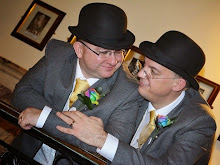
Tuesday, March 31, 2015
Doctor Who Anniversary Special – An Interview With Martha Jones
Originally published in Wonderful Books’ The Doctor Who 8th Anniversary Special… To celebrate the tenth anniversary of Doctor Who’s return to our screens, and today the eighth anniversary of her first appearance in Smith and Jones, here’s my interview with the Doctor’s friend Martha Jones:

“I LEFT THE TARDIS WITH MY HEAD HELD HIGH!”
“I chose my vocation a long time ago, and even meeting the Doctor was never going to change that,” says Dr Martha Smith-Jones. “With a family like mine, you grew up learning to make your own mind up – or Mum made it up for you! But the Doctor certainly widened my career development, it’s fair to say.
“There aren’t many doctors who’ve been swept off into time and space and then come home to work for two different secret alien-fighting organisations. Even the Doctor’s only worked for one! I met my husband through him, of course, and now we deal with them ourselves. Though my Mickey has a slightly more aggressive approach. He shoots, I patch them up. Or him, more often.
“I’ll always be grateful to the Doctor. Some men only give you crabs – well, his were giant! No, no, don’t tell him I said that. He says they’re no such thing.
“After that year of the Master I just decided it was time to move on. I mean, I wasn’t going to keep trailing around with the Doctor for ever. I had my own life to lead. I left the TARDIS with my head held high! Of course, he was the one who came back. Not that it’s not nice to see him, but those Daleks were terrible… And doctors who wring their hands questioning euthanasia don’t know they’re born. They should try deciding whether to blow up the whole planet.
“We still meet up for a gossip, some of us who knew the Doctor. Not Colonel Mace, after Mum slapped him, but she gets on very well with Jack. Well, who doesn’t? Dad, too. I think he’s helped bring them closer. He’s so generous – he’ll take them for weekends away, and after the three of them get together they always come back with such a glow. Mickey pretends not to like him, of course, but secretly he does. Sometimes they go fishing. Mickey says he got a taste for it in that alternative Universe.
“And the Doctor? Oh, I’m completely over him. Hardly ever even mention him these days.”

Wonderful Books
Paul Smith has produced a fabulous array of Doctor Who publications, which you can find out more about at Wonderful Books (there’s a new one out this week). All of them look gorgeous and are immensely readable, but only some are completely factual – and I have to admit, the ones that most appeal to me are those with the most unfactual ‘facts’, the ones that are both deeply loving and taking the piss outrageously.
My Wonderful Books favourite is the one he didn’t write all himself, though it’s not because I’m one of the contributors. I’ve rhapsodised before about the Radio Times Doctor Who Tenth Anniversary Special, a treasured and tattered possession passed on to me when I was a boy and still perhaps the most thrilling Doctor Who magazine ever published. Before websites or guidebooks, this was the unique source of thrilling photos and details of stories all from before I started watching (that is, prehistory). So I was utterly thrilled when Paul asked me out of the blue to write a piece for his version in the fiftieth anniversary year.
Paul’s concept was to give it a similar feel and length to the original Radio Times Doctor Who Tenth Anniversary Special by recreating it as if celebrating not the fiftieth but the eighth anniversary of a Doctor Who series that started for the first time in 2005. And to give it the range of voices of the original’s interviews, he approached other fans to provide some of the artwork and comment pieces.
In the 1973 Special, double-page spreads about past stories alternated with newly shot double-page photo spreads and interview columns for past companions with pull-out quote headlines like “THE NUTCASE PROFESSOR SWEPT ME OFF MY FEET”. For a column like that, I was given only 350 words to play with – imagine – and a couple of other rules which I contrived to bend subtly (such as the ban on alluding to pre-2005 Who). I was asked which companion I’d like to write about, and though several tempted me – Rose and Jack were terrific in 2005, and I loved Jackie and Wilf – I instantly thought of Martha Jones, or rather Martha Smith-Jones as she is now. Had I written Mickey and Martha as a pair, obviously, he’d have mentioned Rose in every paragraph before saying he was completely over her (and had I written for Rory, it would have been a one-joke piece where he dies at the end of each paragraph and then gets better).
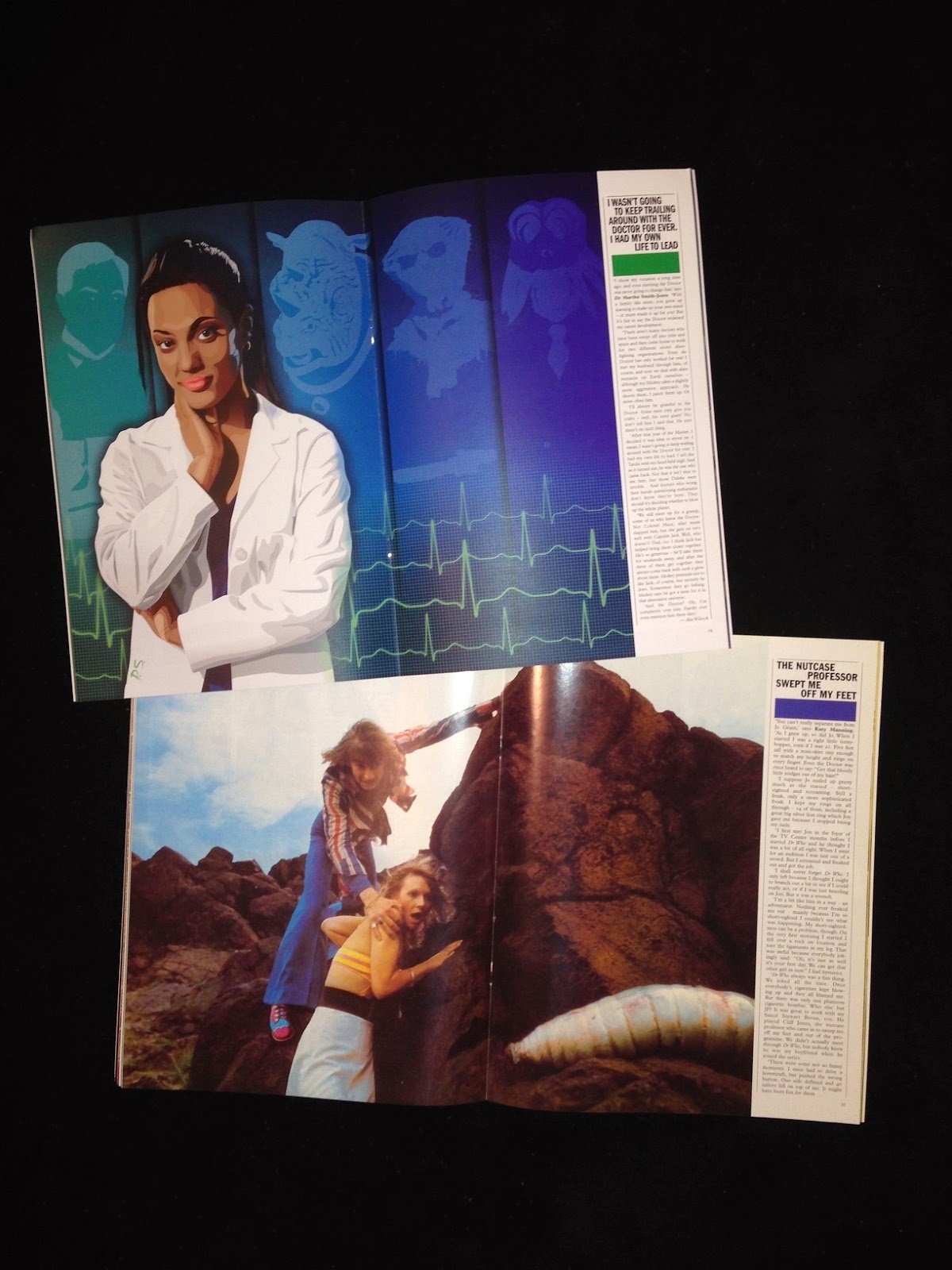
From her first appearance in Smith and Jones, eight years ago today – making it the most appropriate day to publish my own piece from the 8th Anniversary Special – Martha was a breath of fresh air for me. It wasn’t just Freema Agyeman’s performance and giving as good as she got to the Doctor (and him not being interested), nor just that she was the Doctor’s first full-time TV companion who was black (after Sharon, Roz and others elsewhere), but that she wasn’t going off with the Doctor only because her life was a bit rubbish. Martha is the only TV companion since Sarah Jane Smith with a decent, fulfilling, even exciting career – and for all of us who are so utterly gripped by the Doctor and his adventures, that’s a more inspiring example than the implicit suggestion that travelling in the TARDIS is only slightly better than being in a dead-end job you’re bored by or hate, or than having your parents killed in front of you (and going off with the first available surrogate dad). If you’re an achiever with a lot to give up, but the TARDIS is still so exciting you’d go off in it without a second thought – well, you would, wouldn’t you? And, for me, she has by far the most satisfying (and self-chosen) exit from the new TARDIS, too, again after impressive achievements in her own right.
Other contributors took their own approaches, writing critical assessments or celebrations of their chosen characters, but with the Radio Times Special so deeply ingrained in me, I knew immediately that I wanted to write an ‘After the Doctor’ interview in that style, for the character rather than the actor, and that though I was going to be tongue-in-cheek in several ways (her earnestness, the Doctor) as well, I was going to set out first to say ‘She’s a strong, brilliant character’. And while it may have taken some time to think of all the other words, then edit them all back down again, my starting point leapt into my head fully-formed on reading Paul’s initial email to me:
“I LEFT THE TARDIS WITH MY HEAD HELD HIGH.”Though, as you can see from the interview as published, Paul picked a different pull-out quote, though with a very similar feel.

As it turned out, Paul’s wickedly pointed ‘story summaries’ didn’t mention Martha at all, so mine was the only piece that featured her in the whole magazine, and I’m very happy to have done her justice (if thankfully not in an entirely strait-laced way). Happy anniversary, new Who and Martha Jones!
Labels: David Tennant, Doctor Who, Doctor Who Magazine, Fandom, Martha Jones, Obscure Doctor Who Jokes, Personal, Smith and Jones


Monday, March 30, 2015
#LibDemsPointing Meets Doctor Who – Snakedance
It’s finally come: the official end of the 2010 Parliament, and the official start of the campaign (“Not ’til now?” said Tegan, dismayed). And though you might think Doctor Who is all about the Liberal philosophy and not pounding the streets with Focus leaflets, I’ve found evidence of one of the Doctor’s companions standing for election is just the way Lib Dems do.
By chance, the Doctor Who story starting today on the Horror Channel is Snakedance. And there’s a photo-op from that story that shows exactly what I’m talking about. The Doctor tends to be a bit rough and ready in sorting out the big problems and then leaving before he has to do the clearing-up, but Nyssa, one of his friends from the time, was raised in a tradition of public service and proper tidying up (Cleaning up the Mara’s Mess! After Cleaning up the Melkur’s Mess! A Record of Sweeping, A Promise of More!).
We don’t see the TARDIS leave at the end of Snakedance, but you can bet the Doctor goes and hides in it while Nyssa takes over doing her thing. Or, at least, campaigning to be put in charge in the proper #LibDemsPointing way.

RELEASE: IMMEDIATE
What Have the Federation Ever Done For Us?
Nyssa of Traken [pictured, pointing] is standing for Market Ward, Manussa, and campaigning for a new deal for the Scrampus System.
“The Federation have been in charge round here for five hundred years – today! And what have they done since ridding Manussa of the Mara? Nothing but lounged around fondling suggestive antiques on expenses. Market taxpayers have had enough.
“It’s time for a change. We can start by cleaning up this unsightly graffiti that’s all over Manussa’s ancient monuments.”
/ENDS
Labels: Doctor Who, General Election, Lib Dems Pointing, Obscure Doctor Who Jokes, Peter Davison, Snakedance
Sunday, November 23, 2014
Richard and Alex In An Exciting Adventure With Doctor Who – The Video
Hooray!
Celebrating fifty-one years today of Doctor Who – and four weeks today of our marriage.
If the printed version of the reading given at our wedding was too baffling, here is Maius Intra Qua Extra delivered with much more pace and energy – on video!
Many, many thanks to four very lovely men: Nick Campbell (hair) and Simon Fernandes (hat) for performing for us; Simon’s partner Barry for shooting them; and Nick’s partner Jon for looking sweet in the bottom of shot. And, of course, to Richard, for marrying me.
If any reader happened to record any other part of our wedding (or another take of the reading) on their hand-held devices, please let us know, as we’d love to see any videos that any of you have. New-fangled moving pictures were, alas, something we never got round to sorting out, so thank you again, Barry.
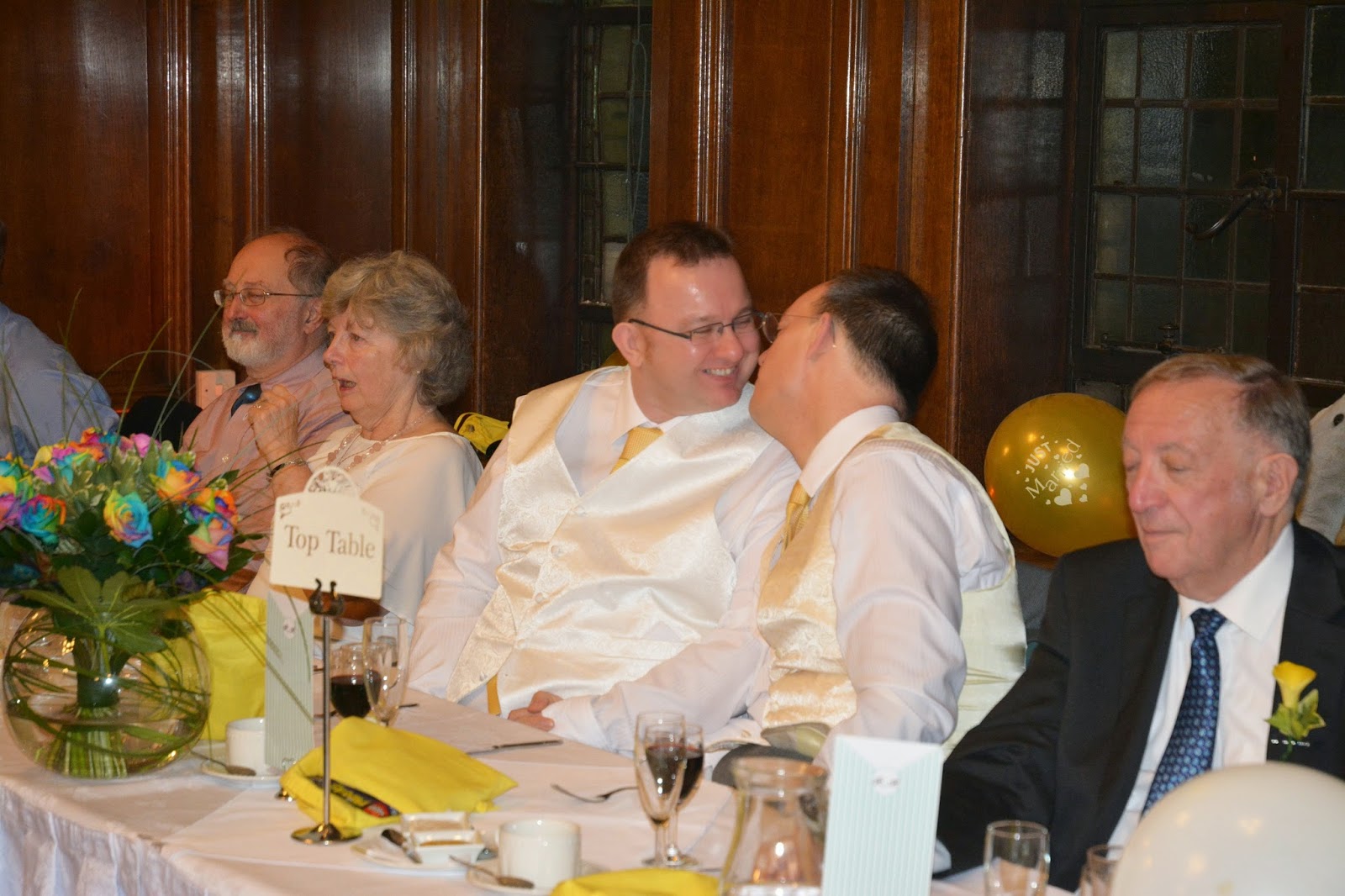
Richard and I are currently sorting through wedding photos for our next project, but here’s one that I particularly like: a shot from during the ‘gratuitous sexual innuendos’ part of the reading, showing the reactions of the two delighted grooms – and of our parents. Fantastic.
I notice no-one’s yet overcome the intimidating number of mashed-up Doctor Who quotations to hazard identifying any of them, so before I just give up and attribute them all, here’s another attempt to get some comments (please chip in either below or on the previous post).
If you’d like a hint for what’s left, though it was all assembled into one piece by Alex Wilcock and Richard Flowers, there were a few other writers.
As is traditional, with additional dialogue by William Shakespeare.
But mainly by David Whitaker, Gareth Roberts, Terrance Dicks, Paul Cornell, Russell T Davies, Anthony Coburn, Rona Munro, Ian Briggs, Ian Stuart Black, Robert Sloman and Barry Letts, Graeme Curry, Christopher H Bidmead, Robert Holmes, Simon Guerrier, Marc Platt, Jim Mortimore and Andy Lane, Ben Aaronovitch, David Fisher,
Thanks to them all, and to so many others.
Labels: Cake, Doctor Who, Marriage, Obscure Doctor Who Jokes, Personal, Pictures, Richard
Monday, October 27, 2014
Richard and I Are Married! Maius Intra Qua Extra
Yesterday, Richard and I celebrated our twentieth anniversary by getting married.

It was wonderful, and we’re incredibly happy.
Thank you to all the many lovely people who came to celebrate with us – and many who couldn’t.

Among the huge highlights for us was a reading performed by our lovely friends Nick and Simon. Like the TARDIS, it was something old, something new, something borrowed and something blue – we wrote it ourselves, but over thirty other writers had written it first, before we assembled nearly ninety quotations from Doctor Who into something uniquely us. How many can you identify?
As I can’t be online much for a couple of weeks to say all the things I’d like to about our wedding and my husband, here to keep you busy in the meantime is our reading, which we carefully scheduled for the middle of the wedding breakfast, when people had already had something to eat and drink and were sitting down. You’ll be able to see how the two readers alternated lines as they went along.

Before I get back online, how about putting your guesses in the comments section? Though if you’re like Richard and can place every single one at once, please don’t take the lot (though you can email me to show off if you like. That’s what I’d do).
Oh, and before I go – you were wonderful. And because we were wonderful too, please send us your photos and videos, by email, website, memory stick for the big ones and carrier pigeon (if my Dad’s not eaten them all). We’ve nicked some photos to start with.

Master of Ceremonies: Peoples of the Universe, please attend carefully. The message that follows is vital to the future of you all. Here are Simon Fernandes and Nicholas Campbell with tonight’s reading.
Richard and Alex in an Exciting Adventure with Doctor Who
Of course we’re getting married. Oh, but there’s another man. Always. The Doctor.
The Doctor is impulsive, idealistic, ready to risk his life for a worthy cause. He hates tyranny and oppression and anything that is anti-life. He never gives in and he never gives up, however overwhelming the odds against him.
The Doctor believes in good and fights evil. Though often caught up in violent situations, he is a man of peace. He is never cruel or cowardly.
In fact, to put it simply, the Doctor is a hero. These days there aren’t so many of them around.
Thank you for this. Thank you for my life, for my wedding, and my husband.
By the way, did I mention – it also travels in time?
Have you ever thought what it’s like to be wanderers in the fourth dimension? Have you? To be exiles? Susan and I are cut off from our own planet, without friends or protection. But one day, we shall get back. Yes, one day. One day…
You had to pick a Sunday, didn’t you? You bring me back to ‘Boredom Capitol of the Universe’; you pick the one day of the week you can’t even get a decent television programme.
So what’s so terrible about Stockport?
Nothing ever happens here.
Nothing for you but pitiless damnation for the rest of your lives! Think on it!
The two Silurians were now hot on the Pakhars’ heels, their big clawed feet making good speed along the cobbles. They kept glancing over their shoulders and squealing. ‘Barbarians!’ yelled Jacquilian at the mob behind them. ‘You’d think it was the twenty-first century!’
‘It is the twenty-first century!’ Sanki told him. ‘So let’s not have any of that Earth Reptile Pride rubbish – let’s just find a barn or something and hide!’
I think you’ve been listening to some very bad advice. Well, it’s just possible that you’ve been given a series of orders while you’ve been asleep. You know – do this, do that, do the other thing. My advice to you is don’t do anything of the sort. Don’t just be obedient. Always make up your own mind.
In the end, we all want the same thing; an ordered society, with everyone happy, well-fed… What’s best for Global Chemicals is best for the world – is best for you!
Such as a little touch of brain-washing.
Freedom from fear, freedom from pain…
Freedom from freedom!
I can hear the sound of empires toppling.
Everything is history, if you look at it from the right perspective.
I used to think – ‘I’ll never get married’… But now I’m not so sure.
That was over twenty years ago. Why must you remind me? I offer you – everything.
Still – the future lies this way.
’Pon my Sam – I may have had a bang on the head, but this is a dashed queer story.
Oh, corks!
Why can’t you talk normally?
What? And be just like everyone else?
Redvers has the whole Universe to explore for his catalogue. New horizons, wondrous beasts, light years from Zanzibar!
Doctor, something tells me you are not in our catalogue – nor will you ever be.
‘What’s that?’ Miles asked as she held the paper up.
Piper remembered what the Doctor had told her, and suddenly grinned.
‘Hope,’ she said, as the powder was carried away from them, like a flurry of sparks, upon the wind.
Now that’s much better. I can believe that.
There was a sudden intensity in his eyes. Ace sensed that he wanted to say something.
Mike offered her the bacon sandwich instead.
Vivien is making some sausage sandwiches. Nothing like sausage sandwiches when you’re working something out.
Personally, I have never seen the necessity for starting a meal with a – what was your word?
Hors d’oeuvres.
Ah! Quite unnecessary, in my opinion. Eight – or nine – main dishes are quite enough.
Unlimited rice pudding, et cetera, et cetera!
The only other solution she could think of was impossible — Daleks didn’t and never, ever had eaten crunchy brown finger biscuits.
Let’s try the pub!
Five rounds rapid.
‘What do you want to drink?’
‘What have you got?’ asked Roz.
‘Hey,’ said the table smugly. ‘You name it we’ve got it.’
‘In that case,’ said Bernice, ‘I’ll have an exaggerated sexual innuendo with a dash of patriot’s spirit and extra mushrooms. Roz?’
‘I’ll have the same,’ said Roz, ‘but with an umbrella in it.’
‘Coming right up,’ said the table.
‘The sky appears to be reflective,’ Holmes replied, more hesitantly than usual. ‘Perhaps, like Dante’s inner circle of Hell, we have ice above us. If you look closely, you will see a reflected glow from something over the horizon. The nearest Earthly equivalent would be the lights of a town or city.’ He coughed. ‘I am merely speculating, of course. It could be an incandescent chicken the size of the North Riding for all I know.’
Jamie, I’m being stared at. Is there something wrong with me?
You mean up here, Doctor?
Is my hair in disarray?
What, no more than usual.
Do I look strange or bizarre?
Aye, well, maybe I’m used to you.
You really ought to come and join me, Pex. It’d do you the world of good. There’s really nothing to be frightened of. …Help!
Doctor, look, here what approaches?!
Oh no, run! It is a Taran Beast!
We’ll meet elsewhere. Now flee with haste
You go West, me East!
Exeunt at different sides, pursued by Taran Beast.
I imagine the whole business caused quite a stir.
No, the Cabinet’s accepted my report and the whole affair’s now completely closed.
You mean it never happened.
Well, a fifty-foot monster can’t swim up the Thames and attack a large building without some people noticing – er, but you know what politicians are like.
And even if it did come after him, the Doctor wasn’t too worried. He didn’t have a very high opinion of monsters, however large and powerful.
Doctor, you – you’re being childish.
Well of course I am. There’s no point in being grown up if you can’t be childish sometimes. Are you coming?
Am I naked in front of millions of viewers?
Victory should be naked! Rejoice in it. Your body is – magnificent.
Ladies – your viewing figures just went up.
Look, Brigadier! It’s growing!
Look, Brigadier – look. I think it’s started.
Well, here we go again.
Men out there – young men – are dying for it!
Thou craggy knob!
David said, ‘Well, then.’
‘Well then,’ said Chris.
At the far end of the street, hostile armed men came to party, and twenty minutes passed.
Was that bang big enough for you, Brigadier?
No, no, the Zigma Experiment was a success! A brilliant, total success!
In many ways, we have the same mind.
Time’s roses are scented with memory. There was a garden where they once grew. Cuttings from the past grafted on to the present. Perfumes that recalled things long gone or echoed memories yet to come.
Listen to me, both of you. I want you to remember. I want you to remember everything. Every single day with me. Every single second. Because your memories are more powerful than anything else on this planet. Just think of it. Remember it. But properly. Properly. Give the Memory Weave everything. Every – planet, every face, every madman, every loss, every sunset, every scent, every terror, every joy, every Doctor.
My father Sidney was a – a watchmaker from Nottingham, and my mother Verity was – erm – well, she was a nurse, actually.
Oh! We make such good wives.
You probably can’t remember your family.
Oh yes, I can when I want to. And that’s the point, really. I have to really want to, to bring them back in front of my eyes. The rest of the time they – they sleep in my mind, and I forget. And so will you. Oh yes, you will. You’ll find there’s so much else to think about, to remember.
Our lives are different to anybody else’s. That’s the exciting thing. Nobody in the Universe can do what we’re doing.
You know, when you’re a kid, they tell you it’s all, ‘Grow up, get a job, get married, get a house, have a kid’, and that’s it. Oh… But the truth is, the world is so much stranger than that. It’s so much darker, and so much madder. And so much better.
Two birds circled each other in the sky above the Lincolnshire marshes. They were owls in love, as much as owls could love.
Are you ready?
If you are.
What? Well, I’d feel more confident if you just said ‘Yes’.
Yes.
Good. Here we go, then.
You look wonderful.
You’d best give me some warning. Um, can you actually dance?
Um… I’m not certain.
There’s a surprise. Is there anything you’re certain about?
Yes. Yes.
And where do you think you’re going?
Well, we’ll have to find out for ourselves, won’t we?
Happy days, my dear.
The happiest of my life, dear heart. Was ever such a potion brewed? In bliss is quenched my thirsty heart.
Very prettily put, my dear.
Oh, sweet, favoured man, you have declared your love for me. And I acknowledge and accept your gentle proposal.
Oh, no, they’re not gonna – oh, people are eating! Nobody over 22 should be doing that in public. Actually, at all.
You see before you the complete killing machine – as beautiful as you, and as deadly as the plague. If only she were real, I’d marry her.
You deserve each other.
Hah! And is not Grendel a faméd coward?
Is the Archimandrite’s hat not silly?
Why then, be gay and deck the hall with spog!
You shall have a husband great or none.
If all the stars were silver, and the sky a giant purse in my fist, I couldn’t be happier than I am tonight.
‘Indeed, Doctor,’ growled the Master. ‘I merely required some time to finish my experiments. I didn’t anticipate the arrival of this maladjusted couple and their wedding plans. I have learnt to be only mildly surprised when you arrive to disrupt my work. But this time you bring with you a full platoon of UNIT troops, numerous armed aliens, an Ice Warrior battlecraft, a couple of Time Lords and Sherlock Holmes! You have excelled yourself!’
I always drezz for the occasion!
Already the Time Lords are gathering, donning seldom-worn robes with their colourful collar insignia. The scarlet and orange of the Prydonians, the green of the Arcalians, and the heliotrope of the Patrexes – and so on.
The latest batch of guests included an upright four-armed blue elephant, who was looking around nervously. ‘Anybody else I know, coming to this wedding?’ he asked.
‘Bestwishesforyourfuturetogetherbut youwillfallbeforethemightofourinvasionforcebythewaywhat
sortofringsarethose?’
Love, the Cybercontroller, Telos.
Don’t mind me. I’m just toasting the happy couple.
Now, remember – enjoy yourselves. Happiness will prevail!
Build high for happiness!
I’m glad you’re happy.
And I’m happy you’re glad.
Sixty million robots danced through the streets of Milky-Pink City. They had never been programmed with dance lessons but what they lacked in style they made up for with enthusiasm. All around, metal limbs twisted with abandon. Tall robots did something that looked like a rumba, lifting robots did the Mashed Potato. And weaving in and out between them raced the Doctor and Martha Jones.
For one vertiginous moment the Dalek Supreme wanted to skip.
Just remember. The future. No looking back, that’s our motto. We’re heading towards a new life… Drive off into the sunset. The future. Adventure. The open road and whatever it might bring.
The sphere experienced, for the first time in its history, the glories of a full cinemascope Technicolor sunset.
Just so Chris and Dep could fly off into it.
So what happens now, then? Tell me what happens now.
In the mid Twenty-First Century, humankind starts creeping off into the stars, spreads its way through the galaxy to the very edges of the Universe. And it endures ’til the end of time. And it does all that because one day in the year 2014, when it had stopped thinking about going to the stars, something occurred that make it look up, not down. It looked out there into the blackness and it saw something beautiful, something – wonderful, that for once it didn’t want to destroy. And in that one moment, the whole course of history was changed.
Homo sapiens. What an inventive, invincible species. It’s only a few million years since they crawled up out of the mud and learned to walk. Puny, defenceless bipeds. They’ve survived flood, famine and plague. They’ve survived cosmic wars and holocausts, and now – here they are out among the stars, waiting to begin a new life, ready to out-sit eternity. They’re indomitable. Indomitable!
In case there is any fear in your heart and doubt in your mind at this awesome moment, let me remind you that you take with you all our pasts. You carry the torch that has been handed down from generation to generation.
The challenge is vast, the task enormous, but let nothing daunt you.
During all the years I’ve been taking care of you, you in return have been taking care of me.
One day, I shall come back – yes, I shall come back. Until then, there must be no regrets, no tears, no anxieties. Just go forward in all your beliefs, and prove to me that I am not mistaken in mine.
There are worlds out there where the sky is burning. Where the sea is asleep, and the rivers dream. People made of smoke, and cities made of song. Somewhere there’s danger. Somewhere there’s injustice. And somewhere else, the tea is getting cold.
Come on, Ace – we’ve got work to do.
The light on the TARDIS flashed like a bright idea.
The TARDIS was on its way to new adventures.
It’s far from being all over!
It’s the end. But the moment has been prepared for.
It’s a new beginning. And the moment has been prepared for.

Labels: Cake, Doctor Who, Marriage, Obscure Doctor Who Jokes, Personal, Richard
Sunday, August 18, 2013
Doctor Who 50 Great Scenes – 35: Full Circle
Counting down towards the fiftieth birthday of Doctor Who with Fifty great scenes… This one’s from 1980, towards the end of three years starring Tom Baker, K9 and Romana. It’s a brilliantly designed, directed and scripted story, a fiercely intelligent evolutionary fable. The allegory of ‘revealed truth’ versus awkward questions and the morality of siding with the underdog are close to my heart. But for all the great dialogue, thought-provoking revelations and the Doctor’s moral passion, deep down the moment that most gets me is still the thrilling monster reveal. When Mistfall comes, the giants leave the swamp…
“Master. Alert.”

Doctor Who’s Eighteenth Season, broadcast from 1980 to 1981, has long been one of my favourites for its ideas and scientific fairy tales (in this case, great work from writer Andrew Smith and lead writer Christopher H Bidmead), as well as for suddenly stunning visuals and music. In the run-up to my Fifty, I selected Eleven Great Cliffhangers and wrote that this season has arguably Doctor Who’s most sustained run of terrific episode endings, with two stories in particular having outstanding cliffhangers every time. This is the other story for which that’s true: the climaxes to Parts Two and Three are brilliant as well, but you can’t beat a great monster moment.
Strange creatures rising from beneath the water are among Doctor Who’s most striking repeated cliffhanger images. First and perhaps most iconically, a Dalek emerging from the Thames in The Dalek Invasion of Earth; the Silurians’ amphibious cousins in The Sea Devils were excitingly captured for me in prose and photos on the page long before I saw their story; the Haemovores in the terrific The Curse of Fenric; if you’re unlucky, River Song. The Marshmen revealing themselves as they leave the water at the end of Full Circle Part One are for me the most memorable of the lot – perhaps because of the atmospheric direction, perhaps because of their monstrous design, perhaps because of the eerie spiralling music that accompanies them. Or perhaps simply because I was at the right age for this to be the first such scene I was able to see on TV.
For once, the sun came out for the location shoot, making the planet Alzarius seem much more alien – to British viewers – and the production much more lush. The Doctor’s vivid red outfit stands out so gorgeously against the vivid green that Richard Briers took this vibrantly exotic image for expensive tropical filming; the sudden murk of Mistfall becomes that much more of a contrast.
The citizens of the Starliner are used to gathering in food from around the great lake, but it’s the food itself that provides the first portent: strange tiny life growing within the marshfruit. Soon the lake itself is bubbling and something beneath the water is grabbing at the skinnydippers. Bearded patriarch Decider Draith announces the coming of Mistfall, the semicentennial Judgment Day during which his people are commanded to huddle within their centuries-broken spaceship, waiting for the deadly mists outside to pass over. Not all of these truths are true… And not everyone is following the commandments. Inquisitive strangers have arrived in a blue box from far further than the Starliner came before its crash on Alzarius, while teenage rebels define themselves by refusing shelter – “Outlers” – one of them even an Elite who ‘should’ be destined to be a Decider, Adric. Draith pursues his protégé, but rather than successfully bringing him back to the fold, the Decider is knocked into the lake and dragged under the water. Adric flees, taking with him Draith’s last warning, and collapses on running into the TARDIS. The Doctor (Tom Baker) and robot dog K9 (John Leeson) go out to the lake to investigate the legends…
The first major clue to the theme of the story – aside from Draith telling his head scientist that he has all the answers the other man seeks, but it would be blasphemy to divulge their ancestors’ secrets to him – is that after all we’ve heard about Mistfall, K9’s analysis instantly debunks it: the billowing fifty-year-recurring fog is non-toxic. So is this just propaganda to remind citizens never to stray from the Starliner? Or is there something else out there they shouldn’t mix with – and is it a physical, a moral or an existential threat?
As the Doctor kneels with K9 to study the marsh, the mist thickens and the lake heaves… K9 alerts the Doctor to potential danger, and the people of the marsh break the surface of the water, approaching the land. The slightly Creature From the Black Lagoon-ish Marshmen designs were one of the best-realised ‘monsters’ the series had created for some years, and Peter Grimwade’s direction gives them a magnificent introduction, swaying and dripping in slow motion in a great return to Doctor Who for scaring the kiddies.
The other contribution that really makes it for me is composer Paddy Kingsland, whose first full score for the series is a triumph, especially here when a spine-chilling motif builds the tension by circling higher and higher until the titles crash in to end the episode. The cliffhanger is cut at just the right moment to leave you wanting more, and if you follow through into the next episode, it offers more: rather than the howl of the Doctor Who Theme’s cliffhanger sting, as the Marshmen fully emerge from the swamp and stride onto land to open Part Two the eerie chiming music evolves into harsh electric guitar power chords for the developing peril.
As I’ve sometimes written, I enjoy film and TV scores but have no musical training and little musical vocabulary, which is why I think in metaphors such as “spiralling”; a person who does know a bit is John Toon, whose blog Doctor Who Electronica – 50 Scores in 50 Weeks for the 50th Anniversary is keeping up much better with its intentions than my own Fifty. He has this to say on that cliffhanger moment:
“A repeated seven note phrase plays over scenes that relate to Mistfall or that feature revelations about the Alzarian life cycle. The end of Part One, as the Marshmen emerge from the water, is a notable example. The notes rise and fall cyclically within the phrase, and the phrase itself rises across repetitions, as if emphasising the upward climb of Alzarius' super-evolving lifeforms. ‘The Ascent of Marshman’, we might call it.”
Bonus Great Doctor Who Quotation – The Power of Kroll
I wrote last time about the brilliance of Robert Holmes’ writing for Doctor Who. His last story in his ten years as a regular scriptwriter featured the same team of the Doctor, Romana and K9 – though a different Romana to the regenerated Time Lord seen in the other two stories I feature today. 1978’s The Power of Kroll doesn’t entirely play to Mr Holmes’ strengths: told to take out the jokes and put in a giant monster, he gives us an alien world whose green-skinned people show more buttocks than Torchwood and whose history of exploitation is a mash-up of Native Americans, Irish nationalism and, as you’re about to discover, the subtle tribal characterisation of King Kong. At least when Kroll the massive tentacled beastie does eventually rise from the depths he’s rather impressive (and has a well-conceived life cycle). Before he does, we’re given what looks like a traditional ‘monster reveal’ cliffhanger at the end of Part One, but is actually something stranger, cleverer, and at first glance a little disappointing: while several of Bob’s cliffhangers are stunning moments let down by lacklustre resolutions the following week, for this one time only it’s the reverse of instant gratification. As Romana (Mary Tamm) struggles on the Stone of Blood and the Doctor (Tom Baker) paddles through the swamp to find her, there’s memorable dialogue from the Tribe. This time with the actions. It’s no double act, and it may be memorable for all the wrong reasons, but I still can never help but sing along to The Kroll Song as the Tribe do aerobics with spears, stamping and thrusting and giving it some welly to summon their god. It’s a sort of ritual chant:
“Kroll!”Repeat twenty-five times, or until cliffhanger.
[Five drumbeats]
“Kroll!”
[Five drumbeats]
“Kroll!”
[Five drumbeats]
“Kroll!”
[Five drumbeats]
“Kroll!”
[Five drumbeats]
Extra Bonus Great Doctor Who Quotation – City of Death
Today’s other bonus was first broadcast back in 1979, in between the other two choices, and though technically it’s not a monster rising from the depths, here we have a villain from the depths of time, traced back to the ocean floor before it was ocean, and who looks very tentacular when not looking like the fabulous Julian Glover. So it counts. And while this story is another to feature marvellous images and marvellous music, this time I’ve picked a line of drawing-room comedy dialogue. The script is credited to “David Agnew” – in truth, a mixture of Graham Williams, David Fisher, the actors and perhaps most prominently Douglas Adams – and towards the end of Part Three, Romana (Lalla Ward) has escaped from the villainous Count Scarlioni – in truth, ancient alien Scaroth, last of the Jagaroth – but returns to his château to find out what he’s up to. She breaks in with the aid of an out-of-his-depth private detective, but they don’t break in terribly successfully. They’re dragged in at gunpoint by a sneering henchman, where Scaroth (Julian Glover) tosses an aside to them with a beautifully underplayed little laugh:
“As soon as the alarm sounded, Excellency – he was halfway through the window, and she was outside. I thought you might wish to speak to them, so I called off the dogs. They cannot be professionals.”She’s so utterly impractical, he’s so urbanely villainous, and it always cracks me up.
“My dear, it was not necessary for you to enter my house by – ah, we could hardly call it stealth – you had only to knock on the door…”
Next Time… The scariest place for anyone
Labels: Comedy, Doctor Who, Doctor Who 50, Douglas Adams, Full Circle, Julian Glover, Music, Obscure Doctor Who Jokes, The Key To Time, Tom Baker
Wednesday, May 01, 2013
Doctor Who Unbound – Sympathy For the Devil (and 10% Off Big Finish Today)
Rush to Big Finish, makers of Doctor Who and other quality audio dramas! Today only, they’re doing 10% off everything, and some of it’s very good indeed. My personal top recommendation is Rob Shearman’s Jubilee, the best bit of Doctor Who in the show’s Fortieth Anniversary and a big influence on the 2005 TV series. Also from 2003, I’ve been listening again to Jonathan Clements’ brilliant Sympathy For the Devil, starring David Warner as a grumpy alternative Doctor, David Tennant, Nicholas Courtney and Sam Kisgart. Order it today, and don’t read anything about it first (here’s the trailer). Spoilers follow…
“Oh, very good, Doctor. Your powers of deduction are, as usual, adequate.”This is a less in-depth review than usual, so you’ve got time to get an order in – but it’s well worth while. You can hear a remarkable number of voices from Doctor Who’s Twenty-first Century TV series in this story, from David Tennant himself to two people involved in this year’s Cold War. And where Jubilee inspired Dalek, something here may just have influenced Rise of the Cybermen… Back in 2003, Big Finish celebrated the series’ last big anniversary by casting six alternative Doctors for one-off dramas, asking What If…? What if, in this one, David Warner were the Third Doctor, exiled to Earth by the Time Lords but arriving nearly twenty years late? That means he was never UNIT’s Scientific Adviser, and a bitter old Brigadier (and Surrey) has had a terrible time of it. The Doctor makes things better – having no Doctor makes things worse. It’s the best of their Doctor Who Unbound series, and so much misanthropic fun that they were paired together for a splendid sequel, Masters of War, which adds another fine old actor to the brilliant team of David Warner and Nick Courtney (and makes it even more like The Scarifiers). And if you fancy more David Warner from Big Finish, they do some excellent Sapphire and Steel, too.
On a personal level, this story’s about both a Doctor and a Brigadier disenchanted by losing out on fuller lives rediscovering themselves. On a story level, it’s both love-letter to and critique of the Pertwee era, with an added local reflection of the Time Lords. UNIT had to get harder and nastier, and David Tennant’s Colonel Brimmicombe-Wood is a nasty hard bastard with a scene-stealingly sweary tongue, a tendency to make mistakes and a shocking contempt for our old friend Lethbridge-Stewart… And then there’s the other character who flies in for a skewed sequel to what is right now a uniquely little-known story of the period. And from now on, the spoilers get thicker and faster, so you might consider stopping reading now. Though most of the fun’s still to come…
“The proof is that the world isn’t overrun by bloody lizards!”This time David Warner’s tangling with a different Cold War power. It’s Hong Kong; it’s 1997; and a sinister figure is prompting tensions between Britain and China on the eve of the Handover – General Ke Le of the People’s Liberation Army, escaping with the aid of, er, foreign stealth technology. It’s Beltane today, so which character have I been writing about, an embarrassing month after I last posted one of my Fifty Great Scenes entries? As this is another take on the Third Doctor, there’s only one person he could possibly be. He had previously defected to the East as Emil Keller, and brought his ability to turn criminals into mindless soldiers with him… Yes, it’s Sam Kisgart, in truth Mark Gatiss, as General Ke Le, in truth the Master. And rather a good giggling fiend he makes, too.
My favourite play on names, though, comes between the Doctor and the local Abbot in Chapter 10 of the CD (also available in download) – puns in Chinese dialects, and I stake a fiver all of them wittier than Mr Moffat is likely to deliver in a fortnight’s time.
One of the Pertwee era’s most stylish and exciting story is Doctor Who – The Mind of Evil, at present the sole TV story featuring Jon Pertwee as the Doctor yet to be released on DVD. It’s due out a month on Friday, though, and painstakingly recoloured after the BBC carelessly burnt the original tapes and left only black and white export copies. It’s striking for showing UNIT as an impressive, extensive – and expensive, the biggest-budget Doctor Who story to that time – military force, and for giving Roger Delgado a fabulously louche Bond-villain role as the Master, as well as showing his biggest fear. Sympathy For the Devil is a very different story to The Mind of Evil, but takes several elements and themes from it as its starting point, expanding the sole mind parasite of the earlier story into a threat to the world – as well as making the end of a chant almost as dangerous as it was in Logopolis (the Master, again). All making a drama that’s both sinister and sometimes very funny, especially if you can spot your Doctor Who (or Rolling Stones) in-jokes… There’s even a reference to a Satanically-titled New Adventure. Add in musing on the nature of evil and Twentieth-Century atrocities, and you have something rather special.
Both the drama and the distinctly dark humour come together brilliantly for a rather bleak ending, as both the Doctor and the Master find things spiralling out of control and we find even the Master has missed the Doctor – frustrated at having been stuck on Earth in his enemy’s place.
“Pol Pot killed every doctor he could find – and none of them was you!”Give this one a go – for today, it’s less than a fiver. Give some of the others a go, too. And listen right to the end for a Doctor strangely more endearing than the one who’d just been on telly around the time the story’s set, and strangely both more and less competent than the other version of the Third Doctor.
Or you could just watch Wizard – it stars David Warner, it’s written by Big Finish’s finest Simon Guerrier, it’s short, it’s funny, and it’s not just 10% off but free. How can you say no?
Labels: Big Finish, David Tennant, Doctor Who, Jon Pertwee, Obscure Doctor Who Jokes, Sapphire and Steel, The Brigadier, The Master
Friday, January 11, 2013
My Doctor Who Thirty-Eighth Anniversary and DWM
It’s one of the perils of writing for someone else’s publication that you face editing – and though under 250 words is a snip by my standards, it still got snipped. Now, usually I’d still be very happy to see it printed (and I am) without any pedantry to follow, but for me it loses something without my last line – which I’d intended as the point of the whole thing, and dropping it completely reverses the meaning.
One of DWM’s regular features is A Battle of Wits… in which Toby Hadoke and Johnny Candon, at least one of whom, improbably, I know to be a real person, debate obscure Doctor Who controversies and then invite readers to take sides. In last month’s issue, Toby argued that the best year ever to be a fan was 1983, because there was lots of stuff going on but you could only do it if you tried really hard, and though curiously he praised very little about the actual TV series that year, it was special because it had never yet been cancelled (so, Doctor Who was special because it was hard, and simultaneously because it was easy). Johnny, on the other hand, praised the series’ great return in 2005, because suddenly it was back, it was popular, and it was good. Whereas my instinct was the same as when I read Tat Wood’s long essay in About Time Volume 3 on why 1973 was, entirely factually, the greatest year ever for Doctor Who: marshal all the arguments you like to ‘prove’ it; it’s really not about the series, but about you. So, read on to the punchline:
My Letter in Galaxy Forum, DWM 456
So, Toby, 1983 was the best year to be a fan? [See A Battle of Wits in DWM 455.] How about 1975 as Doctor Who’s most brilliant year instead? A massive 35 weeks of new episodes – still the most in any year since the series went colour. Fantastic stories including two in every fan vote top ten (Genesis of the Daleks and Pyramids of Mars), a favourite of both twenty-first century showrunners (The Ark In Space), all part of the first full year of Tom Baker, the twentieth century Doctor that everyone remembers. For fan-pleasing returns, Daleks, Cybermen and Sontarans. For creativity in space and time, Davros, Sutekh, a fabulous Robot, an amazing jungle, Zygons and their ship that seemed grown, not made. Who can doubt that 1975 was the best? It’s completely objective truth!
My Original Letter
So, Toby, 1983 was a great year to be a fan because it was hard to do the fan things (A Battle of Wits… DWM 455)? Or because however good, bad or middling the series was, at least it was just always there? I find Johnny’s 2005 more convincing – a thrill beyond hope for old fans like me, a marvellous start for new fans, and one of the most marvellous seasons in the programme’s history. What could possibly beat it?
How about 1975 as Doctor Who’s most brilliant year instead – for fans and everyone else? For quantity, a whole 35 weeks of new episodes, still the most in any year since the series went colour. For quality, the fantastic stories include two still in every fan vote’s top ten results (Genesis of the Daleks and Pyramids of Mars), a favourite of both Twenty-first Century showrunners (The Ark In Space), all part of the first full year of Tom Baker, the Twentieth Century Doctor everyone still remembers. For fan-pleasing returns, Daleks, Cybermen and Sontarans. For creativity into space and time, Davros, Sutekh, a fabulous Robot, an amazing jungle, Zygons and their ship that seemed grown, not made. To take home, not just shiny new Target novels but even The Doctor Who Monster Book, with the most thrilling pictures ever.
Who can doubt 1975 was the best? It’s completely objective truth. And by pure coincidence, it’s when three-year-old me started watching. I bet Toby and Johnny were just as objective.
Now go out and buy DWM 456, which features an adorable* Doctor Who alphabet (surely begging to be a poster), a comic strip with one of their most memorable ‘WTF’ splash-panel endings, features on the both the last and the first of Doctor Who in the ’80s (both rather brilliant), and lots about the new (and, for me, much-improved) TARDIS design. Just don’t look at the spoilertastic pictures from the new version of The Reign of Terror (due on DVD on Richard’s birthday in a fortnight) if you don’t know the story…
*Favourites include 1975’s Zygons, obviously, Quarks, J is for Julian Glover, doing the sort of thing I do and cheating with two for R… But, most of all, another from 1975 made me go ‘Awwhhhh!’ H is for Harry Sullivan. From Trumpton.
Labels: Doctor Who, Doctor Who 50, Doctor Who Magazine, Obscure Doctor Who Jokes, Personal, Tom Baker
Friday, December 21, 2012
The Hobbit Fantasy Casting
The Hobbit
Starring
And in especially large letters at the end
Proper blogging may reappear soon. I’m having a crappy day and humming That Dwarf Song to keep warm.
Labels: Christopher Eccleston, Colin Baker, David Tennant, Matt Smith, Michael Jayston, Obscure Doctor Who Jokes, Paul McGann, Peter Davison, Sylvester McCoy, Tolkien, Tom Baker
Saturday, December 08, 2012
Doctor Who 50 – Eleven More Great Scenes. And More
My idea is to pick a brilliant scene each week and set out just why it’s so brilliant – with a bonus quotation from the series each time that’ll mostly speak for itself. Many of the scenes will be from crucial moments in their stories, so watch out for spoilers (and today’s selection is particularly spoiler-heavy). All the Doctors will be there – just not necessarily in the right order. I’ll be counting down these marvellous moments roughly in order of preference, though not entirely: some might be there to tie in to a particular date, or spread out a bit so that similar scenes don’t all turn up in a row. Some scenes or sequences lasted mere seconds on TV… The longest up to a quarter of an hour. Most tend to be a couple of minutes long if you watch them, though who knows how long my write-ups are going to be.
The Fifty spread over this year will include my few absolute favourites – though not necessarily a ‘top fifty’. Looking at my instinctive choices, certain Doctors, certain stories, certain styles (not least speeches – and scary bits) came up much more than others. So, because I love the whole of Doctor Who, I’ve striven for more balance. The Fifty will include at least one scene from every year in which the series has first aired, and at least one from each of its TV seasons. There will be no more than one scene from each story featured (with one exception) – though the quotes will be more random and less calculated, some reflecting that week’s scene, others ones that just popped into my head, even if I’ve striven not to make them all from The Talons of Weng-Chiang. And I’m afraid this Fifty will be drawn only from the TV series, though I showcased a wider range at the last big anniversary with forty-five stories illustrating Why Is Doctor Who Brilliant? It was hard enough trying to weigh every scene in over two hundred television adventures, and I simply couldn’t have done it with what must now be thousands of different stories in all the many formats. Hopefully, these choices will be variety enough.
Most of all, I’ve picked scenes that I enjoy, and I hope you will, too.
I thought of hundreds of scenes before whittling them down to the Fifty. I could have done the Five Hundred… Except I’d never have managed to get them into any sort of order, still less found time to write about them all. Last week, I whetted your appetite for the forthcoming Fifty with Eleven Great Cliffhangers – though not quite the greatest, which you’ll see across the year – and, this week, Eleven Runners-up of various other descriptions, some to cast a different light, others which so nearly made the Fifty but for other choices already from their year, or their story. Inevitably, there are speeches and scary bits – but also special effects, some things that make me laugh, sentiment, excitement and more. Read on…
The Deadly Assassin
“Through the millennia, the Time Lords of Gallifrey led a life of peace and ordered calm, protected from all threats from lesser civilisations by their great power.
“But this was to change. Suddenly and terribly, the Time Lords faced the most dangerous crisis in their long history…”

First off: my favourite story of them all, beginning with the opening titles and a sombre introduction. This is less a scene than setting the scene, so it seems the perfect way to start. This arrangement of the fabulous Doctor Who Theme is still the best, ending in that marvellous stuttering echo as the titles fade, and the titles themselves the greatest titles ever made, a time tunnel swirling in different shapes and directions, carrying the TARDIS, the Doctor, the logo and credits through time and space and visibly inspiring the title sequence still used today. Then, for the first time, the story is introduced with a scrolling text read in the moody tones of the Doctor (Tom Baker). It promises something special. And it is.
The Doctor will crash into a premonition of death – and then, alone now, become a hunted fugitive in a city that was once his home… A film noir nightmare, political satire, dizzying virtual reality, reimagining the Master and the Time Lords, this will be the series’ most radical and creative story, both conceptually and visually (and upset Mary Whitehouse like no other). But it all starts with that unbeatable time tunnel. That’s Doctor Who.
The Dalek Invasion of Earth – Flashpoint
“One day, I shall come back. Yes, I shall come back. Until then, there must be no regrets, no tears, no anxieties. Just go forward in all your beliefs – and prove to me that I am not mistaken in mine.
“Goodbye, Susan. Goodbye, my dear…”

The first time the Doctor (William Hartnell) ever said goodbye to a travelling companion was to his granddaughter, Susan. And it’s been painful for him ever since. She’s fallen in love but feels she can’t leave him – so he makes the decision for her at the close of this story. It’s the beginning of so many times that writers have had to find a reason for someone to want to stop travelling in space and time, and one of the more plausible but sexist ones, being married off (an idea intermittently challenged by the Ponds); here it’s done with a little more conviction and a little more sexism than most, though the Doctor does show his love and pride in her and give her credit for looking after him as much as he’d looked after her. It’s William Hartnell’s beautifully played address to his grandchild that makes this so special, her shut out of the TARDIS, him standing at the console, both still smudged with ash from exploding Dalek mines. His stirring benediction falters slightly at the end, and he has to leave before he changes his mind. Susan walks slowly away from the vanished TARDIS, leaving her key in the ruins. The selection of part of this scene to open The Five Doctors cemented fans’ love for it, and when – after a decade of making speeches – I at last used a Doctor Who quotation in a speech of my own, I closed with this one. My voice broke at the end, too.
The Brain of Morbius
“How far, Doctor? How long have you lived?”

The brain of Time Lord war criminal Morbius has been restored to physicality in a hideous body of bits (and in an inspired twist not just on Frankenstein but on one of the ’60s and ’70s most often-used great TV threats). As the Nuns of Doom march to his castle in the final episode, bearing the traditional torches, the Doctor (Tom Baker) challenges him to a mind-bending duel: pitting their mental powers against each other to see which can force the other back through their lives to nothingness. Tom Baker and Michael Spice (plus Stuart Fell within the body) are both outstanding in their electric confrontation, Morbius arrogantly proclaiming himself “a Time Lord of the first rank,” the Doctor scorning him as a failed dictator, all set to one of composer Dudley Simpson’s finest moments, deep, stately chords offset with a spine-tingling counter-melody.
Two more things stand out. One is that the Doctor is fighting a desperate rear-guard action against of the titans of his race – what’s special about our hero is his choices, not his intrinsic power, and he’s overwhelmed by Morbius’ mental power: all he does is hold out long enough for the energies to be too much for Morbius’ new brain-case to bear, not the brain itself, and even that nearly kills him. We see Morbius thrust the Doctor’s psyche back through Pertwee, Pat, Billy… And through many previous incarnations as he hurtles back to his beginning. Contradicted or supported elsewhere as these may be (and some fans jump through such hoops to deny their intention), for me they’re a sign that Doctor Who can always surprise us, an enthralling sight and concept, and all that could make them more so is if the pre-Doctors were not members of the production team but old actors’ faces. Just imagine, say, Alastair Sim appearing, firing your imagination to see his black and white Doctor Who movies from the ’40s.
Remembrance of the Daleks
“BANG!”

Doctor Who always beat its budget to create memorable images that no-one else could show you, from the first sight of the TARDIS’ impossible interior and the first alien world, with its petrified forest and gleaming city, to monsters like suckered embryos with a ship that seems grown rather than made and a howlingly alive alien jungle, to eerily beautiful robots in an Art Deco vessel, or multiple Mona Lisas, or an Escher painting that encloses you, to crossing the striations of the timelines wearing a splash of red upon strangely monochrome stately gardens, right up to a would-be tyrant’s face disintegrating horribly or a dying world with a stormily alien sky. All that without yet breaking into the series’ Twenty-first Century stories – until my next choice down. Out of all of them, to champion Doctor Who’s most visually exciting moments I’ve picked two where the series makes an impact on London: one in 1963, when Doctor Who started; the next in the Twenty-first Century, when it continues. This is the one with streetfighting Daleks blasting the hell out of each other and the fuck-off bazooka Dalek.
The Doctor (Sylvester McCoy) is juggling two warring Dalek factions: the wily old gun-metal veterans; the glorious white and gold new Imperial stormtroopers. In Part Four, the veterans have captured a superweapon – but the Imperials don’t intend to let them get away and land an attack squad to take it. The first engagement sees an Imperial force retreat under a hail of fire from the more experienced warriors, one blown satisfyingly apart… Only for the Emperor to order the Special Weapons Dalek into position. Daleks have always been one-being tanks: this one, with its heavier, grimier armour and one huge gun, takes that to extremes. Simply obliterating every rival in its path, when it reaches the enemy base it blasts the gate apart in an enormous fireball, a blizzard of energy bolts slashing through the blaze before it settles. Some of the explosions staged here were so outrageous they caused an anti-terror alert (I love the BBC) – yet the battle’s still more exciting in the novel. Thrill to the Abomination!
Aliens of London
“BONG!”

I said before Doctor Who returned to our screens in 2005 that it would have to deliver not just impressive special effects – which everyone can do these days – but also memorable images with ideas behind them, and that year alone it delivered in spades, from looking at the Lady Cassandra’s beautiful flatness, to Daleks that were everything you ever darkly dreamed, to flying, shrieking time-eaters clawing at a church, to heads choking and splitting into gas masks, and since then keeping up the pace with a werewolf running amok in a stately home, the TARDIS bouncing along a motorway, a hospital on the Moon and right up to, yes, dinosaurs on a spaceship. But the most cheekily memorable image of that first new year? This is the one with the spaceship crashing into Big Ben.
The Doctor (Christopher Eccleston) has accidentally brought Rose back home not a day but a year after taking her on a trip through time and space, which has not gone down well. Both are at their most unlikeable as they bicker on a rooftop, and no-one else on Earth is going to believe Rose if she tries to talk about aliens and spacecraft… Only for a spaceship to fly straight overhead, trailing smoke, weaving across London and eventually crash-diving along Whitehall, smack into the clock topping St Stephen’s Tower, before belly-flopping into the Thames. Thank goodness it came along to snap them out of it, though their initial reactions are mixed… It’s the first and still best moment of its kind, as Russell T Davies enters his vocation to destroy ever major landmark in London. When Doctor Who does a story called ‘Aliens’, it looks like a bumbling comedy where they can’t even fly their ship… But the ominous truth is that they’re as greedy as a Ridley Scott corporation, and can destroy a whole planet much more quickly than something with sinisterly sexual gnashers.
The Talons of Weng-Chiang
“It’s good.”
“Oh. I’m so glad.”

With something to delight and something to offend everyone, The Talons of Weng-Chiang might just be the most enjoyable and quotable and thoroughly unsuitable for children Doctor Who story of them all. Obviously, I’ve loved it since I was five, and remember many years ago standing in a video shop with the latest VHS release and being unable not to overhear another small boy arguing with his mum about which Doctor Who video to buy. He wanted several; she would only pay for one. He was oscillating between two that I didn’t think were much cop, so I felt the urge to intervene, but made the most appalling error in being grown up: I asked her what sort of thing he liked. Of course, she didn’t know. So I knelt and asked which stories he had already and were his favourites. Having listened to the right person, I recommended Talons to him because it was scary and funny – and to her, on the basis that it was six episodes for the same price as four. I’ve often wondered if she left him alone with it, or came in, saw any of it and disapproved of the young man who’d suggested such appalling viewing.
One especially entertaining sequence comes half-way through Part Two. We’re on the dark streets of late Victorian London. The Doctor (Tom Baker) has been auditioning for (he can play the Trumpet Voluntary in a bowl of live goldfish) and sleuthing with theatrical impresario Henry Gordon Jago, not quite the bravest man in the Empire; his warrior tribe companion Leela has remained with premier pathologist Professor Litefoot, a crustily congenial old cove. Someone should pair these two guest artistes. And the villains have been crawling the kerbs in their carriage in search of the plot (spot the Porsche!). That plot revolves around monstrous appetites, so even the comedy scenes that pepper it have disturbing overtones – and this one enriches the main themes even as Litefoot finds the usual late-night cold collation laid out by his housekeeper and innocently offers Leela dinner.

You think writing about special effects is doomed? What about describing comedy? I’d urge you to buy this on DVD and watch it, because the comedy of manners between Leela – raised in an alien jungle – and a perfect Victorian gentleman never fails to crack me up. Expecting a lady, Litefoot’s face as she picks up a joint and just tears into it is priceless. He quails (there’s one of those on the table too). But politeness demands he can’t criticise or embarrass a guest, still less a lady, and when Leela’s own understanding of hospitality makes her express her satisfaction with the food, all he can do is weakly pretend pleasure. Faintly proffering a knife or fork, he sees her seize a carving knife, the better to hack the beef apart, and is left with no option as a good host but to put down the plate he would usually stack with a dainty selection of slices and, instead, grab a whole leg of lamb in both hands and bite. The culture clash in their next scene, when Leela drinks from the trifle bowl while Litefoot looks on queasily, has been known to make me cry with laughter. His last gasp of Victorian propriety comes in trying to save the tablecloth from Leela so as not to mortify the housekeeper come the morning – but before the night is out, it’s doomed to the Doctor. And by the end of Part Three, Leela’s enthusiasm for chomping on a leg has its own darker payoff…
Revelation of the Daleks
“It is our duty to eradicate all those who wish to pollute the purity of the Dalek race… If you ever loved me, Natasha, kill me! Kill me! …It is vital that the Daleks are supreme in all things!”

The Doctor (Colin Baker) isn’t the only one who wants to know what’s happened to his old friend Arthur Stengos; by half-way into Part One, Stengos’ daughter Natasha has broken into the galaxy’s biggest funeral home to find his ‘sleeping’ body missing and Daleks on guard. Overseeing all is Davros, remaking himself as the galaxy’s greatest doctor and promising eternal life – but of the kind that’s red-lit, tortured and underground. And the greatest horror for her is finding what’s left of her father growing into a Dalek, caught between his own self and one of Davros’ new breed of fascists. In a story of black comedy and dreamlike horror, this is the most nightmarish moment, a dramatic and visual triumph as Stengos is revealed in close-ups of eye and mouth, as if dismembered, and struggles to remember his love for his daughter when in his ranting New Order instead “The seed of the Daleks must be supreme.”
Stengos’ fate draws from perhaps the most memorable scenes in two of the greatest Doctor Who novelisations – a glass Dalek, a human slowly transforming into something ‘other’ and begging for death – each of which were too challenging (perhaps too expensive, certainly then too horrific) to portray in the original TV versions of The Daleks and The Ark In Space. And if you’re going to write as the David Whitaker or Bob Holmes tribute band, you’ve certainly got great tunes to play. As, if you didn’t think Natasha’s terrible choice was weird enough, does the resident DJ…
The Curse of Fenric
“Objects can’t harm us – it’s human belief. And you stopped believing when the bombs started falling.”
“I’m not frightened of German bombs.”
“Not German bombs… British.”
“On German cities. British bombs killing German children.”

In World War II, the Doctor (Sylvester McCoy) contests an ancient force of evil on the North-East coast. By the end of Part Two / half-way through the Special Edition of this most complex and layered story, the lively two young women Eastenders are made vampires, draining their self-righteous landlady then stalking through the graveyard mist to the local vicar. He tries to understand them… But they understand him much better. Reverend Wainwright flourishes his Bible, but they know it’s only faith that keeps them at bay – something with a stunning payoff later in the story – and that his is crumbling not under the horrors of the undead, but the horrors of war. Only the Doctor’s ferocity as he hurls himself in front of Wainwright makes them recoil, but they’ll return for him… Will he be able to find it in himself to triumph then? The Doctor and the bloodsuckers are almost forces of nature in this spellbinding scene that turns the traditional vampire story inside-out.
Love & Monsters
“You should take your jacket off.”
“No, I’m fine, I’ll just –”
“No, look, you must be boiling. Oh, look at your shirt. Sorry.”
“I – I – I’m fine. It’s all right.”
“I’ve ruined it.”
“No, honestly, i-i-i-it’s – it’s fine.”
“Take it off. I’ll put it in the wash.”
“Oh, come on! It’s only a little drop.”
“Oop! There now. Ruined.”

Elton Pope’s been fascinated with the Doctor ever since he was a boy, and never been happier than with a little group of friends with the same interests. By half-way into the story, though, someone’s rather taken over, organised them, given them ways to track the Doctor (David Tennant) and his friends, but things are less fun. And some of Elton’s group have vanished. Be careful what you wish for… And Elton wishes he could find Rose, so he tracks down her mum Jackie. Turns out he’s not quite as in control of his infiltration plan as he thinks he is. She keeps inviting him round to fix all the things that keep going wrong about the flat, and it’s got nothing to do with the way Elton’s shirt keeps accidentally riding up to show his stomach as he changes a bulb or his jeans showing off his arse as he looks at the washing machine. It’s a complete coincidence that her tops are getting tighter and skirts shorter, too. But just as she flings herself – or at least her wine, twice – at him, a call from Rose spoils the mood. She feels ashamed of her ulterior motives, and shows it; so does he, but doesn’t. He goes off for pizza to make it up to her, but it’s too late – she discovers what he’s after and she’ll protect them until the day she dies…
Camille Coduri’s Jackie has long been a brilliant comedy creation by now, shot through with tragedy; this is her finest moment, never funnier and never more moving as the cracks show of how much she misses her daughter and even Mickey. “Put the telly on if you want – can’t bear it silent.” The way Elton’s unreliable narration within his unreliable narration collides with her at her most turbo-charged is hilarious, then she and the script turn in an instant and break your heart. It’s inspired how ELO’s Turn To Stone gives way to Jackie’s choice of romantic music as she takes control of the scene from the man who’s been narrating it; her joyous sexuality is brilliant; then she lets her defences down only to find herself betrayed, anger punching through her loneliness to show how selfless and ferocious her heart is. Rose never sees it.
Genesis of the Daleks
“Today, the Kaled race is ended, consumed in a fire of war – but from its ashes will rise a new race: the supreme creature; the ultimate conqueror of the Universe; the Dalek!”

The climax to Part Three of this story, one of Doctor Who’s best, is an odd beast. On screen, the cliffhanger is a slightly underwhelming threat to the Doctor (Tom Baker). On the truncated LP (and now CD) release, the half-way cliffhanger comes a couple of minutes later, with the annihilation in fire of the Daleks’ parent species, the Kaleds, by their ancient enemies, the Thals (a model city with a sense of scale as, for once, the explosions take an age to die away). But it’s Davros, the half-Dalek creator of and would-be Führer of the new race, who actually betrayed the secret of their defences – to stop their leaders bringing the Dalek project to a halt. And in the originally scripted climax to the overrunning Part Three, moved back to begin Part Four, Davros uses the moment of shock for his scientific Elite (now the only survivors save for their mutated, battle-tanked progeny) to destroy his only outspoken internal critic. Ronson has asked awkward questions about the future of the Daleks and aided the Doctor’s escape; biding his time to respond, Davros now denounces Ronson as traitor and spy, ordering in his new Daleks to carry out their first ever extermination and promising vengeance on the Thals, too, then the absolute power and glory to which he aspires.
Genesis of the Daleks is packed with great moments, and another will make my Fifty. It’s the finest example in Doctor Who of actors and writers coming together to forge proper speeches, rather than just assuming ‘speaking at length’ makes great rhetoric. Others might choose the Doctor’s key moral dilemma – asking “Do I have the right?” – but this scene captivated me growing up and listening to it again and again on scratchy vinyl. The sheer power of Michael Wisher’s performance as Davros; the sheer ruthless chutzpah of the character; the sheer horror of Ronson screaming in denial. On screen, it’s the negative blaze around him and the sight of his colleagues backing quickly away, shielding their eyes, that stays with you; on LP and CD, the raw immediacy of the sound design, Davros’ harshly escalating triumph, the crashing march as the Daleks enter and their gun-sticks seethe. Gripping.
An Unearthly Child: The Firemaker
“This knife has no blood on it.”

Of all the Doctor Who stories criminally underrated by fans, for me this is the most unfairly overlooked – or, at least, 75% of it is. The first ever Doctor Who story, nearly everyone (rightly) looks on the first episode as one of the greatest pieces of television ever made, but nearly everyone else then goes on to do down the following three episodes, in which the Doctor (William Hartnell) and his as-yet unwilling companions plunge into prehistory and are caught up in the power struggles of a Stone Age tribe. Yet I’ve argued that these episodes are not only brilliant, but crucial to the show’s story. One outstanding scene comes at the beginning of the fourth episode, by which time the TARDIS crew have escaped the tribe with the aid of an old woman, only to be pursued by Za, one of the two rivals to be chief. Meanwhile, the cleverer but nastier rival, Kal, murders the old woman on finding them gone – and pins the blame on Za. With Za and our heroes captured together, things look bleak. But the Doctor brilliantly invents a genre tens of thousands of years early to beat Kal…
Kal’s great strength has been as a demagogue – Za learns how to adapt over the course of the story, but he’s comparatively slow. Yet as Kal waves Za’s stone knife before the tribe, weaving his story before them, the apparently frail old Doctor shows he can not only defeat a physically much stronger opponent with superior brainpower, but beat him at his own simple declamatory style and even muster the physical force to drive him out. It starts with the Doctor’s simple observation that Za’s knife has no blood on it, and from that point Kal unravels: he calls it a bad knife for not showing what it has done; the Doctor needles his vanity, saying it’s much better than his; Kal falls for it, proudly pulling out his bloody weapon; and the Doctor parades it around the tribe like a prize lawyer. Rousing the whole tribe against the strong fighter, he throws a stone at him and gets everyone else to do the same, making him retreat under a barrage of rocks.
This is simply a terrific scene. William Hartnell is outstanding, slipping effortlessly between quiet, naturalistic instructions and a theatrical display of Stone Age rabble-rousing, but it’s a brilliant idea, too: years before Columbo ever aired, Doctor Who invents the format. We’ve already seen the murderer, and the Doctor exposes him through a combination of psychology and forensic evidence. And while he’s settling the rivalry between Kal and Za, at the same time he’s settling with argumentative teacher Ian Chesterton just exactly who is the leader of the TARDIS crew, and the star of the show (he still is). Just as with the Twentieth-Century humans, the Doctor can speak their language and then get into their mindset and manipulate it, which makes you wonder just how much he’s talking down to our level, too. And I still love the idea of taking a standard of crime drama and reinventing it in an utterly different setting: within a few stories after this, the Doctor will triumph in another courtroom drama, this time on an alien world, and go on in another story to solve both a locked room mystery and a whodunit…
The TARDIS Can Go Anywhere – Super, Super Fun!

Even with these Runners-up I could easily have chosen many more – or even many more fifties. Do you remember the Doctor looking entirely at home in a steaming Victorian laboratory until the devils the owners made a pact with appear in the mirrors? Or the Doctor explaining the TARDIS at its most Victorian with the aid of boxes and points of view, and getting it absolutely right (nine times out of ten)? The Doctor and Amy lying in a field with Vincent van Gogh and seeing the swirling stars he sees; the Doctor echoing, “Do we have a deal?” on a diamond planet; the Doctor dining with a monster, consumed with comedy and tragedy; the Doctor’s shoes and mind clicking into place at exactly the same moment; the Doctor roaring defiance at a murderous, self-perpetuating oligarchy only for them meekly to admit they, too, can’t make the decisions? The Doctor fading but determined as he goes to find his other selves; another self the Doctor would rather not find deriding his tawdry quirks; a man who isn’t the Doctor dreaming of a life with the woman he loves; the Doctor’s people dispassionately putting him on trial for caring too much and ripping away his own self and those who care about him…?
What about Daleks rolling off the production line and shrieking their crusade to conquer and destroy – or as masters of a ruined London – or whimsically playing trains, suddenly made childlike; the Master wielding the devilish charisma of a revivalist preacher to demand his enemies be burned – or telling his allies what fun it is to watch the Clangers, or the Teletubbies; Cybermen bursting free from their tombs to plunging, echoing music and owning those who’ve come to free them – or being mass-manufactured from other victims whose screams are drowned by tacky pop? A masked sordid sex murderer’s monstrous disfigurement revealed; a treacherous monk’s inner fire revealed; a police officer’s two-facedness revealed; a monstrous violation of the dead revealed as the lost leader himself undermining his people? Rose’s father sacrificing himself in the hope that grace may yet save the world; King Richard’s sister defying him with the Pope; an ancient monk unleashing a terrible substance from another dimension to overwhelm the Earth; a carefree couple woken by sacred stones out for blood…?
Think of a suave businessman in a beautiful suit jeering at a tortured Cyberman driven mad, or sneering at a mild-mannered scientist to shoot him – then only laughing as holes appear in his shirt front; a deranged schoolboy taunting his headmaster with deadly science projects; a woman’s mind and then body destroyed by a greedy alien and a bombastic warlord; an interplanetary agent with a licence to kill finding, like each of those others, exactly what happens when the Doctor isn’t there? A deposed princeling surrounded by his dead warriors hearing nothing but the clamour of old battles as he charges to his own death; plague-ridden commuters collapsing at a busy London station while a Cabinet Minister staggers through the streets, spreading the infection; the US President’s appeal to our shared humanity echoing to the stars as a huge spacecraft looms over Earth; the Master becoming Prime Minister of Great Britain and smiling a public smile at a secret joke; the head of a secret UN space defence force curtly telling an impromptu press conference he knows nothing about a man from space…?
I could go on. I will go on! But while I didn’t have room to more than hint at some of those marvellous moments above, the Fifty that do make it are on their way… Every one, you may be relieved to read, much shorter than this week’s post. And each week, you can try and guess which one’s coming next! I even have a special prize ready for the person who guesses the most of them over the next year, should more than one of you try in the comments each week.
So:
Next Time… Two words. The basics.
Labels: Christopher Eccleston, Colin Baker, Daleks, David Tennant, Doctor Who, Doctor Who 50, London, Obscure Doctor Who Jokes, Pictures, Sylvester McCoy, Tom Baker, William Hartnell