Monday, May 26, 2014
Doctor Who 50 Great Scenes – 33: City of Death
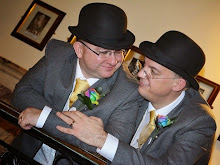
Tonight I bring cheer with, unusually, a great Doctor Who scene that isn’t all death and disaster – counting down more of my Fifty with a dash of romance. And what better time for it? Today is exactly five months until Richard and I marry (and since I posted number 34, Britain’s first same-sex weddings have been celebrated and we’ve received our first invite to another couple’s. Hurrah!). Not only that, but yesterday’s Towel Day commemorated Douglas Adams, while Saturday would have been the birthday of Graham Williams, the two principal writers of this glamorous and many-authored Tom Baker story… If you thought Number 34 was a bit Douglas Adams-y, today’s is properly so, and it’s much happier than the end of the world. More the other end.
“It has a bouquet…”

City of Death is a mostly remarkable Doctor Who story. It’s regularly voted among the best in all the series’ fifty years; it got the series’ highest ever ratings (though, to be fair, with no Internet and, thanks to a lengthy ITV strike, only BBC2 and the radio for competition); even more remarkably, it manages to unite many fans who scorn 1979’s other Doctor Who stories in agreement that this is ‘the good one’ (personally, I love some of the others too). But perhaps the most remarkable thing about it is how it was made at all – a glimpse of alchemy. Brilliant writer David Fisher wrote the first draft, then couldn’t do the rewrites… So the series’ Lead Writer Douglas Adams (yes, that Douglas Adams) and Producer Graham Williams rewrote it from top to bottom in a weekend and a few flashes of genius, before actors like Tom Baker, Lalla Ward and the fabulous Julian Glover rewrote more of it as they went along. Though it’s only Mr Adams, Mr Williams and Mr Fisher who are usually understood to form the BBC compound entity “David Agnew” credited on screen. And part of the new script was to swap the original 1920s setting for – mostly – 1979, which sounds less interesting, but not when Production Manager John Nathan-Turner had worked out in another flash of genius, this time with the accounts, that they could shoot it in contemporary proper Paris as cheaply as in a studio’s fake Monte Carlo of fifty years earlier. It was the first time the series had ever filmed outside the UK. And then there’s an intricate story that would today be called “timey-wimey,” but thankfully wasn’t in 1979, some outstandingly witty scenes and cameos from the likes of Eleanor Bron and John Cleese.
So I’m mildly unusual in finding it a bit of a mixed bag in parts, but thinking the bit that’s absolutely, blissfully perfect is the first five minutes. Because that’s the part before the important bits like the plot and the monster and most of the funny lines get going, and which quite a few fans who otherwise love the story say should have been cut because it’s just aimless faffing about*. Personally, I’m very drawn to aimless faffing about.
The thrilling blue swirl of the time tunnel – still the greatest title sequence ever made – parts on an eerie, barren landscape that looks thoroughly alien, as does the spider-like spacecraft squatting over the rocks. It’s an impressive piece of modelwork, aided by echoing music from regular composer Dudley Simpson and a sweeping camera pan across the plain to make it look enormous. And the alien voices within the ship are arguing with each other – the pilot protesting as the crew insist he take off on warp thrust, despite the dangers. Marvellously, it references Star Wars in their telling him “You are our only hope,” as he’s closer to a frog than a beautiful princess. To thunderous chords, the ship lifts slowly into an appropriately Turner-ish red and black-clouded sky… Only to crumple in on itself, shimmer and explode, the crew’s pleas echoing in desperation. You’d think that in today’s Doctor Who this would be made as a pre-titles sequence, but it’s all the better not for being so because of the fascinating non-sequitur that follows instead. The falling sparks of the explosion fade into blossoms, and again the camera moves left to right, echoing the extended pan and giving the world that came first an equivalence with modern Paris as the Eiffel Tower comes into view behind the flowers, the panning shot across the rock to the latticework gantry spaceship the natural precursor to that across the blossom to the latticework gantry tower. It’s a brilliant directorial choice, not least because, like the script and the French filming, it was something that wasn’t the original plan and was an inspired late improvisation: the director went for the blossoms instead when the special lens brought to zoom out from the top of the Tower didn’t fit the cameras. What director Michael Hayes came up with on the fly is the perfect bridge between two very different visual and storytelling styles, and the perfect opening to one of Doctor Who’s most cinematic sequences.
So, leaving you in anticipation for what happened to the alien pilot (and indeed plot), the story proper instead opens with the Doctor (Tom Baker) and his companion Romana (Lalla Ward) swanning about at the top of la Tour Eiffel being frightfully laid back and witty as they just enjoy themselves.
“It’s the only place in the Universe where one can relax entirely.”Tom is charming and worldly, Lalla superior but utterly charming with it, and eager to see the wonders of Earth. The two actors have marvellous chemistry in this story above all stories, and it’s no surprise that off-screen they were soon to marry and almost sooner to divorce. While in some of their stories they can barely bring themselves to look at each other, here they’re evidently having a wonderful time on every level, diegetic, extra-diegetic and extra-curricular. How natural they look is another part of the serendipity that makes so much of City of Death come together so well.
“Mmmm. That bouquet.”
“What Paris has… It has a – an ethos… A life. It has—”
“A bouquet?”
“…A spirit all of its own. Like a wine, it has—”
“A bouquet.”
“…It has a bouquet, yes. Like a good wine – you have to choose one of the vintage years, of course.”
“What year is this?”
“Ah well, yeah. Well, it’s 1979, actually. More of a table wine, shall we say. Ha!”
There’s a building fanfare of music, and then they’re off! The thrilling, intimate cinematography of the side of the train rushing towards us on the platform, then the Doctor and Romana simply joyous beaming at each other and the Paris Metro, planning dinner, dashing across the road by Notre-Dame hand in hand, all to what could be a career-best score for Dudley Simpson, a gorgeous, playful theme that chimes perfectly with the bouquet. It’s sheer happiness, the closest the series comes to a musical, and I’m always astounded when other fans say it’s padding and want to get on with the plot instead. It’s art.
Then there are two last pieces of serendipity, of alchemy, as they run past a poster for an exhibition on “3 Millions d’Années d’Aventure Humaine”, and the camera at last springs away from them to the threatening wooden carving of a gorgon-like snakes-headed grotesque… But that would be the plot, so it’s time to stop.
*Lawrence Miles and Tat Wood’s impressive and opinionated About Time 4, for example, starts an otherwise complementary review by complaining “the first episode features five whole minutes of the Doctor and Romana jogging through Parisian streets… Often regarded as the only major flaws in this story, and certainly the only bits that video viewers regularly fast-forward through…” Whereas I frequently put the first five minutes on to cheer myself up, and leave it at that. Maybe they’re just not music lovers, for all that they claim to sing along “Running through Paris” to the tune.
Bonus Great Doctor Who Quotations – The Androids of Tara
Tripping back a year to 1978, another gorgeous holiday of a story from a complete David Fisher script, this time on the Ruritanian planet of Tara and in the middle of the quest for The Key To Time. It’s enormous fun, especially where the dashingly dastardly Count Grendel of Gracht (Peter Jeffrey) is involved. It is, though, something of a cautionary tale about marriage, as the Doctor’s companion Romana (in her first body, Mary Tamm) discovers in Part Two when the Count shows her his dungeon – in it, her exact double…
“Is it an android?”In Part Three, Romana is confronted with another double (she’s missed one more in between). This one’s technically less royal and more, well, technical. To the Count’s moustache-twirling satisfaction, she’s been built to assassinate the Doctor (Tom Baker)…
“Good heavens, no, my dear. That’s the Princess Strella. First Lady of Tara, a descendant of the Royal House, Mistress of the domains of Thorvald, Mortgarde and Freya. In fact, Tara’s most eligible spinster! Shortly to become – in rapid succession – my fiancée, my bride, and then… Deceased. Yes – it will be a tragic accident. A flower blighted in its prime. And naturally, as her husband, I shall claim her estates and her position as second in line to the throne, as provided for under Taran law.”
“I see. But since you’ve already got a Princess, what do you need me for?”
“Well, the Princess does not entirely agree with my plan.”
“I can’t say I’m wildly surprised.”
“You see before you the complete killing machine – as beautiful as you, and as deadly as the plague. If only she were real, I’d marry her.”And in Part Four, the still-scheming Count, that well-known champion of widows and orphans, welcomes the Head of the Church of Tara to the charms of Castle Gracht for two weddings and a funeral…
“You deserve each other.”
“Ah, Archimandrite! Welcome.”
“What is so urgent that I must leave my duties and hurry here like this?”
“I am sorry, Archimandrite, but there is a ceremony you must perform.”
“Here? What ceremony?”
“A marriage.”
“Your own chaplain could have done that.”
“Not this marriage.”
“Why? Who is to be married? And to whom?”
“The King – to the Princess Strella.”
“The King? Here?”
“He has placed himself under my protection, your Eminence. Sadly, I have to tell you – he is sick. In fact, he is very near to death.”
“Oh, dear, dear, dear. He did not look well at the coronation. Not himself at all.”
“No… No, I did note that, Archimandrite.”
“But near to death, you say?”
“Indeed he is. It would be as well if you stayed here. I fear he will be in need of the funeral rites very soon after the wedding.”
“Oh, how sad.”
“Mmm, yes. And after the funeral rites, there will be a second wedding for you to perform.”
“A second wedding? May I ask whose that will be?”
“My own. I shall be marrying the poor King’s widow.”
Bonus Great Doctor Who Quotation – The Curse of Fenric
If that’s not warning enough about the dangers of dalliance, let’s turn to what’s possibly my beloved’s favourite story, and one of mine, too. It was 1989 for most of us, 1943 in the story, and half-way into Part Two (or 40 minutes into the story, if you’re watching the movie-length DVD Special Edition). While the Doctor (Sylvester McCoy) investigates vampires rising from the waters off the North-Eastern coast, stony pillar of the church Miss Hardaker has other reasons for taking against the local beauty spot. She doesn’t mince her words when she finds her two teenage East End evacuee lodgers have been swimming at Maidens’ Point…
“Nothing for you but pitiless damnation for the rest of your lives! Think on it!”Romantic.

Miss Hardaker was played by the marvellous Janet Henfrey, who returns to Doctor Who later this year. Richard and I met her in 2009 and, rather than the usual ‘Best wishes’ signed by an actor, we persuaded her to give us a different benediction on our The Curse of Fenric DVD.
Thanks to the Internet (though I’ve lost track of where, so contact me if it was you and you’d like it removed), I was also able to proffer this motivational poster to lovely The Curse of Fenric author Ian Briggs after he talked about some of the underlying themes in his story and the inspiration of Alan Turing. He laughed.

Bonus Not Necessarily Great Doctor Who Quotation – The Armageddon Factor
It’s another Doctor Who story from 1979, and another opening scene from Part One. This one’s not quite so celebrated as City of Death, and you’ll have to watch it to put it into context (though I’d watch the other five stories of The Key To Time series first), but I couldn’t resist. Miss Hardaker would be appalled.
“Men out there – young men – are dying for it!”
Bonus Great Doctor Who Quotation – Rose
And finally… From one of the most uplifting of all Doctor Who stories, the great return nine years ago, not the opening moments but the close. Rose has saved the Doctor (Christopher Eccleston) and the world from the Nestene Consciousness, and he in turn has rescued her from its exploding lair. After that brief trip in the TARDIS, the Doctor and Russell T Davies offer her and us more – to come with him, anywhere in the Universe. That’s one option: reckless, hopeful, open-minded. The narrow, sour, closed-minded alternative is put by her unhelpful boyfriend Mickey, who despite also having been rescued by the Doctor gives him a mouthful of xenophobic abuse as “an alien – a thing.” It’s a clear choice… And for a moment, Rose hesitates. Mickey pulls her to him, holding her back, taking her for granted, and she says no. The TARDIS dematerialises.
Rose, left on the street, just stares into the suddenly empty night as the wind of the TARDIS’ passing whips her hair. If she could have that choice again… And, suddenly, the TARDIS blazes back into reality, the Doctor stepping out to deliver the best pick-up line in history:
“By the way, did I mention – it also travels in time?”Choose your own life, and run into the future.
Next Time… The scariest place for anyone
Labels: Christopher Eccleston, City of Death, Doctor Who, Doctor Who 50, Douglas Adams, Julian Glover, Marriage, Music, Personal, Richard, Sylvester McCoy, The Key To Time, Tom Baker


Wednesday, March 19, 2014
Doctor Who 50 Great Scenes – 34: The Ark – The Plague (and The Ends of the Earth)
Remember the fiftieth birthday of Doctor Who late last year? Of course you do! I had been counting down towards the great event with my choice of Fifty great scenes… Then, let’s say, things went mildly awry. But I still have Fifty marvellous moments to champion, and Doctor Who goes on too. Tonight, I bring a great cliffhanger and a massive spoiler (so get your The Ark DVD now) as I go back to the youngest-oldest Doctor (William Hartnell), and forward to – well, failing to write a blog isn’t the end of the world, you know. But this is…
“The last moment has come.”

Hello again, possibly extinct regular reader! I hope you’ve been hibernating for the Winter, or perhaps in suspended animation. I won’t go into it all, but – short version – Richard is lovely, and most of the rest of life hasn’t been. It is, chasteningly, six months ago today that I last wrote anything on this blog (an article that, in retrospect ironically, was titled “Speeches I Didn’t Make”), and seven months yesterday since I posted Number 35 in my exciting Doctor Who Fifty countdown. A happier anniversary is that tonight is the 48th anniversary of (mild spoiler) The Return, the third episode of Doctor Who serial The Ark and the one that goes on to explain just what the security kitchen was going on at the end of the brilliant cliffhanger I’m about to celebrate. This much-delayed blog post is also, it turns out, my 700th on Love and Liberty, and 700 is a significant number in this particular plot. It’s time for the excitement, the adventure and the really wild spoilers, and, I mean, you may think it’s a long time down the blog since I published, but that’s just peanuts to this Ark in space…
Back in March 1966 – or forward at least* ten million years from another point of view – the Doctor (William Hartnell) and his friends Steven ‘Space Pilot of the Future’ Taylor and Dodo ‘Aptly Named Walking Extinction Event’ Chaplet materialise on a huge space Ark carrying some of the last of humanity and their
Naturally, the Doctor and his friends are the ones who treat the Monoids as people, while some of the Ark humans explode with xenophobic panic against our heroes, merely because Dodo infects them all with her antediluvian cold and threatens to wipe out what’s left of humanity (and, you know, Monoidony, nothing to see there). With, inexplicably, no telephone sanitisers to hand, it’s left to the Doctor to find a cure while the Ark sails from the Earth and the torches start burning.
Doctor Who – The Ark is a strange beast. It’s brilliantly structured, and has an epic sci-fi feel to it rare in the series’ early years (with impressive visuals for the time, too)… But the ambition doesn’t extend to creating much in the way of characters, and the second half trails off into B-Movie shonkiness. It also inspired a fabulous YouTube video to “Get Back!” which has sadly long since been double-copyright-bombed off the Internet, but if any readers happened to take an illicit copy…? But I’m looking for what’s most brilliant about the story and that, unusually, comes exactly in the middle. It’s something that Doctor Who was able to do to viewers in the 1960s and, if you don’t read the Internet too much, today – when stories aren’t given a simple title and an episode number, but an individual title each week that might leave you guessing how long each particular plot will run. This third season of Doctor Who had already had a story that consisted of just one episode and another that lasted for twelve, so when in the last few minutes of the second episode the cure is found, the moral expounded and the Earth de-rounded, there was no reason not to think that the TARDIS would be off to a completely different adventure the following week after this fortnight’s sci-fi parable.
But the TARDIS crew, and the viewer, were back on the Ark after the Hartnell era’s second and most inspired false ending.
The TARDIS materialises and Dodo, her undeterred eagerness to explore nothing to be sneezed at, rushes off to see the new sights. To everyone’s surprise, they’re more like the old sights. The TARDIS hasn’t moved at all – an important and popular fact that is wrong in all important respects – but the Ark’s vast indoor jungle is suddenly looking rather overgrown (and, still more disturbingly, no longer seems to host elephants). The Doctor explores rather gingerly, noting:
“Well, that’s strange. Something must have gone wrong. It appears we’ve landed back in the same place.”Dodo, on the other hand, bursts into the huge control area, expecting to see their friends and previous persecutors, but is puzzled by the apparent lack of humans as well as elephants, assuming “They can’t be far away” because “We’ve only been gone a few seconds.” Steven, taking his cue from the Doctor and more used to time travel, wonders just how long their “few seconds” may have been for the Ark.
If you’re familiar with Shelley’s poem Ozymandias and the statue which inspired it, I like to credit The Ark with inspiration rather than coincidence in throwing that idea into reverse just as it throws the TARDIS far forward in time. While most humans and Monoids are to sleep through the Ark’s seven-hundred-year voyage, the great ship’s dedicated guardians set themselves a task to mark the journey: that while generations lived and died in space to build humanity’s future (oh, and the Monoids’, nothing to see), they would build a vast statue, an embodiment of humanity’s greatness that would at last be completed for the Ark’s arrival. When we saw the Ark setting out from Earth, only the mighty feet were complete.
Unlike Ozymandias, the feet are a sign of hope and promise; the reversal and despair of the mighty only comes when the statue reaches its height.
Dodo sees, towering above the Ark’s deserted centre…
“Doctor – Steven – look! …The statue. They’ve finished the statue.”The camera follows Dodo’s gaze up the chiselled muscles of the nearly-nude figure that holds a new world in its hand in a thrilling exploitation shot… To the great Monoid’s head at the top.
*The Doctor, told this is the Fifty-Seventh Segment of Time by the Arkists’ reckoning, and told that two particular historical events took place in the First by the same reckoning, instantly calculates that (providing the Segments are of equal duration) “We must have jumped at least ten million years” from the TARDIS’ previous landing in the 1960s. Mathematically inclined readers will note that given this minimal information, it is possible to deduce a minimum period of time but not a maximum one, and that this is exactly what the Doctor does. This may prove handy, in a different segment of time.
Astute readers may have deduced that in the last few weeks I’ve been assisted in my faint desire to make life more helpful and intelligible by watching and listening to at least five different variations of The Hitchhiker’s Guide To the Galaxy, some of them even legal. This is not the story of that book, or even of the mind behind it and his contributions to Doctor Who. However, you may also be aware that Douglas Adams began with the idea of a series of quite different stories, all of which would end with the destruction of the Earth. Doctor Who has had much the same idea, with the exception that all of its many versions of the ends of the Earth can, if you squint generously, be said to agree with each other (just don’t get started on Atlantis). In this spirit, rather than just one bonus quotation below, I’ve picked out a selection that all more or less relate to the destruction of our small, blue-green world, though not necessarily all to the same destruction. There’s one related event that I’ve omitted, not because I can’t find a gorgeous line about it but because – in a more minor failure of forward planning than the general one of being a year late – I’ve already used it as a bonus quotation for a completely different one of the Fifty. Arguably, the title of the Doctor Who story involved may maintain some mystery about the planet and its fate (Richard isn’t entirely convinced, if you scroll down to his “… In A Hurry”), so I shan’t spoil it for you here, instead inviting you to click this link and read the Bonus Great Doctor Who Quotation only if you feel yourself thoroughly prepared. This story may safely be made the subject of suspense, since it is of no significance whatsoever.
Bonus Great Doctor Who Quotation – Frontios
Early in Part One, the Doctor (Peter Davison) has decided to sort out the TARDIS. His priorities and efficiency in doing so are uncannily similar to when I aim to tidy our flat, and for the TARDIS, too, things are going to get far more untidy before long. His friends – well, it’s 1984 (or ten million / five billion and forty, etc), so perhaps I should call them ‘his bitching contestants’ – Tegan (Australian) and Turlough (alien, and therefore British but a bit fey) just think he’s gone completely hatstand. On the sunny side, at least I don’t drive; here, the driverless TARDIS has drifted above the planet Frontios, where the forecast is less sunny than cloudy with a hint of meteorites. Turlough and Tegan try to bring this to the Doctor’s attention, though their main interest remains in sniping at each other. She’s louder, but he’s more cutting. And he can read…
“Doctor? Something’s happening to the controls.”Tegan wants to visit – “Laws of Time,” the Doctor weasels, and changes the subject to wanting a pair. That’s not unusual for this Doctor. Guess where they end up? Only to find that this group of fleeing humans are, if anything, even more useless than the first lot, with a total, brilliant ship in a worse state than the TARDIS – for a while….
“BOUNDARY ERROR
“TIME PARAMETERS EXCEEDED”
“Ah. We must be on the outer limits. TARDIS has drifted too far into the future. We’ll just, ah, slip into hover mode for a while.”
“We’re in the Veruna System… Wherever that is.”
“I had no idea we were so far out. Veruna! That’s irony for you.”
“What is?”
“Veruna is where one of the last surviving groups of Mankind took shelter when the great – ah – yes. Well, I suppose you’ve got all that to look forward to, haven’t you?”
“When the great what, Doctor?”
[Sheepishly] “Well, all civilisations have their ups and downs.”
“Fleeing from the imminence of a catastrophic collision with the Sun, a group of refugees from the doomed planet Earth—”
“Yes, that’s enough, Turlough.”

Bonus Great Doctor Who Quotation – The End of the World
The Doctor (Christopher Eccleston) takes Rose – and most of the audience – on her first trip in the TARDIS to the far future… An elegant, spacious chamber; a huge, shuttered window; a mystery. Momentarily. What a magnificent vista for a pre-credits teaser: the shutters retreat to reveal the wide Earth below and, looming beyond, the swollen Sun…
“You lot… You spend all your time thinking about dying. Like you’re going to get killed by eggs, or beef, or global warming, or asteroids. But you never take time to imagine the impossible. That maybe you survive. This is the year Five Point Five Slash Apple Slash Twenty Six, five billion years in your future. And this is the day… Hold on. [Glances at watch to time the Sun’s sudden blazing red] This is the day the Sun expands.Like The Ark, this story has multiple perspectives on time. It’s set at the same moment as the mid-point of the earlier story (of course it is); it was, mind-expandingly, the future, not just on screen but conceptually for its promise of a whole new Doctor Who; it loved and learned from the past (not least The Ark, The Ark In Space and Douglas Adams); and today it seems so dizzyingly long ago. Back in the olden days of nine years ago or five billion years in the future, in the dawn of Russell T Davies when actions had consequences and stories had endings, I loved it for its perfect collision of soaring optimism with sobering wisdom:
“Welcome to the end of the world.”
“Everything has its time, and everything dies.”
Incidentally, I saw the ‘film poster’ above years ago online, as you do, and thought it rather lovely. I’ve not been able to find the site since, though, so if you happen to know who created it, could you drop me a line in order that I can say ‘Thank you’ and they can say either ‘You’re welcome’ or ‘Take it down, impudent worm’?
Bonus Great Doctor Who Quotation – The Ark In Space
In early 1975 (or, again, the far future, but not quite as far as the others), Tom Baker had just started to be the Doctor, and I’d just started to watch Doctor Who. This was the second story for both of us, and it scared me so terribly that I had recurring nightmares of it for years afterwards. It was marvellous. But there’s a famously hopeful moment amid the horror, and ironically it comes just as we realise that the Earth has been scoured of all life…
The Doctor (Tom Baker) and his friends Sarah Jane Smith and Harry Sullivan spend the first episode alone (save something lurking, green and horrible), exploring an apparently deserted space station that still manages to suffocate, shoot at or freeze-dry them in turn. Some chambers hold records of Earth; others, its unliving animal life; then, to a swirl of sober, eerie music, the Doctor and Harry find themselves amid cold towers of cold people, each in their own compartment. While Harry faffs about, humansplaining about massive mortuaries, the Doctor realises that the station and the ‘bodies’ are waiting until the Earth can live once again:
“Homo sapiens… What an inventive, invincible species… It’s only a few million years since they’ve crawled up out of the mud and learned to walk. Puny, defenceless bipeds. They’ve survived flood, famine and plague. They’ve survived cosmic wars and holocausts, and now here they are amongst the stars, waiting to begin a new life, ready to out-sit eternity. They’re indomitable. Indomitable!”Tom Baker’s speech near the end of Part One is utterly magnificent – both script and performance – establishing him as the Doctor even more than the manic energy of his first story. And in a story all about humanity, the Doctor reasserts an alien point of view which like so much of this story echoes across future series.
Bonus Great Doctor Who Quotation – The Sontaran Experiment
In this short but smart sequel to The Ark In Space that swaps claustrophobia for agoraphobia, the Doctor (Tom Baker) and his friends beam down to Earth to see if it’s ready for the return of humanity yet. Good news: it is. Bad news: others found it first. There’s going to be a sinister alien, whose species I shall keep secret for the moment (what’s that? Oh, damn!), but first we meet some other humans. Not the clinical, compartmentalised people of the previous story who slept in the sure and certain hope of resurrection and the even surer certainty of superiority, but a rougher, tougher breed who weren’t among the Chosen and had to work for it, viewing the Earth their distant ancestors fled not as their manifest destiny but a useless and long-junked irrelevance. They’ve only been lured here to become prey, so, just for a change, they don’t trust the Doctor…
“I’m sorry to keep contradicting you, but there is a transmat beam from Space Station Nerva.”Shhh. He mentioned Atlantis once, but I think he got away with it.
“From where?”
“Space Station Nerva.”
“Is he crazy?”
“A joker.”
“You don’t expect us to believe that.”
“Nerva – transmat beam – Earth. It’s as simple as that. Why don’t you believe me?”
“Because Nerva doesn’t exist, that’s why. There’s no such place.”
“Fascinating. You don’t believe it exists, yet you’ve obviously heard of it…?”
“Everybody’s heard of the lost colony.”
“Lost colony? Ahhh. You mean it’s become a legend, like lost Atlantis?”
“Like what?”
“Lost Atlantis. It’s a legendary city… A go— Never mind. This is extremely interesting. Are you going to cut me loose?”
And in sharp contrast with the Doctor’s previous rhapsody, they’re not impressed. The budget didn’t stretch to a statue, but Ozymandias is back in spirit:
“Listen. If you are one of the Old People, we’re not taking orders from your lot. While you were dozing away, our people kept going – and they made it. We’ve got bases all across the galaxy now. You’ve done nothing for ten thousand years while we made an Empire! You understand? …We’re not taking any of that ‘Mother Earth’ rubbish!”
Surprising Bonus Great Doctor Who Quotation – Doctor Who and the Silurians
After The Sontaran Experiment’s cold-water-in-the-face upending of The Ark In Space’s assumptions and the Doctor’s paean to its self-important survivors or even the importance of Earth itself, and going back right to the realisation that perhaps the Monoids might have something to say rather than just seeing everything from humanity’s perspective, I thought it appropriate to finish after the world ended and nobody noticed. Well, nobody you know, anyway. In 1970, or probably about 1976, or the 1980s, or – look, sometimes it’s easier to agree that ten million is the same as five billion – the Earth’s original owners woke up, and they weren’t happy. The different perspective of the Silurians / Homo Reptilia / Earth Reptiles / Indigenous Terrans is a three-eyed rather than a one-eyed one, but in this story the series had come on a long way in the four TV years since 1966. Going into sleep for millions of years, only to find the end of their world hadn’t quite wiped out all the little mammals, this was a story where the ‘aliens’ had as much of a claim to ‘our’ world as we did. But while the Doctor (Jon Pertwee) could see both sides by Episode Four, try telling that to either people…
“I spoke to it. And it understood me.”
“What was it like?”
“Reptilian. Biped. A completely alien species.”
“And it didn’t attack you?”
“Liz, these creatures aren’t just animals. They’re an alien life form, as intelligent as we are.”
“Why – why didn’t you tell the Brigadier?”
“Why? Because I want to find out more about these creatures; they’re not necessarily hostile.”
“Doctor, it attacked me.”
“Yes… But only to escape – it didn’t kill you. It didn’t attack me when I was in Quinn’s cottage. Well, don’t you see? They only attack for survival. Well, human beings behave in very much the same way.”
Next Time… The Next Time is out of joint – this one might have been ‘I had a little drink seven hundred years ago…’ – so while in the past I’ve offered a not terribly cryptic clue each time about what each time I was confident would be a planned, specific entry at the same time next week, I’m aware that this has been both a different Number 34 to that hinted at last August and that had I written it the next week it would have been, well, last August. So in the light of my impressive record so far, I will make no rash commitments. But if I do get to Number 33, and I do feel that you might need something cheerier after multiple and among them possibly even final apocalypses, it could be:
Next Time… Daylight! Music! Romance!
Labels: Christopher Eccleston, Colin Baker, Doctor Who, Doctor Who 50, Douglas Adams, Jon Pertwee, Personal, Peter Davison, The Ark, Tom Baker, William Hartnell
Thursday, August 22, 2013
My Best Posts 2012-2013
As my contribution to the Lib Dem Voice Awards, I’ve just put together a celebration of a great many posts from a great many other Lib Dem Blogs – so it seems an appropriate day to select my own latest ‘greatest hits’ package. Below you can find links and summaries for my best articles of the last year on politics, Doctor Who and one or two other subjects. Featuring What the Lib Dems Stand For, Liberal Quotations, Betrayal, Daleks and much more…! All showcasing posts written from the start of October last year to the end of August this year (a change from last year’s ‘Best of’ selection from September 2011 to September 2012). So, if I write any more this month, I may re-edit this to add something else which you can discover later…
My Best 2012-13: Politics
Nick Clegg’s Garden Cities – Thinking Big, But Are There Any Foundations?
Fisking a major speech from Nick – agreeing with him in principle, but doubting what would happen in practice. Two hard-headed tests for any major policy proposal: ‘Can we get it done?’ and ‘Will we get any credit?’
Eastleigh – Proof There’s No Such Thing As a Perfect Storm
Taking five lessons from the Eastleigh by-election, and asking two questions for the future.
Lessons From Coalition – The Two Biggest Problems: Betrayal and Betrayal
Available in two versions: for the in-depth article, click the named link above, while the supercompressed version was written for Lib Dem Voice.
Update: Syrian Intervention: Nick, Please Make the Hard Choice to Be Practical
Role-reversal where Nick Clegg’s party has to tell him we can’t have everything we want by wishing for it.
The Liberal Democrat What Do We Stand For Challenge
The best political pieces I’ve written in the last year are together ongoing investigation, collaboration and rallying cry about what the Liberal Democrats stand for. The basic idea is to challenge myself, first, then other Lib Dems to get across what we stand for in something more meaningful than a soundbite but still short enough to be no more than a minute’s speech or a box on a Focus leaflet. And to make things harder, I aimed for broad consensus by synthesising the Preamble to the Lib Dem Constitution, the party’s priorities in government and the party leadership’s latest messaging. Did it work? Here’s my go:
The Liberal Democrats stand for freedom for every individual – freedom from poverty, ignorance and conformity.
To make that freedom real needs both fairness and economic responsibility: an economy that works, that encourages enterprise, and where everyone pays their fair share.
So freedom from poverty requires responsible spending, not debt, built on fairer taxes where lower earners pay less tax and the wealthiest pay more, and building green jobs for the future.
Freedom from ignorance needs better education and training, so people have the opportunity to realise their potential.
And freedom from conformity, supported by freedom from poverty and ignorance, means everyone should have the liberty to live their lives as they choose – without harming others; with equality before the law; with a better say, because no government always knows best.
That’s why Liberal Democrats are working for a stronger, greener economy in a fairer society, enabling every person to get on in life.
Happy 25th Birthday, Liberal Democrats – and What the Lib Dems Stand For 2013.1
Why we should sum up What the Lib Dems Stand For, and how it’s developed over the years.
What the Lib Dems Stand For 2013.2 – a Challenge and a Meme #LibDemValues
Setting out my ‘What the Lib Dems Stand For’ based on the Preamble, practice and core messaging, and challenging other Lib Dems to come up with their own.
The Liberal Democrat What Do We Stand For Challenge 2013.3 – Eight Answers (so far) #LibDemValues
After receiving the first set of responses, rounding up eight different Liberal Democrats’ versions of what we stand for – so far…
The Liberal Democrat What Do We Stand For Challenge 2013.4 – What It’s All About #LibDemValues
Inviting people to use my short declaration of ‘What the Lib Dems Stand For’ and explaining what each bit of it means.
There’ll be more.
Last year’s theme for occasional Lib Dem blog posts was less positive – “Things To Remember About Labour”. I’ve written one more since:
Things To Remember About Labour #6 – Iraq
Liberal Mondays
I’ve been writing another occasional series, too. My aim with them was simply to pick an inspiring or intriguing Liberal quotation and publish it to start the week. Naturally, being me, with each of them so far I’ve instead used each line as springboards to talk around Liberal ideas they suggest to me.
Liberal Mondays 1: Alfred Russel Wallace #LibDemValues
Quoting the Victorian naturalist, natural selection theorist and Liberal, then going on to look at the 1996 collection Why I Am A Liberal Democrat. I notice that the party’s evolved from Jeremy Bentham to John Stuart Mill and Harriet Taylor and more – and a good thing, too.
Liberal Mondays 2: Conrad Russell – The Liberal Cause #LibDemValues
Examining in detail the first booklet I ever read by the Conrad, who became a friend and mentor. I’ll probably return to him in the future.
Liberal Mondays 3: John Stuart Mill and Harriet Taylor #LibDemValues
Probably my best of these so far: going to the Liberal text, On Liberty, to look afresh at its heart. In Lib Dem Focus leaflet style, Three Things To Remember; definitely not in Focus style, also one to think about.
Liberal Mondays 4: Ralf Dahrendorf Vs Utopia #LibDemValues
Looking at three separate quotes as a Liberal critique of Utopia.
Liberal Mondays 5: The World’s End Vs Utopia #LibDemValues
Where Ralf Dahrendorf left off, Simon Pegg and Edgar Wright pick up.
Update: Liberal Wednesday 6: Martin Luther King’s “I Have A Dream” #LibDemValues
On the fiftieth anniversary of one of the greatest speeches of the Twentieth Century, and how it echoes through history.
Three Problems With The Politician’s Husband
Bridging my politics and TV articles, I set out exactly why the BBC’s flagship new David Tennant drama was such a failure.
My Best 2012-13: Doctor Who
Doctor Who – The Evil of the Daleks (Campbell & Hadley’s Recorder Uncut)
I’ve written fewer Doctor Who reviews this year, but here’s one with a difference, answering questions from my friend Nick about one of my favourites. And what does it all have to do with John Stuart Mill?
Doctor Who 50 – Fifty Great Scenes
On top of two series of occasional blog posts on Liberal themes, I’ve been writing an occasional series to celebrate Doctor Who’s Fiftieth Anniversary. Taking Fifty Great Scenes, exploring what’s great about each of them in turn, and adding bonus quotations from other stories that seem to fit. Rather than list the lot, here are six of my favourites so far:
Doctor Who 50 Great Scenes – 50: The Eleventh Hour
Starting off the countdown with the two most important words in Doctor Who.
Doctor Who 50 Great Scenes – 47: The Rescue – The Powerful Enemy
Celebrating William Hartnell, the Doctor, and going all the way to Matt Smith
Doctor Who 50 Great Scenes – 45: Robot
The Doctor, Sarah Jane and Harry in the first story I ever saw, with a bonus that was another sort of first for me.
Doctor Who 50 Great Scenes – 44: Enlightenment
Ships where you don’t expect to find them and, as a bonus, one of my more creative moments: fashioning scenes from a favourite story into an epic poem and the cliffhanger that should have been.
The first (plastic) flowerings of each incarnation of the Master.
Doctor Who 50 Great Scenes – 36: The Krotons
Celebrating Patrick Troughton, Robert Holmes and the Double Act
I’ve also got back to my thoughts-from-the-beginning review blog Next Time, I Shall Not Be So Lenient! at last, so here are two from that:
William Hartnell and Patrick Troughton’s Doctor Who: Now You See It…
What happened to much of 1960s Doctor Who, and the different ways in which you can still experience it after all.
Doctor Who – Marco Polo Episode One: The Roof of the World
Beginning an episode-by-episode look at Doctor Who’s first ‘missing story’.
Broadchurch and How To Spot A TV Murderer
And finally, ITV’s goes-against-the-grain-to-say-it-but-far-more-successful flagship new David Tennant drama. Examining the surprisingly deep themes of murder drama Broadchurch – without spoiling whodunnit, but giving Richard’s and my Rules of Suspicion so you can spot the murderer for yourself in a host of different detective series.
Labels: Best of Love and Liberty, Blogs, David Tennant, Doctor Who, Doctor Who 50, Liberal Democrats, Liberal Mondays, Liberalism, Personal
Sunday, August 18, 2013
Doctor Who 50 Great Scenes – 35: Full Circle
Counting down towards the fiftieth birthday of Doctor Who with Fifty great scenes… This one’s from 1980, towards the end of three years starring Tom Baker, K9 and Romana. It’s a brilliantly designed, directed and scripted story, a fiercely intelligent evolutionary fable. The allegory of ‘revealed truth’ versus awkward questions and the morality of siding with the underdog are close to my heart. But for all the great dialogue, thought-provoking revelations and the Doctor’s moral passion, deep down the moment that most gets me is still the thrilling monster reveal. When Mistfall comes, the giants leave the swamp…
“Master. Alert.”

Doctor Who’s Eighteenth Season, broadcast from 1980 to 1981, has long been one of my favourites for its ideas and scientific fairy tales (in this case, great work from writer Andrew Smith and lead writer Christopher H Bidmead), as well as for suddenly stunning visuals and music. In the run-up to my Fifty, I selected Eleven Great Cliffhangers and wrote that this season has arguably Doctor Who’s most sustained run of terrific episode endings, with two stories in particular having outstanding cliffhangers every time. This is the other story for which that’s true: the climaxes to Parts Two and Three are brilliant as well, but you can’t beat a great monster moment.
Strange creatures rising from beneath the water are among Doctor Who’s most striking repeated cliffhanger images. First and perhaps most iconically, a Dalek emerging from the Thames in The Dalek Invasion of Earth; the Silurians’ amphibious cousins in The Sea Devils were excitingly captured for me in prose and photos on the page long before I saw their story; the Haemovores in the terrific The Curse of Fenric; if you’re unlucky, River Song. The Marshmen revealing themselves as they leave the water at the end of Full Circle Part One are for me the most memorable of the lot – perhaps because of the atmospheric direction, perhaps because of their monstrous design, perhaps because of the eerie spiralling music that accompanies them. Or perhaps simply because I was at the right age for this to be the first such scene I was able to see on TV.
For once, the sun came out for the location shoot, making the planet Alzarius seem much more alien – to British viewers – and the production much more lush. The Doctor’s vivid red outfit stands out so gorgeously against the vivid green that Richard Briers took this vibrantly exotic image for expensive tropical filming; the sudden murk of Mistfall becomes that much more of a contrast.
The citizens of the Starliner are used to gathering in food from around the great lake, but it’s the food itself that provides the first portent: strange tiny life growing within the marshfruit. Soon the lake itself is bubbling and something beneath the water is grabbing at the skinnydippers. Bearded patriarch Decider Draith announces the coming of Mistfall, the semicentennial Judgment Day during which his people are commanded to huddle within their centuries-broken spaceship, waiting for the deadly mists outside to pass over. Not all of these truths are true… And not everyone is following the commandments. Inquisitive strangers have arrived in a blue box from far further than the Starliner came before its crash on Alzarius, while teenage rebels define themselves by refusing shelter – “Outlers” – one of them even an Elite who ‘should’ be destined to be a Decider, Adric. Draith pursues his protégé, but rather than successfully bringing him back to the fold, the Decider is knocked into the lake and dragged under the water. Adric flees, taking with him Draith’s last warning, and collapses on running into the TARDIS. The Doctor (Tom Baker) and robot dog K9 (John Leeson) go out to the lake to investigate the legends…
The first major clue to the theme of the story – aside from Draith telling his head scientist that he has all the answers the other man seeks, but it would be blasphemy to divulge their ancestors’ secrets to him – is that after all we’ve heard about Mistfall, K9’s analysis instantly debunks it: the billowing fifty-year-recurring fog is non-toxic. So is this just propaganda to remind citizens never to stray from the Starliner? Or is there something else out there they shouldn’t mix with – and is it a physical, a moral or an existential threat?
As the Doctor kneels with K9 to study the marsh, the mist thickens and the lake heaves… K9 alerts the Doctor to potential danger, and the people of the marsh break the surface of the water, approaching the land. The slightly Creature From the Black Lagoon-ish Marshmen designs were one of the best-realised ‘monsters’ the series had created for some years, and Peter Grimwade’s direction gives them a magnificent introduction, swaying and dripping in slow motion in a great return to Doctor Who for scaring the kiddies.
The other contribution that really makes it for me is composer Paddy Kingsland, whose first full score for the series is a triumph, especially here when a spine-chilling motif builds the tension by circling higher and higher until the titles crash in to end the episode. The cliffhanger is cut at just the right moment to leave you wanting more, and if you follow through into the next episode, it offers more: rather than the howl of the Doctor Who Theme’s cliffhanger sting, as the Marshmen fully emerge from the swamp and stride onto land to open Part Two the eerie chiming music evolves into harsh electric guitar power chords for the developing peril.
As I’ve sometimes written, I enjoy film and TV scores but have no musical training and little musical vocabulary, which is why I think in metaphors such as “spiralling”; a person who does know a bit is John Toon, whose blog Doctor Who Electronica – 50 Scores in 50 Weeks for the 50th Anniversary is keeping up much better with its intentions than my own Fifty. He has this to say on that cliffhanger moment:
“A repeated seven note phrase plays over scenes that relate to Mistfall or that feature revelations about the Alzarian life cycle. The end of Part One, as the Marshmen emerge from the water, is a notable example. The notes rise and fall cyclically within the phrase, and the phrase itself rises across repetitions, as if emphasising the upward climb of Alzarius' super-evolving lifeforms. ‘The Ascent of Marshman’, we might call it.”
Bonus Great Doctor Who Quotation – The Power of Kroll
I wrote last time about the brilliance of Robert Holmes’ writing for Doctor Who. His last story in his ten years as a regular scriptwriter featured the same team of the Doctor, Romana and K9 – though a different Romana to the regenerated Time Lord seen in the other two stories I feature today. 1978’s The Power of Kroll doesn’t entirely play to Mr Holmes’ strengths: told to take out the jokes and put in a giant monster, he gives us an alien world whose green-skinned people show more buttocks than Torchwood and whose history of exploitation is a mash-up of Native Americans, Irish nationalism and, as you’re about to discover, the subtle tribal characterisation of King Kong. At least when Kroll the massive tentacled beastie does eventually rise from the depths he’s rather impressive (and has a well-conceived life cycle). Before he does, we’re given what looks like a traditional ‘monster reveal’ cliffhanger at the end of Part One, but is actually something stranger, cleverer, and at first glance a little disappointing: while several of Bob’s cliffhangers are stunning moments let down by lacklustre resolutions the following week, for this one time only it’s the reverse of instant gratification. As Romana (Mary Tamm) struggles on the Stone of Blood and the Doctor (Tom Baker) paddles through the swamp to find her, there’s memorable dialogue from the Tribe. This time with the actions. It’s no double act, and it may be memorable for all the wrong reasons, but I still can never help but sing along to The Kroll Song as the Tribe do aerobics with spears, stamping and thrusting and giving it some welly to summon their god. It’s a sort of ritual chant:
“Kroll!”Repeat twenty-five times, or until cliffhanger.
[Five drumbeats]
“Kroll!”
[Five drumbeats]
“Kroll!”
[Five drumbeats]
“Kroll!”
[Five drumbeats]
“Kroll!”
[Five drumbeats]
Extra Bonus Great Doctor Who Quotation – City of Death
Today’s other bonus was first broadcast back in 1979, in between the other two choices, and though technically it’s not a monster rising from the depths, here we have a villain from the depths of time, traced back to the ocean floor before it was ocean, and who looks very tentacular when not looking like the fabulous Julian Glover. So it counts. And while this story is another to feature marvellous images and marvellous music, this time I’ve picked a line of drawing-room comedy dialogue. The script is credited to “David Agnew” – in truth, a mixture of Graham Williams, David Fisher, the actors and perhaps most prominently Douglas Adams – and towards the end of Part Three, Romana (Lalla Ward) has escaped from the villainous Count Scarlioni – in truth, ancient alien Scaroth, last of the Jagaroth – but returns to his château to find out what he’s up to. She breaks in with the aid of an out-of-his-depth private detective, but they don’t break in terribly successfully. They’re dragged in at gunpoint by a sneering henchman, where Scaroth (Julian Glover) tosses an aside to them with a beautifully underplayed little laugh:
“As soon as the alarm sounded, Excellency – he was halfway through the window, and she was outside. I thought you might wish to speak to them, so I called off the dogs. They cannot be professionals.”She’s so utterly impractical, he’s so urbanely villainous, and it always cracks me up.
“My dear, it was not necessary for you to enter my house by – ah, we could hardly call it stealth – you had only to knock on the door…”
Next Time… The scariest place for anyone
Labels: Comedy, Doctor Who, Doctor Who 50, Douglas Adams, Full Circle, Julian Glover, Music, Obscure Doctor Who Jokes, The Key To Time, Tom Baker
Wednesday, August 07, 2013
Doctor Who 50 Great Scenes – 36: The Krotons. Featuring Patrick Troughton, Robert Holmes and the Double Act
Counting down towards the fiftieth birthday of Doctor Who with Fifty great scenes… Now we have a new Doctor and look forward to a new direction for the series, today it’s a celebration of two people who did those things brilliantly: second Doctor Patrick Troughton and lead writer Robert Holmes, both still regarded as patron saints by Doctor Who actors and writers today. Paired together here from 1969, this scene (and more) offers the sort of double act both men were famous for, a warning about computer games, and proof that nobody’s perfect:
“Oh, Doctor! You’ve got it all wrong!”

By the time The Krotons was first broadcast at the tail end of the ’60s, Patrick Troughton was approaching the tail end of his time as the Doctor, while Robert Holmes was just starting out on his career in the series – one which would see him write for five Doctors over nearly twenty years, become the series’ most prolific writer during the Twentieth Century with scripts that ran from comedy to horror and nicking from everything in sight, and establish himself as Doctor Who’s greatest ever script editor (the equivalent of today’s showrunners like Russell T Davies and Steven Moffat, without the money), defined by great dialogue and great wickedness. The Krotons is a bit smaller than all that and not the greatest story in which either Mr Troughton or Mr Holmes would be involved, but right from the first Bob writes perfectly for the Doctor and Pat runs with it superbly. You can see why so many actors who’ve played the Doctor since cite him as their favourite, from Peter Davison on BBC1’s So You Think It’s Capaldi… It Is Now! programme last Sunday night to still-current incumbent Matt Smith: not only is Patrick Troughton pretty much unbeatable when he’s giving his best, but he’s obviously the patron saint of ‘the impossible job of following the big success and making it work’. And one of the things both Pat and Bob made their own in their different ways can be checked by asking long-term Who fans, ‘Which Doctor / which writer was brilliant for comedy double acts…?’
Half-way into Episode Two, the Doctor (Patrick Troughton) and his friends Jamie (Frazer Hines) and Zoe (Wendy Padbury) are trying to work out the secret of the Krotons, legendary beings long-unseen and perhaps best left that way* who rule from their great crystal machine over the locals, known as the Gonds. The Krotons have for centuries demanded tribute of the Gonds’ best and brightest delivered to them, and in a neat critique of instant gratification, by the time our heroes arrive the Gonds are predictably no longer best or bright. As the Krotons need mental energy to revive themselves, their own not exactly high-brain short-termism means perpetual slumber for them and perpetual slavery for the Gonds. Unless someone very bright indeed turns up and puts their foot in it, of course…
Zoe is a brilliant teenage computer programmer from the Twenty-first Century who, when the Doctor bumbles off to look elsewhere, is drawn to the Krotons’ teaching machines and all the games installed on them. Stop me if you can see where this is going. She’d have been a demon with ‘Tomb Raider of the Cybermen’, and even though ‘Selris’ only involves a completely inanimate block that has to be winched into place, she’s soon more than doubling the previous high score and flooded with endorphins. The Doctor wrenches off her headphones, but the Gonds’ dreary leader has already spotted the score. The Doctor’s not impressed:
“Yes, well, Zoe is something of a genius. Of course, it can be very irritating at times.”That’s nothing to his reaction when a gong sounds from the great crystal machine and a message from the sleeping Krotons demands that Zoe join them as a special extra companion. As Zoe and the Doctor have both already witnessed that round the back of the great crystal machine there’s an exit where the ‘honoured’ companions are unceremoniously ejected and disintegrated after having their brains sucked out, the usually mildest of Doctors snaps to his friend in sudden fury and fear:
“Now do you see what you’ve done? Fooling around with this stupid machine!”He stomps off to take the test himself, unwilling either to let the Kroton machine massacre the Gonds for disobedience or let Zoe go into danger alone. And that’s what I really love about this scene, because the Doctor’s palpable concern, and Zoe wanting to make up for her getting them into trouble, and looming certain death, all obviously create a situation which is both tense and terrifically funny.
“But I’m not a Gond!”
“But the machine doesn’t know that!”
The Doctor sits down at the teaching machine and their positions are suddenly reversed: he’s the one with the headset on and Zoe’s the responsible one telling him what to do. And on top of both wanting him to succeed, they’re absurdly competitive about it. She tells him to press the button to start, then tells him again, because he can’t hear with his phones on; he answers back too loudly, and with a storm of testy words that get her going, and coming, and them both rushing about:
“All right, there’s no need to shout! Now go away and don’t fuss me – no, come back, what’s this? – It’s all right, I know – right, fire away. I’m ready.”At which an exasperated Zoe now mimes that he has to press the button to set it going. Not much of The Krotons looks good, but there’s some fabulous design here for the circling computer symbols (absolutely not CGI) assembling, breaking and reforming, all to great sound design, too, an ominous low chattering hum. Brian Hodgson’s soundtrack – a radiophonic mixture of electronic effects, textures and near-music – is now available to buy, and so fascinating that Richard has instructed me never again to play it in his presence (look, it’s shorter than The Sea Devils…).
So does the brilliant Doctor at once beat Zoe’s high score? No. He makes a clever person’s error and, rather than reading the instructions properly, works it out on the wrong basis and scores zero. The Gond leader worries to Zoe:
“This is the most advanced machine. Perhaps he can’t answer the questions.”So the Doctor gets it all wrong again, as Zoe jumps in frustration. That is, until he gets into the swing of it and, at last, the score battering over the upper limit, he turns very smug and she turns very cold:
“Of course he can. The Doctor’s almost as clever as I am.”
“I think I’ve scored more than you have, Zoe.”Before long, the “dinner gong” sounds again for them to enter the great machine, and even as the danger reaches its pitch, the Doctor’s deadpan polite thanks when Selris the Gond leader dolefully tells him his people will remember him is a scream…
“You answered more questions!”
*On another not entirely stunning visualisation, Alan and Fiona have recently covered The Krotons on Kaldor City and I laughed at their all-too appropriate “The Gond village looks like someone has dropped a packet of chips and a Scotch egg on a gravelled drive” – this is not among Doctor Who’s more lavish productions.
Bonus Great Patrick Troughton and Robert Holmes Doctor Who Quotation – The Space Pirates
If The Krotons is not the most fêted of Doctor Who stories, Bob Holmes’ second script, The Space Pirates, can be a bit of a slog. Of all the stories I’ve watched when prospecting for the Fifty, this was the hardest work to pry anything precious from: for me, it’s easily Bob’s weakest script, badly structured, thinly plotted, and with most of it junked by the BBC so only the soundtrack is left, not even visually diverting. With Bob’s entertaining but unexpectedly queasy final treatment of Patrick Troughton’s Doctor not until a 1985 guest reunion, though, this is the only other time they paired up. But the great thing about Doctor Who – and about Pat and Bob – is that even in the most exhausted parts you really can still find something marvellous. And here it’s not in the endless, plotless space chases but in the second half of the story, where the Doctor (Patrick Troughton) and his longtime partner in the double act Jamie (Frazer Hines) finally get to meet people from across the plot and to do plenty of their perfectly timed schtick. A terrible gag with drawing pins that’s terribly funny; the Doctor’s favourite marble; and the bit that I’m afraid always makes me laugh – trying to break out of a cell with an audio lock, the Doctor gets out a tuning fork and, endlessly, twangs it. Jamie:
“Which end did he land on when you fell down that shaft?”Confronted with a three-inch-steel door later:
[After driving them all nuts…]
“Oh, look, Doctor, will you stop it?”
“You want to get out of here, don’t you?”
“Oh, that’s not going to get us out…”
“Yes, Jamie, it is! An audio lock is a simple solenoid switch which is only activated by a particular sound. It’s just a question of finding it, that’s all.”
“Oh, look – I can’t stand any more!”
[He grabs the fork off him… Chucks it against the wall… And as the Doctor wails, the cell door opens.]
“Jamie! Jamie! …Jamie, you found the right note!”
“It’s not an audio lock, is it?”And there you go – sifting out the good bits of The Space Pirates.
“No, Jamie, it isn’t.”
“Ah, that’s a relief.”
“Jamie, I think you don’t appreciate all I do for you.”
Admittedly I do find one line from the old comedy character without much comedy to him very appealing, too – here’s Milo Clancey up against the New Labour space police:
“You know it’s an offence to operate without a feedback to CFI?”
“An offence?”
“Right.”
“I didn’t realise that, sonny, no. Oh dear, oh dear, oh dear. There are so many offences these days.”
Bonus Great Patrick Troughton Doctor Who Quotation – The Moonbase
The Doctor had begun as a figure who intended only to observe and who learned only gradually the moral instinct to interfere: moral outrage had long topped non-intervention by the time of his first regeneration, but it’s when the new Doctor (Patrick Troughton) faced the early return of the Cybermen that he gave the clearest declaration that he fights monsters now, and fighting monsters is cool. It’s part-way into Episode 2, with the Doctor and his friends having a bit of a time of it up on a Moonbase about a century after the story’s 1967 broadcast. The base commander is fed up with the Doctor’s antics and wants him gone; the Doctor’s friends are mostly fed up with being injured and threatened and might just do that; but the Cybermen appear to be on the prowl, and the playful Doctor suddenly puts his foot down with sober gravitas and issues his manifesto. This is the moment where this Doctor finds himself. Later Doctors found a more nuanced moral compass, but this one took two very firm and uncompromising if not completely complementary stances: anarchic freethinking meddling; and destroy all monsters…
“There are some corners of the Universe which have bred the most – terrible things. Things which act against everything that we believe in. They must be fought.”
Bonus Great Robert Holmes Doctor Who Quotation – The Time Warrior
One of Robert Holmes more influential scripts, The Time Warrior introduced Sarah Jane Smith (Elisabeth Sladen): in Episode Four, broadcast early in 1974, Sarah Jane has snuck into a medieval castle to knock out a nasty robber baron and his entire garrison while the Doctor deals with the alien in the cellar. It’s a scene that shows how very resourceful she is, how very feminist she is, and how very funny she can be. Caught in the kitchens by Meg the fearsome – well, I suppose in a posher castle she’d be called the châtelaine, but here ‘lead serving wench that bullies the other serving wenches into getting the job done’ – Sarah Jane first bluffs that she’s a lady and will have her flogged, then, that failing, turns on a groat to wheedling pauper needing food and is put to preparing some, after which if she’s lucky she might get some bread, cheese or oatmeal – meat only being for the men. Exasperated at the downtrodden kitchen women, Sarah Jane confronts them about their situation and gets carried away…
“You should set yourselves free.”Next along, half of what will much later become a famous double act with Sarah Jane…
“Oh? And how should we do that?”
“Don’t you want to be free?”
“Women will never be free while there are men in the world, girl. We have our place.”
“What subservient poppycock. You’re still living in the Middle Ages!”
Extra Bonus Great Robert Holmes Doctor Who Quotation – The Sun Makers
After three sublime years of scaring the kiddies (I was that kiddie) in the mid-’70s, the BBC itself took fright of Doctor Who (and of far right anti-TV ideologues), sacked the producer and demanded a change of tone. And lead writer Robert Holmes, who’d been half of the brilliant creative team behind all the horror, stayed on long enough to come up with the next new wave, too – to use Tom Baker’s enormous charisma as a springboard to a much funnier style. 1977’s The Sun Makers has the iconic line-up: the man in the incredibly long scarf (Tom Baker); the woman in the leather bikini (Louse Jameson); the tin dog (John Leeson). While the TARDIS is still in flight, we join the travellers playing chess. There are other great Doctor-machine chess games to come, from the Doctor’s return match with K9 a year later in which he cheats again but steals from the wrong game, to his playing chess against himself within the Cyberiad just this year, and facing Fenric along the way, but this is the first and, in its own way, as much a statement as the Doctor’s famous line on The Moonbase. The Doctor (Tom Baker) will now be funny and outrageous and often get caught out; K9 will be not just a blaster-cum-database on wheels, but bitchy and pedantic and with a touch of robotic venom when his “master” tries it on. And Leela, moving the pieces for K9, will be the straight man.
“Even simple one-dimensional chess exposes the limitations of the machine mind.”
[The Doctor laughs]
“Bishop to queen six. Mistress.”
“There?”
“Affirmative. Check, master.”
“What?”
“Machine mind computes mate in six moves.”
“Rubbish!”
“…Your move, master.”
“I know it’s my move. Don’t flash your eyes at me.”
“Wrong square.”
“What?”
“Your king, master. Wrong square.”
“Really? Are you sure?”
“Affirmative.”
Doctor Who and the Double Act
I don’t know which Doctor Who critic first wrote about the “Holmesian Double Act,” but they nailed one of the most striking things about the series’ arguably greatest writer, and everyone familiar with Robert Holmes’ scripts suddenly knew exactly what they meant. Yet these took a little while to appear; you don’t really get double acts in Bob’s two earliest scripts – there are functional teams (the plotters in The Krotons, the police in The Space Pirates), but they’re not amusing and they’re not memorable. The exception is, of course, the Doctor and Jamie (or the Doctor and Zoe), who’d perfected a brilliant relationship over the years.
So, while Bob was finding his voice, I wonder how much he looked at the team he was writing for in 1969 and was influenced by them – with Pat and Frazer’s fantastic on-screen chemistry displaying a great way to bring out character. The Doctor, highly intelligent, easily flustered, always getting his friend into trouble; the young Scot from 1745, uneducated but canny enough to always watch out for the Doctor getting it wrong; both devoted to each other (and with Zoe coming in to be exasperated and constantly one-upping on both).
The way Robert Holmes writes his own double acts is never the same each time, but still distinctive: two people who are clearly meant to be together but through some imbalance of age, position or outlook constantly snipe at each other, which moves the plot along, informs and entertains us and comments on the story. The earliest version is in 1970’s Spearhead From Space with, archetypally, a husband and wife – and once he’d written the Seeleys always trying to get one over on each other, the key to all the rest is that they’re husband and wife / odd couple sketches transposed into a serious setting. And while Sam Seeley was just a bit shifty, a great many of them raise the stakes by being explicitly villains.
The partners in a Holmesian Double Act can be anywhere along the dial from out-and-out comedy characters to comedy-drama to downright dangerous and very blackly comic indeed, from supporting to central characters in the plot, and from ‘loveable rogue’ with ‘disapproving wife’ all the way up to ‘mad scientist’ paired with both ‘war criminal’ and ‘brutish servant’, which makes the insults all the grander and crueller (“You chicken-brained biological disaster!”) and at their darkest where each might grow to regard the other as disposable. Some double acts are only temporary, just for a scene or two within a story, some an inseparable chorus, but many are deeply celebrated partnerships – to the extent that many other Doctor Who authors consciously emulate the idea, with one writer’s best story features not just Bob Holmes Tribute Band double acts of his own, but even lampshades the term (as does later still writer Paul Cornell. In iambic pentameter).
In 1971’s Terror of the Autons, the Master and Rex Farrel (Michael Wisher) get to play master and servant so archly that it’s amazing so few people spot the husband-wife origins, but the point at which Bob really finds his voice and the double act springs fully formed for every critic to identify is 1973’s Carnival of Monsters, in which we don’t just get gossipy alien fascists Kalik (Michael Wisher) and Orum as the villains but dodgy travellers Vorg and Shirna to mirror the Doctor and his companion. As the series gets scarier, the pairs get more serious – Nyder and Davros (Michael Wisher… Look, he’s awfully good, and very versatile, and they did employ other people in the ’70s, honestly) – but there are vestigial double acts even in comedy exchanges that are going to turn murderous like Warlock and Namin in Pyramids of Mars or Federico and Hieronymous in The Masque of Mandragora, soaring to the nastiest but almost the funniest of the lot in The Brain of Morbius, with unhinged Dr Solon sparking off both his brutish servant and his obsessed master. There’s a spin on the buddy movie not with butch young things but cynical old codgers in The Deadly Assassin (plus The Clue of the Murdered Double-Act that we don’t even get to meet), and in later, less serious times double acts with outrageously evil capitalists before Bob launches another fabulous the Doctor and companion double act, this time an impossibly arch fellow Time Lord. And that’s not the half of them.
Still to come in the Fifty: from Bob Holmes’ big comeback, one of several especially nastily dysfunctional double acts – but will it be the disturbed homoerotic one, the other disturbed homoerotic one, the in-your-face twisted and murderous one, or the only one that’s clearly productive until…? Plus Bob’s deconstruction of his own trope and, shockingly, of his own inspiration – and, of course, the most beloved and famous double act of them all, who each try out various partners before finding each other.
Extra Bonus Great Robert Holmes Doctor Who Double Act Quotation – The Ribos Operation
On, for an irresistible last bonus, to one of Robert Holmes’ most celebrated double acts, broadcast in 1978. I know I quoted The Ribos Operation just last time, but full of such marvellous characters and dialogue that I can’t help coming back to it (and beside, Bob Holmes probably didn’t write that bit, but he definitely wrote this one). It’s half-way into Part Four, and scurrilous con-men Garron (Iain Cuthbertson) and Unstoffe (Nigel Plaskitt) are stuck in a labyrinth. Garron has three aims: avoid the big bad soldiers; avoid the Doctor and Romana; get out with the loot. The more innocent young Unstoffe is shocked by the second aim, and to find that his grizzled old partner has none of the ‘It’s not all about the money’ code of Hustle: having teamed up with Romana in order for each of them to find their friends, Garron’s nicked her vital detector and left her stranded…
“Money isn’t everything, Garron.”
“Well, who wants everything? I’ll settle for 90%.”
“…You cavilling old hypocrite. How could you?”
“Well, I admit I had a great trouble with me conscience. Fortunately, I won.”
Next Time… Monsters from the deep. But which?
Labels: Comedy, Doctor Who, Doctor Who 50, Jon Pertwee, Matt Smith, Patrick Troughton, Sarah Jane Smith, The Krotons, Tom Baker
Sunday, August 04, 2013
Doctor Who 50 Great Scenes – 37: The Two Doctors
Counting down towards the fiftieth birthday of Doctor Who with Fifty great scenes… Last time I unleashed the scene-stealing megalomania of the seven TV Masters. Who could follow that but the Doctor simply being Doctorish – not rising to universal glory, but an individual who’s endlessly fascinated, fascinating and fun. So here are some tips for whoever gets tonight’s blessing on how to do it… Accompanied by a supporting selection of other Doctorish Doctors that spring to mind (but which?), in the lead today it’s Colin Baker, summing up the Doctor in a perfect moment:
“I am interested in everything…”

It’s been too long, hasn’t it, since the last one of these? And it’ll need more than getting back each Saturday to catch up. But never mind all that – the best thing is just to get on with it. I saw Colin Baker at an event three weeks ago today and he was, as ever, a delight: friendly, interesting and very funny. Today it’s common to praise Colin’s Doctor for his Big Finish audio adventures*, and it’s true that he has a finely tuned voice and an especially erudite way with words (and an occasionally bombastic style that greatly influenced my early public speaking). But it does him a disservice to do that at the expense of his TV portrayal. What’s rarely mentioned is how fabulously watchable he is, not just being one of the sexiest Doctors, not just in big actions, but in small but intriguing moments, constantly worth keeping your eye on – even when, all right, sometimes he has to play against the scripts – in always giving the impression of being interested in everything.
That, for me, is a defining trait in the Doctor, and whenever you watch Colin’s incarnation, you can see it even before The Two Doctors author Robert Holmes (someone who understood the Doctor about as well as any writer ever has) came along to give him lines that went with his flow and then asserted that character point explicitly. And for those who find this Doctor less watchable for one particular visual reason, in this scene he’s even got out of that coat.
Paired with a popular former Doctor, Patrick Troughton, you’d expect Colin’s Doctor either to have the show stolen from him or be frenetically overcompensating throughout The Two Doctors. Instead, he gets to be more confidently the Doctor than in any of his previous stories. It’s not just because Colin’s working harder to compete – while he certainly rises to the challenge, he seems counter-intuitively far more relaxed in his portrayal than he had been until now, and it’s because Bob Holmes instinctively knows how to write for the Doctor and Colin’s happily in harmony with that.
Half-way into Part Two, the Doctor (Colin Baker) has sensed echoes of a previous self (Patrick Troughton) in trouble and leapt, electrified, to his aid. But when the TARDIS materialises rather strikingly in a Spanish grove, the Doctor emerges with his enthusiasm tightly focused. Taking in everything around him, he strikes exactly the right note with a useful witness who takes the TARDIS for a branch of Interpol – a washed-up ham actor and restaurateur, accompanied by his braver and more practical companion…
“Officer! We have to report a tragedy. Stark disaster has struck this – simple countryside.”And, all right, I always laugh at that bit. Oscar and Anita are another of Mr Holmes’ sly mirrors of the Doctor and companion – Oscar goes on a bit, and we bet she’s not his girlfriend – but his florid digressions about clothes, groves and moth-hunting give Colin a marvellous opportunity to make his own performance smaller while still fascinating, and as the ‘concerned copper’ prompt the lily-livered thespian’s sense of public service. In my favourite part of the exchange, you can help but know that the Doctor’s reply, though gently guiding Oscar back to the point, is the absolute truth:
“Has it indeed? What manner of disaster, Mr…?”
“Botcherby. Oscar Botcherby at your service, sir, and this dark-eyed naiad is named Anita.”
“Oh, come on, Oscar. There’s been a plane crash.”
“Well, of course, it may not be your department. I – I can see from your raiment that you obviously belong to the plain clothes branch.”
“Are you interested in Lepidoptera at all?”It’s a small but perfectly formed scene in which I always share the Doctor’s evident delight at having found the trail – and at having found someone else whose life will never be the same again…
“I am interested in everything, Mister Botcherby – but mainly, at the moment, in this ‘crash’ you heard.”
*Big Finish have just announced a permanent price cut to some of their ranges, including now offering their first fifty Doctor Who stories at just £5 for the CDs or £2.99 on download: happily if you want to experience the Colin renaissance, this includes several of his very best, from The Marian Conspiracy, an historical adventure that introduces a companion and cake, to The One Doctor, which is an absolute scream, more of his definitive sparring with Terry Molloy as Davros, and of course two brilliantly uncomfortable black comedies from later Doctor Who TV writer Rob Shearman which I would thoroughly recommend – The Holy Terror, just reviewed by Andrew Hickey, and my own personal favourite of the range, Jubilee.
Extra-Doctorish Doctor Who Quotation 1 – Marco Polo
Inspired by tonight – and by being the antithesis of the Master – I let several other especially Doctorish moments simply spring to mind. This one has perhaps my favourite Doctor in one of the Doctor’s first and still most arrestingly unpredictable moments. On my previously long-derelict Doctor Who story-by-story blog Next Time, I Shall Not Be So Lenient! I’ve finally been getting back into the swing over the last few weeks with a preposterously wide array of random one-liners about the early story Marco Polo. In Marco Polo Episode One, the TARDIS has broken down in the Himalayas and the time-travellers’ lives saved by Messr Marco. But, determined above all else to get home to Venice, the self-serving git shows he’s not taken them and the Ship along for altruistic reasons. He wants to bribe his master the Mighty Kublai Khan into releasing him from his service with no less a stolen ‘gift’ than “a caravan that flies”. The thief holds our heroes at swordpoint and lectures them on why his need is greater than theirs, an argument he upholds by refusing to let them answer back. The Doctor’s reaction is much that you’d expect: impatience; blazing fury; incredulity at Polo’s blithe suggestion he can build a new TARDIS in Thirteenth-Century Venice. But after Polo stalks off, refusing to be made to feel guilty merely for committing armed robbery and stranding people, the travelling companions turn to the Doctor (William Hartnell) for an answer. He hasn’t got a clue. So in one of the most endearing moments in fifty years of our hero, they all have to stand by in appalled resignation as he does the only thing he can when faced with such utter calamity: he sees the funny side and collapses into uncontrollable giggles.
“Grandfather – Grandfather!”
“Yes. Go by sea, he says!”
“Why are you laughing?”
“Ooh, hoo hoo hoo!”
“He means it!”
“Doctor, he’s serious!”
“I know he is, yes!”
“But what are you going to do?”
“Oh, ho, ho! I haven’t the faintest idea!”
Extra-Doctorish Doctor Who Quotation 2 – The Enemy of the World
By ten minutes into Episode 1, our heroes have landed for a paddle at a deserted Australian beach, found it less deserted when they’re shot at by assassins in a hovercraft and rescued by an even more dangerous woman in a helicopter on orders from a mysterious superior who seems to been in charge of the others, too. So when they take a breather, the Doctor (Patrick Troughton) senses that however friendly she may seem, the band of gunmen may have had an ulterior motive for trying to kill him and she may have an ulterior motive for saving him. He gives very little away until he knows more, and this time he makes her laugh as he cleans her flesh wound while quietly parrying all her questions with an undercurrent of questions of his own – and it’s not long before he finds out just how ruthlessly efficient she is, nor what everyone suddenly sees in him…
“Oh, you’re a doctor?”But we still haven’t.
“Well, not of any – medical significance.”
“Doctor of law? Philosophy?”
“Which law? Whose philosophies, eh?”
“Oh, I see. You’re determined to be mysterious.”
“Am I?”
“Um… Doctor of science?”
“Septic spray. That should be right.”
“A Doctor of divinity, then!”
“You’ll run out of Doctors in a minute.”
Extra-Doctorish Doctor Who Quotation 4 – The Ribos Operation
The Doctor (Tom Baker) is all set to go on holiday when interrupted by thunder. Well, that much is typical. What’s less typical is that the thunder is inside the TARDIS, and that after the lights go out, suddenly the place blazes with light, organ music bellows, and a mighty voice asks if he really needs to know who’s calling. He might use the name “Guardian”, but we know who this is, and you do have to wonder how much of an influence it was on Time Bandits for a loud, scary God to then be revealed as a quiet, much more scary character actor giving understated orders and threats. That is, if all those people taking him at his word that he is the nice one are right: he is, after all, something of a bastard, and not only does he not offer the Doctor any of the drink he’s sipping, sat on his chair in his white suit and hat, but the green liquor in carafe looks like absinthe, and you know another word for that. But whether to God or Devil, the Doctor’s response is the same – he’d prefer to make his own choices rather than be ordered about, thank you very much. The Doctor is more annoyed by having an assistant foisted on him than by being ordered on a mission: people are more important to our hero than the big things from the first… Our hero doesn’t preen at being chosen as The Hero for a mighty quest; he’s not after glory. He’s after mucking about and seeing what he fancies – interested in everything. The deceptively mild-mannered higher power knows what makes the Doctor tick, too, and in a steely aside, makes one of the most effective threats ever heard in the series:
“Look, I’m sure there must be plenty of other Time Lords who’d be delighted…”
“I have chosen you.”
“Yes, I was afraid you’d say something like that. Ah! You want me to volunteer, isn’t that it?”
“Precisely.”
“And if I don’t?”
“Nothing.”
“Nothing? You mean nothing will happen to me?”
“Nothing at all. Ever.”
Extra-Doctorish Doctor Who Quotation 7 – Remembrance of the Daleks
The Doctor (Sylvester McCoy) has been cross-luring Daleks around 1960s after a terrible Time Lord totem. But he’s at his most Doctorish for me at the end of Part Three, when plans don’t really quite work after all. Thinking he’s got most people evacuated from the dangerous bit of Shoreditch and the remainder safely out of the way in a local school, he aims to let two warring sets of Daleks fight it out for him to deal with later. But even to this day there are few more visually impressive moments in Doctor Who than the Doctor’s getting it ever-so-slightly wrong as a great big honest-to-goodness spaceship comes down in the school playground, not CGI but actually there, blowing out all the windows and blowing his plans. He even has the good grace to blink and duck out of his own cliffhanger crash-zoom.
“Doctor, we’ve had a report of a radar contact.”
“On a re-entry curve from low orbit?”
“Yes.”
“That’ll be the Imperial Dalek shuttlecraft.”
“What? They’re not landing a spaceship here?”
“Here? No. They’re much too far from the main action.”
[Roar of engines]
“You’re sure?”
“Whoa!”
“Ace, get away from the window! Down!
“…I think I might have miscalculated.”
Extra-Doctorish Doctor Who Quotation 11 – A Town Called Mercy
And for the last few minutes when we all think of him as the Doctor (Matt Smith), the marvellously Doctorish current incarnation has been a real pleasure. Not least in strolling through the American Old West, eyeing up the town called Mercy: to quiet, plucking strings, he sees an animal-skull “KEEP OUT” sign and stone-piled boundary and does exactly what the Doctor always does with a boundary. Crosses it, points out the electric street lamp about ten years too early, and as mothers hold their children back in fear at the windows, blazes with enthusiasm:
“Anachronistic electricity; ‘Keep Out’ signs; aggressive stares… Has someone been peeking at my Christmas list?”
Next Time… From The Two Doctors to the double act of double acts.
Update: We’re both absolutely delighted with the announcement of Peter Capaldi. Hurrah! And of course he’s already had a scene for the 50, in at Number 41 – just a shame I didn’t include a photo of him and look as prescient as his character’s daughter, damn damn damn… But it’s not only one of the series’ finest stories, it’s also an impressive source of future casting, isn’t it?
Labels: Big Finish, Colin Baker, Doctor Who, Doctor Who 50, Matt Smith, Patrick Troughton, Peter Capaldi, Sylvester McCoy, The Two Doctors, Tom Baker, William Hartnell