Friday, December 23, 2016
Five Reasons to Read Doctor Who and the Auton Invasion – Doctor Who 52 Extra: D (SE)
Introducing Doctor Who and the Auton Invasion…
Shop window dummies that come to life, the Doctor given a new ‘family’ on Earth and a touch of bitchy soap opera… No wonder this was such an influence on Russell T Davies that he wrote the introduction for the new edition. Terrance Dicks’ first book novelises the thrilling TV story Spearhead From Space, making it more thrilling still from the title on through – one of the best Doctor Who novels ever written, and creating an irresistible monster that never quite made it to TV: “something between spider, crab and octopus…”
Robert Holmes’ 1970 adventure Spearhead From Space is one of the best-known Doctor Who stories – it introduced Jon Pertwee’s Doctor, the Autons and even colour to the series, was among the first to be released in video, DVD and book form, and with its mixture of action, horror, comedy and really aggressive department store sales windows, inspired 2005’s even more radical relaunch, Rose. It was first broadcast before I was born, so I grew up loving the Third Doctor’s adventures in their Target Books adaptations, and only caught up with the TV versions on VHS about two decades after transmission. The Pertwee books are arguably Target’s golden age; the TV originals rarely matched the pictures the novels had conjured in my head. I still think of this as the ‘Pertwee gap’ where this Doctor’s novelisations far outstripped his TV stories, and Spearhead From Space, too, gains a great deal by becoming The Auton Invasion… But in this case, it doesn’t mean that Spearhead From Space is a disappointment. It’s one of my favourite TV Doctor Who stories. The first two books Target commissioned were for me the two best Third Doctor stories, and they made them better still. The Pertwee gap here means that The Auton Invasion is simply fantastic.
These days you might call The Auton Invasion and some of those other remarkable Target novels as Special Editions… And as this is another of those pieces I first wrote last year and, after admittedly not quite as dramatic a health crisis as the Doctor has here, they then trailed off a few down the line, you might think of this a Special Edition of sorts, too. Just not quite as Special as Terrance’s.

Five Reasons To Read – or Listen To – Doctor Who and the Auton Invasion (warning: spoilers lower down the list)
1 – The Nightmarish Nestene.
If you see this story on TV, you remember the Autons. If you read the book, you imagine the Nestene. You might say this is a spoiler to start with, save for it being on the cover and difficult to miss (and not just on Chris Achilleos’ original 1974 cover, either)…
“Standing towering over them was the most nightmarish creature Liz had ever seen. A huge, many-tentacled monster something between spider, crab and octopus. The nutrient fluids from the tank were still streaming down its sides. At the front of its glistening body a single huge eye glared at them, blazing with alien intelligence and hatred.”Much of Terrance Dicks’ book description simplifies: the not-meteorite energy units are green spheres rather than complex polyhedrons; the factory receptionist expressionlessly doll-like; the walking dummy Autons much more blank. It’s effective. The repeated emphasis on Autons looking like half-finished waxworks, or having an enormous but peculiarly horrible hand – “It was completely smooth and white, and there were no fingernails” – that drops away to fire sizzling bolts of energy from the empty wrist instantly conjure mental images without complicated detail. The exception is deep within the factory that builds the Autons, where a body is growing to house the controlling majority of the Nestene Consciousness, the group mind animating all the living plastic for the invasion. The book teases this repeatedly to build anticipation, most effectively at the close of Chapter 6, where the Autons become more threatening yet and a series of short, understated sentences at the end give closure to an earlier attack. The audiobook version has much less in the way of music and sound effects than later Target CDs, but both steady narration by Caroline John (fabulous scientist Dr Liz Shaw on TV) and a strange alien glugging sound build up particularly eerily there too.
The book climaxes with the Doctor and Liz Shaw reaching the heart of the factory, where something enormous heaves, seethes and bubbles in a great tank (which the fascinated Doctor walks round “as if contemplating a swim in it”). On TV, a few limp tentacles emerge – then, in the sequel a year later, just a fuzzy video effect – without being entirely convincing. In the book, there’s no disappointment when the whole side of the tank shatters open and the “huge, many-tentacled monster something between spider, crab and octopus” rears unforgettably into our imaginations.
Where the cover paintings of most Doctor Who novelisations take pictures from the TV show as their model, Terrance Dicks’ Nestene created not just a nightmare but a challenge impossible for many artists to resist. Chris Achilleos paints one lurking on the cover, then gives it much more detail in a starring eruption as the finale to his internal illustrations, followed by other artists competing with further editions. The first sequel, Terror of the Autons, took similarly vivid descriptions from Terrance and let Peter Brookes’ imagination soar into a comic-book Cthulhoid horror that wraps its way around the front of the book, with Alan Willow having a go of his own inside the pages – then the second edition boasted Alun Hood’s horribly photo-realistic glaring eye, writhing tentacle and ickily teeth-like suckers. Even the back cover excitedly talks up
“a malignant, squid-like monster of cosmic proportions and indescribably hideous appearance.”And yet Terrance’s description provides what’s still the most unforgettable mental image of all the Target books, inspiring artist after artist and proving that however powerful the design in front of your eyes, the most memorable horrors remain the ones you imagine.

2 – All Doctors Are Gits.
The Doctor and the Autons both look human, but the book goes to even greater lengths than the TV version to emphasise that neither really is – from the very first, poacher Sam Seeley sees both the ‘meteorites’ and the Doctor landing, and it’s the Doctor that frightens him more. But that’s not my favourite parallel for the Doctor here. The comatose Doctor is brought in to the local cottage hospital, and suddenly the story has a sort of fun that’s rarely found in Twentieth-Century Who. It’s no surprise to have tea and bullying bosses as signatures of normality, but when there’s so much more than those on top you begin to remember that Terrance had written soap opera, too. The original script had plenty of hospital scenes, but the book expands them with full-on soap gossip, rivalries, and everybody on the make (just like Sam, a doomed businessman and even an army corporal later in the book).
A nurse gets the worst of it to start with, trembling at Dr Henderson’s sharp tongue when he shrieks with anger over the two hearts on the Doctor’s X-ray, then when Henderson’s “old enemy” Dr Lomax in Pathology rings to complain too, she “almost dropped the ’phone from pure terror”. In just a few pages, Terrance sketches in a history of bullying medical horrors, with Caroline John’s reading on CD making it all even more entertaining. But that’s nothing to when the hospital’s senior Surgical Consultant Mr Beavis shows up with his “high-handed, lordly manner” that terrifies even the doctors – not least our own favourite one, when he overhears that Beavis regards him as “some kind of interesting freak. Probably plans to open him up and sort out his innards for him.” Which rather reminds me of some of the more careless consultants not just when I was hospitalised this very month but also and still more disturbingly hack-happily in 2014, so it serves him right when the Doctor nicks his car to get away. If it came to it, I might have legged it too.
I always wonder, though – are we being lulled into liking the new Doctor because every other doctor in this is a total git or a complete monster? Or are we being warned by implication that this Doctor’s imprinted on them just after rebirth and thinks doctors ought to be arrogant workplace bullies?

3 – Terrance Dicks.
One of Doctor Who’s most significant writers, Terrance Dicks wrote several TV stories and was the show’s script editor (similar to today’s lead writer) for five years, but it’s with Doctor Who and the Auton Invasion that his even greater role began: he went on to write nearly half the Target novelisations – and hundreds of books altogether.
Terrance’s first novel is still for me his best. He puts in enormous creativity, and you can see immediately that he’s a natural prose as well as script writer – people often talk about his ‘deceptively easy’ style, but I’ve read an awful lot of Doctor Who authors and few of the others manage Terrance’s ‘effortless’ flow even when trying for all they’re worth. His style’s all the more effective for having plenty of action and humour, but understating both. Crisp, dry and with deft touches of horror and sketched-in one-line character backgrounds to help us empathise (often immediately before they’re blasted down), he’s aware that he’s writing in part for children but is never patronising, though occasionally simplifying, such as calling the more advanced doppelgänger Autons “Replicas” rather than “facsimiles” (it would be another decade before the term facsimile would be in common use, but even then associated with sinisterly smooth businessmen who want to take over the world). He’s responsible for generations finding how exciting reading can be.
One of Terrance’s best-known devices is his use of simple, memorable descriptions – and reusing them. Chapter 6 contrasts a comedy car sequence with a very different action-based one, and here we get the first but not the last outing in one of Terrance’s books of a soldier emptying a full clip of bullets into a monster, plainly seeing a line of holes appearing across its chest – but there’s no blood, and the thing just keeps on coming (Terrance considerately also has the man recognise that it’s not human, to reassure us that the army don’t just fill you full of lead when spooked). The Doctor’s driving, by contrast, is already ridiculously accomplished and appalling for the passengers. But it’s not just set pieces like those that recur, but phrases: fanatical alien villains are already “exultant”; doomed characters already stare “in horrified fascination” or react “with unbelieving horror”; multiple ‘Doctor who?’ puns even come with in-character laugh-tracks. All these will become very familiar, though he’s not yet settled into a pattern of short, punchy chapters each ending in their own mini-cliffhanger: compared to the rest, the final chapter is enormous and would make at least three in one of his later books. But his most famous description is here, when the TARDIS materialises right back in Chapter 1:
“…a strange wheezing and groaning filled the air.”

4 – The Auton Invasion.
You can probably tell from the title where the book’s heading, and it’s a stunning tour-de-force. Like the similarly outstanding Remembrance of the Daleks novelisation, it makes even the series’ most thrilling action sequences seem broader, bigger-budget, and more compelling. Auton dummies coming to life behind high street windows is such a vivid image that it relaunched Doctor Who twice on TV – as well as being remade in multiple pop videos and even Pringles ads – but for me the one that still most enthralls me is on the page.
The Doctor and Liz have worked through the night on a device that could disrupt the Nestenes, but in the London dawn the city is coming to life in more than the ordinary way:
“Soon a normal, bustling London day would be in full swing. But this day, in London, and in cities all over the country, was to be like no other. This was the morning of the Auton invasion.One street and one copper draw us in, but the action telescopes swiftly out to the whole country. Autons blast people down in the streets of every major city; the police are overwhelmed by thousands of calls; it’s so serious that Terrance even mentions ITV as well as the BBC issuing urgent warnings to stay inside and barricade your home, before Autons destroy transmitters along with phone exchanges and fire stations. But the really effective part is when he widens the scope to full-on fifth columnist paranoia, with every response going wrong as ministers and senior officers give confusing or deliberately damaging orders – before their hands drop away to reveal Auton guns. It’s leavened by a few scattered examples of ‘hope in the ordinary people’s pluck and bravery’, but for the most part the invasion is pages of grim despair:
“In the shop windows and in the department stores the mannequins stood waiting. A policeman patrolling along Oxford Street cast a casual eye at the window display in one of the big stores. A group of window dummies, dressed in bright, casual sports clothes, sat under a beach umbrella in a cheerful seaside setting. The policeman thought longingly of his own holidays. Only another two weeks… As he passed on his way the mannequins posing round the table stirred and came to life. Jerkily at first, they rose from their beach chairs and rugs. The tallest raised its hand in a pointing gesture. The hand dropped away on its hinge to reveal a gun nozzle.”
“Chaos… panic… confusion… Then, one by one, the outside ’phones went dead.”

5 – Where Do Autons Come From? …Actually, I wish you’d not told me.
“And Channing smiled a terrible smile.”The book’s main villain is “Channing”, the new partner at a plastics factory. On TV the guest star makes him eerie and detached, perfectly alien. Here he’s an unnaturally smooth businessman, immaculately dressed, with regular, handsome features, utterly bland until he looks at you with those blazing eyes – as if he’s empty but for an animating will inside him. Like a waxwork come to life, the book suggests, or like Tony Blair with Margaret Thatcher’s eyes. He spends the novel dominating factory manager Hibbert with his alien will and revering the thing in the tank that is to come after him. And however terrific the Auton Invasion itself, for me the most gripping moment in the book is the revelation when Hibbert finally manages to free his mind enough to ask him a question…
“‘But what’s going to happen to us—to Man?’ The full horror of it suddenly came over Hibbert. ‘You’ll destroy us.’That always gave me a thrill of horror when I was a boy – and others, too. Russell T Davies’ lovely Introduction to the 2011 edition not only talks about meeting his first fan through Target books (though his “doomed to never marry” shows how far we’ve come already since), confesses to childhood theft and praises Sir Terrance, as he should be, but picks that same line as the one that gave him chills and thrills. Can you spot the lines in Rose that came directly from this book, rather than the TV version? A young Alan Moore uses the same terror at the heart of his Auton tale Business As Usual (pairing him with Alan Davis before V For Vendetta). And the Terrance turns of phrase that I’m willing to bet stuck in a young JK Rowling’s head aren’t just stock descriptions like Professor Flitwick’s Pertwee-like “shock of white hair”; at the climax of Harry Potter and the Goblet of Fire, Voldemort, too, smiles a terrible smile…
“Channing’s voice was soothing. ‘Not you, Hibbert. You are our ally. You have helped us.’
Hibbert said dully: ‘And you… you’re not human.’
“‘I am part of the whole, Hibbert. Nestenes have no individual existence. This body is merely a container, Hibbert. You should know that. You made me.’
“And Channing smiled a terrible smile.”

What Else Should I Tell You About Doctor Who and the Auton Invasion?
You can probably tell that I’d put this in my two or three favourite Target novels, and often still simply my favourite of the lot. But it isn’t entirely perfect. This was the book that introduced me to Dr Liz Shaw. When I was a boy, I loved the way she, the Brigadier and the Doctor worked together. Like Polly, Ben and Jamie and Barbara, Ian and Susan, they’re a team from stories that were broadcast before I was born but sang off the page in the novelisations, each group a mix of men and women, but especially each with one woman who shows she’s got a brain and some gumption, who can stand up to the Doctor. They felt so utterly right and I’ve adored them ever since. And yet now I know the TV version too so well, the book is at just a slight disadvantage for each of them. The obvious is that it can’t help missing something that the actors gave it on TV. Liz still comes out of it well – well, after all that, I would say that, wouldn’t I? Lacking Caroline John’s sarky brilliance, but neatly emphasising her scientific ability and curiosity as the outsider finding her way into this weird set-up, the proof of the pudding is that I went to primary school with two Elizabeth Shaws, but I still thought this one was fantastic. Brigadier Lethbridge-Stewart’s characterisation, though, is more confused.
On TV, this is possibly Nicholas Courtney’s best performance and probably his best part as Alistair Gordon Lethbridge-Stewart, the leader of the army UNIT tasked with investigating uncanny happenings. For the first half of the story, he’s the lead, and he’s an intelligent young officer, an urbane, incisive, highly efficient professional, briskly in charge and pedeconferencing decades before it was fashionable. Terrance Dicks wrote this four years later, by which time the Brig was more a comforting fixture and never threatening to steal the show from a domineering Doctor who’d often treat him as the comic relief (though with Nick always retaining some dignity). And in the novel the Brigadier keeps switching between these two poles. He’s never quite a buffoon, but we get internal monologues about what a cushy job he’d been expecting, or his moustache bristling with military fervour when he thinks he’ll get the chance to bomb something, and he loses his own sardonic jokes as he becomes the butt of the narrator’s instead. Crucially, you can see why ambitious, modern TV Brigadier would pick Liz as a scientific adviser, but not how fuddy-duddy stereotype book Brigadier would. But then his best television scene, surrounded by journalists, comes off nearly as well with a very different treatment here, while he has stone-cold serious moments silently spotting the villain or even calmly awaiting death after running out of the machine-gun bullets he’s been blazing away with to cut Autons in two. And for a character that Terrance instinctively thinks of as cosy, it’s noticeable that four chapters out of ten begin with him tearing a strip off his captain (no wonder that one doesn’t come back). The book has a similarly contradictory attitude to the army in general, even more than the script does: on the one hand they turn out to be the Doctor’s friends and shoot up Johnny Alien; on the other, a tired, jumpy sentry shoots up Doctor Alien, too, and they’re not just problematic by human frailty – an Auton Replica hijacking the chain of command implicitly suggests soldiers are brave but too easily misused by abrogating moral responsibility to the group.
Even the most establishment Doctor here gets several anti-establishment moments, starting with a Mr Benn joke, so despite Terrance Dicks overseeing most of the Doctor’s time as UNIT’s scientific adviser, you can credit him with still pointing out that it should never be an easy fit.
And, if you need one, my score:
10/10.

If You Like Doctor Who and the Auton Invasion, Why Not Try…
More Terrance Dicks, obviously. He’s gone down an astonishing long path with Doctor Who, with scripts from 1969’s The War Games to 1994’s Shakedown – Return of the Sontarans, probably the most successful of the straight-to-video while-it’s-off-the-air spin-offs. Mainly, though, it’s other books, his own ‘original’ novels – which usually have fun with elements from his own TV scripts, though World Game playfully rewrites the Prologue of The Auton Invasion – and the legion of Target adaptations. So I’m going to pick…
Doctor Who and the Terror of the Autons. Terrance’s 1975 Auton sequel novelisation established them as Big Monsters for a generation of readers who, like me, hadn’t been born when they were on TV. This too is from a script by Robert Holmes, who Terrance has often said inspired his best books because he was simply Doctor Who’s best writer, and has nastier jokes, the Master and a much greater improvement on the TV version. I’ve previously written about it in considerable detail (and with a picture of me as a little boy, as it was something like the second book I ever bought).
Doctor Who – Made of Steel. This one’s from 2007, with David Tennant’s Doctor and the Cybermen. It’s one of Terrance’s most recent books, and the best of his original novels in about the last twenty years. Short and crisp, this “Quick Read” is hugely entertaining: Terrance does a brilliant job writing a punchy new series adventure, with a London landmark in trouble, absolutely nailing Mr Tennant’s speech and persona, borrowing its opening from the first Doctor Who story I ever saw – by Terrance – and, if you read with the right eye, giving simple but elegant put-downs along the way to both Primeval and Torchwood.
Though also see if you can find Alan Moore and David Lloyd’s Business As Usual, a 1980 Doctor Who Weekly comic strip of the nastily ironic final ‘The End, dot dot dot question mark’ kind (think Saki, or Tharg’s Future Shocks), that does a very similar little Auton plot as some kind of macabre joke.
Labels: Books, Chris Achilleos, Comics, Doctor Who, Doctor Who 52, Doctor Who and the Auton Invasion, Harry Potter, Health, Jon Pertwee, Personal, Pictures, Repeats Er I Mean Special Editions, Terrance Dicks


Sunday, December 18, 2016
Another Health Bulletin
2016’s been a bloody awful year for anyone apart from fascists, and I’m not trying to say I’ve had anywhere near the worst of it. I’m just aware some people have been worried about me in the last few weeks, because my health’s been extremely worse than usual. So the main thing I should say is: as when I was hospitalised with the same thing two and half years ago, while it was intensely awful, it wasn’t life-threatening. Just, like all my other miserable chronic conditions, stopping any sort of quality of life. I was in hospital again, I’m out again, and I’m told it’ll take at least a month for the bonus pain and other suffering to settle down until my health is back to Alex-normal. Which is pretty crappy but which I can cope with some of the time.
After my worst ever year for health and – not unconnectedly – for writing, I made a determined effort in November and published a few blog posts. Even if they were mostly
The Gory So Far
When I ended up spending an entire holiday in hospital in mid-2014, I wrote about it a month later when I was starting to recover. Reading it back, it was a pretty good piece, though obviously deflecting all sorts of awkward questions and dark places with humour. I’m not at the stage where I can write anything like that yet, so if you want some of my better work, read it again. This is going to be more of a bulletin from the pit and less diverting.
Here are a sanitised few of the main details, then. I have several chronic health conditions which are there all the time. The biggies have been going for about two decades. Most years I seem to get a bonus one or two, which if I’m lucky will be temporary, but rather in the health equivalent of standing on a narrow plinth being given another cabbage, I’ve collected quite a few more permanent ones over the years and as a result had to stop doing most of life. Sometimes I can cope, most days I can’t do anything more than just about cope, and rather than rattle off the list (I keep four pages of prescriptions on my phone to show at all my hospital appointments) I have long-term things wrong with me literally from my head to my toes.
So when some other health problem hits me, it tends to hit me very hard and it takes me a long time to recover. 2016’s been my most incapacitated year of my adult life. It started with my being clobbered by various viruses in concert for rather more than the first three months of the year, so I went from the usual ‘didn’t get out much’ to ‘barely got out at all’ and haven’t really clambered steadily as far as Alex-normal for more than a week or so at any time since. None of this helps any of my usual conditions, none of which take a holiday, and while the rest of my psyche can’t find eagerness for any part of life my depression feeds eagerly on every physical downturn. Several other extras hit me in between, knocking me out completely for several shorter patches, one infection starting in June lingered about three months and half a dozen prescriptions, then came back again, but hasn’t been especially extra-painful most of the time, so, hey… And then came the hilarity of November.
Among the few things I’m grateful my body holds up on are that I don’t routinely get high blood pressure, and that while plenty of the prescriptions I’m on have several awkward side effects, I’m not actually allergic to any medications. Until last month, when I suddenly had a massive allergic reaction to an antibiotic I’d had several times, and when the tests I’m always having started to show my blood pressure soaring. The doctor was concerned enough that this was becoming a thing that I was booked on December Seventh to have a device fitted to monitor me for twenty-four hours. Of course, I’m now waiting for that to be re-booked, because it turned out I couldn’t make it to the surgery that day while interned in the Royal London Hospital.
“From what I can see of the people like me
We get ‘better’
But we never get ‘well’”
Paul Simon – Allergies
A&E
After a few ominous days of trying to ignore the signs, I woke at three in the morning on Thursday December First with a great deal of pain and dauntingly familiar symptoms. By five, after several different painkillers and failure to get back to sleep, I woke my long-suffering husband on his busiest day of the month and asked him to drive me to Accident and Emergency a few miles away in Whitechapel (in part as, though I thought I knew what it was and that was bad enough, I’d also been told before that the same symptoms could mean something very much worse). At least this time I decided to act much earlier in the condition and went armed with a clinical record I carry on my phone and can recite with the speed and accuracy of a soldier collapsing prone to attention with name, rank and number, which I suspect helped the whole thing to be pretty bloody awful but not reach quite the appalling crisis of last time.
One plus, at least: it turns out Thursday at 5am isn’t one of the busier times for A&E, so it wasn’t long before I was in a gown and a cannula and being SirDigbyChickenCaesared around on a trolley. No, there was another bonus, too: the cheery doctor who was the most reassuring part of the whole experience (after my beloved Richard). So he told me I was very ill, and was absolutely right to come to A&E, and that though he was giving me some antibiotics now and sending me home after five hours, it was quite likely things would get worse instead and that, if they did, I should come right back to A&E as first point of contact rather than trying to wait anywhere else in the system. But he was cheery while recognising my pain and fear, and he actually listened to me, and he paid attention to my clinical record, and he kept me informed, and he told me what I needed to do. I won’t go into later experiences in detail, but let’s just say each one of these attributes is a rare and precious jewel, so I wish I’d caught his name to thank him.
Diversion: Putting the F in TFL
At this point I would like to thank Transport For London for their imaginative rebuilding of Whitechapel Station. Since the Royal London itself was rebuilt, there is only one lane leading towards the nested north entrance of the hospital, but at least it was planned to face the entrance of the Tube Station across the road, so on my frequent visits for tests for all my Alex-normal chronic conditions all I and other patients had to do was go up two flights of stairs and through to the hospital in a direct line.
This year TFL has had the genius idea to move the station entrance to such a remarkable extent that, although the train I get out of still emerges directly below the pavement facing the hospital, anyone entering or leaving – a sick person, for example, one who might be in considerable pain or have difficulty walking – now has to go up several extra flights of stairs, walk the whole length of the station west and some way more, then leave at a point way back from the road, then walk to the road and round the corner and up the road before being able to cross the road into the narrow cleft to the hospital entrance. This adds a minimum of five minutes – as timed when late for an appointment and running – but more usually an extra ten minutes’ walk or much more for the more significantly invalided. Good show, TFL! Perhaps you could ask your staff to look out for anyone clutching a hospital letter and give us a good kick down all the additional stairs as a bonus.
Hospital Again
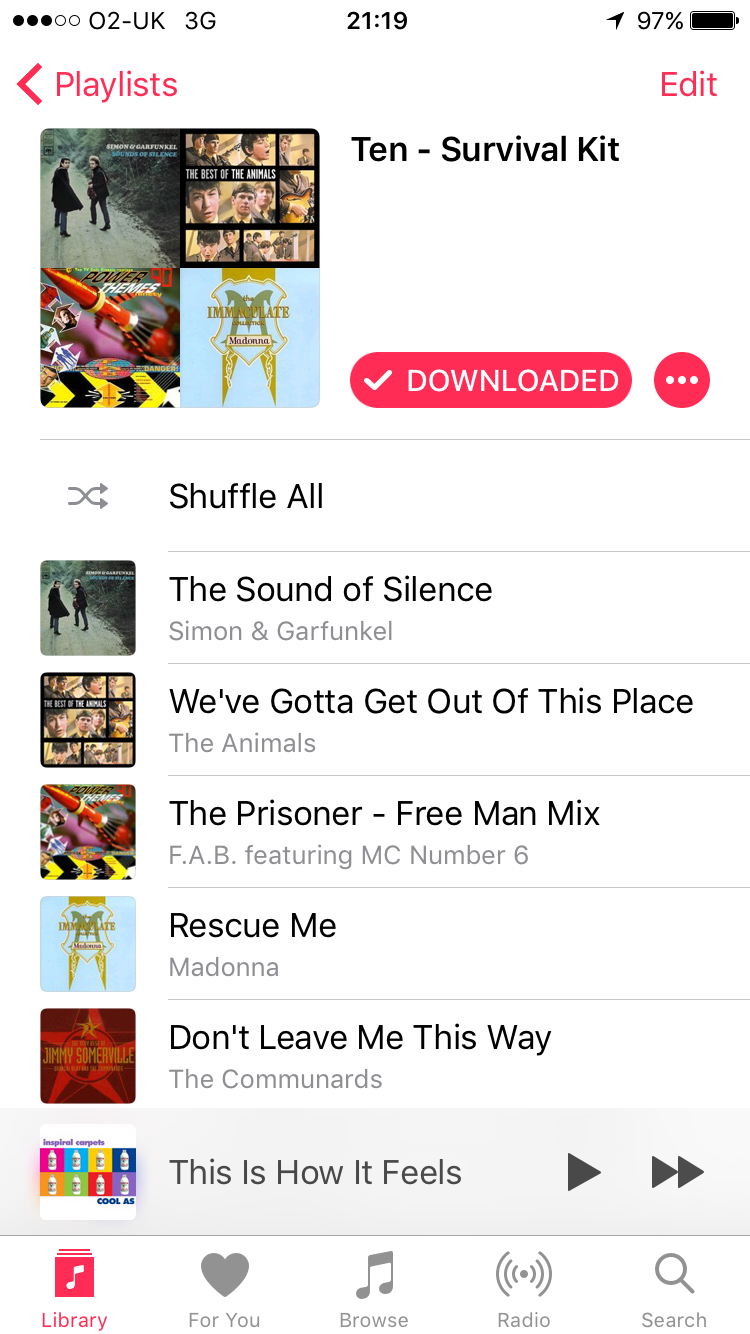
After two days of drugs, pain and exhausted attempts to sleep, obviously I had to face up to both feeling and very visibly being very much worse. I strongly suspected I would not just be sent away with stronger drugs this time, so packed such essentials as my tower of prescriptions and several books, as well as loading my phone with more books, Doctor Who stories, an extended playlist I’d prepared after the last time, and of course that still extraordinarily accurate and topical documentary Carry On Doctor. Plus recharger and plugs. As it turned out, I mostly read JP Martin’s Uncle tales, which I’d recently found as eBooks many years after consuming them at my school library.
On the Saturday afternoon Richard drove me back to A&E. I was there five hours, and I was not happy. This was a busier time and the cheery doctor only passed me in a corridor. There are few things so alienating and afraid as hours alone in a hospital room: my condition may not have been as bad as in 2014, but the communication was far worse. No phone signal in the deep places, either. When they eventually decanted me into a chair and wheeled me round and round and up and up to be admitted into a proper ward, somehow I wasn’t grateful for the excessive speed after the long wait – being dragged and bumped behind an orderly so that I received the maximum excessively painful jolts and couldn’t even see where I was going. I just managed to read the ward number as I whizzed past, but wasn’t helped by the sign headed “Visiting Hours” without any times marked on it.
And so I ended up laid out in a small ward so deep inside the hospital that not only did it not have any windows but that the nearest windows were along enough tangled corridors that I didn’t see natural light again until the following Thursday. This did not have a cheering effect. The evening wasn’t helped by having had literally no food all day and told that I’d missed the evening meal so all they could give me was a packet of biscuits, nor by it taking several requests and an hour to find out when visiting time was. I was finally able to send my distress call to Richard after it had officially finished, but he stayed until they threw him out, for which I was even more grateful than the half-hour in the middle where he legged it out to the nearest supermarket for their saggy surviving sandwiches. Which at that point were awesome (and my husband far more so).
I don’t really want to talk about the next four days. Richard came every minute allowed – and considerably more – that he wasn’t at work. He is the most wonderful man. Be nice to him. He’s frazzled and he needs it.
Thank you, too, for all the people who sent good wishes via his FaceBook, to several people who sent very kind messages (and I’m sorry I replied to so few), and to a friend who came to visit and was extremely nice even when I was at one of my worst points and was shakily and soggily poor company (not least for asking if I could cope with a visitor and then asking if it was time for him to go so I could be alone with Richard). Thanks also particularly to Nurse Tracy, who ran the ward at night over the weekend and was really good at it – the medical side, the reassurance side, and even the little things like bringing replacement gowns and wash-kits before you think to ask for them. If they don’t do that, ask for them. Which brings me to…

Things To Do In Hospital
If you ever end up in the same sort of situation, the most important thing is to fight to stay informed and to ask questions. Particularly if you have a medical history that you know and that they’ve not read (I’m still impressed that, along with two antibiotics that I’m still taking and still being knocked out by, one of the painkillers I was discharged with explicitly warns against taking if you have not one but two of my chronic conditions and, when a doctor suggested I risk it if I really needed it – obviously I really needed it – had as bad an effect as you might imagine).
If a doctor seems to contradict another doctor, ask and give evidence-based back-up to your questions. They probably won’t listen to you, but there’s a chance the next one will when they contradict again. I’m glad that they hit on the right treatments eventually, as a week after discharge I’m showing slow but noticeable signs of improvement, but when you have a different medical opinion and complete reversals every day you must pay attention, because there’s a strong chance you’re the only one who is. My particular winner was the specialist who came up with the best antibiotic but at the same time seemed fanatically in favour of a medical procedure that I’d previously been and was subsequently told would be a disaster. He was also the doctor who told me with utter certainty what had caused my condition and simply repeated himself in the most dismissive way possible when I asked how his off-the-peg assumptions squared with actual individual medical facts and clinical records that not just contradicted him but proved what he was saying was impossible, including those from two and a half years of follow-up tests and operations by his own department. I am not a trained doctor, but I am at least able to grasp that an operation in January 2015 and the continuing complications from it may indeed be among of the banes of my life, but they did not cause the condition that first hospitalised me in July 2014 and to which they were themselves all consequences. Perhaps I shouldn’t have been surprised by a doctor whose firm and unalterable convictions were based on time travel, but I wasn’t reassured by him.
If you’re at your lowest and weakest and most in pain, if two other patients strike up a loud and extended vitriolically homophobic conversation (one led it, but the other went along), you should probably do something. But I’m f**ked if I know how to summon up the spirit to do it rather than just both feeling more vulnerable and isolated than ever and feeling grateful you’re isolated in a corner constantly inside curtains and can try to pretend you’re not in the same room.
Cannulas are the work of the devil (they’re a sort of tap fitted into you so they don’t need to find your veins with fresh needles every few hours). I find they bruise hideously in the hand and much less so in the arm, but both will be painful all the time and far more so when they snag on your gown or as you turn in fitful sleep. When your blood pressure is measured every four hours of day or night, learn not to be too disturbed because there’s nothing you can do when each new nurse says, alarmed, “Did you know your blood pressure is very high?” and when it starts flashing and saying “Emergency” on the readout be patient when they switch to the other arm in the hope that reading will be a crucial few points lower and they don’t have to call a doctor. But especially, if your cannula is in the crook of your elbow, tell the nurse loudly every time and when they don’t listen, push the blood pressure armband further up your biceps before the pressure closes on the needle in your arm and risks breaking it.
If you’re cold, and in an air-conditioned ward with only a thin gown and a thin sheet you probably will be, ask for a blanket and keep asking when the nurse’s face suggests you have asked for a statue of yourself in an ermine wrap. If you are still cold, ask for another one. If you are to be trundled on your bed to another floor for tests, ask for blankets in advance. Assume that you might, for example, be about to be left in a much colder corridor for an hour and a half while waiting for the scanner. Whatever you are in for will not be improved by catching a chill. This might mean, for example, that you are shuddering uncontrollably while the doctor who’s just peeled back your gown and gasped, “Oh! That looks very painful” is trying to keep a steady hand, and that, for example, your temperature and pulse might rocket that night and the nurses have to give you extra medication while you ache appallingly and sweat your entire bodyweight.
Most importantly of all, fight your British instinct to answer ‘Are you feeling all right / better / comfortable?’ with ‘OK / fine / not too bad / embarrassed shrug’. You must gaze steadily at the medical professional and say the words ‘Very bad. I need some morphine.’ Or you will remain in an even greater level of pain than you will be when stuffed with painkillers.
Also get up the bottle – especially if the doctors have ticked you off for not drinking enough fluid after no amount you drink can make up for your massive dehydration after another night pouring sweat on a plastic mattress – to ask for more water and keep asking in the three hours after breakfast in which the jugs have been taken for cleaning and the nurses believe they will return instantly by house-elf while patients discover replacements will only arrive at the next meal. Unless you doggedly keep asking.
Doggedly keep asking.
And that’s it for what I’ll say. I’m out. I’m hoping not to go in again. I’ve had two short walks since I was released and both were so painful and exhausting I was knocked out for a couple of days afterward. I am still in a great deal of pain, somnolent from all the pills, and in either a foul or just a hopeless mood, and very grateful that my husband somehow puts up with me. My health has now been increasingly poor for twenty years and after this year I am very much more fed up with it than ever.
Here’s hoping that my personal 2016 goes into the bin and takes with it all the bonus health disasters so that by a few weeks into the New Year I can enjoy the giddily flourishing vigour of Alex-normal.
“All component parts are functioning normally, master.”
“I don’t believe it. I don’t believe it! All component parts functioning normally – ha! Puh. You mean to tell me that after all we’ve been through, the systems are functioning perfectly?”
“No – not ‘perfectly’, master. Adverb attributed was ‘normally’.”
K9 reporting on the Doctor’s broken-down TARDIS, Doctor Who – Full Circle
Labels: Carry On, Doctor Who, Health, London, Music, NHS, Personal, Pictures, Richard, Tube, Uncle
Sunday, October 05, 2014
Harry Potter and the Prisoner of Azkaban – Who’s In the Wrong? Ron or Hermione?
Are you a cat person or a rat person? As forced polling choices go, that one would have a particularly predictable majority answer. But like a lot of forced polling, my answer to the pollster would be, ‘Can I have another choice, please, because anything but rat isn’t good enough?’ and my real opinion would be that I’m more a people person. There’s a related row in the comments to the Harry Potter and the Prisoner of Azkaban Tor re-read. It’s really ‘Are you Ron or a Hermione person?’ and, spoilers, I’ve had some thoughts about the moral responsibilities here…
If you’ve not read the book – well, this will make less sense, but you can still read it as a summary of some of my ethical reasoning. In short (spoilers), we have three kids in a wizard boarding school: Harry, Ron and Hermione. Their friendship is tested in this book of the series when Hermione buys a huge, aggressive cat that has it in for Ron’s small, cowering rat. It later turns out that all is not as it seems, and that the rat is not only more scared of something else than the cat, but not a rat at all. But in the meantime, Hermione keeps being what I will charitably describe as careless, and eventually the inevitable appears to happen: blood and cat hairs are found where the rat should be. Afterwards, Ron and Hermione don’t talk to each other except to snipe.
Here’s what I said on the Tor re-read comments thread…
I don’t doubt that Ron should try to be nicer to Hermione, because he’s her friend. It’s hard to do, but he should still make the effort. But blaming him alone for not doing so is blaming him for not being massively morally superior to Hermione, whose behaviour is despicable. It holds them to ridiculously different standards. And every time I re-read these chapters, I pay more attention to the details and find myself getting more furious with Hermione.
Let’s go through the levels of moral culpability here.
Cat Vs Rat
A cat attacks a rat? As everyone says, that’s just what cats do. That is a fact that everyone knows. ‘Everyone’ certainly includes Hermione, because it’s at least as true in the Muggle as the wizarding word, and even if she’d somehow never even seen a cat-vs-mouse cartoon and was preternaturally unobservant in her Muggle childhood, Ron has pointed this out to her many times. So were things as they seemed, there would be no moral culpability on either animal.
It turns out later that things are not what they seem. So we can re-examine two moral actors here. The cat is probably (though, awkwardly, never stated as such in the text) half-kneazle, a magical creature that senses dodginess in some ill-defined way, and is going after a disguised human it knows to be no good. We certainly know that “Scabbers” is morally wrong in hindsight. Without knowing for sure about Crookshanks and about what level of intelligence part-kneazles have, we can’t say whether this is just an animal acting on a slightly more sophisticated instinct (and therefore has no moral bearing) or something closer to a person acting as a vigilante (which is a whole other moral debate).
So that leaves the two human owners. We know that Ron and Hermione are friends and are supposed to care for and respect each other (and, hopefully to a lesser extent, care for and respect their pets). We also know that they both believe their pets to be, respectively, rat and cat – they are not at this point aware of the true facts. And we know that both, as well as being emotional teenagers, are also pretty intelligent and unusually capable of logical reasoning for their age (it’s tempting to put more responsibility on Hermione here, but remember Ron and chess).
Consequences Vs Intent
There is one partial justification for Hermione in moral theory, but it happens to be a moral theory I think is a load of rubbish. If you happen to believe that you can only ever judge by consequences, then any level of behaviour and intent isn’t just forgivable but ethically good as long as it works out all right in the end, however unlikely that may have seemed in advance. You can be selfish, vindictive, cruel, hateful, utterly reckless or solipsistic, but if the outcome by some miracle turns out to the good, that makes you and your intent morally right. That to me is pure sophistry or, in plainer language, utter cobblers. It’s reasonable to say to a person who is selfish, vindictive, reckless or any of the rest that they were in the wrong but, no harm done, you won’t be as harsh as you would had something terrible actually happened (whether they wanted it to happen or just didn’t care). But that doesn’t make their actions and intentions moral.
In this case, even if you go to the extremes of saying that because Crookshanks didn’t actually eat Scabbers and so there were no bad consequences at the point Scabbers disappeared, that still means that for consequentialists Hermione is not ‘good’ but only partially in the wrong. She has still already been wrong for repeatedly ignoring her friend’s wishes, showing him a complete lack of respect, and invading his privacy and letting her pet tear his clothes (which his family can ill-afford to replace and which the very well-off Hermione doesn’t offer to) and bloody him. Those are already factual consequences. Being wrong about what appears to be the final act doesn’t change any of them. Even to a consequentialist, Hermione is still morally culpable for all of that.
But for me, morals depend on intent and actions and not merely accidental results, so Hermione is far more in the wrong.
Acting Like Only You Matter In the Whole World
Ron and Hermione both believe their pets to be ordinary animals. They both know what cats and rats do both in general and in their particular case – Crookshanks has repeatedly attacked Scabbers. Ron has many times told Hermione to keep her cat away from him and his rat because of this. Hermione not only ignores this, but actively brings her cat into Ron’s bedroom, making it impossible for him to have any safe place. Hermione is utterly despicable here. She repeatedly ignores Ron’s expressed feelings and wishes and invades his privacy to underline that, making it clear she has no respect or empathy for him, makes no offer of restitution when her cat wrecks a poverty-stricken student’s clothes (in the aim of killing the poverty-stricken student’s pet, which she can afford to replace and he can’t). Then she thinks it’s all about her and her solipsistic wishes when he dares to complain. I wouldn’t have waited until my pet was apparently killed to wonder ‘Is this person who never listens to me and constantly puts her slight whims above actually hurting me really my friend?’
It is completely foreseeable for Hermione that her cat will attack Ron’s rat. It’s foreseeable because she knows about cats and rats, because Ron’s told her, and because she’s seen it happen herself several times. And yet she still keeps bringing her cat to Ron, not making any effort to control it, and then blaming Ron. I don’t think victim-blaming is the most morally despicable thing she does, but it’s one of them, and her snobbish ‘I am superior to you so I am always right’ attitude only gets worse after what the evidence suggests is her cat completely foreseeably killing his rat.
When Ron is blamed afterwards by some readers for not going out on a limb to make it up with her, I’m with Rancho Unicorno and Gadget above on this. Hermione’s been to blame for ages. It looks like the obvious thing that her cat’s been trying to do for ages while she stands by and helps it has happened, and she refuses even to admit the possibility for weeks.
So does she show that, having been utterly horrible and reckless to him over his pet and his wishes for months, she’s still Ron’s friend and does actually have some respect for him? No. Obviously. She tells him she’s superior to him and that only her views count. Again. Obviously. She keeps making decisions for Ron and Harry without even having the decency to tell them. She knows they’re not going to tie her up or stun her to stop her, so she’s simply a coward with no respect for her ‘friends’ by going behind their backs and not even trying to hear their point of view. All through these chapters, she acts in every way as though only she and her opinions and feelings matter, and that Ron and Harry are dirt. I suppose some people might say ‘But girls have more feelings than boys!’ as if sexist twaddle is an excuse.
If you believe in consequences being the only (shaky) basis of ethics, then you have to absolutely condemn Hermione at this point, because she’s wrong about the broom being dangerous and so she’s upsetting Harry and depriving him of his property for no reason at all. Because I think intent and actions are the moral elements instead, I’d give Hermione slightly more leeway here, as she’s doing what she does partly out of concern for her friend based on a very logical, reasonable worry. It’s just a shame that she says she must be right and his opinions aren’t worth a twig whether the evidence is on her side or against her, which means it’s not actually about logic but about her need to say she’s the superior one.
In the next chapter, of course, it’s Ron who makes the crucial move in offering to help her, and Hermione who implicitly accepts that her cat killed his rat, which she must have believed all along and simply refused to admit, so her determination to show no remorse or even concern was even her knowing she was wrong. He immediately implicitly forgives her by saying it’s OK. So there’s proof about who’s the moral one – he doesn’t even wait for a full admission of guilt, much less a public one, but how can you forgive someone while they’re still twisting the knife?
Real-life Examples (or Personal Bias)
Here’s a real-world example about Hermione’s behaviour before Scabbers’ apparent death (one which I’ve only thought of now while actively searching for a real-life analogy, though I can’t say it might not have subconsciously biased me). I am heavily allergic to dogs. If I visit a friend who has a dog, I will wear clothes that I don’t mind stripping and putting in the wash straight afterwards, I will dose myself with extra antihistamines, and I will ask them if they could try to keep the dog off me if possible. I do not blame their dog if it jumps on me, though I will get up and try to move away. If my friend, knowing all this, suddenly broke into my flat, brought their dog into my bedroom, and let it shed hair and saliva all over me and my bed, them blamed me if I protested, I would question if they were really my friend. If I then came out in a really severe allergic reaction, I would blame them. If medical tests later revealed that the allergic reaction was caused by, say, food or an insect bite, I might feel a bit awkward and blame my friend less, but I would still think they had no respect for my wishes, health or privacy and had put me in what they could foresee as danger, even if by luck they didn’t actually hurt me physically – just emotionally.
Now here’s another real-world example which I’ve often considered and scorned in quite a lot of people (to give more of my moral bias) for Ron’s and Hermione’s respective feelings in the aftermath. Claiming ‘Ron is the mean one because Hermione is upset’ is based on no morals, just that whoever proclaims themselves most hurt wins, whatever the causes of their feelings. Ron feels upset because he’s lost the pet he’s had for many years (which he can’t afford to replace) and because his (financially comfortable) so-called friend repeatedly ignored his expressed feelings and wishes and invaded his privacy to underline that, making it clear she has no respect or empathy for him; but Hermione just feels upset because her friend is as a result confronting her with the truth about her own behaviour, making her feel guilty and bad. One of these things is not like the other.
I will be getting married three weeks from today. There are people who have strained every sinew to stop me getting married while loudly arguing that I and my fiancé are intrinsically wrong, evil and fundamentally not as good as them. While I have done nothing to interfere with their rights, I have responded on the evidence that they are homophobic bigots. Many such people then shriek that it is awful to call someone a bigot, and that because they have been made to feel bad they are the real victim here. They are not. This does not make their feelings of hurt and shame any less real, but neither does it wipe away the truth that they are being made to feel bad because they’ve been bad – which means they deserve to feel bad, and deserve no sympathy for being hypocrites when they say ‘But what about my feelings?’ after spending so long completely ignoring those of their victims.
Neither, in this case, does Hermione.
Labels: Harry Potter, Health, Marriage, Moral Philosophy
Friday, August 29, 2014
Adventures On Holiday In Hospital
It’s the end of Summer – traditionally, as Doctor Who’s back – so how was your holiday? Did you go anywhere nice? We went to North Yorkshire for a week, which is relatively usual, then I spent all of mine in hospital, which isn’t. When I’ve not blogged for a while it’s often due to some of my many long-term health problems, so I’ll try to make light of it by saying afterwards that “my health has been worse than usual – as usual”. That week and all the last seven weeks have made this weak gag rather less funny.
I’ve been so ill – and still not quite back even to my normal levels – that I’ve not really known what to write to explain it when I eventually got back to the point when I could. At one point I determined to let absolutely everything out, and drafted a long blog post going into all the gruesome details, including the things that are always wrong with me and how they all fed into each other… But in the end I bottled it. I felt too exposed, and as an excuse told myself that no-one would enjoy reading it. But I’m aware some people have been worrying, and probably more since Richard outed my hospitalisation this time last week, so here’s the very long but hopefully more entertaining and definitely less soul-and-body-baringly invasive version. Are you sitting uncomfortably? I am…
This Is the Important Paragraph – You Should Probably Skip the Rest
The first thing I should say is that while this was intensely awful at its worst, like all my other miserable long-term conditions (and the bonus ones that frequently pop up to join them), its effect was low quality of life rather than life-threatening. So that’s one awkward question you don’t have to ask. The worst effect of it was that my lovely Richard, who has more than enough to cope with anyway, had to work seven hours a day visiting me and more in his ‘time off’ answering all the questions from family and friends that I wasn’t able to cope with. So he deserves a medal and really, really needs an actual holiday. If you happen to be in touch with Richard, please be especially nice to him, as he’s been having a particularly knackering time and, unlike me, can’t spend days in bed after swallowing fourteen pills (my apogee combination of antibiotics, painkillers, especially good hospital painkillers and ordinary prescriptions – I’m down to a smaller number now).
It hasn’t been terribly pleasant for me, either. The week in hospital – for all my terrible health, the first actual hospitalisation of my adult life, though I spent months there as a kid – was of course the worst, involving amongst other things very, very much more pain than I’m used to coping with, almost complete physical incapacitation, humiliation and discovering that I do have some physical vanity after all on getting an unexpected and upsetting blow to it – which like several other things is still not mended. But in some ways the most difficult thing to deal with wasn’t the most intense part but the very slow recovery.
One of my ways of coping with the way ill health usually knocks me out at random is, after the Ray Milland alcoholism film The Lost Weekend, to tell myself my incapacitated time was a Lost Morning, or a Lost Day, or a Lost Week, so that by naming it I can mentally file it away and not dwell on it. I can’t just dismiss a ‘Lost Month And A Half’, especially when both Richard and I are getting rather stressed now that our preparation time for our wedding, which had been going all right, has been cut in half. I suspect this may make me still more wary in future of booking anything; other than my income being technically zero (sorry, Richard, again), I am forced to miss so many things that I’ve paid out for even with my ordinary health problems that I sometimes get to the point where I rarely leave the flat – or get too stressed that I might not be able to when needed (yes, I am listening to the complete works of Kate Bush and feeling jealous as I type). So if you’ve ever wondered why I don’t seem to be about at a Lib Dem Conference, say, then tell me I’m looking well when you eventually see me, there’s a strong chance that I may have been mostly knocked out in a hotel room for the previous forty-eight hours and, on getting out for an evening or an afternoon, be what’s technically termed ‘faking it’. That’s when I don’t just turn entirely inward as a way of coping, a strategy that did at least get me through a week in hospital without going berserk.
I said there’d be entertaining bits, so I’ll tell you that I’ve learned two ‘Be careful what you wish for’ lessons that many a man would grip a monkey’s paw for: one of them isn’t printable in this less TMI version, but the other is ‘I wish it would seem like time on holiday went more slowly’. Well, it certainly did that.
So, Back in Mid-July… The Prologue and the Hotel From Hell
OK, preliminary rambling over, here’s the abridged version of what’s been going on. Back on Sunday July 13th, I started feeling ill, painful and swollen, recognised the symptoms as a nasty infection I’d had once before (though as it turned out to a tiny fraction of the severity), and rather than putting it off as usual because I tend to hope anything new will just go away, decided to deal with it if it hadn’t passed by after I’d slept on it. So on the Monday, with it all much worse, I got a taxi – with a non-stop-gabbling taxi driver so loudly and horribly a Kipper that I wondered if he was a method-actor testing out a stereotype – to seek medical advice, seeing a very nervous doctor who gave me what turned out to be seriously feeble antibiotics. Still, I spent the week mainly trying to rest in order that we’d be able to go on our holiday. I didn’t go out; I missed a pre-booked book evening in town with Neil the Husband In Space and Jenny Colgan; the swelling got worse, but with the (duff) antibiotics, constant paracetamol and not moving the heavy flu-like symptoms seemed to be retreating slightly. What could possibly go wrong? Having fooled myself things were improving, Richard drove us up to Stockport in a nightmare journey of traffic jams in order to see my parents, for whom I looked much better (see ‘faking it’).
The next twenty-four hours were when everything that could went rather wrong at once. As well as getting increasingly feverish as a side-effect during the journey up, the main infection was getting more and more painful while swollen and constricted in a car seat, and I wasn’t able to get any sleep. So that night I was pretty much exhausted – which was unfortunate, as we’d chosen a hotel at random and turned out to have booked into the worst hotel in Stockport. It seemed almost funny at the time. It looked astoundingly like the hotel from Doctor Who – The God Complex, complete with the same cream doors and red paisley carpet, except that even they’d not been able to find a hotel so stuck in the 1950s that it still had a lift with hand-pulled outer shutters and inner cage. It must be thirty years since I was last in one of those (probably not since they pulled the old Hazel Grove Co-op down). It was absolutely sweltering that night, and the place had no air-conditioning, so I did what any rather odd person running a fever and feeling rather out of it would do: reeled around the place after midnight Tweeting that I was trapped in a Sapphire and Steel story. You can read this improbable timeline here: one, two, three, four, five, six, seven, eight, nine and ten (three, five and eight are my favourites).

Not the most entertaining of the photos, but the one that shows lift, carpet and cream.
It got a lot less funny when we tried to sleep. However loud the storm outside, even with the window propped open the crack it would allow, the temperature in the tiny room was soaring and so was mine, so despite my pain and tiredness I was only able to get a few short stretches of sleep. Now, I ordinarily tend to sleep badly, but most days keel over for a couple of hours in the afternoon to deal with it; when I’m short of sleep even in relatively normal health I tend towards testy, headachey, incoherent, unsteady and vomiting (and all without touching a drop). This will all be a bonus later in the day.
The Day It All Went Down
And so we crawled out of bed on the morning of Saturday July 19th, me in a much worse state but Richard also deprived of sleep both by the heat and a feverish fiancé, and more worryingly the one who had to do all the driving. We planned to take some stops along the way from Stockport to Sutton-Under-Whitestonecliffe; as it turned out, the traffic again did that for us, with more massive tailbacks, another long trip taking twice as long as it should, and my trying not to say anything about the effect it was having on me when there was nothing either of us could do about it. One thing I should have done was taken off my shoes and towelled my feet; we’d been out in heavy rain for a couple of minutes in the morning, and I was very soggy. But even bending was by this point excruciating, so I suspect I also caught a chill which may not have helped later.
At long last we arrived at our destination. I got out of the car and went into the office to say hello and get the keys to our self-catering cottage. I was aware at the back of my mind that I was feeling very unwell indeed, but kept standing, bantered – faked it – and it was fine. I was fine. I’d just get my clothes off, dry off and have a sit-down without being jammed into a car seat, have some water and a couple of paracetamol and I’d be fine. We’d got there. We could relax.
I literally collapsed within two minutes of opening the cottage door.
Now, I’m frequently tired and ill and in pain and have to lie down for a couple of hours. Most afternoons, probably. And I label this ‘collapsing’. I think I need to find a new word. Because having held off the worst while doing the bits I absolutely needed to, like travelling, seeing my side of the family and being in public, something suddenly snapped. I fell onto the bed and couldn’t get up.
For two hours I couldn’t move except to weakly reel about when being in one position was too much. I was in suddenly unbearable pain of several types (one of the worst of my usuals, stomach like a bag of knives, coming in just when I didn’t need it). For the first half-hour I couldn’t get my teeth to stop chattering enough to speak. I was shaking, sweating and running a high fever. I threw up the painkillers within minutes of taking them, babbled incoherent guilt to Richard when I could get words out through my shudders, and kept telling myself that I was just too exhausted and if I could only get to sleep, I would get better.
That didn’t happen.
After two hours of this, I gave in and rang 111, because I didn’t want to trouble them with something that wasn’t very serious. I could still barely speak and hardly move at all, and they sent an ambulance immediately. It turns out they thought I was very ill indeed, and it turned out they were right. I’ve only once before been taken off in an ambulance as an adult, when quite a few years earlier I was having several hours of chest pains (which fortunately were just a combination of asthma and muscle spasms). I was given gas and air that time, which relieved the pain and was very jolly (for me, at least. They didn’t give Richard any to relax him, so he was dreadfully worried). So I was a bit disappointed when the gas and air this time made the pain only slightly less intolerable, and that only in the moments I was actually breathing it in. They offered me morphine, which I’ll admit I was wary of but was fantastic (kids: don’t listen). Or at least let me slowly start to cope. I was rushed to the hospital in Northallerton, with Richard – who fortunately knows the area – following in the car (not a great time for him after two days of horrible drives). He stayed with me through all the initial hours of pokes and proddings until I was consigned to a ward about 1am.
I didn’t take any photos that evening, or for the next few days, which is just as well.
Hospital #1
I was given rather a lot of drugs through two different drip-feeds and as a consequence got more sleep that night. In fact I can’t tell you a great deal about the Sunday, as I was constantly dipping in and out of consciousness, and couldn’t actually move without a lot of help – still less make much sense – until the Monday. I do remember using the counter on the electronic box that combined my twin feeds to calculate the time and then counting slowly for the half an hour until three o’clock when I was sure Richard would come. He was stuck in the car park and got in about two minutes past; he was the first to arrive at visiting hours (and the last to leave, but I won’t talk about an excessively rude nurse noting that as the others were very much nicer), but I was not at that point coping well and nearly cried when he didn’t appear on the dot, as I wasn’t up to devising any other coping strategy, then nearly cried again when he appeared to look after me. It’s startling how much hope you can build up on one tiny thing when you’re in an awful state.
The Saturday night and through the Sunday was pretty much all a blur, often a distressing one, certainly an uncomfortable one, but above all a relief. Asked by the ambulance crew to rate my pain level out of ten, I’d given a nine because, you know, nothing’s perfect and you always have to assume something better can come along. My gratitude at it settling to between a five and a seven – and I often get a five at home – was inexpressible. Even when I found myself turning my list of all the things usually wrong with me and all my prescription medication into a sort of ritual chant I could repeat while semi-conscious as what seemed an endless file of doctors and nurses would ask the same questions and be taken aback at the length of the litany detailing my long-term health issues from literally head to toe…
…Even when – throughout the week – they’d always wait impatiently to the end and then say, “Are you diabetic?” (the politer ones) or “Aren’t you diabetic?” (the more supercilious ones), because, y’know, that’s one that’s really easy to forget, isn’t it? Well, no, I’m not, and as I have so many things wrong with me I have regular blood tests – and still many more in the hospitals – I’m regularly aware that I’m still not. And as the various consultants ruled out more and more potential causes of what was wrong with me, despite diabetes actually having no possible bearing on my infections, over and over they kept asking, “Are you diabetic?” and I kept hearing, ‘We are frustrated and feel we lack control of the situation because we should know what’s causing this and don’t, but you are very fat and we wish to reassert our control of the situation by blaming you for it.’ And over and over I kept saying, “No, I’m not diabetic,” and I kept meaning, ‘I am in hospital and very ill and feeling that I have very little control over my life at the moment, but I assert control over at least being adjusted to being very fat, and up yours.’
“‘The sky appears to be reflective,’ Holmes replied, more hesitantly than usual. ‘Perhaps, like Dante’s inner circle of Hell, we have ice above us. If you look closely, you will see a reflected glow from something over the horizon. The nearest Earthly equivalent would be the lights of a town or city.’ He coughed. ‘I am merely speculating, of course. It could be an incandescent chicken the size of the North Riding for all I know.’”That’s a line from Andy Lane’s very entertaining Doctor Who: The New Adventures – All-Consuming Fire that would go through my head each time, stranded in the North Riding with far less mental faculty than me, let alone Sherlock Holmes, and feeling the same overwhelming fish-out-of-water helplessness, with a certain degree of satisfaction that the doctor was similarly stumped. The spontaneous combustion plot was rather less comforting to think of, with the fever I was running (but you can’t have everything, and oh look, I was prefiguring another Victorian spontaneous combustion Doctor Who story just last weekend).
Another sudden collapse of self-image: usually I eat to cope. A lot. The doctors may have deduced this. Richard brought grapes, chocolate, goodies of various kinds (and two very lovely cards), and I just had to ask him to take most of them away again. Not because I was ordered not to eat them (except for the points when I was), but because I realised that I had absolutely no appetite whatsoever and it was too distressing to be reminded of it. I have a massive amount of stomach problems, but this was the only week I can remember when my appetite just went utterly flat. I was aware that with every hospital meal I had to force myself with every forkful, and still left bits (I do not leave food), simply because I was aware I had to eat and willed myself sternly to do it. Not even a giant incandescent chicken could tempt me. The week’s single happiest moment when Richard wasn’t there was being woken at 6am on the Thursday and realising that I’d been in a vivid dream of food, which meant that there was a chance I was becoming me again.
One thing that I held onto – other than Richard – was my befuddled brain playing Doctor Who. One story above (literally, it occurs to me) all: another from the same range as All-Consuming Fire, this time Russell T Davies’ brilliant first official Doctor Who, 1996’s novel Doctor Who: The New Adventures – Damaged Goods. There will be spoilers if you’ve not read it. Because I was surrounded my curtains and full of drugs and exhausted, and until Richard brought in my phone I had no distractions or diversions, all I could do was fall asleep, or lie awake looking up. Looking up at the large panels of the ceiling, like a big noughts and crosses board. And vividly remember how noughts and crosses keep featuring through the book with what eventually turns out to be exactly the same hallucinatory importance I was experiencing. Although it was published the same year my most bedevilling health problem started, at least as a long-term health issue it’s a better one to have than young Steven Jericho’s: in a story of terrible bargains, happy blow jobs, families, death and war, the most haunting aspect is the endless visions of noughts and crosses that Gabriel Tyler receives without rest from his separated, unknown, hospitalised twin who can do nothing every day but stare up at his own noughts and crosses board. Uncannily, not only is the bulk of the book set during the same week of the year that I was in hospital, but it was during that very week this year that Big Finish announced they’re adapting it as an audio play. But like Gabriel’s, my visions of noughts and crosses came first, and knowledge of their significance afterwards.

Noughts and crosses – filled in one nought and crossed drip-feeds (only one showing)
By the Monday, my brain and body were starting to function. Though I preferred being on average more conscious than unconscious, this wasn’t all good. The worst moment… Worse than when I was admitted – because that was a relief from pain. Worse than grumpy nurses trying to take my two gowns and telling me off for not bringing my own pyjamas – because I don’t have pyjamas, doubly not when on holiday, because I was too swollen to get anything over my legs, and I needed two backless, impossible-to-fasten-yourself gowns for courtesy’s sake, as I’m a naturist but am aware non-nudists didn’t want me flashing or mooning them as I tottered to the loo. Worse even than Tuesday when I hit ‘peak swelling’ at a huge, painful and absurd size – because I’d been inured to this being what I was ill with. The worst moment of all when I was in hospital came because I was able to clean myself. I’d been drenched in fever-sweat and unable to move for two days; when, in not a great twist, the cannula on the back of my hand ripped free while I was dozing, it at least meant there was a point when they had to disconnect my drip-feeds and I seized the moment to ask if I could have a shower. I was terribly weak but just determined enough to stagger to a bathroom, pull off my gown, and… Though I’d been conceptually aware of it, this was when I got the real blow to my vanity: there is just one part of my body that I like, and I’d never realised just how much of my limited self-esteem balances on it until I suddenly saw what a wreck the hospital had made of it. It’s still not right, but that initial shock in the mirror nearly stopped me coping. It’s the bits you’re not prepared for that tip you off the deep end. Partly as a way of mentally striking back with a physical change under my own control, and partly just because I didn’t have the energy and co-ordination to use a razor for several days, I decided then to grow a beard until I’d recovered. I have, of course, still got it. Sorry, Richard.
Monday was also the day I changed hospitals. The one in Northallerton had mostly very friendly nurses and a cheerier ward, but it did turn out to have one serious disadvantage: a great many specialists all coming to see me and none, apparently, talking to each other (several of them even to me in my enfeebled state worryingly but plainly not having a clue). So let’s say that I wasn’t very happy when one decided seemingly at random that they should operate and told me, as if that wasn’t enough, that I couldn’t be sewn up but would just have to have a nurse pack the wound daily for a fortnight until it healed of its own accord. And let’s also say that I wasn’t very confident when another sent me for an ultrasound scan (on top of the x-rays, direct physical examinations of every kind and everything else I’d had) and those scan results said that there was absolutely no need to have an operation, because the assumption on which they’d based that decision was entirely wrong. And I wasn’t very happy at all when I was told I’d still be having the operation, pointed out the contrary information from later in the day, and was told that the doctors knew what they were doing.
It turns out it was rather lucky that they didn’t have a theatre available and sent me to a larger sister hospital.
Hospital #2
Almost everything about the second hospital in Middlesbrough was less good. Twenty-five miles further north, in a town neither of us knew, so that rather than Richard being able to drive there in ten minutes it would take an hour, making a full seven-hour day for him to visit me for my five hours of blessed company. The hospital itself bigger and grimmer and the ward much more – disrupted, I’ll call it, and not say anything of the distressed or distressing other patients. The bed… I’ll come back to the bed. The hour’s ambulance ride there, which was excessively painful just as I was levelling out (though the paramedics were lovely).
None of that matters. Because the best thing about the second hospital is that there was one consultant who saw me each time. One consultant, rather than half a dozen who only saw me once or twice each and made on-the-spot contradictory decisions. One consultant, who took the time to explain what was going on at every stage. One consultant, and this is less important but reassuring, who looked rather like Roy Marsden’s before he was eaten by vampires. One consultant, who most importantly of all had a f*****g clue and who on taking the notes from the hospital that had referred me for what I’d already weakly suggested and which his actually reading and cross-referencing them confirmed was a wholly unnecessary and dangerous operation, came remarkably close to expressing his professional opinion of some of the previous hospital’s personnel’s judgement and told me that I would definitely not be going into theatre that night, and detailed precisely why not.
So the second hospital was able to tell me that I had two infections, named, interrelated and both very bad and with pretty horrible direct effects and heavily flu-like side-effects, but that I didn’t in fact also have the other one that a random consultant had just guessed at. Reassuring to know precisely and definitely what was wrong. Slightly less reassuring that, after they also ran all the possible tests all over again to see what caused it, I predictably came up zero on the forty-six or so most common possibilities, which at least means they were able to confirm I’m not at all infectious to anyone else but also means I don’t know what esoteric cause to avoid and so that it might just strike again at random.
By contrast, perhaps the least appealing thing about the second hospital was the bed. Every bed in the ward had a whiteboard with the patient’s name above it. Every bed was a modern grey plastic creation with a wide frame and remote control elevation the patient could operate to get out of bed more easily or raise their pillows. You can see where this is going, can’t you? I was put in Bed 13, which unlike all the others in the ward never had my name put above it, and again uniquely was a narrow old iron frame which I had to clamber out of before they lowered it to change the bedclothes because the crank was too violent. Not that that occurred to the student nurse who, bored with listening in on rounds, idly kicked at it until the constant jolts of pain across my face prompted the senior nurse to stop her.
My slightly thoughtless way of coping was to tell Richard this was because in 1958 the last person whose name had been put on the board over Bed 13 had died before the night was out, and they’d never changed it again. He didn’t think this was very funny. The number, the nameless horror and the ancient frame did give me the sense that I was incarcerated in a half-finished Christmas script by Mark Gatiss, though.

In bed in hospital
The bed’s plastic mattress and pillows were no doubt practical for cleaning, but when I tend to get quite sweaty just as a matter of course and was mostly feverish while incarcerated, it meant the plastic would heat up against my skin like a furnace and I’d simply pour. One night I woke and was so sopping wet with sweat I had to plead with a nurse to change the sheets at 3am, which was one of my more mortifying moments and made rather worse when it transpired there were no spare pillowcases. I said I couldn’t sleep with a sodden rag under my head, so… They took it and left just the bare plastic pillow. That didn’t help. Should you ever find yourself in a similarly untenable position, here is my tip: ask for a large towel. Pillowcases they may not have had, but an intrepid nursing assistant found me a proper bath towel rather than the tea-towels they give you to dry with in the bathroom and I wrapped it snugly round both plastic pillows. Being considerably thicker than the cases, it was much more comfortable too, and psychologically it was a small victory.
Things I Learned From Hospitalisation
Gosh, I’m going on a bit, aren’t I? It’s therapy.
Much like discovering that Carry On Doctor is still a documentary.
It was a small, private act of protest. Both hospitals were festooned with signs saying that mobile phones were not to be used. Stern admonitions were given on admission. And I couldn’t get a signal in the first one, anyway. But after Richard tried to ring me on the ward phone number he was given and was told off because he should have rung my mobile – seriously – I relaxed a bit about occasional surfing to relieve the stupefaction, though I’m afraid I didn’t look at any messages because I just didn’t feel I could cope. And part of this was finding a rogue copy of Carry On Doctor online and slowly buffering it through the night as cheer in my most miserable moments.
For me, Carry On Doctor’s one of the best of the series, and definitely the best of the non-historicals – though the ending is in some ways more disturbing than chopping the villains’ heads off. It makes a brilliant use of a brilliant ensemble cast, and you can really see it as a big relaunch for the series at a new studio but doing what they’d been most famous for. You can see it this Sunday morning on Film4 (and no doubt every other week on some channel).

I saw that film!
What I didn’t realise until I watched it illicitly in hospital was how half a century later it’s still uncannily Cinéma Vérité. Though the thermometers are smaller these days, even the wards still look the same, only split into half-length and with Sky Sports screens dangling above you that I would regularly switch off and that orderlies would be commanded to switch on to try and get me to pay for them. I even had one of the original beds. The only thing that let down the documentary realism was Frankie Howerd being woken at 6am. No, not that part – I was woken every night at at least 2 and 6 (or 12 ½ p in new money) as part of having my blood pressure checked every four hours, which they’d always be surprised to see going sharply up or down but which I could reliably chart by how close they measured it to my last having had fabulous morphine derivatives and whether my pain score was a manageable four or a pump-popping seven. What I found incredible was Mr Francis Bigger wanting to get back to sleep (“Sleep’s good for you!”) only to be interrupted immediately by more crashing about from the guy doing the washes, and the vacuuming and the tea. It’s nothing like real life! They always gave you at least twenty minutes to start to nod off again before the next noisy interruption. Though our tea ladies were always very kindly, and I was always very apologetic when I couldn’t force myself through a full meal. Oh, and that sadly the only seriously hot nurse I saw was only in my ward for a couple of minutes while he was helping transfer a patient, and at a point where I was physically about as far from a Sid James reaction as I’ve ever felt. So no lovely pair there.
On a related note, day staff seem to have no idea what night staff do, as the question “Did you have a good sleep?” is one you can’t answer politely when you’re not only deliberately woken through the night on hospital policy but also constantly woken by patients being trollied in, patients being ferried out or patients being distressing in any number of ways (especially one night, where the suffering of one man was too near the knuckle and I had to go and sit in a loo down the corridor for half an hour because otherwise I couldn’t have dealt with my own). At no point did I ever have anything approaching a good sleep, though in the first night and day there was a long stretch of intermittently blessed unconsciousness and really excellently hazy painkillers.
In hospitals there is also a different meaning of “comfortable”: you are never remotely comfortable, but what they want to know if your pain level is copeable or if they have to hit you on the head with a mallet to stop you screaming the place down (see ‘distressing patients’).
If you have many prescriptions, you must remember to bring all the right drugs in in the right combinations on admission even if you’re passing out with pain.
The nearest I had to a proper row was with the pharmacist in the first hospital. I’d just grabbed one of everything to illustrate what I take, not expecting to be kept in for a week. This meant that the drug that I use in an unusually small dose because I’m prescribed it for something completely different to most people confused her. And then, as I take 2.5-3mg (depending on how badly I’m doing) in a combination of 1mg from one bottle and 0.5mg from another, she only let me take 0.5mg as I’d not actually picked up both bottles. As I need a small but not that small esoteric dose for an esoteric condition, that was no bloody use at all. I preferred the pharmacist in the second hospital, who I first saw scurrying about bent over in an amazingly disreputable manner before he eventually introduced himself. I remain suspicious, not least because he was the only staff member there in the sort of white with green flashes uniform seen in the likes of Doctor Who – The Ark In Space or The Invisible Enemy, and looked uncannily like a cross between Ewen Solon and Charles Kay, who acted in just that sort of TV in just that sort of period. So perhaps he didn’t actually work there, and was just a ’70s method actor pretending to be on set. Or, as he claimed to be a pharmacist, on drugs.
Richard – My Lifeline and Escape Line
I have always known that Richard is the most marvellous person and the most perfect partner in the entire world, but now I have objective factual evidence.
He gave up his holiday to spend every minute (and more) of the five hours allowed each day to come and comfort me – even when I really wasn’t in a good state for company, hospitalised 250 miles from home, and an hour’s drive each way for him. I am still pathetically grateful, to say nothing of what a lifeline he was at the time. He was always the first to arrive and the last to leave, and every day the only visitor who stayed right through. He is, objectively, better than everyone else and the most attentive visitor by a mile. Subjectively, he talked when I wanted him to, he was silently supportive when I needed him to be, and he was adorably affectionate. And from what I could hear of everyone else, he had far, far better conversation. Though I probably can’t go into detail on the parents I wanted to scream at to shut up, or the elderly sister who got bored of an old man just out of surgery not being a performing seal and told her husband to prod him to wake him up. Luckily for her, I was too feeble to prod her by hurling the bedside cabinet I had to hand.
And on one night I was greeted by an older gay man who’d had no visitors and was in a lot of pain talking on the phone to a friend about how the only thing that helped him cope was the gay couple in the opposite berth who were being lovely in holding each other and talking all evening and generally being the most couply couple possible.
Perhaps the thing I should be most grateful to my beloved for is the bit I didn’t see. I absolutely couldn’t cope with anyone else when I was in hospital, however much I love them – though it has been nice to see some of my family since, along with two lovely men who’ve visited me in my lonely flat – and he stopped me having to do so. He stopped well-meaning but just too much people contacting me in hospital, only brought in the messages he knew I’d want, and spent most of the remaining hours of his precious ‘rest’ time when back at the cottage on the phone or on Facebook updating people, reassuring people and answering endless questions from people, all so that I never had to. I love him so much.
I think of him standing at the ward doors him wielding his iPhone and roaring,
“You shall not pass!”

And yet I’m the bearded one in the abyss.
Absolute proof that Richard is the best. Please be lovely to him.
I take back what I said about pharmacists and the worst part in hospital, though.
On the Friday morning, the helpful and competent specialist told me they were going to discharge me. He told me that they’d have kept me in had I lived locally, but that he knew we were on holiday (ho ho) and that we were only booked in where we were staying until Saturday morning. On balance, he thought it would be better for me to get home on Saturday rather than Richard have to find somewhere else to stay, get time off work and them not really be able to do much more for me in hospital except pump me full of drugs and rest. So I was warned not even to think of doing anything for a fortnight (and my usual recovery time is twice medical estimates, because I have so many things wrong with me ordinarily, which has of course been proven again since) and that I was being discharged not for being better but for being on balance manageable. At the time, I was much less feverish than when I was admitted, but actually much more swollen (that having got much worse before starting to improve) and still just as weak.
Where the hitch came was with the ‘pumping me full of drugs’ part. I was told I’d need three different sorts of painkillers and antibiotics to take away with me, and that the hospital pharmacy would send them up. This was about 9am. I was told to expect them between 12pm and 2pm, and a kind nurse said Richard could come in early. This was fortunate, as he ended up staying longer than any of the other days as the time dragged on, and on. They stripped my bed and remade it, as I’d be out straight away… Which became a problem as it got later into the afternoon, when I got weaker and shakier but had nowhere to sleep, caught in a no man’s land where I was neither discharged nor not discharged. Or, as Richard described me, as I changed from patient to impatient. It was the promise being broken: I’d coped with being there all week, the first time I’d been hospitalised for about thirty years as opposed to all the many times going in for tests and consultants, and it was immensely draining but I could shut off enough bits of my mind to get through. But so close to escape, and just finding that always out of reach, that drove me up the wall.
When 4.45pm and the pills eventually came and I tottered weakly out of the hospital to see it for the first time – and disappointingly find that what looked like a scrap-metal sculpture of Gonzo from the window was just an interestingly-but-less-interestingly-shaped tree from more accurate angles – I was more than slightly frustrated. Tip for unblocking hospital beds: don’t let hospital pharmacies delay patients from being discharged by eight hours for no reason at all.
Still, you wouldn’t believe the sense of escape when Richard drove me away from there, despite all the pain. Just seeing anywhere else. Now there was an adrenalin rush.
Aftermath Still-during-math
I had hoped we might get one tiny smidgeon of holiday on the Saturday morning by visiting York – lovely town, our favourite chippie, the Fudge Kitchen – but I was very evidently in no fit state, and still in way too much pain, quite apart from still having a severely suppressed appetite. On the bright side, by leaving early, we seemed to miss most of the traffic and to our great relief had a far less hellish journey going back to London.
That, of course, was only the end of week two of my double-infection. It’s now nearly the end of week seven. I’m looking a little more me, and feeling a lot more me. I’m back to eating far too much food – but still not really up to much of the walking I’d been doing to try and keep my weight in check. It’s been pretty rough in between, though.
Week three I went out just once that wasn’t to the doctor, and of course overdid it with catastrophic results. Much the same happened in week four, but the swelling was a lot less as I moved onto my fourth course of antibiotics (same as the third course I got from the hospital pharmacy, far more effective than the utterly rubbish first week’s variety, and I never knew what the serious second stuff they pumped in intravenously was), so I was quite confident I could be getting out more. Obviously, in week five I moved from merely still weak and feverish to the full-on flu-type attack and was far more ill than I’d been at any time since about the third day in hospital. So that was… Bloody terrible, actually. Week six I was still very knocked out but got a few things done, and at last the multiple massive cannula bruises all along my left hand and arm have vanished.
Now late on in week seven, the former massive cannula bruise on my left hand has even stopped hurting. The swelling hasn’t, though. Both types of swelling are much better, but they’re still ‘tender’ (or just plain sore, depending), and while about a twentieth the absurd / horrific volume at peak, still noticeably inflamed. I finished the fourth course of antibiotics last week; I saw the doctor again this week; I’m on the fifth course of antibiotics. He’ll see how I’m doing in a fortnight.
On the bright side, I’ve managed to get some things done this week though still very far from catching up any of The Lost Month And A Half, and most of the ill hours I’ve had to write off as ‘Lost Time’ this week have been my standard, familiar illnesses and not the one that slaughtered me a month and a half ago, so that’s encouraging, isn’t it?

In our own bed one month after hospital
Whatever the doctor says, maybe this’ll work: the beard’s coming off tomorrow.
Labels: Carry On, Doctor Who, Food, Health, Matt Smith, Naturism, New Adventures, NHS, Personal, Pictures, Richard, Sherlock Holmes, Sylvester McCoy, Twitter