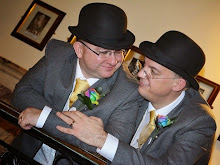
Friday, August 29, 2014
Adventures On Holiday In Hospital
It’s the end of Summer – traditionally, as Doctor Who’s back – so how was your holiday? Did you go anywhere nice? We went to North Yorkshire for a week, which is relatively usual, then I spent all of mine in hospital, which isn’t. When I’ve not blogged for a while it’s often due to some of my many long-term health problems, so I’ll try to make light of it by saying afterwards that “my health has been worse than usual – as usual”. That week and all the last seven weeks have made this weak gag rather less funny.
I’ve been so ill – and still not quite back even to my normal levels – that I’ve not really known what to write to explain it when I eventually got back to the point when I could. At one point I determined to let absolutely everything out, and drafted a long blog post going into all the gruesome details, including the things that are always wrong with me and how they all fed into each other… But in the end I bottled it. I felt too exposed, and as an excuse told myself that no-one would enjoy reading it. But I’m aware some people have been worrying, and probably more since Richard outed my hospitalisation this time last week, so here’s the very long but hopefully more entertaining and definitely less soul-and-body-baringly invasive version. Are you sitting uncomfortably? I am…
This Is the Important Paragraph – You Should Probably Skip the Rest
The first thing I should say is that while this was intensely awful at its worst, like all my other miserable long-term conditions (and the bonus ones that frequently pop up to join them), its effect was low quality of life rather than life-threatening. So that’s one awkward question you don’t have to ask. The worst effect of it was that my lovely Richard, who has more than enough to cope with anyway, had to work seven hours a day visiting me and more in his ‘time off’ answering all the questions from family and friends that I wasn’t able to cope with. So he deserves a medal and really, really needs an actual holiday. If you happen to be in touch with Richard, please be especially nice to him, as he’s been having a particularly knackering time and, unlike me, can’t spend days in bed after swallowing fourteen pills (my apogee combination of antibiotics, painkillers, especially good hospital painkillers and ordinary prescriptions – I’m down to a smaller number now).
It hasn’t been terribly pleasant for me, either. The week in hospital – for all my terrible health, the first actual hospitalisation of my adult life, though I spent months there as a kid – was of course the worst, involving amongst other things very, very much more pain than I’m used to coping with, almost complete physical incapacitation, humiliation and discovering that I do have some physical vanity after all on getting an unexpected and upsetting blow to it – which like several other things is still not mended. But in some ways the most difficult thing to deal with wasn’t the most intense part but the very slow recovery.
One of my ways of coping with the way ill health usually knocks me out at random is, after the Ray Milland alcoholism film The Lost Weekend, to tell myself my incapacitated time was a Lost Morning, or a Lost Day, or a Lost Week, so that by naming it I can mentally file it away and not dwell on it. I can’t just dismiss a ‘Lost Month And A Half’, especially when both Richard and I are getting rather stressed now that our preparation time for our wedding, which had been going all right, has been cut in half. I suspect this may make me still more wary in future of booking anything; other than my income being technically zero (sorry, Richard, again), I am forced to miss so many things that I’ve paid out for even with my ordinary health problems that I sometimes get to the point where I rarely leave the flat – or get too stressed that I might not be able to when needed (yes, I am listening to the complete works of Kate Bush and feeling jealous as I type). So if you’ve ever wondered why I don’t seem to be about at a Lib Dem Conference, say, then tell me I’m looking well when you eventually see me, there’s a strong chance that I may have been mostly knocked out in a hotel room for the previous forty-eight hours and, on getting out for an evening or an afternoon, be what’s technically termed ‘faking it’. That’s when I don’t just turn entirely inward as a way of coping, a strategy that did at least get me through a week in hospital without going berserk.
I said there’d be entertaining bits, so I’ll tell you that I’ve learned two ‘Be careful what you wish for’ lessons that many a man would grip a monkey’s paw for: one of them isn’t printable in this less TMI version, but the other is ‘I wish it would seem like time on holiday went more slowly’. Well, it certainly did that.
So, Back in Mid-July… The Prologue and the Hotel From Hell
OK, preliminary rambling over, here’s the abridged version of what’s been going on. Back on Sunday July 13th, I started feeling ill, painful and swollen, recognised the symptoms as a nasty infection I’d had once before (though as it turned out to a tiny fraction of the severity), and rather than putting it off as usual because I tend to hope anything new will just go away, decided to deal with it if it hadn’t passed by after I’d slept on it. So on the Monday, with it all much worse, I got a taxi – with a non-stop-gabbling taxi driver so loudly and horribly a Kipper that I wondered if he was a method-actor testing out a stereotype – to seek medical advice, seeing a very nervous doctor who gave me what turned out to be seriously feeble antibiotics. Still, I spent the week mainly trying to rest in order that we’d be able to go on our holiday. I didn’t go out; I missed a pre-booked book evening in town with Neil the Husband In Space and Jenny Colgan; the swelling got worse, but with the (duff) antibiotics, constant paracetamol and not moving the heavy flu-like symptoms seemed to be retreating slightly. What could possibly go wrong? Having fooled myself things were improving, Richard drove us up to Stockport in a nightmare journey of traffic jams in order to see my parents, for whom I looked much better (see ‘faking it’).
The next twenty-four hours were when everything that could went rather wrong at once. As well as getting increasingly feverish as a side-effect during the journey up, the main infection was getting more and more painful while swollen and constricted in a car seat, and I wasn’t able to get any sleep. So that night I was pretty much exhausted – which was unfortunate, as we’d chosen a hotel at random and turned out to have booked into the worst hotel in Stockport. It seemed almost funny at the time. It looked astoundingly like the hotel from Doctor Who – The God Complex, complete with the same cream doors and red paisley carpet, except that even they’d not been able to find a hotel so stuck in the 1950s that it still had a lift with hand-pulled outer shutters and inner cage. It must be thirty years since I was last in one of those (probably not since they pulled the old Hazel Grove Co-op down). It was absolutely sweltering that night, and the place had no air-conditioning, so I did what any rather odd person running a fever and feeling rather out of it would do: reeled around the place after midnight Tweeting that I was trapped in a Sapphire and Steel story. You can read this improbable timeline here: one, two, three, four, five, six, seven, eight, nine and ten (three, five and eight are my favourites).

Not the most entertaining of the photos, but the one that shows lift, carpet and cream.
It got a lot less funny when we tried to sleep. However loud the storm outside, even with the window propped open the crack it would allow, the temperature in the tiny room was soaring and so was mine, so despite my pain and tiredness I was only able to get a few short stretches of sleep. Now, I ordinarily tend to sleep badly, but most days keel over for a couple of hours in the afternoon to deal with it; when I’m short of sleep even in relatively normal health I tend towards testy, headachey, incoherent, unsteady and vomiting (and all without touching a drop). This will all be a bonus later in the day.
The Day It All Went Down
And so we crawled out of bed on the morning of Saturday July 19th, me in a much worse state but Richard also deprived of sleep both by the heat and a feverish fiancé, and more worryingly the one who had to do all the driving. We planned to take some stops along the way from Stockport to Sutton-Under-Whitestonecliffe; as it turned out, the traffic again did that for us, with more massive tailbacks, another long trip taking twice as long as it should, and my trying not to say anything about the effect it was having on me when there was nothing either of us could do about it. One thing I should have done was taken off my shoes and towelled my feet; we’d been out in heavy rain for a couple of minutes in the morning, and I was very soggy. But even bending was by this point excruciating, so I suspect I also caught a chill which may not have helped later.
At long last we arrived at our destination. I got out of the car and went into the office to say hello and get the keys to our self-catering cottage. I was aware at the back of my mind that I was feeling very unwell indeed, but kept standing, bantered – faked it – and it was fine. I was fine. I’d just get my clothes off, dry off and have a sit-down without being jammed into a car seat, have some water and a couple of paracetamol and I’d be fine. We’d got there. We could relax.
I literally collapsed within two minutes of opening the cottage door.
Now, I’m frequently tired and ill and in pain and have to lie down for a couple of hours. Most afternoons, probably. And I label this ‘collapsing’. I think I need to find a new word. Because having held off the worst while doing the bits I absolutely needed to, like travelling, seeing my side of the family and being in public, something suddenly snapped. I fell onto the bed and couldn’t get up.
For two hours I couldn’t move except to weakly reel about when being in one position was too much. I was in suddenly unbearable pain of several types (one of the worst of my usuals, stomach like a bag of knives, coming in just when I didn’t need it). For the first half-hour I couldn’t get my teeth to stop chattering enough to speak. I was shaking, sweating and running a high fever. I threw up the painkillers within minutes of taking them, babbled incoherent guilt to Richard when I could get words out through my shudders, and kept telling myself that I was just too exhausted and if I could only get to sleep, I would get better.
That didn’t happen.
After two hours of this, I gave in and rang 111, because I didn’t want to trouble them with something that wasn’t very serious. I could still barely speak and hardly move at all, and they sent an ambulance immediately. It turns out they thought I was very ill indeed, and it turned out they were right. I’ve only once before been taken off in an ambulance as an adult, when quite a few years earlier I was having several hours of chest pains (which fortunately were just a combination of asthma and muscle spasms). I was given gas and air that time, which relieved the pain and was very jolly (for me, at least. They didn’t give Richard any to relax him, so he was dreadfully worried). So I was a bit disappointed when the gas and air this time made the pain only slightly less intolerable, and that only in the moments I was actually breathing it in. They offered me morphine, which I’ll admit I was wary of but was fantastic (kids: don’t listen). Or at least let me slowly start to cope. I was rushed to the hospital in Northallerton, with Richard – who fortunately knows the area – following in the car (not a great time for him after two days of horrible drives). He stayed with me through all the initial hours of pokes and proddings until I was consigned to a ward about 1am.
I didn’t take any photos that evening, or for the next few days, which is just as well.
Hospital #1
I was given rather a lot of drugs through two different drip-feeds and as a consequence got more sleep that night. In fact I can’t tell you a great deal about the Sunday, as I was constantly dipping in and out of consciousness, and couldn’t actually move without a lot of help – still less make much sense – until the Monday. I do remember using the counter on the electronic box that combined my twin feeds to calculate the time and then counting slowly for the half an hour until three o’clock when I was sure Richard would come. He was stuck in the car park and got in about two minutes past; he was the first to arrive at visiting hours (and the last to leave, but I won’t talk about an excessively rude nurse noting that as the others were very much nicer), but I was not at that point coping well and nearly cried when he didn’t appear on the dot, as I wasn’t up to devising any other coping strategy, then nearly cried again when he appeared to look after me. It’s startling how much hope you can build up on one tiny thing when you’re in an awful state.
The Saturday night and through the Sunday was pretty much all a blur, often a distressing one, certainly an uncomfortable one, but above all a relief. Asked by the ambulance crew to rate my pain level out of ten, I’d given a nine because, you know, nothing’s perfect and you always have to assume something better can come along. My gratitude at it settling to between a five and a seven – and I often get a five at home – was inexpressible. Even when I found myself turning my list of all the things usually wrong with me and all my prescription medication into a sort of ritual chant I could repeat while semi-conscious as what seemed an endless file of doctors and nurses would ask the same questions and be taken aback at the length of the litany detailing my long-term health issues from literally head to toe…
…Even when – throughout the week – they’d always wait impatiently to the end and then say, “Are you diabetic?” (the politer ones) or “Aren’t you diabetic?” (the more supercilious ones), because, y’know, that’s one that’s really easy to forget, isn’t it? Well, no, I’m not, and as I have so many things wrong with me I have regular blood tests – and still many more in the hospitals – I’m regularly aware that I’m still not. And as the various consultants ruled out more and more potential causes of what was wrong with me, despite diabetes actually having no possible bearing on my infections, over and over they kept asking, “Are you diabetic?” and I kept hearing, ‘We are frustrated and feel we lack control of the situation because we should know what’s causing this and don’t, but you are very fat and we wish to reassert our control of the situation by blaming you for it.’ And over and over I kept saying, “No, I’m not diabetic,” and I kept meaning, ‘I am in hospital and very ill and feeling that I have very little control over my life at the moment, but I assert control over at least being adjusted to being very fat, and up yours.’
“‘The sky appears to be reflective,’ Holmes replied, more hesitantly than usual. ‘Perhaps, like Dante’s inner circle of Hell, we have ice above us. If you look closely, you will see a reflected glow from something over the horizon. The nearest Earthly equivalent would be the lights of a town or city.’ He coughed. ‘I am merely speculating, of course. It could be an incandescent chicken the size of the North Riding for all I know.’”That’s a line from Andy Lane’s very entertaining Doctor Who: The New Adventures – All-Consuming Fire that would go through my head each time, stranded in the North Riding with far less mental faculty than me, let alone Sherlock Holmes, and feeling the same overwhelming fish-out-of-water helplessness, with a certain degree of satisfaction that the doctor was similarly stumped. The spontaneous combustion plot was rather less comforting to think of, with the fever I was running (but you can’t have everything, and oh look, I was prefiguring another Victorian spontaneous combustion Doctor Who story just last weekend).
Another sudden collapse of self-image: usually I eat to cope. A lot. The doctors may have deduced this. Richard brought grapes, chocolate, goodies of various kinds (and two very lovely cards), and I just had to ask him to take most of them away again. Not because I was ordered not to eat them (except for the points when I was), but because I realised that I had absolutely no appetite whatsoever and it was too distressing to be reminded of it. I have a massive amount of stomach problems, but this was the only week I can remember when my appetite just went utterly flat. I was aware that with every hospital meal I had to force myself with every forkful, and still left bits (I do not leave food), simply because I was aware I had to eat and willed myself sternly to do it. Not even a giant incandescent chicken could tempt me. The week’s single happiest moment when Richard wasn’t there was being woken at 6am on the Thursday and realising that I’d been in a vivid dream of food, which meant that there was a chance I was becoming me again.
One thing that I held onto – other than Richard – was my befuddled brain playing Doctor Who. One story above (literally, it occurs to me) all: another from the same range as All-Consuming Fire, this time Russell T Davies’ brilliant first official Doctor Who, 1996’s novel Doctor Who: The New Adventures – Damaged Goods. There will be spoilers if you’ve not read it. Because I was surrounded my curtains and full of drugs and exhausted, and until Richard brought in my phone I had no distractions or diversions, all I could do was fall asleep, or lie awake looking up. Looking up at the large panels of the ceiling, like a big noughts and crosses board. And vividly remember how noughts and crosses keep featuring through the book with what eventually turns out to be exactly the same hallucinatory importance I was experiencing. Although it was published the same year my most bedevilling health problem started, at least as a long-term health issue it’s a better one to have than young Steven Jericho’s: in a story of terrible bargains, happy blow jobs, families, death and war, the most haunting aspect is the endless visions of noughts and crosses that Gabriel Tyler receives without rest from his separated, unknown, hospitalised twin who can do nothing every day but stare up at his own noughts and crosses board. Uncannily, not only is the bulk of the book set during the same week of the year that I was in hospital, but it was during that very week this year that Big Finish announced they’re adapting it as an audio play. But like Gabriel’s, my visions of noughts and crosses came first, and knowledge of their significance afterwards.

Noughts and crosses – filled in one nought and crossed drip-feeds (only one showing)
By the Monday, my brain and body were starting to function. Though I preferred being on average more conscious than unconscious, this wasn’t all good. The worst moment… Worse than when I was admitted – because that was a relief from pain. Worse than grumpy nurses trying to take my two gowns and telling me off for not bringing my own pyjamas – because I don’t have pyjamas, doubly not when on holiday, because I was too swollen to get anything over my legs, and I needed two backless, impossible-to-fasten-yourself gowns for courtesy’s sake, as I’m a naturist but am aware non-nudists didn’t want me flashing or mooning them as I tottered to the loo. Worse even than Tuesday when I hit ‘peak swelling’ at a huge, painful and absurd size – because I’d been inured to this being what I was ill with. The worst moment of all when I was in hospital came because I was able to clean myself. I’d been drenched in fever-sweat and unable to move for two days; when, in not a great twist, the cannula on the back of my hand ripped free while I was dozing, it at least meant there was a point when they had to disconnect my drip-feeds and I seized the moment to ask if I could have a shower. I was terribly weak but just determined enough to stagger to a bathroom, pull off my gown, and… Though I’d been conceptually aware of it, this was when I got the real blow to my vanity: there is just one part of my body that I like, and I’d never realised just how much of my limited self-esteem balances on it until I suddenly saw what a wreck the hospital had made of it. It’s still not right, but that initial shock in the mirror nearly stopped me coping. It’s the bits you’re not prepared for that tip you off the deep end. Partly as a way of mentally striking back with a physical change under my own control, and partly just because I didn’t have the energy and co-ordination to use a razor for several days, I decided then to grow a beard until I’d recovered. I have, of course, still got it. Sorry, Richard.
Monday was also the day I changed hospitals. The one in Northallerton had mostly very friendly nurses and a cheerier ward, but it did turn out to have one serious disadvantage: a great many specialists all coming to see me and none, apparently, talking to each other (several of them even to me in my enfeebled state worryingly but plainly not having a clue). So let’s say that I wasn’t very happy when one decided seemingly at random that they should operate and told me, as if that wasn’t enough, that I couldn’t be sewn up but would just have to have a nurse pack the wound daily for a fortnight until it healed of its own accord. And let’s also say that I wasn’t very confident when another sent me for an ultrasound scan (on top of the x-rays, direct physical examinations of every kind and everything else I’d had) and those scan results said that there was absolutely no need to have an operation, because the assumption on which they’d based that decision was entirely wrong. And I wasn’t very happy at all when I was told I’d still be having the operation, pointed out the contrary information from later in the day, and was told that the doctors knew what they were doing.
It turns out it was rather lucky that they didn’t have a theatre available and sent me to a larger sister hospital.
Hospital #2
Almost everything about the second hospital in Middlesbrough was less good. Twenty-five miles further north, in a town neither of us knew, so that rather than Richard being able to drive there in ten minutes it would take an hour, making a full seven-hour day for him to visit me for my five hours of blessed company. The hospital itself bigger and grimmer and the ward much more – disrupted, I’ll call it, and not say anything of the distressed or distressing other patients. The bed… I’ll come back to the bed. The hour’s ambulance ride there, which was excessively painful just as I was levelling out (though the paramedics were lovely).
None of that matters. Because the best thing about the second hospital is that there was one consultant who saw me each time. One consultant, rather than half a dozen who only saw me once or twice each and made on-the-spot contradictory decisions. One consultant, who took the time to explain what was going on at every stage. One consultant, and this is less important but reassuring, who looked rather like Roy Marsden’s before he was eaten by vampires. One consultant, who most importantly of all had a f*****g clue and who on taking the notes from the hospital that had referred me for what I’d already weakly suggested and which his actually reading and cross-referencing them confirmed was a wholly unnecessary and dangerous operation, came remarkably close to expressing his professional opinion of some of the previous hospital’s personnel’s judgement and told me that I would definitely not be going into theatre that night, and detailed precisely why not.
So the second hospital was able to tell me that I had two infections, named, interrelated and both very bad and with pretty horrible direct effects and heavily flu-like side-effects, but that I didn’t in fact also have the other one that a random consultant had just guessed at. Reassuring to know precisely and definitely what was wrong. Slightly less reassuring that, after they also ran all the possible tests all over again to see what caused it, I predictably came up zero on the forty-six or so most common possibilities, which at least means they were able to confirm I’m not at all infectious to anyone else but also means I don’t know what esoteric cause to avoid and so that it might just strike again at random.
By contrast, perhaps the least appealing thing about the second hospital was the bed. Every bed in the ward had a whiteboard with the patient’s name above it. Every bed was a modern grey plastic creation with a wide frame and remote control elevation the patient could operate to get out of bed more easily or raise their pillows. You can see where this is going, can’t you? I was put in Bed 13, which unlike all the others in the ward never had my name put above it, and again uniquely was a narrow old iron frame which I had to clamber out of before they lowered it to change the bedclothes because the crank was too violent. Not that that occurred to the student nurse who, bored with listening in on rounds, idly kicked at it until the constant jolts of pain across my face prompted the senior nurse to stop her.
My slightly thoughtless way of coping was to tell Richard this was because in 1958 the last person whose name had been put on the board over Bed 13 had died before the night was out, and they’d never changed it again. He didn’t think this was very funny. The number, the nameless horror and the ancient frame did give me the sense that I was incarcerated in a half-finished Christmas script by Mark Gatiss, though.

In bed in hospital
The bed’s plastic mattress and pillows were no doubt practical for cleaning, but when I tend to get quite sweaty just as a matter of course and was mostly feverish while incarcerated, it meant the plastic would heat up against my skin like a furnace and I’d simply pour. One night I woke and was so sopping wet with sweat I had to plead with a nurse to change the sheets at 3am, which was one of my more mortifying moments and made rather worse when it transpired there were no spare pillowcases. I said I couldn’t sleep with a sodden rag under my head, so… They took it and left just the bare plastic pillow. That didn’t help. Should you ever find yourself in a similarly untenable position, here is my tip: ask for a large towel. Pillowcases they may not have had, but an intrepid nursing assistant found me a proper bath towel rather than the tea-towels they give you to dry with in the bathroom and I wrapped it snugly round both plastic pillows. Being considerably thicker than the cases, it was much more comfortable too, and psychologically it was a small victory.
Things I Learned From Hospitalisation
Gosh, I’m going on a bit, aren’t I? It’s therapy.
Much like discovering that Carry On Doctor is still a documentary.
It was a small, private act of protest. Both hospitals were festooned with signs saying that mobile phones were not to be used. Stern admonitions were given on admission. And I couldn’t get a signal in the first one, anyway. But after Richard tried to ring me on the ward phone number he was given and was told off because he should have rung my mobile – seriously – I relaxed a bit about occasional surfing to relieve the stupefaction, though I’m afraid I didn’t look at any messages because I just didn’t feel I could cope. And part of this was finding a rogue copy of Carry On Doctor online and slowly buffering it through the night as cheer in my most miserable moments.
For me, Carry On Doctor’s one of the best of the series, and definitely the best of the non-historicals – though the ending is in some ways more disturbing than chopping the villains’ heads off. It makes a brilliant use of a brilliant ensemble cast, and you can really see it as a big relaunch for the series at a new studio but doing what they’d been most famous for. You can see it this Sunday morning on Film4 (and no doubt every other week on some channel).

I saw that film!
What I didn’t realise until I watched it illicitly in hospital was how half a century later it’s still uncannily Cinéma Vérité. Though the thermometers are smaller these days, even the wards still look the same, only split into half-length and with Sky Sports screens dangling above you that I would regularly switch off and that orderlies would be commanded to switch on to try and get me to pay for them. I even had one of the original beds. The only thing that let down the documentary realism was Frankie Howerd being woken at 6am. No, not that part – I was woken every night at at least 2 and 6 (or 12 ½ p in new money) as part of having my blood pressure checked every four hours, which they’d always be surprised to see going sharply up or down but which I could reliably chart by how close they measured it to my last having had fabulous morphine derivatives and whether my pain score was a manageable four or a pump-popping seven. What I found incredible was Mr Francis Bigger wanting to get back to sleep (“Sleep’s good for you!”) only to be interrupted immediately by more crashing about from the guy doing the washes, and the vacuuming and the tea. It’s nothing like real life! They always gave you at least twenty minutes to start to nod off again before the next noisy interruption. Though our tea ladies were always very kindly, and I was always very apologetic when I couldn’t force myself through a full meal. Oh, and that sadly the only seriously hot nurse I saw was only in my ward for a couple of minutes while he was helping transfer a patient, and at a point where I was physically about as far from a Sid James reaction as I’ve ever felt. So no lovely pair there.
On a related note, day staff seem to have no idea what night staff do, as the question “Did you have a good sleep?” is one you can’t answer politely when you’re not only deliberately woken through the night on hospital policy but also constantly woken by patients being trollied in, patients being ferried out or patients being distressing in any number of ways (especially one night, where the suffering of one man was too near the knuckle and I had to go and sit in a loo down the corridor for half an hour because otherwise I couldn’t have dealt with my own). At no point did I ever have anything approaching a good sleep, though in the first night and day there was a long stretch of intermittently blessed unconsciousness and really excellently hazy painkillers.
In hospitals there is also a different meaning of “comfortable”: you are never remotely comfortable, but what they want to know if your pain level is copeable or if they have to hit you on the head with a mallet to stop you screaming the place down (see ‘distressing patients’).
If you have many prescriptions, you must remember to bring all the right drugs in in the right combinations on admission even if you’re passing out with pain.
The nearest I had to a proper row was with the pharmacist in the first hospital. I’d just grabbed one of everything to illustrate what I take, not expecting to be kept in for a week. This meant that the drug that I use in an unusually small dose because I’m prescribed it for something completely different to most people confused her. And then, as I take 2.5-3mg (depending on how badly I’m doing) in a combination of 1mg from one bottle and 0.5mg from another, she only let me take 0.5mg as I’d not actually picked up both bottles. As I need a small but not that small esoteric dose for an esoteric condition, that was no bloody use at all. I preferred the pharmacist in the second hospital, who I first saw scurrying about bent over in an amazingly disreputable manner before he eventually introduced himself. I remain suspicious, not least because he was the only staff member there in the sort of white with green flashes uniform seen in the likes of Doctor Who – The Ark In Space or The Invisible Enemy, and looked uncannily like a cross between Ewen Solon and Charles Kay, who acted in just that sort of TV in just that sort of period. So perhaps he didn’t actually work there, and was just a ’70s method actor pretending to be on set. Or, as he claimed to be a pharmacist, on drugs.
Richard – My Lifeline and Escape Line
I have always known that Richard is the most marvellous person and the most perfect partner in the entire world, but now I have objective factual evidence.
He gave up his holiday to spend every minute (and more) of the five hours allowed each day to come and comfort me – even when I really wasn’t in a good state for company, hospitalised 250 miles from home, and an hour’s drive each way for him. I am still pathetically grateful, to say nothing of what a lifeline he was at the time. He was always the first to arrive and the last to leave, and every day the only visitor who stayed right through. He is, objectively, better than everyone else and the most attentive visitor by a mile. Subjectively, he talked when I wanted him to, he was silently supportive when I needed him to be, and he was adorably affectionate. And from what I could hear of everyone else, he had far, far better conversation. Though I probably can’t go into detail on the parents I wanted to scream at to shut up, or the elderly sister who got bored of an old man just out of surgery not being a performing seal and told her husband to prod him to wake him up. Luckily for her, I was too feeble to prod her by hurling the bedside cabinet I had to hand.
And on one night I was greeted by an older gay man who’d had no visitors and was in a lot of pain talking on the phone to a friend about how the only thing that helped him cope was the gay couple in the opposite berth who were being lovely in holding each other and talking all evening and generally being the most couply couple possible.
Perhaps the thing I should be most grateful to my beloved for is the bit I didn’t see. I absolutely couldn’t cope with anyone else when I was in hospital, however much I love them – though it has been nice to see some of my family since, along with two lovely men who’ve visited me in my lonely flat – and he stopped me having to do so. He stopped well-meaning but just too much people contacting me in hospital, only brought in the messages he knew I’d want, and spent most of the remaining hours of his precious ‘rest’ time when back at the cottage on the phone or on Facebook updating people, reassuring people and answering endless questions from people, all so that I never had to. I love him so much.
I think of him standing at the ward doors him wielding his iPhone and roaring,
“You shall not pass!”

And yet I’m the bearded one in the abyss.
Absolute proof that Richard is the best. Please be lovely to him.
I take back what I said about pharmacists and the worst part in hospital, though.
On the Friday morning, the helpful and competent specialist told me they were going to discharge me. He told me that they’d have kept me in had I lived locally, but that he knew we were on holiday (ho ho) and that we were only booked in where we were staying until Saturday morning. On balance, he thought it would be better for me to get home on Saturday rather than Richard have to find somewhere else to stay, get time off work and them not really be able to do much more for me in hospital except pump me full of drugs and rest. So I was warned not even to think of doing anything for a fortnight (and my usual recovery time is twice medical estimates, because I have so many things wrong with me ordinarily, which has of course been proven again since) and that I was being discharged not for being better but for being on balance manageable. At the time, I was much less feverish than when I was admitted, but actually much more swollen (that having got much worse before starting to improve) and still just as weak.
Where the hitch came was with the ‘pumping me full of drugs’ part. I was told I’d need three different sorts of painkillers and antibiotics to take away with me, and that the hospital pharmacy would send them up. This was about 9am. I was told to expect them between 12pm and 2pm, and a kind nurse said Richard could come in early. This was fortunate, as he ended up staying longer than any of the other days as the time dragged on, and on. They stripped my bed and remade it, as I’d be out straight away… Which became a problem as it got later into the afternoon, when I got weaker and shakier but had nowhere to sleep, caught in a no man’s land where I was neither discharged nor not discharged. Or, as Richard described me, as I changed from patient to impatient. It was the promise being broken: I’d coped with being there all week, the first time I’d been hospitalised for about thirty years as opposed to all the many times going in for tests and consultants, and it was immensely draining but I could shut off enough bits of my mind to get through. But so close to escape, and just finding that always out of reach, that drove me up the wall.
When 4.45pm and the pills eventually came and I tottered weakly out of the hospital to see it for the first time – and disappointingly find that what looked like a scrap-metal sculpture of Gonzo from the window was just an interestingly-but-less-interestingly-shaped tree from more accurate angles – I was more than slightly frustrated. Tip for unblocking hospital beds: don’t let hospital pharmacies delay patients from being discharged by eight hours for no reason at all.
Still, you wouldn’t believe the sense of escape when Richard drove me away from there, despite all the pain. Just seeing anywhere else. Now there was an adrenalin rush.
Aftermath Still-during-math
I had hoped we might get one tiny smidgeon of holiday on the Saturday morning by visiting York – lovely town, our favourite chippie, the Fudge Kitchen – but I was very evidently in no fit state, and still in way too much pain, quite apart from still having a severely suppressed appetite. On the bright side, by leaving early, we seemed to miss most of the traffic and to our great relief had a far less hellish journey going back to London.
That, of course, was only the end of week two of my double-infection. It’s now nearly the end of week seven. I’m looking a little more me, and feeling a lot more me. I’m back to eating far too much food – but still not really up to much of the walking I’d been doing to try and keep my weight in check. It’s been pretty rough in between, though.
Week three I went out just once that wasn’t to the doctor, and of course overdid it with catastrophic results. Much the same happened in week four, but the swelling was a lot less as I moved onto my fourth course of antibiotics (same as the third course I got from the hospital pharmacy, far more effective than the utterly rubbish first week’s variety, and I never knew what the serious second stuff they pumped in intravenously was), so I was quite confident I could be getting out more. Obviously, in week five I moved from merely still weak and feverish to the full-on flu-type attack and was far more ill than I’d been at any time since about the third day in hospital. So that was… Bloody terrible, actually. Week six I was still very knocked out but got a few things done, and at last the multiple massive cannula bruises all along my left hand and arm have vanished.
Now late on in week seven, the former massive cannula bruise on my left hand has even stopped hurting. The swelling hasn’t, though. Both types of swelling are much better, but they’re still ‘tender’ (or just plain sore, depending), and while about a twentieth the absurd / horrific volume at peak, still noticeably inflamed. I finished the fourth course of antibiotics last week; I saw the doctor again this week; I’m on the fifth course of antibiotics. He’ll see how I’m doing in a fortnight.
On the bright side, I’ve managed to get some things done this week though still very far from catching up any of The Lost Month And A Half, and most of the ill hours I’ve had to write off as ‘Lost Time’ this week have been my standard, familiar illnesses and not the one that slaughtered me a month and a half ago, so that’s encouraging, isn’t it?

In our own bed one month after hospital
Whatever the doctor says, maybe this’ll work: the beard’s coming off tomorrow.
Labels: Carry On, Doctor Who, Food, Health, Matt Smith, Naturism, New Adventures, NHS, Personal, Pictures, Richard, Sherlock Holmes, Sylvester McCoy, Twitter


Monday, October 24, 2011
DVD Detail: Doctor Who – Kamelion Tales
Peter Davison’s Doctor battles Anthony Ainley’s Master in this DVD box set of the Doctor Who stories The King’s Demons and Planet of Fire. The Time Lords clash across the gorgeous locations of a medieval castle and the island of Lanzarote; each time, the Master takes advantage of the local religion (who is the true demon? A tricky one, with him on the cover) and a shape-shifting robot, Kamelion. Which of the Doctor’s companions will remove the most clothes? Which of them will announce that he’s not a naughty boy, but the messiah? And will Magna Carta die in vain?
Despite their very different settings, these stories from 1983 and 1984 have much in common, even on top of cementing the arch-enemy relationship between ’80s Master Anthony Ainley and, particularly, Peter Davison’s Doctor. Each of them is the final story written by a Doctor Who director-turned-author, respectively Terence Dudley and Peter Grimwade; each has stories from both the ’60s and the ’70s it might take as models; in both, religion takes a key role in how characters are treated, though ironically it’s the more anti-religious script that treats believers with more sympathy; and The King’s Demons and Planet of Fire turned out to be the only two stories featuring that most ill-fated and Tony Blair-related of the Doctor’s companions, Kamelion. Who, you might ask? Particularly as these stories give much more identifiable roles to fellow companions Turlough and Peri? Well, if you can’t remember the robot that inexplicably gives the title to this set, you’re not alone – the production team forgot about him for months on end, too… Back in September 2009, Doctor Who Magazine Issue 413 published “The Mighty 200” – 6,700 fans’ votes on all 200ish TV Doctor Who stories to that point – voting The King’s Demons down into 181st place, which unfortunately is about right, and Planet of Fire a just-about-middling 134; I’d pretty much agree again, or perhaps slightly lower. And yet that in itself shows me just how brilliant Doctor Who is, because when I come to award scores for stories, Planet of Fire is what I think of as the epitome of an ‘average’ mark – perfectly decent if, ironically, lacking a spark – and yet I’d put nearly three-quarters of Doctor Who stories above that ‘average’.
While this ‘taster’ may not be short, incidentally, my policy in these is not to be too spoilery, in order than you can read on without fear of finding out too many key twists from the end. This poses particular problems for The King’s Demons: the key twists are given away by the nature of this DVD box set itself; the DVD menu gives away the only cliffhanger; and it’s arguably difficult to give away the ending of a story when it doesn’t really have one… While if you’ve not seen Planet of Fire, stop reading before the final heading below.
With arguably the silliest plan the Master ever comes up with – despite a lot of competition – The King’s Demons has one of the weakest scripts of the period, with plot, characters and dialogue at best iffy and often unintentionally hilarious, and after fifty minutes less an ending than the impression that someone’s looked at their watch and called, ‘Time! Everyone back to your TARDISes!’ as if in expectation of another round, only for the protagonists to shrug and go home. So you might expect me to lay into it mercilessly. And I will lay into it… But not without mercy. While plot, characters and dialogue are usually what matter to me, and while most TV stories since 2005 have shown how to do Doctor Who far more effectively over a similar time, it’s possible to watch and enjoy it without any sense of the plot, characters and dialogue at all (much like the writer). Thanks to the magic of DVD, you can watch the beautifully cleaned-up picture and let the setting lend it weight: instead of ‘another cheap spaceship, and the story’s even flimsier,’ you think, ‘Ooh, lush filming,’ ‘jousting’ and ‘that’s a real castle’. And it’s not just the filming that’s appealing, but Jonathan Gibbs’ incidental music, too. So for The King’s Demons’ critical stock to soar, just follow my advice and select the “Audio Option: Isolated Score” from the Special Features menu so that you can watch the pretty medieval pictures and just listen to the pretty medieval synthesizer.
Or, if you must listen to the whole thing, try to ignore the plot and focus on the sexual tension…
Inside and outside the TARDIS, there’s consternation. The Doctor gives us notes on the period, Tegan asks awkward questions and takes satisfaction in his not taking everything in your stride – that’ll earn her some put-downs for not knowing who the King is, in a minute – and they emerge to find everyone running about in horror… All save the King. Blasé, he welcomes the TARDIS crew over as his demons, almost carelessly confirming that the Angevins are the Devil’s Brood. Even with the Doctor used to turning up at the wrong point in history, this is a bizarre reaction. Has the King been watching Doctor Who?
The knights take up the joust again, and this time young Hugh comes crashing to earth, lying prettily in full close-up, moaning, and crying “Come, sir!” – of which more later. Of course, the Doctor intercedes for his life… And, of course, in one of the script’s few neat bits of writing, this comes back to bite him from all sides. Meanwhile, Tegan is freezing in her new multi-coloured frock; David Brunt’s rather good text notes (with a surfeit of peaches) tell us that this was chosen by Janet Fielding in order to spare herself participation in bluescreen / greenscreen shots, actors always hating special effects taking up more time than the acting does. And that notion, too, will come back to bite everyone this story…
Part One makes the best of its castle location and vaulted sets, streaming pennants and knights on horseback; Part Two falls to bits rather stunningly, but it does have one thing of note. And that’s Kamelion. Here we get our first sight of the android in his natural form, quite a nice piece of design and clearly without a man inside it, with a voice so arch and oily that he seems for all the world like C3PO’s untrustworthy and even gayer brother. Unfortunately, by his very nature he gets few lines of his own, swaying between the Master and the Doctor, and that’s the central problem with his character: if you’re a shape-changer whose mind is always in thrall to the strongest will in the area, how do you develop a life of your own? So, in so many ways, the problem with Kamelion is ‘What’s the point?’ How, exactly, will a shapeshifter be the key to the Master conquering the Universe? Autons and Axos didn’t do him much good, while he’s already had a walking TARDIS, and he can hypnotise most people he might want to duplicate – as well as himself being, and titter ye not for this story, a Master of disguise. Does he think Kamelion will conquer the pop charts with his ‘Tony Blair Song’? Or could it be that this is the point where he’s finally gone completely fruit loop? Doctor Who novels later came up with a similar idea of a walking, talking, shape-changing machine super-companion and relaunching the series with “After all, that’s how it all started.” They didn’t know what to do with her, either, though at least she couldn’t just be left in the TARDIS…
And it’s not just by singing in praise of total war that Kamelion resembles the last Labour Government. Behind the scenes, he was just like one of their IT contracts. As the DVD documentary Kamelion – Metal Man makes clear across its quarter-hour bitch-fest, the robot looked great when it was demonstrated to sell the producer on the idea, but that was just about the only time it worked (in part because of a tragedy, though it clearly could never do much of what was promised). Actors (Peter Davison’s snigger particularly memorably) and writers all talk about the endless problems: how you had to synch your performance to its pre-recorded speech, which either came too soon or after a long wait; how it could barely move its head, let alone walk, and what happened when it was programmed to malfunction; how he ends up the only companion who just lurks in the back of the TARDIS without ever being mentioned until it’s time to go. Well, that’s not completely true – there was a scene recorded for The Awakening of him creeping out Tegan in the TARDIS, ironically perhaps the one where he displays the most character of his own (just not a very nice one). This was cut for time, showing how vital he wasn’t, but the scene still exists. Frustratingly, there’s only a bit of it on here, with people talking over it. For the full scene, we had to wait a year later than the “Kamelion Tales” that were supposed to be the last word on him – a joke about the robot taking so long to respond after it was cued, perhaps? – and look in the Special Features for The Awakening, which like all the Davison stories released on DVD this year is rather better than The King’s Demons, as well as being paired with a story that has a much better song. All in all, you may join the Doctor Who team from the time in jeering when Kamelion oversells himself on screen:
Just three stories earlier, the series had introduced another new companion, Turlough. You have to wonder how hard lead writer Eric Saward was working when you consider that both of these started off a bit dubious, working for an old enemy of the Doctor’s before coming out from under his wing, and both were aliens masquerading as humans on Earth – so it’s no wonder that Turlough finds himself forced to the sidelines in this story. It’s a great shame, as Mark Strickson is very good in the role, but while it’s only in his first three stories out of ten that the script has to separate him from the Doctor – charged with killing the Time Lord, Turlough can’t be alone with him too often for fear of short-circuiting his story arc either by doing so or finally deciding not to and confessing – with Mr Saward clearly having a short attention span, he carries on having him locked up with nothing to do in almost all of his other stories because that’s just the way he started, despite his then being on the Doctor’s side. The King’s Demons is one of the worst offenders: with Turlough now a goodie, suddenly they have no idea what to do with him and he’s thrown in clink. The Doctor only vaguely notices, while Tegan doesn’t give a stuff. And yet Mark Strickson works his school socks off to perfect a weapon more to his taste once he’s stopped trying to kill the Doctor. Turlough was rubbish with rocks, disengaging spaceships, pirate gang-ups and Brigadiers, but here we see him deploying sarcasm to deadly effect. Well, mildly hurtful effect, anyway.
By contrast, Anthony Ainley has plenty to do, but this does him even fewer favours. Both as the Master and in his hilariously penetrable disguise – it’s blown in the DVD menu, and by, well, just looking at Anthony Ainley looking exactly like Anthony Ainley (with a slightly worse wig) – as Sir Gilles, the King’s Champion and a French knight, as you can tell from that outrrrrrageous accent. With the Doctor failing to be a Pythonian French Taunter in The Time Warrior, a story set in a similar period and with many similarities to this one save for being pretty good, here the Master instead seizes the opportunity to tell the Doctor that his mother was a hamster and his father smelt of elderberries. And this performance is justly famed. Still, he and the Doctor have rather an exciting sword fight, slugging it out with heavy broadswords rather than rapiers, and if it’s not quite as strikingly choreographed as in The Christmas Invasion or as entertaining as in The Androids of Tara, it’s a huge improvement on when the Doctor and the Master last locked swords in The Sea Devils (a swordfight that was both less ambitious and ludicrously out of place).
But once you’re past his flashing sword, fromagey accent and ‘So you did escape from [insert planet name here]’, you’re left with the Master’s plan. This one is so ludicrous that it makes all his others look like models of strategy. The line about the Master’s “small-time villainy” here belongs in a much wittier script; mid-Tom Baker, yes, this might have been an entertaining caper with the audience in on the joke of how absurd the villain is. But when the rest of this is all so painfully earnest, it’s less ‘amusingly silly’ than just ‘stupid’. The real problem with the Master’s plot is not that it’s “inconsequential” – the same author’s Black Orchid was exactly that, but succeeded beautifully on its own terms – but that it thinks it’s really, really important, when it’s just daft. That strips the Master of any role but to snigger, leer and do ‘evil things’ just for the sake of it, which is an even greater drawback when Gerald Flood’s ‘Bad King John’ is rather better at each of those jobs here. I’d been hugely excited at the Master’s return in the early ’80s, and remember thinking at the time that, after three really good new Master stories, ‘maybe Time-Flight was just an off-day’. But following that with this lost Ainley’s Master the benefit of the doubt for me, and from then on more often than not his Master’s a joke.
The King’s Demons and Planet of Fire invite comparison between their writers, Terence Dudley and Peter Grimwade. Each was a BBC director with past work on Doctor Who who then turned to writing – each wrote just three Doctor Who stories, all for Peter Davison’s Doctor though neither is able to give him much fire, and these are the final stories for each of them. Unusually for Doctor Who scriptwriters, they tended to novelise their own work, too. And neither, for me, are top-notch writers, though Peter Grimwade was an outstanding director (while Terence Dudley very much wasn’t). Peter Grimwade’s scripts were often rather tangled, but at least had some interesting ideas in them and gave the impression that he cared; Terence Dudley’s had more of a ‘that’ll do’ attitude to them. For Mr Grimwade, I’d recommend Mawdryn Undead and suggest you leave Time-Flight until last; with Mr Dudley, Black Orchid is rather good, and neither of his other Doctor Who stories are much cop. Much worse, however, was his spin-off script for K9 and Company. The Sarah Jane Adventures have been a triumph; the first go at such a spin-off wasn’t. And with Terence Dudley the producer who forced the strong female lead off Survivors (replacing her with the bloke who’d guested as ‘man with stud farm of obliging women’), making Terry Nation look like a radical feminist, he was surely the worst possible person to write for Sarah Jane Smith.
So it pains me to admit that Terence Dudley was a far better novelist – two times out of three, anyway. Even he couldn’t be bothered novelising his own Four To Doomsday (which Terrance Dicks turns into a functional book peppered with contemptuous asides for the script), and his K9 and Company novel is atrociously written sexist bilge. Fortunately, both his Black Orchid and his The King’s Demons novels are rather good, and remarkably flesh out fifty-minute stories into some of the longer books in the Target range – of the Kamelion Tales, for example, his adaptation of the half-length story is significantly longer than Peter Grimwade’s Planet of Fire. Terence Dudley’s favourite word, incidentally, is “contumely”, which turns up in each of his books as if for a bet, and his novelising the two stories in the reverse order to their transmission shows in glaring mix-ups on the page. Despite that, they’re among the most enjoyable of the Peter Davison novelisations, expanding greatly on the scripts and sorting out some of their problems.
The better of the two and the only one that’s currently available – as an audiobook, impressively read by Michael Cochrane, accompanied by so-so music – is Black Orchid. It’s also the more flawed. On the entertaining side, the first part (and first disc) is rather lovely, making gorgeous use of cricket, and particularly of Nyssa, Adric and Tegan’s competing levels of social embarrassment, particularly the “duck farm” and “That Bisto”, and though he overdoes Tegan’s being Australian, he captures her determination to be detained in sympathy with the Doctor as a rare moment of strength for one of his female characters. Tony Masero’s cover painting is bright, sharp and physics-defying, too. Michael Cochrane is very suited to Mr Dudley’s narration – the slightly pompously overextended vocabulary to up the page count – and most of the voices, notably his very good Lord Cranleigh and an arrestingly crusty and old Doctor. He even makes me feel for Lady Bloody Cranleigh at the end, which is something of an achievement, and manages the innuendoes with admirable deadpan:
Ironically, the medieval one with a king and barons is Terence Dudley’s least snobbish book, with The King’s Demons lacking the comic flair of Black Orchid but also without kindling any desire for violent revolution. The first chapter, in particular, is gripping, dwelling on Sir Ranulf’s misery and how the King seems changed, then the aside in the following chapter’s joust about an answer to Sir Ranulf’s prayer is far more deftly done than Lady Cranleigh’s dubious pieties. Another change is an improvement, too – the Master’s ‘unmasking’ is seen only through the Doctor’s eyes. It’s just a shame that the novels of both The King’s Demons and Planet of Fire avert a death from their TV script’s end; this one comes off worst, as a downbeat moment that leaves everyone in the lurch is bathetically healed by the Doctor popping back with a bit of Savlon. You have to laugh, as indeed Isla Blair did on screen, as she admits in the commentary.
Peter Grimwade’s novels, by contrast, lack both the highs and lows of Terence Dudley’s; competent, readable, but rarely inspired. His opening to the book is quite exciting, juxtaposing two very different crashing ships in a way that almost carries off one as a prefiguring of the other rather than the on-screen aftermaths simply forgetting what planets they’re on when a modern-day beacon from a spacefaring civilisation inexplicably turns up on a long-sunken wreck. At one point, the Doctor rather felicitously quotes Paradise Lost; it had featured in the novel of Logopolis as a metaphor for Anthony Ainley’s Master and so gives a pleasing sense of bookending Davison’s Doctor, even if here it’s merely when the Doctor’s being rude about Birmingham. There’s a neat little aside to The Brain of Morbius, too. Mr Grimwade clearly didn’t think much of having to write for Kamelion, though; he has the Doctor sneer at him as a thing, rather uncomfortably (even if he’s nowhere near as interesting as Drathro), and reflects that the Doctor “had quite forgotten about the robot from Xeriphas”:
Peter Davison’s penultimate story, Planet of Fire is saddled with some clearing of the decks, writing several characters in and out while at the same time given a glamorous location which had to stand in for two separate planets. No wonder writer Peter Grimwade is said to have got fed up with it after several drafts and left script editor Eric Saward to paper over the rest. A lot of it looks good, and there are excellent performances – including, surprisingly, perhaps Anthony Ainley’s best – but the script is distinctly uneven and lacking in edge, sandwiched between a would-be Dalek epic and the fifth Doctor’s glorious finale and with too much to do to keep up the accelerating pace towards the Peter’s climax. This is also the last Davison story without monsters, and the only one in 1984; his era is the only one after the ’60s to feature multiple monsterless adventures, which may be one reason that people often think of his time as bland. It’s the last of that peculiarly Davison sub-genre of the arthouse, meandering, meaningful, slightly cerebral sci-fi, though in this case neither weird nor deep enough to match the best of them (like the more inspired Castrovalva, for example, this features the Master, a skip between locations and a bulky silver suit that cuts it even less as an ‘are they aliens?’ stand-in than the Castrovalvan tribal costumes). And among all this, new companion Peri makes a thankfully wrong impression; Turlough finally gets something to do; and Kamelion really doesn’t…
The volcanic planet Sarn has been stealthily settled and exploited for its resources by a more advanced alien culture, and the bewildered, endangered natives have made a religion out of the scattering of technology, constant threat of fire, and occasional crashed survivors. As things go increasingly pear-shaped for them, some of the community have become more fiercely and murderously theocratic; others, free-thinkers trying to make more reasoned sense of it all. When the Doctor and the Master arrive on the planet, guess which side each of them takes? The Doctor, helpful as ever, is just on the verge of getting things working and making people reasonable when a figure in a dapper black suit appears at the door…
Anthony Ainley is simply outstanding as a fire and brimstone preacher, charismatic, Satanic, effortlessly taking control and enjoying every moment as he fulfils the deepest desire of every hellfire preacher and consigns his opponents to the flames.
Like The King’s Demons, this looks very pretty. But unlike The King’s Demons’ stately heritage, Planet of Fire looks hot. Mostly filmed on Lanzarote, it’s one of Doctor Who’s few trips abroad and has clearly had money spent on it: never has there been so much sun in the series; never have the actors worn fewer clothes; and so never has any story brought out the sexism in fandom as much as Nicola Bryant’s first appearance as Peri (though naturally I prefer the actor playing Roskal, at least if he had a head transplant – sorry, it’s the ’80s). It’s also one of Peter Howell’s most evocative soundtracks, with soaring awe for the landscape, haunting tones to match Peter Wyngarde’s surprisingly underplayed epiphany, and strangely twisted electronic notes in the heart of the volcano (all, thankfully, available as an isolated score).
Peter Davison’s rather good here, with occasional tart moments (“Shall we gaze upon it, too?”), showing off (“I’d hazard a guess by a pupil of Praxiteles”, appropriately a sculptor famous for the nude female form), or figuring things out in his brainy specs. He even manages to maintain his Doctor through suddenly out-of-character moments like taunting Kamelion (and worse), suddenly offering lifts in the TARDIS, or being crabby with Turlough (‘If you’re holding back about my ex, you’re dumped, girlfriend!’). But it’s Mark Strickson who gets the best of the story for the TARDIS crew, with Turlough at last given the chance to grow up, to get out of his uniform (and trousers), and to get a suddenly jarring sci-fi name. Turlough seems to lurch through several years of character development at once: near-psychotic when he thinks Kamelion’s in touch with his captors; reunited with the brother he never knew he had; and offering heroic self-sacrifice by calling on his scary Planet of My Dad to help (much as the Doctor did in The War Games). And, yes, as he bears the sign of the Chosen One, he’s impassioned and commanding when declaring that he’s not a naughty boy, but the messiah.
The Doctor’s other two companions are marked contrasts. Kamelion doesn’t so much struggle to grow into his own identity as to give up, and he’s given almost nothing of his own personality (or Gerald Flood’s fabulously fruity voice) here. He’s also let down by the evident inability of the blasted robot to work, with an actor visibly having to drop his arms into position to ‘transform’ and Kamelion being ‘himself’ largely shown not by his android form, but by Dallas Adams staggering about in silver body paint (he looks rather better as the buff stepfather). The Doctor comes out of this pretty badly, too, struggling with the Master to dominate rather than liberate Kamelion and being absurdly slow to work out what might be up with him in the first place (hmm, could it be the Master again? Better go on holiday instead of worrying).
Peri, on the other hand, has probably the most unflattering opening a companion ever has – even Turlough got to be interesting and was at least fighting his bad side. By contrast, Peri throws a tantrum because she wants to head off for an indeterminate period of months in a different country that minute, without even saying goodbye to her Mom, and is portrayed as nothing but greedy, snide and thoughtless. She’s clearly meant to suggest ‘hey, I’m open to adventure,’ but the writing makes her a spoilt could-be-platinum-digging brat with a strange fixation on an alien dildo (an innuendo even more blatant in Grimwade’s novelisation, especially when a wet Turlough grips its bulbous head). She instantly strips to her bikini (happily encouraging Mark Strickson into his trunks; though Nicola Bryant was the only one who wasn’t skinny-dipping in the hotel, she was famously ‘rescued’ from her drowning scene by a nudist from the next beach), apparently establishing her as a shallow exploitation stereotype. Nicola even mentions “slash” on the commentary, but it’s not what you think. But I’m telling you the plot. Ironically, she’s paired best here with the Master, who gives her something to be stroppy about (my favourite moment’s her shooting “You do realise this creature is about to do a bunk?” at the local religious leader just before the incarnation of evil does indeed run out on that gullible idiot), and luckily for Nicola Bryant, she gets a better part (and more clothes) in almost all of her later stories. So if you ever meet her, when I’ve queued for autographs I’ve heard her express considerable weariness at still being presented with bikini shots; I once cheered her with a picture of her in a very different look which she’d not previously been asked to sign, from a terrific scene first broadcast twenty-five years ago tomorrow. And yet Peri’s debut still inspires some Twenty-First Century companions, with her “Now that’s what I call a real spaceship” mirrored in “At last, some Spock” and the closing lurch shamelessly nicked for Smith and Jones.
Anthony Ainley remakes himself here as a much more physically involved Master and is clearly having a whale of a time, eyes sparkling, as he gets to do something different. And not just in the Part Two cliffhanger – he’s the focus of all three of them, magnetic in his different ways in each (the first is the most predictable and great fun, even if his sticky-on beard has never looked more sticky-coming-off). It’s a fitting send-off to the great pairing between him and Davison (famously pictured back-to-back, cream versus black; in the Kamelion Tales, they’re framed face-to-face) – his Master starts impressively in Logopolis, finishes well in Survival, but often loses it in between. He’s got more stylish props, too: we see his gun open up and fire; his sinister black TARDIS control room, unsubtle but striking; and he never looks better than in a smart black suit. It’s all enough to put up with his Master yet again having landed in a hole and looking a bit dumb – where Roger Delgado’s original version improbably emerged from every defeat without a scratch, Anthony Ainley’s Master is Wile E. Coyote, forever dropping off a cliff or being squashed by his own ten-ton weight, yet even more improbably always surviving without apparent consequences.
The key to the Master’s renewal is, of course, religion. Taken for an angel and doing his best to capitalise on it, despite his desire to be born again he’s at his happiest playing in a very Old Testament set-up. It’s hugely to Mr Ainley’s advantage that his scenes are right on the main seam of the story, as it’s the critique of religion that’s the script’s most effective and, unexpectedly, subtle writing. Though you can tell it’s been toned down from the author’s intent, less ‘angry’ than ‘slightly miffed’, much of this is powerful and still relevant, from the freethinkers’ fear as they make the difficult journey to disprove their god to proto-pope Timanov having a scary but credible point of view rather than being an eye-rolling loon. And in him we have another stand-out performance, as guest star Peter Wyngarde astounds everyone by being grave and subtle, played and written with a frighteningly plausible conviction when he explains the need to burn heretics. It’s refreshing when a script so firmly for free will and against religion has the wit to realise believers can be more dangerous precisely when they aren’t mere crazies, and to show shades of faith from his quietly moving epiphany through his fiery zealotry to his Vicar of Bray-like accommodation with the new messiah when his own position is threatened.
The story has problems when it wanders off that through-line, though, and with so much wilderness on screen there’s room for a lot of wandering. The need to add Peri to the line-up literally drags the story off-course; it makes the first episode almost a prologue, as the Doctor takes a completely unrelated side-step tofind a new companion, er, sit in a café for a bit. And unfortunately they couldn’t go for additional location filming of Peri on holiday in, say, London, where the Doctor might have run into her – to pick up a new companion from Earth, the Doctor has to be on Earth, so they all happen to be visiting Lanzarote (played by your actual Lanzarote). This wouldn’t present a problem were it not for the fact that they then all move on to the suspiciously familiar alien planet Sarn (played by, er, Lanzarote). It’s as if they’d started the story by accidentally broadcasting an episode of Doctor Who Confidential. Couldn’t the Doctor just have placed a contact ad? And even once they get to Sarn, the plot lacks drive – there’s a setting, and people with motivations, but they just amble about, leaving a location, going back there, occasionally clashing, until it’s time to stop. It doesn’t help that when Peter Grimwade runs out of ideas, he substitutes the Master trying to trade bits of the TARDIS no-one’ll ever mention again like a demented Swap Shop for drama (it worked so well in Time-Flight).
A middling story of the Master – surprise! – posing as an authority figure on a colony world to seek power deep inside the mountains, this has always rather reminded me of Colony In Space, albeit targeting religion rather than big business and with a less interesting alien culture but far more effective design. With its themes of the mind as battlefield – albeit, in Kamelion’s case, a battlefield no-one seems to much care about – growing up and religion, it’s also an echo of Doctor Who’s fourteenth season, though it doesn’t do well by the comparison (by comparison, short on horror, witty dialogue or inspiration). As with many Doctor Who stories, it owes something to The Deadly Assassin, in which an exile returns home, the Doctor is unusually violent, and the Master in particular has a similar role: grievously injured, he’s come to a planet whose technological past has become mythologised to heal himself with its unique resource, even if the resulting earthquakes destroy it – and he’s apparently killed at what should be the scene of his recovery. You might look out for his later fiery blue Hammer Rebirth of Voldemort in The End of Time, too…
The third disc in the Kamelion Tales box set offers Planet of Fire – ‘The Movie’ Special Edition, in which original director Fiona Cumming returns to the story with a pair of scissors and a CGI toybox. Cutting out a third of it to make it pacier and more like the modern series works rather less well than her slightly disappointing re-edit of Enlightenment, while at 66 minutes it’s less ‘The Movie’ than ‘The Episode’. The new pre-credits sequence is a brave but very cheap-looking try, and it’s distracting to keep joining in with lines that suddenly aren’t there (my first: “That girl, Doctor”). The omissions that most harm it, though, are giving Kamelion an even smaller part, removing the lines where the Doctor threatens Turlough (explaining why he might have to go) and where he lets people think the Chosen One is dead (explaining why everyone suddenly obeys Turlough as the new messiah), and most of all taking out most of the incidental music score, which even with masses of flaming CGI added leaves the story lacking atmosphere. To be fair, some of the CGI is effective, and it certainly makes Sarn look hotter and more alien – but someone should have told them where to stop with all the flames, as it’s impossible not to snigger at scenes like the high priest and the Chosen One standing, entirely comfortably and unconcerned in their flapping frocks, right next to a flaming great rock and not catching fire. For once, though, the menus are quite stylishly done, with the same scenes on both Planet of Fire discs but using the SE version on the second (a trick they missed on the recent ‘new’ version of Day of the Daleks). The rest of the extras are quite impressive and, for me, rather more watchable – particularly the ‘Making of’ leading the several documentaries, which is chatty and informative, even a return to Sarn / Lanzarote, and a quarter of an hour of deleted and extended scenes. There are some enjoyable anecdotes across the documentaries and commentary, though I’ve heard one of the best told in person with a fabulous punchline (and written about it here, if you scroll down to the cheery bit at the end). The most exciting extra, though, is the “Coming Soon” trailer for The Dominators. I’ve written that Doctor Who – The Dominators is not a great story, but it is one of their best trailers, with great use of tints, circling graphics and an unsettlingly grating mix of the Theme and TARDIS sounds. And, if you’re desperate to buy more from this story, there’s even a “Doctor and Master” toy set (actual size!).
Poor old Kamelion. Hardly in any stories at all, and then – look away now, I’ve warned you – they kill him off. And when I say ‘they’, I mean not just the production team but the Doctor. Can you imagine the Doctor plotting to give a “heart attack” to any of his other companions, let alone shooting them? Kamelion’s last lines are much dumber and more mechanical than his rather fey Gerald Flood incarnation (does Gerald get any lines at all in the second half of the story? How positively Dodo); Dallas Adams’ “Kamelion – no good. Destroy me – please” sounds much more like an Ogron or a dim computer, dehumanised so the Doctor doesn’t look so much of a git. The tiny, twisted, sparking body is rather affecting, but not to the Doctor. The more I think about it, the more it seems a calculated decision. “I am Kamelion… Was Kamelion” is sadly evocative, but pronounced several episodes before his ‘death’. We carefully hear the last of Gerald Flood’s performance even before the Doctor’s anti-robot taunting, or it’d leave a still nastier taste in our mouths. Not giving voice in his final hour to Kamelion’s original oily but highly intelligent persona silences someone who may never sound trustworthy but who definitely sounds like a thinking individual. The ungrammatical, almost monosyllabic, dumb plea for death at the end is delivered by Dallas Adams in a much more warm, loyal – but very dim – voice, so you trust that the poor thing wants to be put out of its misery. The characterisation, in short, abruptly goes from ‘evil C3PO’ to ‘Lassie’, at which point it’s OK to have him put down.
And there really is no coming back from that as a Thundercat.
Despite their very different settings, these stories from 1983 and 1984 have much in common, even on top of cementing the arch-enemy relationship between ’80s Master Anthony Ainley and, particularly, Peter Davison’s Doctor. Each of them is the final story written by a Doctor Who director-turned-author, respectively Terence Dudley and Peter Grimwade; each has stories from both the ’60s and the ’70s it might take as models; in both, religion takes a key role in how characters are treated, though ironically it’s the more anti-religious script that treats believers with more sympathy; and The King’s Demons and Planet of Fire turned out to be the only two stories featuring that most ill-fated and Tony Blair-related of the Doctor’s companions, Kamelion. Who, you might ask? Particularly as these stories give much more identifiable roles to fellow companions Turlough and Peri? Well, if you can’t remember the robot that inexplicably gives the title to this set, you’re not alone – the production team forgot about him for months on end, too… Back in September 2009, Doctor Who Magazine Issue 413 published “The Mighty 200” – 6,700 fans’ votes on all 200ish TV Doctor Who stories to that point – voting The King’s Demons down into 181st place, which unfortunately is about right, and Planet of Fire a just-about-middling 134; I’d pretty much agree again, or perhaps slightly lower. And yet that in itself shows me just how brilliant Doctor Who is, because when I come to award scores for stories, Planet of Fire is what I think of as the epitome of an ‘average’ mark – perfectly decent if, ironically, lacking a spark – and yet I’d put nearly three-quarters of Doctor Who stories above that ‘average’.
While this ‘taster’ may not be short, incidentally, my policy in these is not to be too spoilery, in order than you can read on without fear of finding out too many key twists from the end. This poses particular problems for The King’s Demons: the key twists are given away by the nature of this DVD box set itself; the DVD menu gives away the only cliffhanger; and it’s arguably difficult to give away the ending of a story when it doesn’t really have one… While if you’ve not seen Planet of Fire, stop reading before the final heading below.
Doctor Who – The King’s Demons
With arguably the silliest plan the Master ever comes up with – despite a lot of competition – The King’s Demons has one of the weakest scripts of the period, with plot, characters and dialogue at best iffy and often unintentionally hilarious, and after fifty minutes less an ending than the impression that someone’s looked at their watch and called, ‘Time! Everyone back to your TARDISes!’ as if in expectation of another round, only for the protagonists to shrug and go home. So you might expect me to lay into it mercilessly. And I will lay into it… But not without mercy. While plot, characters and dialogue are usually what matter to me, and while most TV stories since 2005 have shown how to do Doctor Who far more effectively over a similar time, it’s possible to watch and enjoy it without any sense of the plot, characters and dialogue at all (much like the writer). Thanks to the magic of DVD, you can watch the beautifully cleaned-up picture and let the setting lend it weight: instead of ‘another cheap spaceship, and the story’s even flimsier,’ you think, ‘Ooh, lush filming,’ ‘jousting’ and ‘that’s a real castle’. And it’s not just the filming that’s appealing, but Jonathan Gibbs’ incidental music, too. So for The King’s Demons’ critical stock to soar, just follow my advice and select the “Audio Option: Isolated Score” from the Special Features menu so that you can watch the pretty medieval pictures and just listen to the pretty medieval synthesizer.
Or, if you must listen to the whole thing, try to ignore the plot and focus on the sexual tension…
That Golden Moment
“Come, you cringing caitiffs, we tell you there’s naught to fear! Do our demons come to visit us?”It’s the chilly morning of March the Fourth, 1215 – pay attention, there’ll be a test later – and spectators are massing in the lists for the tournament between local heir Hugh Fitzwilliam, with his sparkling blue eyes, and Champion of Bad King John Sir Gilles, with his shaggy red wig (just to confuse the viewer, Blue Eyes is the Red Knight, and Red Wig in Blue). It all looks terrific: the horses gallop; the knights tilt; a broken lance – and then, suddenly, the horses rear and shy as, with a wheezing, groaning sound, the TARDIS appears between them. Doctor Who’d not done anything like that since 1965 (46 years ago last week), and this time has the double bonus of the interrupted combatants being thrilling on horseback and of the BBC not having thrown the tapes in a skip.
Inside and outside the TARDIS, there’s consternation. The Doctor gives us notes on the period, Tegan asks awkward questions and takes satisfaction in his not taking everything in your stride – that’ll earn her some put-downs for not knowing who the King is, in a minute – and they emerge to find everyone running about in horror… All save the King. Blasé, he welcomes the TARDIS crew over as his demons, almost carelessly confirming that the Angevins are the Devil’s Brood. Even with the Doctor used to turning up at the wrong point in history, this is a bizarre reaction. Has the King been watching Doctor Who?
The knights take up the joust again, and this time young Hugh comes crashing to earth, lying prettily in full close-up, moaning, and crying “Come, sir!” – of which more later. Of course, the Doctor intercedes for his life… And, of course, in one of the script’s few neat bits of writing, this comes back to bite him from all sides. Meanwhile, Tegan is freezing in her new multi-coloured frock; David Brunt’s rather good text notes (with a surfeit of peaches) tell us that this was chosen by Janet Fielding in order to spare herself participation in bluescreen / greenscreen shots, actors always hating special effects taking up more time than the acting does. And that notion, too, will come back to bite everyone this story…
Something Else To Look Out For
Part One makes the best of its castle location and vaulted sets, streaming pennants and knights on horseback; Part Two falls to bits rather stunningly, but it does have one thing of note. And that’s Kamelion. Here we get our first sight of the android in his natural form, quite a nice piece of design and clearly without a man inside it, with a voice so arch and oily that he seems for all the world like C3PO’s untrustworthy and even gayer brother. Unfortunately, by his very nature he gets few lines of his own, swaying between the Master and the Doctor, and that’s the central problem with his character: if you’re a shape-changer whose mind is always in thrall to the strongest will in the area, how do you develop a life of your own? So, in so many ways, the problem with Kamelion is ‘What’s the point?’ How, exactly, will a shapeshifter be the key to the Master conquering the Universe? Autons and Axos didn’t do him much good, while he’s already had a walking TARDIS, and he can hypnotise most people he might want to duplicate – as well as himself being, and titter ye not for this story, a Master of disguise. Does he think Kamelion will conquer the pop charts with his ‘Tony Blair Song’? Or could it be that this is the point where he’s finally gone completely fruit loop? Doctor Who novels later came up with a similar idea of a walking, talking, shape-changing machine super-companion and relaunching the series with “After all, that’s how it all started.” They didn’t know what to do with her, either, though at least she couldn’t just be left in the TARDIS…
And it’s not just by singing in praise of total war that Kamelion resembles the last Labour Government. Behind the scenes, he was just like one of their IT contracts. As the DVD documentary Kamelion – Metal Man makes clear across its quarter-hour bitch-fest, the robot looked great when it was demonstrated to sell the producer on the idea, but that was just about the only time it worked (in part because of a tragedy, though it clearly could never do much of what was promised). Actors (Peter Davison’s snigger particularly memorably) and writers all talk about the endless problems: how you had to synch your performance to its pre-recorded speech, which either came too soon or after a long wait; how it could barely move its head, let alone walk, and what happened when it was programmed to malfunction; how he ends up the only companion who just lurks in the back of the TARDIS without ever being mentioned until it’s time to go. Well, that’s not completely true – there was a scene recorded for The Awakening of him creeping out Tegan in the TARDIS, ironically perhaps the one where he displays the most character of his own (just not a very nice one). This was cut for time, showing how vital he wasn’t, but the scene still exists. Frustratingly, there’s only a bit of it on here, with people talking over it. For the full scene, we had to wait a year later than the “Kamelion Tales” that were supposed to be the last word on him – a joke about the robot taking so long to respond after it was cued, perhaps? – and look in the Special Features for The Awakening, which like all the Davison stories released on DVD this year is rather better than The King’s Demons, as well as being paired with a story that has a much better song. All in all, you may join the Doctor Who team from the time in jeering when Kamelion oversells himself on screen:
“And very co-operative. I would make an excellent colleague.”
Turlough / Hugh
Just three stories earlier, the series had introduced another new companion, Turlough. You have to wonder how hard lead writer Eric Saward was working when you consider that both of these started off a bit dubious, working for an old enemy of the Doctor’s before coming out from under his wing, and both were aliens masquerading as humans on Earth – so it’s no wonder that Turlough finds himself forced to the sidelines in this story. It’s a great shame, as Mark Strickson is very good in the role, but while it’s only in his first three stories out of ten that the script has to separate him from the Doctor – charged with killing the Time Lord, Turlough can’t be alone with him too often for fear of short-circuiting his story arc either by doing so or finally deciding not to and confessing – with Mr Saward clearly having a short attention span, he carries on having him locked up with nothing to do in almost all of his other stories because that’s just the way he started, despite his then being on the Doctor’s side. The King’s Demons is one of the worst offenders: with Turlough now a goodie, suddenly they have no idea what to do with him and he’s thrown in clink. The Doctor only vaguely notices, while Tegan doesn’t give a stuff. And yet Mark Strickson works his school socks off to perfect a weapon more to his taste once he’s stopped trying to kill the Doctor. Turlough was rubbish with rocks, disengaging spaceships, pirate gang-ups and Brigadiers, but here we see him deploying sarcasm to deadly effect. Well, mildly hurtful effect, anyway.
“Can you not call on Hell?”Ignored by his new friends and the writers, Turlough is pulled off to the dungeons by young Hugh, who feels his manhood’s been threatened by being spared on the battlefield and compensates by waving his big sword at Turlough with every other line. Mark Strickson and Christopher Villiers strike such sparks off each other that if this was shown today, the Internet would be buzzing with Turlough / Hugh slash. No on-screen couple usually hurl so many arch remarks without ending up in bed together, so it’s a terrible shame Hugh’s mum is literally put between them to defuse the sexual tension. Worse, the Lady Isabella is played by Isla Blair, a fine actress given absolutely nothing to do but say “My Lord” in an increasingly concerned tone. Wearing an enormous cylindrical wimple over a chequerboard dress, too, she looks like she’s come dressed as the Castle and turned up a story early for the life-sized chess.
“I could. But then so could you – with a better chance of success, I fancy.”
By contrast, Anthony Ainley has plenty to do, but this does him even fewer favours. Both as the Master and in his hilariously penetrable disguise – it’s blown in the DVD menu, and by, well, just looking at Anthony Ainley looking exactly like Anthony Ainley (with a slightly worse wig) – as Sir Gilles, the King’s Champion and a French knight, as you can tell from that outrrrrrageous accent. With the Doctor failing to be a Pythonian French Taunter in The Time Warrior, a story set in a similar period and with many similarities to this one save for being pretty good, here the Master instead seizes the opportunity to tell the Doctor that his mother was a hamster and his father smelt of elderberries. And this performance is justly famed. Still, he and the Doctor have rather an exciting sword fight, slugging it out with heavy broadswords rather than rapiers, and if it’s not quite as strikingly choreographed as in The Christmas Invasion or as entertaining as in The Androids of Tara, it’s a huge improvement on when the Doctor and the Master last locked swords in The Sea Devils (a swordfight that was both less ambitious and ludicrously out of place).
But once you’re past his flashing sword, fromagey accent and ‘So you did escape from [insert planet name here]’, you’re left with the Master’s plan. This one is so ludicrous that it makes all his others look like models of strategy. The line about the Master’s “small-time villainy” here belongs in a much wittier script; mid-Tom Baker, yes, this might have been an entertaining caper with the audience in on the joke of how absurd the villain is. But when the rest of this is all so painfully earnest, it’s less ‘amusingly silly’ than just ‘stupid’. The real problem with the Master’s plot is not that it’s “inconsequential” – the same author’s Black Orchid was exactly that, but succeeded beautifully on its own terms – but that it thinks it’s really, really important, when it’s just daft. That strips the Master of any role but to snigger, leer and do ‘evil things’ just for the sake of it, which is an even greater drawback when Gerald Flood’s ‘Bad King John’ is rather better at each of those jobs here. I’d been hugely excited at the Master’s return in the early ’80s, and remember thinking at the time that, after three really good new Master stories, ‘maybe Time-Flight was just an off-day’. But following that with this lost Ainley’s Master the benefit of the doubt for me, and from then on more often than not his Master’s a joke.
“Twice in one day – it is most – embarrassing.”For me, messing about in history is Doctor Who’s iconic story form, but this one is less messing and more mess. As well as The Time Warrior, this has more than a touch of the earlier The Time Meddler, though stupider, and also The Crusade with the King’s brother (if stripped to just the Doctor’s storyline and not Ian and Barbara’s). I quite like a bit of revisionist history, but somehow I feel that the argument’s lacking something when all it consists of is the Doctor saying ‘Oh no it isn’t’ about what everyone thinks of Magna Carta (though the Charter gets an entertaining and informative little documentary on the disc). With only two episodes in the story, none of the Norman lords get much character; praise must go to Frank Windsor of Z Cars for giving some bottom to a medieval Mitt Romney who spins his views round so often it’s a wonder they don’t stick him on his own castle roof to measure the wind.
Does Terence Put the Dud Into Dudley or Peter the Grim Into Grimwade?
The King’s Demons and Planet of Fire invite comparison between their writers, Terence Dudley and Peter Grimwade. Each was a BBC director with past work on Doctor Who who then turned to writing – each wrote just three Doctor Who stories, all for Peter Davison’s Doctor though neither is able to give him much fire, and these are the final stories for each of them. Unusually for Doctor Who scriptwriters, they tended to novelise their own work, too. And neither, for me, are top-notch writers, though Peter Grimwade was an outstanding director (while Terence Dudley very much wasn’t). Peter Grimwade’s scripts were often rather tangled, but at least had some interesting ideas in them and gave the impression that he cared; Terence Dudley’s had more of a ‘that’ll do’ attitude to them. For Mr Grimwade, I’d recommend Mawdryn Undead and suggest you leave Time-Flight until last; with Mr Dudley, Black Orchid is rather good, and neither of his other Doctor Who stories are much cop. Much worse, however, was his spin-off script for K9 and Company. The Sarah Jane Adventures have been a triumph; the first go at such a spin-off wasn’t. And with Terence Dudley the producer who forced the strong female lead off Survivors (replacing her with the bloke who’d guested as ‘man with stud farm of obliging women’), making Terry Nation look like a radical feminist, he was surely the worst possible person to write for Sarah Jane Smith.
So it pains me to admit that Terence Dudley was a far better novelist – two times out of three, anyway. Even he couldn’t be bothered novelising his own Four To Doomsday (which Terrance Dicks turns into a functional book peppered with contemptuous asides for the script), and his K9 and Company novel is atrociously written sexist bilge. Fortunately, both his Black Orchid and his The King’s Demons novels are rather good, and remarkably flesh out fifty-minute stories into some of the longer books in the Target range – of the Kamelion Tales, for example, his adaptation of the half-length story is significantly longer than Peter Grimwade’s Planet of Fire. Terence Dudley’s favourite word, incidentally, is “contumely”, which turns up in each of his books as if for a bet, and his novelising the two stories in the reverse order to their transmission shows in glaring mix-ups on the page. Despite that, they’re among the most enjoyable of the Peter Davison novelisations, expanding greatly on the scripts and sorting out some of their problems.
The better of the two and the only one that’s currently available – as an audiobook, impressively read by Michael Cochrane, accompanied by so-so music – is Black Orchid. It’s also the more flawed. On the entertaining side, the first part (and first disc) is rather lovely, making gorgeous use of cricket, and particularly of Nyssa, Adric and Tegan’s competing levels of social embarrassment, particularly the “duck farm” and “That Bisto”, and though he overdoes Tegan’s being Australian, he captures her determination to be detained in sympathy with the Doctor as a rare moment of strength for one of his female characters. Tony Masero’s cover painting is bright, sharp and physics-defying, too. Michael Cochrane is very suited to Mr Dudley’s narration – the slightly pompously overextended vocabulary to up the page count – and most of the voices, notably his very good Lord Cranleigh and an arrestingly crusty and old Doctor. He even makes me feel for Lady Bloody Cranleigh at the end, which is something of an achievement, and manages the innuendoes with admirable deadpan:
“All at once a wave of happiness overcame Adric. He was doing it. Yes, he was doing it and felt wonderful!”Then, mere moments after “‘Ah!’ ejaculated the Doctor,” Nyssa hears from a young man “about how he stroked, as she understood it, eight men in a boat on a river called the Thames.” At least he’s spared saying “cox”. I mention all this, though, to put off the bad side of the book; Terence Dudley is perhaps the most socially conservative of all Doctor Who novelists, which shows in many ways. He’s such a blatant snob even when mildly critical of the Beauchamp family that I can’t help noticing what utter shits they and their set are, while the servants are only there to serve and be murdered. The extra detail and relentless sucking-up doesn’t hurt the scheming dowager Marchioness of Cranleigh (though there’s no reason beyond snobbery for the Doctor’s conviction she’ll do the right thing in the end), but several other characters come over much worse in the book: her younger son, “Lord Cranleigh,” exposed as a wickedly complicit fake for his own gain; his fiancée both heartless and shockingly thick (crawler Dudley puts down a working class policeman as an idiot but respectfully leaves the family alone, even when Ann here is given absolute proof that the Doctor can’t be guilty); and Sir Robert the Chief Constable a bias and incompetence well outside the course of duty, despite an amusing moment when he wonders if Nyssa is “some diabolical foreign plot… some anarchist plot to substitute a double for Ann and infiltrate the House of Lords?” in which both character and author utterly fail to notice that there is a dastardly plan to substitute a Lord here, and it’s worked for two years. Try to ignore, too, the entirely out of character God-fearing Doctor in a book dripping with C of E sentiment (despite a dash of Catholic history) but disapproving of Johnny Foreigner’s rites, and seeing no contradiction in that.
Ironically, the medieval one with a king and barons is Terence Dudley’s least snobbish book, with The King’s Demons lacking the comic flair of Black Orchid but also without kindling any desire for violent revolution. The first chapter, in particular, is gripping, dwelling on Sir Ranulf’s misery and how the King seems changed, then the aside in the following chapter’s joust about an answer to Sir Ranulf’s prayer is far more deftly done than Lady Cranleigh’s dubious pieties. Another change is an improvement, too – the Master’s ‘unmasking’ is seen only through the Doctor’s eyes. It’s just a shame that the novels of both The King’s Demons and Planet of Fire avert a death from their TV script’s end; this one comes off worst, as a downbeat moment that leaves everyone in the lurch is bathetically healed by the Doctor popping back with a bit of Savlon. You have to laugh, as indeed Isla Blair did on screen, as she admits in the commentary.
Peter Grimwade’s novels, by contrast, lack both the highs and lows of Terence Dudley’s; competent, readable, but rarely inspired. His opening to the book is quite exciting, juxtaposing two very different crashing ships in a way that almost carries off one as a prefiguring of the other rather than the on-screen aftermaths simply forgetting what planets they’re on when a modern-day beacon from a spacefaring civilisation inexplicably turns up on a long-sunken wreck. At one point, the Doctor rather felicitously quotes Paradise Lost; it had featured in the novel of Logopolis as a metaphor for Anthony Ainley’s Master and so gives a pleasing sense of bookending Davison’s Doctor, even if here it’s merely when the Doctor’s being rude about Birmingham. There’s a neat little aside to The Brain of Morbius, too. Mr Grimwade clearly didn’t think much of having to write for Kamelion, though; he has the Doctor sneer at him as a thing, rather uncomfortably (even if he’s nowhere near as interesting as Drathro), and reflects that the Doctor “had quite forgotten about the robot from Xeriphas”:
“It was some time now since Kamelion had declared himself the Doctor’s obedient servant and taken up residence in the TARDIS. But the obsequious automaton had none of the cheerful loyalty of K9 and the Doctor always felt uncomfortable in the presence of this tin-pot Jeeves.”
Doctor Who – Planet of Fire
Peter Davison’s penultimate story, Planet of Fire is saddled with some clearing of the decks, writing several characters in and out while at the same time given a glamorous location which had to stand in for two separate planets. No wonder writer Peter Grimwade is said to have got fed up with it after several drafts and left script editor Eric Saward to paper over the rest. A lot of it looks good, and there are excellent performances – including, surprisingly, perhaps Anthony Ainley’s best – but the script is distinctly uneven and lacking in edge, sandwiched between a would-be Dalek epic and the fifth Doctor’s glorious finale and with too much to do to keep up the accelerating pace towards the Peter’s climax. This is also the last Davison story without monsters, and the only one in 1984; his era is the only one after the ’60s to feature multiple monsterless adventures, which may be one reason that people often think of his time as bland. It’s the last of that peculiarly Davison sub-genre of the arthouse, meandering, meaningful, slightly cerebral sci-fi, though in this case neither weird nor deep enough to match the best of them (like the more inspired Castrovalva, for example, this features the Master, a skip between locations and a bulky silver suit that cuts it even less as an ‘are they aliens?’ stand-in than the Castrovalvan tribal costumes). And among all this, new companion Peri makes a thankfully wrong impression; Turlough finally gets something to do; and Kamelion really doesn’t…
That Golden Moment
“Wretched citizens of Sarn! You’ve turned your backs on the Lord of the Fire Mountain – and listened to his enemy!”From the day this was first transmitted, one scene has stood out for me. While the script and actors pull many of their punches in the attack on religion you can see in the bones of the story, the climax to Part Two suddenly grabs the theme and glories in it. So often lumbered with absurd scheming and cackling “Heh-heh-heh” in the background, Anthony Ainley suddenly shows what he can do with the direct approach.
The volcanic planet Sarn has been stealthily settled and exploited for its resources by a more advanced alien culture, and the bewildered, endangered natives have made a religion out of the scattering of technology, constant threat of fire, and occasional crashed survivors. As things go increasingly pear-shaped for them, some of the community have become more fiercely and murderously theocratic; others, free-thinkers trying to make more reasoned sense of it all. When the Doctor and the Master arrive on the planet, guess which side each of them takes? The Doctor, helpful as ever, is just on the verge of getting things working and making people reasonable when a figure in a dapper black suit appears at the door…
Anthony Ainley is simply outstanding as a fire and brimstone preacher, charismatic, Satanic, effortlessly taking control and enjoying every moment as he fulfils the deepest desire of every hellfire preacher and consigns his opponents to the flames.
Something Else To Look Out For
Like The King’s Demons, this looks very pretty. But unlike The King’s Demons’ stately heritage, Planet of Fire looks hot. Mostly filmed on Lanzarote, it’s one of Doctor Who’s few trips abroad and has clearly had money spent on it: never has there been so much sun in the series; never have the actors worn fewer clothes; and so never has any story brought out the sexism in fandom as much as Nicola Bryant’s first appearance as Peri (though naturally I prefer the actor playing Roskal, at least if he had a head transplant – sorry, it’s the ’80s). It’s also one of Peter Howell’s most evocative soundtracks, with soaring awe for the landscape, haunting tones to match Peter Wyngarde’s surprisingly underplayed epiphany, and strangely twisted electronic notes in the heart of the volcano (all, thankfully, available as an isolated score).
Peter Davison’s rather good here, with occasional tart moments (“Shall we gaze upon it, too?”), showing off (“I’d hazard a guess by a pupil of Praxiteles”, appropriately a sculptor famous for the nude female form), or figuring things out in his brainy specs. He even manages to maintain his Doctor through suddenly out-of-character moments like taunting Kamelion (and worse), suddenly offering lifts in the TARDIS, or being crabby with Turlough (‘If you’re holding back about my ex, you’re dumped, girlfriend!’). But it’s Mark Strickson who gets the best of the story for the TARDIS crew, with Turlough at last given the chance to grow up, to get out of his uniform (and trousers), and to get a suddenly jarring sci-fi name. Turlough seems to lurch through several years of character development at once: near-psychotic when he thinks Kamelion’s in touch with his captors; reunited with the brother he never knew he had; and offering heroic self-sacrifice by calling on his scary Planet of My Dad to help (much as the Doctor did in The War Games). And, yes, as he bears the sign of the Chosen One, he’s impassioned and commanding when declaring that he’s not a naughty boy, but the messiah.
The Doctor’s other two companions are marked contrasts. Kamelion doesn’t so much struggle to grow into his own identity as to give up, and he’s given almost nothing of his own personality (or Gerald Flood’s fabulously fruity voice) here. He’s also let down by the evident inability of the blasted robot to work, with an actor visibly having to drop his arms into position to ‘transform’ and Kamelion being ‘himself’ largely shown not by his android form, but by Dallas Adams staggering about in silver body paint (he looks rather better as the buff stepfather). The Doctor comes out of this pretty badly, too, struggling with the Master to dominate rather than liberate Kamelion and being absurdly slow to work out what might be up with him in the first place (hmm, could it be the Master again? Better go on holiday instead of worrying).
Peri, on the other hand, has probably the most unflattering opening a companion ever has – even Turlough got to be interesting and was at least fighting his bad side. By contrast, Peri throws a tantrum because she wants to head off for an indeterminate period of months in a different country that minute, without even saying goodbye to her Mom, and is portrayed as nothing but greedy, snide and thoughtless. She’s clearly meant to suggest ‘hey, I’m open to adventure,’ but the writing makes her a spoilt could-be-platinum-digging brat with a strange fixation on an alien dildo (an innuendo even more blatant in Grimwade’s novelisation, especially when a wet Turlough grips its bulbous head). She instantly strips to her bikini (happily encouraging Mark Strickson into his trunks; though Nicola Bryant was the only one who wasn’t skinny-dipping in the hotel, she was famously ‘rescued’ from her drowning scene by a nudist from the next beach), apparently establishing her as a shallow exploitation stereotype. Nicola even mentions “slash” on the commentary, but it’s not what you think. But I’m telling you the plot. Ironically, she’s paired best here with the Master, who gives her something to be stroppy about (my favourite moment’s her shooting “You do realise this creature is about to do a bunk?” at the local religious leader just before the incarnation of evil does indeed run out on that gullible idiot), and luckily for Nicola Bryant, she gets a better part (and more clothes) in almost all of her later stories. So if you ever meet her, when I’ve queued for autographs I’ve heard her express considerable weariness at still being presented with bikini shots; I once cheered her with a picture of her in a very different look which she’d not previously been asked to sign, from a terrific scene first broadcast twenty-five years ago tomorrow. And yet Peri’s debut still inspires some Twenty-First Century companions, with her “Now that’s what I call a real spaceship” mirrored in “At last, some Spock” and the closing lurch shamelessly nicked for Smith and Jones.
Quite Masterly
Anthony Ainley remakes himself here as a much more physically involved Master and is clearly having a whale of a time, eyes sparkling, as he gets to do something different. And not just in the Part Two cliffhanger – he’s the focus of all three of them, magnetic in his different ways in each (the first is the most predictable and great fun, even if his sticky-on beard has never looked more sticky-coming-off). It’s a fitting send-off to the great pairing between him and Davison (famously pictured back-to-back, cream versus black; in the Kamelion Tales, they’re framed face-to-face) – his Master starts impressively in Logopolis, finishes well in Survival, but often loses it in between. He’s got more stylish props, too: we see his gun open up and fire; his sinister black TARDIS control room, unsubtle but striking; and he never looks better than in a smart black suit. It’s all enough to put up with his Master yet again having landed in a hole and looking a bit dumb – where Roger Delgado’s original version improbably emerged from every defeat without a scratch, Anthony Ainley’s Master is Wile E. Coyote, forever dropping off a cliff or being squashed by his own ten-ton weight, yet even more improbably always surviving without apparent consequences.
The key to the Master’s renewal is, of course, religion. Taken for an angel and doing his best to capitalise on it, despite his desire to be born again he’s at his happiest playing in a very Old Testament set-up. It’s hugely to Mr Ainley’s advantage that his scenes are right on the main seam of the story, as it’s the critique of religion that’s the script’s most effective and, unexpectedly, subtle writing. Though you can tell it’s been toned down from the author’s intent, less ‘angry’ than ‘slightly miffed’, much of this is powerful and still relevant, from the freethinkers’ fear as they make the difficult journey to disprove their god to proto-pope Timanov having a scary but credible point of view rather than being an eye-rolling loon. And in him we have another stand-out performance, as guest star Peter Wyngarde astounds everyone by being grave and subtle, played and written with a frighteningly plausible conviction when he explains the need to burn heretics. It’s refreshing when a script so firmly for free will and against religion has the wit to realise believers can be more dangerous precisely when they aren’t mere crazies, and to show shades of faith from his quietly moving epiphany through his fiery zealotry to his Vicar of Bray-like accommodation with the new messiah when his own position is threatened.
The story has problems when it wanders off that through-line, though, and with so much wilderness on screen there’s room for a lot of wandering. The need to add Peri to the line-up literally drags the story off-course; it makes the first episode almost a prologue, as the Doctor takes a completely unrelated side-step to
A middling story of the Master – surprise! – posing as an authority figure on a colony world to seek power deep inside the mountains, this has always rather reminded me of Colony In Space, albeit targeting religion rather than big business and with a less interesting alien culture but far more effective design. With its themes of the mind as battlefield – albeit, in Kamelion’s case, a battlefield no-one seems to much care about – growing up and religion, it’s also an echo of Doctor Who’s fourteenth season, though it doesn’t do well by the comparison (by comparison, short on horror, witty dialogue or inspiration). As with many Doctor Who stories, it owes something to The Deadly Assassin, in which an exile returns home, the Doctor is unusually violent, and the Master in particular has a similar role: grievously injured, he’s come to a planet whose technological past has become mythologised to heal himself with its unique resource, even if the resulting earthquakes destroy it – and he’s apparently killed at what should be the scene of his recovery. You might look out for his later fiery blue Hammer Rebirth of Voldemort in The End of Time, too…
The third disc in the Kamelion Tales box set offers Planet of Fire – ‘The Movie’ Special Edition, in which original director Fiona Cumming returns to the story with a pair of scissors and a CGI toybox. Cutting out a third of it to make it pacier and more like the modern series works rather less well than her slightly disappointing re-edit of Enlightenment, while at 66 minutes it’s less ‘The Movie’ than ‘The Episode’. The new pre-credits sequence is a brave but very cheap-looking try, and it’s distracting to keep joining in with lines that suddenly aren’t there (my first: “That girl, Doctor”). The omissions that most harm it, though, are giving Kamelion an even smaller part, removing the lines where the Doctor threatens Turlough (explaining why he might have to go) and where he lets people think the Chosen One is dead (explaining why everyone suddenly obeys Turlough as the new messiah), and most of all taking out most of the incidental music score, which even with masses of flaming CGI added leaves the story lacking atmosphere. To be fair, some of the CGI is effective, and it certainly makes Sarn look hotter and more alien – but someone should have told them where to stop with all the flames, as it’s impossible not to snigger at scenes like the high priest and the Chosen One standing, entirely comfortably and unconcerned in their flapping frocks, right next to a flaming great rock and not catching fire. For once, though, the menus are quite stylishly done, with the same scenes on both Planet of Fire discs but using the SE version on the second (a trick they missed on the recent ‘new’ version of Day of the Daleks). The rest of the extras are quite impressive and, for me, rather more watchable – particularly the ‘Making of’ leading the several documentaries, which is chatty and informative, even a return to Sarn / Lanzarote, and a quarter of an hour of deleted and extended scenes. There are some enjoyable anecdotes across the documentaries and commentary, though I’ve heard one of the best told in person with a fabulous punchline (and written about it here, if you scroll down to the cheery bit at the end). The most exciting extra, though, is the “Coming Soon” trailer for The Dominators. I’ve written that Doctor Who – The Dominators is not a great story, but it is one of their best trailers, with great use of tints, circling graphics and an unsettlingly grating mix of the Theme and TARDIS sounds. And, if you’re desperate to buy more from this story, there’s even a “Doctor and Master” toy set (actual size!).
Lassie Go Home – Or, the Death of (Spoiler)…
Poor old Kamelion. Hardly in any stories at all, and then – look away now, I’ve warned you – they kill him off. And when I say ‘they’, I mean not just the production team but the Doctor. Can you imagine the Doctor plotting to give a “heart attack” to any of his other companions, let alone shooting them? Kamelion’s last lines are much dumber and more mechanical than his rather fey Gerald Flood incarnation (does Gerald get any lines at all in the second half of the story? How positively Dodo); Dallas Adams’ “Kamelion – no good. Destroy me – please” sounds much more like an Ogron or a dim computer, dehumanised so the Doctor doesn’t look so much of a git. The tiny, twisted, sparking body is rather affecting, but not to the Doctor. The more I think about it, the more it seems a calculated decision. “I am Kamelion… Was Kamelion” is sadly evocative, but pronounced several episodes before his ‘death’. We carefully hear the last of Gerald Flood’s performance even before the Doctor’s anti-robot taunting, or it’d leave a still nastier taste in our mouths. Not giving voice in his final hour to Kamelion’s original oily but highly intelligent persona silences someone who may never sound trustworthy but who definitely sounds like a thinking individual. The ungrammatical, almost monosyllabic, dumb plea for death at the end is delivered by Dallas Adams in a much more warm, loyal – but very dim – voice, so you trust that the poor thing wants to be put out of its misery. The characterisation, in short, abruptly goes from ‘evil C3PO’ to ‘Lassie’, at which point it’s OK to have him put down.
And there really is no coming back from that as a Thundercat.
Labels: Books, Doctor Who, DVD, DVD Details, History, Labour, Music, Naturism, Obscure Doctor Who Jokes, Peter Davison, Religion, Reviews, Sarah Jane Smith, The Master
Sunday, July 31, 2011
Why Daniel Radcliffe Is A Liberal
It’s not often you get posters stuck all over the place putting the clearest of Liberal messages. Still less, when it’s an advert for a shop and a big-budget movie. Yet that’s exactly what this Daniel Radcliffe poster (advertising HMV and Harry Potter) did. After publishing the London Mayoral hopefuls’ answers to ‘What the Liberal Democrats stand for’ on Friday and with today Harry Potter’s birthday (a week after Mr Radcliffe’s), this poster sprang to mind – with its admirable quotation chosen by Mr Radcliffe as his inspiration and as blatant a statement I’ve ever seen that ‘I’m a Liberal!’

You may remember Daniel Radcliffe backing the Liberal Democrats in the election last year. Unlike some celebrity backers – who you may or may not consider spineless fairweather friends who threw their toys out of the pram at the first opportunity – I believe that Mr Radcliffe is still a Lib Dem supporter. Whether I’m right about that or not, it’s not difficult to see why he was drawn to the Lib Dems, and it wasn’t a single issue: I can’t think imagine anyone but an instinctive, conviction Liberal picking that one line as their inspiration. Whatever his party, there’s no doubt of his philosophy.
And, really, have you seen some of the other lines famous actors and musicians have come up with? Walk into your local HMV (if there still is one; sorry, they’ve gone a bit downhill from putting up those posters in July 2009 to July 2011) and wince at some of the choices other people made.
So yay for Mr Radcliffe for picking a quote that meant something to him and probably had tabloids fuming. And yay for him, too, for putting his money where his mouth is and not just supporting the Lib Dems but standing up for the rights of the uncommon man and woman through the Trevor Project. If anything, he seems more consistently and intelligently Liberal than the messages of the part and films for which he’s famous – not qualities with which most actors and massive film franchises are usually associated.
And finally, hurrah for his being quite comfortable taking his clothes off. Is it just for the roles, or is he on course to become a celebrity nudist? Hurrah, anyway (and for getting quite handsome with it. If he’s still doing it in a decade or two’s time when he’s filled out a bit, I might quite fancy him myself). In the meantime, well done for helping cast a Liberal spell over the young folks (whether they fancy the Lib Dems or not).
Update: I’ve been reminded of this on the politics of Harry Potter, too.


You may remember Daniel Radcliffe backing the Liberal Democrats in the election last year. Unlike some celebrity backers – who you may or may not consider spineless fairweather friends who threw their toys out of the pram at the first opportunity – I believe that Mr Radcliffe is still a Lib Dem supporter. Whether I’m right about that or not, it’s not difficult to see why he was drawn to the Lib Dems, and it wasn’t a single issue: I can’t think imagine anyone but an instinctive, conviction Liberal picking that one line as their inspiration. Whatever his party, there’s no doubt of his philosophy.
And, really, have you seen some of the other lines famous actors and musicians have come up with? Walk into your local HMV (if there still is one; sorry, they’ve gone a bit downhill from putting up those posters in July 2009 to July 2011) and wince at some of the choices other people made.
“The rights of the uncommon man must always be respected,”a line defending someone who sticks out a bit from Roger Livesey’s character Dr Frank Reeves in Powell and Pressburger’s 1946 classic A Matter of Life and Death shows that, as well as being an instinctive Liberal, Daniel Radcliffe also has excellent taste (not seen it? Go on, do).
So yay for Mr Radcliffe for picking a quote that meant something to him and probably had tabloids fuming. And yay for him, too, for putting his money where his mouth is and not just supporting the Lib Dems but standing up for the rights of the uncommon man and woman through the Trevor Project. If anything, he seems more consistently and intelligently Liberal than the messages of the part and films for which he’s famous – not qualities with which most actors and massive film franchises are usually associated.
And finally, hurrah for his being quite comfortable taking his clothes off. Is it just for the roles, or is he on course to become a celebrity nudist? Hurrah, anyway (and for getting quite handsome with it. If he’s still doing it in a decade or two’s time when he’s filled out a bit, I might quite fancy him myself). In the meantime, well done for helping cast a Liberal spell over the young folks (whether they fancy the Lib Dems or not).
Update: I’ve been reminded of this on the politics of Harry Potter, too.
Labels: Adverts, Fantasy, Film, Harry Potter, Liberal Democrats, Liberalism, Naturism, Pictures, The Golden Dozen, What the Lib Dems Stand For
Saturday, August 15, 2009
Please Come To Our Wedding, And Deny Your Own (FOSVP)
Astoundingly, our identikit Labour machine politician local MP Jim Fitzpatrick (aka Fitzpanic) has been in the national news after years of anonymity. He and his wife went to a wedding the other day, apparently, but they walked out on being told they had to be segregated to separate rooms. To see who was being rude to whom, though, there are two questions that need answering. Obviously, given that I’ve been getting my news from journalists, none of them have answered those key questions – instead just framing everything in inane ‘pro-or-anti-Muslim’ political arguments to whip up bad feeling all round (and that, ironically, they’ve all reported the decision as if it was his alone, and his wife silently obeyed his commands).
The two questions are:
So all the resultant media explosion about ‘rude MP’ and ‘all Muslims are the same’ is just so much eyewash. If Mr Fitzpanic and his wife didn’t know what was going to happen in advance, just decided to leave on finding out, and then found themselves exploded all over the press, then well done them. They did the right thing and shouldn’t be pilloried for it. If he went along with a plan in mind, tipping off the press he was making a stunt, then he’s a git. And much as I hate to defend my local Labour MP, the fact that this has all exploded after the fact rather than showing photos of him storming out does rather suggest the former.
Well, in a similar situation, I’d ask Richard, of course, or he’d ask me, and I hope Mr Fitzpanic asked his wife.
Then we’d tell our hosts to fuck off.
I can think of nothing more absurd, nothing more wrong, and nothing more calculatedly anti-marriage at a wedding than telling couples they have to split up. I mean, really. ‘Celebrate our wedding by denying that you’re together?’ I don’t think so. Even if you don’t share my own moral conviction that being together means you’re both equal.
What does telling a couple they have to be segregated into separate rooms at a wedding tell them:
If I were invited to a wedding but told not to bring Richard because people might be offended, not only would I decline, but I doubt I would speak to the people inviting me again (not without a lot of swearing, anyway). If we turned up and were told we had to sit apart, not dance together, not kiss or hold hands like most couples do at the key moments, because – not that the bride and groom were prejudiced at all, but you know, the families were very religious… Depending on how generous I was feeling, I’d ask them if they were joking, or tell them to grow a spine, or we’d just leave. What a thing to ask a couple.
It’s your choice how you stage your wedding, but if you choose to hold it at Bigots-R-Us, don’t act all offended if some of the people you invite won’t give up their choice not to like it.
The bottom line, surely, is that a wedding is a celebration of people getting together, and that nothing can be ruder and more bizarre than insisting that people do that by being forced apart.
We have, though, been to a wedding where the bride and groom have encouraged us to be as couply as we like and be tactile with the ostracized gay cousin just to make sure that the disapproving religious side of the family knew that the happy couple didn’t approve of them.
And all right, there was that one wedding where our presence was a bit of an issue and we were sat some way apart, but that was complicated and we laugh about it now… And even then, we knew in advance what it would be like. And no-one called the papers.
I notice sadly that yet another council are prudishly forbidding people from being naked on a naturist beach (“warning: video contains tiny-minded locals”). Top marks to reporter Paul MacInnes, and he’s not “horribly ugly” at all – though rolled eyes to the Carry On-style music, and the predictably homophobic interviewees. Shame on Waveney District Council; there are few enough places you can get nude in public, and petty-minded so-and-sos are always trying to chip away at them. Not only should they get themselves lives and stop ordering people around, but it’s at times like these that I almost wish I was a Star Trek fan. Then I could turn up nude at weddings and bellow that traditional Betazoid dress was my ‘cultural tradition’.
‹Older
The two questions are:
- Did the invitation make it clear – or even give any indication – that couples attending the wedding were, ironically, to be forcibly broken up for the event?
- Who told the press about this?
So all the resultant media explosion about ‘rude MP’ and ‘all Muslims are the same’ is just so much eyewash. If Mr Fitzpanic and his wife didn’t know what was going to happen in advance, just decided to leave on finding out, and then found themselves exploded all over the press, then well done them. They did the right thing and shouldn’t be pilloried for it. If he went along with a plan in mind, tipping off the press he was making a stunt, then he’s a git. And much as I hate to defend my local Labour MP, the fact that this has all exploded after the fact rather than showing photos of him storming out does rather suggest the former.
What Would I Do?
Well, in a similar situation, I’d ask Richard, of course, or he’d ask me, and I hope Mr Fitzpanic asked his wife.
Then we’d tell our hosts to fuck off.
I can think of nothing more absurd, nothing more wrong, and nothing more calculatedly anti-marriage at a wedding than telling couples they have to split up. I mean, really. ‘Celebrate our wedding by denying that you’re together?’ I don’t think so. Even if you don’t share my own moral conviction that being together means you’re both equal.
What does telling a couple they have to be segregated into separate rooms at a wedding tell them:
- Our marriage is the only important one – yours isn’t?
- One of you is important – the other isn’t?
- We assume you’re so sexually insatiable that you’ll rip each others’ clothes off and frighten the horses during the ceremony?
If I were invited to a wedding but told not to bring Richard because people might be offended, not only would I decline, but I doubt I would speak to the people inviting me again (not without a lot of swearing, anyway). If we turned up and were told we had to sit apart, not dance together, not kiss or hold hands like most couples do at the key moments, because – not that the bride and groom were prejudiced at all, but you know, the families were very religious… Depending on how generous I was feeling, I’d ask them if they were joking, or tell them to grow a spine, or we’d just leave. What a thing to ask a couple.
It’s your choice how you stage your wedding, but if you choose to hold it at Bigots-R-Us, don’t act all offended if some of the people you invite won’t give up their choice not to like it.
The bottom line, surely, is that a wedding is a celebration of people getting together, and that nothing can be ruder and more bizarre than insisting that people do that by being forced apart.
We have, though, been to a wedding where the bride and groom have encouraged us to be as couply as we like and be tactile with the ostracized gay cousin just to make sure that the disapproving religious side of the family knew that the happy couple didn’t approve of them.
And all right, there was that one wedding where our presence was a bit of an issue and we were sat some way apart, but that was complicated and we laugh about it now… And even then, we knew in advance what it would be like. And no-one called the papers.
Nude Is Not Rude
I notice sadly that yet another council are prudishly forbidding people from being naked on a naturist beach (“warning: video contains tiny-minded locals”). Top marks to reporter Paul MacInnes, and he’s not “horribly ugly” at all – though rolled eyes to the Carry On-style music, and the predictably homophobic interviewees. Shame on Waveney District Council; there are few enough places you can get nude in public, and petty-minded so-and-sos are always trying to chip away at them. Not only should they get themselves lives and stop ordering people around, but it’s at times like these that I almost wish I was a Star Trek fan. Then I could turn up nude at weddings and bellow that traditional Betazoid dress was my ‘cultural tradition’.
Labels: Bigotry, British Politics, Gay, Meddling In Things That Are Nobody's Business But Your Own, Naturism, Personal, Religion, Richard, Stupid Ideas, The Golden Dozen