Friday, December 23, 2016
Five Reasons to Read Doctor Who and the Auton Invasion – Doctor Who 52 Extra: D (SE)
Introducing Doctor Who and the Auton Invasion…
Shop window dummies that come to life, the Doctor given a new ‘family’ on Earth and a touch of bitchy soap opera… No wonder this was such an influence on Russell T Davies that he wrote the introduction for the new edition. Terrance Dicks’ first book novelises the thrilling TV story Spearhead From Space, making it more thrilling still from the title on through – one of the best Doctor Who novels ever written, and creating an irresistible monster that never quite made it to TV: “something between spider, crab and octopus…”
Robert Holmes’ 1970 adventure Spearhead From Space is one of the best-known Doctor Who stories – it introduced Jon Pertwee’s Doctor, the Autons and even colour to the series, was among the first to be released in video, DVD and book form, and with its mixture of action, horror, comedy and really aggressive department store sales windows, inspired 2005’s even more radical relaunch, Rose. It was first broadcast before I was born, so I grew up loving the Third Doctor’s adventures in their Target Books adaptations, and only caught up with the TV versions on VHS about two decades after transmission. The Pertwee books are arguably Target’s golden age; the TV originals rarely matched the pictures the novels had conjured in my head. I still think of this as the ‘Pertwee gap’ where this Doctor’s novelisations far outstripped his TV stories, and Spearhead From Space, too, gains a great deal by becoming The Auton Invasion… But in this case, it doesn’t mean that Spearhead From Space is a disappointment. It’s one of my favourite TV Doctor Who stories. The first two books Target commissioned were for me the two best Third Doctor stories, and they made them better still. The Pertwee gap here means that The Auton Invasion is simply fantastic.
These days you might call The Auton Invasion and some of those other remarkable Target novels as Special Editions… And as this is another of those pieces I first wrote last year and, after admittedly not quite as dramatic a health crisis as the Doctor has here, they then trailed off a few down the line, you might think of this a Special Edition of sorts, too. Just not quite as Special as Terrance’s.

Five Reasons To Read – or Listen To – Doctor Who and the Auton Invasion (warning: spoilers lower down the list)
1 – The Nightmarish Nestene.
If you see this story on TV, you remember the Autons. If you read the book, you imagine the Nestene. You might say this is a spoiler to start with, save for it being on the cover and difficult to miss (and not just on Chris Achilleos’ original 1974 cover, either)…
“Standing towering over them was the most nightmarish creature Liz had ever seen. A huge, many-tentacled monster something between spider, crab and octopus. The nutrient fluids from the tank were still streaming down its sides. At the front of its glistening body a single huge eye glared at them, blazing with alien intelligence and hatred.”Much of Terrance Dicks’ book description simplifies: the not-meteorite energy units are green spheres rather than complex polyhedrons; the factory receptionist expressionlessly doll-like; the walking dummy Autons much more blank. It’s effective. The repeated emphasis on Autons looking like half-finished waxworks, or having an enormous but peculiarly horrible hand – “It was completely smooth and white, and there were no fingernails” – that drops away to fire sizzling bolts of energy from the empty wrist instantly conjure mental images without complicated detail. The exception is deep within the factory that builds the Autons, where a body is growing to house the controlling majority of the Nestene Consciousness, the group mind animating all the living plastic for the invasion. The book teases this repeatedly to build anticipation, most effectively at the close of Chapter 6, where the Autons become more threatening yet and a series of short, understated sentences at the end give closure to an earlier attack. The audiobook version has much less in the way of music and sound effects than later Target CDs, but both steady narration by Caroline John (fabulous scientist Dr Liz Shaw on TV) and a strange alien glugging sound build up particularly eerily there too.
The book climaxes with the Doctor and Liz Shaw reaching the heart of the factory, where something enormous heaves, seethes and bubbles in a great tank (which the fascinated Doctor walks round “as if contemplating a swim in it”). On TV, a few limp tentacles emerge – then, in the sequel a year later, just a fuzzy video effect – without being entirely convincing. In the book, there’s no disappointment when the whole side of the tank shatters open and the “huge, many-tentacled monster something between spider, crab and octopus” rears unforgettably into our imaginations.
Where the cover paintings of most Doctor Who novelisations take pictures from the TV show as their model, Terrance Dicks’ Nestene created not just a nightmare but a challenge impossible for many artists to resist. Chris Achilleos paints one lurking on the cover, then gives it much more detail in a starring eruption as the finale to his internal illustrations, followed by other artists competing with further editions. The first sequel, Terror of the Autons, took similarly vivid descriptions from Terrance and let Peter Brookes’ imagination soar into a comic-book Cthulhoid horror that wraps its way around the front of the book, with Alan Willow having a go of his own inside the pages – then the second edition boasted Alun Hood’s horribly photo-realistic glaring eye, writhing tentacle and ickily teeth-like suckers. Even the back cover excitedly talks up
“a malignant, squid-like monster of cosmic proportions and indescribably hideous appearance.”And yet Terrance’s description provides what’s still the most unforgettable mental image of all the Target books, inspiring artist after artist and proving that however powerful the design in front of your eyes, the most memorable horrors remain the ones you imagine.

2 – All Doctors Are Gits.
The Doctor and the Autons both look human, but the book goes to even greater lengths than the TV version to emphasise that neither really is – from the very first, poacher Sam Seeley sees both the ‘meteorites’ and the Doctor landing, and it’s the Doctor that frightens him more. But that’s not my favourite parallel for the Doctor here. The comatose Doctor is brought in to the local cottage hospital, and suddenly the story has a sort of fun that’s rarely found in Twentieth-Century Who. It’s no surprise to have tea and bullying bosses as signatures of normality, but when there’s so much more than those on top you begin to remember that Terrance had written soap opera, too. The original script had plenty of hospital scenes, but the book expands them with full-on soap gossip, rivalries, and everybody on the make (just like Sam, a doomed businessman and even an army corporal later in the book).
A nurse gets the worst of it to start with, trembling at Dr Henderson’s sharp tongue when he shrieks with anger over the two hearts on the Doctor’s X-ray, then when Henderson’s “old enemy” Dr Lomax in Pathology rings to complain too, she “almost dropped the ’phone from pure terror”. In just a few pages, Terrance sketches in a history of bullying medical horrors, with Caroline John’s reading on CD making it all even more entertaining. But that’s nothing to when the hospital’s senior Surgical Consultant Mr Beavis shows up with his “high-handed, lordly manner” that terrifies even the doctors – not least our own favourite one, when he overhears that Beavis regards him as “some kind of interesting freak. Probably plans to open him up and sort out his innards for him.” Which rather reminds me of some of the more careless consultants not just when I was hospitalised this very month but also and still more disturbingly hack-happily in 2014, so it serves him right when the Doctor nicks his car to get away. If it came to it, I might have legged it too.
I always wonder, though – are we being lulled into liking the new Doctor because every other doctor in this is a total git or a complete monster? Or are we being warned by implication that this Doctor’s imprinted on them just after rebirth and thinks doctors ought to be arrogant workplace bullies?

3 – Terrance Dicks.
One of Doctor Who’s most significant writers, Terrance Dicks wrote several TV stories and was the show’s script editor (similar to today’s lead writer) for five years, but it’s with Doctor Who and the Auton Invasion that his even greater role began: he went on to write nearly half the Target novelisations – and hundreds of books altogether.
Terrance’s first novel is still for me his best. He puts in enormous creativity, and you can see immediately that he’s a natural prose as well as script writer – people often talk about his ‘deceptively easy’ style, but I’ve read an awful lot of Doctor Who authors and few of the others manage Terrance’s ‘effortless’ flow even when trying for all they’re worth. His style’s all the more effective for having plenty of action and humour, but understating both. Crisp, dry and with deft touches of horror and sketched-in one-line character backgrounds to help us empathise (often immediately before they’re blasted down), he’s aware that he’s writing in part for children but is never patronising, though occasionally simplifying, such as calling the more advanced doppelgänger Autons “Replicas” rather than “facsimiles” (it would be another decade before the term facsimile would be in common use, but even then associated with sinisterly smooth businessmen who want to take over the world). He’s responsible for generations finding how exciting reading can be.
One of Terrance’s best-known devices is his use of simple, memorable descriptions – and reusing them. Chapter 6 contrasts a comedy car sequence with a very different action-based one, and here we get the first but not the last outing in one of Terrance’s books of a soldier emptying a full clip of bullets into a monster, plainly seeing a line of holes appearing across its chest – but there’s no blood, and the thing just keeps on coming (Terrance considerately also has the man recognise that it’s not human, to reassure us that the army don’t just fill you full of lead when spooked). The Doctor’s driving, by contrast, is already ridiculously accomplished and appalling for the passengers. But it’s not just set pieces like those that recur, but phrases: fanatical alien villains are already “exultant”; doomed characters already stare “in horrified fascination” or react “with unbelieving horror”; multiple ‘Doctor who?’ puns even come with in-character laugh-tracks. All these will become very familiar, though he’s not yet settled into a pattern of short, punchy chapters each ending in their own mini-cliffhanger: compared to the rest, the final chapter is enormous and would make at least three in one of his later books. But his most famous description is here, when the TARDIS materialises right back in Chapter 1:
“…a strange wheezing and groaning filled the air.”

4 – The Auton Invasion.
You can probably tell from the title where the book’s heading, and it’s a stunning tour-de-force. Like the similarly outstanding Remembrance of the Daleks novelisation, it makes even the series’ most thrilling action sequences seem broader, bigger-budget, and more compelling. Auton dummies coming to life behind high street windows is such a vivid image that it relaunched Doctor Who twice on TV – as well as being remade in multiple pop videos and even Pringles ads – but for me the one that still most enthralls me is on the page.
The Doctor and Liz have worked through the night on a device that could disrupt the Nestenes, but in the London dawn the city is coming to life in more than the ordinary way:
“Soon a normal, bustling London day would be in full swing. But this day, in London, and in cities all over the country, was to be like no other. This was the morning of the Auton invasion.One street and one copper draw us in, but the action telescopes swiftly out to the whole country. Autons blast people down in the streets of every major city; the police are overwhelmed by thousands of calls; it’s so serious that Terrance even mentions ITV as well as the BBC issuing urgent warnings to stay inside and barricade your home, before Autons destroy transmitters along with phone exchanges and fire stations. But the really effective part is when he widens the scope to full-on fifth columnist paranoia, with every response going wrong as ministers and senior officers give confusing or deliberately damaging orders – before their hands drop away to reveal Auton guns. It’s leavened by a few scattered examples of ‘hope in the ordinary people’s pluck and bravery’, but for the most part the invasion is pages of grim despair:
“In the shop windows and in the department stores the mannequins stood waiting. A policeman patrolling along Oxford Street cast a casual eye at the window display in one of the big stores. A group of window dummies, dressed in bright, casual sports clothes, sat under a beach umbrella in a cheerful seaside setting. The policeman thought longingly of his own holidays. Only another two weeks… As he passed on his way the mannequins posing round the table stirred and came to life. Jerkily at first, they rose from their beach chairs and rugs. The tallest raised its hand in a pointing gesture. The hand dropped away on its hinge to reveal a gun nozzle.”
“Chaos… panic… confusion… Then, one by one, the outside ’phones went dead.”

5 – Where Do Autons Come From? …Actually, I wish you’d not told me.
“And Channing smiled a terrible smile.”The book’s main villain is “Channing”, the new partner at a plastics factory. On TV the guest star makes him eerie and detached, perfectly alien. Here he’s an unnaturally smooth businessman, immaculately dressed, with regular, handsome features, utterly bland until he looks at you with those blazing eyes – as if he’s empty but for an animating will inside him. Like a waxwork come to life, the book suggests, or like Tony Blair with Margaret Thatcher’s eyes. He spends the novel dominating factory manager Hibbert with his alien will and revering the thing in the tank that is to come after him. And however terrific the Auton Invasion itself, for me the most gripping moment in the book is the revelation when Hibbert finally manages to free his mind enough to ask him a question…
“‘But what’s going to happen to us—to Man?’ The full horror of it suddenly came over Hibbert. ‘You’ll destroy us.’That always gave me a thrill of horror when I was a boy – and others, too. Russell T Davies’ lovely Introduction to the 2011 edition not only talks about meeting his first fan through Target books (though his “doomed to never marry” shows how far we’ve come already since), confesses to childhood theft and praises Sir Terrance, as he should be, but picks that same line as the one that gave him chills and thrills. Can you spot the lines in Rose that came directly from this book, rather than the TV version? A young Alan Moore uses the same terror at the heart of his Auton tale Business As Usual (pairing him with Alan Davis before V For Vendetta). And the Terrance turns of phrase that I’m willing to bet stuck in a young JK Rowling’s head aren’t just stock descriptions like Professor Flitwick’s Pertwee-like “shock of white hair”; at the climax of Harry Potter and the Goblet of Fire, Voldemort, too, smiles a terrible smile…
“Channing’s voice was soothing. ‘Not you, Hibbert. You are our ally. You have helped us.’
Hibbert said dully: ‘And you… you’re not human.’
“‘I am part of the whole, Hibbert. Nestenes have no individual existence. This body is merely a container, Hibbert. You should know that. You made me.’
“And Channing smiled a terrible smile.”

What Else Should I Tell You About Doctor Who and the Auton Invasion?
You can probably tell that I’d put this in my two or three favourite Target novels, and often still simply my favourite of the lot. But it isn’t entirely perfect. This was the book that introduced me to Dr Liz Shaw. When I was a boy, I loved the way she, the Brigadier and the Doctor worked together. Like Polly, Ben and Jamie and Barbara, Ian and Susan, they’re a team from stories that were broadcast before I was born but sang off the page in the novelisations, each group a mix of men and women, but especially each with one woman who shows she’s got a brain and some gumption, who can stand up to the Doctor. They felt so utterly right and I’ve adored them ever since. And yet now I know the TV version too so well, the book is at just a slight disadvantage for each of them. The obvious is that it can’t help missing something that the actors gave it on TV. Liz still comes out of it well – well, after all that, I would say that, wouldn’t I? Lacking Caroline John’s sarky brilliance, but neatly emphasising her scientific ability and curiosity as the outsider finding her way into this weird set-up, the proof of the pudding is that I went to primary school with two Elizabeth Shaws, but I still thought this one was fantastic. Brigadier Lethbridge-Stewart’s characterisation, though, is more confused.
On TV, this is possibly Nicholas Courtney’s best performance and probably his best part as Alistair Gordon Lethbridge-Stewart, the leader of the army UNIT tasked with investigating uncanny happenings. For the first half of the story, he’s the lead, and he’s an intelligent young officer, an urbane, incisive, highly efficient professional, briskly in charge and pedeconferencing decades before it was fashionable. Terrance Dicks wrote this four years later, by which time the Brig was more a comforting fixture and never threatening to steal the show from a domineering Doctor who’d often treat him as the comic relief (though with Nick always retaining some dignity). And in the novel the Brigadier keeps switching between these two poles. He’s never quite a buffoon, but we get internal monologues about what a cushy job he’d been expecting, or his moustache bristling with military fervour when he thinks he’ll get the chance to bomb something, and he loses his own sardonic jokes as he becomes the butt of the narrator’s instead. Crucially, you can see why ambitious, modern TV Brigadier would pick Liz as a scientific adviser, but not how fuddy-duddy stereotype book Brigadier would. But then his best television scene, surrounded by journalists, comes off nearly as well with a very different treatment here, while he has stone-cold serious moments silently spotting the villain or even calmly awaiting death after running out of the machine-gun bullets he’s been blazing away with to cut Autons in two. And for a character that Terrance instinctively thinks of as cosy, it’s noticeable that four chapters out of ten begin with him tearing a strip off his captain (no wonder that one doesn’t come back). The book has a similarly contradictory attitude to the army in general, even more than the script does: on the one hand they turn out to be the Doctor’s friends and shoot up Johnny Alien; on the other, a tired, jumpy sentry shoots up Doctor Alien, too, and they’re not just problematic by human frailty – an Auton Replica hijacking the chain of command implicitly suggests soldiers are brave but too easily misused by abrogating moral responsibility to the group.
Even the most establishment Doctor here gets several anti-establishment moments, starting with a Mr Benn joke, so despite Terrance Dicks overseeing most of the Doctor’s time as UNIT’s scientific adviser, you can credit him with still pointing out that it should never be an easy fit.
And, if you need one, my score:
10/10.

If You Like Doctor Who and the Auton Invasion, Why Not Try…
More Terrance Dicks, obviously. He’s gone down an astonishing long path with Doctor Who, with scripts from 1969’s The War Games to 1994’s Shakedown – Return of the Sontarans, probably the most successful of the straight-to-video while-it’s-off-the-air spin-offs. Mainly, though, it’s other books, his own ‘original’ novels – which usually have fun with elements from his own TV scripts, though World Game playfully rewrites the Prologue of The Auton Invasion – and the legion of Target adaptations. So I’m going to pick…
Doctor Who and the Terror of the Autons. Terrance’s 1975 Auton sequel novelisation established them as Big Monsters for a generation of readers who, like me, hadn’t been born when they were on TV. This too is from a script by Robert Holmes, who Terrance has often said inspired his best books because he was simply Doctor Who’s best writer, and has nastier jokes, the Master and a much greater improvement on the TV version. I’ve previously written about it in considerable detail (and with a picture of me as a little boy, as it was something like the second book I ever bought).
Doctor Who – Made of Steel. This one’s from 2007, with David Tennant’s Doctor and the Cybermen. It’s one of Terrance’s most recent books, and the best of his original novels in about the last twenty years. Short and crisp, this “Quick Read” is hugely entertaining: Terrance does a brilliant job writing a punchy new series adventure, with a London landmark in trouble, absolutely nailing Mr Tennant’s speech and persona, borrowing its opening from the first Doctor Who story I ever saw – by Terrance – and, if you read with the right eye, giving simple but elegant put-downs along the way to both Primeval and Torchwood.
Though also see if you can find Alan Moore and David Lloyd’s Business As Usual, a 1980 Doctor Who Weekly comic strip of the nastily ironic final ‘The End, dot dot dot question mark’ kind (think Saki, or Tharg’s Future Shocks), that does a very similar little Auton plot as some kind of macabre joke.
Labels: Books, Chris Achilleos, Comics, Doctor Who, Doctor Who 52, Doctor Who and the Auton Invasion, Harry Potter, Health, Jon Pertwee, Personal, Pictures, Repeats Er I Mean Special Editions, Terrance Dicks


Sunday, October 30, 2016
Doctor Strange Thoughts
My beloved husband and I lurched to the cinema this afternoon to see Doctor Strange – a ‘put the clocks back day’ treat (all right, birthday, too). Always a risk. Happily, Marvel’s latest won us both over.
A few thoughts why…

Capes! Clocks! Consequences! Characters! Cumberbatch!
Most of all, I’ve always loved psychedelia. This gives you all the spectacle you could wish for, from Sixties trippery to far-out realms to folding cities. It is, very much, my bag. Though for ideal Blu-ray play we’re going to need a bigger telly. Or four. Or six. And a big room to experience them in as they line every side.

I never read a lot of superheroes when I was younger. But I did like weird s**t, and fantasy, and capes. And much as I’ve enjoyed many of the Marvel movies, a bit of me’s thought at times, ‘Meh – they keep holding back on the costumes because they’re too afraid people will point and laugh. Never mind leather muscles. I like big flowing capes. I’ll never take you seriously until you put on your cape.’
At last, the main hero has a cape, and not just any cape, but a massive flowing cloak that has its own credit. Just seeing that in the trailer had me sold. Richard had to give me one of those looks when I pointed and shouted joyously, “Cape!”

Mads Mikkelsen. Ten years after Bond, still an outstanding villain. Still with a reason. Still problems with his eyes.
Decisions have consequences. Even time catches up with you.
Chiwetel Ejiofor. Compelling. I’ve only read the graphic novel A Nameless Land, A Timeless Time, but fabulous as that was, I wasn’t expecting Mordo to have a character, too…
Everyone’s a b*****d. Everyone’s got a brain. Both of these surprise and delight me.
Tilda Swinton. Translucent. I don’t mean her character, and another superb performance, but: just to look at her you can believe she’s ancient and yet not aged.
“From a certain point of view” has always seemed like a reason to turn someone on the path to the dark side.

Benedict Cumberbatch. Now with American growl. I came out of the cinema with the thought that it’s his reaction to a future he once thought averted (if you remember a story from about six years ago), now inescapable…
[Cumberbatch growl]
‘I’ve seen many terrible futures.
I’ve avoided many of those roles.
But it always ends at this moment.
I am a Doctor.
I am a Lord of Time.
And I am on lunchboxes.’
[/Cumberbatch growl]
Massive dinner consumed (thank you, beloved husband). Before we can manage cake, time to watch yesterday’s Class. Woo! Psychedelic titles! I’m in.
Labels: Class, Comics, Doctor Strange, Film, Marvel
Friday, April 27, 2012
Judge Dredd – The Complete Case Files 01
The galaxy’s greatest comic, 2000AD, has just turned thirty-five, and this week it’s thirty years since I started reading it. So where better to start again than with this chunky 300+ page reprint volume, taking in the whole first year of the grim future law officer who’s still 2000AD’s star, Judge Dredd? Set in the huge Mega-City 1 of a century ahead, covering almost the whole of the former USA’s Eastern seaboard, these stories are sometimes primitive, building Dredd’s world, often funny, already with some remarkable artwork, and where everything from TV to family to the Olympics can kill you…
This omnibus graphic novel is the first of a superb series collecting the whole of Judge Dredd (ish) in chronological order, and with many advantages over previous reprints – it’s the whole thing; it’s a very thick volume; it’s quite a cheap price; this one has several ‘extra features’ at the end – and only a few downsides (with the cheapness comes a slightly smaller page size than original publication, making some panels a bit cramped, and while most of the stories here originally opened with two colour pages, this is only black and white, something more noticeable on the few pages for which they clearly didn’t have the original proofs and are printed in glorious grey murk).


I Am the Law!
“Mega-City 1… 800 million people and every one of them a potential criminal. The most violent, evil city on Earth… But, God help me, I love it.”You can tell it’s early days when Judge Dredd is still saying “God” and not “Grud”; 2000AD soon discovered, like Battlestar Galactica, that they could get away with as much profanity as they liked as long as they made it up (strangely, the end of this volume’s ‘covers gallery’ of Dredd featured on the front of 2000ADs of the time has only three of his six, and one of those omitted has an early use of “By Stomm!”). Of all the Dredd compilations – and this “Complete” series alone now has about twenty volumes – this is the crudest and simplest, but one of the most interesting, as it gradually builds Dredd’s world in the nightmarish sprawl of the Mega-City that from the start is far, far more than just a giant New York, with Carlos Ezquerra’s fabulous weird swirling citiblock designs, even if they’re not yet named as such. And the giant of the giant city, Dredd himself, is also still not yet fully formed as the most capable, most implacable, the most feared and famous of the Judges – though he’s rapidly getting there.
Mega-City 1 is ruled by the Judges – although there’s an element of democracy hinted at here, with a City Mayor, the civil administration doesn’t run anything important, and democracy ended in what used to be the USA with the Atomic Wars that laid waste to much of the country (most of this, by the end of this volume, still yet to be explained). Yet despite nuking the Republican heartlands, the remainder of the country still turned fascist to fight the crimes of 800 million kettled and mostly unemployed citizens. In this selection covering the complete run of Judge Dredd stories from 2000AD issues, or Progs, 02-60 – he was only trailed in Prog 1 – there’s the implication at first that the heavily armed, heavily trained, and just plain heavy Judges are a rare elite, with a remarkably tiny board of remembrance for those killed in action and criminals handed over to an ordinary police force (though still no courts). This soon falls away, leaving a vast Judge force in sole charge, giving out instant, brutal justice.
Co-creators John Wagner and Carlos Ezquerra make very different contributions here: Wagner writes much of the volume, his scripts head and shoulders above pretty much everyone else’s (in later years, he writes pretty much the whole saga himself, usually with a long-time writing partner but under an array of pseudonyms to give the impression of a much wider authorial staff); Ezquerra, however, creates the stunning vistas of Mega-City 1 and Dredd himself but, pissed off that they didn’t bother to use one of the stories he drew as the first one and so giving the impression someone else should get the credit, only draws a handful here and then refuses to return to the strip for five years. Still, he starts the whole thing off, and every time I see his grittily textured, striking compositions, they appeal to me like no other comic artist.
Perhaps if I’d started reading 2000AD at the very beginning, I might have thought differently, but when I picked up Prog 261 five years in, in the week starting 24th April 1982 (they’re now up to Prog 1780), Judge Dredd was in the middle of what for me is still his most stunning saga, the 26-part The Apocalypse War, which you can find in what I reckon is definitely the strongest reprint volume, The Complete Case Files 05. And that marked Ezquerra’s triumphant return, with him and Wagner responsible for every frame and every word. The only break, as I’ll come to, was a story that turns up in this very collection. So for me, John Wagner and Carlos Ezquerra are simply the business for Dredd, as they should be. I associate many of the stories in this first volume with years spent slowly building my collection backwards, saving up pocket money and trawling through the boxes of Back Progs in Manchester’s long-gone shop Odyssey 7, where finds from the past were always exciting and Nik Kershaw’s Wouldn’t It Be Good was for some reason always playing. It’s still a ridiculously evocative song for me to this day…
The Standout Story
This ought to be a difficult choice, as I’m fairly confident this volume has more stories in it than any other – simply because Judge Dredd started off as one-issue short stories, and soon grew into much larger, longer tales. So the obvious selection here would be by far the longest, the precursor of all those much, much longer epics to come, the nine-issue Robot Wars storyline; but that has its problems, for me, so no. That leaves one other obvious choice, a much-reprinted, much-lauded one-part story that’s still seen as a crucial part of Dredd’s history (and is much-copied even in this volume). And, all right, I will pick that one. But I’ll start by cheating, and also picking another that I actually prefer, and that for me is more a sign of Dredd to come…
You Bet Your Life!
“Walter! Turn that off this instant!”Judge Dredd co-creator John Wagner has always been his best writer for me; like Doctor Who’s Robert Holmes, he’s cynical, violent and very funny, and this little one-part story has the sort of vicious satirical bent that Dredd will tend to grow into. Despite being published as early as Prog 25, it was also one of the first Dredd adventures that I read – because it has the rare distinction of being ‘repeated in prime time’, republished not only in compilations like this but in 2000AD’s own weekly Dredd slot in Prog 268, remarkably the only week when that massive half-year epic The Apocalypse War took such a toll on its consistent creative team (again, John Wagner writing) that they had to skip a deadline. And it doesn’t seem at all like part of the relatively crude early Dredd still finding its way; with its grinning talk-show host, stupid venal contestants – among the few citizens this early on to get characters beyond ‘thug’ – and their horrible deaths satirising TV greed and violence, with Ian Gibson’s gleeful art suiting it all perfectly, this is Judge Dredd fully formed. Only an improbably good role for his service droid Walter gives away that it’s from quite early on – and that role in itself points to a problem with Robot Wars, which ends with Walter being given his freedom and equal status with humans. This is a Mega-City with much incidental death in the call of duty, but no death penalty; just read that quote above again. A fwee wobot, eh?
“B-but Judge Dwedd – this is Walter’s favouwite pwogwamme!”
“It’s also so illegal that I could have you dismantled for even watching it. They kill people on that show!”

The Return of Rico
“Good morning! Mega-City Justice H.Q.! Please state your business.”Rightly regarded as a crucial, classic Judge Dredd story, this was first published in Prog 30 but has fallout for decades, from the remarkably similar John Wagner exploration of the same theme, Mutie the Pig, to a sillier revenge tale in Red Christmas and then an outright piss-take with Walter’s evil brother Gus – and those are just the ones in this first volume! – to a darker version in the sprawling epic Necropolis and even a completely bungled attempt in the ’90s Judge Dredd movie. At 6 pages, The Return of Rico is the longest single-issue Dredd to this point, hardly extensive but cramming in a huge amount… Mike McMahon’s art is unusually moody and introspective, giving the noirish story a striking air from the first. But the crucial contributor here is 2000AD’s founding editor Pat Mills, the only writer in this volume of the same calibre as Wagner, though with a very different, more passionate, feel: his Dredd has more of a heart, his stories less funny, and the whole thing generally less satirically fascist. Here, the Judge Joe Dredd we all know’s identical clone brother ex-Judge Rico Dredd returns for revenge twenty years after Joe shopped him for turning bad. It’s a simple basic idea, but done with more depth and experimentation than any of these other early stories – with flashbacks to their childhoods, which you can hardly call childhoods, showing Rico as the more capable cadet and, improbably, Joe-the-later-best-Judge-ever giving him credit for pulling him through training – and a brilliant, terrible reveal of what those twenty years did to Rico. It has its flaws, and its side-effects: the song reference at the climax dares you to snigger; Rico’s timeline is a mess, with Mutie the Pig, as it happens, revealing that the Dredds are only 33 here, and in later years completely screwed when his daughter turns up; and Mills’ more human, yet more uncomplicatedly heroic Joe Dredd is less powerful and less disturbing than Wagner’s faceless embodiment of authority. Yet for all that, it still packs a punch.
“My business is personal! I want to speak to a Judge… Judge Dredd!”
“I’m sorry, sir. The Judge is out on patrol.”
“Just tell him I called… My name is Dredd… Judge Dredd!”
“But, sir, that’s impossible… There’s only one Judge Dredd!”
And you can read it for free on the 20000AD website.
Something Else To Look Out For
Reading Dredd’s first year all in one go, it’s a striking mixture of creativity and repetition. Much of Dredd’s world is in place from the very first; much of it comes in in dazzlingly ingenious slices of the future, with many stories essentially a one-shot framing device to say ‘Look what new mad thing we’ve thought of!’ And yet, alongside this fountain of new ideas and designs, most of the stories are very short, action-packed and not exactly deep, while on top of that there are themes that repeat over and over again, with those echoes of The Return of Rico only scratching the surface. And at the same time, if you’ve got used to Judge Dredd from any point after the first couple of years, some elements and ideas are mysteriously absent, with little character given to the citizens, later to become the crazed backdrop of the series, and the towering blocks in which they live similarly anonymous.
Most strikingly, the Judges themselves are smaller both in number and in appearance: Wagner’s concept was pretty much of ferocious bikers as law enforcers; Ezquerra’s brilliant designs gave the Judges a far more distinctive look, covered in icons and shoulderpads (less Dynasty than American football, with one shoulderpad absurdly but inspiredly moulded as an eagle); but at this stage they still look more like slim bikers in figure-hugging lycra bodysuits than the massive figures we become used to as their accessories expand to ludicrous size and their bodies fill out to suit them. And for that expansion, the artist here who deserves singling-out is the one who started as an Ezquerra-wannabe, Mike McMahon, yet to discover his full style. Yet even in the very first story published (another which you can read online for free), controversially drawn by McMahon, just look at the size of Dredd’s boots as he talks to the “Grand Judge”… Judge Dredd himself, yet to acquire the nickname “Old Stoney-Face” [wrong and wronger – see note below], for this brief volume looks young and slim, but don’t get used to that; like the rounded helmet that for the moment frames it, his ‘baby face’ will soon get sterner and straighter. And he’ll have a much bigger chin.
At this prototype stage, many of the stories weren’t named on the page, and to make it more confusing to find them, there’s no contents page to these volumes – though, thankfully, there is just that on the 2000AD website. And those repetitions coupled with that lack of titling can sometimes make The Complete Case Files 01 confusing to flick through if you’re dipping in and out of them and perhaps haven’t read any for a week. ‘Haven’t I already read this one, but with a slightly different last page?’ you might ask yourself. For a start – and from the start – a lot of the stories are incredibly butch. Judge Dredd doesn’t yet have his reputation with the reader, and barely with the citizens, for being the ultimate iron fist of law and order, so they try very hard, over and over, to make you believe it. In that first story, Judge Whitey, thug “Whitey” Logan is a Judge-killer to show how macho he is; Dredd insists on going in to tackle him alone to show how much more macho he (and by extension the Judge force) is. It’s not a bad opener, though it is very, very butch, and McMahon has some impressive action art – with the very first frame cropped from a pilot by Ezquerra – with only the lack of scale of the “Devil’s Island” prison (no Iso-Blocks this volume) disappointing. But then, a little later, there’s The Solar Sniper, which is almost exactly the same story, combined with introducing the City’s Weather Control; and, to bring the theme full circle, Whitey then breaks out with the aid of his own weather control. Similarly, Dredd is determined to take on Call-Me-Kenneth (butcher than the name suggests) and many others alone, as well as resigning a few times in a strop before realising that the City just can’t make it without him – a habit he grows out of, and when he resigns much, much later, it’s with real impact and its own secret spin-off. It’s perhaps unsurprising that with so much testosterone soaking the pages, this volume is by far the weakest for any women characters: no-one’s thought to have women Judges yet, incredibly, and such women as there are tend to be prettily posing receptionists or Walter’s ‘freedomettes’ (don’t even go to the Texas City Oil logo innuendo), so hurrah for old “Green Fingers” Ma Mahaffy, the evil gardener who actually does something for herself.
Antique Car Heist, one of the less successful stories, comes from the terrific and terrifically weird artist Massimo Belardinelli. Unfortunately, his style doesn’t suit Dredd at all, nor his bike, but thankfully the mistake made so early (and so ludicrously contained) where Dredd removes his helmet in fact cements the character in never, ever doing so, making him the literally faceless embodiment of the Judges. Frankenstein II isn’t a great story, but introduces the idea of stealing people’s organs to keep the rich healthy – not yet named as organ-leggers – and has some great McMahon art of Dredd firing his bike cannons… Though one strange side-effect of Ezquerra not working on the strip for most of its first five years is that it’s only when he returns that he shows what the shiny cone he put on the front of the bike is for: until then, many artists use the machine gun bike cannons either side of the front wheel, but you never get to see the big laser above it in action. A two-parter that makes much of his bike, The Mega-City 5000, doesn’t seem like an important story, but will become so; it’s another very macho one, with a bike race and Dredd joining in to show that he’s got a bigger – motorbike – than anyone else. Except that Bill Ward is the only artist to draw Dredd’s Lawmaster as a bit tiny, and Dredd all spangly, which may just possibly be a critique but I suspect just isn’t any good. Fortunately, the second half of this brings in the clean, dramatic style of Brian Bolland, arguably Dredd’s most fan-beloved artist. It still has a problem in retrospect, though; not only is pretty much the same story done again, again, but better in Land Race, but it introduces the character Spikes Harvey Rotten, a big, black-bearded biker in the Hell’s Angels mould who appears to be dead at the end. In every way, this seems a little strange if you read The Complete Case Files 02… The Academy of Law is a more interesting two-parter, setting up the Judges’ separation from their families and giving us a new black Judge, Judge Giant, in a rare tie-in to another 2000AD strip (in this case, the Harlem Heroes).
Perhaps the most intriguing one-shot stories are those which explore a weird bit of Dredd’s world: The New You face-change parlour comes early, reimagined later in the book as The Face-Change Crimes, a far superior, far funnier Hollywood skit with glorious artwork from Brian Bolland; The Brotherhood of Darkness borrows from Beneath the Planet of the Apes to have near-blind mutants coming in from the as yet unnamed atomic wastelands; a little later, more weirdly, lastingly and satisfyingly, there are the very similar Troggies, coming up from the old (as yet unnamed) Undercity to prey on the citizens and, worse, croon at them, the evil decaying hipsters; there are futzies, people who go suddenly mad from ‘future shock’; New Labour-like crimes of smoking or, worse, selling 2000AD; just how many exciting different types of bullets Dredd’s gun can fire; I’ve said before how much I love Dredd’s informant Max Normal, who isn’t; and robots. Lots of robots. From robot hotels to robot cars to giant robot apes to robot rebellions, pretty much all of them are bad news, but they also provide this volume’s biggest storyline.

Robot Wars and Law on the Moon
“You can’t die if you’re not alive, George. Now get into those flames!”The Robot Wars saga, eight episodes and a prologue, plus later sequels, is Judge Dredd’s first epic, and though later ones have run to three times that length, it already shows some of the strengths and weaknesses of the better-known, more frequently reprinted ‘Dredd epics’. It’s written by John Wagner, and drawn by… Four different artists, only some of whom get it, and all of whom have wildly different styles. Even Ezquerra, who mostly turns in impressive work on his episode, throws away the first appearance of Walter the Wobot, while his big, brutish design for the villain is swiftly replaced by something blandly handsome and forgettable. Ron Turner, an artist from an older generation, does some interesting stylised metallic shading and baroque big robots, but just isn’t right for the Judges; McMahon is dependable; but it’s the flowing style of Ian Gibson which unexpectedly comes to the fore here, simply because he’s just so good at coming up with strange droids, as well as giving this grim story an uncharacteristically dark and dirty style (with a few funny caricatures on top – he probably deserves the credit for the lasting ‘look’ of Walter, too). Gibson does a lot of work in this volume, occasionally as “Emberton” (such as when a character’s named after him), usually stylish, occasionally slapdash – I suspect because he could be a very fast worker, and while his work on the likes of Halo Jones is famously beautiful, he was also sometimes tapped to do things in a hurry when other artists simply couldn’t deliver, suffering as a result – but this, other than one great splash-panel of Dredd bursting in in a later story, is his most striking here. The inconsistency of the artwork, though, is distracting even when individual episodes are impressive, and the script is surprisingly inconsistent, too.
“Death to the fleshy ones!”Most notably, while Mills later returns to the topic of slavery in America with different metaphors and more politics, Wagner’s robot revolution is all over the place. Initially, we see the robots as suffering victims and the human oppressors set up for a fall; Dredd, the satirical fascist hero who’s meant to make you feel uncomfortable is suddenly the noble one; yet the characterisation of the robot leader Call-Me-Kenneth as a mad brute throws away any shades of grey (though making this self-styled messiah a carpenter is a touch that gets past the censors), as to make you side with the fascist state its enemies have to be even worse; and the end of the story leaves a nasty taste in the mouth. Robots who aided the humans in the war are given pleasure circuits, but then told to get back to slavery and presumably not given much time to enjoy them; the lisping drinks wobot who basically falls in love with Dredd [I didn’t need the qualifier – see second note below], Walter, is given his fweedom – but instantly rejects it, wanting to be the Judge’s slave. After which Dredd kicks him around, puts him down and sneers at him for being a robot for the next half-dozen years, many of them admittedly entertaining (not least the terrible jokes of the Walter the Wobot – Fwiend of Dredd comedy spin-offs which are reprinted at the back of this volume, though frustratingly incomplete), until the writers get either bored or ashamed and he mysteriously vanishes from the series. Elvis the Killer Car is essentially the same story later in the volume, a little more playfully and surprisingly going for four episodes while mostly running on empty, but it’s unsurprisingly Pat Mills who writes the more socially conscious sequel, The Neon Knights, in which men in hoods go round beating up robots and “robot-lovers” with what I’m sure they told the censors was nothing like a burning cross. You may be able to spot the subtext there. The Ape Gang, on the other hand, has Wagner’s simian Mafia led by Don Uggie Apelino and, though it’s witty and inventive and McMahon has fun with it, it ends up as, oh dear, more slaves stripped of personhood (and, peculiarly, reprinted with a late-’80s 2000AD ad).
“Don’t do it, citizen! Littering the streets is an offence!”The oddest set of stories here are those where Dredd is appointed Judge-Marshal of Luna1, the United Cities of North America Colony on the Moon; in theory, this is for six months, though if you count the Progs you’ll note they get tired of it well before then and are presumably gagging to get Dredd back to Mega-City 1. Though, again if you read Volume 02, it doesn’t entirely work out that way, as it’s another year on before things really get back to ‘normal’. In the meantime, this is essentially an excuse to do a different side of America: first the big city, now the Wild West. There’s a mild story arc with Moonie Fabrications, not that it matters much, but largely an excuse to mix up lots of Western and other national stereotypes, from Dredd’s subtle Deputy Judge Tex, to the even less subtle Mexican Judges, to the seriously not subtle at all Sov-Judges from a rival Moon Colony. But without Mega-City 1, they tend to be more forgettable than most, despite exceptions: the very silly Red Christmas, with Dredd’s brass neck and electric nose-wipers; Wagner and Bolland’s glorious The Face-Change Crimes, which could easily have been set back in the Big Meg, and the same team’s The Oxygen Board, with lovely art and an ironic idea which conversely makes the best use of the Moon; most memorably, their twin tales The First Luna Olympics and Luna 1 War, which set up a much longer-running story arc that will become explosive four years later and, amongst other things, depict sport as war by any other name and vice versa, and show the Olympics as hilariously disastrous for the Brits. We’ve got all that to look forward to. I wish it was on the bloody Moon… Where was I?
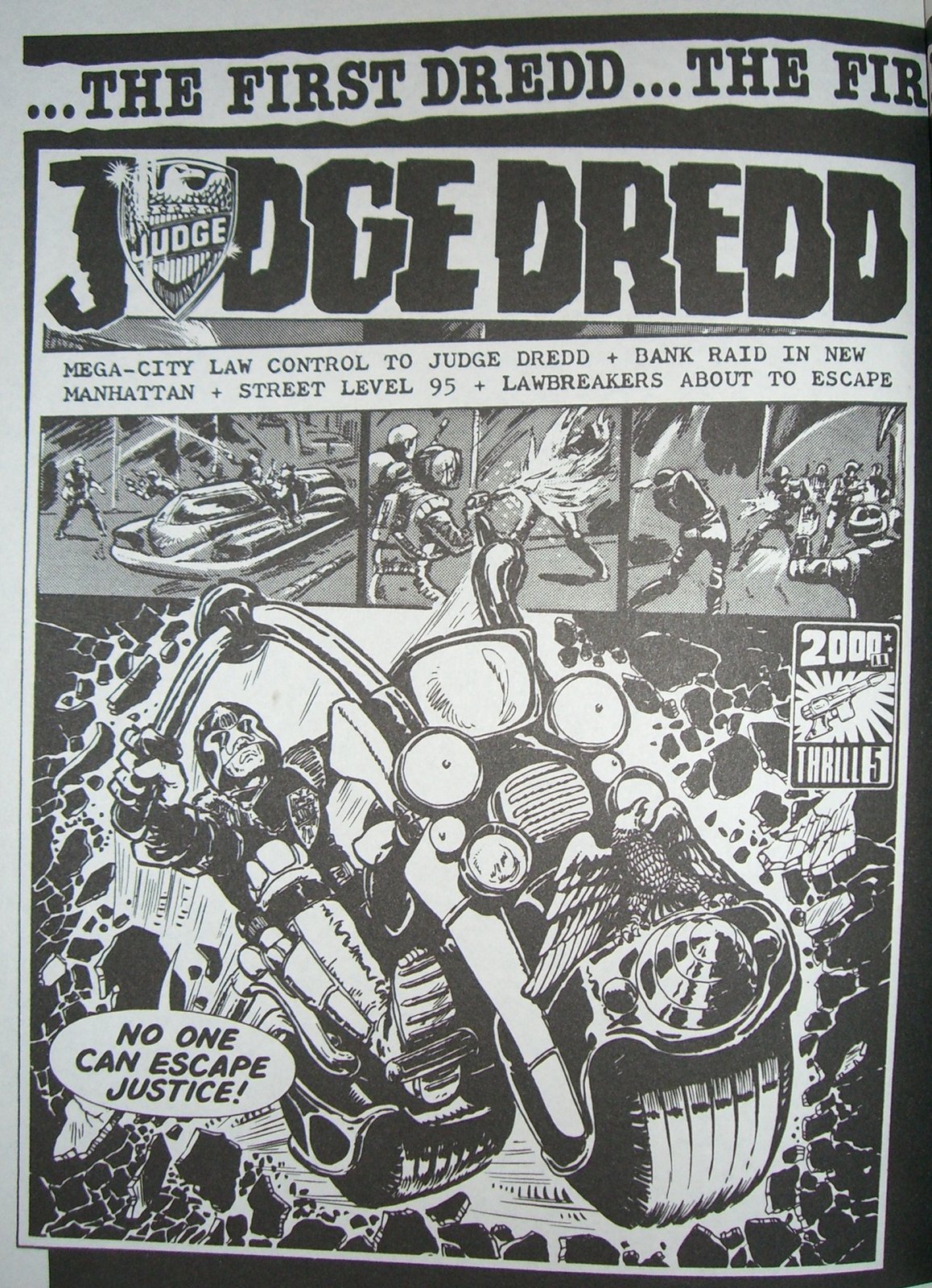
This volume ends with an abrupt Return to Mega-City 1 in a clever little idea for a story, followed by one packed story that re-establishes so much about Mega-City Dredd, from dodgy robot politics to horrible law and order New Labourism. Don’t show it to Yvette Cooper, or she’ll demand extra police powers. And then, of course, those extras: more Walter; not enough covers; and, fascinatingly, the pilot Judge Dredd story, drawn by Carlos Ezquerra, dropped for its violence – Dredd gives summary executions like a robot, which they decided might get the new 2000AD closed down like its effective predecessor Action and switched to lots of shooting but no death penalty – but with some great art, above all the vast Cityscape on the final page that clearly formed the blueprint for all the other artists to this day.
The whole book, then, is packed with great ideas and weak ones, great artwork and weak, satire, violence and things that make you go ‘Oh’. But, most of all, it’s packed. Judge Dredd is the best-known and longest-running British comics character of the last third of a century; this volume shows you how he started, with 336 pages for about fifteen quid. And a lot of it’s even good. Bargain!
Note – “Old Stoney-Face”: I was wrong. I’d got it into my head that Dredd’s nickname was coined by Hershey when she comes on board for The Judge Child Quest, nearly three years later, but it’s in Volume 01 after all. And I was more wrong, because when Judge Gibson calls him this here in Mutie the Pig, it’s not even new for the thirty-three-year-old-but-looks-younger Dredd – it’s what the other cadets used to call Joe back at the Academy of Law.
Other note – Walter the Wobot, Problematic Slave-Husband of Dredd: I said above that Walter “basically” falls in love with Dredd. In the final story of this collection, the ’70s-gay-stereotype-characterised-wobot twice tells Dredd he loves him, the second while attempting suicide after Dredd rejects him. His suicide note bears three kisses after thanking the Judge for the “few, bwief, pwecious moments you allowed him to spend with you.” After Dredd saves him, shouting that “I didn’t mean to be so rough,” the Judge takes up Walter’s Deed of Ownership, making Walter “the happiest wobot in the world!” I’m trying really, really hard to convince myself that rather than this being wildly problematic on several levels it’s making a feminist satirical point about marriage and slavery, but it’s not working. But what about the Luna1 story in which the villains “IPC” are foiled thanks to Walter’s one-off girlfriend Rowena (who is of course a slim and frilly robotette with twin tape spools on her chest)? Was it the strip trying to back off having a gay character before giving up? Was Dredd even denser than usual thinking “Robots in love” when Walter was only trying to make him jealous? Or is Walter bimetallic?
Labels: 2000AD, Bigotry, Books, Comics, Judge Dredd, Olympics, Pictures, Reviews
Wednesday, November 09, 2011
Wholly Unavailable On DVD Batman!
Of all many incarnations of Batman, one of the best-known, best-loved, but most impossible to buy is the camp mid-’60s TV series starring Adam West and Burt Ward. While the spin-off movie’s available on DVD, you can’t buy any of the 120 episodes of the series itself (legal tangles? Embarrassment? Who knows). So if you ever want to get hold of it, right now’s the time to start. ITV4 is showing the whole lot daily, two episodes at a time, at 4ish in the afternoon and again at 10ish the next morning, from today. And some of it’s pretty good…
In the way of mostly-repeat TV stations, ITV4 finished showing the lot this morning with the rather fabulous penultimate episode and a slightly inadequate finale, so without any particular fanfare they’ve wound straight back to the beginning this afternoon. Last time they started the series, though, I was paying attention and have to admit that I’ve watched almost the full set, from the inspired to the drably repetitive. And to get you in the mood, their trailer makes me laugh.
Now, I’m not a massive Batman fan, much less expert, though the character’s always been intriguing – from Adam West’s deadpan do-gooder to the near-psychotic, neo-fascist vigilante of Frank Miller’s The Dark Knight Returns (well, at least he knows he’s a fascist; Superman just thinks he’s God). If you want detailed facts about comics and graphic novels, try Wikipedia and its references; if you want in-depth analysis, ask the brilliant Andrew Hickey (or, as my beloved suggests, try both at Hickeypedia! He’s auditioning to be the new Bat-Announcer). But this was one of the two Batman series I loved as a boy in late ’70s repeats, and though almost every iteration of Batman since then has been trying to get away from it and back to dark psychology, I still have a soft spot for it, and mainly, of course, the performances. Well, some of the performances…
Batman ran from 1966 to 1968 as an amazingly camp Pop Art comedy, and though it was so expensive that it was rapidly cancelled when it stopped being a hit, it was such a hit that it was remembered for decades, and spoofed in its turn (from The Avengers’ genius postmodern The Winged Avenger to The High Life’s Dunk, though Jon Pertwee’s Doctor inexplicably lacked the big exclamation billboards for his fight scenes).
Its incredibly formulaic nature was surely behind both its memorability and people getting tired of it: a teaser scene with helpless Commissioner Gordon ringing the Batphone, butler Alfred answering at Stately Wayne Manor and our heroes diving for the Batpoles; that horribly irresistible theme tune; the Caped Crusaders zooming to Police Headquarters from the Batmobile’s hidden entrance and instantly working out the clues that had stumped Gordon and improbably dense Oirish-utterancing Chief O’Hara; tracking the villains to their lair (usually a very large space with very big props and not much detail, getting increasingly Expressionist – or cheap – as the series went on); indulging in a fist-fight thrillingly punctuated by musical stings and impact-words only to be overcome by trickery and finish the episode hanging above the giant meat grinder, at which point the hysterical Bat-Announcer would tell us that “The worst is yet to come!” and to tune in again,
And, yes, when you put it like that, it could be said to lack diversity. But two things save it. A lot of it is very funny, aided by many of the lines, Alan Napier’s endearing Alfred (it’s always better when he suddenly gets a bigger role, not least impersonating Batman), and particularly Adam West, whose utter deadpan playing of the utter nonsense he gets to say is… Utterly sublime. He remains amazingly watchable. And while his grey bodystocking was much mocked, these days I find the benippled rubber queens of the later movies far more difficult to take seriously: comic-book costumes always look so much more stylish in comic books.
The other thing that saves the series is, of course, the villains, who supply almost all of its variety. There’s an almost total absence of character development: the third and final series introduces Batgirl, who’s at times a brilliant feminist move and at times, er, not, especially when listening to her special signature tune:
Frank Gorshin’s the Riddler gets the series off to a terrific start with his puzzles, manic giggle and eel-like physicality, and all the others pretty much have to match up to him. Many don’t. So if you’re only tuning in for random episodes, his are among the ones to look out for – he comes back several times in the first season, then briefly in the third (substituted once in between by The Addams Family’s John Astin; great Gomez, lousy Riddler).
Now, I’ve read very few Batman comics or graphic novels, and I know which villain obviously stood out in those – but in this TV series, the Batvillain’s crown goes to someone else. For me, you just can’t beat Burgess Meredith as the Penguin. Charm, humour, viciousness, that fabulously imitable squawk, his brilliant schemes to sail just within the law (The Penguin Goes Straight / Not Yet, He Ain’t)… Penguin is far and away the best Batvillain of the ’60s series. And though sometimes, as always, his material’s not up to it – his sudden murderous grudge against Batgirl leaves a nasty taste in the mouth – the story that strikes me as a particular favourite is the second season’s political parody Hizzonner the Penguin / Dizzoner the Penguin, in which he runs for Mayor. Not only did this clearly inspire the second of the ’80s / ’90s Batman movies (however much they tried to get away from the TV series, they kept coming back to it: Penguin for Mayor in Batman Returns; the Batman-Theme-themed Batdance in Batman; the sheer campery of two blatant gay couples with opposing fetishes of Batman Forever… You can keep Batman and Robin in the ’90s, though), but Penguin’s political chicanery is mercilessly funny, and he’s a much better campaigner than Mayor Linseed, Governor Stonefellow or relentlessly stiff Batman, to say nothing of poor Harry Goldwinner down at 2%. And that’s without the inspired mudslinging – ask yourself: who do you always see Penguin pictured with? Our fine, upstanding police officers. And Batman? Always with criminals! The multiple telephone offers in the tag scene always make me laugh, too. You might also look out for Penguin’s splendidly ridiculous extended intrigue involving a fake film, Batman’s kiss-in with Carolyn Jones’ Marsha, Queen of Diamonds (not to mention her ludicrous witch mother) and a tank made out of solid gold.
No-one tops Burgess Meredith; Frank Gorshin’s brilliant; but there are at least two strong runners-up. Victor Buono as King Tut is a huge performance in every sense, a mild-mannered Professor of Egyptology at Yale who becomes a megalomaniac Pharaoh every time he’s hit on the head, and deserves a special award as the only Batvillain to twice discover Batman’s secret identity (the scene in Commissioner Gordon’s office after the first time, when no-one believes Tut as he rolls his eyes and postmodernly says all the things the viewers do about how obvious it is, is priceless). The other is Catwoman, unquestionably the strongest of many strong female opponents, though slightly hampered by being the most prominent recasting among the Batvillains: mostly Julie Newmar; Lee Meriwether in the movie; Eartha Kitt at the end. All are fabulous, but Julie Newmar seems both genuinely dangerous and the most feline – well, excluding Eartha Kitt’s irresistible purr – with a compelling capriciousness and an erotic charge with Adam West that racist ’60s sponsors were not going to allow with Eartha Kitt (despite Batman slipping in a few under-the-Bat-Radar mentions to Robin of how attractive she is, in her absence).
Others to look out for include Joan Collins’ Siren, much of whose episodes appear to have been left on the cutting-room floor, and Vincent Price’s delightful, mercurial Egghead, as well as the lead villain from the penultimate episode, the eponymous The Entrancing Dr Cassandra. Ida Lupino’s Cassandra Spellcraft has a brilliant alchemical scheme to mount a mass escape from the “Arch Criminals Only” wing of Gotham State Penitentiary (warning: may not contain real Batvillains). The extras pretending to be the big villains and trying to avoid us seeing their faces are a scream, especially the one who really gets into playing Victor Buono. It’s a far more appropriate finale than the rather limp actual last episode of mind-reading at a health spa, despite that story’s guest villain Zsa Zsa Gabor. You get the feeling she’d have been better-employed as a “Batclimb” cameo in the previous year, sticking her head out of her hotel window to see the Dynamic Duo scaling the wall as the likes of Lurch, Sammy Davis, Jr. and Edward G. Robinson had done.
Cesar Romero as the Joker. Now, I know he’s the iconic Batvillain, and some of his episodes are very entertaining (if others are frightful), and Cesar Romero isn’t that bad, but… He’s just never good enough. The few Batman comics I’ve read – or Heath Ledger on film, or Mark Hamill in the more prestigious animated series – capture a seriously deranged, compelling match for Batman; this isn’t it. I mentioned two Batman series I loved as a boy, and the other reunited Adam West and Burt Ward in the animated The New Adventures of Batman (usually paired with the equally exciting Tarzan, Lord of the Jungle). A hasty viewing of a few YouTube clips tell me I should leave the series to my cheating memory (though I have to admit I’d still like to get hold of Tarzan), but its Joker firmly grabbed my attention as a cackling spectre in vivid white and green and with unnaturally pointed features. A, ah, mature man with a rather full face upon which – unforgivably, when I was a boy and still spotted it a mile off – he’s applied an acre of make-up to inadequately conceal his moustache, scampering around with nothing of the threat of Penguin or Catwoman… No. Heretical, I know, but simply not up to the job.
One particular low point for Cesar Romero’s Joker sticks in my mind (and throat) because it perfectly illustrates something the series tried several times and each time got toe-curlingly wrong – ’60s youth culture. Surf’s Up! Joker’s Under! features the Joker’s attempt to become surfing champion of Gotham City and so control all the young people. Words fail me (and effects fail them), though there’s a little fun to be had with Joker talking into his hotdog and Batman straight-facedly inviting him into the locker room. But it’s terrible, and though my learned friend Andrew will (as with everything in this article) know better, wasn’t it a little late to be trying to cash in on the Beach Boys? Milton Berle’s Louie the Lilac, too, was an OK performance and had a memorably grisly end (…or is it?), but another middle-aged (to be generous) man attempting to become the pin-up for Gotham’s youth, this time to dominate the flower people, was a major misjudgement. The only remotely plausible counterculture idol is Catwoman rabble-rousing the student population in Catwoman Goes to College (but absolutely not when she kit-naps the voices of a popular beat combo and has a kitty apprentice who sings, played by the producer’s niece in hope of a pop career. Oh, dear me, no). You can’t help thinking that, while studio executives wanted to cash in on the youth happening, they both misunderstood and feared it, always portraying rebellious or even remotely unconventional young people as wannabe patsies to some evil but more intelligent adult in repeated and wearisome exposés of the frightening commie truth behind hippies. See also Star Trek’s The Way to Eden, in which the young space hippies (communists) are manipulated by an evil intellectual (communist) and wind up dying (after rightly being warned off by the clean-cut, caring military) on the planet they imagine to be Eden because, subtly, the grass is acid (and fruits are deadly) – or, embarrassingly, the UK’s very own Carry On Camping, in which the team inexplicably stop cocking a snook at authority and become the grumpy old establishment killing off anyone’s fun. At least at the same time Doctor Who’s The Krotons may have said that student rebellion doesn’t work, but that they had much to rebel against, and the Doctor saves the day by dropping acid.
Getting one ’60s movement badly wrong brings me inexorably to Nora Clavicle and the Ladies’ Crime Club, in which Barbara Rush’s Nora Clavicle uses her push for women’s rights to remove all male crime-fighters and replace them with women police – who will spend all their time talking about lipstick and be terrified of her mechanical mice, leaving the city open. No, it wasn’t a horrible dream. Oh, the number of times Doctor Who nearly did the ‘Imagine how frightful it would be if the girlies were in charge?’ story and managed to pull back at the last minute… It seems almost every ’60s series somehow thought ‘The frightening truth behind women’s liberation’ would be hilarious (or terrifying). Even The Avengers succumbed, once. Don’t go there.
Two unimpressive Batvillains it’s easier to forgive are the simply dull Colonel Gumm and his fake stamp factory, even if he is played by Roger C. Carmel; he was probably designed not to take attention from heroic guest stars the Green Hornet and Kato (Bruce Lee!). At least, that’s a halfway plausible excuse. Similarly, with Frank Gorshin having left the series and before they tried (and failed) to recast the Riddler, Maurice Evans starred as the Puzzler (no relation, I’m legally obliged to say). A fine actor whether disturbing as Dr. Zaius in Planet of the Apes, camping it up in Bewitched or not-Winston-Churchill-honestly in my favourite The Man From U.N.C.L.E. film (I wish they’d release that on DVD, too; I don’t have a copy of One of Our Spies is Missing), he’s lost here as producers try to camouflage his Riddler-clone status by rolling dice on their table of villainous attributes and adding to his love ofriddles puzzles the bonus character traits of ‘obsession with Shakespeare’ and with, er, ‘airplanes’. Which go together so well.
I won’t forgive Lord Marmaduke Ffogg of the three-part story visibly set in South California The Londinium Larcenies, The Foggiest Notion andIsn’t It Bloody Finished The Bloody Tower. Swinging London? The only swinging to hope for here is at Tyburn, as Dick Van Dyke runs past holding a Batsign reading, ‘See? I wasn’t so bad after all’. Though I’ll grant you that renaming “Fleet Street” as “Bleat Street” raised a momentary and unwilling smile. At least Art Carney’s execrable Archer was an affectation. Even Murder She Wrote in the pea-souper was better than this. With so many British actors on the show, what were they thinking in getting Rudy Vallee to mutilate his accent? Still less in inexplicably casting urbane George Sanders, of one of the most gorgeous voices in the world, as heavily Mittel-European Mr Freeze. No wonder he didn’t come back – Freeze was the only villain recast twice on the TV series, and never worked, whether a misused Sanders, Otto Preminger, or Eli Wallach (who at least looked like he was having fun. Maybe it was the cheque). And I’ve not even sneered at David Wayne, whose Mad Hatter and worse accent turned Batman’s cowl pink.
But I’m telling you the plot. Why not tune in, Bat-Channel ITV4, Bat-Time 4ish in the afternoon or 10ish in the morning on weekdays to enjoy them for yourself, and discover all the other villains I’ve not even mentioned? It’s just a shame it’ll take you three months to record your own home-made equivalent of a DVD box set.
In the way of mostly-repeat TV stations, ITV4 finished showing the lot this morning with the rather fabulous penultimate episode and a slightly inadequate finale, so without any particular fanfare they’ve wound straight back to the beginning this afternoon. Last time they started the series, though, I was paying attention and have to admit that I’ve watched almost the full set, from the inspired to the drably repetitive. And to get you in the mood, their trailer makes me laugh.
The Dark Knight Re-Runs!
Now, I’m not a massive Batman fan, much less expert, though the character’s always been intriguing – from Adam West’s deadpan do-gooder to the near-psychotic, neo-fascist vigilante of Frank Miller’s The Dark Knight Returns (well, at least he knows he’s a fascist; Superman just thinks he’s God). If you want detailed facts about comics and graphic novels, try Wikipedia and its references; if you want in-depth analysis, ask the brilliant Andrew Hickey (or, as my beloved suggests, try both at Hickeypedia! He’s auditioning to be the new Bat-Announcer). But this was one of the two Batman series I loved as a boy in late ’70s repeats, and though almost every iteration of Batman since then has been trying to get away from it and back to dark psychology, I still have a soft spot for it, and mainly, of course, the performances. Well, some of the performances…
Batman – The TV Series
Batman ran from 1966 to 1968 as an amazingly camp Pop Art comedy, and though it was so expensive that it was rapidly cancelled when it stopped being a hit, it was such a hit that it was remembered for decades, and spoofed in its turn (from The Avengers’ genius postmodern The Winged Avenger to The High Life’s Dunk, though Jon Pertwee’s Doctor inexplicably lacked the big exclamation billboards for his fight scenes).
Its incredibly formulaic nature was surely behind both its memorability and people getting tired of it: a teaser scene with helpless Commissioner Gordon ringing the Batphone, butler Alfred answering at Stately Wayne Manor and our heroes diving for the Batpoles; that horribly irresistible theme tune; the Caped Crusaders zooming to Police Headquarters from the Batmobile’s hidden entrance and instantly working out the clues that had stumped Gordon and improbably dense Oirish-utterancing Chief O’Hara; tracking the villains to their lair (usually a very large space with very big props and not much detail, getting increasingly Expressionist – or cheap – as the series went on); indulging in a fist-fight thrillingly punctuated by musical stings and impact-words only to be overcome by trickery and finish the episode hanging above the giant meat grinder, at which point the hysterical Bat-Announcer would tell us that “The worst is yet to come!” and to tune in again,
“Same Bat-Time! Same Bat-Channel!”The second episode would follow much the same format, only starting with Batman brilliantly escaping certain doom (usually with the aid of a suspiciously relevant Grinder-Neutralising-Bat-Pellet from his Utility Belt) and closing with a fist-fight that isn’t overcome by trickery and a return to Stately Wayne Manor by the unfrocked Bruce and Dick to explain to Aunt Harriet exactly where they’ve been. Occasional triple-episode stories and the third season’s single episodes (closing not in an explicit “Next Time…” trailer but with one contained in the narrative, such as ‘Well, the Penguin will no doubt serve many years in gaol and the citizens of Gotham are safe once more… But look out of the window! Isn’t that the Joker crossing the street with a giant inflatable marmoset?’) followed much the same pattern at only varying length.
And, yes, when you put it like that, it could be said to lack diversity. But two things save it. A lot of it is very funny, aided by many of the lines, Alan Napier’s endearing Alfred (it’s always better when he suddenly gets a bigger role, not least impersonating Batman), and particularly Adam West, whose utter deadpan playing of the utter nonsense he gets to say is… Utterly sublime. He remains amazingly watchable. And while his grey bodystocking was much mocked, these days I find the benippled rubber queens of the later movies far more difficult to take seriously: comic-book costumes always look so much more stylish in comic books.
The other thing that saves the series is, of course, the villains, who supply almost all of its variety. There’s an almost total absence of character development: the third and final series introduces Batgirl, who’s at times a brilliant feminist move and at times, er, not, especially when listening to her special signature tune:
“Are you a chick who fell in from Outer Space?Somebody shoot them. But, as far as progress goes, that’s it. Ironically, the very first story stretches the format as far as it ever goes – hilariously for a series crammed with deadpan exposition, there’s no introduction nor concessions to anyone who’s never heard of Batman (save a brief mention by Bruce Wayne of his dead parents), and it dives straight in with everything established even down to Chief O’Hara’s endlessly repeatable:
“Or are you real, with a tender warm embrace?
“Yeah, whose baby are you, Batgirl, Batgirl?”
“What idiots we are! Now, why couldn’t we have worked that out?”The main business of this opening episode, Hey Diddle Riddle (concluded in Smack in the Middle, with most of the titles being inadequately punning rhyming couplets), is not a crime or heist of the sort that drives most of them, but a plot against Batman himself such as you’d have expected to find much later in the series: the Riddler tricks our hero into an unjustified attack; this Batman is so utterly square and law-abiding it hurts; these two elements crash together in a putative court case that Bruce Wayne will feel compelled to attend and blow his secret identity, lampshading the impossibility of uptight, upright vigilantism so that the subject need never come up again. “How I’ve waited for this,” the Riddler even gloats implausibly, knowing the audience will be as familiar with Batman as he is. And the episode goes straight to the nearest the series will get to a ‘bad’ Batman, as his drink is spiked and he dances the Batusi with naughty Jill St John before staggering towards the Batmobile and being prevented from driving after poor, kidnapped Robin by police officers who pronounce him “In no condition to drive” and don’t mention the Bat-Signal beaming from the roof of City Hall – “In his shape? Kinder not to tell him.” Even the Superman movies waited until Superman III, but by going as far as this on the first time out, the Batman series is telling us that it’s never going to go any further.
Who To Catch?
Frank Gorshin’s the Riddler gets the series off to a terrific start with his puzzles, manic giggle and eel-like physicality, and all the others pretty much have to match up to him. Many don’t. So if you’re only tuning in for random episodes, his are among the ones to look out for – he comes back several times in the first season, then briefly in the third (substituted once in between by The Addams Family’s John Astin; great Gomez, lousy Riddler).
Now, I’ve read very few Batman comics or graphic novels, and I know which villain obviously stood out in those – but in this TV series, the Batvillain’s crown goes to someone else. For me, you just can’t beat Burgess Meredith as the Penguin. Charm, humour, viciousness, that fabulously imitable squawk, his brilliant schemes to sail just within the law (The Penguin Goes Straight / Not Yet, He Ain’t)… Penguin is far and away the best Batvillain of the ’60s series. And though sometimes, as always, his material’s not up to it – his sudden murderous grudge against Batgirl leaves a nasty taste in the mouth – the story that strikes me as a particular favourite is the second season’s political parody Hizzonner the Penguin / Dizzoner the Penguin, in which he runs for Mayor. Not only did this clearly inspire the second of the ’80s / ’90s Batman movies (however much they tried to get away from the TV series, they kept coming back to it: Penguin for Mayor in Batman Returns; the Batman-Theme-themed Batdance in Batman; the sheer campery of two blatant gay couples with opposing fetishes of Batman Forever… You can keep Batman and Robin in the ’90s, though), but Penguin’s political chicanery is mercilessly funny, and he’s a much better campaigner than Mayor Linseed, Governor Stonefellow or relentlessly stiff Batman, to say nothing of poor Harry Goldwinner down at 2%. And that’s without the inspired mudslinging – ask yourself: who do you always see Penguin pictured with? Our fine, upstanding police officers. And Batman? Always with criminals! The multiple telephone offers in the tag scene always make me laugh, too. You might also look out for Penguin’s splendidly ridiculous extended intrigue involving a fake film, Batman’s kiss-in with Carolyn Jones’ Marsha, Queen of Diamonds (not to mention her ludicrous witch mother) and a tank made out of solid gold.
No-one tops Burgess Meredith; Frank Gorshin’s brilliant; but there are at least two strong runners-up. Victor Buono as King Tut is a huge performance in every sense, a mild-mannered Professor of Egyptology at Yale who becomes a megalomaniac Pharaoh every time he’s hit on the head, and deserves a special award as the only Batvillain to twice discover Batman’s secret identity (the scene in Commissioner Gordon’s office after the first time, when no-one believes Tut as he rolls his eyes and postmodernly says all the things the viewers do about how obvious it is, is priceless). The other is Catwoman, unquestionably the strongest of many strong female opponents, though slightly hampered by being the most prominent recasting among the Batvillains: mostly Julie Newmar; Lee Meriwether in the movie; Eartha Kitt at the end. All are fabulous, but Julie Newmar seems both genuinely dangerous and the most feline – well, excluding Eartha Kitt’s irresistible purr – with a compelling capriciousness and an erotic charge with Adam West that racist ’60s sponsors were not going to allow with Eartha Kitt (despite Batman slipping in a few under-the-Bat-Radar mentions to Robin of how attractive she is, in her absence).
Others to look out for include Joan Collins’ Siren, much of whose episodes appear to have been left on the cutting-room floor, and Vincent Price’s delightful, mercurial Egghead, as well as the lead villain from the penultimate episode, the eponymous The Entrancing Dr Cassandra. Ida Lupino’s Cassandra Spellcraft has a brilliant alchemical scheme to mount a mass escape from the “Arch Criminals Only” wing of Gotham State Penitentiary (warning: may not contain real Batvillains). The extras pretending to be the big villains and trying to avoid us seeing their faces are a scream, especially the one who really gets into playing Victor Buono. It’s a far more appropriate finale than the rather limp actual last episode of mind-reading at a health spa, despite that story’s guest villain Zsa Zsa Gabor. You get the feeling she’d have been better-employed as a “Batclimb” cameo in the previous year, sticking her head out of her hotel window to see the Dynamic Duo scaling the wall as the likes of Lurch, Sammy Davis, Jr. and Edward G. Robinson had done.
Who To Leave In the Care of Liberal Warden Crichton of Gotham State Penitentiary?
Cesar Romero as the Joker. Now, I know he’s the iconic Batvillain, and some of his episodes are very entertaining (if others are frightful), and Cesar Romero isn’t that bad, but… He’s just never good enough. The few Batman comics I’ve read – or Heath Ledger on film, or Mark Hamill in the more prestigious animated series – capture a seriously deranged, compelling match for Batman; this isn’t it. I mentioned two Batman series I loved as a boy, and the other reunited Adam West and Burt Ward in the animated The New Adventures of Batman (usually paired with the equally exciting Tarzan, Lord of the Jungle). A hasty viewing of a few YouTube clips tell me I should leave the series to my cheating memory (though I have to admit I’d still like to get hold of Tarzan), but its Joker firmly grabbed my attention as a cackling spectre in vivid white and green and with unnaturally pointed features. A, ah, mature man with a rather full face upon which – unforgivably, when I was a boy and still spotted it a mile off – he’s applied an acre of make-up to inadequately conceal his moustache, scampering around with nothing of the threat of Penguin or Catwoman… No. Heretical, I know, but simply not up to the job.
One particular low point for Cesar Romero’s Joker sticks in my mind (and throat) because it perfectly illustrates something the series tried several times and each time got toe-curlingly wrong – ’60s youth culture. Surf’s Up! Joker’s Under! features the Joker’s attempt to become surfing champion of Gotham City and so control all the young people. Words fail me (and effects fail them), though there’s a little fun to be had with Joker talking into his hotdog and Batman straight-facedly inviting him into the locker room. But it’s terrible, and though my learned friend Andrew will (as with everything in this article) know better, wasn’t it a little late to be trying to cash in on the Beach Boys? Milton Berle’s Louie the Lilac, too, was an OK performance and had a memorably grisly end (…or is it?), but another middle-aged (to be generous) man attempting to become the pin-up for Gotham’s youth, this time to dominate the flower people, was a major misjudgement. The only remotely plausible counterculture idol is Catwoman rabble-rousing the student population in Catwoman Goes to College (but absolutely not when she kit-naps the voices of a popular beat combo and has a kitty apprentice who sings, played by the producer’s niece in hope of a pop career. Oh, dear me, no). You can’t help thinking that, while studio executives wanted to cash in on the youth happening, they both misunderstood and feared it, always portraying rebellious or even remotely unconventional young people as wannabe patsies to some evil but more intelligent adult in repeated and wearisome exposés of the frightening commie truth behind hippies. See also Star Trek’s The Way to Eden, in which the young space hippies (communists) are manipulated by an evil intellectual (communist) and wind up dying (after rightly being warned off by the clean-cut, caring military) on the planet they imagine to be Eden because, subtly, the grass is acid (and fruits are deadly) – or, embarrassingly, the UK’s very own Carry On Camping, in which the team inexplicably stop cocking a snook at authority and become the grumpy old establishment killing off anyone’s fun. At least at the same time Doctor Who’s The Krotons may have said that student rebellion doesn’t work, but that they had much to rebel against, and the Doctor saves the day by dropping acid.
Getting one ’60s movement badly wrong brings me inexorably to Nora Clavicle and the Ladies’ Crime Club, in which Barbara Rush’s Nora Clavicle uses her push for women’s rights to remove all male crime-fighters and replace them with women police – who will spend all their time talking about lipstick and be terrified of her mechanical mice, leaving the city open. No, it wasn’t a horrible dream. Oh, the number of times Doctor Who nearly did the ‘Imagine how frightful it would be if the girlies were in charge?’ story and managed to pull back at the last minute… It seems almost every ’60s series somehow thought ‘The frightening truth behind women’s liberation’ would be hilarious (or terrifying). Even The Avengers succumbed, once. Don’t go there.
Two unimpressive Batvillains it’s easier to forgive are the simply dull Colonel Gumm and his fake stamp factory, even if he is played by Roger C. Carmel; he was probably designed not to take attention from heroic guest stars the Green Hornet and Kato (Bruce Lee!). At least, that’s a halfway plausible excuse. Similarly, with Frank Gorshin having left the series and before they tried (and failed) to recast the Riddler, Maurice Evans starred as the Puzzler (no relation, I’m legally obliged to say). A fine actor whether disturbing as Dr. Zaius in Planet of the Apes, camping it up in Bewitched or not-Winston-Churchill-honestly in my favourite The Man From U.N.C.L.E. film (I wish they’d release that on DVD, too; I don’t have a copy of One of Our Spies is Missing), he’s lost here as producers try to camouflage his Riddler-clone status by rolling dice on their table of villainous attributes and adding to his love of
I won’t forgive Lord Marmaduke Ffogg of the three-part story visibly set in South California The Londinium Larcenies, The Foggiest Notion and
But I’m telling you the plot. Why not tune in, Bat-Channel ITV4, Bat-Time 4ish in the afternoon or 10ish in the morning on weekdays to enjoy them for yourself, and discover all the other villains I’ve not even mentioned? It’s just a shame it’ll take you three months to record your own home-made equivalent of a DVD box set.
Labels: American Politics, Batman, Bigotry, Carry On, Comedy, Comics, Patrick Troughton, Reviews, Star Trek, The Avengers
Saturday, October 29, 2011
DVD Detail: Doctor Who – The Masque of Mandragora
As the nights draw in for the spookiest Saturday of the year, what could be more appropriate to turn to than Doctor Who’s finest and most Gothic season? First broadcast in Autumn 1976, Doctor Who – The Masque of Mandragora opened an outstanding set of stories with Tom Baker’s Doctor a freethinking adventurer fighting both mental and political tyranny in the form of terrific villains and superstition incarnate. In the rich period setting of the Italian Renaissance, the Doctor and Sarah Jane Smith face scheming, swordplay and masked monks as they’re caught in a dark world of intrigue and sorcery…
Doctor Who’s finest season so far is its Fourteenth, a year of dark religion broadcast across 1976 and 1977. It opens with Elisabeth Sladen at the Doctor’s side for the penultimate time of her original run, and this story should feel secretly familiar to you if you’ve been watching her starring in The Sarah Jane Adventures. When BBC4 showed her final story (until all the others) this May, my review of The Hand of Fear included my overview of Season Fourteen and its uncannily echoing themes under producer Philip Hinchcliffe – who wanted to expand the show’s horizons – and lead writer Robert Holmes – who wanted to “frighten the little buggers to death”. The Masque of Mandragora isn’t the season’s height, but it lays out those themes like a declaration of intent, even down to setting itself during the Enlightenment: the leading battlefield is for and within the mind, here championing rationalism against a whopping great metaphor for superstition; characters and societies strive to grow up, with Marco’s fight here to outgrow his uncle mirrored on a grand scale in Mandragora’s desire to keep humanity as superstitious children; and religion underpins the story’s Gothic setting of new and old world despising and deposing one another. After a couple of years of exploring the themes in unfamiliar framings, masses of monks coursing through secret passages in late Medieval Italy made this Doctor Who’s most flagrantly Gothic story so far – only to be topped a couple of stories later as this portion of the series reaches its crescendo… Back in September 2009, Doctor Who Magazine Issue 413 published “The Mighty 200” – 6,700 fans’ votes on all 200ish TV Doctor Who stories to that point – voting The Masque of Mandragora up to number 85. I might put it ten or so places lower, largely because the competent but uninspired director doesn’t quite fulfil its potential, but either way it’s an excellent little story that takes one of the series’ firmest philosophical stands.
While this ‘taster’ may not be short, incidentally, my policy in these is not to be too spoilery, in order than you can read on without fear of finding out too many key twists from the end.
In 1492, “the period between the dark ages of superstition and the dawn of a new reason”, at the court of one of Italy’s most progressive Princes, two gatherings are planned: one, of the greatest scholars of the new sciences looking for that new birth of reason; the other, a bloodthirsty Roman cult aiming to climb out of its long death to hold Earth under its spell. Yes, it’s the battle of the worldviews, each with a champion from the stars – angel or alien, demon or energy force, according to ideological stance. And unlike the Mandragora Helix’s titanic booming voice, the Doctor has a sense of humour, which proves he’s on the right side. Even as he uses a primitive telescope to calculate exactly when the Helix will be in position to make its attempt, even as he asks for the simple tools he’ll need for his last dangerous gamble to draw off its power, even after he grimly tells Sarah Jane exactly what control by this alien force would mean were it to become humanity’s substitute for science… He goes to sleep standing up, steals the scene utterly from the poor discombobulated Prince and replies to his worry about putting off the (besieged) masque with gay abandon:
Often said to be his favourite story, The Masque of Mandragora feels like producer Philip Hinchcliffe’s manifesto for what the Doctor’s about – he’s an intellectual, and everything about it says so: setting; plot; theme; TARDIS reinvented as wood-panelled study; even the new titles font (the stylish DellaRobbia, named appropriately for an Italian Renaissance artist, becomes the look of the programme’s credits through most of Tom; luckily not the similarly Italian-named Times New Roman, for which I have an irrational dislike). And yet he’s also a swashbuckling adventurer, turning his hand to duelling as easily as engineering, dashing through a crowded market and winding terraces that you might think Italian if you’d never seen The Prisoner, racing along on horseback in exciting stunts that you might think entirely convincing if you’d never seen Tom Baker. And if you want to relaunch the Doctor as a Renaissance man, where better than in the Renaissance? The story isn’t perfect – despite the philosophical power, lush feel and obvious inspiration from The Masque of the Red Death, it lacks some of the bite of the season’s finest stories to come, and of course the edge of the immediately preceding season finale, The Seeds of Doom; but as that story was set on going as far as it possibly could (if not necessarily in the right direction, as I posted in a somewhat overlong reply to TARDIS Eruditorum yesterday) thanks to its thrilling but ultraviolent director, anything would feel like it was pulling back a bit afterwards. So it’s a good job this is moving forward, too.
The new approach is greatly aided by Tom Baker’s performance, carrying off his serious and playful sides with equal assurance as his Doctor comes out of what had almost seemed a year-long sulk. The orange is mightier than the sword; a lion peeps over an altar; he gets to tell Hieronymous, “come off it – drop all that bosh”. He gets a great scene towards the end of Part One, taking responsibility for having taken the Helix to Earth – like Adam, or Prometheus – and trying to warn Count Federico and his court of the terrible danger. That should imply a grimly serious attitude from the Doctor, yet wonderfully as the toadies first wait to see the Count’s reaction, then laugh on cue with their lord, and he’s then presented with the local astrologer to test his credentials, we see the Doctor thinking on his feet – first cheerily convincing, then sharp and sombre when he’s not getting through (“Because you don’t have a future…”), then disgustedly swatting down all Hieronymous’ nonsense just to exercise his wits (“All it requires is a quick imagination and a glib tongue”). And it’s a great scene for Federico, too, in his casual power and ability to size up a character – if not to understand anything that challenges his worldview – even down to rewarding that mocking tongue with that prize so rarely given by villains, prompt execution (and it’s not his fault, of course, that it inevitably fails).
With the Doctor so heavily featured, Sarah Jane’s role is a little more muted than in some stories, though Elisabeth Sladen finds yet another – and perhaps her creepiest – way to play ‘brainwash woman’, as well as all the usual spikiness, exploration and not really taking to being laid out for sacrifice. Pre-empting The End of the World’s definitive Twenty-First Century explanation of how the TARDIS lets its crew understand any language, this story is infamously the one where Bob Holmes decided it was time to say out loud those questions everyone put to him in the BBC canteen, as not only does Federico notice the Doctor’s peculiar clothes but also Sarah Jane – or something else through her – asks how she can speak Italian. It’s rather out of character for Tom’s Doctor (if not Pertwee’s) to object to questions, but he takes this not as a sign of her journalistic inquisitiveness but a dark portent that she’s been hypnotised. Again. Even the TARDIS gets a new start, for both practical (as revealed in the extra features) and aesthetic reasons, with the chutzpah of pretending that its new dusty wooden control room was in fact an old one we’d seen previous Doctors potter about in. It’s an evocative design by Barry Newbery, at once a Sherlockian study and a little chapel (his arched Palace corridors, cleverly theatrical temple effect and simple but inspired way of disguising the Village Town Hall are great bits of design, too). Also of note on the production side, the screaming masks of the Cult of Demnos are very effective, particularly the cruelly opulent design for their leader, though Dudley Simpson’s musical score is a little too reminiscent of several of his earlier contributions (Pyramids of Mars in the sacrifice, The Ark In Space as Sarah Jane’s bewitched), if still with some lovely deep chiming as the Brotherhood plot or spidery percussive music while Sarah Jane’s stalking the Doctor, as well as rather a beautiful arching version of his Doctor’s Theme shortly after they land.
Tom Baker’s first three seasons, led by Hinchcliffe and Holmes, are often referred to as “Gothic Horror”; this story, and this first half of Season Fourteen, is the clearest point to get across what’s meant by that (if you have a copy of Doctor Who Magazine 282, you might also read Alan Barnes’ excellent article Tales From the Crypt). Though the Gothic elements start off very early in this three-year period, perhaps disguised by the relative late-coming of dark shadows and travels back to older times, they reach a peak here in dark religion, ancient tunnels and mad monks. Gothic scholars would instantly recognise that this story is all about the Old World versus the New Age with the Renaissance itself at stake, that it cuts a fine line between exploiting the supernatural and explaining it, and that it’s overflowing with the Gothic trappings of Medieval Europe, alchemy, tyranny (even by the wicked uncle of the rightful heir), dungeons, torture, ancient passageways and rituals… Though, ironically, the force of irrationalism is named for a play by that arch-rationalist of the time Niccolò Machiavelli, in one of many crafty references by writer and Renaissance academic Louis Marks (whose earlier Day of the Daleks also explored issues of free will versus determinism).
The TARDIS landing in the crystal spiral mountains of Mandragora – in the void – amid unearthly sound makes an intriguing start to the story, though if the sound design is more impressive than the visuals, they are at least memorable (and more so than the Mandragora energy on the prowl; the DVD range seemed oddly unwilling to offer alternate CGI for Hinchcliffe’s stories as it did for, say, similarly underwhelming effects on The Time Warrior). Resisting its dizzying hypnotic spell from the first by saying the alphabet backwards seems an appropriate mix of fighting it with learning and turning a catechism upside-down, too. But that’s only the prologue; it’s when we go to Italy that the story really kicks off, in the perfect setting for this battle of ideas.
People usually kick against the aristocracy in Doctor Who, but its casual power is everywhere here without comment, from Count Federico’s chess match to nice Prince Giuliano casually ordering his companion to fetch wine. Only the outsiders the Doctor and Hieronymous fail to defer, and both are nearly killed for it. The court intrigue is very well choreographed, with different guards crossing over each other in a physical symbol of the intercutting political plots. The scene introducing the main characters over a death is especially well-written: the Count enters late for the late Duke, prompting a confrontation between him and his nephew Marco over whether he was “enjoying some sport” which clearly sets up the two rivals for the Dukedom; but while that’s the focal point, other, more important lines from subtly different opposing sides almost toss away what the story’s really about:
There’s a lot more to this story than just the story. The DVD special features are rather fabulous; the novelisation a little flat, but with its moments, and reinvigorated by its audiobook reading; it’s had perhaps as many as five different sequels in different media; and it’s even inspired some rather lovely artwork (most notably Alister Pearson’s gorgeous not-at-all papal reissue book cover, perhaps best presented on John Pettigrew’s DVD and video cover site, as is Mike Little’s less technically accomplished but memorable Tom hemmed in by screaming masks, while on the DVD you can see some striking paintings from the Radio Times in pdf – just don’t look too closely at the masked Cult leader’s glowing crotch on the DVD cover).
The novelisation Doctor Who and the Masque of Mandragora is by producer Philip Hinchcliffe, and while it’s not bad, his writing style doesn’t flow anywhere near as well as Terrance Dicks’, with the scenes and lines trimmed for length making it feel a little sparse. There are a few other changes, of varying effectiveness: the ‘straightening’ of Giuliano; a tensely snapping wire; Hieronymous’ escape employing more thrilling cauldron-dashing; and though the mention of the Pope works vividly for one stream of the story (“The Holy Father himself will kiss my hand for cleansing the state of San Martino” as Federico plots to frame his nephew as a worshipper of Demnos), it works against the other by muddying the waters on religion. Tim Piggot-Smith, though, is a powerful actor, who enlivens the CD reading of the novel with considerable panache and an interesting take on the Doctor, old but deep-voiced and authoritative.
As for the sequels, the promise that Mandragora would return in five hundred years’ time inspired several writers. The first and arguably the most ambitious was Doctor Who Magazine’s comic strip (and graphic novel) The Mark of Mandragora; Big Finish’s Sarah Jane Smith series had the Helix threaded through its whole second series, the most promising and the most disappointing of the sequels (scroll down this article to find my spoilerful explanation of its climax, or anti-climax); the BBC Books novel The Eleventh Tiger matched the Helix, unnamed and anachronistically, against the First Doctor; and most recently, generously name-checking the other three, Gary Russell’s novel Beautiful Chaos brings back the Helix against the Tenth Doctor, Donna and Wilf, and is a particularly good story for the Nobles. Unlike other new series BBC Books (monogamous hetero Captain Jack of The Not-Deviant-At-All Strain, I’m looking at you), but appropriately for the TV original, it’s also got a pair of gayers among all the couples, too. That leaves The Sarah Jane Adventures’ Secrets of the Stars, a rather good TV story first broadcast three years ago, a blatant sequel but with the serial numbers inexplicably filed off. I may be doing him an injustice, but though I can’t trace it I remember some years ago reading its (very talented) author Gareth Roberts snidely asking, “Why would anyone want to watch The Masque of Mandragora?” Well, to get paid for doing an uncredited sequel and a drag comedy feature on it, obviously. Which brings me to the DVD special features.
I wonder if it sparks like the Helix?
Update: A week later, I engage with different arguments about this story from TARDIS Eruditorum, in which she’s astoundingly far more biased than I am; by turns ignores, misquotes and misunderstands the text; constantly repeats unfounded assertions with ever more over-the-top name-calling as a substitute for evidence; and as a result misses the point entirely. I make my case in the comments. She sticks her fingers in her ears and re-edits her own post to try and make herself look marginally less daft. I eventually decide to stop, but I suggest you simply watch the programme for yourself and decide by empirical observation rather than magic thinking that ignores the words.
‹Older
Doctor Who’s finest season so far is its Fourteenth, a year of dark religion broadcast across 1976 and 1977. It opens with Elisabeth Sladen at the Doctor’s side for the penultimate time of her original run, and this story should feel secretly familiar to you if you’ve been watching her starring in The Sarah Jane Adventures. When BBC4 showed her final story (until all the others) this May, my review of The Hand of Fear included my overview of Season Fourteen and its uncannily echoing themes under producer Philip Hinchcliffe – who wanted to expand the show’s horizons – and lead writer Robert Holmes – who wanted to “frighten the little buggers to death”. The Masque of Mandragora isn’t the season’s height, but it lays out those themes like a declaration of intent, even down to setting itself during the Enlightenment: the leading battlefield is for and within the mind, here championing rationalism against a whopping great metaphor for superstition; characters and societies strive to grow up, with Marco’s fight here to outgrow his uncle mirrored on a grand scale in Mandragora’s desire to keep humanity as superstitious children; and religion underpins the story’s Gothic setting of new and old world despising and deposing one another. After a couple of years of exploring the themes in unfamiliar framings, masses of monks coursing through secret passages in late Medieval Italy made this Doctor Who’s most flagrantly Gothic story so far – only to be topped a couple of stories later as this portion of the series reaches its crescendo… Back in September 2009, Doctor Who Magazine Issue 413 published “The Mighty 200” – 6,700 fans’ votes on all 200ish TV Doctor Who stories to that point – voting The Masque of Mandragora up to number 85. I might put it ten or so places lower, largely because the competent but uninspired director doesn’t quite fulfil its potential, but either way it’s an excellent little story that takes one of the series’ firmest philosophical stands.
While this ‘taster’ may not be short, incidentally, my policy in these is not to be too spoilery, in order than you can read on without fear of finding out too many key twists from the end.
That Golden Moment
“It takes away from Man the only thing worth having… A sense of purpose, what else? The ability granted to every intelligent species to shape its own destiny. Once let Mandragora gain control, and Man’s ambition wouldn’t stretch beyond – beyond the next meal. It’d turn you into sheep. Idle, mindless, useless sheep.”The story’s most breathtaking moment for me has always been the cliffhanger closing Part Three, offering a memorably scary death, fabulous rolled Rs and a major turning point. But for most of those reasons, it’s too much of a spoiler to describe here. A couple of scenes from Part One spring to mind – the old Duke’s deathbed openly establishing one of the story’s key plots while more subtly setting out the other, the Doctor’s arrival at the court with a warning and quicksilver wit – but it’s a few minutes into Part Four that the Doctor muses on the philosophical battle that’s going to expand into the slightly ungainly finale. The science is a bit uncertain, but Tom’s dynamic, and the philosophy spot-on.
In 1492, “the period between the dark ages of superstition and the dawn of a new reason”, at the court of one of Italy’s most progressive Princes, two gatherings are planned: one, of the greatest scholars of the new sciences looking for that new birth of reason; the other, a bloodthirsty Roman cult aiming to climb out of its long death to hold Earth under its spell. Yes, it’s the battle of the worldviews, each with a champion from the stars – angel or alien, demon or energy force, according to ideological stance. And unlike the Mandragora Helix’s titanic booming voice, the Doctor has a sense of humour, which proves he’s on the right side. Even as he uses a primitive telescope to calculate exactly when the Helix will be in position to make its attempt, even as he asks for the simple tools he’ll need for his last dangerous gamble to draw off its power, even after he grimly tells Sarah Jane exactly what control by this alien force would mean were it to become humanity’s substitute for science… He goes to sleep standing up, steals the scene utterly from the poor discombobulated Prince and replies to his worry about putting off the (besieged) masque with gay abandon:
“You’re going to hold a dance?”The signal for the attack – or when the stars are right – is to be a total eclipse, foretold as “When Mandragora swallows the Moon…” Though it’s much less vivid now, this story was made only a few years after we had first landed on the Moon, when that was a potent symbol of our reaching outward; Mandragora swallowing it was not just a suitably mystical-sounding way to describe the eclipse, but a metaphor for what it would do to our aspirations. The story’s coda famously predicts that the Helix will be in position to try again five hundred years later – how disheartening that by the end of the Twentieth Century, nobody was going to the Moon any more, and humanity seemed to have lost interest in going anywhere else. Maybe the Helix did come back and succeeded in putting our ambition to sleep after all?
Something Else To Look Out For
Often said to be his favourite story, The Masque of Mandragora feels like producer Philip Hinchcliffe’s manifesto for what the Doctor’s about – he’s an intellectual, and everything about it says so: setting; plot; theme; TARDIS reinvented as wood-panelled study; even the new titles font (the stylish DellaRobbia, named appropriately for an Italian Renaissance artist, becomes the look of the programme’s credits through most of Tom; luckily not the similarly Italian-named Times New Roman, for which I have an irrational dislike). And yet he’s also a swashbuckling adventurer, turning his hand to duelling as easily as engineering, dashing through a crowded market and winding terraces that you might think Italian if you’d never seen The Prisoner, racing along on horseback in exciting stunts that you might think entirely convincing if you’d never seen Tom Baker. And if you want to relaunch the Doctor as a Renaissance man, where better than in the Renaissance? The story isn’t perfect – despite the philosophical power, lush feel and obvious inspiration from The Masque of the Red Death, it lacks some of the bite of the season’s finest stories to come, and of course the edge of the immediately preceding season finale, The Seeds of Doom; but as that story was set on going as far as it possibly could (if not necessarily in the right direction, as I posted in a somewhat overlong reply to TARDIS Eruditorum yesterday) thanks to its thrilling but ultraviolent director, anything would feel like it was pulling back a bit afterwards. So it’s a good job this is moving forward, too.
The new approach is greatly aided by Tom Baker’s performance, carrying off his serious and playful sides with equal assurance as his Doctor comes out of what had almost seemed a year-long sulk. The orange is mightier than the sword; a lion peeps over an altar; he gets to tell Hieronymous, “come off it – drop all that bosh”. He gets a great scene towards the end of Part One, taking responsibility for having taken the Helix to Earth – like Adam, or Prometheus – and trying to warn Count Federico and his court of the terrible danger. That should imply a grimly serious attitude from the Doctor, yet wonderfully as the toadies first wait to see the Count’s reaction, then laugh on cue with their lord, and he’s then presented with the local astrologer to test his credentials, we see the Doctor thinking on his feet – first cheerily convincing, then sharp and sombre when he’s not getting through (“Because you don’t have a future…”), then disgustedly swatting down all Hieronymous’ nonsense just to exercise his wits (“All it requires is a quick imagination and a glib tongue”). And it’s a great scene for Federico, too, in his casual power and ability to size up a character – if not to understand anything that challenges his worldview – even down to rewarding that mocking tongue with that prize so rarely given by villains, prompt execution (and it’s not his fault, of course, that it inevitably fails).
With the Doctor so heavily featured, Sarah Jane’s role is a little more muted than in some stories, though Elisabeth Sladen finds yet another – and perhaps her creepiest – way to play ‘brainwash woman’, as well as all the usual spikiness, exploration and not really taking to being laid out for sacrifice. Pre-empting The End of the World’s definitive Twenty-First Century explanation of how the TARDIS lets its crew understand any language, this story is infamously the one where Bob Holmes decided it was time to say out loud those questions everyone put to him in the BBC canteen, as not only does Federico notice the Doctor’s peculiar clothes but also Sarah Jane – or something else through her – asks how she can speak Italian. It’s rather out of character for Tom’s Doctor (if not Pertwee’s) to object to questions, but he takes this not as a sign of her journalistic inquisitiveness but a dark portent that she’s been hypnotised. Again. Even the TARDIS gets a new start, for both practical (as revealed in the extra features) and aesthetic reasons, with the chutzpah of pretending that its new dusty wooden control room was in fact an old one we’d seen previous Doctors potter about in. It’s an evocative design by Barry Newbery, at once a Sherlockian study and a little chapel (his arched Palace corridors, cleverly theatrical temple effect and simple but inspired way of disguising the Village Town Hall are great bits of design, too). Also of note on the production side, the screaming masks of the Cult of Demnos are very effective, particularly the cruelly opulent design for their leader, though Dudley Simpson’s musical score is a little too reminiscent of several of his earlier contributions (Pyramids of Mars in the sacrifice, The Ark In Space as Sarah Jane’s bewitched), if still with some lovely deep chiming as the Brotherhood plot or spidery percussive music while Sarah Jane’s stalking the Doctor, as well as rather a beautiful arching version of his Doctor’s Theme shortly after they land.
A Gothic Story
Tom Baker’s first three seasons, led by Hinchcliffe and Holmes, are often referred to as “Gothic Horror”; this story, and this first half of Season Fourteen, is the clearest point to get across what’s meant by that (if you have a copy of Doctor Who Magazine 282, you might also read Alan Barnes’ excellent article Tales From the Crypt). Though the Gothic elements start off very early in this three-year period, perhaps disguised by the relative late-coming of dark shadows and travels back to older times, they reach a peak here in dark religion, ancient tunnels and mad monks. Gothic scholars would instantly recognise that this story is all about the Old World versus the New Age with the Renaissance itself at stake, that it cuts a fine line between exploiting the supernatural and explaining it, and that it’s overflowing with the Gothic trappings of Medieval Europe, alchemy, tyranny (even by the wicked uncle of the rightful heir), dungeons, torture, ancient passageways and rituals… Though, ironically, the force of irrationalism is named for a play by that arch-rationalist of the time Niccolò Machiavelli, in one of many crafty references by writer and Renaissance academic Louis Marks (whose earlier Day of the Daleks also explored issues of free will versus determinism).
“You mean they could dominate Earth now through an ancient religion?”The anti-Catholic excesses of Gothic literature are here, too, if masked – which makes it ironic that I felt it was speaking to me at the time, brought up a good half-Catholic boy and as steeped in religion as this year of Doctor Who, if of a rather more modern sort than hinted at here. Of course, the evil Roman religion through which Mandragora will dominate the world is the “pagan” Cult of Demnos and not any vastly larger and more temporally powerful denomination from that city, but to ask the question ‘Why didn’t Mandragora pick the big one?’ is to realise that it’s less an opponent than a stand-in. It’s not a very opaque attack on organised religion: Federico blatantly has in place of a chaplain his “Court Astrologer” Hieronymous (named for the monkly Catholic preacher who effectively ruled Florence around this time), with a non-speaking ‘proper’ priest seen at the old Duke’s deathbed for approximately seven seconds purely, I suspect, for the producer to establish plausible deniability (the Doctor even hangs a lamp on this later with his “No priest available. Will a brother do?”); the Cult is a Latin-chanting mass of monks; and the leader of the Brethren standing in a pillar of fire from above to lay hands on his followers and pass on the unholy spirit seemed entirely plausible to my half-Baptist side. It’s tempting to believe, too, that ex-monk Tom Baker’s newly fired-up performance had something to do with his seeing exactly the same quality in the script, and understanding it all too well.
The TARDIS landing in the crystal spiral mountains of Mandragora – in the void – amid unearthly sound makes an intriguing start to the story, though if the sound design is more impressive than the visuals, they are at least memorable (and more so than the Mandragora energy on the prowl; the DVD range seemed oddly unwilling to offer alternate CGI for Hinchcliffe’s stories as it did for, say, similarly underwhelming effects on The Time Warrior). Resisting its dizzying hypnotic spell from the first by saying the alphabet backwards seems an appropriate mix of fighting it with learning and turning a catechism upside-down, too. But that’s only the prologue; it’s when we go to Italy that the story really kicks off, in the perfect setting for this battle of ideas.
“You can no more tell the stars than you can tell my chamber-pot!”It’s all beautifully filmed, with what appears to be a medieval Italian town (and works damned hard to stop you recognising it) and glamorous wooded paths (after rain, suggesting they’re British, with exotic rhododendrons which suggest childhood holidays to me, though admittedly no closer to the Mediterranean than Watford). There are even bustling street scenes! Doctor Who seems to mix rather well with Italy – The Romans and The Fires of Pompeii two thousand years ago, The Vampires of Venice and a bit of City of Death in roughly the same Renaissance period, while even the series’ first historical, Marco Polo, had a Venetian lead character. And though several of those later stories were in fact shot abroad and one even in Italy, this is still the one which for me feels most Italian, with its gorgeous architecture, lavish costumes and a setting that’s right at the heart of the story. Though it’s amusing that the DVD picture’s been cleaned up so perfectly that while Sarah Jane calls it “Nice, warm…” you can also see Tom’s breath steaming. Oddly, only one of the actors makes a stab at an Italian accent, the others ranging from RSC to fearful Cockney.
People usually kick against the aristocracy in Doctor Who, but its casual power is everywhere here without comment, from Count Federico’s chess match to nice Prince Giuliano casually ordering his companion to fetch wine. Only the outsiders the Doctor and Hieronymous fail to defer, and both are nearly killed for it. The court intrigue is very well choreographed, with different guards crossing over each other in a physical symbol of the intercutting political plots. The scene introducing the main characters over a death is especially well-written: the Count enters late for the late Duke, prompting a confrontation between him and his nephew Marco over whether he was “enjoying some sport” which clearly sets up the two rivals for the Dukedom; but while that’s the focal point, other, more important lines from subtly different opposing sides almost toss away what the story’s really about:
“Many do not believe it – but the decrees of Fate will be obeyed. We – have no choice.”Young Prince Giuliano (Gareth Armstrong) and his “companion” “dear Marco” (the now much more famous Tim Piggott-Smith) are Doctor Who’s first obviously gay couple, though the most suggestive scene is when he’s clearly rather taken with the Doctor at first sight: “A most uncommon spy…” No wonder that Marco spends much of the final episode, even after being broken by torture into awful betrayal, offering jealous put-downs on whatever the Doctor’s doing. And when he exclaims “We have weapons of our own,” his eyes flicker downwards on Giuliano. Really. With the theatrical look of a BBC Shakespeare of the time and the principal actors playing it like that, it’s appropriate that top Shakespearean scholar and Doctor Who DVD text note-writer Martin Wiggins famously compared Giuliano to Hamlet – murdered father, wicked uncle, reluctance to act – with this one stronger in rejecting superstition if generally more wet, and lucky to be in a story where Machiavelli’s Prince can lose (if not exactly by divine intervention), or he’d be deadmeat. Marco’s advice to him throughout is to be more firm – steady! – and ruthless, while the Doctor’s is to “Keep an open mind.” Giuliano has the makings of an enlightened Prince, and is certainly on the right side of the crucial fight here between free will and determinism, but you can’t help feeling that Mandragora and the Doctor turning up was the best thing that could have happened to him. Without them, there’d be Duke Federico.
“You’re alone, now, Giuliano. Your uncle is strong and ruthless.”
“You forget, Marco, I am Duke now… We make our own lives, Marco. Not the stars.”
“If you fail me, Rossini, you shall breakfast on hot coals!”I loved a good bloodthirsty R-rolling villain as a boy, and I still do today – despite so much fun on offer, Jon Laurimore’s Count Federico steals the show. He’s clearly having a whale of a time from the moment we first see him torching and tormenting the peasants, and he’s not just relishably hissable but one of the series’ most competent villains, only brought down in the end by in effect not realising what sort of story he’s in and that he’s actually irrelevant to the key struggle – things come to a climax where, were this a ‘pure’ historical, he actually wins, and the Doctor would be stuffed. His excellent guard captain, Anthony Carrick, is a sort of henchman in Yes, Minster, too (and here shows how villainous ID cards are by demanding the Doctor’s on peril of his life). Jon Laurimore’s given many of the best lines and does great work with them – Richard sighs fondly when I laugh like a hyena at “Before sunrise, I want to see Giuliano’s liver fed to the dogs!” – but he also has moments of surprising quiet, while his final is not just fear, but awe, a man who finally believes in something.
“You can kill me first.”
“No… But we may kill you afterwards.”
Will We Have Any More Trouble From Mandragora?
There’s a lot more to this story than just the story. The DVD special features are rather fabulous; the novelisation a little flat, but with its moments, and reinvigorated by its audiobook reading; it’s had perhaps as many as five different sequels in different media; and it’s even inspired some rather lovely artwork (most notably Alister Pearson’s gorgeous not-at-all papal reissue book cover, perhaps best presented on John Pettigrew’s DVD and video cover site, as is Mike Little’s less technically accomplished but memorable Tom hemmed in by screaming masks, while on the DVD you can see some striking paintings from the Radio Times in pdf – just don’t look too closely at the masked Cult leader’s glowing crotch on the DVD cover).
The novelisation Doctor Who and the Masque of Mandragora is by producer Philip Hinchcliffe, and while it’s not bad, his writing style doesn’t flow anywhere near as well as Terrance Dicks’, with the scenes and lines trimmed for length making it feel a little sparse. There are a few other changes, of varying effectiveness: the ‘straightening’ of Giuliano; a tensely snapping wire; Hieronymous’ escape employing more thrilling cauldron-dashing; and though the mention of the Pope works vividly for one stream of the story (“The Holy Father himself will kiss my hand for cleansing the state of San Martino” as Federico plots to frame his nephew as a worshipper of Demnos), it works against the other by muddying the waters on religion. Tim Piggot-Smith, though, is a powerful actor, who enlivens the CD reading of the novel with considerable panache and an interesting take on the Doctor, old but deep-voiced and authoritative.
As for the sequels, the promise that Mandragora would return in five hundred years’ time inspired several writers. The first and arguably the most ambitious was Doctor Who Magazine’s comic strip (and graphic novel) The Mark of Mandragora; Big Finish’s Sarah Jane Smith series had the Helix threaded through its whole second series, the most promising and the most disappointing of the sequels (scroll down this article to find my spoilerful explanation of its climax, or anti-climax); the BBC Books novel The Eleventh Tiger matched the Helix, unnamed and anachronistically, against the First Doctor; and most recently, generously name-checking the other three, Gary Russell’s novel Beautiful Chaos brings back the Helix against the Tenth Doctor, Donna and Wilf, and is a particularly good story for the Nobles. Unlike other new series BBC Books (monogamous hetero Captain Jack of The Not-Deviant-At-All Strain, I’m looking at you), but appropriately for the TV original, it’s also got a pair of gayers among all the couples, too. That leaves The Sarah Jane Adventures’ Secrets of the Stars, a rather good TV story first broadcast three years ago, a blatant sequel but with the serial numbers inexplicably filed off. I may be doing him an injustice, but though I can’t trace it I remember some years ago reading its (very talented) author Gareth Roberts snidely asking, “Why would anyone want to watch The Masque of Mandragora?” Well, to get paid for doing an uncredited sequel and a drag comedy feature on it, obviously. Which brings me to the DVD special features.
“I only found out recently that there were other Doctors.”This DVD features a particularly entertaining and informative commentary from Tom (“It was a wonderful time…”) Baker, producer Philip Hinchcliffe and his assistant Chris D’Oyly-John (revealing his favourite Doctor), all thinking it looks very good, and joined by Gareth Armstrong, who Tom now calls “Devastatingly handsome” but who at the time called him and Tim “Gert and Daisy”. Bless him – my favourite moment is when Tom sighs orgiastically as Lis Sladen’s dragged into the temple, then enthuses over how wonderful it is that she now has a series of her own. Though his opinion on HD TV, except for art, or engineering plans, or neurosurgery, is also a treat:
“We didn’t like to tell you.”
“I was watching something in high definition, and it was so boring, that I just counted the blackheads on the leading man.”The ‘Making of’, The Secret of the Labyrinth, is rather gorgeous, mainly shot on location in – gasp – it was Portmeirion all the time! Though, in the style of The Prisoner, you’ll soon spot that they didn’t take all of their interviewees there, with some pictured against backgrounds in the studio. It’s one of the best the Doctor Who DVDs have done, helped both by the number and quality of guests from behind and in front of the camera and by the visual style of it all. Gareth Armstrong, for example, now bearded, has aged very well, as well as being incisive; Tim Piggott-Smith still very enthusiastic about how ambitious it all is, disapproving of how young actors today don’t know how to wear a sword, and giggling at how “Tom was very naughty,” especially making him corpse under torture (and, after doing ‘his’ Doctor for the book, gives a very creditable Tom impression); Barry Newbery is great, and I think I’ve worked out that his (cleverly mirrored) detail for Giuliano’s room is taken from Carpaccio’s The Vision of St Augustine; Anthony Carrick has the best stuntman story (while the director remembers cigarettes in their codpieces); but, appropriately, it’s completely stolen by Jon Laurimore:
“It’s an actor’s delight, actually, to get hold of a part like that… Wonderful, wonderful character – he’s the epitome of all everything that’s evil in Renaissance history.”You can also watch a Now and Then piece if you can’t get enough Portmeirion, and there’s a nice feature on the history and design of the TARDIS, with Tom Baker, designers, writers and kids, and an interesting conflict between them – acerbic writer Robert Shearman thinks “You want to explore Narnia, not the wardrobe”, while Tom and Christopher H. Bidmead want whole worlds inside there; I loved Chris’ idea that “We still haven’t really seen the TARDIS,” but are just working our way towards what the TARDIS might really be. Gareth Roberts’ and Clayton Hickman’s spoof documentary Beneath the Masque divides opinion, but I thought several bits of it were funny (and not least because, like me, they like to quote the sinister Radio Times blurbs from the time. You get all of those here on pdf, too, of course, with an excellent interview with Philip Hinchcliffe promising “science fantasy and romance” for viewers up to 90 and some fabulous pictures). I’m afraid I laughed aloud at the ’80s video compilation, “Valerie Singleton”, “Andrew Pixley” and particularly the map of Wales. But – sorry, Gareth – the best bit’s still Jim Sangster’s “Tricky Action Engels”.
I wonder if it sparks like the Helix?
Update: A week later, I engage with different arguments about this story from TARDIS Eruditorum, in which she’s astoundingly far more biased than I am; by turns ignores, misquotes and misunderstands the text; constantly repeats unfounded assertions with ever more over-the-top name-calling as a substitute for evidence; and as a result misses the point entirely. I make my case in the comments. She sticks her fingers in her ears and re-edits her own post to try and make herself look marginally less daft. I eventually decide to stop, but I suggest you simply watch the programme for yourself and decide by empirical observation rather than magic thinking that ignores the words.
Labels: Books, Comics, Doctor Who, Doctor Who Magazine, DVD, DVD Details, Gay, History, Ideas, Religion, Reviews, Sarah Jane Smith, The Prisoner, Tom Baker