Friday, December 31, 2021
The Avengers vs Doctor Who – A Selection Box
My two favourite TV series, both starring a surprisingly un-macho hero and fabulous women, both kicked off in the early Sixties by Sydney Newman, both among the most iconic and most successful British TV ever made – both exciting, witty, weird and fun.
TL;DR—
If there’s one Avengers episode that’s influenced Doctor Who more than any other, it’s The Cybernauts
Of all the Doctor Who crossover actors, watch out for From Venus With Love and Stay Tuned
Of all the Doctor Who crossover plots, marvel at The Morning After and Man-Eater of Surrey Green
And as I publish this right now, try Look – (Stop Me if You’ve Heard This One) But There Were These Two Fellers… and Dressed to Kill.
But keep reading for why, and for many more!
To Begin With… Introducing Doctor Who and The Avengers
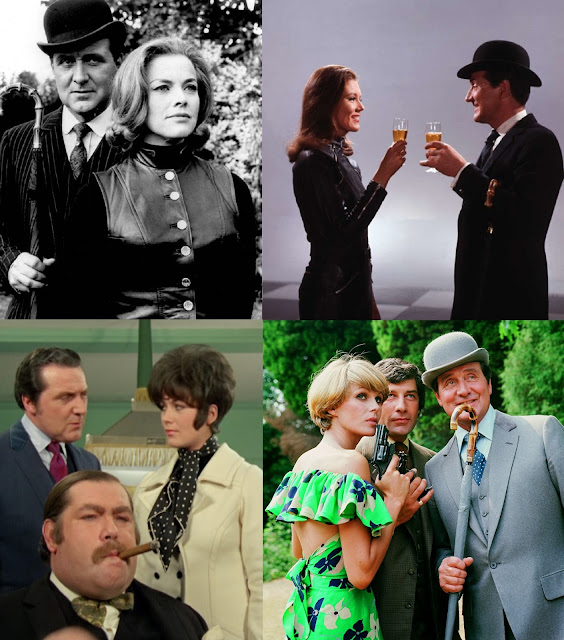
The Avengers – A man with a bowler hat and a woman who throws men over her shoulder
Now you can skip to the selections below and start watching, really, but if you want more about one or the other, you could say that both series revolve around a mysterious, flamboyant figure who tempts you from our world into a strange one off to one side, and that neither carry guns or take themselves as seriously as their mission…
Who is the Doctor?
When the current Doctor, Jodie Whittaker, fell to Earth to play the role for the first time, I wrote So Who is The Doctor Anyway? All You Need To Know About Doctor Who, but, again, the TL;DR—
The Doctor is a traveller in time and space who goes anywhere, from Earth’s past, present and future to alien worlds and stranger places still. The Doctor obeys no authority but their own moral sense, uses intelligence rather than violence, and takes joy in taking friends to explore the wonders of the Universe.
Doctor Who began in 1963 and has run ever since in one medium or another, but most prominently on TV through the following three decades and then again ever since 2005 – and back this very Saturday for New Year.
Who are The Avengers?
“The Avengers is about a man in a bowler hat and a woman who flings men over her shoulders.”
…said Patrick Macnee, Steed, and I can’t say better than that, can I? Or as a famous American trailer told us, that extraordinary crimes have to be avenged by agents extraordinary – John Steed, top professional, and his talented amateur partners – The Avengers. Together, they fight diabolical masterminds. Steed is a shady arm’s-length government agent whose gorgeous old-fashioned suits and bowler are almost as wilfully anachronistic as the Doctor, while The Avengers’ own version of time travel is to pair this seemingly conservative continuing lead with a series of intelligent, capable, confident, experienced and physically combative women that broke the TV mould and created the future (and several excellent men, but none so memorable as Steed or The Avengers’ women). Steed is more casually ruthless than the Doctor but just as playful – winning as often as not through outrageous cheating, while the only rule his partners break is gender. A brilliant balance of suspense and silliness, bizarre mysteries, and more than any other crime-fighting / spy-busting duo, they do it for fun. The Avengers is a secret agent series, a comedy-thriller, occasionally sci-fi, riding old-fashioned Britishness and Swinging modernity with equal excitement, its greatest genius to make all the women ahead of their time and the man from a bygone age, a fantasy of Britain with Steed playing on the swings at the heart of Avengerland.
The Avengers began in 1961 and ran through to 1969, along the way becoming the biggest ever hit British show on primetime US TV just as Doctor Who became a hit in dozens of countries, then returned as The New Avengers in the mid-’70s and, like Doctor Who, still lives on in Big Finish productions.
Both much more strange and interesting than almost any other TV series, both sometimes very funny, sometimes sinister, it’s no surprise that The Avengers is the closest show to my heart than any but Doctor Who. Several writers worked on both – and several plots found their way from one series to the other, with cross-fertilisation apparent as early as Sara Kingdom, the Doctor’s high-action, leather-suited companion in The Daleks’ Master Plan – but it’s the actors who really stand out. Avengers Honor Blackman, Diana Rigg, Gareth Hunt, Patrick Newell and Joanna Lumley all had Doctor Who roles too. The Third Doctor, Jon Pertwee, wasn’t just the most Earthbound but had his own The Avengers part, as did the Master, the Rani, and no fewer than three First Doctors (yet not the original). The guest artists appearing across both series are too many to list, but you can find actors from The Avengers and The New Avengers even well into this century’s New Who – most notably Bernard Cribbins and Diana Rigg, but also the likes of Christopher Benjamin, Lindsay Duncan, Roy Marsden and Stephen Moore (and more).
If you’re a Doctor Who fan looking for an excuse to be enticed into The Avengers, here are a few recommendations that stand out. Not necessarily the best, nor all my favourites, nor the most quintessentially The Avengers, but a selection box of flavours you might just recognise…
Doctor Who Stars in The Avengers
From Venus With L💘ve (Mrs Peel – IN COLOR)
The Brigadier, but not the one you’re expecting: he’s Jon Pertwee!
Plus other Doctor Who guest stars from as early as the very first story in 1963 (Derek Newark) to The Eleventh Hour in 2010 (Arthur Cox), and of course The Crimson Horror’s Diana Rigg as Mrs Emma Peel.
This was the first colour episode of The Avengers to be transmitted, and like Doctor Who’s first colour story, Spearhead From Space (itself packed with Avengers crossover actors), this is shot gorgeously all on film, goes down to Earth but not quite the world as we know it as our heroes – the eccentric dandy in the vintage car and the fantastically overqualified, caustically sharp-witted scientifically accomplished woman working for a mysterious secret agency – investigate an alien invasion…
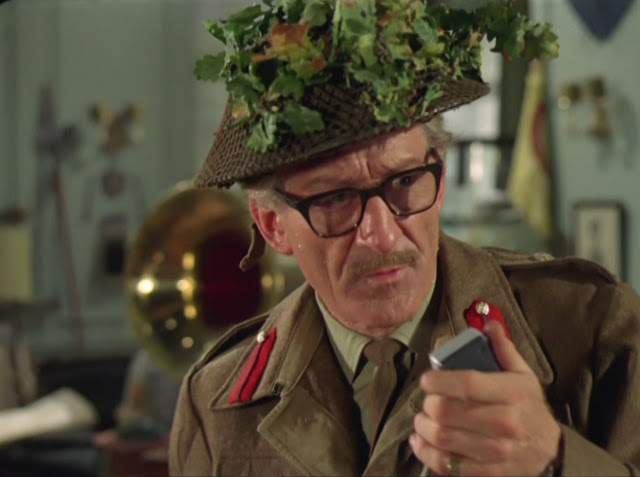
The Eagle’s Nest (The New Avengers)
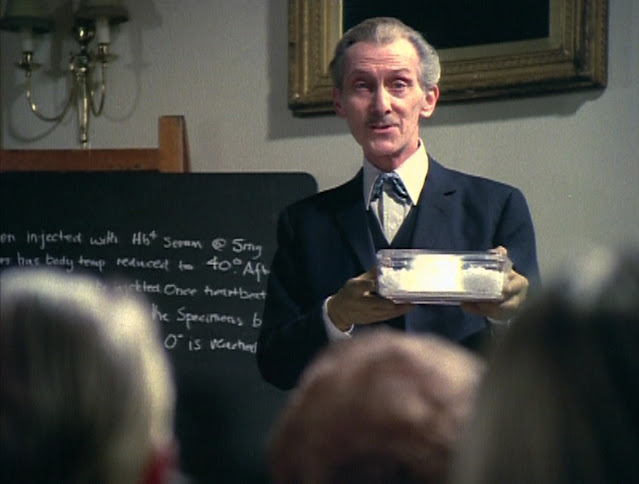
In which movie Dr. Who Peter Cushing is delightful, in almost the same moustache!
He’s so much nicer than his Frankenstein, despite this role having crossover appeal to that too (and still more to Doctor Who – The Brain of Morbius, starring multiple-Avengers’ Philip Madoc).
This episode introduces Joanna Lumley and Gareth Hunt as The New Avengers, and for Doctor Who side-leads also gives us a minor role for the lovely Trevor Baxter, famously Professor George Litefoot. Slightly disappointingly, Litefoot gets an unrewarding role in a good episode, while Jago has a rewarding role in weak ones: Trevor Baxter’s partner in Jago & Litefoot, Christopher Benjamin, is probably the best thing in three different indifferent Avengers episodes, of which the best is probably Split! (which also stars the superb Julian Glover).
Return of the Cybernauts (Mrs Peel, Colour)
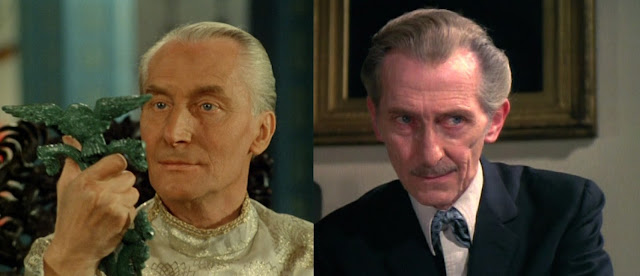
In which movie Dr. Who Peter Cushing is not delightful at all, but full of sinister charm.
With Frederick Jaeger, Fulton Mackay and of course the Cybernauts, of which more later.
Legacy of Death (Tara King)
Among many villains (and several Doctor Who guest actors) one-time third First Doctor Richard Hurndall.
This one’s a parody of The Maltese Falcon written by Dalek devisor Terry Nation (with a hint of Davros). He also sends up his own Daleks, not entirely successfully, in Thingumajig, while his Invasion of the Earthmen has an absurdly ambitious satirical concept not done all that well but does manage to anticipate The Sontaran Stratagem and even (briefly) the Sontaran design. But if you’re looking for a really excellent Terry Nation The Avengers, go for Take Me To Your Leader – despite the title, that isn’t very Doctor Who at all, but it is fast, stylish and hugely entertaining.
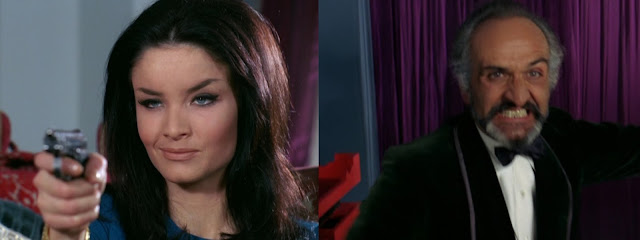
Stay Tuned (Tara King)
The story looks like a time loop… Could it be something to do with two evil Time Lords brought together (if only briefly sharing the camera) long before The Mark of the Rani – the Master and the Rani, Roger Delgado and Kate O’Mara!
Look – (Stop Me if You’ve Heard This One) But There Were These Two Fellers… (Tara King)
The wonderful Bernard Cribbins! He’s just turned 93 this week, and you can see this one on ITV4 on Monday 3rd January at 8.30am (he’s also in The Girl From Auntie).
But that’s not all – this outstandingly fun episode is written by Doctor Who writer Dennis Spooner and has several other crossovers from John Woodvine to John Cleese.

Dressed to Kill – Anneke Wills & Steed in fancy dress; Look – (Stop Me…) – Bernard Cribbins & Steed in a paper-strewn mess
Dressed to Kill (Cathy Gale)
Another topical episode as I write: this is a tale of the New Year, so one for tonight!
And among several fabulous guest stars is Doctor Who companion-to-be Anneke Wills.
Mission… Highly Improbable (Mrs Peel, Colour)
Not quite the Brigadier but a similar sort of role for Nicholas Courtney, with bonus Kevin Stoney – in between the two of them being on opposite sides in Doctor Who’s The Daleks’ Master Plan and The Invasion (though in the end they’re given quite small parts).
The Avengers Plots in Doctor Who
The Morning After (Tara King, though in this Steed’s mostly paired with Peter Barkworth)
This terrific, eerie, stylish adventure is immediately recognisable as a much crisper prototype of the more political Invasion of the Dinosaurs, though in this one the big, roaring monster is BRIAN BLESSED!
The Mauritius Penny (Cathy Gale)
Written by Doctor Who authors-to-be Malcolm Hulke & Terrance Dicks, in which a tiny thing spirals hugely out of control and eventually into a plot that echoes later in Doctor Who – Robot. Though it gets even bigger there.
Man-Eater of Surrey Green (Mrs Peel, B/W)
The most infamous of all, as most of this plot sprouts again in The Seeds of Doom. Although it’s also fair to say that both borrow quite a bit from Quatermass…
Doctor Who Cameos in The Avengers
Death at Bargain Prices (Mrs Peel, B/W)
Featuring André Morell (more bonus Quatermass), T.P. McKenna, John Cater and Peter Howell, but this exciting adventure with a department store most strikingly sees Diana Rigg arranging toy Daleks.
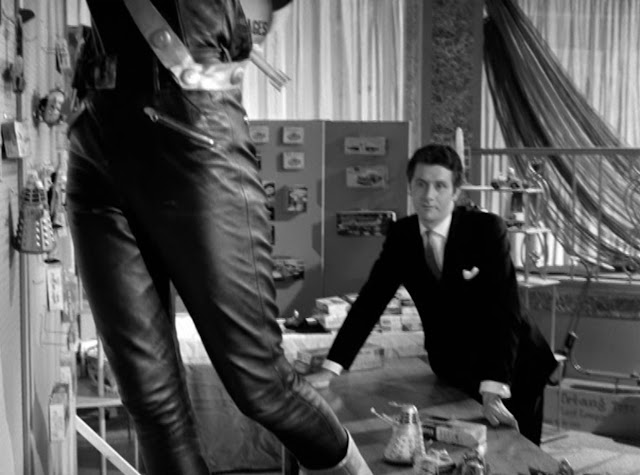
I know what the male gaze wants… Daleks. – Death at Bargain Prices
Target! (The New Avengers)
Gasp at repeated cameos for a shockingly abused TARDIS in The New Avengers’ most iconic (if not most logical) episode. Featuring many familiar faces and the worst Doctor in the world (medically), Target! is written by former Doctor Who Script Editor Dennis Spooner and is almost a doppelgänger for the previous year’s Doctor Who – The Android Invasion, written by former The Avengers Script Editor Terry Nation. Even the very first episode of The Avengers, Hot Snow, has a pre-Doctor Who police box in a rainy film insert in its surviving quarter-hour.
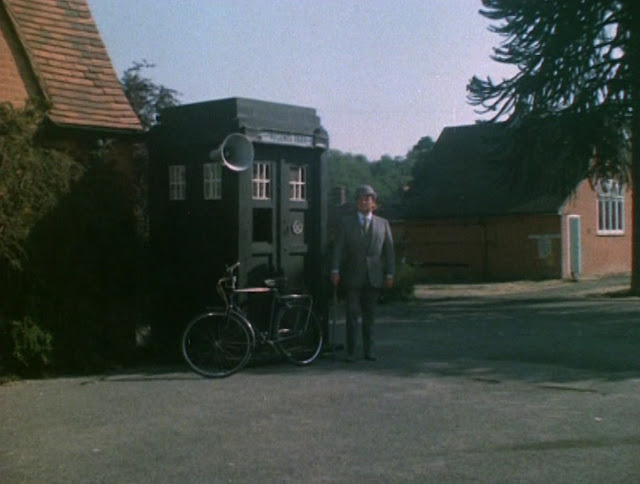
Target! – a police box stands on a village corner, John Steed at its side.
The House That Jack Built (Mrs Peel, B/W)
Before the police box exterior in Target!, an old-fashioned exterior hides weird ultra-modern corridors with what seems to be a super-sci-fi central control console. If the titular House That Jack Built isn’t a TARDIS… I like to imagine the villainous Professor Keller let the Master have his identity for The Mind of Evil, and the Master let him borrow his TARDIS to get at Mrs Peel in return. If ever The Avengers consciously borrowed from Doctor Who, this is it…
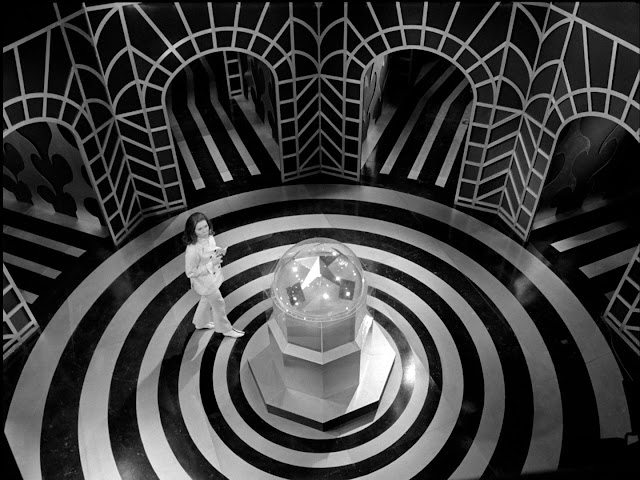
An Eccentric Array of Doctor Who-interest The Avengers Episodes
The Cybernauts (Mrs Peel, B/W)
…While this most sci-fi of all The Avengers conspicuously influences Doctor Who from the obvious Cyber-monsters through The Web of Fear and Spearhead From Space to Terror of the Zygons, with an abundance of familiar actors as a bonus (Michael Gough, Frederick Jaeger, Bernard Horsfall, Burt Kwouk, John Hollis, John Franklyn-Robbins…).

The Cybernauts – a blank-faced metal Cybernaut (brilliantly disguised in dark glasses, coat and hat). Smashing!
The Positive Negative Man (Mrs Peel, Colour)
It’s not so much the plot here that turns up in Doctor Who as many individual images; with its mysterious stalking figure that kills with one touch, or burning files in a safe, not to mention people being ‘magnetised’ to an antique car, I wonder who was watching a repeat of this one evening while working on The Ambassadors of Death.
The Gravediggers (Mrs Peel, B/W)
A Doctor Who writer in Malcolm Hulke and not just several Doctor Who guest stars but even two from half a century later in New Who (Diana Rigg and Steven Berkoff). Not given much to do here but a particular favourite of mine, this is The Avengers with the fabulous Wanda Ventham, who guest-starred in Doctor Who stories in 1967, 1977 and 1987, and I have to say New Who seriously missed out by not casting her in 2007 and 2017 too.
The Wringer (Cathy Gale)
See Doctor Who producer-director-to-be Barry Letts when still an actor! Plus, amid several Who actors, mind-melting Terence Lodge makes me feel this is a little like The Macra Terror.
Quick-Quick Slow Death (Mrs Peel, B/W)
Strictly Avengers by Robert Banks Stewart, who later wrote two of the most Avengers-adjacent Doctor Who adventures in Terror of the Zygons and The Seeds of Doom.
The Town of No Return (Mrs Peel, B/W)
Introducing Diana Rigg, whose Doctor Who – The Crimson Horror features an explicit plot lift from this, and for me the first seven minutes of this are the ideal introduction to The Avengers. Plus the first of many appearances by Patrick Newell.
Escape in Time (Mrs Peel, Colour)
And finally – ish – not just guest-starring Geoffrey Bayldon, on audio the fourth First Doctor (or minus-oneth, or… well, another one, anyway), not just one of my favourite Avengers guest villains in his biggest role (Peter Bowles, who crosses over to The Sarah Jane Adventures many years later, just as Murray Melvin goes from the very first Avengers episode to an enigmatic enemy in Torchwood), not just one of the most vividly enjoyable escapades in Avengerland, but the one with time travel!
Or is it?
Though these are the ones that most stand out for me, you can find Doctor Who connections in dozens more of The Avengers. The Curious Case of the Countless Clues stars Edward de Souza, the only TV Doctor Who lead in a story with no Doctor at all; All Done With Mirrors and Angels of Death feature Dinsdale Landen, but in which is he as villainous as Fenric? Fog is as mock-Victoriana as The Talons of Weng-Chiang, even down to Patsy Smart’s crumbly Cockney, while The Enemy of the World borrows wholesale from The Living Dead. And I’ve somehow not paid enough attention to some of my very favourite Doctor Who villains who cross over as some of my very favourite The Avengers guest stars (and villains – or are they?), so three each for:
- Julian Glover – Pandora, The Living Dead, Two’s A Crowd
- Philip Madoc – My Wildest Dream, The Decapod, Death of a Batman
- Peter Jeffrey – The Joker, Game, House of Cards
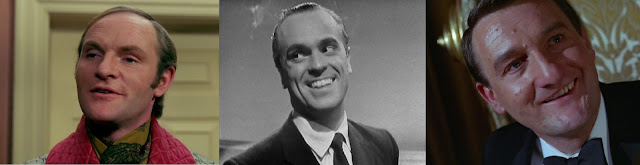
The Three Villains (or are they?)
Or… Doctor Who Stories to intrigue The Avengers Viewer
Spearhead From Space (Third Doctor)
I’m mainly assuming all this is most likely to be read by people more familiar with Doctor Who than The Avengers, but for the other way round, this is a great place to start. As I said above, this is about as The Avengers (and as Quatermass) as Doctor Who gets, with crossover actors, a flamboyant Doctor and a brilliant woman lead, and where the sinister countryside should have a sign up saying ‘Twinned with [From] Venus [With Love]’.
The Seeds of Doom + City of Death (Fourth Doctor)
The Seeds of Doom is the most infamous homage, with a mean green* menace from outer space, a millionaire plant obsessive with a murderous chauffeur, and even a scene-stealingly fabulous eccentric elderly lady. But I’m going to go against the tide and say that while it may be very Avengers on paper (from Avengers writer Robert Banks Stewart), the stylish, powerful direction means it doesn’t feel like The Avengers at all. It’s the closest Doctor Who comes to The Sweeney. So I’d pair this with its opposite: between them brutal The Seeds of Doom and witty, arch City of Death are the tonal extremes of Tom Baker’s Doctor, and while the plot has little of The Avengers, City of Death has an insouciantly Avengers mood and even Villainous Julian Glover.
*Technically black and white in The Avengers
The Web of Fear + The Mind Robber (Second Doctor)
Similarly, take one story with terrific filming and robots exchanging great, smashing blows from The Cybernauts (and guest-starring part-time Avenger Jon Rollason), add another with fabulous Op-art sets and surrealism (featuring the most Avengers fight for any companion), to find Doctor Who being quite Avengers-y between them.
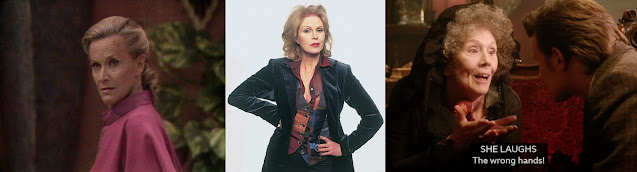
The Who Avengers!
The Crimson Horror (Eleventh Doctor)
Villainous Diana Rigg! Who could ask for more? With a diabolically The Avengers sort of plan a hundred years early and a fake-out with a gramophone borrowed from her first The Avengers episode.
The Trial of a Time Lord – Terror of the Vervoids (Sixth Doctor)
Guest-starring Honor Blackman as Professor Lasky, almost as intelligent as Mrs Gale (though to be frank both her judgment and her outfits are far better in The Avengers).
Planet of the Spiders (Third Doctor)
Gareth Hunt as a pre-The New Avengers bit of rough. Also starring (in thrilling stunt chases) Jon Pertwee from The Avengers – From Venus With Love.
The Android Invasion (Fourth Doctor)
Terry Nation writes by far his most The Avengers Doctor Who script in tone, with a mysterious village and the Brigadier replaced by Mother (Patrick Newell). And yet a completely different story is titled The Androids of Tara (though that one’s much better, even more entertaining, and stars Villainous Peter Jeffrey).
Robot (Fourth Doctor)
Terrance Dicks borrows just some of his The Avengers story The Mauritius Penny, the Doctor and Sarah Jane are as witty and wonderful a pair as you could wish for, and Harry disguises himself as Steed. And both Steed and the Doctor formatively fight fascists.
The Stones of Blood (Fourth Doctor)
Though Honor Blackman turned down a role in this one, we still have fabulous women, including an icily amazing Time Lady who’s the Doctor’s equal, and like so many Avengers it could be subtitled ‘Escape From the Country’ (the villain has chosen to escape to the countryside, which just proves it).
The Curse of Fatal Death (The Many Doctors)
A Comic Relief spectacular in which the ultimate Doctor is Joanna Lumley.
Pick one, dive in, and enjoy!
This was partially inspired by the lovely Roy Gill’s #AvengersWho Twitter thread at the beginning of the year, mashing up The Avengers / Doctor Who story titles. I particularly enjoyed his ‘Castle De’Ath To The Daleks’ and ‘The Hexapod’, Elliot Chapman’s ‘Dial a Deadly Assassin’ and Brendan Jones’ outstanding ‘You Have Just Been Pulverised Into Fragments And Sent Floating Into Space And In My Book That’s Murdered’. I added ‘Doctor Who Was That Woman I Saw You With’ and ‘Rise of the Cybernauts / The Age of Steed’, but then took eleven months to think about this more detailed contribution.
Update: Daniel Blythe brilliantly calls my attention to a fourth First Doctor (technically the third?) in The Avengers, as Frederick Jaeger plays a character who becomes the Doctor for a time in Doctor Who – The Savages.
Labels: Doctor Who, Honor Blackman, Jago & Litefoot, Joanna Lumley, Julian Glover, Peter Jeffrey, Philip Madoc, The Avengers, The New Avengers


Saturday, May 12, 2012
The Avengers – The Morning After
First broadcast in the Midlands 43 years ago last night (oh, all right, they showed it in London several months earlier, but it’s difficult to celebrate proper Avengers anniversaries when ITV regions all used to do their own thing), you can now find The Morning After on Disc 6 of The Avengers – The Complete Series 6 DVD Box Set, or Disc 35 in The Avengers Complete 50th Anniversary Collection. I’ve previously offered tips on which The Avengers DVDs to buy. You may be surprised, though, at how little Tara King appears in this episode from her season of the show; with Series 6 half as long again as any of the others, both Linda Thorson and Patrick Macnee had to have a couple of ‘holiday’ episodes each. I’m a huge admirer of Tara, as I’ve gone into before in The Avengers – Game and My Wildest Dream, but Steed’s new best enemy in The Morning After more than makes up for her absence, a help and hindrance who’s surely the best of the one-off Avengers.
Having written about Seven Days To Noon a week ago, it’s appropriate to recognise the debt this story owes to that film while still being very much its own show. For me, of all the closest variations on that central idea (the original, this, Doctor Who – Invasion of the Dinosaurs and The New Avengers – Sleeper) this is arguably the best, with a clear identity of its own and told with more economy, great visual style and an outstanding musical score. It turns the film’s central threat on its head, an idea which goes on to be swallowed whole by Invasion of the Dinosaurs; it’s probably a coincidence, but a satisfying one, that it deploys a minor young actor from the film, Joss Ackland, as a major guest star two decades later; and it may well be deliberate that it hires stock film shot for Seven Days To Noon to depict its own evacuation scenes, though intriguingly often off-cuts from the film rather than those used in the final version, such as a different edit of men hammering up an evacuation sign (Tat Wood put me onto this in his Doctor Who guidebook About Time 3, though take its thumbnail plot summary of this with a pinch and, for Homicide and Old Lace, a lorryload of salt). Its focus, punch and production values are way ahead of the Doctor Who, although that shares with Seven Days To Noon a greater political depth, while I’ve said before that Sleeper, while mostly enjoyable and looking impressive, is by far the least interesting of these, having no twists, nothing to say and, for all its attempt at ‘urban realism’, pulling almost all its punches (it even takes the near-comic relief gas from this episode and makes it the main plot). True, the others have over The Morning After the ambition and unsettling impact of a deserted London, though this story’s less iconic ‘everytown’ has its own claustrophobic effect. On which note…
That Golden Moment
“Do you think the world’s ended, and they forgot to tell us?”The Avengers doesn’t do multi-part stories with cliffhangers – except that, made for an hour ITV slot in the ’60s, each fifty-minute Avengers episode usually splits into four ‘Acts’, each designed to come to a climax, then fade to black for the ad break. And the first Act of The Morning After is an outstanding example of the style, eighteen minutes opening with an exciting James Bond-style mini-adventure preview, then plunging into Steed’s forced exploration of a mystery in which he’s on his own – no briefing, no Mother to send him in, and no Tara to watch his back. And it’s as gripping for the audience as it is disturbing for our hero, building steadily until a sudden burst of action and the first death, inevitably, to keep you breathless through the adverts that aren’t there.
The Avengers doesn’t do ‘continuity’ – but could a man in a clown mask raiding the Ministry of Technology and Scientific Innovation suggest an old enemy? No. It’s just yet another of those sort of openings, here at least done more briskly and impishly than in previous episodes, then jumping straight to a busy, noisy town somewhere in England, where Steed and Tara lie in wait for him (no spending half the episode working out how he got in or what he’s stolen). I told you this started with a fast-moving Bond mini-adventure, didn’t I? And already, it’s unsettling; Steed never carries a gun. But against quadruple agent Jimmy Merlin, an adversary as playful, as charming and as dangerous as he is, Steed jarringly arms himself. Our heroes get the jump on Merlin; he jumps back to fling down the new sleeping gas capsule he’s stolen; but Steed’s locked the door, so as the little rendezvous fills with gas, all three go down. There’s a thrilling freeze-frame for the title as the phone starts to ring and suddenly music crashes in, fast, bombastic and threatening.
The most gripping part of the story for me is on the morning after; Steed wakes first, the busy town suddenly silent save for a dog howling miserably. Only emphasising the silence, eerie music drifts into the scene, like the wind. Steed tries the phone – no connection. The same with the red callbox outside – from where he can see a car crashed into bins and abandoned. All around, things smashed and left, and not a soul. With Tara still deeply unconscious, Steed testily wakes a protesting Merlin and drags him down to the yellow Rolls, eager to hand him over now he’s captured. I love the banter between the two fabulous characters as everything the camera shows us makes us – and them – more worried, right from Steed cheerily telling Merlin to enjoy the view while he can: usually, in The Avengers, glorious countryside; here, the garage door. And Steed has to enjoy the drive while he can, too, as soon he runs into an empty truck used as a roadblock and has no choice but to handcuff the two of them together and start walking…
“Any chance of making a deal?”And of course, in this strange setting, suddenly neither can get what they want. It’s a terrific sequence with superb cinematography as the two stroll through the deserted town, nothing but keening music to keep them company. And it’s a brilliant idea to use all the humour to build tension, every line played like a gag between them but juxtaposed with the emptiness yawning around them: the policeman’s helmet on the ground and in the foreground as we see them, tiny and lost, far beyond it; the high, old-fashioned buildings looming above them; the sack of spilled coal, the milk bottles, surely to Steed most disturbingly the abandoned pub with drinks left unfinished. And while both actors keep their tone light, their faces are at odds with their voices. Patrick Macnee’s Steed is determined but disturbed, keenly observing; Peter Barkworth’s Merlin jittery and increasingly desperate. Watch Steed knowing that “It’s lonely up there” merely reflects ‘here’; watch Merlin’s little face fall as Steed keeps raising and dashing his hopes.
“I shouldn’t have thought so, but keep talking.”
“Twenty thousand? In a Swiss bank? No names, no strings?”
“Pounds?”
“Yes!”
“Very sorry, old chap. Only deal in guineas.”
“Well, I could throw in a yacht.”
“I’ve had one.”
“My private plane?”
“It’s lonely up there.”
“String of Arab ponies?”
“Prefer palominos.”
“Well, how about… A villa? France?”
“Whereabouts?”
“St Tropez.”
“Prefer Provence.”
“Oh, for heaven’s sake, Steed – isn’t there anything you want?”
“Yes. There’s one thing I want very much. You – behind bars.”
It helps enormously that all of this is out on location, on a sunny day, so you can see right down long, narrow, slightly claustrophobic streets. This was The Avengers’ most ambitious location shoot to date (later beaten in that, I think, by Sleeper), and for this eerie ‘everytown’ director John Hough carefully slices together non-contiguous parts of Watford, Old Hatfield and, particularly, St Albans, most blatantly when the streets suddenly give way to the Cathedral, zooming on the little pram and dollies left behind in its grounds. That always gives me a bit of a turn, as I remember the place vaguely from a single childhood visit with my Nana and Grandad (who lived in the other end of Watford), though the cathedral also offers some mirth if you watch carefully; as Steed and Merlin walk and talk, you keep seeing it poking up in the background in different shots, but never in the same place. You could say that it shows they’re going round in circles; you might just shrug that they’re cutting together lots of different locations; but it keeps looking like the cathedral is tiptoeing from side to side, stalking them.
Brian Clemens’ script is merciless, telling you nothing more of what’s going on than Steed and Merlin can see, and even as Act One draws to a close with eerie exploration shifting to sudden threat, there are no answers – just Merlin starting to ask some of the same questions as the audience. Where has everybody gone? And why? Was it an emergency? A mass kidnapping? War, plague, radiation…? Your mind races through all of Terry Nation’s favourite plot devices, not least because he’s script editor here (is this why he and Clemens fell out over who had the idea for Survivors? All so much more absorbing than Sleeper, which tells you what’s going in the pre-titles sequence). Even the bank’s deserted, notes fluttering everywhere, and no-one comes running when Steed sounds the alarm. Or do they? Now there’s a black, silent VW camper van gliding through the streets – robots? Remote control? Hypnotism? Then, just as Merlin and Steed explode into action, there’s that shockingly loud, thundering fanfare again, not a march but a dash, soldiers running through the streets to shoot a little man down as a “LOOTER!” And if you think the capital-lettered sign they toss onto him is shouting, the man giving the order to fire (camera appropriately zooming on his mouth in close-up) is Sergeant Brian Blessed!
Steed and Merlin
“Your friend wasn’t very brave.”The Morning After is a great episode for Steed, as he carries most of it and almost has to carry unwilling burden Merlin – a much more sober than usual performance, though still with plenty of Patrick Macnee’s charm. Against the usual flamboyant parade of outfits, this time he’s in the same suit from the teaser right up until the last couple of minutes; this isn’t London, and there’s no friendly flat to pop back to for a change of clothes and a glass of champagne. Fortunately, the brown with that trademark velvet collar suits him, and he stays immaculate throughout, of course (even if it seems strangely improbable that, confronting Merlin at the start, he has a touch of uncharacteristic five o’clock shadow, but is as beautifully clean-shaven as always on waking a day later).
“He’s a big disappointment to me.”
Peter Barkworth, Merlin the spy before John le Carré, is a simply sublime guest star and, while I’d put My Wildest Dream just a touch ahead in the terrific episode stakes, Merlin makes a far better anti-Steed than the villain there. Charming and dangerous, tricky and devious, even more playful – sometimes gleeful – but far more cowardly than our hero, he doesn’t look as flamboyant (a straighter hat, a more buttoned-up look, a dark overcoat, as if he wants to stay unnoticed in the shadows) but has his own showiness, not least his conjuror’s-trick habit of producing whatever he needs from his sleeve. It’s a marvellous performance, easily the best and biggest of Barkworth’s four Avengers roles (one lost, a frosty businessperson in The Medicine Men, a well-mannered warrior in The Correct Way To Kill), dragged along, always complaining, never trustworthy – until Steed catches him out and leads him into the jaws of death. They make a very entertaining team. Look out for a particularly priceless exchange where each gives the other three reasons for investigating, or for running away, and just why Steed eventually uncuffs him…
“I’m too young to die!”Not a new man on the team but so fresh he sounds like it, composer Laurie Johnson adds to the feel of ‘The Avengers, but suddenly harder-edged’ with one of his very best original scores. After providing all the music for the Diana Rigg episodes, often reusing and reworking themes into old friends, Laurie Johnson had taken some time off while working on a musical, handing over several of the Tara King scores to Howard Blake. And that clearly recharged his batteries, as the soundtrack here is not just one of his best but strikingly different to his usual.
“You’re over 21.”
“If I were eighty, I’d still feel the same!”
With Linda Thorson recharging her own batteries for the week, Tara gets a couple of good moments – praised at the start, an impressive knockout punch later – but is largely asleep with a teddy (not Chilcott) and in a red and white trouser suit, which isn’t bad but makes her seem a bit young. For anyone missing an Avengers woman for a week, half-way through we meet Jenny Firston, played by Penelope Horner. She’s not bad, if a little flat, and after a rather undignified entrance has little to do save act as the exposition and then hide; if you’ve seen Doctor Who – Invasion of the Dinosaurs, you may just expect to find a plucky female journalist sneaking in for the scoop, and she even has a man called Yates teamed with her who isn’t much help. Her exposition is rather stylishly by television, though it slightly clumsily underlines that they’ve not given the ‘everytown’ a name: “This town has become a ghost area” seems very laboured, when anyone would naturally say ‘This has become a ghost town’.
But why has this ghost town been evacuated, and the fifty square miles surrounding it? Spoilers follow shortly…
Commentary and Conspiracy (Or – Spoilers – What’s It All About, Ackland?)
Late ’60s Avengers episodes look gorgeous on DVD, shot on film and in colour, and with the current full-season (or complete series) box sets they’ve not only been cleaned up beautifully but have been given a few extra features – though, while the look of the episodes mostly beats Doctor Who hands down, the value added material is still some way behind. While almost every Doctor Who DVD release has a full set of commentaries, they’re rare for The Avengers, so it’s cheering that on this (one of my favourites) director John Hough is there to give his recollections, ably questioned by Jaz Wiseman. Hough’s direction is particularly impressive here; not quite as exuberantly inventive as Robert Fuest but still with a great deal of style, equally able in building atmosphere for the unsettlingly empty streets and then in giving it lots of pace and energy as the soldiers crash into the story.
John Hough has some intriguing insights into this story in particular – how to match Peter against Patrick as the two leads so that both could let their own charisma flow and battle each other’s characters without overshadowing each other, or how though it took more hard work than usual to create so much of the empty town, it was only one step up from the way The Avengers always eschewed extras to create its own world – but, with few commentaries about for the series, it’s mostly more of an extended interview than a bantering, story-led traditional commentary. It ranges over his four episodes as full director (he returned for one especially good New Avengers) and how he started off as second unit director, having got that post on The Avengers following The Saint after he and Ray Austin managed to swap jobs. He explains how the series doing it differently led to such high quality, with good words to say about the likes of Linda Thorson, Patrick Macnee, and most of all producers Albert Fennell and Brian Clemens. Though not about the Movie. And, like me, he admired Patrick Macnee’s special velvet collars, though unlike me he went to Patrick’s tailor and got one (it looks like you can see it in the Photo Gallery for Super Secret Cypher Snatch)!
So, now, are you ready for the spoilers on what was going on?
Much of The Avengers takes place in a highly stylised fantasy of Britain, sometimes called ‘AvengerLand’, with highly stylised characters within it. Here, the threat is more grim and real-world than usual, though it’s still informed by Avengers themes and, in the extensive location shooting, brings ‘AvengerLand’ further than it’s ever been before in transforming the real world. Rather than outlandish sets, rolling countryside or picturesque villages called Little Storping-in-the-Swuff, this ambitiously turns a whole town inside-out and into Avengers country, closer to most viewers’ experiences but more unsettlingly different at the same time. And it’s unsettlingly different for Steed, too, as rather than be sent in to investigate the mystery, here he simply wakes up in the midst of it and becomes a hunted fugitive, the full force of the authorities seemingly out to kill him, a reversal that gives him new oomph.
Army nuclear expert Brigadier Hansing has detected an atomic bomb secreted by one of the unfriendly governments who backed the old Eastern Hemisphere Trade Commission in town, and enforces martial law while he’s staying in the evacuated area to dismantle the bomb. Or is he? The conspiracy goes right to the top, with Joss Ackland as Hansing moving deftly from sternly efficient, to snarling brutal orders, to just a few notches below his full Hollywood-villain-boggler of later years. Hansing’s due to be pensioned off in favour of a computer and, as with so many Avengers villains motived by either amity or animosity towards technology, turns. His good old British nuclear shock troop platoons are lying drugged in their trucks while merciless mercenaries led by the excellent Donald Douglas and the even more outstanding Brian Blessed shoot anyone on the streets and Hansing supervises not the dismantling of an imaginary bomb but the installation of a real one, ready to blackmail the government with no time for evacuation once the town’s population returns (though while he’s in it for money and pride, it’s never made entirely clear just what his “Eastern Hemisphere” backers are aiming for. It might have been interesting to hear they intended to double-cross him in turn, and blow up the bomb anyway).
“You have been found guilty of looting!”A shoot-to-kill policy is, of course, just not British – except when it is – and you can see the effect it has on Steed; not concerned for himself, but neatly underplayed doubt that they’re genuine and fear that they might be. It’s a conspiracy thriller quite unlike any other Avengers, full of twists and betrayal, and as well as cleverly subverting the motivations of Seven Days To Noon, when we see soldiers running along house-to-house searches they become far more sinister, the film’s subtext become the text. And, in villainous ’tache, it’s Brian Blessed who barks their orders, on the cusp of serious stardom, already known for Z Cars, still in a working class role, some great asides as he tells Steed he’s not a regular (he gets the drink; Steed doesn’t; he doesn’t drink like Steed does, though), but in an early example of SHOUTING!
I should mention the final moment designed to defuse the tension, the traditional light-hearted ‘tag scene’; in Steed’s flat, it’s immediately rather jarring, as it’s the only scene since the pre-titles where we’ve not been trapped in that unfamiliar town. Unusually, there is a link to the main plot – something else Merlin’s stolen – but it’s not a particularly good gag and, for once, not particularly well done (dialogue or lighting). And though Tara’s back, in rather a shimmery frock, Steed’s tux is a bit much. If it ends on a slight disappointment, though, The Morning After’s still been one of The Avengers’ strongest episodes, and showing great confidence in doing something so different in tone so late in the series. That confidence even shows through in what might be the best moment of that tag scene: Steed, enjoying the TV, hears one hand clapping and sighs, “Sock it to me,” the catchphrase of Rowan and Martin’s Laugh-In, which was right then causing problems for the series when scheduled against it on US TV. It was very interesting to show even Steed fondly watching their opposition… But it was also stupid. Though I think it was more interesting than stupid…
Labels: Brian Blessed, DVD, Film, Jon Pertwee, Music, Reviews, The Avengers, The Avengers Season 6, The New Avengers
Thursday, May 03, 2012
Seven Days To Noon
Are you sitting comfortably? Then I’ll try to put a stop to that with this cosy catastrophe. It’s a thoughtful, understated but tense 1950 political thriller, so it may threaten London’s complete annihilation but, on the plus side, doesn’t have Boris or Ken in it. And though not science fiction, it was hugely influential, not least on Quatermass, The Avengers and Doctor Who, as well as films as late as, well, 28 Days Later.
BBC4 is at this moment cheering us all up at the end of election day with The End of the World? A Horizon Guide To Armageddon, so Seven Days To Noon sprang to mind; a film full of ‘firsts’ in the Armageddon genre, from the spectre of nuclear doom to an eerily deserted London, I’d been thinking about reviewing it for a little while, having recently caught it again on one of its frequent outings on Film4 (keep an eye out, if you don’t own a copy). While Advise and Consent and The Best Man, the early 1960s political thrillers I wrote about last week, were utterly American, this is incredibly British – though it mixes a queasy satire of World War II evacuations and Blitz Spirit with a looming dread of American, Russian and our own new nuclear capability. And while they had plotlines about intellectuals, this not only makes a scientist and thinker its central character, but forces the audience to consider the issues he raises. Though the conspiracy thriller rather than the lone actor comes later, and on the surface this is all stiff upper lip with a government that sternly protects the people, too, there is the subversive undercurrent that asks, like its main character, whether that government in fact wants to make us all complicit in mass murder and then see us blown to bits more comprehensively, just further down the line, which is a less reassuring subtext. While I won’t spoil the end, the way that the authorities simply abandon the plucky everywoman while the military rush about doing their thing is surely telling.
Seven Days To Noon was produced by the Boulting Brothers, perhaps best-known for their terrific version of Brighton Rock, with the story by Paul Dehn (Goldfinger, Beneath the Planet of the Apes and more) and, perhaps surprisingly, his partner, top Hammer composer-to-be James Bernard (another Quatermass connection). The film opens, quietly, with a letter posted to the Prime Minister from top British nuclear scientist Professor Willingdon (Barry Jones) – and if you thought the storyline of a terrorist walking around a big city with a nuclear bomb in their suitcase was new to the Twenty-First Century, think again. He’s come to the conclusion that the work he does is profoundly wrong, and gives the Government an ultimatum: give up nuclear weapons in one week, or have one explode at Westminster. Hence the title. And the film is all about the fallout from that ‘simple’ demand: why did he do it? How can he be stopped? And what will the effect be on everyone else, physically and philosophically?
Joining Jones’ excellent, tortured Willingdon among the stars are André Morell, at the end of the 1950s the definitive Professor Quatermass with a remarkably similar moral quandary, but here playing stern, serious and exceptionally well-spoken Superintendent Folland, who’s put in charge of the manhunt; and the other standout character is Olive Sloane’s Goldie Phillips, there as the spirit of London, a good-time girl a little past her best, sympathetic to those in need but distinctly stroppy at the thought of being blown to bits. She’s hugely endearing in an old-fashioned way, but also has some striking undercurrents to her for a film made in 1950: not only is the ‘everyman’ character a woman, but we’re meant to identify not with the genteel young lady but one for whom every implication is used to get past the censor that she’s been around a bit, and good for her. Though I’m not convinced by Goldie picking up Willingdon in the first place – she doesn’t know how vital he is until he’s much later and more threatening, so he doesn’t seem much of a catch for her. Don’t fancy hers much.
More Betrayal, Vicar?
The crucial scene for me is one that in most films would be a flashback, but instead is a previous conversation with Willingdon related by a friend when Superintendent Folland comes calling in search of information. And the friend betraying a confidence happens to be the Professor’s local vicar, who’s caught doing some manual work and so for a moment presumed not posh enough to be among the clergy (ho ho. Look, most of the humour in the film’s better than this).
“And I’m going to be quite frank. His disappearance endangers – the national safety.”It sets out clearly the moral argument without having to have Willingdon himself confronted by Folland early on, and is a powerful moment, though one of the film’s more dated. It also makes me curl my lip rather at the Church of England; I was brought up Catholic. A Catholic priest wouldn’t let a little thing like nuclear Armageddon pry a confession out of him, still less when only hinted at by a police officer. It’s notable that Barry Jones’ portrayal of a mild, gentle man driven to extremes carries almost all the different notes of religion in the film, with the vicar’s established religion coming across far more as ‘establishment’ than ‘belief’; there’s an element of the more modern depiction of any passionately religious person as slightly mad (or at least of the caricature British view that you should be wary of anyone who believes in anything too much), but he also confronts you – if you were involved in a threat to kill millions of people, what should you do? And is it any more wrong to mount that threat on your own behalf rather than the government’s? Willingdon’s overwhelming guilt, at least, is very recognisable to a Catholic (though his despair is a sin). The film does pull its punches slightly in suggesting that Willingdon may just be mad – everyone’s first conclusion – rather than making a coldly sane decision; is he having a breakdown from the start, or is it only the pressure of his having to sustain his crushingly heavy decision for a week, alone, that causes him to start pacing all night, whispering Bible verses as a trailer for the film’s ultimate climax in a church?
“What is it you want to know?”
“…What would you do if you were convinced the results of your life’s work were being put to an evil purpose?”
Also dated is the convention that the Professor has a pretty daughter with no noticeable character of her own but a boyfriend who’s a leading character, though at least here he’s only a younger scientist there to provide exposition, rather than a square-jawed hero in a ripped shirt (I’m not certain he even loosens his tie).
From this point on, the film is in essence a race against time to find a lone man in London, with first an attempt to keep it all quiet, then the city eventually put through total evacuation – save for Superintendent Folland, and the army – as it becomes clear that he means it, and won’t be easy to find. The stark black and white and frequent night filming all around London, some of it still bomb-damaged by much less ferocious ordinance in the last War, gives it all a tense atmosphere, but some of the film is also surprisingly witty.
There aren’t a lot of jokes in the script, with Goldie too plucky to be just a ‘comedy character’, though two characters do stand out – a man with a “The End Is Nigh” sign who keeps trying to get on his evacuation bus with it and being told to leave it behind, and who to add to the incongruity looks far too like Ronnie Corbett for an actor in 1950, and Joan Hickson’s Mrs Peckett, Willingdon’s temporary landlady. One of the few people less posh in this film than you’d expect – a gossipy Londoner with a fag surgically attached to her lip, a far cry from Miss Marple – she’s the most overtly comedic character, snooty, intrusive and paranoid, a caricature landlady. Suspicious when “Mr Richardson” (or is it “Mr Richards”?) doesn’t want to hand over his ration book, she manages to miss all the “Missing Scientist” posters, but runs to the police after “Moon Maniac” “LANDLADY KILLER AT LARGE” headlines in the Express!
“I thought you might be an actor, and of course I won’t have theatricals in the house.”Most of the wit is in the cinematography; just as the camerawork prowls the shadows and shows us tormented faces, it can also brush past a petty crook or an inappropriate Atomic Racer game, or juxtapose The Garter and Slipper club with God Is Love, then listen to the Prime Minister’s broadcast under a dinosaur skeleton – before, along with “The End Is Nigh” signs, whole piles of items there’s no room to bring on the evacuation transport, from pets to sporting equipment.
To add to Joan Hickson, who was never young, there are many young faces in early roles – look out for Joss Ackland as an eager junior copper, or John Stratton (another to get a major role in Quatermass and the Pit at the other end of the decade) as a not eager at all young soldier, and at the end Victor Maddern as another young soldier at the end of his tether. And then there’s Geoffrey Keen, the thuggish, flag-waving, bomb-cheering ‘man in the street’ (or the pub) who decades later is the perishing Minister in the James Bond films that not even a change of government can get rid of, and Willingdon puts him (and the audience, who he’s almost speaking to direct when he angrily tells the man that he should be made to think about the things he says) down flat:
“You don’t understand what you’re saying… What you’re suggesting would mean the total destruction of mankind.”
After Noon – An Influential Film
As I noted above, Seven Days To Noon had a remarkably wide influence on British cinema and television – most obviously in a host of nuclear blackmail stories, but several more particular and noticeable scripts, especially those more science fiction than just setting topical concern two years ahead. Here are a few of the most striking ones, and two which I hope to review quite shortly (but which?)…
The Quatermass Experiment (1953, and 1955 film): in itself massively influential, but also borrowing a scientist chased through bomb-site London, a scientist lead and moral grappling, a finale in a big church, an apocalyptic threat and, at one remove, André Morell.
The Avengers – November Five (1963): another nuclear bomb threat to London from within the establishment.
Doctor Who – The Dalek Invasion of Earth (1964): similar scenes of pursuit through a deserted London, though this is more of a Nazi than a nuclear parable (but Terry Nation always likes his countdowns and his radiation threats).
The Avengers – The Morning After (1969): a small town rather than London is evacuated under nuclear threat by a figure of trust, though the manhunt isn’t for the ‘villain’. This one (as Tat Wood pointed me to in his revised Doctor Who guide About Time 3) even uses footage shot for Seven Days To Noon as part of its own evacuation scenes. And Joss Ackland.
Doctor Who – Invasion of the Dinosaurs (1974): though very much by way of The Morning After for its conspiracy elements, this still recognisably borrows from the original source, as well, with London evacuated under a different sort of terror threat, and once again has people in positions of trust claiming to do good, by their lights, by means of mass murder.
The New Avengers – Sleeper (1976): London asleep rather than evacuated, though less interestingly than the very similar two immediately previous variations.
And films continue to use both the imagery and the moral complexity, from 28 Days Later to Watchmen…
Labels: Doctor Who, Film, Ideas, London, Quatermass, Religion, Reviews, The Avengers, The New Avengers
Friday, September 30, 2011
Which The Avengers DVDs Should You Buy?
Choosing Between The Avengers DVD Boxed Sets
You’ve got a choice of half a dozen The Avengers DVD boxed sets, and if you don’t want to get everything at once, well, I don’t blame you, and I’ll pick which are best to dip into first in a minute. But bear with me. If you don’t have any of The Avengers – and you have a bit of spare cash – obviously I’ll recommend you buy the 39-disc limited edition DVD box set The Avengers Complete 50th Anniversary Collection, which is complete. Completely complete. The lot… Well, except for The New Avengers, which has a different rights owner and which you have to buy separately (but quite cheaply), and for most of the first season of The Avengers from 1961, which unfortunately doesn’t exist any more. So it’s as complete as you’re likely to get, and it’s worth buying if you can afford it. And if you can afford it today, it’ll be slightly cheaper.
The Avengers Complete 50th Anniversary Collection has several advantages over buying all five of the one-season sets. It’s expensive – but it’s cheaper than buying the lot. And while there’s not a lot of range between different sellers, according to this price comparison site, if you order it by the end of today from one site there’s a 10% off code, which for this one stacks up to more than a tenner. It’s quite a nice case, though the packaging’s even more difficult to get into without leaving your prints all over the disc than it is to shake out the jammed-in slim cases from the season boxes. It has a whole extra disc of still more bonus features that they couldn’t fit on the earlier releases (though, and kudos to Optimum for this, they’re having the decency to bring that out separately later in the year so people who’ve already bought the individual seasons can buy it too). And – and this is embarrassing – if you buy them like this, all the discs work properly. For all these sets, for all 139 episodes, the picture’s been restored as well as it can be; there are commentaries, rare little clips, scripts and other pdfs, huge stills galleries (but not much in the way of subtitles). And then some prat at the DVD authoring house managed to let production faults slip through on most of the boxes. Now don’t panic: they’ve fixed them all, and each of the ones they buggered up can be replaced. But it’s a palaver, isn’t it? So get them at once, and because this big set came out last, you don’t have to exchange any of it.
But, OK, buying the individual season box sets has its advantages too. You get a few more extras to hold in your hands – exciting little reproduction press handouts, and not just on pdf. And you don’t have to shell out so much at once, just in case (in some Bizarro-world) you turn out not to like it. And picking and choosing encourages you to start in the middle, which if you’ve never seen The Avengers, might be wise. There were six seasons broadcast through the Sixties, 1961 to 1969; two more of The New Avengers in the mid-’70s. In six boxes. That’s because they some of the early ones went out live, and some of those they recorded, they threw away, so the few bits left of the first season are in with the complete second, and The New Avengers only ran half as long, so both seasons are boxed together. That’s six. So which to choose? Start in the middle. The Complete Series 2 is historically fascinating, has flashes of brilliance (not least Mr Teddy Bear), and changed TV – but compared to the rest, it’s much cruder, and it suddenly hits its stride a year later. The New Avengers starts well and has a handful of terrific episodes, but hits a steep decline. So be counterintuitive, and leave the first and last until a little later.
Which Avengers Episodes To Watch?
So if you were to buy just one The Avengers season box set, which should it be? And which episodes from it are especially tempting?
Most people would pick The Complete Series 5. It’s “The Avengers – In Color” for the first time, with Diana Rigg and American money, a massive international hit. And it’s brilliant. Or you might go for The Complete Series 3, the height of Honor Blackman, the original breakthrough, the strongest of all the Avengers women, much cheaper but inventive and with the scripts starting to leave the ground. And that’s nearly as brilliant. But I’m a bit strange, so I’ll draw your attention to the two others. The Complete Series 4 was the first with Diana Rigg, the first shot on film, and stylish as anything in black and white. The Complete Series 6 stars Linda Thorson, and is satisfyingly weird in blazing colour. Both hit just the right note for me between camp and sinister. But whichever you pick, some episodes are better than others, so to help you pick your year, or to give you somewhere to start once you’ve got it, here are a few to set you on your way…
The Avengers – The Complete Series 4
Introducing Diana Rigg as Emma Peel, witty, gorgeously shot in black and white, and the perfect balance of suspense and silliness. If you choose this DVD boxed set, I think you’ll find it’s the most consistently brilliant of all the seasons, though some episodes are more wobbly towards the end. And the very first episode in the set is the perfect introduction to The Avengers. As I’ve often said, The Town of No Return is a strong episode, though certainly not the best, but its first seven minutes are flawless: the first blast of that famous fanfare theme tune; a bizarre mystery played utterly deadpan; meeting our heroes as they trade barbs and make their way to the scene. Together, those seven minutes make up the most perfect encapsulation of what The Avengers is about, not least in letting you know that unlike every other crime-fighting / spy-busting duo, they just do it for fun.
“Are you sure you won’t have a marzipan delight?”And once that’s – holding my breath – grabbed your attention, here’s my variety assortment (in no particular order, but with a one-line sketch so you can see which might be most to your taste) of the other episodes you might want to dive in with:
- Dial a Deadly Number – sex, big business and Peter Bowles; high finance, high camp and the best duel in TV history. It’s not with what you think… Or, rather, it is.
- The Cybernauts – straightforward, quite a bit of action, outstanding music and the most sci-fi the series ever gets: watch out for the killer robots!
- Quick-Quick Slow Death – silly froth. Simply fun. With murder, obviously.
- The House That Jack Built – Op-art craziness for Emma! It looks terrific, and so is she (stuck in an evil TARDIS).
- Too Many Christmas Trees – haunting and brilliant, though Steed’s character is off-key for important reasons; not completely the season of goodwill.
The Avengers – The Complete Series 6
Tara King is younger, more earnest – sometimes – and very easy to root for, growing as she goes along. So do the stories; like the black and white Mrs Peels, these superbly blend suspense and silliness, but here the earlier episodes tend to be the rockier ones. It’s more of a mixed bag, but its heights are fabulous. My personal favourite’s Pandora, but even for The Avengers, that’s out of the ordinary, so if you pick up this particular box, here’s my pick of a variety of episodes you might consider starting with:
- Game – iconic Avengers: outrageously surreal sets and plotting, giant killer games, Peter Jeffrey… And I’ve written about it in detail, too, with a whole list of reasons why you should watch this postmodern extravaganza.
- Look – (Stop Me if You’ve Heard This One) But There Were These Two Fellers… – a comedy of murders, with surreal style, John Cleese, Bernard Cribbins and killer clowns.
- My Wildest Dream – threatening psychodrama, with superb action sequences and score, plus one of the most barking sets.
- Who Was That Man I Saw You With? – the first I ever saw, and it got me hooked. Slippery double-crossing spies, murder and setting our heroes up.
The Avengers – The Complete Series 5
The most famous, the most repeated, the height of the series’ wackiness and depiction of Britain as a fantasy ‘Avengerland’, this is Emma Peel “In Color”. Simply iconic, though the last third of this season were made after a bit of a break and (comparatively) run out of steam a little. And if you choose this particular boxed, here are my suggestions for a variety of different episodes you might want to start with:
- Escape in Time – inventive, entertaining, colourful, a great use of other times and cuddly toys, and a magnificent villain in Peter Bowles.
- The Hidden Tiger – archetypal ‘first half setting up the threat, second half going to the villains’ Avengers plotting, and the height of comic fantasy (with Ronnie Barker).
- Dead Man’s Treasure – like a week off, driving around the countryside to breezy music. Fun.
- The Superlative Seven – one of the most sinister colour Mrs Peels, rather brilliant, loads of guest stars… Not a lot of Mrs Peel, though (perhaps The Joker if you want an unsettling one with more Emma).
The Avengers – The Complete Series 3
A little more ‘realistic’ than the others, becoming a big hit in the UK but still with a limited budget, this gives the first, most physical of The Avengers women her finest hours. Steed’s often at his best, too, and Honor Blackman terrific; the downside is a much less polished production and the original theme tune, which isn’t bad, but disjointed and nowhere near as classy as that famous fanfare introduced with Mrs Peel. And finally, if this is the boxed set you pick up, here’s my pick (as with all of these, in no particular order, spanning various tastes) of the episodes you might want to try first:
- Esprit de Corps – great fun, with a twisty-turny plot, a striking central idea and some superb guest stars (Roy Kinnear, John Thaw).
- The Charmers – very witty, a brilliant spy spoof, and even better than the later colour remake (though that’s fun, too).
- Man With Two Shadows – a really rather dark thriller, and arguably the best of the series’ ‘doubles’ episodes.
- November Five – assassination at the by-election, political manipulation and dastardly plots inside the House of Commons. Who’d have thought? Vote Gale to sort it all out!
Of my previously-written Avengers articles I’ve linked to above, incidentally, my picks for the best would be The Town of No Return, Game and The House That Jack Built, as I think I did rather well for each of them. But what are you sitting down reading them for? Go out and find the episodes themselves! And whichever you pick, enjoy, and watch out for diabolical masterminds.
Labels: DVD, DVD Tasters, The Avengers, The Avengers Season 1, The Avengers Season 2, The Avengers Season 3, The Avengers Season 4, The Avengers Season 5, The Avengers Season 6, The New Avengers, Top Tips
Why The Avengers Matters
In British cultural history there’s nothing like the Sixties, and in the Sixties there’s nothing like The Avengers. The decade’s TV is bursting with spies, thrillers, comedies, sci-fi, subversion of the establishment and celebrations of tradition – but only The Avengers did all of that at one, and more. You can’t place it in just one genre: it’s an extraordinary series, with extraordinary “agents”, and I’d call it “A fantasy of Britain” in the much more detailed article I’ll publish here at some point. But not tonight. Because tonight I’m thinking of the most important thing that made The Avengers extraordinary: that it rode old-fashioned Britishness and Swinging modernity with equal excitement – you might call it a hugely successful Conservative-Liberal coalition – and that equality was sexual in a way that no other TV show had ever managed. Or even tried.
Honor Blackman as Cathy Gale; Diana Rigg as Emma Peel; Linda Thorson as Tara King; Joanna Lumley as Purdey; all strong, independent women in their different ways, in a series that for the most part just ignored sexism and simply made women equal. All symbols of modern Britain, all partnered with the best of old Britishness, Patrick Macnee’s John Steed, a mysterious dandy in a bowler hat. It was sheer genius to make all the women ahead of their time and the man from a bygone age. And as well as lifting a glass of champagne to those brilliant women tonight, lift one to Mr Macnee, who was there first and did what few male stars would have done – let alone male action stars – by being both generous and secure enough in himself to let someone else step into the spotlight, and not just another man, but a woman who’d do most of the action (of all the many serendipitous accidents of history that created The Avengers, perhaps a special hurrah for Mr Macnee being raised by lesbians).
And now you’re enthusiastic to see this amazing series, where to start? Well, I can help you with that…
Labels: British Politics, History, The Avengers, The Avengers Season 2, The Avengers Season 3, The Avengers Season 4, The Avengers Season 5, The Avengers Season 6, The New Avengers
Thursday, April 16, 2009
John Cater, Peter Rogers and Clement Freud
Intellectually, I’ve known for many years that Clement Freud was a Liberal MP, but as he lost his seat and largely disappeared from politics at around the time I started getting interested, it’s always been difficult to feel that political presence in the man who I’ve always known as a lugubrious regular alongside Nicholas Parsons (the only time I can remember hearing a Lib Dem conversation about him was scurrilous rumours that he and Roy Jenkins used to compete to see who could go for longest without visiting their seats). So as well as lauding Stephen Glenn’s very appropriate tribute, I’d like to direct you to Paul Walter, whose Clement Freud’s Vital 12.5% puts in perspective just how important Clement was to the Liberal Party during his time in Parliament – first elected on a day when, astonishingly, we won two by-elections on one day (26th July 1973) and, in those days long before being able to get 63 MPs elected, at a stroke increased our Commons representation by a third on top of what we’d had a few hours before. And, of course, I was always a great fan of Band On the Run, too (Nineteen Hundred and Eighty Five is still one of the most stirring rock anthems). But, for all those people who talk about how off-message he was, you can read via Jonathan Calder how sharp his instinct was for getting a political point in at the most unlikely moment.
John Cater – Intense, Reliable, and A Disturbing Sort of Spear-Carrier
You probably knew of Clement Freud, and you’ve almost certainly watched some of Peter Rogers’ films, but you may not be able to place the name of John Cater. He was an actor with a hugely impressive list of screen credits across fifty years – from Saturday Night Theatre in 1958, via the Dr Phibes movies, Dad’s Army and a regular role in The Duchess of Duke Street to, oh, never mind, Bonekickers last year – but taking in along the way an enormous number of roles. I particularly remember him for his appearances in arguably my three favourite series of all, Doctor Who, I, Claudius, and the one I’ll always associate him with, The Avengers.
He was quite slight, and often bearded, with an inquisitive look to him; though usually found in moderately-sized rather than leading roles, he was a very reliable character actor, and managed to combine a light touch for comedy with an extraordinary intensity. He was always terribly watchable. In Doctor Who – The War Machines, the 1966 story that warns that the Internet is coming and it will TAKE OVER THE WORLD! he’s Professor Krimpton, one of the developers of the deadly computer system who, on seeing his boss become a starry-eyed zombie, first laughs and just thinks he’s flipped, as you would, then fights against the Machine’s hypnotic control in a very disturbing scene, then eventually succumbs. A decade later, he was one of the Emperor Claudius’ two trusted Greek administrators towards the end of the serial, the one who saw what was coming and didn’t betray him.
Back in the mid-’80s, however, it was John Cater’s death in an episode of The Avengers that made him unforgettable for me. During a Channel 4 repeat run, I got hooked on the series first through some of the Tara King episodes and then on catching some of the black and white Mrs Peel outings. It was in one of the latter, Death At Bargain Prices, that he plays a store detective who befriends Mrs Peel – sent there to investigate strange goings-on – and comes to a particularly nasty end. Though he’s also an entertainingly diffident foreign spy in the later episode The Living Dead and “Disco” (not who you imagine) in the Cathy Gale story The Nutshell, for me he’ll always be Jarvis, creeping around Pinter’s Department Store. But what harm could come to you in a big store? Well, when there’s a large jungle set up in the middle of it – to show off camping equipment, of course – where better to find yourself winding up with a spear through your chest, for one of the most haunting images of my teens?
In the last couple of years, I met John twice at different Doctor Who events, and had the chance to chat to him (and to get him to autograph my Avengers DVDs). Spry, animated and a great conversationalist, he came across as a genuinely lovely guy, with a wicked twinkle. Discussing I, Claudius, he talked about how Derek Jacobi would always learn his lines at least one episode in advance, so he could sit doing the Times crossword as other actors got it right, and how another actor he worked with, Ronald Culver (father of Michael), would do the same. From the inside, he too was very impressed by I, Claudius, but unimpressed by the industry not giving any work to its director, “the great Herbie Wise,” because “directors over forty are past it” – recalling Herbie’s being asked “What have you done?” when going for a job on The Bill, “whereas actors can get away with it, because there’ll always be old fart parts for old farts like me.” He remembered, in The Avengers’ The Living Dead, “being a rather silly second lieutenant to Julian Glover,” but enjoying playing the piano badly and being asked by a gruff shop steward, “Are you in the Musicians’ Union?” And as he’d always been a bit of a muso, he joined on the spot and still kept it up to that day, which gave him the odd free entry to concerts and things. He found that episode’s director John Krish a real gentleman – he got him a car home despite the unions making a fuss, and did him a copy of The Living Dead when he couldn’t find one (he recalled that John also did a film, Decline and Fall, which John regrets was ruined by the editors forced on him).
I mentioned, of course, my memory of that gloriously surreal Avengers image of him lying dead with a spear in his chest, in a jungle, in a department store, one of the moments that so captivated me about the series when I was new to it. He told me about the filming, and the “mechanism” he was fitted with:
“Yes, I remember that shot. The props man passed by as I was being set up for it and shouted, ‘Stick it up his Jacksie’. And I thought, how rude! ‘You wouldn’t say that if I was Laurence Olivier,’ I said. ‘But you’re not, are you?’ he said. ‘Stick it up his Jacksie!’”
Peter Rogers, Carry On Up the Khyber, and The Worst DVD Commentary in the World, Ever!
Peter Rogers was a brilliant producer. To have made so many Carry On films, and for so many of them to be brilliant – as well as some that were all right, some mediocre and one or two downright dreadful – means he deserves to be remembered for giving people an awful lot of pleasure and, for someone who clearly had a sharp focus on the bottom line, for being responsible for the one of the most successful British film series ever made. I think only James Bond can touch it.
The best way to celebrate him, then, is to bung on one of his films and simply enjoy it. If you need a tip, try going for Carry On Cleo, or Carry On Screaming, or Carry On, Don’t Lose Your Head – yesterday, Film Four showed Leslie Howard’s version of The Scarlet Pimpernel, and though that’s much-lauded, Don’t Lose Your Head is not only (naturally) a much funnier film, but a far more exciting one. The 1934 adaptation may have a strong plot and some good lines (if none to match “The Duc de Pommes Frittes has had his chips!”), but the action in the comedy version beats it hands down, and you can’t beat Sid James’ joyous foppery. For years, every time Leslie Howard’s Pimpernel came round, The Guardian’s film review would praise its swordplay as “exhilarating”. And every time, I’d raise an eyebrow, because that film contains no swordplay at all, still less any to compete with the genuinely exhilarating swordplay at the climax of Peter Rogers’ Don’t Lose Your Head. Or, of course, you could simply watch the finest of all his films, set in part in the aforementioned town of Jacksie, Carry On Up the Khyber.
Ah, yes, Carry On Up the Khyber. It may be an inappropriate way to remember him, but I didn’t hear all that many interviews with Peter Rogers, and the one that sticks in my head with fascinated horror was his DVD commentary for that movie, an experience so dreadful that – years before I started blogging – I was moved to send an e-mail round relating it. So here, from the 24th of May 2003, is my reaction to his reaction. I hope you’ll find it entertaining, if a cautionary tale in why being brilliant behind the camera doesn’t necessarily mean entertainment in front of it…
The Worst DVD Commentary in the World, Ever!
OK, I admit that (paraphrasing Donald Cotton on Helen of Troy) it’s impossible to know this without the most extensive surveys, but yesterday evening I listened to such a mind-boggling train-wreck of a commentary that I had to share it with you. Or give you a warning.
The DVD in question is one just bought for me by my beloved, the Special Edition of Carry On Up the Khyber (or “Carry On the Regiment” as a team of censors unfunnily tried to persuade them was a better title). Now, for the most part this is a terrific DVD, with added subtitles, a nice little booklet with Doctor Who references, rather good extras – even the bonus Carry On Laughing show (usually unimpressive), The Sobbing Cavalier, is quite a fun Civil War piece – and the film itself is fantastic, which is why we went for the Special Edition even after getting the original DVD release. But the commentary is astoundingly painful.
The Carry On Special Edition commentaries I’ve heard so far have mostly been Jim Dale on his own, which are only so-so, or a team of the more minor actors, which are rather more entertaining, each moderated by Carry On reference book author Robert Ross (Barbara Windsor doesn’t seem to be doing any). For Khyber, sadly, almost all the actors are now dead, and presumably they didn’t think Angela Douglas, say, was a big enough draw on her own. You can imagine Mr Ross thinking, ‘Hey, this is the best Carry On, so for something really special, let’s bring in Peter Rogers, the producer of all the films. That’ll work.’
It doesn't.
By half-way through, I was actually wondering if they’d get to the end of the recording; if this was a marriage, it’d be at the stage of acrimonious divorce due to irreconcilable differences. Ross has gone into it with a trayful of fascinating facts and a set of questions to prompt heart-warming anecdotes; Rogers is under the impression that he’s being paid to sit and watch a film – with gritted teeth – and regards any attempt to engage him in conversation as the utmost impertinence.
Before this, my most grumpy commentary was with Nigel Kneale on the laserdisc of the Quatermass II film, being prodded every few minutes by his moderator and either staying silent or snapping viciously at the stick that’s prodding him. At least, though, Kneale is a brilliantly evil old curmudgeon who hates directors, actors, and above all every single young person in the world, and can be relied on to say something waspish and indiscreet (notably taking a fiendish delight in Brian Donlevy’s flying hairpiece) that makes the long periods of silence bearable. Rogers’ lofty hostility beats this hands down as a grim listening experience.
Peter Rogers appears to have entered a bet with someone that he can take profound personal offense at any remark, even if it’s actually praising him, rather like the “I Couldn't Disagree With You More” round on the much-missed ’90s panel game If I Ruled the World. “So, this film is often thought of as one of the best British films ever made – do you feel proud of it?” asks Ross hopefully, for example. “Proud? No, certainly not. What a thing to say,” is just one of the affronted retorts I remember from last night.
Rogers’ other tactic is silence. Getting any reply at all out of him is like pulling teeth. You get the feeling that Ross was considering shooting himself after the 433rd complicated question which had been greeted with “… (pause) … (more pause) …No.” Admittedly, he asks for trouble a couple of times, trying persistently to correct Rogers on facts which the other man clearly isn’t going to give way on (tip: never mention Chitty Chitty Bang Bang in his presence), but you can’t blame him. I’d probably have strangled the rude old git.
He’s hypersensitive about money; he puts down Ross’ attempts to infodump to give the listener something for their money (“You sound like a football commentator”); he says, in the tone of a headmaster cleaning urine out of the drinking fountain with his hands, “As long as I make people laugh, I’m happy.” At one point, he has the cheek to remark, “You’ve not asked me any questions for a while,” immediately qualifying it with “Not that I want to answer them.” Most of all, he just doesn’t want to speak. I suspect he’s never heard a DVD commentary. Except as a lesson in how not to do one, you shouldn’t try to hear this one, either.
Oh, and it closes with Ross somehow forcing himself to say, “Thank you, Peter Rogers. It’s been a pleasure.” “I wish I could say the same,” he stiffly replies. Straight up!
Finally, though you won’t see John Cater in either of them, tonight BBC4 spoil us with two episodes of The Avengers. At 7.40 you can see Obsession, a reasonable story notable for Purdey’s ballet career and sad love affair, asides about Middle East politics and being the first time Lewis Collins and Martin Shaw (later to be a memorable Citizen Camembert himself) worked together, and that’s on again tomorrow night at 12.25. Steed’s pretty damned terrific at the end, too. If you’re seriously sleepless, they’re also showing a signed repeat tonight of the very much better House of Cards, the last of Peter Jeffrey’s strange trilogy of villains spread across a decade, each time a different old foe bent on revenge against an Avenger, where each uses a playing card motif, each has a dubious continental connection, and each one is dead… But that episode’s not on until 2.30am, so I hope not to be watching it this time.
Labels: Carry On, Fandom, Film, Liberal Democrats, Obituary, Peter Jeffrey, Reviews, The Avengers Season 3, The Avengers Season 4, The Avengers Season 5, The New Avengers, William Hartnell