Friday, December 31, 2021
The Avengers vs Doctor Who – A Selection Box
My two favourite TV series, both starring a surprisingly un-macho hero and fabulous women, both kicked off in the early Sixties by Sydney Newman, both among the most iconic and most successful British TV ever made – both exciting, witty, weird and fun.
TL;DR—
If there’s one Avengers episode that’s influenced Doctor Who more than any other, it’s The Cybernauts
Of all the Doctor Who crossover actors, watch out for From Venus With Love and Stay Tuned
Of all the Doctor Who crossover plots, marvel at The Morning After and Man-Eater of Surrey Green
And as I publish this right now, try Look – (Stop Me if You’ve Heard This One) But There Were These Two Fellers… and Dressed to Kill.
But keep reading for why, and for many more!
To Begin With… Introducing Doctor Who and The Avengers
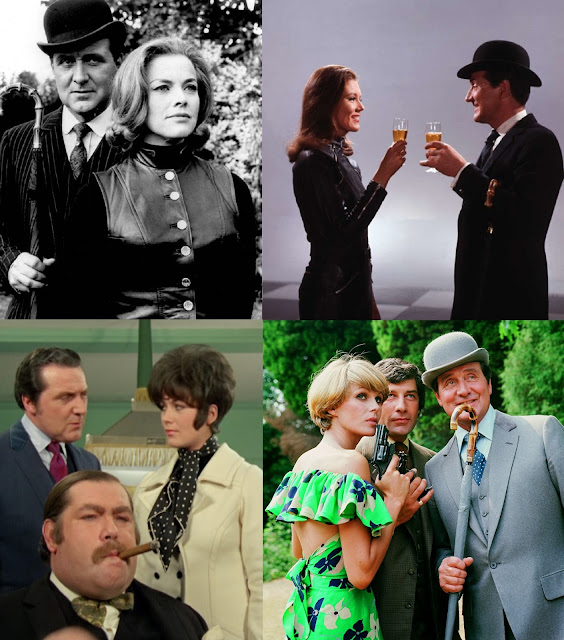
The Avengers – A man with a bowler hat and a woman who throws men over her shoulder
Now you can skip to the selections below and start watching, really, but if you want more about one or the other, you could say that both series revolve around a mysterious, flamboyant figure who tempts you from our world into a strange one off to one side, and that neither carry guns or take themselves as seriously as their mission…
Who is the Doctor?
When the current Doctor, Jodie Whittaker, fell to Earth to play the role for the first time, I wrote So Who is The Doctor Anyway? All You Need To Know About Doctor Who, but, again, the TL;DR—
The Doctor is a traveller in time and space who goes anywhere, from Earth’s past, present and future to alien worlds and stranger places still. The Doctor obeys no authority but their own moral sense, uses intelligence rather than violence, and takes joy in taking friends to explore the wonders of the Universe.
Doctor Who began in 1963 and has run ever since in one medium or another, but most prominently on TV through the following three decades and then again ever since 2005 – and back this very Saturday for New Year.
Who are The Avengers?
“The Avengers is about a man in a bowler hat and a woman who flings men over her shoulders.”
…said Patrick Macnee, Steed, and I can’t say better than that, can I? Or as a famous American trailer told us, that extraordinary crimes have to be avenged by agents extraordinary – John Steed, top professional, and his talented amateur partners – The Avengers. Together, they fight diabolical masterminds. Steed is a shady arm’s-length government agent whose gorgeous old-fashioned suits and bowler are almost as wilfully anachronistic as the Doctor, while The Avengers’ own version of time travel is to pair this seemingly conservative continuing lead with a series of intelligent, capable, confident, experienced and physically combative women that broke the TV mould and created the future (and several excellent men, but none so memorable as Steed or The Avengers’ women). Steed is more casually ruthless than the Doctor but just as playful – winning as often as not through outrageous cheating, while the only rule his partners break is gender. A brilliant balance of suspense and silliness, bizarre mysteries, and more than any other crime-fighting / spy-busting duo, they do it for fun. The Avengers is a secret agent series, a comedy-thriller, occasionally sci-fi, riding old-fashioned Britishness and Swinging modernity with equal excitement, its greatest genius to make all the women ahead of their time and the man from a bygone age, a fantasy of Britain with Steed playing on the swings at the heart of Avengerland.
The Avengers began in 1961 and ran through to 1969, along the way becoming the biggest ever hit British show on primetime US TV just as Doctor Who became a hit in dozens of countries, then returned as The New Avengers in the mid-’70s and, like Doctor Who, still lives on in Big Finish productions.
Both much more strange and interesting than almost any other TV series, both sometimes very funny, sometimes sinister, it’s no surprise that The Avengers is the closest show to my heart than any but Doctor Who. Several writers worked on both – and several plots found their way from one series to the other, with cross-fertilisation apparent as early as Sara Kingdom, the Doctor’s high-action, leather-suited companion in The Daleks’ Master Plan – but it’s the actors who really stand out. Avengers Honor Blackman, Diana Rigg, Gareth Hunt, Patrick Newell and Joanna Lumley all had Doctor Who roles too. The Third Doctor, Jon Pertwee, wasn’t just the most Earthbound but had his own The Avengers part, as did the Master, the Rani, and no fewer than three First Doctors (yet not the original). The guest artists appearing across both series are too many to list, but you can find actors from The Avengers and The New Avengers even well into this century’s New Who – most notably Bernard Cribbins and Diana Rigg, but also the likes of Christopher Benjamin, Lindsay Duncan, Roy Marsden and Stephen Moore (and more).
If you’re a Doctor Who fan looking for an excuse to be enticed into The Avengers, here are a few recommendations that stand out. Not necessarily the best, nor all my favourites, nor the most quintessentially The Avengers, but a selection box of flavours you might just recognise…
Doctor Who Stars in The Avengers
From Venus With L💘ve (Mrs Peel – IN COLOR)
The Brigadier, but not the one you’re expecting: he’s Jon Pertwee!
Plus other Doctor Who guest stars from as early as the very first story in 1963 (Derek Newark) to The Eleventh Hour in 2010 (Arthur Cox), and of course The Crimson Horror’s Diana Rigg as Mrs Emma Peel.
This was the first colour episode of The Avengers to be transmitted, and like Doctor Who’s first colour story, Spearhead From Space (itself packed with Avengers crossover actors), this is shot gorgeously all on film, goes down to Earth but not quite the world as we know it as our heroes – the eccentric dandy in the vintage car and the fantastically overqualified, caustically sharp-witted scientifically accomplished woman working for a mysterious secret agency – investigate an alien invasion…
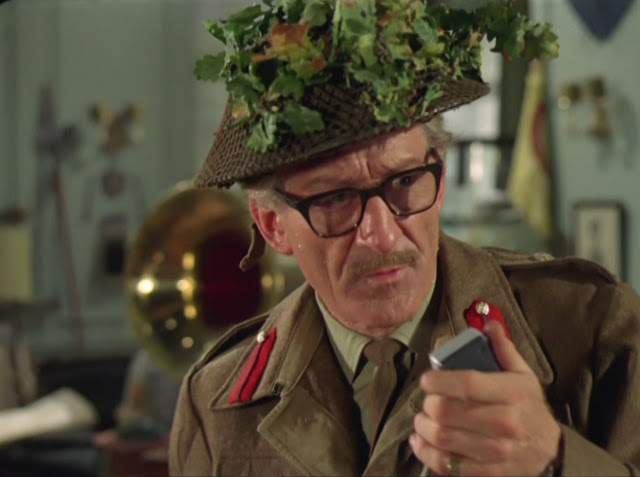
The Eagle’s Nest (The New Avengers)
In which movie Dr. Who Peter Cushing is delightful, in almost the same moustache!
He’s so much nicer than his Frankenstein, despite this role having crossover appeal to that too (and still more to Doctor Who – The Brain of Morbius, starring multiple-Avengers’ Philip Madoc).
This episode introduces Joanna Lumley and Gareth Hunt as The New Avengers, and for Doctor Who side-leads also gives us a minor role for the lovely Trevor Baxter, famously Professor George Litefoot. Slightly disappointingly, Litefoot gets an unrewarding role in a good episode, while Jago has a rewarding role in weak ones: Trevor Baxter’s partner in Jago & Litefoot, Christopher Benjamin, is probably the best thing in three different indifferent Avengers episodes, of which the best is probably Split! (which also stars the superb Julian Glover).
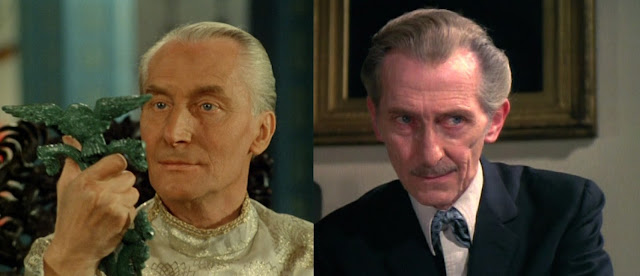
Return of the Cybernauts (Mrs Peel, Colour)
In which movie Dr. Who Peter Cushing is not delightful at all, but full of sinister charm.
With Frederick Jaeger, Fulton Mackay and of course the Cybernauts, of which more later.
Legacy of Death (Tara King)
Among many villains (and several Doctor Who guest actors) one-time third First Doctor Richard Hurndall.
This one’s a parody of The Maltese Falcon written by Dalek devisor Terry Nation (with a hint of Davros). He also sends up his own Daleks, not entirely successfully, in Thingumajig, while his Invasion of the Earthmen has an absurdly ambitious satirical concept not done all that well but does manage to anticipate The Sontaran Stratagem and even (briefly) the Sontaran design. But if you’re looking for a really excellent Terry Nation The Avengers, go for Take Me To Your Leader – despite the title, that isn’t very Doctor Who at all, but it is fast, stylish and hugely entertaining.
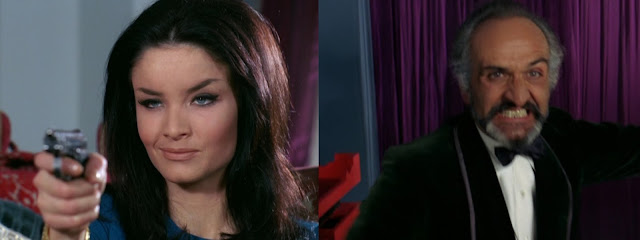
Stay Tuned (Tara King)
The story looks like a time loop… Could it be something to do with two evil Time Lords brought together (if only briefly sharing the camera) long before The Mark of the Rani – the Master and the Rani, Roger Delgado and Kate O’Mara!
Look – (Stop Me if You’ve Heard This One) But There Were These Two Fellers… (Tara King)
The wonderful Bernard Cribbins! He’s just turned 93 this week, and you can see this one on ITV4 on Monday 3rd January at 8.30am (he’s also in The Girl From Auntie).
But that’s not all – this outstandingly fun episode is written by Doctor Who writer Dennis Spooner and has several other crossovers from John Woodvine to John Cleese.

Dressed to Kill – Anneke Wills & Steed in fancy dress; Look – (Stop Me…) – Bernard Cribbins & Steed in a paper-strewn mess
Dressed to Kill (Cathy Gale)
Another topical episode as I write: this is a tale of the New Year, so one for tonight!
And among several fabulous guest stars is Doctor Who companion-to-be Anneke Wills.
Mission… Highly Improbable (Mrs Peel, Colour)
Not quite the Brigadier but a similar sort of role for Nicholas Courtney, with bonus Kevin Stoney – in between the two of them being on opposite sides in Doctor Who’s The Daleks’ Master Plan and The Invasion (though in the end they’re given quite small parts).
The Avengers Plots in Doctor Who
The Morning After (Tara King, though in this Steed’s mostly paired with Peter Barkworth)
This terrific, eerie, stylish adventure is immediately recognisable as a much crisper prototype of the more political Invasion of the Dinosaurs, though in this one the big, roaring monster is BRIAN BLESSED!
The Mauritius Penny (Cathy Gale)
Written by Doctor Who authors-to-be Malcolm Hulke & Terrance Dicks, in which a tiny thing spirals hugely out of control and eventually into a plot that echoes later in Doctor Who – Robot. Though it gets even bigger there.
Man-Eater of Surrey Green (Mrs Peel, B/W)
The most infamous of all, as most of this plot sprouts again in The Seeds of Doom. Although it’s also fair to say that both borrow quite a bit from Quatermass…
Doctor Who Cameos in The Avengers
Death at Bargain Prices (Mrs Peel, B/W)
Featuring André Morell (more bonus Quatermass), T.P. McKenna, John Cater and Peter Howell, but this exciting adventure with a department store most strikingly sees Diana Rigg arranging toy Daleks.
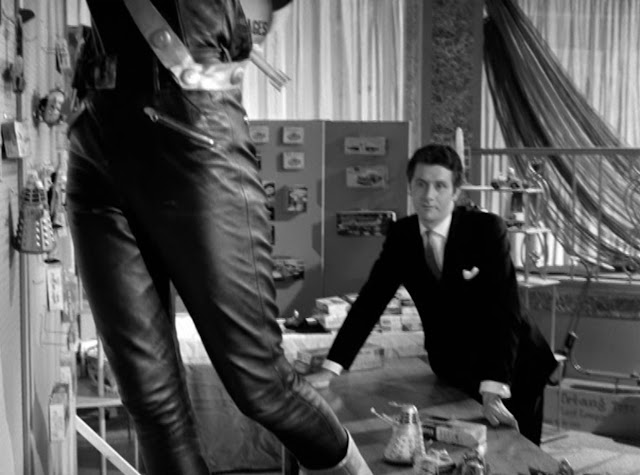
I know what the male gaze wants… Daleks. – Death at Bargain Prices
Target! (The New Avengers)
Gasp at repeated cameos for a shockingly abused TARDIS in The New Avengers’ most iconic (if not most logical) episode. Featuring many familiar faces and the worst Doctor in the world (medically), Target! is written by former Doctor Who Script Editor Dennis Spooner and is almost a doppelgänger for the previous year’s Doctor Who – The Android Invasion, written by former The Avengers Script Editor Terry Nation. Even the very first episode of The Avengers, Hot Snow, has a pre-Doctor Who police box in a rainy film insert in its surviving quarter-hour.
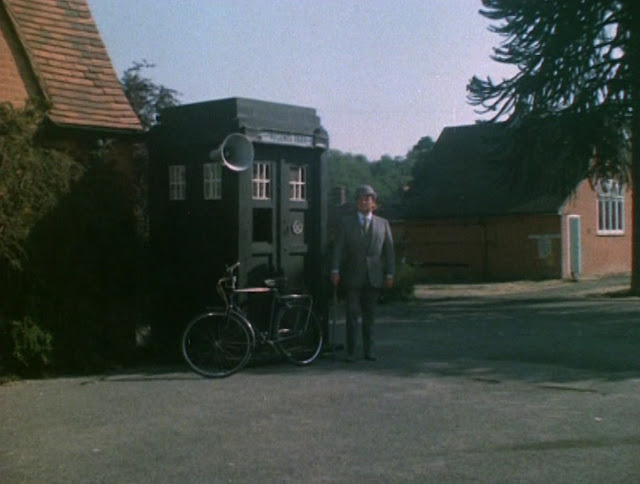
Target! – a police box stands on a village corner, John Steed at its side.
The House That Jack Built (Mrs Peel, B/W)
Before the police box exterior in Target!, an old-fashioned exterior hides weird ultra-modern corridors with what seems to be a super-sci-fi central control console. If the titular House That Jack Built isn’t a TARDIS… I like to imagine the villainous Professor Keller let the Master have his identity for The Mind of Evil, and the Master let him borrow his TARDIS to get at Mrs Peel in return. If ever The Avengers consciously borrowed from Doctor Who, this is it…
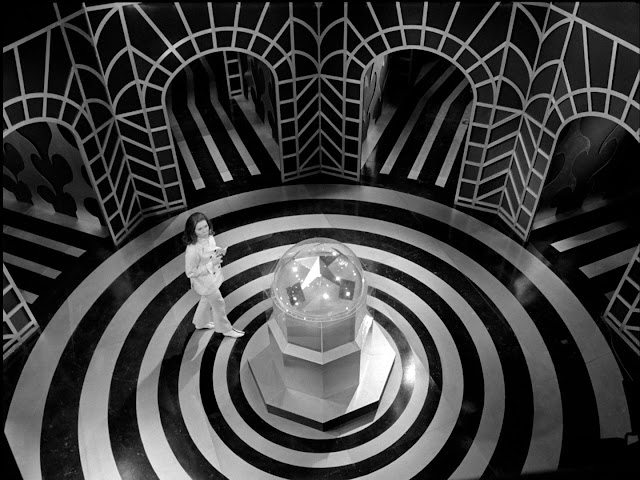
An Eccentric Array of Doctor Who-interest The Avengers Episodes
The Cybernauts (Mrs Peel, B/W)
…While this most sci-fi of all The Avengers conspicuously influences Doctor Who from the obvious Cyber-monsters through The Web of Fear and Spearhead From Space to Terror of the Zygons, with an abundance of familiar actors as a bonus (Michael Gough, Frederick Jaeger, Bernard Horsfall, Burt Kwouk, John Hollis, John Franklyn-Robbins…).

The Cybernauts – a blank-faced metal Cybernaut (brilliantly disguised in dark glasses, coat and hat). Smashing!
The Positive Negative Man (Mrs Peel, Colour)
It’s not so much the plot here that turns up in Doctor Who as many individual images; with its mysterious stalking figure that kills with one touch, or burning files in a safe, not to mention people being ‘magnetised’ to an antique car, I wonder who was watching a repeat of this one evening while working on The Ambassadors of Death.
The Gravediggers (Mrs Peel, B/W)
A Doctor Who writer in Malcolm Hulke and not just several Doctor Who guest stars but even two from half a century later in New Who (Diana Rigg and Steven Berkoff). Not given much to do here but a particular favourite of mine, this is The Avengers with the fabulous Wanda Ventham, who guest-starred in Doctor Who stories in 1967, 1977 and 1987, and I have to say New Who seriously missed out by not casting her in 2007 and 2017 too.
The Wringer (Cathy Gale)
See Doctor Who producer-director-to-be Barry Letts when still an actor! Plus, amid several Who actors, mind-melting Terence Lodge makes me feel this is a little like The Macra Terror.
Quick-Quick Slow Death (Mrs Peel, B/W)
Strictly Avengers by Robert Banks Stewart, who later wrote two of the most Avengers-adjacent Doctor Who adventures in Terror of the Zygons and The Seeds of Doom.
The Town of No Return (Mrs Peel, B/W)
Introducing Diana Rigg, whose Doctor Who – The Crimson Horror features an explicit plot lift from this, and for me the first seven minutes of this are the ideal introduction to The Avengers. Plus the first of many appearances by Patrick Newell.
Escape in Time (Mrs Peel, Colour)
And finally – ish – not just guest-starring Geoffrey Bayldon, on audio the fourth First Doctor (or minus-oneth, or… well, another one, anyway), not just one of my favourite Avengers guest villains in his biggest role (Peter Bowles, who crosses over to The Sarah Jane Adventures many years later, just as Murray Melvin goes from the very first Avengers episode to an enigmatic enemy in Torchwood), not just one of the most vividly enjoyable escapades in Avengerland, but the one with time travel!
Or is it?
Though these are the ones that most stand out for me, you can find Doctor Who connections in dozens more of The Avengers. The Curious Case of the Countless Clues stars Edward de Souza, the only TV Doctor Who lead in a story with no Doctor at all; All Done With Mirrors and Angels of Death feature Dinsdale Landen, but in which is he as villainous as Fenric? Fog is as mock-Victoriana as The Talons of Weng-Chiang, even down to Patsy Smart’s crumbly Cockney, while The Enemy of the World borrows wholesale from The Living Dead. And I’ve somehow not paid enough attention to some of my very favourite Doctor Who villains who cross over as some of my very favourite The Avengers guest stars (and villains – or are they?), so three each for:
- Julian Glover – Pandora, The Living Dead, Two’s A Crowd
- Philip Madoc – My Wildest Dream, The Decapod, Death of a Batman
- Peter Jeffrey – The Joker, Game, House of Cards
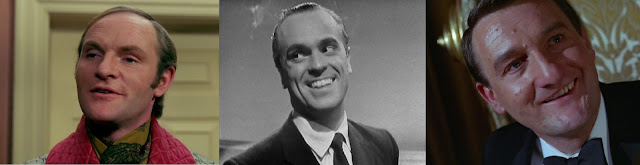
The Three Villains (or are they?)
Or… Doctor Who Stories to intrigue The Avengers Viewer
Spearhead From Space (Third Doctor)
I’m mainly assuming all this is most likely to be read by people more familiar with Doctor Who than The Avengers, but for the other way round, this is a great place to start. As I said above, this is about as The Avengers (and as Quatermass) as Doctor Who gets, with crossover actors, a flamboyant Doctor and a brilliant woman lead, and where the sinister countryside should have a sign up saying ‘Twinned with [From] Venus [With Love]’.
The Seeds of Doom + City of Death (Fourth Doctor)
The Seeds of Doom is the most infamous homage, with a mean green* menace from outer space, a millionaire plant obsessive with a murderous chauffeur, and even a scene-stealingly fabulous eccentric elderly lady. But I’m going to go against the tide and say that while it may be very Avengers on paper (from Avengers writer Robert Banks Stewart), the stylish, powerful direction means it doesn’t feel like The Avengers at all. It’s the closest Doctor Who comes to The Sweeney. So I’d pair this with its opposite: between them brutal The Seeds of Doom and witty, arch City of Death are the tonal extremes of Tom Baker’s Doctor, and while the plot has little of The Avengers, City of Death has an insouciantly Avengers mood and even Villainous Julian Glover.
*Technically black and white in The Avengers
The Web of Fear + The Mind Robber (Second Doctor)
Similarly, take one story with terrific filming and robots exchanging great, smashing blows from The Cybernauts (and guest-starring part-time Avenger Jon Rollason), add another with fabulous Op-art sets and surrealism (featuring the most Avengers fight for any companion), to find Doctor Who being quite Avengers-y between them.
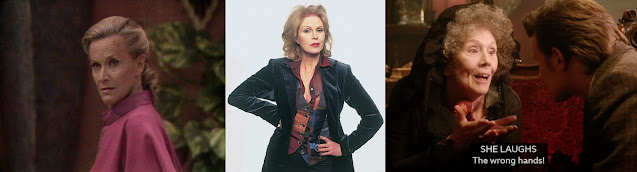
The Who Avengers!
The Crimson Horror (Eleventh Doctor)
Villainous Diana Rigg! Who could ask for more? With a diabolically The Avengers sort of plan a hundred years early and a fake-out with a gramophone borrowed from her first The Avengers episode.
The Trial of a Time Lord – Terror of the Vervoids (Sixth Doctor)
Guest-starring Honor Blackman as Professor Lasky, almost as intelligent as Mrs Gale (though to be frank both her judgment and her outfits are far better in The Avengers).
Planet of the Spiders (Third Doctor)
Gareth Hunt as a pre-The New Avengers bit of rough. Also starring (in thrilling stunt chases) Jon Pertwee from The Avengers – From Venus With Love.
The Android Invasion (Fourth Doctor)
Terry Nation writes by far his most The Avengers Doctor Who script in tone, with a mysterious village and the Brigadier replaced by Mother (Patrick Newell). And yet a completely different story is titled The Androids of Tara (though that one’s much better, even more entertaining, and stars Villainous Peter Jeffrey).
Robot (Fourth Doctor)
Terrance Dicks borrows just some of his The Avengers story The Mauritius Penny, the Doctor and Sarah Jane are as witty and wonderful a pair as you could wish for, and Harry disguises himself as Steed. And both Steed and the Doctor formatively fight fascists.
The Stones of Blood (Fourth Doctor)
Though Honor Blackman turned down a role in this one, we still have fabulous women, including an icily amazing Time Lady who’s the Doctor’s equal, and like so many Avengers it could be subtitled ‘Escape From the Country’ (the villain has chosen to escape to the countryside, which just proves it).
The Curse of Fatal Death (The Many Doctors)
A Comic Relief spectacular in which the ultimate Doctor is Joanna Lumley.
Pick one, dive in, and enjoy!
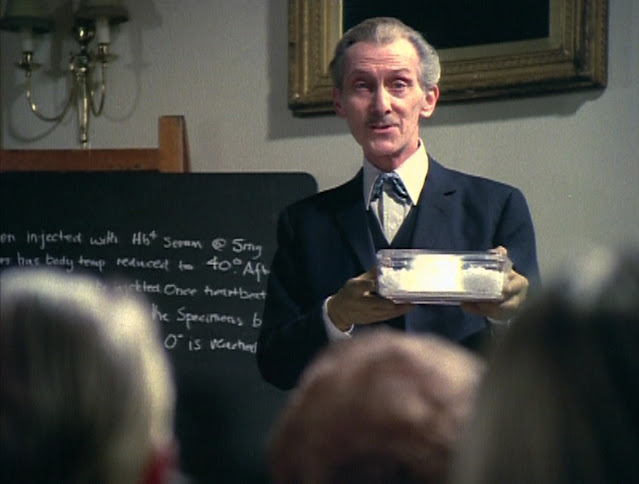
This was partially inspired by the lovely Roy Gill’s #AvengersWho Twitter thread at the beginning of the year, mashing up The Avengers / Doctor Who story titles. I particularly enjoyed his ‘Castle De’Ath To The Daleks’ and ‘The Hexapod’, Elliot Chapman’s ‘Dial a Deadly Assassin’ and Brendan Jones’ outstanding ‘You Have Just Been Pulverised Into Fragments And Sent Floating Into Space And In My Book That’s Murdered’. I added ‘Doctor Who Was That Woman I Saw You With’ and ‘Rise of the Cybernauts / The Age of Steed’, but then took eleven months to think about this more detailed contribution.
Update: Daniel Blythe brilliantly calls my attention to a fourth First Doctor (technically the third?) in The Avengers, as Frederick Jaeger plays a character who becomes the Doctor for a time in Doctor Who – The Savages.
Labels: Doctor Who, Honor Blackman, Jago & Litefoot, Joanna Lumley, Julian Glover, Peter Jeffrey, Philip Madoc, The Avengers, The New Avengers


Friday, February 27, 2009
The New Avengers – Dead Men Are Dangerous
“The only thing that can’t be replaced is the love and life of an old friend.”It’s been an interesting week for slightly or very off-beat programmes on TV, whether you call them comedy-thriller, sci-fi, fantasy, horror… I can never quite warm to the artificial umbrella of “telefantasy,” can you? Anyway, last Sunday we had the gripping penultimate episode of Being Human – a striking series that defies categorisation, and which I’m pleased to say has this week been recommissioned. Demons, on the other hand, had just one episode that hit the mark (the one with Mina’s vampire son) but several that were just rubbish, and after nosediving ratings ITV have this week cancelled the series. It should have been better, but the right series will be back.
Less off-beat – unless you count the distracting ‘Ooh, which Tory MP is that weirdly made-up actor of a cast of thousands meant to be? And why, with all the people they got right (Geoffrey Howe was uncanny), did they mess up John Sergeant so badly?’ effect – was last night’s Margaret, which I found rather gripping and even made me feel a twinge of sympathy for her. I can still remember exactly where I was when I heard the news of her fall, and who I was with; a Green who I’ve not seen for many years and a hard right Tory who shed a tear, then had a brief moment of rejoicing when news broke that John Major was to stand as the continuity Thatchianity candidate (within months he was snarlingly calling him a “bloody social democrat”). That second chap’s a Lib Dem these days… Still, looking back at that time, House of Cards still knocks spots off Margaret.
For me, though, the really stunning shows this week have been in the repeats. On Tuesday, ITV4 showed The Prisoner’s finest hour, Dance of the Dead, with its intricate plotting, insane ending and commanding Number 2 (though they mucked up the transmission); on Wednesday, ITV3 showed Robin of Sherwood’s greatest episode, The Greatest Enemy. The last half of that is still one of the most compelling and moving TV experiences I’ve ever had, and like Dance of the Dead – and unlike most ‘action’ shows where death is common but disposable – it’s an intelligent meditation on death. So, too, is The New Avengers’ Dead Men Are Dangerous with its lingering death and killer nostalgia, beating Dance of the Dead for twisty foreboding and vying with The Greatest Enemy for elegiac tragedy, all making three very fine series which have each had their very finest stories repeated within a few days of each other, remarkably. Next Friday (concluding the Monday after), as it happens, BBC3 is repeating the best story since Doctor Who returned to the screen in 2005. Human Nature is more about love than death, though death and, particularly, war still come through.
But back to tonight, and the main thing that comes to mind is that Patrick Macnee is simply outstanding in this story; funny, gentle, wounded, authoritative, even athletic – he’s lost some weight between seasons and looks really good on it, and he’s extraordinary whether standing mourning his destroyed memories to sombre brass or dashing desperately through the woods to trace a chilling loudspeakered message. His old friend turned jealous enemy Mark Crayford is an equally brilliant performance by Clive Revill, though Mark’s bitterness offers fewer layers for his character. The episode hinges around their two gripping face-offs, beginning and ending the story, each stolen by Steed’s heartbreaking reply to Mark’s challenge.
After so many New Avengers episodes in which an old friend of Steed’s lurches in and dies on the carpet, to be avenged by our heroes through the rest of the story, Dead Men Are Dangerous both gives that recurring theme its finest ever treatment and turns it on its head: while for once you can genuinely believe that Mark was Steed’s oldest and best friend, this time the old friend is dying because Steed shot him (reluctantly but efficiently, as you’ll see in the opening scene), and his death is to be avenged not by the Avengers but on them. It’s an especially fine use of the top Avengers cliché ‘a dead man who isn’t dead’, too, with a twist to that as well…
I love Dead Men Are Dangerous so much that I would love to spend hours on my usual sort of long, discursive review to tease out every subtle moment. And the ones with Gambit. But I’m having a bit of a time today – though not as much as Steed, obviously – so I’m having to write rather more quickly. Were I writing a longer review, there are all sorts of issues that I’d be discussing in detail. Instead, I’ll mention some of them to whet your appetite and see what they prompt you to come up with when you watch it:
- Several of what I regard as absolutely the finest Avengers stories feature an Avenger under some horrendous pressure targeted at them in particular; a strong element of this story, however, is that Steed has his friends around him, so he’s less isolated than Mrs Peel in The House That Jack Built or Tara King in Pandora.
- After getting hooked on The Avengers through intermittently catching Channel 4’s 1984 repeats, a couple of years later I spotted a few New Avengers slipping through the schedules (probably on ITV, as late-night schedule-fillers). Back then, I was still at school and could afford very few video tapes – usually just enough for Doctor Who – and so I only ever recorded two episodes of The New Avengers, both of which I watched repeatedly. Fortunately, this was one of them.
- This builds on and perfects various elements and themes seen in several previous New Avengers stories; I could, for example, make a list of incidental similarities as long as your arm with the rather fine House of Cards (how many can you spot? And, no, it’s not the Ian Richardson one I mention above), while thematically and plotwise it’s very similar – though far superior – to the rather disappointing To Catch A Rat.
- This was the first episode of the second series of The New Avengers, and despite building on what came before it has a very different tone; you’d expect the second series to feel very different from the first. In fact, it does, but not in a good way. Unfortunately, as well as being strikingly better than any episode from the first thirteen, it makes the remaining twelve from the second year look even worse than they are – a few are serviceable (next week’s is OK) but, on a steep decline from here to the end, some of them get pretty bad.
- There are some splendid guest stars, including Gabrielle Drake (that woman in the purple wig from UFO), Trevor Adams (that great bloke from The Fall and Rise of Reginald Perrin and Fawlty Towers, with my old name) and, of course, the extraordinary Clive Revill as the villain – who you may remember as one of the earliest Babylon 5 villains (sadly not in the one where a main character’s dying old enemy devotes his last days to getting even) and as the man who played Emperor Palpatine before Ian McDiarmid did, despite Mr Lucas later airbrushing his performance from The Empire Strikes Back.
- Steed, Gambit and Purdey are all superbly characterised and in each case we learn something new about them; each also reveals something about their tastes in alcohol. Steed’s is as refined as ever, but poor Mike evidently stretches no further than lager and the occasional stout, given that he thinks Purdey’s vodka and lemonade is a new invention. In fact it is, but neither because of the lemonade nor the vodka, but thanks to Purdey being rather more creative than that.
- Though I often wince at the sexual politics in The New Avengers, this has rather a mature and lovely three-cornered relationship between the leads, despite one of Gambit’s more unconvincing ‘conquests’ (at least the situation’s so absurdly improbable you may laugh)… But it also, unusually, has a touch of a very ’70s sort of homophobia – like the otherwise entertaining Carry On Abroad, it’s from a time when they could now feature a minor character who the audience will recognise as gay, but only because ‘they’ are swishy, weak, dishonest and generally unreliable (I once wrote a psychology paper about that). Here, improbably, there’s a fey gay thug. On the other hand, he isn’t too distracting, it could be more in the actor’s and dresser’s interpretation than in the script, and it may be there to distract you from the more subtle but far more powerful homoerotic undercurrent between the villain and Steed. As a hint to Mr Crayford’s character, listen to the James Bond theme Goldeneye.
- And Purdey offers a suggestion for Steed’s one and only failing, though in the villain’s eyes his one and only failing is in fact…
Instead, I’ll finish with a word from someone else. I usually enjoy Cornelltoppingday’s The Avengers Dossier (originally published and pulped as The Avengers Programme Guide), but I very often disagree with them, not least on my favourite episodes. Just this once, though, our tastes converge, and their review puts it beautifully. If you ever chance across a copy of the book, do pick it up, but if you can’t find it, here’s a sharply edited extract:
“This is by far the best episode of The New Avengers. The difference is in the fondness with which it’s written… Steed and Purdey have a bittersweet relationship with real heart. But mainly this is Steed’s story. The damage done to his property is horrifying, but he doesn’t care a jot as long as the people he cares for are safe. It’s all rather wonderful, and is written with a nostalgia and grace that could have got the show another season if this had been the new format. Very special.”
Labels: Being Human, Conservatives, Joanna Lumley, Reviews, Robin Hood, Star Wars, The Avengers, The Avengers Season 4, The Avengers Season 6, The New Avengers
Friday, January 30, 2009
The New Avengers – Sleeper
“We have made exhaustive tests.”Anyway, the plot is, Steed, Gambit and Purdey all happen to be staying in London overnight – even Steed, who in this iteration of the series has a stud out in the country to which he normally repairs – and it turns out they’re all in the very part of London seeded by sleeping gas (well, apparently it’s really a fine powder, but the effect’s much the same) S-95, which gives every single person in the area a longer than usual Sunday morning lie-in. Everyone, that is, save our three stars and the coachload of gun-toting gangsters who’re running around the city looting all the banks (or, mostly, wandering aimlessly). That’s pretty much it, save for our heroes – wait for it, spoilers – foiling the dastardly plan.
“Exhaustive tests on rabbits. People aren’t like rabbits.”
“Oh, I don’t know. Uncle of mine sired nineteen children. He was a keen bicyclist.”
Given that the story’s so slight, it’s mostly made up not of complex plotting but of moments of character, humour and style. Fortunately, the director’s got quite a lot of style, and so has Joanna Lumley – Purdey is today’s featured Avenger, starting off by ineptly locking herself out of her flat but then becoming the lead character for most of the episode. And she’s terrific. Look out in particular (or listen out, I suppose) for all the scenes with the radio on, like Steed and Gambit rushing to the rescue of a radio drama and, even better, Purdey in an exciting car chase as she swerves around town in a stolen mini, the sleeping owner flopping about next to her, crooks with machine guns roaring after her, while she’s coolly doing the exercises to an absurdly posh wireless-wake-up-with-torture woman. Superb. Then once she’s out of the car… Boy, can she run.
The Eroticism of Pyjamas
Others, of course, will mainly remember an unarmed (but ready to high-kick) Purdey hiding from her pursuers as a shop window dummy, at which point her pyjama pants fall down. Still, Joanna manages to carry it off without losing her cool, her blue pyjamas are hugely more stylish than her nasty floral frock of the day before, and her fighting her way out of the shop afterwards showcases her brilliantly. And if you think that element of sexuality’s a bit off, this is also the episode where you can catch a bizarre level of homoeroticism among men who you really wouldn’t want to. Not only does Steed inviting himself for a nightcap at Gambit’s flat frequently seem like he’s trying to chat Gambit up, but the villain’s apparently chatted up by Dr Graham early on, too (and do note that, while he and his group of hilariously over-tooled-up machine gun and bazooka-wielding macho thugs have no compunction about murder, he doesn’t kill the doctor to preserve his secret, but merely knocks him out… And throws him a single rose). At least, when a scene turns up where Gambit’s pyjamas feature, it’s both mildly amusing and gives him points for not wearing any.
Update: Richard, on watching late tonight, is struck (right between the eyes) by the full day-glo glory of Gambit’s décor: “I kept a man here for three weeks. At the end of it, he could never look at a lime again.”
The story’s other main stylistic touch is in all the eerie views of a deserted London. Almost the whole story’s shot on location, and in the grimy ’70s it does sometimes seem like a cross between The Sweeney and Survivors, with urban shooting meeting the feel of apocalyptic disaster stories. It looks great, though, with only a few exceptions – notably, the unbelievable night-time scenes shot in full day, without even a half-hearted filter on the camera, for lines such as “It’ll be light at four forty-five” (you scream, it’s light now!), intercut with scenes of genuine night supposedly taking place at the same time. And then back again. Such little details can really sabotage a production, just as – living in London – I find it difficult to believe in just one police car crossing the ‘border’ to find out what’s happening in the nation’s silent capital, or the mind-boggling take on London geography that, for example, places the Post Office Tower in Tower Hamlets.
The Morning After That Came Before
Unfortunately, it’s not just the few miffed details and skimpy plot that let down a generally quite well-mounted story. My big problem is that The Avengers has already done the same story, and done it very much better. Eight years earlier, our heroes are knocked out by sleeping gas, coming round a day later to find the small town they’re in mysteriously deserted. Setting out to explore, they find the army gunning down “looters” and a plot involving nuclear blackmail… Yes, I’m afraid The Avengers – The Morning After does indeed have more thought, mystery, layers, tension, twists and does just about everything better than Sleeper does – despite being written by the same author. Though the scale is bigger in 1976, the ambition is much, much smaller, both of the story and the villains’ plans, our heroes (and the viewers) know from the start what’s happened, there’s no murderous betrayal by authority and consequent threat from all sides… While in The Morning After, too, from The Avengers’ much less ‘realistic’ days, sealing off a small town took several truckloads of soldiers and a huge public information campaign, here sealing off a large portion of London can be done with a group of people from just one coach. In the intervening years, even Doctor Who had done the same story, with lots of soldiers again and added dinosaurs, in 1974’s Invasion of the Dinosaurs (over which one might draw a discreet veil for many of the visuals, though it has some thought put into it). So it’s a bit of a shame for it to be so familiar, but to have so much less in it. It’s not bad, you understand, but frustrating when it’s mundanely recycling one of The Avengers’ strongest episodes.
Though it’s quite a shallow tale, you’ll also find Sleeper has quite a few ’70s concerns that are still live today, not that it treats them in any great detail: the S-95 ‘gas’ has been developed to knock out terrorists instantaneously (and magically, as one helicopter pass can put a densely populated city to sleep without a single exception, regardless of volume, wind currents or closed windows); after that mention, we’re primed to think that the looters look very much like terrorists of the time, act like terrorists in their brutal machine-gunning lack of concern for life, have a bit of a Baader-Meinhof vibe in the youngish mixed-sex couple who run the outfit… But only rob enough banks to take a helicopter’s-worth, as if Brian Clemens decided to write hard-hitting ‘real world’ villains but then copped out and came up with a plot so sanitised it could crop up in a children’s book, as is the thought that a bunch of savage killers would be entirely trusting about their bosses flying off to Rio with all the spoils. In one of the funnier moments there’s another topical touch, too; when Steed and Gambit are working out what the looters’ targets are, Steed suggests no-one would bother robbing the Bank of England when the economy’s in such a state. One of the minor actors also has a later political theme: Gavin Campbell, to be of That’s Life and career-killing anti-Europe loonyism fame. And there’s CCTV, as the main villain warns his minions to keep their faces covered because the cameras won’t sleep. Obviously, he shows his face all over the place anyway, because, well, he’s the villain.
If You Value Your Life, Don’t Befriend Steed
Oh, and Steed has yet another closest ever, ever, ever friend get caught up in the plot and die a short way into the episode. I know this happened from time to time in the ’60s series, but The New Avengers takes it to absurd lengths in an attempt to drive home the ‘Avenging’ narrative; actor Neil Hallett, who played the best friend who died in last week’s episode, was Steed’s bestest and most doomed chum in an episode at the end of the ’60s, too, so he’s really unlucky. If you want to fit The Avengers into a coherent, ongoing story, best of luck (it makes Doctor Who seem seamless), but there are two possible explanations. Either Steed had a best friend who was killed in an early episode and then, with fine attention to detail but absolutely rotten luck, he worked out who the next-best was and ‘promoted’ him – and so on, and so on, down the line – and each time he works out who’s the best out of what’s left the swines happen to choose that week to kill the very chap, or Steed, always having had an eye to technological innovation (carphone in 1967, the first answering device on British television, mind-swap machine, and so on), invented Facebook forty years early and he takes it really seriously when all these people friend him. He’s a very polite chap (except with a ’phone); even when technically looting a pub because he and Gambit need a drink, he’s adamant that they leave a tip.
If I sound like I’m in two minds about this story, I suspect I am – because how much I enjoy it really depends on the mood I’m in. It’s fun but uninspired; nice to look at, but you really need to switch your brain off. And the move towards greater ‘realism’ rather than outlandish plots and villains means, ironically, that stories like this are less believable – outrageous details are easier to swallow than mundane ones that simply don’t fit with our everyday experience. Next week: spies live and spies die, but the dance goes on. Plus, for Blake’s 7 fans, the first of two appearances by Travis in as many weeks, and for Gambit fans (there must be one, surely?), after Purdey drops her trousers in tonight’s, next week Mike gets his kit off.
Labels: Joanna Lumley, Jon Pertwee, London, Reviews, The Avengers Season 6, The New Avengers
Friday, January 23, 2009
The Psychedelic Spy and The New Avengers – Faces
“Irreplaceable.”Doppelgängers were a staple of ’60s and ’70s series whose feet left the ground, especially science fiction or the more outré spy thrillers – and with The Avengers crossing the boundaries between both of those, with comedy, fantasy and more besides, it’s no surprise that the series had a go at the subject more than once. Two’s a Crowd did it as cod le Carré for Mrs Peel (and there’s a touch of it in her Who’s Who??? and Never, Never Say Die, too), while Tara King’s They Keep Killing Steed may just give you a hint as to which character is copied multiple times. The two that try for the most ‘realistic’ approach, however, are the best of them. Back in 1963, Man With Two Shadows pitted Cathy Gale against Steed, both when one of his associates tips her off that he’s a fake and when he’s shown at his most ruthless with the real doubles. More incredibly, Faces relies much further on coincidence, recovering slightly with talk of plastic surgery and a story spread over a five-year time period, but really succeeds in its intercourse between the regulars. There’s also arresting direction, and among three well-characterised villains you’ll find Edward Petherbridge, later to find fame as Lord Peter Wimsey. Oh, and before I go on with my usual spoilertastic analysis, have you got this week’s Radio Times? Ignore what it says. It’s not a spoiler, just almost completely wrong.
“I’d better have a word with him. Pull him back into line.”Like several New Avengers episodes, the opening scene’s set some years – five, it turns out – before most of the rest of the story. Unusually, this is without clearly identifying it as such, and the strong implication’s that the main part of the episode takes place over a period of weeks, if not months. Though neither script nor direction express that as well as they might, it gives the story added weight and credibility, and the director gives it real force. Two tramps see an obviously wealthy man drive past, the spitting image of one of them; after what we infer is a period of studying him, the pre-credits sequence ends with one of the series’ most striking freeze-frames, as the rabbit-poaching tramp shoots an arrow into the wealthy double who’s diving into his own private pool. It may not be a subtle way of killing, but it gets your attention.
“And if he doesn’t?”
“Hmm. He’ll just have to be replaced, won’t he?”
I’ll fill in the rest later, having given you a taste; my beloved came in late from work after a hellish journey, so I’ve been ministering to his needs and cooking a big meal in an attempt to revive him. Now I’m a little sleepy on it, so I’ll finish once I’ve had a while to digest. Possibly Monday!
The Psychedelic Spy
And finally, a word on Andrew Rissik’s radio thriller, made in 1990, set very firmly in 1968, and broadcast in five parts this week on BBC7. If you missed it, it’s well worth tuning in on the BBC iPlayer; James Aubrey’s rather good as the lead, but ’60s legends Gerald Harper, Charles Gray and of course Joanna Lumley completely steal it.
I’ve been trying to work out in my head something to say about The Prisoner since Patrick McGoohan died last week – I fear it’s still in a bit of a tangle, but if you want to try unpicking the series yourself, it is of course being repeated twice every Tuesday on ITV4. It’ll only be four episodes in this week (depending on how you count them, which is trickier than it sounds), so the next one up’s as good a place as any to pick it up: Free For All is a relatively early episode, which means it explains some of the set-up, but it’s also the first to go utterly barking mad, so that gives you a flavour of what it can all turn into. This isn’t quite as much of a detour as it reads, as BBC7 has been repeating two of The Prisoner’s cousins. Each weekday morning at 9.30 they’re currently broadcasting Michael Jayston’s superb reading of Rogue Male, a 1930s thriller novel that’s a clear antecedent of Patrick McGoohan’s masterwork – it, too, has a magnificently egocentric lead character, a lone wolf at the top of his brutal profession, who’s trapped, repeatedly trying to escape, and persecuted physically and psychologically by anonymous servants of a mysterious service who want to find the purpose of his attention-grabbing opening action. And, of course, the starting point of The Psychedelic Spy is a top agent who resigns – only for his old bosses to try to bring him back in, sent against his will to a mysterious environment where no-one’s loyalties are entirely clear. With a lot of drugs.
The story is both an effective thriller in itself and a meditation on where the ’60s went sour, aided by a soundtrack including Jimi Hendrix, the Byrds and, most tellingly, the Who; the performances are uniformly excellent, the mood alternately grumpy and despairing, and the twists – all right. Look away to avoid spoilers, remember, as I turn to the outstanding actors. Robert Eddison, Michael Cochrane and Ed Bishop are all excellent as minor characters (particularly, I think, Mr Eddison’s fading old master of secret information), and James Aubrey’s rather good as Billy Hindle, the British secret assassin who wants out because he fears he’s turning into a psychopath. The first episode stars Gerald Harper, formerly Adam Adamant, as his manipulative boss Sir Richard Snark; no, with a name like that he’s not very nice, but he’s awfully good at it. The whole thing really gets going, however, when Hindle flies out to Temptation Island, run by dying charismatic genius Charles Gray and his glamorous wife Joanna Lumley. They are, in short, fantastic.
It feels very much like a ’60s thriller, not just for the stars but its mix of acid music, James Bond, The Prisoner, Callan and le Carré (with a dash of Apocalypse Now), but despite its quality, one aspect disappointed me. I think of women in thrillers being the ’40s and ’50s femmes fatale of film noir, or the powerful figures of the ’80s, or simply being treated much the same as the men since; the fact that my favourite series from the ’60s that can very roughly be described as a spy thriller is The Avengers has, I fear, rather spoiled me for a story like this that, in setting itself firmly in the feel of the time, pushes its women firmly into the background. So I admit I was disappointed as The Psychedelic Spy’s three significant women were one by one revealed to be much less interesting than I’d anticipated. In a very ’60s way, they are essentially pliant victims, and it’s notable that Hindle shags each of them. His rather drippy girlfriend whom he picks up after resigning, Marianne, was so utterly convenient that I assumed she was an enemy (or perhaps British) agent right until she was shot in his arms; I then instantly assumed, correctly, that she’d been the target rather than him, and probably at the order of either his ruthless employer or Joanna Lumley’s Tara (another Avengers name). Joanna’s performance is so magnetic – and, as she gives as good as she gets with Charles Gray and claims to be a very bad person – I assumed that she was an agent in her own right, probably responsible for the dodgy activities her husband’s implicated in. Again, I assumed that right up until the last minute… At which point it became dispiritingly clear that she was only there as unfaithful wife and then widow after all. The third woman in the story is Hindle’s ex, who’s disappeared while investigating Charles Gray’s character – our anti-hero characterises her as an evil, manipulative bitch, so I had high hopes that she’d have survived and be secretly engineering the whole thing. No such luck. It turns out, eventually, that she’s dead after all, leaving her undoubted abilities both of no use to the story and entirely framed by men who didn’t like her. I’d have liked us to meet her, instead.
The close is a little too neat – not happy, you understand, but missing a dash of ambiguity, as if what we hear in the final episode is the truth rather than leaving it likely to be another layer of lies – but still, despite being occasionally predictable and a let-down on some of the non-existent twists involving female characters I’d predicted in hope, it works on the whole. Oh, I’m underselling it now; I liked it. But you might want to listen when you’re on an upper.
Labels: Joanna Lumley, Michael Jayston, Radio, Reviews, Spies, The New Avengers, The Prisoner
Friday, January 16, 2009
The New Avengers – The Tale of the Big Why
Before the analysis and the spoilers, for the second week running, the most entertaining scenes include those of Gambit and Purdey zooming about the countryside. Again, he’s at the wheel, but this time rather than his talking about sex, it’s Purdey’s carnal lusts that drive their destination. She’s gagging for a meal, and dreams of Italian. Gambit, bless him, pulls up outside The Chef’s Hat, a roadside hot dog caravan. Purdey, not finding this what she had in mind, emerges from the car in a gold lamé cocktail dress and, in between bites of huge sausage sarnie (actually, I rather fancy one as I watch her), engages first Mike and then the cuisinier in conversation:
“Is this one of your favourite restaurants? I suppose you bring all your girlfriends here… Did he book?”The script’s fast-paced and, though simple in its story, quite complex in its plotting, so it’s to The Tale of the Big Why’s great advantage that Robert Fuest’s in charge, probably my favourite and almost certainly the most strikingly pop-art Avengers director. The story’s shot almost entirely on location, and illustrated with many striking images – justly the most famous is the recurring close-up of a beer glass used as chronometer, but it’s also perhaps the New Avengers episode most packed with chases. My favourite moments are probably of Purdey on her motorbike, zooming towards a great stunt in the pre-credits freeze-frame or popping suddenly into startling close-up, but there’s a lot more variation than that. Through tonight’s story, the vehicles move from a motorbike to an exciting chase with smashing cars (well, very ugly cars, actually, but they get smashed up), then lots of action with a crop-duster plane. Even Gambit gets a strikingly heroic moment facing off against it.
“Nah, he’s just lucky!”
The Regular Characters (and some familiar plots)
Though it’s not quite as light-hearted – there’s an unexpected death, which I’ll mention shortly so look away now if you want to avoid spoilers, which comes quite early on and has a particularly grim aftermath – this has a lot in common with the marvellous Avengers episode Dead Man’s Treasure. That’s more of a summery week off than this is, but both feature extended treasure hunts with remarkable numbers of participants on remarkable numbers of sides. Admittedly, Dead Man’s Treasure has many cryptic clues while The Tale of the Big Why features only one, but the near-eponymous racy Western The Tale of the Big Y is a doozy (despite our heroes’ cracking it rather depending on all aviators’ maps being identical).
The other story from the same stable that this week’s bears an uncanny resemblance to when looked at from the right angle is, as I mentioned above, the previous New Avengers episode, To Catch a Rat. On paper, you’d think this was shallower – there’s none of the genuine emotion of a wounded old spy recovering himself to take on his old enemy, but rather more of the jolly runaround. On screen, it comes across as having a lot more to it. While the actors injected considerable pathos into the last story, it moved very slowly and had very little to it to live up to its serious intent – you could have halved it to a 25-minute episode without losing anything very important, while this week’s all-action frivolity not only deserves its length but passes the time much faster. The chasing around the countryside has had far more thought put into it; there’s far more variety, of scenes, of characters, of vehicles; again, there’s someone emerging after years away to expose a traitor in the Department (one of the perennial New Avengers clichés), but this time the exposer’s corrupt, too, and swiftly dead, which is a real shock after last week’s weary dragging-out. The feel’s improved, too, by a Jazz-flavoured score with which Laurie Johnson is clearly more comfortable than the usual more noticeably ’70s style; though Cornelltoppingday dismiss it with “Porno Funk Music Factor: 10,” I’d say it’s far less dated than that, and I rather enjoy the jazzy ‘chasing around’ theme that accompanies Purdey’s bike and the odd other vehicle.
Though there’s a less powerful emotional core to the acting than Ian Hendry provided and the script is one of the last gasps at fetishising macho Mike Gambit, this story makes far better and more interesting use of the three leads, too. I’ve mentioned Purdey’s fabulous biker’s outfit and gold frock; Joanna looks great in a fairly practical red jacket and black skirt, too, so it looks like the days of the diaphanous dress (so handy for running in) are behind her. Nothing can save Gambit and most of the others, though. Anyway, not only is she better-outfitted, but her part continues to break out of the sexist trap the series’ initial set-up had consigned her to. She’s heavily favoured early in the story, with some fantastic bike work as she takes the lead, Gambit only following at a distance and mainly to report back to Steed at ‘home base’. Towards the end of the story, Purdey’s kidnapped so the two men will break and have to save the poor little girlie – sigh – but, again, that template’s swiftly broken, as Purdey gets hopping mad and, in a terrific scene, shows that she can beat the villains with both arms tied behind her back.
Steed, too, has a much better part this week – rather than kept back until virtually the last scene, he not only has much more to do back at ‘base’ but gets out towards the end, where he’s caught up in some splendid action sequences and has a great time exploring the wonders of nature (while tiring out poor Gambit). Given a far more dynamic role, he seems far more like the old Steed than in most of the previous New Avengers episodes. It’s not that he takes the lead as the action man – though, when two heavies come calling, there’s a great moment where he slaps a gun out of one villain’s hand, instantly punches him out, then repels another with his hat – but that he gets the space in the narrative to relax and enjoy himself. It’s how Steed should be: carefree in doing his job, serious in what he does but not how he does it. He’s perfect when sent to charm a lady and catch a package in his bowler hat, when performing a Holmesian piece of deduction in tracing a location through orchard crop-spray on a pair of boots, or when giving Purdey her moment at the climax with a typically off-the-wall distraction, and Gambit rewards him with absolute trust (when it matters). Amid a profusion of villains, it’s Steed’s attention to detail that captures the most important one, because he’s got almost as much of an eye for photos and guns as for antique doorknobs. We also spend time, for once, not in Purdey’s bedroom but in Steed’s palatial apartment and Gambit’s groovy pad, and to complete the set Gambit gets two action set-pieces towards the end (against a plane and a gun) which really work.
The Irregular Characters (and a deadly sin)
Although I’ve made it sound like it’s all rather fun, and it is, there are some serious undercurrents, particularly in the guest parts. Rarely, almost every new character in the script is working for someone different – themselves, for almost all of them, and so many of them chasing that it resembles Wacky Races – yet almost every one of them has the same motive: greed. It opens with everyone focused on Burt Brandon, a spy just about to get out of prison after nine years and all set to make a fortune, he claims, by exposing a secret at the heart of government. Played by George A Cooper in his third Avengers role, he’s an instantly recognisable actor (Mr Griffiths from Grange Hill) and so blatantly the centre of attention that it’s a real shock when he’s killed barely a dozen minutes in. This takes the viewer by surprise, not least because now it means that no-one knows what they’re looking for, nor where to find it: the chase becomes that much more unpredictable. And, of course, when Steed and Gambit finally unearth the ‘buried treasure’, it isn’t there, so even solving the clue of the pulp paperback doesn’t tell you who has the goods, let alone what the goods actually are.
The story’s main ‘villains’ are apparently Eastern Bloc heavies gone native – they’re communists who’ve turned capitalist, the power of all that money having turned their heads. And one of them’s a Conservative councillor into the bargain! Well, all right, that’s not strictly true, but a corrupt, communist, capitalist traitor Tory is believable, isn’t it? It’s not like we can’t all think of the odd crooked Tory with an extremist political past… No, no not that one – I’m actually thinking of the actor’s later role in The Vicar of Dibley. Yes, it’s him, isn’t it? That surprised you. Anyway, where was I? He and his nervous henchman ambush Brandon and kill him without actually intending to, as this means they can’t get the truth out of him; instead, in the episode’s grimmest sequence, they strip and search his body, splayed out in the middle of a field. Fortunately, the nastiness of that moment is swiftly followed by a surreal echo as, having failed to find anything on him, they search his car then take it to pieces and lay them out around the frame, creating an image in the field like an exploded diagram of all a car’s components. Gambit drives up later, seeing Purdey sitting on the completely disassembled wreck of a car:
“I say! Need any help? Could be a blocked carburettor.”Brian Clemens creates an interesting flourish with the names, too. The two heavies are Roach and Poole, and there’s something distinctly fishy about them; Roy Marsden plays Turner, an apparently ordinary guy who’s tempted to the dark side by the lure of lucre (his first name, ironically, is Frank); and the top civil servant who’s sold out his country for whacking great pay-offs (again, entrepreneurship from the communists) is called Harmer. Incidentally, for Doctor Who fans of old, the two main suspects for the turncoat at the top are Hepesh and Shardovan, but the traitor’s the other way round in this series. With so much money said to be washing around, one of the most memorable things about this story is that it creates new villains among everyone who hears of it, as they’re all tempted just that little too far – an ordinary woman turned gleeful gas-bombing femme fatale, crop-sprayer Turner who takes the vital parcel (and who never had any hair) and is prepared to sell to the highest bidder… Though, with each, there are hints that the lure is only bringing out incipient corruption: the woman is jailbird spy Brandon’s estranged daughter; bluff, friendly Mrs Turner is first seen at her farmhouse, dipping bits of machinery in acid to sell them on to “Genuine Antiques”. But the multiplicity of villains, like the multiplicity of chases, help to keep the episode constantly lively, unpredictable and much better than the ordinary. It all leads up to a splendid series of climaxes with different villains – big and small – and they’ve all been set up so well that each grabs your attention, whether it’s an edge of the seat fight with Soviets turned independent, an impressive stunt with a plane to stop an ordinary bloke, or the fun of revealing and dealing with the traitor that, it turns out, the whole thing’s been about.
Next week, it’s about-face for a story of spies right up close rather than ones you have to chase, and there’s another villain who’ll grow up to be a famous detective on TV, in one of The New Avengers’ best.
Labels: Joanna Lumley, Reviews, The Avengers Season 5, The New Avengers
Wednesday, January 14, 2009
Doctor Who 45th Anniversary – Why Was 1999 Brilliant?
The Curse of Fatal Death
“He was never cruel, and never cowardly. And it’ll never be safe to be scared again.”Steven Moffat’s four mini-episodes, each better than the last: very funny; rather loving; fart gags; breast gags; and a brilliant gag against Charlie Brooker (I’ll explain later). The Master’s augmented by superior Dalek technology, and five Doctors regenerate all the way to Joanna Lumley. Hurrah!
This was released on BBC Video, oddly re-edited, but there’s no sign of it yet on DVD, despite introducing many of our new timey-wimey overlord’s themes and featuring a mass of famous actors (including two who also play Doctors in other decades, a long-rumoured candidate and another actually offered the job). There was a little of it on last Christmas’ Doctor Who Confidential the other week, though.
Sadly, as I mark the last thrilling Twentieth Century appearance of the Daleks on TV, news has broken this week that the man who inhabited more Dalek casings than any other, actor John Scott Martin, has died at the age of 82. He played a host of roles with his own face on, too (next Monday evening will be the fiftieth anniversary of his second TV appearance, and the first with which I’m familiar, in Quatermass and the Pit), my favourite of which is probably the slightly deranged granddad Rico Vivaldi in Russell T Davies’ Mine All Mine; suddenly revealed at the climax of the first episode, it’s impossible not to see it as a fantastic joke on the Part One cliffhanger always being a Dalek.
Labels: Big Finish, Books, Daleks, Doctor Who, Faction Paradox, Joanna Lumley, Obituary, Patrick Troughton, Paul McGann, Professor Bernice Summerfield, Reviews, The Master, Why Is Doctor Who Brilliant?
Friday, January 09, 2009
The New Avengers – To Catch A Rat
Gambit and Purdey are driving in circles, discussing what they were doing seventeen years ago. Gambit is driving, quite badly, and flirting, very badly. Purdey is eating marshmallows.
“Me? I was discovering sex.”Our two young leads seem slightly out of place in this story, but they’re still among the best things in it – their relationship is coming on in leaps and bounds, as the camera has stopped fetishising Gambit as a hard man and Purdey has started taking the Mike out of him. And Joanna Lumley is fantastic at it, from the exchange above, through her pointed failure to get his terrible “undercover” pun, to one of the best scenes in it – at best peripheral to the plot – when they stumble into a church, Gambit’s gun drawn, and startle two ladies doing the flowers. Purdey’s brilliant idea for getting them out of there without causing any embarrassment is worth tuning in for alone.
“What a waste of time. You might have been learning to drive.”
That’s not to say that Joanna has it all her own way. I’ve written before about the sexism in this version of the series’ format (suddenly, an older Steed gets to do the ‘thinking’ and Gambit the ‘action’, both previously the purview of Avengers women) and in the deliberate writing and directing decisions, and Purdey is still leched over by every character to an uncomfortable degree. This was one of the few New Avengers episodes to be novelised, and the only one I’d actively urge you to avoid; the author makes every male character drool over her in a way that leaves you feeling soiled. The TV original is less sleazy, but we still get her involvement with ludicrously improbable men, and the director offers lingering shots up her legs as she rolls filigree coverings over them. No male character’s ever objectified in this way, though I have to admit I wouldn’t thank them for offering the same treatment to Mike Gambit. Thankfully, Purdey’s relaxed teasing of Gambit (and her spotting and nearly stopping the villain) points the way the series is going to go – Joanna’s clearly the one to watch here, and that leg shot is almost made up for by her scenes spent in a suit and big tie, which both looks fantastic and shows that she still commands the camera when completely buttoned up.
The main plot, though, centres on the older actors – and it’s rather nice to see so many of them about, whether in charge of records, swilling brandy and smoking cigars in the bath in the world’s largest bathroom (yes, all right, one rather nicely acted old chap gets to show off even more of his body than Purdey does, though I don’t think the director’s enjoying it so much), or of course being the main protagonists. On the one hand, the villains are rather bland; there’s a double agent to be exposed, and though technically there are several suspects, we only get to know two of them. One of these acts so suspiciously throughout that he may as well have a neon sign above his head saying, ‘You’re supposed to think it’s me!’ while the other’s more urbane until he becomes Purdey’s unbelievably slimy date. If you’re under the age of four, you may not have just worked out whodunnit. It’s odd, really, that the usually prime parts of the villains are so dull, when almost all the bit-part old chaps shine, and both Patrick Macnee and Ian Hendry are marvellous, despite neither having much in common with the characters they were playing together back in 1961.
As in several of the earlier New Avengers stories, Steed largely stays in the background and gives the orders while the young ’uns handle the action; though I still prefer him light but dangerous against a diabolical master mind, this is one of the few episodes where his serious, authority figure persona really works, giving weight to the George Smiley figure in this cut-price le Carré (though the script’s so flimsy on that side that, without Patrick Macnee, there’d be nothing to it but lots of running around and looking concerned on the radio). Despite that, the show’s stolen by Ian Hendry, who’s the only actor in the whole series to get a full screen ‘Guest Star’ credit and thoroughly deserves it.
Ian Hendry and Dr Keel
Ian Hendry once played Dr David Keel, whose fiancée was murdered by drug dealers in the first ever episode of the series and who was assisted by a shadowy government operative named Steed to avenge her. He left after the first series, Patrick Macnee remained and became the lead, Honor Blackman took over the second ‘man’s’ role, and the rest is history. While every later Avengers episode still exists, only two and a half of Mr Hendry’s remain in the archives (the first reel of the very first episode, Hot Snow, up until the murder; The Frighteners, a mundane plot enlivened by great characters and performances; and Girl on the Trapeze, the only Avengers episode without Steed, and like this episode of course featuring a trapeze). His glittering film career never quite materialised, other than character roles like the violent chauffeur in Get Carter, and perhaps it’s not just his (make-up-assisted?) heavy ageing that helps inspire the melancholy feel of this episode.
In Doctor Who terms, this is less The Five Doctors, more Meglos, as the original star returns but not to play his original role. In an uneven script’s best and most self-referential bit of writing, he’s a former agent, lost for sixteen years, come back a shadow of his former self but determined, once again, to avenge his own dead. And Mr Hendry’s performance as Gunner is full of that pathos – one early scene has him struggle to pull his identity back out of his fragmented mind, then see a little girl and break into a warm, reassuring smile, not wanting to frighten her, and it’s beautifully played.
The trouble with the episode, then, isn’t with the leading actors, but with the plot. It desperately wants to be John le Carré, but misses out the multiplicity of suspects, the intricacy and, well, all the clever bits. So we’re left with a trapeze artist agent in East Germany who wounded the double agent who blew his cell – arguably the only ‘clever le Carré plotting’ here has to be inferred to precede the first scene, in the trap Gunner has laid ‘off’ for the “White Rat”; I’d rather we actually got to see some intelligent intelligence work than have to assume it was there just before we joined the story – but was then let down by his traitorous partner before he could tell London. His brain and body broken by the fall, he takes sixteen (or seventeen, depending on who’s speaking) years to be hit on the head again, in traditional fashion, get his memory back and go on the hunt for the White Rat. If you’re hoping for more character moments and subtle intrigues, tough luck; his return is just a cue for everybody to run around the countryside and the odd flat after everybody else until everybody’s either cleared or dead, or simply tired out after all the chasing. Perhaps the biggest let-down, other than the pre-titles freeze-frame, is that the logic of what passes for the plot means Steed can’t catch up with Gunner until the last couple of minutes. Patrick Macnee has one tender moment with his old co-star, but I can’t help hoping for more, and it’s not as if the story came up with a gripping alternative.
A Bit of A Disappointment, Then…?
The plot isn’t merely thin, either, but full of holes. How come the terribly wounded Gunner was moved to a ship’s hold to be found and cared for, rather than finished off or turned over to the Stasi? Why, if the villains were going to soft-heartedly put him on a boat, did they stick him on a boat to Britain, where he can expose them (Richard wonders if they gave him a memory test before dumping him)? Why does the man who dropped him from a great height just happen to be listening in all those years later to spot Gunner’s signal? Why does he then go to ‘reassure’ Gunner, when surely if the man’s finally got his memory back he might remember who betrayed and tried to kill him? Why are the villains the only ones who remember the Department’s signals and codenames from a mere decade and a half earlier, while others in the service at the time – all the other potential White Rats Gunner checks out, Steed himself – have to shrug and wonder? Why isn’t the first thing the Department does to check everyone who was involved back in 1960, then isolate and interrogate them, rather than the identity of one of the main participants being sprung as an off-hand ‘surprise’ at the last minute? And did they really think the contrived nudist jokes about Steed’s old codename were funny – though it does make me wonder which came first, the laboured puns or Patrick Macnee’s naturism? At least if Pat was already hanging out nude, the in-joke’s amusing, if not to the viewers.
So, I’m afraid this isn’t one of the great episodes (rather, among the weaker ones; not actively bad, but dull, plodding and with very little distinctive Avengers feel to the script). It does, however, have some great moments for the regular cast, and particularly from the one who stopped being a regular fifteen years before. But that’s not the only recommendation – despite on the surface being a very old-fashioned story, probably dated in 1960 let alone 1976, it has some elements that the series will take further and improve on. There are some of the first steps in elevating Purdey in the script and treating Gambit as a bit of a prat, rather than the holy soul of machismo. Most strikingly, elements of Terence Feely’s script – a pre-titles sequence years ago on the Iron Curtain, the lost old agent returning from the other side, a melancholy exploration of Steed’s past – are reworked into a far, far better script that knows what to do with them a year later, when Brian Clemens writes by a long way the greatest episode of The New Avengers, Dead Men Are Dangerous. One thing that doesn’t point to the series’ future, though, is the title sequence; sorry, I said last time that this would be the first to have the swishy, expensive, nearly-three-colour 1976 CGI opening. It isn’t. But this time I think it really is the last one to have the by-the-numbers clips montage. Tune in next week to see if I’ve got it wrong again, and for an unusual secret code, an hilarious ‘secret’ outfit and a very dubious young Roy Marsden…
Labels: Joanna Lumley, Naturism, Reviews, The Avengers, The Avengers Season 1, The New Avengers
Saturday, January 03, 2009
And The Next Doctor Is… (Matt Smith, Eventually)
…To be revealed this evening at 5.35 on BBC1, in a special edition of Doctor Who Confidential called The Eleventh Doctor (but mainly celebrating the first ten**)
…Not actually going to appear in an exciting adventure on TV for another year yet, so don’t get too excited today
…Oh, who am I kidding, the most exciting announcement since, ooh, Christopher Eccleston was cast or Tom left
…Paterson Joseph, according to the smart money. Or James Nesbitt. Or Matt Smith. Or Rupert Penry-Jones. Or Chiwetel Ejiofor. Or…
But in the meantime, BBC1’s been showing wall-to-wall broadcasts of a trailer with all the first ten Doctors! They’re plastering the airwaves and the internet with pictures of William Hartnell and Sylvester McCoy because they know that will get people watching in their millions! Truly, the time of restitution has come.
(Long) Goodbye, David Tennant
I remember the emotional roller-coaster of the last few days of October and first few of November – up to my parents to see the dentist for urgent drilling, lurching back in time for my birthday and the news suddenly breaking that David Tennant was leaving, then the joy of Obama and heartbreak of Proposition 8 – and the couple of months since have been a frenzy of media speculation. There’s been nothing like it since Tom Baker left (and sorry, Lawrence, otherwise the most comprehensive tipping about the eleventh Doctor of many, many on the Internet and probably even responsible for the Billie Piper rumour, but there was nothing like as much attention when Peter went).
I’ll miss David Tennant, though I know Jennie’s rejoicing (and I never got round to replying to all of her very persuasive points against him). I’d have liked him to do one more year, if not expecting the role to be prised from his cold, dead hands. In part, that’s because it would have helped the new production team settle in; in part, because stretching the last year out with just the occasional special feels like a bit of a let-down rather than a solid goodbye; and in part because I do actually rather like him as the Doctor.
I thought David was terrific in The Christmas Invasion, though I was disappointed to find him very uneven and often too cartoony in 2006. Last year, though, I thought he really hit his stride; the 2007 season is easily his best for me, with a strong through-story and a great central performance. I think what changed is that Russell T Davies discovered that what David does really well is suffering, and put him through the wringer. Moments like his confession to Martha at the end of Gridlock, his despair as John Smith in Human Nature, or his grief over the Master at the close of Last of the Time Lords gave real weight to already marvellous stories. And, I have to admit, a bit of me’s rankled that just a handful of stories after all the emotional investment of a cop-out fake regeneration we’re being asked to care about the real one: you can’t ask “Why would I want to?” and then do it anyway, though I admit that in retrospect there have been stronger than usual intimations of mortality in every episode from Midnight on.
Who Would I Cast?
This time round… I really don’t know who I’d cast. My preference is instinctively for someone old, authoritative but unpredictable, though for the last few years it’s been clear that younger, sexier actors who can have their backs ruined by lots of running. Had the series come back in the 1990s, I’d have said like a shot that it should be Graham Crowden, having seen the demented majesty of his Dr Jock McCannon in A Very Peculiar Practice and his child-like enthusiasm as Tom in Waiting For God (a little like the original casting of William Hartnell for his tough sergeant from the likes of The Army Game and his pathetic old trainer from This Sporting Life, it suddenly occurs to me). And when time travel is a reality, of course, I hope the 393rd Doctor Who production team will cast Alastair Sim. Perfect!
But the Doctor doesn’t have to be Scottish… I remember on a fan e-group I used to belong to, when David Tennant was announced back in 2005 there were people who argued that he was Scottish, and that wouldn’t do, and that he was far too young – ignoring that previous Doctors had both played the part as far more Scottish and been several years younger. I suggested some actors that I thought were terribly good, and might make suitable Doctors, being neither too young nor ostentatiously from Scotland: for some reason Adrian Lester, Judi Dench and Bruce Boxleitner seemed to press people’s buttons, too.
OK, Is It Going To Be Paterson Joseph, Then?
I suspect the Doctor is very unlikely to be American, quite unlikely to be a woman (though the first woman tipped for the job way back in 1980, Joanna Lumley, did the best job of many sort-of cast in 1999), but quite likely to be black. There are as many runners and riders as there are agents, tabloids and fans to promote them. James Nesbitt’s been a top tip for his work with Steven Moffat, but the fact that David Tennant’s been telling fans to stalk him for months (well, and Wee Jimmie Krankie) suggests that he may not be the actual chap. Like David Morrissey, I might even put money against (too late). Harry Lloyd could be brilliant, but is probably too young (oh, dear, I’m at it now), and Matt Smith both too young and a bit too insipid when I’ve seen him… The big question, really, seems to be not ‘Who will it be from this big list?’ but ‘Will it be Paterson, or a surprise?’
It’s difficult to think how Paterson Joseph has been on the boil for so many weeks, having first been the ‘surprise’, without some sort of discreet plugging from inside sources. So, is he just a big bluff? Pretty much every other surprise story that’s leaked out in the last four years has turned out to be true, and there was that slip in an interview from one of his co-stars in Survivors (in which he was rather good, if underused, and given a cliffhanging ‘He’s been shot in the chest so he doesn’t have to be in the second series if, cough, he’s cast in anything else’), but you never know – this could be the one. It’s got to the stage that it could almost be a disappointment either way: disappointed that he’s not a surprise, or all keyed up to expect him and disappointed if it’s someone who doesn’t seem as good. I’m sure whoever it is will cope, though.
Back in 2005, when I was thinking of potential Doctors who were either black, female or American – all attributes I knew would wind up some fans, but trying to come up with actors I’d rather like in the part as well as for mischief-making – three black actors all sprang to mind. They were Adrian Lester (charismatic and sexy), Don Warrington (charismatic and authoritative) and, of course, Paterson Joseph (charismatic and dangerous). I went for Adrian, simply, because I was wary I was associating the other two too much with one Doctorish part and thinking ‘that was good’: respectively, Rassilon in Doctor Who CDs (particularly Neverland, ironically) and the Marquis de Carabas in Neverwhere. Neverwhere was the first time I remembered seeing Paterson Joseph in anything, and – appropriately for a series that felt very much like someone trying to do something very like Doctor Who – he instantly seemed to be playing a Doctor-like character perfectly. It’s precisely because of that that I had reservations a decade later, because although his playing of that role was a perfect ringer for the Doctor, I don’t want the Doctor to be just a repeat of AN Other Role. I can remember long wariness of polls during the wilderness years where fans pleaded for the Doctor to be played by, say, ‘Captain Picard’ or ‘Mr Giles’, rather than looking at the whole range of the actors who’d played them.
Despite all that, Paterson’s a fine actor, and it’s been enough time since Neverwhere that I’m sure he could do something new and exciting even in much the same part, and for anyone, sorry to feel I have to say this, who complains that the Doctor’s never black before… Oh, get a life. If you’re a racist, have you ever actually watched the show? And if you’re just a pedantic, conservative fan, you’re wrong, too. As I wrote a couple of months ago, we saw a potential black Doctor in The War Games in 1969. He’s up there, right on screen, no denying it, when the Time Lords offer a choice of new bodies to Patrick Troughton’s Doctor on his execution and the Doctor turns them all down. The Doctor calls out “Too fat” as part of looking for excuses for the lot of them, and I’ve never spotted anyone trying to mis-hear it as “Too black” (since then, we’ve had a fat Doctor, and a thin one, too, so you can't use those excuses either. Yay!). So, that’s 39 years out of the 42 that we knew the Doctor could change body that we knew he could change not just his hair colour but his melanin count (or alien equivalent), too. And only a few minutes to find out…
Are you excited? I am.
5.40 update: Well, he’s going to be really young, so it’s not a woman, and it’s not Paterson – now forever the former next Doctor, poor man. It’s a surprise. Is it really Russell Tovey after all, with Russell T Davies so jealous? He’s brilliant and sexy, but I’d probably slightly go for Harry Lloyd now, who’s both, too. Of course, if it’s Matt Smith (more tipped right now), ignore what I said above, because I’ve always thought he was a very mature and exciting actor. Ahem.
And now William Hartnell’s on BBC1! In prime time! After being in the titles! Oh, heaven. I suppose a CGI Billy’s out of the question? Russell’s praising his range, as people damn well should. Ooh, and my favourite Troughton scene, too…
Yes, I have fallen into liveblogging this. I may pop.
5.50: The next Doctor’s 26 (and I’m officially old). It’s surely Matt Smith, and I refer you to the paragraph above. No, not that far above. That was an impersonator. Three above. It’s what I said all along, honest, guv. Excitingly, there’s also a man on screen who I’ve met with Millennium, as his welcome to the scariness that is to come.
The Doctor Who Forum has almost certainly melted down. I’m not even looking.
5.59: Matt Smith. The Eleventh Doctor. He’s on screen now.
Wow.
And he says Robin Hood and Sherlock Holmes! He’s right.
They’re showing a favourite Confidential montage to close – I suspect it was cut together personally by David Tennant – and I’m grinning and teary-eyed. My favourite Billy line, too. And I whooped when it cut to the new Doctor at the final shot. I don’t care that he’s 26. I just want him to be marvellous.
If you’ve just watched The Eleventh Doctor and been taken with some of the Twentieth Century Doctors, incidentally, there’s a bewildering array of their stories available on DVD (and more every month). If you can’t decide which to go for, here are some tips I prepared earlier.
Next, what about the next Master? Who can live up to the legend?
There’s no doubt, of course – albeit too late for the Christmas number one – about the new hit sweeping the nation (later: in between making toptastic poptastic hits, Will has even prepared a fact-file on Matt Smith. Is there no end to the man’s talents?). Sunday Update: there are more versions! Soon it’ll be better-covered than Yesterday.
Comedy links pre-prepared, of course, because now I’m all emotional.
* And you can trust me on this, because the last time I was so sure about who a wide-open pick wouldn’t be, I knew there was absolutely no way John McCain could possibly pick Sarah Palin.
** (See *)

Labels: A Very Peculiar Practice, Blogs, David Tennant, Doctor Who, Fandom, History, Joanna Lumley, Matt Smith, Music, Sylvester McCoy, The Golden Dozen, Top Tips, William Hartnell