Tuesday, January 16, 2018
Blake’s 7 – Cygnus Alpha
Forty years ago tonight, the third episode of dystopian BBC sci-fi Blake’s 7 was broadcast. For me, Cygnus Alpha is both where Blake’s 7 becomes Blake’s 7 and where it definitively spoke to me.
This article is a mix of review of that episode and personal perspective on Blake’s 7. A tale of religion, freedom and BRIAN BLESSED. Of how human nature has to embrace a lot of contradictions while totalitarian systems have to deny them. And of Richard and me, and Stockport and London.
Blake’s 7 is remembered after all these years because it opened more bleakly than any other TV sci-fi and finished more bleakly still. But along the way, it’s somehow still immensely enjoyable. If you’re not familiar with the series, here’s the story so far:
The Way Back opens on a future Earth under a drably authoritarian Administration like 1984 slogging on to centuries later. Roj Blake is an apparently ordinary person who finds his life is a lie, his memory is a lie and the whole system is a lie, which then lies about him in the most horrible way to destroy his credibility as a political threat. From suddenly awakened political activist to convicted criminal, he’s transported to prison world Cygnus Alpha with, well, a bunch of criminals. In Space Fall, their prison freighter London encounters en route a mysterious abandoned spacecraft and prisoners Blake, Jenna and Avon board and take it, but this crew won’t be a clean-cut bunch in starched uniforms. No, the people in uniforms are the ruthless galactic Federation Blake’s fighting, while his allies are thieves and murderers who don’t necessarily share his revolutionary ideals. Cygnus Alpha sees him get used to his spectacular ship the Liberator – while Avon and Jenna have to decide whether it’s going to be his ship. And taking the Liberator to future-Botany Bay Cygnus Alpha itself in search of new recruits to his crusade, Blake finds from the start that even the most desperate won’t necessarily flock to his cause…
Cygnus Alpha and Omega

“Come. Follow us. God has prepared a place for you.”
There are at least a dozen episodes – as early as The Way Back, as late as Blake – that you could point to and say, ‘There. That’s it. That’s what makes Blake’s 7 really Blake’s 7’. Of all of them, while it may not be the most dazzling, the most deep or the most distinctive, the most practical single point at which Blake’s 7 comes together as a series is Cygnus Alpha.
Cygnus Alpha is where it all came together for me, too, and not just for the obvious functional reasons that by the end of the story Blake has in place a dysfunctional crew, a super-functional ship and a messianic mission statement, ready to start.
I had started watching Doctor Who aged three, at the beginning of 1975 and the beginning of Tom Baker (with 1963 and 2005, one of the three perfect moments so far to join the series). It captivated me instantly and has shaped an enormous amount of my life, from learning to read, to my politics, to introducing me to the man I love. So when three years later another BBC science fiction series came along, a little bit later in the evening, a little bit more grown-up, I was determined to see it. Wasn’t I twice as grown up now, and allowed to stay up a little bit later too?
I can still see in my mind’s eye – perhaps wholly hallucinatory, after four decades of unreliable memory – the grubby, grim Radio Times picture of Gareth Thomas and Robert Beatty on a tower block roof or car park to promote the series’ first episode, and remember wondering what it would all be about. My other most vivid memory of The Way Back was also one that involved Robert Beatty’s character, but with absolute certainty: a brutal massacre that both thrilled and shocked me, and provided at the time the most compelling answer to what Blake’s 7 would be all about. That, and the nature of the charges framing Blake, tell me in hindsight that my Dad watched the opening episode with my brother and me while my Mum was listening to the radio in the kitchen. Had she come into the living room for either detail, there would have been the inevitable cry of “The things you let them watch!” (my Mum’s superpower in my childhood being to sense the most ‘unsuitable’ moment of anything on the TV to make her entrance) and that would have been the end of it. Though, despite her disdain for all science fiction, I do remember Mum positively choosing to come through for a couple of minutes each week after that to see what frivolities Jenna was wearing.

Aside: I wrote the passage above about the Radio Times picture back in 2014. Since then, I’ve at last seen again what was almost certainly the original entry that my memory mangled over the years. It’s actually of Gareth Thomas and Michael Keating, which makes more sense, but I can understand how I’d have watched the first episode, been enthralled, and put the two most important characters in it together, even if one of them was quite unlikely to be a continuing cast member by that point.
The photo isn’t even in a particularly identifiable setting, but I was born in 1970s Stockport with plenty of concrete and car parks around and clearly read ‘vaguely urban and like the places I know’ into the shot. After many years away, since I wrote the original version of this article I’ve also been living back in Stockport again – though the way back was less hard work than Blake’s. I moved back there with my husband Richard, who (unknown to each other at the time) was also watching Blake’s 7 all those years ago, and not that far away…
One of the absurd moments in Cygnus Alpha comes when, faced with the alien technological marvel of matter transmission, Blake and Avon immediately grasp it because – by an unbelievable coincidence – they had both worked on the same failed Federation “Aquatar” teleport project. “Small world.” They didn’t meet each other then. “Large project.” Not until the start of this series, with both of them on the prison ship London. I remember scoffing at two people with such different skillsets and backstories both having worked on the same useless project, never meeting, just so that years later the concept could come in so expositionarily useful in understanding technology that no-one on any world they knew had ever mastered. Absurd! A decade and a half after we each watched Blake’s 7 as boys, Richard and I found each other through our fluency in that series, Doctor Who and other tongues while I happened to be staying for a few weeks (or so I thought) in the East End. Our ‘Aquatar moment’ came not on the Liberator but on the almost as shiny and exciting Docklands Light Railway. What an absurd coincidence it would be for us to have both grown up in the same town but only to find each other in… London.
The Radio Times picture was posted by the quite extraordinary Twitter account @MakingBlakes7, which is the most brilliant continuing documentary project I’ve ever seen on Twitter. You can see that Radio Times Tweet by clicking here.
“Prisoners? New souls for the Faith.”
For this episode, it helps that it all looks rather stylish. I’ll admit that I often find something of the ‘that’ll do’ about Vere Lorrimer’s direction in his later work for the series, but here the night filming is striking and the projected backgrounds (yellow moon, forbidding citadel) as fantastic an effect as the series ever delivers. But it’s my Mum and Dad’s influence that really primed me to love Cygnus Alpha, though they’d roll their eyes at quite why. They’re both deeply religious, and I grew up going to two churches every Sunday, Catholic and Baptist. Add two competing versions of the same faith and a bright boy who read a lot, and I became steeped in religion, but at the same time asking a lot of questions and curiously open-minded about different flavours that all claimed to be the one true faith. Perhaps that’s why I was just as happy with two ‘rival’ sci-fi shows.
Doctor Who had gone through a year of dark religion that’s still to this day my favourite just before Blake’s 7 came along, and Cygnus Alpha spoke to me in just the same way. This was my world! Religion in all its scary but fascinating glory! My strange personal mix of free-thinking and immersion in dogma meant I was always more compelled by terror in the pews than Yeti in the loos. So, as much as day-after-1984 dystopia had grabbed my attention, it was Cygnus Alpha that was speaking my language and told me this was absolutely my sort of series.
“My word is law. My followers obey without question.”
For all that the Federation, like communist regimes of the time, has banned religion, Cygnus Alpha’s theocratic society is the Federation in miniature (though distinguished by a greedily ambitious figurehead rather than a faceless bureaucracy, Vargas prefiguring über-villain-to-be Servalan). The script is full of parallels between them, from the cruder version of Blake’s show-trial in this world’s “SO PERISH UNBELIEVERS” to the subtler point that, for all his cowardice, it’s Vila who’s still by nature the most wary of going along with authority, whatever form it takes – or clever juxtapositions like “the place of rebirth” and “Berthing sequence automatic”.
Perhaps the unambiguous connection of this theocracy with that already established totalitarianism is what gives the attack on religion such force. Even by the standards of science fiction using other worlds to get away with social critiques that would provoke too many complaints in a modern-day setting, this one pulls no punches (though the institutional child abuse was the Federation rather than the Faith). It’s not a case of using religious trappings to save on money or world-building, using historical window-dressing to tell a different story. One of the reasons this so appealed to little religious me was, ironically, what I’d expect to offend other believers most. It was about the ideas, not just the imagery. Underneath all the monk-like robes, the blasphemous crucifixion, the cruel crusader bust, the Inquisition torture imagery and echoing chants familiar from Gothic horror films, the script really is making a bitter attack on the very concept of organised religion.
“So you and those before you built your power on fear and ruled them with it.”

We saw back on Earth that the Administration maintain their power by surveillance and brute force, fear and drugs, suppression of ideas and the Big Lie. That mirrored totalitarian regimes of the time; now this mirror of the Federation in turn mirrors religious power. If there’s ever a daytime on this world, we don’t see it. Cygnus Alpha is symbolically in the Dark Ages, and for generations its people have been kept in the dark of ignorance. Just like Earth under the Federation, on Cygnus Alpha under the Faith you are always watched. Literally by guards in both, but where the Administration uses cameras everywhere, the Faith uses its God, explicitly invented as a tool of social control.
My husband Richard points out that the constellation of Cygnus is also known as the Northern Cross: both a religious allusion in itself and a reflection of the Southern Cross which is the symbol of Australia, a striking setting for a theocratic space-Botany Bay.
This mini-Australian mini-Federation doesn’t just swipe at religion in general but, true to its Gothic trappings, is as specifically anti-Catholic as any fevered Gothic text. It’s not just taking the fear of an invented death for the fear of an invented hell and proclaiming that the Faith is your only salvation. The Saruman-like hand is one of the production’s few symbols that isn’t obviously Christian, perhaps deliberately to make you focus on a fictional symbol and not on the words and their meaning: “Only from this hand comes life” coupled with a priest handing you a small, round, white thing to swallow that claims to be salvation but is in fact nothing at all? Could it get any more blatant? To look at the “life” held out and see a Trebor mint is to miss the point, but perhaps the very cheapness and obvious solution helps distract and avert complaints. Later dystopia V For Vendetta offered one poisonously satirical communion wafer, but this is a gob-smacking polemic against the whole idea of transubstantiation.
And the Curse of Cygnus (a near-homophone for ‘sickness’) catechised as divine punishment on every wretched inhabitant of Cygnus Alpha – all deserving it as either criminals in their previous life or descended from offenders by birth – from which they can only be saved through the Faith? That’s Original.
After this story’s impact, there’s no real follow-up to the theme; Blake’s 7 is never this savagely critical of religion again. It’s background colour in a few more stories, but they don’t have anything that feels so real. Cygnus Alpha does act as a prototype for more generic Blake’s 7 stories, such as generally the Liberator turning up at a planet of the week and bringing down the regime (or, in this case, leaving it in chaos and having to run away) or more particularly the primitive planet with a primitive people and a twist about something more advanced, usually involving a quarry and a more interesting B-plot in which the crew bitch at each other. Modern BBC sci-fi watchers might call that the ‘Utopia style’, though Russell T Davies’ Blake’s 7 homage brought an altogether rougher beast for its second coming. Perhaps the real thematic legacy of this episode isn’t equating the fierce religion of Cygnus Alpha with the totalitarianism of the Federation, though. Fittingly for my own complicated view of religion as both good and bad, there’s a parable here that’s closer to home.
“The architectural style is early maniac.”
These days I wonder if the whole thing’s not a great big warning about Blake.

If aged six, getting into the series, Cygnus Alpha confirmed that it was my sort of show, I was delighted by how it grew when watching the whole TV series right through again in 2014, aged forty-two. It wasn’t an episode I often chose to watch when I felt like a bit of Blake’s 7 (though I always loved it more than I expected when I did), but I’d thought it was one of the ones I had the clearest picture of in my head: the end of the beginning, fabulous Pamela Salem and Brian Blessed, evil religion plot with a different tone to the rest of the show, entertaining but a bit cheesy. It may well be all those things, but with a more critical brain and knowing the show well enough to put the whole thing in context, I suddenly felt there was a lot more to it.
Blake’s the hero and Vargas is the villain, so they must be opposites, right? Except that it doesn’t play that way at all. If the society of Cygnus Alpha is a mirror of the Federation, the extent to which its leader was not a contrast to but an explicit counterpart to Blake seems so striking that it’s hard not to see it as deliberate (with all the implicit consequences should Blake ever get into power that that entails). Blake getting a messiah complex in Series Two? This story more than any other reads like he’s been off on one since the beginning. Vargas and Blake face off, Brian Blessed and Gareth Thomas with similar intensity, their demands incompatible because the two of them both want the same thing: souls as currency to spread their belief, the power of their word, across the galaxy. Blake takes up his special handgun for the first time; the first to use it? Vargas. Avon’s warning to Jenna about Blake? “He’s a crusader.” Vargas rules by the Big Lie and forced ‘conversion’; Blake tells his followers they have a free choice, but keeps the truth from his first, sceptical disciples (“Did you see anything while you were down there?” “Not much”) and like Vargas gives the next batch of converts the choice of his way or death:
“Only from this hand comes life.”Three different characters this week all state that the prisoners have no choice, and in the end they don’t – whoever they follow, they’re still going to be followers.
Back on the London, Blake was willing to sacrifice himself so that his followers might live. Now we see the flip-side of that: if you’re not with him, you’re against him. He’s come to find new converts, but when they deny him in fear of the rival Faith, he rages at them instead: “You’re pathetic! …slaves! …I’m better off without you.” For all his rhetoric of freedom, Blake demands a positive choice to follow him – a leap of faith. Offering salvation to his own followers is one thing, but rather than sacrifice his messianic ideals he’ll let everyone else die. Vargas and Kara had watched the Liberator in the sky – a light in the darkness. They called it a sign, and it’s a guiding star heralding the new messiah, but we all know who that is, and it’s not the Blessed One whose hard certainty will be driving death after death in this series.
“A little more practice, we should be able to put you down with precision.”

In the context of the whole series, Avon’s appeal to Jenna that Blake would only use all the ship’s treasures to fight the Federation – though it turns out that Blake is never bright enough to realise how effective wealth would be as a weapon, and Avon is bright enough never to tell him – seems like foreshadowing.
“And he can’t win. You know he can’t win. What do you want to be – rich, or dead?”From almost the very beginning, you can see in hindsight warnings, prefigurings, fetches of much later events in the series, and perhaps it’s appropriate that this religious episode seems the most prophetic. Avon even aims his gun at Blake first chance he gets (though it’s only once he’s become a believer that he’ll fire). But Avon needn’t have been foresighted enough to see Blake coming down the road. I realise this time that he could just have watched where Blake’s been, already fighting to the last drop of their blood. Consider…
- Blake’s first rebellion, the series’ backstory: everyone else gets killed and he has his brain knackered.
- Blake’s second rebellion, the series’ opening: he only has to turn up out of vague interest and everyone else is massacred (while several children have their brains knackered).
- Blake’s third rebellion, last week: everyone’s rounded up and several of them get shot though, remarkably, most of them live. In chains.
- This week, Blake’s fourth rebellion: they’re only up against knives and knuckles on Cygnus Alpha, but he still manages to be one of only three survivors who leg it.
- Never mind the “Curse of Cygnus”; Blake is such a jinx that he only has to express a passing interest in a particular rebellion and 99% of them will die. On which subject, tune in next week…
“It didn’t answer any of your questions. More than that – it deliberately ignored them.”
There may be a certain irony in my having gradually given up belief in religion but gained a passion for politics in my teens, but I remain a free-thinker and just as ready to question my leaders as I was scriptures, and unlike Blake I’m more than wary of imposing my beliefs on others. For me, there was nothing like seeing how two competing church hierarchies that theoretically professed the same beliefs were both much more obsessed with control of individuals than individual belief to tip my own beliefs towards Liberal individualism, if not a hint of anarchism in observing that the best way to kill a belief is to set up a rigid structure to enforce it.
Though I wrestled with the theology for years afterwards, it was perhaps inevitably a confrontation with church authority which precipitated my eventual teenage crisis with religion. The surprise might be that it turned out to be with the smaller ‘free’ church rather than the more top-down hierarchy; the ‘Cygnus Alpha’ Baptists rather than the ‘Federation’ of Catholicism. Aged eighteen, I was teaching Sunday School for the kids; one Sunday I came in with a noticeable bruise and, asked what had happened by one boy, replied with the truth: I’d been walking down the road with my boyfriend and someone had hit us. The next week I found I wasn’t teaching Sunday School any more and that a tight-lipped “You know why” was the only explanation. My own moment of liberation came in realising not my fear, but theirs in their own repression; that they couldn’t bring themselves to talk to me, nor even do what a decent human being would do and ask if I was all right after I’d been attacked. The truth shall set you free, indeed, but not in the way they or I had expected it. That was the moment I lost all respect for that particular church because, after all, what was there to respect? And, fortunately, it wasn’t such a long walk back.
“That would have been very disarming if I didn’t know that you meant it.”

Zen and Jenna offer an intriguing alternative here, both a different angle on (explicitly non-Christian) religion and on what the series might have been had each of them kept such significant roles. How much does each affect the other when enigmatic ship’s computer Zen gets into its new pilot’s head? Jenna’s “to be completely known. It’s like – innocence” is more like a revealed religious experience than anything else in the episode, and without it, would she have hesitated to head off with Avon? Zen is characterised as a superior and evasive oracle with less obvious reactions – except one – but, taking its name and the ship’s from Jenna’s thoughts, does it make itself in her image?
“Wisdom must be gathered; it cannot be given.”Zen is a very different religious text to the certainties of Vargas and Blake, but how much of Zen’s resistance to direct is inspired by its pilot’s resistance to being dominated, as “the Liberator” it plucks from her desires suggests?
The best piece of bitching among the crew is an understated one from Zen, as it says in turn to the three of them:
“Welcome, Jenna Stannis.”It’s a masterclass in how to be an oracle while making it absolutely bleedin’ obvious what you think; Avon only gets a neutral reply when he prompts it. Clearly, it’s read his mind last week and Jenna’s here and decided it’s not going to like him well before he starts saying it’s “just a machine”. It’s a shame that Zen’s telepathy is lost to another crewmember long before it loses prime spot as ‘bitchy super-computer’. The series also swiftly drops this week’s attempts to pretend they know what they’re talking about on scientific ideas – Aquatar, negative hyperspace, the anti-matter interface – which is no great loss. It feels much more Blake’s 7 when the crew don’t know what they’re talking about, like Blake stumbling on using the teleport because he’s not used to it.
“Welcome, Roj Blake.”
That is all.
I do feel a little wistful about some of the other interpersonal dynamics that the story appears to set up: judging by Cygnus Alpha, there are now going to be three charismatic leads setting the direction, Jenna being the swing vote, with willingly violent killer Gan and his little friend Vila as wild cards, but it doesn’t work out that way… You can see here that Jenna has so much potential. Blake’s 7 began broadcast just as Star Wars first opened in Britain, so it’ll take a while for the film to start having any impact on the series, but compare and contrast even from the first the clean versus the dirty-handed rebels. One of this series’ great lost opportunities is still that its ‘Han Solo’ is a woman – which may be why she gets elbowed out of the way. But, still to come, Blake’s 7’s ‘Tarkin’ figure will be a woman too – and once she appears, their ‘Darth Vader’-equivalent won’t stand a chance.
“You’re a free man.”
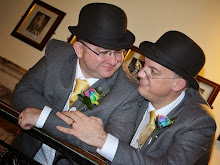
In 2014 I watched Blake’s 7 right through with my beloved Richard. But much as we enjoyed the series all over again, we’ll always remember 2014 for something much more significant to our lives together. We went back, not to the Dome – there’s one just across the river from our flat in London – but to Stockport. On our twentieth anniversary together, we got married at Stockport Town Hall.
I’d say that this was my personal triumph of freedom over dark religion, but freedom won for me so long ago that religion was barely a footnote. Though I still find stories powerful when they make strong use of religion, for good or ill, it’s only as I write this that I realise Stockport Baptist Church is a couple of minutes’ walk from the Town Hall. It’s not something that crossed my mind on the day (though I probably quoted Blake’s 7 at some point). When we made the most important decision of our lives, we were surrounded by believers in several kinds of politics and faiths and in none, including my very proud and happy Mum and Dad, but we chose each other and we chose all the people we invited for love and belief in ourselves.
The Apocrypha: Trevor Hoyle’s Blake’s 7
“Hands reached up and pushed back the cowl to reveal Kara’s evil, haunting beauty – a face that was disfigured by a kind of lustful greed… a smile that was rapturous and yet somehow obscene…”

There’s another alternative world of Blake’s 7, and of Cygnus Alpha. I was already a voracious reader when Blake’s 7 turned up, but though my memories of Cygnus Alpha are thoroughly entangled in Trevor Hoyle’s first Blake’s 7 novelisation (like the first VHS release, compressing the first four episodes), I didn’t return to it as nearly often as Target’s Doctor Who range. Wondering why, I accompanied my 2014 rewatch by buying the audiobook versions, with this part now read by Paul Darrow… And, yes, I can understand why; Hoyle’s writing style tries to be hard-boiled and usually just about hits pedestrian. The CD readers liven him up, but the main interest is the differences from the TV versions – it seems that the first book is from early drafts of the scripts, and without having seen most of the actors, while the Liberator is described backwards. My guess is that these are unadulterated script writer Terry Nation, before script editor Chris Boucher came along; there are notably fewer sharp one-liners and a much smaller part for Avon. The biggest point of interest, unexpectedly, may be his take on Time Squad, for a very different backstory to both Gan and the assassins (though Zen is far less intriguing); the biggest wasted opportunity that Hoyle seems to stick too rigidly to the scripts rather than, say, establishing Arco and Selman with roles in the London rebellion now the actors don’t need paying for an extra episode.
The very ’70s stylistic tic that most sticks out today, though, is that suddenly we’re plunged into an alternate version of Blake’s 7 where (speaking of adultery) every woman is there to be leered at. Men get sexually neutral or ugly descriptions – let’s hope he’d not seen poor Michael Keating when Vila’s a “gargoyle” – but every woman is objectified at length and, if they’re baaad girls, all the more titillating! I suspect this may have put me off when I was a boy, but hearing Gareth Thomas and Paul Darrow having to read all this first made me wince, then laugh. Though I’ll give Hoyle the benefit of the doubt that there’s an earlier Gareth Thomas series in-joke in there, I did actually laugh aloud as Paul Darrow purred:
“Avon casually looked round and then sat up straight, his eyes popping out of his head. His first thought was to wonder how a beautiful and sexy star maiden had managed to get aboard the Liberator and it took all of ten seconds to realise that it was Jenna, attired in the most magnificent – and rather revealing – space-age costume.”Or, ‘Why, Miss Jenna, you’re beautiful!’
Avon follows this by swallowing in “goggling admiration” and “real appreciation”, her with “impish seductiveness” as she’s “coyly” “posing for him”. Later, Cally will be a “young”, “stunning-attractive girl”, “incredibly beautiful”, “athletically supple”, and Blake will be unable to fathom why a “beautiful girl” should be wearing combat gear. Dear [ Blessed ]GOD![ /Blessed ] She will also have amazing eyes the like of which Blake has never seen but which the author won’t describe, so they might boggle out on springs for all we know. At least Blake won’t actually ask her what she’s doing in a place like this.
But where Hoyle really gets excited is the female villains, who are beautiful – but evil, but sexy – but evil! What a mix. And a minx.
“His companion turned towards him… and in the flickering firelight it was a face of evil, the lips twisted in a rapacious snarl, yet even so with a fascinating, hypnotic beauty.Oh, put it away. The strangest thing is that the Terry Nation draft of the script forgets about her at – forgive me – the climax, and so bizarrely does Mr Hoyle. You’d think he’d have been faster to write her an unconvincing last moment than the one Chris Boucher seems to have stuck in. ‘Only the love of a good violent criminal she’s kissed once could free her from being the Sexy Nun of Evil…’
“‘New souls for the Faith,’ said Kara in a throaty whisper, her eyes alight with sly rapture.”
Paul Darrow clearly enjoys all this schlock too, as well as capturing Gareth Thomas’ intensity rather well for Blake and compensating for half Avon’s part not having been written yet with a compelling emphasis on his own character’s lines that makes his every. Word. Twice. As. Avonnn. The whole thing is hammy as hell but very entertaining, and far more so than the prose deserves.
So it’s a good job that the TV version was so absolutely perfect – not perhaps entirely perfect as a piece of television, but perfect to broadcast directly into my six-year-old world and open up a new one.
“Let’s all go! Er… No, on the other hand, let’s all stay.”

Last year I found that I couldn’t bear blogging any more. I wish I could say that, with the pressure off, I’ve been able to write plenty of articles for my own pleasure and that this is the herald of more to come. I’m sorry. I haven’t. It isn’t. So this is perhaps a coda – something I’ve not previously published, but which isn’t technically new.
Cygnus Alpha and Omega was first published in 2015 in the book Blake’s Heaven, a collection of personal perspectives on every episode of Blake’s 7. I was delighted to be a part of it and surprised I managed to write something, though that delight has since been marred by the horrible circumstances in which the book has been withdrawn and which I don’t want to think about. But with the fortieth anniversary of the series this year, I re-read my contribution and decided it was worthwhile enough not to go to waste. It’s more personal than most of my writing, and I found as I was putting it together the first time that how resonant the themes – and some of the coincidences – were to my life. Well, bits of it.
I’ve spent a ridiculous amount of time re-reading, re-watching and re-writing in tiny perfectionist polishes preparing for tonight, some of it no doubt procrastinating to avoid having to make the decision whether or not to put something else on my blog. I have. I hope you enjoy it.
I am, at least, enjoying Blake’s 7 all over again. For what it’s worth, though Cygnus Alpha has its own special place for me, my particular highlights of the series are:
- Rumours of Death
- Star One
- Sand
- The Way Back
- Terminal
- Orbit
I’m sorry this isn’t my way back to blogging. For something cheerier, you might look up another great piece of BBC sci-fi; first broadcast on TV thirty-seven years ago this week – though, like this article, it had already done the rounds in other media – I find myself thinking of The HitchHiker’s Guide to the Galaxy Episode 3. Magrathea doesn’t properly revive from its long slumber, merely turning in its sleep to put a new spin on a previous work, but that too is about religion and, for all that I know how badly everything turned out, that it’s a cosmic joke and that the new beginning isn’t going anywhere, there is a moment at the end of that episode that still moves me more than almost any other piece of television. This piece of writing is nothing like that. But I am quite fond of the crinkly bits round the edges.
Labels: Bigotry, Blake’s 7, Books, Brian Blessed, Gay, Personal, Religion, Richard, Star Wars, The Hitchhikers Guide To the Galaxy


Wednesday, August 28, 2013
Liberal Wednesday 6: Martin Luther King’s “I Have A Dream” #LibDemValues
This week’s Liberal Monday is on a Wednesday: the fiftieth anniversary of one of the most celebrated speeches of the Twentieth Century. Dr Martin Luther King Jnr’s speech to the March on Washington for Jobs and Freedom still has tremendous power both for in itself and for its place in history – the right person, at the right time and place, with more than the right moral clarion call in its inspired oratory. The BBC marked the occasion with a tribute on Radio 4 at 9am, plus a documentary to come on BBC2 at 9 tonight.
“I have a dream that one day this nation will rise up and live out the true meaning of its creed: ‘We hold these truths to be self-evident, that all men are created equal.’What is there to be said of this great appeal for equality, justice and fellowship that hasn’t already been said? Well, there’s this morning’s tribute, for a start. I was a little sceptical of Radio 4’s I Have a Dream this morning – reminiscent of the BBC’s 1997 recording of Perfect Day, the main part of the programme was a ‘cover version’ of the speech performed by a wide array of different people from different countries. It seemed like a bit of a gimmick. But on listening to the collage, ranging from John Lewis and Joan Baez, who were both part of the 1963 March for Jobs and Freedom that day, to the Dalai Lama, to Malala Yousafzai, the Pakistani student shot by the Taliban for being a girl who went to school, I found it incredibly moving. With a full speech, the reading doesn’t just switch reader on every line, instead segueing between Dr King and impassioned stretches by so many other people it had touched with enough time for each different person to get a sense of how much it means to each of them. And unlike the original line-up of speakers after the 1963 March, this version of the rally’s showstopping final number has women in it, without which it would seem odd today but shows that not only racial attitudes have changed in the last half-century. It’s repeated on the World Service at 3.30 this afternoon and on Radio 4 this Sunday at 1.30pm.
“I have a dream that one day on the red hills of Georgia, the sons of former slaves and the sons of former slave owners will be able to sit down together at the table of brotherhood.
“I have a dream that one day even the state of Mississippi, a state sweltering with the heat of injustice, sweltering with the heat of oppression, will be transformed into an oasis of freedom and justice.
“I have a dream that my four little children will one day live in a nation where they will not be judged by the color of their skin but by the content of their character.
“I have a dream today!”
You can also listen to the programme for the next week on BBC iPlayer here; you can read about it and the many contributors here; you can read the text of the speech here; and, above all of those, you can watch Martin Luther King delivering the original speech here.
I’d heard the whole speech before, though much more often excerpts from it – most of all, the extraordinary “I have a dream” peroration of the second half that echoes down the decades. But listening to it fresh this morning, without the thrilling cadences of Dr King whose voice gave perhaps the greatest speech I’ve ever heard, though the multiple performance had much less power than the original, it made me concentrate more on the words.
The speech itself is fascinatingly constructed, an appeal to America’s history and heartstrings with astonishing moral force. I think of the passion, the imagery, the repeated refrains, but it’s far more than that. The speech comes to us now with the power of fifty years of Dr King being proven right and becoming a lasting symbol on its side, but in itself it cascades back through history.
Dr King stood at the Lincoln Memorial and made his own and the marchers’ demand for the fulfilment of Lincoln’s promise an integral part of President Lincoln’s own history; I remember going to Washington in my twenties and wanting to visit that Memorial as soon as I could, looking up at the great graven face of Lincoln but seeing and hearing King in my head. And his speech grounds itself firmly on Lincoln’s own promise, deliberately opening between the hundredth anniversary of the Emancipation Proclamation and the hundredth anniversary of the Gettysburg Address with a championing of one and the echo of the other: “Five score years ago…” Dr King samples Shakespeare, economics, current affairs and a host of other touchstones, but in speaking for a new America rising irresistibly on the deepest feelings of the old, there’s no mistaking the other great stream pouring through the speech – religion. It’s not just in the words, testifying to the equality of all God’s children, but coming through his own preacher’s experience and oratorical style. The American Dream is only real for any American if it’s shared by all Americans, and that’s because God created all equal. And in that shared language, he was speaking to many who wouldn’t otherwise want to hear him.
For me the most fascinating thing about the speech from my own experience of watching and making a great many different speeches is how it’s essentially two speeches, Dr King’s extraordinary gift making them appear seamless. I know that my own best speeches have been ones delivered without a prepared text, but my worst ones, too: it’s a risk to try to fly. What he does here is start in the safer, meticulously prepared style as a run-up, then suddenly lifts off. There’s the carefully crafted written word fixed in American history, a reasoned argument. And then, apparently spurred by Mahalia Jackson’s cry of “Tell them about the dream, Martin!” he switches from his written text into the part that everyone remembers: the repeated rhetoric beamed straight into the heart through Biblical words and a million-watt charisma, every phrase resonating with the American Dream and with the Gospel call. And that, clearly, is the powerful spiritual appeal of the preacher.
That’s not to say that the “I have a dream / Let freedom ring” extended climax was entirely off-the-cuff. Dr King had had three years of honing that exact metaphor, from his 1960 speech “The Negro and the American Dream” onwards, but clearly it was on the day that it was most needed that suddenly the theme came together and, inspired and inspiring, helped transform America.
There’s much more to the speech – embracing both the more timorous and the more militant sides of the Civil Rights movement, the uncompromising demand to make brotherhood a reality, passing sometimes shocking judgement on the segregationists and the shameful, but then not just rising but soaring above them, preaching against hate, the realisation on his part and on “our white brothers’” part that “their freedom is inextricably bound to our freedom”. But I still get teary-eyed reading or watching it for myself, so watching or reading it for yourself is going to have much more of an impact than reading about it.
It’s a sign of how far things have come that under the institutional bigotry of the times, in 1963 twenty-one US States prohibited mixed-race marriage. That’s almost impossible to believe, fifty years later, when Martin Luther King’s speech has become one of America’s great moral foundations. Today, thirty-seven US States prohibit same-sex marriage. I wonder whose soaring rhetoric will transform the next fifty years?

Labels: American Politics, Bigotry, History, Liberal Mondays, Liberalism, Martin Luther King, Religion, Speeches, The Golden Dozen
Tuesday, April 30, 2013
Broadchurch and How To Spot A TV Murderer
Did you guess whodunnit in Broadchurch? Having saved it up, Richard and I binged on the whole series over the weekend, and I have a few thoughts on its themes and surprising quality below (with implicit spoilers if you’re good at clues). Or what about other murder mysteries? Have you ever wondered how to spot the murderer in a TV detective series? Or specifically whoprobablydunnit in Sherlock Holmes, Agatha Christie, Father Brown, Inspector Morse and more? I reveal Richard and my (almost) infallible Rules of Suspicion: what’s the number one biggest giveaway of the TV murderer attempting to divert suspicion?
Richard started this long ago when he told me the three general and specific rules for spotting whodunnit in Agatha Christie. He’s right about them, too. Though I did correctly predict Broadchurch’s in Episode Two (albeit after wrongly being convinced Mark and the Rev Paul were shagging, particularly when the former stormed into the latter’s church as if in personal betrayal), I’m usually not a patch on Richard for spotting the murderers. What I am pretty good at is spotting themes in particular authors’ writing. Between us, we’ve come up with three rules that catch bang to rights an awful lot of whodunnits’ off-the-shelf attempts at misdirection, and several more specific ones after watching too much of particular detectives…
Richard and Alex’s Rules of Suspicion
One
Whoever throws around the most vicious accusations is probably the murderer. Any child will be able to tell you the rhyme that warns of this.
Two
Whoever is too nice is probably the murderer. But you don’t come to a murder mystery to stoke your faith in human nature, do you?
Three
Whoever is the victim of a murder attempt but manages to survive when all around them fall is almost certainly faking it to divert suspicion.
If anyone manages to survive an ‘attempt on their life’ while the detective is there as a witness, the chance of their being innocent approaches zero.
Richard and Alex’s Detective-Specific Suspicions
Sherlock Holmes
- The villain will never be the beautiful young woman*, though there is a fifty-fifty chance of her marrying Watson by the end of the story.
Agatha Christie
- Miss Marple – she’s a gimlet-eyed, gossiping spinster; the murderer is likely to be a younger, sexier woman who’s no better than she ought to be.
- Hercule Poirot – he’s a rather prim retired police officer; the murderer is likely to be an ambitious young man.
- Or in any Agatha Christie, it’ll be the one person with such a supernaturally perfect alibi they couldn’t possibly have done it.
Father Brown
- GK Chesterton version and faithful adaptations – the Catholic Church is always right, and anyone who stirs any of Mr Chesterton’s prejudices (particularly if they’re an atheist or, worse, of the wrong Christian denomination [that is, says Father Brown sonorously, not a Christian]) will be proven evil.
- New BBC version – the Catholic Church was surprisingly liberal in the 1950s, so anyone who stirs any of our own prejudices about prejudice (particularly if they’re a sexist man in a position of power) will be proven evil.
Baldi
- A priest with a wandering sense of his vocation and a police officer friend too close and too pretty for the Monsignor’s comfort? God, in the person of the omnipresent author, keeps dropping subtle hints about celibacy by making all the murders love gone wrong.
Inspector Morse
- Richard’s a big fan, but he still suggests the old man usually waits until nearly everyone’s dead and then arrests the survivor.
- It’s also worth looking at the woman he fancies and acts unprofessionally with in each episode: she’ll either be dead or in the nick by the end of it. I wonder if that’s why Endeavour’s admirer decided not to push her luck with a second go the other night.
SS Sturmbannführer Kessler
- Depending on your point of view, either hedunnit or he’s unlikely to get his suspects, but eats out well while puzzling over them. Surprisingly good at getting away when it’s his turn.
Midsomer Murders
- I resisted getting into detective dramas for so many years, but this is so insidious in its quirkiness, bitchy lead detectives and warped country ways that I’ve fallen for it over many classier productions. And yet it’s the odd one out: it has so many writers and so many tones (the weirder and funnier and more AvengerLand the better, for me) that I don’t have a rule for it. But see particularly Rule One above.
- Mind you, if you’re stuck for spotting the killer, in this inbred county where the actors all look like they’ve been in it before (and have), incest is always worth a punt.
Broadchurch
Implicit spoiler warning: in case you’re just skimming across this article and might pick up something vital at a glance, I’m not going to mention names of suspects when I say something that implicitly implicates or clears a particular person, though you can probably work out who they are if you’re reading more closely.
I have to admit that I came to Broadchurch with some wariness. It was an ambitious drama series with many good actors in it, so I wanted to give it a go; but on the other hand, police procedurals aren’t really my thing (particularly horrible depressing Daily Mail-ish paedo-scare misery-porn), most ITV drama I’ve seen over the past few years has been deeply unimpressive, and Chris Chibnall as a writer has often been much worse than that. I have in the past been so critical of Chris Chibnall’s writing (Torchwood Series One being its nadir) that I came to Broadchurch fearing the worst, though with a little hope from his two Doctor Who episodes last year which while no triumphs for me felt conspicuously like he’d been trying harder and, despite having serious problems with the end of each, I’d quite enjoyed until the last five minutes. In Broadchurch, remarkably, his writing seems to have grown up, even down to a dramatically and morally satisfying conclusion.
The obvious part of the series’ success lies in telling two overlapping stories well: a whodunnit police investigation; more importantly, the harrowing emotional effect that has on a community. And it achieves the latter with generally very effective writing and in letting the various characters in that community breathe, as well as giving most of the recognisable suspects their own moments of suspicion and plenty of what on the surface seem like red herrings. The two leads were, of course, strong performances, with David Tennant seeming like he’d not slept since giving up Doctor Who and Olivia Colman moving from Hot Fuzz to everywoman in much darker places, but none of the actors and few of their actions struck false. The emotional realism reinforced the well-plotted mystery, with almost all the clues feeding back into the eventual pay-off from the in-your-face damaged characters to the intriguingly off-key early question of the deleted messages. For me it made the right choice, too, in the ending being all about the effects on the people, rather than just catching the murderer (something achieved through a combination of chance and, at the last, choice, rather than brilliant policework). It meant the writing was both straightforward in terms of how we understood and empathised, and shot through with ambiguity in no character being plain good or bad – that is, going some way to capture the complexity of life, even if that occasionally led to mixed messages (hugging is fine and natural and you should be ashamed for being suspicious of it / but also a danger sign of suppressed evil, for example).
And yet there were other, slightly postmodern touches for people wanting more layers: references such as naming Wessex Police’s DI “Alec” “Hardy” for Wessex’s Thomas Hardy and one of his best-known characters, Doctor Who quotes in the dialogue (to match the large cast of Doctor Who actors) and the faintest whiff of Twin Peaks that ITV would let you get away with; genre-aware – up to a point – DS Miller hanging a lampshade on her superior’s stereotypical broody detective schtick; the recognition about the viewer that we will recognise certain actors and say ‘Ooh, it’s them – they must be significant’, which the first episode foregrounded by giving us opening minutes of the soon-to-be-bereaved dad’s happy tour of all the famous faces in the village, then closing with a montage of those same faces in the dark, alone, troubled and suspicious, all but slapping on subtitles ‘FAMOUS SUSPECT #1…’
For me, though, the most interesting – and the most successful – extra layer was the thought that had gone into giving it a moral outlook that underpinned the drama without being overpowering.
Broadchurch – The Underlying Themes
What most impressed me about the series was that it dealt with a horrible, tabloid-friendly, always-reported-black-and-white sort of story as a much more thoughtful narrative. Even as the show drew me in, I was sceptical that it was trading on a fictional form of rubbernecking misery porn even as it had its cake and ate it with ‘…But of course journalists are evil reptiles’ to show false piety. But by the end, Broadchurch had shown itself to be something much deeper than that, and perhaps even with a touch of genuine piety.
Rather than just take the easy road of saying how shocking
There was a deeper morality to the series than media ethics, however. Broadchurch was at the same time a very modern story and very old-fashioned in its underlying themes, to such an extent that I wonder if the writer has a Christian faith informing his work. Part of it might be the name of show, in plain sight. Part of it was that the vicar for once seemed more or less credible as a vicar – at least in his two sermons, after a piss-poor attempt at the Problem of Evil (perhaps he just bottled giving the line on that to a grieving mother, which you might take as extra motivation to find courage to do the right thing in the penultimate episode even when faced with the worst threat someone can make today). But it was also that as every character’s secrets peeled away, all of those ‘red herrings’ echoed and reinforced each other until at the end it wasn’t just the grammar of whodunnits that made the killer’s identity clear, but the morality of the series that led inevitably to it. Over and over, we were told how destructive adultery was (even in the heart) and that betrayal by your partner was the series’ original sin. It was a murder mystery where you don’t work it out from the clues, but from the themes, asking the viewer by the end: how can you not have known? While the characters themselves weren’t black and white, it’s hard not to see the overwhelming near-universal guilt and the way that almost anything a character vindictively slags off rebounds to be found unwittingly in their own lives as a stern morality from the omnipotent author.
So Broadchurch Wasn’t Perfect…
There was one suspect who, though a decent performance, I found so improbable in concept and their red herring so unconnected to the themes of the rest that their only proper dramatic function appeared to be to illustrate DI Hardy’s gradual collapse. Conversely, we didn’t see enough of Tracey Childs’ rather fabulous police boss with her cool pedeconferencing sporting shades and ice cream, but she was saddled right up front with one of the minor mysteries so awkward that I wondered throughout if it would ever have a payoff (a practical rather than a thematic one): why didn’t Ellie get the job? The series starts with DS Miller returning from three weeks of holiday, scattering presents among the jolly coppers, before being abruptly called away by the Chief Superintendent to be told that she’s not been promoted. Despite being told before she left that they needed a female DI, that she was local and that she was a shoo-in, in her absence the situation had changed and someone else had already been appointed a week ago. A male DI with an apparently conspicuously awful record about which no-one would speak. For a minute, I thought that the explanation had to be that the murder had taken place a week ago, they’d had to get someone in fast, and so Ellie would be the viewer’s point of view in a town suddenly gone horribly wrong – but, no, it was all still to come and there was no motivation at all for dumping on her. That made Hardy’s appointment such a bizarre turnaround that it suggested psychic powers not for Will Mellor but for Tracey Childs, with her able to see into the future of the case or indeed into the minds of TV bosses who might have said, ‘I know we promised the lead to a woman character actor but really we need a big name male star’.
DI Hardy belatedly explaining the missing link (and pendant) in the infamous Sanbrook Case was in many ways necessary – for the drama, for the viewers, giving his motivation, showing he’s a good copper really (or was: seeking redemption through doing another job he’s literally not fit for suggests he no longer is), and to put in place the last major piece of thematic reinforcement for the series’ underlying original sin. But, as he’d been silently taking the blame until now to protect two other people, and as even without naming the guilty party the press are going to find it bleedin’ obvious, why come clean now and ask only for a couple of days’ delay from the local rag? This was so clearly a deathbed confession that, the viewers having heard what we needed to, there was no dramatic need for it to be published as well: you expected his caveat to be not ‘give me a couple of days’ but ‘after I’m dead [in a couple of days]’. Was he scripted to keel over at the moment of triumph, as many earlier scenes had hinted, but then the producers realised they might have a hit on their hands and asked for a rewrite to preserve the unlikely but now promised sequel?
All in all, though, Broadchurch was a surprisingly impressive and thoughtful series, and once again proves the old Sherlock Holmes adage that I’m glad I don’t live in the countryside.
[Oh, joy, Blogger’s doing its thing where it either prints all my text in one splat or gives random massive gaps if I force in breaks again]
Labels: Agatha Christie, Broadchurch, David Tennant, Newspapers, Religion, Reviews, Richard, Sherlock Holmes, Top Tips, Tracey Childs
Monday, March 25, 2013
Total Lack of Thought For the Day: Cristina Odone Vs TV Ratings and Truth
Religious spin-doctor Cristina Odone has today used what she calls “a huge hit”, US TV mini-series The Bible, to attack the BBC, secularism and, basically, the whole 21st Century. Her propagandaggrandisement in today’s Daily Telegraph, the journal of pre-Enlightenment fantasy, rests on the twin absurdities that 13 million US viewers is “a huge triumph” and tells us anything about British religion or TV viewing.
Ms Odone’s bigging-up of the so-called “History” Channel ignores three important facts.
First, though she claims the BBC ignores religion, in fact the money of all licence-fee-payers by law has to pay for making religious programmes. By choice, happily, almost none of us watch them.
Second, she fails to mention that by any measure you like – church attendance, church buildings, opinion polls of belief – the USA is vastly more religious, and even more vastly Christian, than any country in Europe except the Vatican, and certainly has a wildly different religious make-up to the UK. Despite our having an established Church, again by law. It seems that on two for two, Ms Odone’s demand for people to be forced into religion in law not only irks the silent majority of us who the screaming zealots seize cash from and boss about, but it’s clearly doing no good for religion, either. So perhaps she should pause in her authoritarian diktat that the US so-called “History” Channel’s Bible series should be “compulsory” here, in schools, on the BBC, and presumably by strapping every viewer to A Clockwork Orange-style eye-restraining chairs.
Before introducing the third and most absurdly abused fact that will fisk Ms Odone on her own shaky ground, I should point out that I do not believe TV ratings to be any guarantee of quality, just as I do not believe majorities should be able to push around minorities (or, in this case, vice versa), even when by her own argument we should ignore the Godly Torygraph’s tiny readership in favour of the Satanic BBC’s many millions, causing her entire vindictive rant to disappear in a puff of logic. But as Ms Odone wants to command her beliefs to be “compulsory”, and as she’s using the dubious testament of television ratings as her foundation, this is the appropriate ground around which to march to bring her ludicrous fabrication tumbling down.Third, like any good spin-doctor Ms Odone cherry-picks the top viewing figure of 13 million for one “huge hit” episode (not telling us how far ratings have dropped since then) for the so-called “History” Channel’s Bible-story mini-series, just as the programme itself cherry-picks only the most popular bits of the Bible. She exalts this, again in her words, “huge triumph” to disprove the spooky, invisible US atheist conspiracy which televangelists and the lunatic far right make up stories of to raise so many millions. And yet, it surprises me by suggesting that, against all other evidence, perhaps big-budget Christianity in the USA isn’t looking that healthy after all…
The Facts – Ms Odone, Look Away Now (oh, she already has)
The USA is a country of 316 million people (I’m doing Ms Odone the favour of assuming that her pet series’ top rating only included the USA and not world-wide ratings, though as with all her ‘facts’, she isn’t clear). 13 million viewers is a “huge triumph” of, er, just 4.11% of the population. Ms Odone will no doubt tell you that’s an overwhelming majority. That doesn’t mean you should believe her.
By way of one simple factual comparison, the UK is a country of 61 million people. Cherry-picking one huge hit episode, Doctor Who – Voyage of the Damned (guest-starring Kylie Minogue), that was watched by 13.3 million people in the UK alone. That’s 21.11% of the population.
Much as I love it, Doctor Who is not my religion. In my view, it would be absurd and wrong to suggest on the basis of this factual like-for-like comparison that Doctor Who (or Kylie) is far more important than the Bible to the people of the UK, let alone extrapolate that Doctor Who – were it not for the evil conspiracy against it by US TV – is really, deep down, five times as big for the US population as Christianity.
Yet that absurd nonsense is exactly the way that Cristina Odone has extrapolated US viewing figures to scream that everyone in the UK should be ‘compulsorily’ bossed about. It seems that while UK schools’ compulsory religion does no good for most of us, sadly UK schools’ compulsory maths lessons did even less good for Ms ‘Dunce’ Odone.
Of course, it’s unthinkable that she knows that what she’s saying is a nasty, cynical lie to justify her outrageous authoritarianism, because, after all, she mentions the Ten Commandments. Though she claims no-one knows them any more, I do. And “Thou shalt not bear false witness” is one Ms Odone should know, too.
Ms Odone will no doubt point, scream and call for me to be burnt – ‘compulsorily’ – as I’ve just noticed that, as luck would have it, this is my 666th blog post on here.
Update: I’ve been fact-checked in an especially embarrassing way for a chap who bristles every time people misspell my own name. I apologise to Ms Odone for my mistake, and have corrected her Christian name from “Christina” to Cristina each time I used it.
Labels: BBC, David Tennant, Doctor Who, Kylie Minogue, Religion, Stupid Ideas, TV Ratings
Wednesday, March 20, 2013
Doctor Who 50 Great Scenes – 40: The Rebel Flesh / The Almost People
Counting down towards the fiftieth birthday of Doctor Who with Fifty great scenes… This one’s from 2011 and the Twenty-Second Century, and it’s one of my favourite moments for Matt Smith’s Doctor – an almost perfectly formed cliffhanger. So expect rather large spoilers, deep themes, and the enemy within…?
“This is insane. We’re fighting ourselves.”
“Yes, it’s insane, and it’s about to get even more insanerer. Is that a word? Show yourself, right now!”
“Doctor, we are trapped in here and Rory’s out there with them. Hello? We can’t get to the TARDIS and we can’t even leave the island!”
“Correct in every respect, Pond. It’s frightening, unexpected, frankly a total, utter splattering mess on the carpet, but I am certain, one hundred per cent certain, that we can work this out. Trust me. I’m the Doctor.”

It’s the answer to accidents at work. Working in a dangerous environment? Worried you might fall into a pool of seething acid and bubble to a hideous dissolution? Robots too expensive and covered by pesky artificial intelligence regulations? Then meet the Flesh: reformable, reusable, disposable, and you. Just sit back in comfort and control your Flesh “Ganger” self through all the sticky bits, and if you’re a bit more careless than you would be with your usual body and it happens to die in screaming agony, just withdraw your consciousness from it and form another from the vat of gloop. It’s not as if anyone’s hurt, right? And if you get it wrong, you can just be born again. Again.
The Rebel Flesh / The Almost People is the 2011 Doctor Who story that felt most traditional to me – that is, of all the many, many thematic traditions of Doctor Who, this chimed with those that most deeply speak to me. Traditional, then, though not at all reassuring. The Flesh vat from which life can rise at will – eventually, its own, after a spark from the heavens – is only the font of the religious imagery, housed, of course, in the old Chapel. Free will and the created rebelling against the creator? Frankenstein is positively a modern influence in that context, here given a kick by a solar storm as its lightning. There are existential crises, cruelty begetting cruelty, conflicts between people who are basically (and never more so here) the same, all shot in dark, shadowy corridors. And with Matt Smith’s Doctor arriving to investigate and the actor’s love for Patrick Troughton’s time in the role, it’s not inappropriate that the story evolves into one of base under siege.
The cliffhanger brings all of this to a head in a way that’s predictable if you’ve been watching, yet deeply satisfying, a terrific ‘What’s going to happen next?’ moment of horror, revelation and just a little of challenging the viewer. On arrival, the Doctor (Matt Smith) scans the Flesh pool and finds himself disconcerted – as if it’s scanning him in return. It pulls his hand down to touch it, and they share a moment of understanding when
“I felt it in my mind. I reached out to it, and it to me.”There’s no such awe for the creators. They simply don’t care. They pile their personalities and lives directly into it, yet they don’t expect it to be alive. Naturally, the Doctor’s feelings are with the exploited Flesh, urging one of the team whose face suddenly slides into incoherence – revealed as Ganger – to trust him, appealing to bridge the gap between natural and new human as the differences between the bodies and personalities of each become ever more indistinct, only for the ever-careless human team leader to do what she’s always done and ‘dispose’ of Gangers in her way… Prompting the Gangers to decide on the same strategy of “us or them”. Where once they touched, now he’s guilty by association of betrayal and death, how can even the Doctor become an intercessor between creators and created? Though, racing about the place as he does, he did pop back into the Chapel alone to scan – or prompt – the pool of Flesh once more, the vat forming lips in reaction, and practicing the words: “Trust me.”
Events approach crisis. The humans see the Gangers as nothing. The Flesh rebel. The TARDIS sinks beneath an acid mulch. The greatest solar storm of all is building to baptise all with fire. There’s a thrilling, throbbing, backwards pulse of music as people run down dark stone passageways. And a figure staggers from the vat, muttering “Trust me…” as its clammy hand holds itself up against the wall…
The TARDIS crew splits apart as Rory rushes out in concern for the team member-Ganger-person he’s been talking to – perhaps showing himself (while everyone here clearly passes the Turing Test) the only ‘human’ of either creation capable of passing a Voight-Kampff Test – while Amy’s left behind, fearing the unlike and the too-alike, shocked that Rory is with another woman. And the Doctor can’t hold her together now, because he’s heard a voice from the shadows of the Chapel, asking “Why?” “Show yourself!” the Doctor commands, but whose self is it (and hasn’t a son of the Doctor asked “Why?” before)? His face the bloated Flesh of a not-quite-controlled Ganger, the Doctor (Matt Smith) steps forward to reassure Amy just as he always does, characteristically straightening his bow tie and giving that crooked smile. Trust him. He’s the Doctor.
Bonus Great Doctor Who Quotation – Amy’s Choice
I did warn you there were spoilers, didn’t I?

In this especially fine sci-fi short story of a Doctor Who episode, the Doctor (Toby Jones) is much less friendly an other Doctor than the Doctor (Matt Smith) above is going to be to the Doctor (Matt Smith). Introducing himself as “the Dream Lord”, he flits between the Doctor, Amy and Rory’s confusing, conflicting realities of the happy, domestic life that Rory’s always wanted, settled as a doctor, or of the scary, exciting life in the TARDIS, settled with the Doctor. He tells them to pick the real one, or die. But which is Amy’s dream outcome? And what a sly other self the Doctor has – where Rory dreams of at last drawing equal as a proper doctor, this one promotes himself to Consultant to put him down again:
“Now then, the prognosis is this: if you die in the dream, you wake up in reality. Healthy recovery in next to no time. Ask me what happens if you die in reality.”Toby Jones is deliciously bitchy as he sneers that he could always see through the Doctor; Matt Smith matches him secret smile for secret smile, knowing only one person could hate him that much. But is he a person in his own right, like both Doctors above? I think Richard’s talked me round, in his review for Millennium’s Fluffy Diary. And what about the next one…?
“What happens?”
“You die, stupid. That’s why it’s called reality.”
Extra Bonus Great Not Doctor Who Quotation – Human Nature / The Family of Blood
This is arguably the best Doctor Who story since it returned to TV in 2005, but not for John Smith (David Tennant). He spends the first half of it happy with his life as a teacher, his burgeoning relationship with Joan the Matron, and his exciting dreams of adventure, though his faithful maid Martha seems to be getting a little strange. But in his Journal of Impossible Things we see for the first time all his past selves, and everything turns inside-out when he finds those dreams are real and his life’s become a nightmare. The local dance ends in death. People he thought he knew become an uncanny Family led by a pupil with wild eyes now styling himself Son of Mine, and they want something from him he doesn’t know he has. Martha’s become an unsettling mixture of protector and threat, and she, too, wants something from him he doesn’t know he has. To him, he’s an ordinary man, with unreliable memories but real feelings. To both pursuers and protector, he’s a walking placeholder, not the Doctor but just an inferior mind and body walking around in exactly the form and place the Doctor would usually occupy, all of them for different reasons looking forward to his erasure. He despairs that even the woman he hoped to marry thinks he’s not enough – though she’s the only person who sees him for who he feels he is. At the story’s half-way point, as people suddenly demand the Doctor of him, there’s a “Next Time…” trailer in which he declares “I am not the Doctor.” It’s a sign of how little control he has of his life that he doesn’t get to say that in the second episode – even his denial just gets written out. And yet his plight prefigures not only the sinister echoes of his role (and Martha’s) in the three-part season finale, but the existential crises and self-loathing of the other Doctors above.

John Smith runs from the Family, but they call him back, holding the TARDIS the Doctor loves as hostage. Martha loves the Doctor and tries to wake him into his dream to save them – and doom him. Joan loves John Smith and tries to reassure – but can’t lie to him. And poor John breaks under the responsibility all of them put on his human shoulders.
“You recognise it, don’t you?”
“Come out, Doctor! Come to us!”
“I’ve never seen it in my life.”
“Do you remember its name?”
“I’m sorry, John, but you wrote about it. The blue box. You dreamt of a blue box.”
“I’m not – I’m John Smith. That’s all I want to be. John Smith. With his life – and his job – and his love. Why can’t I be John Smith? Isn’t he a good man?”
“Yes. Yes, he is.”
“Why can’t I stay?”
“But we need the Doctor!”
“So what am I then? Nothing. I’m just a story.”
And there might just be more dodgy Doctors to come (though another, much as I enjoy this scene half-way down, doesn’t quite make the Fifty). The next scene up’s not just a but the man who is not the Doctor, though…
Next Time… Hiding behind… Oh, no, hiding from…
Labels: David Tennant, Doctor Who, Doctor Who 50, History, Matt Smith, New Adventures, Religion, The Almost People, The Rebel Flesh
Saturday, February 09, 2013
What Is the Point of the Church of England?
I don’t imagine that unelected Lord Welby will be any worse than his predecessor as Archbishop of Canterbury, that hypocritical, canting bigot-fancier Rowan Williams, but he faces a church in an even worse state of decay. Church attendance continues to decline, while the only issues on which the Church of England speaks with passion – or shrill desperation – and consistency are as the BNP’s vicars on Earth.
The Church of England – Moral Evil Moderated Only By Love of Money and Power
The Church of England is on the wrong side of history, but still screams with privilege – not to mention power and the love of money. The only thing the establishment of the established screams louder about than upholding vicious evil bigotry is upholding its holdings. The less influence it has on society and the less interest anyone has in it, the more they hold onto their unearned goodies.
No-one votes for their bishops, who must on pain of death never be women or gays, but they get to sit in their palaces and in our Lords to literally lord it over the rest of us.
Major church decisions are made not on theology or faith, but on what will get through Parliament and retain their cash and comfy red leather benches.
While other churches without all the state money and power can choose who they perform services for, the established church is meant to be the nationalised industry that has to do the cheap and cheerful ceremonies for anyone who asks. But though their talk is cheap, can anyone call them cheerful? Not when they put up snobby block after snobby block to prevent people they disapprove of from calling on their increasingly narrow ‘love’.
This isn’t just a lazy bunch of pampered bigots trying to get out of doing any work for their power, wealth and prestige. It’s shrivelling the pitiful excuse for a moral sense that the established church still pretends to, their very establishment nature gnawing away daily at Christianity in this country while they blame everyone else for it.
Does anyone – does even any bishop saying it – not cringe as they bear false witness about their vicious campaigns of hate? When thirty seconds’ online search on Hansard proves the bigot bishops liars who screamed against and voted against every liberal move on lesbian, gay, bisexual and transgender rights that they now mendaciously claim they always supported, just no further? That they now ‘support’ the civil partnerships that they warned were the end of the world?
No wonder they screamed so much about civil registrars not having to perform civil partnerships – the ones they loathe and fear but feel compelled to lie about now approving, and which they made sure had nothing to do with religion? They protect evil bigots who want to take all the money but not do the job. Can anyone be surprised, when that’s exactly what the Church of England itself does, writ large? Has anyone on Earth previously had a special law passed in order to ‘protect’ themselves from doing the only job they’re meant to do?
And does anyone think for a moment that anything will get easier for them?
Two Predictions For Within the Next Ten Years – More Marriage, Fewer Lords
More ‘redefining’ marriage:
- Once people have got used to same-sex marriage, as they did civil partnerships, with surprising speed, it will seem more and more absurd that there are two separate sets of laws for the same institution. Within a couple of Parliaments’ time, there will be a Marriage Bill, simply equalising the laws to bring them into the understanding of most people not stuck in the wrong century.
- Same-sex partners will not be singled out to be penalised in their pensions. Carrying on the constant redefinition of marriage that English law has practised across the centuries, more antediluvian legal hangovers from the days of wives as property will be removed. For one, female partners in mixed-sex marriages will no longer uniquely have the defence that they’re wilting, helpless Victorian victims of brain fever when they conspire with their husbands to break the law. Not that any woman with a brain and a career would ever shelter behind such a humiliating sexist pretence these days.
- Mealy-mouthed bigot MPs who pretend that the only reason that they vote against people having any sort of marriage to a partner of the same sex is a never-before-spoken commitment to absolute letter-of-the-law equality will lose their last fig opportunistic fig leaf, when they’re no longer able to bleat ‘I would truly, honestly be all for the horrible stomach-churning gays if only the law specifically mentioned adultery and non-consummation for them, which means that I’m pretending not to know that “unreasonable behaviour” includes both and that for me the only thing about the gays is THEIR TERRIFYING[ly tempting] SEX AND WHY DO THEY GET SO MUCH OF IT AND SURELY MARRIAGE SHOULD INSIST THEY CAN’T GET EXTRA!’
- And, perhaps most importantly, all religions will get the right to marry or not marry any consenting adult otherwise free to marry under the law. Except the Church of England, the only church for which all reason (and all they get in return for it) says should, alone, as the nationalised church of everyone, by law have to marry anyone who asks, which will instead shout and scream that it needs a special law, again, to excuse it from performing its only public duty. While still getting paid.
- Almost certainly from a Labour Government that wants to vote through out of spite something they voted against out of spite. But I’m not a shitty hypocritical toe-rag like every Labour MP, so next time they say ‘Only Labour can deliver (because we’ll gang up and vote against everything we pretend to believe in to stop anyone else doing it)’ I will grit my teeth and support their move on principle, even though they don’t have any.
- And does anyone think that, given another few years of the Church of England’s decline, they’ll keep the failed sop to Conservatives of holding onto their unelected block of Bishops voting for evil bigotry and without anyone able to vote them out?
- Though it’s much more certain that the wing of the Church concerned with grabbing unaccountable power and which doesn’t give a toss about tradition if it gets in the way of that will mount another panicked rush to say ‘OK, we’ll give in on women – eeeww – as long as we keep the power we don’t deserve and keep the gays in the pit we say they deserve’.
The Monarchy – An Embarrassment to the Church of England (or vice versa)
Many of the bigot bishops will surely be praying for a swift end to the monarchy. Not only is it a constant reminder to everyone in the country to point and laugh at the church founded on the one holy aim of Henry VIII having a divorce (and more) explicitly forbidden by the same Jesus who never mentioned gays pretending that their never, ever redefining marriage is the pretext for their bigotry, but it’s only a matter of time before we have a gay or bi heir to the throne who wants to marry their same-sex partner.
With the monarchy falling in public esteem at a far slower rate than the crash-diving established church, there would be no faffing about with abdication next time. Imagine the public outrage if the Church of England tried to insist that the princess or prince could not marry and could not become monarch because of the bishops’ bigotry. No; once again, the reality of money and power would collide with the Church of England and it would suddenly find that it could accommodate a change in the law when the alternative is having to take a vow of poverty and political impotence.
The bigot bishops might, with straight faces, say that all is needed is a special exceptional law, so that the Queen or King can marry someone of the same sex but no-one else can. Oh, sorry, I apologise. I’m being too cynical. That would be like the Church of England having a woman Supreme Governor but saying that, at the next rung down, women bishops were icky and silly flibbertigibbets that no right-thinking man could tolerate. No, wait – bad example.
This week, of course, Richard III’s body was dug up in Leicester. He was a Catholic King, whose power base was at York and who wanted to be buried in York Minster. Obviously, the only question should be whether to honour his spiritual or his temporal wishes, and bury him either in a currently Catholic cathedral or in York Minster, with a possible outside bet of Westminster Abbey to honour a monarch. Equally obviously, the Church of England insist that he’s theirs to do with as they wish, that they refuse to have him at York, and that he’s to be kept in Leicester. Where he was dragged by the Tudor usurper with a slim claim to the throne whose son founded their usurper church with a slim claim to Christian tradition. No wonder the Church of England want to keep him as close to under the car park as they can.
Jesus is an embarrassment to them, too. He called the Church his Bride and he the Bridegroom; Justin Welby in his private prayers must no doubt scourge himself for those many more than thrice public denials before the cock, every time he insists that he’s only the deity’s civil partner.
Not Today, Not Tomorrow, But, Inevitably, Disestablishment
The only job the Church of England has that most people see in their everyday lives – and even then only at infrequent points in them – is officiating at births, marriages and deaths. And they’re so determined to avoid doing even that tiny thing for the people of England to justify their money and power that they’ve had a special law passed exempting them from their only point.
There’s no point to the Church of England for lesbian, gay, bisexual or transgender people.
There’s no point to the Church of England for women generally.
There’s no point to the Church of England for honest believers.
There’s not even any point to the Church of England for the monarchy.
Beyond the point of no return, it’s time to disestablish the Church of England. Obviously.
This is the only point at which I regret that the Liberal Democrats are in coalition with the unstable Tory coalition of half rudderless Cameroons, half ungovernable loonies, and not with the 1980s Conservative Party of Mrs Thatcher. If she were the Prime Minister we were dealing with, then we’d be able to break up the last and most failed of the nationalised industries. The Coalition could disestablish the whole wreck, sell off the vast wealth and use the money to help the people left in the cold by the church’s gold-plated empty words, and let every local believer-franchise decide on its own genuine theology rather than have to present one-lie-fits-all compromises for Parliamentary approval.
Win-win, surely? But, as obviously as it’s time for them to go, the Church of England will no doubt carry on as a zombie establishment on the wrong side of history for another century. How much more harm will it do before it’s put out of our misery?
Labels: Bigotry, British Politics, Corruption, Gay, History, Lords, Religion
Thursday, January 17, 2013
One-Day Doctor Who Fandom Challenge: Favourite Season Countdown
10: Season Seven – Exiled to Earth (1970)
Possibly Doctor Who’s most consistently strong season, where I could stick every single story in front of you and say, ‘There, that’s really good, that is.’ The Doctor has suffered the egregious fate of being exiled to Earth as Jon Pertwee, and ends up semi-working for the United Nations Intelligence Taskforce. This means we get the awesome Brigadier Lethbridge-Stewart (Nicholas Courtney), at pretty much his most awesome and, to start with, very much the lead, and Dr Elizabeth Shaw (Caroline John), the companion so brilliant and capable that she could only last one year. On the downside, it can be rather too consistent: in theory, it’s virtually all on Earth in the same period (the 1980s, probably. What? What?). I say ‘in theory’, because perhaps surprisingly, what you might think of as the UNIT paradigm of day-after-tomorrow Earth (probably being invaded) lasts precisely one story before they start undermining it. Still, with the Doctor all mouth and no TARDIS and with not much sense of playfulness, there’s something vital missing. Still, if you like your Who with a bit of a Quatermass flavour and a strong moral centre yet also lots of shooting, this is a bold, terrific relaunch for the series.
Great stories: Doctor Who and the Silurians, Spearhead From Space, The Ambassadors – SPROING! – of Death…
9: Season Twenty-Nine / Season 2007 / Series Three – You Are Not Alone (2007)
One of the two Twenty-First Century seasons that really stand out so far, this captivates me with a powerful through-theme about what it means to be human, running alongside the Doctor’s story as ‘last of the Time Lords’. In both themes, after a fun but less focused season in between, this is from lead writer Russell T Davies’ natural, more reflective, more pessimistic successor to 2005’s return. From the mirroring of the last of Boekind and the last of the Daleks, then the last of humanity, to the ‘A Deal With God’ mirroring of the Doctor’s watch against the Master’s, the themes are carefully intertwined. This season’s favourite horror trope is more thematically consistent again, too: where Season 2005 was all walking dead but 2006 packed in a wide variety of horror / fairy-tale tropes, this time there’s a strongly vampiric feel, with repeated transformation and consumption of humans – starting with the Empress of the Racnoss, who feasts on us, transforms Donna and has a history much like that of the Great Vampires and the Yssgaroth, and carrying on through the plasmavore, the Carrionites, the various Dalek-human hybrids, Professor Lazarus transforming to give himself more life then sucking the life from his victims, the crew sucking the life out of a sun and possessed by it in vengeful turn, the Family wanting to consume the Doctor’s long life, the Weeping Angels leeching life and time from their victims, the cannibal Futurekind and the “Toclafane” prolonging their lives but losing their humanity, to ultimately – and most disturbingly – the Buffy vampires-as-demons-entering-a-human-body-and-giving-it-superpowers-while-overwhelming-the-personality idea inherent in the way that both John Smith and Professor Yana meet their ends… With the bonus of David Tennant finding his feet as the Doctor in suffering (and possibly through Freema Agyeman’s Martha Jones giving him a kick in the arse).
Great stories: Human Nature / The Family of Blood, Utopia / The Sound of Drums / Last of the Time Lords, Gridlock…
8: Season Thirteen – Body Horror (1975-6)
Tom Baker’s second season as the Doctor, and his second in one year – and what a year! – sees more horror, but of a very different kind to Season Twelve. The Doctor himself is at his most grim and brooding; Elisabeth Sladen’s Sarah Jane Smith really comes into her own; and where the previous season had strong underlying themes emphasised by its own largely monochrome colour palette, here it’s as if the colour leads the stories – but what colour! The most visually startling of any Twentieth Century season, it explodes into rich, visceral, organic colours for stories which are, appropriately, the series’ most consistently horrific, with a recurring motif of body horror and possession and scientists changing from the previous season’s fascists to dangerous meddlers who disturb something horrible. Science was the sterile future; now it awakens the dark past and the all-too-fertile body. This time, there are very few references to Doctor Who, but an awful lot to famous horror stories: Frankenstein, the Wolf Man / Jekyll and Hyde, Mummies, Triffids, zombie android body-snatching pod-people… Plus starting with the Zygons, the series’ best one-off monsters between the Quarks and the Reapers. While in theory the season returns surprisingly often to UNIT, paradoxically it’s only to emphasise how far away the series has moved, and the defining stories are the ones with the fabulous historical setting, dark god and glorious score, the stunning alien world and nightmarish sci-fi burial alive, and the series’ own myths and black humour that herald what’s to come. This season establishes what feels like the most settled old Who pattern – five four-episode stories followed by a big six-parter that takes what’s gone before to its natural conclusion – but its vivid, thrilling tone has its own weaknesses: everything tends to get blown up at the end, there are very few women, and there’s little playfulness to leaven the mood. For all those reasons, it’s a terrific though flawed season, and perhaps the very best ever to show to small boys.
Great stories: Pyramids of Mars, The Brain of Morbius, Planet of Evil…
7: Season Twenty-Six – New Games (1989)
Doctor Who’s last TV season of the Twentieth Century draws elements from many earlier ones – echoes of the very first story in its earthly child, of Season Seven’s almost entirely Earthbound setting and a world destroyed in the finale, of early Tom’s horror stories – but has an assured, mature confidence of its own. And though the BBC brought Doctor Who on screen to an abrupt pause, Season Twenty-Six looks forward, too, inspiring one of the greatest eras of Doctor Who, though sadly most of the New Adventures weren’t on the telly. That’s a fitting legacy for one of the most intelligent, innovative and impressive years in the history of the series. Sylvester McCoy had already become a darker Doctor; here, he and lead writer Andrew Cartmel add more subtle shades, with a more complex character and morality than the judgemental destroyer of the previous year. This gives his companion Ace (Sophie Aldred) more focus, with female empowerment another running theme (as the current DWM explores), and she brings the recognisable world in whatever strange setting she finds herself. There’s still often a dark feel, with a hint of magic – every story has something unearthly and unexplained, and each of them is packed with ideas and, looking forward to post-2005 Doctor Who, passion too.
Great stories: The Curse of Fenric, Ghost Light, Survival…
6: Season Sixteen – The Key To Time (1978-9)
If Season Twenty-Six has a hint of magic, this marvellous season revels in it, the series at its most fairy-tale, fluffy and fun. Tom Baker’s enjoying himself as the Doctor, Mary Tamm’s Romana is icily fabulous, and this is easily the best season for K9 (John Leeson), all now collected together in a DVD box set for the show’s first serious ‘story arc’. Which, despite impending doom for the entire Universe, is rarely serious at all. The sheer entertainment of the actors and the style is massively boosted by some of the best writers ever to work on the Doctor, who include Douglas Adams, Robert Holmes and David Fisher (the most underrated, but who for my money gets the best balance of character and wit here, and is rather grown-up about sex). A compelling Doctor and companion having masses of fun, witty scripts, love, magic, a story arc, vivid women characters and even filming in Wales… It could almost be the series in the Twenty-First Century, if you stepped up the pace and budget and added all the old enemies. While the sparkly magical themes of quests, citadels and evil queens appear very cohesive on the surface, the battles between or rejection of gods underneath keep pointing in different directions – perhaps because producer and writers had different ideas about all-powerful superiors. And the stories themselves feature the Doctor sent on a mission from God, at which point he gets involved in a small-time scam and ignores the ‘important people’; the Daily Mail’s worst nightmare – young people today who are gay hoodies; a fabulous killer lesbian and sausage sandwiches; a summer holiday running around the countryside, playing at swordfighting with a moustache-twirling villain; more buttocks and tentacles on show than Torchwood; a skull on a stick, and the most Doctorish possible answer to absolute power…
Great stories: The Androids of Tara, The Ribos Operation, The Pirate Planet…
5: Season Eighteen – Decay and Change (1980-1)
Tom Baker’s final season is something wonderful and strange, not the dry science it’s often dismissed as but a much older sort of story underneath: I may be the only person who loves both this and Season Sixteen to bits equally, and sees that amid their very different tones, both are making, in their own way, sci-fi fairy tales (just as Mr Moffat says he’s making today, and just as distinct from each other as they are from his). The ultimate in Who ‘concept albums’ from lead writer Christopher H Bidmead, this is one of those seasons that work best when you watch all the way through. Events cast shadows before them, and with Season Eighteen the long shadow of Tom’s departure, no wonder it’s so often hymned as “Change and Decay”. But it’s really the other way round – just as it’s wrong to see regeneration as a funeral, in a season of Decay and Change, every story features things set in their ways before collapsing, then ends in rebirth, whether people, societies or ultimately our heroes. By the season’s end, everything has changed, but with an irresistible sense of hope. Sombre yet still wittily quotable, beautiful but scary again, with gorgeous music and every penny seeming well-spent on great design thanks to new producer John Nathan-Turner, five stories out of seven brilliant and only one a bit saggy, I’d call it a triumph were it not for the sober tone. It makes for two striking bookends, as well: though all of Tom’s seasons have an unusual degree of thematic unity, this one closes his reign more coherently than any other since his first; and, the first season broadcast in the ’80s, it’s way ahead of any other season of the decade until the final one.
Great stories: The Keeper of Traken, Logopolis, Full Circle (Warriors’ Gate, The Leisure Hive)…
4: Season One – Wanderers in the Fourth Dimension (1963-4)
Several brilliant people invent the best idea ever invented in the history of the world and Verity Lambert and David Whitaker put it on TV with the impossibly brilliant William Hartnell as the Doctor to take us on adventures in time and space. And it’s not just a cracking concept, but a cracking start, nailed from the very beginning with perhaps the greatest single piece of television ever made, and the pieces rapidly come together with that theme, with the TARDIS, then with the Daleks and their world. The sound and visual design is inspired, and unlike anything else: weird and disorientating; dark and atmospheric; busy and terrifying; gleaming white and mind-expanding. The stories find their way into shaping the Doctor and the series in a diverse but strangely discrete assortment – for the only time, strictly split into either Earth and history or sci-fi and otherworldly – that set an amazing standard with five of the first six adventures simply superb. The great line-up of companions, especially teacher and goddess Barbara Wright (Jacqueline Hill), do as much as the Daleks to prompt the Doctor into becoming the hero. And everyone involved creates what, fifty years later, is still an astonishing launch for a series that’s still being carried forward today on the ever-expanding edge of that first explosion of imagination.
Great stories: The Aztecs, An Unearthly Child, The Daleks…
3: Season Twenty-Seven / Season 2005 / Series One – The Trip of a Lifetime (2005)
At last, Doctor Who was back on television, and more fantastic than I’d dared to hope. This is still the most coherent of the Twenty-First Century series so far, just beating 2007, with its strong running story of Christopher Eccleston’s war survivor and Billie Piper’s shop assistant journeying together and bringing out the best in each other. Yet though the key themes are of the Doctor’s journey from suicidal survivor guilt to new life and love and Rose’s from shopworker just going with the flow to deciding the fate of all time and space, with underneath it all the looming and receding shadows of the Bad Wolf and the Time War, there are two other underlying ideas with very different tones to them. On the one hand, keeping all the stories within our solar system, from human history to the end of the Earth, makes the series not just down-to-earth but about the wonder of humanity… On the other, there’s a recurring motif of the walking dead. The Autons are plastic zombies; the Doctor and Cassandra, last survivors who ought to be dead; the Gelth zombies; aliens walking round inside dead humans; the Dalek is another last survivor who should be dead; zombies staff the Satellite 5 control room; Pete, dead but walking; gas-masked zombies; Blon Fel-Fotch Passameer-Day Slitheen as Margaret Blaine, another sole survivor, again walking around in a dead person; and a Dalek army made entirely from the dead. A bright and optimistic series, then, but – as Russell T Davies said – steeped in death. The first three episodes together (or simply that trailer) are just about a perfect introduction to Doctor Who, and it’s notable how many seasons since have started off with the same present-past-future template all covered within three weeks – and it’s not just those: there’s not a single weak story in all ten. While the music and visual design (barring the TARDIS) is no longer alien and bizarre, it still looks different to anything else on TV: matching the thematic consistency, this season simply glows, beautifully. Oh, and it’s all eerily (and, given Russell’s love of it, surely deliberately) reminiscent of Season Twelve, too, in both the structure and content of the stories…
Great stories: Father’s Day, Boom Town, Rose…
2: Season Twelve – New Birth and Cold Science (1975)
This was the first Doctor Who season I ever saw, and I’ve always loved it. Yet if anything I’ve only grown to appreciate it more over the years. Striking out in a bold new direction, in come Tom Baker as the Doctor, Robert Holmes as lead writer, Philip Hinchcliffe as producer and the greatest titles ever. Here are companions intelligent, capable Sarah Jane Smith (Elisabeth Sladen) and adorable, pretty Harry Sullivan (Ian Marter). And it’s one of the most thematically unified seasons in the show’s history, on top of obvious links to get you from one story to the next. On screen, it’s the cold, monochromatic style that hits you – the vibrant new Doctor in red and a swirl of scarf often the only dab of colour – but the design theme reflects the scripted themes of fascistic elites placing survival at all costs over what makes us human, a mixture of sterility and rebirth. These cold abusers of science include: the nuclear blackmailers out to ‘reform’ society on scientific lines; the chosen survivors set to resettle a world; the alien mechanically testing humanity to destruction; thrilling new villain Davros devising the ultimate form of scientific ‘progress’ overwhelming individual feeling and decision; and the battle between humanity and its half-machine ‘descendants’ (though the last story falls to bits on delivery, hey, not even everything Holmes and Hinchcliffe touched could turn to gold). With other recurring motifs such as compelling speeches, disturbing torture, and even great big phallic missiles, this is an amazingly coherent season. I was coming up to three and a half when I started watching this, and I’ve got no idea what my life would have been like if I hadn’t. Tom Baker’s first three seasons are written through me like a stick of rock, and the Doctor, Harry and Sarah Jane seem as natural a team as I could imagine. I love this period. It scared me as a kid, inspired me growing up, and I still find new ideas in it today. What more does a television series need?
Great stories: Genesis of the Daleks, The Ark In Space, Robot…
1: Season Fourteen – Dark Religion (1976-7)
Tom Baker, Philip Hinchcliffe and Robert Holmes – and Doctor Who – reach their height in a season with a sense of history that both builds on and goes way past what’s gone before, in style and substance, theme and design. Motifs of survival, vengeance and possession continue; colour palettes of sterile monochrome and visceral colour give way to darkness; rebirth and scaring small boys evolve into growing up; and science as fascism and science as dangerous meddling give way to science as sheer intelligence, for good or evil, pitting rationalism against dogma. You can still see them borrowing from horror, but there’s also much invention and experimentation, with a greater variety of settings and styles than in any season since the ’60s now the Doctor’s at last fully a wanderer again. Most of this season features rich, dark design aiding literate scripts in building believable societies, with the Doctor a Renaissance man in a dark Universe of ancient secrets and fallen glories, the stories often taking place at the fringes of or as codas to great events. The horror is both more full-blooded than before and leavened by vivid characters, much black humour, more satisfying conclusions than just a big bang and the Doctor finally coming out of a year-long sulk. I was five for this season, and during it Doctor Who was making my mind pop with ideas and inspiring me to start reading: I think it was Isaac Asimov who said the stories you loved the best are those you come to when you’re fourteen. Well, I wasn’t, but Doctor Who was, and made me feel like it (and did an Asimovian murder mystery here into the bargain).
The season’s key themes are laid out in The Masque of Mandragora like a manifesto. Enlightenment-set, it puts the importance of intellect and making up your own mind centre stage, pitching it against intrigue and dogma – so from here, the season unfolds into three main underlying ideas. The mind is this year’s battlefield, whether championing intelligence and rationalism or delving into the darker themes of mental domination and madness, with not just the human mind at stake but computer, robot, pig and even electronic group minds. That’s complemented by the running theme of growing up, from Marco trying to outgrow both superstition and his uncle, to the Doctor returning home before finding himself another world’s absentee dad (then saddled with heretic ‘granddaughter’ Leela). And on a personal note, I had a very religious upbringing, so I felt this was speaking my language: it’s impossible to miss the religious elements throughout the season, usually in opposition to intelligence and individuality (imagine!). Everyone’s in a cowl, even the TARDIS looks like a chapel, and if you split the season into two halves (as they did, on first broadcast; how modern), both have the same structure: a Catholicism-inspired society where an evil god sets religion against science and it’s the Doctor’s fault, taking the role of Adam or Prometheus; then the Doctor faces a self-styled scientific messiah; then a masked, post-death villain from another time mixes technology with religious trappings. This has been my favourite season since it first aired, and I’ve got more out of it as I’ve got older, as good as Doctor Who ever gets – so far… And to complete this Fandom Challenge, watch a fan-made Season Fourteen trailer here.
Great stories: All of them. Obviously. But in particular, three that stand out as among the best the series has ever produced: the Art Deco character study in psychological horror and extraordinary worldbuilding; Doctor Who in the inner city, with gangs, guns, stabbings, drugs and prostitution – which, ridiculously, turns out to be one of the most quotable and sheerly enjoyable works of television ever made; and the greatest Doctor Who story ever told, not least because it tells so many stories and fires off so many ideas in so much style – so that, to take just one thing about it, after Part One you’d pin it as ‘just’ a brilliant comedy horror driven by satirical dialogue, but it then overturns expectations into first nightmarish surrealism and then an action epic where hardly a word is uttered. Isn’t that the very definition of Doctor Who, that nobody should know what’s coming next?
And if you don’t know the stories that were coming last, they were, of course, this time in ascending order, The Robots of Death, The Talons of Weng-Chiang and – if you watch only one from this page – The Deadly Assassin.
Labels: Christopher Eccleston, David Tennant, Doctor Who, Doctor Who 50, Douglas Adams, Jon Pertwee, Memes, Religion, Sarah Jane Smith, Sylvester McCoy, The Brigadier, Tom Baker, William Hartnell