Thursday, April 20, 2006
Watch Newsnight, Get Blue
Two Tory propaganda coups yesterday: their ‘Vote Blue, Go Green’ broadcast was their best in about a decade – probably their only positive one in that time, too (like a Lib Dem one with added cartoons). Of course the pitiful Tory green record and proposals made it a con, yet still less deceitful than the longer Tory propaganda slot calling itself ‘Newsnight’. We’re all used to the constant bias of Nick ‘Mate of Dave Cameron’ Robinson on BBC ‘News’, but Mr Luntz’s shockingly rigged Newsnight polling has been exposed by Millennium… Complete with a witness from his focus group.
Being ill and knackered, I was unconscious and missed it, but after the reports, I have a question. As so many people have spotted how partisan US Republican pollster (surprise, uncredited by the BBC) Mr Luntz produces his miraculous results - as could anyone who’s ever seen Jonathan Creek or, indeed, who has a smidgeon of common sense - are Newsnight really, really dumb to be hoodwinked by this con-artist, or actively complicit in promoting the Tories? If you’re willing to give them the benefit of the doubt, keep a look out for when Mr Luntz gives a third ‘astonishing’ finding about the popularity of Mr Balloon. As the famously naïve and trusting Mr Goldfinger pointed out, once is happenstance, twice is coincidence, but three times is enemy action.
Being ill and knackered, I was unconscious and missed it, but after the reports, I have a question. As so many people have spotted how partisan US Republican pollster (surprise, uncredited by the BBC) Mr Luntz produces his miraculous results - as could anyone who’s ever seen Jonathan Creek or, indeed, who has a smidgeon of common sense - are Newsnight really, really dumb to be hoodwinked by this con-artist, or actively complicit in promoting the Tories? If you’re willing to give them the benefit of the doubt, keep a look out for when Mr Luntz gives a third ‘astonishing’ finding about the popularity of Mr Balloon. As the famously naïve and trusting Mr Goldfinger pointed out, once is happenstance, twice is coincidence, but three times is enemy action.


Friday, April 14, 2006
Booked
The last episode of Hustle’s just half an hour away, and it’s now only 22 hours and 50 minutes until Doctor Who begins. Woo hoo! However, I won’t be blogging about either until well into next week, as things are busy, not least because I’ve taken time out to blog in the last couple of days when there’s rather a lot of housework to be done (and tomorrow I’m out at Tenth Planet to get a DVD signed). Ironically, much of that involves finding a way to manage the humungous piles of books that have taken over the spare room. Well, pretty much every room, really. I should probably try to put them into some sort of order and find proper spaces for them this time, as the strategy of ‘stack them somewhere and they might go away’ doesn’t seem to be entirely successful. Anyway, that’s all going to take some time, so I’m going to get my head down for a few days.
Plus there’s the return of the most fantastic show in the world tomorrow night, which might be distracting, and all that chocolate to eat on Sunday (despite the amusing detail of my temporary filling choosing this week to disintegrate, making my mouth resemble a scale model of that scene at the end of Carry On Up the Khyber where the plaster caves in).
Happy Easter, and see you all next week, books permitting!
Plus there’s the return of the most fantastic show in the world tomorrow night, which might be distracting, and all that chocolate to eat on Sunday (despite the amusing detail of my temporary filling choosing this week to disintegrate, making my mouth resemble a scale model of that scene at the end of Carry On Up the Khyber where the plaster caves in).
Happy Easter, and see you all next week, books permitting!
Books
Mr Neil Fawcett has shared with me that he learned to read on Doctor Who books. So did I. I may have grown up the child of two librarians, in a house with seventeen bookshelves, but it was of course Doctor Who that did it. I still read a lot now, though I’m not sure either this blog or various Lib Dem policy papers count as writing books (though if any reader happens to have a spare / saleable copy of It’s About Freedom, could you drop me a line? It’s out of print, but there are a couple of people I’d like to give it to).
Even before I went to school, my Dad would sometimes take me around libraries he was working in, and I’ve always felt deeply at home in places with lots of books. The trouble is, on getting to school the books I was ‘encouraged’ to learn to read with were hugely uninspiring, so I made no progress at all. I can still remember with a shudder of horror one called Wet Wednesday, in which a little boy was walking to school with his mum, in the rain. That was it. I spent weeks on that sodding book, driving my teacher and my parents to distraction. I just couldn’t see any reason why anyone would want to read such a monumentally tedious story – I could tell what was happening from the pictures, and nothing about them made me want to read the words. So, aged five, I was jammed into a solid lack of progress.
Fortunately, I fell seriously ill and was hospitalised. No, that’s not quite as crazy as it sounds. I’d just bought my first book – Doctor Who and the Cybermen, by Gerry Davis – at the school bookshop, and my Mum brought it into the hospital. She’d been trying to help me to read with the ‘aid’ of another lifeless schoolbook, this time featuring ‘Simon and Elizabeth’ (Mum claims ‘Simon and Sarah’, but with no greater enthusiasm; I think that was a different series, perhaps equally banal), who were enthrallingly, yes, making their way to school, only this time by bus, and possibly with a dog. In any case, they didn’t get me to make any more progress, so Mum read Doctor Who to me instead. She doesn’t like the programme. Never has, never will. And, with an adult’s critical ‘reading head’ on, these days even I’ll concede that that particular novel isn’t one of those where the prose really flies by. So she did what any mother might have done when she was bored beyond the call of duty, and about half-way through the book she told me to read it myself.
I did.
When I eventually got back to school, I was told – probably as a joke, I’m never quite sure – that if I could somehow learn to read entirely from ‘proper’ books, I’d never have to go back to all the early and intermediate stages of unremitting tedium. So while at the age of five I had a reading age probably too low to be measured, by five and a half I had a reading age of twelve, and am forever grateful to all the different teachers at St Simon’s Primary School, Hazel Grove, none of whom ever made me read through all those ghastly excuses for books that I was ‘supposed’ to wade through before I was allowed something interesting.
As well as taking a trip down memory lane at Neil’s prompting, there are policy issues I take from this, too, and not just the way I was always the one who stuck up for public libraries most passionately in Federal Policy Committee meetings when we were deciding how little money we could get away with committing to ‘the arts’. Nor is it to do with recently reading Roy Jenkins’ biography of Gladstone (and Millennium has beaten me to blogging what I thought of Huw Edwards’ hagiographic Monday programme about David Lloyd George, who may have been a brilliant Chancellor but who managed to win third place as both best and worst Liberal Leader in a vote at a Lib Dem History Group meeting. I didn’t vote for him as the best).
The policy issue I think of when I remember learning to read is that when this government sneers at all education for the sake of learning, based on people studying what really interests and enthuses them, and only wants money to go into things that will make money and be fitted for ‘work’, they’re not just wrong in principle. Give kids only things that are lifelessly practical and carefully calculated to make exactly the right sort of progress – and what child with a scraping of imagination is going to bother learning anyway?
Even before I went to school, my Dad would sometimes take me around libraries he was working in, and I’ve always felt deeply at home in places with lots of books. The trouble is, on getting to school the books I was ‘encouraged’ to learn to read with were hugely uninspiring, so I made no progress at all. I can still remember with a shudder of horror one called Wet Wednesday, in which a little boy was walking to school with his mum, in the rain. That was it. I spent weeks on that sodding book, driving my teacher and my parents to distraction. I just couldn’t see any reason why anyone would want to read such a monumentally tedious story – I could tell what was happening from the pictures, and nothing about them made me want to read the words. So, aged five, I was jammed into a solid lack of progress.
Fortunately, I fell seriously ill and was hospitalised. No, that’s not quite as crazy as it sounds. I’d just bought my first book – Doctor Who and the Cybermen, by Gerry Davis – at the school bookshop, and my Mum brought it into the hospital. She’d been trying to help me to read with the ‘aid’ of another lifeless schoolbook, this time featuring ‘Simon and Elizabeth’ (Mum claims ‘Simon and Sarah’, but with no greater enthusiasm; I think that was a different series, perhaps equally banal), who were enthrallingly, yes, making their way to school, only this time by bus, and possibly with a dog. In any case, they didn’t get me to make any more progress, so Mum read Doctor Who to me instead. She doesn’t like the programme. Never has, never will. And, with an adult’s critical ‘reading head’ on, these days even I’ll concede that that particular novel isn’t one of those where the prose really flies by. So she did what any mother might have done when she was bored beyond the call of duty, and about half-way through the book she told me to read it myself.
I did.
When I eventually got back to school, I was told – probably as a joke, I’m never quite sure – that if I could somehow learn to read entirely from ‘proper’ books, I’d never have to go back to all the early and intermediate stages of unremitting tedium. So while at the age of five I had a reading age probably too low to be measured, by five and a half I had a reading age of twelve, and am forever grateful to all the different teachers at St Simon’s Primary School, Hazel Grove, none of whom ever made me read through all those ghastly excuses for books that I was ‘supposed’ to wade through before I was allowed something interesting.
As well as taking a trip down memory lane at Neil’s prompting, there are policy issues I take from this, too, and not just the way I was always the one who stuck up for public libraries most passionately in Federal Policy Committee meetings when we were deciding how little money we could get away with committing to ‘the arts’. Nor is it to do with recently reading Roy Jenkins’ biography of Gladstone (and Millennium has beaten me to blogging what I thought of Huw Edwards’ hagiographic Monday programme about David Lloyd George, who may have been a brilliant Chancellor but who managed to win third place as both best and worst Liberal Leader in a vote at a Lib Dem History Group meeting. I didn’t vote for him as the best).
The policy issue I think of when I remember learning to read is that when this government sneers at all education for the sake of learning, based on people studying what really interests and enthuses them, and only wants money to go into things that will make money and be fitted for ‘work’, they’re not just wrong in principle. Give kids only things that are lifelessly practical and carefully calculated to make exactly the right sort of progress – and what child with a scraping of imagination is going to bother learning anyway?
Labels: Books, Doctor Who, Education, Personal
Thursday, April 13, 2006
Doctor Who Preview RIGHT NOW
Oh, I've sinned - all these weeks avoiding spoilers, and right now we're watching a fantastic three-minute preview montage. If you have Freeview, go to BBC1 right now and press the red button - it's fab (and on constant rotation for the time being...)!
Particularly what - avoiding humungous spoilers - Sarah and Rose say. We high-fived.
I'm really very excited indeed.
Now I have to pretend to forget it all until the episodes come round.
Particularly what - avoiding humungous spoilers - Sarah and Rose say. We high-fived.
I'm really very excited indeed.
Now I have to pretend to forget it all until the episodes come round.
Lone Martyr or Tip of the Iceberg?
Flt Lt Dr Malcolm Kendall-Smith has been found guilty of disobeying orders after refusing to go to Iraq last June. This raises several questions, though unfortunately none of them are about his guilt – I don’t see how someone in the armed forces refusing to serve there last year could possibly be found innocent, with British troops now operating in Iraq under a clear UN mandate and by invitation of the Iraqi government. They weren’t legal when they invaded, of course, but that wasn’t the issue in this prosecution. But why is he the one we’ve heard about? Were soldiers who refused to go to Iraq so rare that all their courts martial make headline news? Or has he been singled out for some reason? I simply don’t know enough to tell.
It’s like this. We invaded Iraq illegally, and occupied Iraq illegally. Since then, our presence has been made legal, but it can’t be made legal retrospectively. The problem now is not our illegality but that we’re not helping; waving a wand can stop British forces continuing to break international law, but it can’t stop people in Iraq remembering how our troops got there. We’re part of the problem in Iraq, not helping to solve it, because we invaded illegally and we get the blame for it. That’s because we’re to blame. But the 2003 problem was one of international law, and the current one is one of practical politics. Of course soldiers should be able to refuse an illegal order, but an impractical one? Well, no. When I first heard of this case, like many others I wanted Dr Kendall-Smith to be my hero, but while he may be brave, his case doesn’t stand up.
So I have to wonder why Dr Kendall-Smith has been the only one I’ve heard being found so publicly guilty. Is he the only member of the armed forces to object, and happened to do it at the wrong time? Or have those who objected during the illegal invasion been let go quietly so that the issue of international law can’t be examined in embarrassing hearings?
I note that the Judge Advocate-General refused to hear any testimony on the legality of the war. It’s much more difficult to object to that when it’s plain that it didn’t apply when Dr Kendall-Smith refused to serve. But a full-on refusal to hear the case for a soldier to whom it clearly applied, with the British command structure attempting to force the Nuremberg Defence on him or her rather than permitting soldiers to decide on their legal standing – good grief, we should be saying they have a moral duty to make sure they’re not war criminals, not saying it’s none of their business! – now, that would have been far more threatening to the armed forces and to the Government. Is it cynical to wonder why the only court martial I’ve heard of is one that the Government can point to and say, ‘Look, it’s been tested in court, and it was legal’?
Because, you see, this Government has form on Iraq-related enquiries that find them entirely innocent by virtue of not asking any questions on the things they’re actually guilty of. But in the meantime, thousands of people are still dead, because of an illegal invasion, because of something that wasn’t true. And this feels like another diversion from that.
It’s like this. We invaded Iraq illegally, and occupied Iraq illegally. Since then, our presence has been made legal, but it can’t be made legal retrospectively. The problem now is not our illegality but that we’re not helping; waving a wand can stop British forces continuing to break international law, but it can’t stop people in Iraq remembering how our troops got there. We’re part of the problem in Iraq, not helping to solve it, because we invaded illegally and we get the blame for it. That’s because we’re to blame. But the 2003 problem was one of international law, and the current one is one of practical politics. Of course soldiers should be able to refuse an illegal order, but an impractical one? Well, no. When I first heard of this case, like many others I wanted Dr Kendall-Smith to be my hero, but while he may be brave, his case doesn’t stand up.
So I have to wonder why Dr Kendall-Smith has been the only one I’ve heard being found so publicly guilty. Is he the only member of the armed forces to object, and happened to do it at the wrong time? Or have those who objected during the illegal invasion been let go quietly so that the issue of international law can’t be examined in embarrassing hearings?
I note that the Judge Advocate-General refused to hear any testimony on the legality of the war. It’s much more difficult to object to that when it’s plain that it didn’t apply when Dr Kendall-Smith refused to serve. But a full-on refusal to hear the case for a soldier to whom it clearly applied, with the British command structure attempting to force the Nuremberg Defence on him or her rather than permitting soldiers to decide on their legal standing – good grief, we should be saying they have a moral duty to make sure they’re not war criminals, not saying it’s none of their business! – now, that would have been far more threatening to the armed forces and to the Government. Is it cynical to wonder why the only court martial I’ve heard of is one that the Government can point to and say, ‘Look, it’s been tested in court, and it was legal’?
Because, you see, this Government has form on Iraq-related enquiries that find them entirely innocent by virtue of not asking any questions on the things they’re actually guilty of. But in the meantime, thousands of people are still dead, because of an illegal invasion, because of something that wasn’t true. And this feels like another diversion from that.
The Political Objectives Test
I’ve been sent another of those questionnaires today, The Political Objectives Test, which scores over ‘Political Compass’ by, well, having fewer questions. It purports to balance your attraction to particular values: Liberty, Equality and Stability. Yes, it’s a political philosophy test, so how could I not be suckered into it?
That said, I’m not certain how the results stack up. I’ve been labelled Social-Liberal, which sounds fine, though I raise an eyebrow at being put “in the hazy area that exists between the Liberal and the Socialist” – particularly as my ‘Liberty’ score was far higher than the ‘Equality’ one. Join in, and test my hypothesis that it puts you into a ‘joint’ category if you gain a positive score for more than one attribute, whatever the gap between the actual scores is. I wonder if it’s possible to get a positive score on all through? Or if it’s possible to be a Liberal-Conservative at all? That sounds like a disturbed sort of bunny.
Still, the actual definition of Social-Liberal isn’t too objectionable, if slightly more tilted left than I’d choose:
That said, I’m not certain how the results stack up. I’ve been labelled Social-Liberal, which sounds fine, though I raise an eyebrow at being put “in the hazy area that exists between the Liberal and the Socialist” – particularly as my ‘Liberty’ score was far higher than the ‘Equality’ one. Join in, and test my hypothesis that it puts you into a ‘joint’ category if you gain a positive score for more than one attribute, whatever the gap between the actual scores is. I wonder if it’s possible to get a positive score on all through? Or if it’s possible to be a Liberal-Conservative at all? That sounds like a disturbed sort of bunny.
Still, the actual definition of Social-Liberal isn’t too objectionable, if slightly more tilted left than I’d choose:
Your commitment to both liberty and equality puts you in the hazy area that exists between the Liberal and the Socialist. You value liberty particularly in cultural and personal life. You also value government intervention to promote equity in economic life while still supporting private enterprise. For you liberty and equality are two parts of the same condition. Everyone has to be free to pursue their own way-of-life but in order for that it happen everyone must start with a similar basic standard of living.I tried it twice, once filling out all the questions, and once omitting those where I didn’t feel a particular affinity for any of the options. I stayed consistent at 85 ‘Liberty’ and 21 ‘Stability’ for both, though my ‘Equality’ score varied between 57 and 64 (I suspect that, as usual, I’m less ideological on the economy).
Abolition of Parliament Abolished?
At the risk of sounding sceptical about our honest, forthright Government, I’m waiting to see the details of exactly what the redrafted Bill will say before I cheer that the Legislative and Regulatory Reform Bill is no longer a danger. It’s reported that the junior minister in charge of this most stealthily authoritarian piece of legislation is climbing down. Well, sounds good, but as the recent Tory-fooling ‘compromise’ over ID cards proved, it’s what the Bill does that matters, not the warm gushy noises.
As it stands, this is more dangerous than any other bill in my lifetime – not because it does terrible things on its own, but because it empowers ministers to do any terrible thing they like (and not just ministers, but any ‘person’ they nominate). Though it’s said to be about ‘relieving regulatory burdens’, rather than allowing ministers to change minor regulations, it allows ministers to change any law at all without any reference to Parliament – for a bill about ‘regulation’ rather than ‘legislation’, one could be forgiven for being suspicious when the former word appears just once in the existing Bill, but the latter, er, nineteen times. Until today, it had just two restraints – that it would not be used for ‘controversial’ issues (worthless, as the only person empowered to decide that safeguard is the minister exercising its power), and that it can’t be used to impose new taxes or to create new criminal offences with a sentence of more than two years (so, banging people up for 700 days for standing against the Labour Party is fine, then). The trouble is, the power to amend any legislation doesn’t exempt the Bill itself – so in theory, five minutes after it receives royal assent, the responsible minister could decide to change ‘two years’ to ‘two hundred years’. See why people are worried?
One thing that would make what's become known as the Abolition of Parliament Bill slightly less scary is if it contained a list of the only categories of legislation it could amend, but I doubt the government will want to give up toys that good. A less powerful but still useful option would be to explicitly exclude both the Bill itself and some of the most vital legislation (let’s say on holding elections and on powers of other branches of government, for a start). The trouble is, the government has already rejected amendments to exclude such uncontroversial legislation as (hat-tip to Liberty Central):
Act of Settlement 1700
Anti-Terrorism, Crime and Security Act 2001
Bail Act 1976
Bill of Rights 1688
Church of England Assembly (Powers) Act 1919
Church of Scotland Act 1921
Civil Contingencies Act 2004
Claim of Right 1689
Constitutional Reform Act 2005
Criminal Justice and Public Order Act 1994
European Communities Act 1972
Freedom of Information Act 2000
Government of Ireland Act 1920
Government of Wales Act 2006
Government of Wales Act 1998
Habeas Corpus Acts 1679 to 1862
House of Lords Act 1999
Human Rights Act 1998
Identity Cards Act 2006
Immigration Act 1971
Local Government Act 1972
Magna Carta 1215
Ministerial and Other Salaries Act 1975
Ministers of the Crown Act 1975
Northern Ireland Act 1947
Northern Ireland Act 1998
Official Secrets Acts 1911 to 1989
Parliament Acts 1911 and 1949
Parliamentary Constituencies Act 1986
Police and Criminal Evidence Act 1984
Prevention of Terrorism Act 2005
Protestant Religion and Presbyterian Church Act 1706
Public Order Acts 1936 to 1986
Regulation of Investigatory Powers Act 2000
Representation of the People Acts 1981 to 2002
Scotland Act 1998
Security Service Act 1989
Statute of Westminster 1931
Succession to the Crown Act 1707
Terrorism Act 2000
Terrorism Act 2006
Union with England Act 1707
Union with Scotland Act 1706
Welsh Church Disestablishment Act 1914.
So I’m taking their conversion to limiting the power of the bill with a pinch of salt until a U-turn on all that for starters.
Reports suggest they want to give a select committee the power of veto, which does sound like a major step forward, though I’d be happier if, say, one-third of any select committee could refer it to the whole House (never mind that – how about one member?). And will this be a new select committee charged purely with overseeing orders under this legislation, because I suspect that’ll be more than enough to keep it busy? Still, at least it gives Parliament something to do if the rest of the Bill survives, as Parliamentary debates and votes wouldn’t be worth much any more.
I’m hoping they mean what they say. It’s a hope that this Government often disappoints, but it happens occasionally. But until there’s concrete evidence that the Legislative and Regulatory Reform Bill can only be used to alter uncontroversial regulations, remember not just that this Government has a record of abusing power disgracefully – which it does – but that, even if we had nothing to fear from them, they have a habit of putting legislation on the statute books that they may never misuse, but that their successors could do anything they like with. Liberalism in practice is about the control of arbitrary power more than any other single objective. This bill has power you wouldn’t trust to a saint, and no guarantee that the people who inherit it won’t be devils. Is the danger receding? Don’t trust that it is.
As it stands, this is more dangerous than any other bill in my lifetime – not because it does terrible things on its own, but because it empowers ministers to do any terrible thing they like (and not just ministers, but any ‘person’ they nominate). Though it’s said to be about ‘relieving regulatory burdens’, rather than allowing ministers to change minor regulations, it allows ministers to change any law at all without any reference to Parliament – for a bill about ‘regulation’ rather than ‘legislation’, one could be forgiven for being suspicious when the former word appears just once in the existing Bill, but the latter, er, nineteen times. Until today, it had just two restraints – that it would not be used for ‘controversial’ issues (worthless, as the only person empowered to decide that safeguard is the minister exercising its power), and that it can’t be used to impose new taxes or to create new criminal offences with a sentence of more than two years (so, banging people up for 700 days for standing against the Labour Party is fine, then). The trouble is, the power to amend any legislation doesn’t exempt the Bill itself – so in theory, five minutes after it receives royal assent, the responsible minister could decide to change ‘two years’ to ‘two hundred years’. See why people are worried?
One thing that would make what's become known as the Abolition of Parliament Bill slightly less scary is if it contained a list of the only categories of legislation it could amend, but I doubt the government will want to give up toys that good. A less powerful but still useful option would be to explicitly exclude both the Bill itself and some of the most vital legislation (let’s say on holding elections and on powers of other branches of government, for a start). The trouble is, the government has already rejected amendments to exclude such uncontroversial legislation as (hat-tip to Liberty Central):
Act of Settlement 1700
Anti-Terrorism, Crime and Security Act 2001
Bail Act 1976
Bill of Rights 1688
Church of England Assembly (Powers) Act 1919
Church of Scotland Act 1921
Civil Contingencies Act 2004
Claim of Right 1689
Constitutional Reform Act 2005
Criminal Justice and Public Order Act 1994
European Communities Act 1972
Freedom of Information Act 2000
Government of Ireland Act 1920
Government of Wales Act 2006
Government of Wales Act 1998
Habeas Corpus Acts 1679 to 1862
House of Lords Act 1999
Human Rights Act 1998
Identity Cards Act 2006
Immigration Act 1971
Local Government Act 1972
Magna Carta 1215
Ministerial and Other Salaries Act 1975
Ministers of the Crown Act 1975
Northern Ireland Act 1947
Northern Ireland Act 1998
Official Secrets Acts 1911 to 1989
Parliament Acts 1911 and 1949
Parliamentary Constituencies Act 1986
Police and Criminal Evidence Act 1984
Prevention of Terrorism Act 2005
Protestant Religion and Presbyterian Church Act 1706
Public Order Acts 1936 to 1986
Regulation of Investigatory Powers Act 2000
Representation of the People Acts 1981 to 2002
Scotland Act 1998
Security Service Act 1989
Statute of Westminster 1931
Succession to the Crown Act 1707
Terrorism Act 2000
Terrorism Act 2006
Union with England Act 1707
Union with Scotland Act 1706
Welsh Church Disestablishment Act 1914.
So I’m taking their conversion to limiting the power of the bill with a pinch of salt until a U-turn on all that for starters.
Reports suggest they want to give a select committee the power of veto, which does sound like a major step forward, though I’d be happier if, say, one-third of any select committee could refer it to the whole House (never mind that – how about one member?). And will this be a new select committee charged purely with overseeing orders under this legislation, because I suspect that’ll be more than enough to keep it busy? Still, at least it gives Parliament something to do if the rest of the Bill survives, as Parliamentary debates and votes wouldn’t be worth much any more.
I’m hoping they mean what they say. It’s a hope that this Government often disappoints, but it happens occasionally. But until there’s concrete evidence that the Legislative and Regulatory Reform Bill can only be used to alter uncontroversial regulations, remember not just that this Government has a record of abusing power disgracefully – which it does – but that, even if we had nothing to fear from them, they have a habit of putting legislation on the statute books that they may never misuse, but that their successors could do anything they like with. Liberalism in practice is about the control of arbitrary power more than any other single objective. This bill has power you wouldn’t trust to a saint, and no guarantee that the people who inherit it won’t be devils. Is the danger receding? Don’t trust that it is.
Oh, No, Not Daytime TV!
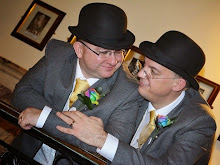
So it's come to this... I'm at home, not very well, trying to get the housework done, trying to keep an eye out for Doctor Who trailers on BBC1 (ooh, look, a new one yesterday)... And now I've been pulled into the horror that is daytime soap as a result. There's no hope for me. I'm watching Doctors, a soap I've never even seen before, but still getting snuffly at today's gay wedding (though I probably won't take many notes for our own far-distant day). Hurrah! Civil partnership on the Beeb!
At least I turned the sound off during Neighbours.
My habitual slight scowl at the words 'civil partnership' has also receded, as no-one mentioned them at any time. So maybe I'm wrong and the law will eventually be steamrollered by the word 'marriage' anyway.
At least I turned the sound off during Neighbours.
My habitual slight scowl at the words 'civil partnership' has also receded, as no-one mentioned them at any time. So maybe I'm wrong and the law will eventually be steamrollered by the word 'marriage' anyway.
Sunday, April 09, 2006
Crisp Unt Light Brown
Disaster! Walkers have changed all their Sensations Crisps flavours (you know, the ones in the gigantic bags about which you always tell yourself, ‘Just because I’ve opened it doesn’t mean I have to eat them all at once’). Gone are favourites like Roast Lamb and Mint or Four Cheeses, and just because the new Lamb and Moroccan Spices are particularly nice obviously won’t stop me fulminating about the missing ones ;-)
Right now, News 24 is also talking about resistance to change in the reaction to Camilla replacing Diana. The Labour Party face a similar problem. They too will say that the (formerly) popular, glamorous one was just a marriage of convenience and that now they’re going to get the one they really love. I don’t think Mr Windsor has done anything to merit just assuming the top job in the country, but good luck to him in finding happiness with someone he loves. I’ll reserve wishing luck to Mr Frown, who I don’t think has done anything to merit assuming the top job in the country either, and he may find that lack of ‘crossover appeal’ is going to be more of a problem for him than for Mrs Windsor.
In the interests of balance, though, don't you think Tony looks tired?
Right now, News 24 is also talking about resistance to change in the reaction to Camilla replacing Diana. The Labour Party face a similar problem. They too will say that the (formerly) popular, glamorous one was just a marriage of convenience and that now they’re going to get the one they really love. I don’t think Mr Windsor has done anything to merit just assuming the top job in the country, but good luck to him in finding happiness with someone he loves. I’ll reserve wishing luck to Mr Frown, who I don’t think has done anything to merit assuming the top job in the country either, and he may find that lack of ‘crossover appeal’ is going to be more of a problem for him than for Mrs Windsor.
In the interests of balance, though, don't you think Tony looks tired?
Saturday, April 08, 2006
Wikimeme
Ooh, my first* meme! Spotted over at Will’s:
Three political events:
Deaths:
*Technically it isn’t, of course, but it’s the first time I’ve filled out one of these viral blog questionnaires of that name.
Go to Wikipedia. Type in your birth date (but not year). List three events that happened on your birthday. List two important birthdays and one interesting death. Post this in your journal.I’ve customised this one for October 30th to suit my blog…
Three political events:
1270 - The Eighth Crusade and siege of Tunis end by an agreement between Charles I of Sicily (brother to King Louis IX of France, who had died months earlier) and the Sultan of Tunis.Three important events:
1905 - Tsar Nicholas II grants Russia's first constitution, creating a legislative assembly.
1947 - The General Agreement on Tariffs and Trade (GATT), which is the foundation of the World Trade Organisation (WTO), is founded.
1925 - John Logie Baird creates Britain's first television transmitter.Three events that aren’t in the Wikipedia list:
1938 - Orson Welles broadcasts his radio play of H. G. Wells' The War of the Worlds, causing a nationwide panic (in the USA, obviously).
2002 - British digital terrestrial television (DTT) service Freeview starts transmitting throughout parts of the United Kingdom.
1965 – The third episode of the Doctor Who story The Myth Makers is transmitted. In those days (and again in the 21st Century), each episode had an individual title rather than the more prosaic ‘Part Three’. This one always entertains me as, in a story taking a largely comedic look at the Trojan Wars, the author wanted it to be called ‘Is There A Doctor In the Horse?’ Po-faced Auntie Beeb wouldn’t let him, and called it ‘Death of a Spy’ instead.Births:
1967 – The Times announces that Linda Thorson has succeeded Diana Rigg as the female lead in The Avengers.
1976 – The third episode of the Doctor Who story The Deadly Assassin is transmitted. It’s still my favourite story, and at the time it was, of course, my favourite ‘birthday present’ (I can think of a better one since, but not on a public blog).
1735 - John Adams, American revolutionary leader and President of the United States (d. 1826)And I must add an extra one from 1882 - Günther von Kluge, German field marshal, of whom I had never heard but who has a fantastic name.
1956 - Juliet Stevenson, English actress (otherwise known as Flora Matlock, MP)
Deaths:
1979 - Barnes Wallis, British aeronautical engineer (b. 1887)Having once been a good Catholic boy, I’m further adding to the meme the Calendar of Saints (feast days of Roman Catholic Saints), and offering up thanks to my parents - should they ever read my blog, which might entail giving way to the nagging from their children and actually switching on the computer I gave them a couple of years ago - for not naming me after:
St. Zenobius & ZenobiaEsoteric meme-related factoid:
The Doctor Who story The End of the World (2005) takes place aboard a space station which forbids the use of those dangerous constructs “weapons, teleportation and religion”. The villain of the piece conspicuously makes use of weapons and teleportation but, more subtly, has monklike catspaws known as ‘the Adherents of the Repeated Meme’ – which sounds rather like a definition of religion.And finally, one from Richard and my anniversary:
Richard also points out two clues that link the adherents to the villain behind them: a villain with no arms has to use these ARMs to do the dirty work; and, given that the villain is monumentally self-obsessed, repeating ‘meme’ sounds very like “me me me me me me me me me me me me…” – which is curiously appropriate to the blogospheric use of the term.
1881 - The Gunfight at the O.K. Corral takes place at Tombstone, Arizona.
*Technically it isn’t, of course, but it’s the first time I’ve filled out one of these viral blog questionnaires of that name.
Thursday, April 06, 2006
Introducing the Doctor…
Doctor Who’s return to our screens approaches rapidly, so I’m taking a quick look at the last year’s stories (showing over the next week at 7pm on BBC3). We don’t really know the current Doctor (David Tennant) yet; he talks a lot – so I like him – his mood changes rapidly, and he dresses in his own strange mix of ‘smart but scruffy’. But the Doctor’s had nine other bodies before him, and last year's (Christopher Eccleston) encountered ‘ghosts’ from the past and aliens from the future, and saw the day the Earth died in a ball of flame.
Intense, often angry or abrupt, the ninth Doctor was a survivor from a terrible war, struggling not to be consumed by survivor’s guilt. We saw him rediscovering his joy in life in sudden bursts of good humour with a new friend from modern London, Rose Tyler. He seemed much more hesitant to act than other Doctors, gradually encouraging other people to live their own lives to the full but seeming unsure of himself after his terrible experiences and, perhaps, actions. Perhaps that’s why he cropped his hair and dressed in a leather jacket, as if in a mid-life crisis (“I’m not over a thousand! I’m only 900!”). But his stories brought Doctor Who back to the screen with not just a far bigger budget but with a real run of quality, including scripts from the writers of Queer As Folk, Coupling and The League of Gentlemen. The more impressive stories are brilliant, the less impressive ones still stay pretty good, and with so much travel through the past, present and far future of Earth to examine the history of humanity, you hardly notice a distinct lack of alien planets so far…
On BBC3 tonight at 7pm:
Rose
Sheer verve and energy as Rose’s bored life as a London shop assistant is thrown into chaos by meeting the Doctor. I love the scene where she's introduced to the TARDIS. It has almost the punch and fun of a modern The Avengers, though Rose and a Northern Doctor ironically make it rather more down-to-Earth. There’s an alien invasion by dummies, too, but sometimes you’d hardly notice; it’s just window-dressing.
The End of the World
Rose goes five billion years in the future and says goodbye to the Earth. It’s very amusing, has astounding special effects and the immensely enjoyable villain looks fantastic, the ultimate in plastic surgery. Just don't try pitching it against Poirot as a whodunnit, that's all.
On BBC3 tomorrow night:
The Unquiet Dead
Ahh, Doctor Who’s scary again. Zombies walk in Nineteenth Century Cardiff and upset Charles Dickens. Easily one of my favourites from last year, there’s a witty script and some great culture clashes but, really, you just can’t beat a well-told Victorian ‘ghost story’.
Aliens of London
Back to modern London to see the consequences of Rose’s travelling, as aliens infiltrate the government. It’s the one where the spaceship crashes into Big Ben, which is always fun, but some of the broad humour trips over the political satire.
On BBC3 this Saturday night:
World War Three
Continuing from the previous episode, the aliens are revealed and some of the characters end up as rather more serious than you thought they’d be. The humour’s down and satire’s up as - first broadcast the week before the 2005 election - it lays into the Iraq War and ID cards (hurrah), and as for what happens to Downing Street…
On BBC3 next Monday night:
Dalek
The grimmest of these stories (when even the scariest of the others have a playful tone), as the Doctor encounters the last survivor of the enemy side in the war. You know what it is. He’s not quite as loveable as usual here – but then, none of the people we meet here are particularly nice, and all of them have life-changing (or life-ending) experiences…
The Long Game
Into the far future with Rose and a new friend, who’s, well, not really up to the job. It’s quite a slim plot, but don’t write it off – bits will turn up later. Besides, I enjoy a villain who enjoys himself, and this one does (then there’s the monster in the ceiling)…
On BBC3 next Tuesday night:
Father's Day
Rose is taken back to the day her father died, and discovers the dangers of mucking about with time. A fantastic episode where almost everything comes right: awesome flying monsters to appeal to the 3-year-old-me that fell in love with the show in the first place, and great emotional scenes that got the 33-year-old me watching all misty-eyed. Beautiful music, too.
The Empty Child
Back to the Blitz, and Doctor Who continues to be the only series that visits the Second World War but never does the cliché and fights the Nazis there (you can tell it’s not an American show). A witty episode that’s probably also the scariest of the year, and all the better for it; children with gasmasks asking, “Are you my mummy…?”
On BBC3 next Wednesday night:
The Doctor Dances
Continuing from the previous episode, there are more really quite disturbing transformations, and our heroes are joined by a very handsome man called Jack. There’s even a surprisingly happy ending. I have a feeling this one won an award as the single best piece of telly last year, and it’s not bad, you know.
Boom Town
After so many special-effects-laden epics, most of the drama here takes place in a restaurant in modern Cardiff. And the face-off between the Doctor and the villain is so electrifying, the mix of drama and humour so perfectly judged, that it’s probably my favourite of the year.
On BBC3 next Thursday night:
Bad Wolf
Into the far future again for a nightmarish take on reality TV; funny and shocking, and with the most impressive cliffhanger ending to any of the episodes this year. Plus, you get to see a robot Anne Robinson who fires deathrays. What’s not to like?
The Parting of the Ways
Continuing from the previous episode and concluding a lot that’s been going on in the year, if you want an action-packed space epic, this is for you. There are some fantastic scenes but it's less than the sum of its parts, with set pieces stronger than the story stringing them together. Looks impressive, though.
…And then there’s less than 48 hours to go until New Earth starts the new run. Don’t read about it in the Radio Times; they spoil things. And most of the newspapers’ll be worse. As with much of TV today, it’s such big news that the best thing to do if you want to enjoy it as it happens is to stop reading anything in a paper that says ‘Doctor Who’, and politely decline if people say “Hey! Guess what I’ve heard!”
Of course, you can get the 2005 season of Doctor Who on DVD, too. They’re well worth it, and I’d recommend getting the somewhat impractically built box set of all of them rather than buying the ‘individual’ releases – the price adds up to about the same, and you get plenty of extras (instead of, er, none). The commentaries are all enjoyable, you get a complete set of mini-documentaries, and the ‘deleted scenes’ they talk about and meant to include are, er, not there. They forget to put them in. Whoops. Maybe in the '2006' box. So there you go. The first year of ‘new’ Doctor Who, in a nutshell, and awfully good it is too, with one more from right at the end of the year…
There’s also the first story for the new Doctor:
On BBC3 this Sunday night at 8pm, just to be different:
The Christmas Invasion
You can probably guess when this one’s set, but though it starts on a modern London council estate with more than a few laughs, it’s a dark Christmas fable of aliens coming to harvest humanity and us ending up scarier than they are. The Doctor’s still recovering from the explosive effect of changing bodies, but when he finally gets going, wow, he makes an impact…
It's really not remotely necessary to know the 'old' series of Doctor Who before you see the new ones (you don't even need to see last year's ones before New Earth, though it helps a little). But they're still obviously related, and it'll hardly be a shock if you get interested in the original series, too. I’m going to be doing shorter pieces on the ‘old’ Doctors, but if you’re vaguely interested but don’t think you can wade through another article, I’ll close with the mini-version. There are so many novels, CDs, websites and the like out there that they can be very off-putting, and while many of them are good, none of them are vital. The best thing to do is pick up some DVDs – easy to get hold of (often reduced in price), and showing the stories as they were meant to be seen, including the best ‘extras’ and picture and sound restoration work on any DVDs you’ll find aside from blockbuster movies.
If you want to dip into the Doctor Who DVDs, these are probably the best of the old series that's available:
Doctor Who – The Beginning
Way back to 1963 for the first three stories in a box together, including the first appearance of the Daleks, and some terrific documentaries about how it all started.
Doctor Who – The Talons of Weng-Chiang
A hugely enjoyable story of Victorian murders starring Tom Baker as the Doctor, which despite the subject matter is one of the wittiest, most quotable pieces of television going. Another great documentary as an extra.
Doctor Who – Earthshock
The Cybermen attack in a futuristic macho action thriller which is good dumb fun, but among some impressive extras the one that stands out is when the actors are reunited for the bitchiest commentary going.
Doctor Who – The Curse of Fenric
Doctor Who’s always been good at horror stories, and this is a particularly intelligent one. The outstanding feature of the DVD is a wholesale new edit of the story, with new scenes, effects, music and a movie format.
And Doctor Who – The Complete First Series (2005), of course.
If you want to make a start on Doctor Who novels instead, that’s much more tricky. With so many to choose from, it’s difficult to sort out the best of them, and most of them are sadly out of print. None of them are as good a start as a DVD (many throw you in at the deep end), and while I have many of the published guides and handbooks to the series and find some of them addictive, none of them are authoritative and enthusiastic enough to recommend as gospel. None of them agree enough with me, either ;-) However, if you feel suddenly enthused by Doctor Who and, like me, you love to read, before you spend all your savings getting all the novels you can find on eBay, see if you can track down a few of these. The books come in many different ranges, but they divide mainly into the novelisations from Target Books – based on the TV stories – and original novels (from many different publishers).
For the best of the Target novelisations, try:
Doctor Who and the Daleks (David Whitaker)
Doctor Who and the Auton Invasion (Terrance Dicks)
Doctor Who and the Cave-Monsters (Malcolm Hulke)
Doctor Who and the Ark In Space (Ian Marter)
Doctor Who – Remembrance of the Daleks (Ben Aaronovitch)
And if you fancy the original novels, look for:
Doctor Who – The New Adventures: Lucifer Rising (Andy Lane and Jim Mortimore)
Doctor Who – The New Adventures: The Also People (Ben Aaronovitch)
Doctor Who – The Missing Adventures: Venusian Lullaby (Paul Leonard)
Doctor Who (BBC Books) – Alien Bodies (Lawrence Miles)
Doctor Who (BBC Books) – The Shadows of Avalon (Paul Cornell)
…But do try watching some of Doctor Who on the telly (or shiny silver disc) first.
Intense, often angry or abrupt, the ninth Doctor was a survivor from a terrible war, struggling not to be consumed by survivor’s guilt. We saw him rediscovering his joy in life in sudden bursts of good humour with a new friend from modern London, Rose Tyler. He seemed much more hesitant to act than other Doctors, gradually encouraging other people to live their own lives to the full but seeming unsure of himself after his terrible experiences and, perhaps, actions. Perhaps that’s why he cropped his hair and dressed in a leather jacket, as if in a mid-life crisis (“I’m not over a thousand! I’m only 900!”). But his stories brought Doctor Who back to the screen with not just a far bigger budget but with a real run of quality, including scripts from the writers of Queer As Folk, Coupling and The League of Gentlemen. The more impressive stories are brilliant, the less impressive ones still stay pretty good, and with so much travel through the past, present and far future of Earth to examine the history of humanity, you hardly notice a distinct lack of alien planets so far…
On BBC3 tonight at 7pm:
Rose
Sheer verve and energy as Rose’s bored life as a London shop assistant is thrown into chaos by meeting the Doctor. I love the scene where she's introduced to the TARDIS. It has almost the punch and fun of a modern The Avengers, though Rose and a Northern Doctor ironically make it rather more down-to-Earth. There’s an alien invasion by dummies, too, but sometimes you’d hardly notice; it’s just window-dressing.
The End of the World
Rose goes five billion years in the future and says goodbye to the Earth. It’s very amusing, has astounding special effects and the immensely enjoyable villain looks fantastic, the ultimate in plastic surgery. Just don't try pitching it against Poirot as a whodunnit, that's all.
On BBC3 tomorrow night:
The Unquiet Dead
Ahh, Doctor Who’s scary again. Zombies walk in Nineteenth Century Cardiff and upset Charles Dickens. Easily one of my favourites from last year, there’s a witty script and some great culture clashes but, really, you just can’t beat a well-told Victorian ‘ghost story’.
Aliens of London
Back to modern London to see the consequences of Rose’s travelling, as aliens infiltrate the government. It’s the one where the spaceship crashes into Big Ben, which is always fun, but some of the broad humour trips over the political satire.
On BBC3 this Saturday night:
World War Three
Continuing from the previous episode, the aliens are revealed and some of the characters end up as rather more serious than you thought they’d be. The humour’s down and satire’s up as - first broadcast the week before the 2005 election - it lays into the Iraq War and ID cards (hurrah), and as for what happens to Downing Street…
On BBC3 next Monday night:
Dalek
The grimmest of these stories (when even the scariest of the others have a playful tone), as the Doctor encounters the last survivor of the enemy side in the war. You know what it is. He’s not quite as loveable as usual here – but then, none of the people we meet here are particularly nice, and all of them have life-changing (or life-ending) experiences…
The Long Game
Into the far future with Rose and a new friend, who’s, well, not really up to the job. It’s quite a slim plot, but don’t write it off – bits will turn up later. Besides, I enjoy a villain who enjoys himself, and this one does (then there’s the monster in the ceiling)…
On BBC3 next Tuesday night:
Father's Day
Rose is taken back to the day her father died, and discovers the dangers of mucking about with time. A fantastic episode where almost everything comes right: awesome flying monsters to appeal to the 3-year-old-me that fell in love with the show in the first place, and great emotional scenes that got the 33-year-old me watching all misty-eyed. Beautiful music, too.
The Empty Child
Back to the Blitz, and Doctor Who continues to be the only series that visits the Second World War but never does the cliché and fights the Nazis there (you can tell it’s not an American show). A witty episode that’s probably also the scariest of the year, and all the better for it; children with gasmasks asking, “Are you my mummy…?”
On BBC3 next Wednesday night:
The Doctor Dances
Continuing from the previous episode, there are more really quite disturbing transformations, and our heroes are joined by a very handsome man called Jack. There’s even a surprisingly happy ending. I have a feeling this one won an award as the single best piece of telly last year, and it’s not bad, you know.
Boom Town
After so many special-effects-laden epics, most of the drama here takes place in a restaurant in modern Cardiff. And the face-off between the Doctor and the villain is so electrifying, the mix of drama and humour so perfectly judged, that it’s probably my favourite of the year.
On BBC3 next Thursday night:
Bad Wolf
Into the far future again for a nightmarish take on reality TV; funny and shocking, and with the most impressive cliffhanger ending to any of the episodes this year. Plus, you get to see a robot Anne Robinson who fires deathrays. What’s not to like?
The Parting of the Ways
Continuing from the previous episode and concluding a lot that’s been going on in the year, if you want an action-packed space epic, this is for you. There are some fantastic scenes but it's less than the sum of its parts, with set pieces stronger than the story stringing them together. Looks impressive, though.
…And then there’s less than 48 hours to go until New Earth starts the new run. Don’t read about it in the Radio Times; they spoil things. And most of the newspapers’ll be worse. As with much of TV today, it’s such big news that the best thing to do if you want to enjoy it as it happens is to stop reading anything in a paper that says ‘Doctor Who’, and politely decline if people say “Hey! Guess what I’ve heard!”
Of course, you can get the 2005 season of Doctor Who on DVD, too. They’re well worth it, and I’d recommend getting the somewhat impractically built box set of all of them rather than buying the ‘individual’ releases – the price adds up to about the same, and you get plenty of extras (instead of, er, none). The commentaries are all enjoyable, you get a complete set of mini-documentaries, and the ‘deleted scenes’ they talk about and meant to include are, er, not there. They forget to put them in. Whoops. Maybe in the '2006' box. So there you go. The first year of ‘new’ Doctor Who, in a nutshell, and awfully good it is too, with one more from right at the end of the year…
There’s also the first story for the new Doctor:
On BBC3 this Sunday night at 8pm, just to be different:
The Christmas Invasion
You can probably guess when this one’s set, but though it starts on a modern London council estate with more than a few laughs, it’s a dark Christmas fable of aliens coming to harvest humanity and us ending up scarier than they are. The Doctor’s still recovering from the explosive effect of changing bodies, but when he finally gets going, wow, he makes an impact…
It's really not remotely necessary to know the 'old' series of Doctor Who before you see the new ones (you don't even need to see last year's ones before New Earth, though it helps a little). But they're still obviously related, and it'll hardly be a shock if you get interested in the original series, too. I’m going to be doing shorter pieces on the ‘old’ Doctors, but if you’re vaguely interested but don’t think you can wade through another article, I’ll close with the mini-version. There are so many novels, CDs, websites and the like out there that they can be very off-putting, and while many of them are good, none of them are vital. The best thing to do is pick up some DVDs – easy to get hold of (often reduced in price), and showing the stories as they were meant to be seen, including the best ‘extras’ and picture and sound restoration work on any DVDs you’ll find aside from blockbuster movies.
If you want to dip into the Doctor Who DVDs, these are probably the best of the old series that's available:
Doctor Who – The Beginning
Way back to 1963 for the first three stories in a box together, including the first appearance of the Daleks, and some terrific documentaries about how it all started.
Doctor Who – The Talons of Weng-Chiang
A hugely enjoyable story of Victorian murders starring Tom Baker as the Doctor, which despite the subject matter is one of the wittiest, most quotable pieces of television going. Another great documentary as an extra.
Doctor Who – Earthshock
The Cybermen attack in a futuristic macho action thriller which is good dumb fun, but among some impressive extras the one that stands out is when the actors are reunited for the bitchiest commentary going.
Doctor Who – The Curse of Fenric
Doctor Who’s always been good at horror stories, and this is a particularly intelligent one. The outstanding feature of the DVD is a wholesale new edit of the story, with new scenes, effects, music and a movie format.
And Doctor Who – The Complete First Series (2005), of course.
If you want to make a start on Doctor Who novels instead, that’s much more tricky. With so many to choose from, it’s difficult to sort out the best of them, and most of them are sadly out of print. None of them are as good a start as a DVD (many throw you in at the deep end), and while I have many of the published guides and handbooks to the series and find some of them addictive, none of them are authoritative and enthusiastic enough to recommend as gospel. None of them agree enough with me, either ;-) However, if you feel suddenly enthused by Doctor Who and, like me, you love to read, before you spend all your savings getting all the novels you can find on eBay, see if you can track down a few of these. The books come in many different ranges, but they divide mainly into the novelisations from Target Books – based on the TV stories – and original novels (from many different publishers).
For the best of the Target novelisations, try:
Doctor Who and the Daleks (David Whitaker)
Doctor Who and the Auton Invasion (Terrance Dicks)
Doctor Who and the Cave-Monsters (Malcolm Hulke)
Doctor Who and the Ark In Space (Ian Marter)
Doctor Who – Remembrance of the Daleks (Ben Aaronovitch)
And if you fancy the original novels, look for:
Doctor Who – The New Adventures: Lucifer Rising (Andy Lane and Jim Mortimore)
Doctor Who – The New Adventures: The Also People (Ben Aaronovitch)
Doctor Who – The Missing Adventures: Venusian Lullaby (Paul Leonard)
Doctor Who (BBC Books) – Alien Bodies (Lawrence Miles)
Doctor Who (BBC Books) – The Shadows of Avalon (Paul Cornell)
…But do try watching some of Doctor Who on the telly (or shiny silver disc) first.
Labels: Books, Christopher Eccleston, David Tennant, Doctor Who, DVD, Reviews
So Who is This Doctor Bloke Anyway?
With a new series of Doctor Who beginning on Easter Saturday, and BBC3 tonight beginning a repeat of last year’s stories, it’s a perfect time to start watching. So what do you need to know? The Doctor is a traveller in time and space. He goes anywhere he likes – alien worlds, past, present, future… He respects life rather than authority and obeys no rules but his own sense of fun and a moral sense to fight oppression. He uses his intelligence rather than violence, and he takes friends with him to explore the wonders of the Universe. That’s it.
OK, so that’s the important bit, but a few more questions.
Where’s the Doctor from, and why does he travel?
Well, he’s an alien, and the people of his world watched over all of time and space, but without interfering. He found that just watching bored him, when he wanted to get out to meet people and experience things for himself, and offended his morals, because when he saw evil he wanted to stand up to it. So he took a TARDIS and left. Those he fought most often were the Daleks, alien conquerors in armoured mini-tanks with a hatred for all other races. They too developed time travel, leading to conflict with the Doctor’s own people in which both sides wiped each other out, and now the Doctor’s the only survivor. So he just carries on travelling, making the most of life, seeing the sights, toppling empires, that sort of thing. He also claims to have a really complicated name, so he just calls himself ‘the Doctor’ (‘Doctor Who?’ That’s one of the many questions about him that’ll remain a mystery).
What’s this ‘TARDIS’ that he travels in?
It’s a machine for travelling through time and space, the name standing for Time And Relative Dimension In Space. It was a bit old and unreliable back when he took from his people, and he’s patched it up and customised it many times in around a thousand years that they’ve been travelling together. Just to make it even less likely it’ll go where he wants it to, it’s quite literally got something of a mind of its own, too. It seems to vanish from one place and just appear in the next, travelling through a strange ‘vortex’ that’s unlike ordinary space. Oh, and the outside of it gives no sign of what’s inside. It used to disguise itself on landing so it wouldn’t be spotted, but when the Doctor arrived in the 1960s it took the form of a police box, a sort of phone booth before the British police had personal radios and mobile phones, and got stuck like that. Inside, though, unfolds into many other dimensions and many different rooms. So you’ll have noticed that it’s bigger inside than outside. So do most people who go in, unsurprisingly.
A thousand years or so of travelling? He looks good on it.
Well, his people were pretty long-lived, so that helps more than moisturiser. But it’s not just that their bodies live for hundreds of years. When they get too old, or are fatally injured, they’ve got a way of cheating death. Their body changes into a completely new one, giving them a new lease of life, shaking up their personality while remaining essentially the same person underneath. The Doctor’s had quite an eventful life, and he’s just been ‘born’ into his tenth body. Naturally, it also helps the TV series carry on when the actor playing the Doctor decides to leave, and it’s almost the only TV show that can recast its lead without hoping the audience are blind or pretending it’s something to do with plastic surgery or showers.
You’ve mentioned actors, and admitted it’s not real at last. So what’s special about this TV programme?
It started off in 1963 and lasted three decades, before being reborn last year, and has usually been a popular success, thanks to its unique flexibility and, of course, to monsters like the Daleks. The big creative talent behind the new series, Russell T Davies, calls it “the best idea ever invented in the history of the world,” and it’s inspired an awful lot of people since, though you don’t need to know any intricate details to follow it. It’s the idea that’s important, that you can go pretty much anywhere and do pretty much anything, that people everywhere are worthwhile, whether they’re people like us or green scaly rubber people. The Doctor believes in freedom, and hates ignorance, conformity and insularity. He doesn’t work for anyone, wear a uniform or carry a gun, making the series both very British and very anti-establishment. It encourages people to think, to have fun, and to take a moral stand, but it’s wary of solving problems by shooting them. You don’t have to believe what you’re told, still less do what you’re told. And it’s spent several decades scaring children with nasty monsters and even the music, which when you put it all together is what family entertainment is about – a show with enough in it to satisfy all ages.
The best of Doctor Who would include a dash of horror, adventures in history, enough wit to make you smile, enough ideas and strangeness and to make you think, and enough action to get you excited. That’s probably too much to fit into just one piece of television, which takes you right back to the idea that you can go anywhere and do anything, because it’s not about just one piece of television, but different travels. It’s the only show where, if you don’t like where it’s ended up one week, if you want it to be scarier, or funnier, or more thoughtful, or more action-packed, the next week will be in a completely different place and time and probably in a completely different style, but still recognisably the same programme. That’s probably why I fell in love with it, anyway.
How can I find out more?
You can read more of this blog, or tens of thousands of other web pages. But I wouldn’t, if I were you, not to start with. It’s probably the best TV programme ever made, so the best way to find about it is to watch it.
The new series starts on BBC1 on April 15th (look out for the trailer) – or, if you’re in tonight, watch BBC3. Between tonight and next Thursday, they’re repeating the whole of the ‘comeback’ series from last year, and the first episode, Rose, starts at 7 tonight, where the Doctor (in his ninth body, played by Christopher Eccleston) meets a young woman from a council estate called Rose and they foil an alien invasion. Alternatively, at 7.15pm on Easter Saturday there’s a brand new story called New Earth, starring David Tennant as the Doctor, and I don’t know anything else about that yet. But watching either will be a better introduction to this fantastic series than anything you could possibly read. So watch one!
OK, so that’s the important bit, but a few more questions.
Where’s the Doctor from, and why does he travel?
Well, he’s an alien, and the people of his world watched over all of time and space, but without interfering. He found that just watching bored him, when he wanted to get out to meet people and experience things for himself, and offended his morals, because when he saw evil he wanted to stand up to it. So he took a TARDIS and left. Those he fought most often were the Daleks, alien conquerors in armoured mini-tanks with a hatred for all other races. They too developed time travel, leading to conflict with the Doctor’s own people in which both sides wiped each other out, and now the Doctor’s the only survivor. So he just carries on travelling, making the most of life, seeing the sights, toppling empires, that sort of thing. He also claims to have a really complicated name, so he just calls himself ‘the Doctor’ (‘Doctor Who?’ That’s one of the many questions about him that’ll remain a mystery).
What’s this ‘TARDIS’ that he travels in?
It’s a machine for travelling through time and space, the name standing for Time And Relative Dimension In Space. It was a bit old and unreliable back when he took from his people, and he’s patched it up and customised it many times in around a thousand years that they’ve been travelling together. Just to make it even less likely it’ll go where he wants it to, it’s quite literally got something of a mind of its own, too. It seems to vanish from one place and just appear in the next, travelling through a strange ‘vortex’ that’s unlike ordinary space. Oh, and the outside of it gives no sign of what’s inside. It used to disguise itself on landing so it wouldn’t be spotted, but when the Doctor arrived in the 1960s it took the form of a police box, a sort of phone booth before the British police had personal radios and mobile phones, and got stuck like that. Inside, though, unfolds into many other dimensions and many different rooms. So you’ll have noticed that it’s bigger inside than outside. So do most people who go in, unsurprisingly.
A thousand years or so of travelling? He looks good on it.
Well, his people were pretty long-lived, so that helps more than moisturiser. But it’s not just that their bodies live for hundreds of years. When they get too old, or are fatally injured, they’ve got a way of cheating death. Their body changes into a completely new one, giving them a new lease of life, shaking up their personality while remaining essentially the same person underneath. The Doctor’s had quite an eventful life, and he’s just been ‘born’ into his tenth body. Naturally, it also helps the TV series carry on when the actor playing the Doctor decides to leave, and it’s almost the only TV show that can recast its lead without hoping the audience are blind or pretending it’s something to do with plastic surgery or showers.
You’ve mentioned actors, and admitted it’s not real at last. So what’s special about this TV programme?
It started off in 1963 and lasted three decades, before being reborn last year, and has usually been a popular success, thanks to its unique flexibility and, of course, to monsters like the Daleks. The big creative talent behind the new series, Russell T Davies, calls it “the best idea ever invented in the history of the world,” and it’s inspired an awful lot of people since, though you don’t need to know any intricate details to follow it. It’s the idea that’s important, that you can go pretty much anywhere and do pretty much anything, that people everywhere are worthwhile, whether they’re people like us or green scaly rubber people. The Doctor believes in freedom, and hates ignorance, conformity and insularity. He doesn’t work for anyone, wear a uniform or carry a gun, making the series both very British and very anti-establishment. It encourages people to think, to have fun, and to take a moral stand, but it’s wary of solving problems by shooting them. You don’t have to believe what you’re told, still less do what you’re told. And it’s spent several decades scaring children with nasty monsters and even the music, which when you put it all together is what family entertainment is about – a show with enough in it to satisfy all ages.
The best of Doctor Who would include a dash of horror, adventures in history, enough wit to make you smile, enough ideas and strangeness and to make you think, and enough action to get you excited. That’s probably too much to fit into just one piece of television, which takes you right back to the idea that you can go anywhere and do anything, because it’s not about just one piece of television, but different travels. It’s the only show where, if you don’t like where it’s ended up one week, if you want it to be scarier, or funnier, or more thoughtful, or more action-packed, the next week will be in a completely different place and time and probably in a completely different style, but still recognisably the same programme. That’s probably why I fell in love with it, anyway.
How can I find out more?
You can read more of this blog, or tens of thousands of other web pages. But I wouldn’t, if I were you, not to start with. It’s probably the best TV programme ever made, so the best way to find about it is to watch it.
The new series starts on BBC1 on April 15th (look out for the trailer) – or, if you’re in tonight, watch BBC3. Between tonight and next Thursday, they’re repeating the whole of the ‘comeback’ series from last year, and the first episode, Rose, starts at 7 tonight, where the Doctor (in his ninth body, played by Christopher Eccleston) meets a young woman from a council estate called Rose and they foil an alien invasion. Alternatively, at 7.15pm on Easter Saturday there’s a brand new story called New Earth, starring David Tennant as the Doctor, and I don’t know anything else about that yet. But watching either will be a better introduction to this fantastic series than anything you could possibly read. So watch one!
Labels: Doctor Who, In-Depth Doctor Who, Top Tips
And in Other News...
Having been variously away, busy and unwell, I've got rather behind in my blogging (barring last minute incitements to watch the telly), but I've kept up with odd snippets on which others have blogged faster and better:
Most disturbing Most surprising Sadly only the most recent story of British freedom and justice
Most uplifting news
Most eye-watering example of Lib Dem self-immolation
And not forgetting...
Best recipe
Best expensive CGI effects
The blog that didn't bark: unaccountably, I've yet to see an enthusiastic welcome for the new Lib Dem Deputy Leader on Reflecting Britain ;-) Had Simon Hughes, say, been elected Leader, I might have seen the case for electing a safe, talented, incisive, elderly man from the Lib Dem right, but as we've already got one of those (and in the absence of a talented female candidate for variety) I'd have voted like a shot for Matthew Taylor, who is one of the few Lib Dem MPs I've seen come out clearly ahead under a full Paxman barrage and has a superb grip on the big picture of policy and philosophy, as well as hailing from a sufficiently different strand of Liberalism and, indeed, age group to our new ruling grandees to have given a bit of balance to the ticket.
Most uplifting news
Most eye-watering example of Lib Dem self-immolation
And not forgetting...
Best recipe
Best expensive CGI effects
The blog that didn't bark: unaccountably, I've yet to see an enthusiastic welcome for the new Lib Dem Deputy Leader on Reflecting Britain ;-) Had Simon Hughes, say, been elected Leader, I might have seen the case for electing a safe, talented, incisive, elderly man from the Lib Dem right, but as we've already got one of those (and in the absence of a talented female candidate for variety) I'd have voted like a shot for Matthew Taylor, who is one of the few Lib Dem MPs I've seen come out clearly ahead under a full Paxman barrage and has a superb grip on the big picture of policy and philosophy, as well as hailing from a sufficiently different strand of Liberalism and, indeed, age group to our new ruling grandees to have given a bit of balance to the ticket.
The News of the World Defends Privacy…
…but the only person in the land they think is entitled to it is one of their scummy provocateurs. Not that they’re in any way hypocritical. They’ve taken out an injunction – a ‘Mary Bell’ Order, no less, unprecedented outside of murder cases – against George Galloway, who spotted that their ‘Fake Sheikh’ attempted to entrap him, to prevent him from publishing photos of the man. I know, I know, the News of the Screws vs George Galloway; given the question, surely most people would answer “Can’t I just pretend I didn’t see either of them in the burning building?” It seems bizarre that this injunction to protect a ‘journalist’ from having his photo published was ever granted, but it appears to have expired (hurrah). Guido and Bloggerheads have published photos of the Fake, in an astounding array of accoutrements to baffle and bewilder, while Mr Galloway has sent pictures of him to every MP and members of the Windsor Family. I can’t stand the MP for next to where I live, but that made even me laugh.
With this and various recent political stories, I return to musing that British society would be so much happier and more liberal if some dubious billionaire became a media tycoon and mounted ruthless exposés on the sex and drug habits of every single employee of News International. Obviously I'd be shocked by such a thing, but if you happen to know any dubious billionaires, do give them a call...
With this and various recent political stories, I return to musing that British society would be so much happier and more liberal if some dubious billionaire became a media tycoon and mounted ruthless exposés on the sex and drug habits of every single employee of News International. Obviously I'd be shocked by such a thing, but if you happen to know any dubious billionaires, do give them a call...
Monday, April 03, 2006
The Green Death
No, this post’s not about squeezing the Green vote – stick a ‘Green Action’ flash on every leaflet you ever put out for that – but BBC4 again for their ‘1973 Week’. Life On Mars was such a success that they're repeating it with an entire week’s schedule fashioned around it, with many goodies on show from that year. At 7 tonight, tomorrow and Wednesday they’re showing The Green Death, a Doctor Who story that’s famous as ‘the one with the maggots’, that’s got very 1973 flashes of brilliance and moments of rubbish, and that made me a green Liberal. Ironic, then, that it was broadcast in a year before I could watch it and I picked up a large chunk of my Liberal political philosophy from the book, which was written by fluffy old communist Malcolm Hulke. It may or may not be a coincidence that on novelising the story he took out the most ostentatiously Liberal scene (and my favourite in the whole thing), as the villains try to persuade the Doctor that
I first saw this as an adult – somewhat surreally, I missed an episode of the early ’90s repeat because I was chairing a Lib Dem policy meeting where one of the actors from it was giving evidence, and a very strange man he was too – so, rather than the maggots making the biggest impression on me, it was the megalomaniac computer. Usually one of the biggest clichés in sci-fi, the BOSS computer here adds masses to this story through a very different characterisation to conventional ranting and a fantastic acting performance that gives the impression of constant ad-libbing. BOSS is irrational through being linked to a human brain, and the actor gives by far the most human and endearing mad computer I’ve ever come across, through voice alone. Florid and testy, he almost always wanders from the point, and spends most of one episode humming to himself. His symbiotic relationship with Stevens, his human ‘contact’, is fascinating; it’s difficult to escape the feeling it was sneaking a gay relationship into the 1973 schedules (with BOSS quoting Oscar Wilde, and in the book even humming the wedding march for the two of them). If it was done today, it'd be an allegory for sex over the Internet, but BOSS is much more interesting than any of that modern cliché I’ve seen on TV, too. When he meets his inevitable end, his painful ravings are very disturbing, and actually make me feel sorry for him despite his plan to enforce permanent happiness and equality on the human race through mind-controlled slavery.
Perhaps most people don’t spot the relationship between Stevens and BOSS because of a rather more high-profile relationship between the Doctor’s companion Jo Grant and new love interest Professor Jones, blatantly introduced as a ‘younger Doctor’ for her to leave with (amid surprising amounts of sexual innuendo all round). It’s a mixture of the most patronising way in which Doctor Who women left the series – give them another man to look after their pretty little heads – and consciously emulating the way Mrs Peel left The Avengers on the return of her lost husband, a glimpse of whom makes him obviously identical to Steed, just as here Jo leaves but is, of course, marrying the Doctor. Our hero displays an amusing level of jealousy at this throughout the story, right through to the touching ending as he leaves, alone. With Jon Pertwee’s Doctor probably the most haughtily paternal of the lot, I have to admit I wonder what Jo sees in Jones – he’s an arrogant git who patronises her so badly that he rather overdoes the ‘he’s really the Doctor’ characterisation.
Pertwee’s stories tended to have rather more in common with each other than most, and this has a lot of the familiar trappings of the period, with the Brigadier and his United Nations army chaps being frightfully serious or dim when the script requires the Doctor to put them down, the Doctor flouncing around in a big cloak and indulging in a space-filling ‘Venusian Aikido’ fight which would be much improved through the addition of Batman-style “Kerpow!”, “Boooof!” and “Splatt!” caption cards, and, of course, the moral.
Early ’70s Doctor Who did racism, colonialism, the EEC and so forth at one time or another, all on the Liberal side but with the Doctor’s homily given in a very patrician way (there’s an egregious example here where he describes bombing a mine as “the worst day’s work the world has seen for many, many years,” which rather overlooks not just his period’s alien invasions but some pretty grim wars we all know about), but never quite so blatantly as this story’s unsubtle ‘big business will drain your brain and poison you’. If I weren’t inclined to agree with the message, I’d probably have to complain about it. The probably unintended additional moral that ‘vegetarian food can KILL!’ slightly goes against the general tone of a story that’s Doctor Who at its most hippie, several years after everyone else was (there are even crystals with, like, groovy powers, man), and I hope it’s unintended that good people are in heterosexual relationships and villains are gay – though going by other work by the uncredited co-author, I wouldn’t put money on it. There’s also an unfortunate undercurrent that the Doctor’s travels in space and time are a silly, irresponsible waste of time rather than the point of the series, and that also comes across in the same writing team’s later Planet of the Spiders (guess which creepy-crawlies they did in that one). Just for fun, spot the scene where the Prime Minister is referred to as ‘Jeremy’; a programme showing Jeremy Thorpe as Prime Minister proves both that they were setting their stories a few years in the future, and that they were really bad at predicting it.
Still, it’s a fun story that I’ve always liked for all its failings, such a hugely endearing mad computer villain counts for a lot, and I might not have grown up a Lib Dem if I’d not read it as a boy. Tune in and enjoy it for ‘1973 Week’, along with the run of Life On Mars – it might just be the best Doctor Who story of that year, though rather strangely its rivals for that position, The Three Doctors and Carnival of Monsters, each have a lot more in common with this year’s time-swap cop show. Look them out on DVD and marvel at the way characters wonder if they’re dead, or what’s real, or if people ‘outside’ are watching them, or if it’s all a creation of their own mind, ticking off pretty much all the options of what’s happened to Sam Tyler…
“In the end, we all want the same thing; an ordered society, with everyone happy, well-fed… What’s best for Global Chemicals is best for the world, is best for you!”While evidently happy with the subtle underlying message of the story – hey, kids, big business makes pollution, and both of those are BAD – I wonder if Mr Hulke was slightly more uneasy with the Doctor objecting to a faux-utopian society claiming freedom from material want at the price of “Freedom from freedom”. Still, I loved the book anyway, and perhaps it was just a cut for space, because the story doesn’t exactly move at a gallop on TV (BBC4 are wise to show the episodes two at a time)…
“No, no, no!”Most people who saw this at the time remember it for the giant maggots, and they look fantastically horrid (if you get the DVD, there’s even a feature on how to make them and, yes, condoms are involved). You can see why they were memorable, and of course it’s the rapacious fruits of industry that mutate them, in the form of oil waste by-products. So, pretty much the model of a successful Doctor Who monster; they look convincing, scare the kiddies and have a moral behind them (though it’s a little strange that, like your standard alien menace, they’re immune to bullets in much the way that maggots, er, aren’t). So, if you want an example to prove to people that special effects in the old Doctor Who series were better than everyone makes out, you should watch this one, right? Um… Up to a point. Unfortunately the maggots share the screen with lots of people filmed on location in Wales. Which is fine. And lots of people shot in the studio while it purports to pretend to be Wales. Which you’ll be able to spot even if you’ve never seen a television before. The show’s depiction of Wales brings its own problems, too; so for Welsh viewers like Peter Black AM, if you've been impressed by the new series’ three-dimensional modern portrayal of the country, the best thing, boyo, to say about what the BBC did in 1973, Blodwen, is that it’s been much improved since, isn’t it.
“But, Doctor, it’s exactly your cup of tea. This fellow’s bright green, apparently, and dead.”
I first saw this as an adult – somewhat surreally, I missed an episode of the early ’90s repeat because I was chairing a Lib Dem policy meeting where one of the actors from it was giving evidence, and a very strange man he was too – so, rather than the maggots making the biggest impression on me, it was the megalomaniac computer. Usually one of the biggest clichés in sci-fi, the BOSS computer here adds masses to this story through a very different characterisation to conventional ranting and a fantastic acting performance that gives the impression of constant ad-libbing. BOSS is irrational through being linked to a human brain, and the actor gives by far the most human and endearing mad computer I’ve ever come across, through voice alone. Florid and testy, he almost always wanders from the point, and spends most of one episode humming to himself. His symbiotic relationship with Stevens, his human ‘contact’, is fascinating; it’s difficult to escape the feeling it was sneaking a gay relationship into the 1973 schedules (with BOSS quoting Oscar Wilde, and in the book even humming the wedding march for the two of them). If it was done today, it'd be an allegory for sex over the Internet, but BOSS is much more interesting than any of that modern cliché I’ve seen on TV, too. When he meets his inevitable end, his painful ravings are very disturbing, and actually make me feel sorry for him despite his plan to enforce permanent happiness and equality on the human race through mind-controlled slavery.
Perhaps most people don’t spot the relationship between Stevens and BOSS because of a rather more high-profile relationship between the Doctor’s companion Jo Grant and new love interest Professor Jones, blatantly introduced as a ‘younger Doctor’ for her to leave with (amid surprising amounts of sexual innuendo all round). It’s a mixture of the most patronising way in which Doctor Who women left the series – give them another man to look after their pretty little heads – and consciously emulating the way Mrs Peel left The Avengers on the return of her lost husband, a glimpse of whom makes him obviously identical to Steed, just as here Jo leaves but is, of course, marrying the Doctor. Our hero displays an amusing level of jealousy at this throughout the story, right through to the touching ending as he leaves, alone. With Jon Pertwee’s Doctor probably the most haughtily paternal of the lot, I have to admit I wonder what Jo sees in Jones – he’s an arrogant git who patronises her so badly that he rather overdoes the ‘he’s really the Doctor’ characterisation.
Pertwee’s stories tended to have rather more in common with each other than most, and this has a lot of the familiar trappings of the period, with the Brigadier and his United Nations army chaps being frightfully serious or dim when the script requires the Doctor to put them down, the Doctor flouncing around in a big cloak and indulging in a space-filling ‘Venusian Aikido’ fight which would be much improved through the addition of Batman-style “Kerpow!”, “Boooof!” and “Splatt!” caption cards, and, of course, the moral.
Early ’70s Doctor Who did racism, colonialism, the EEC and so forth at one time or another, all on the Liberal side but with the Doctor’s homily given in a very patrician way (there’s an egregious example here where he describes bombing a mine as “the worst day’s work the world has seen for many, many years,” which rather overlooks not just his period’s alien invasions but some pretty grim wars we all know about), but never quite so blatantly as this story’s unsubtle ‘big business will drain your brain and poison you’. If I weren’t inclined to agree with the message, I’d probably have to complain about it. The probably unintended additional moral that ‘vegetarian food can KILL!’ slightly goes against the general tone of a story that’s Doctor Who at its most hippie, several years after everyone else was (there are even crystals with, like, groovy powers, man), and I hope it’s unintended that good people are in heterosexual relationships and villains are gay – though going by other work by the uncredited co-author, I wouldn’t put money on it. There’s also an unfortunate undercurrent that the Doctor’s travels in space and time are a silly, irresponsible waste of time rather than the point of the series, and that also comes across in the same writing team’s later Planet of the Spiders (guess which creepy-crawlies they did in that one). Just for fun, spot the scene where the Prime Minister is referred to as ‘Jeremy’; a programme showing Jeremy Thorpe as Prime Minister proves both that they were setting their stories a few years in the future, and that they were really bad at predicting it.
Still, it’s a fun story that I’ve always liked for all its failings, such a hugely endearing mad computer villain counts for a lot, and I might not have grown up a Lib Dem if I’d not read it as a boy. Tune in and enjoy it for ‘1973 Week’, along with the run of Life On Mars – it might just be the best Doctor Who story of that year, though rather strangely its rivals for that position, The Three Doctors and Carnival of Monsters, each have a lot more in common with this year’s time-swap cop show. Look them out on DVD and marvel at the way characters wonder if they’re dead, or what’s real, or if people ‘outside’ are watching them, or if it’s all a creation of their own mind, ticking off pretty much all the options of what’s happened to Sam Tyler…
Labels: Doctor Who, Jon Pertwee, Reviews, The Brigadier, Utopia
Saturday, April 01, 2006
I'm Officially Very Excited
(Sound of TARDIS materialising)
Think you’ve seen it all?
Think again.
Outside those doors, we might see anything.
We could find new worlds –
Terrifying monsters –
Impossible things.
And if you come with me…
Nothing'll ever be the same again.
“Come on. Let’s go!”
Doctor Who
Coming soon to BBC1.
It looks great, too. Richard: “Is that the first time in history that a trailer has had a sequel?”
Thirteen days, twenty-three hours, thirty-five minutes to go. Not that I'm counting...
Think you’ve seen it all?
Think again.
Outside those doors, we might see anything.
We could find new worlds –
Terrifying monsters –
Impossible things.
And if you come with me…
Nothing'll ever be the same again.
“Come on. Let’s go!”
Doctor Who
Coming soon to BBC1.
It looks great, too. Richard: “Is that the first time in history that a trailer has had a sequel?”
Thirteen days, twenty-three hours, thirty-five minutes to go. Not that I'm counting...
Friday, March 31, 2006
Dead Man’s Treasure – It’s Such Fun!
Tune in to BBC4 tonight at 11.30, or set your recording devices, for the last really great episode of the colour Diana Rigg episodes of The Avengers. It’s enormous fun, starting off like a standard Avengers – stolen secrets, agents murdered – but rapidly turning into larks in the countryside, as Steed and Mrs Peel just drive around enjoying themselves to fabulous music. It’s like a week’s holiday in the ‘ordinary’ Sixties instead of their usual fabulous world, complete with ‘Swingingdale’ village, sexual innuendo, Arthur Lowe and the most hilariously bad back projection you’ve ever seen. Some of it’s even deliberate.
The later colour Mrs Peel episodes are, as a rule, much less wild and less fun, with everyone seeming to have run comparatively low on verve and ideas (last week’s was positively turgid). That’s why watching this one last night made such an impression on me – everyone’s enjoying themselves, even the deeply useless villains, who seem to think they’re doing a live-action version of Dastardly and Muttley. There’s a more secret villain, too… Could it be the ditzy blonde? Surely not in The Avengers, despite the fact that her trail of outstandingly dead fiancés makes her sound like a serial killer. There’s even a scene at the end where Mrs Peel, incredibly, grows a – no, I can’t spoil it. Tune in, instead. If you watch this, you will enjoy it.
The later colour Mrs Peel episodes are, as a rule, much less wild and less fun, with everyone seeming to have run comparatively low on verve and ideas (last week’s was positively turgid). That’s why watching this one last night made such an impression on me – everyone’s enjoying themselves, even the deeply useless villains, who seem to think they’re doing a live-action version of Dastardly and Muttley. There’s a more secret villain, too… Could it be the ditzy blonde? Surely not in The Avengers, despite the fact that her trail of outstandingly dead fiancés makes her sound like a serial killer. There’s even a scene at the end where Mrs Peel, incredibly, grows a – no, I can’t spoil it. Tune in, instead. If you watch this, you will enjoy it.
Labels: Music, Reviews, Style, The Avengers, The Avengers Season 5
Friday, March 24, 2006
Getting a Laugh at Conference
I was chatting to a lovely Lib Dem about Conference speeches earlier today, and I noted how difficult it is to get a laugh (and there must be a reason other than me not being all that funny, obviously). So I came up with three rules to guarantee getting a laugh, assuming it’s a session where there are more than half a dozen people in the hall:
1 - Mention John Prescott
2 - Be really funny
3 - Be Party Leader
Many members of the government inspire derision, but Mr Prescott's unique brand of ostentatious incompetence means he’s the only one that almost everyone just laughs at. I’m not too proud to admit that, preparing to speak against ID cards in Blackpool last September, I had several lines I thought were witty (each of which went down like lead balloons) and one about Mr Prescott that wasn’t. Richard liked the others, but suggested I drop it for time, and I argued that it would probably get the only laugh. It did, of course.
I suspect most of us who make speeches at conferences are never going to make it as stand-ups. Intermittent flashes of wit are very different to busking it in front of a crowd that want nothing other than to be entertained. No, I wouldn’t last two minutes, but good luck to anyone who’s actually talented. I fondly imagine that Conference-goers like a bit of content as well as to be amused, though, so that’s my excuse for not shutting up.
And we all laugh at jokes in Leader’s speeches, though I’ll not judge whether it’s because they’ve got better speechwriters, out of duty, or out of sheer relief that it’s going all right under the weight of expectation piled onto them.
The biggest laugh I ever got in a speech, incidentally, was when I pounded a lectern, the glass on it jumped, and a miniature fountain splashed across my notes. So I stopped, turned to one side and shared that with the Conference; witty remarks are one thing, but spontaneous slapstick is what people really want. The chair of the debate was less amused, and told me she’d nearly switched to the red light before I demolished the set. So you can’t please everyone.
In other news, I’m leaving my lovely Richard at home to go off to my parents for a few days for Mother’s Day (and, less happily, to go to the dentist). As my parents are high on my list of things not to blog about – though not as high on the list as Richard’s parents – and as they don’t have an Internet connection, and as I’m not really awake enough to engage with serious thoughts right now, I won’t be able to respond to the comments on my last couple of posts until some way into next week. Sorry about that, but I have read them…
1 - Mention John Prescott
2 - Be really funny
3 - Be Party Leader
Many members of the government inspire derision, but Mr Prescott's unique brand of ostentatious incompetence means he’s the only one that almost everyone just laughs at. I’m not too proud to admit that, preparing to speak against ID cards in Blackpool last September, I had several lines I thought were witty (each of which went down like lead balloons) and one about Mr Prescott that wasn’t. Richard liked the others, but suggested I drop it for time, and I argued that it would probably get the only laugh. It did, of course.
I suspect most of us who make speeches at conferences are never going to make it as stand-ups. Intermittent flashes of wit are very different to busking it in front of a crowd that want nothing other than to be entertained. No, I wouldn’t last two minutes, but good luck to anyone who’s actually talented. I fondly imagine that Conference-goers like a bit of content as well as to be amused, though, so that’s my excuse for not shutting up.
And we all laugh at jokes in Leader’s speeches, though I’ll not judge whether it’s because they’ve got better speechwriters, out of duty, or out of sheer relief that it’s going all right under the weight of expectation piled onto them.
The biggest laugh I ever got in a speech, incidentally, was when I pounded a lectern, the glass on it jumped, and a miniature fountain splashed across my notes. So I stopped, turned to one side and shared that with the Conference; witty remarks are one thing, but spontaneous slapstick is what people really want. The chair of the debate was less amused, and told me she’d nearly switched to the red light before I demolished the set. So you can’t please everyone.
In other news, I’m leaving my lovely Richard at home to go off to my parents for a few days for Mother’s Day (and, less happily, to go to the dentist). As my parents are high on my list of things not to blog about – though not as high on the list as Richard’s parents – and as they don’t have an Internet connection, and as I’m not really awake enough to engage with serious thoughts right now, I won’t be able to respond to the comments on my last couple of posts until some way into next week. Sorry about that, but I have read them…
Labels: Comedy, Labour, Liberal Democrat Conferences, Speeches
Thursday, March 23, 2006
A Laws Unto Himself
Tonight’s Question Time features David Laws MP for the Liberal Democrats. There – I saw you flinch. When that shameless stirrer Ken Clarke last week spun that some Lib Dems were really Tories, most Lib Dems will have laughed at the accusation about Ming, been bewildered by the mention of Nick Clegg, known from Vince Cable’s record that it’s untrue… And thought that, with David, Ken probably has a point. Rubbish. A partisan Tory's trying to split us for a laugh, but David’s undoubtedly a Liberal, if an idiosyncratic one – and I’ll examine The Orange Book to prove it.
A lot of people don’t like David Laws, and The Orange Book’s not the only reason why. Several of the reasons are more to do with things associated with him than the man himself – that Tory/Labour-supporting papers often look favourably on him, for example, either through genuine appreciation (for example, I've read stories based on his digging out facts about benefits simply because he does that very effectively) or a Clarke-like attempt to smother him in their embrace, or that before he became an MP he made a lot of money. Well, I’m not fussed about that, and I’m much happier with people making a lot of money and then deciding to go into public service than with people making lots of money as a result of their time in public service.
As it happens, I like him, and have always found him easy to get on with – if not always to agree with. I had some dealings with him in my early years on the Federal Policy Committee, though his period as Lib Dem Director of Policy was while I’d stood down from the FPC for the first time. Unlike many, he always assembled a good case and could answer difficult questions on it, which is why I remember him winning me over for a new pensions policy in around 2000. It became the first time I’d spoken on the more conservative economic side in a Conference debate (though against several MPs and aspiring MPs, which was more in character), on the simple basis that I wanted a pensions policy that wouldn’t go bankrupt before I came to claim on it. Pensions and education between them were still by a long way our biggest spending commitments in the 2001 election, but we refused to promise to restore an earnings link that, a couple of decades down the line, there’d be no way we could pay for. I rate Steve Webb highly as well, but when a few years ago he brought populist proposals to the FPC that we do a complete U-turn on that policy, he simply dodged the question of what would happen a little way into the future. So I suspect I share with David – now our Pensions Spokesperson, ironically – a worry about our attitude to pensions provision, at least one Lib Dem dividing line. I also can’t help smiling at the memory of him telling me about canvassing for his first election in Yeovil, when an elderly family friend presented him with possibly the most terrifying question ever put to a Lib Dem candidate on the doorstep: “What do you think of Alex Wilcock?”
I was less impressed with David’s most famous printed contribution to Lib Dem thinking, though I wasn’t one of those who at the party’s 2004 Conference advocated putting him inside a giant wicker Orange Book and burning it on Bournemouth beach. At the time, I was Vice-Chair of the FPC, putting a lot of effort into the consultation process about the Pre-Manifesto, Freedom, Fairness, Trust, and thought some people trying to come up with a bundle of new policies at the last minute when the party would have no chance to vote on them before the election was, well, less than useful. I realised the rest of the party shared this view when I mentioned The Orange Book entirely neutrally at a packed fringe meeting on the Pre-Manifesto on the first night of Conference and the audience broke into spontaneous hissing, one of the few times I’ve been unable to stop myself laughing on a public platform. Feeling I should read the thing rather than just slag it off, I waded through it that week and so was able to slag it off from an informed position. For some reason, people seemed to think my criticism of the Tories when I summated in the Freedom, Fairness, Trust debate later that week was something to do with it: warning people to beware of imitations – yes, even before Mr Balloon, they were trying to sound like Lib Dems on tuition fees and long-term care, but without spending any money – I concluded that “It’s not the first time something’s been marketed as orange, but you’ve been sold a lemon.”
Surely the most controversial publication by any Liberal Democrats since the party was formed, The Orange Book is far more mediocre than its cheerleaders or its demonisers like to claim. Not as interesting as Passports to Liberty, by a very long way less persuasive than An Intelligent Person’s Guide to Liberalism, its two main claims to controversy are its timing and, yes, David Laws. I mentioned some of the reasons people aren’t too keen on him earlier, but the timing and content of The Orange Book sum up perhaps the key ones, a peculiar mixture of naïvety and pig-headedness. His speech at Harrogate where he talked about cutting benefits to single parents caused a storm not just because what he said was perceived as right-wing, but because it was seen as dropping on the party from a great height - I should, however, point out that many years on the FPC have made it clear to me that he is far from the only spokesperson to make policy on the hoof (he’s either more brazen or just better-reported). The Liberal Democrats have a lengthy and deliberative process of consultation to create policy, at the end of which we get to vote on it. A spokesperson’s speech coming out of the blue, giving no chance for a vote, and grabbing the headlines over the issues the party was actually debating, is not the best way to start a discussion, still less make friends and influence people. It was, however, entirely in line with the painfully bad timing of The Orange Book.
Had The Orange Book been published for, say, Harrogate Conference this year or Blackpool last year, there would still have been plenty of internal gossip about what this faction ‘meant’, but far less rancour. It would also have meant that fewer people might have bought it, but perhaps more would have read and agreed with it, or at least starting a debate within the party rather than most Lib Dems hurling it into the outer darkness and its band of supporters bleating what martyrs they were. Published just before a General Election and with absolutely zero chance that the new ideas in it could make it to a Manifesto already near completion, all it did was set itself up as an alternative manifesto – and not only did that wind everyone up so much that they wouldn’t listen to what was in it even if it had been brilliant (pretty much the definition of ‘self-defeating’), it just wasn’t up to the job. Paul Marshall’s ‘Introduction’ explicitly tries to make a manifesto of a series of disparate essays, to the obvious later embarrassment of some of its authors, and his attempt to tie them together falls flat. It doesn’t help that it’s by a long way the most dull and poorly written piece in the book, and the fact that Mr Marshall’s apparent financial abilities are in no way matched by literary ones probably meant a lot of people started at the beginning and didn’t make it any further. That’s a shame, less because they’ve missed out on something wonderful than because they were therefore unable to take the heat out of the internal party row by a massed chorus of “Oh, is that it?”
Few people can now remember most of the essays the book contained on various policy areas, whether the likes of Ed Davey on localism, Susan Kramer on using the market to protect the environment, Paul Marshall (yawn) on pensions or Chris Huhne on international institutions, which was probably the one I most agreed with at the time but also where I saw potential for a row to erupt that didn’t. Steve Webb’s piece is the authoritarian odd one out, thinking the state should have more power – over families – but ducking away from a head-on collision with the pro-marketeers. Even Mark Oaten’s piece was relatively persuasive, despite dropping the really dodgy proposal into his ‘Conclusion’ (sigh). But, be honest, you don’t remember any of those, do you, nor Nick or Vince? No, it’s David Laws’ essay on health that was the radical, pig-headed, naïve and doomed one. His advocacy of a national health insurance scheme has been described by Joe Otten in an excellent demolition as pulling a rabbit out of a hat, which rather sums up David’s tendency to come up with magic solutions that surprise but don’t delight. Not only was it tactically unwise to say the party should dismantle the NHS immediately before a General Election, but the proposal had already been considered by Chris Huhne’s Public Services Commission and roundly rejected. In other words, if the consultation doesn’t work, just pretend it’s never been mentioned before and that it’s a brilliant panacea no-one in their right minds could disagree with. Unfortunately, the party concluded almost to a member that David wasn’t the messiah, but a very naughty boy.
There are two reasons why my blood didn’t boil about David’s health proposals, other than the obvious one that I think he was trying to do some good. Firstly, I knew they’d already been rejected and that, by attempting to bounce them on the party in this way, he’d ensured they were not just dead but buried at a crossroads with a stake through them. Secondly, wonk though I am, I’m still more interested in the big picture than in individual policies, and I thought everyone was reading the wrong chapter. If you want to know what makes David tick, ignore the self-immolating health controversy and turn to his essay applying Liberal philosophy at the beginning. It’s really rather good. Well, up to a point…
David Laws’ first chapter – ‘Reclaiming Liberalism’ – is by my lights roughly 75% good, 20% all over the place and 5% out of place, but in any case easily the most interesting thing in the book. Anyone who believes he’s a Tory should read it. No, anyone who’s a Liberal should read it. You won’t agree with all of it, but I’ve never found an essay on Liberalism yet that didn’t have things I could disagree with in it, even in John Stuart Mill and Harriet Taylor or in Conrad Russell. David Laws’ personal creed has plenty that I wouldn’t go along with, but I can’t see how it’s possible to read it and not recognise that he’s a Liberal. Lib Dems familiar only with the caricature of David might be surprised by how much and how well he writes on how social liberalism is needed to make freedom meaningful, or how inspiringly he writes on liberal internationalism or personal liberalism. You might be slightly bemused at his detour under political liberalism, but ‘How liberal are the Liberal Democrats?’ is entirely the right question to raise for this sort of analysis, even if I don’t agree with all the answers. His pet phrase is to argue that well-meaning liberals don’t always practise their beliefs but instead choose “Liberalism à la carte,” a persuasive critique of the blind spots that all politicians can develop. Perhaps his holier-than-thou attitude would have been more influential, however, if he’d asked someone from a different school of Liberal thought to read through it and give an honest appraisal of what his own blind spots were (I suspect I’d often do better if I did the same).
Probably the essay’s biggest failing is its complete inability to see that there are ways of meeting the same Liberal principles with different approaches, instead taking every policy in grand dogmatic sweeps, and this is most true of economics. David really needs to make a little more effort not to act as if he’s unquestionably right all the time. When Charles Kennedy wrote in the foreword that “Not all of the ideas… are existing party policy, but all are compatible with our Liberal heritage,” it was as good a warning to the writers as to the readers. David dismisses Liberal economics all the way from the 1930s to the 1980s as a corporatist cop-out, seeing the Liberal Democrats as only just starting to head back in the right direction in the 1990s. I’m sure that, like the Tories, the Liberals had elements of ‘me-tooism’ about then-exciting, then-modern socialism, and he’s right that the Alliance’s obsession with putting itself in ‘the middle’ was difficult to base on solid principle. However, David’s essay seems to make market solutions a dogmatic imperative, without stopping to consider when they might not deliver the best value to the taxpayer, whether there are alternatives or even if they’d work at all. For example, in the ‘corporatist’ 1970s he dismisses so entirely, there was a distinctively Liberal policy (now all but withered to dust, one of my few large regrets in mostly the best policy landscape for us post-war) of industrial democracy and worker participation, bridging political and economic Liberalism and the absolute opposite of soggy socialism – anti-state, non-unionised, bottom-up. If I’ve been aware of it for a good many years, David must be, and I can only think that he fails to mention this inconvenient fact because it would get in the way of his ‘us or them’ thesis. He mentions opposition to monopoly and 1930s market failure, but that brief aside merely draws attention to this as his biggest blind spot. While many Liberal policies over the years have been directed against private monopoly, he fails to address other monopolies than state ones, or what to do in the event of other market failure – as well as raising the question, if he admits the market failed in 1930s (and that’s the only point at which he’s prepared to admit any such thing), does he have any alternative answer to such catastrophic failures or would he just have shut his eyes and hoped it would go away?
Bizarrely, ‘Reclaiming Liberalism’ lets the Tories get away with ‘economic liberalism’, and commits one of the worst essayist’s sins: producing a highly contentious and unsupported new assertion in his conclusion. At the time, it was the bit of the essay that really leapt out at me, and, yes, Post Office privatisation has since become a bit of an issue in the Lib Dems. Well, I read it here first. One of the reasons that I was sorry to miss the Harrogate Conference was that I’d have liked to hear the debate, as - some way from the ‘if you have anything to do with privatisation you must be a Tory’ earache - Richard Gadsden’s argument against was quite persuasive, but so were some of the arguments in favour. Less impressive were those along the lines of ‘we must be disciplined / send a signal / win over Rupert Murdoch in one bound’ rather than on the policy’s merits, and unfortunately its sudden appearance in David’s essay was just such a piece of willy-waving. No justification was supplied for suddenly springing Post Office privatisation as one of ten ‘minimum’ items for a Liberal programme, and it’s far more specialised than any of the others, making it stand out still further. There are Liberal cases for and against, but not all privatisations have been the best option – compare Telecom, mostly good with some bad features, with rail, mostly bad but with some nice trains – and again his naïve cheerleading for private ownership fails even to mention other Liberal economic alternatives such as mutualism. Notably, the version of this policy that finally made it through a Conference was after assiduous consultation, rather than David’s habit of ‘bouncing’, and by combining it with a return to the workers’ participation he overlooks. His authoritarian tone on single parents (yes, that was in there too) also sits poorly with his excellent piece on personal liberalism. And his list of illiberal measures by Lib Dems excludes councils who’ve banned drinking in public, perhaps an oversight but I suspect because there are several signs that his own ‘à la carte well-meaning illiberal instincts’ emerge on law and order.
His ten-policy ‘minimum’ list for a Liberal programme seems less a rational set of the most important issues than an attempt to dissociate himself from other parts of the party and claim they aren’t Liberal if they don’t follow his precise prescription – like those Green Party spin doctors who say what the Lib Dems must do to be ‘green’ in their view by setting out differences, not looking at where any party would start from (incidentally, you may have noticed that independent groups like Friends of the Earth said the Lib Dem manifesto last year was greener on a number of issues than the Green Party’s, so don’t think that because they’re small and dogmatic their prescription must be stronger). If you rightly want to seize the environmental agenda for the Liberal Democrats, however, David isn’t much help to you. His essay ignores the environmental aspects of modern Liberalism, so in the complete absence of that development of the last couple of decades and the participatory agenda of a couple of decades before, and having rejected the ‘corporatism’ developed in the earlier part of the last century, he’s in the rather striking position for a ‘moderniser’ of leaving his philosophical innovation stalled somewhere around 1908.
I like David, and though I often disagree with him, when he sounds thoughtful he can be very persuasive. It’s just when he tries to lay down the law out of nowhere that he gets my back up. I hope he won’t shoot from the hip too much on Questionable Time tonight, and that when he gives his own views rather than giving the party line he decides to be thoughtful rather than prescriptive. Equally, don’t assume that because he doesn’t share some of your own prescriptions for Liberalism that he isn’t a Liberal too. Both David and his detractors would do better to recognise that asking questions and having arguments rather than just accepting a revealed truth is pretty much what Liberals do.
A lot of people don’t like David Laws, and The Orange Book’s not the only reason why. Several of the reasons are more to do with things associated with him than the man himself – that Tory/Labour-supporting papers often look favourably on him, for example, either through genuine appreciation (for example, I've read stories based on his digging out facts about benefits simply because he does that very effectively) or a Clarke-like attempt to smother him in their embrace, or that before he became an MP he made a lot of money. Well, I’m not fussed about that, and I’m much happier with people making a lot of money and then deciding to go into public service than with people making lots of money as a result of their time in public service.
David Laws: Alex’s Reminiscences
As it happens, I like him, and have always found him easy to get on with – if not always to agree with. I had some dealings with him in my early years on the Federal Policy Committee, though his period as Lib Dem Director of Policy was while I’d stood down from the FPC for the first time. Unlike many, he always assembled a good case and could answer difficult questions on it, which is why I remember him winning me over for a new pensions policy in around 2000. It became the first time I’d spoken on the more conservative economic side in a Conference debate (though against several MPs and aspiring MPs, which was more in character), on the simple basis that I wanted a pensions policy that wouldn’t go bankrupt before I came to claim on it. Pensions and education between them were still by a long way our biggest spending commitments in the 2001 election, but we refused to promise to restore an earnings link that, a couple of decades down the line, there’d be no way we could pay for. I rate Steve Webb highly as well, but when a few years ago he brought populist proposals to the FPC that we do a complete U-turn on that policy, he simply dodged the question of what would happen a little way into the future. So I suspect I share with David – now our Pensions Spokesperson, ironically – a worry about our attitude to pensions provision, at least one Lib Dem dividing line. I also can’t help smiling at the memory of him telling me about canvassing for his first election in Yeovil, when an elderly family friend presented him with possibly the most terrifying question ever put to a Lib Dem candidate on the doorstep: “What do you think of Alex Wilcock?”
I was less impressed with David’s most famous printed contribution to Lib Dem thinking, though I wasn’t one of those who at the party’s 2004 Conference advocated putting him inside a giant wicker Orange Book and burning it on Bournemouth beach. At the time, I was Vice-Chair of the FPC, putting a lot of effort into the consultation process about the Pre-Manifesto, Freedom, Fairness, Trust, and thought some people trying to come up with a bundle of new policies at the last minute when the party would have no chance to vote on them before the election was, well, less than useful. I realised the rest of the party shared this view when I mentioned The Orange Book entirely neutrally at a packed fringe meeting on the Pre-Manifesto on the first night of Conference and the audience broke into spontaneous hissing, one of the few times I’ve been unable to stop myself laughing on a public platform. Feeling I should read the thing rather than just slag it off, I waded through it that week and so was able to slag it off from an informed position. For some reason, people seemed to think my criticism of the Tories when I summated in the Freedom, Fairness, Trust debate later that week was something to do with it: warning people to beware of imitations – yes, even before Mr Balloon, they were trying to sound like Lib Dems on tuition fees and long-term care, but without spending any money – I concluded that “It’s not the first time something’s been marketed as orange, but you’ve been sold a lemon.”
The Orange Book: Reclaiming Liberalism
Surely the most controversial publication by any Liberal Democrats since the party was formed, The Orange Book is far more mediocre than its cheerleaders or its demonisers like to claim. Not as interesting as Passports to Liberty, by a very long way less persuasive than An Intelligent Person’s Guide to Liberalism, its two main claims to controversy are its timing and, yes, David Laws. I mentioned some of the reasons people aren’t too keen on him earlier, but the timing and content of The Orange Book sum up perhaps the key ones, a peculiar mixture of naïvety and pig-headedness. His speech at Harrogate where he talked about cutting benefits to single parents caused a storm not just because what he said was perceived as right-wing, but because it was seen as dropping on the party from a great height - I should, however, point out that many years on the FPC have made it clear to me that he is far from the only spokesperson to make policy on the hoof (he’s either more brazen or just better-reported). The Liberal Democrats have a lengthy and deliberative process of consultation to create policy, at the end of which we get to vote on it. A spokesperson’s speech coming out of the blue, giving no chance for a vote, and grabbing the headlines over the issues the party was actually debating, is not the best way to start a discussion, still less make friends and influence people. It was, however, entirely in line with the painfully bad timing of The Orange Book.
Had The Orange Book been published for, say, Harrogate Conference this year or Blackpool last year, there would still have been plenty of internal gossip about what this faction ‘meant’, but far less rancour. It would also have meant that fewer people might have bought it, but perhaps more would have read and agreed with it, or at least starting a debate within the party rather than most Lib Dems hurling it into the outer darkness and its band of supporters bleating what martyrs they were. Published just before a General Election and with absolutely zero chance that the new ideas in it could make it to a Manifesto already near completion, all it did was set itself up as an alternative manifesto – and not only did that wind everyone up so much that they wouldn’t listen to what was in it even if it had been brilliant (pretty much the definition of ‘self-defeating’), it just wasn’t up to the job. Paul Marshall’s ‘Introduction’ explicitly tries to make a manifesto of a series of disparate essays, to the obvious later embarrassment of some of its authors, and his attempt to tie them together falls flat. It doesn’t help that it’s by a long way the most dull and poorly written piece in the book, and the fact that Mr Marshall’s apparent financial abilities are in no way matched by literary ones probably meant a lot of people started at the beginning and didn’t make it any further. That’s a shame, less because they’ve missed out on something wonderful than because they were therefore unable to take the heat out of the internal party row by a massed chorus of “Oh, is that it?”
The Orange Content
Few people can now remember most of the essays the book contained on various policy areas, whether the likes of Ed Davey on localism, Susan Kramer on using the market to protect the environment, Paul Marshall (yawn) on pensions or Chris Huhne on international institutions, which was probably the one I most agreed with at the time but also where I saw potential for a row to erupt that didn’t. Steve Webb’s piece is the authoritarian odd one out, thinking the state should have more power – over families – but ducking away from a head-on collision with the pro-marketeers. Even Mark Oaten’s piece was relatively persuasive, despite dropping the really dodgy proposal into his ‘Conclusion’ (sigh). But, be honest, you don’t remember any of those, do you, nor Nick or Vince? No, it’s David Laws’ essay on health that was the radical, pig-headed, naïve and doomed one. His advocacy of a national health insurance scheme has been described by Joe Otten in an excellent demolition as pulling a rabbit out of a hat, which rather sums up David’s tendency to come up with magic solutions that surprise but don’t delight. Not only was it tactically unwise to say the party should dismantle the NHS immediately before a General Election, but the proposal had already been considered by Chris Huhne’s Public Services Commission and roundly rejected. In other words, if the consultation doesn’t work, just pretend it’s never been mentioned before and that it’s a brilliant panacea no-one in their right minds could disagree with. Unfortunately, the party concluded almost to a member that David wasn’t the messiah, but a very naughty boy.
There are two reasons why my blood didn’t boil about David’s health proposals, other than the obvious one that I think he was trying to do some good. Firstly, I knew they’d already been rejected and that, by attempting to bounce them on the party in this way, he’d ensured they were not just dead but buried at a crossroads with a stake through them. Secondly, wonk though I am, I’m still more interested in the big picture than in individual policies, and I thought everyone was reading the wrong chapter. If you want to know what makes David tick, ignore the self-immolating health controversy and turn to his essay applying Liberal philosophy at the beginning. It’s really rather good. Well, up to a point…
David’s Philosophy
David Laws’ first chapter – ‘Reclaiming Liberalism’ – is by my lights roughly 75% good, 20% all over the place and 5% out of place, but in any case easily the most interesting thing in the book. Anyone who believes he’s a Tory should read it. No, anyone who’s a Liberal should read it. You won’t agree with all of it, but I’ve never found an essay on Liberalism yet that didn’t have things I could disagree with in it, even in John Stuart Mill and Harriet Taylor or in Conrad Russell. David Laws’ personal creed has plenty that I wouldn’t go along with, but I can’t see how it’s possible to read it and not recognise that he’s a Liberal. Lib Dems familiar only with the caricature of David might be surprised by how much and how well he writes on how social liberalism is needed to make freedom meaningful, or how inspiringly he writes on liberal internationalism or personal liberalism. You might be slightly bemused at his detour under political liberalism, but ‘How liberal are the Liberal Democrats?’ is entirely the right question to raise for this sort of analysis, even if I don’t agree with all the answers. His pet phrase is to argue that well-meaning liberals don’t always practise their beliefs but instead choose “Liberalism à la carte,” a persuasive critique of the blind spots that all politicians can develop. Perhaps his holier-than-thou attitude would have been more influential, however, if he’d asked someone from a different school of Liberal thought to read through it and give an honest appraisal of what his own blind spots were (I suspect I’d often do better if I did the same).
Probably the essay’s biggest failing is its complete inability to see that there are ways of meeting the same Liberal principles with different approaches, instead taking every policy in grand dogmatic sweeps, and this is most true of economics. David really needs to make a little more effort not to act as if he’s unquestionably right all the time. When Charles Kennedy wrote in the foreword that “Not all of the ideas… are existing party policy, but all are compatible with our Liberal heritage,” it was as good a warning to the writers as to the readers. David dismisses Liberal economics all the way from the 1930s to the 1980s as a corporatist cop-out, seeing the Liberal Democrats as only just starting to head back in the right direction in the 1990s. I’m sure that, like the Tories, the Liberals had elements of ‘me-tooism’ about then-exciting, then-modern socialism, and he’s right that the Alliance’s obsession with putting itself in ‘the middle’ was difficult to base on solid principle. However, David’s essay seems to make market solutions a dogmatic imperative, without stopping to consider when they might not deliver the best value to the taxpayer, whether there are alternatives or even if they’d work at all. For example, in the ‘corporatist’ 1970s he dismisses so entirely, there was a distinctively Liberal policy (now all but withered to dust, one of my few large regrets in mostly the best policy landscape for us post-war) of industrial democracy and worker participation, bridging political and economic Liberalism and the absolute opposite of soggy socialism – anti-state, non-unionised, bottom-up. If I’ve been aware of it for a good many years, David must be, and I can only think that he fails to mention this inconvenient fact because it would get in the way of his ‘us or them’ thesis. He mentions opposition to monopoly and 1930s market failure, but that brief aside merely draws attention to this as his biggest blind spot. While many Liberal policies over the years have been directed against private monopoly, he fails to address other monopolies than state ones, or what to do in the event of other market failure – as well as raising the question, if he admits the market failed in 1930s (and that’s the only point at which he’s prepared to admit any such thing), does he have any alternative answer to such catastrophic failures or would he just have shut his eyes and hoped it would go away?
Bizarrely, ‘Reclaiming Liberalism’ lets the Tories get away with ‘economic liberalism’, and commits one of the worst essayist’s sins: producing a highly contentious and unsupported new assertion in his conclusion. At the time, it was the bit of the essay that really leapt out at me, and, yes, Post Office privatisation has since become a bit of an issue in the Lib Dems. Well, I read it here first. One of the reasons that I was sorry to miss the Harrogate Conference was that I’d have liked to hear the debate, as - some way from the ‘if you have anything to do with privatisation you must be a Tory’ earache - Richard Gadsden’s argument against was quite persuasive, but so were some of the arguments in favour. Less impressive were those along the lines of ‘we must be disciplined / send a signal / win over Rupert Murdoch in one bound’ rather than on the policy’s merits, and unfortunately its sudden appearance in David’s essay was just such a piece of willy-waving. No justification was supplied for suddenly springing Post Office privatisation as one of ten ‘minimum’ items for a Liberal programme, and it’s far more specialised than any of the others, making it stand out still further. There are Liberal cases for and against, but not all privatisations have been the best option – compare Telecom, mostly good with some bad features, with rail, mostly bad but with some nice trains – and again his naïve cheerleading for private ownership fails even to mention other Liberal economic alternatives such as mutualism. Notably, the version of this policy that finally made it through a Conference was after assiduous consultation, rather than David’s habit of ‘bouncing’, and by combining it with a return to the workers’ participation he overlooks. His authoritarian tone on single parents (yes, that was in there too) also sits poorly with his excellent piece on personal liberalism. And his list of illiberal measures by Lib Dems excludes councils who’ve banned drinking in public, perhaps an oversight but I suspect because there are several signs that his own ‘à la carte well-meaning illiberal instincts’ emerge on law and order.
His ten-policy ‘minimum’ list for a Liberal programme seems less a rational set of the most important issues than an attempt to dissociate himself from other parts of the party and claim they aren’t Liberal if they don’t follow his precise prescription – like those Green Party spin doctors who say what the Lib Dems must do to be ‘green’ in their view by setting out differences, not looking at where any party would start from (incidentally, you may have noticed that independent groups like Friends of the Earth said the Lib Dem manifesto last year was greener on a number of issues than the Green Party’s, so don’t think that because they’re small and dogmatic their prescription must be stronger). If you rightly want to seize the environmental agenda for the Liberal Democrats, however, David isn’t much help to you. His essay ignores the environmental aspects of modern Liberalism, so in the complete absence of that development of the last couple of decades and the participatory agenda of a couple of decades before, and having rejected the ‘corporatism’ developed in the earlier part of the last century, he’s in the rather striking position for a ‘moderniser’ of leaving his philosophical innovation stalled somewhere around 1908.
I like David, and though I often disagree with him, when he sounds thoughtful he can be very persuasive. It’s just when he tries to lay down the law out of nowhere that he gets my back up. I hope he won’t shoot from the hip too much on Questionable Time tonight, and that when he gives his own views rather than giving the party line he decides to be thoughtful rather than prescriptive. Equally, don’t assume that because he doesn’t share some of your own prescriptions for Liberalism that he isn’t a Liberal too. Both David and his detractors would do better to recognise that asking questions and having arguments rather than just accepting a revealed truth is pretty much what Liberals do.
Labels: British Politics, David Laws, Ideas, Liberal Democrats, Liberalism
Politically Intolerant, Economically Blinkered, Historically Illiterate (but not all bad)
A number of self-styled ‘economic Liberals’ claim that the Liberal Democrats should return to ‘pure’, ‘free market’, ‘small-state’ Nineteenth Century Liberalism, and that if Mill or Gladstone were to hear Liberal Democrats advocating income tax rises (say) they would spin in their graves and take their votes elsewhere. I’m not an historian, nor especially well-read in history, but I have sufficient awareness of my own perspective to be careful of claiming that similar-sounding policies from the period would have had the same effect, or have been advanced with the same aims in mind.
John Stuart Mill was a strong advocate both of individual freedom and the free market, but was absolutely clear that these were for different reasons: the former on principle, and the market simply because it worked. William Ewart Gladstone constantly wished to abolish income tax, but – in office – only sometimes lowered it, sometimes raised it to new highs, renewed it for longer than his predecessors and, when he made a final stand against it by leading the Liberals in a sudden pledge to get rid of it altogether, was comprehensively defeated at the next election and never tried it again. Gladstone also constantly wanted to cut public spending, but again comparing this directly with a ‘minimal state’ approach has no sense of history. Like Radicals who supported free trade because it would help the poor but are associated through an historical prism with the greediest of international capitalists, Gladstone’s desire to cut spending was heavily related to where the money was then spent, and it wasn’t on schools, hospitals, pensions and benefits. He wanted to pare down money spent on defence, and disapproved on moral grounds of much public spending because it was to feather the nests of the rich at the expense of the tax-paying poor. To claim that if Gladstone was suddenly to appear on today’s scene he would certainly call for vast slashing of spending on the poor to save money for the rich and that anyone who disagrees is therefore diverging from the pure flame of Liberalism is historical illiteracy of the highest order. Looking at Gladstone’s record, it might be true, or it might not. Looking at Gladstone’s record, he might strongly support one course and then swing through an equally passionate 180-degree turn, because he frequently did. And looking at Gladstone’s record, a great mass of perfectly sound Liberals of the time would disagree with him either way, because they frequently did, and we have every right to, as well. Because Liberals are like that.
Oh yes. And on the notion of ‘public ownership bad, private ownership good’, one issue on which Mr Gladstone kept being tempted towards whether he was a Tory or a Liberal was railway nationalisation, which he considered several times in several different forms. He saw it as a pragmatic and not a dogmatic issue, in common with most of the more sensible modern Liberal Democrats.
I suspect the people who most annoy some in the free market fetishist faction of the Liberal Democrats are not their polar opposites in the party – between whom they can happily trade fruitful insults like ‘Socialist!’ and ‘Tory!’ – but those of us who follow the historically more Liberal trend of taking a pragmatic view on economics. Liberalism is much more about power than money, and if the Twentieth Century was defined by Marxists and anti-Marxists who took mirror-image positions that economics was more important than anything else, well, that century’s over now.
I’m happy to listen to and debate with the self-styled ‘economic Liberals’. If what they propose sounds like it’ll work better, I’ll even vote for it. But to those of them whose contribution to the debate consists of ‘If you don’t agree with my precise economic prescription you’re not a proper Liberal like Mr Gladstone,’ I have three suggestions. First, you have a choice between persuading and haranguing people, as you evidently aren’t capable of both. Second, listen to other people once in a while and you might find other approaches might be equally valid. And third, after opening your mind, please open a history book and stop making bloody fools of yourselves.
Economics and a Sense of History
John Stuart Mill was a strong advocate both of individual freedom and the free market, but was absolutely clear that these were for different reasons: the former on principle, and the market simply because it worked. William Ewart Gladstone constantly wished to abolish income tax, but – in office – only sometimes lowered it, sometimes raised it to new highs, renewed it for longer than his predecessors and, when he made a final stand against it by leading the Liberals in a sudden pledge to get rid of it altogether, was comprehensively defeated at the next election and never tried it again. Gladstone also constantly wanted to cut public spending, but again comparing this directly with a ‘minimal state’ approach has no sense of history. Like Radicals who supported free trade because it would help the poor but are associated through an historical prism with the greediest of international capitalists, Gladstone’s desire to cut spending was heavily related to where the money was then spent, and it wasn’t on schools, hospitals, pensions and benefits. He wanted to pare down money spent on defence, and disapproved on moral grounds of much public spending because it was to feather the nests of the rich at the expense of the tax-paying poor. To claim that if Gladstone was suddenly to appear on today’s scene he would certainly call for vast slashing of spending on the poor to save money for the rich and that anyone who disagrees is therefore diverging from the pure flame of Liberalism is historical illiteracy of the highest order. Looking at Gladstone’s record, it might be true, or it might not. Looking at Gladstone’s record, he might strongly support one course and then swing through an equally passionate 180-degree turn, because he frequently did. And looking at Gladstone’s record, a great mass of perfectly sound Liberals of the time would disagree with him either way, because they frequently did, and we have every right to, as well. Because Liberals are like that.
Oh yes. And on the notion of ‘public ownership bad, private ownership good’, one issue on which Mr Gladstone kept being tempted towards whether he was a Tory or a Liberal was railway nationalisation, which he considered several times in several different forms. He saw it as a pragmatic and not a dogmatic issue, in common with most of the more sensible modern Liberal Democrats.
I suspect the people who most annoy some in the free market fetishist faction of the Liberal Democrats are not their polar opposites in the party – between whom they can happily trade fruitful insults like ‘Socialist!’ and ‘Tory!’ – but those of us who follow the historically more Liberal trend of taking a pragmatic view on economics. Liberalism is much more about power than money, and if the Twentieth Century was defined by Marxists and anti-Marxists who took mirror-image positions that economics was more important than anything else, well, that century’s over now.
I’m happy to listen to and debate with the self-styled ‘economic Liberals’. If what they propose sounds like it’ll work better, I’ll even vote for it. But to those of them whose contribution to the debate consists of ‘If you don’t agree with my precise economic prescription you’re not a proper Liberal like Mr Gladstone,’ I have three suggestions. First, you have a choice between persuading and haranguing people, as you evidently aren’t capable of both. Second, listen to other people once in a while and you might find other approaches might be equally valid. And third, after opening your mind, please open a history book and stop making bloody fools of yourselves.
Labels: History, Liberal Democrats, Liberalism
The Iron Chicken was Robbed
Riots broke out today on a small, dustbin-lid-covered planet at the news that Rainbow has been voted the favourite series for very young children. A Clanger spokessock claimed, “Woo oo oooh. Ooo hoo ioooooh!”
In a separate statement, Zippy said: “Exterminate!”
In a separate statement, Zippy said: “Exterminate!”
Tuesday, March 21, 2006
Doctor Who: The Scripts (Going Cheap)
No, I’m not flogging my collection. The other week I spotted Doctor Who: The Scripts 1974/5 in discount bookshop The Works, knocked down from £16.99 to £2.99. Bargain! If you have a Works nearby, pop out and pick up the full scripts for Tom Baker’s first season. I’m not on commission; it’s simply that these are terrific scripts, the stories that got me hooked on Who at an improbable age, and (unlike many cash-ins) this handsome hardback has a lot that’s of interest in its own right. Detailed introductions, notes on script changes, photos and Genesis of the Daleks. What more could you want? Well, personally I want at least the next two seasons’ worth available in the same splendid format, but as it was released in 2001 and clearly sold so poorly that it’s now being remaindered for next to nothing, I doubt I’ll get them :-(
It’s solid and well-produced, with a fair choice of black and white stills and the odd design sketch, but as you’d expect of a script book, it’s mainly about the words. There are five stories here, with details of many of the changes to the lines as they went along (probably the biggest of many improvements on the showier but less interesting book of scripts for the 2005 series), footnotes, transmission details, audience reaction, even notes on stories that were nearly made, but weren’t. All that, and surprisingly readable. The cover shows off not just a Dalek and a Cyberman – both back in the new series, along with Sarah Jane Smith, who accompanies the Doctor here – but an impressively boggling shot of Tom Baker, the same one familiar to all visitors of the barking mad but irresistible tribute site to Tom’s voice (and thanks to Will for letting me know about it).


At the time, I enjoyed Doctor Who because it was unlike anything else, I loved the inquisitive wanderer as lead character, and, no bones about it, it was terrifying. Novelisations and DVDs are often easily to hand to enjoy these stories again, but (at the risk of sounding utterly decrepit) when I first watched them, that was all you got. I can still remember the recurring nightmares three of these stories gave me. You might think that's a bad thing, but in the days before video players nightmares were the only way to see Doctor Who again, and they were brilliant!
The stories of Doctor Who's twelfth season printed here have unusually strong connections to each other, not just through linking scenes but shared themes. Philip Hinchcliffe and Robert Holmes, then the new producer and new script editor, were determined to make their mark with a year all about new birth and cold science. On screen, this is echoed by a stark monochrome, with the Doctor’s bright red jacket often the only splash of colour. Despite the appearance of sterility, every story features blasted worlds (from putative nuclear holocaust to one so long-dead it’s alive again) and some form of rebirth. Each script explores some form of rule by elites who believe science is the way forward, pitting alien / machine logic and intelligence against human instinct from many different angles. It constantly raises the question, does humanity deserve to survive? Is the survival proposed by faceless technocracies worth it? Each story is naked in portraying antagonists as fascists, and though fascism’s the defining opponent in British sci-fi television, they aren’t just clichés; added to the repeated motifs of torture, horror and rather phallic missiles, this is the season of Doctor Who if you want impressive speeches. You’ll find well-crafted set-piece speeches in most of the scripts, but the two that stand out in equal conviction but opposite morality are the Doctor’s soliloquy about humanity in The Ark in Space and Davros’ scenes in Genesis of the Daleks. Rarely has a script dared to make a fascist so compelling…
The script, borrowing freely from Frankenstein, King Kong and James Bond but pre-empting Isaac Asimov with a twist he didn’t come up with until a decade later (it’s pretty clever, you know, this show), has the disadvantage of not showing us a real masterpiece of design in the titular robot – the stills don’t do it justice – but also the advantage of missing out the robot's less than convincing on-screen growth to giant size. It’s to the script’s credit that it’s much better-structured than the special effects, and surely every IT tutor has at some stage reassured students with the Doctor’s line that computers are “very sophisticated idiots”. Well, I know I have. Either Part Two or Three was the first Who I ever saw, too, and I’m still watching 31 years later, so I never look kindly on reviews that say it’s not very impressive. It made a hell of an impression on me.
Focusing on the sleeping survivors of a global catastrophe, it’s more complex than a simple paean to humanity, despite the Doctor waxing lyrical on his favourite species. You root for the last remnants of Earth to survive, but not because of their natural charm; in order to survive, they’ve become uncompromising techno-fascists, and for a story where humanity triumphs over the insects, the humans themselves have insectlike specialisations (though the Doctor, of course, encourages them to reach beyond what they’re ‘meant’ to be). This whole season has an uncanny number of echoes in the plots and ethos of the 2005 series, and The Ark in Space most of all… Clearly a great favourite of Russell T Davies. The ending – where the monsters are destroyed despite no longer being a threat – has always disturbed me, and I suspect it was deliberately revisited in Coronation Street-beating The Christmas Invasion. At the close of that story by Davies, Harriet Jones,High Prime Minister, also blows up a retreating alien ‘threat’ and the Doctor turns on her for it; it’s usually been called a ‘Belgrano moment’, but I suspect the 1975 echo was just as influential, as was the Tony Martin-style murder of ‘shoot them in the back when they’re running away’. There’s much to admire in the human struggle here, though, with the character of Vira magnificent, especially as Holmes’ brilliant writing was usually tempered by an inability to write decent parts for women (though the script’s mixture of races contrasts with the on-screen casting, where the Doctor’s line “All colours and creeds finally forgotten” suggests they ‘forgot’ to include anyone who’s black, or blond, or who disagrees with them).
This was the first Doctor Who story that gave me those nightmares, but even the monsters that lived on in my head were less terrifying than the concept behind them, as they infect the human leader and he gradually becomes one of them. Ian Marter's novelisation towers above most of the series, expanding on the ‘body horror’ and taking as its single purpose to scare you out of your wits, which is probably why I read it so often. On screen, the half-transformed actor is suitably repulsive (if his acting’s variable, unlike most of them), and if anything he’s more poignant in the script, where he begs to die in a scene thought too disturbing to be transmitted. If that’s influenced by The Quatermass Experiment, the other strain is later borrowed by Alien, as the creatures grow within the sleeping humans in an unsettling twist on vampirism, feeding on the sleepers' intelligence as well as their bodies: “You mean Dune’s knowledge…” “Has been thoroughly digested, I’m afraid.” The cold, clean, clinical whiteness is just begging to be corrupted, as though maggots have taken over a hospital. There’s also much religious imagery, suggesting the Rapture (and horrid green corruption in Heaven is even more disturbing than in hospital). It’s such a confident change of direction for the series that it reads like a manifesto for a new and scarier show. Twelve years in, and Doctor Who is hitting its stride.
The villain is a Sontaran, one of the series’ best-known aliens (shiveringly revealed at the cliffhanger, though the title is just a bit of a giveaway - Richard suggests ‘The Human Experiment’, more appropriate in many ways), and almost everything comes together to make him work. The actor is superb, the mask is alien and expressive, and the characterisation unnervingly references Dr Mengele in his experiments to see what makes humans tick. Despite this grim conviction, the script really doesn’t know what to do with him, and the ending hurtles towards a cop-out, as this feared military race back off from invading purely because the Doctor’s polished one of them off, giving them the impression of being remarkably cowardly or ludicrously bureaucratic (he didn’t get a chance to send back his paperwork). I love stories set on the fringes of great events, but this lacks proportion, as if an invasion of a country was called off because a small child in a tiny village there complained about a money-spider in her bedroom. Still, before all that lets it down it does a great job of building worlds, not just the howling, barren Earth in front of the camera but the culture of the humans who’ve returned to it evoked in the script.
Well, I’ll spring no revisionist surprises; it really is good, and though the lead actors, music and dark direction for the story as produced are all outstanding, the script’s rock-solid – though this book reveals much of the grim war-movie style was added by the director, the Nazi parallels are all in here, and a 2006 perspective may find something additionally disturbing in the way Davros essentially kills off his own people to stop them setting up an independent tribunal over his weapons of mass destruction. It’s deeply grounded in the morality of the story, rather than just giving glib satirical asides, and it focuses on the character of Davros. On screen, he’s superbly realised by mask and actor, but he succeeds still more through perhaps the best script given to any Doctor Who villain as he orchestrates both his ascent and his own destruction in a cleverly truncated portrait of a fascist’s rise to power. It’s like an historical thriller in the Bunker. Davros is a frighteningly plausible and often audacious political operator, unlike the stereotypes who usually pass for politicians in Who. I’ve given quite a lot of speeches, and his oratory is so well written and delivered that you could imagine it working on a platform or in quiet debate to persuade people. Er, if you were a fascist megalomaniac, obviously (though that gives an unfair impression; most of the time he’s terribly calm and in control, which both makes him appear serious and gives plenty of room to go a bit further towards the end. A young general who raves on, by contrast, is someone nobody takes seriously). After centuries of nuclear and chemical warfare, his race have been turning out the resulting mutants, yet Davros experiments to find where the mutation is leading – yes, all right, writer Terry Nation had some strange ideas about evolution going in a straight line to a set ‘goal’ – and then creates a tank-like machine to protect them and enable them to exterminate their enemies…
Despite a great number of action scenes, including an unwise one with some giant clams better read than watched, the story turns on its dialogue and moral arguments, and perhaps the most compelling in all Doctor Who is one where the Doctor teases out of Davros what he really wants the Daleks for, whether it’s survival or power (and if elements seem familiar from The Brothers Karamazov and Bride of Frankenstein, why not borrow from the best?). There’s a slow-burning moral message running through it that all the characters who are absolutely certain in themselves do terrible things so doubt is fundamentally vital, a more Liberal message than most normally see in it. I’ve always thought the Doctor’s agonised questioning himself over whether to commit genocide even of the most evil monsters, “Do I have the right?” was crying out to be a cliffhanger instead of the predictable threat to his life that was used, and it’s interesting to see here that it was scripted that way (I suppose it’s too much to hope for that the DVD might have the ‘proper’ cliffhanger edit as an extra?). The Daleks themselves are conditioned to obey unquestioningly and to hate every creature that is different, and – appropriately for a war story where the living beings within them are so central – both in the script and in superb photography come across more like tanks than ever before. Whichever way you encounter it, it’s a stunning story, and hurrah for a moral dilemma from Terry Nation more complex than ‘Bang bang bang! And hey, kids, war is hell.’
The devious infighting among the scared aliens hiding underground is hardly John le Carré; the script makes little of potentially interesting clashes between security and liberty - or at least trade - and while the leader’s actions against his rival are rather like sending in the army on the Mayor of London, the parallel’s less striking when he looks like Father Christmas, the rest look like Godfrey from Dad’s Army, and none of them are doing much acting. I’ll never forget the sinking feeling on returning to it as an adult as the usually reliable Kevin Stoney delivers the line “It’s going to hit!” not with the screaming panic of the novel, but in a tone of faint disinterest. The only two watchable characters are the only two who aren’t desperately bland, Vorus the bombastic nationalist who’s a sort of alien David Owen and Kellman the twisty double agent (I remember once writing a story about a traitor for whom I combined the names of two Doctor Who characters who sold out to the Cybermen to call ‘Kellway’. How I laughed when the bastard candidate who defected and derailed our Euro- and by-elections in 1994 was a Cllr Kellaway). Even the regulars aren’t as sparky as usual, with the Doctor acting out of character with oh-so-convenient bits of technobabble instead of clever solutions – the transmat as cure-all, suspiciously not used that way in The Ark in Space – or callously torturing Kellman.
The story’s ultimate failing, though, lies in the Cybermen. When a tale’s just an excuse to bring some old monsters back and it makes a terrible hash of it, there’s not a lot left. They’re very badly acted, but then, they’re useless in the script. Highly logical half-man, half-machines kill off a load of humans instead of turning them into spare parts, flounce about histrionically, hatch absurd plans and don’t listen to problems with them, and even manage to develop an allergy to gold. Initially they were a technological horror, mummy-wrapped zombies from a vampire planet, but here it’s forgotten that they’re basically dead men walking and the toxicity of gold isn’t there as a vampire allegory, but for sheer convenience. Sigh. Oh, and at the finish most of the interesting characters are dead and it’s all resolved by two different sets of people playing Atari games, which is exactly as exciting as it sounds. The ‘climax’ is so abrupt it’s more of an embarrassed stop. I was so enthused when I first saw this that it retains a special place in my heart and I never fail to enjoy watching it, but even its Mum would have to admit that it’s rubbish.
Newer› ‹Older
It’s solid and well-produced, with a fair choice of black and white stills and the odd design sketch, but as you’d expect of a script book, it’s mainly about the words. There are five stories here, with details of many of the changes to the lines as they went along (probably the biggest of many improvements on the showier but less interesting book of scripts for the 2005 series), footnotes, transmission details, audience reaction, even notes on stories that were nearly made, but weren’t. All that, and surprisingly readable. The cover shows off not just a Dalek and a Cyberman – both back in the new series, along with Sarah Jane Smith, who accompanies the Doctor here – but an impressively boggling shot of Tom Baker, the same one familiar to all visitors of the barking mad but irresistible tribute site to Tom’s voice (and thanks to Will for letting me know about it).

At the time, I enjoyed Doctor Who because it was unlike anything else, I loved the inquisitive wanderer as lead character, and, no bones about it, it was terrifying. Novelisations and DVDs are often easily to hand to enjoy these stories again, but (at the risk of sounding utterly decrepit) when I first watched them, that was all you got. I can still remember the recurring nightmares three of these stories gave me. You might think that's a bad thing, but in the days before video players nightmares were the only way to see Doctor Who again, and they were brilliant!
The stories of Doctor Who's twelfth season printed here have unusually strong connections to each other, not just through linking scenes but shared themes. Philip Hinchcliffe and Robert Holmes, then the new producer and new script editor, were determined to make their mark with a year all about new birth and cold science. On screen, this is echoed by a stark monochrome, with the Doctor’s bright red jacket often the only splash of colour. Despite the appearance of sterility, every story features blasted worlds (from putative nuclear holocaust to one so long-dead it’s alive again) and some form of rebirth. Each script explores some form of rule by elites who believe science is the way forward, pitting alien / machine logic and intelligence against human instinct from many different angles. It constantly raises the question, does humanity deserve to survive? Is the survival proposed by faceless technocracies worth it? Each story is naked in portraying antagonists as fascists, and though fascism’s the defining opponent in British sci-fi television, they aren’t just clichés; added to the repeated motifs of torture, horror and rather phallic missiles, this is the season of Doctor Who if you want impressive speeches. You’ll find well-crafted set-piece speeches in most of the scripts, but the two that stand out in equal conviction but opposite morality are the Doctor’s soliloquy about humanity in The Ark in Space and Davros’ scenes in Genesis of the Daleks. Rarely has a script dared to make a fascist so compelling…
Robot
“There’s no point in being grown-up if you can’t be childish sometimes.”The first story here is Tom Baker’s debut, and it’s often dismissed as very much a children’s serial – there’s some truth in that, with a lighter tone than the other scripts and a strong resemblance to a ‘Junior’ Avengers plot (while the novel based on it was indeed rewritten for younger readers as ‘Junior Doctor Who’). There’s more to it than that, though. Superficially similar to various Earthbound stories for the previous Doctor and (again) dismissed as the last shot of the outgoing producer, it gives the whole format a kick in the pants. On screen, you get the obvious impact of fantastic swirling title sequence and Tom Baker giving more sheer energy than you’ll ever see again, but it’s there in the script too. The Doctor’s energy is not just physical but intellectual, as his firecracker brain works out the plot, bewilders old friends and sweeps the villains before him. Add to that the dark side of the green parables often told in the previous few years, with a bunker full of establishment eco-fascists willing to bring down nuclear destruction on the world to ‘save’ it (I don’t think proto-Thatcher Miss Winters can be that concerned about global warming), and while it still has a strong moral sense of humanity and remains huge fun, it’s already pointing to a more dangerous series.
The script, borrowing freely from Frankenstein, King Kong and James Bond but pre-empting Isaac Asimov with a twist he didn’t come up with until a decade later (it’s pretty clever, you know, this show), has the disadvantage of not showing us a real masterpiece of design in the titular robot – the stills don’t do it justice – but also the advantage of missing out the robot's less than convincing on-screen growth to giant size. It’s to the script’s credit that it’s much better-structured than the special effects, and surely every IT tutor has at some stage reassured students with the Doctor’s line that computers are “very sophisticated idiots”. Well, I know I have. Either Part Two or Three was the first Who I ever saw, too, and I’m still watching 31 years later, so I never look kindly on reviews that say it’s not very impressive. It made a hell of an impression on me.
The Ark In Space
“It’s almost too horrible to think about.”Robot was fun, but this is startling. Suddenly everything’s done with utter conviction. Pop the DVD on and you’ll find some towering lead performances, hugely memorable design, beautiful music and modelwork that’s… dreadful, but there’s new CGI to cover it up. Even the monsters really shouldn’t work, but do, largely because the script supplies characters that you believe in when horrible things happen to them, in a story that revels in having everything they do to make things better make things worse. Writer Robert Holmes has a love of language, contrasting humans 15,000 years in the future with the Doctor’s companions, down-to-Earth journalist Sarah Jane and endearingly Boys’ Own Harry, and creating a first episode that’s practically a two-hander just to delight in dialogue. It’s so good that it flows as if the scenes were full of people, and on screen pulls out of Tom Baker perhaps the best acting he’s ever done. Part of it’s that, in a story all about humanity, the Doctor here reasserts an alien point of view. After years when the previous Doctor was exiled to Earth constantly to save the place and harangue us into looking after it, the new regime starts off with a future where the Earth’s been destroyed and the Doctor doesn’t bat an eyelid. Subtle.
Focusing on the sleeping survivors of a global catastrophe, it’s more complex than a simple paean to humanity, despite the Doctor waxing lyrical on his favourite species. You root for the last remnants of Earth to survive, but not because of their natural charm; in order to survive, they’ve become uncompromising techno-fascists, and for a story where humanity triumphs over the insects, the humans themselves have insectlike specialisations (though the Doctor, of course, encourages them to reach beyond what they’re ‘meant’ to be). This whole season has an uncanny number of echoes in the plots and ethos of the 2005 series, and The Ark in Space most of all… Clearly a great favourite of Russell T Davies. The ending – where the monsters are destroyed despite no longer being a threat – has always disturbed me, and I suspect it was deliberately revisited in Coronation Street-beating The Christmas Invasion. At the close of that story by Davies, Harriet Jones,
This was the first Doctor Who story that gave me those nightmares, but even the monsters that lived on in my head were less terrifying than the concept behind them, as they infect the human leader and he gradually becomes one of them. Ian Marter's novelisation towers above most of the series, expanding on the ‘body horror’ and taking as its single purpose to scare you out of your wits, which is probably why I read it so often. On screen, the half-transformed actor is suitably repulsive (if his acting’s variable, unlike most of them), and if anything he’s more poignant in the script, where he begs to die in a scene thought too disturbing to be transmitted. If that’s influenced by The Quatermass Experiment, the other strain is later borrowed by Alien, as the creatures grow within the sleeping humans in an unsettling twist on vampirism, feeding on the sleepers' intelligence as well as their bodies: “You mean Dune’s knowledge…” “Has been thoroughly digested, I’m afraid.” The cold, clean, clinical whiteness is just begging to be corrupted, as though maggots have taken over a hospital. There’s also much religious imagery, suggesting the Rapture (and horrid green corruption in Heaven is even more disturbing than in hospital). It’s such a confident change of direction for the series that it reads like a manifesto for a new and scarier show. Twelve years in, and Doctor Who is hitting its stride.
The Sontaran Experiment
“While you were dozing away, our people kept going, and they made it. We’ve got bases all across the galaxy now. You’ve done nothing for ten thousand years while we made an empire!”This creepy little story is the shortest by far of the ’70s, as if to point out all the padding in its predecessors, and though its two episodes make up about the same length as a modern Who story, it uses its brevity very differently. Seen on TV, the most memorable elements are the remarkable performance and mask for the alien, and the blasted wasteland of Earth that’s almost a character in itself, but the script uses the landscape for the supremely eerie first episode much better than it constructs a rushed and lightweight conclusion (while the new series generally misses out on the ‘mysterious’ build-up in order to have a more satisfying main body). Despite being a very action-based, outdoor script, there’s some lovely byplay between the Doctor, Sarah and Harry, and after the last story made the sleepers vital, it’s a great twist that they’re as irrelevant a legend as Atlantis to the humans who’ve come back from out among the stars and aren’t taking any of “that ‘Mother Earth’ rubbish.” You can see that there’s going to be a clash when Earth is resettled between the pioneers who got their hands dirty and the rigidly pure sleepers who’ll see them as deviant scum.
The villain is a Sontaran, one of the series’ best-known aliens (shiveringly revealed at the cliffhanger, though the title is just a bit of a giveaway - Richard suggests ‘The Human Experiment’, more appropriate in many ways), and almost everything comes together to make him work. The actor is superb, the mask is alien and expressive, and the characterisation unnervingly references Dr Mengele in his experiments to see what makes humans tick. Despite this grim conviction, the script really doesn’t know what to do with him, and the ending hurtles towards a cop-out, as this feared military race back off from invading purely because the Doctor’s polished one of them off, giving them the impression of being remarkably cowardly or ludicrously bureaucratic (he didn’t get a chance to send back his paperwork). I love stories set on the fringes of great events, but this lacks proportion, as if an invasion of a country was called off because a small child in a tiny village there complained about a money-spider in her bedroom. Still, before all that lets it down it does a great job of building worlds, not just the howling, barren Earth in front of the camera but the culture of the humans who’ve returned to it evoked in the script.
Genesis of the Daleks
“Davros, if you had created a virus in your laboratory, something contagious and infectious, that killed on contact, a virus that would destroy all other forms of life... Would you allow its use?”If you’re only aware of one Doctor Who story, it could easily be this one, the most-repeated, most-merchandised of all the original series, including books, videos, CDs, LPs, cassettes, this script book and, soon, a DVD, meaning some fans of a certain age know much of it word for word and can’t help using lines like “Thank you, that’s what I wanted to know” or “This seems an opportune moment to end this session” in conversation. Yes, I’m like that. There’s also a chicken-and-egg connection to it being regularly voted among the series’ greatest stories, as the Doctor is sent back to a terrible war in order to prevent the creation of the Daleks by the wizened, half-Dalek-wheelchair-bound scientist Davros.
Well, I’ll spring no revisionist surprises; it really is good, and though the lead actors, music and dark direction for the story as produced are all outstanding, the script’s rock-solid – though this book reveals much of the grim war-movie style was added by the director, the Nazi parallels are all in here, and a 2006 perspective may find something additionally disturbing in the way Davros essentially kills off his own people to stop them setting up an independent tribunal over his weapons of mass destruction. It’s deeply grounded in the morality of the story, rather than just giving glib satirical asides, and it focuses on the character of Davros. On screen, he’s superbly realised by mask and actor, but he succeeds still more through perhaps the best script given to any Doctor Who villain as he orchestrates both his ascent and his own destruction in a cleverly truncated portrait of a fascist’s rise to power. It’s like an historical thriller in the Bunker. Davros is a frighteningly plausible and often audacious political operator, unlike the stereotypes who usually pass for politicians in Who. I’ve given quite a lot of speeches, and his oratory is so well written and delivered that you could imagine it working on a platform or in quiet debate to persuade people. Er, if you were a fascist megalomaniac, obviously (though that gives an unfair impression; most of the time he’s terribly calm and in control, which both makes him appear serious and gives plenty of room to go a bit further towards the end. A young general who raves on, by contrast, is someone nobody takes seriously). After centuries of nuclear and chemical warfare, his race have been turning out the resulting mutants, yet Davros experiments to find where the mutation is leading – yes, all right, writer Terry Nation had some strange ideas about evolution going in a straight line to a set ‘goal’ – and then creates a tank-like machine to protect them and enable them to exterminate their enemies…
Despite a great number of action scenes, including an unwise one with some giant clams better read than watched, the story turns on its dialogue and moral arguments, and perhaps the most compelling in all Doctor Who is one where the Doctor teases out of Davros what he really wants the Daleks for, whether it’s survival or power (and if elements seem familiar from The Brothers Karamazov and Bride of Frankenstein, why not borrow from the best?). There’s a slow-burning moral message running through it that all the characters who are absolutely certain in themselves do terrible things so doubt is fundamentally vital, a more Liberal message than most normally see in it. I’ve always thought the Doctor’s agonised questioning himself over whether to commit genocide even of the most evil monsters, “Do I have the right?” was crying out to be a cliffhanger instead of the predictable threat to his life that was used, and it’s interesting to see here that it was scripted that way (I suppose it’s too much to hope for that the DVD might have the ‘proper’ cliffhanger edit as an extra?). The Daleks themselves are conditioned to obey unquestioningly and to hate every creature that is different, and – appropriately for a war story where the living beings within them are so central – both in the script and in superb photography come across more like tanks than ever before. Whichever way you encounter it, it’s a stunning story, and hurrah for a moral dilemma from Terry Nation more complex than ‘Bang bang bang! And hey, kids, war is hell.’
Revenge of the Cybermen
“I wanted to free them from this tyranny of dark, dripping rock.”Another iconic Doctor Who monster, another desperate fight for survival at any cost, another face-off between competing political heavyweights… Everything went so right with the previous story that you’d swear it has a picture of this one in its attic. Watch it and you’ll find the oddly piece of stylishly clunky Seventies design, but tired actors, poor music, a kebab impersonating a planet and some of the worst matches between footage shot on location and in the studio that’ll ever completely fail to fool you, but even if the production had been firing on all cylinders it would have had a job to conceal such a feeble script, though there are moments where it’s so steeped in death it almost grabs you. This script book reveals the many hoops it jumped through before it got into such shape as it finished in, but even Holmes and Hinchcliffe fumble this one. I once wrote a long review that’s both a send-up of the story itself and a send-up of the way fans find elaborate excuses when something doesn’t turn out as well as it should, along with, I admit it, that old chestnut ‘how I’d have done it better’ - both alien races in this one should be a perfect fit for the survivalist themes, but the writers don't seem to have noticed - and the moral is simply that anyone can have an off-day.
The devious infighting among the scared aliens hiding underground is hardly John le Carré; the script makes little of potentially interesting clashes between security and liberty - or at least trade - and while the leader’s actions against his rival are rather like sending in the army on the Mayor of London, the parallel’s less striking when he looks like Father Christmas, the rest look like Godfrey from Dad’s Army, and none of them are doing much acting. I’ll never forget the sinking feeling on returning to it as an adult as the usually reliable Kevin Stoney delivers the line “It’s going to hit!” not with the screaming panic of the novel, but in a tone of faint disinterest. The only two watchable characters are the only two who aren’t desperately bland, Vorus the bombastic nationalist who’s a sort of alien David Owen and Kellman the twisty double agent (I remember once writing a story about a traitor for whom I combined the names of two Doctor Who characters who sold out to the Cybermen to call ‘Kellway’. How I laughed when the bastard candidate who defected and derailed our Euro- and by-elections in 1994 was a Cllr Kellaway). Even the regulars aren’t as sparky as usual, with the Doctor acting out of character with oh-so-convenient bits of technobabble instead of clever solutions – the transmat as cure-all, suspiciously not used that way in The Ark in Space – or callously torturing Kellman.
The story’s ultimate failing, though, lies in the Cybermen. When a tale’s just an excuse to bring some old monsters back and it makes a terrible hash of it, there’s not a lot left. They’re very badly acted, but then, they’re useless in the script. Highly logical half-man, half-machines kill off a load of humans instead of turning them into spare parts, flounce about histrionically, hatch absurd plans and don’t listen to problems with them, and even manage to develop an allergy to gold. Initially they were a technological horror, mummy-wrapped zombies from a vampire planet, but here it’s forgotten that they’re basically dead men walking and the toxicity of gold isn’t there as a vampire allegory, but for sheer convenience. Sigh. Oh, and at the finish most of the interesting characters are dead and it’s all resolved by two different sets of people playing Atari games, which is exactly as exciting as it sounds. The ‘climax’ is so abrupt it’s more of an embarrassed stop. I was so enthused when I first saw this that it retains a special place in my heart and I never fail to enjoy watching it, but even its Mum would have to admit that it’s rubbish.
“My colleague is a doctor of medicine, and I am a Doctor of many things...”I was coming up to three and a half when I saw all this, and I’ve got no idea what my life would have been like if I hadn’t. Tom Baker’s first three seasons are written through me like a stick of rock, and the Doctor, Harry and Sarah seem as natural a team as I could imagine. Season Twelve here is usually portrayed as the poor relation of the next two, but it got me hooked and has a lot of strength on its own, not just as a jarring change from the previous Doctor and ‘the start of Hinchcliffe’, with only one story really failing its potential. On screen, it's the cold, monochromatic style that hits you, but the design theme reflected the scripted themes of fascistic elites placing survival at all costs over what makes us human, and this script book does a great job of putting them all together: the nuclear blackmailers out to ‘reform’ society on scientific lines; the chosen survivors set to resettle a world; the alien mechanically testing humanity to destruction; the ultimate form of scientific ‘progress’ overwhelming individual feeling and decision; the battle between humanity and its half-machine ‘descendants’. I love this period. It scared me as a kid, inspired me growing up, and I still find new ideas in it today. What more does a television series need?
Labels: Books, Daleks, Doctor Who, In-Depth Doctor Who, Personal, Reviews, Sarah Jane Smith, The Brigadier, Tom Baker