Tuesday, September 14, 2021
My Impassioned Speech on Equal Marriage (and more)
LGBT+ rights are deeply personal to me and at the heart of Liberal Democrat values – but sometimes we have to stand up for them even in the Lib Dems. With another Lib Dem Conference looming, my Equal Marriage speech two years ago today was one of the most nerve-wracking I’ve ever delivered – though also one of my best. I had to stand up to a then-MP and a former Leader, because many people knew someone had to but no-one else was doing it (I’ve even drawn out lessons from two former Leaders at the end. Don’t have nightmares).

My Speech on Equal Marriage, Liberal Democrat Conference, Bournemouth, 14th September 2019
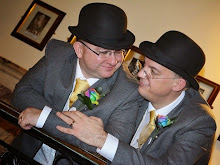
Next month is my fifth wedding anniversary.
But my husband Richard and I have been together twenty-five years.
The wait wasn’t because we’re really traditional and wanted a really long engagement.
We had to wait for the Liberal Democrats in Government to change the law before we could get married on our twentieth anniversary.
Thank you.
Liberal Democrats have always had the best policy of any party on LGBT+ issues.
But it’s not just the policies and campaigning issues.
For me it’s personal.
We got married – but many people still can’t.
We got married – that’s why I can’t stand by and say, ‘I’m all right, Jac, never mind the rest of you.’
I must stand up. We must stand up.
Jo Swinson talked about love in her victory speech as Leader.
This is a simple choice: love or hate.
Liberal Democrats are about love and liberty.
Now, I take it personally when people tell me I shouldn’t have the same rights – my marriage matters!
Is it a matter of conscience? Yes! For the people getting married!
But if you want to bully people, to enforce your prejudices on people, to stop people making their own decisions…?
That’s not conscience – it’s control!
Everything in this motion comes back to the same founding principle: people’s right to control their own lives.
But it’s not just about policy. It’s about the face that the party shows.
I welcome people joining us from other parties. Some will be fully-formed Liberals, and some you might have to give more Leeway to.
Like children raised by wolves, you might not expect them to have perfect table manners, but we should expect all our MPs to say without qualification, ‘Biting people to death is wrong’, and if you’re in doubt, ask someone with scars, don’t say, ‘No-one’s ever tried to bite my leg off, so it’s just a point of view if they bite you.’
We should expect all our MPs to be whipped to stand up and not make excuses for homophobia.
Phillip Lee: I know you’re married. I hope you’re both very happy. Was it a long engagement?
We wrecked our last General Election campaign because we compromised – one person compromised – on homophobia.
Listen, all our MPs: if you don’t want to wreck the next one, it’s not just about the policy.
To put it in language at least two of our MPs will need to understand:
You may try to get into Parliament with good policies, but without faith you are nothing.
Surprisingly Good Reviews
Many Lib Dems agreed with this speech – many laughed, many clapped, Caron Lindsay was particularly kind on Twitter – which helped balance the usual line of the great and good saying How Very Dare You. But just this once, I did get some very good reviews from the New Statesman. Stephen Bush cited me in his write-up of the debate:
“In a speech that received loud applause from the floor, Alex Wilcock, a Liberal Democrat activist, spoke about the 20 years he had to wait to marry his partner, and asked Lee if his marriage had a similarly “long engagement”. It was Wilcock’s speech that also got to the heart of the Liberal Democrats’ unease over Lee’s admission: the party’s defence and toleration of their then-leader, Tim Farron, and his record on equal rights, and the price it paid for that at the 2017 election.”
But my cockles were most warmed by him and Alibhe Rea on The New Statesman Podcast – Lib Syncing, 19th September 2019.
Stephen Bush:
“For me the best speech, actually, of the Conference, and I also think probably one of the best speeches I have seen in party conferences all told, was from a man called Alex Wilcock, who spoke about his own marriage, the very long engagement and the fact that same-sex marriage was illegal for so long, and basically challenged both Phillip Lee and the party for kind of turning a blind eye to some of the aspects of his voting record.”
Alibhe Rea:
“Yeah, it was pretty powerful, that they had been engaged for twenty years and unable to marry, and then the concluding line of his speech was something like, you know, ‘Phillip Lee, I gather you’re married, I hope you’re happy – was it a long engagement?’ It was really quite stirring in the context, and he was just a very good speaker. He’d sort of circled around and alluded to it for quite a while, and then arrived at that conclusion.”
Which is probably the best review I’ve ever had in the press (at least since the Daily Mail’s double-page-spread hit-job back in 1994, which was flattering in quite a different way).

Why I Made This Speech
I wasn’t going to make that speech. I wasn’t going to speak at all. If you want to make a speech in a physical Lib Dem Conference debate – it’s even less flexible in the current online Conferences – you need to put a card in saying roughly what you mean to say well in advance of a popular debate, usually at least the day before. I hadn’t, and had no intention to. But there had been so many hurt people around – not least friends who’d resigned from the party over its welcoming in an MP who saw us as Hell-spawned inferior life forms and wanting to tear out our hard-won rights. I’d prefer a sinner to repent, I’d like everyone to get along, but confronted with the choice between an unrepentant bully and people whose values actually belonged in the Liberal Democrats, there was no way not to pick a side. I woke at 4am that Saturday, stressed and depressed, massively wound up, and could not get back to sleep. So I did the obvious thing: I started thinking of a speech. Amazingly, I was in the Conference hall by 9.30am and put in a card (after Tweeting an obscure declaration of intent which nobody else would get but to stiffen my sinews). More amazingly still, I was called to speak.
I’d been scribbling thoughts, desperate to sort out what I thought at all, how much of it I should say, what tone I should take, and how on earth I might fit any of it into three minutes, which is a very short time indeed once you’re up on stage and gives no room for waffle (in the end, I was so focused on getting to the point that I ran under time). I still have the several sheets of paper where I can see my thoughts take shape – and how much was still unformed by the time the debate began. Unusually, I hadn’t decided how to end it even as I walked onto the platform and opened my mouth. But before I wrote anything else, I had circled to one side at the top, next to where I had to put the opening lines: “Serious and funny!”
A debate speech should have a point – you want to swing people’s votes with you. Sometimes I’ll wing it as I go along, but there are always two parts I need to prepare: the opening, because that gets people listening to you; the closing, because that gets people applauding. The finest arguments have been lost when people are still nattering from the last one because they don’t notice you’ve started or when stopped in mid-flow as your time runs out and the mike’s cut off. I realised both very early, but over the years I’ve set a second aim for the opening line that’s more difficult: it’s also to get people on your side. Whether it’s a joke, a self-deprecating moment or just saying hello, an effective speech begins by getting people to like you. The previous year, I’d made a blistering speech against a policy paper that hand-wringingly appeased bigots over immigration. It was one of my best speeches, focused, incisive, impassioned, but it had an opening like chucking a brick through a window, and while that got people’s attention, I don’t think it got anyone on my side. This time I might have to be even more combative – not attacking a paper, but possibly attacking MPs in person. Fortunately, this speech was personal and a personal opening came naturally, even with a funny bit and an opportunity (heartfelt as it was) to butter Conference up.
The Equal Marriage motion not only celebrated the Liberal Democrats’ achievement of making marriage legal at last for same-sex couples, but recognised that equal marriage is still some way off and set out how to get there – in Northern Ireland, for humanists, removing the hugely unfair spousal veto for trans people – and with speeches overwhelmingly in favour was passed, too, by an overwhelming vote in favour as Lib Dem policy.
Several excellent speeches before mine dealt with those issues for marriage directly, with the rise in homophobic attacks, with Labour MPs wanting a new Section 28, with daily virulent press transphobia – I was crossing off bullet points I’d scribbled haphazardly across my notes, helpful in terms of keeping better to time by not repeating what everyone else was saying, but with stress rising as I listened out for what everyone else was leaving unsaid. MPs and former MPs I admire paid loving praise to people who’d left the party because of— What? Our party was the best on LGBT+ values, and was getting better in this very debate, and yet for some reason that dared not speak its name people were loudly hoping that one day leading LGBT+ activists might somehow find their way back. Many in the hall must have wondered, had they accidentally slipped through into some parallel dimension and were merely lost, because surely nothing about our party was explaining it? I very much did not want to give the speech I could see in a choose-your-own-adventure set of variably hard-hitting ideas scribbled in question marks, but by the time I was called to speak (and for the rest of the debate) no-one else had said a word, and someone had to.
For that Conference, the number of Lib Dem MPs suddenly almost doubled: some defectors I was enthusiastic about; some seemed OK; and then there was one. In June 2019 I had written not a blog post but a Twitter thread as speculation about defectors rose: my instinct was to welcome everyone who chose to side with us. I was thinking aloud on Twitter, but I still – mostly – agree with myself. Yet there are always caveats… But it was by being welcoming, bold and Liberal that we attracted so many people who used to vote for other parties. Being open doesn’t mean watering down what we stand for – if we don’t stand for anything, no-one would make the leap anyway. Though I can’t help thinking that, as one of the Leadership’s more appealing themes at the time was that we were leading a wider Liberal movement, it might have saved a lot of heartache if we’d persuaded a defector standing with us on the big issue but clearly a git on others to caucus with the Liberal Democrats in Parliament as part of a wider Liberal movement and not actually join a party whose values he does not share (that nobody thought of it after years of the party faffing about with supporters’ schemes…). I didn’t actually say that because there wasn’t room for procedural rumination, but despite appearances I have never given a speech in which I was more thinking aloud.
Today I sum up Lib Dem values in three words: Freedom, Fairness, Future. I’ve been writing and speaking about the first two, intertwined, since the early ’90s: that was when I identified them as “Love and Liberty” in a long philosophical pamphlet, and carried that on to this blog. But “Love” isn’t a word politicians are often bold enough to claim, so I was delighted when Jo Swinson did that Summer, and I seized on it. Not just because I agreed with her and applauded her speech, but because if you’re about to go in with both barrels it always helps to call the Leader on your side. But that and my funny opening had a point: this is not ‘a point of view’. This is not just a debate. This is something that is crucial to real people’s lives, and no Liberal should be hoarding rights that they deny to others.
There was a moment where I nearly lost it. As I declaimed, “That’s not conscience – it’s control!” the last word surged up in a growl that almost frightened me: I’d never heard that tone from myself in a speech before and I realised with a shock that I was seconds from just shouting in righteous anger. It doesn’t seem as visible as it felt, but I pushed myself down hard inside, because I knew that I was at the pivot to the dangerous bit of the speech and, suddenly, I could so easily lose control. I forced myself to sound more at ease, to slip in a cutting pun, a stealth Doctor Who reference and a breezily insulting put-down. But as there’s a storm of applause, I wince now seeing the curt gesture to cut it, harsher than I’ve ever been in a speech, as I’m fighting not to snap. And then I say the line that I remember most vividly: “Was it a long engagement?” And it’s only three seconds before I dive on, but after the laughs and applause the deathly shocked silence at that picking up Chekhov’s punchline from earlier and making it a punch in the face felt like an eternity, and inside I was panicking that I’d blown it.
So as I went into the close, knowing I was going to finish with a mangled flourish from my religious upbringing – that you may try to get into heaven with good works, but without faith you are nothing – wielding it as a righteous flaming sword against two theocratic bigots, but not knowing how I was supposed to get there, with several partial versions scribbled in front of me and none I was happy with, and at the last moment somehow navigated between the cop-out of sticking only to Phillip Lee and full-on naming and shaming Tim Farron. I glanced at the scrawl of lines hoping we would pass the policy then warning that most people would never hear about it, while many voters would hear if so-called Liberal MPs lust to control others and claim their religion says my twenty-five years is too short a wait; or reminding the lucky few Lib Dem MPs elected in that disastrous General Election of the cost of weakly suggesting homophobia is just a point of view. But I swerved away from going full Old Testament thunder because I might never stop, or explode in sheer incandescent rage. I feared I’d already lost the hall but I was committed to saying something – in the end, my more tightly controlled ferocity still got the point across and the thunder was left to the applause.
Where Nick Clegg Went Wrong
I thought hard about whether to say any of this, after leaving it unsaid in 2019 – both in a speech that in the end confronted what everyone knew in the least confrontational way I could bring myself to, and after holding back from saying it at far greater length earlier that year. It isn’t uplifting, so you may wish just to stop here. But I’ve made myself look in order to learn.
During the 2019 Liberal Democrat Leadership election I wrote – most of – an article assessing the three immediately previous Leaders, and lessons to be learned. Though I wrote at length about the positives for each before blasting their big disasters, I never published it. What I had to say about Nick felt too much like old wounds, what I had to say about Tim Farron was still too raw and hurt and blisteringly angry, and I never quite finished writing about Vince, as just too meh (though in a late surprise entry since he’s now topped the ‘Most Problematic Former Lib Dem Leader’ chart. I wish he hadn’t). I’m not going to publish all that now. But it’s worth summarising the crucial lessons: not just when two Leaders f—ed up, which everyone knows, but why those particular f—k ups were so deadly. I’m not going to assess the whole Coalition – though Richard and I did say thank you for our marriage on our (twenty-years-and-) six-month anniversary, without which we’d still be waiting.
Here goes, though. “Tuition fees” was engraved on every Lib Dem heart and every anti-Lib Dem attack leaflet. The biggest, most catastrophic, monumental political misjudgement of the Lib Dems in Coalition. Yes, we all know this. But steel yourself and look at just why this was so destructive. First and foremost, for the Lib Dems (and for Nick Clegg personally), education is an absolute, passionate priority. It’s at the centre of enabling everyone to have the opportunity to realise their potential, not just a policy but at the heart of our philosophy. And in Coalition government, we championed education; we protected the schools budget from cuts and introduced the pupil premium, so schools got more money to help teach poorer kids. But every single time any Lib Dem mentions it to this day, what does every voter think? ‘But tuition fees.’ F—k. Breaking the promise was bad, but breaking the heart of our values was catastrophic. And from naked political nous, university towns and higher-educated voters had become the hard-earned most likely to vote Lib Dem, and the tuition fees betrayal kicked them in the face. It’s hard to think of a more laser-guided missile to the Lib Dem vote.
Some More of Tim Farron’s Greatest Mistakes
Which brings me to Tim Farron. The 2015 Leadership election was blighted in two ways: not only did we have practically no MPs left to choose from, but in hindsight the two contenders were summed up by Yes Minister:
“If Eric gets it, we’ll have a split in the Party in three months. If it’s Duncan – we’ll have one in three weeks.”
Eurosceptic Norman Lamb would have been an utterly catastrophic Lib Dem Leader for Brexit. Tim Farron made the critical choice that we would stay fighting as the party of Remain, a brave, principled decision trying to save Britain’s future that also enabled the Lib Dems to survive the near-extinction event preceding Farron’s Leadership and then the near-extinction event precipitated by Farron’s Leadership. But then, obviously, he went and proved that while it’s hard to think of a more laser-guided missile to the Lib Dem vote than tuition fees, it could still be done. I’m trying to strike an ironic tone, but I’ve cut my next four paragraphs from 2019 because they’re unlikely to do anyone much good, and certainly I felt the fury, misery and betrayal rising just re-reading them. Plus there aren’t enough em dashes to cover all the swearing. Every single day of that blighted election I defended him because I thought I knew him, as furious and hurt and betrayed LGBT+ people said, ‘How can you do this to us?’ But Farron didn’t just destroy the LGBT vote for the Lib Dems, much as Nick didn’t just hammer the student vote. This was about the sort of party we are and the sort of people who might vote for us. Think about the sort of voters who are likely to listen to the Lib Dems. Even if they don’t mention it on the doorstep, how are they going to react to the only thing they hear from the Lib Dems, day in, day out, being that their Leader doesn’t like the gays? A more perfectly targeted voter-seeking missile even than tuition fees – not even the excuse that the money was too tight, not even the excuse that we couldn’t get another party to accept it, but simply because the Leader we chose had chosen to be a bigot. Name me anything a Liberal Leader could possibly do more effectively to alienate Liberal-minded voters. They recoiled en masse. In the year of the universally hopeless leaders, to be more of a voter turn-off than disintegrating robot Theresa May and a UKIP nonentity? The 2017 Lib Dem Leader was sheer electoral poison – delivering an even lower vote than 2015’s collapse, the worst share of the vote for British Liberalism since the 1950s – and, as votes had to go somewhere, if you wonder how on Earth people once saw any hope in Brexit’s Best Mate Jeremy Corbyn, Tim Farron was his biggest asset.
I had known and liked both Nick Clegg and Tim Farron since long before they became Leader. I felt for both of them… But I admit one I find easier to forgive for their worst calls when leading the Liberal Democrats. It’s an appallingly hard job and I wouldn’t wish it on anyone, but it’s also hard not to want to tell anyone doing it: if you must f—k up, can you at least think about what’s deepest in our values and what’s most important to our voters, and try to f—k up at the furthest-away political point from both?
Labels: Gay, LGBT, Lib Dems Believe, Liberal Democrat Conferences, Liberal Democrat Leadership, Liberal Democrats, Richard, Speeches


Tuesday, June 02, 2015
Charles Kennedy
I heard at 7am the news that Charles Kennedy had died. It feels so terribly unfair. He had so many gifts and should have had so much more to give with them. And just as Liberal Democrats are starting to recover from the grief of the election, and find something to celebrate in such unlooked-for growth in our numbers (from 45,000 members to 60,000 since polling day), our family is plunged into the most appalling shared grief of all. My heart goes out to Charles’ immediate family too. I knew Charles as Leader, much less since, but I’ll miss him.
Like many Lib Dems, I started the day by pouring out some of my grief on Twitter and a comment on Lib Dem Voice – then a short piece on my Tumblr, which is where, essentially, I write and publish things quickly, before there’s time for insecurity to stop me writing. But I’ve decided that Charles deserves a proper thank you and memorial from me, too, which in my typical way means much the same I said earlier, but at significantly greater length.
A Great Communicator (but not in every way)
You’ll have read a great many tributes and obituaries. Like all Leaders, he had his good and his bad points – perhaps more of both than most. Charles’ greatest strength was that he came across as genuine, and decent, and more like an ordinary bloke than other politicians: today British politics has to make do with Nigel Farage, his anti-matter duplicate. Getting to know Charles over half a dozen years or so, as I’ll come to, he always struck me as the same in private as he was in public, and in private, too, he rarely let people see his bad days.
The one thing I’ll say that contradicts most of the pieces I’ve seen about Charles today is that I don’t think he was a great orator. He was a great communicator – probably the best the Liberal Democrats have had, though I reckon we’ve been blessed with three. But his greatest gift was in speaking directly, conversationally, not reading lines from a platform. I don’t mean he couldn’t deliver a speech – he could, and I saw many of them. Some stuck in my head for his principles as a call to action; some inspired me by turning those principles into a brave challenge. But platform oratory wasn’t his best platform, and if you want to read a review of one of his speeches with a favourable view of the content and a not entirely complimentary look at some of his vocal tics, I wrote one quite some years ago and still think I was right. That doesn’t matter.
I think it may well have been on introducing Charles for the first of the three speeches I mentioned above that a Lib Dem MP said something rather indiscreet that stuck in my head as much as the speech itself. Charles was relatively new in the job of Leader, and there was a wide assumption (not necessarily a fact) that he’d been more the choice of the armchair members than the activists – but also, by this stage, a widespread feeling of pleasant surprise that he’d made himself both a more explicitly Liberal leader and more distanced from the Labour Party than anyone had expected before his election (I remember one of his initial backers telling me sourly that I was probably more pleased with his victorious candidate than he was, and happily agreeing). So when Charles was introduced for his own Leader’s Speech with “I didn’t vote for him – but I’m ever so glad he won!” there was both a huge laugh and a sense from many, myself included, that we would have said the same if we’d been daring enough.
My Memories of Charles (and the Reverse Aesop)
I got to know Charles mainly on the Lib Dem Federal Policy Committee. I was an elected member throughout his Leadership, and for four years I was a Vice-Chair to Charles as Chair. He was the same in private party meetings as he was on the telly: a big change from Paddy Ashdown’s fight to the death on every issue – bringing people together, but passionate on the issues he really cared about. The converse was also true; the chance of my taking over the Chair for an hour when Charles suddenly discovered he had another urgent Commons appointment rose in direct proportion to the time FPC members spent droning on multiplied by the lack of interest he had in the subject. His slipping out rarely helped meetings to finish on time, as he was far more skilled in finding kindly ways to shut people up when they were blathering on than I ever was.
I used to joke at the time that in choosing Charles to succeed Paddy the party had done a reverse Aesop – calling for King Log after King Stork. That was a little unfair (to Charles, at least). He may not have wanted pitched battles on every line of policy, but I remember him usually making two different sorts of crucial contribution across the board. One was in spotting when policy was getting either too impenetrable or too up itself (not that he’d use those terms). In particular, he had a keen eye for the Lib Dem habit of setting up National Institutes for Well-Meaning Interference. Nobody else on the FPC was ever so good at puncturing pompous proposals, rolling his eyes at yet another new bureaucracy: “No more capital letters, please!” Part of that was what you might call Charles ‘remembering common sense’. But there was another element in there. Whether it was being a Highlander, an outsider, his temperament or his chosen ideology, he quietly disliked people pushing other people around.
Growing Into a Liberal Leader
I didn’t know Charles well enough to be able to say whether it was out of that instinct, or his political judgement as Leader, or it simply seeming the obvious thing to do, but his other ‘big picture’ contribution was more blatantly ideological – under Charles, the Liberal Democrats started using the words “Liberal” and “Liberalism” in the headlines, not just in the small print. The Liberal Democrats never lost our Liberalism; when during the election I was searching for inspiring Liberal quotes, short and long, for my Liberal Democrats Believe Tumblr (which, like so many things, I must get back to), one of the most inspiring speeches and probably the one I quoted at greatest length was one of Paddy’s Leader’s speeches, which is as brilliant an exploration of philosophical Liberalism as you could hope to find. But you’d rarely find the word on its own on a policy paper front page or in a shorthand description of the party.
I suspect that a lot of this comes down to simple history: Paddy had been a Liberal MP, and as the Liberal Democrats’ Leader for our first decade, he was careful not to ‘unpick the merger’. And so was everyone else who’d gone through that shambles of a time. Under Charles, the party was more at ease with itself, with the passage of time and the passage of members. Quietly, we had a Leader who would say of us, “We’re a Liberal party,” without anyone being under the impression he was expelling former Social Democrats; policy papers on what we stood for started proclaiming “It’s About Freedom” or “Freedom in a Liberal Society”, rather than the party’s early years of “Our Different Vision”, which I remember reading cover to cover and still being unable to say quite what it was.
I joined the new party immediately after the merger in 1988, because I’d been a teenage supporter but didn’t see why there were two separate parties and waited until it was official to sign up. For me and my generation of Lib Dem Youth and Students, it was natural to be Liberal Democrats, happy with a party born out of a merger, not wanting to go back to the structures and strifes of a party we’d never been members of, but of course we were ideologically Liberals too. Older members found it more difficult to separate the history and the philosophy, so it was something a lot of Lib Dems were very quiet about during the ’90s. It was obvious to me that Bob Maclennan – a former Leader of the SDP – was by far our most Liberal Home Affairs Spokesperson of the time, and similarly, when Bob was Party President in the mid-’90s he was the most senior figure to speak of our Liberalism, unabashed, one of many reasons I became an unlikely fan and friend. No-one could accuse him of digging up old rivalries or a Liberal Party takeover, and the same was true when Charles, another former Social Democrat, was elected Leader. He was able to talk about what we all stood for without it being divisive. Under Charles’ Leadership, the Lib Dems started to grow our own distinct philosophical rivalries, today spoken of more along Social Liberal and Economic Liberal lines, though neither (with a few exceptions!) as sharp as between our two predecessor parties. Most Lib Dems are both Social and Economic Liberals, and those who come down much more heavily on one side than the other are just as likely to have come from the old SDP as the old Liberal Party – but, like the vast majority of Liberal Democrat members, are most likely not to have been a member of either party that voted to merge into the Lib Dems nearly three decades ago.
So every time a ‘political correspondent’ talks about the ‘fault lines in the Lib Dems’ being based on the Liberal Party vs the SDP, they are almost without exception talking bollocks – just as it would have been absurd to characterise every internal debate of the pre-1988 Liberal Party in terms of Whigs, Radicals and Peelites who merged to create the Liberals in their turn. We are not our parents, and neither are parties. Charles, in his calm and consensual but crucial way, helped the Liberal Democrats to grow up.
Charles’ Principles and Passions
The much less quiet decision that Charles took, after much internal debate and soul-searching, and which came to define his Leadership, was to oppose the Iraq War. It’s often falsely remembered as a populist move. It was nothing of the kind. It was a terrifying plunge into doing the right thing when nobody else would, and we were vilified for it. In the run-up to the War, there were mass marches in opposition, but not largely by natural Lib Dems, and the massed fire of the media was all against us. When the invasion began, our opinion poll support took a dive. It was only much later, when it became clear to people not that the principle of invading another country against international law was wrong – people knew that, and were gung-ho anyway – but that the Labour Party and the Republican Party had created such an appalling, bloody mess, that support swung back our way. Remember that the Labour Party and their Tory and press cheerleaders called Charles and the Lib Dems “Traitors” and much worse for not going along with their illegal war of aggression.
If Iraq was Charles Kennedy’s defining issue by circumstance and brave decision in a hard place, perhaps his greatest passion was Europe. A committed and persuasive European, internationalist, democrat and reformer, while Liberal Democrats and many others who simply liked and agreed with him will miss Charles for too many reasons to count, over the next couple of years our loss will be a huge loss in the coming referendum. As well as the personal loss for his family and our wider Lib Dem family, both bereaved, it’s tragic to lose his voice when he’s so needed.
“I am a Highlander, a Scot, proudly British, and European. I’m proud of all four of these things, and I don’t see why I should have to choose between them or delete any of them.”You may well have seen today a letter from Charles replying to a voter with his judgement that, even though he’s blue, Gonzo’s a nice guy and his favourite Muppet. I can reveal that he rather liked Doctor Who, too, and that his favourite Doctor was always Patrick Troughton, so I’ve had the Mighty Trout’s most Liberal story on this afternoon. If you really want to celebrate one of Charles’ passions, though, put on some David Bowie to remember him by. There, he was a real fan.

Labels: Charles Kennedy, FPC, Iraq, Liberal Democrats, Liberalism, Obituary, Paddy Ashdown, Personal, Speeches, The Golden Dozen
Thursday, September 19, 2013
Speeches I Didn’t Make: The Manifesto and Freedom #LibDemValues
Yesterday morning, I didn’t make a speech. That’s not unusual: I didn’t make a speech on any of the previous hundred or so mornings, either. But yesterday morning I had a rallying call ready, and wasn’t called (as I’d almost told myself). Liberal Democrat Conferences are democratic – ordinary members or Leaders can speak, and each has one vote – and yesterday’s debate more than usually so, giving us the chance to debate a “Manifesto Themes” Paper long before the General Election. So now you can see my contribution, both written and delivered on YouTube live from a broom cupboard!
A Stronger Economy in a Fairer Society – Enabling Every Person to Get on in Life is a title regular readers will recognise: the Liberal Democrats’ main message. I’ve been doing quite a bit of work to broaden it into a slightly longer statement that reflects more of our values, and that was what I was going to talk about yesterday morning (before Nick Clegg’s cheeringly similar “No, nope, nah” refrain in the afternoon). Thanks to Caron Lindsay for wielding the camera-phone and offering use of the tiny office – it was an odd experience delivering a speech designed for a big hall and big audience in a tiny space and to two lovely people, and it made me feel rather hammy. It’s also much easier when there’s a lectern to rest the speech on and hide behind, as I talk with my hands and shuffle my feet! This version lasts rather longer than the statutory four minutes: I didn’t have a time limit in the broom cupboard, and wander about a bit in the middle, but when practicing it earlier I worked out which bits to gabble through and could sprint to the end in 3.45…
Freedom Is Our Signature Tune
A stronger economy, a fairer society, a million jobs… It’s a good tune, but it sounds a lot like what everyone else is playing. We need that competent, managerial message, but we need passion, too. To make our signature tune sing it needs something more – and freedom is a tune only we can play.
It’s great to see my favourite bit of the Preamble in here. It’s a start. But it’s politically streetwise to pump up freedom higher in the mix. Freedom says we’ve got principles – it inspires our activists and attracts those converts that no-one else can reach.
And it’s streetwise because if we don’t stand up for freedom in the campaign, it will be much harder to make it cast-iron in Coalition, or to make voters understand why we’ll give up other priorities for it.
Make no mistake – it will be much harder next time. When Labour were the most authoritarian government in modern British history, the Tories discovered a taste for freedom. Back in power, they’ve rediscovered how much they love to boss people about. And still, the Labour bully-boys’ first reaction on every liberty is to attack the Coalition from the far right.
Yet if you combine freedom and economic responsibility, austerity can be a friend to some freedoms. Because appalling illiberal authoritarian schemes aren’t just appalling illiberal authoritarian schemes – they’re always expensive appalling illiberal authoritarian schemes. So make the Lib Dems the party of economic responsibility by attacking the other two for wasting a ton of money on their bullying pet projects when there’s so little money to spare.
ID cards waste a ton of money, so don’t.
Snoopers’ Charters waste a ton of money, so don’t.
“Go Home” vans, and porn filters, and every massive intrusive database waste a ton of money, so don’t.
Of course there are positive Liberal commitments I’d like to see in the Manifesto too.
I want to say a personal thank you to every moral Liberal Democrat at Westminster – on our twentieth anniversary next year, Richard and I will be getting married. Thanks to you voting for equal marriage. But the Manifesto should have more than a picture celebrating the partially equal marriage we have now – a commitment to fully equal marriage, so that trans people can be as happy as we are.
I want to see in this Manifesto a Greater Repeal Bill, to expand on the Freedom Act the Tories watered down.
I want to see us repealing all the victimless crimes that waste people’s lives and waste court money and waste police time.
But most of all I want to see a ringing rallying call.
Your mission, David, should you decide to accept it, is to set out a clear, concise vision that combines our big slogan message, our priorities for government and our Liberal principles.
It sounds like mission impossible, but it can be done. And as readers of my blog will know, here’s one I prepared earlier.
Sing Along
The Liberal Democrats stand for freedom for every individual – freedom from poverty, ignorance and conformity.
To make that freedom real needs both fairness and economic responsibility: an economy that works, that encourages enterprise, and where everyone pays their fair share.
So freedom from poverty requires responsible spending, not debt, built on fairer taxes where lower earners pay less tax and the wealthiest pay more, and building green jobs for the future.
Freedom from ignorance needs better education and training, so people have the opportunity to realise their potential.
And freedom from conformity, supported by freedom from poverty and ignorance, means everyone should have the liberty to live their lives as they choose – without harming others; with equality before the law; with a better say, because no government always knows best.
That’s why Liberal Democrats are working for a greener, stronger economy in a fairer society, enabling every person to get on in life.
I wanted to make a positive contribution, so gambled on putting in a card to speak mostly in favour of parts of the motion on the Manifesto Themes. Had I played the Conference ‘game’ and put in to speak against on something the vast majority supported, I’d have been much more likely to have been called: in retrospect, it would have been tempting to speak against the first amendment. Sadly, no-one did, and it was passed overwhelmingly, despite being a shoddy piece of drafting and an ugly piece of wording. It’s bad enough that it was a piece of self-indulgent fappery from Liberal Left, adding rambling statements of the obvious as if only they’d thought of them, and deleting one paragraph merely to reword it slightly differently and less flowingly. What really got my goat about it was that in their eagerness to indulge themselves they dropped things from the original wording. How do you support children by taking out any mention of parents or early years education? And, shamefully, where the original lines talked about “removing barriers faced by communities such as ethnic minorities”, an open-ended and Liberal commitment that gives in example groups who face particular barriers but with its “such as” implies that we want to break down barriers all around, Liberal Left’s clumsy redraft was exclusive, not inclusive, only wanting barriers removed for its chosen groups. Barriers of sexism? Homophobia? Transphobia? Anyone else but Liberal Left’s chosen few? Then their amendment excludes you.
Shameful.
Labels: Gay, Liberal Democrat Conferences, Liberal Democrats, Liberalism, Personal, Richard, Speeches, Video, What the Lib Dems Stand For
Wednesday, August 28, 2013
Liberal Wednesday 6: Martin Luther King’s “I Have A Dream” #LibDemValues
This week’s Liberal Monday is on a Wednesday: the fiftieth anniversary of one of the most celebrated speeches of the Twentieth Century. Dr Martin Luther King Jnr’s speech to the March on Washington for Jobs and Freedom still has tremendous power both for in itself and for its place in history – the right person, at the right time and place, with more than the right moral clarion call in its inspired oratory. The BBC marked the occasion with a tribute on Radio 4 at 9am, plus a documentary to come on BBC2 at 9 tonight.
“I have a dream that one day this nation will rise up and live out the true meaning of its creed: ‘We hold these truths to be self-evident, that all men are created equal.’What is there to be said of this great appeal for equality, justice and fellowship that hasn’t already been said? Well, there’s this morning’s tribute, for a start. I was a little sceptical of Radio 4’s I Have a Dream this morning – reminiscent of the BBC’s 1997 recording of Perfect Day, the main part of the programme was a ‘cover version’ of the speech performed by a wide array of different people from different countries. It seemed like a bit of a gimmick. But on listening to the collage, ranging from John Lewis and Joan Baez, who were both part of the 1963 March for Jobs and Freedom that day, to the Dalai Lama, to Malala Yousafzai, the Pakistani student shot by the Taliban for being a girl who went to school, I found it incredibly moving. With a full speech, the reading doesn’t just switch reader on every line, instead segueing between Dr King and impassioned stretches by so many other people it had touched with enough time for each different person to get a sense of how much it means to each of them. And unlike the original line-up of speakers after the 1963 March, this version of the rally’s showstopping final number has women in it, without which it would seem odd today but shows that not only racial attitudes have changed in the last half-century. It’s repeated on the World Service at 3.30 this afternoon and on Radio 4 this Sunday at 1.30pm.
“I have a dream that one day on the red hills of Georgia, the sons of former slaves and the sons of former slave owners will be able to sit down together at the table of brotherhood.
“I have a dream that one day even the state of Mississippi, a state sweltering with the heat of injustice, sweltering with the heat of oppression, will be transformed into an oasis of freedom and justice.
“I have a dream that my four little children will one day live in a nation where they will not be judged by the color of their skin but by the content of their character.
“I have a dream today!”
You can also listen to the programme for the next week on BBC iPlayer here; you can read about it and the many contributors here; you can read the text of the speech here; and, above all of those, you can watch Martin Luther King delivering the original speech here.
I’d heard the whole speech before, though much more often excerpts from it – most of all, the extraordinary “I have a dream” peroration of the second half that echoes down the decades. But listening to it fresh this morning, without the thrilling cadences of Dr King whose voice gave perhaps the greatest speech I’ve ever heard, though the multiple performance had much less power than the original, it made me concentrate more on the words.
The speech itself is fascinatingly constructed, an appeal to America’s history and heartstrings with astonishing moral force. I think of the passion, the imagery, the repeated refrains, but it’s far more than that. The speech comes to us now with the power of fifty years of Dr King being proven right and becoming a lasting symbol on its side, but in itself it cascades back through history.
Dr King stood at the Lincoln Memorial and made his own and the marchers’ demand for the fulfilment of Lincoln’s promise an integral part of President Lincoln’s own history; I remember going to Washington in my twenties and wanting to visit that Memorial as soon as I could, looking up at the great graven face of Lincoln but seeing and hearing King in my head. And his speech grounds itself firmly on Lincoln’s own promise, deliberately opening between the hundredth anniversary of the Emancipation Proclamation and the hundredth anniversary of the Gettysburg Address with a championing of one and the echo of the other: “Five score years ago…” Dr King samples Shakespeare, economics, current affairs and a host of other touchstones, but in speaking for a new America rising irresistibly on the deepest feelings of the old, there’s no mistaking the other great stream pouring through the speech – religion. It’s not just in the words, testifying to the equality of all God’s children, but coming through his own preacher’s experience and oratorical style. The American Dream is only real for any American if it’s shared by all Americans, and that’s because God created all equal. And in that shared language, he was speaking to many who wouldn’t otherwise want to hear him.
For me the most fascinating thing about the speech from my own experience of watching and making a great many different speeches is how it’s essentially two speeches, Dr King’s extraordinary gift making them appear seamless. I know that my own best speeches have been ones delivered without a prepared text, but my worst ones, too: it’s a risk to try to fly. What he does here is start in the safer, meticulously prepared style as a run-up, then suddenly lifts off. There’s the carefully crafted written word fixed in American history, a reasoned argument. And then, apparently spurred by Mahalia Jackson’s cry of “Tell them about the dream, Martin!” he switches from his written text into the part that everyone remembers: the repeated rhetoric beamed straight into the heart through Biblical words and a million-watt charisma, every phrase resonating with the American Dream and with the Gospel call. And that, clearly, is the powerful spiritual appeal of the preacher.
That’s not to say that the “I have a dream / Let freedom ring” extended climax was entirely off-the-cuff. Dr King had had three years of honing that exact metaphor, from his 1960 speech “The Negro and the American Dream” onwards, but clearly it was on the day that it was most needed that suddenly the theme came together and, inspired and inspiring, helped transform America.
There’s much more to the speech – embracing both the more timorous and the more militant sides of the Civil Rights movement, the uncompromising demand to make brotherhood a reality, passing sometimes shocking judgement on the segregationists and the shameful, but then not just rising but soaring above them, preaching against hate, the realisation on his part and on “our white brothers’” part that “their freedom is inextricably bound to our freedom”. But I still get teary-eyed reading or watching it for myself, so watching or reading it for yourself is going to have much more of an impact than reading about it.
It’s a sign of how far things have come that under the institutional bigotry of the times, in 1963 twenty-one US States prohibited mixed-race marriage. That’s almost impossible to believe, fifty years later, when Martin Luther King’s speech has become one of America’s great moral foundations. Today, thirty-seven US States prohibit same-sex marriage. I wonder whose soaring rhetoric will transform the next fifty years?
Labels: American Politics, Bigotry, History, Liberal Mondays, Liberalism, Martin Luther King, Religion, Speeches, The Golden Dozen
Friday, May 11, 2012
Happy Birthday to the Libera-Tory Coalition?
Forming the Coalition was easier for the Tories. First, because they’re not used to being out of power and would do anything to get it back; the Lib Dems, having been out of power for ninety years, were a bit more concerned with what to achieve with it. And second, because once the negotiations reached an agreement between the two parties, they could make an instant yes / no decision, as the Tory Leader’s word is law right up to the point they decide to cut his head off (luckily for Mr Cameron, his main threat at the moment only appears to be Nadine Dorries, a headless chicken herself).
The Liberal Democrats who negotiated The Coalition: Our Programme For Government had, instead, to convince the rest of the party to agree in advance (which turned out not to be so hard after all, and strengthens Nick Clegg in adversity where Tories who get cold feet can pretend it’s all David Cameron’s fault). And once Parliamentarians and Party Committees had been convinced, the rest of us were given our opportunity in that rare beast, the Special Conference, held on Sunday 16 May 2010 in an unfriendly aircraft hangar at the Birmingham NEC. Now, what I should be doing, of course, is re-reading our 2010 Manifesto, the initial Coalition Agreement and the long Coalition Agreement, cross-referencing them against each other and against the Government’s record. Sorry. I haven’t (though I did notice that during the negotiations I said it should be all four of our front-page Manifesto priorities, or no deal, and our negotiators got three and a half, which was better than I was expecting). But what I have done recently is come across the scrappy bit of paper on which I jotted down my speech to that Special Conference and, bonus! It was only a minute long…
Coalition Special Conference Speech: “The Worst Possible Time”
If you want to make a speech at a Lib Dem Conference, you have a think about why and then put that down on a card. The Chair of the debate balances what you want to say against what everyone else does, so the debate’s neither too repetitious or two one-sided (a speech against often helps you get called, with the speakers against Coalition at the Special Conference also being virtually all of the tiny “No” vote so as to make the debate sound more balanced). And the likelihood of your being selected also rises or falls depending on how popular the topic and how early the hour. If you say just what everyone else is going to on your card, but less coherently, and you put in to speak in the packed debate on the Manifesto immediately before the Leader’s speech, you’ve got no chance, while if you want to be called at 9am on the third day of Conference to speak against the Milk Marketing motion, even if what you’ve written is gibberish, the Chair will be as pathetically grateful you’ve got out of bed as if you were the cavalry charging over the hill.
It turned out that, for this debate, arguably the most important the party’s ever held and all essentially on the same topic, nearly two hundred people wanted to make the fewer than forty speeches there would be time for at five minutes apiece. Worse, MPs, Peers and all the rest of the Party Great and Good were all lining up impatiently for their own chance at the lottery, making the likelihood of your being called if you were an ordinary member slimmer still. My beloved Richard Flowers wrote an excellent speech about making the Liberal difference, but didn’t get the chance to make it.
However, for massive debates like this – well, there are no others like this, and haven’t been since the Lib Dems were formed, but for major debates with wide-ranging policies – there’s also the opportunity of making an ‘intervention’. This means you don’t go up to the stage to speak, resoundingly, from the lectern, but have to clutch your notes in your hand at a smaller mike somewhere in the middle of the seating; that you’re chosen at random; and you only get one minute, one second after which you will usually have the power to your mike switched off, which is ignominious and unhelpful to your point if you’re in the middle of a sentence. In this case there were a mere hundred or so people chasing just over thirty mini-speeches but, luckily, my name was called for a slot – and here’s roughly what I said in it:
“I wanted a progressive coalition too, but 57 Lib Dems plus one Alliance Party’s still only 58, so we had to talk to both nasty authoritarian parties instead.
“When I read that Coalition Agreement, some of it was inspiring.
“OK, some of it was dispiriting.
“But at last we can implement Liberal Democrat policies. Liberalism.
“We can hold back the worst of the Tories – when the alternative was the DUP making the Tories that much worse.
“And we can scrap some of the worst of that appalling Labour Government in the Freedom Bill – which I hope will include the Digital Economy Act. No wonder Labour didn’t want to talk.
“This is our first real national power since 40 years before I was born.
“Maybe it is the worst possible time to take power.
“But I don’t want us to wait until I’m wheeled into Conference aged 78, in another 40 years, to say, ‘Well, the economy’s crashed again and at last we’ve got another hung Parliament. Maybe we should try it this time’.”
Why did I want to speak? To make my point; to be part of history; to ‘dip my hand in the blood’. Take your pick. I wanted to make a mark on the main issue – astoundingly, no-one else seemed to say what I said – I knew what I wanted to say, and I found myself ever more strongly hoping that I’d get the chance to say it as the debate went on, with most of the ‘interventions’ basically shopping lists of ‘I want you to renegotiate the entire Coalition Agreement because you’ve not included my pet project’ or, even more aggravatingly, delusional members moaning that they wanted a “progressive coalition” with Labour and wasn’t it unfair that the voters hadn’t given either party enough seats to do it.
So I know that my first line was made up on the spot to answer back. I have no illusions about either of the other parties. Progressive? Labour? Thirteen years of appalling Labour Government, and one week for some idiots to forget what they were like, apparently. Two years later, I can still think of plenty of things to remember about Labour. Anyway, knowing the mike-choppers are brutal on one-minute interventions, as I found myself starting that way instead I automatically skipped over my original opening line: ‘Of course it’s scary. Coalition might make us unpopular – power can do that. So can permanent irrelevance.’ Of course, it’s a good job I did, as we’re today so universally beloved and soaring at 57% in the polls that, had I suggested out loud that Coalition might make us unpopular, I’d look a right nana now.
[Tumbleweeds]
I had the added fun of having been horribly ill – much more than usual – throughout the previous month, and varied from bounding about with nervous excitement to being half-carried on the day. Luckily for their own nerves, the speakers waiting in line for the mike with me didn’t know that I didn’t know if I was going to speak or to projectile-vomit. Luckily, I spoke, and under the various stresses of the moment, with some passion: what one activist called later “A frisson of ‘fuck off’!” Being on form, I got a lot of applause and quite a few cheers (which are pretty damn rare).
“It’s Going To Be Bloody Awful…”
But it’s not just ego that makes me regret there were no cameras there. For only the second time I can remember at a Lib Dem Conference, the press were excluded: party managers were worried there’d be a storm of opposition to the Coalition, I think. Instead, Nick Clegg afterwards slightly ruefully called the 98% vote in favour a bit North Korean, and posterity – and the day’s news broadcasts – were denied quite a few telling speeches.
Although I didn’t think much of most of my fellow interventionists, some of the principal speeches were very impressive, and if there was one advantage to denying the cameras access, it’s that some ‘big guns’ felt they could speak more personally, just to a hall full of Lib Dem members, rather than have to beam a message to the country as a whole. I remember other people raving about several of them: Simon Hughes touching activists’ g-spots; Chris Huhne grandly combative; David Rendel sad and dignified speaking against. But the two speeches that stuck in my heart were each from senior Lib Dems I’ve never been a huge fan of, despite one of them being then at the crest of quite amazing popularity. One spoke to my hopes, and said he would look after them, the other to my fears, and said they were worth facing.
So when things get bad in the Coalition, I still hold firm to what I said then, and hold close the speeches from Tom McNally and Vince Cable, both newly-appointed ministers. Tom, in the Justice Ministry, knew that of all the ministers speaking, he was the one right on a major faultline between Liberals and Conservatives, and he took his responsibility seriously in promoting freedom rather than just letting yet another hideously authoritarian Government take over: he was, he said, “Minister with Responsibility for this party’s soul.” And Vince was the platform speaker who didn’t seem starry-eyed, or triumphant, or combative, but in tune with my feeling that I wished it wasn’t the worst possible time to take power, but that if we said, ‘No, it’s too difficult and it’ll hurt’, what would have been the point of all those years in the wilderness? We had a responsibility to do what we could. And one line of his should be written on every Lib Dem’s heart:
“It’s going to be bloody awful. But it’ll be less awful because we’re there.”I remembered the lovely Andy Strange having written an excellent piece about the Special Conference, so I’ve looked up what he had had to say at the time in case there was something important I’d forgotten. For me, he sums up the tone of the debate perfectly as a “pattern of a clear head and a troubled heart”, and has a far better overview than I can remember of it two years later. But I’m also slightly embarrassed, as I’m sure there were other people who wrote about the debate, and it’s just possible Andy’s may have stuck in my head because his was the one I agreed with! He, too, says “Vince Cable gave the best speech I heard” and “The speech that moved me most was the one by Tom McNally.” And also, erm…
“The best speaker in the two intervention slots was Alex Wilcock who managed to make several telling points in a short space of time.”
When I Feel Cowardly
It has, obviously, been bloody awful. Again obviously, we’d be far higher in the opinion polls now (though the new Lib Dem minister in May 2010 who said we’d be down to 5% within a year is still looking on the bright side) if we’d refused to enter the Coalition, not that the voters who back us in mid-term (or even mid-campaign) opinion polls ever have the guts to actually vote for us, and those polls and the lovely pure voting record of our forty or so MPs against the Conservative Government elected in Autumn 2010 would give Lib Dems the warming glow we need to sustain us against the unfortunate let-down that we were slashed down to forty or so MPs when the Conservative Government was elected in Autumn 2010. And we’d have voted against the unlimited rises in tuition fees that the Tories wanted and that Labour’s Browne Report decided, and we’d have patted ourselves on the back when we were a useless minority of forty or so MPs with both the other parties voting it all through, because at least people would still see us as the fluffy, nice, ineffectual party, and they still wouldn’t vote for us.
When I feel cowardly, I wish, in secret, that the Labour Party had managed to creep back into office in 2010 with a majority of 6 seats, rather than dodging the bullet and going into Opposition, where they could say they never did any of the things they did in Government, and vote against all the things they did in Government, and not face a single one of the consequences of the things they did in Government.
I wish, when I feel cowardly, that I wasn’t just writing about things to remember about Labour, but watching Labour MPs scream and turn on each other as their party writhes around with nowhere else to go but face up to their trashing the economy. Watching the Labour Party destroy itself as it either stuck to the cuts they announced before the election and prayed someone else would have to carry out – the cuts “worse than Thatcher” that Labour’s Chancellor promised, mañana – or that they’d bottle them, crash the economy completely and have no-one willing to lend to them, like many other countries in the same position.
I wish the Labour Party who laughed that “There is no money left” to the Coalition that had to pick up their shattered pieces had to find some. That the Labour Party who dicked about in negotiations because the last thing they wanted was to be back in power and then said how terrible a betrayal it was to have a Coalition, because they always thought they could smash our teeth in and then drag us into bed with them like their battered wife, were instead dumped with just enough power on their own to destroy themselves. That when Mervyn King said that whoever won the 2010 election and had to deal with Labour’s disastrous legacy would be “out of power for a generation”, it would mean the Labour Party.
But no.
If we Liberal Democrats were cowards, we’d have joined either Labour or the Tories years ago, never mind what power is for, it’s easier just to sit back and enjoy it. And we Liberals used to dream of being out of power for just a generation.
Holding Back the Cry-Babies Who Think They’re Born To Rule
I’d love watching the Labour Party be destroyed by staying in Government. But that would mean destroying more of the country, too, from their sinking the economy to enforcing their ID cards, and that wouldn’t just be cowardly, it would be evil.
I don’t like the Tories. I never have, and never will. But they’re just like the Labour Party, except that they were serious about compromising on a programme for Coalition Government because they wanted it, and Labour weren’t because they didn’t. Because Labour are cowards.
As for the other lot… There was a brief period where the Tories were trying to be nice, and to their credit I did think their slogan “Together in the National Interest” was a lot better than our slightly forced “In Government – On Your Side”. I remember interviewing Oliver Letwin in Autumn 2010 (written up by Prateek Buch and Mary Reid), and he was trying his hardest to show that we were all the same, while I and others tried our hardest to prize out some differences. He called himself both a soggy liberal and a Gladstonian Liberal (tip for anyone else trying to put one over: you can’t be both). I managed to prize out some differences that convinced me he was really a Tory, but, fine, one we could do business with. Interestingly, one issue the Lib Dems were pressing for and the Tories were still against at the time was same-sex marriage, and the more I threw at him Conservative reasons for it from every direction, the more he looked like he wanted to run away. So, to be fair to them, the Tories in Government have still let themselves be moved further since. But within a month, there came the Browne Report on tuition fees; within six, the AV referendum campaign, and never glad confident morning again. At which most Tories and most Lib Dems breathed a secret sigh of relief and thought, well, we may still have to work with each other but we no longer have to pretend we don’t hate each other’s guts.
Too many Tories still believe that they have a divine right to rule. Well, tough. Labour drones love to squeak ‘No-one voted for this government!’ despite the two parties having had the support of well over 50% of the voters, massively more than any other government during my lifetime (and, still, even in last week’s ‘terrible’ elections). To be fair to the Tories, even on their own they got a lot more votes than Labour did when their last Government ‘won’ absolute power in 2005, though both of them only got a little over a third of the vote. Funny how Labour drones never got round to saying ‘No-one voted for that government!’ isn’t it?
But Liberal Democrats are old-fashioned in that we think Governments need a majority of votes to count, and if they don’t get them, they’re not legitimate. The Tories, of course, are used to being bastards, but they’re not bastards with a majority, so every time they scream that we’re stopping them doing every nasty thing they want – and we are – what they’re really furious about is not ‘the Lib Dems won’t let us govern like Tories’ but ‘the voters didn’t let us govern like Tories, and how very dare they?’
Last year, my subtle and judicious (and award-winning) article “Tory Boy Throws Toys Out of Pram: Not Exactly ‘Man Bites Dog’” explained the whining Tories’ sense of entitlement, their inability to do basic maths, and how far right they want the Government to be – but Lib Dems have stopped them being – on a massive range of issues they were crying bitterly about. I’d like to say the Tory Party’s grown up since, but the latest cry-baby who thinks he’s born to rule is David Cameron, so that’ll be a no.
A Determined Birthday
There’s a lot more to say about the Coalition Government. It’s not a happy birthday. But so what? We knew what we were getting into. We never said we were going to be happy. We said it was going to be bloody awful. And it is.
But we also said it would be less awful because we’re there. And it is. And not just because we’ve put the brakes on much of what the Tories wanted, and fixed much of what Labour did – last week, proudly, with The Protection of Freedoms Act (going right back to my Special Conference speech) becoming law and making Britain a bit more Liberal, a bit less Labour’s bully state.
Those four priorities written on the front of the Liberal Democrat Manifesto are being put into positive action – well, three and a half of them, at least. In Coalition Government, even with Labour blowing the economy to bits and leaving an incredible debt to repay, and even having to compromise with the Tories over what they want to do, the Liberal Democrats have still put our own distinctive stamp on good things from government, not just lessening the bad. Look at that front cover: the only party that ever proposed raising the income tax threshold and cutting taxes for 23 million ordinary working people; the Pupil Premium to help out poorer schoolkids; a fairer economy, tackling the banks, record numbers of apprenticeships, green jobs and the new Green Investment Bank open for business; more open politics, even as Labour and the Tories both try to dick about with democratic reforms they both stood on, too.
When things are bloody awful, it’s easy to be cowardly. It’s easy to let someone else take the responsibility. It’s easy just to take it easy.
The Liberal Democrats have never been a ‘take it easy’ party – or we’d all have joined one of the others and coasted, long ago.
It’s not a happy birthday for the Coalition. It’s a determined birthday. Just as it was a determined birth.
I’ll return to look at what the Lib Dems stand for – and what might make people listen to us again. I’ll look at some more of the Coalition’s greatest mistakes. But today, of all days, I’m determined that we should carry on doing the right thing, because while that may be worse for us, it’s a lot better for the country.
Mark Valladares asked last month, “Can we stop apologising for being in government yet?” Let me agree with him and say, with a lot of determination and, for cowards, a frisson of ‘fuck off’, that the only apology due would have been if we’d been given the opportunity of making a more Liberal Government and let people down instead.
And thanks to everyone who’s linked to this, particularly Caron’s lovely post.
Labels: British Politics, Coalition, Conservatives, Education, Environment, Health, History, Labour, Liberal Democrat Conferences, Liberal Democrats, Nick Clegg, Personal, Richard, Speeches, Tax, The Golden Dozen
Monday, April 02, 2012
“I am a Liberal and I am against this sort of thing” – Time To Remember What We Stand For
Many Lib Dems, rightly, think it’s important when in Coalition to communicate more clearly what we stand for, so we’re not submerged at elections. Well, it’s even more important to remember what we stand for for the people inside the Coalition, and Lib Dem Ministers should take a moment to think about our history as their civil servants urge them to just act like “the Government” always acts. We all knew that the Tories’ discovery of civil liberties in Opposition would melt away once they had all the goodies of power back in their hands and all the whisperers of the security state back in their ears. We all know that one day it would be up to you, Minister. Today, Lib Dem Ministers, remember that you’re Liberals and what the fucking point of being there is.
The latest news on Government plans for new cyber-snooping powers are virtually indistinguishable from anything Labour came up with, or any other securocrat-written authoritarian rubbish that’s always put forward by “the Government”. Yes, Labour would have done all this instantly and it took the Coalition two years to go native. That’s not good enough. It’s not worth all the pain of being in Coalition to mildly delay being just like Labour. You’re even trampling the Coalition Agreement on which this Government was founded, signed in the heady days when the Tories still said they believed in freedom.
Hearing on the news that the Liberal Democrats may have some concerns but “support the plans in principle” is exactly the sort of thing that makes me wonder – for the first time – if we ought to vote down the Coalition. There’s a lot it’s done that I don’t like, and I daily feel personally scared by the approach to benefits (because I’m still waiting for my next ATOS summons). But there’s a difference between every choice being a nasty choice, every cut a painful cut, because Labour destroyed the economy, and signing off on something that isn’t forced on you by financial necessity but deliberately turning the Coalition into an authoritarian force for evil (and not saving but wasting more money to feed the securocrats’ wet dreams!).
I’ve often wondered what my own “Red Lines” would be. I’m not grateful to Lib Dem Ministers for drawing them for me.
A fortnight ago, Minister, Liberal Democrat Conference said exactly what we thought about governments thrashing civil liberties and spying on our privacy (and one of the key movers of that motion, Julian Huppert MP, is worried today). You were there, Minister. Had you already seen your briefings? Did you decide it was wiser not to hear the Conference pre-emptively tell you, “No, Minister”? Or did you simply nod, applaud, and then flush it out of your brain as you went back to your desk at the Department of Doing Things the Way Governments Always Do Them?
Today, some Lib Dems are willing to give you the benefit of the doubt. We like you. We’re glad you’re in Government. But it’s difficult for most of us not to start shouting when you say stupid things like “the Liberal Democrats support the plans in principle”. We do not. Millennium Dome, Elephant does not. Richard Morris does not. Jennie Rigg does not. Neil Monnery does not. Zoe O’Connell does not. Charlotte Henry does not. Mark Valladares does not. With every minute of this ticking time bomb, more Lib Dems will not. These are not just the usual suspects. If you want a party to come back to when you return to your constituency at the weekend, stop this thing now.
Freedom isn’t always popular. The securocrats are already shouting ‘Look – terrorists!’ and ‘Look – paedophiles!’ as if that answers every question. The papers and the Labour Party will be foaming at the mouth for more, more, more. But there is absolutely no fucking point in being Liberals if we don’t stand up for freedom.
Before the last General Election, I stood up and told Nick Clegg and Danny Alexander that I was deeply worried when they’d written a draft Manifesto in our name that stopped talking about “Freedom” and replaced it with “Safety” and “Strength”. You can watch my speech in which I pointed out just who that sounded like (you might think ironically, in hindsight). And, afterwards, I was told I had a point, and they’d listened, and the real Manifesto would be better – and it was, a bit, though I might have hoped that when it came to the first Manifesto since 1992 that I hadn’t been on the Policy Committee to write bits of it, I wouldn’t be proved to be the only member of the FPC who remembered to put in a little thing like “Freedom”.
Remembering Liberal Democrat history isn’t just about learning from the triumphs, avoiding repeats of the disasters and celebrating our tribe. It’s about remembering that the only reason we’re still here: the only reason Liberals survived after nearly a century of splits, near-oblivion, faltering revivals and then near-oblivion again is that we stood for something no-one else can ever be trusted with. Freedom.
Minister, don’t betray that trust, or you might just destroy your party.
Just a few weeks ago, Mark Park came to me with the idea of an article about Party history, one that would let people know that the arguments we have today are ones we’ve had before, that principles we hold today are ones we’ve held before, that splits we’ve had today are… As yet, nothing like as bad as we’ve had before. We threw around some ideas and – horrors – constrained by a tight word limit we wrote six bullet points for the party newspaper, Liberal Democrat News a week and a half ago. Last week, Mark republished it on Lib Dem Voice. But before I republish it myself below, today it seems appropriate to remember a seventh moment from our history – not from an MP, not from a Minister, but simply from an ordinary party member who threw back for a time what “the Government” always does.
Stopped by a securocrat and told to do what he was told for no reason other than that’s what securocrats always do, Clarence Henry Willcock (no, no relation) said
“I am a Liberal and I am against this sort of thing.”And freedom prevailed.
Nick, you once said he was one of your heroes. Let him be again. Remember your history. Remember what you stand for. Listen, again, to Lib Dems telling you that freedom is more important than strength and safety. Say “No,” Deputy Prime Minister.
Some Thought-Provoking Reminders of Our Liberal History
Paddy Ashdown once admitted to under-estimating the importance of a party’s history:
“A political party is about more than plans and priorities and policies… It also has a heart and a history and a soul”.Yet there is no “history of the party” training session for the keen Conference representative nor history briefings for new members. So here are six snippets from the party’s history to entertain, elucidate and illustrate our heart and soul in ways that should still strike a note today.
1. Impressive Firsts
The first Jewish Member of Parliament was Liberal Lionel de Rothschild, elected in 1847 but not able to take his seat until 1858. The first atheist MP was Liberal Charles Bradlaugh, elected in 1880 and finally able to take his seat in 1886. Both fought in Parliament and in multiple elections in order to establish their rights. Also, Robert Throckmorton, elected MP for Berkshire in 1831 as a Whig and then Liberal, was the first Catholic in Parliament for more than 300 years, following the Relief Act of 1829.
The first Asian MP was Liberal Dadabhai Naoroji in 1892. The first female Liberal MP was Margaret Wintringham in 1921, when she succeeded her deceased husband in a by-election. The first female Liberal MP without such a family route to Parliament was Vera Woodhouse in 1923. The first out gay Liberal Democrat MP was Stephen Williams in 2005.
2. Left/Right Confusion
Wanting to make deals with Labour isn’t historically associated with being left-wing. It used to be people seen as being on the party’s Liberal Party’s right (such as Richard Holme) who were keenest on deals with Labour. Conversely, being pro-market forces has not historically been associated with being pro-Conservative. During his time as Leader, Paddy Ashdown both pushed for a much more hard-edged free market attitude and also saw the Liberal Democrats as being part of a common centre-left political mission with Labour.
3. Disputes We’d Rather Forget
The longest and most bitter row after the Liberal Party and the SDP merged to form the Liberal Democrats in 1988 was not over philosophy, policy or even personalities – simply over the word “Liberal” (with no distinction between ‘social’ and ‘economic’). For a while, the new party was named the Social and Liberal Democrats; a mouthful, this was officially shortened to “the Democrats”. Most of the party rebelled and insisted on “Liberal Democrats”. It took several years, an all-member referendum and a constitutional amendment before the name simply became “Liberal Democrats”. Then everyone could get on with shortening it to “Lib Dems”…
4. Heroics We’re Happy To Remember
In 1989, with the new-ish party badly split, a very distant fourth in the European Elections and described by Leader Paddy Ashdown as within the margin of error of nothing in the opinion polls, the most unifying issue the party became known for was a liberal policy on immigration. With Hong Kong about to return to Chinese rule, the Lib Dems were united in saying that Hong Kong residents were entitled to British passports. In contrast, the Conservative Government said only the richest could buy their way in; the Labour Party voted with rebels on the Conservative far right to keep every single one out.
5. Policies That Have Gone From ‘Eccentric’ To Conventional Wisdom
In 1992, the three issues Jeremy Paxman threw against Paddy Ashdown in interviews repeatedly as proof that the Liberal Democrats were extreme and out of touch were Hong Kong passports, green taxes and (what were then called) gay rights. One issue passed; the others are now the mainstream.
6. Avoiding A Coalition Didn’t Work Last Time
The Liberal Party for a short time kept the Labour Party in office in the late 1970s after it lost its majority in the House of Commons. The so-called Lib/Lab Pact was seen by most in the party as at best a missed opportunity and at worst a failure as it did not contain a list of significant policy promises. PR for the European Parliament was lost as the deal only promised a free vote, not the support of Labour MPs.
* Yes, the Liberal Democrat tradition is lists of three things to remember. But there are two of us, OK?
Thanks to Mark Pack for the idea and the drafting, and to Oranjepan for reminding us about Robert Throckmorton.
Labels: Coalition, History, Liberal Democrat Conferences, Liberal Democrats, Liberalism, Meddling In Things That Are Nobody's Business But Your Own, Nick Clegg, Paddy Ashdown, Speeches, Stupid Ideas
Sunday, March 18, 2012
So, Farewell, Then, Rowan Williams
Well, that’s the nice bit over with.
I’ve never been a member of the Church of England – both my youthful Christian tribes rather looked down on it as something wishy-washy in between – but I’ve always taken an interest in its politics, not least because the House of Lords is stuffed with unelected bishops who boss the rest of us around and seem mainly to come out of the woodwork to hate the gays.
I remember when Dr Williams was appointed, to the joy of ‘liberal’ Anglicans and those who expected a thoughtful academic. I’ve watched the disappointment as he’s given in to every conservative demand and pushed his church further into homophobia and against modernity. And his kindly, otherworldy bufferish image, looking exactly like the Church of England as so many imagine it, has been a handy screen for the hate and bigotry that’s increasingly animated its public pronouncements.
So I’m glad he’s going. I’d rather have a sneering bigot that doesn’t make a pretence of reasonableness (though I’d rather have a bigot of any stripe not get an automatic place in Parliament, and free the Church of England to make its own decisions by disestablishing the lot. But that’s another story).
But I snorted at his going back to academia. Because everyone always says what a wise and thoughtful intellectual he is.
Bollocks.
Perhaps he is, when actually an academic and held to peer-reviewed standards. But I’ll always remember his ‘intellectual’ pronouncements as Archbishop of Canterbury, giving long speeches full of mendacious empire-building and supported by covering fire from vicious spin-doctors.
Always remember that Rowan Williams was a politician, sitting in the Lords, making political pronouncements, and advancing his own agenda through lies and spin.
Next time someone gives him reverential deference because of how otherworldly but wise he is, please have a read of my in-depth fisking of one of his most infamous speeches, in which he tried to wind back centuries of the Rule of Law and pile up his tribal privileges: Rowan Williams In Detail: Deceitful, Demented or Naïve to the Point of Idiocy?. I think it’s still one of my best articles. And I think it shows him up for the devious, rotten authoritarian he is.
And, obviously, no-one with my name would wish childishly that the “smart money” is right and the Bishop of Coventry gets the nod, so that his name is constantly put on screen as the country’s main cheerleader for homophobic medievalism.
Labels: Bigotry, British Politics, Gay, Lords, Meddling In Things That Are Nobody's Business But Your Own, Religion, Speeches
Tuesday, September 06, 2011
DVD Detail: Doctor Who – The Trial of a Time Lord: The Mysterious Planet
Back in 1986, the BBC high-ups had turned against Doctor Who. They cancelled it, then grudgingly allowed it back eighteen months later with a reduced running time, reduced budget and a series of directives from above that (as the excellent, if dispiriting, set of extras here reveal) were long on criticism and very short indeed in saying what they wanted instead. So when the punch-drunk series returned twenty-five years ago tonight with most of the executives wanting it to fail, it wasn’t a massive success. The Doctor Who production team fought back by giving all fourteen episodes one long story arc: in pretty much the most obvious and postmodern theme in the series’ history, the Doctor’s popularity is tested on a big TV screen while his corrupt superiors are completely stacked against him. It’s the ‘Trial’, symbolising a trial, and it’s sometimes a bit of a trial. So as to avoid swallowing the whole lot at once, it’s broken into several mini-stories as different parts of the ‘evidence’ (structured into past, present and future, inspired by A Christmas Carol), the first being sub-titled The Mysterious Planet. It’s possibly not the best of the Trial, but it’s probably the one of which I’m fondest… And what do other fans think of it? Back in September 2009, Doctor Who Magazine 413 published “The Mighty 200” – 6,700 fans’ votes on all 200ish TV Doctor Who stories to that point – and placed the whole Trial of a Time Lord 142nd (about right, to me) but these first four episodes at a lowly 165ish (I’d put it about thirty places higher).
While this ‘taster’ may not be short, incidentally, my policy in these is not to be too spoilery. So read on without fear of finding out too many key twists from the end.
That Golden Moment
“Listen… You are only a robot. The people out there – the work units, the organics, whatever you choose to call them – they’re living creatures, Drathro. They have a right to their lives.”


Everyone else rightly remembers this story for a special effects sequence that’s still striking a quarter of a century later, or for a star-studded guest cast boasting the likes of Michael Jayston, Lynda Bellingham, Tony Selby and Joan Sims. I remember it for all those things, too, but still more for Colin Baker facing off against someone you’ve probably not heard of in a big metal suit. Colin is a very theatrical actor, and one of the reasons I love his Doctor is that he’s at his best when giving speeches. Robert Holmes was the best of the Twentieth Century Doctor Who writers, and the two or three stories he wrote for Colin give him brilliant speeches that Colin rises to magnificently. The Mysterious Planet is the last more-or-less full story Bob Holmes wrote, and Colin gets superb material here particularly in the first episode – bubbling with enthusiasm then wistfully compassionate as he tells his companion that “nothing can be eternal” – and then again half-way through Part Four, trying to persuade a robot tyrant to let his people go, when the Doctor makes a mistake. Ironically, though you’d expect great speeches of a courtroom drama, not one of them is in the courtroom this time, despite this scene being fine advocacy from an actor who started as a lawyer.
And perhaps surprisingly, the character that I empathised with here even more than the Doctor was the robot tyrant, Drathro.
In September 1986, I was fourteen, and perhaps there’s something about being a bright teenager that leads to empathy with existential crises. The show was certainly in the middle of one, but from the very first time I saw this episode, I knew instinctively that Drathro was having one, too, and that that’s why the Doctor’s advocacy gets it wrong. I’ve never read another reviewer that came to the same conclusion; it may have been a theme of the script, or merely something that I read into it – making it a rare Doctor Who story that was rewritten better in my head as I was actually watching it – but ever since a man in 2000AD’s 1980 Robo-Hunter – Day of the Droids woke up, accidentally opened his face and discovered he was a robot, I’d been fascinated by existential questions. Long before I ever heard of the Turing Test, I was often on the side of robots in sci-fi, reasoning that if I didn’t know if they were sentient or not, perhaps neither did they, and that might be depressing them.
Drathro’s self-absorption is the (self-)centre of the story: the set-up of the two human tribes on the eponymous (or is it?) mysterious planet is a result of his rigid control; the threat of the black light explosion is down to his desire to take everyone with him; even his homoerotic servants Humker and Tandrell deserting him is triggered by his magnificent, hilarious reassurance that his armour means the Tribe of the Free don’t threaten him – “Their guns will destroy only you.” Drathro’s early observation that “organic” intuition often improves on his logic makes him sound slightly admiring and envious of the Doctor, while also seeking to control him – his existential crisis in a nutshell, like Taren Capel in reverse. He’s rather a good design, too, a massive robot with a curved head resembling both a signal receiver in a TV story about TV and a minotaur in a tale of a labyrinth (he looks even better next to his hench-robot, which is a bit rubbish). On the down side, he’s rarely directed to best advantage, but here he towers impressively over Colin as they debate on the crucial question of, if everything’s set to blow up, he should choose to be shut down five minutes early so that the five hundred humans he’s in charge of can live. And with Drathro entirely self-absorbed and far more charismatic than his vassals, it’s easy to miss just how appallingly he’s misused the power he gained through a state of emergency – it’s not just the explosive crisis presented here, but five hundred years in which he’s kept people enslaved by poverty, ignorance and conformity when none of it was necessary. Yet I still find him compelling.
The reason why I love the Doctor’s confrontation with Drathro to bits is that Drathro is tormented by not knowing if he’s self-aware or just programmed like that, which is why he has it in for the organics and why the Doctor’s tactless opening moral argument that he is “only a robot” is saying exactly the wrong thing. The brilliant Doctor winds him up, and the great big robot stops listening, because he doesn’t know whether he’s real or not and doesn’t like the Doctor rubbing it in. He’s such an underrated character, like Marvin the paranoid android done for real – a grumpy mechanical teenager with a marvellously flat, almost sulky delivery (Roger Brierley doing the voice, Paul McGuiness the physical acting).
And I’m certain, too, that the Doctor spots that he’s put his foot in it. His argument dances around Drathro, trying to find anything that will make him pay attention and think about anyone but himself. He offers a moral argument, then a logical argument, then one that’s both scientific and almost poetic; Drathro responds with a very ’80s Thatcherite argument, where he understands “value” only in the most limited sense, then with the sniffy thought that if no-one’s ever seen an explosion like this, well, there’ll be one soon. For me, it’s a major misstep by the script to suddenly inflate this internal debate with a threat to the world – the galaxy – the Universe!! – which seems less an exciting climax than a major loss of faith in the story’s ability to engage us so far, but I still think the misstep of dismissing Drathro’s personhood is a deliberate one: Colin plays it as if he realises what he’s said, and admits his humanity. Because he recognises that to be such a git, Drathro has to be a person – only an individual could be so selfish – and it’s at that point that Drathro’s earned the Doctor being angry at him.
“Hubris – false pride. A human sin. You’ve controlled your pointless little empire for too long – now you can’t see anything beyond it.”Though the Doctor’s honestly talking to him as a person now, Drathro is too sunk in depression to notice – until the Doctor’s friends (and uneasy allies) turn up trying to get in the back way, aiming to persuade Drathro with Great Big Guns. Drathro, who’s been sulkily planning to let everyone else in the story die, then takes hilarious umbrage when he thinks the Doctor’s been having him on and snaps out of depression to malice, hoping to food-process and microwave the intruders to death. His angry response has far more believable undercurrents than any other villain I can think of who presses the button on the giant mincing machine: whether it’s someone tormented with doubt about whether he’s only programmed or ‘real’ and is taking out his existential crisis on everyone else, a superintelligent teenager in a strop, or displaying the self-absorbed hurt and outrage of the terrorist who suddenly twigs that their hostage negotiator is not, in fact, taking a genuine interest in them as an individual after all.
In the background, Nicola Bryant’s companion Peri is great taking the initiative; usually fine guest star Tom Chadbon is inexplicably wooden; and a pair of galactic con-artists have some entertaining moments, quoting from old Who stories, setting up the clue that the ‘muscle’ may in fact be the clever one all along, and in the end providing the very ’80s twist that the Universe is saved not by logic, nor moral force, but by Arthur Daley (oh, no, spoiler!). Just a shame about the gunge tank. But it’s the Doctor and Drathro here that have always fired my imagination.
Something Else To Look Out For
That opening special effects shot? It does still look as fantastic as it did in 1986. Turning around a Time Lord space station that’s like a baroque cathedral among the stars, it was the most complex and expensive model sequence mounted for Doctor Who in the Twentieth Century. Typically, that segues into a scene scripted as a moody procession down a darkened corridor, which ended up having to be shot in an emergency outside a brightly-lit, very tacky door. And that’s the problem with The Mysterious Planet: it can’t help lurching between brilliance and banality.
The lead actors definitely lift it. Colin Baker’s Doctor is not just a great speaker but endlessly watchable, full of entertaining business. He and Peri are at last firm friends, too; engaging and enthusiastic together rather than the previous year’s bickering, in no small part thanks to the actors deciding their characters were going to mellow. While the Doctor’s coat is as garish as ever and his hair more so, Peri now has clothes someone might actually wear, which help her into a far better role. Colin has a very different but just as watchable relationship with Michael Jayston, together turning rather tiresomely written courtroom sparring electric – “The crime was in being there, Doctor!” The coldly powerful Mr Jayston is terrific casting, cutting through Colin’s florid charm (though some of the reason for that, when I gushed over how brilliant he is recently, must remain clouded by spoilerphobia); usually it’s only the Doctor or the villain who light up the screen, but in this case…
“Hear how the Doctor condemns himself with his own words.”The script sets the tone – of being all over the place. Among the few things on which Colin Baker and script editor Eric Saward (who does his bitching in a separate commentary to everyone else, due to his immense popularity) agree is that Bob Holmes was a brilliant writer, though this isn’t his best. Some of the snags are clearly down to Eric’s idea of the Trial, though that’s not the only structural issue. The problem with the Trial set-up emerges very quickly. Although that’s where we start in Part One, soon we’re drawn into the Doctor’s exploration of the mysterious planet, with atmospheric long shots, lighting and music in a dark ruin before Peri makes her shocking discovery (guess) and she and the Doctor share some beautifully elegiac scenes together. It feels like the story’s hitting its stride… And then, with a grinding gear-change, the Trial not only interrupts but sneers at it:
“Can’t we just have the edited highlights?”As if, fourteen minutes into a new series, the production team have lost all faith in it and can’t help ruining any atmosphere the story had built up. And throughout not fourteen minutes but fourteen episodes, this keeps happening. Most of the story works, but interrupting it with the Trial stops it every time it gets started – you can see why they killed off the Time Lords for the next big relaunch two decades later. It doesn’t help that the production values take a tumble once we get back below. After the effectiveness of the subdued lighting and ruined stair as the Doctor and Peri talk of dead worlds, the Doctor is plonked into a brightly lit studio that doesn’t look at all as if it’s suffered five centuries of privation, where he’s jumped by condom-clad men who appear to have been huddled waiting for their cue. The only thing that could make the tunnels look naffer is if a really pathetic vehicle were to trundle through it… Oh. You’ll know, if you watch it, what sort of place this ought to look like. It doesn’t (if only someone had taken a look at Doctor Who Magazine’s End of the Line).
Back in the script, several times there are sinister mentions of things that have already been revealed: both “the Immortal” and the fate of those in the Selection would have far more impact if we didn’t see them trolling along before we heard the terrible rumours, and that’s simply poor plotting. The case in favour of the Trial largely rests with its postmodern inventiveness, alternately playful, threatening and cheap, as various characters watch others on TV. It’s mildly amusing, but all the comments about violence, incoherence and dullness (“I would appreciate it if these brutal and repetitious scenes are reduced to a minimum,” “Why are we doing this?” “I tire of this empty banter”…) are surely rather Ratnerishly unwise, like singing ‘We’re ****, and we know we are’.
“Well, if the rest of his presentation is as riveting as the first little epic, wake me when it’s finished.”With subtler irony, while the Court accuses the Doctor of violence simply because he’s caught up in trying to stop it, pastiching Mary Whitehouse, Joan Sims’ Katryca notices that the Doctor not carrying weapons makes him “unusual” amongst star-travellers; the people sitting in judgement and picking holes don’t understand the Doctor, but the people he meets do. Similarly, while many comments are as unsubtle as people just saying ‘ooh, this isn’t very good!’ and hoping the audience at home will disagree or titter rather than nod and switch over, having Handbag and Handrail expound on syllogisms immediately before Drathro jumps to a great big syllogism of his own is a clever touch. Though why, exactly, is the screen that the jury watch for most of their time in the Court directly behind them, so everyone has to crick their necks and squint? Surely the most appropriate place for the screen is the fourth wall.
There’s more than poking fun at itself and Colin’s riveting set-piece speeches that make parts of the script shine, however. The pull-back reveal of Glitz and Dibber through the trees is one of the more stylish flashes, juxtaposing the newly relaxed Doctor and Peri pairing with the jarring dark comedy of a seedy, greedy version of the Doctor, a carelessly murderous traveller with immense but often misplaced self-confidence who keeps putting his companion down (the often dull text notes reveal that – rather than the excellent Tony Selby and Glen Murphy – the director had considered French and Saunders for the parts of Minder’s sociopathic future incarnations. I wonder if that’s why they did their sketch on the Trial set?). There are other clever juxtapositions, too – both sets of humans imprisoned by different dead dogmas while the Doctor tells us to “Never believe what is said” but find out for ourselves, and the different sets of hunters who swap places as to which is the threat to our heroes. The Reader of the Books (and, particularly, his books) is funny, and one of Bob Holmes’ best writing tics comes in, with snippets of a history that’s happened offscreen, though it’s a disappointment that the story of “the three Sleepers” is no sooner raised than it’s discarded.
Stolen Secrets
You might also ask, is it a miscalculation or a brilliant gag to do Planet of the Apes for laughs, on a BBC budget, with the climactic revelation ten minutes in? Other sources obviously date the story to 1986 – the Minder-a-likes blasé about mass murder to make a fast grotzit, touches of Spycatcher when elements are excised as “Against the public interest,” the post-apocalyptic Tribe of the “Free” being a tyranny led by a single shouting woman and her mumbling male advisers, with Joan Sims playing both Margaret Thatcher and Tina Turner – but there’s also a spray of naughty Doctor Who allusions. Not only does Colin get to spoof Jon Pertwee (and Peri respond “You’re alive. I knew it” rather than weep over his body), but Bob Holmes writes an outrageous remake of both The Ark in Space (far future, solar flares, Earth abandoned, sleepers, rigidly autocratic rule of survivors) and The Sontaran Experiment (robot with grabbing tentacles, abandoned Earth, Doctor staring right into monstrous villain’s camera) but mixed with The Krotons turned upside-down and made deeper and more layered (from the postmodern games to Drathro’s identity crisis).
I’ve criticised set design that suddenly tumbles from intriguing to just not looking like it gives a toss, but perhaps the biggest single fault is in the direction, which while not actively bad is mostly flat, simply lacking flair, pace and energy. Not even the explosions are up to the usual maniacally dangerous level of BBC enthusiasm. Thank goodness, then, for the music. Dominic Glynn provides a new version of the Doctor Who Theme which has less punch than the two previous versions, but an ethereal, almost water-like sound that suits the rippling titles and is particularly effective on the echoing fade into the story. He’s also responsible for the incidental music, which is some of the best in the series and quite the most consistently good thing about the production. It’s a great shame that, because the master tapes of the music for the next four episodes of The Trial of a Time Lord are the only ones from the ’80s which no longer exist, they chose to include no isolated score on any of these discs: I’d love to be able to play the elegy for Earth under the ground, the piping and the stately march for the Tribe of the Free, the driving music for the otherwise feeble L1 robot… The expansive music as Peri and Glitz yomp their way to the second cliffhanger, for example, is far more thrilling than the cliffhanger itself (a misfiring line that can be taken either as inappropriate despair from the Doctor or a postmodern statement that doesn’t raise a laugh). So the soundtrack, like Colin, is a highlight throughout.
“I did my best. I only hope it’s enough…”Despite flashes of brilliance, too much of The Mysterious Planet feels uninspired, almost going through the motions – not bad, certainly, but not good enough to grab the audience and stick the two fingers up to the series’ BBC enemies that it needed. Ironically, though the direction looked distinctly unadventurous even in 1986, new Who viewers coming to the DVD might find the ‘DVD commentary’ style of the Trial more modern, with the Doctor and the Valeyard even arguing about the deleted scenes.
Classified Material
Colin Baker and Michael Jayston are more harmonious in the 25-minute The Making of The Mysterious Planet (and Colin is a splendid raconteur and ringmaster for the commentary itself), with a strong line-up of interviewees for candid discussions, revelations, and disagreements with the script editor. It’s rather good, and joined by a remarkable host of extra features even on just this first disc in the set: eight and a half minutes of deleted and extended scenes, including the TARDIS materialising in the rain (I’m glad they lost the bickering), the Doctor pointedly pointing out there are ways to come upon knowledge that don’t involve the Time Lords and a sweet scene of Humker and Tandrell skipping off as a couple; ten minutes of trailers and continuity setting the story in the terrifyingly ’80s context of Roland Rat, Noel Edmonds (for the moment…), Paul Daniels, Russ Abbot and – also twenty-five years ago tonight – the very first episode of Casualty… There’s even a cameo from a future incarnation of the Doctor! Add to that some theme remixes and a scored photo gallery which go a little way to making up for the absence of an isolated soundtrack, Wogan, Blue Peter, Points of View (Anne Robinson before she did that to her face and a very badly-written slagging-off letter from a self-important fan. How unlike the home life of our own dear internet). For once, even the DVD menus are quite well put-together, and not too spoilery. PDFs include Radio Times features and a press pack from the time; interesting that the listings threaten the Doctor with “If found guilty, he will forfeit his remaining lives!” – as if some figure from the Doctor’s future would muck about with such things these days – and advertises the new video release of Day of the Daleks (which coincidentally blows its Dalek reveal mid-way through its first episode just as this blows Drathro’s – had neither story heard of cliffhangers? – and does a different bit of Planet of the Apes), when it’s now due out on DVD almost exactly a quarter of a century later. So whatever verdict you reach on the story, it’s a terrific DVD release.

The photos, incidentally, are from the Blackpool Doctor Who Exhibition. A major part of my childhood, it was closed in 1986, making The Trial of a Time Lord its last new season of Doctor Who. A new version opened in the 2000s, but the BBC closed it and flogged off the exhibits two years ago rather than preserve them for the nation. Philistines. So even in these glory days, some BBC brass are still tossers to Doctor Who.
Should you come across the novelisation, it’s not Terrance Dicks’ best, but quite interesting; with more of the original authors taking over in the mid-’80s after a long period in which Terrance had written almost all the Target series, it was his only book for Colin’s Doctor, so his only crack at a description, and a cracking one. It starts well but doesn’t really sustain the style (as well as displaying rather more typos than usual), though fans may note that the chapter title for the climax is The Big Bang – well, it’s better than last year’s, at any rate. Oh, and that opening line Mark Gatiss thinks he made up? It’s here.
“It was a graveyard in space.”As this “Taster” has – as usual – spiralled out of control, you’ll be relieved that I’m being contrary this time: usually I do a whole DVD release at once, even if it’s made up of several stories; The Trial of a Time Lord box set is in theory all one big story, but I’m doing only the first disc with the opening evidence this month. As the Trial continues, the Doctor seems to be his own worst enemy… While the mini-stories alternate between straightforward but perhaps forgettable, and memorable messes of conflicting ideas. So, Next Time…
The Mysterious Planet… In a Hurry
And finally… Richard and Millennium have a few things to say about this story, too. You might also like to read Millennium’s Mysteries of Doctor Who #1: Just What Is so Mysterious about Ravolox? which was the first in an extensive series that later returned with the (more spoilerish, as it covers the next ten episodes too) Mysteries of Doctor Who #15: What the TRUNK is going on at Dr Who’s Trial?
Less seriously than the elephant, and mindful that my articles tend to go on a bit, Richard has helpfully condensed the whole story into two scenes for your entertainment and delectation:
Scene 1: ext. woodland. THE DOCTOR and PERI enter
THE DOCTOR: I wonder what this Mysterious Planet is?
PERI: Oh golly, Doctor, it’s Earth, isn’t it?
THE DOCTOR: Er…
Scene 2: int. underground lair. DRATHRO – a giant robot – is pottering around. QUEEN JOAN of SIMMS enters
QUEEN JOANIE: SIDNEY!!!!!
DRATHRO: Ooh, I feel a bit funny.
DRATHRO collapses on top of QUEEN JOAN; SABALOM GLITZ – a spiv – enters
GLITZ: Ooh, look at those >deleted< They’ll be worth a few grotzits.
THE VALEYARD: (off) Nothing to see here, Sagacity, move along.
Roll titles
Labels: BBC, British Politics, Carry On, Charles Dickens, Colin Baker, Comics, Conservatives, Doctor Who, Douglas Adams, DVD, DVD Details, Michael Jayston, Music, Pictures, Richard, Speeches