Tuesday, September 14, 2021
My Impassioned Speech on Equal Marriage (and more)
LGBT+ rights are deeply personal to me and at the heart of Liberal Democrat values – but sometimes we have to stand up for them even in the Lib Dems. With another Lib Dem Conference looming, my Equal Marriage speech two years ago today was one of the most nerve-wracking I’ve ever delivered – though also one of my best. I had to stand up to a then-MP and a former Leader, because many people knew someone had to but no-one else was doing it (I’ve even drawn out lessons from two former Leaders at the end. Don’t have nightmares).

My Speech on Equal Marriage, Liberal Democrat Conference, Bournemouth, 14th September 2019
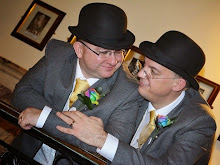
Next month is my fifth wedding anniversary.
But my husband Richard and I have been together twenty-five years.
The wait wasn’t because we’re really traditional and wanted a really long engagement.
We had to wait for the Liberal Democrats in Government to change the law before we could get married on our twentieth anniversary.
Thank you.
Liberal Democrats have always had the best policy of any party on LGBT+ issues.
But it’s not just the policies and campaigning issues.
For me it’s personal.
We got married – but many people still can’t.
We got married – that’s why I can’t stand by and say, ‘I’m all right, Jac, never mind the rest of you.’
I must stand up. We must stand up.
Jo Swinson talked about love in her victory speech as Leader.
This is a simple choice: love or hate.
Liberal Democrats are about love and liberty.
Now, I take it personally when people tell me I shouldn’t have the same rights – my marriage matters!
Is it a matter of conscience? Yes! For the people getting married!
But if you want to bully people, to enforce your prejudices on people, to stop people making their own decisions…?
That’s not conscience – it’s control!
Everything in this motion comes back to the same founding principle: people’s right to control their own lives.
But it’s not just about policy. It’s about the face that the party shows.
I welcome people joining us from other parties. Some will be fully-formed Liberals, and some you might have to give more Leeway to.
Like children raised by wolves, you might not expect them to have perfect table manners, but we should expect all our MPs to say without qualification, ‘Biting people to death is wrong’, and if you’re in doubt, ask someone with scars, don’t say, ‘No-one’s ever tried to bite my leg off, so it’s just a point of view if they bite you.’
We should expect all our MPs to be whipped to stand up and not make excuses for homophobia.
Phillip Lee: I know you’re married. I hope you’re both very happy. Was it a long engagement?
We wrecked our last General Election campaign because we compromised – one person compromised – on homophobia.
Listen, all our MPs: if you don’t want to wreck the next one, it’s not just about the policy.
To put it in language at least two of our MPs will need to understand:
You may try to get into Parliament with good policies, but without faith you are nothing.
Surprisingly Good Reviews
Many Lib Dems agreed with this speech – many laughed, many clapped, Caron Lindsay was particularly kind on Twitter – which helped balance the usual line of the great and good saying How Very Dare You. But just this once, I did get some very good reviews from the New Statesman. Stephen Bush cited me in his write-up of the debate:
“In a speech that received loud applause from the floor, Alex Wilcock, a Liberal Democrat activist, spoke about the 20 years he had to wait to marry his partner, and asked Lee if his marriage had a similarly “long engagement”. It was Wilcock’s speech that also got to the heart of the Liberal Democrats’ unease over Lee’s admission: the party’s defence and toleration of their then-leader, Tim Farron, and his record on equal rights, and the price it paid for that at the 2017 election.”
But my cockles were most warmed by him and Alibhe Rea on The New Statesman Podcast – Lib Syncing, 19th September 2019.
Stephen Bush:
“For me the best speech, actually, of the Conference, and I also think probably one of the best speeches I have seen in party conferences all told, was from a man called Alex Wilcock, who spoke about his own marriage, the very long engagement and the fact that same-sex marriage was illegal for so long, and basically challenged both Phillip Lee and the party for kind of turning a blind eye to some of the aspects of his voting record.”
Alibhe Rea:
“Yeah, it was pretty powerful, that they had been engaged for twenty years and unable to marry, and then the concluding line of his speech was something like, you know, ‘Phillip Lee, I gather you’re married, I hope you’re happy – was it a long engagement?’ It was really quite stirring in the context, and he was just a very good speaker. He’d sort of circled around and alluded to it for quite a while, and then arrived at that conclusion.”
Which is probably the best review I’ve ever had in the press (at least since the Daily Mail’s double-page-spread hit-job back in 1994, which was flattering in quite a different way).

Why I Made This Speech
I wasn’t going to make that speech. I wasn’t going to speak at all. If you want to make a speech in a physical Lib Dem Conference debate – it’s even less flexible in the current online Conferences – you need to put a card in saying roughly what you mean to say well in advance of a popular debate, usually at least the day before. I hadn’t, and had no intention to. But there had been so many hurt people around – not least friends who’d resigned from the party over its welcoming in an MP who saw us as Hell-spawned inferior life forms and wanting to tear out our hard-won rights. I’d prefer a sinner to repent, I’d like everyone to get along, but confronted with the choice between an unrepentant bully and people whose values actually belonged in the Liberal Democrats, there was no way not to pick a side. I woke at 4am that Saturday, stressed and depressed, massively wound up, and could not get back to sleep. So I did the obvious thing: I started thinking of a speech. Amazingly, I was in the Conference hall by 9.30am and put in a card (after Tweeting an obscure declaration of intent which nobody else would get but to stiffen my sinews). More amazingly still, I was called to speak.
I’d been scribbling thoughts, desperate to sort out what I thought at all, how much of it I should say, what tone I should take, and how on earth I might fit any of it into three minutes, which is a very short time indeed once you’re up on stage and gives no room for waffle (in the end, I was so focused on getting to the point that I ran under time). I still have the several sheets of paper where I can see my thoughts take shape – and how much was still unformed by the time the debate began. Unusually, I hadn’t decided how to end it even as I walked onto the platform and opened my mouth. But before I wrote anything else, I had circled to one side at the top, next to where I had to put the opening lines: “Serious and funny!”
A debate speech should have a point – you want to swing people’s votes with you. Sometimes I’ll wing it as I go along, but there are always two parts I need to prepare: the opening, because that gets people listening to you; the closing, because that gets people applauding. The finest arguments have been lost when people are still nattering from the last one because they don’t notice you’ve started or when stopped in mid-flow as your time runs out and the mike’s cut off. I realised both very early, but over the years I’ve set a second aim for the opening line that’s more difficult: it’s also to get people on your side. Whether it’s a joke, a self-deprecating moment or just saying hello, an effective speech begins by getting people to like you. The previous year, I’d made a blistering speech against a policy paper that hand-wringingly appeased bigots over immigration. It was one of my best speeches, focused, incisive, impassioned, but it had an opening like chucking a brick through a window, and while that got people’s attention, I don’t think it got anyone on my side. This time I might have to be even more combative – not attacking a paper, but possibly attacking MPs in person. Fortunately, this speech was personal and a personal opening came naturally, even with a funny bit and an opportunity (heartfelt as it was) to butter Conference up.
The Equal Marriage motion not only celebrated the Liberal Democrats’ achievement of making marriage legal at last for same-sex couples, but recognised that equal marriage is still some way off and set out how to get there – in Northern Ireland, for humanists, removing the hugely unfair spousal veto for trans people – and with speeches overwhelmingly in favour was passed, too, by an overwhelming vote in favour as Lib Dem policy.
Several excellent speeches before mine dealt with those issues for marriage directly, with the rise in homophobic attacks, with Labour MPs wanting a new Section 28, with daily virulent press transphobia – I was crossing off bullet points I’d scribbled haphazardly across my notes, helpful in terms of keeping better to time by not repeating what everyone else was saying, but with stress rising as I listened out for what everyone else was leaving unsaid. MPs and former MPs I admire paid loving praise to people who’d left the party because of— What? Our party was the best on LGBT+ values, and was getting better in this very debate, and yet for some reason that dared not speak its name people were loudly hoping that one day leading LGBT+ activists might somehow find their way back. Many in the hall must have wondered, had they accidentally slipped through into some parallel dimension and were merely lost, because surely nothing about our party was explaining it? I very much did not want to give the speech I could see in a choose-your-own-adventure set of variably hard-hitting ideas scribbled in question marks, but by the time I was called to speak (and for the rest of the debate) no-one else had said a word, and someone had to.
For that Conference, the number of Lib Dem MPs suddenly almost doubled: some defectors I was enthusiastic about; some seemed OK; and then there was one. In June 2019 I had written not a blog post but a Twitter thread as speculation about defectors rose: my instinct was to welcome everyone who chose to side with us. I was thinking aloud on Twitter, but I still – mostly – agree with myself. Yet there are always caveats… But it was by being welcoming, bold and Liberal that we attracted so many people who used to vote for other parties. Being open doesn’t mean watering down what we stand for – if we don’t stand for anything, no-one would make the leap anyway. Though I can’t help thinking that, as one of the Leadership’s more appealing themes at the time was that we were leading a wider Liberal movement, it might have saved a lot of heartache if we’d persuaded a defector standing with us on the big issue but clearly a git on others to caucus with the Liberal Democrats in Parliament as part of a wider Liberal movement and not actually join a party whose values he does not share (that nobody thought of it after years of the party faffing about with supporters’ schemes…). I didn’t actually say that because there wasn’t room for procedural rumination, but despite appearances I have never given a speech in which I was more thinking aloud.
Today I sum up Lib Dem values in three words: Freedom, Fairness, Future. I’ve been writing and speaking about the first two, intertwined, since the early ’90s: that was when I identified them as “Love and Liberty” in a long philosophical pamphlet, and carried that on to this blog. But “Love” isn’t a word politicians are often bold enough to claim, so I was delighted when Jo Swinson did that Summer, and I seized on it. Not just because I agreed with her and applauded her speech, but because if you’re about to go in with both barrels it always helps to call the Leader on your side. But that and my funny opening had a point: this is not ‘a point of view’. This is not just a debate. This is something that is crucial to real people’s lives, and no Liberal should be hoarding rights that they deny to others.
There was a moment where I nearly lost it. As I declaimed, “That’s not conscience – it’s control!” the last word surged up in a growl that almost frightened me: I’d never heard that tone from myself in a speech before and I realised with a shock that I was seconds from just shouting in righteous anger. It doesn’t seem as visible as it felt, but I pushed myself down hard inside, because I knew that I was at the pivot to the dangerous bit of the speech and, suddenly, I could so easily lose control. I forced myself to sound more at ease, to slip in a cutting pun, a stealth Doctor Who reference and a breezily insulting put-down. But as there’s a storm of applause, I wince now seeing the curt gesture to cut it, harsher than I’ve ever been in a speech, as I’m fighting not to snap. And then I say the line that I remember most vividly: “Was it a long engagement?” And it’s only three seconds before I dive on, but after the laughs and applause the deathly shocked silence at that picking up Chekhov’s punchline from earlier and making it a punch in the face felt like an eternity, and inside I was panicking that I’d blown it.
So as I went into the close, knowing I was going to finish with a mangled flourish from my religious upbringing – that you may try to get into heaven with good works, but without faith you are nothing – wielding it as a righteous flaming sword against two theocratic bigots, but not knowing how I was supposed to get there, with several partial versions scribbled in front of me and none I was happy with, and at the last moment somehow navigated between the cop-out of sticking only to Phillip Lee and full-on naming and shaming Tim Farron. I glanced at the scrawl of lines hoping we would pass the policy then warning that most people would never hear about it, while many voters would hear if so-called Liberal MPs lust to control others and claim their religion says my twenty-five years is too short a wait; or reminding the lucky few Lib Dem MPs elected in that disastrous General Election of the cost of weakly suggesting homophobia is just a point of view. But I swerved away from going full Old Testament thunder because I might never stop, or explode in sheer incandescent rage. I feared I’d already lost the hall but I was committed to saying something – in the end, my more tightly controlled ferocity still got the point across and the thunder was left to the applause.
Where Nick Clegg Went Wrong
I thought hard about whether to say any of this, after leaving it unsaid in 2019 – both in a speech that in the end confronted what everyone knew in the least confrontational way I could bring myself to, and after holding back from saying it at far greater length earlier that year. It isn’t uplifting, so you may wish just to stop here. But I’ve made myself look in order to learn.
During the 2019 Liberal Democrat Leadership election I wrote – most of – an article assessing the three immediately previous Leaders, and lessons to be learned. Though I wrote at length about the positives for each before blasting their big disasters, I never published it. What I had to say about Nick felt too much like old wounds, what I had to say about Tim Farron was still too raw and hurt and blisteringly angry, and I never quite finished writing about Vince, as just too meh (though in a late surprise entry since he’s now topped the ‘Most Problematic Former Lib Dem Leader’ chart. I wish he hadn’t). I’m not going to publish all that now. But it’s worth summarising the crucial lessons: not just when two Leaders f—ed up, which everyone knows, but why those particular f—k ups were so deadly. I’m not going to assess the whole Coalition – though Richard and I did say thank you for our marriage on our (twenty-years-and-) six-month anniversary, without which we’d still be waiting.
Here goes, though. “Tuition fees” was engraved on every Lib Dem heart and every anti-Lib Dem attack leaflet. The biggest, most catastrophic, monumental political misjudgement of the Lib Dems in Coalition. Yes, we all know this. But steel yourself and look at just why this was so destructive. First and foremost, for the Lib Dems (and for Nick Clegg personally), education is an absolute, passionate priority. It’s at the centre of enabling everyone to have the opportunity to realise their potential, not just a policy but at the heart of our philosophy. And in Coalition government, we championed education; we protected the schools budget from cuts and introduced the pupil premium, so schools got more money to help teach poorer kids. But every single time any Lib Dem mentions it to this day, what does every voter think? ‘But tuition fees.’ F—k. Breaking the promise was bad, but breaking the heart of our values was catastrophic. And from naked political nous, university towns and higher-educated voters had become the hard-earned most likely to vote Lib Dem, and the tuition fees betrayal kicked them in the face. It’s hard to think of a more laser-guided missile to the Lib Dem vote.
Some More of Tim Farron’s Greatest Mistakes
Which brings me to Tim Farron. The 2015 Leadership election was blighted in two ways: not only did we have practically no MPs left to choose from, but in hindsight the two contenders were summed up by Yes Minister:
“If Eric gets it, we’ll have a split in the Party in three months. If it’s Duncan – we’ll have one in three weeks.”
Eurosceptic Norman Lamb would have been an utterly catastrophic Lib Dem Leader for Brexit. Tim Farron made the critical choice that we would stay fighting as the party of Remain, a brave, principled decision trying to save Britain’s future that also enabled the Lib Dems to survive the near-extinction event preceding Farron’s Leadership and then the near-extinction event precipitated by Farron’s Leadership. But then, obviously, he went and proved that while it’s hard to think of a more laser-guided missile to the Lib Dem vote than tuition fees, it could still be done. I’m trying to strike an ironic tone, but I’ve cut my next four paragraphs from 2019 because they’re unlikely to do anyone much good, and certainly I felt the fury, misery and betrayal rising just re-reading them. Plus there aren’t enough em dashes to cover all the swearing. Every single day of that blighted election I defended him because I thought I knew him, as furious and hurt and betrayed LGBT+ people said, ‘How can you do this to us?’ But Farron didn’t just destroy the LGBT vote for the Lib Dems, much as Nick didn’t just hammer the student vote. This was about the sort of party we are and the sort of people who might vote for us. Think about the sort of voters who are likely to listen to the Lib Dems. Even if they don’t mention it on the doorstep, how are they going to react to the only thing they hear from the Lib Dems, day in, day out, being that their Leader doesn’t like the gays? A more perfectly targeted voter-seeking missile even than tuition fees – not even the excuse that the money was too tight, not even the excuse that we couldn’t get another party to accept it, but simply because the Leader we chose had chosen to be a bigot. Name me anything a Liberal Leader could possibly do more effectively to alienate Liberal-minded voters. They recoiled en masse. In the year of the universally hopeless leaders, to be more of a voter turn-off than disintegrating robot Theresa May and a UKIP nonentity? The 2017 Lib Dem Leader was sheer electoral poison – delivering an even lower vote than 2015’s collapse, the worst share of the vote for British Liberalism since the 1950s – and, as votes had to go somewhere, if you wonder how on Earth people once saw any hope in Brexit’s Best Mate Jeremy Corbyn, Tim Farron was his biggest asset.
I had known and liked both Nick Clegg and Tim Farron since long before they became Leader. I felt for both of them… But I admit one I find easier to forgive for their worst calls when leading the Liberal Democrats. It’s an appallingly hard job and I wouldn’t wish it on anyone, but it’s also hard not to want to tell anyone doing it: if you must f—k up, can you at least think about what’s deepest in our values and what’s most important to our voters, and try to f—k up at the furthest-away political point from both?
Labels: Gay, LGBT, Lib Dems Believe, Liberal Democrat Conferences, Liberal Democrat Leadership, Liberal Democrats, Richard, Speeches


Saturday, September 15, 2018
Time For Hard-Headed Realism On Immigration
Liberal Democrat members have attacked the proposed Migration paper A Fair Deal for Everyone for reasons ranging from fairness, to morality, to family, to economics. But for a political party, it has another fatal flaw. Its well-meaning, wishful-thinking naivety is just terrible politics. It’s time to get politically streetwise with a bit of hard-headed realism. Let’s ask the tough questions, get back to evidence-based policy and demand better.
Meaning Well and Wishing Are Not Enough
I’m sure the people who wrote the proposed paper for debate at Lib Dem Conference and its defenders mean well. I know and respect quite a few of them. And I can see how they got themselves into this mess. Two of the deepest Lib Dem instincts might be put simply as ‘Stand up to bullies’ and ‘Why can’t everyone get along?’ And most of the time those go hand in hand. But at times like these, when the country’s split, hate’s on the rise and things seem to be going horribly wrong, cracks can appear between the two. The proposed Migration paper feels upset at how nasty things have got – and I feel the hurt of that too – and wishes, really hard, that everyone would be nice to each other again. ‘Why can’t everyone get along?’ And so it compromises: a bit for immigrants; a bit for people who hate them and want them all gone. But in the real world, wishing doesn’t cut it, and there comes a time when you have to choose standing up to bullies instead of hoping they’ll turn nice if you only half-encourage them.
In thirty years of the Liberal Democrats, there can’t have been many more wince-inducing juxtapositions than one month ago. On August 14th, Lib Dem Leader Vince Cable said unequivocally that, hard as it might be, there was no room for racism in the Lib Dems. On August 15th, Lord William Wallace – a peer I have a lot of time for and usually agree with – gave an apologetic defence of the proposed Migration paper by saying that we have to pander a bit to racists otherwise they won’t vote for us (I paraphrase, but not unfairly).
The proposed Migration paper has the point of view that policy and the British polity should be kinder and gentler, wishing that people were nice, assuming everyone means well deep down and really agrees with us, and if they don’t yet then compromises in good faith will help them agree with us, and if nothing else maybe they’d vote for us after we tell them we agree with them, really, just a bit, and please, please, don’t hurt us. I can empathise. The problem is that the evidence supports none of it. I believe the Lib Dems backing these proposals mean well. But I’m realistic enough to know that not everyone else means well, and that wishing won’t make it so. The fight to make Britain better can be won. But it will take a fight, and if Liberals don’t put up a fight, who will? It won’t be won by acting as if we’re non-combatants who won’t take our own side in a quarrel, saying, ‘If you don’t want immigrants then you have a point’.
I don’t want to take this unduly personally, but when the proposed Migration paper puts forward a well-meaning compromise and I realise, ‘I’m the son of an immigrant and had this proposed Lib Dem policy been around when my parents met I’d never have been born’, it loses its appeal. That’s the trouble with compromising between haters and the people they hate; it always makes things worse for the ones who are already getting all the flak, but never goes far enough to satisfy those who want them gone. The proposed Migration paper proposes as a moderate compromise that I shouldn’t exist. What would I have left to give on the next compromise?
Stop wishing. Look at the evidence. Ask the difficult questions.
Look back ten, twenty, thirty years: the attitudes and policies and hostile environment against immigrants that are now ‘mainstream’ were confined to a few vicious hatemongers like the British National Party and then UKIP. How did we get here?
Has compromising bit by bit to defuse racists worked? Has mainstream politicians talking about ‘valid concerns’ increased harmony? Has fanning flames extinguished them? Has encouraging xenophobia quietened it? Has being too scared to confront lies made the truth more widely known?
I don’t blame people for thinking, once – maybe if we give a little we can avoid something worse. I do blame people who still stick to that hope when it has been tried over and over again and every time, the bigots have grown and strengthened as a result. Hostile immigration policy – hate crimes – Brexit – all these were unimaginable ten, twenty, thirty years ago. Compromising a little at a time has never stopped at a little. It didn’t work. That is the evidence. That is the unhappy fact. As the saying goes, one definition of insanity is doing the same thing over and over again, but expecting different results. The ‘wishing’ approach of the proposed Migration paper has been tested to destruction.
Pandering to racists only increases racism. Saying ‘I share your valid concerns’ doesn’t win hearts and minds – it just makes people in the middle say, ‘Well, if even the Liberals say immigrants are bad…’ while hardcore racists think we’re just mealy-mouthed politicians out to con them. And saying out loud – the shocking naivety! – that we have to pander to racists not because we actually agree with them but just to make them vote for us, so we’ll campaign on a promise that although we want to make things nicer for immigrants, because we recognise their ‘valid concerns’, we wouldn’t make things as nice as all that? That’s just treating voters as idiots.
Since the Brexit Referendum there’s been more hard polling evidence than ever before in British history on how social attitudes break around votes for parties. About 90% of the Lib Dem vote comes from people who also voted Remain. Voters who hate immigrants as their top issue? That’s UKIP’s big thing. That’s Theresa May’s big thing. That’s even Jeremy Corbyn’s big thing. Why on Earth would Lib Dems propose a Migration paper in the hope of appeasing appealing to such a crowded marketplace as what will only ever be the fourth choice of authoritarian racists? Let’s make an evidence-based call here: stop asking, ‘How do we get racists to vote for us?’ Because they won’t anyway.
Look at Labour’s record. Gordon Brown in 2010 trying to recover from “I agree with Nick” in the first debate by monstering him over immigration in the second and third (the third Leaders’ Debate was the one in which an audience member said “We’re not allowed to talk about immigration,” despite it being the only issue bar the economy featured in every debate, because hardcore racists are impossible to satisfy or to shake from their lies). Yvette Cooper attacked the Coalition from the right for not being tough enough on immigrants. Ed Miliband put immigrant-bashing on a mug. Brexit-backer Jeremy Corbyn tells lies about foreign workers stealing British jobs. Do Labour get ‘credit’ for being tough on immigration? No. Racist voters still think they’re too soft. Because there are always other parties that will go harder right to compete.
When I campaign, I try for every vote. If someone disagrees with us on immigration, they might still respect us locally for getting their potholes fixed. But if the economic and moral and principled case for a powerfully Liberal migration policy doesn’t persuade you, here’s the naked political calculation. We’re on 11% in the polls (at best). We’re not chasing an immediate 500-seat landslide. So to build up our vote, does it make more sense to make policy that’s weaselly and indistinct in the vain hope that’ll attract the people who are least likely to vote for us, when they can get red meat from several other parties? Or should we put our effort into attracting people who already agree with our values into voting for us?
It’s worth reading Andrew Hickey’s The Howard Rule – in which he proposes testing Lib Dem policy against Michael Howard’s once-infamous authoritarianism as Home Secretary – not just as a statement of principle, but as a reminder of just how far right all political parties have shifted in the last quarter-century. In the 1990s, he was appalling. Present his immigration regime today and it would scare the horses with its liberal openness.
Taking A Stand
We must do better than the proposed Migration paper. We can do better by demanding better of ourselves again.
One of my defining early political experiences was Paddy Ashdown leading the newly formed Liberal Democrats alone in standing up for the rights of Hong Kong British citizens. You might think struggling on a good day to hit 11% in the polls puts our party in the doldrums now, but back in 1989 a good day was hitting half that and the sheer relief of getting beyond the margin of error of nothing in the opinion polls. Standing up for a liberal immigration policy then let us hold our heads up. Margaret Thatcher’s Government steered the familiar Tory course of nationalism tempered by greed: standing by Britain’s promises to only the richest, offering citizenship by bribery. Norman Tebbit led a Tory rebellion against Mrs Thatcher to stop anyone with the wrong colour skin entering Britain, and the Labour Party piously opposed the idea of citizenship for the rich – then voted with Mr Tebbit’s Tory far right to stop anyone being let in at all. Mr Corbyn takes the same faux-ethical stance of economic populism as cover for immigrant-bashing today.
In April 2000, during a hard-fought by-election campaign where the Liberal Democrats were striving to take ultra-Tory Romsey, Charles Kennedy took on the immigrant-bashing Conservative campaign head-on. The Lib Dem campaign could have played down our Liberalism, played it safe, stuck to ‘popular’ issues and only challenged the Tories where they were perceived as electorally ‘weak’. Instead, the Lib Dem Leader took the huge risk of facing down the Conservatives’ asylum policy, in a speech in Romsey, where conventional wisdom was that saying the right thing would lose us the seat. We didn’t cower. We won. Charles said afterwards:
“The voters of Romsey were not beguiled by William Hague’s personal brand of politics – those based on fear and division… By concentrating on the negative, and pandering to the small-minded, he insulted the electorate.”Standing up for our principles heartens, rallies and recruits the people that none of the anti-immigrant parties can reach. And making the case instead of letting it go by default changes minds. We can persuade by telling it as it is – not by pretending and pre-compromising. How do we make racism less bad? Not by saying it’s right. Why can’t we all get along? Because some people don’t want to. Someone has to confront hate, say why it’s wrong, and don’t say they have a point when they don’t. But it’s not just about standing up to hate: it’s appealing to the better instincts of people for whom it’s complicated. Whose fears have been stoked by the Daily Hate, but who like their neighbours and were appalled by Theresa May over Windrush.
Liberal Democrats must make the case for immigration and for immigrants – because it’s right, because it’s the only way to turn back the poison, and because no-one else will. Immigration is good for the economy. But it’s not all about the money. Immigrants are the lifeblood of the NHS. But it’s not all about the work we get from them. Families should be able to be together because love is more important than money. Tabloids screaming lies about “open door” immigration, when it’s way tougher than anyone believes, has led to families being torn apart, but still most people think if you marry an immigrant they can stay. That would be a Liberal immigration policy. That’s the sort of appeal Lib Dems should make – not the proposed Migration paper keeping a price on family life.
Demand Better
Remember – these are only proposals to be debated and decided at Conference. It is not A Fair Deal. For Liberal Democrats, it is not a done deal.
Be politically streetwise. Look at the evidence. Tell the truth. Don’t pander to racism and don’t settle for wishful thinking that has been proven year after year only makes things worse. Vote to send the proposed Migration paper back so the Liberal Democrats can offer – can demand – something better.
This is a slightly longer version of my article published on Liberal Democrat Voice earlier today. I recommend going there to read Caron Lindsay’s The paper on migration, even amended, is not good enough. Her piece is brilliant, speaks from the heart on how to persuade people, and scathingly dissects the paper in detail.
Labels: Bigotry, Brexit, Charles Kennedy, Conservatives, Immigration, Labour, Liberal Democrat Conferences, Liberal Democrats, Paddy Ashdown, Vince Cable
Friday, February 26, 2016
A #LibDemValues Vs Other Parties Rorschach Test
A quick test. Read this paragraph – which other parties is it implicitly opposing?
Government should be about freedom from poverty. Governments shouldn’t protect the interests of the already powerful and wealthy, and sneer at, snatch from and push down people working to make a life for themselves, or those who aren’t able to support themselves. Government should be about freedom from ignorance. Governments shouldn’t assume it can do everything, control everyone, as long as you take what you’re given and don’t ask awkward questions when paternalist leaders claim they always know best and ignore the evidence. Government should be about freedom from conformity. Governments shouldn’t tell you that nation is the only thing that matters about you, exclude ‘outsiders’ and shout ‘traitor’ at anyone who doesn’t want their flag cut smaller, narrower and meaner.
How I Wrote For Agenda 2020
The Liberal Democrats are in the middle of an “Agenda 2020” consultation about the party’s values. As part of this, they ran an essay competition to sum up in one thousand words what it means to be a Liberal Democrat. I entered, as did my husband Richard, and we were both shortlisted from the sixty-odd entrants for the nine finalists put to public vote. Though the vote’s now closed, you can still read all the essays here. There’s another exciting consultation session coming up at the Conference in York in a fortnight.
Anyone familiar with my level of productivity – the length of time it takes me to get anything written, and also the length of text once I’m done – will be unsurprised to learn that I left writing my entry until quite late, then didn’t like what I’d written, then wrote it again from scratch a couple of days later, and then found myself with something I was happier with, but which was also a little over one thousand seven hundred words. On the afternoon of the deadline.
My final entry was in some ways an improvement on the larger draft – less repetitive, and more powerful in combining some ideas – but as I lopped more and more out of it in increasingly desperate haste, it did lose some elements altogether, which inevitably changed its tone and weakened the message. At some point I might write a version that brings some of those bits back in, but for now I’ve simply presented you with one previously deleted paragraph above. The only other person who read my long draft thought it was the best bit. So why did I cut it?
What I Aimed For (and why that paragraph didn’t fit)
I set myself several tasks in writing the essay beyond ‘What the Liberal Democrats should be if I were their god-emperor’. Not least because we don’t, as a rule, believe god-emperors are a good thing. So I wanted a statement of belief that not just fired me up but which I thought most other Liberal Democrats would agree with at least most of, too. And I wanted something that could clearly explain and inspire people outside the Lib Dems to try Liberalism. I’m sick of people saying, ‘Oh, you Liberals, you’re too reasonable, you don’t feel strongly about anything’, or ‘Oh, you’re just about feelings, you don’t live in the real world,’ both of which I will politely refute on the doorstep (rather than swearing at the f***wits in the towering rage they deserve), so I aimed to counter both of those loads of old b****cks, for example. And some of it was a reaction to things other Lib Dems had said we stood for, where I thought, ‘Not me, matey’. But amongst all the other things I wanted to do in a thousand words – possibly why it got to nearly twice that – I told myself, as I always do when I try to express what the Lib Dems stand for, that I had to be positive. We hardly ever get any time to say what Liberal Democrat values positively are, so why on Earth waste time just saying what’s wrong with the others instead?
And that’s why the paragraph above had to go. Although it was a sort of judo-statement, illustrating Lib Dem principles by overthrowing other parties in turn, and even though it didn’t name them, it still stood out as knocking copy in an essay that should have been positively Liberal Democrat.
[By this stage, readers who read all nine of the shortlisted essays will almost certainly be able to deduce which essay was mine, and also which essay I would have given ninth preference to. It’s a shame we didn’t get to vote for them all in order of preference, as there were none of them I was entirely happy with but eight I would be fairly happy with. I did consider fisking each of them, but I thought that might have come over as a ‘vote for me’, which we were asked not to do – though I’d also have fisked mine, having written it and knowing its flaws, and even Richard’s, which I found the most inspiring.]
Which leaves the one last question about that paragraph: which parties did you assume each line was overthrowing in turn? Because I reckon two are pretty unambiguous, but the other… I deliberately wrote it so you could infer more than one ‘enemy’, because it was an attack on a particular sort of philosophy, not on just one party that enslaves people to that philosophy. Even so, one party was flashing like a neon light in my head. But when the only other person who’s read it until now told me that was the best bit, he also named the kicking I gave to a different party as particularly satisfying. So, out of interest, who was it for you?
A Note On Health
Regular readers will have noticed that my blogging has been even worse than usual – especially and embarrassingly as I’d set myself explicit targets, so you can spot each one that goes by. It’s not just a lack of blogging mojo (though that always comes up). On top of all my usual long-term health problems which are permanent and quality-of-life-sapping fixtures, I’ve had a chest infection for two months now that just will not shift. I can cope with my usual asthma, but persistently finding it difficult to breathe makes all sorts of things rather difficult. And because when my physical ill health is especially low I easily pick up bonus problems, suffice to say I’ve been picking up several bonus problems. So at the moment I don’t know if I’ll be able to get to York, nor even if I do so (as with several previous conferences) whether I’ll spend most of it keeled over in our hotel room. But in the hope of minimum functionality, I hope to see some of you there.

Labels: Liberal Democrat Conferences, Liberal Democrats, Liberalism, The Golden Dozen, What the Lib Dems Stand For
Wednesday, October 08, 2014
Lib Dem Conference On TV: Watching Where the Money Goes
I’m usually busy at Liberal Democrat Conferences. Writing speeches – sometimes even getting called to make them. Writing chunks of policy – sometimes even proposing them. Not writing a blog looking at the telly, while policies I’ve had nothing to do with are debated without my vote or voice. One I’m in two minds over. One I’m proud of. One taking baby steps but going nowhere near far enough. One that’s OK but should’ve been inspiring. One that’s unjust, unaffordable and unworkable. And the big picture: the very few places where my party puts any money where its mouth is.
As my health has gone further downhill, in conference after conference I’ve made fewer speeches and attended fewer debates than I did five years ago, or ten, or twenty. It’s just a bit of a shock to go from steadily decreasing participation and days when I often have to stay in a hotel room rather than in the conference hall to zilch. Hopefully Richard and I will be back next year, more engaged once we’re married (though it’ll be much more expensive for me just as my low income’s been eradicated, thanks to government policies I can’t say I support).
But there is one advantage to watching this Glasgow Conference on TV. I would be sitting in the hall fired up and wondering if I’ll be called to make my speech, listening to dreary meandering mumbles with nothing to say even if they could deliver it, where the only message is ‘My view on this crucial national issue is incoherent but involves a mind-bogglingly dull special plea for my own little local area’ – and it’s not just the MPs, some of the ordinary members are just as bad. I would be thinking hard at the sodding chair of the session, ‘It’s one thing not to call me to make the brilliant speech I’ve crafted so carefully, but calling these ones instead is just insulting.’
At home, I don’t feel the urge to write a speech, I don’t have to worry if I can make it to the hall, and above all, I can record the debates and watch most of them with my finger on the fast-forward button!
In my breaks from Lib Dem Conference, I’ve also been watching Doctor Who – The Pirate Planet, starring Tom Baker and written by Douglas Adams. This brilliant story, is I have to admit, better viewing than pretty much any Agenda item bar the Presentation On Same-Sex Marriage, and its second episode was first broadcast on this night back in 1978. At the time, part of it was a satire about the idea of an “economic miracle” for which no-one has to pay. It also turns out (spoilers) that behind the exponentially increasing devouring of the resources of whole worlds is someone very old to whom no demand is ever enough.
So what’s been happening back at the Conference? You can read all the papers here, and catch many of the debates via the BBC. But here’s why some debates particularly caught my attention…
“One Member, One Vote”
I’m torn on this one. If party membership hadn’t been hollowed out, I’d be wary that these proposals sound like they’re about equality but actually even more heavily in favour of time-rich, money-rich people who happen to live close to the seaside (or, in this case, to Glasgow). The equivalent of electoral reform for the UK being to propose one person, one vote – as long as you can all pay a large registration fee to crowd into the same one polling station. In Glasgow. Or, discarding the party’s current constituency-based representative democracy model, like reforming the House of Commons by saying any UK citizen can turn up and vote there, as long as they can afford to pay to register and pay to stay in London. And I wasn’t totally convinced by the argument that our shrunken membership makes it less likely people will turn up to swing the votes, which seems like an argument that we should completely change the structures just to get no more people turn up anyway. That the proposals themselves were a badly-drafted mess from a Federal Executive that has been record-breakingly navel-gazing and incompetent in its faits accompli this year didn’t help.
And yet… I’ve had times when I’ve been to conference without being an elected conference representative with a vote too, and it’s even more frustrating than being a conference representative who’s not at conference as I am today. The amendments stopped the constitution being turned into incoherence. And the arguments on the OMOV side were simply far better, with too many of those against resorting to pathetic ad hominem attacks.
Watching from home, though, if every member is to get a vote not just if they attend conference but for the major party committees, the small changes in making conference easier to follow over the past few years need to accelerate mightily. During conferences, the party website must have a one-click ‘What is happening right now’ solution rather than a many-click ‘Somewhere here you can work it out’ puzzle box. The back-projections and the chairs of sessions need to give the site address several times during each debate and explain what’s going on in each vote, not just to make it clear to conference-goers rushing about, but to those more members we’re told will be freshly engaged and watching after OMOV. Announcing at the end what the votes have actually decided, rather than just reading out a list of numbers and letters, would help the TV watchers too.
In a spirit of helpfulness, here’s one I prepared earlier: Making It Easier To Follow Liberal Democrat Conference.
Towards Safer Sex Work
Twenty years ago, I was newly elected to the Liberal Democrat Federal Policy Committee – the body that decides on the major policy proposals that go to Conference. I was the youngest person on it by more than ten years, the only out LGBT person on it (putting into perspective today’s debates over reducing ‘diversity’ to only one tick-box quota), and – the unique thing about me that most mattered to me and which made the difference on the Committee – by the reckoning both of those meaning it approvingly and those meaning it critically the most unfilteredly ideologically Liberal. One of the first policy papers that that year’s FPC discussed had something done to it that I can’t remember any other paper save election manifestos. Election manifestos come back several times for FPC debate because there’s so much in them and we need to get them right. This paper was sent away for redrafting not once but twice because it was simply too Liberal for the FPC. I can’t remember any other than wasn’t just redrafted a bit in committee, as was the norm, but rejected in total and sent away to be rewritten from top to bottom (possibly not the best words), then once we saw it again, told it was still too interesting and needed to be completely redrafted yet again.
The neutered and regulation-heavy paper that was eventually permitted to creep into Conference was titled “Confronting Prostitution”. I bear some responsibility for that overly confrontational language: I was the one who pointed out to the FPC that the title “Tackling Prostitution” might be open to ribald remarks and we should get our tackle out.
It wasn’t a bad paper. It advanced us well ahead of the other parties. But I always looked at it with disappointment, because the policy working group had followed its remit, followed the evidence, and followed Liberalism in drafting a civil liberties paper that the FPC gutted stage by stage until it was about ‘getting them off the streets’. When the first draft came to FPC, it was the only policy paper that was ever so unpopular that just one solitary FPC member supported it as it stood. You will not be surprised to read that it was not the only time in which I was in a minority of one, but it was the most significant.
So I was very proud to watch all of Saturday afternoon’s debate, to see how far we’ve come. I particularly recommend you read Sarah Brown’s speech, but I was really pleased at how sensible and Liberal the overwhelming majority of the speakers – and the votes – were, including protecting sex workers both from exploitation and from the state, rejecting the idea of reintroducing ID Cards but just for sex workers, and setting out the principle that informed, consenting sex should simply be legal and is nobody else’s business (even if it’s a business). Well done, Conference! I just hope now that the next FPC will not be as timid about the forthcoming policy paper as its predecessor two decades ago. So if you have a vote, vote for the candidates with some Liberal ideas rather than just a CV on their manifesto.
Doing What Works To Cut Crime
I liked this policy paper – it sets out a practical, evidence-based approach to cutting crime. But its piecemeal nature means it looks more like a compilation than a coherent whole. So I welcome the commitment to crime prevention. And civil liberties. And evidence-based baby-step liberalisation of our useless, gangster-boosting drug laws. And to the interests of victims.
But a bigger question that the paper doesn’t ask is that if we want fewer victims, what about the victimless? What about ‘crimes’ that are not about protecting any victim but only about the state victimising people that aren’t hurting anyone else? Because it’s not only criminals who attack you that can be bullies. The state can, too. And if you want to prevent crime, expand freedom, cut the ground from under gangsters and have fewer victims, then setting out the principle that ‘victimless crimes’ should simply not be crimes at all is something I’d like to see as the keystone of our next crime paper when it looks at evidence for how to implement that.
The Liberal Democrat 2014 Pre-Manifesto – A Stronger Economy and A Fairer Society
I wrote a little about this yesterday, looking at the Introduction and how that’s changed and improved on previous attempts – though it lacks a short, stirring rallying call of What the Liberal Democrats Stand For.
The whole thing’s pretty good. And I particularly liked Duncan Brack’s closing peroration in the debate (Duncan, if you’re reading, please send me your speech and I’ll print some of it in a Liberal Monday). I have to admit, though, save the much-purloined policy to further raise the personal allowance for the lower-paid, I’m a bit hard-pressed to remember a ‘wow’ policy. That suggests that its narrative isn’t all that thrilling. And then at the last minute, someone came along and diluted the best bit.
I might have been tempted to vote against it for the drafting amendment announced this morning: the problem with an amendment that’s accepted into the text at the last minute is that no-one gets to debate it or speak against it. Several years ago, there was a crappy Guardianista fad for “wellbeing”, a meaningless top-down political concept like a New Labour zombie. The Lib Dems made the great mistake of deciding it was the biggest of big ideas, with almost zero enthusiasm, and since then have sheepishly never mentioned it again because it’s a load of rubbish. Until this policy motion, when some utter fool wanted to add it and the bigger fools on the FPC let them. Worse, it means that the motion as passed says that the one big thing we’re really about is “above all to empower every person to realise their potential” – oh, and also “wellbeing”! Which is crud. It’s not one task. It’s two. It means the inspiring, Liberal, bottom-up idea that we are about enabling everyone to decide their own life is now knitting together with top-down Blairite mulch about how we should decide what’s good for people. As no-one mentioned it in the debate, proving yet again how pathetically uninspiring the idea is, my advice is just to pretend it isn’t there.
But at least the Pre-Manifesto remembered to talk quite a bit about the deficit, and didn’t pretend you can fix it while bringing in no new tax revenue at all and giving massive handouts to the wealthiest.
Did We Forget About the Deficit After All? The Big Four Spending Commitments
The Pre-Manifesto was very tough on the deficit this morning. Then there was a huge splurge this afternoon.
I’m not against huge splurges (no, titter ye not). But the Liberal Democrats have carefully costed our Manifestos for more than two decades to only promise what we can afford, even in the good times when the money was rolling in (though less than the Labour Government pretended). Now the money’s not just tight but gone, it’s all the more obvious where the few extra bits are going – while everything else gets slashed.
- The Liberal Democrats are committed to protecting and expanding spending for schools and early years education – we always have. It’s probably our single most consistent commitment.
- We’re committed to increasing pensions through the so-called ‘triple lock’ (heads, tails or side, pensioners always win big).
- We’re committed to raising the income tax allowance to the level of the current minimum wage – but that isn’t ‘locked’, so it can be eaten away by inflation.
- And we’re now also committed to above-inflation increases in the NHS budget. All the previous three follow on from the big promises the Liberal Democrats made in the 2010 election, all three of which were delivered in the LiberaTory Coalition. This one is different: it also happened for every year of the Coalition, but at the last election it wasn’t promised by either the Liberal Democrats or Labour. This part of the Coalition’s record now taken up by every party was only a Tory commitment. We forced them to agree to the others – they forced us to agree to this one.
These four spending commitments are massive. And everything else will have to suffer.
I remember in 2001 – in what Labour told us were the boom years – I put out a really good leaflet across the constituency for which I was standing for election. ‘Follow the money’, I thought, and so this was all about the two biggest spending commitments in our 2001 Manifesto. On one side, a picture of me with local kids, with details of our proposals for children and education and how we’d pay for them. On the other, a picture of me with local pensioners, with details of our proposals for old people and pensions and how we’d pay for them.
I thought this was a great idea until a working person without kids told me angrily, “So you’re offering me nothing, then. I just have to pay for it all.” That should have occurred to me: I was a working person without kids. But though we’d said in our 1997 Manifesto that we’d raise the personal allowance for the low-paid, by 2001 we’d dropped that from our priorities to give a massive bung to pensioners. And back then that didn’t even include the earnings link and ‘triple lock’.
Today we have even less money. We’ve restored the policy of cutting taxes for low-earners – and made it a reality for millions despite the Tories wanting a tax cut for dead millionaires instead and Labour opposing it because they want government hand-outs only to the people they say deserve it rather than letting all the low-paid keep their own money. But that wasn’t a choice between generations. Something for children; something for working people; something for pensioners; now something for the NHS for everyone.
I just don’t think this can hold – because four massive commitments of extra cash is too many without squeezing everything else until it pops. And one of those four is not like the others. Only one has had no hard choices at all – just constant rises.
Age Ready Britain
Back when I was healthy enough to stand for elections, I went through an assessment to see if I was politically fit to be a Liberal Democrat Parliamentary candidate. I passed with flying colours, and can still remember my going all Churchill to the assessor role-playing an anti-asylum-seeker voter on the doorstep (as well as remembering that I’d only use the word “refugee”). One of the parts of the approval process of which I most approved in turn was the point where you had to prove you had a Liberal brain by identifying a party policy that you disagreed with and explaining why. I think at the time it was something about well-meaningly bossing young people about – a “wellbeing” policy, if you will – and, if I thought today about which I considered our most wrong policy, I would quite happily blast that Blairite twaddle of a “wellbeing” paper out of existence. But as it’s already been wiped from everyone’s memory through its very blandness, I would answer that the policy I most disagree with is one that has been made even more disagreeable today.
Our policy on pensions is generous, warm-hearted, well-meaning and attractive.
It’s a shame that it’s completely out of touch with reality.
This morning, the Liberal Democrats voted for a Pre-Manifesto that constantly repeats that it is all about “the next generation” and uses that as a primary argument for reducing the massive deficit between what the government spends and the money it has – that we must spend less now rather than saddle ever-increasing debts onto the next generation.
This afternoon, the Liberal Democrats voted for our biggest spending commitment not only to remain humungous increases for pensioners when every single other group in society is suffering cuts, but to put that vast and ever-increasing cost into law so that it can never be changed.
Completely unworkable.
The first time I ever spoke on what might be called the party ‘establishment’ side, after many years of being the radical outsider, was sometime roughly around the year 2000. It was in a debate on pensions that saw the unlikely bedfellows of young people, the party Leadership and elderly members of the House of Lords on one side, with middle-aged Parliamentary candidates on the other. The Parliamentary candidates wanted to restore the link between earnings and pensions because it was very popular. The rest of us said that it was a mistake to make that a principle because we could afford it today – as we then thought, not realising that even in the boom years the Labour Government was already running an unaffordable budget deficit – because there would come the twin pressures of an ageing population and a less rosy economy, and then we’d be stuck with a policy that wasn’t affordable. I can’t remember precisely my age, but I can remember my speech’s opening line that got people’s attention (and got a few boos):
“Conference, I’m twenty-eight. And I want a pensions policy that doesn’t make me pay through the nose and then go bankrupt before I get anywhere near claiming it.”Back then, sense won the day. Somehow, between then and now, as the nation has got older and the economy has gone down the toilet, as the side that won back then have been proved right, we’ve gone ahead and gone for the unreal option anyway.
A ‘triple lock’ on pensions ratchets up without end, so that whatever happens to wages, or inflation, or the nation’s finances, however children or working people or people on benefits or services or anything else under the sun suffer, one group alone will forever get more and more money even as that group gets bigger and bigger.
We promised it at the last Election. We were wrong.
We’ve delivered it in government. We were wrong.
Today, we’ve proposed locking it into legislation so that every other group, every other service, every other dire need must always by law be subordinate to pensioners not just not contributing much to the cuts, not just staying still, but getting more, more, more while everyone and everything else gets less, less, less. We are stupidly, impossibly wrong.
With today’s pressure on the public finances, this is not merely utterly unworkable but utterly unjust.
I argued for pensions increases and other spending to help pensioners back in 2001. I meant it. It was the right thing to do when we could (seemingly) afford it. I didn’t argue for massive age discrimination and a huge and ever-increasing transfer of wealth from the current generation and the next generation to pensioners who will never be all in this together even when we can afford none of it. Because I’m an idealist, not a complete fantasist.
The Party Leadership and speakers in the debate today told the brave souls who stood up against this dangerous absurdity that they were wrong to say that ever-increasing numbers of pensioners getting a never-ending increase above the country’s wealth was unaffordable, because we just don’t understand the numbers. They didn’t say what the numbers were. Because… Because… Because… It’s magic! Government spending is still way above the money it takes. Everything and everyone else is struggling to keep their heads above water. The benefits bill is being slashed and people having their benefits cut or cruelly taken away altogether – the one exception being the vast majority of the benefits bill, the vast majority of benefits claimants, all of whom get much more than any other benefits recipients. They are the pensioners. But pouring extra cash into by far the biggest chunk of the benefits budget is “affordable”, we were told, and we just don’t understand if we say the emperor has no money to get clothes.
How stupid do they think we are?
One MP replied to criticism – from the unlikely bedfellows of Liberal Reform and a leading member of the Social Liberal Forum – by saying that we shouldn’t turn this into a fight between the generations. Well, that’s exactly what you do say when you’re the victor enjoying all the spoils, but not when you’re the side left bleeding and looted. Behind the scenes, they spin something else: not that it’s right, but that “pensioners vote”, so we need to throw money at them even if we have to mortgage the next generation’s future by borrowing half of it and mug the current working generation for the rest.
Ever wondered why the Tories so readily went along with a massive bung to pensioners – and took the credit? Maybe some of it was that when they got into power Mr Cameron still wanted to detoxify them and saw pensions as a totem that they were now the Nice Party to one group, at least. Before they rediscovered their taste for celebrating kicking the poor in the nuts. But why, do you think, were the Tories so happy to increase pensions while they slash and bash every other benefits claimant? It’s not rocket science, is it? Yes, “pensioners vote”. Pensioners vote Tory. Our most unrealistically expensive policy has been to make everyone else suffer, infamously cutting at our own core voters, to give a massive advantage to the Conservative core vote. For which the Conservatives get all the credit and we see our vote, as it always is, weaker the older the voting demographic gets.
We.
Can’t.
Afford.
This.
There are several good ideas in the Age Ready Britain Paper. There’s also the biggest infection of any policy paper this Conference of, yes, more twaddle about patronising “wellbeing” again, which is just a neon light for me to say that if I had been at Conference I would have urged the other Liberal Democrats to hurl it out and shred it, and start considering fiscal reality, fairness and the next generation’s future.
Labels: Coalition, Conservatives, Douglas Adams, Education, FPC, Labour, Liberal Democrat Conferences, Liberal Democrats, Manifesto, Pensions, Sex, Stupid Ideas, Tax, The Golden Dozen
Monday, October 06, 2014
Liberal Mondays 9: Nick Clegg on Today (Today) #LibDemValues
I’m not at Liberal Democrat Autumn Conference in Glasgow this week. It’s the first I’ve missed in about twenty years, and I am missing it – Richard and I would love to be there, but we’re getting married in twenty days’ time and just don’t have the time or the money. Following it on TV, one person who you can’t miss in Glasgow is Nick Clegg. This morning he was interrupted – I can’t say interviewed – on the Today Programme, so his latest answer on what the Lib Dems stand for is the latest of my Liberal Mondays quotations…
The Limits of the “Centre” and the Bigger Limitations of the “Interviewer”
Some of the random shouting by the random talentless hack from their researchers’ random shouting points and the Labour Party’s random propaganda points on Today this morning involved sneering at “Stronger Economy, Fairer Society” and shouting at Nick Clegg,
“Where is your core identity? What is it that the Lib Dems stand for?”Obviously, none of the random shouting involved listening or engaging with the answer – yawn, he’s answering the question, bored now, time to hear my own voice again – but I’ve managed to piece together what Nick was allowed to get a word in edgeways with in his latest short summary of what the Liberal Democrats stand for.
Earlier in the interview, Nick summed us up in part with a line that doesn’t appeal to me at all, but here goes:
“The Liberal centre ground is where we’ve always been anchored, and where we’ve sought to anchor the government.”I love the word “Liberal” – but I suspect those who aren’t tribal Liberals, which would be probably in excess of 99% of the population, don’t really respond to a tribal label. Only a minority, too, might respond to a concept, like “Freedom”, but it’ll be a lot more than those that identify with the label. Instead, the concept is “Centre” – which is meant to sound like ‘at the centre of things’ (if only one centre among, er, several in the same place?), but just sounds to me (and I suspect to almost everyone) like a statement that we don’t stand for anything of our own, splitting the difference between the others, neither one thing nor the other but somewhere… Quite a long way behind these days.
To be fair, there are advantages to the “centre” message. It lets you say your opponents are extreme and that only you are reasonable (isn’t really true but which might persuade) or that only you can rein them in (which is really true but which no-one believes). Nick came through with this strongly when contrasting the LiberaTory Coalition with what the Tories are gagging to do if they get “in power on their own” without us to tell them “No”: he focused on last week’s Tory Conference ‘Osborne bombshell’, where the Chancellor wants to abandon taxing the rich more (such as by the Liberal Democrats getting Capital Gains Tax raised above the previous Labour Government’s rich-bribing low level) and through eye-watering cuts alone
“only ask the working age poor to pick up the tab for the mistakes made by the bankers and the black hole in the public finances”.What you might call the Tories’ “No-tax bombshell”.
The weakness in the “centre” came when Nick tried to attack Labour in the same way, claiming that “Labour move rapidly to the Left”. I don’t think they’re moving anywhere. They’re just a frightened vacuum. And though Nick drew attention to Mr Miliband’s cowardly and incompetent inability even to mention the massive deficit left by Labour, that cowardice and incompetence isn’t red-blooded Leftism. It’s the biggest symptom of an inability to make up their minds about anything at all in the face of a terrifying reality that would tear them apart. But that doesn’t fit with us being ‘somewhere in between’. Nick wanted people to give us credit for “holding firm”, I suppose in a rebuttal of “the centre cannot hold” – but that only opened him up to the interviewer’s sole moment of demonstration that she wasn’t merely a non-Turing-compliant iDevice programmed to shout a limited number of dumb phrases on repeat:
“Holding firm is not an ideology.”Though I wait for any Today presenter ever to ask what either of the other two stand for and cut them off when their only answer is ‘Labour would tax you more and be nice to poor people and immigrants’ (the latter two points of which, unfortunately, aren’t even true) or ‘We’re shit, and we know we are, but oooooh! The Tories! Scary!’ (which is all true, but still gives me no reason to touch them with a barge pole and has nearly killed Labour in Scotland).
Nick Clegg’s Answer To “Where is your core identity? What is it that the Lib Dems stand for?”
“I’ll tell you exactly where we stand, and I feel this has always been the case.
“On the Left you’ve got socialism, the Labour Party, which is all about the state telling people what’s good for them; you’ve got the Right, the Conservative Party, that basically wants to keep the pecking order as it is.
“What has always distinguished British Liberalism, and I feel this very strongly, is an absolute, a huge emphasis on opportunity – that what everybody in politics should be about is trying to spread opportunity, such that everyone can get ahead in life, can live out their dreams, can use their talents to the greatest possible extent.
“And that’s why if you look at the signature tune things that we’ve done – I mean, don’t listen to the words, what we’ve done, our actions, judge us by our actions – whether it’s the massive expansion in apprenticeships, the huge transformation of the tax system so people on low pay keep more money as they work, or the very heavy emphasis on early years education, childcare, putting money into schools that cater for disadvantaged children.
“All of that is about opportunity.”
That is much better, and I’m glad Nick got to say most of it.
It feels recognisably Liberal in spirit as well as in label.
It’s something that Nick clearly believes, and is right at his heart, and that always helps when a politician says what they believe.
Though he didn’t say “Stronger Economy, Fairer Society” after the sneering, it chimes right in with that while sounding much more positive and definite than “Centre”.
And it links all that to our priorities in government.
It’s in many ways the same sort of thing I’ve been trying to do with my What the Liberal Democrats Stand For series, unifying ideology with our record in practice (latest version here; version with explanations here).
Any Liberal Democrat could say it themselves or stick it on a leaflet and not feel, ‘Oh, well, if I really have to.’
It isn’t perfect. In my own What the Liberal Democrats Stand For series, I’ve made a point of saying what we stand for – and Nick had already done his knocking copy, and been told not to talk about the others, but us. So starting with another attack on them was a mistake. It was a mistake because it made the statement about them.
Nick, next time you do this, if you must waste positive time being negative, take a tip from the “yeah, yeah, yeah, yeahhhh!” pre-chorus that propelled She Loves You irresistibly to Number One. If you stick otherwise to exactly the same words, then at least let your opening be “The Liberal Democrats are about opportunity for everyone.” People listen to your first line. Make it the most important and the most appealing.
And though your actual one-line sum-ups of the Labour and Conservative Parties were both fine, your first words about them were Centre-propagandist dumb:
“On the Left you’ve got socialism, the Labour Party…”No, Nick. You haven’t. Leave the word behind. Labour left it behind more than twenty years ago. People so terrified that Ed Miliband is a revolutionary socialist coming to chop their heads down to size will not be voting for us anyway. The vast majority simply will not recognise that as reality, just as Mr Miliband is too frightened to recognise reality. He is not a socialist. He is not anything. He is a pitiful vacuum.
I nod to “trying to spread opportunity, such that everyone can get ahead in life, can live out their dreams, can use their talents to the greatest possible extent.” That’s my inspiration too. I recognise the issue that’s been closest to your heart since before you became Leader in talking with such passion about opportunity and about early years education. I just wish that for all the investment, the passion and the genuine commitment, you could say the word “education” without having cut the ground out under you biggest priority by everyone else hearing “tuition fees”. And you were cut off, so I’ll give you the benefit of the doubt and assume you would have got round to mentioning the environment after criticising Mr Cameron for not talking about it any more.
And it’s a shame that the “interviewer” gave one of her many parroted lines from the Labour Party press office in ruling out any examples of what we’ve done in office connecting to what we believe by saying as ‘fact’ that it’s just a Conservative Government with our support. Too many people believe that. The BBC presenting a stupid Labour lie as a fact doesn’t help. But though you won’t convince everyone – or, I fear, anything like enough people – by saying ‘here are our values, and here’s how we’ve put them into practice in government’, you need to keep at it. Because only saying either without the other will give far fewer people even than that a reason to vote for us.
Possibly wise to find a better phrase than “don’t listen to the words,” though.
How Nick Today Was Better Than Nick On Other Days
It’s not what I would have said. But it’s in tune with what I would have said, and recognisably from the same sort of ideological place. And while it has its own weaknesses, it’s much better than some of Nick’s (and others’) previous statements of what we stand for. I’ll be kind and not repeat what he said in his second debate against Nigel Farage – focus-grouped to death, palpably making him uncomfortable, and the least Liberal ‘statement of principles’ I’ve ever seen from a British Liberal Leader – but it compares very well with the messaged-to-death message at the last General Election, for example. That brought everything down to one word: “Fairness”.
Now, I’d say that Fairness is certainly among Liberalism’s crucial concepts, but on its own it’s just not the one thing we’re about. Fairness should be in the service of something else. Nick says “Opportunity”. I can go with that. I’d say “Freedom” – and it’s always depressing and also a bit bizarre when I’m the only Liberal who seems to be saying that. But it wasn’t just that “Fairness” was only our number one in 2010 because it was what the focus groups said: it was, like several other things in that Election, a hostage to fortune that sounded good during the election but killed us afterwards. It’s absolutely true that throughout the LiberaTory Coalition Government the Liberal Democrats have made the cuts and hard choices fairer than the Tories wanted. But without a Tory Government to measure that against, nobody sees it. It’s absolutely true that the gap between rich and poor – which the previous Labour Government made wider and wider with their doubling tax on the poor and bungs to the rich – has fallen under the LiberaTory Coalition Government, fallen sharply, for the first time since I was at primary school. But when that proof of fairness comes not in the happy way – by lifting everyone up, but those at the bottom most – but in the painful way, by everyone suffering but taking most from the rich and protecting the poor, then nobody feels that it’s “fair”. Because no-one who suffers ever thinks it is fair for them to suffer. It’s a risk to say the one thing you stand for is Fairness even if you’re awash with money, because no effing voter is ever grateful. But to say the one thing you stand for is Fairness when you know that the most you can do is make everybody hurt in the fairest way is pretty close to suicidal.
Where you’ll find the closest relative of Nick’s Today statement today is, unsurprisingly, in the Liberal Democrats’ new Pre-Manifesto, and in Nick’s Introduction to it. As is usually the case, the section on what we stand for is relegated to a ‘personal view’ by the Leader, as if presenting it as actual philosophy or, worse, ideology for a party would send readers screaming to the hills. As is always the case, this is written in part by Nick, in part literally by a committee (the Liberal Democrat Federal Policy Committee, if you want to tell them what you think of it), partly by staff and partly by another committee whose names you’ll find at the back of the booklet. But of course it’s Nick’s every word, officially. Comparing what Nick says in the booklet in these three pages with what he said on the radio in three paragraphs gives you an idea of what’s really closest to his heart.
For me, the Introduction to the 2014 Pre-Manifesto is one of the best that the party has produced. I think – after usually complaining that they’re far too short – that it should really have a short version, probably on the front or back cover. Here’s one I prepared earlier. But it’s persuasive, it’s distinctively Liberal, and the middle one of the three pages gives our policy priorities for the future in a way that fits seamlessly into what we’re about. But without a summary or a short version, it’s not quite clear that there’s one word that motivates it – which is probably quite right, as complex politics don’t usually reduce to just one word. Mine is “Freedom” and, hurrah! for the first time in ages, that appears there quite a lot. Nick’s is “Opportunity”. So does that. Yet though Freedom would be my one word, I’ve more often summed us up with three: “Freedom, Fairness, Future”. Between those, I can pull out most of our policies, as well as thinking they work as a buzzword condensed Liberalism (and, yes, I’m a sucker for alliteration too). So it’s notable that “Future” starts out as the main buzzword in this Introduction, repeated three times in the first line alone. Then, on the middle page, it becomes “the next generation”, repeated in six of the seven priorities and, though in different words, what the seventh is all about – as were most of Nick’s examples in his interview. Then “free”, “Liberal” and “opportunity” all stand out several times, the latter prominent but noticeably less than in Nick’s speeches, but the meaning of all three driving the first and third pages just as the next generation drives the priorities. By contrast, Fairness doesn’t actually appear on its own as a positive noun, instead standing at the back as a few slightly embarrassed adjectives. I hope to get time to write about the Pre-Manifesto in more detail, but if I can’t, it’s interesting that I’ve gone from unusually critical of the centrality of Fairness to the Liberal Democrat message to making it unusually prominent, just by staying still. I suspect Nick is more comfortable using the word closest to his heart this time round.
Today Is So Yesterday
It’ll still be on the iPlayer for a bit, but I wouldn’t bother listening to the whole ‘interview’. And not because of Nick.
Some journalists – by which I mean presenters, not journalists, as they neither write anything nor ever find anything out – want nothing other than to be the next Jeremy Paxman. This is a crapulent ambition, as the old Jeremy Paxman had been an unwatchable panto caricature for decades before he retired to spend time with his many-times-larger-than-any-politician-public-salary millions. Unfortunately, one of the worst examples of this disease is the Today Programme, once a flagship for holding politicians to account and now an unlistenable presenters’ masturbation demonstration with no interest in presenting or prying out information. The ‘big beast’ interviewers, or interrupters, have spent decades now doing nothing but making up their minds about some tiny fiddling point and then constantly repeating it until either the interviewee ‘admits’ to it – which lets them crow – or gets fed up and asks why they’re obsessed with some tiny fiddling point that no listener gives a toss about – which lets them say no-one answers their questions. Or they just talk over people so they never get a chance to answer a question because, oh, anyone else but their own voice is so boring, right?
Evan Davis had been a breath of fresh air: a journalist who knew what he was talking about and who used that to listen to answers and engage intelligently with them, which made him able to genuinely interrogate his subjects and inform his listeners. He’s been recruited to replace Mr Paxman, which suggests Newsnight is acting on a long-buried desire to become a critical news programme again instead of a long-running ‘argument’ sketch that shows why Monty Python were so wise to do a limited run. I’d like to hope that Mr Davis becomes a great success and a household name, making other presenters wish to be the next Evan Davis instead. It’s not a very confident hope, though, because to know what you’re talking about requires both talent and a lot of hard work. It’s far easier to just shout random things your researchers have told you and not let people finish the answers that you’re too stupid to understand anyway. Who does that inform, exactly?
This morning some talentless hack ‘interviewed’ Nick Clegg. I can’t remember her name. I doubt anyone else can. She may as well have come from the same mould as so many ambitious but lazy men and women who want to be Jeremy Paxman. Her equally lazy researchers had given her several stupidly untrue statements to shout and then shout again when Nick contradicted her with something boring like facts. And she got bored when he started answering her questions and decided it was time we heard her voice again. It’s all part of the Today Programme’s inevitable transmogrification into Thought For the Day, the part of the programme I always turn the volume off for and put on a music track instead. Before long they’ll decide that politicians, alternative views and tedious facts only get in the way of not just three minutes of semi-religious inanity but the far more important three hours of presenters’ egos. Someone with very ill-thought-out opinions says something bland and obvious in a monologue for which no-one can hold them to account: bishops today, Today presenters tomorrow. A radio shouting in a human ear, forever.
Labels: Conservatives, Education, FPC, Labour, Liberal Democrat Conferences, Liberal Democrats, Liberal Mondays, Liberalism, Manifesto, Nick Clegg, Tax, The Today Programme, What the Lib Dems Stand For
Thursday, September 19, 2013
Speeches I Didn’t Make: The Manifesto and Freedom #LibDemValues
Yesterday morning, I didn’t make a speech. That’s not unusual: I didn’t make a speech on any of the previous hundred or so mornings, either. But yesterday morning I had a rallying call ready, and wasn’t called (as I’d almost told myself). Liberal Democrat Conferences are democratic – ordinary members or Leaders can speak, and each has one vote – and yesterday’s debate more than usually so, giving us the chance to debate a “Manifesto Themes” Paper long before the General Election. So now you can see my contribution, both written and delivered on YouTube live from a broom cupboard!
A Stronger Economy in a Fairer Society – Enabling Every Person to Get on in Life is a title regular readers will recognise: the Liberal Democrats’ main message. I’ve been doing quite a bit of work to broaden it into a slightly longer statement that reflects more of our values, and that was what I was going to talk about yesterday morning (before Nick Clegg’s cheeringly similar “No, nope, nah” refrain in the afternoon). Thanks to Caron Lindsay for wielding the camera-phone and offering use of the tiny office – it was an odd experience delivering a speech designed for a big hall and big audience in a tiny space and to two lovely people, and it made me feel rather hammy. It’s also much easier when there’s a lectern to rest the speech on and hide behind, as I talk with my hands and shuffle my feet! This version lasts rather longer than the statutory four minutes: I didn’t have a time limit in the broom cupboard, and wander about a bit in the middle, but when practicing it earlier I worked out which bits to gabble through and could sprint to the end in 3.45…
Freedom Is Our Signature Tune
A stronger economy, a fairer society, a million jobs… It’s a good tune, but it sounds a lot like what everyone else is playing. We need that competent, managerial message, but we need passion, too. To make our signature tune sing it needs something more – and freedom is a tune only we can play.
It’s great to see my favourite bit of the Preamble in here. It’s a start. But it’s politically streetwise to pump up freedom higher in the mix. Freedom says we’ve got principles – it inspires our activists and attracts those converts that no-one else can reach.
And it’s streetwise because if we don’t stand up for freedom in the campaign, it will be much harder to make it cast-iron in Coalition, or to make voters understand why we’ll give up other priorities for it.
Make no mistake – it will be much harder next time. When Labour were the most authoritarian government in modern British history, the Tories discovered a taste for freedom. Back in power, they’ve rediscovered how much they love to boss people about. And still, the Labour bully-boys’ first reaction on every liberty is to attack the Coalition from the far right.
Yet if you combine freedom and economic responsibility, austerity can be a friend to some freedoms. Because appalling illiberal authoritarian schemes aren’t just appalling illiberal authoritarian schemes – they’re always expensive appalling illiberal authoritarian schemes. So make the Lib Dems the party of economic responsibility by attacking the other two for wasting a ton of money on their bullying pet projects when there’s so little money to spare.
ID cards waste a ton of money, so don’t.
Snoopers’ Charters waste a ton of money, so don’t.
“Go Home” vans, and porn filters, and every massive intrusive database waste a ton of money, so don’t.
Of course there are positive Liberal commitments I’d like to see in the Manifesto too.
I want to say a personal thank you to every moral Liberal Democrat at Westminster – on our twentieth anniversary next year, Richard and I will be getting married. Thanks to you voting for equal marriage. But the Manifesto should have more than a picture celebrating the partially equal marriage we have now – a commitment to fully equal marriage, so that trans people can be as happy as we are.
I want to see in this Manifesto a Greater Repeal Bill, to expand on the Freedom Act the Tories watered down.
I want to see us repealing all the victimless crimes that waste people’s lives and waste court money and waste police time.
But most of all I want to see a ringing rallying call.
Your mission, David, should you decide to accept it, is to set out a clear, concise vision that combines our big slogan message, our priorities for government and our Liberal principles.
It sounds like mission impossible, but it can be done. And as readers of my blog will know, here’s one I prepared earlier.
Sing Along
The Liberal Democrats stand for freedom for every individual – freedom from poverty, ignorance and conformity.
To make that freedom real needs both fairness and economic responsibility: an economy that works, that encourages enterprise, and where everyone pays their fair share.
So freedom from poverty requires responsible spending, not debt, built on fairer taxes where lower earners pay less tax and the wealthiest pay more, and building green jobs for the future.
Freedom from ignorance needs better education and training, so people have the opportunity to realise their potential.
And freedom from conformity, supported by freedom from poverty and ignorance, means everyone should have the liberty to live their lives as they choose – without harming others; with equality before the law; with a better say, because no government always knows best.
That’s why Liberal Democrats are working for a greener, stronger economy in a fairer society, enabling every person to get on in life.
I wanted to make a positive contribution, so gambled on putting in a card to speak mostly in favour of parts of the motion on the Manifesto Themes. Had I played the Conference ‘game’ and put in to speak against on something the vast majority supported, I’d have been much more likely to have been called: in retrospect, it would have been tempting to speak against the first amendment. Sadly, no-one did, and it was passed overwhelmingly, despite being a shoddy piece of drafting and an ugly piece of wording. It’s bad enough that it was a piece of self-indulgent fappery from Liberal Left, adding rambling statements of the obvious as if only they’d thought of them, and deleting one paragraph merely to reword it slightly differently and less flowingly. What really got my goat about it was that in their eagerness to indulge themselves they dropped things from the original wording. How do you support children by taking out any mention of parents or early years education? And, shamefully, where the original lines talked about “removing barriers faced by communities such as ethnic minorities”, an open-ended and Liberal commitment that gives in example groups who face particular barriers but with its “such as” implies that we want to break down barriers all around, Liberal Left’s clumsy redraft was exclusive, not inclusive, only wanting barriers removed for its chosen groups. Barriers of sexism? Homophobia? Transphobia? Anyone else but Liberal Left’s chosen few? Then their amendment excludes you.
Shameful.
Labels: Gay, Liberal Democrat Conferences, Liberal Democrats, Liberalism, Personal, Richard, Speeches, Video, What the Lib Dems Stand For