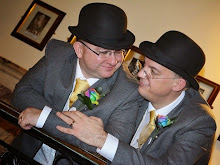
Tuesday, September 14, 2021
My Impassioned Speech on Equal Marriage (and more)
LGBT+ rights are deeply personal to me and at the heart of Liberal Democrat values – but sometimes we have to stand up for them even in the Lib Dems. With another Lib Dem Conference looming, my Equal Marriage speech two years ago today was one of the most nerve-wracking I’ve ever delivered – though also one of my best. I had to stand up to a then-MP and a former Leader, because many people knew someone had to but no-one else was doing it (I’ve even drawn out lessons from two former Leaders at the end. Don’t have nightmares).

My Speech on Equal Marriage, Liberal Democrat Conference, Bournemouth, 14th September 2019
Next month is my fifth wedding anniversary.
But my husband Richard and I have been together twenty-five years.
The wait wasn’t because we’re really traditional and wanted a really long engagement.
We had to wait for the Liberal Democrats in Government to change the law before we could get married on our twentieth anniversary.
Thank you.
Liberal Democrats have always had the best policy of any party on LGBT+ issues.
But it’s not just the policies and campaigning issues.
For me it’s personal.
We got married – but many people still can’t.
We got married – that’s why I can’t stand by and say, ‘I’m all right, Jac, never mind the rest of you.’
I must stand up. We must stand up.
Jo Swinson talked about love in her victory speech as Leader.
This is a simple choice: love or hate.
Liberal Democrats are about love and liberty.
Now, I take it personally when people tell me I shouldn’t have the same rights – my marriage matters!
Is it a matter of conscience? Yes! For the people getting married!
But if you want to bully people, to enforce your prejudices on people, to stop people making their own decisions…?
That’s not conscience – it’s control!
Everything in this motion comes back to the same founding principle: people’s right to control their own lives.
But it’s not just about policy. It’s about the face that the party shows.
I welcome people joining us from other parties. Some will be fully-formed Liberals, and some you might have to give more Leeway to.
Like children raised by wolves, you might not expect them to have perfect table manners, but we should expect all our MPs to say without qualification, ‘Biting people to death is wrong’, and if you’re in doubt, ask someone with scars, don’t say, ‘No-one’s ever tried to bite my leg off, so it’s just a point of view if they bite you.’
We should expect all our MPs to be whipped to stand up and not make excuses for homophobia.
Phillip Lee: I know you’re married. I hope you’re both very happy. Was it a long engagement?
We wrecked our last General Election campaign because we compromised – one person compromised – on homophobia.
Listen, all our MPs: if you don’t want to wreck the next one, it’s not just about the policy.
To put it in language at least two of our MPs will need to understand:
You may try to get into Parliament with good policies, but without faith you are nothing.
Surprisingly Good Reviews
Many Lib Dems agreed with this speech – many laughed, many clapped, Caron Lindsay was particularly kind on Twitter – which helped balance the usual line of the great and good saying How Very Dare You. But just this once, I did get some very good reviews from the New Statesman. Stephen Bush cited me in his write-up of the debate:
“In a speech that received loud applause from the floor, Alex Wilcock, a Liberal Democrat activist, spoke about the 20 years he had to wait to marry his partner, and asked Lee if his marriage had a similarly “long engagement”. It was Wilcock’s speech that also got to the heart of the Liberal Democrats’ unease over Lee’s admission: the party’s defence and toleration of their then-leader, Tim Farron, and his record on equal rights, and the price it paid for that at the 2017 election.”
But my cockles were most warmed by him and Alibhe Rea on The New Statesman Podcast – Lib Syncing, 19th September 2019.
Stephen Bush:
“For me the best speech, actually, of the Conference, and I also think probably one of the best speeches I have seen in party conferences all told, was from a man called Alex Wilcock, who spoke about his own marriage, the very long engagement and the fact that same-sex marriage was illegal for so long, and basically challenged both Phillip Lee and the party for kind of turning a blind eye to some of the aspects of his voting record.”
Alibhe Rea:
“Yeah, it was pretty powerful, that they had been engaged for twenty years and unable to marry, and then the concluding line of his speech was something like, you know, ‘Phillip Lee, I gather you’re married, I hope you’re happy – was it a long engagement?’ It was really quite stirring in the context, and he was just a very good speaker. He’d sort of circled around and alluded to it for quite a while, and then arrived at that conclusion.”
Which is probably the best review I’ve ever had in the press (at least since the Daily Mail’s double-page-spread hit-job back in 1994, which was flattering in quite a different way).

Why I Made This Speech
I wasn’t going to make that speech. I wasn’t going to speak at all. If you want to make a speech in a physical Lib Dem Conference debate – it’s even less flexible in the current online Conferences – you need to put a card in saying roughly what you mean to say well in advance of a popular debate, usually at least the day before. I hadn’t, and had no intention to. But there had been so many hurt people around – not least friends who’d resigned from the party over its welcoming in an MP who saw us as Hell-spawned inferior life forms and wanting to tear out our hard-won rights. I’d prefer a sinner to repent, I’d like everyone to get along, but confronted with the choice between an unrepentant bully and people whose values actually belonged in the Liberal Democrats, there was no way not to pick a side. I woke at 4am that Saturday, stressed and depressed, massively wound up, and could not get back to sleep. So I did the obvious thing: I started thinking of a speech. Amazingly, I was in the Conference hall by 9.30am and put in a card (after Tweeting an obscure declaration of intent which nobody else would get but to stiffen my sinews). More amazingly still, I was called to speak.
I’d been scribbling thoughts, desperate to sort out what I thought at all, how much of it I should say, what tone I should take, and how on earth I might fit any of it into three minutes, which is a very short time indeed once you’re up on stage and gives no room for waffle (in the end, I was so focused on getting to the point that I ran under time). I still have the several sheets of paper where I can see my thoughts take shape – and how much was still unformed by the time the debate began. Unusually, I hadn’t decided how to end it even as I walked onto the platform and opened my mouth. But before I wrote anything else, I had circled to one side at the top, next to where I had to put the opening lines: “Serious and funny!”
A debate speech should have a point – you want to swing people’s votes with you. Sometimes I’ll wing it as I go along, but there are always two parts I need to prepare: the opening, because that gets people listening to you; the closing, because that gets people applauding. The finest arguments have been lost when people are still nattering from the last one because they don’t notice you’ve started or when stopped in mid-flow as your time runs out and the mike’s cut off. I realised both very early, but over the years I’ve set a second aim for the opening line that’s more difficult: it’s also to get people on your side. Whether it’s a joke, a self-deprecating moment or just saying hello, an effective speech begins by getting people to like you. The previous year, I’d made a blistering speech against a policy paper that hand-wringingly appeased bigots over immigration. It was one of my best speeches, focused, incisive, impassioned, but it had an opening like chucking a brick through a window, and while that got people’s attention, I don’t think it got anyone on my side. This time I might have to be even more combative – not attacking a paper, but possibly attacking MPs in person. Fortunately, this speech was personal and a personal opening came naturally, even with a funny bit and an opportunity (heartfelt as it was) to butter Conference up.
The Equal Marriage motion not only celebrated the Liberal Democrats’ achievement of making marriage legal at last for same-sex couples, but recognised that equal marriage is still some way off and set out how to get there – in Northern Ireland, for humanists, removing the hugely unfair spousal veto for trans people – and with speeches overwhelmingly in favour was passed, too, by an overwhelming vote in favour as Lib Dem policy.
Several excellent speeches before mine dealt with those issues for marriage directly, with the rise in homophobic attacks, with Labour MPs wanting a new Section 28, with daily virulent press transphobia – I was crossing off bullet points I’d scribbled haphazardly across my notes, helpful in terms of keeping better to time by not repeating what everyone else was saying, but with stress rising as I listened out for what everyone else was leaving unsaid. MPs and former MPs I admire paid loving praise to people who’d left the party because of— What? Our party was the best on LGBT+ values, and was getting better in this very debate, and yet for some reason that dared not speak its name people were loudly hoping that one day leading LGBT+ activists might somehow find their way back. Many in the hall must have wondered, had they accidentally slipped through into some parallel dimension and were merely lost, because surely nothing about our party was explaining it? I very much did not want to give the speech I could see in a choose-your-own-adventure set of variably hard-hitting ideas scribbled in question marks, but by the time I was called to speak (and for the rest of the debate) no-one else had said a word, and someone had to.
For that Conference, the number of Lib Dem MPs suddenly almost doubled: some defectors I was enthusiastic about; some seemed OK; and then there was one. In June 2019 I had written not a blog post but a Twitter thread as speculation about defectors rose: my instinct was to welcome everyone who chose to side with us. I was thinking aloud on Twitter, but I still – mostly – agree with myself. Yet there are always caveats… But it was by being welcoming, bold and Liberal that we attracted so many people who used to vote for other parties. Being open doesn’t mean watering down what we stand for – if we don’t stand for anything, no-one would make the leap anyway. Though I can’t help thinking that, as one of the Leadership’s more appealing themes at the time was that we were leading a wider Liberal movement, it might have saved a lot of heartache if we’d persuaded a defector standing with us on the big issue but clearly a git on others to caucus with the Liberal Democrats in Parliament as part of a wider Liberal movement and not actually join a party whose values he does not share (that nobody thought of it after years of the party faffing about with supporters’ schemes…). I didn’t actually say that because there wasn’t room for procedural rumination, but despite appearances I have never given a speech in which I was more thinking aloud.
Today I sum up Lib Dem values in three words: Freedom, Fairness, Future. I’ve been writing and speaking about the first two, intertwined, since the early ’90s: that was when I identified them as “Love and Liberty” in a long philosophical pamphlet, and carried that on to this blog. But “Love” isn’t a word politicians are often bold enough to claim, so I was delighted when Jo Swinson did that Summer, and I seized on it. Not just because I agreed with her and applauded her speech, but because if you’re about to go in with both barrels it always helps to call the Leader on your side. But that and my funny opening had a point: this is not ‘a point of view’. This is not just a debate. This is something that is crucial to real people’s lives, and no Liberal should be hoarding rights that they deny to others.
There was a moment where I nearly lost it. As I declaimed, “That’s not conscience – it’s control!” the last word surged up in a growl that almost frightened me: I’d never heard that tone from myself in a speech before and I realised with a shock that I was seconds from just shouting in righteous anger. It doesn’t seem as visible as it felt, but I pushed myself down hard inside, because I knew that I was at the pivot to the dangerous bit of the speech and, suddenly, I could so easily lose control. I forced myself to sound more at ease, to slip in a cutting pun, a stealth Doctor Who reference and a breezily insulting put-down. But as there’s a storm of applause, I wince now seeing the curt gesture to cut it, harsher than I’ve ever been in a speech, as I’m fighting not to snap. And then I say the line that I remember most vividly: “Was it a long engagement?” And it’s only three seconds before I dive on, but after the laughs and applause the deathly shocked silence at that picking up Chekhov’s punchline from earlier and making it a punch in the face felt like an eternity, and inside I was panicking that I’d blown it.
So as I went into the close, knowing I was going to finish with a mangled flourish from my religious upbringing – that you may try to get into heaven with good works, but without faith you are nothing – wielding it as a righteous flaming sword against two theocratic bigots, but not knowing how I was supposed to get there, with several partial versions scribbled in front of me and none I was happy with, and at the last moment somehow navigated between the cop-out of sticking only to Phillip Lee and full-on naming and shaming Tim Farron. I glanced at the scrawl of lines hoping we would pass the policy then warning that most people would never hear about it, while many voters would hear if so-called Liberal MPs lust to control others and claim their religion says my twenty-five years is too short a wait; or reminding the lucky few Lib Dem MPs elected in that disastrous General Election of the cost of weakly suggesting homophobia is just a point of view. But I swerved away from going full Old Testament thunder because I might never stop, or explode in sheer incandescent rage. I feared I’d already lost the hall but I was committed to saying something – in the end, my more tightly controlled ferocity still got the point across and the thunder was left to the applause.
Where Nick Clegg Went Wrong
I thought hard about whether to say any of this, after leaving it unsaid in 2019 – both in a speech that in the end confronted what everyone knew in the least confrontational way I could bring myself to, and after holding back from saying it at far greater length earlier that year. It isn’t uplifting, so you may wish just to stop here. But I’ve made myself look in order to learn.
During the 2019 Liberal Democrat Leadership election I wrote – most of – an article assessing the three immediately previous Leaders, and lessons to be learned. Though I wrote at length about the positives for each before blasting their big disasters, I never published it. What I had to say about Nick felt too much like old wounds, what I had to say about Tim Farron was still too raw and hurt and blisteringly angry, and I never quite finished writing about Vince, as just too meh (though in a late surprise entry since he’s now topped the ‘Most Problematic Former Lib Dem Leader’ chart. I wish he hadn’t). I’m not going to publish all that now. But it’s worth summarising the crucial lessons: not just when two Leaders f—ed up, which everyone knows, but why those particular f—k ups were so deadly. I’m not going to assess the whole Coalition – though Richard and I did say thank you for our marriage on our (twenty-years-and-) six-month anniversary, without which we’d still be waiting.
Here goes, though. “Tuition fees” was engraved on every Lib Dem heart and every anti-Lib Dem attack leaflet. The biggest, most catastrophic, monumental political misjudgement of the Lib Dems in Coalition. Yes, we all know this. But steel yourself and look at just why this was so destructive. First and foremost, for the Lib Dems (and for Nick Clegg personally), education is an absolute, passionate priority. It’s at the centre of enabling everyone to have the opportunity to realise their potential, not just a policy but at the heart of our philosophy. And in Coalition government, we championed education; we protected the schools budget from cuts and introduced the pupil premium, so schools got more money to help teach poorer kids. But every single time any Lib Dem mentions it to this day, what does every voter think? ‘But tuition fees.’ F—k. Breaking the promise was bad, but breaking the heart of our values was catastrophic. And from naked political nous, university towns and higher-educated voters had become the hard-earned most likely to vote Lib Dem, and the tuition fees betrayal kicked them in the face. It’s hard to think of a more laser-guided missile to the Lib Dem vote.
Some More of Tim Farron’s Greatest Mistakes
Which brings me to Tim Farron. The 2015 Leadership election was blighted in two ways: not only did we have practically no MPs left to choose from, but in hindsight the two contenders were summed up by Yes Minister:
“If Eric gets it, we’ll have a split in the Party in three months. If it’s Duncan – we’ll have one in three weeks.”
Eurosceptic Norman Lamb would have been an utterly catastrophic Lib Dem Leader for Brexit. Tim Farron made the critical choice that we would stay fighting as the party of Remain, a brave, principled decision trying to save Britain’s future that also enabled the Lib Dems to survive the near-extinction event preceding Farron’s Leadership and then the near-extinction event precipitated by Farron’s Leadership. But then, obviously, he went and proved that while it’s hard to think of a more laser-guided missile to the Lib Dem vote than tuition fees, it could still be done. I’m trying to strike an ironic tone, but I’ve cut my next four paragraphs from 2019 because they’re unlikely to do anyone much good, and certainly I felt the fury, misery and betrayal rising just re-reading them. Plus there aren’t enough em dashes to cover all the swearing. Every single day of that blighted election I defended him because I thought I knew him, as furious and hurt and betrayed LGBT+ people said, ‘How can you do this to us?’ But Farron didn’t just destroy the LGBT vote for the Lib Dems, much as Nick didn’t just hammer the student vote. This was about the sort of party we are and the sort of people who might vote for us. Think about the sort of voters who are likely to listen to the Lib Dems. Even if they don’t mention it on the doorstep, how are they going to react to the only thing they hear from the Lib Dems, day in, day out, being that their Leader doesn’t like the gays? A more perfectly targeted voter-seeking missile even than tuition fees – not even the excuse that the money was too tight, not even the excuse that we couldn’t get another party to accept it, but simply because the Leader we chose had chosen to be a bigot. Name me anything a Liberal Leader could possibly do more effectively to alienate Liberal-minded voters. They recoiled en masse. In the year of the universally hopeless leaders, to be more of a voter turn-off than disintegrating robot Theresa May and a UKIP nonentity? The 2017 Lib Dem Leader was sheer electoral poison – delivering an even lower vote than 2015’s collapse, the worst share of the vote for British Liberalism since the 1950s – and, as votes had to go somewhere, if you wonder how on Earth people once saw any hope in Brexit’s Best Mate Jeremy Corbyn, Tim Farron was his biggest asset.
I had known and liked both Nick Clegg and Tim Farron since long before they became Leader. I felt for both of them… But I admit one I find easier to forgive for their worst calls when leading the Liberal Democrats. It’s an appallingly hard job and I wouldn’t wish it on anyone, but it’s also hard not to want to tell anyone doing it: if you must f—k up, can you at least think about what’s deepest in our values and what’s most important to our voters, and try to f—k up at the furthest-away political point from both?
Labels: Gay, LGBT, Lib Dems Believe, Liberal Democrat Conferences, Liberal Democrat Leadership, Liberal Democrats, Richard, Speeches


Tuesday, August 11, 2020
Ed Davey Answers on Lib Dem Values and ‘Mean’ Questions
What do the Liberal Democrats stand for, and why vote for us?
Liberal Democrat Leadership contender Edward Davey MP highlights “a greener economy, a fairer society and a more caring country” on my lead question.
Last month I sent three questions on Lib Dem values to both Ed and Layla Moran – plus two individually tailored ‘mean’ questions each. Layla replied last week, so you also can read Layla Moran’s five answers here. Ed and his Correspondence Team have now replied to me in full, and you can read his five answers below.

Ed Davey MP’s Answers to my ‘Values’ Questions (asked to both Candidates)
Question One:
People say all politicians are the same. Lib Dems have often seen moderation, working with others and compromise as virtues, to the point of the caricature that a Liberal is someone so fair they don’t take their own side in an argument. So what really motivates you?
When someone asks you on the doorstep, the hustings or on TV to sum up in a sentence or two what the Lib Dems, uniquely, stand for – and why anyone should vote for us – what do you answer?
The biggest problem for the party over recent elections has been our failure to answer that question. The election review was clear about that: we must have a coherent message that speaks to voters.
So I’ve set out my answer in this election: I want the Liberal Democrats to be known as the party that fights for a greener economy, a fairer society and a more caring country. And I’ve illustrated that with a Green Economic Recovery Plan and priorities on childcare, education and carers.
My motivations in politics have long been the environment and caring. I was an environmentalist before I joined our party 30 years ago when we were 4% in the polls – and I joined partly because Ashdown and Hughes were the only politicians talking green.
And a lifetime of hands-on experience as a carer – as a young carer for my mum when she had terminal cancer, for my Nanna when she became frail and elderly and now as a parent of a disabled child – drives me just as much as any intellectual debate, linked as it is to the real life experiences of 10 million carers.
Question Two:
Two of the most heartfelt Liberal Democrat instincts are ‘Why can’t we all just get along?’ and ‘Stand up to bullies.’ Whether you call those ‘moderate and Liberal’, ‘caring and courage’, ‘love and liberty’, the party feels both, needs both, but they’re often competing as well as complimentary, so our balance between them changes with the times.
Which do we need most to lead on right now?
We are at their best when we can find issues that follow both instincts – because they are indeed often complimentary. Getting Boris Johnson to agree to a public inquiry at PMQs was a huge moment for me, and plays perfectly into these two instincts.
It was about both standing up to Boris Johnson and his awful Tory Government, but also looking to deliver something meaningful and life changing for the millions of people affected by the Covid-pandemic. I don’t think it is simple to say we can focus more on one than the other.
Rebuilding our society and economy post-Covid will need more of one, continuing to hold Boris Johnson to account so we can win elections in the future is a bit more of the other.
Question Three:
Ask what the core of Liberalism is and the answer’s obvious: “It’s About Freedom”. So obvious, that was the title of the Liberal Democrats’ 2002 philosophy paper. Look at our other positioning papers and manifestos under Charles Kennedy – “Freedom In A Liberal Society”, “Freedom, Justice, Honesty” – Freedom led*. Our constitution leads with “Liberty, equality and community”. But Leaders and campaigns since have made Freedom or Liberty invisible. Afraid it’s not popular, not relevant, or just ceded it to the illiberal Right?
Neither of you chose Freedom as a buzzword or even talk about it in your values. Why not?
I talk about freedom a lot, actually, because it runs through everything I’m standing for in this election. When I talk about my plans for carers, the reason I want more legal employment protections for carers is because it will give carers the freedom to choose how to balance their work and caring responsibilities. The investment I believe we need to make in universal childcare is all about unshackling people from excessive costs and opening up their options in terms of work and childcare responsibilities.
I’m a Liberal to my fingertips, and freedom underpins my views and priorities, and is never hidden. Whether “freedom” as a word is a good campaigning slogan, seems to me a different debate.

Ed Davey’s Answers to my ‘Mean’ Questions for him
Question Four:
The Leader needs to win attention and support. You’ve been Acting Leader for over six months, during which our poll rating has halved since the General Election. You’ve had your shot and flunked it. Why should we give you even longer to keep failing?
Good to get a nice and friendly one! I think it’s fair to say that being interim co-leader, on the back of a bad general election result, in the middle of a global pandemic is hardly the rich soil on which to grow a party. I think most reasonable people would agree with that!
I also note that our party scored just 5.9% at a nationwide elections, 11 months into the leadership of one Paddy Ashdown. I’m glad we didn’t ditch him in 1989.
And I’m proud of the work we’ve done holding Boris Johnson to account, setting up the coronavirus volunteer task force and forcing the PM to agree to holding a public inquiry, but I’m standing in this election because I want a mandate from members. I currently don’t have that, so I can’t push forward and deliver on my vision of a fairer, greener, more caring society, and help rebuild our party to win elections again.
The election review was brutally honest about the problems facing our party, and they were never going to be solved in 6 months after an election, even without a global pandemic. We have a big rebuilding job on, but I have every confidence that with a mandate for members, and the support of our party, we can implement the election review and rebuild the party to get us winning again.
Question Five:
People need to feel good about their vote to vote for us again. Nasty choices in the Coalition destroyed our feel-good factor as the Nice Party. As they did every day with Jo, Labour will derail us by throwing that history at us. Your history. How do we move on when a Minister from the past as Leader will always be on the defensive?
We had our best ever local election results and European election results with a coalition Minister, Vince Cable, leading our party, so I’d challenge the idea it automatically has to be a drag on our party. It certainly wasn’t for Vince!
I think we need to be realistic that elements of the Labour Party will throw coalition at us whoever is leader, because in plenty of places they are our political opponents and therefore it’s in their interest to bring it up. But I equally don’t think you’ll see the same level of vitriol from the top of the Labour Party under Starmer as we did under Jeremy Corbyn, because Keir Starmer knows he needs us to win seats against the Conservatives if he’s going to be Prime Minister.
I’m proud of what we achieved in coalition, from trebling renewable energy, to the pupil premium, to same-sex marriage and tax cuts for millions of people. Of course, no Government gets everything right, but I think the fact that I’m backed by people, like Daisy Cooper and Tim Farron, who were critical of coalition is testament to the fact that they recognise the choice for our next leader is bigger, and more important, than who was or wasn’t involved in coalition.
The other thing I would say is that the election review is 61 pages long, but mentions coalition in passing two or three times. It is a mistake to think our issues are purely routed in that, the rebuilding job we have is so much bigger.
Lib Dems Believe – More Answers
I’m grateful to Ed and his team for answering so comprehensively.
You can read Layla Moran’s five answers here.
You can also read my original post here, where I asked these questions to Ed and more to Layla. I also talk there in detail about why I chose the questions I did. I believe we need to be both distinctive and sharp to break through, and that politics-free politics won’t cut it. Post-Brexit, post Covid-19, I don’t feel I know the answers, and I want a Leader who will inspire me. But I want to avoid another Leadership self-destructing by hoping that nasty questions they don’t want asked will somehow just go away. Liberal Democrat Leadership elections are nice and wish the best for everyone, but actual election campaigns are not – I’ve attempted to test the two candidates a little harder. You can also read two utterly terrible answers to what the Lib Dems stand for that I’ve previously heard, one in a complacent local party and one from a very senior Lib Dem…
As a bonus, I also asked my Lib Dem values questions to several other current senior Lib Dems. Party President and Acting Co-Leader Mark Pack sent me his own answers, which you can read here. For that post I included some of my own answers, and several of the best answers I’ve previously heard or read, going all the way back to David Lloyd George and including a link to my very favourite – and very long even though I’ve abridged it – speech by Paddy Ashdown.
I hope some of them inspire you, too.
Labels: Ed Davey, Lib Dems Believe, Liberal Democrat Leadership, Liberal Democrats, Liberalism, What the Lib Dems Stand For
Thursday, August 06, 2020
Layla Moran Answers on Lib Dem Values and ‘Mean’ Questions
What do the Liberal Democrats stand for, and why vote for us?
Liberal Democrat Leadership contender Layla Moran MP highlights “Education, the Environment and the Economy” as her three key priorities on my lead question.
Last month I sent three questions on Lib Dem values to both Layla and Ed Davey – plus two individually tailored ‘mean’ questions each. Layla and her Correspondence Team have replied to me in full, and you can read all five answers below (I will continue to nag Ed and his team).

Layla Moran’s Answers to my ‘Values’ Questions (asked to both Candidates)
Question One:
People say all politicians are the same. Lib Dems have often seen moderation, working with others and compromise as virtues, to the point of the caricature that a Liberal is someone so fair they don’t take their own side in an argument. So what really motivates you?
When someone asks you on the doorstep, the hustings or on TV to sum up in a sentence or two what the Lib Dems, uniquely, stand for – and why anyone should vote for us – what do you answer?
Layla has said on many occasions what motivates her is the need to make a case for a fairer, greener and more compassionate society, driven from the bottom up, that will champion small businesses and seek to tackle discrimination.
An issue we have regularly faced is the question of what we as a party stand for, at the last general election we were seen as the party of Stop Brexit. We now need to redefine ourselves as a party, we need to be a party with liberalism at its core, and as Paddy Ashdown used to say, ‘fizzing with ideas’. Layla wants the Liberal Democrats to have a clear vision, with a progressive green agenda highlighted by three key priorities; Education, the Environment and the Economy. This is what Layla wants the party to stand for. In the coming months, and possibly years, liberal ideas could be more popular than before, because Covid-19 has exposed the deep inequalities in our society and a clear majority are open to change – this is a huge opportunity.
Question Two:
Two of the most heartfelt Liberal Democrat instincts are ‘Why can’t we all just get along?’ and ‘Stand up to bullies.’ Whether you call those ‘moderate and Liberal’, ‘caring and courage’, ‘love and liberty’, the party feels both, needs both, but they’re often competing as well as complimentary, so our balance between them changes with the times.
Which do we need most to lead on right now?
Quite frankly, we still need to do both, in different ways. In terms of defeating the Conservatives, Layla has said she will work with anyone who shares her progressive liberal values. She is open to working with Keir Starmer and Labour on an issue by issue basis – though she would strongly encourage and push for an end to Labour tribalism and hostility in some local areas, as well as fully eradicating the antisemitism that is still prevalent in certain parts of their party membership.
Right now, the Liberal Democrats, Labour and the Greens share a similar vision for the society we want to see, one which contrasts sharply with the inward and backward looking world of the Conservatives. For us to overcome the injustices in the system, we must look to engage with other parties to take forward our shared goals. In Oxford West and Abingdon, Layla was supported by the local Green Party, who she still meets with regularly to update them on what she has been doing as their MP.
However, we are still different parties with different views on how change should be achieved. We have to be careful how we communicate our distinct identity, while allowing voters to see the common ground. In future, Layla believes a more respectful discourse between respective leaderships would show voters that an alternative Government to the Conservatives could be possible. This is all the more important for us as there are now around 90 seats in which the Liberal Democrats are the main opposition to the Conservatives. If we are to win these seats, we must regain the trust of Labour voters.
Layla has often stood up to bullies and has stuck up for the underrepresented. The Build Back Better policy paper, spearheaded by Layla, shows that the Liberal Democrats can be radical and progressive and campaign for the country to go in the right direction; an equal society, strong social justice and getting across our liberal values to the wider public. The Liberal Democrats are at our best when we are ‘fizzing with ideas’, as Paddy used to describe it. We need to show that we have the new ideas that can transform Britain after the COVID pandemic, and create a fairer and more inclusive society. We should also continue to call out the Conservatives for their illiberal and quite frankly offensive views on social issues, whether that be on racism or LGBTQ+ rights.
Question Three:
Ask what the core of Liberalism is and the answer’s obvious: “It’s About Freedom”. So obvious, that was the title of the Liberal Democrats’ 2002 philosophy paper. Look at our other positioning papers and manifestos under Charles Kennedy – “Freedom In A Liberal Society”, “Freedom, Justice, Honesty” – Freedom led*. Our constitution leads with “Liberty, equality and community”. But Leaders and campaigns since have made Freedom or Liberty invisible. Afraid it’s not popular, not relevant, or just ceded it to the illiberal Right?
Neither of you chose Freedom as a buzzword or even talk about it in your values. Why not?
Layla has often used the word freedom when discussing her vision for the country, and her reasoning for entering politics. In an interview in the New Statesman just last month Layla said that the party must emphasise that liberalism means “freedom to” as well as “freedom from”. She explained that this means talking about education and climate change, but also about business and the economy. Layla understands that liberalism is all about freedom, and she continues to advocate for greater freedoms for those who need it most.
Layla Moran’s Answers to my ‘Mean’ Questions for her
Question Four:
Last year Lib Dems surged on a pro-EU campaign. It wasn’t enough – but it was the one thing people knew about us and drew votes to us. I’ve read your “Vision”. There is no mention of Europe or working with other countries (a two-word afterthought: “and abroad”). Why have you completely dropped our one selling-point?
Layla’s heart has never left the EU, she is a European. However, that is not the feeling of the majority of the country right now, as demonstrated by the outcome of the 2019 General Election. Right now, the Liberal Democrats need to regain the trust of the electorate, and that starts by changing the hearts and minds of the country. Layla believes that we will rejoin the EU at some point in the future, but we need to reflect on when we start to promote those ideas, and how we do it. We cannot say to the electorate ‘we told you so’. Currently we should do all we can to avoid a No-deal Brexit and to campaign for as close an alignment as possible with our European friends and neighbours.
Question Five:
People need to feel good about their vote to vote for us again. How can the party stand unequivocally against bullying and domestic violence when the question keeps coming back to you and you’ll always be on the defensive with ‘Yes, but…’?
Thank you for raising this and allowing us the chance to address this issue. Layla understands the concerns of members about the incident which happened seven years ago in Glasgow.
Layla first spoke out about this last year. Though it wasn’t universally reported this way, she made it clear that she acted defensively – Layla acted in self-defence because she felt threatened.
As you may have heard her partner at the time and her were both arrested in line with Scotland’s zero-tolerance policy. She was initially charged but the charges were dropped when there was no case to answer. Layla has forgiven her former partner but nevertheless, she is keen to make sure her side of the situation is clear.
Layla is ready to state this categorically should she be asked about this by the media. Though, despite appearances on Sophy Ridge, BBC, SKY, ITN – broadcasters are yet to raise the issue.
There has been an election since she spoke out about the incident. Word from the campaign team was that it was barely raised on the doorstep in Oxford – and it certainly didn’t impact her vote share as she increased her majority by over 8,000.
Politicians are people with pasts. Layla has been open and honest about this awful incident. She is completely supportive of the zero-tolerance policy. She does not believe this diminishes or undermines the qualities and vision she would bring to our party as leader.
Our enemies will always try to hurt us, and pick apart our MPs’ lives looking to attack them. Layla knows that her honesty on the subject and her strength of character means she is prepared for this and will do all she can to ensure she embodies our values. Layla hopes members will support her in doing so.
Lib Dems Believe – More Answers
I’m grateful to Layla and her team for answering so comprehensively.
You can read my original post here, where I asked these questions to Layla and more to Ed (from whom I am still hoping for some reply). I also talk there in detail about why I chose the questions I did. I believe we need to be both distinctive and sharp to break through, and that politics-free politics won’t cut it. Post-Brexit, post Covid-19, I don’t feel I know the answers, and I want a Leader who will inspire me. But I want to avoid another Leadership self-destructing by hoping that nasty questions they don’t want asked will somehow just go away. Liberal Democrat Leadership elections are nice and wish the best for everyone, but actual election campaigns are not – I’ve attempted to test the two candidates a little harder. You can also read two utterly terrible answers to what the Lib Dems stand for that I’ve previously heard, one in a complacent local party and one from a very senior Lib Dem…
As a bonus, I also asked my Lib Dem values questions to several other current senior Lib Dems. Party President and Acting Co-Leader Mark Pack sent me his own answers, which you can read here. For that post I included some of my own answers, and several of the best answers I’ve previously heard or read, going all the way back to David Lloyd George and including a link to my very favourite – and very long even though I’ve abridged it – speech by Paddy Ashdown.
I hope some of them inspire you, too.
Labels: Layla Moran, Lib Dems Believe, Liberal Democrat Leadership, Liberal Democrats, Liberalism, What the Lib Dems Stand For
Saturday, July 11, 2020
Liberal Democrat Values: Mark Pack’s Three Answers
What do the Liberal Democrats stand for, and why vote for us?
That’s my lead question from several I sent to Liberal Democrat Leadership candidates Layla Moran and Ed Davey. I’m still awaiting their replies, yet have just had answers from a Lib Dem Leader… But probably not the one you’re expecting.
Doctor Mark Pack is Acting Co-Leader of the Liberal Democrats, an unexpected temporary addition to his election as Lib Dem President, so I sent him three of the same questions and he was first to respond. Thank you, Mark! Here are Mark’s pithy answers:
Question One:
People say all politicians are the same. Lib Dems have often seen moderation, working with others and compromise as virtues, to the point of the caricature that a Liberal is someone so fair they don’t take their own side in an argument. So what really motivates you?
When someone asks you on the doorstep, the hustings or on TV to sum up in a sentence or two what the Lib Dems, uniquely, stand for – and why anyone should vote for us – what do you answer?
We want to give everyone the best possible chances to live their lives as they wish, to be who they want to be and to make their own choices. Both Labour and the Conservatives are far too keen to tell people how they should behave, or to pick chunks of society who they don’t care so much about and to put different parts of our society at odds with each with other.
(That’s my English doorstep answer, of course. For Scotland and Wales, I’d talk also about nationalists, and how we want to bring down barriers, not put up new ones between people on our common islands.)
Question Two:
Two of the most heartfelt Liberal Democrat instincts are ‘Why can’t we all just get along?’ and ‘Stand up to bullies.’ Whether you call those ‘moderate and Liberal’, ‘caring and courage’, ‘love and liberty’, the party feels both, needs both, but they’re often competing as well as complimentary, so our balance between them changes with the times.
Which do we need most to lead on right now?
As your own blog’s name correctly captures, we need both. Each is dependent on the other. Love and liberty each flourish when the other is present. I wouldn’t make a forced choice between the two, just as I won’t pick vowels or consonants are the most important types of letter. It’s when both come together that the best happens.
Question Three:
Ask what the core of Liberalism is and the answer’s obvious: “It’s About Freedom”. So obvious, that was the title of the Liberal Democrats’ 2002 philosophy paper. Look at our other positioning papers and manifestos under Charles Kennedy – “Freedom In A Liberal Society”, “Freedom, Justice, Honesty”, “Freedom, Fairness, Trust” – Freedom led. Our constitution leads with “Liberty, equality and community”. But Leaders and campaigns since have made Freedom or Liberty invisible.
Are we afraid it’s not popular, not relevant, or have we just ceded it to the illiberal Right?
I’m enthusiastic about the concept of freedom while being cautious about the vocabulary. The word as acquired strong right-wing overtones. If someone saw a leaflet saying ‘I’m for freedom’ and had to guess the politics of the candidate before reading on, I strongly suspect most people would assuming the person is right-wing, a libertarian even perhaps. If the word freedom seems right-wing, I also suspect the word liberty sounds like a word from the past. You’re more likely to hear it in a historical Hollywood movie than in ordinary conversation.
So I don’t worry too much about word counts on either, as long as the concept comes through clearly in what we argue for – such as the future benefits of a close relationship with the rest of Europe that minimises barriers, and so protects people’s freedoms.
Lib Dems Believe – More Answers
I posted my three questions (with an extra two individually targeted ‘mean’ ones for Ed and Layla) here on Monday, along with some of my own commentary on where the Liberal Democrats are going and – to lower the bar for the candidates – the two absolutely worst answers I’ve ever heard on Lib Dem values and why to vote for us.
I was rightly challenged on this to share some of the best answers I’ve had, too. So you can read my eight-Tweet thread here in which I pick out some of my favourites, including answers directly to me from Lib Dems such as Lynne Featherstone, Caron Lindsay and Brian Paddick, and historical choices such as David Lloyd George and Roy Jenkins (and a friend has just shared with me his own new vision this week, which I hope to quote and promote when he publishes it).
During the 2015 General Election I posted every day on Lib Dems Believe with a variety of values, long and short, old and new, in which the same ideas and ideals came across over and over, though in a wide variety of different words. Most answers I’ve had tend, like Mark’s, to be pithy. My absolute favourite is of course the longest of all those I chose, an abridgement of one of Paddy Ashdown’s Leader’s speeches and still the most inspiring I’ve ever heard. I recommend it.
Finally, as I’m judging others it’s only fair I put my own answers up for judgement too. Over many blog posts on what the Lib Dems stand for over many years, the pithy values closest to my heart remain “Freedom, Fairness, Future” (which I evolved from the party’s “Free, Fair and Green” in the 2000s because alliteration goes a long way) and “Freedom from poverty, ignorance and conformity” (my more active rewording of the Preamble to the Lib Dem Constitution). My longer versions have changed much more, but this article includes both the latest written statement of values and my YouTube ‘Why vote Lib Dem’.
Here’s to the next set of inspiring answers!
Labels: Lib Dems Believe, Liberal Democrat Leadership, Liberal Democrats, Liberalism, Mark Pack, Paddy Ashdown, What the Lib Dems Stand For
Monday, July 06, 2020
Lib Dem Leaders – My ‘Values’ Questions and my ‘Mean’ Questions To Ed and Layla
What do the Liberal Democrats stand for, and why vote for us?
That’s my lead question of a set I’ve just now sent to Liberal Democrat Leadership candidates Layla Moran and Ed Davey. I’ve asked each the same three questions about values (each framed by a contentious scene-setter) and a different two individually targeted mean questions, because I want to be inspired – but also I don’t want another Leader self-destructing.
I ask about values because those are what motivate me – and because for people to vote for us, we need to get their attention, we need to have something to say, and we need them to feel positive about their vote, that we embody their values too.
We work hard, we deliver leaflets, we’re local champions. That will always be crucial. But it has never been enough to break through – and we have just had three General Elections where it was within the margin of error of not being enough to avoid extinction. ‘Shut up about anything and just deliver leaflets’ has been tested to destruction. Where we work, we… mostly still don’t win now. This is not the 1990s any more, where local work had the wind in our sails of a popular leader who was on telly a lot, where most voters felt we were a sort of nice party, and where almost everywhere in England if they didn’t want to vote Labour or Tory we were the only ‘other’ option, so we could win through politics-free politics. None of those are true any more, and closing our eyes, wishing, and acting as if they still were will keep us irrelevant. While the SNP are the third party at Westminster – even though they’ve always won fewer votes than we do – even getting a one-liner on the news is a challenge, and using it to say nothing distinctive is a failure.
I like both candidates. Both have already said things that I fiercely agree with and both have made me go, ‘Oh, for f—’s sake!!’ so they’re both as qualified as any previous Leader on that basis. I’m not yet committed to either (though I’m leaning more towards one of them). I don’t know if either can break through, but I have to hope. Yes, both are talking up their local campaigning successes – but they are rare winners for the Liberal Democrats, and that’s something else we somehow need to get across to win again: people are put off voting for losers, and that vicious circle has been reinforced by the absolutely necessary cancellation of this year’s local elections, usually the one day of the year when Liberal Democrats have a chance to make good news about ourselves.
I am less certain about where the Liberal Democrats should go from here than I have ever been. For years, I have written about what the Lib Dems stand for. Last year, I demanded better of the party with the latest of my own arguments for our values. I summed those up in three words: “Freedom, Fairness, Future”.
Post-Brexit, post Covid-19, I don’t feel I know the answers. Though I still think “Freedom, Fairness, Future” are as good a handle on what we stand for as I’ve seen, even then I knew that they didn’t instinctively get across the internationalism at our heart, and I added “Bollocks To Brexit” – our one message that has chimed with large numbers of voters for ten years. Today, as two terrible disasters unroll with no end in sight, I can’t see where we go next. I can’t find an optimistic message. I started writing these questions a full month ago (and an extra candidate ago), but it’s been a rougher month than usual and I’ve been hoping for something upbeat to say. I don’t have it, but I still look for it.
Will Ed or Layla be able to inspire me? I hope so. For me, the single thing I most want to hear from a Liberal Democrat Leader is a clear heart to what we stand for that will not just have me nodding, but will have voters feel, yes, that’s better, I agree with that, that appeals to me, those are my values, that’s someone I can vote for.

My ‘Values’ Questions to Both Candidates
Question One to both of you:
People say all politicians are the same. Lib Dems have often seen moderation, working with others and compromise as virtues, to the point of the caricature that a Liberal is someone so fair they don’t take their own side in an argument. So what really motivates you? When someone asks you on the doorstep, the hustings or on TV to sum up in a sentence or two what the Lib Dems, uniquely, stand for – and why anyone should vote for us – what do you answer?
Question Two to both of you:
Two of the most heartfelt Liberal Democrat instincts are ‘Why can’t we all just get along?’ and ‘Stand up to bullies.’ Whether you call those ‘moderate and Liberal’, ‘caring and courage’, ‘love and liberty’, the party feels both, needs both, but they’re often competing as well as complimentary, so our balance between them changes with the times.
Which do we need most to lead on right now?
Question Three to both of you:
Ask what the core of Liberalism is and the answer’s obvious: “It’s About Freedom”. So obvious, that was the title of the Liberal Democrats’ 2002 philosophy paper. Look at our other positioning papers and manifestos under Charles Kennedy – “Freedom In A Liberal Society”, “Freedom, Justice, Honesty” – Freedom led*. Our constitution leads with “Liberty, equality and community”. But Leaders and campaigns since have made Freedom or Liberty invisible. Afraid it’s not popular, not relevant, or just ceded it to the illiberal Right?
Neither of you chose Freedom as a buzzword or even talk about it in your values. Why not?
I want to be inspired – but I want to avoid another Leadership self-destructing by hoping that nasty questions they don’t want asked will somehow just go away. Because getting people to feel warm and positive about voting for us also needs people who share our values not to feel, ‘Ick. The Lib Dem Leader doesn’t have my values’. I really hope both Ed and Layla have thought of the painful, embarrassing or exasperating question they least want to hear and are ready with their one-line, truthful reply to it first time. Those probably aren’t the mean questions I’ve come up with, but I’ve done my best to test them anyway. Liberal Democrat Leadership elections are nice and wish the best for everyone. Actual election campaigns are not.
My ‘Mean’ Questions to Ed Davey
Question Four to Ed:
The Leader needs to win attention and support. You’ve been Acting Leader for over six months, during which our poll rating has halved since the General Election. You’ve had your shot and flunked it. Why should we give you even longer to keep failing?
Question Five to Ed: People need to feel good about their vote to vote for us again. Nasty choices in the Coalition destroyed our feel-good factor as the Nice Party. As they did every day with Jo, Labour will derail us by throwing that history at us. Your history. How do we move on when a Minister from the past as Leader will always be on the defensive?
My ‘Mean’ Questions to Layla Moran
Question Four to Layla:
Last year Lib Dems surged on a pro-EU campaign. It wasn’t enough – but it was the one thing people knew about us and drew votes to us. I’ve read your “Vision”. There is no mention of Europe or working with other countries (a two-word afterthought: “and abroad”). Why have you completely dropped our one selling-point?
Question Five to Layla:
People need to feel good about their vote to vote for us again. How can the party stand unequivocally against bullying and domestic violence when the question keeps coming back to you and you’ll always be on the defensive with ‘Yes, but…’?
Two Terrible Answers (they must be able to do better, surely?)
I’ve asked some version of my ‘Why vote Lib Dem?’ Question One to Liberal Democrat Leaders, MPs and candidates local and national for over two decades. I’ve heard long and short answers, wonky and passionate, brilliant and unexpected. As I don’t have the latest ones yet, I thought I’d share the two absolutely worst experiences I’ve had with the question (if not the names).
At the height of Lib Dem blogging, my beloved Richard Flowers and Millennium Dome, Elephant organised many bloggers’ interviews with Lib Dem MPs and candidates for senior posts. I took part in several, though even when I was prolific in my blogging I still didn’t manage to write as much as I should. Only one MP was so gobsmackingly bad on this question that I made a deliberate choice not to write up the interview. This was his response to my ‘Why vote Lib Dem?’ question:
[PAUSE]
[GLARE]
[PAUSE]
“…I would refer them to our excellent policies.”
[GLARES AND SHUTS UP]
While my question has been pretty much the same across the years, I’ve changed the ‘frame’ depending on the context for the candidate – local, national, leadership. At one hustings in a local party that had become the epitome of politics-free politics and where competitors had matched and surpassed Lib Dem campaigning, I prefaced the question by pointing out that while we like to say that we’re local and hardworking, Tory and Labour candidates say the same, so what sets us apart from a local, hardworking Labour or Tory? The Returning Officer read this out in a tone of utter derision and said that it must have been written by a Labour or Tory plant, at which the audience laughed and a candidate agreed that there were no such things as local and hardworking Labour or Tories. That was their entire answer. Coincidentally, this was in a Parliamentary seat where Lib Dems had previously held six of the seven wards and had been reduced to just two in that Spring’s local elections, including Labour gaining their first elected councillor there for fifty years, so the reeking complacency was a more telling answer than any other I’ve had to this question.
I’m hoping for something more inspiring from Ed and Layla.
Updates:
Layla Moran Answers on Lib Dem Values and my ‘Mean’ Questions
Ed Davey Answers on Lib Dem Values and my ‘Mean’ Questions
And bonus Liberal Democrat Values: Mark Pack’s Three Answers
*Just after I posted, two more sprang to mind: “Freedom, Fairness, Trust” under Charles, for which I was Vice-Chair of the Federal Policy Committee and spoke in favour of at Conference, and the more mangled “Trust In People: Making Britain Free, Fair and Green” under Ming, for which I wasn’t and spoke against. But Freedom was always a big Lib Dem thing, until it wasn’t.
With thanks to my husband Richard for proof-reading and ‘Are you sure that’s wise’-ing this, and to Will Barter, who last month shared with me a piece he’d written on the direction of the party in general. One insight crystallised something for me with an ‘Ah! I wish I’d thought of it from that angle years ago!’, so I’ve nicked it. All my choices about where I’ve taken it and everything else above are my own responsibility.
Labels: Ed Davey, Layla Moran, Liberal Democrat Leadership, Liberal Democrats, Liberalism, What the Lib Dems Stand For
Sunday, July 07, 2019
Liberal Democrat Leadership: Three Answers From Jo Swinson
The Liberal Democrats are in the middle of our most exciting (and certainly our most positive) Leadership election in over a decade. I’ve not been well enough to make it to the hustings, but I also have questions I would like to ask the contenders. So I’ve sent three questions to Jo Swinson and Ed Davey, each question framed by a contentious scene-setter, starting with the one I’ve asked as many Lib Dem candidates as I can for about twenty years. Thank you to Jo: here are her answers.

Question One:
People say all politicians are the same. Lib Dems have often seen moderation, working with others and compromise as virtues, to the point of the caricature that a Liberal is someone so fair they don’t take their own side in an argument. So what really motivates you?
When someone asks you on the doorstep, the hustings or on TV to sum up in one or two sentences what the Lib Dems, uniquely, stand for – and why anyone should vote for us – what do you answer?
“Jo believes that people should vote for the Lib Dems because we are the only party who are campaigning to truly improve the things that are most important to them – building an economy that puts people and the planet first, targeting rising inequality, the climate emergency, and fixing the broken social safety net; harnessing the technological revolution for Britain’s future, making sure that the benefits of automation and technological change aren’t just felt by the richest but by the people whose jobs and lives are set to change; and fixing our broken politics by working together, reaching beyond tribal politics and the damaging rhetoric being espoused by populists and nationalists, building a co-operative democracy that works not for our own successes but to improve the lives of our citizens.”
Question Two:
Nancy Seear’s answer to how the Liberals survived near-extinction in the 1950s was: “We didn’t like the Tories and we didn’t trust the state.”
The Lib Dems seem to be emerging at last from another extinction-level period.
What two ideals made us survive this time, and what can we learn from that?
“What we’ve seen since 2010 is an astonishing tenacity of people who have always been liberals, and an openness to new members and new ideas. This combination has seen our membership grow to its largest number ever – filled with people who have never joined a political party before and who have been welcomed into the Liberal Democrats. These members have helped to make us relevant again and their enthusiasm is what pushes us to win.”
Question Three:
The Tory Leadership contest went up in smoke over what drugs they’ve all used that they say should be illegal for *everyone else*.
When it comes not just to drug use but to any ‘victimless crimes’ that a lot of people disapprove of but which don’t harm others, should ordinary non-MP adults giving their informed consent be criminalised?
“Lib Dems have been clear over a long time that criminalising people for drug possession and consumption is counter-productive and should be stopped. Our policies in general shy away from any unwarranted criminalisation – focusing on the harm principle that if your actions harm someone else, they should be stopped, but that anything else needs serious consideration and debate before we look to involve the criminal law.”
I sent Jo and Ed these questions three weeks ago, followed by reminders. Jo’s team replied one week ago with a very reasonable apology – unsurprisingly, people have been asking Jo a lot of questions. I was in the middle of drafting an article to go with the questions and was going to publish Jo’s answers as soon as I’d finished it… But, finding it harder and harder to write these days, I’m still very slowly chiselling my thoughts and have only managed a paragraph or two each day of a rather difficult week.
Having sent me her answers, it’s unfair on Jo and her team for me to keep delaying. So it’s my turn to apologise to Jo and publish. And if I can finish writing something before the Leadership election actually closes…
Labels: Jo Swinson, Liberal Democrat Leadership, Liberal Democrats, What the Lib Dems Stand For
Sunday, March 03, 2019
Freedom, Fairness, Future – Demanding Better of the Liberal Democrats
Happy thirty-first birthday, Liberal Democrats?
Liberalism is desperately needed today. Liberal Democrats are sometimes powerful voices, but sometimes tongue-tied.
We must demand better.
Last year I chose six words (three positive values, one urgent priority) for a short video on ‘Why the Lib Dems’:
If our MPs would even pick six such words and sound like they meant them, that would be a start.
Our Leadership seems to think ‘Why can’t we all get along?’ is good enough. It isn’t. It’s a cry of helplessness, and they have no answer to their own question.
I don’t have all the answers. But the least the Lib Dem Leadership can do is answer why we shouldn’t all pack up and go home. The slogan “Demand Better” is a headline to get attention, but with absolutely no idea what to say if anyone then looks our way and asks, ‘Yes, what?’
It’s a cliché to say a Liberal won’t take their own side in an argument, but even after years of singularly failing to put any passion into Liberalism I didn’t expect our own Leadership’s answer to ‘Demand a better Centre Party’ to be ‘Oh, perhaps they have a point’. After a year of navel-gazing about ‘Registered Supporters’, now our Leadership doesn’t even seem to have the energy to ask potential supporters to register with this party in particular. Rather than assuming people would rally if we tinkered with the mechanics, perhaps the Liberal Democrats should have considered that the way to get people to support us is to articulate something worth supporting.
Some time ago, I wrote about “What It Means To Be A Liberal Democrat”. I made the case for the values I believe in and the positive difference Liberal Democrats should make.
Liberal Democrats can certainly demand better than what I publish here. But first we need our Leadership to stop standing frozen in the headlights in the middle of the road. To go anywhere, we must set out a direction of travel.

What It Means To Be A Liberal Democrat
To be a Liberal Democrat is to believe in freedom.
Freedom grounded in real life, starting with people as they are. Not ‘The People’. Not ‘Our People’. Freedom based on the unique worth and potential of every individual person, and the reality that the person who knows best how to live their life is themselves.
To be a Liberal Democrat is to demand better. Government shouldn’t just protect the interests of those who are already well-off, and sneer at and push down people working hard to make a life for themselves, or those who aren’t able to support themselves. Liberal Democrats demand freedom from poverty. Government shouldn’t assume it can do everything, control everyone, as long as you take what you’re given and don’t ask awkward questions of those in charge. Liberal Democrats demand freedom from ignorance. Government shouldn’t tell you that your nation is the only thing that matters about you, drive out ‘outsiders’ and call anyone who doesn’t want their flag cut smaller, narrower and meaner ‘traitors’. Liberal Democrats demand freedom from conformity.
Liberal Democrats feel in our guts that everyone should be free to live their own life, that pushing people about and telling them what to do or who to be is wrong. We feel in our guts that everyone should have a fair chance, that prejudice and lack of opportunity are wrong. We feel in our guts the need for a better future, that piling up today’s problems for our kids to deal with tomorrow is wrong. But politics isn’t just about gut feelings and protesting when things aren’t right. We must face up to how things really are to work out how to change them, and change our own methods if experience shows us better ways to achieve our ideals. So Liberal Democrats are principle-led, but evidence-based.
An open, fairer society and a greener, stronger economy are interdependent. Liberal Democrats champion opportunity, fairness and economic responsibility. An economy that works, that encourages enterprise, that’s environmentally and financially sustainable, and where everyone pays their fair share. All thriving within an outward-looking, optimistic society that’s open-minded, open-hearted and open to co-operating with other countries to tackle climate change, promote peace and increase prosperity for our whole planet’s future.
Liberal Democrats believe freedom needs both positive help to make it real for everyone, and action to break down barriers to freedom such as poverty, ignorance and conformity. Education is the single most crucial way to combine both. A great education ensures everyone has the opportunity to realise their potential, whatever their background, whatever their choices. Every child getting the best education is central to them growing up with the freedom to live their own lives, getting a fair start and building for the future. If you’re for every person, and you want every person to have the ability to ask the important questions and make their own informed decisions in realising their own dreams, education is where it starts. If you want an economy growing and succeeding with innovation and creativity and where the most talented get ahead instead of just the most wealthy, education, training and apprenticeships are where it starts.
From the foundation that society should be for everyone and that everyone should be free, Liberal Democrats understand that individual people choose to come together in any number of complementary ways – families, jobs, mutual interests, neighbourhoods, nations, the whole human family – and that decisions can be made at any of those levels without giving up the others. That’s why we’ve always been both the most localist and the most internationalist party. Any political party denying diversity, defining itself by just one single identity or community and telling each individual that your birth or your faith or your cash or your class or your country is the only thing that counts doesn’t just diminish people’s lives and hopes, doesn’t just make society more fearful, hateful and divided, but is the mark of a party so stuck in its own prejudices that it has no idea how real people’s real lives work.
One vivid, simple answer to what Liberalism is for has always stuck with me: Liberalism is about standing up to bullies. That’s why a Liberal’s gut instinct is to side with the underdog – whoever the bully is and whoever the underdog is at any one time. Any sort of power can threaten liberty, but any sort of power can defend it, too. Whether it’s the state, or big business or big unions, or just other people, any of them can boss you around and anyone can help stop you being bossed around. So Liberals wouldn’t label any of them ‘the enemy’ or do away with any of them – just as we won’t say any of them are right all the time. When government acts fairly it can be the biggest force to restrain bullies, from crooks and murderers to stifling communities and bad employers; but a government that bosses you around or that only protects one special interest or only picks on another is just a bigger bully. The closer anyone has to a monopoly of power, the more it’s abused. Liberals challenge power and privilege, break up monopolies, set the same rules for everyone and make the starting point for any decisions the people that they affect.
When the starting point is people, what’s the end point? Get real! If you start with people you never say ‘that’s it.’ Whether it’s a grandiose utopia that you’ll never finish building or a thousand mean little targets to tick, imaginary end points have two things in common. Believing the ‘ends’ justify the means, they throw real people under the bus, seeing individuals only as statistics or as problems. And they never work. A Liberal society isn’t a perfect society, because there aren’t any perfect people or perfect politicians – but an open, untidy society that develops constantly in response to the individuals who form it has the advantage of being about real life. Liberals don’t say ‘We know best’, because everyone’s best is different.
To be a Liberal Democrat is to be wary of grand plans and little prejudices. To say of human nature, ‘It’s complicated’. Anyone might be kind or selfish, creative or lazy, successful or failing. Other parties see that as a reason to control people, because they believe people who disagree with them can’t be trusted with freedom, and they think ‘their people’ will want to do what they tell them anyway. Other parties fear pluralism, diversity, flexibility and individuality. Liberal Democrats might give an instinctive two-word answer to that ending in “—off”, but we have a better answer, too, countering fear with hope. Our fear is more that if a government makes a mistake in its giant one-life-fits-all authoritarianism, it’s going to be a doozy. And our hope, based on realism, is that the more different ideas run free, the more brilliant, practical ones will succeed. Believe in people, enable people, and unlock everyone’s potential.
To be a Liberal Democrat is to embrace the contradictions – because people are contradictory. Because only one idea has room for how messy, contradictory and wonderful real life and real people are. Freedom.

The Story Since 2016
I’ve never published this before, but for a couple of years it was on the Liberal Democrat main website as one of nine shortlisted essays chosen in early 2016. The competition was part of a consultation on “What It Means To Be A Liberal Democrat In 2015”. I re-read it a couple of weeks ago and was surprised how relevant it still seemed (even the ‘traitors’ line was in there back then). I aimed to make our Liberalism instinctive and accessible, and that stands. My video above is much more politically punchy for our immediate priorities and better to show someone who’s not interested in philosophy. Comparing this essay to my 2017 General Election post “A Liberal Britain. A Brighter Future. My Hope”, that takes a very different approach and that, too, has some punchy lines confronting issues I didn’t mention at all here (though in trying to find hope post-Brexit I was a little too shell-shocked to do more than wish it would all go away).
You’d think British politics has changed a lot since 2016. As the Prime Minister might say, nothing has changed, and yet everything has. Back when I wrote my “What It Means To Be A Liberal Democrat”, I was concerned that I’d leaned a bit too hard on vigilance about the state rather than its power to help – giving emphasis to education, but not health or infrastructure. After two years of Theresa May in charge, I didn’t go nearly far enough in warning against the might of government to be a heartless bully, an unmitigated f— up, or both at the same time. Back then, Brexit was a looming threat, not yet a tectonic shift. Since then, British politics has been frozen while Britain itself has become far worse – all because of the worst decision ever made in British democracy, and a slither of decisions and non-decisions ever since that have only made the worst decision worse still.
In the face of this titanic catastrophe, the Liberal Democrat Leadership has been more frozen than most. Much of the time their only message has been ‘Why can’t we all get along?’ when the answer is ‘Because an awful lot of people made a decision based on hating other people’, and wishing and hoping that they didn’t really mean it and that the clock would turn back has failed to make any impact as a political strategy because it has no political appeal and no political reality. Liberalism is worth fighting for. Bullies must be stood up to. Looking hand-wringingly heavenward and wishing that the bully and the bullied would just get along simply does not cut it.
If I’d started writing this today, stopping Brexit would have been the angry focus and I would have been far more pugnacious against Theresa May and her fascistic Hostile Environment or Jeremy Corbyn and his sub-BNP attacks on immigrants stealing British jobs. I’ve written quite a few times on what the Lib Dems stand for, and I may well write again. But I realised that what I’d written was something positive – and that wasn’t afraid to take a side. I’ve decided to publish pretty much what I entered, with a couple of small polishes. The competition set a limit of a thousand words. I’ve reintroduced a sentence or two that I’d originally cut for space, but mainly I’ve put back one whole paragraph. The reason I removed that one at the time was that I liked what it was aiming for but it just didn’t quite flow. Ironically, I found the Lib Dems’ “Demand Better” gave me the edge I was looking for, so that one paragraph has been rewritten today and restored to set the tone at the top.
You see? You can get something out of demanding better – but you have to give people some idea of what you’re demanding.

Labels: Brexit, Bullies, Economy, Education, Environment, Ideas, Liberal Democrats, Liberalism, Meddling In Things That Are Nobody's Business But Your Own, What the Lib Dems Stand For
Saturday, September 15, 2018
Time For Hard-Headed Realism On Immigration
Liberal Democrat members have attacked the proposed Migration paper A Fair Deal for Everyone for reasons ranging from fairness, to morality, to family, to economics. But for a political party, it has another fatal flaw. Its well-meaning, wishful-thinking naivety is just terrible politics. It’s time to get politically streetwise with a bit of hard-headed realism. Let’s ask the tough questions, get back to evidence-based policy and demand better.
Meaning Well and Wishing Are Not Enough
I’m sure the people who wrote the proposed paper for debate at Lib Dem Conference and its defenders mean well. I know and respect quite a few of them. And I can see how they got themselves into this mess. Two of the deepest Lib Dem instincts might be put simply as ‘Stand up to bullies’ and ‘Why can’t everyone get along?’ And most of the time those go hand in hand. But at times like these, when the country’s split, hate’s on the rise and things seem to be going horribly wrong, cracks can appear between the two. The proposed Migration paper feels upset at how nasty things have got – and I feel the hurt of that too – and wishes, really hard, that everyone would be nice to each other again. ‘Why can’t everyone get along?’ And so it compromises: a bit for immigrants; a bit for people who hate them and want them all gone. But in the real world, wishing doesn’t cut it, and there comes a time when you have to choose standing up to bullies instead of hoping they’ll turn nice if you only half-encourage them.
In thirty years of the Liberal Democrats, there can’t have been many more wince-inducing juxtapositions than one month ago. On August 14th, Lib Dem Leader Vince Cable said unequivocally that, hard as it might be, there was no room for racism in the Lib Dems. On August 15th, Lord William Wallace – a peer I have a lot of time for and usually agree with – gave an apologetic defence of the proposed Migration paper by saying that we have to pander a bit to racists otherwise they won’t vote for us (I paraphrase, but not unfairly).
The proposed Migration paper has the point of view that policy and the British polity should be kinder and gentler, wishing that people were nice, assuming everyone means well deep down and really agrees with us, and if they don’t yet then compromises in good faith will help them agree with us, and if nothing else maybe they’d vote for us after we tell them we agree with them, really, just a bit, and please, please, don’t hurt us. I can empathise. The problem is that the evidence supports none of it. I believe the Lib Dems backing these proposals mean well. But I’m realistic enough to know that not everyone else means well, and that wishing won’t make it so. The fight to make Britain better can be won. But it will take a fight, and if Liberals don’t put up a fight, who will? It won’t be won by acting as if we’re non-combatants who won’t take our own side in a quarrel, saying, ‘If you don’t want immigrants then you have a point’.
I don’t want to take this unduly personally, but when the proposed Migration paper puts forward a well-meaning compromise and I realise, ‘I’m the son of an immigrant and had this proposed Lib Dem policy been around when my parents met I’d never have been born’, it loses its appeal. That’s the trouble with compromising between haters and the people they hate; it always makes things worse for the ones who are already getting all the flak, but never goes far enough to satisfy those who want them gone. The proposed Migration paper proposes as a moderate compromise that I shouldn’t exist. What would I have left to give on the next compromise?
Stop wishing. Look at the evidence. Ask the difficult questions.
Look back ten, twenty, thirty years: the attitudes and policies and hostile environment against immigrants that are now ‘mainstream’ were confined to a few vicious hatemongers like the British National Party and then UKIP. How did we get here?
Has compromising bit by bit to defuse racists worked? Has mainstream politicians talking about ‘valid concerns’ increased harmony? Has fanning flames extinguished them? Has encouraging xenophobia quietened it? Has being too scared to confront lies made the truth more widely known?
I don’t blame people for thinking, once – maybe if we give a little we can avoid something worse. I do blame people who still stick to that hope when it has been tried over and over again and every time, the bigots have grown and strengthened as a result. Hostile immigration policy – hate crimes – Brexit – all these were unimaginable ten, twenty, thirty years ago. Compromising a little at a time has never stopped at a little. It didn’t work. That is the evidence. That is the unhappy fact. As the saying goes, one definition of insanity is doing the same thing over and over again, but expecting different results. The ‘wishing’ approach of the proposed Migration paper has been tested to destruction.
Pandering to racists only increases racism. Saying ‘I share your valid concerns’ doesn’t win hearts and minds – it just makes people in the middle say, ‘Well, if even the Liberals say immigrants are bad…’ while hardcore racists think we’re just mealy-mouthed politicians out to con them. And saying out loud – the shocking naivety! – that we have to pander to racists not because we actually agree with them but just to make them vote for us, so we’ll campaign on a promise that although we want to make things nicer for immigrants, because we recognise their ‘valid concerns’, we wouldn’t make things as nice as all that? That’s just treating voters as idiots.
Since the Brexit Referendum there’s been more hard polling evidence than ever before in British history on how social attitudes break around votes for parties. About 90% of the Lib Dem vote comes from people who also voted Remain. Voters who hate immigrants as their top issue? That’s UKIP’s big thing. That’s Theresa May’s big thing. That’s even Jeremy Corbyn’s big thing. Why on Earth would Lib Dems propose a Migration paper in the hope of appeasing appealing to such a crowded marketplace as what will only ever be the fourth choice of authoritarian racists? Let’s make an evidence-based call here: stop asking, ‘How do we get racists to vote for us?’ Because they won’t anyway.
Look at Labour’s record. Gordon Brown in 2010 trying to recover from “I agree with Nick” in the first debate by monstering him over immigration in the second and third (the third Leaders’ Debate was the one in which an audience member said “We’re not allowed to talk about immigration,” despite it being the only issue bar the economy featured in every debate, because hardcore racists are impossible to satisfy or to shake from their lies). Yvette Cooper attacked the Coalition from the right for not being tough enough on immigrants. Ed Miliband put immigrant-bashing on a mug. Brexit-backer Jeremy Corbyn tells lies about foreign workers stealing British jobs. Do Labour get ‘credit’ for being tough on immigration? No. Racist voters still think they’re too soft. Because there are always other parties that will go harder right to compete.
When I campaign, I try for every vote. If someone disagrees with us on immigration, they might still respect us locally for getting their potholes fixed. But if the economic and moral and principled case for a powerfully Liberal migration policy doesn’t persuade you, here’s the naked political calculation. We’re on 11% in the polls (at best). We’re not chasing an immediate 500-seat landslide. So to build up our vote, does it make more sense to make policy that’s weaselly and indistinct in the vain hope that’ll attract the people who are least likely to vote for us, when they can get red meat from several other parties? Or should we put our effort into attracting people who already agree with our values into voting for us?
It’s worth reading Andrew Hickey’s The Howard Rule – in which he proposes testing Lib Dem policy against Michael Howard’s once-infamous authoritarianism as Home Secretary – not just as a statement of principle, but as a reminder of just how far right all political parties have shifted in the last quarter-century. In the 1990s, he was appalling. Present his immigration regime today and it would scare the horses with its liberal openness.
Taking A Stand
We must do better than the proposed Migration paper. We can do better by demanding better of ourselves again.
One of my defining early political experiences was Paddy Ashdown leading the newly formed Liberal Democrats alone in standing up for the rights of Hong Kong British citizens. You might think struggling on a good day to hit 11% in the polls puts our party in the doldrums now, but back in 1989 a good day was hitting half that and the sheer relief of getting beyond the margin of error of nothing in the opinion polls. Standing up for a liberal immigration policy then let us hold our heads up. Margaret Thatcher’s Government steered the familiar Tory course of nationalism tempered by greed: standing by Britain’s promises to only the richest, offering citizenship by bribery. Norman Tebbit led a Tory rebellion against Mrs Thatcher to stop anyone with the wrong colour skin entering Britain, and the Labour Party piously opposed the idea of citizenship for the rich – then voted with Mr Tebbit’s Tory far right to stop anyone being let in at all. Mr Corbyn takes the same faux-ethical stance of economic populism as cover for immigrant-bashing today.
In April 2000, during a hard-fought by-election campaign where the Liberal Democrats were striving to take ultra-Tory Romsey, Charles Kennedy took on the immigrant-bashing Conservative campaign head-on. The Lib Dem campaign could have played down our Liberalism, played it safe, stuck to ‘popular’ issues and only challenged the Tories where they were perceived as electorally ‘weak’. Instead, the Lib Dem Leader took the huge risk of facing down the Conservatives’ asylum policy, in a speech in Romsey, where conventional wisdom was that saying the right thing would lose us the seat. We didn’t cower. We won. Charles said afterwards:
“The voters of Romsey were not beguiled by William Hague’s personal brand of politics – those based on fear and division… By concentrating on the negative, and pandering to the small-minded, he insulted the electorate.”Standing up for our principles heartens, rallies and recruits the people that none of the anti-immigrant parties can reach. And making the case instead of letting it go by default changes minds. We can persuade by telling it as it is – not by pretending and pre-compromising. How do we make racism less bad? Not by saying it’s right. Why can’t we all get along? Because some people don’t want to. Someone has to confront hate, say why it’s wrong, and don’t say they have a point when they don’t. But it’s not just about standing up to hate: it’s appealing to the better instincts of people for whom it’s complicated. Whose fears have been stoked by the Daily Hate, but who like their neighbours and were appalled by Theresa May over Windrush.
Liberal Democrats must make the case for immigration and for immigrants – because it’s right, because it’s the only way to turn back the poison, and because no-one else will. Immigration is good for the economy. But it’s not all about the money. Immigrants are the lifeblood of the NHS. But it’s not all about the work we get from them. Families should be able to be together because love is more important than money. Tabloids screaming lies about “open door” immigration, when it’s way tougher than anyone believes, has led to families being torn apart, but still most people think if you marry an immigrant they can stay. That would be a Liberal immigration policy. That’s the sort of appeal Lib Dems should make – not the proposed Migration paper keeping a price on family life.
Demand Better
Remember – these are only proposals to be debated and decided at Conference. It is not A Fair Deal. For Liberal Democrats, it is not a done deal.
Be politically streetwise. Look at the evidence. Tell the truth. Don’t pander to racism and don’t settle for wishful thinking that has been proven year after year only makes things worse. Vote to send the proposed Migration paper back so the Liberal Democrats can offer – can demand – something better.
This is a slightly longer version of my article published on Liberal Democrat Voice earlier today. I recommend going there to read Caron Lindsay’s The paper on migration, even amended, is not good enough. Her piece is brilliant, speaks from the heart on how to persuade people, and scathingly dissects the paper in detail.
Labels: Bigotry, Brexit, Charles Kennedy, Conservatives, Immigration, Labour, Liberal Democrat Conferences, Liberal Democrats, Paddy Ashdown, Vince Cable