Tuesday, July 31, 2007
David Cameron on Today: How I Long For Yesterday
Whoops. With everything going wrong for David Cameron in recent weeks, this morning he dropped three different messes of his own making all over the Today Programme. Reaching for another Tory core vote issue to shore up his fragile position, he chose the wrong one: what idiot prattles about school discipline whilst his own party are rioting? Then he fell flat on his pitiful by-election failures, describing the Conservatives without qualification as the third party. Finally, unable to answer multiple Tory attacks on him, he chose to attack each of them in turn, sounding like just another feuding, useless Tory.
School discipline (warning! Warning! Tory leader losing support and desperately blowing another dog whistle to their core vote instead of tackling the big issues!) is an issue that would normally be ‘safe’ for him – not reaching out to anyone new, a very minor issue that won’t make much of a difference to any of the problems in education, but making the right noises to stop the retired colonels, swivel-eyed Thatchianists and Daily Hate Mail ladies turning against him. You can tell he’s desperate – that one was even one of the five main points in the last Tory Manifesto, under Michael Howard. Oh, come on, you must remember that: it was the knee-jerk right-wing one that went down with most voters like a cup of cold Tebbit, written by some vitriolic right-winger called David Cameron who today’s brave Dave Cameron, progressive new Tory leader, has entirely repudiated. Well, until he has to reach back into it for a scrap to throw to the wolves behind him, of course.
But David, David, couldn’t you have thought of a different golden oldie to play today? Even the Today Programme couldn’t miss the open goal that was including something along the lines of ‘but of course Mr Cameron can’t even keep discipline in his own party, which is falling apart by the hour with most of the different bits calling for his head’ in the headline. Ouch. In Agatha Christie’s phrase, this was a drowning man clutching at a razor blade. Not that natural Tories will really have their jollies tickled by what he’s proposing, really: no wonder he keeps using the words “school discipline” like a mantra and rushing quickly past the actual details, which is merely denying kids the right of appeal. What the Tory base wants is the smack! of corporal punishment for oiks and hoodies, willow against flesh, mmmm, harder, headmaster, and a little thing like abandoning natural justice sounds rather namby-pamby compared to the fetishes of their overheated imaginations.
When asked why he couldn’t do any better in Ealing Southall, Mr Cameron made a big thing of being third. Again and again. Until, prodded beyond endurance, he delivered his verdict on the Tories’ electoral problem in general:
It’s shame interviewers can’t do a tiny bit of homework, though; the obvious comeback from anyone with a clue would have been ‘So your result in Sedgefield must have been an absolute disaster by your logic, then, as the Liberal Democrats were in third place but leapt up to second, squeezing you down to third?’ Sarah Montague also got the name of the Tory candidate in Ealing Southall wrong, enabling Mr Cameron to score one of his few hits by gently correcting her (subtext: ‘she doesn’t know what she’s talking about, listeners,’ and unfortunately, she didn’t). It still wasn’t much of a good moment for him to claw back from that particular disaster area…
Mr Cameron also came unstuck when pressed on the hilarious success of putting “David Cameron’s Conservatives” on the ballot paper in Ealing (though not in Sedgefield, of course; you know the Conservatives, they always say one thing in one place and something completely different in another). Having already bravely taken responsibility for his own name by firing Grant Shapps on the grounds that he thought up the name “David Cameron”, this morning’s desperate attempt at an excuse was that it was all the local party’s fault, and they can call themselves any old silly thing, no matter how stupid. Brave, brave Sir David! What a marvellous display of leadership: to run away, shouting ‘They made me do it!’ and blame everyone else in sight for even his own name.
Let’s just give Mr Cameron’s career a minute’s silence for that point: the one leader in history so petrified of taking responsibility for anything that he says ‘Not in my name!’ about even his own name.
‘Brave’ Dave then got quite crabby when presented with one of his own party’s new attack on him which asked for “some substance and some credibility” and said he was just about “box-ticking and gimmickry” and “another Tony Blair” – and this from, not an old Tory die-hard, but from a new-look younger Conservative who introduced Mr Cameron’s leadership bid at their Conference! Was Mr Cameron able to produce a raft of policy substance to defend himself from this charge? Well, obviously not, because he knows the truth of it better than anyone. No, Mr Cameron just announced that Mr Miraj had asked him for a peerage, and he was only in a strop because that was “not a promise I would make to anybody” (he couldn’t even say he’d turned the man down flat, so forceful wasn’t this claim), as if that meant everything he’d ever said must be false.
Of course, if the Today Programme was the serious political forum it claims to be rather than sensationalist lightweights who mistake shouting for scrutiny, they might have done some of that thing, what do you call it, research (Wiki the word, Ms Montague), and asked, ‘Mr Miraj was your candidate in Watford, wasn’t he? That’s a seat that you’ve got to win, and a close three-way marginal. If he’s begging you to make him a Lord, aren’t you Conservatives admitting you’ve given up all hope of winning that seat and left it to the Liberal Democrats? After all, you are the third party.’ Mr Cameron found similar reasons to rubbish the next Tory she quoted saying he was useless. Oh, and the next. And the one after that. He still couldn’t answer the substance of their charges when she piled them all together and pointed out that all he was doing was criticising the individuals and not what they were saying, offering him what I believe is known in footballing parlance as an easy save. Has no-one told him that not answering the substance makes him seem shifty and vacuous (all right, I know lots of people have told him that)? More importantly to his image, has no-one told him that indulging in a constant series of bitchy personal attacks just makes him seem childishly nasty (and, yes, I know, pot and kettle, but I’m a blogger and we do petty gossip; he wants us to think he’s mature enough to be Prime Minister)? And I had to laugh when her last question was:


School discipline (warning! Warning! Tory leader losing support and desperately blowing another dog whistle to their core vote instead of tackling the big issues!) is an issue that would normally be ‘safe’ for him – not reaching out to anyone new, a very minor issue that won’t make much of a difference to any of the problems in education, but making the right noises to stop the retired colonels, swivel-eyed Thatchianists and Daily Hate Mail ladies turning against him. You can tell he’s desperate – that one was even one of the five main points in the last Tory Manifesto, under Michael Howard. Oh, come on, you must remember that: it was the knee-jerk right-wing one that went down with most voters like a cup of cold Tebbit, written by some vitriolic right-winger called David Cameron who today’s brave Dave Cameron, progressive new Tory leader, has entirely repudiated. Well, until he has to reach back into it for a scrap to throw to the wolves behind him, of course.
But David, David, couldn’t you have thought of a different golden oldie to play today? Even the Today Programme couldn’t miss the open goal that was including something along the lines of ‘but of course Mr Cameron can’t even keep discipline in his own party, which is falling apart by the hour with most of the different bits calling for his head’ in the headline. Ouch. In Agatha Christie’s phrase, this was a drowning man clutching at a razor blade. Not that natural Tories will really have their jollies tickled by what he’s proposing, really: no wonder he keeps using the words “school discipline” like a mantra and rushing quickly past the actual details, which is merely denying kids the right of appeal. What the Tory base wants is the smack! of corporal punishment for oiks and hoodies, willow against flesh, mmmm, harder, headmaster, and a little thing like abandoning natural justice sounds rather namby-pamby compared to the fetishes of their overheated imaginations.
When asked why he couldn’t do any better in Ealing Southall, Mr Cameron made a big thing of being third. Again and again. Until, prodded beyond endurance, he delivered his verdict on the Tories’ electoral problem in general:
“You get squeezed by the top two parties”.Whoops! Not something a Liberal Democrat would ever be dim enough to admit (well, there was that crushingly stupid by-election candidate in about 1996…), and saying both other parties are ahead of you without even bothering to qualify it is a pretty foolish admission for the leader of the Conservative Party to let slip. Really, it’s a good job for him that the interview finished after only about a dozen minutes: by 8.30, he’d probably have been conceding ‘We’re shit, and we know we are,’ followed by pleading ‘Please – don’t hurt me’. It’s no wonder so many people in his own party think he can’t be let out on his own.
It’s shame interviewers can’t do a tiny bit of homework, though; the obvious comeback from anyone with a clue would have been ‘So your result in Sedgefield must have been an absolute disaster by your logic, then, as the Liberal Democrats were in third place but leapt up to second, squeezing you down to third?’ Sarah Montague also got the name of the Tory candidate in Ealing Southall wrong, enabling Mr Cameron to score one of his few hits by gently correcting her (subtext: ‘she doesn’t know what she’s talking about, listeners,’ and unfortunately, she didn’t). It still wasn’t much of a good moment for him to claw back from that particular disaster area…
Mr Cameron also came unstuck when pressed on the hilarious success of putting “David Cameron’s Conservatives” on the ballot paper in Ealing (though not in Sedgefield, of course; you know the Conservatives, they always say one thing in one place and something completely different in another). Having already bravely taken responsibility for his own name by firing Grant Shapps on the grounds that he thought up the name “David Cameron”, this morning’s desperate attempt at an excuse was that it was all the local party’s fault, and they can call themselves any old silly thing, no matter how stupid. Brave, brave Sir David! What a marvellous display of leadership: to run away, shouting ‘They made me do it!’ and blame everyone else in sight for even his own name.
Let’s just give Mr Cameron’s career a minute’s silence for that point: the one leader in history so petrified of taking responsibility for anything that he says ‘Not in my name!’ about even his own name.
‘Brave’ Dave then got quite crabby when presented with one of his own party’s new attack on him which asked for “some substance and some credibility” and said he was just about “box-ticking and gimmickry” and “another Tony Blair” – and this from, not an old Tory die-hard, but from a new-look younger Conservative who introduced Mr Cameron’s leadership bid at their Conference! Was Mr Cameron able to produce a raft of policy substance to defend himself from this charge? Well, obviously not, because he knows the truth of it better than anyone. No, Mr Cameron just announced that Mr Miraj had asked him for a peerage, and he was only in a strop because that was “not a promise I would make to anybody” (he couldn’t even say he’d turned the man down flat, so forceful wasn’t this claim), as if that meant everything he’d ever said must be false.
Of course, if the Today Programme was the serious political forum it claims to be rather than sensationalist lightweights who mistake shouting for scrutiny, they might have done some of that thing, what do you call it, research (Wiki the word, Ms Montague), and asked, ‘Mr Miraj was your candidate in Watford, wasn’t he? That’s a seat that you’ve got to win, and a close three-way marginal. If he’s begging you to make him a Lord, aren’t you Conservatives admitting you’ve given up all hope of winning that seat and left it to the Liberal Democrats? After all, you are the third party.’ Mr Cameron found similar reasons to rubbish the next Tory she quoted saying he was useless. Oh, and the next. And the one after that. He still couldn’t answer the substance of their charges when she piled them all together and pointed out that all he was doing was criticising the individuals and not what they were saying, offering him what I believe is known in footballing parlance as an easy save. Has no-one told him that not answering the substance makes him seem shifty and vacuous (all right, I know lots of people have told him that)? More importantly to his image, has no-one told him that indulging in a constant series of bitchy personal attacks just makes him seem childishly nasty (and, yes, I know, pot and kettle, but I’m a blogger and we do petty gossip; he wants us to think he’s mature enough to be Prime Minister)? And I had to laugh when her last question was:
“Your party has a habit of getting rid of its leaders. So how long have you got?”Ms Montague may not be a brilliant interviewer, but comparing Mr Cameron’s shifty playing-the-man-damn-person-not-the-ball technique to his success as posing as a poor tiny victim in the past shows he found it much more difficult this morning. He seems to be rather testy that he can’t snap so much at a female interviewer than he can at beastly John Humphrys, though, without looking like the oily bully that he really is. Mr Cameron is not a happy bunny this morning, nor – more importantly – looking remotely like a winner. Who needs to look at goat entrails, tea leaves or opinion polls to see how well he’s doing when his every word is muffled by the foot in his mouth?
Labels: British Politics, Conservatives, The Golden Dozen, The Today Programme


Sunday, June 24, 2007
The Future Isn’t Tangerine
Commentators are saying Alan Johnston should feel robbed, but no. Not only was the counting method as fair as you can get under Labour’s bizarre system of ‘one person, potentially several votes, some worth a thousand times as much as others’, but there’s another failed candidate who has every right to feel peeved – not with the electoral system, but the voters. Harriet Harman is a vain, pontificating, hypocritical opportunist who won by saying anything to get elected, despite her actions in government… So tangerine-toned turncoat Peter Hain must be crying, ‘It should have been me!’ Tragically, he was annihilated by all the other candidates except the mini-me avatar of Tony Blair put up for the Labour Party to give the good kicking they never dared deliver to his face.
Curiously, my eyes remain dry.
Curiously, my eyes remain dry.
Labels: British Politics, Labour
Tuesday, June 19, 2007
The Statler and Waldorf Guide To ID Cards
Very Junior Minister With Special Responsibility For Paperclips And Being A Nasty Piece of Work Liam Byrne has made a starry-eyed pronouncement about the Labour Government’s second-favourite useless, extortionate, intrusive, unworkable fiasco (obviously, Iraq remains ahead by a long way), claiming that ID Cards and the National Identity Register will become a “great British institution” for the Twenty-First Century.
Alex, from armchair:
And, yes, I know I’ve not blogged for ages and ages and have promised articles to many people. I’ve not been well, but, fingers crossed, I’m working on it…
Alex, from armchair:
“Some of us prefer not to live in institutions.”Richard, from other armchair:
“Just like workhouses were the great institution of the Nineteenth Century, you great *****.”Both:
“Ho ho ho ho!”Perhaps the Government is trying to compensate for randomly releasing so many prisoners by turning the entire country into one huge penal institution?
And, yes, I know I’ve not blogged for ages and ages and have promised articles to many people. I’ve not been well, but, fingers crossed, I’m working on it…
Labels: British Politics, Labour, Meddling In Things That Are Nobody's Business But Your Own, Richard
Friday, May 11, 2007
The Avengers – A Funny Thing Happened On the Way to the Station
If you’re up at midnight, there’s an especially good episode of The Avengers featuring Dad’s Army’s top eccentric John Laurie and a diabolical plot on a train. Tonight on BBC4, it’s the tasteful attack of the funny terrorists! It was on last night, too; with fabulous timing, if you took a break from wall-to-wall TV coverage of a slimy liar re-announcing that he’s really, really, really going to go this time, eventually, you may have caught someone called Blair’s involvement with a plan to sharply abbreviate a Labour Prime Minister’s reign in mid-term (then Hustle, with another load of con-artists).
Steed goes off the rails – Emma finds her station in life
Steed goes off the rails – Emma finds her station in life
“Durbridge. Population – two thousand, four hundred and thirteen. Principal industry – manufacture of glass eyes for teddy bears. Fame – non-existent. But – after tonight, there won’t be anyone in the civilised world who hasn’t heard of it.”Perhaps you might not think ‘comedy terrorism’ the ideal subject material for television today. I can’t imagine it was a natural choice in 1967 either, but then that was the year kids were entertained by Captain Scarlet and the Mysterons, a couple of dozen episodes of puppet fun in which a heroic living corpse battled an unending stream of zombie terrorists. Whose terror attacks sometimes succeeded. Anyway, this story opens with a big, brassy chase theme as a thoroughly respectable civil service type is chased between trains by two gun-wielding roughs… But turns out to be slightly less innocent and defenceless when he uses his neatly striped tie as a garrotte on one of them and escapes. Don’t worry, though, readers – he’s one of Steed’s sort of chaps, and has discovered a plan to assassinate the Prime Minister by a “splinter group of fanatics”. The funny thing that then happened to this script on the way to it being as dark as an episode of Cracker is, of course, that it became terribly funny. If it hadn’t been made forty years ago and was being put out on a channel where more than a handful of us were watching it, there would be letters of complaint. Hurrah!
Labels: British Politics, Reviews, The Avengers, The Avengers Season 5
Thursday, May 10, 2007
A Tragic Announcement… Oh, Who Am I Kidding?
Ding Dong! The Witch is dead!Perhaps I should wait until it’s verified legally, but he is morally, ethically, spiritually, politically, positively, absolutely, undeniably and reliably finished. And he has, of course, been so for years. Technically, even now he’s not gone yet, but after this latest, absurdly stage-managed (and characteristically pre-announced), self-justifying, faux-humble, faux-apologetic pile of cant, even this loathsome lying hypocrite will find it difficult to wiggle out of this announcement. Holding my breath that he doesn’t declare martial law, fulfil his greatest unrealised ambition by arresting Gordon Brown, and call the whole thing off, on the 27th of June the streets will ring to the joyous cheer, “Hail, hail, the Witch is dead.” As always, it emerged first through his spin doctors.
Which old Witch? The Wicked Witch!
Ding Dong! The Wicked Witch is dead.
Wake up, you sleepy head, rub your eyes, get out of bed.
Wake up, the Wicked Witch is dead.
She’s gone where the goblins go,
Below, below, below, yo-ho,
Let’s open up and sing, and ring the bells out.
Ding Dong the merry-oh, sing it high, sing it low.
Let them know
The Wicked Witch is dead!
More charitable political obituaries will remember the first few months of Mr Blair’s reign, when he put into practice proposals championed by other leaders and other parties, all of which he was lukewarm over at the time and has bitterly regretted since: freedom of information; Scottish and Welsh devolution; the Human Rights Act. He grits his teeth and struggles to chip away at them to this day. And since then… What? Been more Tory than the Tories? Centralised more power than ever known in peacetime? Demanded government control to micromanage every area of our lives? Swept away centuries of British freedoms, so that reviled kings like John or Richard III who introduced them are certain to look better in the history books than he does? Brought in dozens of criminal justice acts that aren’t worth the paper they’re printed on while displaying nothing but contempt for the Rule of Law? Yes, what an incredible achievement it was to win three elections in a row, even with the astounding luck that our supercasino voting system gave him a jackpot of power with barely a third of voters backing him. But isn’t it still more incredible that, having won such immense majorities and all that power, Mr Blair so clearly had absolutely not the faintest idea of what to do with it, except keep it? No wonder he’s hung on so long. What else was he there for, but to be there? Mr Blair is the most public proof ever displayed that it’s not the size that matters, but what you do with it. Look at his record at home, and his protracted period of incompetently Orwellian absolute power has left nothing but the most mean-spirited of marks.
But it isn’t for any of those things that Mr Blair will be remembered. His legacy is one thing, and one only.
Iraq.
Because of Mr Blair’s appalling judgement and because of Mr Blair’s shameless lies, hundreds of thousands of people are dead, terrorists rejoice at the recruits he’s brought to them, and Britain is reviled around the world. Even before he came to power, Mr Blair had made ‘spin’ famous. His relationship with truth was always tenuous. But his lies to take Britain to war with Iraq, his lies to smear the opponents brave enough to stand up to him at the time, and his lies to cover it all up mean that politics has never been regarded with such contempt. And that’s not unfair. Because when the Prime Minister lies about something so serious, we all deserve to be held to account for it.
Tony Blair has had a hideously corrosive effect on British politics. Even when he’s telling the truth, no-one can believe a single word the Prime Minister says. He preaches to the powerless and sucks up to the powerful; he is a loathsome, hypocritical, sanctimonious bully who lied his way into mass murder. I know many Liberal Democrats had a sneaking (or in some cases blatant) regard for Mr Blair when he was first elected. I started off finding him an untrustworthy Tory snake-oil salesman, and that was the high point of my regard for him. I came up with a Watchdog-style consumer questionnaire in 2001 for people who’d voted him into office: ‘Is This the Labour You Voted For in 1997?’ I didn’t come up with a funny list in 2005. ‘Did you expect Labour to pitch us into an aggressive, illegal war that will make us infamous around the world?’ just didn’t have that comic edge to it. Today’s was the first of his speeches for years that I’ve been able to bring myself to watch, and that only in the spirit of someone standing over the coffin with a mirror over the lips. Just to make sure that that irredeemable shit isn’t about to get up again. Even his own party has been desperate to get rid of him for months now, and in many cases years. Such a shame they didn’t stand up to him when it mattered, and just want to duck the blame now.
Members of opposition parties must, I think, be more selfless than members of the Labour Party. In the 1990s, Labour held their noses and wanted him as Labour Leader because, though they hated him and he despised them, he would win elections for them. Today, though he hates us and we despise him, few members of opposing parties will experience anything other than public-spirited relief at his going, though by cold electoral calculation we should want him as Labour Leader because he would win elections for us. While every day that Mr Blair stays means that the biggest focus of bitter resentment against the Labour Party remains in place and that no-one can properly set a future direction that might just get them out of that mess, all of which is hugely damaging to Labour prospects, his staying in office has been even more damaging to the national interest of the nation he closed his speech in synthetic fervour for, this scoundrel picking jingoism as his last refuge. I believe that the second everyone is certain he’s left Downing Street for the last time, there will be a surge in support for Labour through sheer relief, and the Liberal Democrats will be more squeezed than ever. Despite that, it can’t come a moment too soon. He’s pure poison to British politics, and that simply isn’t good for anyone.
For readers expecting one of my usual jolly Doctor Who references, I’ll leave you with this. Two Doctor Who stories were broadcast on this very date in years gone by. One was The War Games, in which sinister autocrats toyed with countless soldiers’ lives as part of their sincerely held conviction in creating a new order. No relation. I watched the other this morning, noting the uncannily prescient phraseology:
“I shall be the people’s liberator.”No such luck, Mr Blair. People will forget your ‘triumphs’, but your chosen role as destroyer will stain our history for centuries.
“You came very close to being their destroyer!”
“That will be forgotten in my triumph.”
Labels: British Politics, History, Iraq, Labour
Monday, May 07, 2007
Blake’s 7 Reborn
A small band of fighters for freedom, having scored years of remarkable victories against impossible odds, are finally annihilated by the overwhelming forces of a pitiless right-wing administration. But enough of the depressing world of the local elections: do you remember Blake’s 7? More than a quarter of a century since its heroes were shockingly gunned down at the series’ finale, the Sci-Fi Channel today relaunches Britain’s bleakest sci-fi as an online audio drama starring James Bond’s Colin Salmon and This Life’s Daniela Nardini alongside Derek Riddell as Blake – the only dramatic hero going labelled as a terrorist paedophile. Even more than when the series first started in 1978, it’s difficult to think of a worse combination to throw at someone.
Though the paedophile charge is fabricated by a totalitarian state desperate to destroy a political opponent, the line between terrorist and freedom-fighter in the series is likely to be more complicated; Blake was certainly veering towards the scarily messianic by some way into the TV series… And as far as the heroes go, he’s the ‘nice’ one. From political activist to convicted criminal, he’s shipped off to a prison world (a futuristic take on transportation to Australia) with, well, a bunch of criminals. So when, en route, their prison freighter encounters a mysterious abandoned space ship and Blake is able to board it, his crew won’t be a clean-cut bunch in starched uniforms. No, the people in uniforms are the ruthless galactic Federation he’s fighting, and Blake’s allies are thieves and murderers who don’t necessarily share his revolutionary ideals (if there’s an echo of a familiar old story, there’s more than a touch of the Robin Hood legend, too). Still, he looks on the bright side in an episode to be broadcast online next week:
In addition to the show’s political direction, I’m intrigued to hear what tone it’ll settle on. Even allowing for people’s occasionally justified sneers at the production values, the original series had a remarkably variable feel – it started and finished in a grim, gritty 1984-influenced style, but the introduction of Servalan (as well as altering the political balance) meant that much of the series in between struck a gloriously camp attitude, which is why I’ve previously described that series as “Robin Hood meets 1984, but with more frocks”. The two approaches have occasionally been termed ‘Gun’ and ‘Frock’, and though it’s not yet obvious which the new series is more likely to take, it would seem more difficult to depict someone in a fabulous cocktail frock striding across a quarry on audio… On the other hand, on noticing after Saturday’s event that the blurb in the Sci-Fi-London 6 booklet describes Daniela Nardini’s Servalan as their “arch nemesis,” I asked Ben Aaronovitch if there was any significance to the lack of the expected hyphen between those words. He agreed that she is, indeed, about as arch as a nemesis can get.
Saturday’s event? Oh, yes. On Saturday morning, Richard and I were at the Apollo West End for a new Blake’s 7 launch event as part of Sci-Fi-London 6: The 6th Annual International Festival of Science Fiction and Fantastic Film. With producers, writers and the star answering questions, a quarter-hour rough cut documentary (‘A Rebellion Reborn’) and a preview of one of the mini-episodes, we had an intriguing taste of the new series. New series lead writer Ben Aaronovitch (a hugely impressive author in Doctor Who’s late ’80s renaissance and the New Adventures, and an occasional but acerbic blogger about his distaste for banks) and writer James Swallow discussed whether the times and the ‘War on Terror’ had influenced what they could or couldn’t show – no – and, as the documentary put it (to one of the biggest laughs, as Derek Riddell turned in slo-mo on the big screen), how
In the meantime, today the first couple of chapters went online for Ben Aaronovitch’s introductory script, Rebel. Fans of the original series will discover this is pretty much a new take on the first three episodes back in 1978, as Blake is framed, tried, exiled and (in a remarkable stroke of luck) presented with the best ship in the galaxy, which he names the Liberator. Even if you’re not a fan of the original series, you’ll note that this is telling the story at three times the original pace, so it’ll have to go at quite a lick. Rather strangely, and in part because our steam-powered dial-up isn’t too good at streaming media, we’ve not yet heard the initial few chapters online now (with more added each Tuesday, Thursday and Friday), but we have heard the seventh one. About 35 minutes into the first story, this segment features Blake and a handful of others already aboard their new ship, trying to work out how to handle it and each other, while less lucky cast members are in the process of being dumped on a singularly unpleasant prison planet. From this instalment alone, it seemed very promising: the first few lines were a bit shaky – telling the audience they were on radio by painstakingly describing rather too many things to sound natural – but swiftly drawing us in with well-sketched characters and promising lines as two contrasting pairs of people explore their ship (“Shouldn’t we tell Blake?” Avon is asked of another discovery. “There’s no hurry,” observes the smoothly ruthless second lead), or as the prison ship’s computer reels off lists of crimes for the convicts, including a very funny murderer (no, really) and a superbly set-up gag from the chapter title ‘Space Fall’… And, yes, it does seem a little strange that they picked that one to preview, but that gave the people there the chance to skip the set-up, with most of us familiar enough with the original story to follow the re-imagining. And it sounded good.
The sound design is the work of the extremely talented Alistair Lock, who’s previously worked both on Big Finish’s Doctor Who audio plays and on the infrequent but gripping Kaldor City political thrillers that mixed story elements from both Doctor Who and Blake’s 7. Alistair’s preference both in audio environments and in music has always seemed to be for ‘big sound’, and he described the approach on Saturday as “audio widescreen”. Without big-budget visual effects on screen – because there are no visuals at all – it’s been up to Alistair to create the soundscape for the show, and it does indeed sound huge, with an epic theme that fits right in with modern sci-fi spectaculars (and, indeed, could easily fit in for one of Babylon 5’s seasons). Derek Riddell added that, rather than the TV sci-fi style of acting against a coloured backdrop which will be replaced by computer-generated images or the traditional style of radio drama where they do all the sound effects live, the Blake’s 7 actors are acting with just each other, and Alistair adds everything in afterwards by sound, an approach coined as “Audio Bluescreen”. I wonder if it’ll catch on? I’m commanded, incidentally, to add that the full benefit will only be reaped by listening to the whole thing on a proper surround-sound system – like George Lucas, but with hard work and talent standing in for an enormous budget, Alistair is very keen that people experience his work properly. I have to admit, though, it sounded fantastic in a proper cinema…
As far as the actors go, the very “contemporary” and quite big-name cast is impressive, too. We saw Derek Riddell in action on Saturday, and I’m also particularly keen to hear more of Colin Salmon as Avon – the cold, cynical anti-hero of the original – and Daniela Nardini as the villainous Servalan, but then there are also Queer As Folk’s Craig Kelly, Crusade’s Carrie Dobro, Robin of Sherwood Michael Praed (a series not unlike Blake’s 7 set in the forest), Hellraiser’s Doug Bradley and even Big Finish’s fabulous India Fisher. Derek Riddell, of course, has been in tons of dramas in the last few years – the BBC’s modern Shakespeare retellings, No Angels, Spooks – but you’ll not be surprised that I particularly remembered him as Sir Robert MacLeish in last year’s thrilling Victorian werewolf episode of Doctor Who, Tooth and Claw. All right, I admit it. Forewarned who’d be at Saturday’s event, I hummed and hawed over bringing books for the authors to sign (with another I recognised but wasn’t expecting sitting, surreally, directly behind me the night after we’d listened to his latest Doctor Who commentary; I won’t name him, as Richard’s rather embarrassed that he continued his occasional series of saying unfortunate things in authors’ hearing by observing that he “looks like Mooncat” without realising the man was about two metres away), decided that would be altogether too gauche, but did bring along just the one Doctor Who DVD booklet in case I got the chance to collar Derek Riddell. I did, surprised as he was that anyone remembered him from just one episode. “You don’t realise,” I chipped in brightly, “that now you’ve done Doctor Who and Blake’s 7, you’ll have two sets of stalkers who’ll never let you go for the rest of your life.” From the flash of animal terror that inspired, I somehow think that may not have been my most well-timed truism. So, if he flies off to LA and never, ever comes back, look, I’m sure it won’t be my fault, OK?
Blake, Avon and Servalan had always been very striking parts, but several of the other regulars were on occasion rather anonymous. The new cast may go some way towards rectifying that, but the writers and producers have made it clear they’re giving their cast more to work with than some of the ‘originals’ sometimes got. On Saturday, they promised that they’re not going to fiddle with already strong characters, but to put the work in on neglected ones. Appropriately for the reinvention of a series that helped inspire Babylon 5, a character they regarded as a particular waste of a good actor and promising backstory – Jenna, the show’s pilot – has had a lot of work put into her character and is now played by Carrie Dobro, not only a sassy former New York stand-up but a former cast member on (doomed) Babylon 5 spin-off Crusade. The series’ other early female lead, alien telepath Cally, will join the new team eventually in a story centring round her, so in the meantime there’s a new character, disgraced but still “true-blue” Federation Section Leader Laura Mezin (bound to be the cause of a little friction with the rest of the convicts). Thief Vila and big dim strongman Gan sound like they’ve been given a very different interpersonal dynamic, too, though from an excerpt we heard I suspect this version of the story doesn’t go along with the notion that Gan’s a sex killer, compellingly advanced in Fiona Moore and Alan Stevens’ intelligent critical study of Blake’s 7, Liberation (easily the best book to get hold of on the original series).
The other two stories already recorded are Traitor and Liberator, by James Swallow and Marc Platt (another creative powerhouse from late ’80s Doctor Who and the New Adventures). I suspect the triptych of Rebel, Traitor, Liberator both describes Blake and gives a clue into the subjects: Rebel giving Blake’s story as political criminal; Traitor perhaps seeing him from the Federation’s point of view and introducing their Supreme Commander Servalan; and Liberator, the name given to their mysterious ship and likely to involve ‘weird stuff’ hinted at by Ben Aaronovitch on Saturday as he praised the work of Marc Platt:
Though the paedophile charge is fabricated by a totalitarian state desperate to destroy a political opponent, the line between terrorist and freedom-fighter in the series is likely to be more complicated; Blake was certainly veering towards the scarily messianic by some way into the TV series… And as far as the heroes go, he’s the ‘nice’ one. From political activist to convicted criminal, he’s shipped off to a prison world (a futuristic take on transportation to Australia) with, well, a bunch of criminals. So when, en route, their prison freighter encounters a mysterious abandoned space ship and Blake is able to board it, his crew won’t be a clean-cut bunch in starched uniforms. No, the people in uniforms are the ruthless galactic Federation he’s fighting, and Blake’s allies are thieves and murderers who don’t necessarily share his revolutionary ideals (if there’s an echo of a familiar old story, there’s more than a touch of the Robin Hood legend, too). Still, he looks on the bright side in an episode to be broadcast online next week:
“We need more crew. People we can trust.”It’s the third century of the second calendar, and just as in 1984, a future dystopian regime aims to define the past as well as the present – their smearing of Blake’s past being just the most obvious. The TV series began by depicting the Federation as a corrupt, faceless bureaucracy, communist-dreary with fascist enforcement, but before long it became personified in the figure of Servalan; with her charismatic leadership the focus of opposition more than the system itself, the totalitarianism grew to feel much more definitively fascist. Knowing that Daniela Nardini’s Servalan will be as central a part of the re-imagined series as the fabulous Jacqueline Pearce was in the original, I’m looking forward to finding out just what the political flavour will be.
“And where are we going to find them?”
“We don’t have to. The Federation already have.”
In addition to the show’s political direction, I’m intrigued to hear what tone it’ll settle on. Even allowing for people’s occasionally justified sneers at the production values, the original series had a remarkably variable feel – it started and finished in a grim, gritty 1984-influenced style, but the introduction of Servalan (as well as altering the political balance) meant that much of the series in between struck a gloriously camp attitude, which is why I’ve previously described that series as “Robin Hood meets 1984, but with more frocks”. The two approaches have occasionally been termed ‘Gun’ and ‘Frock’, and though it’s not yet obvious which the new series is more likely to take, it would seem more difficult to depict someone in a fabulous cocktail frock striding across a quarry on audio… On the other hand, on noticing after Saturday’s event that the blurb in the Sci-Fi-London 6 booklet describes Daniela Nardini’s Servalan as their “arch nemesis,” I asked Ben Aaronovitch if there was any significance to the lack of the expected hyphen between those words. He agreed that she is, indeed, about as arch as a nemesis can get.
Saturday’s event? Oh, yes. On Saturday morning, Richard and I were at the Apollo West End for a new Blake’s 7 launch event as part of Sci-Fi-London 6: The 6th Annual International Festival of Science Fiction and Fantastic Film. With producers, writers and the star answering questions, a quarter-hour rough cut documentary (‘A Rebellion Reborn’) and a preview of one of the mini-episodes, we had an intriguing taste of the new series. New series lead writer Ben Aaronovitch (a hugely impressive author in Doctor Who’s late ’80s renaissance and the New Adventures, and an occasional but acerbic blogger about his distaste for banks) and writer James Swallow discussed whether the times and the ‘War on Terror’ had influenced what they could or couldn’t show – no – and, as the documentary put it (to one of the biggest laughs, as Derek Riddell turned in slo-mo on the big screen), how
“Blake is your worst nightmare – he’s a pragmatic idealist, and he will kill.”Though they’ve retained the core concept of the original series, it has a different spin, and a very different style of storytelling; rather than a series of 50-minute TV productions, the new series recorded so far consists of three hour-long audio dramas… Each split into twelve individual five-minute segments to enable people to play them online – for free, incidentally, though CDs of the three complete episodes will be available to buy a little later on. The idea of telling an absorbing drama in such short bursts made me think more of comics like 2000AD than audio drama, and I did wonder about the audience: will graphic novel readers be interested in radio plays; and aren’t traditional radio listeners more interested in things that go on a bit? To be fair, James Swallow compared the fast-moving bite-sized chunks to the fast-paced storytelling of American TV ‘acts’ split for ad breaks, and I can see the similarity, along with the (not deep, but thrilling) Star Wars: Clone Wars series. I just hope they find their audience, not least as they all seemed so enthusiastic to do more… Of course, as well as the need to design the segments for an online audience, it’s impossible to imagine the series done in exactly the same way anyway, particularly after the ‘evolving story of a bunch of people in space who don’t like each other and may not survive the experience’ has been developed again in Blake’s 7-influenced series such as Babylon 5, Farscape and Firefly / Serenity. So, as well as learning from each of those to have a more modern style, the story may well go in a different direction to the original (and it’s already evident that one or two of the more convenient plot elements have been surgically removed). We know that one version ended with all its heroes brutally slaughtered and a boot stamping on the galaxy forever – now we have the joy of knowing that the new one might not. Or it might again!
In the meantime, today the first couple of chapters went online for Ben Aaronovitch’s introductory script, Rebel. Fans of the original series will discover this is pretty much a new take on the first three episodes back in 1978, as Blake is framed, tried, exiled and (in a remarkable stroke of luck) presented with the best ship in the galaxy, which he names the Liberator. Even if you’re not a fan of the original series, you’ll note that this is telling the story at three times the original pace, so it’ll have to go at quite a lick. Rather strangely, and in part because our steam-powered dial-up isn’t too good at streaming media, we’ve not yet heard the initial few chapters online now (with more added each Tuesday, Thursday and Friday), but we have heard the seventh one. About 35 minutes into the first story, this segment features Blake and a handful of others already aboard their new ship, trying to work out how to handle it and each other, while less lucky cast members are in the process of being dumped on a singularly unpleasant prison planet. From this instalment alone, it seemed very promising: the first few lines were a bit shaky – telling the audience they were on radio by painstakingly describing rather too many things to sound natural – but swiftly drawing us in with well-sketched characters and promising lines as two contrasting pairs of people explore their ship (“Shouldn’t we tell Blake?” Avon is asked of another discovery. “There’s no hurry,” observes the smoothly ruthless second lead), or as the prison ship’s computer reels off lists of crimes for the convicts, including a very funny murderer (no, really) and a superbly set-up gag from the chapter title ‘Space Fall’… And, yes, it does seem a little strange that they picked that one to preview, but that gave the people there the chance to skip the set-up, with most of us familiar enough with the original story to follow the re-imagining. And it sounded good.
The sound design is the work of the extremely talented Alistair Lock, who’s previously worked both on Big Finish’s Doctor Who audio plays and on the infrequent but gripping Kaldor City political thrillers that mixed story elements from both Doctor Who and Blake’s 7. Alistair’s preference both in audio environments and in music has always seemed to be for ‘big sound’, and he described the approach on Saturday as “audio widescreen”. Without big-budget visual effects on screen – because there are no visuals at all – it’s been up to Alistair to create the soundscape for the show, and it does indeed sound huge, with an epic theme that fits right in with modern sci-fi spectaculars (and, indeed, could easily fit in for one of Babylon 5’s seasons). Derek Riddell added that, rather than the TV sci-fi style of acting against a coloured backdrop which will be replaced by computer-generated images or the traditional style of radio drama where they do all the sound effects live, the Blake’s 7 actors are acting with just each other, and Alistair adds everything in afterwards by sound, an approach coined as “Audio Bluescreen”. I wonder if it’ll catch on? I’m commanded, incidentally, to add that the full benefit will only be reaped by listening to the whole thing on a proper surround-sound system – like George Lucas, but with hard work and talent standing in for an enormous budget, Alistair is very keen that people experience his work properly. I have to admit, though, it sounded fantastic in a proper cinema…
As far as the actors go, the very “contemporary” and quite big-name cast is impressive, too. We saw Derek Riddell in action on Saturday, and I’m also particularly keen to hear more of Colin Salmon as Avon – the cold, cynical anti-hero of the original – and Daniela Nardini as the villainous Servalan, but then there are also Queer As Folk’s Craig Kelly, Crusade’s Carrie Dobro, Robin of Sherwood Michael Praed (a series not unlike Blake’s 7 set in the forest), Hellraiser’s Doug Bradley and even Big Finish’s fabulous India Fisher. Derek Riddell, of course, has been in tons of dramas in the last few years – the BBC’s modern Shakespeare retellings, No Angels, Spooks – but you’ll not be surprised that I particularly remembered him as Sir Robert MacLeish in last year’s thrilling Victorian werewolf episode of Doctor Who, Tooth and Claw. All right, I admit it. Forewarned who’d be at Saturday’s event, I hummed and hawed over bringing books for the authors to sign (with another I recognised but wasn’t expecting sitting, surreally, directly behind me the night after we’d listened to his latest Doctor Who commentary; I won’t name him, as Richard’s rather embarrassed that he continued his occasional series of saying unfortunate things in authors’ hearing by observing that he “looks like Mooncat” without realising the man was about two metres away), decided that would be altogether too gauche, but did bring along just the one Doctor Who DVD booklet in case I got the chance to collar Derek Riddell. I did, surprised as he was that anyone remembered him from just one episode. “You don’t realise,” I chipped in brightly, “that now you’ve done Doctor Who and Blake’s 7, you’ll have two sets of stalkers who’ll never let you go for the rest of your life.” From the flash of animal terror that inspired, I somehow think that may not have been my most well-timed truism. So, if he flies off to LA and never, ever comes back, look, I’m sure it won’t be my fault, OK?
Blake, Avon and Servalan had always been very striking parts, but several of the other regulars were on occasion rather anonymous. The new cast may go some way towards rectifying that, but the writers and producers have made it clear they’re giving their cast more to work with than some of the ‘originals’ sometimes got. On Saturday, they promised that they’re not going to fiddle with already strong characters, but to put the work in on neglected ones. Appropriately for the reinvention of a series that helped inspire Babylon 5, a character they regarded as a particular waste of a good actor and promising backstory – Jenna, the show’s pilot – has had a lot of work put into her character and is now played by Carrie Dobro, not only a sassy former New York stand-up but a former cast member on (doomed) Babylon 5 spin-off Crusade. The series’ other early female lead, alien telepath Cally, will join the new team eventually in a story centring round her, so in the meantime there’s a new character, disgraced but still “true-blue” Federation Section Leader Laura Mezin (bound to be the cause of a little friction with the rest of the convicts). Thief Vila and big dim strongman Gan sound like they’ve been given a very different interpersonal dynamic, too, though from an excerpt we heard I suspect this version of the story doesn’t go along with the notion that Gan’s a sex killer, compellingly advanced in Fiona Moore and Alan Stevens’ intelligent critical study of Blake’s 7, Liberation (easily the best book to get hold of on the original series).
The other two stories already recorded are Traitor and Liberator, by James Swallow and Marc Platt (another creative powerhouse from late ’80s Doctor Who and the New Adventures). I suspect the triptych of Rebel, Traitor, Liberator both describes Blake and gives a clue into the subjects: Rebel giving Blake’s story as political criminal; Traitor perhaps seeing him from the Federation’s point of view and introducing their Supreme Commander Servalan; and Liberator, the name given to their mysterious ship and likely to involve ‘weird stuff’ hinted at by Ben Aaronovitch on Saturday as he praised the work of Marc Platt:
“He’s a very underused writer. I think he should be writing everything! He’s incredibly versatile, very funny, and quite cheap at the moment.”Providing we hit on a way to listen to them smoothly – or when the CD comes out – we’re very much looking forward to them…
Labels: Blake’s 7, New Adventures
Thursday, May 03, 2007
Good Luck If You’re a Candidate, and Be Sure to Vote Even If You’re Not!
The very best of luck to all Liberal Democrats standing for election today across Scotland, Wales and England. With London curiously quiet, I’ll be doing some telephone knocking-up, which is less exciting but also warmer than a brisk tramp about the streets.
If you’re somewhere that has elections today, please get out and vote… Ideally for your local Liberal Democrat, but voting for someone else is much better than not voting at all.
Meanwhile, if you’re too eager for polling news to wait until tonight, or (understandably) fear that Mr Dimbleby will send you to sleep, here’s a placebo. Yesterday I wrote an analysis of the Britain-wide opinion polls during April for Liberal Democrat Voice, so if you want to pore over some sheep’s entrails, please read.
If you need a reminder of which parties do and don’t deserve your vote, too, and don’t have a local leaflet to hand, Lib Dem Voice also has a national (indeed international) hint for you. Whichever way you incline, do use your vote – or how will you be able to complain afterwards about whoever gets in?
If you’re somewhere that has elections today, please get out and vote… Ideally for your local Liberal Democrat, but voting for someone else is much better than not voting at all.
Meanwhile, if you’re too eager for polling news to wait until tonight, or (understandably) fear that Mr Dimbleby will send you to sleep, here’s a placebo. Yesterday I wrote an analysis of the Britain-wide opinion polls during April for Liberal Democrat Voice, so if you want to pore over some sheep’s entrails, please read.
If you need a reminder of which parties do and don’t deserve your vote, too, and don’t have a local leaflet to hand, Lib Dem Voice also has a national (indeed international) hint for you. Whichever way you incline, do use your vote – or how will you be able to complain afterwards about whoever gets in?
Labels: British Politics, Liberal Democrats
Thursday, April 26, 2007
An Eighth of a Century Later…
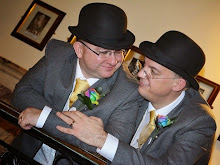
Today’s our twelfth-and-a-halfth anniversary! After a late night when my beloved serenaded me to sleep with the Kroll song, Richard and I were up early for a romantic morning of presents, wondering what to do for dinner, discussing Doctor Who and shouting at the Today Programme. Awwhhh. Thanks to Liberal Democrat Blogs Aggregated, too, for giving us a special private day to ourselves and discouraging anyone from peeking in at our blogs; at least, both mine and Millennium’s have vanished from the listings (so much for his latest on Sir Mr the Merciless and mine on free Doctor Who books!).
After a horrible journey in to work this morning with a fire on another line overloading the DLR, poor Richard’s not home yet this evening, so I hope the trains have been faster and less packed. Still, I have dinner ready to go when he gets in, and one of the presents that took too long in the post has finally turned up for me to wave at him when he gets in (the unlikely concept of a Philip K Dick cartoon). What other presents have there been, you’re wondering? Knowing my taste for melodrama, I now have another film of Richard III; knowing my taste for film noir, I now have both The Blue Dahlia and The Black Dahlia. It was only after I’d opened them that my beloved realised he’d given me Richard and Flowers, bless him! While I’m afraid my own gifts couldn’t really compete for instinctive puntastic ability, I did think he’d be amused by a bag of chocolate. Not just any bag, you understand; Richard frequently gives our relatives dainty little selection bags from Clarins, so when I saw a similar arrangement with romantic chocolates at the overpriced but classy Hotel Chocolat, I couldn’t resist giving him a taste of his own medicine. The fact that the shop was entirely staffed by slim, pretty young men had nothing to do with it – not my type, though I have to admit the Carry On side of my nature was sorely tempted when they glided round me (their sole customer at the time) with little trays of chocolates, asking “Would sir like a taste?” Fortunately, I was able to restrain my tongue and just use it to appreciate their chocolates, so I’m here to greet Richard rather than in court on a sexual harassment charge.
And here he is! So I must go to prepare more chocolate (and other things). Toodle pip! Oh, and most importantly – an eighth of a century later, I still love him very much. Here’s to a quarter of a century!
After a horrible journey in to work this morning with a fire on another line overloading the DLR, poor Richard’s not home yet this evening, so I hope the trains have been faster and less packed. Still, I have dinner ready to go when he gets in, and one of the presents that took too long in the post has finally turned up for me to wave at him when he gets in (the unlikely concept of a Philip K Dick cartoon). What other presents have there been, you’re wondering? Knowing my taste for melodrama, I now have another film of Richard III; knowing my taste for film noir, I now have both The Blue Dahlia and The Black Dahlia. It was only after I’d opened them that my beloved realised he’d given me Richard and Flowers, bless him! While I’m afraid my own gifts couldn’t really compete for instinctive puntastic ability, I did think he’d be amused by a bag of chocolate. Not just any bag, you understand; Richard frequently gives our relatives dainty little selection bags from Clarins, so when I saw a similar arrangement with romantic chocolates at the overpriced but classy Hotel Chocolat, I couldn’t resist giving him a taste of his own medicine. The fact that the shop was entirely staffed by slim, pretty young men had nothing to do with it – not my type, though I have to admit the Carry On side of my nature was sorely tempted when they glided round me (their sole customer at the time) with little trays of chocolates, asking “Would sir like a taste?” Fortunately, I was able to restrain my tongue and just use it to appreciate their chocolates, so I’m here to greet Richard rather than in court on a sexual harassment charge.
And here he is! So I must go to prepare more chocolate (and other things). Toodle pip! Oh, and most importantly – an eighth of a century later, I still love him very much. Here’s to a quarter of a century!
Labels: Richard
Wednesday, April 25, 2007
Free Doctor Who Books (…With A Small Catch)
One of the many lovely things about Doctor Who being a big TV success again is that people are buying the books in huge numbers, too. Right now, you can also get some for ‘free’ – some online, some with a magazine (requiring cash). So, should you? For me there were two golden ages where Doctor Who novels really seemed to matter: the scintillating New Adventures, aimed at older readers, which came to an end ten years ago yesterday after keeping the series going once the television dropped it; and the cheery Target novelisations of the original TV series itself. Happily, these are the very book ranges from which you can now obtain a selected few for free. Read on to find out just how and, perhaps more importantly, which ones you should try to lay your hands on…
Now, BBC Books have been publishing their own range of novels, nicely produced hardbacks featuring the two latest Doctors. In fact, there are three new stories of the Doctor and Martha just out in the last week or so, and while I’m particularly looking forward to reading the one with childhood terrors the Zygons, I’ll get to them shortly rather than dashing out for them on day of publication. So far, you see, this line’s been… OK. Aimed at children like the Target novels, but of a length closer to that of Virgin’s New Adventures, I quite enjoy them, but as far as I’m concerned they’ve not yet hit their stride. The best of both of my favourite book ranges can punch alongside the TV series; these BBC Books so far look very feeble alongside the new series. They lack either the depth and inspiration of the New Adventures – whose authors included half a dozen of the new TV series’ writers – or the crisp, well-told stories of the Target novelisations. Well, with one exception, which I’ll come to later and contrast with the least appealing of the new books.
Rather than indulging my love for the New Adventures novels, I’m going to skip past those swiftly and then look in a bit more detail at some of the Target books. The reason for that’s simple enough; the magazine with Targets attached won’t be on newsagents’ shelves for long, but four of the New Adventures, and four other books from the same stable, have been redone as Ebooks on the BBC website and are in general likely to be around for a while. Having re-read a couple in the new online editions (I recommend Lungbarrow; not my favourite of those available, but intriguingly rewritten as well as supplying author’s notes, not to mention saving you a fortune on eBay), today I’ve picked out another in celebration of the range that came to a tragic end a decade ago with So Vile a Sin. The one I’ve just started on is Nightshade, an early novel by the League of Gentlemen’s Mark Gatiss (both a writer and an actor for Doctor Who on TV these days), and though hardly the most groundbreaking of stories, it has a place in my heart as the first bit of Doctor Who to scare me since the ’70s. This chilly paean to Quatermass and Doctor Who like Mr Hinchcliffe used to make now has new illustrations, notes by the author and, most excitingly of all, even MP3s of the long-deleted Cybertech ‘soundtrack’. Ever since the lovely Mike Fillis gave me a copy, I’ve loved that ‘Nightshade TV Theme’…
Anyway, you can pick the Ebooks up at leisure, but pop into your nearest newsagent and, with luck, they’ll have a Doctor Who-related magazine or two. The one with the free Target novel attached is SFX’s latest special, SFX Collection – Doctor Who: The Ultimate Unofficial Guide to New Who, and in the way of these things it’s more a free magazine to pick up with a book bumped up to about the same price as the new BBC ones; for the most part, it’s not the most enthralling read. Far more worth dipping into is the latest Doctor Who Magazine special, a fabulous pile of gossip labelled In Their Own Words Volume Three, 1977-81, but don’t let that put you off. Mini-reviews of the magazines at the end, but before then, at last to the point. The SFX specials come with a choice of fifteen novels. Which should you pick?
First off, I suspect there’s very little quality control gone into the selection of free books in the SFX goodie bags. I imagine they simply found a supplier with a pile of remaindered books and picked out at least one for each Doctor (original series vintage), which is as fair a way to do it as any. They’re definitely not the best – perhaps one or two might be at the top end of the range – but, again with an exception or two, they’re not the worst of them. The mix of quality is about as thorough as the mixture of Doctors. There are a good few monsters around, too, though while Cybermen appear, you won’t find any Daleks. And there’s a good selection of authors, with most of the Target regulars represented (omitting only Ian Marter, a bloodthirsty childhood favourite) to illustrate the styles that came round most often, not to mention the clichés: if you buy more than one, look out for recurring chapter titles such as Attack, Escape or Trapped! Here they go, in the order in which the original stories were broadcast…
Doctor Who – Marco Polo
Starring the Doctor (William Hartnell)
A greatly extended very early story of the Doctor’s encounter with the famous explorer in China makes a surprisingly short novel by comparison, though John Lucarotti does quite a good job of it. It moves more quickly on the page than the TV’s weekly variations of ‘see the sights of Cathay / the Doctor breaks into the TARDIS / Tegana’s discovered to be a baddie / he sets Marco against our heroes’, though less stylishly. I enjoy the additions of all Kublai Khan’s endearments to his Empress (Richard never responds to them), and it’s interesting to compare the two ‘versions’ – here, written once the TV series had been going for a couple of decades, important points are redrafted to give the regulars more of a starring role, presumably because everyone expected it by then, as if making little changes to bend it more into the shape of a Who story. A nicely characterised little adventure in history, if you pick this one up.
Doctor Who – Galaxy Four
Starring the Doctor (William Hartnell)
From a highly experimental period of the show where they went for big concepts but limited characters, this story saw our heroes land on a doomed planet where two other parties of travellers have crashed. The Rills are ugly but good, the Drahvins are wicked but ‘beautiful’, and that’s pretty much the whole story. It’s not the most layered morality tale. The book’s only got four chapters, straight from the TV episodes, which makes it less digestible than many; there’s some rather poor internal dialogue and a fair bit of backstory added, but it’s just not terribly interesting, with a final line that’s too melodramatic to take seriously yet not over-the-top enough to be entertaining. Fortunately, it boast a fabulous cover, easily Andrew Skilleter’s campest work, featuring ‘beautiful space women’ against a blazingly colourful planet. It’s worth getting for that alone.
Doctor Who and the Tenth Planet
Starring the Doctor (William Hartnell)
“The last thrilling adventure of the first DOCTOR WHO,” as the back will tell you, this is also the first story with the Cybermen – back when they even had names, plus a particularly bonkers planet pictured gloriously on the very striking cover. Right from Gerry Davis’ often-reused Cyber-intro, this is an exciting, macho tale (James Bond clip and all), with little changes to make it up-to-the-minute and beyond – for 1976 – as the Cybermen attack a polar military base. These Cybermen are nowhere near as eerie as on TV, but if you like your blood-and-thunder…
Doctor Who and the Cybermen
Starring the Second Doctor (Patrick Troughton)
Ahh, well, this is the first book I ever read, and I love it to bits, even if it’s a bit flat and pretty much The Tenth Planet again (though like several of the very early books, this adds pictures – even if only the one of a Cyber-silhouette and the one of them rising into space are much good – but has even less brain). On TV, this story was made as The Moonbase, and could be called the first ‘production-line’ Who story with no innovations; the book’s similarly functional, but from the opening of the TARDIS as a ship in a stormy sea, rather endearing. With the Doctor accompanied by Ben, Polly and Jamie, it’s rather a strong line-up, and Polly gets a stunning ‘the deb strikes back’ moment as she destroys Cybermen with The Nail Varnish Remover of Death. I was so impressed when I read about it that my Mum had to stop me playing with nail varnish remover to try to dissolve things… Read it to see why it was so particularly suitable for me to learn to read while alone in hospital.
Doctor Who and the Mutants
Starring the Third Doctor (Jon Pertwee)
At last we come to a book with the brisk, crisp, deceptively simple style of Target top writer Terrance Dicks. For reasons that passeth understanding, one of the biggest rivalries between Who fans is the vitriol thrown between those who champion Jon Pertwee and those who favour Sylvester McCoy. Yep, some things are a mystery even to as dedicated a fan as me. Anyway, as far as I’m concerned, both have stories that tend to be rather disappointing on screen (with glorious exceptions), but they come alive in the books. For Sylv, it’s the magnificent New Adventures; with Pertwee, his stories are vastly improved as the best of the Target novelisations. The Mutants is perhaps the definitive example of a Pertwee novel told with gusto that was a terrible disappointment when I finally got to see it, and arguably the best script by Dave Martin (who died just a few weeks ago) and Bob Baker, even if it’s always felt more like one from Malcolm Hulke. It tells the future as if it’s history – picked up by the New Adventures, too – in a resolutely anti-colonialist / anti-apartheid parable, which only really lets itself down with the Star Trek ending. Still, with the book you get a great monster on the cover, but escape the rotten actors, dodgy effects and seeing aliens that organically evolve frocks, sequins, rainbow lighting and shoulderpads (who said drag queens were unnatural?).
This book also makes me a little bit sniffly, remembering when I first got it. It was in a swap for a weirdly exciting ‘spaceship thing’ I’d found on some waste ground – in truth a GAS RING – in Mrs Rigby’s classroom at primary school, from my friend Jon Good, another Who fan and brilliant cartoonist who died much too young. So I always think of him.
Doctor Who and the Green Death
Starring the Third Doctor (Jon Pertwee)
Target’s other great scribe was Malcolm Hulke, and this was the only story he novelised that he’d not written the original script for. You can’t spot the joins, though, as it’s full of well-drawn characters with rounded lives and a homily for the way we live today. This was a particularly effective homily, as a TV tale of big-business-will-poison-you that people remembered as ‘the one with the giant maggots’ becomes, in novel form, the story that turned me into a green liberal before I was ten. Reading it now, of course, I notice all the self-contradictory, romantic socialist propaganda instead. Sorry, Mac! That bit didn’t work, but never mind. The TV story is truncated in parts to make way for character, but that’s all to the good (even when he drops my favourite scene), and the gay relationship is even more obvious than on screen. So this is rather a good one to pick, even if the pictures are rubbish…
Doctor Who and the Seeds of Doom / Doctor Who and the Deadly Assassin
Starring the Fourth Doctor (Tom Baker)
Ooh, bargain! I’m looking out for this one, as it’s two books stuck together, though I haven’t spotted an SFX carrying it yet. The Seeds of Doom’s by fantastic Who producer Philip Hinchcliffe, and though he’s merely a functional prose writer, it’s still pretty tense and fast-moving. Missing an actor’s charismatic turn as the villain, as a whole less stylish but also less insanely macho than the TV story, there’s possession, horror and an enormous killer plant to enjoy, though oddly it loses most of the comic relief. Famously, one of the chapters is titled ‘Cottage Under Siege’; find a copy to see whether that’s actually true.
The Deadly Assassin is another Terrance Dicks, based on a script by the great Bob Holmes, and, well, this was the greatest story of them all on TV. In the book, it still fires off a great many ideas but doesn’t display so many remarkable styles as the disorientating, brilliant TV story as the Doctor returns to his home planet but finds himself a hunted fugitive. Though the satire is toned down here, the repeated hallucination of the early chapters is still strikingly effective, as are the action sequences as the Doctor is hunted through a surreal wilderness and, of course, the story’s complete re-imagining of the Master, a villain who’d become rather a cliché and was given a whole new lease of life (or living death). It’s far from the best of the novel range, but the crisp storytelling based on such an extraordinary script still makes it an impressive read.
Doctor Who and the Power of Kroll
Starring the Fourth Doctor (Tom Baker)
Again, Terrance adapts Bob, but this time it benefits from the page, with the dialogue, setting and a rather effective little prologue all standing out rather better than in the slightly lacklustre TV story. Part of the quest for the Key to Time, though that’s not a huge part of the plot, it’s a tale of industrial beastliness to alien ‘natives’ and not the most original in the world, but, hey, the characters work rather well, and there are religious maniacs and a huge giant squid to enjoy – even if Terrance takes the edge off the nasty ending! The Doctor’s casual brilliance seems perfect, too. Appropriately for a story all about money and religion, I knelt in WH Smiths in Stockport and read the whole book when it first came out, refusing to buy it in protest at the outrageous 10p price hike to 85p. Sigh…
Doctor Who and the Armageddon Factor
Starring the Fourth Doctor (Tom Baker)
A slightly abrupt Terrance retelling of a Bob Baker and Dave Martin story that suffers without its guest star’s bombastic charisma – the character’s an intriguing mixture of Churchill and Hitler – but is improved by losing all those beige corridors. This is the climax of the Key to Time series, and quite exciting, really. All about the horrors of war, it’s sometimes a little too enthralled by it to get that across, and at times it seems like a cover version of Genesis of the Daleks as well as echoing elements from other of the Key to Time stories. It sags a bit in the middle, though much less so than on screen, and some of the mythic elements of the story come over rather better; on TV, this was a striking mixture of absolutely brilliant and quite disastrous, but the ending wins it for me when the Doctor realises that no-one should be trusted with god-like power… Not even God.
Doctor Who – Castrovalva
Starring the Fifth Doctor (Peter Davison)
Christopher H Bidmead (a writer not known for his shy hesitancy in singing his own stories’ praises, known to one friend of mine as Jesus H Bidmead) adapts his own script for the Fifth Doctor’s first story here, a beautiful scientific fairy tale that’s curiously text-dense for a Target novel. There are masses of long paragraphs of description or internal dialogue, and in a typeface that’s not as easy to read as some, though the story’s rather interestingly told. I’ve always been tickled by a line summing up a feeling I know all too well:
Starring the Fifth Doctor (Peter Davison)
Peter Grimwade was a superb director, but though he was one of the few Who directors who wrote stories as well, asked to express his vision in script form… Well, let’s just say this story isn’t universally loved. I remember reading this book in the hope that it would give it a new life seen as it was in his head (though the dialogue would still be terrible). Did it? Well, no, and I still can’t work out just what he thought he was doing other than advertising Concorde, but while it’s still no epic it massively improves on the TV “crap”. Thankfully, the writing style makes a fairly feeble story bearable. The Doctor’s a bit daft, the Master’s a ridiculous cackling loon, and with help from and for Earth authorities, posh male companions and the Master plotting a diabolical scheme with aliens, it’s like a Pertwee story lost in the ’80s. Quite entertainingly written, but empty.
Doctor Who – The Twin Dilemma
Starring the Sixth Doctor (Colin Baker)
The Sixth Doctor’s first outing, just about the only thing this story had going for it on screen was Colin’s verve and enthusiasm. Well, it looks better in the book, but was the hackneyed script exposed? Actually, no. Half of the book’s taken from the first episode, which is hugely expanded and characterised while the rest’s cut down in the biggest departure from the televised story of any of these books. Adaptor Eric Saward was the most macho and bloody of Doctor Who script editors, and here he attempts to marry that style with pastiche Douglas Adams. It’s hardly an unqualified success, but at least it’s interesting.
Doctor Who – Delta and the Bannerman
Starring the Seventh Doctor (Sylvester McCoy)
A whimsical story that on screen was a showcase for ’50s music and not one that ever appealed to me; it should have been played like the TV Batman, but instead of arch, was wide-eyed and took itself terribly seriously. Just not very convincingly. And as for the ‘funny genocide’… Perhaps it would have been better with a straightforward ‘the Doctor’s holiday’ approach and drop the villains? Anyway, does writer Malcolm Kohll bring out the lighter, wittier touch this story needed when adapting his own script in a book? Nah. There’s a nice little prologue, but after that everything goes wrong. Dreadfully written, the only thing anyone’s ever remembered it for in my hearing is the misprints. If you avoid one, it should be this.
Doctor Who – The Greatest Show in the Galaxy
Starring the Seventh Doctor (Sylvester McCoy)
Now, this is more like it; Stephen Wyatt does an entertaining job of adapting his own much more successful piece of whimsy, one that a lot of people rave about. Scary clowns, futuristic hippies and strange gods fire the imagination (even if the Norse mythology doesn’t tie up to the next book, peculiarly), though the end’s a little too pat. It’s a good read, though I’m not quite sure about the writing style; he addresses the reader directly a lot of the time, which I always raise an eyebrow at. Not bad, though.
Doctor Who – The Curse of Fenric
Starring the Seventh Doctor (Sylvester McCoy)
This Second World War vampire tale was another absolutely terrific story on TV, and a very popular book – certainly a big influence on the New Adventures. I wonder why Ian Briggs never wrote one of those? It’s certainly very good, though the book’s no match for the TV version (the author improves his own Dragonfire rather more). There’s a lot of inventiveness here, with the story fleshed out with fragments of other styles such as Norse mythology, The Arabian Nights, Beowulf and Dracula. It’s probably the best of the books on offer as a book… It’s just that it’s better style on DVD.
So, if you see them on the shelves, which one will you choose?
If you see this next one of the new BBC Books at your local bookshop, though, I really wouldn’t advise it:
Doctor Who – The Price of Paradise
Starring the Doctor (David Tennant)
I said earlier that the new series-linked Doctor Who novels from the BBC have so far been a comparative disappointment, flabbily talking down to their readers rather than the crisp, well-told stories of the Target novelisations, with one exception; I’ll come to that in a moment, but first, the least appealing of the new books. This one’s by Colin Brake, an eco-parable about the damage we do by not living in harmony with nature on an idyllic planet that’s already been thoroughly taken apart by Richard on young Millennium Dome’s blog (look out particularly for what he says about human sacrifice, how fusion works, and why the ‘allergy’ idea had no sense of proportion at all). For me, it started all right – a bit bland, but serviceable – but as the ‘point’ became obvious, it just went horribly, horribly wrong. When I was a kid, Doctor Who seeded a lot of my political ideals. Goodness knows what I’d have got if I’d read this one. Look at the series: the Doctor’s a traveller in time and space, always interested in new people and places, and helping them out. It’s easy to lift out of that internationalism, individual freedom and environmentalism, and the new series has added more strongly than ever before an optimism about humanity (as well as our dark side). This story? Don’t travel anywhere – it’s wrong and evil. May as well dump the series, eh? Humans – they’re wrong and evil. Our very souls are unclean. Even the orphan who fits in slavishly is just racially evil. Then the ‘natives’ are entirely characterless, with the planet the real personality, and what is its character? If I was feeling generous, it’s that God’s still in charge in Eden, and a jealous god – but, no, this is Doctor Who and the BNP Planet. It’s revolting, and entirely out of step with the ethos of a series that’s all about openness to new things and seeing the best in people. Oh, and it opens by paraphrasing ’80s blandster Phil Collins at his most sanctimonious. Think twice: if you want an eco-parable, find a copy of SFX with The Green Death stuck to the front and leave this well alone.
Doctor Who – Made of Steel
Starring the Doctor (David Tennant)
At last, a new series book by Terrance Dicks, and you know what? It really works. I thought Only Human and The Stealers of Dreams from the new BBC Books were very good, too, but this book has one huge advantage: it isn’t huge. From the £1.99 Quick Reads series like last year’s rather good I Am a Dalek, aimed at getting people reading who usually don’t, this reads as if it was effortless to write. After reading so many other people trying to pull off the same sort of thing, it patently isn’t! Now, I like my Who novels long and deep, or short and crisp, and Terrance doesn’t do ‘deep’. Straightforward, undemanding and entertaining, at 99 pages instead of 250 this is the perfect length to capture the feel of a TV episode, while the others are too long for what they’re trying to do but too unambitious to deliver anything ‘bigger’ and just plod on. I’m hoping Richard will come along with a full-length review, as he’s done with a lot of the new novels – so I won’t nick his brilliant observations about the title or why the Cybermen bicker – but here’s a whistle-stop tour. The Doctor brings Martha back to her own place and time, only to find survivors of Cybermen from the battle of Canary Wharf in last year’s TV season finale Doomsday. Guess the London landmark where they’re hiding out (I hooted)? Much of it recalls old Doctor Who as much as new, but there are simple but elegant lampoons of both versions of the series, as well as amusing dismissals of Primeval and Torchwood (while the whole thing shows up Cyberwoman terribly. But then, so do most things). It’s not a great part for Martha, though she’s good when she’s in it and her history with the Cybermen adds to the story, but Terrance surprised me by absolutely nailing David Tennant’s speech and persona as the Doctor. The way he deals with a bullying military policeman had me punching the air, though describing them as “gorillas” is back to Terrance’s ’70s novels, along with the stock ‘ambitious woman’ characterisation. On the whole, though, it’s enormously refreshing, perhaps the most entertaining Who novel Terrance has written for about a decade and a half, and certainly the best of the new series novels so far. With the new series moving along at a hell of a lick on TV, perhaps the novels all need the discipline – hark at me! – of being much shorter.
One of my biggest disappointments with Doctor Who publishing last year, incidentally, was that – unlike the 2005 series – there was no script book. I like televised Who stories on my bookshelf, as well as on the telly. If they’re not publishing the scripts any more, they could hardly do better than get Terrance to briskly novelise them. After all, it’s worked before.
SFX Collection – Doctor Who: The Ultimate Unofficial Guide to New Who
As long as you pick up one of the right Target books with it, the book’s the main thing to get this for, but it’s not bad. It’s just… Not terribly interesting. Less an in-depth guide to the new series than a cross between tepid description and DVD commentary, it covers the 2005 and 2006 seasons, plus Torchwood and Sarah Jane Smith, with the aid of pie charts not very amusingly depicting the ‘Anatomy of an Episode’ – though it did make me laugh about Cyberwoman. It looks a bit tacky, too (one of the few striking pages is an advert for all the Doctor Who DVDs; see if you can spot which one is missing. It’s like the ‘odd one out’ puzzles in Battles in Time comic). On the bright side, the micro-guide to spin-off websites isn’t bad, and there’s one thing entirely worth buying it for right near the end. There’s a joint interview and photos with Doctor Who’s original producer, St Verity of Lambert, and current creative supremo Russell T Davies. Lovely!
Doctor Who Magazine – In Their Own Words Volume Three 1977-81
And finally, the other new magazine special edition on the shelves. On the face of it, this doesn’t sound very promising either; interviews from three decades of Doctor Who Magazine selected and cut down to reprint the best bits. Amazingly, it’s brilliant, and though I can’t remember the last time I read a magazine cover to cover, I did here. Covering all but the earliest years of Tom Baker, this is the best of the three they’ve done so far, despite losing most of the amusing photo-captions, brilliantly assembled and highly entertaining (just be careful before you show some of the anecdotes to children). Look out in particular for the way lines from different interviews are chopped together so they seem to answer each other, often to ironic effect, and for anything by the barking but startlingly honest Tom Baker. In other news, directors are unfairly bitchy about scripts, writers named Chris praise their own scripts to the skies, and Graham Williams and Douglas Adams come across as having died far too early (and poor Graham seems to have been under a curse as Who producer. The Curse of Callaghan, perhaps). The highlight, though, is none of these things, nor even the great selection of pictures. It’s the still jaw-dropping selection of interviews from Lalla Ward, variously Romana in the series, Richard Dawkins’ wife and (very briefly) Tom Baker’s. This magazine would be worth reading for her eye-watering account of Tom’s proposal alone…
Now, BBC Books have been publishing their own range of novels, nicely produced hardbacks featuring the two latest Doctors. In fact, there are three new stories of the Doctor and Martha just out in the last week or so, and while I’m particularly looking forward to reading the one with childhood terrors the Zygons, I’ll get to them shortly rather than dashing out for them on day of publication. So far, you see, this line’s been… OK. Aimed at children like the Target novels, but of a length closer to that of Virgin’s New Adventures, I quite enjoy them, but as far as I’m concerned they’ve not yet hit their stride. The best of both of my favourite book ranges can punch alongside the TV series; these BBC Books so far look very feeble alongside the new series. They lack either the depth and inspiration of the New Adventures – whose authors included half a dozen of the new TV series’ writers – or the crisp, well-told stories of the Target novelisations. Well, with one exception, which I’ll come to later and contrast with the least appealing of the new books.
Doctor Who – The New Adventures Ebooks
Rather than indulging my love for the New Adventures novels, I’m going to skip past those swiftly and then look in a bit more detail at some of the Target books. The reason for that’s simple enough; the magazine with Targets attached won’t be on newsagents’ shelves for long, but four of the New Adventures, and four other books from the same stable, have been redone as Ebooks on the BBC website and are in general likely to be around for a while. Having re-read a couple in the new online editions (I recommend Lungbarrow; not my favourite of those available, but intriguingly rewritten as well as supplying author’s notes, not to mention saving you a fortune on eBay), today I’ve picked out another in celebration of the range that came to a tragic end a decade ago with So Vile a Sin. The one I’ve just started on is Nightshade, an early novel by the League of Gentlemen’s Mark Gatiss (both a writer and an actor for Doctor Who on TV these days), and though hardly the most groundbreaking of stories, it has a place in my heart as the first bit of Doctor Who to scare me since the ’70s. This chilly paean to Quatermass and Doctor Who like Mr Hinchcliffe used to make now has new illustrations, notes by the author and, most excitingly of all, even MP3s of the long-deleted Cybertech ‘soundtrack’. Ever since the lovely Mike Fillis gave me a copy, I’ve loved that ‘Nightshade TV Theme’…
Anyway, you can pick the Ebooks up at leisure, but pop into your nearest newsagent and, with luck, they’ll have a Doctor Who-related magazine or two. The one with the free Target novel attached is SFX’s latest special, SFX Collection – Doctor Who: The Ultimate Unofficial Guide to New Who, and in the way of these things it’s more a free magazine to pick up with a book bumped up to about the same price as the new BBC ones; for the most part, it’s not the most enthralling read. Far more worth dipping into is the latest Doctor Who Magazine special, a fabulous pile of gossip labelled In Their Own Words Volume Three, 1977-81, but don’t let that put you off. Mini-reviews of the magazines at the end, but before then, at last to the point. The SFX specials come with a choice of fifteen novels. Which should you pick?
First off, I suspect there’s very little quality control gone into the selection of free books in the SFX goodie bags. I imagine they simply found a supplier with a pile of remaindered books and picked out at least one for each Doctor (original series vintage), which is as fair a way to do it as any. They’re definitely not the best – perhaps one or two might be at the top end of the range – but, again with an exception or two, they’re not the worst of them. The mix of quality is about as thorough as the mixture of Doctors. There are a good few monsters around, too, though while Cybermen appear, you won’t find any Daleks. And there’s a good selection of authors, with most of the Target regulars represented (omitting only Ian Marter, a bloodthirsty childhood favourite) to illustrate the styles that came round most often, not to mention the clichés: if you buy more than one, look out for recurring chapter titles such as Attack, Escape or Trapped! Here they go, in the order in which the original stories were broadcast…
The Free Target Doctor Who Book Selection With SFX
Doctor Who – Marco Polo
Starring the Doctor (William Hartnell)
A greatly extended very early story of the Doctor’s encounter with the famous explorer in China makes a surprisingly short novel by comparison, though John Lucarotti does quite a good job of it. It moves more quickly on the page than the TV’s weekly variations of ‘see the sights of Cathay / the Doctor breaks into the TARDIS / Tegana’s discovered to be a baddie / he sets Marco against our heroes’, though less stylishly. I enjoy the additions of all Kublai Khan’s endearments to his Empress (Richard never responds to them), and it’s interesting to compare the two ‘versions’ – here, written once the TV series had been going for a couple of decades, important points are redrafted to give the regulars more of a starring role, presumably because everyone expected it by then, as if making little changes to bend it more into the shape of a Who story. A nicely characterised little adventure in history, if you pick this one up.
Doctor Who – Galaxy Four
Starring the Doctor (William Hartnell)
From a highly experimental period of the show where they went for big concepts but limited characters, this story saw our heroes land on a doomed planet where two other parties of travellers have crashed. The Rills are ugly but good, the Drahvins are wicked but ‘beautiful’, and that’s pretty much the whole story. It’s not the most layered morality tale. The book’s only got four chapters, straight from the TV episodes, which makes it less digestible than many; there’s some rather poor internal dialogue and a fair bit of backstory added, but it’s just not terribly interesting, with a final line that’s too melodramatic to take seriously yet not over-the-top enough to be entertaining. Fortunately, it boast a fabulous cover, easily Andrew Skilleter’s campest work, featuring ‘beautiful space women’ against a blazingly colourful planet. It’s worth getting for that alone.
Doctor Who and the Tenth Planet
Starring the Doctor (William Hartnell)
“The last thrilling adventure of the first DOCTOR WHO,” as the back will tell you, this is also the first story with the Cybermen – back when they even had names, plus a particularly bonkers planet pictured gloriously on the very striking cover. Right from Gerry Davis’ often-reused Cyber-intro, this is an exciting, macho tale (James Bond clip and all), with little changes to make it up-to-the-minute and beyond – for 1976 – as the Cybermen attack a polar military base. These Cybermen are nowhere near as eerie as on TV, but if you like your blood-and-thunder…
Doctor Who and the Cybermen
Starring the Second Doctor (Patrick Troughton)
Ahh, well, this is the first book I ever read, and I love it to bits, even if it’s a bit flat and pretty much The Tenth Planet again (though like several of the very early books, this adds pictures – even if only the one of a Cyber-silhouette and the one of them rising into space are much good – but has even less brain). On TV, this story was made as The Moonbase, and could be called the first ‘production-line’ Who story with no innovations; the book’s similarly functional, but from the opening of the TARDIS as a ship in a stormy sea, rather endearing. With the Doctor accompanied by Ben, Polly and Jamie, it’s rather a strong line-up, and Polly gets a stunning ‘the deb strikes back’ moment as she destroys Cybermen with The Nail Varnish Remover of Death. I was so impressed when I read about it that my Mum had to stop me playing with nail varnish remover to try to dissolve things… Read it to see why it was so particularly suitable for me to learn to read while alone in hospital.
Doctor Who and the Mutants
Starring the Third Doctor (Jon Pertwee)
At last we come to a book with the brisk, crisp, deceptively simple style of Target top writer Terrance Dicks. For reasons that passeth understanding, one of the biggest rivalries between Who fans is the vitriol thrown between those who champion Jon Pertwee and those who favour Sylvester McCoy. Yep, some things are a mystery even to as dedicated a fan as me. Anyway, as far as I’m concerned, both have stories that tend to be rather disappointing on screen (with glorious exceptions), but they come alive in the books. For Sylv, it’s the magnificent New Adventures; with Pertwee, his stories are vastly improved as the best of the Target novelisations. The Mutants is perhaps the definitive example of a Pertwee novel told with gusto that was a terrible disappointment when I finally got to see it, and arguably the best script by Dave Martin (who died just a few weeks ago) and Bob Baker, even if it’s always felt more like one from Malcolm Hulke. It tells the future as if it’s history – picked up by the New Adventures, too – in a resolutely anti-colonialist / anti-apartheid parable, which only really lets itself down with the Star Trek ending. Still, with the book you get a great monster on the cover, but escape the rotten actors, dodgy effects and seeing aliens that organically evolve frocks, sequins, rainbow lighting and shoulderpads (who said drag queens were unnatural?).
This book also makes me a little bit sniffly, remembering when I first got it. It was in a swap for a weirdly exciting ‘spaceship thing’ I’d found on some waste ground – in truth a GAS RING – in Mrs Rigby’s classroom at primary school, from my friend Jon Good, another Who fan and brilliant cartoonist who died much too young. So I always think of him.
Doctor Who and the Green Death
Starring the Third Doctor (Jon Pertwee)
Target’s other great scribe was Malcolm Hulke, and this was the only story he novelised that he’d not written the original script for. You can’t spot the joins, though, as it’s full of well-drawn characters with rounded lives and a homily for the way we live today. This was a particularly effective homily, as a TV tale of big-business-will-poison-you that people remembered as ‘the one with the giant maggots’ becomes, in novel form, the story that turned me into a green liberal before I was ten. Reading it now, of course, I notice all the self-contradictory, romantic socialist propaganda instead. Sorry, Mac! That bit didn’t work, but never mind. The TV story is truncated in parts to make way for character, but that’s all to the good (even when he drops my favourite scene), and the gay relationship is even more obvious than on screen. So this is rather a good one to pick, even if the pictures are rubbish…
Doctor Who and the Seeds of Doom / Doctor Who and the Deadly Assassin
Starring the Fourth Doctor (Tom Baker)
Ooh, bargain! I’m looking out for this one, as it’s two books stuck together, though I haven’t spotted an SFX carrying it yet. The Seeds of Doom’s by fantastic Who producer Philip Hinchcliffe, and though he’s merely a functional prose writer, it’s still pretty tense and fast-moving. Missing an actor’s charismatic turn as the villain, as a whole less stylish but also less insanely macho than the TV story, there’s possession, horror and an enormous killer plant to enjoy, though oddly it loses most of the comic relief. Famously, one of the chapters is titled ‘Cottage Under Siege’; find a copy to see whether that’s actually true.
The Deadly Assassin is another Terrance Dicks, based on a script by the great Bob Holmes, and, well, this was the greatest story of them all on TV. In the book, it still fires off a great many ideas but doesn’t display so many remarkable styles as the disorientating, brilliant TV story as the Doctor returns to his home planet but finds himself a hunted fugitive. Though the satire is toned down here, the repeated hallucination of the early chapters is still strikingly effective, as are the action sequences as the Doctor is hunted through a surreal wilderness and, of course, the story’s complete re-imagining of the Master, a villain who’d become rather a cliché and was given a whole new lease of life (or living death). It’s far from the best of the novel range, but the crisp storytelling based on such an extraordinary script still makes it an impressive read.
Doctor Who and the Power of Kroll
Starring the Fourth Doctor (Tom Baker)
Again, Terrance adapts Bob, but this time it benefits from the page, with the dialogue, setting and a rather effective little prologue all standing out rather better than in the slightly lacklustre TV story. Part of the quest for the Key to Time, though that’s not a huge part of the plot, it’s a tale of industrial beastliness to alien ‘natives’ and not the most original in the world, but, hey, the characters work rather well, and there are religious maniacs and a huge giant squid to enjoy – even if Terrance takes the edge off the nasty ending! The Doctor’s casual brilliance seems perfect, too. Appropriately for a story all about money and religion, I knelt in WH Smiths in Stockport and read the whole book when it first came out, refusing to buy it in protest at the outrageous 10p price hike to 85p. Sigh…
Doctor Who and the Armageddon Factor
Starring the Fourth Doctor (Tom Baker)
A slightly abrupt Terrance retelling of a Bob Baker and Dave Martin story that suffers without its guest star’s bombastic charisma – the character’s an intriguing mixture of Churchill and Hitler – but is improved by losing all those beige corridors. This is the climax of the Key to Time series, and quite exciting, really. All about the horrors of war, it’s sometimes a little too enthralled by it to get that across, and at times it seems like a cover version of Genesis of the Daleks as well as echoing elements from other of the Key to Time stories. It sags a bit in the middle, though much less so than on screen, and some of the mythic elements of the story come over rather better; on TV, this was a striking mixture of absolutely brilliant and quite disastrous, but the ending wins it for me when the Doctor realises that no-one should be trusted with god-like power… Not even God.
Doctor Who – Castrovalva
Starring the Fifth Doctor (Peter Davison)
Christopher H Bidmead (a writer not known for his shy hesitancy in singing his own stories’ praises, known to one friend of mine as Jesus H Bidmead) adapts his own script for the Fifth Doctor’s first story here, a beautiful scientific fairy tale that’s curiously text-dense for a Target novel. There are masses of long paragraphs of description or internal dialogue, and in a typeface that’s not as easy to read as some, though the story’s rather interestingly told. I’ve always been tickled by a line summing up a feeling I know all too well:
“He stared with the distant gaze of a man watching his departing train of thought from an empty platform.”Doctor Who – Time-Flight
Starring the Fifth Doctor (Peter Davison)
Peter Grimwade was a superb director, but though he was one of the few Who directors who wrote stories as well, asked to express his vision in script form… Well, let’s just say this story isn’t universally loved. I remember reading this book in the hope that it would give it a new life seen as it was in his head (though the dialogue would still be terrible). Did it? Well, no, and I still can’t work out just what he thought he was doing other than advertising Concorde, but while it’s still no epic it massively improves on the TV “crap”. Thankfully, the writing style makes a fairly feeble story bearable. The Doctor’s a bit daft, the Master’s a ridiculous cackling loon, and with help from and for Earth authorities, posh male companions and the Master plotting a diabolical scheme with aliens, it’s like a Pertwee story lost in the ’80s. Quite entertainingly written, but empty.
Doctor Who – The Twin Dilemma
Starring the Sixth Doctor (Colin Baker)
The Sixth Doctor’s first outing, just about the only thing this story had going for it on screen was Colin’s verve and enthusiasm. Well, it looks better in the book, but was the hackneyed script exposed? Actually, no. Half of the book’s taken from the first episode, which is hugely expanded and characterised while the rest’s cut down in the biggest departure from the televised story of any of these books. Adaptor Eric Saward was the most macho and bloody of Doctor Who script editors, and here he attempts to marry that style with pastiche Douglas Adams. It’s hardly an unqualified success, but at least it’s interesting.
Doctor Who – Delta and the Bannerman
Starring the Seventh Doctor (Sylvester McCoy)
A whimsical story that on screen was a showcase for ’50s music and not one that ever appealed to me; it should have been played like the TV Batman, but instead of arch, was wide-eyed and took itself terribly seriously. Just not very convincingly. And as for the ‘funny genocide’… Perhaps it would have been better with a straightforward ‘the Doctor’s holiday’ approach and drop the villains? Anyway, does writer Malcolm Kohll bring out the lighter, wittier touch this story needed when adapting his own script in a book? Nah. There’s a nice little prologue, but after that everything goes wrong. Dreadfully written, the only thing anyone’s ever remembered it for in my hearing is the misprints. If you avoid one, it should be this.
Doctor Who – The Greatest Show in the Galaxy
Starring the Seventh Doctor (Sylvester McCoy)
Now, this is more like it; Stephen Wyatt does an entertaining job of adapting his own much more successful piece of whimsy, one that a lot of people rave about. Scary clowns, futuristic hippies and strange gods fire the imagination (even if the Norse mythology doesn’t tie up to the next book, peculiarly), though the end’s a little too pat. It’s a good read, though I’m not quite sure about the writing style; he addresses the reader directly a lot of the time, which I always raise an eyebrow at. Not bad, though.
Doctor Who – The Curse of Fenric
Starring the Seventh Doctor (Sylvester McCoy)
This Second World War vampire tale was another absolutely terrific story on TV, and a very popular book – certainly a big influence on the New Adventures. I wonder why Ian Briggs never wrote one of those? It’s certainly very good, though the book’s no match for the TV version (the author improves his own Dragonfire rather more). There’s a lot of inventiveness here, with the story fleshed out with fragments of other styles such as Norse mythology, The Arabian Nights, Beowulf and Dracula. It’s probably the best of the books on offer as a book… It’s just that it’s better style on DVD.
So, if you see them on the shelves, which one will you choose?
If you see this next one of the new BBC Books at your local bookshop, though, I really wouldn’t advise it:
Two New Doctor Who Books – of Varying Quality…
Doctor Who – The Price of Paradise
Starring the Doctor (David Tennant)
I said earlier that the new series-linked Doctor Who novels from the BBC have so far been a comparative disappointment, flabbily talking down to their readers rather than the crisp, well-told stories of the Target novelisations, with one exception; I’ll come to that in a moment, but first, the least appealing of the new books. This one’s by Colin Brake, an eco-parable about the damage we do by not living in harmony with nature on an idyllic planet that’s already been thoroughly taken apart by Richard on young Millennium Dome’s blog (look out particularly for what he says about human sacrifice, how fusion works, and why the ‘allergy’ idea had no sense of proportion at all). For me, it started all right – a bit bland, but serviceable – but as the ‘point’ became obvious, it just went horribly, horribly wrong. When I was a kid, Doctor Who seeded a lot of my political ideals. Goodness knows what I’d have got if I’d read this one. Look at the series: the Doctor’s a traveller in time and space, always interested in new people and places, and helping them out. It’s easy to lift out of that internationalism, individual freedom and environmentalism, and the new series has added more strongly than ever before an optimism about humanity (as well as our dark side). This story? Don’t travel anywhere – it’s wrong and evil. May as well dump the series, eh? Humans – they’re wrong and evil. Our very souls are unclean. Even the orphan who fits in slavishly is just racially evil. Then the ‘natives’ are entirely characterless, with the planet the real personality, and what is its character? If I was feeling generous, it’s that God’s still in charge in Eden, and a jealous god – but, no, this is Doctor Who and the BNP Planet. It’s revolting, and entirely out of step with the ethos of a series that’s all about openness to new things and seeing the best in people. Oh, and it opens by paraphrasing ’80s blandster Phil Collins at his most sanctimonious. Think twice: if you want an eco-parable, find a copy of SFX with The Green Death stuck to the front and leave this well alone.
Doctor Who – Made of Steel
Starring the Doctor (David Tennant)
At last, a new series book by Terrance Dicks, and you know what? It really works. I thought Only Human and The Stealers of Dreams from the new BBC Books were very good, too, but this book has one huge advantage: it isn’t huge. From the £1.99 Quick Reads series like last year’s rather good I Am a Dalek, aimed at getting people reading who usually don’t, this reads as if it was effortless to write. After reading so many other people trying to pull off the same sort of thing, it patently isn’t! Now, I like my Who novels long and deep, or short and crisp, and Terrance doesn’t do ‘deep’. Straightforward, undemanding and entertaining, at 99 pages instead of 250 this is the perfect length to capture the feel of a TV episode, while the others are too long for what they’re trying to do but too unambitious to deliver anything ‘bigger’ and just plod on. I’m hoping Richard will come along with a full-length review, as he’s done with a lot of the new novels – so I won’t nick his brilliant observations about the title or why the Cybermen bicker – but here’s a whistle-stop tour. The Doctor brings Martha back to her own place and time, only to find survivors of Cybermen from the battle of Canary Wharf in last year’s TV season finale Doomsday. Guess the London landmark where they’re hiding out (I hooted)? Much of it recalls old Doctor Who as much as new, but there are simple but elegant lampoons of both versions of the series, as well as amusing dismissals of Primeval and Torchwood (while the whole thing shows up Cyberwoman terribly. But then, so do most things). It’s not a great part for Martha, though she’s good when she’s in it and her history with the Cybermen adds to the story, but Terrance surprised me by absolutely nailing David Tennant’s speech and persona as the Doctor. The way he deals with a bullying military policeman had me punching the air, though describing them as “gorillas” is back to Terrance’s ’70s novels, along with the stock ‘ambitious woman’ characterisation. On the whole, though, it’s enormously refreshing, perhaps the most entertaining Who novel Terrance has written for about a decade and a half, and certainly the best of the new series novels so far. With the new series moving along at a hell of a lick on TV, perhaps the novels all need the discipline – hark at me! – of being much shorter.
One of my biggest disappointments with Doctor Who publishing last year, incidentally, was that – unlike the 2005 series – there was no script book. I like televised Who stories on my bookshelf, as well as on the telly. If they’re not publishing the scripts any more, they could hardly do better than get Terrance to briskly novelise them. After all, it’s worked before.
…And Those ‘Doctor Who Special’ Magazines Themselves
SFX Collection – Doctor Who: The Ultimate Unofficial Guide to New Who
As long as you pick up one of the right Target books with it, the book’s the main thing to get this for, but it’s not bad. It’s just… Not terribly interesting. Less an in-depth guide to the new series than a cross between tepid description and DVD commentary, it covers the 2005 and 2006 seasons, plus Torchwood and Sarah Jane Smith, with the aid of pie charts not very amusingly depicting the ‘Anatomy of an Episode’ – though it did make me laugh about Cyberwoman. It looks a bit tacky, too (one of the few striking pages is an advert for all the Doctor Who DVDs; see if you can spot which one is missing. It’s like the ‘odd one out’ puzzles in Battles in Time comic). On the bright side, the micro-guide to spin-off websites isn’t bad, and there’s one thing entirely worth buying it for right near the end. There’s a joint interview and photos with Doctor Who’s original producer, St Verity of Lambert, and current creative supremo Russell T Davies. Lovely!
Doctor Who Magazine – In Their Own Words Volume Three 1977-81
And finally, the other new magazine special edition on the shelves. On the face of it, this doesn’t sound very promising either; interviews from three decades of Doctor Who Magazine selected and cut down to reprint the best bits. Amazingly, it’s brilliant, and though I can’t remember the last time I read a magazine cover to cover, I did here. Covering all but the earliest years of Tom Baker, this is the best of the three they’ve done so far, despite losing most of the amusing photo-captions, brilliantly assembled and highly entertaining (just be careful before you show some of the anecdotes to children). Look out in particular for the way lines from different interviews are chopped together so they seem to answer each other, often to ironic effect, and for anything by the barking but startlingly honest Tom Baker. In other news, directors are unfairly bitchy about scripts, writers named Chris praise their own scripts to the skies, and Graham Williams and Douglas Adams come across as having died far too early (and poor Graham seems to have been under a curse as Who producer. The Curse of Callaghan, perhaps). The highlight, though, is none of these things, nor even the great selection of pictures. It’s the still jaw-dropping selection of interviews from Lalla Ward, variously Romana in the series, Richard Dawkins’ wife and (very briefly) Tom Baker’s. This magazine would be worth reading for her eye-watering account of Tom’s proposal alone…
Labels: Books, David Tennant, Doctor Who, New Adventures, New Beginnings, Reviews, The Key To Time
Wednesday, April 18, 2007
The Lords’ Appointments Commission Isn’t Toothless – It Just Didn’t Bite
You may have heard about Lord Laidlaw, a Conservative peer and donor who’s said to be the second richest person in Scotland and – gasp! – a tax exile. The BBC reports that, three years after agreeing to become a UK resident to gain a peerage, he still hasn’t done it. The Lords’ Appointments Commission will “name and shame him in a forthcoming review” (so what’s this morning’s leak news?), but the Today Programme said they’re otherwise “powerless”. I know what you’d expect me to say: ‘Tory donor, filthy rich, tax exile, cash for honours, scandal, holds up shocked mittens’. Actually, it’s not quite that simple. My biggest problem is not with Lord Laidlaw, but with Lords’ Appointments Commission.
I don’t approve of peerages, with donations or without. I was delighted last month when the House of Commons voted to replace the whole bunch with people who can be elected and held to account – though, unaccountably, the Lords didn’t agree. But despite Lord Laidlaw sounding, in a one-line summary, like one of the dodgier members of a wholly dodgy House, I’m wary of reports that throw everything at one individual. In part, it’s because that distracts attention from the need to throw out the lot of them and replace them with people we can choose to throw out, or not, on a regular basis. In part, it’s because the story contains some elements in his favour.
Obviously, if we’re going to have legislators on the basis of some whim, bung or ancestry rather than because they’ve won an election (sorry to keep banging on, but my dictionary and I have rather old-fashioned notions of what a ‘democracy’ might mean), having a legislator called ‘Laidlaw’ is as good an excuse as any, and better than most – I mean, can you think of a more brilliant name? More seriously, the BBC’s Business Editor reports that Lord Laidlaw has written to the Lords’ Appointments Commission to say that he does still plan to move, but that personal reasons have delayed it. Well, I can understand that; I’m quite attached to our flat and wouldn’t want to be forced to move from that either, though tragically it’s not worth £700-odd million, and involves us already paying taxes. And, very much in his favour, he’s said he intends gradually to give away his vast personal fortune to charity. Knowing little about him except for this story, that makes him sound rather a good egg, major donor to the Tories or not. Against him, there’s the fact that he told the BBC’s Business Editor “I have made it a rule never to speak to journalists.” Well, I suppose being a snooty git who considers any enquiries from the people they rule over to be the height of impertinence comes with the job, too (see ‘objections to House of Lords, general’, above).
So if Lord Laidlaw is a laudable philanthropist who simply has an unfortunate record of giving some of his largesse to deeply undeserving causes, what’s my real problem? It’s with this report, swallowed wholesale by journalists, that all the Lords’ Appointments Commission can do is “name and shame” tax exile peers they’ve previously rubber-stamped, and that they’re brave, noble individuals who are “powerless” to take real action such as, say, revoking a peerage. Well, aside from their being there as an artificial life-support for the concept of government by patronage, I have no sympathy whatsoever for their sanctimonious bleatings today. Their cowardly leaking that they’d like to revoke Lord Laidlaw’s peerage if they only could is shameful. The fact is, they were not powerless when it mattered – just incompetent. The Commission had all the power they needed to prevent a tax exile from becoming a peer. They could have heard his evidence that he intended to move at some point, and answered: ‘Fine. And six months after you’ve done so, provide us with the evidence you’ve settled here and we will give you your peerage.’ But they didn’t bother. This cowardly, lazy and incompetent bunch are now saying – out of the corners of their mouths, as of course their “review” remains “forthcoming” – that it’s all someone else’s fault. No, it’s not. It’s theirs, and rather than criticise someone else, they should be apologising for giving him the nod in the first place when it was their duty to have stopped him. Just as all but about 0.0001% of the tens of millions of us in Britain have no say on the Lords themselves, we have no say on this small group of people who are supposed to choose whether our potential lawmakers are ‘worthy’. Today more than ever, it’s clear they need holding to account, too.
In other news, the ‘war on drugs’ (immensely tasteless, with all the real wars about) has completely failed, as drug use remains high and a major source of criminality. Well, goodness me, bless my muffins, who’d have thought, I don’t Adam and Eve it, etc. Expect the Labour Government to sound just as faux-shocked as their Lords’ Appointments Commission as they rush round to blame everyone else but themselves and ask for new powers with which to waste police time instead of getting to the root of the problem. As long as drugs have an effect on people, people will take them. And as long as they remain illegal, criminals will take those people’s money. Like ‘Who gave the go-ahead to a tax exile peer,’ this is not rocket science.
I don’t approve of peerages, with donations or without. I was delighted last month when the House of Commons voted to replace the whole bunch with people who can be elected and held to account – though, unaccountably, the Lords didn’t agree. But despite Lord Laidlaw sounding, in a one-line summary, like one of the dodgier members of a wholly dodgy House, I’m wary of reports that throw everything at one individual. In part, it’s because that distracts attention from the need to throw out the lot of them and replace them with people we can choose to throw out, or not, on a regular basis. In part, it’s because the story contains some elements in his favour.
Obviously, if we’re going to have legislators on the basis of some whim, bung or ancestry rather than because they’ve won an election (sorry to keep banging on, but my dictionary and I have rather old-fashioned notions of what a ‘democracy’ might mean), having a legislator called ‘Laidlaw’ is as good an excuse as any, and better than most – I mean, can you think of a more brilliant name? More seriously, the BBC’s Business Editor reports that Lord Laidlaw has written to the Lords’ Appointments Commission to say that he does still plan to move, but that personal reasons have delayed it. Well, I can understand that; I’m quite attached to our flat and wouldn’t want to be forced to move from that either, though tragically it’s not worth £700-odd million, and involves us already paying taxes. And, very much in his favour, he’s said he intends gradually to give away his vast personal fortune to charity. Knowing little about him except for this story, that makes him sound rather a good egg, major donor to the Tories or not. Against him, there’s the fact that he told the BBC’s Business Editor “I have made it a rule never to speak to journalists.” Well, I suppose being a snooty git who considers any enquiries from the people they rule over to be the height of impertinence comes with the job, too (see ‘objections to House of Lords, general’, above).
So if Lord Laidlaw is a laudable philanthropist who simply has an unfortunate record of giving some of his largesse to deeply undeserving causes, what’s my real problem? It’s with this report, swallowed wholesale by journalists, that all the Lords’ Appointments Commission can do is “name and shame” tax exile peers they’ve previously rubber-stamped, and that they’re brave, noble individuals who are “powerless” to take real action such as, say, revoking a peerage. Well, aside from their being there as an artificial life-support for the concept of government by patronage, I have no sympathy whatsoever for their sanctimonious bleatings today. Their cowardly leaking that they’d like to revoke Lord Laidlaw’s peerage if they only could is shameful. The fact is, they were not powerless when it mattered – just incompetent. The Commission had all the power they needed to prevent a tax exile from becoming a peer. They could have heard his evidence that he intended to move at some point, and answered: ‘Fine. And six months after you’ve done so, provide us with the evidence you’ve settled here and we will give you your peerage.’ But they didn’t bother. This cowardly, lazy and incompetent bunch are now saying – out of the corners of their mouths, as of course their “review” remains “forthcoming” – that it’s all someone else’s fault. No, it’s not. It’s theirs, and rather than criticise someone else, they should be apologising for giving him the nod in the first place when it was their duty to have stopped him. Just as all but about 0.0001% of the tens of millions of us in Britain have no say on the Lords themselves, we have no say on this small group of people who are supposed to choose whether our potential lawmakers are ‘worthy’. Today more than ever, it’s clear they need holding to account, too.
In other news, the ‘war on drugs’ (immensely tasteless, with all the real wars about) has completely failed, as drug use remains high and a major source of criminality. Well, goodness me, bless my muffins, who’d have thought, I don’t Adam and Eve it, etc. Expect the Labour Government to sound just as faux-shocked as their Lords’ Appointments Commission as they rush round to blame everyone else but themselves and ask for new powers with which to waste police time instead of getting to the root of the problem. As long as drugs have an effect on people, people will take them. And as long as they remain illegal, criminals will take those people’s money. Like ‘Who gave the go-ahead to a tax exile peer,’ this is not rocket science.
Labels: British Politics, Conservatives, Drugs, Republic
Sunday, April 15, 2007
A Blissful Saturday Evening
For some people it’s being out in the sun, for some it’s great food, for some it’s their loved ones… Well, Richard and I had a very agreeable walk in the sun this afternoon and enjoyed our steak and chips this evening, but what we took the greatest pleasure in was our own company. And the television. You knew, didn’t you? We both thought tonight’s Doctor Who, Gridlock, was absolutely marvellous, so for once I’ve got some (spoilertastic) observations before Millennium gets there. Then watching Any Dream Will Do let us indulge our inner Statler and Waldorf to the full…
So, did you see Gridlock tonight? If not, what on New New (etc) Earth were you doing? We warmed up with some fabulous old telly, and even some of Carry On Up the Khyber – would I take that film with me to a desert island if offered just eight? I might, you know – but Doctor Who still knocked them all into a cocked hat for sheer joy, and as I’m going to say a little of why, if you don’t want to know the result then look away now. Well, I’m told it’s a special milestone with tonight’s story, as Doctor Who – already the longest-running sci-fi series in the world, even if you take out the years in which it was inconveniently missing from the screen – passes Star Trek and all its multifarious spin-offs in terms of number of individual episodes (I’ve not counted them, so if someone’s worked this all out on their fingers and got it wrong, please take my apologetic shrug as read. I’m enjoying this evening far too much to start researching Star Trek series online). The lovely Mr Matt Davies, who may or may not resemble Tobey Maguire, tells us with uncanny timing for Gridlock that it’s also the 75th anniversary of the Highway Code. However, tonight I’m more concerned with another milestone anniversary – if you’ve not seen Doctor Who, you really should stop reading now – that technically passed a few weeks ago. It’s the fortieth anniversary of the first appearance of legendary Doctor Who monsters the Macra, and I whooped aloud when their giant, crabby forms appeared through the swirling traffic fumes beneath New New (etc) York.
After last year’s fortieth anniversary re-imagining of the Cybermen, by the way, I’m hoping for a pattern. That means I’m holding out for multi-functional hovering robots popping out deadly accessories from all angles as their spiky heads spin and spin; yes, with an exciting 2008 remodelling in my head that mixes an Imperial Probe Droid and a malignant penknife, next year expect the Quarks. You read it here first.
I’ve always been very fond of the long-lost 1967 story The Macra Terror, and I’d intended for months to write a review of it for its fortieth anniversary. I’d even started writing bits of it, and was delighted when I found a new (and fabby) Reconstruction was available, just in time. I can now reveal, though, that a week or two before I posted my humungous review (well, the Macra were the largest monsters built for the old series, and it seemed an appropriate way to celebrate them), someone let slip a ‘hint’ about a returning old monster. Though I’d been desperately trying to avoid spoilers, obviously my Who-honed brain instantly turned the supposedly cryptic clue into ‘Damn, that must be the Macra’. I considered abandoning my review as a result, but at least I’d worked it out, as once I published my review a couple of people said things along the lines of ‘So you’re tying that in with this year’s surprise monster return, then?’ and I’d have been rather dischuffed if the surprise had been spoiled quite so blatantly. Fortunately, when Richard heard there was a story coming up called ‘Utopia’, he had immediately and convincingly pegged them to turn up there, so I was still able to be surprised and delighted when the Macra were revealed half-way into tonight’s show. Hurrah! Even the spoiler hadn’t managed to spoil it for me.
There’s a bit of me that wanted a bigger part for them than ‘monster in the pit’, but I can see the logic: if you’re having secret monsters under a human settlement in the far future that live off toxic gas, if they hadn’t used the Macra people would just have said, ‘Oh, they’re just like the Macra.’ Like the Slitheen and the Foamasi. And, in the end, I think the Macra were rather well-used. There are echoes of the earlier story without repeating the plot – the Doctor overturning the system and freeing everyone, of course, but also touches like a traffic hologram replacing jingles, or people being trapped without being aware that they’re trapped, despite the rumours that everyone knows but daren’t repeat. And, no, they weren’t behind (beneath) it all this time, but the setting actually turned that to a strength for me rather than a disappointment. In 2005’s The End of the World, the Doctor has a witty adventure in the year five billion (see if you can guess one of the main events taking place in it), encountering among sundry non-human people the wicked Lady Cassandra, who’s technically the last human but has had so many changes that she looks like a huge, stretched skin – the most striking image in a gloriously rich set of visuals. After all that, I found that most people pretty much looking human in last year’s visit to New Earth in five billion and a bit was a bit of a let-down. Along with some extra effort at diversity among the human-ish and non-human but also people this time – five billion and a bit more – and, hurrah, an old married same-sex couple and some naturists (we’d fit right in), the Doctor observing that the Macra had, over billions of years, devolved to the level of snapping beasts was a very welcome reminder that change happens, as well as that ‘progress’ and evolution are not always linear synonyms.
For readers of my review of The Macra Terror, incidentally, though I’ll leave the in-depth review of Gridlock to Millennium, I have a couple of observations relating to theories there. I noted that there isn’t an explanation of where they come from in the original story, and that some people suggested there’s a circle of oppression in which the humans they exploit forced them underground in the first place: no, says Russell T Davies, they were all over the place and did this sort of underhand aggression quite a lot. And as for my going into how they were the Colony’s psychosis made manifest… Well, perhaps they were the same for the car people, de-evolved and bestial and simply surviving, just as the gridlockees just went round and round aimlessly. OK, that’s more of a stretch, particularly with so many associations of the underworld / afterlife and how blind faith keeps them going (both misled and ultimately keeping them alive until they’re redeemed), and I’m not sure how to fit a crab psychosis in with the religious allegories…
I did love the huge energy of it all, with the Doctor hopping down through the cars – that joyous kinetic feel was superbly balanced by the relentless horror of the gridlock itself, and it all segued beautifully into the heart-wringing requiem for the Face of Boe and the Doctor’s people, and the fantastic spectacle of the city coming, out of all that death, back to life. In all, the story had just as many moods as last year’s New Earth trip, but here they complemented each other rather than clashing. I enjoyed all the undermined expectations, too: the Macra not being the main antagonists once revealed as at the bottom of the gridlock, for example; the real reason for the cars being sealed off; the nun with the gun turning out nice (seeing a preview image, I’d assumed she was out for revenge); the motive of Martha’s kidnappers, and so on. Admittedly, we’d guessed precisely the Face’s secret, but it would have been a disappointment otherwise, wouldn’t it, and the Doctor’s talk with Martha was another movingly bittersweet moment. I laughed, too, at Martha teasing the Doctor for taking her on the same dates he took Rose, but then, I would.
And, of course, when Any Dream Will Do was over and we were able to watch our recording of Doctor Who Confidential, it was a treat to hear Russell talk about 2000 AD as another inspiration (and not the only artistic reference, either). Issues are tending to pile up unread now, but there are a few early years of the galaxy’s greatest comic that are fixed into my head – as well as thinking of New New (etc) York as a bit of a futuristic urban Alice with a dash of Coruscant, the wild tone had reminded me of 2000 AD. I’d spotted Max Normal as soon as he said it was deliberate, but though of course Mega-City One (Judge Dredd’s home city, name-checked tonight) is the original New New York, the whole thing reminded me rather more of Terror Tube mixed with Halo Jones’ Hoop… That holographic traffic announcer was the spitting image of Swifty Frisco. The whole thing had a flavour of the dear old New Adventures, too, while firmly setting itself at the heart of the new Doctor Who series. Beautiful.
I thought Smith and Jones was terrific – fast, exciting action, but with stunning images, a great (and amusing) villain and altogether making a brilliant introduction, easily the best ‘new season’ opening episode since the Doctor returned in 2005 and among the best the series has ever delivered. Perhaps because I had such high expectations for it (I love adventures in history, and was really looking forward to TV Doctor Who from that particular author), The Shakespeare Code was a relative disappointment; lots of individually fun bits (Bad Queen Bess was a scream), but neither Shakespeare nor the witches convinced me. Bearing in mind that I love all Doctor Who to bits, I had relatively low expectations of tonight’s story, so perhaps I’ll change my mind after a second watching – with most of my Who reviews I like to sleep on it, usually (like Rip Van Winkle) for a couple of decades – but for now, I’m still bowled over. It’s rare that a story keeps surprising me and is both moving and fast-moving, but the rest of the season’ll have to do very well to get better than this. I’m hoping it will, of course.
I hope you were excited by the closing Dalek trailer – a haunting line for the Doctor just before the music cut in – and, in daytime TV style, the last time I wrote about Dalek Sec Any Dream Will Do wasn’t far behind. So it proved tonight, as we watched the whole thing and, I’m forced to admit, were completely caught up in it. Tragically, I’ve even warmed to Andrew Lloyd Webber after years of thinking of him as a Tory git, and the level of talent among the potential Josephs was remarkable. No, not that sort of talent, though I admit that most tastes for different varieties of handsome young men are catered for, from blond and plastic, through waiflike and pretty, to rough and chunky. Even if they’ve evidently and off-puttingly all shaved their chests. I’ve not make my mind up on the chap with the most star quality yet (Richard may have done), but several of them were really impressive tonight. Rob stole the show from the first with a belting voice and a great physical performance; Johndeep and Daniel sung beautifully; Anthony had another great voice and, as was pointed out, practically made love to the microphone; and Seamus, despite the apparent disadvantages of looking rather like Jesus, having a slightly tired voice, and by all accounts being a bit of a tosser, had enormous charisma. It’s pure coincidence that four of those five would be the four out of the twelve most to my physical taste, of course (running from the youngest to the oldest, though neither of them look it!). Of the others, Ben, who I identified last week as ‘vampire boy’, looked far more alive with a dash of orange and gave another great physical performance, though he may have had the weakest voice of them (probably why he was nearly voted off), while Keith was endearingly cheeky, Craig too cheesy, and Lewis like a factory model printed off from Paul Nicholas in Hair (remembering an old clip from The Rock’n’Roll Years)… Wholesome, blond and bland. I have a terrible feeling we’ll be following these young men all the way through.
So, did you see Gridlock tonight? If not, what on New New (etc) Earth were you doing? We warmed up with some fabulous old telly, and even some of Carry On Up the Khyber – would I take that film with me to a desert island if offered just eight? I might, you know – but Doctor Who still knocked them all into a cocked hat for sheer joy, and as I’m going to say a little of why, if you don’t want to know the result then look away now. Well, I’m told it’s a special milestone with tonight’s story, as Doctor Who – already the longest-running sci-fi series in the world, even if you take out the years in which it was inconveniently missing from the screen – passes Star Trek and all its multifarious spin-offs in terms of number of individual episodes (I’ve not counted them, so if someone’s worked this all out on their fingers and got it wrong, please take my apologetic shrug as read. I’m enjoying this evening far too much to start researching Star Trek series online). The lovely Mr Matt Davies, who may or may not resemble Tobey Maguire, tells us with uncanny timing for Gridlock that it’s also the 75th anniversary of the Highway Code. However, tonight I’m more concerned with another milestone anniversary – if you’ve not seen Doctor Who, you really should stop reading now – that technically passed a few weeks ago. It’s the fortieth anniversary of the first appearance of legendary Doctor Who monsters the Macra, and I whooped aloud when their giant, crabby forms appeared through the swirling traffic fumes beneath New New (etc) York.
After last year’s fortieth anniversary re-imagining of the Cybermen, by the way, I’m hoping for a pattern. That means I’m holding out for multi-functional hovering robots popping out deadly accessories from all angles as their spiky heads spin and spin; yes, with an exciting 2008 remodelling in my head that mixes an Imperial Probe Droid and a malignant penknife, next year expect the Quarks. You read it here first.
I’ve always been very fond of the long-lost 1967 story The Macra Terror, and I’d intended for months to write a review of it for its fortieth anniversary. I’d even started writing bits of it, and was delighted when I found a new (and fabby) Reconstruction was available, just in time. I can now reveal, though, that a week or two before I posted my humungous review (well, the Macra were the largest monsters built for the old series, and it seemed an appropriate way to celebrate them), someone let slip a ‘hint’ about a returning old monster. Though I’d been desperately trying to avoid spoilers, obviously my Who-honed brain instantly turned the supposedly cryptic clue into ‘Damn, that must be the Macra’. I considered abandoning my review as a result, but at least I’d worked it out, as once I published my review a couple of people said things along the lines of ‘So you’re tying that in with this year’s surprise monster return, then?’ and I’d have been rather dischuffed if the surprise had been spoiled quite so blatantly. Fortunately, when Richard heard there was a story coming up called ‘Utopia’, he had immediately and convincingly pegged them to turn up there, so I was still able to be surprised and delighted when the Macra were revealed half-way into tonight’s show. Hurrah! Even the spoiler hadn’t managed to spoil it for me.
There’s a bit of me that wanted a bigger part for them than ‘monster in the pit’, but I can see the logic: if you’re having secret monsters under a human settlement in the far future that live off toxic gas, if they hadn’t used the Macra people would just have said, ‘Oh, they’re just like the Macra.’ Like the Slitheen and the Foamasi. And, in the end, I think the Macra were rather well-used. There are echoes of the earlier story without repeating the plot – the Doctor overturning the system and freeing everyone, of course, but also touches like a traffic hologram replacing jingles, or people being trapped without being aware that they’re trapped, despite the rumours that everyone knows but daren’t repeat. And, no, they weren’t behind (beneath) it all this time, but the setting actually turned that to a strength for me rather than a disappointment. In 2005’s The End of the World, the Doctor has a witty adventure in the year five billion (see if you can guess one of the main events taking place in it), encountering among sundry non-human people the wicked Lady Cassandra, who’s technically the last human but has had so many changes that she looks like a huge, stretched skin – the most striking image in a gloriously rich set of visuals. After all that, I found that most people pretty much looking human in last year’s visit to New Earth in five billion and a bit was a bit of a let-down. Along with some extra effort at diversity among the human-ish and non-human but also people this time – five billion and a bit more – and, hurrah, an old married same-sex couple and some naturists (we’d fit right in), the Doctor observing that the Macra had, over billions of years, devolved to the level of snapping beasts was a very welcome reminder that change happens, as well as that ‘progress’ and evolution are not always linear synonyms.
For readers of my review of The Macra Terror, incidentally, though I’ll leave the in-depth review of Gridlock to Millennium, I have a couple of observations relating to theories there. I noted that there isn’t an explanation of where they come from in the original story, and that some people suggested there’s a circle of oppression in which the humans they exploit forced them underground in the first place: no, says Russell T Davies, they were all over the place and did this sort of underhand aggression quite a lot. And as for my going into how they were the Colony’s psychosis made manifest… Well, perhaps they were the same for the car people, de-evolved and bestial and simply surviving, just as the gridlockees just went round and round aimlessly. OK, that’s more of a stretch, particularly with so many associations of the underworld / afterlife and how blind faith keeps them going (both misled and ultimately keeping them alive until they’re redeemed), and I’m not sure how to fit a crab psychosis in with the religious allegories…
I did love the huge energy of it all, with the Doctor hopping down through the cars – that joyous kinetic feel was superbly balanced by the relentless horror of the gridlock itself, and it all segued beautifully into the heart-wringing requiem for the Face of Boe and the Doctor’s people, and the fantastic spectacle of the city coming, out of all that death, back to life. In all, the story had just as many moods as last year’s New Earth trip, but here they complemented each other rather than clashing. I enjoyed all the undermined expectations, too: the Macra not being the main antagonists once revealed as at the bottom of the gridlock, for example; the real reason for the cars being sealed off; the nun with the gun turning out nice (seeing a preview image, I’d assumed she was out for revenge); the motive of Martha’s kidnappers, and so on. Admittedly, we’d guessed precisely the Face’s secret, but it would have been a disappointment otherwise, wouldn’t it, and the Doctor’s talk with Martha was another movingly bittersweet moment. I laughed, too, at Martha teasing the Doctor for taking her on the same dates he took Rose, but then, I would.
And, of course, when Any Dream Will Do was over and we were able to watch our recording of Doctor Who Confidential, it was a treat to hear Russell talk about 2000 AD as another inspiration (and not the only artistic reference, either). Issues are tending to pile up unread now, but there are a few early years of the galaxy’s greatest comic that are fixed into my head – as well as thinking of New New (etc) York as a bit of a futuristic urban Alice with a dash of Coruscant, the wild tone had reminded me of 2000 AD. I’d spotted Max Normal as soon as he said it was deliberate, but though of course Mega-City One (Judge Dredd’s home city, name-checked tonight) is the original New New York, the whole thing reminded me rather more of Terror Tube mixed with Halo Jones’ Hoop… That holographic traffic announcer was the spitting image of Swifty Frisco. The whole thing had a flavour of the dear old New Adventures, too, while firmly setting itself at the heart of the new Doctor Who series. Beautiful.
I thought Smith and Jones was terrific – fast, exciting action, but with stunning images, a great (and amusing) villain and altogether making a brilliant introduction, easily the best ‘new season’ opening episode since the Doctor returned in 2005 and among the best the series has ever delivered. Perhaps because I had such high expectations for it (I love adventures in history, and was really looking forward to TV Doctor Who from that particular author), The Shakespeare Code was a relative disappointment; lots of individually fun bits (Bad Queen Bess was a scream), but neither Shakespeare nor the witches convinced me. Bearing in mind that I love all Doctor Who to bits, I had relatively low expectations of tonight’s story, so perhaps I’ll change my mind after a second watching – with most of my Who reviews I like to sleep on it, usually (like Rip Van Winkle) for a couple of decades – but for now, I’m still bowled over. It’s rare that a story keeps surprising me and is both moving and fast-moving, but the rest of the season’ll have to do very well to get better than this. I’m hoping it will, of course.
I hope you were excited by the closing Dalek trailer – a haunting line for the Doctor just before the music cut in – and, in daytime TV style, the last time I wrote about Dalek Sec Any Dream Will Do wasn’t far behind. So it proved tonight, as we watched the whole thing and, I’m forced to admit, were completely caught up in it. Tragically, I’ve even warmed to Andrew Lloyd Webber after years of thinking of him as a Tory git, and the level of talent among the potential Josephs was remarkable. No, not that sort of talent, though I admit that most tastes for different varieties of handsome young men are catered for, from blond and plastic, through waiflike and pretty, to rough and chunky. Even if they’ve evidently and off-puttingly all shaved their chests. I’ve not make my mind up on the chap with the most star quality yet (Richard may have done), but several of them were really impressive tonight. Rob stole the show from the first with a belting voice and a great physical performance; Johndeep and Daniel sung beautifully; Anthony had another great voice and, as was pointed out, practically made love to the microphone; and Seamus, despite the apparent disadvantages of looking rather like Jesus, having a slightly tired voice, and by all accounts being a bit of a tosser, had enormous charisma. It’s pure coincidence that four of those five would be the four out of the twelve most to my physical taste, of course (running from the youngest to the oldest, though neither of them look it!). Of the others, Ben, who I identified last week as ‘vampire boy’, looked far more alive with a dash of orange and gave another great physical performance, though he may have had the weakest voice of them (probably why he was nearly voted off), while Keith was endearingly cheeky, Craig too cheesy, and Lewis like a factory model printed off from Paul Nicholas in Hair (remembering an old clip from The Rock’n’Roll Years)… Wholesome, blond and bland. I have a terrible feeling we’ll be following these young men all the way through.
Labels: Comics, David Tennant, Doctor Who, Patrick Troughton, Reviews
Thursday, April 12, 2007
The Avengers – The Correct Way to Kill
This evening’s edition of The Avengers (BBC4 at 7.10, and again tomorrow night at 11.50) is one of the most amusing and – with its impeccably polite killers, an army of deadly agents inspired by Steed’s fashions, and Emma meeting her Eastern Bloc match – one of the most ‘iconic’, though hardly the most original. The US-financed colour episodes from 1967 were really getting into their swing, so writer Brian Clemens decided he’d like to show American audiences some of what they’d missed in the early ’60s with this direct remake of black and white Honor Blackman episode The Charmers, the first of three and a half such rewrites. With the beautifully filmed Mrs Peel shows “in color” by far the best-remembered, most-repeated and most often commercially available of The Avengers these days, it’s a fair bet that this version is better-known than the original version. But is it better?
Steed changes partner – Emma joins the enemy
This story certainly has a scintillating script, though writer / producer Brian Clemens deserves most of his credit for it for the 1964 rather than the 1967 version, but there’s also impressive work from (appropriately) Ealing Comedy director Charles Crichton and a startling array of guest stars – Philip Madoc, Peter Barkworth, Anna Quayle, Terence Alexander, Timothy Bateson, Michael Gough – with even Steed and Emma’s outfits almost uniformly delightful this time out (thanks to Pierre Cardin and Alun Hughes). Added to all that talent, it certainly had a lot more money put into it than the visibly much cheaper version made more crudely on videotape. Now, by this stage you’re going to imagine my punchline to be that the cheapie prototype has a raw power to it, but that the stylish and expensive remake loses the chemistry and is a terrible flop. Actually, no. Both of them are splendidly crafted and highly entertaining pieces of television – but the earlier one, while less polished, remains the more stylish…
More (sigh) to follow…
Meanwhile, for anyone trying to get in touch, again please use the e-mail link in the sidebar. My main e-mail address remains inaccessible, despite my being told by my ISP that it was a temporary problem and everyone’s service would be restored by “tomorrow evening”. That was a week of tomorrows ago now… Anyone with the misfortune to share Breathe as their ISP has my sympathy.
…And after a slight interregnum, I’ve caught up [readers may be reassured to learn that we did eventually find a better ISP. And for this particular piece of television, it seems apposite that it’s Waitrose].
It’s not hard to understand why this is an iconic episode: The Avengers defies a simple description, but is often called a comedy spy series, while I’d describe it as a fantasy of Britain. This is one of the most comedy scripts (even more noticeable in the more down-to-earth 1963-4 series as a clear signpost of what was to come), one which unusually revolves around spies from ‘the other side’ rather than mad scientists and mad conservatives, and as for a fantasy of Britain… The villain wants to take over the world with an army of Steeds. It even starts on a foggy cobbled street at night by gas lamp, as a rather nastily-outfittedRussian member of the other side with an accent – which all of them share (to verifying degrees of plausibility) but no-one mentions – waits for two impeccably attired chaps in suits and bowlers just like our hero’s to come round the corner, accompanied by an inappropriately (or is it?) martial fanfare. They have important information to sell – but, being British, can’t do so until they’ve been properly introduced. So, is this a topical tale of traitors? It seems so for a moment… But then it looks more complicated, as their raise their hats to their contact – and shoot him dead with silenced pistols, leaving him in the gutter as they walk briskly away and the episode’s title is revealed as the punchline: “The Correct Way to Kill”. The music’s far better with Laurie Johnson than the 1964 version, of course, as is the title, and this teaser scene’s much more to the point – establishing the Cold War and the perfidious stiff upper lip. Yet while upper-class killers Percy and Algy are one up on the less memorable lone well-mannered warrior of the earlier production, I can’t help thinking it was more subtle and stylish when fencing practice turned suddenly deadly was presented as a complete mystery. As the episode goes on, too, you notice that the army for whom Percy and Algy are prototypes are all trained in foils; that the episode ends with an exciting pair of fights with foils; and that this opening scene rewritten with guns… Lacks its earlier symmetry.
So, we have a mystery. Who is killing off theSoviet other side’s agents? And why? Steed and Mrs Peel meet on that cobbled street in the clear daylight, and two of them look rather good on it. I don’t usually go for pinstripe, but Steed’s is in a rather plush grey that always suits him, while Emma’s in a striking blue top and very vibrant orange blouse and skirt (very Pet Shop Boys). It’s not what you’d expect her to be wearing, but she looks terrific in it. That street, though, looks even more like a studio in ‘daylight’; unusually for this period of The Avengers, the whole thing’s filmed on studio sets*, and perhaps it’s a little let down by their ranging only from ‘quite intriguing’ to ‘functional’ rather than up to ‘outré’, meaning that while this episode is visibly much less cheap than the 1964 production it’s still one of the cheaper ones by 1967 standards (perhaps they spent the budget on the star-studded guest cast?). Anyway, Steed is rather peeved to recognise Groski in the gutter:
I’ve said this has a set of great guest actors and a script full of witty lines, though the two don’t always come together to make great parts. The late Peter Barkworth gets little to do but sneer and shoot as assassin Percy (and Graham Armitage still less as Algy, though the only other TV I really know him from is Doctor Who’s The Macra Terror, coincidentally broadcast the same day), while Timothy Bateson has virtually nothing but being testy, then jumpy, then murdered in a blackly comic way. Philip Madoc’s Ivan is on paper a more shallow part than the 1964 equivalent “Martin” and probably the slightest of his five Avengers roles, but he mines something memorable from not very much, not only making the most of his meagre lines but with a flickering wolfish grin, many significant looks, lots of business with his coat and an ability to insinuate himself into the foreground so that, when he does get something to say, you listen. Not long after they kill off Ivan, the traditional mid-episode shift of scene takes us to SNOB and Terence Alexander’s Tarquin Ponsonby-Fry, a larger role but almost his polar opposite – where Ivan was mostly gloomy with a predatory smile, stating his opposition to Steed but eventually helpful, Ponsonby-Fry lights up with admiration at Steed’s style but, for all his smiling worship, wants to give him a short, sharp, stab in the back.
The two biggest guest roles are both from the other side: Anna Quayle’s formidable Olga (wearing a complete Russian bear) and Michael Gough’s spymaster Nutski (“My friends call me Nutty”). Olga is a more heavily armed, more ideologically pure and far less knowing Mrs Peel, introduced to much admiration from Nutski (“And they say that today there is no moral fibre among the younger generation”) and with much hostility to Steed (though she thaws slightly by the end, the tag scene suggesting a degree of cultural exchange and offering a good shaggy dog of a party manifesto). She’s the biggest change from The Charmers – not as subtle, funny or lush as Fenella Fielding’s Kim Lawrence, but with a completely different character and different set of lines she’s able to make the part her own. And I suspect it may have been written that way, as Anna Quayle had had a hit on stage with a very similar Soviet part in Stop the World – I Want To Get Off. She has the disadvantage that where Kim’s unpredictability would throw Steed, Olga’s blunderbuss fanaticism doesn’t worry him at all, though her utterly straight absurdity and reactions direct to camera for his more outrageous moments are still priceless. While there’s a running joke about his asking for her to be more “subtle”, that’s something someone might have said to Michael Gough, as his characterisation of Nutski starts with the name and goes upward. Where Warren Mitchell’s 1964 equivalent Keller is grubby, Nutski is hammy, and only in part because his plan is significantly inflated here (like his little tribute to The Great Dictator). Perhaps Michael Gough, a superb actor with an amazingly long résumé, just wanted to differentiate his performance from last season’s Dr Armstrong in The Cybernauts (Emma gives a twirl to that role here as one of her several homages to that particular episode)? He still gets many of the best lines, and Merlin’s hanging crocodile, but somehow he’s less funny by being just that bit too over the top, right from his first greeting to Steed – and aside to Ivan:
Steed and Emma are still at the centre of all this, despite so many scene-stealers – not least because even the villains recognise that they are the best in the world. Everyone mysteriously seems to have the same Enemy Identification Boards boasting rather lovely publicity shots of each of them, with her tickled at their labels; and while Steed is the more obvious model for the evil of the Third Way, that might just be because Mrs Peel is too high a standard to meet. The killers trained at Sociability, Nobility, Omnipotence, Breeding, Inc. (like FOG, SMOG and ABORCASHATA, I can’t resist an acronym) are all men, and all doing Steed the compliment of becoming dangerous agents with bowlers and swordstick brollies but with added fascistic taxi-hailing… But they’re all taught by a woman, who’s clearly deadlier. SNOB, as it should, has the best of the sets, rich-looking golden panelling outside, fashionable paint sketches within.
Patrick Macnee and Diana Rigg live up to their roles as ever, both seemingly enjoying an episode in which even the baddies hero-worship them. Steed has enormous opportunities for fun paired with Olga and then admired by Ponsonby-Fry as so much better than his protégés even in defeat, with Patrick Macnee happily every bit as suave as the script demands, and while Emma has less time to form double-acts with Ivan or Nutski, Diana Rigg gets some sparkling moments on her own (as well as a fabulous reaction to what Hubert Merryweather does, in a gag that literally up-ends a role from the earlier version). Emma wins the outfits, too in an episode where neither of them have a bad one – though Emma’s lilac trouser suit isn’t too striking and Steed’s slightly-too-dark-for-him navy suit is, shockingly, accessorised by a non-matching black bowler, even Steed’s cravats are stylish, and while Emma’s vibrant dark blue and orange from earlier in the episode is her best outfit here, to prepare for the inevitable fights she swaps round the dominant colours for an even more vivid orange Emmapeeler with dark blue trim. If I have a complaint, it’s that neither are at their most dangerous – perhaps they simply assume beating imitations will be a breeze. So, for example, Emma’s delivery of “I can assure you, my cheek will be nowhere near his jowl” can’t help but sound secretly indulgent, lacking Cathy’s fiery whiplash the first time, and though their individual swordfights at the climax are neatly choreographed – particularly Emma and Olga at last perfectly in sync – something in me says they’re the wrong way round; Emma gets to be stylish but looks too easy, while Steed’s fight with Ponsonby-Fry sees the two smashing and slashing as if their foils are broadswords or cutlasses, making it more about strength than style. It’s a rare moment where they slip into sexual stereotypes, and also for me Steed seems more dangerous when he looks like he’s not trying, and Emma when beating men at their own game.
Perhaps that’s part of the sense that, in polishing The Charmers, they’ve filed off some of its edge. Other than Ponsonby-Fry’s creeping, it’s mostly so light and frothy that there’s not much sinister, despite a rare outing for Mrs Peel’s first season’s old ‘mysterious’ music in a colour episode and two effective ominous moments, one a ‘hanged man’ in the foreground as Steed and Olga enter Winters’ shop (though the proprietor is much jollier than the creepy old curmudgeon once in his place), and another a brief use of writer Brian Clemens’ favourite ‘undertaker’ motif. It’s certainly not threatening when the diabolical mastermind’s plan suddenly grows to preposterous proportions. He’s revealed as none other than triple-crossing Nutski himself – not merely frustrated, as Keller was in 1964, with being an underfunded station chief and looking to exploit both sides, but suddenly a Bond villain who wants to take over the entire world! I like the idea ‘How would a Russian take over the world? By being just like the British’, and that we’re secretly very unsporting, too, but it’s a bit of a leap, and Michael Gough is both too much and not enough. If you want a bonkers villain who throws around a globe, plots world domination and declaims “this is merely the beginning” like he means it while still being funny, I have the terrible confession that Sean Connery slices much better ham in The Avengers movie (though in general that’s far less successful than The Correct Way To Kill). For what’s been – for 1967 – a relatively small, relatively (relatively) rooted in reality spy spoof, it seems to climax in a failure of nerve and try to puff itself up to something it isn’t. The villains want to be the Avengers, but bigger, and badder, and fail; the producers want to do The Charmers, but bigger, and better, and… Nearly succeed. But not quite. It’s still funny, stylish and a solid piece of Avenging, but it tries just that little bit too hard.
*There’s just one brief scene filmed in a real dingy, wet street as Ivan’s nasty car drives up; establishing it shows us that the other side are a bit cheap, but it hardly adds to the style of the thing.
Newer› ‹Older
Steed changes partner – Emma joins the enemy
This story certainly has a scintillating script, though writer / producer Brian Clemens deserves most of his credit for it for the 1964 rather than the 1967 version, but there’s also impressive work from (appropriately) Ealing Comedy director Charles Crichton and a startling array of guest stars – Philip Madoc, Peter Barkworth, Anna Quayle, Terence Alexander, Timothy Bateson, Michael Gough – with even Steed and Emma’s outfits almost uniformly delightful this time out (thanks to Pierre Cardin and Alun Hughes). Added to all that talent, it certainly had a lot more money put into it than the visibly much cheaper version made more crudely on videotape. Now, by this stage you’re going to imagine my punchline to be that the cheapie prototype has a raw power to it, but that the stylish and expensive remake loses the chemistry and is a terrible flop. Actually, no. Both of them are splendidly crafted and highly entertaining pieces of television – but the earlier one, while less polished, remains the more stylish…
More (sigh) to follow…
Meanwhile, for anyone trying to get in touch, again please use the e-mail link in the sidebar. My main e-mail address remains inaccessible, despite my being told by my ISP that it was a temporary problem and everyone’s service would be restored by “tomorrow evening”. That was a week of tomorrows ago now… Anyone with the misfortune to share Breathe as their ISP has my sympathy.
…And after a slight interregnum, I’ve caught up [readers may be reassured to learn that we did eventually find a better ISP. And for this particular piece of television, it seems apposite that it’s Waitrose].
Iconic Avenging
It’s not hard to understand why this is an iconic episode: The Avengers defies a simple description, but is often called a comedy spy series, while I’d describe it as a fantasy of Britain. This is one of the most comedy scripts (even more noticeable in the more down-to-earth 1963-4 series as a clear signpost of what was to come), one which unusually revolves around spies from ‘the other side’ rather than mad scientists and mad conservatives, and as for a fantasy of Britain… The villain wants to take over the world with an army of Steeds. It even starts on a foggy cobbled street at night by gas lamp, as a rather nastily-outfitted
So, we have a mystery. Who is killing off the
“You mean he’s not one of ours?”It’s just not cricket. He hopes they don’t do it again… But, of course, they do, dispatching agents in a lift and then a revolving door, with Emma pulling Steed up on repeating his same testy observations about purges and unethical behaviour…
“No. He’s one of theirs. One of their top agents.”
“That makes a change.”
“Yes, but it’s embarrassing. If he had been naughty, they might have had the good manners to have popped him off in his own country.”
“Leaves us with all the paperwork.”
“We need a drink.”Which, knowing those two, I frankly find unlikely. Still, that gets us back to Steed’s flat for the scene that sets up the dynamic of most of the plot: Emma notices a lurking presence and, tethering Steed to declaim a mish-mash of poetry and prose, lures in and clobbers Philip Madoc’s agent Ivan, who wants to shoot our hero (while Steed saves, then offers, the red wine). And it’s not just that he’s fed up with schoolboys reciting Casabianca – in a twist on who’s usually ‘the Avengers’, he’s been sent to kill Steed in revenge for the others. But Steed hasn’t killed anyone all week! With Ivan convinced, they realise that someone is setting the two sides against each other and decide to work together – Emma being assigned to work with Ivan, and Steed given a new partner who’s the most Russian Russian ever shown on TV without anyone ever saying the word “Russian”. And so the hi-jinks ensue. With an increasing level of spoilers from this point on.
“That you haven’t said.”
Stars From the Other Side
I’ve said this has a set of great guest actors and a script full of witty lines, though the two don’t always come together to make great parts. The late Peter Barkworth gets little to do but sneer and shoot as assassin Percy (and Graham Armitage still less as Algy, though the only other TV I really know him from is Doctor Who’s The Macra Terror, coincidentally broadcast the same day), while Timothy Bateson has virtually nothing but being testy, then jumpy, then murdered in a blackly comic way. Philip Madoc’s Ivan is on paper a more shallow part than the 1964 equivalent “Martin” and probably the slightest of his five Avengers roles, but he mines something memorable from not very much, not only making the most of his meagre lines but with a flickering wolfish grin, many significant looks, lots of business with his coat and an ability to insinuate himself into the foreground so that, when he does get something to say, you listen. Not long after they kill off Ivan, the traditional mid-episode shift of scene takes us to SNOB and Terence Alexander’s Tarquin Ponsonby-Fry, a larger role but almost his polar opposite – where Ivan was mostly gloomy with a predatory smile, stating his opposition to Steed but eventually helpful, Ponsonby-Fry lights up with admiration at Steed’s style but, for all his smiling worship, wants to give him a short, sharp, stab in the back.
The two biggest guest roles are both from the other side: Anna Quayle’s formidable Olga (wearing a complete Russian bear) and Michael Gough’s spymaster Nutski (“My friends call me Nutty”). Olga is a more heavily armed, more ideologically pure and far less knowing Mrs Peel, introduced to much admiration from Nutski (“And they say that today there is no moral fibre among the younger generation”) and with much hostility to Steed (though she thaws slightly by the end, the tag scene suggesting a degree of cultural exchange and offering a good shaggy dog of a party manifesto). She’s the biggest change from The Charmers – not as subtle, funny or lush as Fenella Fielding’s Kim Lawrence, but with a completely different character and different set of lines she’s able to make the part her own. And I suspect it may have been written that way, as Anna Quayle had had a hit on stage with a very similar Soviet part in Stop the World – I Want To Get Off. She has the disadvantage that where Kim’s unpredictability would throw Steed, Olga’s blunderbuss fanaticism doesn’t worry him at all, though her utterly straight absurdity and reactions direct to camera for his more outrageous moments are still priceless. While there’s a running joke about his asking for her to be more “subtle”, that’s something someone might have said to Michael Gough, as his characterisation of Nutski starts with the name and goes upward. Where Warren Mitchell’s 1964 equivalent Keller is grubby, Nutski is hammy, and only in part because his plan is significantly inflated here (like his little tribute to The Great Dictator). Perhaps Michael Gough, a superb actor with an amazingly long résumé, just wanted to differentiate his performance from last season’s Dr Armstrong in The Cybernauts (Emma gives a twirl to that role here as one of her several homages to that particular episode)? He still gets many of the best lines, and Merlin’s hanging crocodile, but somehow he’s less funny by being just that bit too over the top, right from his first greeting to Steed – and aside to Ivan:
“What a delightful surprise! What a pleasure to see you again! I told you to kill him.”
Imitation and Flattery
Steed and Emma are still at the centre of all this, despite so many scene-stealers – not least because even the villains recognise that they are the best in the world. Everyone mysteriously seems to have the same Enemy Identification Boards boasting rather lovely publicity shots of each of them, with her tickled at their labels; and while Steed is the more obvious model for the evil of the Third Way, that might just be because Mrs Peel is too high a standard to meet. The killers trained at Sociability, Nobility, Omnipotence, Breeding, Inc. (like FOG, SMOG and ABORCASHATA, I can’t resist an acronym) are all men, and all doing Steed the compliment of becoming dangerous agents with bowlers and swordstick brollies but with added fascistic taxi-hailing… But they’re all taught by a woman, who’s clearly deadlier. SNOB, as it should, has the best of the sets, rich-looking golden panelling outside, fashionable paint sketches within.
Patrick Macnee and Diana Rigg live up to their roles as ever, both seemingly enjoying an episode in which even the baddies hero-worship them. Steed has enormous opportunities for fun paired with Olga and then admired by Ponsonby-Fry as so much better than his protégés even in defeat, with Patrick Macnee happily every bit as suave as the script demands, and while Emma has less time to form double-acts with Ivan or Nutski, Diana Rigg gets some sparkling moments on her own (as well as a fabulous reaction to what Hubert Merryweather does, in a gag that literally up-ends a role from the earlier version). Emma wins the outfits, too in an episode where neither of them have a bad one – though Emma’s lilac trouser suit isn’t too striking and Steed’s slightly-too-dark-for-him navy suit is, shockingly, accessorised by a non-matching black bowler, even Steed’s cravats are stylish, and while Emma’s vibrant dark blue and orange from earlier in the episode is her best outfit here, to prepare for the inevitable fights she swaps round the dominant colours for an even more vivid orange Emmapeeler with dark blue trim. If I have a complaint, it’s that neither are at their most dangerous – perhaps they simply assume beating imitations will be a breeze. So, for example, Emma’s delivery of “I can assure you, my cheek will be nowhere near his jowl” can’t help but sound secretly indulgent, lacking Cathy’s fiery whiplash the first time, and though their individual swordfights at the climax are neatly choreographed – particularly Emma and Olga at last perfectly in sync – something in me says they’re the wrong way round; Emma gets to be stylish but looks too easy, while Steed’s fight with Ponsonby-Fry sees the two smashing and slashing as if their foils are broadswords or cutlasses, making it more about strength than style. It’s a rare moment where they slip into sexual stereotypes, and also for me Steed seems more dangerous when he looks like he’s not trying, and Emma when beating men at their own game.
Perhaps that’s part of the sense that, in polishing The Charmers, they’ve filed off some of its edge. Other than Ponsonby-Fry’s creeping, it’s mostly so light and frothy that there’s not much sinister, despite a rare outing for Mrs Peel’s first season’s old ‘mysterious’ music in a colour episode and two effective ominous moments, one a ‘hanged man’ in the foreground as Steed and Olga enter Winters’ shop (though the proprietor is much jollier than the creepy old curmudgeon once in his place), and another a brief use of writer Brian Clemens’ favourite ‘undertaker’ motif. It’s certainly not threatening when the diabolical mastermind’s plan suddenly grows to preposterous proportions. He’s revealed as none other than triple-crossing Nutski himself – not merely frustrated, as Keller was in 1964, with being an underfunded station chief and looking to exploit both sides, but suddenly a Bond villain who wants to take over the entire world! I like the idea ‘How would a Russian take over the world? By being just like the British’, and that we’re secretly very unsporting, too, but it’s a bit of a leap, and Michael Gough is both too much and not enough. If you want a bonkers villain who throws around a globe, plots world domination and declaims “this is merely the beginning” like he means it while still being funny, I have the terrible confession that Sean Connery slices much better ham in The Avengers movie (though in general that’s far less successful than The Correct Way To Kill). For what’s been – for 1967 – a relatively small, relatively (relatively) rooted in reality spy spoof, it seems to climax in a failure of nerve and try to puff itself up to something it isn’t. The villains want to be the Avengers, but bigger, and badder, and fail; the producers want to do The Charmers, but bigger, and better, and… Nearly succeed. But not quite. It’s still funny, stylish and a solid piece of Avenging, but it tries just that little bit too hard.
*There’s just one brief scene filmed in a real dingy, wet street as Ivan’s nasty car drives up; establishing it shows us that the other side are a bit cheap, but it hardly adds to the style of the thing.
Labels: Philip Madoc, Reviews, Style, The Avengers, The Avengers Season 3, The Avengers Season 5