Friday, December 31, 2021
The Avengers vs Doctor Who – A Selection Box
My two favourite TV series, both starring a surprisingly un-macho hero and fabulous women, both kicked off in the early Sixties by Sydney Newman, both among the most iconic and most successful British TV ever made – both exciting, witty, weird and fun.
TL;DR—
If there’s one Avengers episode that’s influenced Doctor Who more than any other, it’s The Cybernauts
Of all the Doctor Who crossover actors, watch out for From Venus With Love and Stay Tuned
Of all the Doctor Who crossover plots, marvel at The Morning After and Man-Eater of Surrey Green
And as I publish this right now, try Look – (Stop Me if You’ve Heard This One) But There Were These Two Fellers… and Dressed to Kill.
But keep reading for why, and for many more!
To Begin With… Introducing Doctor Who and The Avengers
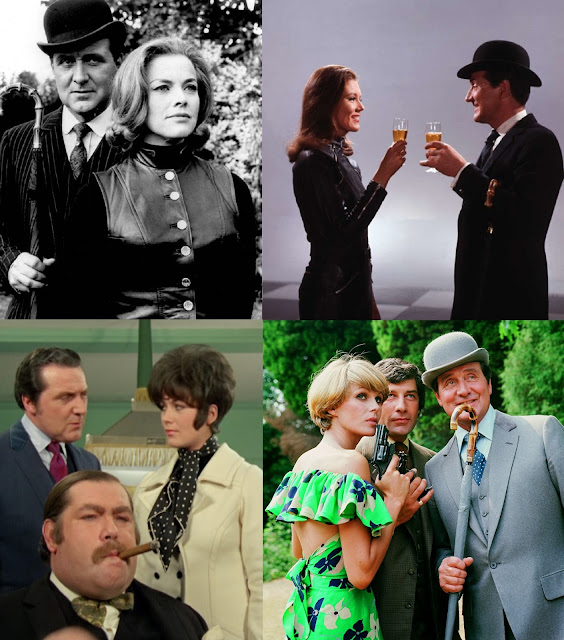
The Avengers – A man with a bowler hat and a woman who throws men over her shoulder
Now you can skip to the selections below and start watching, really, but if you want more about one or the other, you could say that both series revolve around a mysterious, flamboyant figure who tempts you from our world into a strange one off to one side, and that neither carry guns or take themselves as seriously as their mission…
Who is the Doctor?
When the current Doctor, Jodie Whittaker, fell to Earth to play the role for the first time, I wrote So Who is The Doctor Anyway? All You Need To Know About Doctor Who, but, again, the TL;DR—
The Doctor is a traveller in time and space who goes anywhere, from Earth’s past, present and future to alien worlds and stranger places still. The Doctor obeys no authority but their own moral sense, uses intelligence rather than violence, and takes joy in taking friends to explore the wonders of the Universe.
Doctor Who began in 1963 and has run ever since in one medium or another, but most prominently on TV through the following three decades and then again ever since 2005 – and back this very Saturday for New Year.
Who are The Avengers?
“The Avengers is about a man in a bowler hat and a woman who flings men over her shoulders.”
…said Patrick Macnee, Steed, and I can’t say better than that, can I? Or as a famous American trailer told us, that extraordinary crimes have to be avenged by agents extraordinary – John Steed, top professional, and his talented amateur partners – The Avengers. Together, they fight diabolical masterminds. Steed is a shady arm’s-length government agent whose gorgeous old-fashioned suits and bowler are almost as wilfully anachronistic as the Doctor, while The Avengers’ own version of time travel is to pair this seemingly conservative continuing lead with a series of intelligent, capable, confident, experienced and physically combative women that broke the TV mould and created the future (and several excellent men, but none so memorable as Steed or The Avengers’ women). Steed is more casually ruthless than the Doctor but just as playful – winning as often as not through outrageous cheating, while the only rule his partners break is gender. A brilliant balance of suspense and silliness, bizarre mysteries, and more than any other crime-fighting / spy-busting duo, they do it for fun. The Avengers is a secret agent series, a comedy-thriller, occasionally sci-fi, riding old-fashioned Britishness and Swinging modernity with equal excitement, its greatest genius to make all the women ahead of their time and the man from a bygone age, a fantasy of Britain with Steed playing on the swings at the heart of Avengerland.
The Avengers began in 1961 and ran through to 1969, along the way becoming the biggest ever hit British show on primetime US TV just as Doctor Who became a hit in dozens of countries, then returned as The New Avengers in the mid-’70s and, like Doctor Who, still lives on in Big Finish productions.
Both much more strange and interesting than almost any other TV series, both sometimes very funny, sometimes sinister, it’s no surprise that The Avengers is the closest show to my heart than any but Doctor Who. Several writers worked on both – and several plots found their way from one series to the other, with cross-fertilisation apparent as early as Sara Kingdom, the Doctor’s high-action, leather-suited companion in The Daleks’ Master Plan – but it’s the actors who really stand out. Avengers Honor Blackman, Diana Rigg, Gareth Hunt, Patrick Newell and Joanna Lumley all had Doctor Who roles too. The Third Doctor, Jon Pertwee, wasn’t just the most Earthbound but had his own The Avengers part, as did the Master, the Rani, and no fewer than three First Doctors (yet not the original). The guest artists appearing across both series are too many to list, but you can find actors from The Avengers and The New Avengers even well into this century’s New Who – most notably Bernard Cribbins and Diana Rigg, but also the likes of Christopher Benjamin, Lindsay Duncan, Roy Marsden and Stephen Moore (and more).
If you’re a Doctor Who fan looking for an excuse to be enticed into The Avengers, here are a few recommendations that stand out. Not necessarily the best, nor all my favourites, nor the most quintessentially The Avengers, but a selection box of flavours you might just recognise…
Doctor Who Stars in The Avengers
From Venus With L💘ve (Mrs Peel – IN COLOR)
The Brigadier, but not the one you’re expecting: he’s Jon Pertwee!
Plus other Doctor Who guest stars from as early as the very first story in 1963 (Derek Newark) to The Eleventh Hour in 2010 (Arthur Cox), and of course The Crimson Horror’s Diana Rigg as Mrs Emma Peel.
This was the first colour episode of The Avengers to be transmitted, and like Doctor Who’s first colour story, Spearhead From Space (itself packed with Avengers crossover actors), this is shot gorgeously all on film, goes down to Earth but not quite the world as we know it as our heroes – the eccentric dandy in the vintage car and the fantastically overqualified, caustically sharp-witted scientifically accomplished woman working for a mysterious secret agency – investigate an alien invasion…
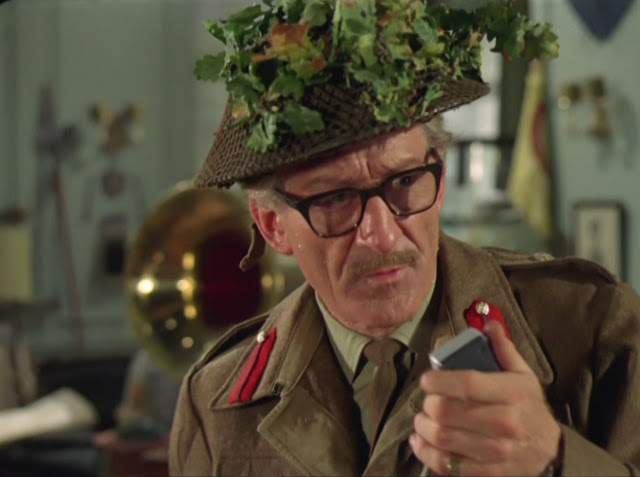
The Eagle’s Nest (The New Avengers)
In which movie Dr. Who Peter Cushing is delightful, in almost the same moustache!
He’s so much nicer than his Frankenstein, despite this role having crossover appeal to that too (and still more to Doctor Who – The Brain of Morbius, starring multiple-Avengers’ Philip Madoc).
This episode introduces Joanna Lumley and Gareth Hunt as The New Avengers, and for Doctor Who side-leads also gives us a minor role for the lovely Trevor Baxter, famously Professor George Litefoot. Slightly disappointingly, Litefoot gets an unrewarding role in a good episode, while Jago has a rewarding role in weak ones: Trevor Baxter’s partner in Jago & Litefoot, Christopher Benjamin, is probably the best thing in three different indifferent Avengers episodes, of which the best is probably Split! (which also stars the superb Julian Glover).
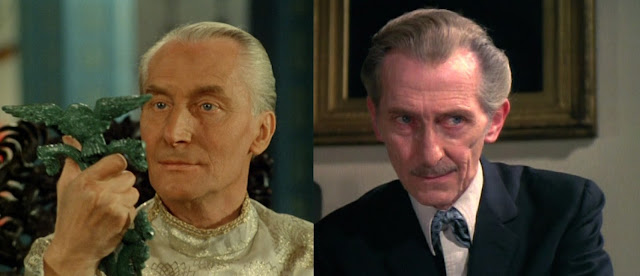
Return of the Cybernauts (Mrs Peel, Colour)
In which movie Dr. Who Peter Cushing is not delightful at all, but full of sinister charm.
With Frederick Jaeger, Fulton Mackay and of course the Cybernauts, of which more later.
Legacy of Death (Tara King)
Among many villains (and several Doctor Who guest actors) one-time third First Doctor Richard Hurndall.
This one’s a parody of The Maltese Falcon written by Dalek devisor Terry Nation (with a hint of Davros). He also sends up his own Daleks, not entirely successfully, in Thingumajig, while his Invasion of the Earthmen has an absurdly ambitious satirical concept not done all that well but does manage to anticipate The Sontaran Stratagem and even (briefly) the Sontaran design. But if you’re looking for a really excellent Terry Nation The Avengers, go for Take Me To Your Leader – despite the title, that isn’t very Doctor Who at all, but it is fast, stylish and hugely entertaining.
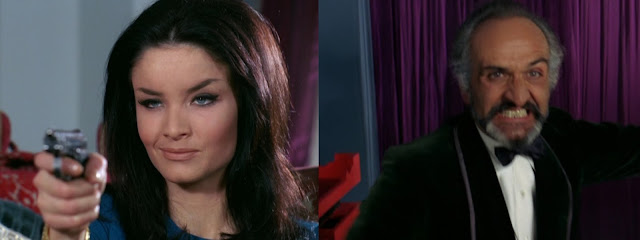
Stay Tuned (Tara King)
The story looks like a time loop… Could it be something to do with two evil Time Lords brought together (if only briefly sharing the camera) long before The Mark of the Rani – the Master and the Rani, Roger Delgado and Kate O’Mara!
Look – (Stop Me if You’ve Heard This One) But There Were These Two Fellers… (Tara King)
The wonderful Bernard Cribbins! He’s just turned 93 this week, and you can see this one on ITV4 on Monday 3rd January at 8.30am (he’s also in The Girl From Auntie).
But that’s not all – this outstandingly fun episode is written by Doctor Who writer Dennis Spooner and has several other crossovers from John Woodvine to John Cleese.

Dressed to Kill – Anneke Wills & Steed in fancy dress; Look – (Stop Me…) – Bernard Cribbins & Steed in a paper-strewn mess
Dressed to Kill (Cathy Gale)
Another topical episode as I write: this is a tale of the New Year, so one for tonight!
And among several fabulous guest stars is Doctor Who companion-to-be Anneke Wills.
Mission… Highly Improbable (Mrs Peel, Colour)
Not quite the Brigadier but a similar sort of role for Nicholas Courtney, with bonus Kevin Stoney – in between the two of them being on opposite sides in Doctor Who’s The Daleks’ Master Plan and The Invasion (though in the end they’re given quite small parts).
The Avengers Plots in Doctor Who
The Morning After (Tara King, though in this Steed’s mostly paired with Peter Barkworth)
This terrific, eerie, stylish adventure is immediately recognisable as a much crisper prototype of the more political Invasion of the Dinosaurs, though in this one the big, roaring monster is BRIAN BLESSED!
The Mauritius Penny (Cathy Gale)
Written by Doctor Who authors-to-be Malcolm Hulke & Terrance Dicks, in which a tiny thing spirals hugely out of control and eventually into a plot that echoes later in Doctor Who – Robot. Though it gets even bigger there.
Man-Eater of Surrey Green (Mrs Peel, B/W)
The most infamous of all, as most of this plot sprouts again in The Seeds of Doom. Although it’s also fair to say that both borrow quite a bit from Quatermass…
Doctor Who Cameos in The Avengers
Death at Bargain Prices (Mrs Peel, B/W)
Featuring André Morell (more bonus Quatermass), T.P. McKenna, John Cater and Peter Howell, but this exciting adventure with a department store most strikingly sees Diana Rigg arranging toy Daleks.
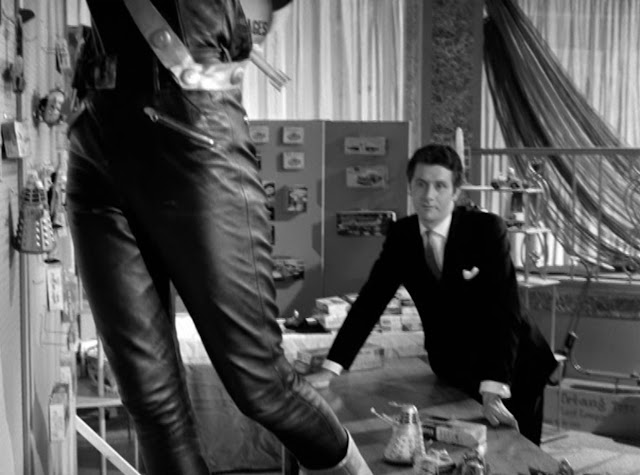
I know what the male gaze wants… Daleks. – Death at Bargain Prices
Target! (The New Avengers)
Gasp at repeated cameos for a shockingly abused TARDIS in The New Avengers’ most iconic (if not most logical) episode. Featuring many familiar faces and the worst Doctor in the world (medically), Target! is written by former Doctor Who Script Editor Dennis Spooner and is almost a doppelgänger for the previous year’s Doctor Who – The Android Invasion, written by former The Avengers Script Editor Terry Nation. Even the very first episode of The Avengers, Hot Snow, has a pre-Doctor Who police box in a rainy film insert in its surviving quarter-hour.
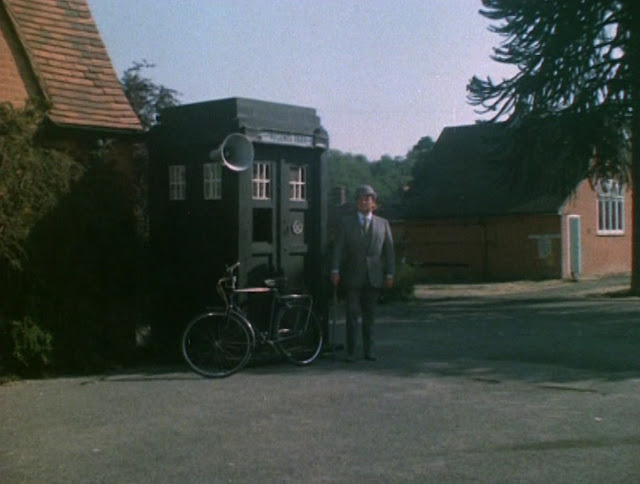
Target! – a police box stands on a village corner, John Steed at its side.
The House That Jack Built (Mrs Peel, B/W)
Before the police box exterior in Target!, an old-fashioned exterior hides weird ultra-modern corridors with what seems to be a super-sci-fi central control console. If the titular House That Jack Built isn’t a TARDIS… I like to imagine the villainous Professor Keller let the Master have his identity for The Mind of Evil, and the Master let him borrow his TARDIS to get at Mrs Peel in return. If ever The Avengers consciously borrowed from Doctor Who, this is it…
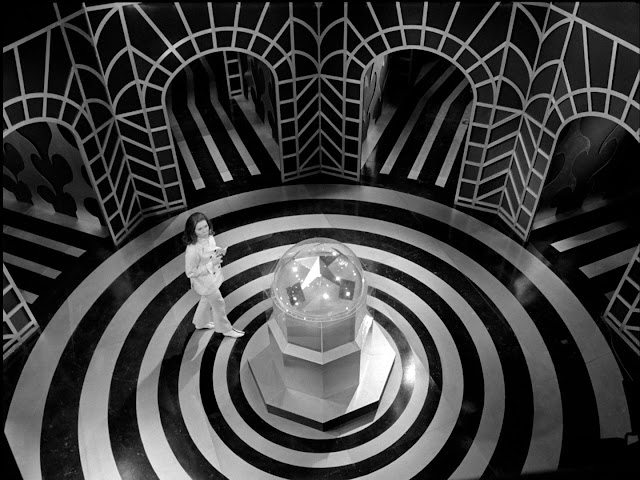
An Eccentric Array of Doctor Who-interest The Avengers Episodes
The Cybernauts (Mrs Peel, B/W)
…While this most sci-fi of all The Avengers conspicuously influences Doctor Who from the obvious Cyber-monsters through The Web of Fear and Spearhead From Space to Terror of the Zygons, with an abundance of familiar actors as a bonus (Michael Gough, Frederick Jaeger, Bernard Horsfall, Burt Kwouk, John Hollis, John Franklyn-Robbins…).

The Cybernauts – a blank-faced metal Cybernaut (brilliantly disguised in dark glasses, coat and hat). Smashing!
The Positive Negative Man (Mrs Peel, Colour)
It’s not so much the plot here that turns up in Doctor Who as many individual images; with its mysterious stalking figure that kills with one touch, or burning files in a safe, not to mention people being ‘magnetised’ to an antique car, I wonder who was watching a repeat of this one evening while working on The Ambassadors of Death.
The Gravediggers (Mrs Peel, B/W)
A Doctor Who writer in Malcolm Hulke and not just several Doctor Who guest stars but even two from half a century later in New Who (Diana Rigg and Steven Berkoff). Not given much to do here but a particular favourite of mine, this is The Avengers with the fabulous Wanda Ventham, who guest-starred in Doctor Who stories in 1967, 1977 and 1987, and I have to say New Who seriously missed out by not casting her in 2007 and 2017 too.
The Wringer (Cathy Gale)
See Doctor Who producer-director-to-be Barry Letts when still an actor! Plus, amid several Who actors, mind-melting Terence Lodge makes me feel this is a little like The Macra Terror.
Quick-Quick Slow Death (Mrs Peel, B/W)
Strictly Avengers by Robert Banks Stewart, who later wrote two of the most Avengers-adjacent Doctor Who adventures in Terror of the Zygons and The Seeds of Doom.
The Town of No Return (Mrs Peel, B/W)
Introducing Diana Rigg, whose Doctor Who – The Crimson Horror features an explicit plot lift from this, and for me the first seven minutes of this are the ideal introduction to The Avengers. Plus the first of many appearances by Patrick Newell.
Escape in Time (Mrs Peel, Colour)
And finally – ish – not just guest-starring Geoffrey Bayldon, on audio the fourth First Doctor (or minus-oneth, or… well, another one, anyway), not just one of my favourite Avengers guest villains in his biggest role (Peter Bowles, who crosses over to The Sarah Jane Adventures many years later, just as Murray Melvin goes from the very first Avengers episode to an enigmatic enemy in Torchwood), not just one of the most vividly enjoyable escapades in Avengerland, but the one with time travel!
Or is it?
Though these are the ones that most stand out for me, you can find Doctor Who connections in dozens more of The Avengers. The Curious Case of the Countless Clues stars Edward de Souza, the only TV Doctor Who lead in a story with no Doctor at all; All Done With Mirrors and Angels of Death feature Dinsdale Landen, but in which is he as villainous as Fenric? Fog is as mock-Victoriana as The Talons of Weng-Chiang, even down to Patsy Smart’s crumbly Cockney, while The Enemy of the World borrows wholesale from The Living Dead. And I’ve somehow not paid enough attention to some of my very favourite Doctor Who villains who cross over as some of my very favourite The Avengers guest stars (and villains – or are they?), so three each for:
- Julian Glover – Pandora, The Living Dead, Two’s A Crowd
- Philip Madoc – My Wildest Dream, The Decapod, Death of a Batman
- Peter Jeffrey – The Joker, Game, House of Cards
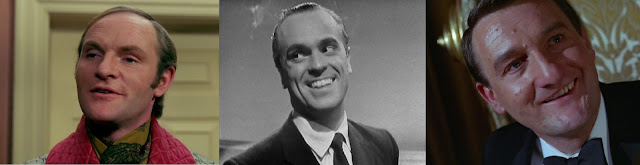
The Three Villains (or are they?)
Or… Doctor Who Stories to intrigue The Avengers Viewer
Spearhead From Space (Third Doctor)
I’m mainly assuming all this is most likely to be read by people more familiar with Doctor Who than The Avengers, but for the other way round, this is a great place to start. As I said above, this is about as The Avengers (and as Quatermass) as Doctor Who gets, with crossover actors, a flamboyant Doctor and a brilliant woman lead, and where the sinister countryside should have a sign up saying ‘Twinned with [From] Venus [With Love]’.
The Seeds of Doom + City of Death (Fourth Doctor)
The Seeds of Doom is the most infamous homage, with a mean green* menace from outer space, a millionaire plant obsessive with a murderous chauffeur, and even a scene-stealingly fabulous eccentric elderly lady. But I’m going to go against the tide and say that while it may be very Avengers on paper (from Avengers writer Robert Banks Stewart), the stylish, powerful direction means it doesn’t feel like The Avengers at all. It’s the closest Doctor Who comes to The Sweeney. So I’d pair this with its opposite: between them brutal The Seeds of Doom and witty, arch City of Death are the tonal extremes of Tom Baker’s Doctor, and while the plot has little of The Avengers, City of Death has an insouciantly Avengers mood and even Villainous Julian Glover.
*Technically black and white in The Avengers
The Web of Fear + The Mind Robber (Second Doctor)
Similarly, take one story with terrific filming and robots exchanging great, smashing blows from The Cybernauts (and guest-starring part-time Avenger Jon Rollason), add another with fabulous Op-art sets and surrealism (featuring the most Avengers fight for any companion), to find Doctor Who being quite Avengers-y between them.
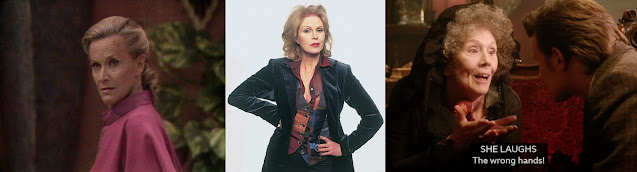
The Who Avengers!
The Crimson Horror (Eleventh Doctor)
Villainous Diana Rigg! Who could ask for more? With a diabolically The Avengers sort of plan a hundred years early and a fake-out with a gramophone borrowed from her first The Avengers episode.
The Trial of a Time Lord – Terror of the Vervoids (Sixth Doctor)
Guest-starring Honor Blackman as Professor Lasky, almost as intelligent as Mrs Gale (though to be frank both her judgment and her outfits are far better in The Avengers).
Planet of the Spiders (Third Doctor)
Gareth Hunt as a pre-The New Avengers bit of rough. Also starring (in thrilling stunt chases) Jon Pertwee from The Avengers – From Venus With Love.
The Android Invasion (Fourth Doctor)
Terry Nation writes by far his most The Avengers Doctor Who script in tone, with a mysterious village and the Brigadier replaced by Mother (Patrick Newell). And yet a completely different story is titled The Androids of Tara (though that one’s much better, even more entertaining, and stars Villainous Peter Jeffrey).
Robot (Fourth Doctor)
Terrance Dicks borrows just some of his The Avengers story The Mauritius Penny, the Doctor and Sarah Jane are as witty and wonderful a pair as you could wish for, and Harry disguises himself as Steed. And both Steed and the Doctor formatively fight fascists.
The Stones of Blood (Fourth Doctor)
Though Honor Blackman turned down a role in this one, we still have fabulous women, including an icily amazing Time Lady who’s the Doctor’s equal, and like so many Avengers it could be subtitled ‘Escape From the Country’ (the villain has chosen to escape to the countryside, which just proves it).
The Curse of Fatal Death (The Many Doctors)
A Comic Relief spectacular in which the ultimate Doctor is Joanna Lumley.
Pick one, dive in, and enjoy!
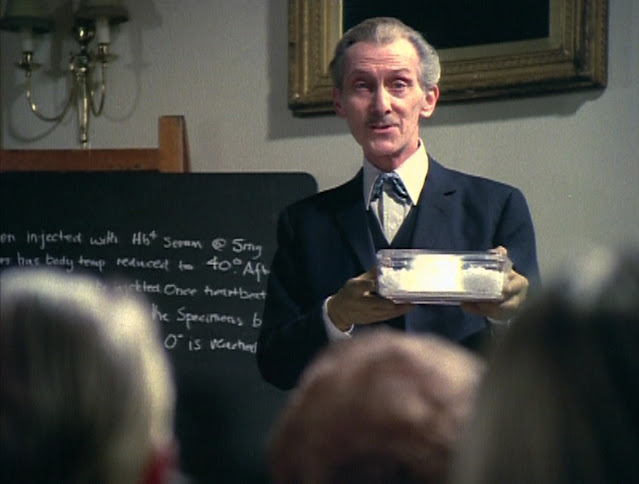
This was partially inspired by the lovely Roy Gill’s #AvengersWho Twitter thread at the beginning of the year, mashing up The Avengers / Doctor Who story titles. I particularly enjoyed his ‘Castle De’Ath To The Daleks’ and ‘The Hexapod’, Elliot Chapman’s ‘Dial a Deadly Assassin’ and Brendan Jones’ outstanding ‘You Have Just Been Pulverised Into Fragments And Sent Floating Into Space And In My Book That’s Murdered’. I added ‘Doctor Who Was That Woman I Saw You With’ and ‘Rise of the Cybernauts / The Age of Steed’, but then took eleven months to think about this more detailed contribution.
Update: Daniel Blythe brilliantly calls my attention to a fourth First Doctor (technically the third?) in The Avengers, as Frederick Jaeger plays a character who becomes the Doctor for a time in Doctor Who – The Savages.
Labels: Doctor Who, Honor Blackman, Jago & Litefoot, Joanna Lumley, Julian Glover, Peter Jeffrey, Philip Madoc, The Avengers, The New Avengers


Wednesday, August 29, 2012
The Weirdstone of Brisingamen

Childhood
I grew up with several fantasy books – first my Dad reading them to us, then reading them for myself – but I think The Weirdstone of Brisingamen was the one that felt most personal. I was born about ten years after it was written, and raised about ten miles from where it was set, in a town at the top of Cheshire or the bottom of Manchester… So more than any other story I knew, this one seemed to have an immediacy, one that was almost familiar, only just out of reach in space and time. There’s something about a lot of adventure stories that grab you as a child, the feeling that it could happen to you, in a place you know – one of the reasons I have a soft spot for little-loved Doctor Who story The Android Invasion is that it felt, watching it, like the sort of village Mum and Dad might drive us to on a Sunday – but this was different. I think we only actually went to the Edge a few times when I was a child, but knowing that it was there, and real, almost close enough to touch, gave this tale a special magic. So many of the stories I loved, even if they were set in our world, seemed distant from us: the mystic fringes of Wales, Scotland or Cornwall; England always somehow meaning ‘South-East England’ on the page or on TV. But no legend was as powerfully evocative as that of King Arthur (greatest of our four great national myths), and to find that he was buried not at the other end of the country somewhere but in our own North West, now, that was marvellous.
For Richard, who I met in London and fell in love with half my life ago and only then found he’d gone to school not much of a walk from my parents’ and grown up almost on the edge of the Edge, the book is even more powerful. As a boy, he’d lived not ten miles away (close, but beyond the travelling power if not the imagination of a child), close to Lindow, not quite in one of those “mean dwellings” that Cadellin disparages but only just up the road. So if it was special to me, it was literally close to home for him – and, building on that strange coincidence into sheer improbability, for the lovely Nick’s other half Jon, who Richard knew as a boy and who Londoner Nick met quite separately long after we had, in turn, become friends.
I read The Weirdstone of Brisingamen many times when I was a boy, and it stayed part of me – instinctively, getting the train up north to see family I always look out for Shuttlingslow as I get towards the end of my journey – but I’d not thought consciously of it for some years, despite having discovered Mr Garner’s Red Shift in a peculiarly vivid way in the early ’90s as a relationship of mine was nearing its end (with his even, improbably, taking me to visit Mow Cop for the only time in my life). Then, in the last year, it’s strange – first I felt the Weirdstone pressing on my mind, with details suddenly flashing back to me, and then almost as if it was intruding insistently into reality. For the first time in decades, I re-read it and its first sequel, The Moon of Gomrath, last September, a little before turning 40, still thrilled.
Then I discovered CDs of both books read by Philip Madoc, always a favourite actor of mine, and gave them to Richard for his birthday early this year. I’d not anticipated just how thrilled he would be, and we listened to them swiftly, enraptured at Madoc’s marvellous voice telling such marvellous tales (and, after a lifetime for each of us pronouncing “Gowther” with a hard ‘th’, changing our minds).
Rediscovery
And then, astonishingly, after so many years, Alan Garner announced that he was writing the third – and not just that, but around Jodrell Bank. Alderley Edge was a magical place from Richard’s childhood; both of us had always admired Jodrell, a marvellous scientific achievement of the area; but even more, over the last couple of decades my Dad’s worked there, deploying his natural charisma in public speaking (something I’ve always had to work at) in enthusing and informing people at the Planetarium. Last month I visited my parents; my Dad had just glimpsed an old gentleman who he thought was Alan Garner being shown around, ready for a big event there on the release of Boneland. I found a picture online: “Oh, yes, that was him.” It was all I could do not to squee. And “Do you know the Wizard?” asked my Mum just last Monday. They’d just been to the Inn for a wedding reception at the weekend, for an old college friend of mine for whom Richard and I had attended a very different dedication ceremony some years ago. So it’s as if the trilogy is closing in around me, slipping through the interstices of folk memory to press on my reality.
I’m hugely excited by the looming Boneland. My one regret is that poor old Philip Madoc passed away this Spring, and will never be able to gift it his marvellous voice.
I’d meant to write about The Weirdstone of Brisingamen itself. I haven’t. I’ve always been one for plot, but somehow this book’s always been most present for me in feelings, in moods and mental images. Just as I felt on the edge of its world, it feels between ours and somewhere else, and not just because of its plot, that like much of the best of Doctor Who it’s not about a great event but on the fringes of it, seeing the knights of one war and preserving them for the next. Think of Selina Place, both something like the Cailleach of legend and a modern woman using the highest technology in the novel – a car – and at the heart of a witch brood that’s also a conspiracy of ordinary blokes you might meet down the pub (or be listening in one as the local gossip gives you away). Think of Gowther and Bess, earthy, reassuring, thoroughly normal… But, into the ’60s, almost the last time you can imagine it in ordinary life (I can just, just remember a rag and bone man calling at our road when I was very small), still driving a horse and cart, as if for all their ordinariness they’re half in a time of legend and not awake to the fact.
And the moods and images are because the story deliberately takes you into fears and places that a child could or would get into, of course. The cause of a Wizard’s sorrow may impress itself into ordinary people naming it a “Tear,” and the hooded one in his mist may be right out of a horror film and a pleasurable thrill of fear – with what’s under the hood always staying with you as worse than all the horrors you imagined, because you imagine your own – but it’s the fears of things that could get you playing out in the woods, or the mud, or in caves, even under skies of birds, that strike at the familiar and make your own life feel claustrophobic. Though almost everyone feels utterly claustrophobic after Plankshaft. Throughout my childhood, I loved, but also somehow felt threatened by, winding my way through tiny caves and passages. I’ve been a fat man for a long time, but I was a very thin and gawky boy, and I found a strange satisfaction in twisting my way through places that I couldn’t really twist through. I still have vivid memories of trying to get around a ‘chimney’ in an educational museum that I was really too tall for, or my parents wearily calling me to give up as I forced myself around tiny, chilly cracks between caves in the Peak District. I suspect all that, both fun and fearful, something I enjoyed but dreaded, was a child’s way of dealing with that extraordinarily long, unforgiving account of Colin trying to make it through the dwarves’ improbably horrible tunnels Where no Svart will ever tread.
Coming back to the book as an adult, many of the people and images are still as powerful as ever – putting your trust in Cadellin, being unable to forget being part of his world, the black and terrible storm of the climax as the Morthbrood fly from something greater that we only have a whisper of. I can also feel things to kick against, and wonder if I’m meant to, torn between agreeing with the condemnation both spoken and metaphorical of pollution, and thinking that if elves and dwarves shut us off from magic and then slag us off when we find other ways to live, aren’t they just insufferably up themselves (oh, just wait ’til the sequel)? And the most distinctive, most jarring thing structurally about Alan Garner’s writing, that you’ll find here and throughout his early children’s books: where you might expect a moment to catch your breath after the climax, a coda, some resolution that takes in the aftermath of the grand adventure and adjusting back to our world, for both the children taking part and the children reading… None of that. Every time, within a few short lines of the big finish, the book simply stops – the wrath of Nastrond is coming, it’s coming, it’s nearly here… Firefrost withstands it, it blows itself out, and seventy words later all the bodies have been swirled away,
“And this tale is called the Weirdstone of Brisingamen. And here is an end of it.”I’ve never known if that abruptness was a deliberate choice, an unpolished craft before books on storytelling structure abounded, or a sign of an author exhausting himself. To me, such Garner books feel like they finish before their time, almost a slap in the face, yet it’s that very incompleteness – a sense of certainty about the big things, and merciless uncertainty about everything else going back into ordinary life – that’s a strangely powerful signature, telling us that, no, people don’t live happily ever after, or if they do, it’s no business of ours, and not easy to find out. The end of the book, like Colin and Susan being separated from the magic, feels like loss rather than comfort in victory. And if anything I’ve heard about Boneland is true, it sounds like Colin’s felt as unresolved for several decades as the readers.
Labels: Alan Garner, Books, Fantasy, King Arthur, Personal, Philip Madoc, Richard, The Weirdstone of Brisingamen
Monday, April 30, 2012
The Avengers – My Wildest Dream
Someone in the office you want to kill? Aggresso-therapist Dr Jaeger offers a harmless way to relieve your frustrations. What could possibly go wrong? The Avengers – My Wildest Dream gives you The Manchurian Capitalist, a disorientating, violent thriller of board members killing each other in dreams, all witnessed by Steed and Tara. Guest stars include Peter Vaughan, Edward Fox, John Savident and the mighty Philip Madoc, who sadly died last month, as did stylish director Robert Fuest, who gives the episode real (or is it hallucinatory?) punch: dizzyingly shifting points of view; stunning fight sequences; showing off striking sets…
“It’s a – dream! It’s all a dream!”My Wildest Dream was one of the episodes that first got me into The Avengers when I discovered the series in the middle of Channel 4’s mid-’80s repeats (even taping the thrilling fight and car chase after Vengeance On Varos and The Mark of the Rani to fill up one of my precious Betamax tapes), and for me it’s still a favourite. You can find it on Disc 3 of The Avengers – The Complete Series 6 DVD Box Set, or Disc 32 in The Avengers Complete 50th Anniversary Collection – I’ve previously offered tips on which The Avengers DVDs to buy – while original viewers in 1969 had a slightly harder job: because of concerns about the violence having too much oomph, it was shown on a different day than usual and much later in the evening. Even though there’s only one tiny spot of blood (the BBFC now classifies it a PG). Surprisingly, this was made quite early in Tara King’s season of The Avengers but held back until close to the end, despite being one of her best – Linda Thorson is at her most mature and confident, looks cool, has great timing and gets a fantastic fight, so this fits right in with her later episodes, generally her best and a fabulously strong run.
Though he remained as consultant for a while longer, My Wildest Dream was the final script by Philip Levene, one of The Avengers’ most prolific and defining writers, his scripts known for their humour, teasingly science fiction elements and general outrageousness. This, however, while witty in places, is uncharacteristically down to Earth and tense – while for me Tara King’s season of The Avengers is one of the two that best balance the silly and the sinister, this threatening psychodrama weighs heavily at the sinister end and is easily Levene’s darkest, revisiting his Death’s Door drugs and dreams but with considerably more palpable danger (plus a dash of Brian Clemens’ Honey For the Prince). And that’s greatly boosted both by Robert Fuest’s vividly in-your-face direction and Philip Madoc’s unsettlingly bipolar performance…
Robert Fuest and Philip Madoc
Artist, designer and director Robert Fuest started off on The Avengers as a set designer right in the early days, on Ian Hendry episodes that no longer exist – though you can see his designs in the surviving episode The Frighteners, and pictures of some of his work in the photo galleries for the Season 1 and 2 DVDs – and came back with a bang at the other end of the ’60s as a director in his own right, instantly becoming the best of the Series 6 helmsmen across the seven Tara King stories he directed. He returned for The New Avengers’ The Midas Touch and The Tale of the Big Why, though he’s probably most famous for the two Dr Phibes films he directed in between. Yes – they were his idea. Marvellous!
My Wildest Dream was actually Fuest’s first Avengers episode in the director’s chair, though the first of his to be broadcast was Game, a story so highly regarded it was chosen to launch Tara King, and which I’ve previously raved about for its Op-Art inventiveness and superb eye for colour. My Wildest Dream is less quintessentially Avengers, not having the same immediately joyous wacky appeal, but for me it’s even better. The cinematography is simply outstanding, with lessons learned from those 1961 Avengers taped in poky sets – watch for those inventive camera angles that liven up, say, Nurse Owen talking by showing her in her own desk mirror, or his instinctive affinity for shadows – but getting every advantage from the bigger budget, whether it’s roving cameras inside cars on location or the rapid cross-cutting stabbings that still make you jump even if what you see is rarely what you think you see. That other most prolific, defining Avengers writer Brian Clemens clearly loved Hitchcock as an influence on his scripts, but if ever there were a Hitchcockian Avengers director in his pace and energy, his inventiveness, and his gleeful black humour that nearly but not quite goes too far, it was Robert Fuest.


While Bob Fuest has always been one of the most outstanding contributors to The Avengers for me and here hits his stride so perfectly that it’s difficult to believe it was his first time, on the other side of the camera there’s the final Avengers performance from another of my favourite irregulars in the series, Philip Madoc of the gorgeous voice and predatory grin. While in his five Doctor Who screen roles he was usually the guest-starring villain, in his five Avengers episodes he was usually a little lower down the cast list, but still making a memorable impact. I love his understated Dutch banker who quietly realises when the game is up in Death of a Batman and his scene-stealing Soviet agent in The Correct Way to Kill (for which, when I reviewed it, I was for very personal reasons particularly sad that fellow actor Peter Barkworth had just died; since then, tragically, all that episode’s male guest stars have passed away), but it’s his first and his last appearances in The Avengers that are his most striking for me. Startlingly young and smooth in 1962’s The Decapod, he unleashes that fabulously wolfish grin as an ambassador who may or may not be the villain – while in 1969, his uncanny, unhinged business executive Slater persistently steals the show (and is framed on probably my favourite Avengers set just to make sure you can’t ignore him).
For my other favourite series, in Doctor Who it’s strangely Philip Madoc’s first and last TV roles that are his least impressive, while in between this great actor created two utterly terrific but unrecognisably different villains (as Jack Graham suggests in his tribute on Shabogan Graffiti). Both The War Games with Patrick Troughton and The Brain of Morbius with Tom Baker are outstanding stories, with Time Lords the ultimate villains in each but Madoc’s roles more memorable still: the War Lord, the cold alien conqueror who comes in after his junior villains have been fighting to outdo each other and dominates with underplayed, deadly, quiet wit; and egotistical surgeon Mehendri Solon, determined both to bring his master back from the dead and to establish himself definitively as the
“Your name will also go on ze list! What is it?”I’d provide an overview of Philip Madoc’s career, but he’s been in everything. A champion of and the definitive portrayal of The Life and Times of David Lloyd George; DCI Noel Bain in his own detective series, A Mind to Kill; a long-running lead role as Cadfael on the radio (and, like his TV counterpart, the Master – or is he?); probably most famously for an actor famous for his guest roles, the U-Boat Captain in The Deadly Attachment, Dad’s Army’s finest episode, who visibly almost corpses as he rejects the idea of nasty, soggy chips, wanting them “Crisp – unt light brown.” I wish Channel 4 would show again or release 2003’s eerie Y Mabinogi, for which he provided a (Welsh) voice of legend and which I’ve only seen once, in the middle of the night. And it’s telling that, on the joyous news last month that Alan Garner was at last to return to his Alderley Edge tales – the first two being such a major part of our childhoods – the first thought for both Richard and I was that, sadly, Mr Madoc would not be around to record Boneland for CD in the gorgeous way he’s read The Weirdstone of Brisingamen and The Moon of Gomrath, each of which we’ve recently listened to together.
“Don’t tell him, Pike!”
I think there was only one event I knew of at which I might have met Robert Fuest, and I wasn’t well enough to go; there were a handful at which I could have met Philip Madoc, and though I was too ill to make most of them, I’m so glad I made it to a shonky pool hall in Barking in 2008 on the DVD release of The Brain of Morbius. Though he was pleased to recall praise from other actors for his sinister War Lord, he was very clear that Dr Solon was his favourite Who character, for the script, for how much he had to do, and for how much fun it all was (miming dropping and picking up an evil brain). I remember him being presented with his own copy of the DVD, and saying sotto voce to fellow guest Cynthia Grenville as she passed him hers,
“Now, Cynthia, if I sign that, it’ll rub straight off.”Asking which one it was when presenting him with an earlier DVD release of My Wildest Dream, I told him:
“Oh? Why?”
“Because you haven’t taken the wrapping off.”
“You go a bit mad in this one. Peter Vaughan had been injecting you with new drugs.”But what I most remember was when I apologetically passed him our DVD of Doctor Who – The Power of Kroll to sign, knowing his opinion of it, and all the backstory why (and why he was much happier that his real final Doctor Who roles, many years later, included classier audio dramas like Master and Faction Paradox). Philip bared his teeth at it and asked, carefully enunciating each word, “Is this the one by the sea-side?” as if not quite actually saying ‘Why do you wish me to autograph a turd?’ Though he perked up mildly at the feature about him, A Villain For All Seasons, I felt I had to justify myself:
“Ah, yes. He was always doing that.”
“I know you don’t think much of this one, but I always find your performance very entertaining. It’s the way you look permanently pissed off – you seem to be playing someone who’s looking at his boss and thinking he could do a much better job of it.”I was rewarded with that full, dazzling, dangerous, wolfish grin.
“Just very good acting.”
That Golden Moment
“I feel so much better, Doctor. I feel so much better.”

From the disturbing, disorientating teaser to the charming, funny tag scene, My Wildest Dream brims with superb moments, taking in Tara’s most breathtaking fight sequence and probably my favourite – and one of the most barking – of all Avengers sets along the way. But the scene that sums up this episode for me may just help explain why some censors and schedulers took fright. It’s less a golden moment than a crimson one, with two brilliant guest stars and stunning direction that both surprises and shocks.
Boardroom tensions have been just a little edgier than usual at Acme Precision Combine Ltd; undergoing unconventional treatment from the sinister Dr Jaeger, one board member has already stabbed a rival then fallen to his own death while apparently believing himself to be in a dream, and now Philip Madoc’s Slater seems to be going down much the same path to conclude his own clashes with Henry Winthrop. And, as they did the first time, Steed and Tara have had a mysterious tip-off and dashed to the scene in Steed’s Great Gatsby yellow Rolls (ahead of being incredibly fashionable in the ’70s, and tipped to be so again this year). Winthrop’s home, The Lodge, is a great find – like a giant witch’s hat, it’s very distinctive, a memorable setting for a murder. We hear Howard Blake’s swirling music and sinister bass beat, as we did the first time, as Madoc explains in gleeful voiceover how Winthrop lives alone, the camera cutting from him in Jaeger’s surgery, reflected in his own knife, to his legs striding up to the house, to viciously guillotining Winthrop’s picture in his red-lit darkroom – an inspired piece of substitute violence – before he stabs, Winthrop dies, our heroes burst in —! Only for Winthrop to turn, developing film in hand, surprised but very much alive, Slater’s attack being just another drug-induced fantasy acted out with his aggresso-therapist. Or is it?
Of all the five members of the Acme Board, Slater and Winthrop are by far the most entertaining, thanks to Philip Madoc’s superb turn as a man who, doped out of his head, is the one who most enjoys it all and then is most miserable in withdrawal (only in being separated from his dreams and his doctor, of course – what do you mean, ’60s drug metaphors? It’s not a metaphor, he’s just drugged to the eyeballs) and, as his main rival for direction of the company, the marvellous John Savident. Another man of many memorable guest parts, he’s probably best-known for Coronation Street – never mind – and here he grabs the camera in just one scene, surprised by the intruders, shocked by news of deaths in the company, but preeningly confident that it’s just a false alarm and, if not, he can handle anyone with the gun he keeps to hand.
But outside, in another car among the daffodils, Jaeger’s cool, calm orderly Dyson is losing his cool and his schedule as he frustratedly tries to bring the lurching, incoherent Slater round just enough to prod him out of the car and into the Lodge. Tara sees him go, just too late, and the hallucination plays out all over again, Winthrop gasping horribly and lurching right into our faces like – sorry, I’m quite fat, too, but it’s an irresistible simile – a harpooned whale just as our handily unimpeachable witnesses burst in once more and, satisfied at acting out his fantasy again, Slater thanks his doctor, smiles, and offers his knife to them to put away for his next go…
The Avengers has always shown death, and frequently great violence, often of a fantastic nature, which the directors imply rather than present in gory horror – people shredded, bloodlessly, in The Hidden Tiger (with which this has a twist or two in common) or The Winged Avenger spring to mind – but while those make you fill in the blood, the sheer speed and savagery of the stabbings in this episode, the way the camera plunges around, even when most of the time it’s only dummies that the knives are plunging into, makes this far more startlingly visceral than earlier stories that should, in theory, have been more gruesome. And of all the scenes, this one’s the most striking, in part because all four actors are compelling, but also because in the darkroom everything already looks like it’s drenched in blood – and it’s the only moment when Fuest really pushes it as we see a splash of proper blood on Winthrop’s beached front and Slater, fascinated, pokes his finger in it for a moment to look at it before turning to Steed and Tara. He’s going to have a hell of a comedown…
Steed and Tara
I love The Avengers and, unlike some, in particular the sixth series with Tara King – that glorious fanfare opening with knights, roses, running along the bridge in sunshine and colour to open every episode, and with mysteries solved by Patrick Macnee at his most urbane and authoritative and Linda Thorson wide-eyed but winning through. Both lead actors are on top form in My Wildest Dream, with Linda Thorson especially giving one of her best performances: here, Tara is resourceful, witty, stunning in one of the series’ most physical fights and puts off an unwelcome admirer with considerable style (and a cheer from me when she throws him flying). She even gets to do such effective detective work in following leads that Steed gives her twelve out of ten.

It’s a great day for Steed and Tara’s outfits, too. Tara’s given two looks with culottes, which really suit her, a pleasant pale blue and white ensemble and a terrifically cool one with a leather jacket that she looks far more comfortable in than if she was forced into one of Cathy Gale’s old catsuits (something Diana Rigg never liked). That’s what she wears when checking out Slater’s optical workshop at Acme, when Fuest’s direction really lets rip in a massive Pop-Art punch-up between her and Dyson, as both hurl each other across an enormous room filled with blue, red and yellow glass, framed through jagged broken glass and targets and then finally leaping out through the door and into an almost as kinetic car chase, all to the accompaniment of some of Howard Blake’s most exciting music and then Laurie Johnson’s (which I remember from the likes of Something Nasty in the Nursery). Outstanding. The follow-up fight’s briskness is a bit of a let-down, not to mention showcasing unsafe taste in decoration, but you can almost hear her saying, ‘Well, haven’t we done this?’
Steed, too, looks good – particularly in grey with a striking copper tie, but also in his dark blue suit, blue shirt and maroon tie or rich chocolate-brown suit with trademark deeper brown collar and matching tie. He can even get away with a yellow shirt and olive-brown suit, just as she manages to look businesslike in a bright kimono, though both of them have brief bad moments (ironically, the only outfit she’s complimented on on screen is a green tartan best left to a Scottie dog, while it’s a good job that the closing tag scene has such wit and warmth to distract you from his hideous brown striped trousers and roll-neck). His best scene here, on the other hand, is far more laid-back than Tara’s physicality – once she’s tracked down Dr Jaeger, he goes in for the kill. Or, far worse, the piss-take…
Bad Therapy
“You’re not in my dream. Go away.”

Madoc is outstanding as he’s pulled from one reality to another, always told what to think by forceful medical figures, confused but sullen and resisting – and never more memorable than once he’s been whisked away after killing Winthrop, to be discussed by Steed and Tara with pompous Dr Reece, who believes everything in the world can be dealt with by “New drugs, you know,” and who keeps confronting him with the nasty reality. It’s a good scene in itself, as everyone simply insists on their own point of view and has no interest in listening to the people they’re talking to, but it’s elevated to brilliance by Fuest’s direction and Robert Jones’s hilariously untherapeutic set design. Yes, rather than being put in a comfy bed on a friendly ward with flowers round a little window, Slater has been put in the Observation Room. And I can never help but hoot as Reece stalks away from Slater, both of them still talking across each other, and the massive white space with a threatening red stripe down the middle, pointing to the patient, is revealed, the word “OBSERVATION” picked out in large, unfriendly letters along the whole back wall. Just to perfect it, it doesn’t have a door, but another wall, which simply glides in front to snap shut and leave poor Slater stranded. Walls just shouldn’t move like that. And Reece’s moving phone mounted on it does strange things to your head, too.
“A catharsis! A release of all repressions and hatreds! A man lives out his dream – his wildest dream!”Peter Vaughan is another of my favourite actors, another I’d love to meet, and another with a list of roles as long as your arm. Probably best-known as Porridge kingpin Genial Harry Grout, today (like top Avengers guest star Julian Glover) he’s reaching a whole new audience in Game of Thrones, though not so far in its sexposition scenes, high fantasy’s answer to the Topless News Channel. And his Jaeger here is utterly compelling, a self-confessed quack who genuinely believes that he’s ahead of his time, a pioneer. He is a real doctor, too – but of what (perhaps Valeyard is a German title)? Intense, mesmerising, vaguely Germanic, he’s My Wildest Dream’s other outstanding performance, in a role that has much in common with Ronnie Barker’s Mr Cheshire in fellow Avengers classic The Hidden Tiger – an obsessed, focused, brilliant technocrat (and a bit round-faced and in Porridge)!
While Laurie Johnson does a splendid job taking over the music for The Avengers once it goes into film from Series 4 onwards – not least in providing the main title them with that perfect fanfare – for some of Series 6 he was busy with a musical and recommended new composer Howard Blake, later of Flash Gordon and The Snowman fame; this was the first of ten episodes for which Blake provided much of the score in a similar but sharper style, and arguably his best (up with Who Was That Man I Saw You With, which provides the opposite bookend to his Avengers soundtrack CD release).
Between them, it’s Peter Vaughan, Howard Blake and of course Robert Fuest who seize our attention from the first here in a gripping teaser sequence as the first member of the Acme Board narrates his stalking his ideal victim to a harsh jazz beat, up the fire escape, into his room, a vertiginous spin and plunging his poniard in to stabbing brass – then reeling out into reality, disorientatingly now set to floating, dreamlike music, where it’s only a dummy with the man’s face that he’s knifed, egged on by Jaeger’s shouting and injections. After which he’s picked up for work by none other than the man he’s just ‘killed’… Dr Jaeger believes so passionately in himself that he’s the centre of the episode for most of the way through, dominating members of the Board and the voice that keeps urging, compelling. Madoc’s scenes with Vaughan crackle with conviction as two superb actors spur each other on – one sweating, sullen, in denial, then finding release; the other lashing out with sheer charisma to force Slater into accepting his point of view, revealing his innermost fears and hatreds, then delighted as he makes a breakthrough:
“Excellent! That’s really excellent, Mr Slater! ‘Kill’… ‘Destroy’… And ‘erase’! I particularly like ‘erase’!”And as his ‘patients’ stab and stab again the dummies with the faces of their tormentors, though you know it’s only a dummy, though you know no-one’s really being murdered – this time – you can’t help feeling queasy at the violence with which sawdust gouts out onto the glass table through which we’re seeing Jaeger’s rapt face.

Of course, it all falls apart. That’s what happens when Steed walks in.
From the moment Steed charmingly praises Jaeger’s receptionist, Janet Owen – “What a nice voice you have. Soothing” – and she’s one of the least charmed respondents in TV history, and Jaeger makes the mistake of letting this relaxed, charming man who claims to think he’s a horse into his consulting room, Jaeger’s galloping downhill faster than you can say ‘woo’. Suddenly, the Doctor is in need of some aggresso-therapy of his own. And the other big guest star you’re likely to recognise might just help…
Not Liking Steed, and Simply Not Like Tara
“Who is it you hate?”Oh, poor Teddy. No, scratch that – the Hon Teddy Chilcott is an utter git, a self-obsessed upper-class twit who’s clearly met Tara at one of the parties she hates and just will not leave her alone. It’s rare that any of the Avengers get a love interest, and here she’s very plainly not interested – even in Edward Fox. Handsome but querulous, he disapproves of her “cloak and dagger nonsense” and even more so of Steed. The impression is that he just doesn’t want a woman to work, but it is perhaps possible that he’s particularly pissed off by secret agents – might he afterwards be so scarred by this experience that he applies himself to the secret service in order to control them, and winds up M? Never! But, sexist git as he is, the way Tara simply keeps ignoring him is very funny, from her replying to his fishing for a compliment (“Persistent,” she suggests), to her priming Steed with excuses to get away, to the marvellous moment when he lies in wait to surprise her with flowers… And his despicable follow-up, where his sexism is notably only sustained by false advantage, the swine, and exactly how he gets his comeuppance. Then, satisfyingly, he’s beaten up for a third time, now by Jaeger’s nurse / receptionist, and deployed as a sinister pawn in which, at last, you can see Fox as the Jackal to be.
“Steed.”
“Who is it you hate?”
“Steed.”
“Who is it you hate?”
“Steed!”
Nurse Owen is, though, the only element of My Wildest Dream that doesn’t entirely come off for me – and not just because I never warm to a sinister medic called Owen. She starts off as the intriguing voice on the phone that keeps propelling Steed into the plot, giving him tip-offs that are just too late to save the murder victims, and when called on to be cold and enigmatic, Susan Travers is perfectly decent. My problem with her comes when she gets to do the action scenes – also rather well – and also gets many costume changes: striking in dark blue with red stripes at collar and cuffs; all right in pale orange frock; nasty in pale mud; sofa-like in brown stripes. Paired with an older, authoritative man (ignore Dyson, who in his sharp suit and shades just wants to be Alfie), too, it suddenly becomes obvious who she’s meant to be – who else gets all those outfits, intelligence, and to knock men out? She and her partner are evil reflections of Tara and Steed. And though they’re both quite serviceable, they just don’t have an ounce of the charisma needed for those parts. He even has a fat, ugly car. Our heroes agree, too, as at the climax Tara wallops one villain in passing and the other’s easily carpeted. But that does make the ending a little unsatisfying; I like to imagine them recast with actors a little less dull and, once all is revealed, being something more of a challenge.

The tag scene as Tara psychoanalyses Steed is, of course, light, frothy, bubbly – in a word, champagne. As a boy, little John confesses, he would creep to his father’s study for a splash of soda water. He really wanted lemonade, but his father wouldn’t have the palate-rotting stuff in the house. This tickled me when I saw it as a boy, because I remember similarly stealing into the kitchen by night to make some Andrews’ Liver Salts, not because I liked the taste, but because at least it fizzed! So, wonders therapist Tara, does that explain his liking for…?
“No, the insatiable craving, the perpetual desire, the uncontrollable urge to lay my hands on a bottle of champagne, that’s a very very different reason…”
“Dare I ask?”
The bottle pops.
“Because… I happen to like it.”
They drink, and cue the music!
Labels: Books, Comedy, Doctor Who, DVD, Faction Paradox, Music, Obituary, Patrick Troughton, Personal, Philip Madoc, Pictures, Quackery, Reviews, Style, The Avengers, The Avengers Season 2, The Avengers Season 6
Wednesday, November 23, 2011
Doctor Who and the Pyramids of Mars

The Terror is Unleashed
1975 was probably the most exciting year Doctor Who has ever had – and I’m sure that I can judge that entirely objectively, having started watching it at the beginning of the year with the early days of Tom Baker. With more new stories broadcast that year than in any for a decade – or for another three decades to come – there was a mighty amount of Doctor Who, and of an astounding quality. In fan polls – and for me – two 1975 stories always make the top ten of all the two hundred and more broadcast so far, while another is said to be the personal favourite of both Russell T Davies and Steven Moffat. Pyramids of Mars is one of those two up there at the top, and from interviews and references in his stories as early as Queer As Folk onward clearly a favourite of Russell’s, if not the favourite. And it may say something about the age or taste of fans as to whether they prefer the different ‘raising dark gods’ stories of 1971’s The Dæmons, 1975’s Pyramids of Mars or 2006’s The Impossible Planet (which explicitly refers to the earlier two). For me, it’s the combination of 1975 and 1911 all the way.
On TV, it’s easy to see why Pyramids of Mars is so highly regarded. Looking great in the ideal setting of ‘about a hundred years ago’, it has perhaps the most perfect Doctor Who opening episode of the lot, climaxing in for me the series’ scariest ever cliffhanger, then introduces the TARDIS and big concepts around time travel, and finishes with the Doctor tempted – and taken – by the Devil, a mixture of science fiction, myth and pure horror that gives you big-scale ideas on a canvas small-scale enough to deliver them convincingly, the ultimate in ‘ancient horror on the rise’. Robert Holmes’ least funny, most scary script (with additional work by Paddy Russell, adding to her assured direction); a small but perfect cast including Bernard Archard, Michael Sheard, Peter Copley and Peter Mayock; a superb atmosphere created by filming at Mick Jagger’s stately home, gorgeous antique design and a career-best eerie music score from Dudley Simpson that can all compete with Hammer’s own Mummy movies; and, above all, probably Doctor Who’s greatest ever villain in a heart-stopping performance by Gabriel Woolf as the dark god Sutekh, dripping malice in a voice that rarely lifts above an agonised whisper. The whole thing was the single story that scared me the most, and though I loved returning to it, it was always with a thrill of fear – most vividly going down the stairs that led into the Blackpool Doctor Who Exhibition, finding Sutekh, mummies and sarcophagi in the dark at the bottom, and being seized with such terror that I gripped the banister and couldn’t be dragged inside for what felt like an eternity (probably two or three minutes of parental persuasion, or of patient prising my fingers away).
Pyramids of Mars has been repeated twice on BBC1 or BBC2 and released several times – it was one of the first Doctor Who stories available on VHS in the mid-’80s (and the first I bought), initially in a feature-length edit with not only cliffhangers but several other scenes sliced out, seemingly at random, then a few years later in full, and a fairly early DVD release, one of the first to have the sort of full selection of extras that set the standard for the range continuing today (complete with a scriptwriter being unfeasibly rude about Mary Whitehouse, as he should). And it’s the first ‘classic’ Doctor Who to be released on Blu-ray, in tribute to Elisabeth Sladen as an extra feature on The Sarah Jane Adventures Series Four – while if you missed it on CBBC last month, the very last and one of the finest of The Sarah Jane Adventures begins tomorrow on BBC1, so make sure you catch it. As a Blu-ray experience, though, Richard notes in Millennium’s excellent Mysteries of Doctor Who #23: Why Does Pyramids of Mars Take Place in ENGLAND? that the disc presentation could be better. One of the great things about that article, incidentally, is that it mirrors the Scarman brothers as both keys to Sutekh’s escape: everyone knows that Marcus’ archaeological bent is bent by Sutekh; but Laurence’s scientific invention becomes another fatal flaw. This was released on 31st October this year, appropriately, for what’s probably the most perfect Halloween Doctor Who story (its main competition being Image of the Fendahl, both adventures first shown at the end of October, both filmed at the same manor house, though the latter ironically set at Lammas). And though I can’t remember where I first saw this picture – several years ago – or give appropriate credit to the bright carver who created it, it’s remarkable what you can find on your hard drive, isn’t it?

The Return of Marcus Scarman
With all that to live up to, you might wonder how the book can compare without the actors, music, direction or location, particularly as the novelisations and Terrance Dicks especially tend to tone down the horror (Ian Marter’s The Ark In Space, on the other hand…). But you needn’t worry, even if he takes out the most controversial bit (it’s not the one Mary Whitehouse would think of). Though this doesn’t have quite the depth and power of his Doctor Who and the Auton Invasion – nor its thrill of horror that outmatches that story’s TV version, as I’ve recently written – it’s still one of Terrance’s best, telling the story with pace, occasional flourishes and fascinating extensions at either end, into the past and the future. Last week, I looked in detail at another childhood favourite, Doctor Who and the Carnival of Monsters, and noted that Terrance himself says he rose to his best when novelising Bob Holmes’ work, because those were simply the best scripts (and I’m pretty sure that it was when signing my copy of Doctor Who and the Pyramids of Mars that he told me that in pretty much those words).
I have many memories of the book in particular: when I was a little boy and only just starting on my life of obsessive collecting spreading out all my Doctor Who books (perhaps thirty or so) and trying to put them in ‘best’ order, with this always at or near the front; it being the first I chose to lend to another boy at primary school (Martin Campbell, down in The Valley; not the James Bond director) to show him why they were so brilliant… Before, I suspect, going overboard and adding a crate of others, not realising that not everyone would share my enthusiasm or indeed reading speed; and, of course, the book itself, from the mythic Prologue to the melancholy, eerie Epilogue of Sarah Jane alone in a library (a familiar part of my young life).
Chris Achilleos’ original cover, now used for the audiobook, is uncharacteristically stark – a grim-faced Doctor and even grimmer rifle-wielding Sarah Jane framed around a mummy (out of character for her, you might think, though arguably there’s nothing so Doctor Who as the juxtaposition of frock and gun). Alister Pearson’s cover for the reprint (adapted here into a video cover, and also used on Heathcliff Blair’s CD of Dudley Simpson Doctor Who music of the period) is one of his best, intense and expansive, seething with dark colours around the Doctor, Sutekh and his servants.
“For many thousands of years SUTEKH had waited . . . trapped in the heart of an Egyptian Pyramid. Now at last the time had come – the moment of release, when all the force of his pent-up evil and malice would be unleashed upon the world . . .When I was a boy, I loved those exciting back blurbs; now I ask, only half-possessed? Though I also now realise that mentioning UNIT should have been much more jarring at the time, and only wasn’t because most of the early books were of Jon Pertwee stories. And yet that very cosy familiarity was clearly designed to be a deliberate statement in the original script – with the Doctor at last breaking away from his exiled Earth ‘home’, albeit less destructively than Sutekh, this firmly told anyone expecting a return to the early ’70s status quo that literally right where the comfortable familiarity of UNIT ‘ought’ to be there’s going to be a time-travel story of unspeakable horror instead (and in case you didn’t get the message, the substitute UNIT HQ gets burned to the ground). So at a glance, this is something bolder than usual. Terrance doesn’t even use any of his stock chapter titles, the most traditional – if effective – being “The Terror is Unleashed”, though few others could actually boast “The World Destroyed . . .” and “The Weapon of the Time Lords” has rather a ring to it. As does…
“The TARDIS lands on the site of UNIT headquarters in the year 1911, and the Doctor and Sarah emerge to fight a terrifying and deadly battle . . . against Egyptian Mummies, half-possessed humans – and the overwhelming evil power of SUTEKH!”
The Legend of the Osirians
Terrance Dicks rarely added scenes when novelising Doctor Who scripts, so his rare Prologues were always a treat for me. This one, “The Legend of the Osirians”, memorably gives his backstory for Sutekh and his people. It’s interesting to compare it to other interpretations: Justin Richards’ The Sands of Time pedantically ‘corrects’ the details to fit ‘proper’ Egyptian mythology and grinds down imagination with banal spaceships and explanations of psychic powers; Lawrence Miles’ Faction Paradox series offers a vast, non-linear mythos of rival gods that fits more with the cynical asides of Robert Holmes’ script. Terrance’s advantage here is that he paints with a broad brush as if an ancient story told many times, allowing you to fill in the details of a galaxy-spanning conflict in your mind’s eye without the bathos of spelling them all out in a couple of pages. His disadvantage I think is that he has a more comforting worldview than Robert Holmes’ dark universe; rather than everyone who isn’t evil being corrupt, Terrance tends to tell stories of bad apples but a basically trustworthy establishment, as in his tale of the godlike Osirians:
“As they grew in power, so they grew in wisdom – all but one.”And yet in other ways Terrance makes his Universe every bit as dark as Bob Holmes’. The script, famously, kills off every character other than the Doctor, Sarah Jane, and the Egyptian labourers who flee in terror from Marcus Scarman’s ill-fated archaeological dig in the first scene; on the page, even they are swiftly caught and slaughtered by the Cult of the Black Pyramid, making the book – with Terrance’s own Horror of Fang Rock – the most merciless in the entire series. If anything, his deft little biographical notes that sketch in the likes of Marcus Scarman (“The year was 1911, and Englishmen abroad were expected to maintain certain standards”), Ibrahim Namin (“To his terror and delight, one of the Great Ones had spoken to him”) and especially Ernie Clements (who “regarded himself as the Scarmans’ unpaid gamekeeper”) make their gruesome fates all the worse for first having made us feel for the characters as people.
Against expectations, he maintains much of the feel of horror throughout, not least by being constantly aware that Marcus Scarman, walking around as the apparent villain of the piece for much of the story, is a perambulating, smouldering corpse under Sutekh’s control. He underlines the arrival of the ‘messenger’ by giving him bare feet as he steps out to dispose of Sutekh’s earlier servant, whose “shuddering scream” is as horrible a moment as any in the novels; he describes the charred hands that kill his brother, only hinted at on TV; most memorably, as Sutekh sends him the co-ordinates for the Pyramids of Mars, he picks up the despatch:
“The cylinder glowed with the fire of Sutekh and there was a horrible sizzling sound as Marcus touched it. But he felt no pain. Only the living feel pain.”One change where Terrance could have done with rather more ambiguity is towards the end, as Marcus Scarman’s body finally collapses into ash: on screen, you can make your own reading as to whether it’s Marcus or Sutekh who at the last exclaims that he’s free. Yet perhaps that’s his surprising mercilessness coming through again; with Sutekh exultant, there’s not even the faintest crumb of comfort to take from the old archaeologist’s fate. Either way, there’s a terrible aptness in that, possessed, his last act is to be once more an archaeologist, in the service of a hideous patron. His friend Dr Warlock is a more striking but sensible change in the context of a novel: a ruddy-faced, hearty, typical village squire (given a bluff Yorkshire accent in Tom’s reading) in the book, fitting his self-confident to the point of bossy character but very different to Peter Copley’s fine TV performance. Think for a moment, though, and you can see how Paddy Russell might cast to suggest an elderly, ascetic gentleman who you could easily imagine as an old friend and contemporary of Bernard Archard’s Marcus Scarman, while Terrance has very reasonably made him a very different physical type so as not to end up describing two very similar thin old men.

Sarah Jane shines through the book, as Lis Sladen did on screen in what was surely her most effective season as the Doctor’s companion – she even lifts the novel at points by taking the piss out of the Doctor, if less so than on screen, giving a bit of a release of tension when Terrance evokes the horror of the script with unexpected force but rarely manages to get across the moments of humour. One slight change, having not Warlock’s hat but the Doctor’s dropped for their pursuers to find, gives her a grimly amusing moment of mutiny over his outfits.
Without Michael Sheard’s childlike wonder and Lis Sladen’s grim defiance, the ‘escape’ to “1980” – mentioned six times on TV but tactfully trimmed from the book – doesn’t have quite the same punch, though the scene again stands out as one of those (as in The Masque of Mandragora) in which Robert Holmes decided it was time to say out loud those questions everyone put to him in the BBC canteen and up the tension with it into the bargain. In Doctor Who’s ultimate horror story, it’s not just all his favourite horror themes from the cinema that are on view, but new ones he introduces especially for a time travel series. We get fear of the living dead; fear of possession and loss of identity; fear of something horrible happening to a loved one, and even being done by a loved one; fear of confinement and pursuit, at the same time; we get several different types of horrible death, through burning, strangling and crushing; and if all that fear, existential horror and plain death isn’t enough to scare you, the trip to the alternate present day where, because the Doctor deserts his post, Sutekh has long since destroyed the world, gives new existential horror on a grand scale, not just of the end of the world but that you might have ceased to exist before you were even born.
In the Power of Sutekh
Though Terrance drops the ball a bit in having Sutekh’s voice sometimes rise “to a maddened howl” in typical OTT villain description, at other points he captures something of Gabriel Woolf’s quietly compelling portrayal – there’s “hideous strain” in his voice when holding in an explosion, and the first description of him is perfect:
“Sutekh’s voice was soft and ferocious at the same time, like that of some great beast.”Neither the design nor the script quite deliver on the final episode’s voyage inside a trap-filled alien pyramid – the Pyramid of Mars promised from the first – on TV, but as ever it’s on a bigger budget on the page, with the added advantage that Terrance can use carefully ambiguous descriptions to imply far more devious traps and puzzles. While seeing the VHS in the late ’80s was for the most part an amazing thrill, I can still remember being rather disappointed by the inner chamber for which my imagination fed by the book had overlaid my actually having seen the programme, an awesome chamber of light in which “cradled in a silver tulip-shaped cup was what appeared to be a giant ruby, bigger than a man’s head. Four silver rods projected from it, like the rays of a stylised sun” – rather than, on screen, something that looks a bit like an item of garden ornamenture. Even throwaway details add to the design – such as the simple but rewarding moment where we ‘see’ that the deflection barriers around the Scarman Estate don’t just go straight up but form the pattern of a pyramid.
Those deflection barriers invite comparisons with The Dæmons in particular, showing a very different sort of worldview from when Terrance Dicks was lead writer on the show to Robert Holmes’ period; they’re very different stories, and the points of similarity only show up their differences (as if Hinchcliffe and Holmes were poking the Pertwee era in the eye with something very much tauter and darker). The vicar’s only bad in one because he’s been done away with and replaced by the Master; the priest is only a part of a nasty Cult in the other. The alien that looks like the Devil in one is a cross between an amoral scientist and a harsh Old Testament father God, who when he wakes up may destroy the world if we don’t meet his exacting standards; the demonic alien here is a cruel and twisted Lovecraftian dark god that will destroy the world once freed because he wants to. And while both stories have the scene hemmed in by an impassable force barrier, in one the barrier is merely an inconvenience that stops people getting in or out, while in this story it makes a whole country estate a place of claustrophobic horror because the grey ‘inanimate’ servants that have come to life are stalking rather than merely guarding, determined to kill everyone within. In both stories, too, the Doctor builds a clever machine to stop the enemy, but it’s destroyed before it can do the trick, but each is succeeded by a very different finale. Whereas in The Dæmons it’s human goodness that wins out, something it would be impossible to believe against Sutekh (or, some might say, full stop), in Pyramids of Mars, each of the last three episodes builds up a device that will foil Sutekh, each blown by the end except for the last one – the first a lash-up that fails, the second succeeding for the moment but at the cost of the Doctor, and the last invoking the might of the Time Lords, pitting (according to taste) one mythic race against another or pitting science against god… And Terrance’s novelisation improves the ending of Pyramids of Mars in two key ways. First, his chapter title naming Time “The Weapon of the Time Lords” makes it sound both rather grand and ponderous and as if it’s down to someone other than the Doctor (had he called that final chapter ‘The Doctor Shoots Sutekh With a Big Time-Gun’ it would have seemed both easier and much less in character). And then he gives us a proper aftermath.
While on TV we can sit back and watch the rising flames to give closure, the book grounds us with an appropriate coda, the Doctor musing over the fire as practical Sarah Jane wants to get out before “some heavily-moustached village policeman of the year nineteen eleven” arrives to ask questions, then back in the TARDIS the way she ponders one by one every death, including remembering Laurence’s “bright-eyed eagerness” looking round the TARDIS, “And most tragic of all, Marcus Scarman, taken over and burnt out by Sutekh’s horrible alien power.” With the Epilogue still to come, the end of the book really gives it a sense that it matters. And that elegiac Epilogue in which Terrance shows that he, too, can answer those questions asked in the BBC canteen (‘Didn’t anyone notice?’), is unique in the Target range, set “Later, much later,” once Sarah Jane has parted from the Doctor, where she visits the little country town close by the scene and looks up the newspaper files from 1911:
“BROTHERS DIE IN TRAGIC FIRE
“HOLOCAUST SWEEPS COUNTRY ESTATE…
“Sarah skimmed through the rest of the report. So that was what the Doctor had meant. The terrible events surrounding the return of Sutekh had found a natural explanation, a deplorable but soon forgotten tragedy in an English country village.
“Sarah looked through the window, out into the bustling high street of the little country town. She shivered at the memory of the desolate world she had seen through the doors of the TARDIS—the world Sutekh would have made if he had not been defeated. The sacrifice of all those lives had not been in vain. The pity was that no one would ever know.
“Sarah closed the heavy old volume and went into the summer sunshine of her own, unchanged, twentieth century.”
The Doctor Fights Back
Tom Baker read four complete audiobooks from Target novels before moving on to ‘new’ adventures, of which more later, but this is by a long stretch his best. Decades before, he’d created a reedy ‘old man’ voice for an abridged version of State of Decay that really doesn’t work for Solon when he digs it up after a quarter of a century, for example, while even the humour of The Creature From the Pit didn’t bring out the best in him.
In Doctor Who and the Pyramids of Mars, though, you can hear an actor who’s suddenly enjoying and engaging with his material, doing justice to an excellent book. His ‘old man’ gets new life for Laurence, while his bluff, Yorkshire Warlock is ideal and his ferocious Sutekh decidedly impressive. He gives an appropriate air of mythic grandeur to the Prologue, is entertaining on Sarah’s little asides, and even seems to engage with ‘his’ own lines, finding interestingly different readings for many of them – generally playing the Doctor a little lighter in 2008 than in 1975 (and still giving a pronounced ‘shh’ sound in the word “eviscerated”). Aided by its own musical motifs, this CD is surely the best way to enjoy it today (and the only one that’s not out of print).

Epilogue
I was a little mean to Justin Richards’ Missing Adventures novel The Sands of Time above, but it’s frustrating in part because a lot of it’s so good – it would simply be much better if it had no connection to Pyramids of Mars. This sequel is brilliantly plotted, but follows its source material of Mummy movies and Egyptian mythology far too slavishly – not least, effectively saying ‘Doctor Who got it wrong and I’m going to get the legends right,’ getting in the way of a good story to try for spurious accuracy. A sequel shouldn’t make its original smaller. And then there’s the book’s stand-in for the all-hating, especially sibling-hating Sutekh. Justin would change Terrance’s line to ‘As they grew in power, so they grew in wisdom – all but one… And his Mum and his sister, with whom he remained best mates’, and I find that very hard to swallow (oh, his Mum? Actually, she’s in a Big Finish CD, which again is rather fun if you can ignore Pyramids of Mars, but it would be a spoiler to say which. E-mail me if you want to know).
Twenty-first Century Doctor Who stories owing a debt to Pyramids of Mars range from Steven Moffat’s “Timey-wimey” scripts or Sarah Jane reminding the Doctor that “A man has just been murdered!” while he only pays attention to millions being echoed in Rose to the outright references in The Impossible Planet, where the planet’s code number is ‘Sutekh’ backwards if you squint, the Doctor muses about Sutekh and the sinister voice of the great Beast is even provided by none other than Gabriel Woolf. “Don’t turn around,” indeed. And, in this time of wonders, you can now buy the toys that my eyes would have boggled out on stalks to see when I was little: two slightly different versions of Sutekh’s Mummies are available from Character Options, complete with either jackal-or-falcon-headed canopic jars with silver force generators inside; an inappropriately grinning figure of Tom Baker’s Doctor with the part of the TARDIS he wires up to Sutekh’s space-time tunnel to make him miss his station; and, next year, even a cuddly Sutekh, apparently.

The most impressive variation on the theme, though, is undoubtedly a series of six linked audio dramas. Gabriel Woolf returned to the role of Sutekh alongside Julian Glover, Isla Blair, Philip Madoc and others in Lawrence Miles’ 2005-2009 Faction Paradox series from Magic Bullet (Coming to Dust / The Ship of a Billion Years, Body Politic / Words From Nine Divinities and Ozymandias / The Judgment of Sutekh), which expands the Osiran Court across time and space. You’ve probably not heard of it, but it’s a brilliant piece of work.
But Doctor Who fans have a lot to thank this novel for in two better-selling if less intense audio drama series. Listening to the audiobook, it felt like Tom Baker was getting into it in a way he hadn’t with his three previous readings – and it turns out he really had. After years of resisting, it was on doing this reading that he was at last enthused enough to agree to record new Doctor Who audio dramas, first with BBC Audiobooks and now with Big Finish. So Robert Holmes, Terrance Dicks and a novel from 1976 are still impressive enough to be pushing on new Doctor Who today.
Labels: Books, David Tennant, Doctor Who, Faction Paradox, Jon Pertwee, Julian Glover, Mary Whitehouse, Music, Personal, Philip Madoc, Pictures, Religion, Reviews, Sarah Jane Smith, Tom Baker, Toys