Tuesday, January 16, 2018
Blake’s 7 – Cygnus Alpha
Forty years ago tonight, the third episode of dystopian BBC sci-fi Blake’s 7 was broadcast. For me, Cygnus Alpha is both where Blake’s 7 becomes Blake’s 7 and where it definitively spoke to me.
This article is a mix of review of that episode and personal perspective on Blake’s 7. A tale of religion, freedom and BRIAN BLESSED. Of how human nature has to embrace a lot of contradictions while totalitarian systems have to deny them. And of Richard and me, and Stockport and London.
Blake’s 7 is remembered after all these years because it opened more bleakly than any other TV sci-fi and finished more bleakly still. But along the way, it’s somehow still immensely enjoyable. If you’re not familiar with the series, here’s the story so far:
The Way Back opens on a future Earth under a drably authoritarian Administration like 1984 slogging on to centuries later. Roj Blake is an apparently ordinary person who finds his life is a lie, his memory is a lie and the whole system is a lie, which then lies about him in the most horrible way to destroy his credibility as a political threat. From suddenly awakened political activist to convicted criminal, he’s transported to prison world Cygnus Alpha with, well, a bunch of criminals. In Space Fall, their prison freighter London encounters en route a mysterious abandoned spacecraft and prisoners Blake, Jenna and Avon board and take it, but this crew won’t be a clean-cut bunch in starched uniforms. No, the people in uniforms are the ruthless galactic Federation Blake’s fighting, while his allies are thieves and murderers who don’t necessarily share his revolutionary ideals. Cygnus Alpha sees him get used to his spectacular ship the Liberator – while Avon and Jenna have to decide whether it’s going to be his ship. And taking the Liberator to future-Botany Bay Cygnus Alpha itself in search of new recruits to his crusade, Blake finds from the start that even the most desperate won’t necessarily flock to his cause…
Cygnus Alpha and Omega

“Come. Follow us. God has prepared a place for you.”
There are at least a dozen episodes – as early as The Way Back, as late as Blake – that you could point to and say, ‘There. That’s it. That’s what makes Blake’s 7 really Blake’s 7’. Of all of them, while it may not be the most dazzling, the most deep or the most distinctive, the most practical single point at which Blake’s 7 comes together as a series is Cygnus Alpha.
Cygnus Alpha is where it all came together for me, too, and not just for the obvious functional reasons that by the end of the story Blake has in place a dysfunctional crew, a super-functional ship and a messianic mission statement, ready to start.
I had started watching Doctor Who aged three, at the beginning of 1975 and the beginning of Tom Baker (with 1963 and 2005, one of the three perfect moments so far to join the series). It captivated me instantly and has shaped an enormous amount of my life, from learning to read, to my politics, to introducing me to the man I love. So when three years later another BBC science fiction series came along, a little bit later in the evening, a little bit more grown-up, I was determined to see it. Wasn’t I twice as grown up now, and allowed to stay up a little bit later too?
I can still see in my mind’s eye – perhaps wholly hallucinatory, after four decades of unreliable memory – the grubby, grim Radio Times picture of Gareth Thomas and Robert Beatty on a tower block roof or car park to promote the series’ first episode, and remember wondering what it would all be about. My other most vivid memory of The Way Back was also one that involved Robert Beatty’s character, but with absolute certainty: a brutal massacre that both thrilled and shocked me, and provided at the time the most compelling answer to what Blake’s 7 would be all about. That, and the nature of the charges framing Blake, tell me in hindsight that my Dad watched the opening episode with my brother and me while my Mum was listening to the radio in the kitchen. Had she come into the living room for either detail, there would have been the inevitable cry of “The things you let them watch!” (my Mum’s superpower in my childhood being to sense the most ‘unsuitable’ moment of anything on the TV to make her entrance) and that would have been the end of it. Though, despite her disdain for all science fiction, I do remember Mum positively choosing to come through for a couple of minutes each week after that to see what frivolities Jenna was wearing.

Aside: I wrote the passage above about the Radio Times picture back in 2014. Since then, I’ve at last seen again what was almost certainly the original entry that my memory mangled over the years. It’s actually of Gareth Thomas and Michael Keating, which makes more sense, but I can understand how I’d have watched the first episode, been enthralled, and put the two most important characters in it together, even if one of them was quite unlikely to be a continuing cast member by that point.
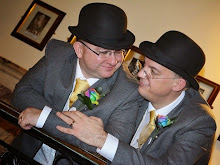
The photo isn’t even in a particularly identifiable setting, but I was born in 1970s Stockport with plenty of concrete and car parks around and clearly read ‘vaguely urban and like the places I know’ into the shot. After many years away, since I wrote the original version of this article I’ve also been living back in Stockport again – though the way back was less hard work than Blake’s. I moved back there with my husband Richard, who (unknown to each other at the time) was also watching Blake’s 7 all those years ago, and not that far away…
One of the absurd moments in Cygnus Alpha comes when, faced with the alien technological marvel of matter transmission, Blake and Avon immediately grasp it because – by an unbelievable coincidence – they had both worked on the same failed Federation “Aquatar” teleport project. “Small world.” They didn’t meet each other then. “Large project.” Not until the start of this series, with both of them on the prison ship London. I remember scoffing at two people with such different skillsets and backstories both having worked on the same useless project, never meeting, just so that years later the concept could come in so expositionarily useful in understanding technology that no-one on any world they knew had ever mastered. Absurd! A decade and a half after we each watched Blake’s 7 as boys, Richard and I found each other through our fluency in that series, Doctor Who and other tongues while I happened to be staying for a few weeks (or so I thought) in the East End. Our ‘Aquatar moment’ came not on the Liberator but on the almost as shiny and exciting Docklands Light Railway. What an absurd coincidence it would be for us to have both grown up in the same town but only to find each other in… London.
The Radio Times picture was posted by the quite extraordinary Twitter account @MakingBlakes7, which is the most brilliant continuing documentary project I’ve ever seen on Twitter. You can see that Radio Times Tweet by clicking here.
“Prisoners? New souls for the Faith.”
For this episode, it helps that it all looks rather stylish. I’ll admit that I often find something of the ‘that’ll do’ about Vere Lorrimer’s direction in his later work for the series, but here the night filming is striking and the projected backgrounds (yellow moon, forbidding citadel) as fantastic an effect as the series ever delivers. But it’s my Mum and Dad’s influence that really primed me to love Cygnus Alpha, though they’d roll their eyes at quite why. They’re both deeply religious, and I grew up going to two churches every Sunday, Catholic and Baptist. Add two competing versions of the same faith and a bright boy who read a lot, and I became steeped in religion, but at the same time asking a lot of questions and curiously open-minded about different flavours that all claimed to be the one true faith. Perhaps that’s why I was just as happy with two ‘rival’ sci-fi shows.
Doctor Who had gone through a year of dark religion that’s still to this day my favourite just before Blake’s 7 came along, and Cygnus Alpha spoke to me in just the same way. This was my world! Religion in all its scary but fascinating glory! My strange personal mix of free-thinking and immersion in dogma meant I was always more compelled by terror in the pews than Yeti in the loos. So, as much as day-after-1984 dystopia had grabbed my attention, it was Cygnus Alpha that was speaking my language and told me this was absolutely my sort of series.
“My word is law. My followers obey without question.”
For all that the Federation, like communist regimes of the time, has banned religion, Cygnus Alpha’s theocratic society is the Federation in miniature (though distinguished by a greedily ambitious figurehead rather than a faceless bureaucracy, Vargas prefiguring über-villain-to-be Servalan). The script is full of parallels between them, from the cruder version of Blake’s show-trial in this world’s “SO PERISH UNBELIEVERS” to the subtler point that, for all his cowardice, it’s Vila who’s still by nature the most wary of going along with authority, whatever form it takes – or clever juxtapositions like “the place of rebirth” and “Berthing sequence automatic”.
Perhaps the unambiguous connection of this theocracy with that already established totalitarianism is what gives the attack on religion such force. Even by the standards of science fiction using other worlds to get away with social critiques that would provoke too many complaints in a modern-day setting, this one pulls no punches (though the institutional child abuse was the Federation rather than the Faith). It’s not a case of using religious trappings to save on money or world-building, using historical window-dressing to tell a different story. One of the reasons this so appealed to little religious me was, ironically, what I’d expect to offend other believers most. It was about the ideas, not just the imagery. Underneath all the monk-like robes, the blasphemous crucifixion, the cruel crusader bust, the Inquisition torture imagery and echoing chants familiar from Gothic horror films, the script really is making a bitter attack on the very concept of organised religion.
“So you and those before you built your power on fear and ruled them with it.”

We saw back on Earth that the Administration maintain their power by surveillance and brute force, fear and drugs, suppression of ideas and the Big Lie. That mirrored totalitarian regimes of the time; now this mirror of the Federation in turn mirrors religious power. If there’s ever a daytime on this world, we don’t see it. Cygnus Alpha is symbolically in the Dark Ages, and for generations its people have been kept in the dark of ignorance. Just like Earth under the Federation, on Cygnus Alpha under the Faith you are always watched. Literally by guards in both, but where the Administration uses cameras everywhere, the Faith uses its God, explicitly invented as a tool of social control.
My husband Richard points out that the constellation of Cygnus is also known as the Northern Cross: both a religious allusion in itself and a reflection of the Southern Cross which is the symbol of Australia, a striking setting for a theocratic space-Botany Bay.
This mini-Australian mini-Federation doesn’t just swipe at religion in general but, true to its Gothic trappings, is as specifically anti-Catholic as any fevered Gothic text. It’s not just taking the fear of an invented death for the fear of an invented hell and proclaiming that the Faith is your only salvation. The Saruman-like hand is one of the production’s few symbols that isn’t obviously Christian, perhaps deliberately to make you focus on a fictional symbol and not on the words and their meaning: “Only from this hand comes life” coupled with a priest handing you a small, round, white thing to swallow that claims to be salvation but is in fact nothing at all? Could it get any more blatant? To look at the “life” held out and see a Trebor mint is to miss the point, but perhaps the very cheapness and obvious solution helps distract and avert complaints. Later dystopia V For Vendetta offered one poisonously satirical communion wafer, but this is a gob-smacking polemic against the whole idea of transubstantiation.
And the Curse of Cygnus (a near-homophone for ‘sickness’) catechised as divine punishment on every wretched inhabitant of Cygnus Alpha – all deserving it as either criminals in their previous life or descended from offenders by birth – from which they can only be saved through the Faith? That’s Original.
After this story’s impact, there’s no real follow-up to the theme; Blake’s 7 is never this savagely critical of religion again. It’s background colour in a few more stories, but they don’t have anything that feels so real. Cygnus Alpha does act as a prototype for more generic Blake’s 7 stories, such as generally the Liberator turning up at a planet of the week and bringing down the regime (or, in this case, leaving it in chaos and having to run away) or more particularly the primitive planet with a primitive people and a twist about something more advanced, usually involving a quarry and a more interesting B-plot in which the crew bitch at each other. Modern BBC sci-fi watchers might call that the ‘Utopia style’, though Russell T Davies’ Blake’s 7 homage brought an altogether rougher beast for its second coming. Perhaps the real thematic legacy of this episode isn’t equating the fierce religion of Cygnus Alpha with the totalitarianism of the Federation, though. Fittingly for my own complicated view of religion as both good and bad, there’s a parable here that’s closer to home.
“The architectural style is early maniac.”
These days I wonder if the whole thing’s not a great big warning about Blake.

If aged six, getting into the series, Cygnus Alpha confirmed that it was my sort of show, I was delighted by how it grew when watching the whole TV series right through again in 2014, aged forty-two. It wasn’t an episode I often chose to watch when I felt like a bit of Blake’s 7 (though I always loved it more than I expected when I did), but I’d thought it was one of the ones I had the clearest picture of in my head: the end of the beginning, fabulous Pamela Salem and Brian Blessed, evil religion plot with a different tone to the rest of the show, entertaining but a bit cheesy. It may well be all those things, but with a more critical brain and knowing the show well enough to put the whole thing in context, I suddenly felt there was a lot more to it.
Blake’s the hero and Vargas is the villain, so they must be opposites, right? Except that it doesn’t play that way at all. If the society of Cygnus Alpha is a mirror of the Federation, the extent to which its leader was not a contrast to but an explicit counterpart to Blake seems so striking that it’s hard not to see it as deliberate (with all the implicit consequences should Blake ever get into power that that entails). Blake getting a messiah complex in Series Two? This story more than any other reads like he’s been off on one since the beginning. Vargas and Blake face off, Brian Blessed and Gareth Thomas with similar intensity, their demands incompatible because the two of them both want the same thing: souls as currency to spread their belief, the power of their word, across the galaxy. Blake takes up his special handgun for the first time; the first to use it? Vargas. Avon’s warning to Jenna about Blake? “He’s a crusader.” Vargas rules by the Big Lie and forced ‘conversion’; Blake tells his followers they have a free choice, but keeps the truth from his first, sceptical disciples (“Did you see anything while you were down there?” “Not much”) and like Vargas gives the next batch of converts the choice of his way or death:
“Only from this hand comes life.”Three different characters this week all state that the prisoners have no choice, and in the end they don’t – whoever they follow, they’re still going to be followers.
Back on the London, Blake was willing to sacrifice himself so that his followers might live. Now we see the flip-side of that: if you’re not with him, you’re against him. He’s come to find new converts, but when they deny him in fear of the rival Faith, he rages at them instead: “You’re pathetic! …slaves! …I’m better off without you.” For all his rhetoric of freedom, Blake demands a positive choice to follow him – a leap of faith. Offering salvation to his own followers is one thing, but rather than sacrifice his messianic ideals he’ll let everyone else die. Vargas and Kara had watched the Liberator in the sky – a light in the darkness. They called it a sign, and it’s a guiding star heralding the new messiah, but we all know who that is, and it’s not the Blessed One whose hard certainty will be driving death after death in this series.
“A little more practice, we should be able to put you down with precision.”

In the context of the whole series, Avon’s appeal to Jenna that Blake would only use all the ship’s treasures to fight the Federation – though it turns out that Blake is never bright enough to realise how effective wealth would be as a weapon, and Avon is bright enough never to tell him – seems like foreshadowing.
“And he can’t win. You know he can’t win. What do you want to be – rich, or dead?”From almost the very beginning, you can see in hindsight warnings, prefigurings, fetches of much later events in the series, and perhaps it’s appropriate that this religious episode seems the most prophetic. Avon even aims his gun at Blake first chance he gets (though it’s only once he’s become a believer that he’ll fire). But Avon needn’t have been foresighted enough to see Blake coming down the road. I realise this time that he could just have watched where Blake’s been, already fighting to the last drop of their blood. Consider…
- Blake’s first rebellion, the series’ backstory: everyone else gets killed and he has his brain knackered.
- Blake’s second rebellion, the series’ opening: he only has to turn up out of vague interest and everyone else is massacred (while several children have their brains knackered).
- Blake’s third rebellion, last week: everyone’s rounded up and several of them get shot though, remarkably, most of them live. In chains.
- This week, Blake’s fourth rebellion: they’re only up against knives and knuckles on Cygnus Alpha, but he still manages to be one of only three survivors who leg it.
- Never mind the “Curse of Cygnus”; Blake is such a jinx that he only has to express a passing interest in a particular rebellion and 99% of them will die. On which subject, tune in next week…
“It didn’t answer any of your questions. More than that – it deliberately ignored them.”
There may be a certain irony in my having gradually given up belief in religion but gained a passion for politics in my teens, but I remain a free-thinker and just as ready to question my leaders as I was scriptures, and unlike Blake I’m more than wary of imposing my beliefs on others. For me, there was nothing like seeing how two competing church hierarchies that theoretically professed the same beliefs were both much more obsessed with control of individuals than individual belief to tip my own beliefs towards Liberal individualism, if not a hint of anarchism in observing that the best way to kill a belief is to set up a rigid structure to enforce it.
Though I wrestled with the theology for years afterwards, it was perhaps inevitably a confrontation with church authority which precipitated my eventual teenage crisis with religion. The surprise might be that it turned out to be with the smaller ‘free’ church rather than the more top-down hierarchy; the ‘Cygnus Alpha’ Baptists rather than the ‘Federation’ of Catholicism. Aged eighteen, I was teaching Sunday School for the kids; one Sunday I came in with a noticeable bruise and, asked what had happened by one boy, replied with the truth: I’d been walking down the road with my boyfriend and someone had hit us. The next week I found I wasn’t teaching Sunday School any more and that a tight-lipped “You know why” was the only explanation. My own moment of liberation came in realising not my fear, but theirs in their own repression; that they couldn’t bring themselves to talk to me, nor even do what a decent human being would do and ask if I was all right after I’d been attacked. The truth shall set you free, indeed, but not in the way they or I had expected it. That was the moment I lost all respect for that particular church because, after all, what was there to respect? And, fortunately, it wasn’t such a long walk back.
“That would have been very disarming if I didn’t know that you meant it.”

Zen and Jenna offer an intriguing alternative here, both a different angle on (explicitly non-Christian) religion and on what the series might have been had each of them kept such significant roles. How much does each affect the other when enigmatic ship’s computer Zen gets into its new pilot’s head? Jenna’s “to be completely known. It’s like – innocence” is more like a revealed religious experience than anything else in the episode, and without it, would she have hesitated to head off with Avon? Zen is characterised as a superior and evasive oracle with less obvious reactions – except one – but, taking its name and the ship’s from Jenna’s thoughts, does it make itself in her image?
“Wisdom must be gathered; it cannot be given.”Zen is a very different religious text to the certainties of Vargas and Blake, but how much of Zen’s resistance to direct is inspired by its pilot’s resistance to being dominated, as “the Liberator” it plucks from her desires suggests?
The best piece of bitching among the crew is an understated one from Zen, as it says in turn to the three of them:
“Welcome, Jenna Stannis.”It’s a masterclass in how to be an oracle while making it absolutely bleedin’ obvious what you think; Avon only gets a neutral reply when he prompts it. Clearly, it’s read his mind last week and Jenna’s here and decided it’s not going to like him well before he starts saying it’s “just a machine”. It’s a shame that Zen’s telepathy is lost to another crewmember long before it loses prime spot as ‘bitchy super-computer’. The series also swiftly drops this week’s attempts to pretend they know what they’re talking about on scientific ideas – Aquatar, negative hyperspace, the anti-matter interface – which is no great loss. It feels much more Blake’s 7 when the crew don’t know what they’re talking about, like Blake stumbling on using the teleport because he’s not used to it.
“Welcome, Roj Blake.”
That is all.
I do feel a little wistful about some of the other interpersonal dynamics that the story appears to set up: judging by Cygnus Alpha, there are now going to be three charismatic leads setting the direction, Jenna being the swing vote, with willingly violent killer Gan and his little friend Vila as wild cards, but it doesn’t work out that way… You can see here that Jenna has so much potential. Blake’s 7 began broadcast just as Star Wars first opened in Britain, so it’ll take a while for the film to start having any impact on the series, but compare and contrast even from the first the clean versus the dirty-handed rebels. One of this series’ great lost opportunities is still that its ‘Han Solo’ is a woman – which may be why she gets elbowed out of the way. But, still to come, Blake’s 7’s ‘Tarkin’ figure will be a woman too – and once she appears, their ‘Darth Vader’-equivalent won’t stand a chance.
“You’re a free man.”
In 2014 I watched Blake’s 7 right through with my beloved Richard. But much as we enjoyed the series all over again, we’ll always remember 2014 for something much more significant to our lives together. We went back, not to the Dome – there’s one just across the river from our flat in London – but to Stockport. On our twentieth anniversary together, we got married at Stockport Town Hall.
I’d say that this was my personal triumph of freedom over dark religion, but freedom won for me so long ago that religion was barely a footnote. Though I still find stories powerful when they make strong use of religion, for good or ill, it’s only as I write this that I realise Stockport Baptist Church is a couple of minutes’ walk from the Town Hall. It’s not something that crossed my mind on the day (though I probably quoted Blake’s 7 at some point). When we made the most important decision of our lives, we were surrounded by believers in several kinds of politics and faiths and in none, including my very proud and happy Mum and Dad, but we chose each other and we chose all the people we invited for love and belief in ourselves.
The Apocrypha: Trevor Hoyle’s Blake’s 7
“Hands reached up and pushed back the cowl to reveal Kara’s evil, haunting beauty – a face that was disfigured by a kind of lustful greed… a smile that was rapturous and yet somehow obscene…”

There’s another alternative world of Blake’s 7, and of Cygnus Alpha. I was already a voracious reader when Blake’s 7 turned up, but though my memories of Cygnus Alpha are thoroughly entangled in Trevor Hoyle’s first Blake’s 7 novelisation (like the first VHS release, compressing the first four episodes), I didn’t return to it as nearly often as Target’s Doctor Who range. Wondering why, I accompanied my 2014 rewatch by buying the audiobook versions, with this part now read by Paul Darrow… And, yes, I can understand why; Hoyle’s writing style tries to be hard-boiled and usually just about hits pedestrian. The CD readers liven him up, but the main interest is the differences from the TV versions – it seems that the first book is from early drafts of the scripts, and without having seen most of the actors, while the Liberator is described backwards. My guess is that these are unadulterated script writer Terry Nation, before script editor Chris Boucher came along; there are notably fewer sharp one-liners and a much smaller part for Avon. The biggest point of interest, unexpectedly, may be his take on Time Squad, for a very different backstory to both Gan and the assassins (though Zen is far less intriguing); the biggest wasted opportunity that Hoyle seems to stick too rigidly to the scripts rather than, say, establishing Arco and Selman with roles in the London rebellion now the actors don’t need paying for an extra episode.
The very ’70s stylistic tic that most sticks out today, though, is that suddenly we’re plunged into an alternate version of Blake’s 7 where (speaking of adultery) every woman is there to be leered at. Men get sexually neutral or ugly descriptions – let’s hope he’d not seen poor Michael Keating when Vila’s a “gargoyle” – but every woman is objectified at length and, if they’re baaad girls, all the more titillating! I suspect this may have put me off when I was a boy, but hearing Gareth Thomas and Paul Darrow having to read all this first made me wince, then laugh. Though I’ll give Hoyle the benefit of the doubt that there’s an earlier Gareth Thomas series in-joke in there, I did actually laugh aloud as Paul Darrow purred:
“Avon casually looked round and then sat up straight, his eyes popping out of his head. His first thought was to wonder how a beautiful and sexy star maiden had managed to get aboard the Liberator and it took all of ten seconds to realise that it was Jenna, attired in the most magnificent – and rather revealing – space-age costume.”Or, ‘Why, Miss Jenna, you’re beautiful!’
Avon follows this by swallowing in “goggling admiration” and “real appreciation”, her with “impish seductiveness” as she’s “coyly” “posing for him”. Later, Cally will be a “young”, “stunning-attractive girl”, “incredibly beautiful”, “athletically supple”, and Blake will be unable to fathom why a “beautiful girl” should be wearing combat gear. Dear [ Blessed ]GOD![ /Blessed ] She will also have amazing eyes the like of which Blake has never seen but which the author won’t describe, so they might boggle out on springs for all we know. At least Blake won’t actually ask her what she’s doing in a place like this.
But where Hoyle really gets excited is the female villains, who are beautiful – but evil, but sexy – but evil! What a mix. And a minx.
“His companion turned towards him… and in the flickering firelight it was a face of evil, the lips twisted in a rapacious snarl, yet even so with a fascinating, hypnotic beauty.Oh, put it away. The strangest thing is that the Terry Nation draft of the script forgets about her at – forgive me – the climax, and so bizarrely does Mr Hoyle. You’d think he’d have been faster to write her an unconvincing last moment than the one Chris Boucher seems to have stuck in. ‘Only the love of a good violent criminal she’s kissed once could free her from being the Sexy Nun of Evil…’
“‘New souls for the Faith,’ said Kara in a throaty whisper, her eyes alight with sly rapture.”
Paul Darrow clearly enjoys all this schlock too, as well as capturing Gareth Thomas’ intensity rather well for Blake and compensating for half Avon’s part not having been written yet with a compelling emphasis on his own character’s lines that makes his every. Word. Twice. As. Avonnn. The whole thing is hammy as hell but very entertaining, and far more so than the prose deserves.
So it’s a good job that the TV version was so absolutely perfect – not perhaps entirely perfect as a piece of television, but perfect to broadcast directly into my six-year-old world and open up a new one.
“Let’s all go! Er… No, on the other hand, let’s all stay.”

Last year I found that I couldn’t bear blogging any more. I wish I could say that, with the pressure off, I’ve been able to write plenty of articles for my own pleasure and that this is the herald of more to come. I’m sorry. I haven’t. It isn’t. So this is perhaps a coda – something I’ve not previously published, but which isn’t technically new.
Cygnus Alpha and Omega was first published in 2015 in the book Blake’s Heaven, a collection of personal perspectives on every episode of Blake’s 7. I was delighted to be a part of it and surprised I managed to write something, though that delight has since been marred by the horrible circumstances in which the book has been withdrawn and which I don’t want to think about. But with the fortieth anniversary of the series this year, I re-read my contribution and decided it was worthwhile enough not to go to waste. It’s more personal than most of my writing, and I found as I was putting it together the first time that how resonant the themes – and some of the coincidences – were to my life. Well, bits of it.
I’ve spent a ridiculous amount of time re-reading, re-watching and re-writing in tiny perfectionist polishes preparing for tonight, some of it no doubt procrastinating to avoid having to make the decision whether or not to put something else on my blog. I have. I hope you enjoy it.
I am, at least, enjoying Blake’s 7 all over again. For what it’s worth, though Cygnus Alpha has its own special place for me, my particular highlights of the series are:
- Rumours of Death
- Star One
- Sand
- The Way Back
- Terminal
- Orbit
I’m sorry this isn’t my way back to blogging. For something cheerier, you might look up another great piece of BBC sci-fi; first broadcast on TV thirty-seven years ago this week – though, like this article, it had already done the rounds in other media – I find myself thinking of The HitchHiker’s Guide to the Galaxy Episode 3. Magrathea doesn’t properly revive from its long slumber, merely turning in its sleep to put a new spin on a previous work, but that too is about religion and, for all that I know how badly everything turned out, that it’s a cosmic joke and that the new beginning isn’t going anywhere, there is a moment at the end of that episode that still moves me more than almost any other piece of television. This piece of writing is nothing like that. But I am quite fond of the crinkly bits round the edges.
Labels: Bigotry, Blake’s 7, Books, Brian Blessed, Gay, Personal, Religion, Richard, Star Wars, The Hitchhikers Guide To the Galaxy


Monday, December 21, 2009
A Taste of Christmas (Don’t Worry, It’s With Real Pies)
Christmas Day races terrifyingly towards you, you’ve not finished your Christmas shopping and there’s a blizzard outside. The pavements are slippery to walk on, the trains are knackered and your car’s stuck in a snow drift. You’re wet and cold and miserable as you stagger about trying to fight your way through the queues of fewer shops than you’d thought you’d make in the time, so what could be more seasonal than stuffing your face to make up for it? But there’s another problem: which Christmas sarnies taste of Christmas dinner, and which of cheap cash-in? I’ve tried ’em all. Well, quite a few, anyway. Purely out of selfless dedication to consumer testing, you understand, and not because I’m a gutbucket (and watch out, if you’re picky, for festive spoilers at the bottom for an episode of Blake’s 7 that’s twenty-eight years old tonight).
Christmas Edition Sandwich
You’d expect the swishest end of the supermarkets to do something special. Well… It’s turkey with bacon, stuffing and cranberry sauce, like most of them, and only one element of it’s memorable. There’s quite a bit of turkey, but it’s piled up in incredibly thin slices and none of them taste of very much. The bacon’s all right, there’s quite a sweet bit of cranberry, but the only interesting bit’s the stuffing – pork, sage and onion in a moist and rather tasty paste (you wouldn’t object if it was a sauce). But mainly, the square, processed slices of turkey dominate it, and they’re just not wildly interesting.
Christmas Turkey and all the Trimmings Sandwich
It looks better than the Waitrose; slightly thicker turkey slices (though piled a lot lower) and big half-bits of sausage at a glance. One bite, though, and it’s not one you’d make yourself. The most anonymous turkey, a tiny bit of flavour in the sausage, some very bland malted bread; then there’s sage and onion stuffing in there, and cranberry sauce, but you wouldn’t notice – even the bacon tastes of nothing. This wins the prize for the least interesting taste and the one that screams (or mumbles) ‘mass-produced for the lowest price’. It’s no excuse, though, is it? Some of their sarnies are quite good – stick to the all-day breakfast.
Christmas Triple Sandwich
Because what could be more Christmassy than a selection box? Especially if two of them are a bit cheaper to make than the one you’re actually after? Cheese and Christmas Chutney: the chutney’s quite tasty – bit of a zing – but there’s not a lot of it, though, and the cheese is just cheese. Prawn Cocktail: oh, it’s quite pleasant, I suppose, but doesn’t taste of much (their buy-it-in-a-plastic-pot-and-spread-it-on-yourself sandwich filler’s much better), and it doesn’t sing ‘Christmassy’ to me. But then there’s the Christmas Lunch: turkey slices that resemble actual turkey, a little bit of cranberry, some leaves chucked in, rather uninteresting bacon, but some good stuffingish mayo. It’s the best of the supermarket ones.
Turkey and Cranberry Panini
This smells great, and the panini’s got a good taste and texture. But they’ve really skimped on what’s inside it – it’s the only one that blatantly has little wodges of turkey sticking temptingly out of the sides but not actually covering the inside. The cranberry doesn’t do a lot, though the pork, sage and onion stuffing and mayo are tasty in their tiny amounts, but I have to wonder if the other sandwiches would get a similar boost if they were toasted, too. Everything meaty tastes better hot, doesn’t it? Like the Tesco, it’s one to avoid: I think this was twice their price, and it’s nowhere near twice as interesting.
The Pret Christmas Lunch Sandwich
Everyone seems to be going for malted bread and sage and onion stuffing, sometimes with pork – come on, even chestnut would seem radical in this company – but for once this all actually tastes of something. Thank goodness that someone can make a sarnie that you remember eating. There are proper bits of turkey, a firm slice of pork, sage and onion stuffing with a good flavour, a splodge of cranberry (I can’t taste the port), leaf spinach (yes, that makes it a health food), but the real zing is the crispy onion mayo, with a bit of crunch to it, too. This is easily the best sarnie of the lot, with both flavour and texture. You don’t realise that all the others are one rather soft flat sensation until you bite into one where the different ingredients have different consistencies.
Their site, however, doesn’t give you what’s in it – just the dietary factoids. Oh dear. How to miss the point.
Turkey and Cranberry Sandwich
Very dull. Actually, it’s a good bit of turkey – the slices have clearly been done by hand rather than on a conveyor belt into processed squares, but there’s just not enough to make it tasty, despite the cranberry, in a very plain sandwich. And stuffing a few rocket leaves in doesn’t make it go. At least the malted bread’s a lot nicer than Tesco’s… Fortunately, they have another go.
Christmas Full Works Sandwich
Now, this one’s a lot better. It’s a white bloomer (unique among these sandwiches in not coming in the regulation triangular packet), softer than any of the others – satisfying to sink your teeth deep into – with proper thick slices of turkey, the ubiquitous sage and onion stuffing, cranberry, mayo, mixed leaf (hey ho), and ham, which wins points for adding something different, even if it’s not that special. This is my runner-up – chunky and comforting, it has the most home-made feel, though the taste and texture lacks the kick of the Pret.
Christmas Pie – Turkey and Stuffing
A hot pie, looking good – an impressive size, round and high enough that even I can’t get it all in my mouth at once – with a generous blob of cranberry on top. It smells great; bite or cut into this pie, and it’s crammed full, too. And I’ll tell you, the turkey’s very tasty, with a touch of bacon, sausage and sauce to make it a lovely little bit of meat. This is sounding like a great pie, isn’t it? So what could possibly go wrong? Only this. That some insane person decided to make it turned inside out, so that succulent morsel’s a tiny nodule of meat surrounded by a vast mass of dry, crumbly sage and onion stuffing that it’s impossible to swallow. Someone must have said, ‘You know how people always do meat with a little bit of stuffing on the inside? Wouldn’t it be really imaginative to do it the other way round, so there’s a tiny bit of meat to set off our amazing stuffing that’s the same flavour as everyone else’s but drier and the size of a castle?’ No. It would make a potentially gorgeous pie into an utter disaster.
I’ve not gone round trying all the veggie options, because there are only so many hours in the day, pounds in the wallet and stone I can put on, but I did give them a second chance and got their Christmas Honey-roast Parsnip and Chestnut Pie as well: it tastes very leeky (baby onions, apparently), quite rich, moist, lots of cheese, tasty parsnips and above all a relief from bloody sage and onion (look, I quite like that combination sparingly, but there are limits). So that one was rather good.
Xmas (yes, I know) Pie
I don’t often write about food, but when I do, I’m quite likely to mention Square Pie. They are fab, always with good pastry – moist and firm, not at all bland or flaky – and always with something interesting in their monthly special pies. Their Christmas special tries the hardest of any of the Christmas-dinner-on-the-move offerings I’ve sampled, boasting “prime turkey, mini roast potatoes, sprouts, chipolatas, stuffing and gravy all wrapped up in a pie”. And though some of theirs have been better (and I still vote for their evergreen Lamb and Rosemary Pie), this works. It’s got a pastry star on the top, sweetly, and mixes both turkey breast and dark meat – a winner for me, as I prefer it. Hot and soaked in gravy sets off the flavour no end, too, and in that mix even the startling wodge of sprout is juicy and rather tasty (Richard still hated it, though). The downside to so many ingredients in a good-sized but not gigantic pie is that what you get in each individual one is something of a lottery; I can’t tell you about the “mini roast potatoes,” as there weren’t any in mine, and the chipolatas don’t really work (everything else is enriched by gravy, but a sausage just goes droopy). Still, on the whole it gives you what you expect to taste and more, and it’s warming and filling. Ideal if you’ve staggered into the shop from a blizzard. Just a shame about the Eat pie that might have beaten it, but went mad.
So, if you’re caught in a storm and fancy a Christmas savoury to pretend you’re at home in front of the fire, look for a Pret A Manger or Square Pie, or failing that an Eat – providing you take a note of which of their recipes work and which are dry and dull – or even ASDA (the Marks and Spencer sandwich was pretty good, too, but I had that before I started making notes, so I’m afraid after a few weeks I can’t remember what distinguished it). And don’t go anywhere near Tesco or Caffé Nero.
…Meanwhile, we’ve been enjoying the seasonal spectacular that is Ann Widdecombe On Ice (you’re not that fussed?) as part of BBC2’s Victoria Wood Night. I still remember Victoria Wood As Seen On TV being one of the very first things I video-recorded, and then being surprised when I started to go out in Manchester slightly later in my teens and found that every other gayer in the city also adored her. Tonight’s rather fabulous documentary Victoria Wood: Seen On TV – stolen by a Roger Moore anecdote – suggested that my experience was not a completely unique one.
And finally, what could be more festive than to celebrate the anniversary of a Christmassy TV finale from slightly earlier in the ’80s? This was the night that writer Chris Boucher was forever labelled “The man who killed Christmas,” for finishing off the heroic / gittish freedom fighters / terrorists of Blake’s 7 in a hail of fire that killed off the entire cast. And, unlike the infamous Dynasty ‘massacre’ that briefly appeared just as satisfying but which turned out only to have killed the slightly darker-skinned woman in a relationship with a white man and the gay man in a relationship with a man whose sexuality was frequently rewritten – yes, it was an American TV show, how could you tell? – they’re all still dead, a uniquely and brilliantly bleak ending.
(If you want something less bleak, hurrah for the other Gareth Thomas!)
So, as a festive treat, here are three Blake’s 7 trailers from YouTube. The first two are each for that final episode, Blake, both making superb use of CGI from DVD releases (though not necessarily Blake’s 7 ones): this one is in the style of Doctor Who “Next Time…” trailers, complete with Who music, which chooses a great dramatic closing line then an equally effective slightly less dramatic extra ending; while this one is in a self-consciously epic Hollywood style, looking and sounding (thanks to a Batman score) terrific, particularly with Servalan’s added sashay. My favourite Blake’s 7 trailer, though, still remains the official one for the second series on DVD, set to the gorgeous theme from Doctor Who spin-off Shakedown and with a nicely judged sense of irony… Even if I’d have cut it after Travis’ perfect

Waitrose
Christmas Edition Sandwich
You’d expect the swishest end of the supermarkets to do something special. Well… It’s turkey with bacon, stuffing and cranberry sauce, like most of them, and only one element of it’s memorable. There’s quite a bit of turkey, but it’s piled up in incredibly thin slices and none of them taste of very much. The bacon’s all right, there’s quite a sweet bit of cranberry, but the only interesting bit’s the stuffing – pork, sage and onion in a moist and rather tasty paste (you wouldn’t object if it was a sauce). But mainly, the square, processed slices of turkey dominate it, and they’re just not wildly interesting.
Tesco
Christmas Turkey and all the Trimmings Sandwich
It looks better than the Waitrose; slightly thicker turkey slices (though piled a lot lower) and big half-bits of sausage at a glance. One bite, though, and it’s not one you’d make yourself. The most anonymous turkey, a tiny bit of flavour in the sausage, some very bland malted bread; then there’s sage and onion stuffing in there, and cranberry sauce, but you wouldn’t notice – even the bacon tastes of nothing. This wins the prize for the least interesting taste and the one that screams (or mumbles) ‘mass-produced for the lowest price’. It’s no excuse, though, is it? Some of their sarnies are quite good – stick to the all-day breakfast.
ASDA
Christmas Triple Sandwich
Because what could be more Christmassy than a selection box? Especially if two of them are a bit cheaper to make than the one you’re actually after? Cheese and Christmas Chutney: the chutney’s quite tasty – bit of a zing – but there’s not a lot of it, though, and the cheese is just cheese. Prawn Cocktail: oh, it’s quite pleasant, I suppose, but doesn’t taste of much (their buy-it-in-a-plastic-pot-and-spread-it-on-yourself sandwich filler’s much better), and it doesn’t sing ‘Christmassy’ to me. But then there’s the Christmas Lunch: turkey slices that resemble actual turkey, a little bit of cranberry, some leaves chucked in, rather uninteresting bacon, but some good stuffingish mayo. It’s the best of the supermarket ones.
Caffé Nero
Turkey and Cranberry Panini
This smells great, and the panini’s got a good taste and texture. But they’ve really skimped on what’s inside it – it’s the only one that blatantly has little wodges of turkey sticking temptingly out of the sides but not actually covering the inside. The cranberry doesn’t do a lot, though the pork, sage and onion stuffing and mayo are tasty in their tiny amounts, but I have to wonder if the other sandwiches would get a similar boost if they were toasted, too. Everything meaty tastes better hot, doesn’t it? Like the Tesco, it’s one to avoid: I think this was twice their price, and it’s nowhere near twice as interesting.
Pret A Manger
The Pret Christmas Lunch Sandwich
Everyone seems to be going for malted bread and sage and onion stuffing, sometimes with pork – come on, even chestnut would seem radical in this company – but for once this all actually tastes of something. Thank goodness that someone can make a sarnie that you remember eating. There are proper bits of turkey, a firm slice of pork, sage and onion stuffing with a good flavour, a splodge of cranberry (I can’t taste the port), leaf spinach (yes, that makes it a health food), but the real zing is the crispy onion mayo, with a bit of crunch to it, too. This is easily the best sarnie of the lot, with both flavour and texture. You don’t realise that all the others are one rather soft flat sensation until you bite into one where the different ingredients have different consistencies.
Their site, however, doesn’t give you what’s in it – just the dietary factoids. Oh dear. How to miss the point.
Eat
Turkey and Cranberry Sandwich
Very dull. Actually, it’s a good bit of turkey – the slices have clearly been done by hand rather than on a conveyor belt into processed squares, but there’s just not enough to make it tasty, despite the cranberry, in a very plain sandwich. And stuffing a few rocket leaves in doesn’t make it go. At least the malted bread’s a lot nicer than Tesco’s… Fortunately, they have another go.
Christmas Full Works Sandwich
Now, this one’s a lot better. It’s a white bloomer (unique among these sandwiches in not coming in the regulation triangular packet), softer than any of the others – satisfying to sink your teeth deep into – with proper thick slices of turkey, the ubiquitous sage and onion stuffing, cranberry, mayo, mixed leaf (hey ho), and ham, which wins points for adding something different, even if it’s not that special. This is my runner-up – chunky and comforting, it has the most home-made feel, though the taste and texture lacks the kick of the Pret.
Christmas Pie – Turkey and Stuffing
A hot pie, looking good – an impressive size, round and high enough that even I can’t get it all in my mouth at once – with a generous blob of cranberry on top. It smells great; bite or cut into this pie, and it’s crammed full, too. And I’ll tell you, the turkey’s very tasty, with a touch of bacon, sausage and sauce to make it a lovely little bit of meat. This is sounding like a great pie, isn’t it? So what could possibly go wrong? Only this. That some insane person decided to make it turned inside out, so that succulent morsel’s a tiny nodule of meat surrounded by a vast mass of dry, crumbly sage and onion stuffing that it’s impossible to swallow. Someone must have said, ‘You know how people always do meat with a little bit of stuffing on the inside? Wouldn’t it be really imaginative to do it the other way round, so there’s a tiny bit of meat to set off our amazing stuffing that’s the same flavour as everyone else’s but drier and the size of a castle?’ No. It would make a potentially gorgeous pie into an utter disaster.
I’ve not gone round trying all the veggie options, because there are only so many hours in the day, pounds in the wallet and stone I can put on, but I did give them a second chance and got their Christmas Honey-roast Parsnip and Chestnut Pie as well: it tastes very leeky (baby onions, apparently), quite rich, moist, lots of cheese, tasty parsnips and above all a relief from bloody sage and onion (look, I quite like that combination sparingly, but there are limits). So that one was rather good.
Square Pie
Xmas (yes, I know) Pie
I don’t often write about food, but when I do, I’m quite likely to mention Square Pie. They are fab, always with good pastry – moist and firm, not at all bland or flaky – and always with something interesting in their monthly special pies. Their Christmas special tries the hardest of any of the Christmas-dinner-on-the-move offerings I’ve sampled, boasting “prime turkey, mini roast potatoes, sprouts, chipolatas, stuffing and gravy all wrapped up in a pie”. And though some of theirs have been better (and I still vote for their evergreen Lamb and Rosemary Pie), this works. It’s got a pastry star on the top, sweetly, and mixes both turkey breast and dark meat – a winner for me, as I prefer it. Hot and soaked in gravy sets off the flavour no end, too, and in that mix even the startling wodge of sprout is juicy and rather tasty (Richard still hated it, though). The downside to so many ingredients in a good-sized but not gigantic pie is that what you get in each individual one is something of a lottery; I can’t tell you about the “mini roast potatoes,” as there weren’t any in mine, and the chipolatas don’t really work (everything else is enriched by gravy, but a sausage just goes droopy). Still, on the whole it gives you what you expect to taste and more, and it’s warming and filling. Ideal if you’ve staggered into the shop from a blizzard. Just a shame about the Eat pie that might have beaten it, but went mad.
So, if you’re caught in a storm and fancy a Christmas savoury to pretend you’re at home in front of the fire, look for a Pret A Manger or Square Pie, or failing that an Eat – providing you take a note of which of their recipes work and which are dry and dull – or even ASDA (the Marks and Spencer sandwich was pretty good, too, but I had that before I started making notes, so I’m afraid after a few weeks I can’t remember what distinguished it). And don’t go anywhere near Tesco or Caffé Nero.
Victoria Wood and Blake’s 7
…Meanwhile, we’ve been enjoying the seasonal spectacular that is Ann Widdecombe On Ice (you’re not that fussed?) as part of BBC2’s Victoria Wood Night. I still remember Victoria Wood As Seen On TV being one of the very first things I video-recorded, and then being surprised when I started to go out in Manchester slightly later in my teens and found that every other gayer in the city also adored her. Tonight’s rather fabulous documentary Victoria Wood: Seen On TV – stolen by a Roger Moore anecdote – suggested that my experience was not a completely unique one.
And finally, what could be more festive than to celebrate the anniversary of a Christmassy TV finale from slightly earlier in the ’80s? This was the night that writer Chris Boucher was forever labelled “The man who killed Christmas,” for finishing off the heroic / gittish freedom fighters / terrorists of Blake’s 7 in a hail of fire that killed off the entire cast. And, unlike the infamous Dynasty ‘massacre’ that briefly appeared just as satisfying but which turned out only to have killed the slightly darker-skinned woman in a relationship with a white man and the gay man in a relationship with a man whose sexuality was frequently rewritten – yes, it was an American TV show, how could you tell? – they’re all still dead, a uniquely and brilliantly bleak ending.
(If you want something less bleak, hurrah for the other Gareth Thomas!)
So, as a festive treat, here are three Blake’s 7 trailers from YouTube. The first two are each for that final episode, Blake, both making superb use of CGI from DVD releases (though not necessarily Blake’s 7 ones): this one is in the style of Doctor Who “Next Time…” trailers, complete with Who music, which chooses a great dramatic closing line then an equally effective slightly less dramatic extra ending; while this one is in a self-consciously epic Hollywood style, looking and sounding (thanks to a Batman score) terrific, particularly with Servalan’s added sashay. My favourite Blake’s 7 trailer, though, still remains the official one for the second series on DVD, set to the gorgeous theme from Doctor Who spin-off Shakedown and with a nicely judged sense of irony… Even if I’d have cut it after Travis’ perfect
“Oh, yes. I’m a hero too.”
Labels: Blake’s 7, Christmas, Food, Gay, The Golden Dozen, Top Tips
Friday, January 16, 2009
Doctor Who 45th Anniversary – Why Was 2001 Brilliant?
The fairy-tale Grimm Reality and The Adventuress of Henrietta Street’s complex histories are among Paul McGann’s best books – and it’s ‘new millennium, new ranges’, including the DVD releases starting in earnest; Occam’s Razor, first of the intelligent, dangerous Kaldor City CDs; and Billy novella Time and Relative. Perhaps most excitingly (not ignoring Peter’s and Colin’s fabulous Loups-Garoux and The One Doctor), Big Finish relaunch Paul with Storm Warning, then visit…
As with all the Big Finish dramas, this is available on CD and download, both on its own and as part of a collection of the first Paul McGann stories broadcast on BBC7 (starting in 2005).
The Stones of Venice
“I don’t carry weapons. I don’t need them. But I must say, I think you treat your visitors here in a very shabby manner indeed.”Edwardian adventuress Charley Pollard thinks the TARDIS is a gothic nightmare – wait until she reaches a poetically doomed Venice at the close of a hundred-year curse. The Duke’s moping over his lost love, her cult’s praying for resurrection, and there’s something fishy about the gondoliers…
As with all the Big Finish dramas, this is available on CD and download, both on its own and as part of a collection of the first Paul McGann stories broadcast on BBC7 (starting in 2005).
Labels: Big Finish, Blake’s 7, Books, Colin Baker, Doctor Who, DVD, Paul McGann, Peter Davison, Reviews, Why Is Doctor Who Brilliant?, William Hartnell
Saturday, April 26, 2008
As the Supervising Editor of Fate Fades Down the Trumpet Knob of Destiny…
The sad deaths have been reported of two rather marvellous octogenarians who’ve often brought joy to my ears (though not in the way Samantha might).
Tristram Cary was a ground-breaking composer, scoring films such as The Ladykillers and Quatermass and the Pit and pioneering electronic music. In Doctor Who’s early days, his inspired contributions ranged from comedy ballads to the eerie musique concrète which accompanied the first appearance of the Daleks (appropriately, repeated a couple of weeks ago in commemoration of Verity Lambert).
And now Richard has just woken me in need of a cuddle at news of Humphrey Lyttelton, patron saint of young people who are a bit clever and want to mystify people with the rules of a strange game they’re apparently playing while simultaneously indulging in terrible double entendres. Well, that’s one of the reasons I loved him when I was at college, anyway. That, and the letter sometime in the ’80s – before I understood what most of the innuendos meant – from an irate listener to the Radio Times about how these shocking old lechers mistreated ‘score-girl’ Samantha. I understood what the problem was there, anyway. And just last year I was at Tenth Planet while gravel-voiced Paul Darrow – of the once and future Blake’s 7, confirmed to me on Thursday by Zen – was warming up for a signing by reciting some of the filthiest Lionel Blair jokes imaginable from Humph the previous week. As shocked parents steered their children away from him, I cackled and realised that, tragically, my days of not understanding them are long gone. Now, tragically, there won’t be any more.
My parents playing Humph’s jazz programme on a Sunday never really caught on with me, but I haven’t a clue about any memory before his antidote to panel games. I’m sorry. I’ll miss him, as will any other listener to Radio 4. And I hope someone from the Office of Government Commerce is there to comfort Samantha.
Onto a happier note for fans of strange noises. If you’re not taking a Saturday lie-in and want cheering up, by the way, turn on BBC Breakfast News in a few hours and you’ll see young whipper-snapper seventy-something Dick Mills – whose first contributions to Doctor Who sound were alongside and even before those of Tristram Cary, and who is still going strong – explaining how to make peculiar sounds and marking fifty years since the foundation of the BBC’s legendary BBC Radiophonic Workshop. I met him just a couple of weeks ago, and a nicer chap you couldn’t hope for, inspiring to hear talk about the Workshop (complete with PowerPoint presentation) and lovely to chat to. I spent most of yesterday curled inside a duvet on the sofa coughing in pleasure at Genesis of the Daleks, many of Dick’s evocative special sounds for which I’ve known by heart for three decades. And, in memory of Humph, when I was next to Dick sorting out a few shiny silver discs for him to autograph the other week, a friend whose name coincidentally is Robert Dick asked if I’d seen everyone I wanted. “Not yet,” I piped up, distracted and rather too loudly, “I’ve just got to grab Dick.”
Now back to bed, and my distraught beloved.
Tristram Cary
Tristram Cary was a ground-breaking composer, scoring films such as The Ladykillers and Quatermass and the Pit and pioneering electronic music. In Doctor Who’s early days, his inspired contributions ranged from comedy ballads to the eerie musique concrète which accompanied the first appearance of the Daleks (appropriately, repeated a couple of weeks ago in commemoration of Verity Lambert).
Humphrey Lyttelton
And now Richard has just woken me in need of a cuddle at news of Humphrey Lyttelton, patron saint of young people who are a bit clever and want to mystify people with the rules of a strange game they’re apparently playing while simultaneously indulging in terrible double entendres. Well, that’s one of the reasons I loved him when I was at college, anyway. That, and the letter sometime in the ’80s – before I understood what most of the innuendos meant – from an irate listener to the Radio Times about how these shocking old lechers mistreated ‘score-girl’ Samantha. I understood what the problem was there, anyway. And just last year I was at Tenth Planet while gravel-voiced Paul Darrow – of the once and future Blake’s 7, confirmed to me on Thursday by Zen – was warming up for a signing by reciting some of the filthiest Lionel Blair jokes imaginable from Humph the previous week. As shocked parents steered their children away from him, I cackled and realised that, tragically, my days of not understanding them are long gone. Now, tragically, there won’t be any more.
My parents playing Humph’s jazz programme on a Sunday never really caught on with me, but I haven’t a clue about any memory before his antidote to panel games. I’m sorry. I’ll miss him, as will any other listener to Radio 4. And I hope someone from the Office of Government Commerce is there to comfort Samantha.
And Now the Radiophonic Workshop and Dick Mills on TV
Onto a happier note for fans of strange noises. If you’re not taking a Saturday lie-in and want cheering up, by the way, turn on BBC Breakfast News in a few hours and you’ll see young whipper-snapper seventy-something Dick Mills – whose first contributions to Doctor Who sound were alongside and even before those of Tristram Cary, and who is still going strong – explaining how to make peculiar sounds and marking fifty years since the foundation of the BBC’s legendary BBC Radiophonic Workshop. I met him just a couple of weeks ago, and a nicer chap you couldn’t hope for, inspiring to hear talk about the Workshop (complete with PowerPoint presentation) and lovely to chat to. I spent most of yesterday curled inside a duvet on the sofa coughing in pleasure at Genesis of the Daleks, many of Dick’s evocative special sounds for which I’ve known by heart for three decades. And, in memory of Humph, when I was next to Dick sorting out a few shiny silver discs for him to autograph the other week, a friend whose name coincidentally is Robert Dick asked if I’d seen everyone I wanted. “Not yet,” I piped up, distracted and rather too loudly, “I’ve just got to grab Dick.”
Now back to bed, and my distraught beloved.
Labels: Blake’s 7, Comedy, Daleks, Doctor Who, Fandom, Obituary, Radio
Wednesday, February 06, 2008
Kevin Stoney, RIP
When I think of villains, I think of Kevin Stoney. By all accounts, he was a lovely man, but among the dozens of characters he played – in TV series as diverse as I, Claudius, The Avengers, All Creatures Great and Small and Bergerac – I treasure two charismatic would-be dictators in Doctor Who. He was even voted the Daily Mail’s 1965 “Villain of the year” (presumably handing over to Roy Jenkins for the rest of the ’60s). He was a marvellous actor, and after two decades of false reports of his death, sadly the news that broke on Monday is true.


Doctor Who fans will always remember him as Mavic Chen in The Daleks’ Master Plan, the first human villain striking enough to steal a scene from a Dalek, then as Tobias Vaughn in The Invasion, a business tycoon of such Bond-villain cool that he very much made the Cybermen just secondary villains in their own story. In one of the first Who stories I ever saw, Revenge of the Cybermen, he returns to play an avuncular bearded alien – though unfortunately that’s not a story from which anyone emerges with much credit. You may also have seen him as the perpetually upbeat astrologer Thrasyllus in I, Claudius (I must get round to watching him play the same man in The Caesars), Tiberius’ sidekick in exile who has to laugh off the threat of being thrown down a mountain. He was just about the only thing worth watching in two of the weakest episodes of Blake’s 7, first as a scheming councillor and then as a blind archivist who knows too much. And you can see him as a doomed Treasury inspector and then a bitter old bird expert in The Avengers, a dodgy Colonel in The Prisoner, the Prime Minister in the final Quatermass and in dozens of roles in TV series from The Adventures of Robin Hood in the 1950s to Inspector Morse in the 1990s.
The Daleks’ Master Plan was the series’ early epic, a mixture of war story, political thriller, horror story and space opera, and perhaps because the Daleks are best when they have someone to play against, they’re accompanied throughout by Kevin Stoney’s Mavic Chen. Though the Daleks plot to take over Earth’s galaxy with the help of several ambitious leaders, it’s Mavic Chen, traitorous Guardian of the Solar System, who’s the real star. Named and made up to evoke a mix of as many human ethnicities as possible to accentuate his betrayal of the whole human race, he has something of the commanding camp of the Emperor Ming about him – but across twelve episodes, he has the time to develop as a character and in performance, with his overweening self-confidence (to the point of megalomania) making him increasingly blind to the Daleks’ real view of him and the fate he has coming. Competing for attention with another villain who has real charisma, the Daleks are at their height; for me, they were never better than pitched against the original Doctor, and in this story they get to be the devious galaxy-spanning conquerors of the TV21 comic strips. It’s enormous fun to see Mavic Chen winding them up to fury; because they need him – temporarily – he gets away with talking back to them and even swatting a Dalek’s eye-stalk with a long-fingernailed hand well past the point that they’d exterminate anyone else. And he still doesn’t see the danger when he’s told that
When I was just four, I saw a Doctor Who villain that petrified me so much I’ve loved him ever since. Gabriel Woolf’s Sutekh the Destroyer (from Pyramids of Mars) was a performance of such quietly terrifying evil that the same actor was brought in to supply the voice of the Beast in The Impossible Planet two years ago. I still enjoy a great villain today, and Doctor Who has seen a great many – but only one’s ever captivated me as much as Sutekh did, and I didn’t see that until I was 21 and The Invasion was released on video (though, for all sorts of reasons, you’re much better off now with the DVD). My other favourite is, of course, Kevin Stoney as Tobias Vaughn. Kevin Stoney’s second appearance in Doctor Who is frequently said to be a retread of his first: an extra-long story; elements of a spy thriller; an invasion of Earth by one of the most famous two Doctor Who monsters; a human using his power and prestige first to betray Earth to the monsters, then planning to double-cross them (and, naturally, being double-crossed first). Despite all that, the 1968 story has a very different feel to the 1965-66 epic – the Daleks leapt from planet to planet to attack a far-future Earth, while the Cybermen are in effect invading a Bond movie on a BBC budget, with Tobias Vaughn very much a Bond villain in a sharp suit rather than a grand piece of Flash Gordon camp. On the other hand, if you’ve seen 2006’s Rise of the Cybermen / The Age of Steel, you’ll recognise an awful lot of that double-length story lifted from The Invasion…
Tobias Vaughn is the head of International Electromatics, a global business empire that dominates the electronics market through its unique ‘micromonolithic circuit’ (yes, you may very well think this is where Intel started). And, unwilling to settle for mere market domination, he plots to take over the world. One of the reasons Vaughn is so striking is that he’s just like how we imagine heads of major corporations to be – after all, the James Bond films are documentaries, aren’t they? And this story has much of the style of the ’60s, with Vaughn’s dark suit and lovely high-collared shirt making him one of the best-dressed men in Doctor Who, but set just a little bit in the future, with videophones and private armies. And that look, the script and Kevin Stoney’s performance come together into the ideal villain for the story: he’s authoritative, he’s witty, he’s in control… At least until the Doctor gets in the way. In The Invasion, the Cybermen are at their most inhuman – faceless, mostly voiceless, wholly emotionless, and so Vaughn makes the perfect contrast. His journey from urbane sophistication through anger to broken depression isn’t just a demonstration of the kind of emotions that his allies can’t have, but a tour de force by a brilliant actor.
When we first encounter Vaughn, he’s not just calm but amused; when some of the Doctor’s friends wreck his irritating computer answering service – as many of us wish to on a daily basis – he thinks it’s very funny, and only his thuggish head of security wants to maltreat them. His urbanity persists while he’s still utterly in control, with orders and threats of “encouragement” for someone he wants to talk given as smiling asides that make them all the more effective. But his self-image as someone who’s both laid-back and in control is threatened when his ambition is threatened – he flares into temper for a moment when the Cybermen won’t share information, and again lets out a sudden whiplash of anger when his head of security warns him not to disobey the Cybermen:
You can watch this extraordinary character study on a beautifully cleaned-up DVD, and I thoroughly recommend it (with lots of bangs and flashes as well as acting, if you like that sort of thing). Though this is another story for which the BBC carelessly destroyed some episodes, this one’s the reverse of The Daleks’ Master Plan – three-quarters of it are present, rather than missing, and, even better, it’s the only one so far where you can see the ‘missing’ episodes on DVD. The BBC stumped up the cash a couple of years ago to have two full episodes recreated through animation and paired to the soundtrack, so it now starts with a rather marvellous film noir cartoon that completes the story. It’s the best way to remember a magnificent actor bringing a character to life. I remember reading the novelisation of The Invasion in the mid-’80s, and being so thrilled by the story that I acted out scenes from it in Drama class at school. I didn’t play the Doctor; I played Vaughn. Quite often, my imagination would conjure up something more impressive from the book than what Doctor Who had actually produced on screen, and I’d find myself a little disappointed on eventually seeing the video. When, years later, I was able to watch Kevin Stoney’s Tobias Vaughn, I saw everything I’d imagined and much more besides. He was simply brilliant. Ten years ago, I was inspired to draw a set of ‘Doctor and Villain’ portraits, and – as I draw very much more slowly even than I write – I only managed to complete the one. The first I chose, though, was of course a picture featuring Kevin Stoney as Tobias Vaughn (with Patrick Troughton as the second Doctor). You can see it above.
My condolences to Mr Stoney’s friends and family, and he’ll be missed by many people who, like me, never met him but had their imaginations captured by his work.

Doctor Who fans will always remember him as Mavic Chen in The Daleks’ Master Plan, the first human villain striking enough to steal a scene from a Dalek, then as Tobias Vaughn in The Invasion, a business tycoon of such Bond-villain cool that he very much made the Cybermen just secondary villains in their own story. In one of the first Who stories I ever saw, Revenge of the Cybermen, he returns to play an avuncular bearded alien – though unfortunately that’s not a story from which anyone emerges with much credit. You may also have seen him as the perpetually upbeat astrologer Thrasyllus in I, Claudius (I must get round to watching him play the same man in The Caesars), Tiberius’ sidekick in exile who has to laugh off the threat of being thrown down a mountain. He was just about the only thing worth watching in two of the weakest episodes of Blake’s 7, first as a scheming councillor and then as a blind archivist who knows too much. And you can see him as a doomed Treasury inspector and then a bitter old bird expert in The Avengers, a dodgy Colonel in The Prisoner, the Prime Minister in the final Quatermass and in dozens of roles in TV series from The Adventures of Robin Hood in the 1950s to Inspector Morse in the 1990s.
Mavic Chen (The Daleks’ Master Plan)
The Daleks’ Master Plan was the series’ early epic, a mixture of war story, political thriller, horror story and space opera, and perhaps because the Daleks are best when they have someone to play against, they’re accompanied throughout by Kevin Stoney’s Mavic Chen. Though the Daleks plot to take over Earth’s galaxy with the help of several ambitious leaders, it’s Mavic Chen, traitorous Guardian of the Solar System, who’s the real star. Named and made up to evoke a mix of as many human ethnicities as possible to accentuate his betrayal of the whole human race, he has something of the commanding camp of the Emperor Ming about him – but across twelve episodes, he has the time to develop as a character and in performance, with his overweening self-confidence (to the point of megalomania) making him increasingly blind to the Daleks’ real view of him and the fate he has coming. Competing for attention with another villain who has real charisma, the Daleks are at their height; for me, they were never better than pitched against the original Doctor, and in this story they get to be the devious galaxy-spanning conquerors of the TV21 comic strips. It’s enormous fun to see Mavic Chen winding them up to fury; because they need him – temporarily – he gets away with talking back to them and even swatting a Dalek’s eye-stalk with a long-fingernailed hand well past the point that they’d exterminate anyone else. And he still doesn’t see the danger when he’s told that
“One Dalek… is capable of exterminating all!”While they allow him to live, his theatrics are immensely entertaining, and he’s great teasing and outwitting other of the Daleks’ allies in the second episode, Mr Stoney making great use of bars to peer through, lit by flames. Unfortunately, only three episodes still survive from the story, but the whole thing’s available on BBC CD, complete with narration to make it easier to follow. Once you have the CD, you might also consider picking up the Reconstruction, as the part-stills, part-computer-animated version of this story is by far the best Recon I’ve seen. You get a charming interview with Mr Stoney on the Recons for both The Daleks’ Master Plan and for The Invasion, too. But perhaps the most accessible way to view the story – well, a quarter of it, anyway – is to pick up the Doctor Who DVD set Lost In Time, which collects together eighteen ‘orphaned’ episodes, and where the survivors of The Daleks’ Master Plan are among the undoubted highlights (along with The Crusade and The Evil of the Daleks).
Tobias Vaughn (The Invasion)
When I was just four, I saw a Doctor Who villain that petrified me so much I’ve loved him ever since. Gabriel Woolf’s Sutekh the Destroyer (from Pyramids of Mars) was a performance of such quietly terrifying evil that the same actor was brought in to supply the voice of the Beast in The Impossible Planet two years ago. I still enjoy a great villain today, and Doctor Who has seen a great many – but only one’s ever captivated me as much as Sutekh did, and I didn’t see that until I was 21 and The Invasion was released on video (though, for all sorts of reasons, you’re much better off now with the DVD). My other favourite is, of course, Kevin Stoney as Tobias Vaughn. Kevin Stoney’s second appearance in Doctor Who is frequently said to be a retread of his first: an extra-long story; elements of a spy thriller; an invasion of Earth by one of the most famous two Doctor Who monsters; a human using his power and prestige first to betray Earth to the monsters, then planning to double-cross them (and, naturally, being double-crossed first). Despite all that, the 1968 story has a very different feel to the 1965-66 epic – the Daleks leapt from planet to planet to attack a far-future Earth, while the Cybermen are in effect invading a Bond movie on a BBC budget, with Tobias Vaughn very much a Bond villain in a sharp suit rather than a grand piece of Flash Gordon camp. On the other hand, if you’ve seen 2006’s Rise of the Cybermen / The Age of Steel, you’ll recognise an awful lot of that double-length story lifted from The Invasion…
Tobias Vaughn is the head of International Electromatics, a global business empire that dominates the electronics market through its unique ‘micromonolithic circuit’ (yes, you may very well think this is where Intel started). And, unwilling to settle for mere market domination, he plots to take over the world. One of the reasons Vaughn is so striking is that he’s just like how we imagine heads of major corporations to be – after all, the James Bond films are documentaries, aren’t they? And this story has much of the style of the ’60s, with Vaughn’s dark suit and lovely high-collared shirt making him one of the best-dressed men in Doctor Who, but set just a little bit in the future, with videophones and private armies. And that look, the script and Kevin Stoney’s performance come together into the ideal villain for the story: he’s authoritative, he’s witty, he’s in control… At least until the Doctor gets in the way. In The Invasion, the Cybermen are at their most inhuman – faceless, mostly voiceless, wholly emotionless, and so Vaughn makes the perfect contrast. His journey from urbane sophistication through anger to broken depression isn’t just a demonstration of the kind of emotions that his allies can’t have, but a tour de force by a brilliant actor.
When we first encounter Vaughn, he’s not just calm but amused; when some of the Doctor’s friends wreck his irritating computer answering service – as many of us wish to on a daily basis – he thinks it’s very funny, and only his thuggish head of security wants to maltreat them. His urbanity persists while he’s still utterly in control, with orders and threats of “encouragement” for someone he wants to talk given as smiling asides that make them all the more effective. But his self-image as someone who’s both laid-back and in control is threatened when his ambition is threatened – he flares into temper for a moment when the Cybermen won’t share information, and again lets out a sudden whiplash of anger when his head of security warns him not to disobey the Cybermen:
“I don’t take orders, Packer, I give them!”Increasingly, the story becomes about Vaughn’s state of denial when he stops having it easy. There’s a priceless scene when the hapless Packer finds the Doctor and friend inexplicably missing from a lift, while Vaughn – face like thunder – has clearly spotted the open panel in the ceiling and is losing his patience with an underling too stupid to notice. He manages an icy impression of his previous calm when Packer promises to find them:
“Call me when you do, Packer. I’ll be in my office. And don’t fail this time, there’s a good fellow.”When Packer inevitably misses their exit by fire escape, Vaughn’s already strained quiet façade breaks into screaming fury. He’s one of those villains who purrs
“Much as I detest violence…”then clearly distracts himself from things going pear-shaped by bullying sadism. Desperate to find a weapon he can use against the Cybermen, clearly terrified he’s left it too late, he has one wired up to an emotion-inducing machine that drives it mad with artificial fear, but the scene cuts two ways. It’s disturbing, because we’ve never seen a villain so powerful he can make a monster suffer before, but Vaughn’s evident hunger to make a Cybermen feel fear is a reminder that their natural state is that he’s afraid of them, not the other way round. He torments an inoffensive little scientist into shooting him in a superbly played scene, just so he can show off that he has a partly-cybernetic body that’s impervious to bullets – but again, underlying that is his desperation not to be fully converted by the Cybermen, because he doesn’t want to lose his individual human mind. Perhaps it was a real gamble, assuming he’d be shot in the chest rather than the head, but his whole invasion plan has been a gamble, and the more he realises the odds are against him the more he refuses to cut his losses, insisting
“Nothing has been overlooked.”and
“I must go on, I must…”One of the most memorable aspects of Kevin Stoney’s acting here is the way he keeps his left eye lazily half-closed throughout most of the story, while Vaughn is in control, then – when everything finally, undeniably falls apart around him – suddenly switches to having his eyes race around as if looking for a way out while he virtually has a nervous breakdown, then sinks into despair. He only drags himself out of it, after a last burst of fiery energy as he tries to justify himself and his need for power, with a desire to revenge himself on the Cybermen who destroyed his dreams. It’s a compelling turnaround, and you can’t help noticing that he never goes back to that lazy half-closed lid – because on being forced to admit his real situation, he’s finally opened his eyes.
You can watch this extraordinary character study on a beautifully cleaned-up DVD, and I thoroughly recommend it (with lots of bangs and flashes as well as acting, if you like that sort of thing). Though this is another story for which the BBC carelessly destroyed some episodes, this one’s the reverse of The Daleks’ Master Plan – three-quarters of it are present, rather than missing, and, even better, it’s the only one so far where you can see the ‘missing’ episodes on DVD. The BBC stumped up the cash a couple of years ago to have two full episodes recreated through animation and paired to the soundtrack, so it now starts with a rather marvellous film noir cartoon that completes the story. It’s the best way to remember a magnificent actor bringing a character to life. I remember reading the novelisation of The Invasion in the mid-’80s, and being so thrilled by the story that I acted out scenes from it in Drama class at school. I didn’t play the Doctor; I played Vaughn. Quite often, my imagination would conjure up something more impressive from the book than what Doctor Who had actually produced on screen, and I’d find myself a little disappointed on eventually seeing the video. When, years later, I was able to watch Kevin Stoney’s Tobias Vaughn, I saw everything I’d imagined and much more besides. He was simply brilliant. Ten years ago, I was inspired to draw a set of ‘Doctor and Villain’ portraits, and – as I draw very much more slowly even than I write – I only managed to complete the one. The first I chose, though, was of course a picture featuring Kevin Stoney as Tobias Vaughn (with Patrick Troughton as the second Doctor). You can see it above.
My condolences to Mr Stoney’s friends and family, and he’ll be missed by many people who, like me, never met him but had their imaginations captured by his work.
Labels: Blake’s 7, Daleks, Doctor Who, DVD, In-Depth Doctor Who, Obituary, Patrick Troughton, Pictures, Quatermass, Recons, Reviews, Style, The Avengers, The Brigadier, William Hartnell
Wednesday, January 02, 2008
The Way Back
Thirty years ago this evening, with Star Wars opening in cinemas across the country, the BBC broadcast the first episode of Blake’s 7. Aged seven, I was captivated by both, but despite each starring a band of rebels fighting an oppressive galactic power, they’re not the same sort of thing. The leader of the rebels in one was a princess; in the other, a convicted paedophile. True, all charges of child molestation against Blake were faked to discredit him, but what drama today (let alone one aiming for a substantial child audience) would risk its hero being labelled a paedo-terrorist?
Most series start with a ‘pilot’ episode that sets up everything we might expect from the series. While The Way Back introduces the main character, very little else carried over; it’s more like a prologue than a conventional pilot episode. Set on Earth, with ordinary people slugging along under a drably authoritarian administration, the hero is initially very sniffy about getting heroic – and, in the rest of the series, this is the man who’ll turn out to be the only nice one. With only two of the other regular characters appearing (and even then only as cameos near the end), the focus is on how Blake becomes himself, and on the faceless banality of the system that forces him to react.
The most memorable characters of the series – anti-hero Avon, iconic villain Servalan – are yet to appear and give bastardism personality. Instead, we have a story that could almost be a Play For Today about a futuristic Soviet state, something which dates it almost as much as the constant presence of security cameras as a signifier of oppression; one strain of totalitarianism has since lost, the other won. The central character is an apparently ordinary person who finds his life is a lie, his memory is a lie and the whole system is a lie, which then lies about him in the most horrible way to destroy his credibility as a political threat. Very few later episodes deal with such edgy material; very few are anything like as brutal; and very few are anything like as impressive. Despite it being almost completely different from the rest, it remains hugely powerful, both as a piece of drama in its own right and as a statement of what our heroes are there to fight against through the rest of the series.
Most series start with a ‘pilot’ episode that sets up everything we might expect from the series. While The Way Back introduces the main character, very little else carried over; it’s more like a prologue than a conventional pilot episode. Set on Earth, with ordinary people slugging along under a drably authoritarian administration, the hero is initially very sniffy about getting heroic – and, in the rest of the series, this is the man who’ll turn out to be the only nice one. With only two of the other regular characters appearing (and even then only as cameos near the end), the focus is on how Blake becomes himself, and on the faceless banality of the system that forces him to react.
The most memorable characters of the series – anti-hero Avon, iconic villain Servalan – are yet to appear and give bastardism personality. Instead, we have a story that could almost be a Play For Today about a futuristic Soviet state, something which dates it almost as much as the constant presence of security cameras as a signifier of oppression; one strain of totalitarianism has since lost, the other won. The central character is an apparently ordinary person who finds his life is a lie, his memory is a lie and the whole system is a lie, which then lies about him in the most horrible way to destroy his credibility as a political threat. Very few later episodes deal with such edgy material; very few are anything like as brutal; and very few are anything like as impressive. Despite it being almost completely different from the rest, it remains hugely powerful, both as a piece of drama in its own right and as a statement of what our heroes are there to fight against through the rest of the series.
Labels: Blake’s 7, DVD, Reviews, Star Wars, Utopia
Monday, November 19, 2007
Leaders – What’s the Point?
The Liberal Democrat Leadership election is starting to look as unedifying as the media ferment that saw Ming having to resign, and this time it’s largely self-inflicted by fellow Lib Dems. Despite that, I’m still happier with both candidates than with any of those on offer last year (and, yes, that does mean I think Chris has improved enormously). I can see advantages in each candidate that the other lacks, and drawbacks that the other doesn’t share. So to help me make up my mind, I’m trying to consider what a Leader is actually for, rather than the current vitriol.
There are three reasons why I’ve not blogged about this Leadership election until now. The first, obviously, is that I’ve not been blogging much about anything; even by my own standards, I’ve not been well (as well as the usual stuff, the heavy cold which faded only to be succeeded by flu was less funny than it sounds). The second is that I reckon I’ve got a fair handle on both of them and rate both very highly, and even though I started off instinctively leaning slightly more towards one than the other, I’m still unable to decide finally – and the contest has made me more undecided still, meaning I keep drafting notes and then thinking ‘Nah, not any more’ a couple of days later. And, of course, I didn’t want to start from here. After losing both Charles Kennedy and Ming Campbell in rapid succession, many other Lib Dems will have pretty low morale and be thinking ‘What’s the point?’ But, with the ballot papers going out this week, those of us still floating have to make up our minds.
In an ideal world, I’d have preferred Ming to be a success – losing two Leaders in two years makes us look a mess, and there’s no denying it. Unfortunately, though Ming sharpened up policy, improved organisation, and by all accounts was better at marshalling the MPs, none of that did him any good. So what is a Leader for? I asked Ming in September why, despite all those improvements he’d made, was it the case that – while I remembered lots of people saying ‘I like that Paddy Ashdown’ or ‘I like that Charles Kennedy’ – I’d never heard anyone saying ‘I really like that Ming Campbell’? Noticeably, it was the only question on which he stumbled (and tried to say I was asking about age, which I wasn’t), and I suspect it was the question he asked himself when he stood down. If a Leader does all the right things but just isn’t popular, does none of the rest of it matter? Is the Leader’s only real job to be a loveable front man? In which case, wouldn’t the party have done better if the last two years had all been a dream and we just woke up to find Charles Kennedy in the shower?
I think Leaders have to do more – but that the demand to deliver instantly on opinion poll ratings may well make politics impossible. So what qualities might others have brought to the role?
Nick and Chris both have it in them to make impressive Leaders, and I expect to be pretty happy with either one. Despite that, I’d have liked a wider choice than two new MPs from the same school, both ex-MEPs, and both with a fairly similar political outlook – which, had they stood a few years ago as part of a wider field, would have had both described unhelpfully as on the modern centre-right of the party, not least because each of them contributed to the widely caricatured damp squib The Orange Book.
Steve Webb was the next-most likely contender, and was usually described unhelpfully as on the left of the party. Why “unhelpfully”? Well, because left and right mean very little these days, and in a party for which the main differences are between Liberals and bullies, or greens and greed, ‘left’ doesn’t tell you much. The way the media try to cram us into labels usually fails – after Ming resigned, Newsnight’s report of the runners and riders said the challenge to Nick was likely to come from a Liberal (meaning Chris Huhne) and a Social Democrat (meaning Simon Hughes), leading us to shout at the screen. Steve’s a brilliant spokesperson, did a good job on the Manifesto That Never Was, and he’s an effective speaker too – though not, for my money, as good as the two ‘finalists’. I think he would have brought an interesting set of issues and views to the campaign. But would his so-called ‘leftism’ have got the support of ‘radicals’? My suspicion is that his prominent backing of Simon Hughes last year had less to do with their economic position and more to do with their shared Christian faith. Liberals might have looked at Steve’s views and thought he was the most socially conservative of the candidates (though only by the Liberal standards of our party, of course). Looking at his chapter of The Orange Book – no, that doesn’t make him ‘right-wing’ on economics – his is the authoritarian odd one out, thinking the state should have more power, and over families, but ducking away from a head-on collision with the pro-marketeers. So does that make him right-wing over social policy?
The opposite problem comes with David Laws, orchestrator of The Orange Book and viewed as the most right-wing bogeyman of the potential candidates. Like Steve, he’s a brilliant policy wonk, and like Chris, he’s good at turning that into news stories. There are plenty of topics on which I disagree with David, but I’d side with him on many of the more libertarian issues against Steve, who I suspect may be more keen on banning things. So on some issues you could call him a right-winger, and on others a radical Liberal. Which is media code for ‘leftie’. Now, isn’t life complicated? David and Steve also have experience most of the potential candidates lack (elected in 2001 and 1997 respectively), as does Ed Davey, elected in 1997 – Ed’s another good speaker and very bright. I suspect he lost out mainly through being not quite as young, not quite as pretty and not quite as good a speaker as Nick.
More temptingly still for me, I’d have preferred to see some of the party’s women MPs in the running – in part because we could do with a woman contender, but mainly because several of them are clearly up to it. Jo Swinson and Julia Goldsworthy are worth putting a punt on for the future (at the risk of raising ‘the age question’), but I’d have liked Lynne Featherstone and Susan Kramer to give it a try this time. Both are superb spokespeople, one more down-to-earth, the other more authoritative. I might even risk grave offence to her by saying Susan might appeal to some Tories missing Mrs Thatcher (and she was much better than Nick rounding up on the last Leadership election). She was a superb London Mayoral candidate, building a profile from nothing and nearly knocking Labour into fourth. Along with David Laws and – should he lose – Chris Huhne, I think she’d at least be a very strong contender to be made Shadow Chancellor, and let Vince concentrate on being Deputy Leader.
The final non-candidate people have pined for was, of course, Charles Kennedy. Too early to come back, to prove he’s up to it again and to rebuild trust in the Parliamentary Party; still a regret, though, and someone else who needs a high-profile post to rebuild the Liberal Democrats once the new Leader’s been elected. There’s a lot of debate on the blogs about what post would be best for him; I have to admit, despite the merits of Ros and Lembit, that I think tying him down to a single portfolio would be a mistake. He’s best at engaging with people on the big picture, and there’s time enough to change the Party Constitution before next year so that he can make another run for Party President. Come on, a largely honorary position which involves going round jollying people up, in effect the deputy leader of the Party in the country (as opposed to Parliament) – there’s no person better-suited to it.
In the end, though, we have two strong candidates. And with Ming “irritated and frustrated” at his media coverage, with his lack of popularity in the press and inability to get them to listen to him being his key reason for leaving, is being able to be loved by the press the key concern? Well, my key concern about that is that I don’t think it’s possible. Of course there were Lib Dems sniping at Ming – but I’ve been a Lib Dem member since I was a teenager, and there’s never been a single day when someone’s not been critical of whoever the Leader is at the time. But Ming was hounded from office entirely by the press, and their sanctimonious hand-wringing when he went doesn’t disguise the fact that the media appear to have it in their power to simply destroy our Leader on a whim. Which makes me wonder – is politics manageable at all? Can it work? Or is it just broken?
Nick Clegg is touted as the media-friendly candidate. Dire warnings are made about what they’ll do to us if we choose ‘the wrong one’. I don’t think that matters. Not one outlet of the old-fashioned media is our friend – and taking their advice will do precisely nothing to save our new Leader if they yawn, stretch and decide to take him down. You want evidence? Almost the entire media told us we had to pick Ming last time. Along with most of the MPs, who tried to stop there even being a contest. Even before Charles was forced out, every newspaper and discussion programme of the small number that covered us had pundits saying Ming’s steady hand was the answer we needed. Then, suddenly, he wasn’t. When Ming resigned, the nearest we have to a supporter tried very hard to say it was a party plot. The Independent offered a pretentious “Merciless” full-page headline, but inside it offered no shred of evidence. They were just trying to cover their backs, because I read the very same paper every day at Lib Dem Conference in September, when the vast majority of the Party thought Ming did well and wished him well, and when every day the Independent had a cartoon of Ming on a zimmer frame, on a life-support machine, as a skeleton… And that was the ‘friendly’ paper. In over 70 interviews by journalists that week, every single one had asked about his age.
And guess what? Neither Chris nor Nick is immune from the age question. Nick cheerleader Linda Jack has (amongst many other attacks on Chris) laid into him because – gasp – he’s old enough to go on a Saga Holiday. And Steve Bell, another cartoonist who depicted 66-year-old Ming as a skeleton, showed Nick as an infant in a nappy the day after Nick launched his campaign. On News 24 after Ming went, Claire Rayner said that at 76 she might start thinking about giving up around 86, at which I cheered; but she then lost all my ageism-related sympathy by patronising LDYS Chair Mark Gettleston (22) and complaining of Cabinet ministers in their 30s and 40s being “Young boys with milk still dribbling down their chin”. Sorry, Claire, but that’s every bit as wrong, offensive and simply stupid. So, Nick is far too young at 40; Chris far too old at 53. That doesn’t leave a very wide window of opportunity for those who wish to run the country, does it? Perhaps – now here’s a thought – we should simply judge whether people are up to the job, and the rest is all bollocks.
The trouble is, we already know that whoever we pick, the media will savage them. Nick will be a clone-of-Cameron-clone-of-Blair; Chris will be a boring adding machine. Of course, neither criticism is remotely fair. Still, anyone willing to put money on them not being the universal media opinion of the new Leader within five minutes of being declared the victor?
My biggest problem with assessing the candidates’ media appeal – and it’s probably the key difficulty I have in deciding my vote – is that I think to survive in today’s media environment, between them they have what it takes (though both need to work much harder on seeming anti-establishment), but on their own I remain unconvinced either does. Both are very strong candidates – both are fluent, intelligent, persuasive and know their stuff. What’s the difference? That Nick’s more likely to be liked, and Chris is more likely to be heard.
Nick’s two advantages are the obvious ones. First, he looks better. It’s not just that he’s better-looking, but on TV he’s more natural, more at ease, less stiff. Second, he’s better at putting things into ordinary people-speak – when he answers the question. Less inspiringly, he’s been showing a worrying tendency simply not to answer questions that he doesn’t like, or to seem simply ill-prepared. When his passion shows, it’s captivating, but it doesn’t show often enough. I think his charisma is oversold, to his detriment when people compare the real thing to the messianic ‘sell’, but he comes across as a nice bloke and quite down to earth when he doesn’t waffle. Not as nice and down to earth a bloke than Charles; but slightly less waffly. So he has his advantages, and one of them is that he might be able to shore up our appeal as the ‘nice’ party.
I’ve been contributing tetchily to the argument on Lib Dem Voice about yesterday’s BBC Politics Show, in which neither candidate impressed me (one avoiding the questions, one off-puttingly belligerent). For the lovely Mat, who complained about having to interrupt his Blake’s 7 DVDs to watch the show, I’ll caricature them as Blake, who was sometimes inspirational, sometimes passionate, sometimes clueless; and Avon, who was mean and ruthless but got things done. He was also, incidentally, devoted to Blake, but ended up shooting him. Well before I saw the programme, though, I’d decided that Chris’ greatest strength is also his greatest weakness: that he’s a hungry, ambitious bastard who has an instinct for getting noticed.
In both this year’s and last year’s Leadership contests, Chris has unerringly found the issues that get attention, and in politics you need the killer instinct. Last year, I hoped Ming might be as fearsome as Francis Urquhart; well, Chris is not a clever plotter who will stab you slyly in the back like that. He stabs you in the front and makes sure the cameras are there to see it. He may not be liked, but he gets noticed in a way that Nick’s campaign has been entirely hopeless at doing. It’s a high risk, but is there any Liberal Democrat in the land who is not sick of us never getting a word in edgeways? Chris’ other talent is his consistency. He’s far less dull than he was last year – he’s clearly been working hard at it – and he answers questions calmly, speaking to the point, and always sounding like he knows what he’s talking about. He got a bit ruffled yesterday and make the serious mistake of indulging in putting the boot in, where Nick’s campaign (though not his supporters) have relied on better-behaved innuendo such as Nick’s repeated lines about, for example, not speaking like a policy wonk (gee, who could he mean?), but this has been his first serious error of judgement in the campaign. Nick has been far less consistent in both performance and judgement this time, but hasn’t made any single so serious misjudgement this year – though last year, as the hatchet man for Ming’s campaign, he mounted a public and brutal attack on Chris as ‘Opportunism Knocks’. Chris didn’t whine under fire then, and he hasn’t this year.
I’m worried that Nick seems so easily rattled by relatively gentle assaults, and what this means for us if Nick has to be Leader in the real, nasty world. He seems far too easily floored. Meanwhile, Chris has another potential media drawback – while I’m certain he’ll keep his seat, there is the risk that his 500 majority ‘being at risk’ will become ‘the story’, which won’t stop Chris being re-elected but may stop people seeing us as winners elsewhere.
The choice, then, may boil down to which is more important: to get heard? Or to be liked once people hear you? We desperately need both. My quandary is that each excellent candidate seems to major on just the one ability.
The Leader can’t do it all. It’s mad to think they can. So, naturally, the media perpetuate that myth, and our last two Leaders have faced ritual sacrifice because the rains didn’t come. On policy, the idea that the Leader is a cure-all is particularly pronounced in the media, encouraged by the fact that the candidates have been setting out their policy positions as if they’ll be able to steamroller them into effect as soon as they’re elected. Being the Liberal Democrats, they’ll be able to do no such thing: we vote to accept Leaders, not every one of their wacky (or insufficiently wacky) ideas. That doesn’t mean there’s no point in Leaders staking out a policy position, still less a philosophical one.
No Liberal Democrat Leader can tear up the policy programme like a Tory or Labour Leader, but they have an enormous amount of goodwill and persuasive power. The textbook example of the impact a Leader can have on the Party is, ironically, not from a Leader at all, but a runner-up – Chris’ programme last year was frequently criticised by Ming and even lied about by Simon, but it’s formed the backbone of policy since. Now that’s impressive. So is the way that Chris has managed to take the initiative again this year, when you’d think the cupboard was bare. And while the new Leader can’t overturn policy at will, he will certainly have the right to ask questions and re-open issues… Though I hope this election won’t turn into a referendum on Trident, particularly as I find neither candidate’s answer entirely convincing. Positioning straight to the jugular by Chris, though, and who with long memories (for me, going back before I joined) can fail to enjoy the irony of David Steel announcing specifically that he backs the candidate who’s striking a more anti-nuclear stance than the one supported by Simon Hughes?
Despite the ‘negative’ charge, Chris has put out far more concrete, positive positions than Nick. Chris’ manifesto allowed me to engage, get my teeth into it, find things to agree with and disagree with. Nick’s statement is warm and fuzzy and tells me very little. That leads me to different worries about each candidate on policy. Chris may be too firm on policy, presenting a set menu and putting his Leadership on the line with all of it – but at least you can wrestle with it. He seems desperate to find the issue that lets you get a word in; is it the right one? Is it just to get attention? Nick is instead in no danger of getting too much attention so far on what he says, but on what he doesn’t. So far, the only striking thing he’s said was that he wants us to move outside our comfort zone. That was a couple of weeks ago, and I still have no idea what he means (and judging by how tediously safe his campaign has been, neither does he). Is it just to sound exciting because he couldn’t think of anything? Or is it to get us to sign a blank cheque? I don’t know, and his evasive or tetchy answers to questions he doesn’t like haven’t told me anything more. Assuming it means that he wants the Party’s approach to change, in what way? And will it help? For what it’s worth, and despite my being one of those policy wonks that Nick keeps disparaging, nudge nudge, no names, I think if his analysis is that we need to change our policies to appeal to people, he’s sadly quite wrong. If you’ll forgive a sentence clustered with negatives (it’s late, I’m wrecked): people don’t not vote for us because they disagree with our policies – it’s because we can’t get a word in edgeways. And which candidate is better at doing that, Nick? Whichever wins, I hope they’ll chair the Federal Policy Committee and persuade the Party of their policies, rather than lobbing them at us from a great height.
A Leader must also set much of the Party’s tone and direction. Here, I feel more comfortable with Nick, but I’d like to hear more of the big picture from both. Neither has so far come up with a brilliant, attention-grabbing, instinctively right, or snappy reason why we’re different and why people should vote for us. Why, in short, do we bother, either in mood music or in soundbite form. And I’m sorry to say that both their slogans are rubbish. Chris’ started out as one of those amorphous Fairer, Greener, listier slogans assembled from a kit (like the Meeting the Challenge paper), though I did warm to the ‘People in charge’ bit of it. Now it seems to have metamorphosed into ‘A Liberal Revolution’, which sounds a bit studenty, and not in a good way. Nick, on the other hand, plumps straight for our comfort zone with ‘Britain’s Liberal Future’ – which could have been the title of any of our manifestos for the last half-century, and is indeed borrowed from Jo Grimond’s 1959 book, with a little dash of added patriotism. Mmm, comfy. And I have to say that for all that the litany of ‘Free, Fair and Green’ may not be exciting, each of those words has a certain resonance with the public. Ironically for Nick as the candidate said to be ‘reaching out’, while I love the word ‘Liberal’, I believe it is entirely preaching to the converted.
Last time Ming was the answer for the press and the MPs, and eventually for the Party. This year, that appears to be Nick on the first two counts, and no-one knows for the rest of us. I’ve been writing this for many hours and am very tired so, shh, this is the skimpier bit. Of course the Leader has another job, and that’s making sure people are willing to be led. How consensual or confrontational do you be, how open, and how many people who supported the other one will go along with you?
On the face of it, with so many more establishment endorsements, Nick has the easier job. He also seems to have a less abrasive (if possibly less effective) personality. The media suggests Nick may have a bumpier ride afterwards if he ‘challenges’ the Party, but I don’t think either of us really know what they’ll do. Leaders are like that. I think whichever wins, a sizeable chunk of MPs will be teed off. Well, tough. The Party’s bigger than your ego. And the new Leader should give top positions to his opponent and their supporters, too. Because each has massive talents. But, really, Ming was good at geeing up the MPs, and it didn’t save him. For me, the two wider audiences are more important to give attention to: the Party, and the public. Morale in the Liberal Democrats is lower than it’s been for two decades. If you want the foot-soldiers to work in the Party where that most matters, cheer us up. And public interest in the Liberal Democrats is lower than it’s been for a decade and a half. If you want to improve our votes, get people’s attention and engage them.
As for the allegations of negativity… Well, I’ve dealt with much of that unappetising subject, but the part of the Party that’s really being deeply unattractive at the moment is, I’m afraid, a lot of the blogosphere, and almost entirely the Nick-supporting blogosphere. It’s so much more vitriolic than last year, or than is sane, that I frequently wonder if I’ve accidentally wandered in on another party. We just don’t do bile, as a rule. Yet for some reason, it was horrible from the start. I won’t single out everyone, but there are two offenders that I’ve found particularly make me warm to the person they attack. The big backfirer from Chris’ camp was Matthew Huntbach, who while not having a blog of his own spewed around Lib Dem Voice for several threads that his mysterious inner convictions told him Nick was a Satanic Thatcherite, and that anyone who didn’t precisely agree with Mr Huntbach and particularly anyone with a good word to say about Nick was also a Satanic Thatcherite. He seems to have gone quiet, thankfully. Never quiet, and the single most persuasive voice in tilting me Chris’ way instead, is of course – how could it be anyone else? – Linda Jack.
I find myself constantly perplexed by Linda’s blog. I know her from the FPC, and she is constructive, intelligent, gutsy and often witty. Perhaps she doesn’t have a computer and so has never discovered that some hate-filled obsessive has hijacked her name. Because I genuinely find it difficult to match the two people: the nice one and the horribly, horribly offputting one. Right from the start, she has poured the most appalling vitriol on Chris, taking every issue on which he agrees with her as proof of opportunism and every issue on which he disagrees with her as proof of Satanism. In the last few days, she has been crowing with delight at how he deserves to be thrown from any position he has because he’s so negative – with absolutely no sense of irony. Her blog’s current ‘front page’ shows thirteen anti-Chris posts to five pro-Nick ones, which is still a far better ratio than the almost universally hate-filled comments she’s posted on Lib Dem Voice. I really do not understand what motivates all this – even if she’s never forgiven Chris (nor Ming, who she constantly berated) for beating her hero Simon Hughes last year. Oddly, she’s never commented on the fact that the only candidate to tell flat-out, bald-faced lies about another last year was Simon, about Chris (and I don’t remember Chris nor his supporters constantly bleating about it). Naturally, she proclaimed Simon’s support for Nick as proof that Nick was really a leftie: oddly, when she celebrated his endorsement by Cyril Smith, she somehow forgot to mention that he was seen as the Liberal Party’s one-man far right when, long ago, he was in Parliament. And looking at the attacks on Chris today from Linda and others, I’m astounded at claims that people couldn’t live with Chris as Leader, or that he should be thrown from the Shadow Cabinet – despite holding the only portfolio where opinion polls say we’re ‘ahead’ (and Nick keeps doing Chris down on that, but, whoops, I forgot – team Clegg isn’t negative). This relentless negativity is infinitely more offputting and hysterical than any behaviour they’re denigrating. The fact remains that I’ve not seen a single blogger for Chris saying they couldn’t live with a Nick Leadership, nor a single blogger for Chris saying Nick should be left out of the Shadow Cabinet. If anyone can find examples of anti-Nick bloggers of such ferocity, please let me know and I will turn my fire on them. But I’ve not seen them. And Linda, if you’re reading, I’m sorry to let all this flood out, but really – if you want to aid Nick’s campaign, for goodness’ sake shut up about Chris.
Last year I didn’t declare, in part because never felt enthused and I thought a quarter-hearted reluctant endorsement was worse than none at all. This year, yesterday’s interview fiascos aside, I feel much more enthusiastic about both of them. And while from the first I’ve been undecided, at the start of the campaign – well, once it was clear which two were the choice – I leant towards Nick, but not so strongly that I felt I could never change my mind. I don’t know either well, but I know Nick a little better, and was very impressed by him some years ago on the It’s About Freedom paper on the Party’s philosophy: I get the feeling I agree with his Liberal instincts more than I do with Chris. He’s pleasant, engaging, and very bright – he’s absolutely not a lightweight, which is why it’s so irritating to see him give the impression of one in his terminally lacklustre campaign. But I was very unimpressed with his bruising for Ming in last year’s contest, and the only point at which I’ve been impressed with his campaign this year was for about two minutes on last week’s Question Time, when he finally caught fire.
Chris’ campaign, on the other hand, has barely put a foot wrong until putting a foot in it yesterday, when his instinct for what the Party likes failed to inform him that we don’t like ‘nasty’. Chris has raised his game hugely since last year, meaning that the choice we face is of much better quality, if not variety! He has set the agenda, and, come on, Nick – if you can’t set the agenda even in a Liberal Democrat contest, when can you make waves? Chris has really impressed me, and though when comparing performances Nick’s highs are much higher, Chris is consistent where Nick’s answers are too often vague. Nick needs to move outside his comfort zone.
During the campaign, both must say they think the other would make a good Leader (Chris has, though he’ll need to repeat it after yesterday; Nick, despite being ‘the nice one’, pointedly refused to do so when asked twice yesterday) and would be happy to serve under the other. Whoever wins, I hope they give a senior position to the other. I don’t care if they like each other underneath or can’t stand each other. The Party needs both. And it needs the supporters of each to be critical friends of the new Leader, and for the defeated candidate. We should always encourage constructive criticism – but the sort of blazing vitriol that has come particular from Nick’s cheerleaders should be excoriated. In particular, the new Leader needs to be given time to make an impact, and that means the Party needs to hold its nerve. If your candidate loses and the opinion polls don’t improve, then don’t call for your ‘opponent’ to be sacked. Just make a useful suggestion or shut the f*** up.
There is a fact on which to concentrate your mind. It is that no Lib Dem Leader has ever had a new Leader’s ‘bounce’ in the polls. Never, never, never. Though his failure in the polls and no space in the media for him to recover was the overwhelming reason why Ming decided to go, there is remarkably little in the short term that a Lib Dem Leader can do to improve them. I might still vote for either – I would be happy with either. Even if you don’t share that view, remember that dumping another Leader in another year or two would be an act of sheer insanity.
This won’t – hopefully – be my last post on the Leadership. This morning, I go off with Richard and Millennium to ask questions of Nick Clegg, along with other bloggers and perhaps including the lovely Linda Jack. Coming up, with luck: closer analysis of Chris and Nick’s individual and joint question and answer sessions, and my take on which other leading politicians they reminded me of on Question Time…
‹Older
There are three reasons why I’ve not blogged about this Leadership election until now. The first, obviously, is that I’ve not been blogging much about anything; even by my own standards, I’ve not been well (as well as the usual stuff, the heavy cold which faded only to be succeeded by flu was less funny than it sounds). The second is that I reckon I’ve got a fair handle on both of them and rate both very highly, and even though I started off instinctively leaning slightly more towards one than the other, I’m still unable to decide finally – and the contest has made me more undecided still, meaning I keep drafting notes and then thinking ‘Nah, not any more’ a couple of days later. And, of course, I didn’t want to start from here. After losing both Charles Kennedy and Ming Campbell in rapid succession, many other Lib Dems will have pretty low morale and be thinking ‘What’s the point?’ But, with the ballot papers going out this week, those of us still floating have to make up our minds.
The Lost Leaders
In an ideal world, I’d have preferred Ming to be a success – losing two Leaders in two years makes us look a mess, and there’s no denying it. Unfortunately, though Ming sharpened up policy, improved organisation, and by all accounts was better at marshalling the MPs, none of that did him any good. So what is a Leader for? I asked Ming in September why, despite all those improvements he’d made, was it the case that – while I remembered lots of people saying ‘I like that Paddy Ashdown’ or ‘I like that Charles Kennedy’ – I’d never heard anyone saying ‘I really like that Ming Campbell’? Noticeably, it was the only question on which he stumbled (and tried to say I was asking about age, which I wasn’t), and I suspect it was the question he asked himself when he stood down. If a Leader does all the right things but just isn’t popular, does none of the rest of it matter? Is the Leader’s only real job to be a loveable front man? In which case, wouldn’t the party have done better if the last two years had all been a dream and we just woke up to find Charles Kennedy in the shower?
I think Leaders have to do more – but that the demand to deliver instantly on opinion poll ratings may well make politics impossible. So what qualities might others have brought to the role?
Nick and Chris both have it in them to make impressive Leaders, and I expect to be pretty happy with either one. Despite that, I’d have liked a wider choice than two new MPs from the same school, both ex-MEPs, and both with a fairly similar political outlook – which, had they stood a few years ago as part of a wider field, would have had both described unhelpfully as on the modern centre-right of the party, not least because each of them contributed to the widely caricatured damp squib The Orange Book.
Steve Webb was the next-most likely contender, and was usually described unhelpfully as on the left of the party. Why “unhelpfully”? Well, because left and right mean very little these days, and in a party for which the main differences are between Liberals and bullies, or greens and greed, ‘left’ doesn’t tell you much. The way the media try to cram us into labels usually fails – after Ming resigned, Newsnight’s report of the runners and riders said the challenge to Nick was likely to come from a Liberal (meaning Chris Huhne) and a Social Democrat (meaning Simon Hughes), leading us to shout at the screen. Steve’s a brilliant spokesperson, did a good job on the Manifesto That Never Was, and he’s an effective speaker too – though not, for my money, as good as the two ‘finalists’. I think he would have brought an interesting set of issues and views to the campaign. But would his so-called ‘leftism’ have got the support of ‘radicals’? My suspicion is that his prominent backing of Simon Hughes last year had less to do with their economic position and more to do with their shared Christian faith. Liberals might have looked at Steve’s views and thought he was the most socially conservative of the candidates (though only by the Liberal standards of our party, of course). Looking at his chapter of The Orange Book – no, that doesn’t make him ‘right-wing’ on economics – his is the authoritarian odd one out, thinking the state should have more power, and over families, but ducking away from a head-on collision with the pro-marketeers. So does that make him right-wing over social policy?
The opposite problem comes with David Laws, orchestrator of The Orange Book and viewed as the most right-wing bogeyman of the potential candidates. Like Steve, he’s a brilliant policy wonk, and like Chris, he’s good at turning that into news stories. There are plenty of topics on which I disagree with David, but I’d side with him on many of the more libertarian issues against Steve, who I suspect may be more keen on banning things. So on some issues you could call him a right-winger, and on others a radical Liberal. Which is media code for ‘leftie’. Now, isn’t life complicated? David and Steve also have experience most of the potential candidates lack (elected in 2001 and 1997 respectively), as does Ed Davey, elected in 1997 – Ed’s another good speaker and very bright. I suspect he lost out mainly through being not quite as young, not quite as pretty and not quite as good a speaker as Nick.
More temptingly still for me, I’d have preferred to see some of the party’s women MPs in the running – in part because we could do with a woman contender, but mainly because several of them are clearly up to it. Jo Swinson and Julia Goldsworthy are worth putting a punt on for the future (at the risk of raising ‘the age question’), but I’d have liked Lynne Featherstone and Susan Kramer to give it a try this time. Both are superb spokespeople, one more down-to-earth, the other more authoritative. I might even risk grave offence to her by saying Susan might appeal to some Tories missing Mrs Thatcher (and she was much better than Nick rounding up on the last Leadership election). She was a superb London Mayoral candidate, building a profile from nothing and nearly knocking Labour into fourth. Along with David Laws and – should he lose – Chris Huhne, I think she’d at least be a very strong contender to be made Shadow Chancellor, and let Vince concentrate on being Deputy Leader.
The final non-candidate people have pined for was, of course, Charles Kennedy. Too early to come back, to prove he’s up to it again and to rebuild trust in the Parliamentary Party; still a regret, though, and someone else who needs a high-profile post to rebuild the Liberal Democrats once the new Leader’s been elected. There’s a lot of debate on the blogs about what post would be best for him; I have to admit, despite the merits of Ros and Lembit, that I think tying him down to a single portfolio would be a mistake. He’s best at engaging with people on the big picture, and there’s time enough to change the Party Constitution before next year so that he can make another run for Party President. Come on, a largely honorary position which involves going round jollying people up, in effect the deputy leader of the Party in the country (as opposed to Parliament) – there’s no person better-suited to it.
Leadership and the Media
In the end, though, we have two strong candidates. And with Ming “irritated and frustrated” at his media coverage, with his lack of popularity in the press and inability to get them to listen to him being his key reason for leaving, is being able to be loved by the press the key concern? Well, my key concern about that is that I don’t think it’s possible. Of course there were Lib Dems sniping at Ming – but I’ve been a Lib Dem member since I was a teenager, and there’s never been a single day when someone’s not been critical of whoever the Leader is at the time. But Ming was hounded from office entirely by the press, and their sanctimonious hand-wringing when he went doesn’t disguise the fact that the media appear to have it in their power to simply destroy our Leader on a whim. Which makes me wonder – is politics manageable at all? Can it work? Or is it just broken?
Nick Clegg is touted as the media-friendly candidate. Dire warnings are made about what they’ll do to us if we choose ‘the wrong one’. I don’t think that matters. Not one outlet of the old-fashioned media is our friend – and taking their advice will do precisely nothing to save our new Leader if they yawn, stretch and decide to take him down. You want evidence? Almost the entire media told us we had to pick Ming last time. Along with most of the MPs, who tried to stop there even being a contest. Even before Charles was forced out, every newspaper and discussion programme of the small number that covered us had pundits saying Ming’s steady hand was the answer we needed. Then, suddenly, he wasn’t. When Ming resigned, the nearest we have to a supporter tried very hard to say it was a party plot. The Independent offered a pretentious “Merciless” full-page headline, but inside it offered no shred of evidence. They were just trying to cover their backs, because I read the very same paper every day at Lib Dem Conference in September, when the vast majority of the Party thought Ming did well and wished him well, and when every day the Independent had a cartoon of Ming on a zimmer frame, on a life-support machine, as a skeleton… And that was the ‘friendly’ paper. In over 70 interviews by journalists that week, every single one had asked about his age.
And guess what? Neither Chris nor Nick is immune from the age question. Nick cheerleader Linda Jack has (amongst many other attacks on Chris) laid into him because – gasp – he’s old enough to go on a Saga Holiday. And Steve Bell, another cartoonist who depicted 66-year-old Ming as a skeleton, showed Nick as an infant in a nappy the day after Nick launched his campaign. On News 24 after Ming went, Claire Rayner said that at 76 she might start thinking about giving up around 86, at which I cheered; but she then lost all my ageism-related sympathy by patronising LDYS Chair Mark Gettleston (22) and complaining of Cabinet ministers in their 30s and 40s being “Young boys with milk still dribbling down their chin”. Sorry, Claire, but that’s every bit as wrong, offensive and simply stupid. So, Nick is far too young at 40; Chris far too old at 53. That doesn’t leave a very wide window of opportunity for those who wish to run the country, does it? Perhaps – now here’s a thought – we should simply judge whether people are up to the job, and the rest is all bollocks.
The trouble is, we already know that whoever we pick, the media will savage them. Nick will be a clone-of-Cameron-clone-of-Blair; Chris will be a boring adding machine. Of course, neither criticism is remotely fair. Still, anyone willing to put money on them not being the universal media opinion of the new Leader within five minutes of being declared the victor?
The Key Issue?
My biggest problem with assessing the candidates’ media appeal – and it’s probably the key difficulty I have in deciding my vote – is that I think to survive in today’s media environment, between them they have what it takes (though both need to work much harder on seeming anti-establishment), but on their own I remain unconvinced either does. Both are very strong candidates – both are fluent, intelligent, persuasive and know their stuff. What’s the difference? That Nick’s more likely to be liked, and Chris is more likely to be heard.
Nick’s two advantages are the obvious ones. First, he looks better. It’s not just that he’s better-looking, but on TV he’s more natural, more at ease, less stiff. Second, he’s better at putting things into ordinary people-speak – when he answers the question. Less inspiringly, he’s been showing a worrying tendency simply not to answer questions that he doesn’t like, or to seem simply ill-prepared. When his passion shows, it’s captivating, but it doesn’t show often enough. I think his charisma is oversold, to his detriment when people compare the real thing to the messianic ‘sell’, but he comes across as a nice bloke and quite down to earth when he doesn’t waffle. Not as nice and down to earth a bloke than Charles; but slightly less waffly. So he has his advantages, and one of them is that he might be able to shore up our appeal as the ‘nice’ party.
I’ve been contributing tetchily to the argument on Lib Dem Voice about yesterday’s BBC Politics Show, in which neither candidate impressed me (one avoiding the questions, one off-puttingly belligerent). For the lovely Mat, who complained about having to interrupt his Blake’s 7 DVDs to watch the show, I’ll caricature them as Blake, who was sometimes inspirational, sometimes passionate, sometimes clueless; and Avon, who was mean and ruthless but got things done. He was also, incidentally, devoted to Blake, but ended up shooting him. Well before I saw the programme, though, I’d decided that Chris’ greatest strength is also his greatest weakness: that he’s a hungry, ambitious bastard who has an instinct for getting noticed.
In both this year’s and last year’s Leadership contests, Chris has unerringly found the issues that get attention, and in politics you need the killer instinct. Last year, I hoped Ming might be as fearsome as Francis Urquhart; well, Chris is not a clever plotter who will stab you slyly in the back like that. He stabs you in the front and makes sure the cameras are there to see it. He may not be liked, but he gets noticed in a way that Nick’s campaign has been entirely hopeless at doing. It’s a high risk, but is there any Liberal Democrat in the land who is not sick of us never getting a word in edgeways? Chris’ other talent is his consistency. He’s far less dull than he was last year – he’s clearly been working hard at it – and he answers questions calmly, speaking to the point, and always sounding like he knows what he’s talking about. He got a bit ruffled yesterday and make the serious mistake of indulging in putting the boot in, where Nick’s campaign (though not his supporters) have relied on better-behaved innuendo such as Nick’s repeated lines about, for example, not speaking like a policy wonk (gee, who could he mean?), but this has been his first serious error of judgement in the campaign. Nick has been far less consistent in both performance and judgement this time, but hasn’t made any single so serious misjudgement this year – though last year, as the hatchet man for Ming’s campaign, he mounted a public and brutal attack on Chris as ‘Opportunism Knocks’. Chris didn’t whine under fire then, and he hasn’t this year.
I’m worried that Nick seems so easily rattled by relatively gentle assaults, and what this means for us if Nick has to be Leader in the real, nasty world. He seems far too easily floored. Meanwhile, Chris has another potential media drawback – while I’m certain he’ll keep his seat, there is the risk that his 500 majority ‘being at risk’ will become ‘the story’, which won’t stop Chris being re-elected but may stop people seeing us as winners elsewhere.
The choice, then, may boil down to which is more important: to get heard? Or to be liked once people hear you? We desperately need both. My quandary is that each excellent candidate seems to major on just the one ability.
Leadership on Policy
The Leader can’t do it all. It’s mad to think they can. So, naturally, the media perpetuate that myth, and our last two Leaders have faced ritual sacrifice because the rains didn’t come. On policy, the idea that the Leader is a cure-all is particularly pronounced in the media, encouraged by the fact that the candidates have been setting out their policy positions as if they’ll be able to steamroller them into effect as soon as they’re elected. Being the Liberal Democrats, they’ll be able to do no such thing: we vote to accept Leaders, not every one of their wacky (or insufficiently wacky) ideas. That doesn’t mean there’s no point in Leaders staking out a policy position, still less a philosophical one.
No Liberal Democrat Leader can tear up the policy programme like a Tory or Labour Leader, but they have an enormous amount of goodwill and persuasive power. The textbook example of the impact a Leader can have on the Party is, ironically, not from a Leader at all, but a runner-up – Chris’ programme last year was frequently criticised by Ming and even lied about by Simon, but it’s formed the backbone of policy since. Now that’s impressive. So is the way that Chris has managed to take the initiative again this year, when you’d think the cupboard was bare. And while the new Leader can’t overturn policy at will, he will certainly have the right to ask questions and re-open issues… Though I hope this election won’t turn into a referendum on Trident, particularly as I find neither candidate’s answer entirely convincing. Positioning straight to the jugular by Chris, though, and who with long memories (for me, going back before I joined) can fail to enjoy the irony of David Steel announcing specifically that he backs the candidate who’s striking a more anti-nuclear stance than the one supported by Simon Hughes?
Despite the ‘negative’ charge, Chris has put out far more concrete, positive positions than Nick. Chris’ manifesto allowed me to engage, get my teeth into it, find things to agree with and disagree with. Nick’s statement is warm and fuzzy and tells me very little. That leads me to different worries about each candidate on policy. Chris may be too firm on policy, presenting a set menu and putting his Leadership on the line with all of it – but at least you can wrestle with it. He seems desperate to find the issue that lets you get a word in; is it the right one? Is it just to get attention? Nick is instead in no danger of getting too much attention so far on what he says, but on what he doesn’t. So far, the only striking thing he’s said was that he wants us to move outside our comfort zone. That was a couple of weeks ago, and I still have no idea what he means (and judging by how tediously safe his campaign has been, neither does he). Is it just to sound exciting because he couldn’t think of anything? Or is it to get us to sign a blank cheque? I don’t know, and his evasive or tetchy answers to questions he doesn’t like haven’t told me anything more. Assuming it means that he wants the Party’s approach to change, in what way? And will it help? For what it’s worth, and despite my being one of those policy wonks that Nick keeps disparaging, nudge nudge, no names, I think if his analysis is that we need to change our policies to appeal to people, he’s sadly quite wrong. If you’ll forgive a sentence clustered with negatives (it’s late, I’m wrecked): people don’t not vote for us because they disagree with our policies – it’s because we can’t get a word in edgeways. And which candidate is better at doing that, Nick? Whichever wins, I hope they’ll chair the Federal Policy Committee and persuade the Party of their policies, rather than lobbing them at us from a great height.
A Leader must also set much of the Party’s tone and direction. Here, I feel more comfortable with Nick, but I’d like to hear more of the big picture from both. Neither has so far come up with a brilliant, attention-grabbing, instinctively right, or snappy reason why we’re different and why people should vote for us. Why, in short, do we bother, either in mood music or in soundbite form. And I’m sorry to say that both their slogans are rubbish. Chris’ started out as one of those amorphous Fairer, Greener, listier slogans assembled from a kit (like the Meeting the Challenge paper), though I did warm to the ‘People in charge’ bit of it. Now it seems to have metamorphosed into ‘A Liberal Revolution’, which sounds a bit studenty, and not in a good way. Nick, on the other hand, plumps straight for our comfort zone with ‘Britain’s Liberal Future’ – which could have been the title of any of our manifestos for the last half-century, and is indeed borrowed from Jo Grimond’s 1959 book, with a little dash of added patriotism. Mmm, comfy. And I have to say that for all that the litany of ‘Free, Fair and Green’ may not be exciting, each of those words has a certain resonance with the public. Ironically for Nick as the candidate said to be ‘reaching out’, while I love the word ‘Liberal’, I believe it is entirely preaching to the converted.
Leadership and the Led
Last time Ming was the answer for the press and the MPs, and eventually for the Party. This year, that appears to be Nick on the first two counts, and no-one knows for the rest of us. I’ve been writing this for many hours and am very tired so, shh, this is the skimpier bit. Of course the Leader has another job, and that’s making sure people are willing to be led. How consensual or confrontational do you be, how open, and how many people who supported the other one will go along with you?
On the face of it, with so many more establishment endorsements, Nick has the easier job. He also seems to have a less abrasive (if possibly less effective) personality. The media suggests Nick may have a bumpier ride afterwards if he ‘challenges’ the Party, but I don’t think either of us really know what they’ll do. Leaders are like that. I think whichever wins, a sizeable chunk of MPs will be teed off. Well, tough. The Party’s bigger than your ego. And the new Leader should give top positions to his opponent and their supporters, too. Because each has massive talents. But, really, Ming was good at geeing up the MPs, and it didn’t save him. For me, the two wider audiences are more important to give attention to: the Party, and the public. Morale in the Liberal Democrats is lower than it’s been for two decades. If you want the foot-soldiers to work in the Party where that most matters, cheer us up. And public interest in the Liberal Democrats is lower than it’s been for a decade and a half. If you want to improve our votes, get people’s attention and engage them.
As for the allegations of negativity… Well, I’ve dealt with much of that unappetising subject, but the part of the Party that’s really being deeply unattractive at the moment is, I’m afraid, a lot of the blogosphere, and almost entirely the Nick-supporting blogosphere. It’s so much more vitriolic than last year, or than is sane, that I frequently wonder if I’ve accidentally wandered in on another party. We just don’t do bile, as a rule. Yet for some reason, it was horrible from the start. I won’t single out everyone, but there are two offenders that I’ve found particularly make me warm to the person they attack. The big backfirer from Chris’ camp was Matthew Huntbach, who while not having a blog of his own spewed around Lib Dem Voice for several threads that his mysterious inner convictions told him Nick was a Satanic Thatcherite, and that anyone who didn’t precisely agree with Mr Huntbach and particularly anyone with a good word to say about Nick was also a Satanic Thatcherite. He seems to have gone quiet, thankfully. Never quiet, and the single most persuasive voice in tilting me Chris’ way instead, is of course – how could it be anyone else? – Linda Jack.
I find myself constantly perplexed by Linda’s blog. I know her from the FPC, and she is constructive, intelligent, gutsy and often witty. Perhaps she doesn’t have a computer and so has never discovered that some hate-filled obsessive has hijacked her name. Because I genuinely find it difficult to match the two people: the nice one and the horribly, horribly offputting one. Right from the start, she has poured the most appalling vitriol on Chris, taking every issue on which he agrees with her as proof of opportunism and every issue on which he disagrees with her as proof of Satanism. In the last few days, she has been crowing with delight at how he deserves to be thrown from any position he has because he’s so negative – with absolutely no sense of irony. Her blog’s current ‘front page’ shows thirteen anti-Chris posts to five pro-Nick ones, which is still a far better ratio than the almost universally hate-filled comments she’s posted on Lib Dem Voice. I really do not understand what motivates all this – even if she’s never forgiven Chris (nor Ming, who she constantly berated) for beating her hero Simon Hughes last year. Oddly, she’s never commented on the fact that the only candidate to tell flat-out, bald-faced lies about another last year was Simon, about Chris (and I don’t remember Chris nor his supporters constantly bleating about it). Naturally, she proclaimed Simon’s support for Nick as proof that Nick was really a leftie: oddly, when she celebrated his endorsement by Cyril Smith, she somehow forgot to mention that he was seen as the Liberal Party’s one-man far right when, long ago, he was in Parliament. And looking at the attacks on Chris today from Linda and others, I’m astounded at claims that people couldn’t live with Chris as Leader, or that he should be thrown from the Shadow Cabinet – despite holding the only portfolio where opinion polls say we’re ‘ahead’ (and Nick keeps doing Chris down on that, but, whoops, I forgot – team Clegg isn’t negative). This relentless negativity is infinitely more offputting and hysterical than any behaviour they’re denigrating. The fact remains that I’ve not seen a single blogger for Chris saying they couldn’t live with a Nick Leadership, nor a single blogger for Chris saying Nick should be left out of the Shadow Cabinet. If anyone can find examples of anti-Nick bloggers of such ferocity, please let me know and I will turn my fire on them. But I’ve not seen them. And Linda, if you’re reading, I’m sorry to let all this flood out, but really – if you want to aid Nick’s campaign, for goodness’ sake shut up about Chris.
Which Leader Am I Swinging Towards?
Last year I didn’t declare, in part because never felt enthused and I thought a quarter-hearted reluctant endorsement was worse than none at all. This year, yesterday’s interview fiascos aside, I feel much more enthusiastic about both of them. And while from the first I’ve been undecided, at the start of the campaign – well, once it was clear which two were the choice – I leant towards Nick, but not so strongly that I felt I could never change my mind. I don’t know either well, but I know Nick a little better, and was very impressed by him some years ago on the It’s About Freedom paper on the Party’s philosophy: I get the feeling I agree with his Liberal instincts more than I do with Chris. He’s pleasant, engaging, and very bright – he’s absolutely not a lightweight, which is why it’s so irritating to see him give the impression of one in his terminally lacklustre campaign. But I was very unimpressed with his bruising for Ming in last year’s contest, and the only point at which I’ve been impressed with his campaign this year was for about two minutes on last week’s Question Time, when he finally caught fire.
Chris’ campaign, on the other hand, has barely put a foot wrong until putting a foot in it yesterday, when his instinct for what the Party likes failed to inform him that we don’t like ‘nasty’. Chris has raised his game hugely since last year, meaning that the choice we face is of much better quality, if not variety! He has set the agenda, and, come on, Nick – if you can’t set the agenda even in a Liberal Democrat contest, when can you make waves? Chris has really impressed me, and though when comparing performances Nick’s highs are much higher, Chris is consistent where Nick’s answers are too often vague. Nick needs to move outside his comfort zone.
During the campaign, both must say they think the other would make a good Leader (Chris has, though he’ll need to repeat it after yesterday; Nick, despite being ‘the nice one’, pointedly refused to do so when asked twice yesterday) and would be happy to serve under the other. Whoever wins, I hope they give a senior position to the other. I don’t care if they like each other underneath or can’t stand each other. The Party needs both. And it needs the supporters of each to be critical friends of the new Leader, and for the defeated candidate. We should always encourage constructive criticism – but the sort of blazing vitriol that has come particular from Nick’s cheerleaders should be excoriated. In particular, the new Leader needs to be given time to make an impact, and that means the Party needs to hold its nerve. If your candidate loses and the opinion polls don’t improve, then don’t call for your ‘opponent’ to be sacked. Just make a useful suggestion or shut the f*** up.
There is a fact on which to concentrate your mind. It is that no Lib Dem Leader has ever had a new Leader’s ‘bounce’ in the polls. Never, never, never. Though his failure in the polls and no space in the media for him to recover was the overwhelming reason why Ming decided to go, there is remarkably little in the short term that a Lib Dem Leader can do to improve them. I might still vote for either – I would be happy with either. Even if you don’t share that view, remember that dumping another Leader in another year or two would be an act of sheer insanity.
This won’t – hopefully – be my last post on the Leadership. This morning, I go off with Richard and Millennium to ask questions of Nick Clegg, along with other bloggers and perhaps including the lovely Linda Jack. Coming up, with luck: closer analysis of Chris and Nick’s individual and joint question and answer sessions, and my take on which other leading politicians they reminded me of on Question Time…
Labels: Blake’s 7, Blogs, British Politics, Liberal Democrats, Liberalism, Nick Clegg