Thursday, March 26, 2020
Loving Doctor Who – Rose #TripOfALifetime
This is a very lovely moment for what’s written most deeply on my hearts.
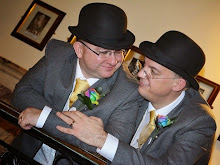
My beloved and I have been together for twenty-five years and five months – today!
So he’s working from home and I’m out on the balcony.
Don’t worry – I’m only one metre outside our flat and there’s no-one else about. The party boats have stopped running, and even if they did want to do The Masque of the Red Death on Thames, we were already distancing because the river charts have dangers marked on them like wrecks, whirlpools, Ben Aaronovitch’s goddesses and steer away from the naked gays.
But today it’s another anniversary that’s almost as wonderful, and that’s exactly fifteen years since Doctor Who came back with Rose.
The very first Doctor Who story I ever saw was a fantastic new beginning that started with “Ro”, and I still love Robot and Rose so much that when last week I published a binge-watch Doctor Who playlist, those two were right up at the beginning, because I can’t imagine better introductions to the show.
A few years ago I wrote Ten Reasons To Watch Rose to share my enthusiasm and encourage you to see it.
I mean, I even wrote my Reasons To Watch The Trip of a Lifetime Trailer for it, partly because it’s the most thrilling trailer ever made and partly because I thought it was funny to have an article that took longer to read than the things it was recommending.
Today is a fantastic day to watch Rose again and realise just how outstanding it really is, or to watch it for the first time and see what all the fuss is about for Doctor Who. Thousands of people will be watching all over the world and will welcome you in.
Because that’s something I adore about Rose.
In my reasons to watch it, well, it was more simply reasons I love it, and I went from the most obvious things like Rose, and the Doctor, and introducing the TARDIS, and if you don’t know what they are just watch the story, to getting passionate and political and just a bit angry and how Rose is not just welcoming but defiant in championing a life of change and strangeness and danger, but the tenth and last reason I want to share with you, even though it’s a bit of a spoiler.
With anything you love you can get jealous and possessive instead of saying, Wow, how awesome, and being delighted when someone else sees this the way you do.
And fifteen years ago it was tempting to say, but what about me?! Never mind ten million new viewers, I was here first! And to remember not fifteen years but sixteen years, sixteen long years where there was no spring of a new Doctor Who series on TV.
But Rose is open and welcoming and isn’t just a brilliant introduction but has one inspired moment, right at the end, where it answers that question and makes it absolutely clear that Doctor Who can be for you. We’ve seen a new world open up through Rose’s eyes and fallen in love with the idea, and then at the end – Doctor Who goes away again.
And Rose has made the Doctor’s world so utterly compelling that the endless wait of the next sixteen seconds feels like the yearning of sixteen years.
And then everyone shares the joy – when Doctor Who comes back.
I bloody love Rose, and I’m watching it tonight.
I thought of this all in one go this afternoon.
I got out of the bath and wrote it down.
I realised it would be better to camera.
I realised I couldn’t print it or learn it.
I did one take.
I was lucky not to trip over and make it the #TripOfALifetime…
Labels: Christopher Eccleston, Doctor Who, Richard, Rose, Why Is Doctor Who Brilliant?


Friday, March 20, 2020
Doctor Who Playlists – How Doctor Who and Self-Isolation Can Inspire Completely Sensible Plans (ish)
Do you want to watch some Doctor Who? Aliens from the past; wonders from the future; all of time and space. It’s the trip of a lifetime…
But where to start? Which Doctors? What style? Monsters, villains, scary horror? Wit, weirdness, wild ideas? Adventures in history, alien worlds, a bit of politics? Or sheer fun?
On the off-chance that to start at the beginning and watch all 296 stories in order is a little daunting, I’ve made a self-isolation playlist for you to dip in and out of different Doctors and experience the show’s variety much more quickly. Intrigued? Read on.

I’m not going to explain who or what Doctor Who is this time – I’ve done that before (here’s my So Who is The Doctor Anyway? All You Need To Know About Doctor Who if you want that) and, besides, it’s all becoming more complicated. For now, the Doctor is a traveller in time and space who goes anywhere, from Earth’s past, present and future to alien worlds and stranger places still. The Doctor respects life rather than authority, obeys no-one else’s rules but has a clear moral sense, preferring to use intelligence rather than violence, and takes joy in taking friends to explore the wonders of the Universe.
If you’re stuck at home and want to watch some Doctor Who for a week or three, with more than half a century’s-worth – what you need is a playlist, a ‘box set’. Here’s one (and more) I prepared earlier to make it easy. Almost as importantly, one of the things that’s made Doctor Who last so long is variety – if you don’t like one story, something completely different will probably be along in a couple of weeks; if you don’t like one Doctor or creative team, something completely different will probably be along in a couple of years. I just speed that up a bit by suggesting a list that leaps all over the place. A binge-watching buffet! Here goes…
53 Doctor Who Stories For a Week or Three
- 1 Robot (Tom Baker, 1974-5)
- 2 An Unearthly Child (William Hartnell, 1963)
- 3 Rose (Christopher Eccleston, 2005)
- 4 Ghost Light (Sylvester McCoy, 1989)
- 5 Genesis of the Daleks (Tom Baker, 1975)
- 6 Last Christmas (Peter Capaldi, 2014)
- 7 The Rescue (William Hartnell, 1965)
- 8 The End of the World (Christopher Eccleston, 2005)
- 9 The War Games (Patrick Troughton, 1969)
- 10 Utopia / The Sound of Drums / Last of the Time Lords (David Tennant, 2007)
- 11 The Day of the Doctor (Matt Smith, David Tennant and John Hurt with…, 2013)
- 12 Carnival of Monsters (Jon Pertwee, 1973)
- 13 Vengeance on Varos (Colin Baker, 1985)
- 14 Paradise Towers (Sylvester McCoy, 1987)
- 15 Boom Town (Christopher Eccleston, 2005)
- 16 The Caves of Androzani (Peter Davison with…, 1984)
- 17 The Enemy of the World (Patrick Troughton, 1967-8)
- 18 Doctor Who and the Silurians (Jon Pertwee, 1970)
- 19 Kill the Moon (Peter Capaldi, 2014)
- 20 The Talons of Weng-Chiang (Tom Baker, 1977)
- 21 The Crimson Horror (Matt Smith, 2013)
- 22 Kinda (Peter Davison, 1982)
- 23 The Curse of Fenric (Sylvester McCoy, 1989)
- 24 The Dæmons (Jon Pertwee, 1971)
- 25 Pyramids of Mars (Tom Baker, 1975)
- 26 The Tomb of the Cybermen (Patrick Troughton, 1967)
- 27 The Daleks (William Hartnell, 1963-4)
- 28 Planet of Evil (Tom Baker, 1975)
- 29 The Trial of a Time Lord (Colin Baker with…, 1986)
- 30 Amy’s Choice (Matt Smith with…, 2010)
- 31 The Aztecs (William Hartnell, 1964)
- 32 The Fires of Pompeii (David Tennant, 2008)
- 33 Enlightenment (Peter Davison, 1983)
- 34 City of Death (Tom Baker, 1979)
- 35 The Zygon Invasion / The Zygon Inversion (Peter Capaldi, 2015)
- 36 The Happiness Patrol (Sylvester McCoy, 1988)
- 37 The Androids of Tara (Tom Baker, 1978)
- 38 Human Nature / The Family of Blood (David Tennant, 2007)
- 39 The Doctor’s Wife (Matt Smith, 2011)
- 40 Doctor Who (The TV Movie) (Paul McGann with Sylvester McCoy, 1996)
- 41 Dark Water / Death In Heaven (Peter Capaldi, 2014)
- 42 Logopolis (Tom Baker with…, 1981)
- 43 Revelation of the Daleks (Colin Baker, 1985)
- 44 Bad Wolf / The Parting of the Ways (Christopher Eccleston with…, 2005)
- 45 Earthshock (Peter Davison, 1982)
- 46 Remembrance of the Daleks (Sylvester McCoy, 1988)
- 47 The Dalek Invasion of Earth (William Hartnell, 1964)
- 48 Spearhead From Space (Jon Pertwee, 1970)
- 49 Love & Monsters (David Tennant, 2006)
- 50 The Mind Robber (Patrick Troughton, 1968)
- 51 Survival (Sylvester McCoy, 1989)
- 52 The Girl Who Died (Peter Capaldi, 2015)
- 53 The Deadly Assassin (Tom Baker, 1976)

I’ve identified each story by the actor playing the Doctor because names are easier to read than a blizzard of numbers (even for media where the actor wasn’t directly involved). And because numbers get increasingly complicated…
Why 53 Stories?
Well, it’s a lot more manageable than nearly 300 so far, isn’t it? If you have to self-isolate for a month, you can probably manage a couple a day.
The original idea was inspired by Doctor Who’s 52nd anniversary (November 23rd, 2015). It’s an important and popular fact that there are 52 weeks in a year, which seemingly leads to 52 stories. I picked one Doctor Who story for every week – then, if you start with a story at the beginning of your first week and finish with one at the end of your last week, you’ll watch 53 stories in a year. There’s another reason, too, which will make you groan. So keep reading!
Why This Sequence?
Variety. And the odd pattern. The main thing you’ll notice as you watch is that I’ve grouped stories thematically – so the first three, for example, are introductions to the series, then three for Christmas (ish. Enjoy the Nativity). I’ll leave the rest for you to work out, and to see if you can guess how each story links in turn to the next, because some of them even I can’t quite remember.
Many other fans have picked their own essential to-watch choices. Most such Doctor Who playlists I’ve seen select stories in chronological order; others in order of preference. I wanted a list that offered a lot more of a mix than that. So I jump around as many Doctors as possible (with a few for each) and choose different types of adventure to keep you interested. I’m not writing a history of Doctor Who, but trying to tempt and divert you with a constantly changing assortment. They’re not my own ‘top 53’, either – almost all the list are stories I like, but to stick to only my own preferences might have been too narrow. Besides, you wouldn’t believe how agonisingly long it took me to cut it down from well over a hundred. I love a lot of Doctor Who.
You can watch anything at any time, but just to give you an idea, my original ‘year’ of weekly Doctor Who didn’t begin in January. If you were to start watching as I’d initially planned on Doctor Who’s birthday of November 23rd and, at one a week, finish on November 20th, that would be the anniversary of the final episode of The Deadly Assassin. But that’s not the real reason it closes the box set – it’s because it’s my favourite story, so I made it the climax. And also because, if I’d kept to my original plan and blogged one story a week, readers would’ve expected it to stop at 52 and then been surprised. The Deadly Assassin has the line “A mere 53 storeys high”.
I told you you’d groan.
Why No Jodie Whittaker?
Only time. I constructed this list in 2015. The antepenultimate story in the sequence is Survival, which was the last story broadcast in Doctor Who’s original 26-year run, then the penultimate story was chosen to be from the latest Doctor Who: it fitted at the time that The Girl Who Died was both part of the most recent season and that, like Survival, it pointedly says, ‘So, is this the end…? No! The story continues.’
First time round, it took me weeks of putting stories in and taking them out to settle on the original list. When I opened the file again this week, I found that even between starting publishing weekly choices and tailing off I’d definitely, probably, decided that I had to include The Curse of Peladon (1972) and The Robots of Death (1977) too. But I’d been completely unable to decide which two stories to cut out (try watching Peladon as about 7b and Robots about 28b if you feel like it). So the thought of weeks of indecision as I tried to rejig the whole thing and cut out half a dozen stories so as to include the current Doctor filled me with horror. It would never get done.
Yet she is the Doctor, she’s brilliant and I don’t want to leave her out, so here, for a start, are half a dozen particularly interesting stories you might watch for the current and Thirteenth* (*you wonder why I didn’t number them) Doctor:
- Spyfall Part One / Spyfall Part Two
- Rosa
- Fugitive of the Judoon
- Demons of the Punjab
- The Woman Who Fell To Earth
- The Haunting of Villa Diodati / Ascension of the Cybermen / The Timeless Children

Then I spent a couple of days making a different list to do Jodie justice after all, which you’ll find if you scroll down.
I also recommend Gatecrashers, Joy Wilkinson’s Thirteenth Doctor short story which opens last year’s anthology Doctor Who – The Target Storybook (and which is probably my favourite in there). I love Doctor Who in other media, too…
Half A Dozen Stories I Actually Published Reasons To Watch (plus another five. WTF?)
Ten Reasons to Watch Robot
Five Reasons to Read Doctor Who and the Cybermen
Ten Reasons to Watch An Unearthly Child
Five Reasons to Read Doctor Who In An Exciting Adventure With the Daleks
Five Reasons to Watch The Trip of a Lifetime Trailer
Ten Reasons to Watch Rose
Five Reasons to Read Doctor Who and the Auton Invasion
Ten Reasons to Watch Ghost Light
Five Reasons to Listen To Home Truths
Ten Reasons to Watch Last Christmas
Ten Reasons to Watch The Rescue
If you just read one, try the Ten Reasons… for Rose. That’s one of my better (and more heartfelt) pieces of writing.
Anyway… My original idea was to write about one Doctor Who story every week, giving ten reasons to watch each in turn. What could possibly go wrong? Several mental and physical health catastrophes played a fairly major part in bringing my writing to a grinding halt, but I also have an unerring ability to overcomplicate things.
I’d deliberately chosen 53 stories that were broadcast on TV and which still exist – the most accessible form of Doctor Who. But why not, I thought, make it up to a full hundred by also fitting in and around them many other forms of Doctor Who that I love just as much? Novelisations, novels, audio dramas, comic strips, even a trailer (by far the shortest choice in here). And a few are even brilliant Doctor Who stories the BBC transmitted in the 1960s and then burnt (yes, I know), all of which survive as soundtracks recorded at home, some of which have some surviving episodes, and others which have since been animated to give them a new lease of life.
Obviously adding this extra layer of work was a brilliant ploy to make absolutely sure my schedule would come crashing down.
But if Doctor Who on television alone isn’t enough for you, either – and why should it be? – then here is the expanded list on the same themes.
53 Doctor Who TV Stories plus 47 More Complicated Choices To Experience
- 1 Robot (Tom Baker, 1974-5)
- A Doctor Who and the Cybermen (book, Patrick Troughton, 1975)
- 2 An Unearthly Child (William Hartnell, 1963)
- B Doctor Who in an Exciting Adventure With the Daleks (book, William Hartnell, 1964)
- C Doctor Who – Series One Trailer: The Trip of a Lifetime (TV, Christopher Eccleston, 2005)
- 3 Rose (Christopher Eccleston, 2005)
- D Doctor Who and the Auton Invasion (book, Jon Pertwee, 1974)
- 4 Ghost Light (Sylvester McCoy, 1989)
- E Doctor Who – Home Truths (audio, William Hartnell, 2008)
- 5 Genesis of the Daleks (Tom Baker, 1975)
- 6 Last Christmas (Peter Capaldi, 2014)
- F Doctor Who – Tales of Trenzalore (book, Matt Smith, 2014)
- 7 The Rescue (William Hartnell, 1965)
- 8 The End of the World (Christopher Eccleston, 2005)
- G Doctor Who – Alien Bodies (book, Paul McGann, 1997)
- 9 The War Games (Patrick Troughton, 1969)
- H Doctor Who and the Two Doctors (book, Colin Baker with Patrick Troughton, 1985)
- 10 Utopia / The Sound of Drums / Last of the Time Lords (David Tennant, 2007)
- J The Night of the Doctor (TV, Paul McGann with…, 2013)
- K Faction Paradox – The Book of the War (book, Time War…?, 2002)
- 11 The Day of the Doctor (Matt Smith, David Tennant and John Hurt with…, 2013)
- L Doctor Who – The War Doctor 2: Infernal Devices (audio, John Hurt, 2016)
- 12 Carnival of Monsters (Jon Pertwee, 1973)
- 13 Vengeance on Varos (Colin Baker, 1985)
- 14 Paradise Towers (Sylvester McCoy, 1987)
- M Doctor Who and the Creature From the Pit (book, Tom Baker, 1981)
- 15 Boom Town (Christopher Eccleston, 2005)
- 16 The Caves of Androzani (Peter Davison with…, 1984)
- 17 The Enemy of the World (Patrick Troughton, 1967-8)
- N Daleks – Invasion Earth 2150AD (Film, Peter Cushing, 1966)
- 18 Doctor Who and the Silurians (Jon Pertwee, 1970)
- 19 Kill the Moon (Peter Capaldi, 2014)
- P Doctor Who: The New Adventures – Damaged Goods (book, Sylvester McCoy, 1996)
- Q Doctor Who and the Ark In Space (book, Tom Baker, 1977)
- 20 The Talons of Weng-Chiang (Tom Baker, 1977)
- R Jago & Litefoot Series 1 (audio, Christopher Benjamin & Trevor Baxter, 2010) (Cheat and start with Doctor Who – The Mahogany Murderers)
- S Doctor Who: The New Adventures – All-Consuming Fire (book, Sylvester McCoy, 1994)
- 21 The Crimson Horror (Matt Smith, 2013)
- T Doctor Who – The Tides of Time (graphic novel, Peter Davison, 1982 / 2005)
- T/A TV21 – The Dalek Chronicles (comic strip, the Daleks, 1965-7 / collected 1994)
- U The Sarah Jane Adventures – The Mad Woman in the Attic (TV, Elisabeth Sladen, 2009)
- 22 Kinda (Peter Davison, 1982)
- V The Daleks’ Master Plan (TV [3 episodes + 9 soundtrack], William Hartnell, 1965-66)
- 23 The Curse of Fenric (Sylvester McCoy, 1989)
- 24 The Dæmons (Jon Pertwee, 1971)
- W Doctor Who – The Shadows of Avalon (book, Paul McGann, 2000)
- X Doctor Who – The Holy Terror (audio, Colin Baker, 2000)
- 25 Pyramids of Mars (Tom Baker, 1975)
- Y Doctor Who – Fallen Gods (book, Paul McGann, 2003)
- Z Doctor Who: The Novel Adaptations – Love and War (audio, Sylvester McCoy, 2012)
- 26 The Tomb of the Cybermen (Patrick Troughton, 1967)
- AA Doctor Who – The Eye of Torment (graphic novel, Peter Capaldi, 2015)
- 27 The Daleks (William Hartnell, 1963-4)
- BB Doctor Who: The New Adventures – The Also People (book, Sylvester McCoy, 1995)
- CC Doctor Who: The Missing Adventures – Venusian Lullaby (book, William Hartnell, 1994)
- 28 Planet of Evil (Tom Baker, 1975)
- DD The Tenth Planet (TV [3 episodes + 1 animated], William Hartnell, 1966)
- 29 The Trial of a Time Lord (Colin Baker with…, 1986)
- 30 Amy’s Choice (Matt Smith with…, 2010)
- 31 The Aztecs (William Hartnell, 1964)
- EE Doctor Who: The New Adventures – Lucifer Rising (book, Sylvester McCoy, 1993)
- 32 The Fires of Pompeii (David Tennant, 2008)
- FF Doctor Who – The Iron Legion (graphic novel, Tom Baker, 1979-1980 / 2004)
- GG Doctor Who – The Pirate Loop (book, David Tennant, 2007)
- 33 Enlightenment (Peter Davison, 1983)
- HH Doctor Who – The Stones of Venice (audio, Paul McGann, 2001)
- 34 City of Death (Tom Baker, 1979)
- 35 The Zygon Invasion / The Zygon Inversion (Peter Capaldi, 2015)
- JJ The Macra Terror (TV [4 animated], Patrick Troughton, 1967)
- 36 The Happiness Patrol (Sylvester McCoy, 1988)
- KK Doctor Who and the Cave-Monsters (book, Jon Pertwee, 1974)
- 37 The Androids of Tara (Tom Baker, 1978)
- LL The Evil of the Daleks (TV [1 episode + 6 soundtrack], Patrick Troughton, 1967)
- 38 Human Nature / The Family of Blood (David Tennant, 2007)
- MM Doctor Who and the Time Warrior (book, Jon Pertwee, 1978)
- 39 The Doctor’s Wife (Matt Smith, 2011)
- NN Doctor Who: The New Adventures – Lungbarrow (book, Sylvester McCoy with…, 1997)
- 40 Doctor Who (The TV Movie) (Paul McGann with Sylvester McCoy, 1996)
- 41 Dark Water / Death In Heaven (Peter Capaldi, 2014)
- OO Doctor Who and the Doomsday Weapon (book, Jon Pertwee, 1974)
- 42 Logopolis (Tom Baker with…, 1981)
- PP Doctor Who – Castrovalva (book, Peter Davison, 1983)
- QQ The Sarah Jane Adventures – Death of the Doctor (TV, Elisabeth Sladen with Matt Smith, 2010)
- 43 Revelation of the Daleks (Colin Baker, 1985)
- RR Torchwood – They Keep Killing Suzie (TV, John Barrowman, 2006)
- SS Doctor Who – The Stealers of Dreams (book, Christopher Eccleston, 2005)
- 44 Bad Wolf / The Parting of the Ways (Christopher Eccleston with…, 2005)
- TT Doctor Who – Jubilee (audio, Colin Baker, 2003)
- 45 Earthshock (Peter Davison, 1982)
- 46 Remembrance of the Daleks (Sylvester McCoy, 1988)
- UU Doctor Who – Remembrance of the Daleks (book, Sylvester McCoy, 1990)
- 47 The Dalek Invasion of Earth (William Hartnell, 1964)
- 48 Spearhead From Space (Jon Pertwee, 1970)
- VV The Invasion (TV [6 episodes + 2 animated], Patrick Troughton, 1968)
- 49 Love & Monsters (David Tennant, 2006)
- WW Doctor Who: The New Adventures – Happy Endings (book, Sylvester McCoy, 1996)
- 50 The Mind Robber (Patrick Troughton, 1968)
- 51 Survival (Sylvester McCoy, 1989)
- 52 The Girl Who Died (Peter Capaldi, 2015)
- 53 The Deadly Assassin (Tom Baker, 1976)

I hope that whets your appetite. Or makes you binge. One thing that especially delights me is that, since I made this list four and a half years ago, The Macra Terror has changed from being just a soundtrack with a few surviving pictures and film clips to a full animation, making one of my favourite stories very much easier to watch (and, on the Steelbook, you get the almost as marvellous Gridlock as a bonus). You might also realise that there are four there in dual formats, but they’re probably the best Target books and great television too (can you guess which one I think is even better on TV than on the page?).
This monster of strange diversity is my favourite list. Of course it is. It’s just a little bit too much, but I love Doctor Who more than a little too much. But if you want something less absurd, I have one more list of 53 to go. And it’s free!
This is the easiest to watch (at least, if you’re in the UK). I took the 21st Century TV stories I’d already chosen above and took the last two days adding more to make them up to a full 53 (well, mostly adding too many then cutting them back) and trying to make the order interesting – starting, again, with adventures that make the best introductions, and finishing, again, with the very latest and then my favourite. But what makes this the simplest to watch is that every single story is on BBC iPlayer, officially, for free, so all you need do is sit on your sofa and click.
Doctor Who – The iPlayer Menu
- 1 Rose (Christopher Eccleston, 2005)
- 2 The Woman Who Fell To Earth (Jodie Whittaker, 2018)
- 3 Smith and Jones (David Tennant, 2007)
- 4 The Eleventh Hour (Matt Smith, 2010)
- 5 Dalek (Christopher Eccleston, 2005)
- 6 The Christmas Invasion (David Tennant, 2005)
- 7 The Husbands of River Song (Peter Capaldi, 2015)
- 8 Last Christmas (Peter Capaldi, 2014)
- 9 The Unquiet Dead (Christopher Eccleston, 2005)
- 10 The Witchfinders (Jodie Whittaker, 2018)
- 11 The Crimson Horror (Matt Smith, 2013)
- 12 Nikola Tesla’s Night of Terror (Jodie Whittaker, 2020)
- 13 Thin Ice (Peter Capaldi, 2017)
- 14 Partners In Crime (David Tennant, 2008)
- 15 Time Heist (Peter Capaldi, 2014)
- 16 The End of the World (Christopher Eccleston, 2005)
- 17 Utopia / The Sound of Drums / Last of the Time Lords (David Tennant, 2007)
- 18 The Name of the Doctor (Matt Smith with…, 2013)
- 19 The Night of the Doctor (Paul McGann with…, 2013)
- 20 The Day of the Doctor (Matt Smith, David Tennant and John Hurt with…, 2013)
- 21 Spyfall Part One / Spyfall Part Two (Jodie Whittaker, 2020)
- 22 Fugitive of the Judoon (Jodie Whittaker with…, 2020)
- 23 Kill the Moon (Peter Capaldi, 2014)
- 24 Amy’s Choice (Matt Smith with…, 2010)
- 25 The Girl Who Died (Peter Capaldi, 2015)
- 26 Father’s Day (Christopher Eccleston, 2005)
- 27 Vincent and the Doctor (Matt Smith, 2010)
- 28 The Fires of Pompeii (David Tennant, 2008)
- 29 Rosa (Jodie Whittaker, 2018)
- 30 The Zygon Invasion / The Zygon Inversion (Peter Capaldi, 2015)
- 31 The Empty Child / The Doctor Dances (Christopher Eccleston, 2005)
- 32 Gridlock (David Tennant, 2007)
- 33 Praxeus (Jodie Whittaker, 2020)
- 34 The Doctor’s Wife (Matt Smith, 2011)
- 35 The Magician’s Apprentice / The Witch’s Familiar (Peter Capaldi, 2015)
- 36 Blink (David Tennant, 2007)
- 37 Midnight (David Tennant, 2008)
- 38 The Vampires of Venice (Matt Smith, 2010)
- 39 The Eaters of Light (Peter Capaldi, 2017)
- 40 Demons of the Punjab (Jodie Whittaker, 2018)
- 41 The Impossible Planet / The Satan Pit (David Tennant, 2006)
- 42 It Takes You Away (Jodie Whittaker, 2018)
- 43 Aliens of London / World War Three (Christopher Eccleston, 2005)
- 44 Boom Town (Christopher Eccleston, 2005)
- 45 Dark Water / Death In Heaven (Peter Capaldi, 2014)
- 46 World Enough and Time / The Doctor Falls (Peter Capaldi with…, 2017)
- 47 Army of Ghosts / Doomsday (David Tennant, 2006)
- 48 Bad Wolf / The Parting of the Ways (Christopher Eccleston with…, 2005)
- 49 Resolution (Jodie Whittaker, 2019)
- 50 Love & Monsters (David Tennant, 2006)
- 51 The Rebel Flesh / The Almost People (Matt Smith, 2011)
- 52 The Haunting of Villa Diodati / Ascension of the Cybermen / The Timeless Children (Jodie Whittaker with…, 2020)
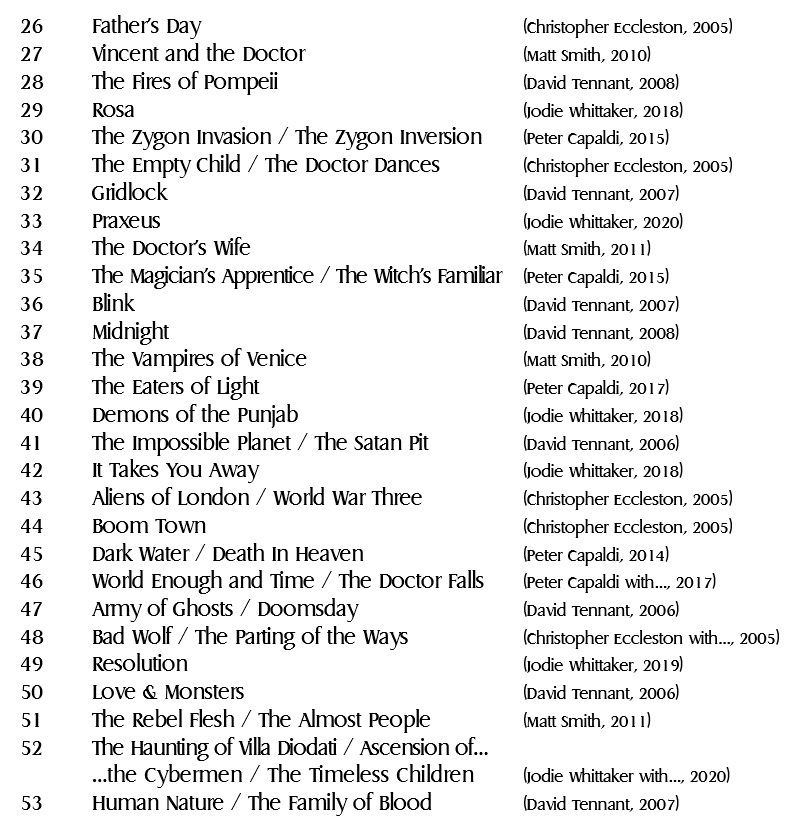
- 53 Human Nature / The Family of Blood (David Tennant, 2007)

Doctor Who – The Classic Buffet
Having spent two days working out a ‘new Who’ list I thought, well, why not do the same for ‘classic Who’? So I made a shortlist of the stories that weren’t on the original list but were absolutely necessary, counted them up, realised that 57 extra stories would be just a few too many to fit into the slots left by taking 17 from 53, hummed and hawed, tried making a shorter short list, and decided that the only way to cut the list short was to stop immediately or I would never, ever, finish and publish.
Sorry.
Oh, Go On, Then: The Extras
Half a dozen brilliant Doctor Who box sets on Blu-ray if you want to watch sequentially after all
- Season Fourteen (Tom Baker, 1976-7, out shortly)
- Season Twelve (Tom Baker, 1974-5)
- Series One [Season Twenty-Seven] (Christopher Eccleston, 2005)
- Season Twenty-Six (Sylvester McCoy, 1989)
- Season Eighteen (Tom Baker, 1980-1)
- Series Twelve [Season Thirty-Eight] (Jodie Whittaker, 2020)

I’ll make a confession. Had I written my Ten Reasons To Watch Logopolis as planned, then six of the reasons (well, five, at least) would have been the other stories in Season Eighteen, because it’s not just a superb collection of stories but Doctor Who’s most thematically consistent season, and I’d encourage you to watch them as well. Logopolis is at its best as the summation and explosion of those, the finale to the concept album. So now you can add some more stories to the lists above after all.
Even More Doctor Who from Big Finish
While the unfolding story of Doctor Who continues to expand on TV every year or two, Doctor Who on audio is growing at a far faster rate. Another confession: there’s so much of it, and I’m so often not up to enjoying things, that I’m way, way behind with Big Finish’s Doctor Who productions, but in the last couple of years I’ve made an effort to catch up with at least some of them. So I’ve listened to quite a lot of their Sylvester McCoy adventures, Lost Stories, other Doctors (and Masters) in the Time War, and a few of their series starring other characters such as Jago & Litefoot, the Counter-Measures team and River Song, many of all of which are terrific. If you get a taste for them, here are an extra half a dozen:
- Doctor Who – The Trouble With Drax (Tom Baker)
- Doctor Who: The Lost Stories – Paradise 5 (Colin Baker)
- Doctor Who: The Lost Stories – The Elite (Peter Davison; good one for novices)
- Doctor Who: The Novel Adaptations – Cold Fusion (Peter Davison and Sylvester McCoy)
- Doctor Who: The Novel Adaptations – Damaged Goods (Sylvester McCoy)
- Doctor Who: Ravenous 2 – Better Watch Out / Fairytale of Salzburg (Paul McGann for Christmas)
I love particularly two of their ongoing teams alongside Sylvester McCoy:
With Ace and Hex, starting with The Harvest (set in 2021, so almost now) and reaching a peak with A Death in the Family;
With a very different companion in Klein, for whom I’d recommend the trilogy of four A Thousand Tiny Wings, Klein’s Story, Survival of the Fittest and The Architects of History, as well as UNIT: Dominion, where Klein’s not the only character not to be who you expect.
It’s hard to choose just one of their Master stories, because so many of them are so good (well, not good, exactly, but…). I’d rush to listen to any Derek Jacobi, because he gets to do so much more on audio and is not just amazing in the part but delightful (and disturbing) in the added interviews. Or Michelle Gomez, for much the same reasons.
Perhaps the best choice is The Diary of River Song Volume Five – the stories are excellent, and you get four superb Masters to play with (despite no Alex Macqueen). Next year they unleash Masterful, or The Eight Masters (without Sacha Dhawan as yet, though as he’s done other roles for them and clearly adores being utterly fantastic in the part, surely he will before long).
The Diary of River Song Volume One – Signs is another favourite for Sam West (which reminds me: he’s fabulous as an entire family in Serpent in the Silver Mask).
Also on audio – and on the page, which is marvellous, but read by Tom Baker with charisma and ad-libs is more marvellous still:
- Doctor Who – Scratchman
Terrance Dicks
Doctor Who’s most prolific novelist died last year. I noticed with a bit of a pang that, though I started my list with the TV story he wrote that got me into Doctor Who in the first place, in my determination for variety I’d only chosen two of his books for the expanded version. So here, as is now traditional, are an extra half a dozen. All are good reads, and the first has the greatest opening line in Doctor Who:
- Doctor Who and the Dalek Invasion of Earth (William Hartnell)
- Doctor Who and the Abominable Snowmen (Patrick Troughton)
- Doctor Who and the Terror of the Autons (Jon Pertwee)
- Doctor Who and the Pyramids of Mars (Tom Baker)
- Doctor Who: The New Adventures – Timewyrm: Exodus (Sylvester McCoy)
- Doctor Who – Made of Steel (David Tennant)

I Hope You Enjoyed All That
Well, some of it, at least.
Did you find a list that was to your taste? If they were all too intimidating, just pick any story, from any list, and give it a go.
Very little me watched Robot quite by accident, forty-five years ago, and I had no idea what I was getting into. Thanks to that experience, I’m still into it.
Irritatingly, Blogger won’t upload any new photos from my PC right now. After ages of fiddling last night, I managed to upload some from my phone. This morning, it’s as if Blogger spotted the functionality and won’t let me do even that now. It’s really not helping me get back into blogging after so long away, however determined.
I also couldn’t find a way to space out the credits from the titles above, so they look rather cramped and a bit of a mess. But I took some screenshots from my draft and pasted them in from my phone at about 2am. That’s only one of the reasons I’m very knackered. As an experiment, the lists pasted as images below may be easier to read for some; if you’re partially sighted and are using some form of text reader, the lists above have identical content as the versions below.


Labels: Daleks, Doctor Who, Doctor Who 52, Jodie Whittaker, Top Tips, Why Is Doctor Who Brilliant?
Friday, August 30, 2019
Doctor Who – The Leisure Hive: A Perfect Holiday Moment
On this day in 1980, Doctor Who returned for its Eighteenth Season with a blaze of sound and colour in The Leisure Hive. The Season is the ultimate in Who ‘concept albums’ and its opening story is a bold statement, the director’s ambitious visuals, faster edits and movie-style camerawork revolutionising the show’s look (and breaking its budget). Yet the story opens with a shot so infamous that almost everyone calls it a disaster. For me, it’s a truly great moment and Doctor Who’s most sublime comment on Summer Holidays.

“I don’t think much of this Earth idea of recreation.”
When I was a boy, this time of year meant two things – going back to school, and the return of Doctor Who to our screens to sweeten the pill. It wasn’t just Doctor Who’s scariness that made it ideal viewing as the nights started drawing in. It was that the new Autumn Season often opened with stories that deliberately reflected that ‘end of Summer holidays’ feel on screen. Terror of the Zygons and The Masque of Mandragora combined holiday destinations with putting shivers up my spine in Bob Holmes’ mission to “frighten the little buggers to death”. The Ribos Operation opened with the Doctor about to go on holiday, at which point the light fails and it ends up snowing, which seemed like half my Dad’s travel plans. Or what could be more ‘British Summer’ than a trip to the seaside when the weather’s horrible and the driver’s telling you you ought to be enjoying it and it’s not his fault about the cold or the wind or getting lost in the fog…? That was Horror of Fang Rock (the first episode of which I missed because, inevitably, we were stuck in traffic jams and complaining all the way back from the sea). But no story ever evoked the end of the Summer holidays more perfectly than The Leisure Hive.

There is a Wilcock family photo taken at Land’s End in Summer 1980, mere weeks before The Leisure Hive Part One first aired. My Dad is beaming defiantly, brandishing my clearly unhappy little sister; my Mum bracing little me to try and stop us both being blown over the cliffs; my little brother sensibly crouching against the ground so that, if we all went, he wouldn’t be going over with us. But in the driving rain and bitter wind, in flapping kagouls, my brother and I are holding ice lollies in our numb fingers. The things you remember: mine was a blue Star Trek – The Motion Picture tie-in ice (probably chosen more so it would turn my tongue blue rather than to accessorise with the fingers holding it, but it worked for both). You’ll goggle at that photo and wonder, what were we thinking? The day was grim, the rain was slicing through us, the wind was chill and threatening to whip the lollies from our stiff little fingers if it couldn’t bowl us to our doom, and yet there we were, clutching things that could only make us colder. Why? Because it was Summer, damn it, and we’d been told we were going to ‘enjoy ourselves’ on pain of frostbite and smile for the camera.

“You’ve got the century wrong, you’ve got the season wrong, and you’ve got K9’s seawater defences wrong.”A summary of The Leisure Hive’s opening scene might be that the Doctor has taken Romana and K9 to Brighton, where his holiday plans go awry. He’s missed the opening of the Pavilion – again – and is sitting in a sulk. Romana chucks a beach-ball in the sea for K9 to fetch, only to find that the Doctor’s not sea-proofed him. She heaves the exploded robot up the beach to the Doctor, complains, then suggests they go on an improving trip to an alien resort instead. So they do. That’s what happens in theory, but it misses what’s entertaining about it almost as much as – to pick one review among many – Tat Wood’s livid screed in About Time 5 that “they wantonly began the season with the dullest one-hundred seconds of Doctor Who ever”.
“Well, I can’t get everything right.”
“Just something would be a help.”

After six years of Tom Baker as the Doctor with every episode opening through a swirling blue time tunnel and an only slightly remixed version of the Doctor Who Theme used since 1963, The Leisure Hive blasts into life and into the ’80s with blazing, bright stars streaking across space and a WHOOOM! howling new electric version of the theme. Most of the story will be set on the alien world of Argolis, a holiday bursting with fabulous colours, arresting angles and rapid edits, a glorious electronica score from Peter Howell to build on his new theme arrangement, three utterly stunning cliffhangers in a row, magnificent vistas, war, money, science and murder.

But first, it makes you wait.

Audiences at the time would have been shocked at the new look and sound and might have needed a breather – but viewers at any time can appreciate the antici…pation when instead of plunging right out of the stars and into an in-your-face alien environment, the camera opens on Brighton Pier and, to the sound of sighing wind and keening music slowly pans across the beach, and the beach huts, and the beach, and the beach huts, and the beach, and the beach huts, and the sound of snoring… And, at last, standing in the line of beach huts, the TARDIS, with the Doctor asleep on a deckchair, on the beach, in a huge new scarf, thick coat, and hat pulled across his face.

The Doctor wrapped up against the biting wind but still sitting on the beach anyway was something a British audience would instantly recognise and enjoy.

It’s still a brilliantly – almost absurdly – audacious move to start with an unbelievably long panning shot, and I still love it. Yes, it makes you wait, but only after it’s grabbed your attention with an explosive new title sequence and theme that nobody was expecting, which is a big tease. It’s not ‘padding’ or ‘longueurs’, but – with the first few minutes and those few minutes only set for Brighton beach – very much planned, and brave, and stylish, and though as with many brave and stylish things not everyone would get it, it’s also very funny, and fantastic in context.

To complain about the ‘dreary’ beach is to entirely miss the point of it being broadcast on August 30th. Everyone who’s just got back from a dreary British holiday when it rained in the cold will cheer when they see the Doctor wrapped up on the beach, determined to stick it out like everyone’s Dad, and young Romana saying ‘But can’t we go somewhere more exotic and exciting?’ like all the kids. And then they do! And everyone who’s just been somewhere exotic and exciting will feel smug to start with, confirmed in their view that they made the right decision, then realise that however exotic and exciting their locale, the Doctor can still go somewhere that beats it, and be drawn in. For me, it’s a stylish opening on its own, but in context it’s a perfect one.

Given a very short scene to open the story and a filming allocation for it on Brighton beach, what else would you do with it? The director succeeds in being witty, stylish and creative, and – not something for which he was famed – definitely getting his money’s worth. I suspect that as well as being a signature for new Producer John Nathan-Turner, the Brighton scene was planned as somewhere striking for all those photo-shoots of Tom’s new costume and Lalla in a bathing outfit while getting some filming in too, to visually establish the story’s holiday theme, and perhaps simply to give viewers something reassuringly ‘normal’ to lure them in before soaring off somewhere amazing.

The DVD (and now Blu-ray) commentary mixes Director Lovett Bickford, Script Editor Christopher H Bidmead and Romana Lalla Ward, and while each are excellent separately, together they wind each other up so much that you have to take turns finding each of them unbearable. But this moment starts as they’ll go on: Chris pans the minute and a half pan. Lovett superbly responds with “It’s the perfect length.” And Lalla says it makes a change from being in the TARDIS “with that thing going up and down” (Tom Baker, as we call him). Chris and Lalla agree it looks like an Italian art film, which Lovett is very happy with, though I’m not certain either of them intended it as a compliment. But Lalla is spot-on for me, sighing, “God, it’s so like the kind of British holidays, this set-up, that one dreaded so much as a child.” The one thing about the panning shot where the director missed a trick: the camera pulls past a blue and white-striped beach hut… Which for an instant makes you think of the TARDIS. But there are several more colours to come before the suggestion’s realised. The TARDIS should have been the next one after the blue.

“Well, I can’t spend the rest of my life running away from the Black Guardian.”Romana arguing with the Doctor is shot as beautifully as medieval monarchs issuing challenges on the field of battle, framed by what seem to be pennants fluttering in the wind. And then you realise, gloriously, that the camera’s filming them through the seats of deckchairs. As in any family bickering, Romana first tells the Doctor off for bypassing the Randomiser – previously crucial to stop them being found by a terrible enemy – merely because he fancies going to Brighton, and then about-faces her complaint to say that she wanted to choose a deliberate destination, too, but not one as rubbish as this. And on the Blu-ray, you can see that it really is cold enough that their breath is steaming as they speak. Naturally, while she’d sulked at K9 when he was bobbling endearingly over the shingle prattling of holiday resorts, it doesn’t stop her doing the same to the Doctor once the two of them between them have managed to put K9 out of action. That, too, is a brilliant gag, played absolutely straight – the press had already reported that the tin dog was to be written out in a few stories’ time, so his trundling from a “DANGER” sign in the background down into the sea is hilariously shot from the floating beach ball’s perspective as ominously as Jaws, with peril-zooms before they shock-comedy blow him up in the Season’s very first scene.
“We should be safe here. I shouldn’t think even he fancies freezing to death on Brighton beach.”

The mix of stylish and send-up in the direction ends the scene, too: the Doctor goes back to sleep as Romana tries to interest him in the planet they’re going to head for; but an absolutely gorgeous pull out takes us to the whole beach and then out to space as Peter Howell’s music takes us into Argolis. It’s another fantastic shot, and the real story’s only just about to begin.

When the Doctor and Romana get to Argolis, they find that the people are obsessed with a War which was over decades ago, that the place has been reduced to one big tourist attraction, that it’s run out of money and is falling apart partly because of greedy chancers deliberately running the place down so they can make a killing, and then that a pathetic wannabe who wasn’t even born when the War happened is so thirsty to do it all over again he mounts a fascist coup.
Which just shows how exotic travel destinations date, because now we can get all that at home.

This has been much more about the director than the script, but The Leisure Hive is the final script by David Fisher, for me the finest Doctor Who scriptwriter of the late ’70s and possibly the most underrated Who writer on TV. He brought not just intriguing stories but a light touch and more than a hint of sex (which you can find in The Leisure Hive, too, if you look for it). His earlier The Androids of Tara is even more delightfully Summery both in look and tone, despite having been transmitted through November and December. Having spent all day composing two thousand words about the first five minutes, I might be able to write about just why I love the story proper by about 2029…
Labels: Doctor Who, Holidays, The Leisure Hive, Tom Baker
Sunday, July 07, 2019
Liberal Democrat Leadership: Three Answers From Jo Swinson
The Liberal Democrats are in the middle of our most exciting (and certainly our most positive) Leadership election in over a decade. I’ve not been well enough to make it to the hustings, but I also have questions I would like to ask the contenders. So I’ve sent three questions to Jo Swinson and Ed Davey, each question framed by a contentious scene-setter, starting with the one I’ve asked as many Lib Dem candidates as I can for about twenty years. Thank you to Jo: here are her answers.

Question One:
People say all politicians are the same. Lib Dems have often seen moderation, working with others and compromise as virtues, to the point of the caricature that a Liberal is someone so fair they don’t take their own side in an argument. So what really motivates you?
When someone asks you on the doorstep, the hustings or on TV to sum up in one or two sentences what the Lib Dems, uniquely, stand for – and why anyone should vote for us – what do you answer?
“Jo believes that people should vote for the Lib Dems because we are the only party who are campaigning to truly improve the things that are most important to them – building an economy that puts people and the planet first, targeting rising inequality, the climate emergency, and fixing the broken social safety net; harnessing the technological revolution for Britain’s future, making sure that the benefits of automation and technological change aren’t just felt by the richest but by the people whose jobs and lives are set to change; and fixing our broken politics by working together, reaching beyond tribal politics and the damaging rhetoric being espoused by populists and nationalists, building a co-operative democracy that works not for our own successes but to improve the lives of our citizens.”
Question Two:
Nancy Seear’s answer to how the Liberals survived near-extinction in the 1950s was: “We didn’t like the Tories and we didn’t trust the state.”
The Lib Dems seem to be emerging at last from another extinction-level period.
What two ideals made us survive this time, and what can we learn from that?
“What we’ve seen since 2010 is an astonishing tenacity of people who have always been liberals, and an openness to new members and new ideas. This combination has seen our membership grow to its largest number ever – filled with people who have never joined a political party before and who have been welcomed into the Liberal Democrats. These members have helped to make us relevant again and their enthusiasm is what pushes us to win.”
Question Three:
The Tory Leadership contest went up in smoke over what drugs they’ve all used that they say should be illegal for *everyone else*.
When it comes not just to drug use but to any ‘victimless crimes’ that a lot of people disapprove of but which don’t harm others, should ordinary non-MP adults giving their informed consent be criminalised?
“Lib Dems have been clear over a long time that criminalising people for drug possession and consumption is counter-productive and should be stopped. Our policies in general shy away from any unwarranted criminalisation – focusing on the harm principle that if your actions harm someone else, they should be stopped, but that anything else needs serious consideration and debate before we look to involve the criminal law.”
I sent Jo and Ed these questions three weeks ago, followed by reminders. Jo’s team replied one week ago with a very reasonable apology – unsurprisingly, people have been asking Jo a lot of questions. I was in the middle of drafting an article to go with the questions and was going to publish Jo’s answers as soon as I’d finished it… But, finding it harder and harder to write these days, I’m still very slowly chiselling my thoughts and have only managed a paragraph or two each day of a rather difficult week.
Having sent me her answers, it’s unfair on Jo and her team for me to keep delaying. So it’s my turn to apologise to Jo and publish. And if I can finish writing something before the Leadership election actually closes…
Labels: Jo Swinson, Liberal Democrat Leadership, Liberal Democrats, What the Lib Dems Stand For
Sunday, March 03, 2019
Freedom, Fairness, Future – Demanding Better of the Liberal Democrats
Happy thirty-first birthday, Liberal Democrats?
Liberalism is desperately needed today. Liberal Democrats are sometimes powerful voices, but sometimes tongue-tied.
We must demand better.
Last year I chose six words (three positive values, one urgent priority) for a short video on ‘Why the Lib Dems’:
Freedom, Fairness, Future
Exit From Brexit
If our MPs would even pick six such words and sound like they meant them, that would be a start.
Our Leadership seems to think ‘Why can’t we all get along?’ is good enough. It isn’t. It’s a cry of helplessness, and they have no answer to their own question.
I don’t have all the answers. But the least the Lib Dem Leadership can do is answer why we shouldn’t all pack up and go home. The slogan “Demand Better” is a headline to get attention, but with absolutely no idea what to say if anyone then looks our way and asks, ‘Yes, what?’
It’s a cliché to say a Liberal won’t take their own side in an argument, but even after years of singularly failing to put any passion into Liberalism I didn’t expect our own Leadership’s answer to ‘Demand a better Centre Party’ to be ‘Oh, perhaps they have a point’. After a year of navel-gazing about ‘Registered Supporters’, now our Leadership doesn’t even seem to have the energy to ask potential supporters to register with this party in particular. Rather than assuming people would rally if we tinkered with the mechanics, perhaps the Liberal Democrats should have considered that the way to get people to support us is to articulate something worth supporting.
Some time ago, I wrote about “What It Means To Be A Liberal Democrat”. I made the case for the values I believe in and the positive difference Liberal Democrats should make.
Liberal Democrats can certainly demand better than what I publish here. But first we need our Leadership to stop standing frozen in the headlights in the middle of the road. To go anywhere, we must set out a direction of travel.

What It Means To Be A Liberal Democrat
To be a Liberal Democrat is to believe in freedom.
Freedom grounded in real life, starting with people as they are. Not ‘The People’. Not ‘Our People’. Freedom based on the unique worth and potential of every individual person, and the reality that the person who knows best how to live their life is themselves.
To be a Liberal Democrat is to demand better. Government shouldn’t just protect the interests of those who are already well-off, and sneer at and push down people working hard to make a life for themselves, or those who aren’t able to support themselves. Liberal Democrats demand freedom from poverty. Government shouldn’t assume it can do everything, control everyone, as long as you take what you’re given and don’t ask awkward questions of those in charge. Liberal Democrats demand freedom from ignorance. Government shouldn’t tell you that your nation is the only thing that matters about you, drive out ‘outsiders’ and call anyone who doesn’t want their flag cut smaller, narrower and meaner ‘traitors’. Liberal Democrats demand freedom from conformity.
Liberal Democrats feel in our guts that everyone should be free to live their own life, that pushing people about and telling them what to do or who to be is wrong. We feel in our guts that everyone should have a fair chance, that prejudice and lack of opportunity are wrong. We feel in our guts the need for a better future, that piling up today’s problems for our kids to deal with tomorrow is wrong. But politics isn’t just about gut feelings and protesting when things aren’t right. We must face up to how things really are to work out how to change them, and change our own methods if experience shows us better ways to achieve our ideals. So Liberal Democrats are principle-led, but evidence-based.
An open, fairer society and a greener, stronger economy are interdependent. Liberal Democrats champion opportunity, fairness and economic responsibility. An economy that works, that encourages enterprise, that’s environmentally and financially sustainable, and where everyone pays their fair share. All thriving within an outward-looking, optimistic society that’s open-minded, open-hearted and open to co-operating with other countries to tackle climate change, promote peace and increase prosperity for our whole planet’s future.
Liberal Democrats believe freedom needs both positive help to make it real for everyone, and action to break down barriers to freedom such as poverty, ignorance and conformity. Education is the single most crucial way to combine both. A great education ensures everyone has the opportunity to realise their potential, whatever their background, whatever their choices. Every child getting the best education is central to them growing up with the freedom to live their own lives, getting a fair start and building for the future. If you’re for every person, and you want every person to have the ability to ask the important questions and make their own informed decisions in realising their own dreams, education is where it starts. If you want an economy growing and succeeding with innovation and creativity and where the most talented get ahead instead of just the most wealthy, education, training and apprenticeships are where it starts.
From the foundation that society should be for everyone and that everyone should be free, Liberal Democrats understand that individual people choose to come together in any number of complementary ways – families, jobs, mutual interests, neighbourhoods, nations, the whole human family – and that decisions can be made at any of those levels without giving up the others. That’s why we’ve always been both the most localist and the most internationalist party. Any political party denying diversity, defining itself by just one single identity or community and telling each individual that your birth or your faith or your cash or your class or your country is the only thing that counts doesn’t just diminish people’s lives and hopes, doesn’t just make society more fearful, hateful and divided, but is the mark of a party so stuck in its own prejudices that it has no idea how real people’s real lives work.
One vivid, simple answer to what Liberalism is for has always stuck with me: Liberalism is about standing up to bullies. That’s why a Liberal’s gut instinct is to side with the underdog – whoever the bully is and whoever the underdog is at any one time. Any sort of power can threaten liberty, but any sort of power can defend it, too. Whether it’s the state, or big business or big unions, or just other people, any of them can boss you around and anyone can help stop you being bossed around. So Liberals wouldn’t label any of them ‘the enemy’ or do away with any of them – just as we won’t say any of them are right all the time. When government acts fairly it can be the biggest force to restrain bullies, from crooks and murderers to stifling communities and bad employers; but a government that bosses you around or that only protects one special interest or only picks on another is just a bigger bully. The closer anyone has to a monopoly of power, the more it’s abused. Liberals challenge power and privilege, break up monopolies, set the same rules for everyone and make the starting point for any decisions the people that they affect.
When the starting point is people, what’s the end point? Get real! If you start with people you never say ‘that’s it.’ Whether it’s a grandiose utopia that you’ll never finish building or a thousand mean little targets to tick, imaginary end points have two things in common. Believing the ‘ends’ justify the means, they throw real people under the bus, seeing individuals only as statistics or as problems. And they never work. A Liberal society isn’t a perfect society, because there aren’t any perfect people or perfect politicians – but an open, untidy society that develops constantly in response to the individuals who form it has the advantage of being about real life. Liberals don’t say ‘We know best’, because everyone’s best is different.
To be a Liberal Democrat is to be wary of grand plans and little prejudices. To say of human nature, ‘It’s complicated’. Anyone might be kind or selfish, creative or lazy, successful or failing. Other parties see that as a reason to control people, because they believe people who disagree with them can’t be trusted with freedom, and they think ‘their people’ will want to do what they tell them anyway. Other parties fear pluralism, diversity, flexibility and individuality. Liberal Democrats might give an instinctive two-word answer to that ending in “—off”, but we have a better answer, too, countering fear with hope. Our fear is more that if a government makes a mistake in its giant one-life-fits-all authoritarianism, it’s going to be a doozy. And our hope, based on realism, is that the more different ideas run free, the more brilliant, practical ones will succeed. Believe in people, enable people, and unlock everyone’s potential.
To be a Liberal Democrat is to embrace the contradictions – because people are contradictory. Because only one idea has room for how messy, contradictory and wonderful real life and real people are. Freedom.

The Story Since 2016
I’ve never published this before, but for a couple of years it was on the Liberal Democrat main website as one of nine shortlisted essays chosen in early 2016. The competition was part of a consultation on “What It Means To Be A Liberal Democrat In 2015”. I re-read it a couple of weeks ago and was surprised how relevant it still seemed (even the ‘traitors’ line was in there back then). I aimed to make our Liberalism instinctive and accessible, and that stands. My video above is much more politically punchy for our immediate priorities and better to show someone who’s not interested in philosophy. Comparing this essay to my 2017 General Election post “A Liberal Britain. A Brighter Future. My Hope”, that takes a very different approach and that, too, has some punchy lines confronting issues I didn’t mention at all here (though in trying to find hope post-Brexit I was a little too shell-shocked to do more than wish it would all go away).
You’d think British politics has changed a lot since 2016. As the Prime Minister might say, nothing has changed, and yet everything has. Back when I wrote my “What It Means To Be A Liberal Democrat”, I was concerned that I’d leaned a bit too hard on vigilance about the state rather than its power to help – giving emphasis to education, but not health or infrastructure. After two years of Theresa May in charge, I didn’t go nearly far enough in warning against the might of government to be a heartless bully, an unmitigated f— up, or both at the same time. Back then, Brexit was a looming threat, not yet a tectonic shift. Since then, British politics has been frozen while Britain itself has become far worse – all because of the worst decision ever made in British democracy, and a slither of decisions and non-decisions ever since that have only made the worst decision worse still.
In the face of this titanic catastrophe, the Liberal Democrat Leadership has been more frozen than most. Much of the time their only message has been ‘Why can’t we all get along?’ when the answer is ‘Because an awful lot of people made a decision based on hating other people’, and wishing and hoping that they didn’t really mean it and that the clock would turn back has failed to make any impact as a political strategy because it has no political appeal and no political reality. Liberalism is worth fighting for. Bullies must be stood up to. Looking hand-wringingly heavenward and wishing that the bully and the bullied would just get along simply does not cut it.
If I’d started writing this today, stopping Brexit would have been the angry focus and I would have been far more pugnacious against Theresa May and her fascistic Hostile Environment or Jeremy Corbyn and his sub-BNP attacks on immigrants stealing British jobs. I’ve written quite a few times on what the Lib Dems stand for, and I may well write again. But I realised that what I’d written was something positive – and that wasn’t afraid to take a side. I’ve decided to publish pretty much what I entered, with a couple of small polishes. The competition set a limit of a thousand words. I’ve reintroduced a sentence or two that I’d originally cut for space, but mainly I’ve put back one whole paragraph. The reason I removed that one at the time was that I liked what it was aiming for but it just didn’t quite flow. Ironically, I found the Lib Dems’ “Demand Better” gave me the edge I was looking for, so that one paragraph has been rewritten today and restored to set the tone at the top.
You see? You can get something out of demanding better – but you have to give people some idea of what you’re demanding.

Labels: Brexit, Bullies, Economy, Education, Environment, Ideas, Liberal Democrats, Liberalism, Meddling In Things That Are Nobody's Business But Your Own, What the Lib Dems Stand For
Sunday, February 03, 2019
Doctor Who – The Armageddon Factor: Where Have All the Zeons Gone?
Forty years ago today, the Doctor was facing The Armageddon Factor – the climax of his quest for the Key To Time. It’s one of my favourite and most fun years of Doctor Who, yet this finale tells a grimmer story. A world inexplicably breaks off trade with its closest neighbour, goes to war instead and ends up nearing utter destruction, while its leader* spouts self-deluded nationalist propaganda with Churchillian rhetoric but Hitlerian meaning, promising
“Victory – or death!”But the Doctor’s trip to neighbouring planet Zeos poses a question that’s never been answered until now: where have all the Zeons gone?
*Meanwhile, the powerless figurehead constitutional monarch offers subtly coded resistance in her speeches.

Enjoying The Key To Time
The Doctor is on a mission from God. Surprisingly, that’s where the fun starts.
Doctor Who – The Key To Time Coming Soon Trailer
I was six when Season Sixteen of Doctor Who began in Autumn 1978, and I adored it. I still adore it now, for all the old reasons and quite a few more besides. For the first time, the whole season has a declared mission statement and story arc: the Doctor must search for the six segments of the Key To Time, to prevent the Universe from being plunged into eternal chaos. Marvellously, the series reacts against this grimdark threat by revelling in being fairy-tale, fluffy and fun. Tom Baker’s enjoying himself as the Doctor, Mary Tamm’s Romana is icily fabulous, and this is the year when K9 really works. The sheer entertainment of the actors and the style is built on some of the best authors ever to write for the Doctor, who include Douglas Adams, Robert Holmes and David Fisher (the most underrated, but who for my money gets the best balance of character and wit here, and is rather grown-up about sex).

Striking out into science fantasy with citadels, evil queens and the Doctor as a wizard on a quest, the most consistent theme underlying the magical journey is that gods aren’t to be trusted. From the very beginning, the Doctor chafes against being told what to do, and through a succession of witty adventures with larger-than-life opponents, despite the warning of impending doom, he and the stories are far more about having fun than following the holy writ. In the first story of the season, The Ribos Operation, the Doctor gets involved in a small-time scam and does his best to ignore the ‘important people’, while the most moving and heroic figure is an alien world’s equivalent of Galileo. The Pirate Planet fizzes with ideas, builds a very serious story seamlessly out of a very silly one, pits the Doctor’s fury against a cyborg Pirate Captain and features the Daily Mail’s worst nightmare – young people today who are gay hoodies. The Stones of Blood follows that with a fabulous lesbian goddess, female Gothic and sausage sandwiches. The Androids of Tara – my favourite in one of my favourite seasons – is almost a summer holiday in gorgeous countryside, playing at swordfighting with a dastardly double-dealing moustache-twirling villain. The Power of Kroll is a bit flatter than the rest, but does have a very big god indeed and a performance by Philip Madoc of a man who knows he could do a better job than his rubbish boss that becomes immeasurably more entertaining if you know the behind-the-scenes casting details. And then there’s The Armageddon Factor.
The Armageddon Factor
“We have the power to do anything we like…”The Armageddon Factor is a story that almost no-one has a good word for. After six months of the search for the Key To Time, I’ve seen quite a few reviews complain that it’s not a sufficiently epic finale – the money’s clearly run out, the macho space battles are dismissed as a very bad idea, and the conclusion of the whole quest is an anti-climax because it resolutely rejects the self-importantly deterministic apotheosis that messianic sci-fi often marched towards. But those reviews tend to see the whole season as incorrigibly frivolous already. Many fans who enjoyed the rest of it, though, are disappointed by this story because after so much jolly colour in both style and tone, the finale is dark and drab. Writer Gareth Roberts praises Season Sixteen as Doctor Who’s best, but still thinks it tails off: his novel The Well-Mannered War attempts a grand finale for the era, most blatantly going for The Armageddon Factor II, with a ton of reworked plot riffs (even his own version of ‘Where have all the Zeons gone?’) though with characteristically misanthropic overtones.
For me there’s a lot to the story, not least the ending that winds so many people up: I don’t want the Doctor to create Universal order. I can’t think of a more Doctorish answer to absolute power than that no-one should be trusted with god-like supremacy… Not even God. Along the way, John Woodvine’s Marshal is a toweringly watchable dictator, the eerie skull on a stick both fascinated and disturbed me, and its critique of war offers some very black humour. I do have some problems with the plot structure – the ‘comic relief’ comes in too late, when it’s starving for some drama towards the end (but even then, that inspires John Dorney’s brilliant The Trouble With Drax, possibly the most enjoyable of all Big Finish’s modern Tom Baker adventures) while the middle sags a bit and could have done with something more diverting than too many corridors. But it’s in those corridors that you find a question that’s been nagging away at me for years…
Having landed in the midst of an interplanetary war between Atrios and Zeos, the Doctor spends roughly a third of the story each on Atrios, then on Zeos, then in the sinister base of the sinister third force behind the whole sinister plan. The trouble is, there isn’t much there on Zeos: a few beige corridors; a bit of dust; an over-intelligent Weapon of Mass Destruction that K9 exchanges sexts with; and, er, that’s it. This makes a problem for the viewer, as Zeos being so unexciting sometimes gives the impression that the war is less between two planets than between two leisure centres in need of refurbishment. But it also makes a problem for the script: where have all the Zeons gone?
The Missing Planet Vs the Missing People
“The fleet is still trying to locate the target, sir.”The story’s initial mystery is not the Zeons, but their entire planet: earlier in the story, what remains of the Atrian fleet is unable to find their target, then engaged and hopelessly outfought by the Zeon ships. The Doctor works out the answer to the ‘missing’ planet, which though a bit iffy in terms of spatial understanding gives the clue that there is something else, and someone else, out there; the inhumanly efficient Zeon attacks in turn are a clue as to the nature of the Zeon ‘commander’, not a person but an alien-built super-computer, Mentalis. That revelation is part of the intriguing mirror to that opening question: once you’ve found Zeos, why does it appear deserted?
“The target, Major Shapp, is Zeos! The planet. Isn’t that big enough?”
Whoever wrote the Radio Times teasers for this story certainly considered this a crucial question. For Part Two, it intrigued readers with:
“The Atrian defences are finally exhausted and the Marshal enlists the Doctor’s help in fighting off the Zeon attack. But who are the Zeons? Why has no one ever seen one?”Which we later find out isn’t strictly true, but pales next to Part Three:
“The Doctor discovers the bizarre truth about the Zeons.”About Zeos, perhaps – but when Part Three was broadcast on 3rd February 1979, the Doctor’s visit to Zeos asks the question but only gets answers to a different one. The sleight of hand is such, though, that I didn’t notice until long after 1979. It took until The Key To Time was released in a DVD box set for Richard and I to watch The Armageddon Factor together and, chatting after each episode as we often do, discover that we both had diametrically opposed assumptions. I’d always had in the back of my mind that the Zeons had all emigrated to some other system or something of the sort; Richard had always assumed they’re all dead.
Which of those you think is true graphically changes the tone of the story.
Now, there are a lot of clues in the story before we get to Zeos. The Doctor’s bluffing suggestion of a cheap and energy-saving psychological barrier, inducing “Atrophobia”, to keep the Zeon fleet away is really a stab at being able to talk to a Zeon prisoner and get a wider picture of what’s going on – but there are no prisoners. At first, this seems of a piece with the way that the Atrians can’t find Zeos – but if it isn’t there, where are the attacks coming from? The Doctor notes that of course it’s there, but hidden, which suggests some sort of outside interference with Zeos (a much bigger part of the plot in the original storyline). Then the Zeon fleet’s suddenly gone, like ghosts, and the Marshal declaims, “Deliver us from the terrors of war and the evils of pestilence…” Are we supposed to wonder if the Zeons have all been killed by disease? Are people dissolved by disease on Zeos (the Doctor pointedly tells one character that people aren’t dissolved by radiation)? After the Doctor has the idea of going to Zeos to investigate, his odd nagging question en route is why the Marshal, leader of the world at war with Zeos, should have the equivalent of a secret passage straight there – but it’s odder still in retrospect to look at the exchange between the Marshal and the Doctor that leads to the trip:
“There are no Zeons!”When the Doctor arrives on Zeos, he’s been clobbered by the sinister Shadow’s henchbeings: of course, we assume that the blokes apparently from and on Zeos in black robes and skull masks are Zeons. That mirrors the implications for the first couple of episodes that Zeos is some sort of ghost planet, a planet of the dead (a frequent state in Doctor Who – one that writers Bob Baker and Dave Martin had tried to get in before – and another of many elements that this story would have in common with the following one). Atrios’ Princess Astra calls the war futile and begs for peace, warning, “We shall all be wiped out if we go on, Zeons and Atrians alike.” Is that perhaps another clue that they may all be dead already? And then, of course, what appears to be the clincher, as the Doctor concludes:
“There are on Zeos.”
“What exactly are you proposing?”
“There are no Zeons on Zeos…”I’m not sure there’s such a thing as a fan consensus, except not to ask the question: The Discontinuity Guide buries a questionable ‘fact’ in its summary that “Atrios and Zeos have been waging nuclear war on each other, despite the fact that for the last five years Zeos has been uninhabited and that its warfare has been prosecuted by Mentalis, a computerised commandant… The Zeons were human, but were possibly wiped out by the Atrions’ attacks” but makes no attempt to think past that ambiguity, while About Time IV states baldly that “they’re all dead now”, and even assumes it’s been for the last five years, since Mentalis was built. So what killed them at the very beginning of the war, or earlier, then?

The Missing Plot
The roots of the problem surely lie in what happened when the Doctor arrived on Zeos in the script as originally planned. This outline, Armageddon, had much the same structure, but once it’s been established that the now near-uninhabitable Atrios is too weak to win, we were to be surprised to meet plenty of Zeons – who are all in much the same radiation-sick, bombed-out state as the Atrians. Thanks to the DVD text notes (or, if you have them, In-Vision and Doctor Who – The Complete and Utter History), you can read quite a bit about the original storyline and the Zeon people – but, by the time the story made it to screen, script editor Anthony Read had decided that the Zeos episodes essentially repeated what the Doctor had already encountered on Atrios and, with the budget already at breaking point, were a prime target for a cut. He deleted the Zeons and added Mentalis the sexy WMD, a “totally invincible” commander whose robot fighters now have the edge against untrained young Atrian pilots after too many casualties. Though fewer speaking parts in the middle episodes are a problem for audience engagement, the change at least comes up with something different – as well as taking the script in a different direction to what seemed at times Bob Baker and Dave Martin’s cover version of the earlier story Genesis of the Daleks (war, radiation, mutants, a dictator in a bunker making familiar speeches and even another Brothers Karamazov moral dilemma; peculiarly, the new additions are in part a satire on Game Theory, something that also crops up in the next story along, Destiny of the Daleks, which is in itself a direct sequel to Genesis of the Daleks). So, in one fell swoop, that’s the behind-the-scenes reason why we don’t meet any Zeons. But that still leaves an unanswered on-screen question – what happened to them? Are they all dead? And if so, how?
In The Armageddon Factor as broadcast, despite the revelation of Mentalis fighting a zombie Zeon war, all the other hints about the dead planet suddenly hit a beige wall. We’ve been given a mystery – but there’s no pay-off. When the Doctor arrives on Zeos, it’s just a load of dusty corridors, and the more weirdly fairground-ride planet of the dead is somewhere else entirely. The revelation that “There are no Zeons on Zeos” should be a shattering twist, like it turning out there are no Russians in Russia for a World War III thriller, but the line’s tossed away and no-one shows any interest in it, as if suddenly none of it matters. We’re left wondering if someone’s going to finish off telling us the plot eventually, but they never do. Mentalis resembles a high-tech version of a dead man’s switch, but we never see the dead men.
I suspect that my understanding that the Zeons had just ‘gone away’ came from the novelisation Doctor Who and the Armageddon Factor. In it, Terrance Dicks does what he often did, zeroing in on a plot hole he’s spotted and explaining it away with the option that will be less disturbing for kids. So, on page 69 of the book, the Doctor finds Mentalis and concludes that “The whole planet is automated. There are no Zeons on this part of Zeos.” Atrian Major Shapp then asks where the Zeons are, prompting the Doctor to guess, “On the other side of the planet, I imagine, somewhere in hiding. But before they went, they set this up.” It’s a stab at an explanation, but on closer examination, surely it doesn’t hold up (planets turn, after all. Emigration might have made sense – but with nothing anywhere to support that theory, you’d just have to make it up). Yet the TV version suddenly falters at the obvious counter-conclusion.
The more disturbing option, the one that seems much more heavily implied by all the signifiers before we actually reach Zeos, is that all the Zeons are dead, but that the Shadow has had Mentalis set up to fight for them from beyond the grave, or that they built Mentalis to ‘win the war’ and as a result didn’t put enough effort into Atrios-like bunkers so were all killed by the radiation or, as Shapp asks, “Could be the result of… biological warfare?” Though it’s worth noting that, as well as being atrociously acted, Major Shapp is atrociously written; he doesn’t seem sure whether Atrios used or even possess biological weapons, despite being second in command of all Atrian forces.
The trouble with this reading is that, while the war’s a little protracted, it can’t be a millennium-long one like Genesis of the Daleks’ Thal-Kaled war that might explain how bodies could have crumbled to dust over centuries while the machinery just continues remorselessly – the only skeletons we see are perambulatory and not local (the Shadow’s robed, skeletal servants, the “Mutes”, are literally represented by the costume designer as having no mouths – the most ‘extra’ of all extras, with even their costumes saying, ‘There’s no way on Earth you’re getting a line’ – but are apparently a leftover from the Zeons being mutated after all the nuclear war, again much like the “Mutos” of Genesis of the Daleks. Yet though the idea of them began as Zeons, on screen they are explicitly not). Bob and Dave pull off ‘walking on crumbled corpses’ very effectively in The Hand of Fear, but those took millions of years to collapse into sand; here, Shapp’s only in early middle age, but he clearly remembers trading with Zeons before the war, and that they looked just like the (humanoid) Atrians, while we hear later from Drax that the war started only just over five years ago.
The clues are all set up, then, for all the Zeons to be dead, until we actually reach Zeos. At that point, not only is there is no real moment of resolution, but every clue suddenly backs away from the grisly ‘truth’: K9 makes no warnings (unlike on Atrios) of high levels of radiation; there appears to be almost no damage; the Doctor even makes a point of pointing out to Shapp, “There’s no sign of your attacks getting through though, is there?” The revelation of Mentalis itself raises another question: its Dr Strangelove parallel is explicit when Marshal Jack D Ripper launches his own mad mission in person and Mentalis is programmed to respond with its ‘If you bomb us we will blow up the entire solar system… Maybe we should have told you this in advance’ Non-Deterring Deterrent Doomsday Device (that apparent oversight in itself a clue to what’s really going on). Yet if all the Zeons are already dead, how did whatever killed them not already trigger such Mutual Assured Destruction? Early in Part Four, Romana notes:
“Well, since there don’t seem to be any Zeons on Zeos, if you know what I mean…”As established, I’m not sure we do, but the script seems to keep worrying at it like a missing tooth or a distracting thought they can’t quite place. To confuse matters further, as late as Part Five (once the plot’s already left Zeos, and after you’d think all the facts were established) Romana observes that there are only four seconds left in their makeshift time-loop designed to delay the system’s total destruction, and that if it should snap, “millions of people on Zeos and Atrios will die”. So, did she see quite a lot of people on Zeos that we didn’t see, or was she just left reading an earlier version of the script? And, as the black-hearted plan behind the war is to foment chaos and suffering and trap the Doctor in a moral dilemma with millions of lives at stake, why would the Shadow cut short the chaos and suffering for one world, or wipe out half his ‘hostages’?
The mystery of the missing Zeons hurts The Armageddon Factor not just by making it less coherent, but by drawing back from the mood of death and destruction with which the story starts, making it one of the elements that fight against the drama by actively reducing tension as the story goes on. With a heavily rewritten script at the end of a full season’s overarching story, it seems that this was a detail that just fell through the cracks. It may well be that the script hinted at a dead planet, then bottled out of the idea as too frightening when it got there, and there just wasn’t the time to change all the promising details even when they were no longer going to deliver. The Armageddon Factor had two credited writers; many changes were made to it by the outgoing script editor (the equivalent of today’s lead writer); incoming script editor Douglas Adams and producer Graham Williams were concentrating on making the ending to the whole six-month story arc work, rather than the details of the six-episode story. It’s not hard to see how the Zeons got lost down the back of the sofa between drafts.
The Watsonian conclusion that most fits the tone of the story is that all the Zeons are dead, and simply try to ignore everything that pulls against that – or, at the risk of making it even closer to Genesis of the Daleks, to fill in the gap with the sole suspect to hand: single-mindedly programmed to win the war, Mentalis did it, clinically deciding that the Zeon people were a waste of scarce wartime resources. It’s almost a relief that none of the many writers made such an obvious sci-fi cliché explicit, merely leaving it a lurking possibility. But the real, unsatisfyingly Doylist answer lies in the decision to take them out of the script, but leave their planet as their meaningless ghost in the middle of it: by the time The Armageddon Factor went into production, the truth is that the Zeons aren’t all dead – they were never alive.

As well as today being the fortieth anniversary of the Doctor’s trip to Zeos, it was thirteen years ago today that I began this blog. While Love and Liberty was never exactly prolific, I’ve found it incredibly difficult to write as my health has nosedived faster than ever over the past few years. But this has been rattling around my head and various drafts for ages, so today seemed a good day to buckle down to it at last, and rather to my surprise, I have. Will there be more? Who knows.

Labels: Brexit, Doctor Who, The Armageddon Factor, The Golden Dozen, The Key To Time, Tom Baker