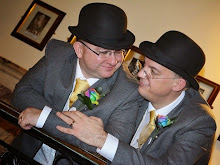
Friday, December 31, 2021
The Avengers vs Doctor Who – A Selection Box
My two favourite TV series, both starring a surprisingly un-macho hero and fabulous women, both kicked off in the early Sixties by Sydney Newman, both among the most iconic and most successful British TV ever made – both exciting, witty, weird and fun.
TL;DR—
If there’s one Avengers episode that’s influenced Doctor Who more than any other, it’s The Cybernauts
Of all the Doctor Who crossover actors, watch out for From Venus With Love and Stay Tuned
Of all the Doctor Who crossover plots, marvel at The Morning After and Man-Eater of Surrey Green
And as I publish this right now, try Look – (Stop Me if You’ve Heard This One) But There Were These Two Fellers… and Dressed to Kill.
But keep reading for why, and for many more!
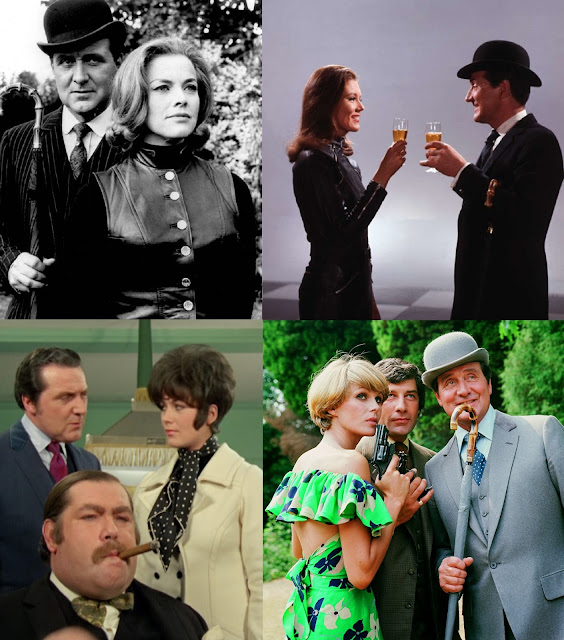
To Begin With… Introducing Doctor Who and The Avengers
The Avengers – A man with a bowler hat and a woman who throws men over her shoulder
Now you can skip to the selections below and start watching, really, but if you want more about one or the other, you could say that both series revolve around a mysterious, flamboyant figure who tempts you from our world into a strange one off to one side, and that neither carry guns or take themselves as seriously as their mission…
Who is the Doctor?
When the current Doctor, Jodie Whittaker, fell to Earth to play the role for the first time, I wrote So Who is The Doctor Anyway? All You Need To Know About Doctor Who, but, again, the TL;DR—
The Doctor is a traveller in time and space who goes anywhere, from Earth’s past, present and future to alien worlds and stranger places still. The Doctor obeys no authority but their own moral sense, uses intelligence rather than violence, and takes joy in taking friends to explore the wonders of the Universe.
Doctor Who began in 1963 and has run ever since in one medium or another, but most prominently on TV through the following three decades and then again ever since 2005 – and back this very Saturday for New Year.
Who are The Avengers?
“The Avengers is about a man in a bowler hat and a woman who flings men over her shoulders.”
…said Patrick Macnee, Steed, and I can’t say better than that, can I? Or as a famous American trailer told us, that extraordinary crimes have to be avenged by agents extraordinary – John Steed, top professional, and his talented amateur partners – The Avengers. Together, they fight diabolical masterminds. Steed is a shady arm’s-length government agent whose gorgeous old-fashioned suits and bowler are almost as wilfully anachronistic as the Doctor, while The Avengers’ own version of time travel is to pair this seemingly conservative continuing lead with a series of intelligent, capable, confident, experienced and physically combative women that broke the TV mould and created the future (and several excellent men, but none so memorable as Steed or The Avengers’ women). Steed is more casually ruthless than the Doctor but just as playful – winning as often as not through outrageous cheating, while the only rule his partners break is gender. A brilliant balance of suspense and silliness, bizarre mysteries, and more than any other crime-fighting / spy-busting duo, they do it for fun. The Avengers is a secret agent series, a comedy-thriller, occasionally sci-fi, riding old-fashioned Britishness and Swinging modernity with equal excitement, its greatest genius to make all the women ahead of their time and the man from a bygone age, a fantasy of Britain with Steed playing on the swings at the heart of Avengerland.
The Avengers began in 1961 and ran through to 1969, along the way becoming the biggest ever hit British show on primetime US TV just as Doctor Who became a hit in dozens of countries, then returned as The New Avengers in the mid-’70s and, like Doctor Who, still lives on in Big Finish productions.
Both much more strange and interesting than almost any other TV series, both sometimes very funny, sometimes sinister, it’s no surprise that The Avengers is the closest show to my heart than any but Doctor Who. Several writers worked on both – and several plots found their way from one series to the other, with cross-fertilisation apparent as early as Sara Kingdom, the Doctor’s high-action, leather-suited companion in The Daleks’ Master Plan – but it’s the actors who really stand out. Avengers Honor Blackman, Diana Rigg, Gareth Hunt, Patrick Newell and Joanna Lumley all had Doctor Who roles too. The Third Doctor, Jon Pertwee, wasn’t just the most Earthbound but had his own The Avengers part, as did the Master, the Rani, and no fewer than three First Doctors (yet not the original). The guest artists appearing across both series are too many to list, but you can find actors from The Avengers and The New Avengers even well into this century’s New Who – most notably Bernard Cribbins and Diana Rigg, but also the likes of Christopher Benjamin, Lindsay Duncan, Roy Marsden and Stephen Moore (and more).
If you’re a Doctor Who fan looking for an excuse to be enticed into The Avengers, here are a few recommendations that stand out. Not necessarily the best, nor all my favourites, nor the most quintessentially The Avengers, but a selection box of flavours you might just recognise…
Doctor Who Stars in The Avengers
From Venus With L💘ve (Mrs Peel – IN COLOR)
The Brigadier, but not the one you’re expecting: he’s Jon Pertwee!
Plus other Doctor Who guest stars from as early as the very first story in 1963 (Derek Newark) to The Eleventh Hour in 2010 (Arthur Cox), and of course The Crimson Horror’s Diana Rigg as Mrs Emma Peel.
This was the first colour episode of The Avengers to be transmitted, and like Doctor Who’s first colour story, Spearhead From Space (itself packed with Avengers crossover actors), this is shot gorgeously all on film, goes down to Earth but not quite the world as we know it as our heroes – the eccentric dandy in the vintage car and the fantastically overqualified, caustically sharp-witted scientifically accomplished woman working for a mysterious secret agency – investigate an alien invasion…
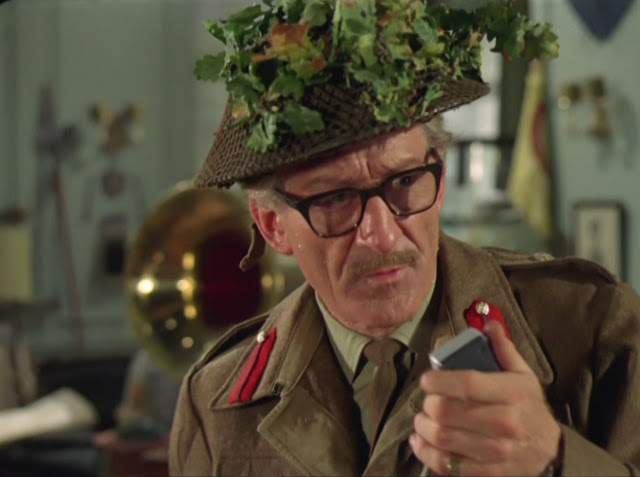
The Eagle’s Nest (The New Avengers)
In which movie Dr. Who Peter Cushing is delightful, in almost the same moustache!
He’s so much nicer than his Frankenstein, despite this role having crossover appeal to that too (and still more to Doctor Who – The Brain of Morbius, starring multiple-Avengers’ Philip Madoc).
This episode introduces Joanna Lumley and Gareth Hunt as The New Avengers, and for Doctor Who side-leads also gives us a minor role for the lovely Trevor Baxter, famously Professor George Litefoot. Slightly disappointingly, Litefoot gets an unrewarding role in a good episode, while Jago has a rewarding role in weak ones: Trevor Baxter’s partner in Jago & Litefoot, Christopher Benjamin, is probably the best thing in three different indifferent Avengers episodes, of which the best is probably Split! (which also stars the superb Julian Glover).
Return of the Cybernauts (Mrs Peel, Colour)
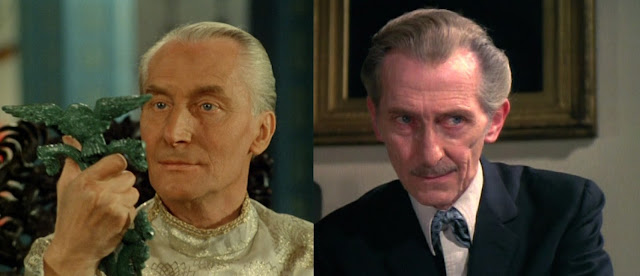
In which movie Dr. Who Peter Cushing is not delightful at all, but full of sinister charm.
With Frederick Jaeger, Fulton Mackay and of course the Cybernauts, of which more later.
Legacy of Death (Tara King)
Among many villains (and several Doctor Who guest actors) one-time third First Doctor Richard Hurndall.
This one’s a parody of The Maltese Falcon written by Dalek devisor Terry Nation (with a hint of Davros). He also sends up his own Daleks, not entirely successfully, in Thingumajig, while his Invasion of the Earthmen has an absurdly ambitious satirical concept not done all that well but does manage to anticipate The Sontaran Stratagem and even (briefly) the Sontaran design. But if you’re looking for a really excellent Terry Nation The Avengers, go for Take Me To Your Leader – despite the title, that isn’t very Doctor Who at all, but it is fast, stylish and hugely entertaining.
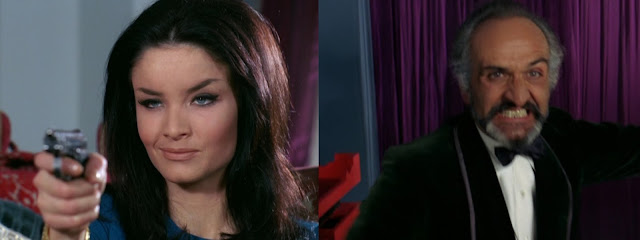
Stay Tuned (Tara King)
The story looks like a time loop… Could it be something to do with two evil Time Lords brought together (if only briefly sharing the camera) long before The Mark of the Rani – the Master and the Rani, Roger Delgado and Kate O’Mara!
Look – (Stop Me if You’ve Heard This One) But There Were These Two Fellers… (Tara King)
The wonderful Bernard Cribbins! He’s just turned 93 this week, and you can see this one on ITV4 on Monday 3rd January at 8.30am (he’s also in The Girl From Auntie).
But that’s not all – this outstandingly fun episode is written by Doctor Who writer Dennis Spooner and has several other crossovers from John Woodvine to John Cleese.

Dressed to Kill – Anneke Wills & Steed in fancy dress; Look – (Stop Me…) – Bernard Cribbins & Steed in a paper-strewn mess
Dressed to Kill (Cathy Gale)
Another topical episode as I write: this is a tale of the New Year, so one for tonight!
And among several fabulous guest stars is Doctor Who companion-to-be Anneke Wills.
Mission… Highly Improbable (Mrs Peel, Colour)
Not quite the Brigadier but a similar sort of role for Nicholas Courtney, with bonus Kevin Stoney – in between the two of them being on opposite sides in Doctor Who’s The Daleks’ Master Plan and The Invasion (though in the end they’re given quite small parts).
The Avengers Plots in Doctor Who
The Morning After (Tara King, though in this Steed’s mostly paired with Peter Barkworth)
This terrific, eerie, stylish adventure is immediately recognisable as a much crisper prototype of the more political Invasion of the Dinosaurs, though in this one the big, roaring monster is BRIAN BLESSED!
The Mauritius Penny (Cathy Gale)
Written by Doctor Who authors-to-be Malcolm Hulke & Terrance Dicks, in which a tiny thing spirals hugely out of control and eventually into a plot that echoes later in Doctor Who – Robot. Though it gets even bigger there.
Man-Eater of Surrey Green (Mrs Peel, B/W)
The most infamous of all, as most of this plot sprouts again in The Seeds of Doom. Although it’s also fair to say that both borrow quite a bit from Quatermass…
Doctor Who Cameos in The Avengers
Death at Bargain Prices (Mrs Peel, B/W)
Featuring André Morell (more bonus Quatermass), T.P. McKenna, John Cater and Peter Howell, but this exciting adventure with a department store most strikingly sees Diana Rigg arranging toy Daleks.
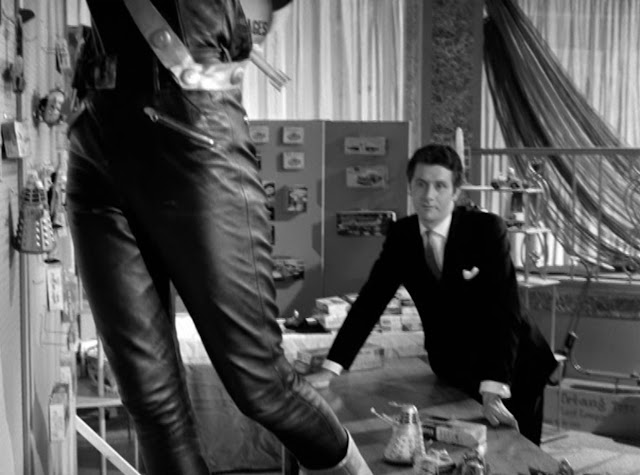
I know what the male gaze wants… Daleks. – Death at Bargain Prices
Target! (The New Avengers)
Gasp at repeated cameos for a shockingly abused TARDIS in The New Avengers’ most iconic (if not most logical) episode. Featuring many familiar faces and the worst Doctor in the world (medically), Target! is written by former Doctor Who Script Editor Dennis Spooner and is almost a doppelgänger for the previous year’s Doctor Who – The Android Invasion, written by former The Avengers Script Editor Terry Nation. Even the very first episode of The Avengers, Hot Snow, has a pre-Doctor Who police box in a rainy film insert in its surviving quarter-hour.
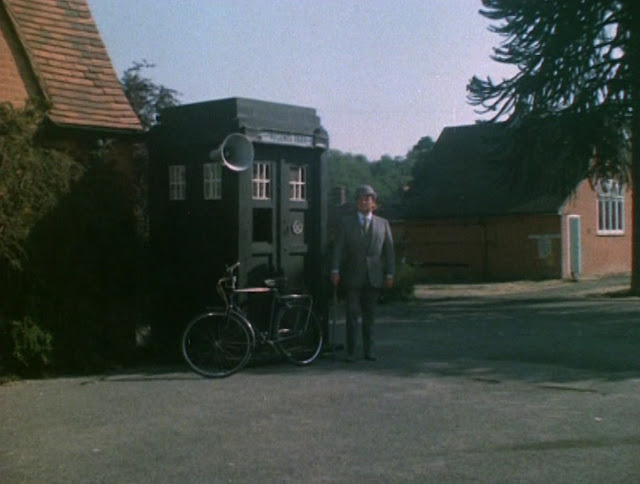
Target! – a police box stands on a village corner, John Steed at its side.
The House That Jack Built (Mrs Peel, B/W)
Before the police box exterior in Target!, an old-fashioned exterior hides weird ultra-modern corridors with what seems to be a super-sci-fi central control console. If the titular House That Jack Built isn’t a TARDIS… I like to imagine the villainous Professor Keller let the Master have his identity for The Mind of Evil, and the Master let him borrow his TARDIS to get at Mrs Peel in return. If ever The Avengers consciously borrowed from Doctor Who, this is it…
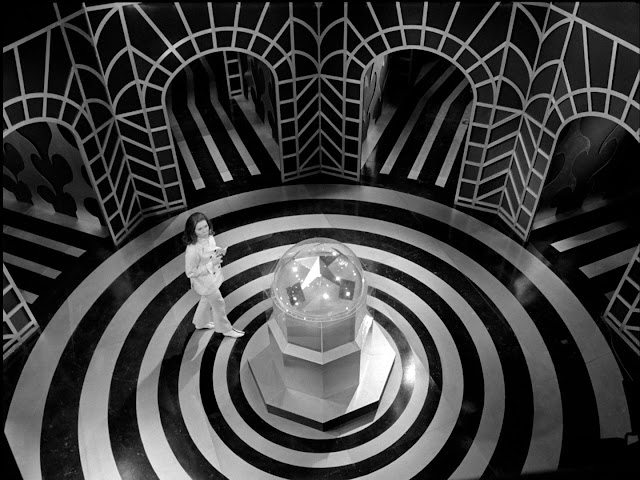
An Eccentric Array of Doctor Who-interest The Avengers Episodes
The Cybernauts (Mrs Peel, B/W)
…While this most sci-fi of all The Avengers conspicuously influences Doctor Who from the obvious Cyber-monsters through The Web of Fear and Spearhead From Space to Terror of the Zygons, with an abundance of familiar actors as a bonus (Michael Gough, Frederick Jaeger, Bernard Horsfall, Burt Kwouk, John Hollis, John Franklyn-Robbins…).

The Cybernauts – a blank-faced metal Cybernaut (brilliantly disguised in dark glasses, coat and hat). Smashing!
The Positive Negative Man (Mrs Peel, Colour)
It’s not so much the plot here that turns up in Doctor Who as many individual images; with its mysterious stalking figure that kills with one touch, or burning files in a safe, not to mention people being ‘magnetised’ to an antique car, I wonder who was watching a repeat of this one evening while working on The Ambassadors of Death.
The Gravediggers (Mrs Peel, B/W)
A Doctor Who writer in Malcolm Hulke and not just several Doctor Who guest stars but even two from half a century later in New Who (Diana Rigg and Steven Berkoff). Not given much to do here but a particular favourite of mine, this is The Avengers with the fabulous Wanda Ventham, who guest-starred in Doctor Who stories in 1967, 1977 and 1987, and I have to say New Who seriously missed out by not casting her in 2007 and 2017 too.
The Wringer (Cathy Gale)
See Doctor Who producer-director-to-be Barry Letts when still an actor! Plus, amid several Who actors, mind-melting Terence Lodge makes me feel this is a little like The Macra Terror.
Quick-Quick Slow Death (Mrs Peel, B/W)
Strictly Avengers by Robert Banks Stewart, who later wrote two of the most Avengers-adjacent Doctor Who adventures in Terror of the Zygons and The Seeds of Doom.
The Town of No Return (Mrs Peel, B/W)
Introducing Diana Rigg, whose Doctor Who – The Crimson Horror features an explicit plot lift from this, and for me the first seven minutes of this are the ideal introduction to The Avengers. Plus the first of many appearances by Patrick Newell.
Escape in Time (Mrs Peel, Colour)
And finally – ish – not just guest-starring Geoffrey Bayldon, on audio the fourth First Doctor (or minus-oneth, or… well, another one, anyway), not just one of my favourite Avengers guest villains in his biggest role (Peter Bowles, who crosses over to The Sarah Jane Adventures many years later, just as Murray Melvin goes from the very first Avengers episode to an enigmatic enemy in Torchwood), not just one of the most vividly enjoyable escapades in Avengerland, but the one with time travel!
Or is it?
Though these are the ones that most stand out for me, you can find Doctor Who connections in dozens more of The Avengers. The Curious Case of the Countless Clues stars Edward de Souza, the only TV Doctor Who lead in a story with no Doctor at all; All Done With Mirrors and Angels of Death feature Dinsdale Landen, but in which is he as villainous as Fenric? Fog is as mock-Victoriana as The Talons of Weng-Chiang, even down to Patsy Smart’s crumbly Cockney, while The Enemy of the World borrows wholesale from The Living Dead. And I’ve somehow not paid enough attention to some of my very favourite Doctor Who villains who cross over as some of my very favourite The Avengers guest stars (and villains – or are they?), so three each for:
- Julian Glover – Pandora, The Living Dead, Two’s A Crowd
- Philip Madoc – My Wildest Dream, The Decapod, Death of a Batman
- Peter Jeffrey – The Joker, Game, House of Cards
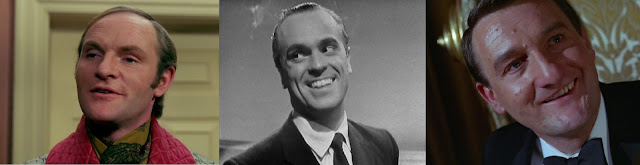
The Three Villains (or are they?)
Or… Doctor Who Stories to intrigue The Avengers Viewer
Spearhead From Space (Third Doctor)
I’m mainly assuming all this is most likely to be read by people more familiar with Doctor Who than The Avengers, but for the other way round, this is a great place to start. As I said above, this is about as The Avengers (and as Quatermass) as Doctor Who gets, with crossover actors, a flamboyant Doctor and a brilliant woman lead, and where the sinister countryside should have a sign up saying ‘Twinned with [From] Venus [With Love]’.
The Seeds of Doom + City of Death (Fourth Doctor)
The Seeds of Doom is the most infamous homage, with a mean green* menace from outer space, a millionaire plant obsessive with a murderous chauffeur, and even a scene-stealingly fabulous eccentric elderly lady. But I’m going to go against the tide and say that while it may be very Avengers on paper (from Avengers writer Robert Banks Stewart), the stylish, powerful direction means it doesn’t feel like The Avengers at all. It’s the closest Doctor Who comes to The Sweeney. So I’d pair this with its opposite: between them brutal The Seeds of Doom and witty, arch City of Death are the tonal extremes of Tom Baker’s Doctor, and while the plot has little of The Avengers, City of Death has an insouciantly Avengers mood and even Villainous Julian Glover.
*Technically black and white in The Avengers
The Web of Fear + The Mind Robber (Second Doctor)
Similarly, take one story with terrific filming and robots exchanging great, smashing blows from The Cybernauts (and guest-starring part-time Avenger Jon Rollason), add another with fabulous Op-art sets and surrealism (featuring the most Avengers fight for any companion), to find Doctor Who being quite Avengers-y between them.
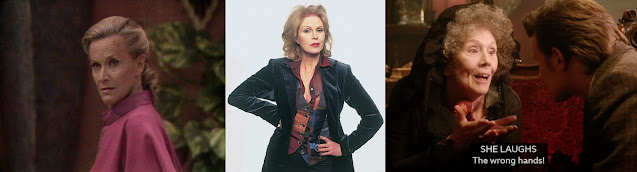
The Who Avengers!
The Crimson Horror (Eleventh Doctor)
Villainous Diana Rigg! Who could ask for more? With a diabolically The Avengers sort of plan a hundred years early and a fake-out with a gramophone borrowed from her first The Avengers episode.
The Trial of a Time Lord – Terror of the Vervoids (Sixth Doctor)
Guest-starring Honor Blackman as Professor Lasky, almost as intelligent as Mrs Gale (though to be frank both her judgment and her outfits are far better in The Avengers).
Planet of the Spiders (Third Doctor)
Gareth Hunt as a pre-The New Avengers bit of rough. Also starring (in thrilling stunt chases) Jon Pertwee from The Avengers – From Venus With Love.
The Android Invasion (Fourth Doctor)
Terry Nation writes by far his most The Avengers Doctor Who script in tone, with a mysterious village and the Brigadier replaced by Mother (Patrick Newell). And yet a completely different story is titled The Androids of Tara (though that one’s much better, even more entertaining, and stars Villainous Peter Jeffrey).
Robot (Fourth Doctor)
Terrance Dicks borrows just some of his The Avengers story The Mauritius Penny, the Doctor and Sarah Jane are as witty and wonderful a pair as you could wish for, and Harry disguises himself as Steed. And both Steed and the Doctor formatively fight fascists.
The Stones of Blood (Fourth Doctor)
Though Honor Blackman turned down a role in this one, we still have fabulous women, including an icily amazing Time Lady who’s the Doctor’s equal, and like so many Avengers it could be subtitled ‘Escape From the Country’ (the villain has chosen to escape to the countryside, which just proves it).
The Curse of Fatal Death (The Many Doctors)
A Comic Relief spectacular in which the ultimate Doctor is Joanna Lumley.
Pick one, dive in, and enjoy!
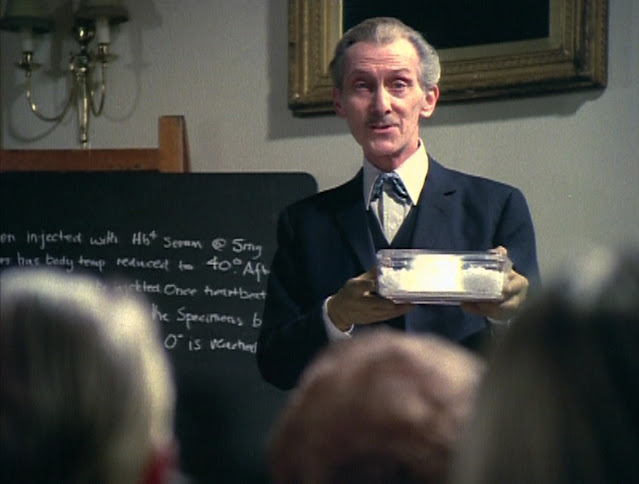
This was partially inspired by the lovely Roy Gill’s #AvengersWho Twitter thread at the beginning of the year, mashing up The Avengers / Doctor Who story titles. I particularly enjoyed his ‘Castle De’Ath To The Daleks’ and ‘The Hexapod’, Elliot Chapman’s ‘Dial a Deadly Assassin’ and Brendan Jones’ outstanding ‘You Have Just Been Pulverised Into Fragments And Sent Floating Into Space And In My Book That’s Murdered’. I added ‘Doctor Who Was That Woman I Saw You With’ and ‘Rise of the Cybernauts / The Age of Steed’, but then took eleven months to think about this more detailed contribution.
Update: Daniel Blythe brilliantly calls my attention to a fourth First Doctor (technically the third?) in The Avengers, as Frederick Jaeger plays a character who becomes the Doctor for a time in Doctor Who – The Savages.
Labels: Doctor Who, Honor Blackman, Jago & Litefoot, Joanna Lumley, Julian Glover, Peter Jeffrey, Philip Madoc, The Avengers, The New Avengers


Tuesday, July 21, 2020
An Age of Kings Vs The Hollow Crown and Henry V #Fragments
Sixty years ago tonight, the BBC broadcast the centrepiece of their hugely ambitious, brilliant Shakespeare Henriad An Age of Kings – beginning the really popular one, Henry V.
Eight years ago tonight, the BBC broadcast the centrepiece of their hugely ambitious, brilliant Shakespeare Henriad The Hollow Crown – the really popular one, Henry V.
It’s Robert Hardy vs Tom Hiddleston as the one Official Good King of the set, fifty-two years apart.
Hiddleston looks fantastic and has glorious weight in speeches and in battle, but doesn’t look like he’s enjoying himself nearly as much as Hardy, who gets his big matches with Sean Connery and Judi Dench* and whose St Crispin’s Day speech is the most rousing I’ve seen.


Mores have changed so that Falstaff was still a big draw in 1960, but he’s just drunk and unappealing in the later version to the extent you can’t see what they see in him.
*I think Dench is the one actor in both series (though not on July 21).

I’m at most a very casual Shakespeare fan. Sometimes I’m in the mood and swept away by a series like this; sometimes I run up against modern avant-garde interpretation of the sort insightfully described by Shakespearean scholar Philomena Cunk as “completely f—ing unwatchable” and founder.
What’s A Henriad and Why Do I Need To Watch Two of Them?
An Age of Kings and The Hollow Crown are both fantastic but very different takes on the same plays. They do the complete run of the two Henriads in historical order (which even Shakespeare didn’t): Richard II, Henry IV, Henry V, Henry VI and Richard III. Two of the Kings here, and not the best ones, get multiple plays to their names; Edward IV [don’t mention V] doesn’t get his own.
These series are the only times I’ve watched all the plays as a set, though I’ve seen half of them presented solo in other versions (not counting Game of Thrones). But you might think of the two Henriads – sets of plays about the Henrys – as the original Roses Wars plus the Prequel Trilogy (OK, tetralogy, but Henry IV’s in two Parts, which is cheating).
An Age of Kings is one continuous story shown fortnightly across April-November 1960, the plays broken into hour-and-a-bit episodes.
The Hollow Crown is seven movies, shown in two series in 2012 and 2016.
“An Age of Kings” is a title fit for grandeur, ambition and six-months’-worth of TV. “The Hollow Crown” sounds bleaker and darker; less appealing, more modern. For me, it better evokes the Henriads, as they have a lot of Kings but most of them aren’t up to it (nor enjoying it).
They knew that in 1960, too. The opening episode of An Age of Kings is the first half of Richard II and takes its title from a famous line in that play: An Age of Kings 1 – The Hollow Crown.
(Sadly, no episodes of The Hollow Crown are subtitled “An Age of Kings”).

Richard II and Epic Vs Pace
Richard II in 1960 is much less fabulous than Ben Whishaw but even more all at sea than in other versions I’ve seen and Bolingbroke is just creepy, so even from the first you think ‘Neither as King, please’ (and also think ‘How can I work “insatiate cormorant!” into conversation?’).
The main things I remember from each of these series are what you might call grand historical sweeps, from how TV is produced to how monarchs are compared in Shakespeare. That, and some fantastic actors.
Richard II is the key to both.
An Age of Kings is made in small studios, in black and white, with an amazing cast of soon-to-be-very-famous actors who often pop up weeks later in different parts and wigs, like a theatre rep company.
The Hollow Crown is epic movies for television.
You’d think the 2012-2016 series is more modern than the 1960. Well, yes, by definition. Except… With grand locations and epic sweeps of the camera come actors striking poses and declaiming as seriously as their cinematography demands.
1960 is fast, and much less reverent.
While The Hollow Crown is staged far more naturalistically, An Age of Kings is played far more naturalistically.
My defining scene: Bolingbroke has Bushy and Green, two of the other side / traitors murdered / executed (you get these fuzzy edges in undeclared civil wars).
In 2012, Rory Kinnear stands on the edge of a cliff and makes his self-justifying speech, the others make their self-justifications, there is a sweep of the camera and a sweep of the blade and the two heads fall. It looks real.
In 1960, Tom Fleming snaps out his orders on a cramped bit of stage, his two victims gabble across each other in a panic, he cuts off their lines and they’re dragged off to be slaughtered without him listening. It feels real.
The rapid-fire TV speech vs showing sumptuous locations might be the biggest difference between the two productions.
Another is, I think, that the statelier Hollow Crown is more kindly to its Kings, but that’s harder to crystallise.
I have to admit that one reason I adored An Age of Kings was that it was full of actors who would go on to Doctor Who – albeit most looking startlingly young, lean and hungry (to the point of undernourished, having grown up under rationing).
There’s Jerome Willis being dragged to his death – he’ll be back in many roles, most strikingly as the Dauphin.
There’s George A Cooper with a full head of dark hair and a beard! Is it a wig, or did all his go really suddenly?
Great Who villain John Ringham doesn’t get to be Richard III in this one, so he’ll play an Aztec as Olivier instead.
Most of all, my favourite Julian Glover, who gets a mass of parts and is luckily cast in his biggest last, so his repeats stand out less.
Michael Hayes directed An Age of Kings; by a strange coincidence, I’d rewatched his 1979 Doctor Who – The Armageddon Factor before seeing his epic Shakespeare, so did he put in the “This blessed plot” line, or was that in the script, or a Tom Baker ad-lib, and another huge coincidence?
Watching in historical line, the Yorks are set up as baddies from the first. At least Bolingbroke has some balls, it seems to say, but the Yorks haver from side to side (part of why Richard II is a bad king). The father even says his son – or is he? – deserves to die (mirrored in the finale when Richard III’s cursed by his mum)! So the whole line’s condemned at the root: the House of York descends from a compromised, possibly bastard, all-round traitor and eventual kingslayer, the damned son Aumerle.
Just a little weighted there.
One acting criticism for The Hollow Crown: in context, Tom Hughes needs to be a scene-stealing proto-Richard III as Aumerle. He’s adequate for a smallish part, but if you’re looking through the line he ought to be compelling (no match for Ben Whishaw’s deserved BAFTA).
[To be fair, I realise that I only thought of this deficiency in the character while watching The Hollow Crown and I don’t remember anything about Aumerle in An Age of Kings, which probably comes to the same criticism.]
OK – big skip, because although I was enthralled I didn’t make a lot of notes, and I’ve already told you all I had on the most popular King and play. So onto the Henry VIs, which aren’t much celebrated and each of which are cut down but in interestingly different ways…

More Failed Kings and Three Cheers For Richard
An Age of Kings keeps the common rebellion at home but loses most of the noble battles in France; The Hollow Crown is mostly the reverse. Although both versions rush through the three Henry VI plays to get to Richard III, I preferred this second half.
Henry IV’s a more coherent story than VI, but I’m less keen on Falstaff and on patriotic conquest as the punchline – and of the two big, popular plays here, the Hollow Crown season finales, I’m always for Richard III over Henry V.
The Henry VIs aren’t very satisfying unless you add Richard III – or, as in McKellen’s Richard III (my favourite Shakespeare), just do the brilliant one and pillage extra bits from Henry VI.
But it really works when you see Richard on the rise through someone else’s plays.
Paul Daneman’s 1960 Richard (III to be) is terrific, a slow build, then leaping to seize it. I remember thinking, thank god! when he makes his electric speech, miming seizing the crown, lines I knew from McKellen.
Intriguingly, it’s not that Richard III forswears love for power, but goes for power because love has forsworn him from his mother’s womb. Not least juxtaposed with Henry VI’s long and whiny self-pity, you can respect Richard!
The Hollow Crown deftly simplifies the story (dropping the rabble, shortening the conflict), but it also makes all the would-be kings here more sympathetic – bar Cumberbatch’s powerfully vicious Richard.
An Age of Kings really critiques the whole idea of kingship.
Richard Plantagenet (father York of Edward, Clarence and Richard) is Magneto in X-Men, the best of them all in cunning, ability and even nobility. Like Magneto, 1960 Jack May must keep saying ‘I’m a villain!’ so you don’t side with him and think he has a point. By contrast, 2016 Adrian Dunbar is more blatantly noble, but rash and a bit dim (though in helmets showing only their profiles, he and Cumberbatch do look father and son).
Even with Shakespeare tilted against them, the Yorks seem much the more reasonable side. Richard Plantagenet the elder giving up his own claims for his sons is the reverse of Henry VI – saintly Henry, the exemplar of oathbreaking who would rather the land “unpeopled” by war than abdicate himself. Kill everyone!
Terry Scully’s 1960 Henry VI is a whining, petulant, entitled tosser with no ability as king and no sense of responsibility, far more of a failure than Tom Sturridge’s 2016 away with the fairies interpretation.
[From now on I’m concentrating on An Age of Kings – purely because I made notes when I watched it!]
But the real 1960 critique of monarchy is Julian Glover’s Edward IV, who steals it even from Daneman’s business with massive-I’m-king-really-look crowns and sprawling his crotch as he chats up sexy Elizabeth (like Helen of Troy, an unrewarding part for any woman). Glover’s Edward is a much loucher and far more insightful performance than any I’ve seen because you believe, yes, he really does only think with his knob, and he’s a terrible king – he wants a shag more than to do the job.
Clarence is another petulant, entitled one, and a drunk (fed by Richard, with a fabulous end credits business of saving Clarence falling into a barrel then repeated looks to camera that had me laughing aloud).
Completely changed as a character if you only see him in Richard III… Just like his brothers.
Richard III on its own is a terrific play, but it’s easy to take from it that Edward IV is a wise old King slandered by Richard, Clarence a nice old buffer who’s a bit too innocent for his own good, and Richard III an appalling villain who brings down a goodly court purely through his own ambition. None of these are true at the end of either series here.
Watched as the culmination of the Henriads, like any great series finale Richard III gains a lot more layers, just as you root even more for Richard himself getting a grip. Not only was Edward IV a bad King and Clarence a treacherous schemer, but throughout these plays England’s been mired in decades of pointless death, divided and leaderless under whichever self-indulgent waste of a king, save one brief golden moment.
So when Richard has magnetism and actual decisiveness, you might very well think that he might be evil, but at least he’s got it.
Much like the other spurned villain (through her sex), Queen Margaret, Mary Morris being amazing – she gives by far the best troop-rousing speech and is the only one who totally rocks a crown.

An Age of Kings’ finale is superb bar its women: haunted Mary Morris and Violet Carson guesting one month early in hairnet wimple, but they cut the cursing and the Elizabeths don’t even get to say yes or no to Henry Tulip (a terrible King to be, but barely in the play except as Hope).
Hardy’s Hal is in the crowd, hilariously, for a last curtain-call cameo in the ‘two priests’ (not actual priests) scene. An in-joke on the constantly rotating rep company – Glover’s so good in so many wigs and beards and fortunate in his Edward being last that he almost gets away with it, but Jerome Willis was so distinctive as the Dauphin and Jack May as York that you can’t miss them as Richmond (astonishingly pious) or Stanley (nearly as plotting) at the end.
Another cut: “I’m not made of stone!” Boo.
But though much of the scene resembles the Olivier staging, instead of the naked power at the end, Richard tips his prayerbook up to God and then tosses it down.
I don’t really like their Buckingham, though.

Which Richard III?
Iconic Olivier; devilishly charming McKellen; shockingly savage Cumberbatch…? 1960 Paul Daneman is as brilliant as any of them, from hysterical glee to bloodstained determination at the end.
And pious as Tudor may seem, he wins the crown writhing in the mud.
Though damning Richard III as the worst of villains, Shakespeare still explicitly rejects “A horse!” as Richard attempting to flee – it’s to fight on from strength, having already “slain five Richmonds”, and he refuses offers to get him away.
A bold fighter to the end – like Henry V, the only other King up to the job.
That is not an endorsement of crowns.
Finale to the whole Age of Kings: murk over Bosworth ends the brief dynasty heralded by the Three Suns / Sons of Mortimer’s Cross. And “England hath long been mad” is far more powerful as the cap to a series rather than a single play.
This 1960 production’s “Despair and die!” ghosts are so terrifically done they look like a big influence on the climax of The Caves of Androzani…
I always see things through Doctor Who eyes. But Shakespeare’s sometimes pretty exciting, too.
(I started writing this as a Twitter thread this afternoon, on spotting the enticing double-anniversary where the two adaptations crossed. Then I found I’d made intermittent notes on watching some of these, and the thread grew into a yarn. So I decided that I’d simply blog it all at the same time, as that might be easier to follow.
This is the sixth of what might be a series of Fragments – not-quite-finished, not-quite-polished, from ideas I’ve written up over time and maybe I’ll share some of them anyway. If you’d like more, please let me know, and if you’d like to help, please ask me, ‘Have you at some point written something intriguing about Story / Series X, and could you find it, consider it and post it?’ You might suggest one that I can (TS;RM [Too Short; Read More]? Here). Nobody requested this one, but I got carried away.
Labels: Fragments, Henry V, Ian McKellen, Julian Glover, Richard II, Richard III, Sean Connery, Shakespeare, The Armageddon Factor
Tuesday, July 07, 2020
More! More! Moore! The Spy Who Loved Me – For Your Eyes Only OO7 Double Bill #Fragments
7/7/77 – who could resist launching a James Bond film on double double sevens? The Spy Who Loved Me opened 43 years ago tonight. Though it’s the first Bond I remember seeing advertised – kids at school had the car-submarine toy! – I was much too young to see it on the big screen. We finally did three years ago, in a UNICEF Benefit double bill with For Your Eyes Only (the first Bond I did see at the cinema) celebrating the life of Roger Moore. They made an unexpectedly successful pairing. When we got in from our night at the Greenwich Odeon, I typed up what I thought about each, and both, and the bits that each film might do better swapping between them…
Now, I know what you’re thinking: that’s a strange choice. Why not The Spy Who Loved Me and Moonraker? Because that would be like having a massive chocolate gateau followed by an even more massive chocolate gateau. No, scratch that – it is, apparently, World Chocolate Day and that’s making me hungry. I’ll start again. Because that would be like watching the same film You Only Live Twice in a row. Tonally, these do interestingly different things (though I reckon one’s more successful in what it sets out to do). Neither is my favourite Roger Moore Bond film, but they’re the massive success on its own terms, and the critical success that shows his range. And there’s something else: at our showing, the trailers before the double bill were all late middle-aged dreary, and we weren’t interested in any of them. Then, I remember… The very last one starts. Rey’s hand on a rock. John Williams’ music. Into my head comes the thought, ‘Every member of the audience is sighing, “Finally!”’ just as I, too, breathe out with relief. And at that exact moment, Luke Skywalker says, “Breathe.” But the even better trailer came at the end of The Spy Who Loved Me: “James Bond Will Return in For Your Eyes Only”. And for that one night only, he did.
Spoilers follow.
To Begin With…
The Spy Who Loved Me stars Roger Moore as James Bond. Barbara Bach is the Bond woman, KGB Major Anya Amasova, Bond’s competitor and one of the few who’s a proper opposite number. Curd Jürgens is the megalomaniac villain, Karl Stromberg, lurking in his (usually) underwater base, Atlantis. And Richard Kiel is Jaws, the giant hench with the steel teeth. With bonus Lotus submersible car, previous James Bond (voice) George Baker and Doctor Who’s Space James Bond star Edward de Souza. Russian and British nuclear subs have vanished, swallowed by Stromberg’s supertanker with the even bigger jaws in a plan to start World War III… The poster’s justified in saying this is the big one – everything you expect from a Bond film and Moore, with a massive world-spanning plot, sets so huge they had to build the world’s biggest stage, and the biggest, most outrageous ski jump in cinema history, they threw everything into Bond to see if it could still be a blockbuster: they doubled the previous film’s box office.
For Your Eyes Only stars Roger Moore as James Bond. Carole Bouquet is the Bond woman, crossbow-wielding Melina Havelock out to avenge her murdered parents. But which gangster is the villain? Could it be, as first appears, cheery Columbo (Topol)? Or will it be, in a twist, Kristatos (Villainous Julian Glover)? It’s definitely not Ernst Stavro Blofeld, whatever the pre-titles sequence might suggest. With a more interesting role than usual for Walter Gotell’s KGB General Gogol and an early one for Charles Dance. On the surface it’s a Cold War plot chasing a sunken British nuclear submarine ATAC targeting device, but deeper down it’s about the local catspaws, the people who get caught in the crossfire and who’s out for revenge on who. This one gets the critical praise for being the sober, serious Bond film. In theory…

The Spy Who Loved Me
“Just keeping the British end up, sir.”The pre-credits adventure grabs your attention as we’re introduced to new Bond regular General Gogol, the KGB chief who brings charisma and ambiguity to the series as the Cold War comes back (though more often than not with Britain and the USSR in uneasy alliance). Points for the film’s first twist: Gogol calls in his top agent – not Michael Billington’s sexily hairy sub-Bond, who turns out merely to be Major Amasova’s lover. Add sexual innuendo (“something came up”), corniness (“But James, I need you!” “So does England”), a ski chase to great music and an incredible jump off a cliff with a Union Flag parachute, and the movie’s off to an unbeatable start even before the song cuts in.
When you think of James Bond, perhaps it’s the action, the quips, the women, the cars, the villains? For me – well, yes, it’s the villains – a major part what I think of any Bond film is in the music. Give me a bold belter of a theme song with an acid edge, then a brassy, gorgeous score that says ‘What a fantastic vista’, ideally by John Barry. But the music takes a definite swerve for both of these films. Now, you might think, ‘Hit song, but no John Barry, and that’s your problem’. Well… Not quite. The strange thing about The Spy Who Loved Me is that Carly Simon’s Nobody Does It Better is a massive hit, while Marvin Hamlisch is more disco than the strident, insistent traditional Bond score, but I prefer the score to the song. The pulsing disco of Bond ’77 races along with some serious energy, the eerie, bubbling approach to Atlantis is a great new direction, and this is a composer who gets it – as you might guess from the Bond music documentary in which he was the one who said of Goldfinger’s “Wah wahhh-wah!” opening, “If you’re dead, you wake up for that.” Whereas Nobody Does It Better is a statement of intent with great knowing confidence, but it doesn’t have the bite for me and only lets rip towards the end. The title sequence that goes with it is the first to feature Bond himself, again the statement of intent, though the Maurice Binder naked goose-stepping Russian ‘girlies’ and guns are even more sexist than it sounds.
Odd things I’d never noticed until seeing the film on the big screen: a young, slim Kevin R McNally rushing about on a sub; Stromberg’s underwater-and-sometimes-looming-over-the-water base Atlantis initially being a disappointment, as it should be city-sized but the bigger the picture, the smaller it seems when we first see it rising from the depths. But later, when we get snap-round camera moves and forced perspectives, I believed.
The movie’s other massive special effect – Jaws – is hugely effective. And pretty huge. And though inspired by the book that they weren’t allowed to use (and not allowed to use SPECTRE either, a film that’s so very definitely present but built on absences), he’s part of the pop-culture riffing that’s especially there for the first half (and the Bond film riffing for the whole thing). We see a shark – reference to hit movie Jaws – and a horrible kill. Then we get not the shark but the man named – Jaws. Then he goes up against the shark. And wins! This is Bond saying ‘We are the blockbusters.’ Though even this film’s box office success was nowhere near Jaws’, it’s got the same chutzpah as Nobody Does It Better: enormous confidence in itself after following fashion for two movies, yet never tipping into arrogance, and utterly winning. While after Christopher Lee last time, here we’re really doing a vampire bite. And a massive figure, haunting the pyramids in a big horror movie sequence. He’s Jaws-Frankenstein-Mummy-Dracula!
Disconcertingly, one of the attractions has a voiceover from Charles Gray, as if the film’s haunted by the spectre of SPECTRE – exorcised from it by legal action. “I’m not interested in extortion”; context makes Stromberg’s line funnier. On top of being You Only Live Twice and its threat to the whole world (though closer in plan to Doctor Who’s Warriors of the Deep – which must have been thinking of this, later), I’m getting Goldfinger, too, in the Bond’s Greatest Hits: the amusing car, the obscenely wealthy villain, the memorable hench, the woman who’s impressive in her own right… It really does succeed in what it aims to do, doesn’t it? Because after Goldfinger, this pretty much is the car, the hench and at least one of the best roles for a woman, though not one of the most charismatic actors (Caroline Munro steals it by still flirting as she tries to gun Bond down from a helicopter, and he gives her the feminist compliment of actually killing her as he would any other hench). And a lot of films have tried.
The plot has a deliberate feel of the Sean Connery movies, and firmly underlines Moore as the same Commander Bond after Live and Let Die in particular introduced a different man. For all that, this is also the definitive tongue-in-cheek Roger Moore. It couldn’t be anyone else. It’s all done with great verve, with amazingly huge sets from genius designer Ken Adam, a villain with glowering presence who wants to destroy humanity for nihilism (rather than the ’60s exploiting the Cold War for profit), and while it’s not the most creative Bond, much of it’s great fun, much of it’s a bit crass, and it is indeed “Bond – and Beyond!” I enjoyed it immensely, and though my head says to give it 007 out of 10, the whole experience swept me up to an 8.

For Your Eyes Only
“Bless me, father, for I have sinned.”This was the first Bond film my parents let me see at the cinema, and I have to separate a lot of baggage from it. The longest-carried is that I had dearly wanted to see Moonraker, for lasers! But was judged too young (though we’d been allowed to watch Bond films on TV). Four decades later, I probably prefer this to Moonraker, but when I was nine the lack of lasers was a cruel disappointment. But that’s only the start. What I expected, what it isn’t, what it does with the lead villain, and right from the beginning, the pre-titles sequence and, oh, dear, the music…
“That’s putting it mildly, 007.”
Where The Spy Who Loved Me wanted to be a big hit and aimed – and squarely hit – You Only Live Twice with a splash of Goldfinger, For Your Eyes Only always feels to me like it really wants to be the taut Cold-War-to-one-side-seen-through-third-country-rivals thriller From Russia With Love, but without the thrasos, as Columbo would say, while it somehow can’t stop casting its eyes to On Her Majesty’s Secret Service. The pre-titles sums this up and sums up the film’s tonal dissonance. Roger Moore is terrific throughout the movie, less commanding than in his imperial The Spy Who Loved Me but stretched beyond the innuendo and charm to disturbingly psychopathic flashes of chilling coldness and, opening, quietly underplayed grief. He visits Tracy Bond’s grave in one of the most solemnly introspective moments in all of Bond, then is kidnapped by a remote-controlled helicopter which he in turn hijacks in order to drop contractually not-Blofeld, babbling about delicatessens, down a factory chimney. Even when I was nine and tonal dissonance was not the foremost term in my critical vocabulary, that felt like whiplash. Reading the endless backstory of court cases, it feels like a massive ‘Up yours’. Quite literally. Someone’s suing you to make a rival Bond film with Blofeld and defector-Connery? Erase Connery’s last movie and go back to the Telly Savalas incarnation (ish) so they can chuck him in the bin after, and there is no subtle way to put this, using the landing prop of the helicopter to f—k him in the arse first. This does not set the tone most of the film is aiming for.
If you’re having a really frustrating time in court, wouldn’t therapy be cheaper?
Sheena Easton’s For Your Eyes Only was another big hit song, and though it’s terribly unfair, again it’s one that I only quite like, and this time with the double let-down of not just what it is but what it isn’t: it isn’t Blondie. It’s not bad, and it opens with a certain mysterious longing tone, but it’s a little bland and sugary next to the best Bond themes. Bill Conti first approached Blondie, who turned them down when it turned out he only wanted Deborah Harry, not the musicians, and she wasn’t going to be allowed to write the song, just pout for him. Worse news for Sheena Easton: Blondie wrote and recorded their own song on their album The Hunter, and the film’s theme is no match for the punchy challenge sung from a female Bond counterpart with, in Debbie Harry, the most icy-cool voice in pop. But that’s only the second most famous factoid about the title song. The most famous is that, for the first time, the singer appeared in the main titles, Maurice Binder having taken a fancy to Sheena Easton. But, as her lips were to be in a fifty-foot close-up on cinema screens, the famous tacky titles obsessive made one small demand. She could only do it if he could fix her entire head in giant clamps to stop her moving a millimetre. And she did! She looks terrific in the clamps, but I’m afraid I still find myself thinking ‘But she hasn’t got Deborah Harry’s cheekbones. Or voice. Or song.’
Does the rest of Bill Conti’s score make up for losing Blondie? It does not. Far, far too many early ’80s porno funk guitars (though the Bond Theme survives one arrangement here, another makes even that cheesily near-unlistenable) and piping little ‘pah pahs’ instead of proper brass. Of all of the films, the music for this one has dated horribly. Close your eyes and just listen to the score, and you imagine people dancing on ice in neon-toned legwarmers. Open them, and discover to your horror that it’s not far from the truth. All right, there are some swirling strings when Melina shoots someone with her crossbow and more nice strings with a sinister bubbling fade after the ‘Countess’ dies. But, on the whole, I’d’ve preferred the film entirely re-scored by John Barry, and I’d love to have heard what he might have added to the Blondie song, too. Of all my For Your Eyes Only baggage, the heaviest may be that, while the music boosts several of the weaker Bonds, it drags this one down.
That’s a shame, as much of this is rather good in a low-key way, but even the subdued elements aren’t always well-judged. There’s a feint between two potential villains that partially works, but Topol’s exuberant character comes over rather more strongly than the usually magnificent but necessarily underplayed Julian Glover. Famously, Julian Glover was cast as the villain after producer Cubby Broccoli saw him as Count Scarlioni in Doctor Who – City of Death. That is a fantastic performance. Urbane (“My dear, it was not necessary to enter my house by – well, you can hardly call it stealth – you had only to knock on the door”), deadly on an extinction-level scale, gorgeously dressed with a splash of green. if ever there were an audition for the perfect Bond villain, that was it. Julian Glover might just be my favourite actor. He’s one of very few for whom, on meeting him at a convention, my mask of confidence collapsed into an incoherent babble of it’s Julian Glover!! Doctor Who, Star Wars, Blake’s 7, Quatermass, Indiana Jones, Game of Thrones, four-times-over guest star Villainous Julian Glover in The Avengers – an extraordinary career of all your favourite things. I should be so pleased to see him in this as Kristatos. And I am. Ish. I’m ashamed to say it, but he is a brilliant actor giving a mostly subtle, double-edged performance that isn’t called on to give the rip-roaring, showboating, flamboyant, let’s face it, what I miss is massive ham villain that would probably have been much less interesting to play but, I confess, this feels a bit of a waste. It’s like a reverse Diamonds Are Forever: where Charles Gray gave his usual villain performance, which is an ideal Bond villain but not remotely Blofeld, Glover is given a subdued character part with an accent so, while naturally superb here because he’s a brilliant actor with range, if anyone had charismatic posh perfect ur-Bond villain potential, it was Villainous Julian Glover. Yes, I know: now I’m criticising this film for not being crass enough. I can do tonal dissonance too.
Even the villainous twist they go with lacks oomph. While Julian Glover’s been understated as the fake Bond ally setting up Topol as the bad gangster who Bond must eliminate, there’s not quite been anything bar a bit of music on the beach to suggest wrongness in that, and then – Topol just spills the whole truth, and after a moment of doubt, he shows thrasos and Bond believes him, so rushes in shooting on his behalf. Well, I can believe Bond taking a leap of faith after sizing a man up, but it kills the spy thriller ambiguity stone dead. It’s never ambiguity – just a switch from one state to another. So Kristatos gets one scene where he gets to laugh like a Bond villain, the keelhauling, which is fine, but that’s next to nothing. I enjoy his slipping around the blond idiot hench to grab the goods and make his exit at the end, but that’s a bit of business, not a proper climax. I want the two old smuggler rivals fighting – there’s only a smidgeon of that, and not much drama. I suppose they don’t want to take the attention from Bond, but it means the thing lacks a heart save Melina, and she’s not driven it as much as those two.
The two best lines are both Bond found with priests: the opening, sober, “Some sort of emergency” / “It usually is” followed by the eerie blessing at the graveside and then, as established, ‘with hilarious results’, and the not at all sober but very entertaining reversal of “Bless me, father…” later. As if seeking absolution for the opening chimney dropping on Tracy’s headstone, traces of On Her Majesty’s Secret Service keep glimmering. The exciting ski-and-bobsled-and-extra-bike-chase is more original and more in your face than I’d remembered (marred by truly ghastly music), while Columbo comes across as another take on chummy gangster Draco (and to be fair, Topol is way better in the role), and there’s even a ‘down to earth’ version of the swanky Piz Gloria turned much less glam old abbey for the mountain climax. Bond’s climb is new to the series and very tense – even pulling himself up by his own bootstraps.
One effect of the largely subdued tone is that the film runs short on memorable set-pieces. The climb near the end is gripping, but at the beginning they throw away the terrific ‘hi-tech boat’ lost scene that’s more ‘real’ and even more tense than Spy’s, and the murder of the Havelocks, which they should have got over their urge to stick it to Kevin McClory’s lawsuit and positioned as the pre-credits sequence (it doesn’t help that the script jarringly makes James Villiers, probably the poshest actor in any Bond movie and a nob who’d know, call Sir Timothy “Sir Havelock”). I rather like the aftermath to their murder that sees Gonzales going into his own pool with a bolt in his back, then Loque not only taking the briefcase payment back, its owner no longer able to spend it, but that his henchman meanly snatches back the bundle of notes tossed to one of the women! Unfortunately, that’s followed by the exploding car. It was, I imagine, intended to be symbolic of not relying on gadgets. So it’s ironic that the ‘We’re realistic!’ statement is one of the silliest in all the movies: a car ‘security device’ that blows it up when anyone so much as touches it.
Daniel Craig is, like Timothy Dalton, often seen as a backlash against the ‘silly’ Bond before him (now I’ve got Graham Chapman in my head as M saying, “Stop that, it’s silly,” with Terry Jones as Moneypenny. You couldn’t have John Cleese as Q, though. That would never work). Watching For Your Eyes Only, it’s clear that so is Roger Moore a backlash against the ‘excesses’ of Roger Moore: not only in his underplaying but that his use here of anything to hand to wallop people prefigures Craig’s Bond. The Bond women and his relationships with them are interestingly characterised this time, too: he turns down too-young Bibi; he’s got proper chemistry with Melina, as she genuinely laughs at one of his one-liners and there are a few ‘touristy’ scenes where, unusually, they seem to enjoy each other’s company; and the Countess, closer to his own age, is rather lovely, as both relax and let each other know they’re play-acting. Like – again – OHMSS, but played at high speed, they go from a brutal fight on a beach to tragedy, which in turn leads to Moore’s coldest yet most feeling kill, Loque’s “no head for heights”. Though the Countess’ death creates a jarring note with Topol’s Columbo, charming and scene-stealing as he is, because he’s so jolly that he doesn’t seem to give a toss about his lover. Merely one line where he’s marginally less expansive, quickly over.
Roger Moore is the best thing in this, and holds the film together even when he is unexpectedly being the serious, dangerous part and all around him panics at the thought of getting too heavy. That’s what I have to make of the way that For Your Eyes Only is a meditation on destructive vengeance that before saying “First dig two graves” opens on Tracy’s grave just to set up the Blofeld-McClory revenge gag, or that despite Bond’s impressively ruthless moments and the thoughtful spy thriller elements, it’s hamstrung by a lack of verve and of nerve, edging away from its darker places with crudely ill-judged mickey-taking instead. The exploding car might just be a statement that went wrong, but the film closes on more panicky slapstick that simply undermines the mood. Geoffrey Keen’s grumbling minister gets on my wick in each of his Bond films, but especially this one, where he appears to have defected to Mrs Thatcher’s government. Yes, Mrs Thatcher. The film’s last scene features a parrot saying rude things to a Margaret Thatcher impersonator, and it’s shoddy beyond belief. Finishing on an innuendo makes me smile, but somehow that ending has always put me off the film.
The James Bond Double Bill
Watched in one night as a follow-up to The Spy Who Loved Me, I don’t think I’d ever appreciated For Your Eyes Only more. The two films have a lot in common, but a very different feel, so they made remarkably good companions. Though, first, an aside on the bearers of the bad news: I love Graham Crowden. Another of my favourite ever actors, amazingly tall, especially on a cinema screen, and his gravitas on “Not deep enough, I’m afraid” is so perfect on so very little (no, it’s not a critique of what the film is attempting). But just this once, in the second underwater Bond of the evening, I look to Noel Johnson next to him and my Doctor Who brain exclaims, ‘F—k me! It’s the King of Atlantis!’ [Graham Crowden starred in a differently fabulous Doctor Who take on Greek Myths.]
I’m sure the double bill was chosen for how well both films showcase Roger Moore, but they do have themes that interestingly intertwine. Ski chases to pepper largely secrets underwater affairs and a McGuffin machine that compromises nuclear subs? Check! But it’s that McGuffin that compromises nuclear subs in both films which is the crucial element for me. For Your Eyes Only’s best bit of music comes approaching the St George wreck underwater. But here’s where we get one of the biggest plot holes, too. Kristatos has more resources and has had more time. Why hasn’t he got to the wreck already? There’s a line afterwards about Bond saving them the trouble of disarming it, but it seems like that was handy, not a plan, and a hell of a risk. Because why didn’t Bond destroy the ATAC underwater? There’s no reason at all in the plot. And that would have been that. Between us, walking home after the cinema, Richard and I came up with a simple fix: the British government want the data from the spy-ship’s mission. That’s why it was there. So Bond has been ordered to destroy it only as a last resort. That would only take a line. Or here’s another: the diving-suited killer attacks. Bond and Melina use the self-destruct bomb to kill him (in a Battlefield moment, when the suit blows he visibly starts to say “Shit!”). Just switch that around very slightly: they’ve armed the self-destruct; he attacks; they’re about to die; the only weapon they have is the bomb, so they have to make the choice, tear it free and use it to save themselves, but now need to take the ATAC and find another way of destroying it properly.
Why Bond doesn’t destroy the ATAC earlier in the film is a problem for For Your Eyes Only in isolation. And yet watching the two films back-to-back, the two devices prompted inspiration. Each would be more effective with a little swapped between them. In The Spy Who Loved Me, it’s hugely important that there’s now a device that can track nuclear submarines, but only for the first half of the movie. Then everyone forgets about it. But it should still be a critical Cold War game-changer, and for all that Q is blasé about the theory, should have been definitely finished off with Stromberg. The McGuffin seems more ‘real’ in For Your Eyes Only: an updated Enigma machine, or – one of my From Russia With Love echoes – a reverse-Lektor that the Russians want to get their hands on to compromise the British this time. And yet… Despite this ‘realism’, and being carried all the way through to the end of the plot as Spy failed to, its role in the climax would have made more sense if this machine was instead the machine they had last time. Spy’s device was something new that neither had and could tilt the balance: Bond destroying it would absolutely make his “Détente” line true. Except it isn’t. In this film, it’s not an irreplaceable third-party development but a British device the Russians want. The British keeping it from the Russians is… Actually a British victory and the whole point of the entire movie. Though Moore’s defiant charisma and the ambiguous smile from General Gogol still makes the (anti-)climax rather interesting, that’s the actors, not the script.
I enjoyed For Your Eyes Only on the big screen far more in May 2017 than little me did in 1981. But I still can’t help wanting to fix it. The Spy Who Loved Me thrilled me by succeeding in exactly what it wanted to do, while the second film just doesn’t have the confidence to follow through on its own instincts. I would love this to be the movie it so nearly is and give it 007 out of 10, but I can only say 6.
James Bond Will Return In Octopussy
Just to be contrary, my favourite Roger Moore Bond film is the next along – Octopussy. The title song is adequate but bottles out of using the title-word (“All Time High” swapping one hostage-to-fortune title for another, I fear). With a competing ‘Bond film’ that year, though, John Barry is back to do the score, and it’s terrific. Particularly the forbidding strings for the sinister twin assassins near the Berlin Wall, the rousing mix of Bondian and exotic for the balloon-led attack near the end, and most strikingly the bomb, where a deep, sinister circling beat builds from deceptively soft to powerful strings – all the more effective for saying ‘something big is in reserve’ while Bond is trying to disarm a live nuke. The other main element I love it for is the villain, or rather the villains – three key antagonists, each memorable and with their own agendas, though loosely allied. Octopussy herself is one of the most intriguing and powerful Bond women (with, unsurprisingly, hints of Pussy Galore, greatest of them all), deposed prince Kamal Khan is urbane-but-deadly, looking for money, power and the main chance and tossing out bon mots (“You have a nasty habit of surviving”), yet it’s still stolen by Steven Berkoff’s scenery-chewing Cold War hawk General Orlov (when I’m rushing for a train that I’m just too late for, I always have him shouting, “I must get to that train!” in my head).
The most electrifying sequence does not involve any of the principal villains, but a pair of henches as the titles fade: it’s East Germany, and a clown – in truth, 009 – is running through the woods, only to run into knife-throwing twin assassins, to fantastic music. Mortally wounded, he staggers through the window of the British Ambassador, his outstretched hand (still with a balloon hovering above it) releasing a Fabergé Egg that rolls towards His horrified Excellency. The scene always makes the hairs rise at the back of my neck, and it’s like an Avengers episode wandering into John le Carré. 007, too, will dress as a clown for one of the most tense, gripping pieces of acting Moore ever does. This is not a critically acclaimed film, but like the circus that provides much of the backdrop, if you don’t like one act, another will be along in a minute to make you wide-eyed, and it never fails to entertain me.
This is the fourth of what might be a series of Fragments – not-quite-finished, not-quite-polished, from ideas I’ve written up over time and maybe I’ll share some of them anyway. If you’d like more, please let me know, and if you’d like to help, please ask me, ‘Have you at some point written something intriguing about Story / Series X, and could you find it, consider it and post it?’ You might suggest one that I can (TS;RM [Too Short; Read More]? Here). This one’s for Millennium.
Labels: Blondie, Debbie Harry, Film, For Your Eyes Only, Fragments, James Bond, Julian Glover, Music, Roger Moore, Star Wars, The Spy Who Loved Me
Monday, May 26, 2014
Doctor Who 50 Great Scenes – 33: City of Death
Tonight I bring cheer with, unusually, a great Doctor Who scene that isn’t all death and disaster – counting down more of my Fifty with a dash of romance. And what better time for it? Today is exactly five months until Richard and I marry (and since I posted number 34, Britain’s first same-sex weddings have been celebrated and we’ve received our first invite to another couple’s. Hurrah!). Not only that, but yesterday’s Towel Day commemorated Douglas Adams, while Saturday would have been the birthday of Graham Williams, the two principal writers of this glamorous and many-authored Tom Baker story… If you thought Number 34 was a bit Douglas Adams-y, today’s is properly so, and it’s much happier than the end of the world. More the other end.
“It has a bouquet…”

City of Death is a mostly remarkable Doctor Who story. It’s regularly voted among the best in all the series’ fifty years; it got the series’ highest ever ratings (though, to be fair, with no Internet and, thanks to a lengthy ITV strike, only BBC2 and the radio for competition); even more remarkably, it manages to unite many fans who scorn 1979’s other Doctor Who stories in agreement that this is ‘the good one’ (personally, I love some of the others too). But perhaps the most remarkable thing about it is how it was made at all – a glimpse of alchemy. Brilliant writer David Fisher wrote the first draft, then couldn’t do the rewrites… So the series’ Lead Writer Douglas Adams (yes, that Douglas Adams) and Producer Graham Williams rewrote it from top to bottom in a weekend and a few flashes of genius, before actors like Tom Baker, Lalla Ward and the fabulous Julian Glover rewrote more of it as they went along. Though it’s only Mr Adams, Mr Williams and Mr Fisher who are usually understood to form the BBC compound entity “David Agnew” credited on screen. And part of the new script was to swap the original 1920s setting for – mostly – 1979, which sounds less interesting, but not when Production Manager John Nathan-Turner had worked out in another flash of genius, this time with the accounts, that they could shoot it in contemporary proper Paris as cheaply as in a studio’s fake Monte Carlo of fifty years earlier. It was the first time the series had ever filmed outside the UK. And then there’s an intricate story that would today be called “timey-wimey,” but thankfully wasn’t in 1979, some outstandingly witty scenes and cameos from the likes of Eleanor Bron and John Cleese.
So I’m mildly unusual in finding it a bit of a mixed bag in parts, but thinking the bit that’s absolutely, blissfully perfect is the first five minutes. Because that’s the part before the important bits like the plot and the monster and most of the funny lines get going, and which quite a few fans who otherwise love the story say should have been cut because it’s just aimless faffing about*. Personally, I’m very drawn to aimless faffing about.
The thrilling blue swirl of the time tunnel – still the greatest title sequence ever made – parts on an eerie, barren landscape that looks thoroughly alien, as does the spider-like spacecraft squatting over the rocks. It’s an impressive piece of modelwork, aided by echoing music from regular composer Dudley Simpson and a sweeping camera pan across the plain to make it look enormous. And the alien voices within the ship are arguing with each other – the pilot protesting as the crew insist he take off on warp thrust, despite the dangers. Marvellously, it references Star Wars in their telling him “You are our only hope,” as he’s closer to a frog than a beautiful princess. To thunderous chords, the ship lifts slowly into an appropriately Turner-ish red and black-clouded sky… Only to crumple in on itself, shimmer and explode, the crew’s pleas echoing in desperation. You’d think that in today’s Doctor Who this would be made as a pre-titles sequence, but it’s all the better not for being so because of the fascinating non-sequitur that follows instead. The falling sparks of the explosion fade into blossoms, and again the camera moves left to right, echoing the extended pan and giving the world that came first an equivalence with modern Paris as the Eiffel Tower comes into view behind the flowers, the panning shot across the rock to the latticework gantry spaceship the natural precursor to that across the blossom to the latticework gantry tower. It’s a brilliant directorial choice, not least because, like the script and the French filming, it was something that wasn’t the original plan and was an inspired late improvisation: the director went for the blossoms instead when the special lens brought to zoom out from the top of the Tower didn’t fit the cameras. What director Michael Hayes came up with on the fly is the perfect bridge between two very different visual and storytelling styles, and the perfect opening to one of Doctor Who’s most cinematic sequences.
So, leaving you in anticipation for what happened to the alien pilot (and indeed plot), the story proper instead opens with the Doctor (Tom Baker) and his companion Romana (Lalla Ward) swanning about at the top of la Tour Eiffel being frightfully laid back and witty as they just enjoy themselves.
“It’s the only place in the Universe where one can relax entirely.”Tom is charming and worldly, Lalla superior but utterly charming with it, and eager to see the wonders of Earth. The two actors have marvellous chemistry in this story above all stories, and it’s no surprise that off-screen they were soon to marry and almost sooner to divorce. While in some of their stories they can barely bring themselves to look at each other, here they’re evidently having a wonderful time on every level, diegetic, extra-diegetic and extra-curricular. How natural they look is another part of the serendipity that makes so much of City of Death come together so well.
“Mmmm. That bouquet.”
“What Paris has… It has a – an ethos… A life. It has—”
“A bouquet?”
“…A spirit all of its own. Like a wine, it has—”
“A bouquet.”
“…It has a bouquet, yes. Like a good wine – you have to choose one of the vintage years, of course.”
“What year is this?”
“Ah well, yeah. Well, it’s 1979, actually. More of a table wine, shall we say. Ha!”
There’s a building fanfare of music, and then they’re off! The thrilling, intimate cinematography of the side of the train rushing towards us on the platform, then the Doctor and Romana simply joyous beaming at each other and the Paris Metro, planning dinner, dashing across the road by Notre-Dame hand in hand, all to what could be a career-best score for Dudley Simpson, a gorgeous, playful theme that chimes perfectly with the bouquet. It’s sheer happiness, the closest the series comes to a musical, and I’m always astounded when other fans say it’s padding and want to get on with the plot instead. It’s art.
Then there are two last pieces of serendipity, of alchemy, as they run past a poster for an exhibition on “3 Millions d’Années d’Aventure Humaine”, and the camera at last springs away from them to the threatening wooden carving of a gorgon-like snakes-headed grotesque… But that would be the plot, so it’s time to stop.
*Lawrence Miles and Tat Wood’s impressive and opinionated About Time 4, for example, starts an otherwise complementary review by complaining “the first episode features five whole minutes of the Doctor and Romana jogging through Parisian streets… Often regarded as the only major flaws in this story, and certainly the only bits that video viewers regularly fast-forward through…” Whereas I frequently put the first five minutes on to cheer myself up, and leave it at that. Maybe they’re just not music lovers, for all that they claim to sing along “Running through Paris” to the tune.
Bonus Great Doctor Who Quotations – The Androids of Tara
Tripping back a year to 1978, another gorgeous holiday of a story from a complete David Fisher script, this time on the Ruritanian planet of Tara and in the middle of the quest for The Key To Time. It’s enormous fun, especially where the dashingly dastardly Count Grendel of Gracht (Peter Jeffrey) is involved. It is, though, something of a cautionary tale about marriage, as the Doctor’s companion Romana (in her first body, Mary Tamm) discovers in Part Two when the Count shows her his dungeon – in it, her exact double…
“Is it an android?”In Part Three, Romana is confronted with another double (she’s missed one more in between). This one’s technically less royal and more, well, technical. To the Count’s moustache-twirling satisfaction, she’s been built to assassinate the Doctor (Tom Baker)…
“Good heavens, no, my dear. That’s the Princess Strella. First Lady of Tara, a descendant of the Royal House, Mistress of the domains of Thorvald, Mortgarde and Freya. In fact, Tara’s most eligible spinster! Shortly to become – in rapid succession – my fiancée, my bride, and then… Deceased. Yes – it will be a tragic accident. A flower blighted in its prime. And naturally, as her husband, I shall claim her estates and her position as second in line to the throne, as provided for under Taran law.”
“I see. But since you’ve already got a Princess, what do you need me for?”
“Well, the Princess does not entirely agree with my plan.”
“I can’t say I’m wildly surprised.”
“You see before you the complete killing machine – as beautiful as you, and as deadly as the plague. If only she were real, I’d marry her.”And in Part Four, the still-scheming Count, that well-known champion of widows and orphans, welcomes the Head of the Church of Tara to the charms of Castle Gracht for two weddings and a funeral…
“You deserve each other.”
“Ah, Archimandrite! Welcome.”
“What is so urgent that I must leave my duties and hurry here like this?”
“I am sorry, Archimandrite, but there is a ceremony you must perform.”
“Here? What ceremony?”
“A marriage.”
“Your own chaplain could have done that.”
“Not this marriage.”
“Why? Who is to be married? And to whom?”
“The King – to the Princess Strella.”
“The King? Here?”
“He has placed himself under my protection, your Eminence. Sadly, I have to tell you – he is sick. In fact, he is very near to death.”
“Oh, dear, dear, dear. He did not look well at the coronation. Not himself at all.”
“No… No, I did note that, Archimandrite.”
“But near to death, you say?”
“Indeed he is. It would be as well if you stayed here. I fear he will be in need of the funeral rites very soon after the wedding.”
“Oh, how sad.”
“Mmm, yes. And after the funeral rites, there will be a second wedding for you to perform.”
“A second wedding? May I ask whose that will be?”
“My own. I shall be marrying the poor King’s widow.”
Bonus Great Doctor Who Quotation – The Curse of Fenric
If that’s not warning enough about the dangers of dalliance, let’s turn to what’s possibly my beloved’s favourite story, and one of mine, too. It was 1989 for most of us, 1943 in the story, and half-way into Part Two (or 40 minutes into the story, if you’re watching the movie-length DVD Special Edition). While the Doctor (Sylvester McCoy) investigates vampires rising from the waters off the North-Eastern coast, stony pillar of the church Miss Hardaker has other reasons for taking against the local beauty spot. She doesn’t mince her words when she finds her two teenage East End evacuee lodgers have been swimming at Maidens’ Point…
“Nothing for you but pitiless damnation for the rest of your lives! Think on it!”Romantic.

Miss Hardaker was played by the marvellous Janet Henfrey, who returns to Doctor Who later this year. Richard and I met her in 2009 and, rather than the usual ‘Best wishes’ signed by an actor, we persuaded her to give us a different benediction on our The Curse of Fenric DVD.
Thanks to the Internet (though I’ve lost track of where, so contact me if it was you and you’d like it removed), I was also able to proffer this motivational poster to lovely The Curse of Fenric author Ian Briggs after he talked about some of the underlying themes in his story and the inspiration of Alan Turing. He laughed.

Bonus Not Necessarily Great Doctor Who Quotation – The Armageddon Factor
It’s another Doctor Who story from 1979, and another opening scene from Part One. This one’s not quite so celebrated as City of Death, and you’ll have to watch it to put it into context (though I’d watch the other five stories of The Key To Time series first), but I couldn’t resist. Miss Hardaker would be appalled.
“Men out there – young men – are dying for it!”
Bonus Great Doctor Who Quotation – Rose
And finally… From one of the most uplifting of all Doctor Who stories, the great return nine years ago, not the opening moments but the close. Rose has saved the Doctor (Christopher Eccleston) and the world from the Nestene Consciousness, and he in turn has rescued her from its exploding lair. After that brief trip in the TARDIS, the Doctor and Russell T Davies offer her and us more – to come with him, anywhere in the Universe. That’s one option: reckless, hopeful, open-minded. The narrow, sour, closed-minded alternative is put by her unhelpful boyfriend Mickey, who despite also having been rescued by the Doctor gives him a mouthful of xenophobic abuse as “an alien – a thing.” It’s a clear choice… And for a moment, Rose hesitates. Mickey pulls her to him, holding her back, taking her for granted, and she says no. The TARDIS dematerialises.
Rose, left on the street, just stares into the suddenly empty night as the wind of the TARDIS’ passing whips her hair. If she could have that choice again… And, suddenly, the TARDIS blazes back into reality, the Doctor stepping out to deliver the best pick-up line in history:
“By the way, did I mention – it also travels in time?”Choose your own life, and run into the future.
Next Time… The scariest place for anyone
Labels: Christopher Eccleston, City of Death, Doctor Who, Doctor Who 50, Douglas Adams, Julian Glover, Marriage, Music, Personal, Richard, Sylvester McCoy, The Key To Time, Tom Baker