Wednesday, March 18, 2015
Fifty Things I Love About Britain
Fifty days until the General Election. Fifty days of nothing but ‘why Britain is terrible’. Labour say it’s terrible now they’re in, so put back in the people who made it terrible in the first place. Tories say it was terrible when they were in, so don’t let them back in. UKIP say Britain has been terrible ever since we let any of ‘them’ in and hang up their ‘No blacks, no Polish, no gays’ signs. And the Lib Dems say it’ll be a bit less terrible if we’re a bit in. So, today, only things I love about Britain.
1 – My greatest Briton
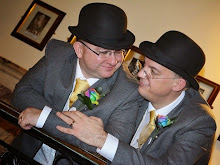
…and Earthling, and citizen of the Universe, of them all, my husband, Richard Flowers
2 – Love and marriage
Having the right to marry the person I love, if they want to too, or not to marry at all
3 – That he did want to
…and that we did, after waiting only twenty years (to the day)
That’s all I need, really, but there are forty-seven more, including food, Doctor Who, more food, the Liberal Democrats (the whole bally lot of them), so much food… And that’s all just the other stuff that was at our wedding!
4 – Doctor Who
…of course
5 – Being a nation made up of several nations
…all distinct and all having each in common, and being a people that has always been made up of many peoples and still mixing in people from everywhere else
6 – Being a nation where we all have multiple loyalties and identities
…by definition, and not letting people tell us what one thing they think we are
7 – Being always open to change
…whether it’s new people in our streets, new words in our language (often from someone else’s) or newly being comfortable with lesbian, gay, bisexual and transgender people and all sorts of other people who no longer have to be like everybody else
8 – My parents
…My Mum, who wasn’t born here but has always put her all into wherever she is, and my Dad, who was born in Glasgow, did some more growing up in Watford, and made a life for his family in Stockport, because we’re lots of different places and all one country too
9 – Inspirational heroes
…The four greatest British heroic myths: King Arthur; Robin Hood; Sherlock Holmes; and World War II
10 – Doubt
…and asking awkward questions
11 – Great big cliffs
…and windmills on hillsides
12 – Great crashing waves
…and nudist beaches when it’s bloody freezing
13 – Picturesque villages
…like Aldbourne, East Hagbourne, South Oxhey, Little Bazeley-by-the-Sea, Summerisle (but I’m more of an Escape From the Country guy, so…)
14 – Thrilling cities
…like London, Manchester, Edinburgh
15 – Stockport Town Hall
16 – The Beatles
…and especially George Harrison who, like me, swung wildly from terribly earnest to taking the piss, but who unlike me played the most gorgeous slide guitar ever heard – plus the movie of Yellow Submarine
17 – Electronic music
…from the likes of the Pet Shop Boys, The Human League, Heaven 17 and Delia Derbyshire
18 – Kate Bush
…and whatever the hell she does
19 – Punk rock
…Especially Tom Robinson and, right now, Ian Dury and the Blockheads and the wish that I could make my lists scan as well as Reasons To Be Cheerful
20 – Dame Shirley Bassey
21 – The Avengers
…Possibly the most British thing ever, and which wasn’t just style and subversion but which mattered – introducing to a mass audience the idea of intelligent, independent women who flung men over their shoulders. A fantasy of Britain where old-fashioned tradition and high-tech, sexually equal modernity went hand in hand (a hugely successful Conservative-Liberal coalition, you might say)
22 – The BBC
23 – Quatermass
…combining British ingenuity and a wish to build rocket ships with sheer naked terror (but doing it anyway)
24 – The Clangers
…encouraging us to love the alien and gently laugh at ourselves
25 – 2000AD
…the comic, not the year, particularly, which turned out a bit samey
26 – Carry On Up the Khyber
27 – Alastair Sim
…in drag
28 – BRIAN BLESSED
29 – Shakespeare
…A great many of his lines, anyway (and Queen Elizabeth the First, at least according to Blackadder)
30 – The works of JRR Tolkien
…even the ones scribbled on bits of toast and painstakingly reconstituted by his son. Mmm, toast…
31 – Clasping strange new foreign foods to our bosom
…over the centuries, making them our own so we couldn’t imagine life without them, like – the potato – and tea – and chocolate
32 – Chicken Korma
33 – Roast lamb
34 – Scotch eggs
35 – Pies
…Pies. More pies. And especially appropriate today, Pieminister pies
36 – Margaret Thatcher, Tony Benn and Nicola Sturgeon
…and the gladly exercised right to say thanks but no thanks, never have, never will
37 – William Gladstone, David Lloyd-George, Paddy Ashdown, Nick Clegg and Jo Swinson
…and the gladly exercised right to say yes, and I will again
38 – Being more or less democratic for quite a long time
39 – Mostly giving up an Empire with less fuss than is usual
40 – The NHS
…which on balance makes me go “Aaargghh!” less than it helps stop me going “Aaargghh!”
41 – Fulfilling the UN target of giving 0.7% of our national wealth in overseas aid and development
…a target set a year before I was born. It’s only in the last couple of years that we’ve finally met it (one of only about half a dozen countries that does), and in the last few weeks set it in law created by the Liberal Democrats
42 – The gap between rich and poor narrowing
…at last, over the last five years, after widening hugely ever since the 1980s
43 – The Rule of Law
…meaning that those in power get frustrated by the law applying to them too
44 – Signing the European Convention on Human Rights
…And not just being part of it, but Winston Churchill commissioning British lawyers to create it, in order to protect and spread our values
45 – Traditional British values
…like creativity, eccentricity, tolerance, generosity, fair play, standing up for the underdog, and universal, indivisible freedom
46 – Not having ID cards
…or being snooped on by the state at will, and the Liberal Democrats constantly being on guard whenever everybody else suddenly thinks that would be a good idea
47 – Making lists instead of doing anything
…making tutting sounds instead of hitting anyone, and grumbling but never giving up
48 – Inventing the train and the Internet
…even when each sometimes goes off the rails
49 – Many of the things we used to have but don’t any more
…like welcoming immigrants, Woolworths, Texan Bars, how Blackpool was in my childhood memories, The Daleks’ Master Plan, Nick Courtney, Conrad Russell and my Grandad
50 – The future
…even more than those I’ve loved and lost, and that there will always be many, many more new wonderful, beautiful, innovative, unpredictable and aggravating but loveable things to put on a list.
And that any list will be quite different for you, or even quite different for me tomorrow (I thought the best way was to write the lot off the top of my head), but still blatantly and brilliantly British.
So in fifty days’ time, why not vote for a Britain that offers more things to love than merely against the bits you don’t?
Here’s Nick Clegg on things he loves about Britain. I applauded him delivering this speech on Sunday and suspect he may have spent a bit more time and thought crafting this version than I did mine, but I agree with most of his, too.
Labels: 2000AD, BBC, Brian Blessed, British Politics, Doctor Who, Food, George Harrison, Kate Bush, King Arthur, Liberalism, Personal, Robin Hood, Sherlock Holmes, The Avengers


Wednesday, August 29, 2012
The Weirdstone of Brisingamen
Tomorrow sees the publication of Boneland, Alan Garner’s second sequel to The Weirdstone of Brisingamen, a novel that puts “long-awaited” into perspective: half a century. Of the many fantasy books I loved as a boy, the Weirdstone perhaps always felt closest to home, and in the last year I’ve found myself rediscovering it – as has our friend Nick, who’s encouraged several of his friends (including author Paul Magrs) to re-read the originals in preparation for tomorrow. He interwove our views last week, including a few of mine, and this is the full stream of consciousness that I sent him. Nick’s is rather a lovely piece – as is his new one returning the favour for our Time’s Champions blog this morning – and Paul Magrs’ thoughts on Atlendor and Durathror’s Capulets and Montagues (or is it Sharks and Jets?) relationship are particularly enlightening. Look out, though; if you’ve not read the Weirdstone, there are spoilers below, even if only about the end itself and not how to get there…
I grew up with several fantasy books – first my Dad reading them to us, then reading them for myself – but I think The Weirdstone of Brisingamen was the one that felt most personal. I was born about ten years after it was written, and raised about ten miles from where it was set, in a town at the top of Cheshire or the bottom of Manchester… So more than any other story I knew, this one seemed to have an immediacy, one that was almost familiar, only just out of reach in space and time. There’s something about a lot of adventure stories that grab you as a child, the feeling that it could happen to you, in a place you know – one of the reasons I have a soft spot for little-loved Doctor Who story The Android Invasion is that it felt, watching it, like the sort of village Mum and Dad might drive us to on a Sunday – but this was different. I think we only actually went to the Edge a few times when I was a child, but knowing that it was there, and real, almost close enough to touch, gave this tale a special magic. So many of the stories I loved, even if they were set in our world, seemed distant from us: the mystic fringes of Wales, Scotland or Cornwall; England always somehow meaning ‘South-East England’ on the page or on TV. But no legend was as powerfully evocative as that of King Arthur (greatest of our four great national myths), and to find that he was buried not at the other end of the country somewhere but in our own North West, now, that was marvellous.
For Richard, who I met in London and fell in love with half my life ago and only then found he’d gone to school not much of a walk from my parents’ and grown up almost on the edge of the Edge, the book is even more powerful. As a boy, he’d lived not ten miles away (close, but beyond the travelling power if not the imagination of a child), close to Lindow, not quite in one of those “mean dwellings” that Cadellin disparages but only just up the road. So if it was special to me, it was literally close to home for him – and, building on that strange coincidence into sheer improbability, for the lovely Nick’s other half Jon, who Richard knew as a boy and who Londoner Nick met quite separately long after we had, in turn, become friends.
I read The Weirdstone of Brisingamen many times when I was a boy, and it stayed part of me – instinctively, getting the train up north to see family I always look out for Shuttlingslow as I get towards the end of my journey – but I’d not thought consciously of it for some years, despite having discovered Mr Garner’s Red Shift in a peculiarly vivid way in the early ’90s as a relationship of mine was nearing its end (with his even, improbably, taking me to visit Mow Cop for the only time in my life). Then, in the last year, it’s strange – first I felt the Weirdstone pressing on my mind, with details suddenly flashing back to me, and then almost as if it was intruding insistently into reality. For the first time in decades, I re-read it and its first sequel, The Moon of Gomrath, last September, a little before turning 40, still thrilled.
Then I discovered CDs of both books read by Philip Madoc, always a favourite actor of mine, and gave them to Richard for his birthday early this year. I’d not anticipated just how thrilled he would be, and we listened to them swiftly, enraptured at Madoc’s marvellous voice telling such marvellous tales (and, after a lifetime for each of us pronouncing “Gowther” with a hard ‘th’, changing our minds).
And then, astonishingly, after so many years, Alan Garner announced that he was writing the third – and not just that, but around Jodrell Bank. Alderley Edge was a magical place from Richard’s childhood; both of us had always admired Jodrell, a marvellous scientific achievement of the area; but even more, over the last couple of decades my Dad’s worked there, deploying his natural charisma in public speaking (something I’ve always had to work at) in enthusing and informing people at the Planetarium. Last month I visited my parents; my Dad had just glimpsed an old gentleman who he thought was Alan Garner being shown around, ready for a big event there on the release of Boneland. I found a picture online: “Oh, yes, that was him.” It was all I could do not to squee. And “Do you know the Wizard?” asked my Mum just last Monday. They’d just been to the Inn for a wedding reception at the weekend, for an old college friend of mine for whom Richard and I had attended a very different dedication ceremony some years ago. So it’s as if the trilogy is closing in around me, slipping through the interstices of folk memory to press on my reality.
I’m hugely excited by the looming Boneland. My one regret is that poor old Philip Madoc passed away this Spring, and will never be able to gift it his marvellous voice.
I’d meant to write about The Weirdstone of Brisingamen itself. I haven’t. I’ve always been one for plot, but somehow this book’s always been most present for me in feelings, in moods and mental images. Just as I felt on the edge of its world, it feels between ours and somewhere else, and not just because of its plot, that like much of the best of Doctor Who it’s not about a great event but on the fringes of it, seeing the knights of one war and preserving them for the next. Think of Selina Place, both something like the Cailleach of legend and a modern woman using the highest technology in the novel – a car – and at the heart of a witch brood that’s also a conspiracy of ordinary blokes you might meet down the pub (or be listening in one as the local gossip gives you away). Think of Gowther and Bess, earthy, reassuring, thoroughly normal… But, into the ’60s, almost the last time you can imagine it in ordinary life (I can just, just remember a rag and bone man calling at our road when I was very small), still driving a horse and cart, as if for all their ordinariness they’re half in a time of legend and not awake to the fact.
And the moods and images are because the story deliberately takes you into fears and places that a child could or would get into, of course. The cause of a Wizard’s sorrow may impress itself into ordinary people naming it a “Tear,” and the hooded one in his mist may be right out of a horror film and a pleasurable thrill of fear – with what’s under the hood always staying with you as worse than all the horrors you imagined, because you imagine your own – but it’s the fears of things that could get you playing out in the woods, or the mud, or in caves, even under skies of birds, that strike at the familiar and make your own life feel claustrophobic. Though almost everyone feels utterly claustrophobic after Plankshaft. Throughout my childhood, I loved, but also somehow felt threatened by, winding my way through tiny caves and passages. I’ve been a fat man for a long time, but I was a very thin and gawky boy, and I found a strange satisfaction in twisting my way through places that I couldn’t really twist through. I still have vivid memories of trying to get around a ‘chimney’ in an educational museum that I was really too tall for, or my parents wearily calling me to give up as I forced myself around tiny, chilly cracks between caves in the Peak District. I suspect all that, both fun and fearful, something I enjoyed but dreaded, was a child’s way of dealing with that extraordinarily long, unforgiving account of Colin trying to make it through the dwarves’ improbably horrible tunnels Where no Svart will ever tread.
Coming back to the book as an adult, many of the people and images are still as powerful as ever – putting your trust in Cadellin, being unable to forget being part of his world, the black and terrible storm of the climax as the Morthbrood fly from something greater that we only have a whisper of. I can also feel things to kick against, and wonder if I’m meant to, torn between agreeing with the condemnation both spoken and metaphorical of pollution, and thinking that if elves and dwarves shut us off from magic and then slag us off when we find other ways to live, aren’t they just insufferably up themselves (oh, just wait ’til the sequel)? And the most distinctive, most jarring thing structurally about Alan Garner’s writing, that you’ll find here and throughout his early children’s books: where you might expect a moment to catch your breath after the climax, a coda, some resolution that takes in the aftermath of the grand adventure and adjusting back to our world, for both the children taking part and the children reading… None of that. Every time, within a few short lines of the big finish, the book simply stops – the wrath of Nastrond is coming, it’s coming, it’s nearly here… Firefrost withstands it, it blows itself out, and seventy words later all the bodies have been swirled away,
‹Older

Childhood
I grew up with several fantasy books – first my Dad reading them to us, then reading them for myself – but I think The Weirdstone of Brisingamen was the one that felt most personal. I was born about ten years after it was written, and raised about ten miles from where it was set, in a town at the top of Cheshire or the bottom of Manchester… So more than any other story I knew, this one seemed to have an immediacy, one that was almost familiar, only just out of reach in space and time. There’s something about a lot of adventure stories that grab you as a child, the feeling that it could happen to you, in a place you know – one of the reasons I have a soft spot for little-loved Doctor Who story The Android Invasion is that it felt, watching it, like the sort of village Mum and Dad might drive us to on a Sunday – but this was different. I think we only actually went to the Edge a few times when I was a child, but knowing that it was there, and real, almost close enough to touch, gave this tale a special magic. So many of the stories I loved, even if they were set in our world, seemed distant from us: the mystic fringes of Wales, Scotland or Cornwall; England always somehow meaning ‘South-East England’ on the page or on TV. But no legend was as powerfully evocative as that of King Arthur (greatest of our four great national myths), and to find that he was buried not at the other end of the country somewhere but in our own North West, now, that was marvellous.
For Richard, who I met in London and fell in love with half my life ago and only then found he’d gone to school not much of a walk from my parents’ and grown up almost on the edge of the Edge, the book is even more powerful. As a boy, he’d lived not ten miles away (close, but beyond the travelling power if not the imagination of a child), close to Lindow, not quite in one of those “mean dwellings” that Cadellin disparages but only just up the road. So if it was special to me, it was literally close to home for him – and, building on that strange coincidence into sheer improbability, for the lovely Nick’s other half Jon, who Richard knew as a boy and who Londoner Nick met quite separately long after we had, in turn, become friends.
I read The Weirdstone of Brisingamen many times when I was a boy, and it stayed part of me – instinctively, getting the train up north to see family I always look out for Shuttlingslow as I get towards the end of my journey – but I’d not thought consciously of it for some years, despite having discovered Mr Garner’s Red Shift in a peculiarly vivid way in the early ’90s as a relationship of mine was nearing its end (with his even, improbably, taking me to visit Mow Cop for the only time in my life). Then, in the last year, it’s strange – first I felt the Weirdstone pressing on my mind, with details suddenly flashing back to me, and then almost as if it was intruding insistently into reality. For the first time in decades, I re-read it and its first sequel, The Moon of Gomrath, last September, a little before turning 40, still thrilled.
Then I discovered CDs of both books read by Philip Madoc, always a favourite actor of mine, and gave them to Richard for his birthday early this year. I’d not anticipated just how thrilled he would be, and we listened to them swiftly, enraptured at Madoc’s marvellous voice telling such marvellous tales (and, after a lifetime for each of us pronouncing “Gowther” with a hard ‘th’, changing our minds).
Rediscovery
And then, astonishingly, after so many years, Alan Garner announced that he was writing the third – and not just that, but around Jodrell Bank. Alderley Edge was a magical place from Richard’s childhood; both of us had always admired Jodrell, a marvellous scientific achievement of the area; but even more, over the last couple of decades my Dad’s worked there, deploying his natural charisma in public speaking (something I’ve always had to work at) in enthusing and informing people at the Planetarium. Last month I visited my parents; my Dad had just glimpsed an old gentleman who he thought was Alan Garner being shown around, ready for a big event there on the release of Boneland. I found a picture online: “Oh, yes, that was him.” It was all I could do not to squee. And “Do you know the Wizard?” asked my Mum just last Monday. They’d just been to the Inn for a wedding reception at the weekend, for an old college friend of mine for whom Richard and I had attended a very different dedication ceremony some years ago. So it’s as if the trilogy is closing in around me, slipping through the interstices of folk memory to press on my reality.
I’m hugely excited by the looming Boneland. My one regret is that poor old Philip Madoc passed away this Spring, and will never be able to gift it his marvellous voice.
I’d meant to write about The Weirdstone of Brisingamen itself. I haven’t. I’ve always been one for plot, but somehow this book’s always been most present for me in feelings, in moods and mental images. Just as I felt on the edge of its world, it feels between ours and somewhere else, and not just because of its plot, that like much of the best of Doctor Who it’s not about a great event but on the fringes of it, seeing the knights of one war and preserving them for the next. Think of Selina Place, both something like the Cailleach of legend and a modern woman using the highest technology in the novel – a car – and at the heart of a witch brood that’s also a conspiracy of ordinary blokes you might meet down the pub (or be listening in one as the local gossip gives you away). Think of Gowther and Bess, earthy, reassuring, thoroughly normal… But, into the ’60s, almost the last time you can imagine it in ordinary life (I can just, just remember a rag and bone man calling at our road when I was very small), still driving a horse and cart, as if for all their ordinariness they’re half in a time of legend and not awake to the fact.
And the moods and images are because the story deliberately takes you into fears and places that a child could or would get into, of course. The cause of a Wizard’s sorrow may impress itself into ordinary people naming it a “Tear,” and the hooded one in his mist may be right out of a horror film and a pleasurable thrill of fear – with what’s under the hood always staying with you as worse than all the horrors you imagined, because you imagine your own – but it’s the fears of things that could get you playing out in the woods, or the mud, or in caves, even under skies of birds, that strike at the familiar and make your own life feel claustrophobic. Though almost everyone feels utterly claustrophobic after Plankshaft. Throughout my childhood, I loved, but also somehow felt threatened by, winding my way through tiny caves and passages. I’ve been a fat man for a long time, but I was a very thin and gawky boy, and I found a strange satisfaction in twisting my way through places that I couldn’t really twist through. I still have vivid memories of trying to get around a ‘chimney’ in an educational museum that I was really too tall for, or my parents wearily calling me to give up as I forced myself around tiny, chilly cracks between caves in the Peak District. I suspect all that, both fun and fearful, something I enjoyed but dreaded, was a child’s way of dealing with that extraordinarily long, unforgiving account of Colin trying to make it through the dwarves’ improbably horrible tunnels Where no Svart will ever tread.
Coming back to the book as an adult, many of the people and images are still as powerful as ever – putting your trust in Cadellin, being unable to forget being part of his world, the black and terrible storm of the climax as the Morthbrood fly from something greater that we only have a whisper of. I can also feel things to kick against, and wonder if I’m meant to, torn between agreeing with the condemnation both spoken and metaphorical of pollution, and thinking that if elves and dwarves shut us off from magic and then slag us off when we find other ways to live, aren’t they just insufferably up themselves (oh, just wait ’til the sequel)? And the most distinctive, most jarring thing structurally about Alan Garner’s writing, that you’ll find here and throughout his early children’s books: where you might expect a moment to catch your breath after the climax, a coda, some resolution that takes in the aftermath of the grand adventure and adjusting back to our world, for both the children taking part and the children reading… None of that. Every time, within a few short lines of the big finish, the book simply stops – the wrath of Nastrond is coming, it’s coming, it’s nearly here… Firefrost withstands it, it blows itself out, and seventy words later all the bodies have been swirled away,
“And this tale is called the Weirdstone of Brisingamen. And here is an end of it.”I’ve never known if that abruptness was a deliberate choice, an unpolished craft before books on storytelling structure abounded, or a sign of an author exhausting himself. To me, such Garner books feel like they finish before their time, almost a slap in the face, yet it’s that very incompleteness – a sense of certainty about the big things, and merciless uncertainty about everything else going back into ordinary life – that’s a strangely powerful signature, telling us that, no, people don’t live happily ever after, or if they do, it’s no business of ours, and not easy to find out. The end of the book, like Colin and Susan being separated from the magic, feels like loss rather than comfort in victory. And if anything I’ve heard about Boneland is true, it sounds like Colin’s felt as unresolved for several decades as the readers.
Labels: Alan Garner, Books, Fantasy, King Arthur, Personal, Philip Madoc, Richard, The Weirdstone of Brisingamen