Friday, December 28, 2012
Doctor Who and the Gays (and an interview with me)
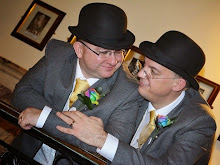
My friend Nick Campbell recently interviewed me for his book blog, A Pile of Leaves. The whole chat’s in his imaginary garden, including what I think of eBooks, librarian’s perks, and how I was always a Fattypuff even when technically a Thinifer. But, being me, my answers went on a bit, so Nick edited down several of them, and there’s one that I’ve decided to publish in full here. Nick asked me:
Do you think Doctor Who is the gay man’s delight it once was? And do you have your own theory on why it was in the first place?
Obviously, the contentious last paragraph – which the lovely Nick omitted – may seem a little unfair now after the return of Mr Moffat’s most popular characters, the kick-ass married lesbians (even if in the same story where the Doctor’s been described as going back to fancying a “hot chick”). But then I remember another dear friend of mine on top of Nick, Mikey Russell (you can get his very different books here and here), grappling with a Russell T Davies-era Steven Moffat story he found otherwise superb and in which Mr Moffat thought it an incredible step forward in screenwriting to come up with the groundbreaking idea of, as he himself put it, “Doctor Who Discovers Girls”:
How is it for you?
Do you think Doctor Who is the gay man’s delight it once was? And do you have your own theory on why it was in the first place?
I’m not sure I have anything profoundly different to say about why Doctor Who was the gay man’s delight; I think it was because it was the gay boy’s delight, with its consistent appeal to the outsider and its being all about standing up to bullies of every kind. I’m sure ‘How Doctor Who appealed to me even before I knew I was gay’ has a lot in common with How Doctor Who Made Me A Liberal: the series hates prejudice and oppression, celebrates free will and non-conformity. It’s also frequently incredibly camp.
But I have a suspicion that beyond the individualist theme and intermittently camp veneer, it may just be that the Doctor has friends who are women and men, but ostentatiously doesn’t notice them sexually, let alone doesn’t shag them – not reading as ‘gay’ but being almost unique as a main character in hardly ever reading as ‘straight’. Both in being an individual rather than a ‘uniform’ and in being, seemingly, the only hero who doesn’t have a girl in every port, he was the opposite of Captain Kirk. Not that I didn’t enjoy Kirk sometimes growing up, but I never identified with him. The Doctor was someone you could identify with whoever you were, but most of all if you didn’t fit in, because he didn’t have any of the characteristics every other hero did that pushed you away if you weren’t like everyone else.
As for if it still is, you’d probably have to ask gay boys much younger than me now. I hope it still is, but both gay culture and the way the series approaches relationships has changed so much that I don’t know: it must still be as hard coming out for many, but much more mainstream for many others; there’s a lot more gayery, and positively, than there ever was; and under Russell Doctor Who suddenly was suddenly open to gay and bi characters on screen… But at the same time the Doctor was suddenly very heterosexual. Since Mr Moffat took over, we’ve become almost completely invisible again and the Ponds, while lovely, inevitably made the TARDIS crew its most thoroughly heterosexual ever. Though at the same time, the Doctor became strange and ‘other’ again, and not interested in that sort of thing (except when the lovely TARDIS came along, inevitably). So it’s a maelstrom. You need to do a survey of the under-20s!
Obviously, the contentious last paragraph – which the lovely Nick omitted – may seem a little unfair now after the return of Mr Moffat’s most popular characters, the kick-ass married lesbians (even if in the same story where the Doctor’s been described as going back to fancying a “hot chick”). But then I remember another dear friend of mine on top of Nick, Mikey Russell (you can get his very different books here and here), grappling with a Russell T Davies-era Steven Moffat story he found otherwise superb and in which Mr Moffat thought it an incredible step forward in screenwriting to come up with the groundbreaking idea of, as he himself put it, “Doctor Who Discovers Girls”:
“One of the reasons Doctor Who meant so much to me as a scared gayboy growing up in fundamentalist-choked Arkansas was that he could be a hero without showing the slightest interest in girls; in all other shows I saw back then, the male lead had to prove his worthiness to be a hero by chasing women around. So I’m glad they didn’t do this in the old series because that would have been one more slap in the face, one more statement from the world that I shouldn’t exist.”This is something that, really, I should write a long and properly referenced article about, with qualifiers and fairness all round and studiously seeing the other point of view… But I thought instead I’d publish my instinctive answer when suddenly put on the spot, as otherwise I’d probably never get back to it. Because ever since I can remember, the Doctor’s not been like all the other men, and ever since the New Adventures, which Richard, Nick, Simon and I all separately remembered drinking in like a first snog, it had seemed that we might be starting to put flesh on our selves at last. Yet ever since The Eleventh Hour, it’s seemed increasingly that Doctor Who has the viewpoint of one straight man, and that’s that.
How is it for you?
Labels: Blogs, Doctor Who, Gay, Matt Smith, New Adventures, Personal, Sex, Star Trek


Wednesday, November 09, 2011
Wholly Unavailable On DVD Batman!
Of all many incarnations of Batman, one of the best-known, best-loved, but most impossible to buy is the camp mid-’60s TV series starring Adam West and Burt Ward. While the spin-off movie’s available on DVD, you can’t buy any of the 120 episodes of the series itself (legal tangles? Embarrassment? Who knows). So if you ever want to get hold of it, right now’s the time to start. ITV4 is showing the whole lot daily, two episodes at a time, at 4ish in the afternoon and again at 10ish the next morning, from today. And some of it’s pretty good…
In the way of mostly-repeat TV stations, ITV4 finished showing the lot this morning with the rather fabulous penultimate episode and a slightly inadequate finale, so without any particular fanfare they’ve wound straight back to the beginning this afternoon. Last time they started the series, though, I was paying attention and have to admit that I’ve watched almost the full set, from the inspired to the drably repetitive. And to get you in the mood, their trailer makes me laugh.
Now, I’m not a massive Batman fan, much less expert, though the character’s always been intriguing – from Adam West’s deadpan do-gooder to the near-psychotic, neo-fascist vigilante of Frank Miller’s The Dark Knight Returns (well, at least he knows he’s a fascist; Superman just thinks he’s God). If you want detailed facts about comics and graphic novels, try Wikipedia and its references; if you want in-depth analysis, ask the brilliant Andrew Hickey (or, as my beloved suggests, try both at Hickeypedia! He’s auditioning to be the new Bat-Announcer). But this was one of the two Batman series I loved as a boy in late ’70s repeats, and though almost every iteration of Batman since then has been trying to get away from it and back to dark psychology, I still have a soft spot for it, and mainly, of course, the performances. Well, some of the performances…
Batman ran from 1966 to 1968 as an amazingly camp Pop Art comedy, and though it was so expensive that it was rapidly cancelled when it stopped being a hit, it was such a hit that it was remembered for decades, and spoofed in its turn (from The Avengers’ genius postmodern The Winged Avenger to The High Life’s Dunk, though Jon Pertwee’s Doctor inexplicably lacked the big exclamation billboards for his fight scenes).
Its incredibly formulaic nature was surely behind both its memorability and people getting tired of it: a teaser scene with helpless Commissioner Gordon ringing the Batphone, butler Alfred answering at Stately Wayne Manor and our heroes diving for the Batpoles; that horribly irresistible theme tune; the Caped Crusaders zooming to Police Headquarters from the Batmobile’s hidden entrance and instantly working out the clues that had stumped Gordon and improbably dense Oirish-utterancing Chief O’Hara; tracking the villains to their lair (usually a very large space with very big props and not much detail, getting increasingly Expressionist – or cheap – as the series went on); indulging in a fist-fight thrillingly punctuated by musical stings and impact-words only to be overcome by trickery and finish the episode hanging above the giant meat grinder, at which point the hysterical Bat-Announcer would tell us that “The worst is yet to come!” and to tune in again,
And, yes, when you put it like that, it could be said to lack diversity. But two things save it. A lot of it is very funny, aided by many of the lines, Alan Napier’s endearing Alfred (it’s always better when he suddenly gets a bigger role, not least impersonating Batman), and particularly Adam West, whose utter deadpan playing of the utter nonsense he gets to say is… Utterly sublime. He remains amazingly watchable. And while his grey bodystocking was much mocked, these days I find the benippled rubber queens of the later movies far more difficult to take seriously: comic-book costumes always look so much more stylish in comic books.
The other thing that saves the series is, of course, the villains, who supply almost all of its variety. There’s an almost total absence of character development: the third and final series introduces Batgirl, who’s at times a brilliant feminist move and at times, er, not, especially when listening to her special signature tune:
Frank Gorshin’s the Riddler gets the series off to a terrific start with his puzzles, manic giggle and eel-like physicality, and all the others pretty much have to match up to him. Many don’t. So if you’re only tuning in for random episodes, his are among the ones to look out for – he comes back several times in the first season, then briefly in the third (substituted once in between by The Addams Family’s John Astin; great Gomez, lousy Riddler).
Now, I’ve read very few Batman comics or graphic novels, and I know which villain obviously stood out in those – but in this TV series, the Batvillain’s crown goes to someone else. For me, you just can’t beat Burgess Meredith as the Penguin. Charm, humour, viciousness, that fabulously imitable squawk, his brilliant schemes to sail just within the law (The Penguin Goes Straight / Not Yet, He Ain’t)… Penguin is far and away the best Batvillain of the ’60s series. And though sometimes, as always, his material’s not up to it – his sudden murderous grudge against Batgirl leaves a nasty taste in the mouth – the story that strikes me as a particular favourite is the second season’s political parody Hizzonner the Penguin / Dizzoner the Penguin, in which he runs for Mayor. Not only did this clearly inspire the second of the ’80s / ’90s Batman movies (however much they tried to get away from the TV series, they kept coming back to it: Penguin for Mayor in Batman Returns; the Batman-Theme-themed Batdance in Batman; the sheer campery of two blatant gay couples with opposing fetishes of Batman Forever… You can keep Batman and Robin in the ’90s, though), but Penguin’s political chicanery is mercilessly funny, and he’s a much better campaigner than Mayor Linseed, Governor Stonefellow or relentlessly stiff Batman, to say nothing of poor Harry Goldwinner down at 2%. And that’s without the inspired mudslinging – ask yourself: who do you always see Penguin pictured with? Our fine, upstanding police officers. And Batman? Always with criminals! The multiple telephone offers in the tag scene always make me laugh, too. You might also look out for Penguin’s splendidly ridiculous extended intrigue involving a fake film, Batman’s kiss-in with Carolyn Jones’ Marsha, Queen of Diamonds (not to mention her ludicrous witch mother) and a tank made out of solid gold.
No-one tops Burgess Meredith; Frank Gorshin’s brilliant; but there are at least two strong runners-up. Victor Buono as King Tut is a huge performance in every sense, a mild-mannered Professor of Egyptology at Yale who becomes a megalomaniac Pharaoh every time he’s hit on the head, and deserves a special award as the only Batvillain to twice discover Batman’s secret identity (the scene in Commissioner Gordon’s office after the first time, when no-one believes Tut as he rolls his eyes and postmodernly says all the things the viewers do about how obvious it is, is priceless). The other is Catwoman, unquestionably the strongest of many strong female opponents, though slightly hampered by being the most prominent recasting among the Batvillains: mostly Julie Newmar; Lee Meriwether in the movie; Eartha Kitt at the end. All are fabulous, but Julie Newmar seems both genuinely dangerous and the most feline – well, excluding Eartha Kitt’s irresistible purr – with a compelling capriciousness and an erotic charge with Adam West that racist ’60s sponsors were not going to allow with Eartha Kitt (despite Batman slipping in a few under-the-Bat-Radar mentions to Robin of how attractive she is, in her absence).
Others to look out for include Joan Collins’ Siren, much of whose episodes appear to have been left on the cutting-room floor, and Vincent Price’s delightful, mercurial Egghead, as well as the lead villain from the penultimate episode, the eponymous The Entrancing Dr Cassandra. Ida Lupino’s Cassandra Spellcraft has a brilliant alchemical scheme to mount a mass escape from the “Arch Criminals Only” wing of Gotham State Penitentiary (warning: may not contain real Batvillains). The extras pretending to be the big villains and trying to avoid us seeing their faces are a scream, especially the one who really gets into playing Victor Buono. It’s a far more appropriate finale than the rather limp actual last episode of mind-reading at a health spa, despite that story’s guest villain Zsa Zsa Gabor. You get the feeling she’d have been better-employed as a “Batclimb” cameo in the previous year, sticking her head out of her hotel window to see the Dynamic Duo scaling the wall as the likes of Lurch, Sammy Davis, Jr. and Edward G. Robinson had done.
Cesar Romero as the Joker. Now, I know he’s the iconic Batvillain, and some of his episodes are very entertaining (if others are frightful), and Cesar Romero isn’t that bad, but… He’s just never good enough. The few Batman comics I’ve read – or Heath Ledger on film, or Mark Hamill in the more prestigious animated series – capture a seriously deranged, compelling match for Batman; this isn’t it. I mentioned two Batman series I loved as a boy, and the other reunited Adam West and Burt Ward in the animated The New Adventures of Batman (usually paired with the equally exciting Tarzan, Lord of the Jungle). A hasty viewing of a few YouTube clips tell me I should leave the series to my cheating memory (though I have to admit I’d still like to get hold of Tarzan), but its Joker firmly grabbed my attention as a cackling spectre in vivid white and green and with unnaturally pointed features. A, ah, mature man with a rather full face upon which – unforgivably, when I was a boy and still spotted it a mile off – he’s applied an acre of make-up to inadequately conceal his moustache, scampering around with nothing of the threat of Penguin or Catwoman… No. Heretical, I know, but simply not up to the job.
One particular low point for Cesar Romero’s Joker sticks in my mind (and throat) because it perfectly illustrates something the series tried several times and each time got toe-curlingly wrong – ’60s youth culture. Surf’s Up! Joker’s Under! features the Joker’s attempt to become surfing champion of Gotham City and so control all the young people. Words fail me (and effects fail them), though there’s a little fun to be had with Joker talking into his hotdog and Batman straight-facedly inviting him into the locker room. But it’s terrible, and though my learned friend Andrew will (as with everything in this article) know better, wasn’t it a little late to be trying to cash in on the Beach Boys? Milton Berle’s Louie the Lilac, too, was an OK performance and had a memorably grisly end (…or is it?), but another middle-aged (to be generous) man attempting to become the pin-up for Gotham’s youth, this time to dominate the flower people, was a major misjudgement. The only remotely plausible counterculture idol is Catwoman rabble-rousing the student population in Catwoman Goes to College (but absolutely not when she kit-naps the voices of a popular beat combo and has a kitty apprentice who sings, played by the producer’s niece in hope of a pop career. Oh, dear me, no). You can’t help thinking that, while studio executives wanted to cash in on the youth happening, they both misunderstood and feared it, always portraying rebellious or even remotely unconventional young people as wannabe patsies to some evil but more intelligent adult in repeated and wearisome exposés of the frightening commie truth behind hippies. See also Star Trek’s The Way to Eden, in which the young space hippies (communists) are manipulated by an evil intellectual (communist) and wind up dying (after rightly being warned off by the clean-cut, caring military) on the planet they imagine to be Eden because, subtly, the grass is acid (and fruits are deadly) – or, embarrassingly, the UK’s very own Carry On Camping, in which the team inexplicably stop cocking a snook at authority and become the grumpy old establishment killing off anyone’s fun. At least at the same time Doctor Who’s The Krotons may have said that student rebellion doesn’t work, but that they had much to rebel against, and the Doctor saves the day by dropping acid.
Getting one ’60s movement badly wrong brings me inexorably to Nora Clavicle and the Ladies’ Crime Club, in which Barbara Rush’s Nora Clavicle uses her push for women’s rights to remove all male crime-fighters and replace them with women police – who will spend all their time talking about lipstick and be terrified of her mechanical mice, leaving the city open. No, it wasn’t a horrible dream. Oh, the number of times Doctor Who nearly did the ‘Imagine how frightful it would be if the girlies were in charge?’ story and managed to pull back at the last minute… It seems almost every ’60s series somehow thought ‘The frightening truth behind women’s liberation’ would be hilarious (or terrifying). Even The Avengers succumbed, once. Don’t go there.
Two unimpressive Batvillains it’s easier to forgive are the simply dull Colonel Gumm and his fake stamp factory, even if he is played by Roger C. Carmel; he was probably designed not to take attention from heroic guest stars the Green Hornet and Kato (Bruce Lee!). At least, that’s a halfway plausible excuse. Similarly, with Frank Gorshin having left the series and before they tried (and failed) to recast the Riddler, Maurice Evans starred as the Puzzler (no relation, I’m legally obliged to say). A fine actor whether disturbing as Dr. Zaius in Planet of the Apes, camping it up in Bewitched or not-Winston-Churchill-honestly in my favourite The Man From U.N.C.L.E. film (I wish they’d release that on DVD, too; I don’t have a copy of One of Our Spies is Missing), he’s lost here as producers try to camouflage his Riddler-clone status by rolling dice on their table of villainous attributes and adding to his love ofriddles puzzles the bonus character traits of ‘obsession with Shakespeare’ and with, er, ‘airplanes’. Which go together so well.
I won’t forgive Lord Marmaduke Ffogg of the three-part story visibly set in South California The Londinium Larcenies, The Foggiest Notion andIsn’t It Bloody Finished The Bloody Tower. Swinging London? The only swinging to hope for here is at Tyburn, as Dick Van Dyke runs past holding a Batsign reading, ‘See? I wasn’t so bad after all’. Though I’ll grant you that renaming “Fleet Street” as “Bleat Street” raised a momentary and unwilling smile. At least Art Carney’s execrable Archer was an affectation. Even Murder She Wrote in the pea-souper was better than this. With so many British actors on the show, what were they thinking in getting Rudy Vallee to mutilate his accent? Still less in inexplicably casting urbane George Sanders, of one of the most gorgeous voices in the world, as heavily Mittel-European Mr Freeze. No wonder he didn’t come back – Freeze was the only villain recast twice on the TV series, and never worked, whether a misused Sanders, Otto Preminger, or Eli Wallach (who at least looked like he was having fun. Maybe it was the cheque). And I’ve not even sneered at David Wayne, whose Mad Hatter and worse accent turned Batman’s cowl pink.
But I’m telling you the plot. Why not tune in, Bat-Channel ITV4, Bat-Time 4ish in the afternoon or 10ish in the morning on weekdays to enjoy them for yourself, and discover all the other villains I’ve not even mentioned? It’s just a shame it’ll take you three months to record your own home-made equivalent of a DVD box set.
In the way of mostly-repeat TV stations, ITV4 finished showing the lot this morning with the rather fabulous penultimate episode and a slightly inadequate finale, so without any particular fanfare they’ve wound straight back to the beginning this afternoon. Last time they started the series, though, I was paying attention and have to admit that I’ve watched almost the full set, from the inspired to the drably repetitive. And to get you in the mood, their trailer makes me laugh.
The Dark Knight Re-Runs!
Now, I’m not a massive Batman fan, much less expert, though the character’s always been intriguing – from Adam West’s deadpan do-gooder to the near-psychotic, neo-fascist vigilante of Frank Miller’s The Dark Knight Returns (well, at least he knows he’s a fascist; Superman just thinks he’s God). If you want detailed facts about comics and graphic novels, try Wikipedia and its references; if you want in-depth analysis, ask the brilliant Andrew Hickey (or, as my beloved suggests, try both at Hickeypedia! He’s auditioning to be the new Bat-Announcer). But this was one of the two Batman series I loved as a boy in late ’70s repeats, and though almost every iteration of Batman since then has been trying to get away from it and back to dark psychology, I still have a soft spot for it, and mainly, of course, the performances. Well, some of the performances…
Batman – The TV Series
Batman ran from 1966 to 1968 as an amazingly camp Pop Art comedy, and though it was so expensive that it was rapidly cancelled when it stopped being a hit, it was such a hit that it was remembered for decades, and spoofed in its turn (from The Avengers’ genius postmodern The Winged Avenger to The High Life’s Dunk, though Jon Pertwee’s Doctor inexplicably lacked the big exclamation billboards for his fight scenes).
Its incredibly formulaic nature was surely behind both its memorability and people getting tired of it: a teaser scene with helpless Commissioner Gordon ringing the Batphone, butler Alfred answering at Stately Wayne Manor and our heroes diving for the Batpoles; that horribly irresistible theme tune; the Caped Crusaders zooming to Police Headquarters from the Batmobile’s hidden entrance and instantly working out the clues that had stumped Gordon and improbably dense Oirish-utterancing Chief O’Hara; tracking the villains to their lair (usually a very large space with very big props and not much detail, getting increasingly Expressionist – or cheap – as the series went on); indulging in a fist-fight thrillingly punctuated by musical stings and impact-words only to be overcome by trickery and finish the episode hanging above the giant meat grinder, at which point the hysterical Bat-Announcer would tell us that “The worst is yet to come!” and to tune in again,
“Same Bat-Time! Same Bat-Channel!”The second episode would follow much the same format, only starting with Batman brilliantly escaping certain doom (usually with the aid of a suspiciously relevant Grinder-Neutralising-Bat-Pellet from his Utility Belt) and closing with a fist-fight that isn’t overcome by trickery and a return to Stately Wayne Manor by the unfrocked Bruce and Dick to explain to Aunt Harriet exactly where they’ve been. Occasional triple-episode stories and the third season’s single episodes (closing not in an explicit “Next Time…” trailer but with one contained in the narrative, such as ‘Well, the Penguin will no doubt serve many years in gaol and the citizens of Gotham are safe once more… But look out of the window! Isn’t that the Joker crossing the street with a giant inflatable marmoset?’) followed much the same pattern at only varying length.
And, yes, when you put it like that, it could be said to lack diversity. But two things save it. A lot of it is very funny, aided by many of the lines, Alan Napier’s endearing Alfred (it’s always better when he suddenly gets a bigger role, not least impersonating Batman), and particularly Adam West, whose utter deadpan playing of the utter nonsense he gets to say is… Utterly sublime. He remains amazingly watchable. And while his grey bodystocking was much mocked, these days I find the benippled rubber queens of the later movies far more difficult to take seriously: comic-book costumes always look so much more stylish in comic books.
The other thing that saves the series is, of course, the villains, who supply almost all of its variety. There’s an almost total absence of character development: the third and final series introduces Batgirl, who’s at times a brilliant feminist move and at times, er, not, especially when listening to her special signature tune:
“Are you a chick who fell in from Outer Space?Somebody shoot them. But, as far as progress goes, that’s it. Ironically, the very first story stretches the format as far as it ever goes – hilariously for a series crammed with deadpan exposition, there’s no introduction nor concessions to anyone who’s never heard of Batman (save a brief mention by Bruce Wayne of his dead parents), and it dives straight in with everything established even down to Chief O’Hara’s endlessly repeatable:
“Or are you real, with a tender warm embrace?
“Yeah, whose baby are you, Batgirl, Batgirl?”
“What idiots we are! Now, why couldn’t we have worked that out?”The main business of this opening episode, Hey Diddle Riddle (concluded in Smack in the Middle, with most of the titles being inadequately punning rhyming couplets), is not a crime or heist of the sort that drives most of them, but a plot against Batman himself such as you’d have expected to find much later in the series: the Riddler tricks our hero into an unjustified attack; this Batman is so utterly square and law-abiding it hurts; these two elements crash together in a putative court case that Bruce Wayne will feel compelled to attend and blow his secret identity, lampshading the impossibility of uptight, upright vigilantism so that the subject need never come up again. “How I’ve waited for this,” the Riddler even gloats implausibly, knowing the audience will be as familiar with Batman as he is. And the episode goes straight to the nearest the series will get to a ‘bad’ Batman, as his drink is spiked and he dances the Batusi with naughty Jill St John before staggering towards the Batmobile and being prevented from driving after poor, kidnapped Robin by police officers who pronounce him “In no condition to drive” and don’t mention the Bat-Signal beaming from the roof of City Hall – “In his shape? Kinder not to tell him.” Even the Superman movies waited until Superman III, but by going as far as this on the first time out, the Batman series is telling us that it’s never going to go any further.
Who To Catch?
Frank Gorshin’s the Riddler gets the series off to a terrific start with his puzzles, manic giggle and eel-like physicality, and all the others pretty much have to match up to him. Many don’t. So if you’re only tuning in for random episodes, his are among the ones to look out for – he comes back several times in the first season, then briefly in the third (substituted once in between by The Addams Family’s John Astin; great Gomez, lousy Riddler).
Now, I’ve read very few Batman comics or graphic novels, and I know which villain obviously stood out in those – but in this TV series, the Batvillain’s crown goes to someone else. For me, you just can’t beat Burgess Meredith as the Penguin. Charm, humour, viciousness, that fabulously imitable squawk, his brilliant schemes to sail just within the law (The Penguin Goes Straight / Not Yet, He Ain’t)… Penguin is far and away the best Batvillain of the ’60s series. And though sometimes, as always, his material’s not up to it – his sudden murderous grudge against Batgirl leaves a nasty taste in the mouth – the story that strikes me as a particular favourite is the second season’s political parody Hizzonner the Penguin / Dizzoner the Penguin, in which he runs for Mayor. Not only did this clearly inspire the second of the ’80s / ’90s Batman movies (however much they tried to get away from the TV series, they kept coming back to it: Penguin for Mayor in Batman Returns; the Batman-Theme-themed Batdance in Batman; the sheer campery of two blatant gay couples with opposing fetishes of Batman Forever… You can keep Batman and Robin in the ’90s, though), but Penguin’s political chicanery is mercilessly funny, and he’s a much better campaigner than Mayor Linseed, Governor Stonefellow or relentlessly stiff Batman, to say nothing of poor Harry Goldwinner down at 2%. And that’s without the inspired mudslinging – ask yourself: who do you always see Penguin pictured with? Our fine, upstanding police officers. And Batman? Always with criminals! The multiple telephone offers in the tag scene always make me laugh, too. You might also look out for Penguin’s splendidly ridiculous extended intrigue involving a fake film, Batman’s kiss-in with Carolyn Jones’ Marsha, Queen of Diamonds (not to mention her ludicrous witch mother) and a tank made out of solid gold.
No-one tops Burgess Meredith; Frank Gorshin’s brilliant; but there are at least two strong runners-up. Victor Buono as King Tut is a huge performance in every sense, a mild-mannered Professor of Egyptology at Yale who becomes a megalomaniac Pharaoh every time he’s hit on the head, and deserves a special award as the only Batvillain to twice discover Batman’s secret identity (the scene in Commissioner Gordon’s office after the first time, when no-one believes Tut as he rolls his eyes and postmodernly says all the things the viewers do about how obvious it is, is priceless). The other is Catwoman, unquestionably the strongest of many strong female opponents, though slightly hampered by being the most prominent recasting among the Batvillains: mostly Julie Newmar; Lee Meriwether in the movie; Eartha Kitt at the end. All are fabulous, but Julie Newmar seems both genuinely dangerous and the most feline – well, excluding Eartha Kitt’s irresistible purr – with a compelling capriciousness and an erotic charge with Adam West that racist ’60s sponsors were not going to allow with Eartha Kitt (despite Batman slipping in a few under-the-Bat-Radar mentions to Robin of how attractive she is, in her absence).
Others to look out for include Joan Collins’ Siren, much of whose episodes appear to have been left on the cutting-room floor, and Vincent Price’s delightful, mercurial Egghead, as well as the lead villain from the penultimate episode, the eponymous The Entrancing Dr Cassandra. Ida Lupino’s Cassandra Spellcraft has a brilliant alchemical scheme to mount a mass escape from the “Arch Criminals Only” wing of Gotham State Penitentiary (warning: may not contain real Batvillains). The extras pretending to be the big villains and trying to avoid us seeing their faces are a scream, especially the one who really gets into playing Victor Buono. It’s a far more appropriate finale than the rather limp actual last episode of mind-reading at a health spa, despite that story’s guest villain Zsa Zsa Gabor. You get the feeling she’d have been better-employed as a “Batclimb” cameo in the previous year, sticking her head out of her hotel window to see the Dynamic Duo scaling the wall as the likes of Lurch, Sammy Davis, Jr. and Edward G. Robinson had done.
Who To Leave In the Care of Liberal Warden Crichton of Gotham State Penitentiary?
Cesar Romero as the Joker. Now, I know he’s the iconic Batvillain, and some of his episodes are very entertaining (if others are frightful), and Cesar Romero isn’t that bad, but… He’s just never good enough. The few Batman comics I’ve read – or Heath Ledger on film, or Mark Hamill in the more prestigious animated series – capture a seriously deranged, compelling match for Batman; this isn’t it. I mentioned two Batman series I loved as a boy, and the other reunited Adam West and Burt Ward in the animated The New Adventures of Batman (usually paired with the equally exciting Tarzan, Lord of the Jungle). A hasty viewing of a few YouTube clips tell me I should leave the series to my cheating memory (though I have to admit I’d still like to get hold of Tarzan), but its Joker firmly grabbed my attention as a cackling spectre in vivid white and green and with unnaturally pointed features. A, ah, mature man with a rather full face upon which – unforgivably, when I was a boy and still spotted it a mile off – he’s applied an acre of make-up to inadequately conceal his moustache, scampering around with nothing of the threat of Penguin or Catwoman… No. Heretical, I know, but simply not up to the job.
One particular low point for Cesar Romero’s Joker sticks in my mind (and throat) because it perfectly illustrates something the series tried several times and each time got toe-curlingly wrong – ’60s youth culture. Surf’s Up! Joker’s Under! features the Joker’s attempt to become surfing champion of Gotham City and so control all the young people. Words fail me (and effects fail them), though there’s a little fun to be had with Joker talking into his hotdog and Batman straight-facedly inviting him into the locker room. But it’s terrible, and though my learned friend Andrew will (as with everything in this article) know better, wasn’t it a little late to be trying to cash in on the Beach Boys? Milton Berle’s Louie the Lilac, too, was an OK performance and had a memorably grisly end (…or is it?), but another middle-aged (to be generous) man attempting to become the pin-up for Gotham’s youth, this time to dominate the flower people, was a major misjudgement. The only remotely plausible counterculture idol is Catwoman rabble-rousing the student population in Catwoman Goes to College (but absolutely not when she kit-naps the voices of a popular beat combo and has a kitty apprentice who sings, played by the producer’s niece in hope of a pop career. Oh, dear me, no). You can’t help thinking that, while studio executives wanted to cash in on the youth happening, they both misunderstood and feared it, always portraying rebellious or even remotely unconventional young people as wannabe patsies to some evil but more intelligent adult in repeated and wearisome exposés of the frightening commie truth behind hippies. See also Star Trek’s The Way to Eden, in which the young space hippies (communists) are manipulated by an evil intellectual (communist) and wind up dying (after rightly being warned off by the clean-cut, caring military) on the planet they imagine to be Eden because, subtly, the grass is acid (and fruits are deadly) – or, embarrassingly, the UK’s very own Carry On Camping, in which the team inexplicably stop cocking a snook at authority and become the grumpy old establishment killing off anyone’s fun. At least at the same time Doctor Who’s The Krotons may have said that student rebellion doesn’t work, but that they had much to rebel against, and the Doctor saves the day by dropping acid.
Getting one ’60s movement badly wrong brings me inexorably to Nora Clavicle and the Ladies’ Crime Club, in which Barbara Rush’s Nora Clavicle uses her push for women’s rights to remove all male crime-fighters and replace them with women police – who will spend all their time talking about lipstick and be terrified of her mechanical mice, leaving the city open. No, it wasn’t a horrible dream. Oh, the number of times Doctor Who nearly did the ‘Imagine how frightful it would be if the girlies were in charge?’ story and managed to pull back at the last minute… It seems almost every ’60s series somehow thought ‘The frightening truth behind women’s liberation’ would be hilarious (or terrifying). Even The Avengers succumbed, once. Don’t go there.
Two unimpressive Batvillains it’s easier to forgive are the simply dull Colonel Gumm and his fake stamp factory, even if he is played by Roger C. Carmel; he was probably designed not to take attention from heroic guest stars the Green Hornet and Kato (Bruce Lee!). At least, that’s a halfway plausible excuse. Similarly, with Frank Gorshin having left the series and before they tried (and failed) to recast the Riddler, Maurice Evans starred as the Puzzler (no relation, I’m legally obliged to say). A fine actor whether disturbing as Dr. Zaius in Planet of the Apes, camping it up in Bewitched or not-Winston-Churchill-honestly in my favourite The Man From U.N.C.L.E. film (I wish they’d release that on DVD, too; I don’t have a copy of One of Our Spies is Missing), he’s lost here as producers try to camouflage his Riddler-clone status by rolling dice on their table of villainous attributes and adding to his love of
I won’t forgive Lord Marmaduke Ffogg of the three-part story visibly set in South California The Londinium Larcenies, The Foggiest Notion and
But I’m telling you the plot. Why not tune in, Bat-Channel ITV4, Bat-Time 4ish in the afternoon or 10ish in the morning on weekdays to enjoy them for yourself, and discover all the other villains I’ve not even mentioned? It’s just a shame it’ll take you three months to record your own home-made equivalent of a DVD box set.
Labels: American Politics, Batman, Bigotry, Carry On, Comedy, Comics, Patrick Troughton, Reviews, Star Trek, The Avengers
Friday, May 20, 2011
DVD Taster: Doctor Who – Myths and Legends
Saturday’s Doctor Who – The Doctor’s Wife showed the TARDIS with a life of its own and TARDISes inside TARDISes; so did The Time Monster, broadcast 39 years ago today. Available with Underworld and The Horns of Nimon in the Myths and Legends DVD boxed set, starring Jon Pertwee and Tom Baker, K9 and the Master, these three stories offer a distinctively ’70s interpretation of the Greek Myths. So do they build on those myths to make Doctor Who a still more legendary epic? No. All Doctor Who is, of course, brilliant, but some of it’s more brilliant than others. None of these stories are the worst least brilliant Doctor Who ever made… But all three are in the running! And yet even here, there are marvellous things to treasure.
While this ‘taster’ may not be short, incidentally, my policy in these is not to be too spoilery. So read on without fear of finding out the key twists.
I’d certainly rate The Doctor’s Wife very much more highly than The Time Monster, though the 1972 story’s take on the fall of Atlantis was at least more interesting than BBC1’s dreary docu-drama Atlantis a couple of Sundays ago (terrible dialogue, but prettier – both the special effects and the Atlantean male lead). That aside, few fans have a good word to say for these three tales. Some Doctor Who DVD boxed sets just offer stories sequentially; others have stories from different years based around some more or less distinct ‘theme’. Those themed are usually a mix – Beneath the Surface, the other ‘trilogy’ boxed set with Pertwee and another Doctor, runs from absolutely brilliant, to exciting but flawed, to pretty shonky – but this box is all of pretty much the same unfortunate quality. Officially called “Myths and Legends,” it’s been given a lot of other names from fans. As I try to be positive, I can’t repeat any of them. However, back in September 2009, Doctor Who Magazine 413 published “The Mighty 200” – 6,700 fans’ votes on all 200 TV Doctor Who stories to that point (I made it 204). So what did the mass of fandom make of these stories? Not a lot. Out of 200, The Time Monster flaps in at 187, and I can’t argue with that; Underworld is at 197 and The Horns of Nimon 189, and though I might put each of those perhaps 10 or 20 places higher on a good day, that still leaves them deep in the lower reaches.
Between them, the Myths and Legends borrow from the Titans and the fall of Atlantis, the Argonauts, the Minotaur (twice) and several other elements from Greek legend, but you’ll probably have gathered that none of them quite hit the spot. The Time Monster has a more ‘magic’ take on it – or, at least, New Age hippiedom – while the other two both sci-fi it up and largely miss the point. The Time Monster and The Horns of Nimon are the minotaur stories, the latter more thoroughly (try to ignore it not being real in 1968’s The Mind Robber, and note that – in DVD order – The Creature from the Pit was one month later, which almost makes sense of the Doctor mentioning the labyrinth); the Nimon isn’t the series’ most successful monster, but it beats the others here – a flappy thing, men with tin tea-cosies on and the most disappointing “dragon” ever conceived. Underworld and The Horns of Nimon both play with asteroids / clashing rocks, gravity / whirlpools, lost ships and fallen empires, the former merely tedious (though I loved it when I was six) and the latter teetering into ‘so bad it’s good’ – though less so, for either category, than many reviews would have you believe. Ironically, The Key To Time saga was first broadcast between those two and does a far better job of being legendary, despite only a sideswipe at Greek myth. So, really, if you’re short of Doctor Who boxed sets, you should buy that first (and if you want a thrilling volcanic historical tragedy from Doctor Who, why not try The Fires of Pompeii?). But, anyway, the prologue…
This one’s the full house for your Greek Myths: Doctor Who does both Atlantis and the Minotaur three times, and The Time Monster hits the jackpot as the only story to feature both, showing exactly how much this jackpot’s worth. Ingrid Pitt steals the show, though it takes a while for her to turn up; Darth Vader’s involved, too – but don’t get your hopes up; and who could the mysterious “Professor Thascalos” be? Oh… You guessed (and even he overacts mightily here). Like Planet of the Spiders, this is co-written by Barry Letts and Roger Sloman: that one, apparently, the most ‘Barry’ of their scripts together, this the most ‘Slo’; though they do have much in common (changes of scene half-way through, the Doctor’s guru and ‘magic crystals’), this one has the more achingly trendy hippy ending. And there are six interminable episodes to crawl through before you get to it.
Purists may well say that this premonition doesn’t have much of a logical connection to the plot of Episode One – well, there isn’t much of a logical basis to what passes for the plot of Episode One, anyway. It’s disappointing that when we reach the inevitable destruction of Atlantis at the end of the story, it doesn’t look anywhere near as good as this, but by then we’ll have had nearly six episodes to get used to this particular story not looking anywhere near as good as it should. The first signal of this is when the Doctor wakes to find Jo Grant wearing one of her most early ’70s and most hideous outfits (brown and yellow!), with lines that send up how badly she’s usually written (“Look, I know I’m exceedingly dim, but would you mind explaining?”). Before long, though, one of his companions gets revenge on the patronising Pertwee – the Doctor demands agents be alerted world-wide because he’s just seen the Master, only for the Brigadier to deliver the perfect put-down when his advisor lets slip the source of this ‘intelligence’:
The Time Monster is from dead in the middle of Jon Pertwee’s five-year run as the Doctor, while he’s still exiled to Earth and working with UNIT, and it finishes the series’ ninth season with one of its very few deliberately epic season finales – but, though it tries so hard, it’s probably the second-biggest flop the series has ever had at achieving any such thing. As I’ve intimated above, it doesn’t really get going until about two-thirds of the way in before petering out again at the climax (as I said the other week, exactly the reverse of Planet of the Spiders), and very little of it makes much sense. It’s impossible to believe that the Brigadier and Sergeant Benton wouldn’t recognise the Master, particularly when he shouts his head off for no reason other than his Time Lord powers sensing an approaching cliffhanger – and what are they doing attending a research project in Cambridge, anyway? Why does UNIT, rather than just the ministry, send an observer? Why are this UN team suddenly part of the UK government? Why doesn’t their scientific advisor go along, just the military side, who know naff all about science? Why does Dudley Simpson compose that hideously ‘jaunty’ theme for the Doctor’s car Bessie? Why is Dr Ingram astonished at the crystal being “the actual crystal” from Atlantis, when she could never have heard of Kronos or its bling, so she should be shocked that it’s ‘the actual Atlantis’? Why are modern troops and Roundheads perfectly matched in battle, with the New Model Army never having to reload and, equally magically, no-one dying? How come the TARDIS can suddenly move about as much as it likes, as if they can’t be arsed remembering the Doctor was supposed to be ‘grounded’? Where did it get its ‘Get out of cliffhanger free’ lever? And what on Earth were they thinking when they spent ten minutes of gibberish with the Doctor saying, ‘No, wait, wait, this is really cool, I used to do a lot of it when I was a student,’ involving an empty wine bottle…? No, actually, I think that one may have answered itself.
This story may also win a special prize for Doctor Who sexism. The series in the ’60s was mostly moderately ahead of its time in giving good parts to the women leads, not least because the very nature of the series made it impossible for them to just stay at home; Pertwee’s first, best season had Dr Liz Shaw, cool, brainy and more than able to hold her own against the Doctor. She was then succeeded by Jojo Grant (as she’s dubbed here), the series’ first companion deliberately designed to be nowhere near as good as her predecessor, so the Doctor could ‘take her under his wing’. Much of the time, Katy Manning is so sparky in the role that she saves the character – but 1971’s hugely sexist shift back was a terrible idea, and by 1972 producer (and co-writer here) Barry Letts was thinking that maybe he’d better ‘do feminism’. Unfortunately, rather than ’60s Who’s attitude of simply having intelligent, competent women who were rarely put down or indeed commented on for being women, Barry’s brilliant plan was to have a career woman whose standing up for herself is followed by exclaiming “Men!” and then threatening to cry. Last time we watched this story together, my reaction to the line “May God bless the good ship Women’s Lib and all who sail in her” was apparently so volcanic that Richard laughed like a hyena (not at the line itself, you understand). Despite this, there are two saving graces: patronise her he may, but the Master still trusts Dr Ingram to do important work for him, which is more than the überpatronising Doctor ever does with Jo; and in the novel by Terrance Dicks – not himself the series’ leading feminist standard-bearer – he nails that the Master “didn’t assume that he was superior just to women. He was superior to everybody.”
Bizarrely, Queen Galleia of Atlantis comes across far better than the attempt to write a ‘modern’ woman, though to be fair to the authors each is given a callow male counterpart who’s not nearly as good at what they do as the women (Stuart a less impressive scientist; Hippias a far less charismatic tarty piece – the other week’s Atlantis docudrama was dreary, but at least their equivalent eye candy was prettier). And with Ingrid Pitt’s fabulous Galleia comes sex, in a way that hadn’t really before in Doctor Who – while the Doctor wasn’t allowed snoggage until 2005, here the Master seduces the Queen. It’s something of a relief, actually, as from Nick Courtney’s relish in exclaiming “Tom-TIT!”, the shape of the time sensor and Jo wearing a floppy belt instead of a skirt, until this point in the story you get a sense that someone on the production team wasn’t getting any. Or, as we always remark on hearing “You dare mock the High Priest?” Oooh, TOMTITter ye not!
So, yes, there are some things here worth watching after all. The glamorous, strong Queen and the wise, surprisingly bitchy King of Atlantis are the two best things in it, and worth waiting for. The King, in particular, gets some tantalising scenes on film before the action’s fully shifted to Atlantis, setting up the mystery of his age and his Age, and some very funny put-downs of the Master, followed by a subtle test disguised as gallantry to Jo. The Master is often very entertaining railing against his rubbish henchmen, even if “I’ve never seen a more inept performance” may be giving a hostage to fortune, and charismatic when he chats up the Queen, though in between Delgado is by far at his hammiest. And when Sergeant Benton and his ‘crack team’ of severe Dr Ruth and florid-shirted slacker Stuart are running about, all they’re missing is a big dumb talking dog (actually – that’s Benton). It’s a shame they waste the story’s initial idea of excitingly anachronistic attacks on making them merely a device to slow down the plot in the middle, but from the same part of the story, if you’ve bought Spearhead From Space (re-released just last week) you might forgive a comedy yokel: you’ll recognise he was a UNIT soldier in the earlier story, so clearly he’s lost his mind and been farmed off to the country. The story’s high point for many fans is a ‘charming’ Buddhist parable in a dungeon; unfortunately, having seen it cross-cut with a Monty Python sketch to Dance of the Sugar Plum Fairy, I find it very difficult to sit through – as would Jo, if she wasn’t chained down.
On top of some pretty remarkable picture restoration, the DVD has a middling set of extras – a considerably more experimental commentary than usual (swapping between several different teams of people to get different perspectives for each episode), text notes, photo gallery and so on, with the highlight a ‘Making of’ that majors on the science, with Professor Jim Al-Khalili (in truth, the MASTER! Not really) bravely trying to make sense of it all. And, utterly absurdly, the story’s soon to have its own range of action toys. But the real ‘extras’ for The Time Monster are to be found in other stories – one in particular that it rips off and several that, incredibly, it inspired…
‘Jason and the Astronauts’. The magic silhouettes of the bloke in the scarf, the woman in the leather bikini and the tin dog are the old series’ most iconic line-up, and you get all three – Tom Baker, Leela and K9 – in this story. It’s from Season 15, a troubled time for the series: Mary Whitehouse had seen off a brilliant producer; the brilliant script editor had just left; and their replacements, while promising, were dropped in it at the last minute at exactly the moment all the BBC’s money ran out (it’s also a season where most stories end in great big explosions: ‘Boom and Bust’, you might call it). So this isn’t the most polished story ever made, and they’ve not yet come up with the wit in their scripts that replaces the horror the old regime was told off for. The result is a story that lacks verve, lacks skilled hands knowing what’ll work and what won’t, and perhaps more famously than any other Doctor Who adventure lacks a budget. And whereas most Who stories that look a bit threadbare have a strong script and lively actors to fall back on, here both underperform. This is perhaps the only Tom Baker story that’s just plain dull.
Though Terrance Dicks’ novelisation mostly tells the story more briskly, it opens with a five-page Prologue setting out how the Time Lords were welcomed as “gods” by the Minyan people, who picked up technology too fast, kicked out their “gods” and then destroyed themselves – giving one of my favourite offhand lines: “A hundred thousand years went by.” And that’s where we are in Part One: the doomed Minyans sent off a ship to settle a new world… Which was never seen again, and the crew of the ancient ship the Doctor finds have been looking for it ever since. Not unreasonably, they’ve got very weary along the way, not least because it’s been the same people throughout: they don’t have the Time Lords’ natural ability to shake themselves up and gain a new self when they die, but borrowed from them a machine-driven, mercilessly efficient form of regeneration that simply makes your old body young again, not a rebirth but merely an endless repeat.
After Part One, there’s a very distinctive look to Underworld – or rather, a very indistinct one. Without the cash to build the ‘underworld’ itself, for the first time all the actors are shot against bluescreen for most of the ‘action’, with cave images added behind them. And what dull caves they are, too (similarly inlaid backgrounds for some scenes just three stories earlier had shown how interesting the results could be, or at least different, for The Invisible Enemy). With a design sense that passes understanding, people in brown and grey outfits are pasted onto a brown and grey background, and then it all goes a bit fuzzy to make absolutely sure it all looks like a dull smear. Perhaps it’s a visual metaphor for taking a legend and sucking all the excitement out of it. The similarly indistinct plot of the next three episodes largely consists of remarkably incompetent ‘action’ sequences: half the cast forgotten behind one door (which opens instantly after the cliffhanger), with the Doctor unable to work another then staggering around in the fog making the first Williams-era blow job gag until the editor takes pity on him and runs the end titles; a wobbly energy blast that gets kids’ hopes up by being called a “dragon” (and, on screen, makes even less sense than the script); shoot-outs with energy beams so lethargic that you could yawn and step out of their way. On the bright side, the “shield guns” that fire those beams were very cool when I was six, and I still think they’re the best-realised idea in it.
Tedious as the fight scenes are, the best character for the story is a fighter: Herrick, played by Diana Dors’ husband Alan Lake, is the only person here who gives it some welly. In Part One he’s almost insanely hostile to the Doctor, the Minyans being rather split in opinion over their former colonial masters and responsibility for their civil war – when one crewmember wonderingly recognises the TARDIS’ wheezing, groaning sound as “the time-ships of the gods,” Herrick is furious that they’ve turned up again and gives a glimmer of how it would feel to be caught in a Greek legend: “They use us for their sport!” Later, he almost single-handedly makes a fight sequence come to life, holding off the bad guys while seeming invulnerable, yet his bravado misses the point – surely the reason he should be a carefree berserker is if his mates are ready to drag him off to regenerate, not if they’ve all run away! Yet while one warrior enlivens the story, another drags it down. It’s no fault of the marvellous Louise Jameson, but no companion of the Doctor’s has ever had such potential wasted as Leela. Born into a warrior tribe, she was the heretic who asked the awkward questions – highly intelligent, just untutored. Unfortunately, once her creators left the building, later writers saw no further than her leather bikini and made Leela a stupid, infantile savage. Did they ever watch the show, or just Louise Jameson’s cleavage? And this story is perhaps her nadir, especially when zapped by the ‘cannabis ray’. No, it’s nowhere near as exciting as it sounds, and for once – incredibly – the series seems to approve of mind control (in just the previous story, the Doctor thought a similar pacification programme an abomination).
The Tom Baker Show offers us the Doctor in a painter’s smock and lots of scarf-wafting (and it’s a particularly impressive version of the scarf, worn almost as a toga), but he rarely seems engaged; he’s unusually happy for both Leela and K9 to shoot things, and the writers similarly miss the point at what should be his sparkiest moment: “Who are you to question me?” roars the megalomaniac villain. “Who do I have to be?” he retorts, just as you would to, say, Tony Blair outraged at some little person daring to ask impertinent questions… But then the script goes and spoils it by the Doctor pulling rank (back in the days when that was out of character), as if the writers didn’t realise they’d written a good line. They don’t even make it hurtful – if he’s going to tell the villain he’s a Time Lord, in this story that should really have made it lose control: ‘I’m one of the Minyans’ real fake gods, as opposed to only the fake fake god they made in our image’. At least the principal villain has an impressive voice (and groovy disco lighting), as opposed to the dispirited delivery and design disasters of everyone else. Hurrah that, unusually, Tom does the DVD commentary with Louise Jameson, who he’d usually avoided – though don’t get your hopes up for one with ex-wife Lalla Ward on the final DVD in the set (of all his stories, this is the one I’ve heard K9 voice John Leeson slag off most unmercifully, so he’s unsurprisingly missing from the line-up). Of the other extras, the ‘Making of’ is rather well done, evoking sympathy for the poor director (“And then he had rather a lot of scotch”), though most terrifying is the 17 minutes of extra studio footage – if you ever wished for more of Underworld, and more blurrily…
Fond as I am of several of their scripts, the blame for much of what went wrong here has to rest with Bob Baker and Dave Martin, who reach their low-point here, and not merely because as the budget collapses, their ambition expands (I won’t even start on their ‘science’). As well as fatally misunderstanding Leela, they treat the TARDIS as just a spaceship, not a “timeship”, and having created K9, they make him an amazing cure-all here, jump-leaded into the Minyans’ ship to run all their drives and power it all – DIY Earth kit being so much better than Time Lord-derived technology. They make a serious mess of the series’ morals, too; not just the Doctor’s sudden self-aggrandizement, but that the Minyan questors’ cold determination to survive at any cost while rejecting their less silvery relatives reminds me of the Cybermen, except we’re meant to sympathise with them. You wonder what will happen on Minyos II after 100,370 years’ obsessive questing (will they have died out? Had another civil war? Or will Jackson just shoot them all for not being true Minyans?), and after all, in Bob and Dave’s The Hand of Fear – ironically achieving a far more successfully ‘mythic’ feel with an ancient tale that’s all their own – the “race bank” was the empty obsession of a fascist.
But it’s the way they’ve borrowed this story from three main sources – Greek myths, Doctor Who: The Face of Evil, and Star Trek – and managed to make it far less interesting than any of them that really lets it down. It makes Greek legends dull and prosaic, taking the shape of them but emptying them of meaning. The ‘underworld’ is not death but just under the ground; ‘dragons’ just an electrified door; the ‘golden fleece’ a test tube (or a couple of dildos). Why is an ordinary sword, rather than something technological that’s been used as a sword, significant? And it entirely misses the point of the Sword of Damocles (I seem to be using that phrase so often that I may as well have headed this review ‘Mything the Point’). Of all their wordplay – the lost starship “P7E” the best, and Quest starship “R1C” the most forced – why name a hero “Jackson”? It’s even less ‘spacey’ than “Jason”. I learnt to swim (through water, not zero-gravity air) down the Jackson’s Lane Baths, and there were no space aliens there. You’d have noticed in the changing rooms. The idea of the Time Lords’ most tragic mistake has potential (and, shh, don’t notice that it’s nicked from Marvel Comics), but the crew seem bored by it and it’s just forgotten after Part One. They’ve clearly remembered bits of the far superior Season 14 and wanted to do the ancient history of the Time Lords from The Deadly Assassin, as well as the whole thing basically being a remake of The Face of Evil with its brain scooped out (making it all the more aggravating that Leela doesn’t get the concept of great-great-great-great grandfathers)… And, astonishingly, what isn’t taken from legend or Doctor Who is from Star Trek – a touch of The Cloud Minders (is it just me who’s always thought that has to be a typo, as like this story it’s about troglodyte miners?), and a whole lot of For the World is Hollow and I Have Touched the Sky. When Doctor Who steals from Star Trek and one of the Treks is better, you really have to wonder why they bothered. And yet, when I was a boy – or when I’d not seen it for a long time, but remembered the basic ideas – Underworld still caught my imagination. You can see what they were trying to do, but you can’t help wishing they’d done it so much better…
This part’s mostly written, but I’m in a lot of pain right now and it’s The Time Monster’s birthday, so I’m posting most of it this evening – it’s all taken so long to write; who would have thought a Chronovore would eat my time? – and hope to have the Nimon’s Great Journey of Life arrive tomorrow. So, if you’re reading this tonight, don’t forget to return later… As The Horns of Nimon is the one I like best of these three, it may even be worth coming back for!
The day after tomorrow (near enough, eh?): “Lord Nimon! Lord Nimon! It is I, Sandy!”
The last story of Myths and Legends was once widely regarded as the worst Doctor Who story ever, and both its detractors and defenders still often describe it as “pantomime” – either as an insult, or claiming that it went out over Christmas and was intended as a load of silly fun. They’re both wrong. I’ve been to pantos and it’s nothing like one, though with its marvellously stormy Wagnerian skies and some of the flamboyant costumes it might resemble an opera. I’m enormously fond of The Horns of Nimon (not least the book), though it’s often not funny enough to be comedy nor serious enough to be drama (even in the book) and very few of the ‘bad’ bits are deliberately so, even if several of them are entertaining. On the other hand, for some years it was the only Doctor Who Richard wouldn’t have in the flat, and when once I asked him for a reason why (as with all Who) it was brilliant, his stony reply was that “After a hundred minutes, it ends.” Though even he’ll occasionally admit to the cleverness of the deadly hustle involved, despite not being able to bear watching what they make of it.
Oh, and if you’ve not seen this before, don’t watch the DVD menu [“Or, indeed, the DVD,” growls Richard] – just stick it straight in and press “Play”. In fact, I’d make that general advice. Quite a few Doctor Who DVDs carelessly toss away twists in the menu clips; this is one of them.
The last story of the ’70s, it’s easy to see that the money’s run out – though the story is, itself, about what happens when the glory runs out and you won’t take it lying down. Something about fallen empires has always fascinated me, so the empire of Skonnos and their desperation to rise again is a gripping backstory. A Second Empire, for only the price of a tribute to the great Nimon… And while opinions are decidedly mixed about the Nimon, too, it’s still an exciting monster to me – at least from its bullish front. Former script editor Anthony Read, who’d previously crafted the superb Key To Time season, provides a decent script, this time edited by Douglas Adams; on screen, it’s brought to life on the cheap with moments of horror and minutes of ham, some of which works surprisingly well and some of which doesn’t work at all. And a lot of that’s down to the Doctor – both Tom Baker, nominally, and the actor who takes on the role for much of the story…
Though much of the design is very cheap, it makes up for it with an astute colour sense of blacks and greys with vivid red and yellow highlights, and thanks to brilliant costume designer June Hudson nothing stands out more strikingly than Lalla’s hunting pink, a splash of red that’s surely her best outfit (though, strangely, the straight guys seem to prefer her ‘school uniform’). Her part and her performance have just the same impact. When the Doctor’s around, she comes up with the ideas, quotes Oscar Wilde and has a better sonic than he does; without him, she asks all the pertinent questions – such as “Have you seen it?” and “How many?” – and brings back the crucial information in Part Four; she’s both calming and ironic with the hostages in Part Two, giving a brilliant assessment of where the Nimon lives; she leads them into the Labyrinth and makes a gruesome discovery; and most memorably, she confronts wannabe-Emperor Soldeed first in his pomp, then again as his power drains away.
Perhaps surprisingly, Graham Crowden was considered for the Doctor when Tom Baker got the part in 1974; perhaps even more surprisingly, I think he’d have been perfect casting, but not then. He was an actor who, for me, hit a certain age – old age – and, from having been perfectly good, suddenly became a towering talent. Twenty-five years ago this week, Graham Crowden ran away with the dark comedy-drama A Very Peculiar Practice with his doom-laden, half-demented authority as Dr McCannon; a few years later, he brought a childlike delight in life to Tom Ballard in sit-com Waiting for God. And while Lalla Ward plays an outstanding one-off Doctor in this story, if I’d been casting for a new Doctor Who series in the 1990s, I couldn’t think of any better choice than Graham Crowden to combine the elements of those two great roles into the Doctor.
So what about Tom Baker? Well, this was the last story shown in his penultimate season, a time when he was widely regarded as doing pretty much what he wanted, and here he gets to sit back and watch Lalla do all the work for a treat. No, that’s not entirely fair; in the first episode, he calms some of the frightened juveniles with a jelly baby (his last on screen), saves a ship with some tinkering and gets some very Doctorish moments:
Most of the script is pretty good – and tells the cautionary tale at a much faster pace than a very similar one for the Centauri in Babylon 5 – but it isn’t just the production that’s a bit ropy. A story that’s solidly plotted for three episodes, and even introduces some impressive twists and a guiltily sympathetic new character in Part Four, significantly lets itself down with a clever plan that turns dumb at the end: on the large scale there’s an extremely unwise “final contingency plan” that’s also the first resort; on the small scale, that’s when the Nimon gets to say, “Kill him – but not yet.” Never a good sign. Yet on top of more Underworld-style wordplay, there are some clever reverses to the myth, and Teka’s a commentary on how myths start (but more on her later). And I still love the Nimon, mainly for Clifford Norgate’s vocal acting and the deep, surging rumble all the way through its speech – while almost everybody’s voices in Underworld were dreary and dull, that’s not a fault you can find here – it’s also impressively tall, and I enjoy the bull face and horns. So why do so many people hate it? Well, I think a lot of that’s to do with something in a draft of the script that never quite made it to screen: that the bull-head was artificial, with another creature within. Perhaps too expensive (or too daft) an idea to be realised, apparently the designer tried to make it look artificial to prepare for this – and, yes, it does. Particularly from the back. So whether it’s meant to be a creature, a cyborg or a mask, try not to see the join. Still, it’s better than the Minotaur in The Time Monster. Some might say that this deft treatment of the legend from an uncommonly more-or-less safe-for-work Oglaf is better than either…
People often called old Doctor Who stories “cheap”; well, on this one it’s deserved. With 1979’s Season 17 as a whole reduced to just 60% the real budget of Season 14 thanks to inflation forcing BBC cuts, this was planned to be the cheapest of the year. And yet it sometimes does remarkably well for it. Like Underworld, it has a memorable gun design, this time with twin barrels (I was eight, and a boy. I remembered the guns). The story starts with a pretty poor spaceship model; it ends with a pretty impressive explosion. There’s rather a good ‘extruding defence shield’ special effect, homaged in last year’s The Time of Angels, and a form of space travel that’s both clever and rather effectively realised; there’s an unimpressive flashing light for a “furnace”, and an overacting man meeting his doom with split pants. A spaceship set is built to judder about in a meteorite-hit gravity whirlpool; bless them, it’s deliberate, but it unfairly looks just like a wobbly set. Things are better on Skonnos, under operatic skies (and operatic hats), with great big yellow arches like an evil McDonalds. Well, more evil. I’ve praised Lalla’s outfit; Soldeed’s is fabulous, looking even better in the Photo Gallery where you can make out the brocade; one character in the final episode looks fascinatingly like a Skeksis; and the Anethans are in pyjamas, which sums up how exciting they are. So if you want to say it looks good, or terrible, all you need do is pause your DVD at the appropriate point to ‘prove’ either case.
The actors are mixed in a different way. The Skonnons, survivors of an empire fallen in civil war, divide between weary old soldiers and a fanatical younger generation brought up on stories of greatness without having seeing how it all turned out; it’s a great backstory [Richard thinks I infer much of it from the book, and suggests replacing “weary” and “fanatical” with “bored” and “nuts”], and though even the shoutier Skonnon actors aren’t that memorable – save, obviously, Soldeed – you almost side with the nasty bunch of fascists over their next-door neighbours, the “Weakling scum!” from Aneth (intended to make you think of ‘Athens’, when unfortunately the actors prompt ‘Anaesthetic’). This insipid bunch who are being used unwittingly to enable an invasion of their own planet – hmm, sounds a clever plan – do so little that you’re left to find something else to say about the actors: doesn’t that one with the perm look like Dominic Monaghan? As on DVD you can see a bit of chest hair, is it quite right to call Seth “chicken”? Teka is played by future Blue Peter legend Janet Ellis, which is the most noteworthy thing about her – you barely notice when at one stage she’s captured and put into cold storage, poor frozen Teka.
Janet Ellis is one of the stars of this disc’s lead extra feature. Who Peter – Partners In Time takes us through Blue Peter’s work with Doctor Who across the ’60s, ’70s and ’80s with sex symbols from three generations, silver fox Peter Purves (delightfully described as having played “Outer Space bloke Steven Taylor”), naughty Janet Ellis and sex-on-a-stick Gethin Jones (she genuinely shocks him at one point with a revelation of her wiles and a Blue Peter badge). Legendary producer Biddy Baxter is both praised for saving so many Doctor Who clips and terrifyingly Stasi-like in her tracking down the secret files on Sophie Aldred. Rather than a ‘Making Of’, there’s an interesting but rather too short piece on writer Anthony Read – the same is true of Peter Howell’s Music Demos. There’s quite a good commentary with Janet and the two stars (I don’t mean Tom, obviously), and some OK text notes – shame they keep hinting at interesting little nuggets, then not giving them any detail (such as Douglas Adams’ theory of time travel for the series, apparently worked out with Graham Williams, which would have been nice to read rather than just have mentioned).
So of all the ‘minor’ Target novelisations, The Horns of Nimon is the one I’d love to have Tom or Lalla read aloud on CD. I doubt it’ll happen, because I’m very unusual in being just fond of the story. The chances are that those choosing which books should be released are fans who either hate or love the story for what it was – or when it was – on screen, and the book fits neither worldview. More than any other story, this still splits fandom today, and much less because of the story itself than as a symbol, a frontier in time…
‹Older
While this ‘taster’ may not be short, incidentally, my policy in these is not to be too spoilery. So read on without fear of finding out the key twists.
I’d certainly rate The Doctor’s Wife very much more highly than The Time Monster, though the 1972 story’s take on the fall of Atlantis was at least more interesting than BBC1’s dreary docu-drama Atlantis a couple of Sundays ago (terrible dialogue, but prettier – both the special effects and the Atlantean male lead). That aside, few fans have a good word to say for these three tales. Some Doctor Who DVD boxed sets just offer stories sequentially; others have stories from different years based around some more or less distinct ‘theme’. Those themed are usually a mix – Beneath the Surface, the other ‘trilogy’ boxed set with Pertwee and another Doctor, runs from absolutely brilliant, to exciting but flawed, to pretty shonky – but this box is all of pretty much the same unfortunate quality. Officially called “Myths and Legends,” it’s been given a lot of other names from fans. As I try to be positive, I can’t repeat any of them. However, back in September 2009, Doctor Who Magazine 413 published “The Mighty 200” – 6,700 fans’ votes on all 200 TV Doctor Who stories to that point (I made it 204). So what did the mass of fandom make of these stories? Not a lot. Out of 200, The Time Monster flaps in at 187, and I can’t argue with that; Underworld is at 197 and The Horns of Nimon 189, and though I might put each of those perhaps 10 or 20 places higher on a good day, that still leaves them deep in the lower reaches.
Between them, the Myths and Legends borrow from the Titans and the fall of Atlantis, the Argonauts, the Minotaur (twice) and several other elements from Greek legend, but you’ll probably have gathered that none of them quite hit the spot. The Time Monster has a more ‘magic’ take on it – or, at least, New Age hippiedom – while the other two both sci-fi it up and largely miss the point. The Time Monster and The Horns of Nimon are the minotaur stories, the latter more thoroughly (try to ignore it not being real in 1968’s The Mind Robber, and note that – in DVD order – The Creature from the Pit was one month later, which almost makes sense of the Doctor mentioning the labyrinth); the Nimon isn’t the series’ most successful monster, but it beats the others here – a flappy thing, men with tin tea-cosies on and the most disappointing “dragon” ever conceived. Underworld and The Horns of Nimon both play with asteroids / clashing rocks, gravity / whirlpools, lost ships and fallen empires, the former merely tedious (though I loved it when I was six) and the latter teetering into ‘so bad it’s good’ – though less so, for either category, than many reviews would have you believe. Ironically, The Key To Time saga was first broadcast between those two and does a far better job of being legendary, despite only a sideswipe at Greek myth. So, really, if you’re short of Doctor Who boxed sets, you should buy that first (and if you want a thrilling volcanic historical tragedy from Doctor Who, why not try The Fires of Pompeii?). But, anyway, the prologue…
Doctor Who – The Time Monster
This one’s the full house for your Greek Myths: Doctor Who does both Atlantis and the Minotaur three times, and The Time Monster hits the jackpot as the only story to feature both, showing exactly how much this jackpot’s worth. Ingrid Pitt steals the show, though it takes a while for her to turn up; Darth Vader’s involved, too – but don’t get your hopes up; and who could the mysterious “Professor Thascalos” be? Oh… You guessed (and even he overacts mightily here). Like Planet of the Spiders, this is co-written by Barry Letts and Roger Sloman: that one, apparently, the most ‘Barry’ of their scripts together, this the most ‘Slo’; though they do have much in common (changes of scene half-way through, the Doctor’s guru and ‘magic crystals’), this one has the more achingly trendy hippy ending. And there are six interminable episodes to crawl through before you get to it.
That Golden Moment
“Welcome! Welcome to your new Master!”It would be very unfair to pick the opening scene of Episode One as my golden moment, and say that the story largely goes downhill from there. But that’s not going to stop me. For various reasons, the most entertaining stretch of the story is undoubtedly Episode Five, and this is essentially a trailer for that part of the story: the whole thing opens with the Doctor having a terrible dream of the Master, and unlike most of The Time Monster this is “terrible” in its more impressive meaning. Roger Delgado steals the scene unmercifully as a giant, laughing Master, surrounded by lightning and labyris, while volcanoes erupt all around. It looks tremendous, and gets your attention. It even subliminally calls to mind without aping two of Pertwee’s far better early stories, Inferno explaining why the Doctor would have nightmares of the world’s fiery end and The Mind of Evil why the Master would be so keen to be a tower of terror in the Doctor’s dreams.
Purists may well say that this premonition doesn’t have much of a logical connection to the plot of Episode One – well, there isn’t much of a logical basis to what passes for the plot of Episode One, anyway. It’s disappointing that when we reach the inevitable destruction of Atlantis at the end of the story, it doesn’t look anywhere near as good as this, but by then we’ll have had nearly six episodes to get used to this particular story not looking anywhere near as good as it should. The first signal of this is when the Doctor wakes to find Jo Grant wearing one of her most early ’70s and most hideous outfits (brown and yellow!), with lines that send up how badly she’s usually written (“Look, I know I’m exceedingly dim, but would you mind explaining?”). Before long, though, one of his companions gets revenge on the patronising Pertwee – the Doctor demands agents be alerted world-wide because he’s just seen the Master, only for the Brigadier to deliver the perfect put-down when his advisor lets slip the source of this ‘intelligence’:
“A dream. Really, Doctor, you’ll be consulting the entrails of a sheep next!”
Something Else To Look Out For
The Time Monster is from dead in the middle of Jon Pertwee’s five-year run as the Doctor, while he’s still exiled to Earth and working with UNIT, and it finishes the series’ ninth season with one of its very few deliberately epic season finales – but, though it tries so hard, it’s probably the second-biggest flop the series has ever had at achieving any such thing. As I’ve intimated above, it doesn’t really get going until about two-thirds of the way in before petering out again at the climax (as I said the other week, exactly the reverse of Planet of the Spiders), and very little of it makes much sense. It’s impossible to believe that the Brigadier and Sergeant Benton wouldn’t recognise the Master, particularly when he shouts his head off for no reason other than his Time Lord powers sensing an approaching cliffhanger – and what are they doing attending a research project in Cambridge, anyway? Why does UNIT, rather than just the ministry, send an observer? Why are this UN team suddenly part of the UK government? Why doesn’t their scientific advisor go along, just the military side, who know naff all about science? Why does Dudley Simpson compose that hideously ‘jaunty’ theme for the Doctor’s car Bessie? Why is Dr Ingram astonished at the crystal being “the actual crystal” from Atlantis, when she could never have heard of Kronos or its bling, so she should be shocked that it’s ‘the actual Atlantis’? Why are modern troops and Roundheads perfectly matched in battle, with the New Model Army never having to reload and, equally magically, no-one dying? How come the TARDIS can suddenly move about as much as it likes, as if they can’t be arsed remembering the Doctor was supposed to be ‘grounded’? Where did it get its ‘Get out of cliffhanger free’ lever? And what on Earth were they thinking when they spent ten minutes of gibberish with the Doctor saying, ‘No, wait, wait, this is really cool, I used to do a lot of it when I was a student,’ involving an empty wine bottle…? No, actually, I think that one may have answered itself.
This story may also win a special prize for Doctor Who sexism. The series in the ’60s was mostly moderately ahead of its time in giving good parts to the women leads, not least because the very nature of the series made it impossible for them to just stay at home; Pertwee’s first, best season had Dr Liz Shaw, cool, brainy and more than able to hold her own against the Doctor. She was then succeeded by Jojo Grant (as she’s dubbed here), the series’ first companion deliberately designed to be nowhere near as good as her predecessor, so the Doctor could ‘take her under his wing’. Much of the time, Katy Manning is so sparky in the role that she saves the character – but 1971’s hugely sexist shift back was a terrible idea, and by 1972 producer (and co-writer here) Barry Letts was thinking that maybe he’d better ‘do feminism’. Unfortunately, rather than ’60s Who’s attitude of simply having intelligent, competent women who were rarely put down or indeed commented on for being women, Barry’s brilliant plan was to have a career woman whose standing up for herself is followed by exclaiming “Men!” and then threatening to cry. Last time we watched this story together, my reaction to the line “May God bless the good ship Women’s Lib and all who sail in her” was apparently so volcanic that Richard laughed like a hyena (not at the line itself, you understand). Despite this, there are two saving graces: patronise her he may, but the Master still trusts Dr Ingram to do important work for him, which is more than the überpatronising Doctor ever does with Jo; and in the novel by Terrance Dicks – not himself the series’ leading feminist standard-bearer – he nails that the Master “didn’t assume that he was superior just to women. He was superior to everybody.”
Bizarrely, Queen Galleia of Atlantis comes across far better than the attempt to write a ‘modern’ woman, though to be fair to the authors each is given a callow male counterpart who’s not nearly as good at what they do as the women (Stuart a less impressive scientist; Hippias a far less charismatic tarty piece – the other week’s Atlantis docudrama was dreary, but at least their equivalent eye candy was prettier). And with Ingrid Pitt’s fabulous Galleia comes sex, in a way that hadn’t really before in Doctor Who – while the Doctor wasn’t allowed snoggage until 2005, here the Master seduces the Queen. It’s something of a relief, actually, as from Nick Courtney’s relish in exclaiming “Tom-TIT!”, the shape of the time sensor and Jo wearing a floppy belt instead of a skirt, until this point in the story you get a sense that someone on the production team wasn’t getting any. Or, as we always remark on hearing “You dare mock the High Priest?” Oooh, TOMTITter ye not!
So, yes, there are some things here worth watching after all. The glamorous, strong Queen and the wise, surprisingly bitchy King of Atlantis are the two best things in it, and worth waiting for. The King, in particular, gets some tantalising scenes on film before the action’s fully shifted to Atlantis, setting up the mystery of his age and his Age, and some very funny put-downs of the Master, followed by a subtle test disguised as gallantry to Jo. The Master is often very entertaining railing against his rubbish henchmen, even if “I’ve never seen a more inept performance” may be giving a hostage to fortune, and charismatic when he chats up the Queen, though in between Delgado is by far at his hammiest. And when Sergeant Benton and his ‘crack team’ of severe Dr Ruth and florid-shirted slacker Stuart are running about, all they’re missing is a big dumb talking dog (actually – that’s Benton). It’s a shame they waste the story’s initial idea of excitingly anachronistic attacks on making them merely a device to slow down the plot in the middle, but from the same part of the story, if you’ve bought Spearhead From Space (re-released just last week) you might forgive a comedy yokel: you’ll recognise he was a UNIT soldier in the earlier story, so clearly he’s lost his mind and been farmed off to the country. The story’s high point for many fans is a ‘charming’ Buddhist parable in a dungeon; unfortunately, having seen it cross-cut with a Monty Python sketch to Dance of the Sugar Plum Fairy, I find it very difficult to sit through – as would Jo, if she wasn’t chained down.
On top of some pretty remarkable picture restoration, the DVD has a middling set of extras – a considerably more experimental commentary than usual (swapping between several different teams of people to get different perspectives for each episode), text notes, photo gallery and so on, with the highlight a ‘Making of’ that majors on the science, with Professor Jim Al-Khalili (in truth, the MASTER! Not really) bravely trying to make sense of it all. And, utterly absurdly, the story’s soon to have its own range of action toys. But the real ‘extras’ for The Time Monster are to be found in other stories – one in particular that it rips off and several that, incredibly, it inspired…
Doctor Who – Underworld
‘Jason and the Astronauts’. The magic silhouettes of the bloke in the scarf, the woman in the leather bikini and the tin dog are the old series’ most iconic line-up, and you get all three – Tom Baker, Leela and K9 – in this story. It’s from Season 15, a troubled time for the series: Mary Whitehouse had seen off a brilliant producer; the brilliant script editor had just left; and their replacements, while promising, were dropped in it at the last minute at exactly the moment all the BBC’s money ran out (it’s also a season where most stories end in great big explosions: ‘Boom and Bust’, you might call it). So this isn’t the most polished story ever made, and they’ve not yet come up with the wit in their scripts that replaces the horror the old regime was told off for. The result is a story that lacks verve, lacks skilled hands knowing what’ll work and what won’t, and perhaps more famously than any other Doctor Who adventure lacks a budget. And whereas most Who stories that look a bit threadbare have a strong script and lively actors to fall back on, here both underperform. This is perhaps the only Tom Baker story that’s just plain dull.
That Golden Moment
“None of us likes it. But the Quest is the Quest.”Part One is the most coherent, the most straightforward, and possibly the least interesting part of Underworld; in effect, it’s a prologue to the main story, a vignette in the never-ending lives of a crew that have been travelling so long they’re fatigued beyond endurance. In its favour, this is where all the money went, on a large starship bridge set and some quite decent special effects (I rather like the whirlpool nebula), and while actors playing been exhausted and bored stiff after a hundred thousand years makes for every bit as dynamic drama as you’d imagine, there’s one idea in it that’s hauntingly effective.
Though Terrance Dicks’ novelisation mostly tells the story more briskly, it opens with a five-page Prologue setting out how the Time Lords were welcomed as “gods” by the Minyan people, who picked up technology too fast, kicked out their “gods” and then destroyed themselves – giving one of my favourite offhand lines: “A hundred thousand years went by.” And that’s where we are in Part One: the doomed Minyans sent off a ship to settle a new world… Which was never seen again, and the crew of the ancient ship the Doctor finds have been looking for it ever since. Not unreasonably, they’ve got very weary along the way, not least because it’s been the same people throughout: they don’t have the Time Lords’ natural ability to shake themselves up and gain a new self when they die, but borrowed from them a machine-driven, mercilessly efficient form of regeneration that simply makes your old body young again, not a rebirth but merely an endless repeat.
“Each one of us has regenerated a thousand times… And now we’re like the ship, regenerating faster than we can regenerate ourselves. Not the body, not the mind – but the spirit. A ship of ghosts, Doctor.”Just as the Doctor comes on board, one of the tiny crew – Tala – collapses through extreme old age, and is taken off the flight deck to be force-regenerated for the thousandth-plus time (she’s the one being carried on the DVD cover picture, so they thought this was a key scene, too). And the chilling moment is that she wanted to die: “She’s gone past her regeneration point, deliberately – just like all the others.” As she’s taken to the sleeping bays to be rejuvenated, we see why the crew’s so small after all this time – it’s a huge, vaulted chamber with dozens of pallets stretching away… All empty. It’s understated, but most of the crew have already despaired of the Quest and committed suicide. Not that ‘you’ve made something marvellous merely prosaic and bored yourself to death’ carries any warning for the viewer. The novel lacks the telling shot of the empty couches, but has Tala wake in that despair, rather than the TV version’s suddenly improbably perky newly-young-again woman:
“As she looked at her smooth unwrinkled skin and dark, shining hair, her face filled with despair. ‘Again!’ she whispered softly.
Once again, she had been sentenced to life.”
Something Else To Look Out For
After Part One, there’s a very distinctive look to Underworld – or rather, a very indistinct one. Without the cash to build the ‘underworld’ itself, for the first time all the actors are shot against bluescreen for most of the ‘action’, with cave images added behind them. And what dull caves they are, too (similarly inlaid backgrounds for some scenes just three stories earlier had shown how interesting the results could be, or at least different, for The Invisible Enemy). With a design sense that passes understanding, people in brown and grey outfits are pasted onto a brown and grey background, and then it all goes a bit fuzzy to make absolutely sure it all looks like a dull smear. Perhaps it’s a visual metaphor for taking a legend and sucking all the excitement out of it. The similarly indistinct plot of the next three episodes largely consists of remarkably incompetent ‘action’ sequences: half the cast forgotten behind one door (which opens instantly after the cliffhanger), with the Doctor unable to work another then staggering around in the fog making the first Williams-era blow job gag until the editor takes pity on him and runs the end titles; a wobbly energy blast that gets kids’ hopes up by being called a “dragon” (and, on screen, makes even less sense than the script); shoot-outs with energy beams so lethargic that you could yawn and step out of their way. On the bright side, the “shield guns” that fire those beams were very cool when I was six, and I still think they’re the best-realised idea in it.
Tedious as the fight scenes are, the best character for the story is a fighter: Herrick, played by Diana Dors’ husband Alan Lake, is the only person here who gives it some welly. In Part One he’s almost insanely hostile to the Doctor, the Minyans being rather split in opinion over their former colonial masters and responsibility for their civil war – when one crewmember wonderingly recognises the TARDIS’ wheezing, groaning sound as “the time-ships of the gods,” Herrick is furious that they’ve turned up again and gives a glimmer of how it would feel to be caught in a Greek legend: “They use us for their sport!” Later, he almost single-handedly makes a fight sequence come to life, holding off the bad guys while seeming invulnerable, yet his bravado misses the point – surely the reason he should be a carefree berserker is if his mates are ready to drag him off to regenerate, not if they’ve all run away! Yet while one warrior enlivens the story, another drags it down. It’s no fault of the marvellous Louise Jameson, but no companion of the Doctor’s has ever had such potential wasted as Leela. Born into a warrior tribe, she was the heretic who asked the awkward questions – highly intelligent, just untutored. Unfortunately, once her creators left the building, later writers saw no further than her leather bikini and made Leela a stupid, infantile savage. Did they ever watch the show, or just Louise Jameson’s cleavage? And this story is perhaps her nadir, especially when zapped by the ‘cannabis ray’. No, it’s nowhere near as exciting as it sounds, and for once – incredibly – the series seems to approve of mind control (in just the previous story, the Doctor thought a similar pacification programme an abomination).
The Tom Baker Show offers us the Doctor in a painter’s smock and lots of scarf-wafting (and it’s a particularly impressive version of the scarf, worn almost as a toga), but he rarely seems engaged; he’s unusually happy for both Leela and K9 to shoot things, and the writers similarly miss the point at what should be his sparkiest moment: “Who are you to question me?” roars the megalomaniac villain. “Who do I have to be?” he retorts, just as you would to, say, Tony Blair outraged at some little person daring to ask impertinent questions… But then the script goes and spoils it by the Doctor pulling rank (back in the days when that was out of character), as if the writers didn’t realise they’d written a good line. They don’t even make it hurtful – if he’s going to tell the villain he’s a Time Lord, in this story that should really have made it lose control: ‘I’m one of the Minyans’ real fake gods, as opposed to only the fake fake god they made in our image’. At least the principal villain has an impressive voice (and groovy disco lighting), as opposed to the dispirited delivery and design disasters of everyone else. Hurrah that, unusually, Tom does the DVD commentary with Louise Jameson, who he’d usually avoided – though don’t get your hopes up for one with ex-wife Lalla Ward on the final DVD in the set (of all his stories, this is the one I’ve heard K9 voice John Leeson slag off most unmercifully, so he’s unsurprisingly missing from the line-up). Of the other extras, the ‘Making of’ is rather well done, evoking sympathy for the poor director (“And then he had rather a lot of scotch”), though most terrifying is the 17 minutes of extra studio footage – if you ever wished for more of Underworld, and more blurrily…
Fond as I am of several of their scripts, the blame for much of what went wrong here has to rest with Bob Baker and Dave Martin, who reach their low-point here, and not merely because as the budget collapses, their ambition expands (I won’t even start on their ‘science’). As well as fatally misunderstanding Leela, they treat the TARDIS as just a spaceship, not a “timeship”, and having created K9, they make him an amazing cure-all here, jump-leaded into the Minyans’ ship to run all their drives and power it all – DIY Earth kit being so much better than Time Lord-derived technology. They make a serious mess of the series’ morals, too; not just the Doctor’s sudden self-aggrandizement, but that the Minyan questors’ cold determination to survive at any cost while rejecting their less silvery relatives reminds me of the Cybermen, except we’re meant to sympathise with them. You wonder what will happen on Minyos II after 100,370 years’ obsessive questing (will they have died out? Had another civil war? Or will Jackson just shoot them all for not being true Minyans?), and after all, in Bob and Dave’s The Hand of Fear – ironically achieving a far more successfully ‘mythic’ feel with an ancient tale that’s all their own – the “race bank” was the empty obsession of a fascist.
But it’s the way they’ve borrowed this story from three main sources – Greek myths, Doctor Who: The Face of Evil, and Star Trek – and managed to make it far less interesting than any of them that really lets it down. It makes Greek legends dull and prosaic, taking the shape of them but emptying them of meaning. The ‘underworld’ is not death but just under the ground; ‘dragons’ just an electrified door; the ‘golden fleece’ a test tube (or a couple of dildos). Why is an ordinary sword, rather than something technological that’s been used as a sword, significant? And it entirely misses the point of the Sword of Damocles (I seem to be using that phrase so often that I may as well have headed this review ‘Mything the Point’). Of all their wordplay – the lost starship “P7E” the best, and Quest starship “R1C” the most forced – why name a hero “Jackson”? It’s even less ‘spacey’ than “Jason”. I learnt to swim (through water, not zero-gravity air) down the Jackson’s Lane Baths, and there were no space aliens there. You’d have noticed in the changing rooms. The idea of the Time Lords’ most tragic mistake has potential (and, shh, don’t notice that it’s nicked from Marvel Comics), but the crew seem bored by it and it’s just forgotten after Part One. They’ve clearly remembered bits of the far superior Season 14 and wanted to do the ancient history of the Time Lords from The Deadly Assassin, as well as the whole thing basically being a remake of The Face of Evil with its brain scooped out (making it all the more aggravating that Leela doesn’t get the concept of great-great-great-great grandfathers)… And, astonishingly, what isn’t taken from legend or Doctor Who is from Star Trek – a touch of The Cloud Minders (is it just me who’s always thought that has to be a typo, as like this story it’s about troglodyte miners?), and a whole lot of For the World is Hollow and I Have Touched the Sky. When Doctor Who steals from Star Trek and one of the Treks is better, you really have to wonder why they bothered. And yet, when I was a boy – or when I’d not seen it for a long time, but remembered the basic ideas – Underworld still caught my imagination. You can see what they were trying to do, but you can’t help wishing they’d done it so much better…
Doctor Who – The Horns of Nimon
This part’s mostly written, but I’m in a lot of pain right now and it’s The Time Monster’s birthday, so I’m posting most of it this evening – it’s all taken so long to write; who would have thought a Chronovore would eat my time? – and hope to have the Nimon’s Great Journey of Life arrive tomorrow. So, if you’re reading this tonight, don’t forget to return later… As The Horns of Nimon is the one I like best of these three, it may even be worth coming back for!
The day after tomorrow (near enough, eh?): “Lord Nimon! Lord Nimon! It is I, Sandy!”
The last story of Myths and Legends was once widely regarded as the worst Doctor Who story ever, and both its detractors and defenders still often describe it as “pantomime” – either as an insult, or claiming that it went out over Christmas and was intended as a load of silly fun. They’re both wrong. I’ve been to pantos and it’s nothing like one, though with its marvellously stormy Wagnerian skies and some of the flamboyant costumes it might resemble an opera. I’m enormously fond of The Horns of Nimon (not least the book), though it’s often not funny enough to be comedy nor serious enough to be drama (even in the book) and very few of the ‘bad’ bits are deliberately so, even if several of them are entertaining. On the other hand, for some years it was the only Doctor Who Richard wouldn’t have in the flat, and when once I asked him for a reason why (as with all Who) it was brilliant, his stony reply was that “After a hundred minutes, it ends.” Though even he’ll occasionally admit to the cleverness of the deadly hustle involved, despite not being able to bear watching what they make of it.
Oh, and if you’ve not seen this before, don’t watch the DVD menu [“Or, indeed, the DVD,” growls Richard] – just stick it straight in and press “Play”. In fact, I’d make that general advice. Quite a few Doctor Who DVDs carelessly toss away twists in the menu clips; this is one of them.
The last story of the ’70s, it’s easy to see that the money’s run out – though the story is, itself, about what happens when the glory runs out and you won’t take it lying down. Something about fallen empires has always fascinated me, so the empire of Skonnos and their desperation to rise again is a gripping backstory. A Second Empire, for only the price of a tribute to the great Nimon… And while opinions are decidedly mixed about the Nimon, too, it’s still an exciting monster to me – at least from its bullish front. Former script editor Anthony Read, who’d previously crafted the superb Key To Time season, provides a decent script, this time edited by Douglas Adams; on screen, it’s brought to life on the cheap with moments of horror and minutes of ham, some of which works surprisingly well and some of which doesn’t work at all. And a lot of that’s down to the Doctor – both Tom Baker, nominally, and the actor who takes on the role for much of the story…
That Golden Moment
“Despicable worm!”…thunders Romana as she storms onto a spaceship bridge at the end of Part One like a force of nature, confronting the cowardly, ungrateful and hammy Co-Pilot because he’s just abandoned the Doctor. And yet for much of this story the script, and Tom Baker, do exactly the same – and it’s the making of it. Lalla Ward, usually pretty good as the Doctor’s Time Lady companion, is suddenly awesome when for large parts of The Horns of Nimon she’s called upon in effect to play the Doctor (strikingly, both when he’s stranded for much of the second episode, and when she is in the last). Though Tom Baker is still around, in Tat Wood’s memorable phrase able “to prat about like he always wanted to and find out how unsatisfying it is,” this would feel like a modern ‘Doctor-lite’ story were it not for Lalla stepping into the void and stealing the show with every bit the authority of a Time Lord.
Though much of the design is very cheap, it makes up for it with an astute colour sense of blacks and greys with vivid red and yellow highlights, and thanks to brilliant costume designer June Hudson nothing stands out more strikingly than Lalla’s hunting pink, a splash of red that’s surely her best outfit (though, strangely, the straight guys seem to prefer her ‘school uniform’). Her part and her performance have just the same impact. When the Doctor’s around, she comes up with the ideas, quotes Oscar Wilde and has a better sonic than he does; without him, she asks all the pertinent questions – such as “Have you seen it?” and “How many?” – and brings back the crucial information in Part Four; she’s both calming and ironic with the hostages in Part Two, giving a brilliant assessment of where the Nimon lives; she leads them into the Labyrinth and makes a gruesome discovery; and most memorably, she confronts wannabe-Emperor Soldeed first in his pomp, then again as his power drains away.
“You – you meddlesome hussy!”Romana’s real finest moment, though as it’s part of the climax it would give away too much to describe it in detail, is in her ferocious final face-off with Soldeed, one which sums up the story. It’s not just a clash of two personalities, but almost of two different productions: where Lalla is fantastic taking it absolutely seriously, Graham Crowden as Soldeed is gleefully hamming it up like mad. Both dreadful and dreadfully entertaining here, he’s the other leading performance, playing a self-styled genius who’s out of his depth and desperate for power in one of the most over-the-top acting turns ever seen in Doctor Who, where even those who hate him and the story can’t resist joining in with a chorus of “It is I, Soldeed…”
Perhaps surprisingly, Graham Crowden was considered for the Doctor when Tom Baker got the part in 1974; perhaps even more surprisingly, I think he’d have been perfect casting, but not then. He was an actor who, for me, hit a certain age – old age – and, from having been perfectly good, suddenly became a towering talent. Twenty-five years ago this week, Graham Crowden ran away with the dark comedy-drama A Very Peculiar Practice with his doom-laden, half-demented authority as Dr McCannon; a few years later, he brought a childlike delight in life to Tom Ballard in sit-com Waiting for God. And while Lalla Ward plays an outstanding one-off Doctor in this story, if I’d been casting for a new Doctor Who series in the 1990s, I couldn’t think of any better choice than Graham Crowden to combine the elements of those two great roles into the Doctor.
Something Else To Look Out For
So what about Tom Baker? Well, this was the last story shown in his penultimate season, a time when he was widely regarded as doing pretty much what he wanted, and here he gets to sit back and watch Lalla do all the work for a treat. No, that’s not entirely fair; in the first episode, he calms some of the frightened juveniles with a jelly baby (his last on screen), saves a ship with some tinkering and gets some very Doctorish moments:
“Have you noticed that people’s intellectual curiosity declines sharply when they start waving guns about?”But for much of the story, he’s Tomming it up with K9 (I’d say the dog plays his straight man, but it’s difficult to do that from under a cloud of multi-coloured computer printout), dismantling the TARDIS for fun, putting two fingers up to Lalla (watch for it)… And yet it’s only in the final scene when he really gets my back up, not as Tom Baker but as the Doctor, casually dismissing races of people and satisfied about genocide: that’s not the fault of the actor, but of the usually very talented writers. And it’s Mr Read and Mr Adams who are most to blame for the final episode falling to bits, too.
Most of the script is pretty good – and tells the cautionary tale at a much faster pace than a very similar one for the Centauri in Babylon 5 – but it isn’t just the production that’s a bit ropy. A story that’s solidly plotted for three episodes, and even introduces some impressive twists and a guiltily sympathetic new character in Part Four, significantly lets itself down with a clever plan that turns dumb at the end: on the large scale there’s an extremely unwise “final contingency plan” that’s also the first resort; on the small scale, that’s when the Nimon gets to say, “Kill him – but not yet.” Never a good sign. Yet on top of more Underworld-style wordplay, there are some clever reverses to the myth, and Teka’s a commentary on how myths start (but more on her later). And I still love the Nimon, mainly for Clifford Norgate’s vocal acting and the deep, surging rumble all the way through its speech – while almost everybody’s voices in Underworld were dreary and dull, that’s not a fault you can find here – it’s also impressively tall, and I enjoy the bull face and horns. So why do so many people hate it? Well, I think a lot of that’s to do with something in a draft of the script that never quite made it to screen: that the bull-head was artificial, with another creature within. Perhaps too expensive (or too daft) an idea to be realised, apparently the designer tried to make it look artificial to prepare for this – and, yes, it does. Particularly from the back. So whether it’s meant to be a creature, a cyborg or a mask, try not to see the join. Still, it’s better than the Minotaur in The Time Monster. Some might say that this deft treatment of the legend from an uncommonly more-or-less safe-for-work Oglaf is better than either…
People often called old Doctor Who stories “cheap”; well, on this one it’s deserved. With 1979’s Season 17 as a whole reduced to just 60% the real budget of Season 14 thanks to inflation forcing BBC cuts, this was planned to be the cheapest of the year. And yet it sometimes does remarkably well for it. Like Underworld, it has a memorable gun design, this time with twin barrels (I was eight, and a boy. I remembered the guns). The story starts with a pretty poor spaceship model; it ends with a pretty impressive explosion. There’s rather a good ‘extruding defence shield’ special effect, homaged in last year’s The Time of Angels, and a form of space travel that’s both clever and rather effectively realised; there’s an unimpressive flashing light for a “furnace”, and an overacting man meeting his doom with split pants. A spaceship set is built to judder about in a meteorite-hit gravity whirlpool; bless them, it’s deliberate, but it unfairly looks just like a wobbly set. Things are better on Skonnos, under operatic skies (and operatic hats), with great big yellow arches like an evil McDonalds. Well, more evil. I’ve praised Lalla’s outfit; Soldeed’s is fabulous, looking even better in the Photo Gallery where you can make out the brocade; one character in the final episode looks fascinatingly like a Skeksis; and the Anethans are in pyjamas, which sums up how exciting they are. So if you want to say it looks good, or terrible, all you need do is pause your DVD at the appropriate point to ‘prove’ either case.
The actors are mixed in a different way. The Skonnons, survivors of an empire fallen in civil war, divide between weary old soldiers and a fanatical younger generation brought up on stories of greatness without having seeing how it all turned out; it’s a great backstory [Richard thinks I infer much of it from the book, and suggests replacing “weary” and “fanatical” with “bored” and “nuts”], and though even the shoutier Skonnon actors aren’t that memorable – save, obviously, Soldeed – you almost side with the nasty bunch of fascists over their next-door neighbours, the “Weakling scum!” from Aneth (intended to make you think of ‘Athens’, when unfortunately the actors prompt ‘Anaesthetic’). This insipid bunch who are being used unwittingly to enable an invasion of their own planet – hmm, sounds a clever plan – do so little that you’re left to find something else to say about the actors: doesn’t that one with the perm look like Dominic Monaghan? As on DVD you can see a bit of chest hair, is it quite right to call Seth “chicken”? Teka is played by future Blue Peter legend Janet Ellis, which is the most noteworthy thing about her – you barely notice when at one stage she’s captured and put into cold storage, poor frozen Teka.
Janet Ellis is one of the stars of this disc’s lead extra feature. Who Peter – Partners In Time takes us through Blue Peter’s work with Doctor Who across the ’60s, ’70s and ’80s with sex symbols from three generations, silver fox Peter Purves (delightfully described as having played “Outer Space bloke Steven Taylor”), naughty Janet Ellis and sex-on-a-stick Gethin Jones (she genuinely shocks him at one point with a revelation of her wiles and a Blue Peter badge). Legendary producer Biddy Baxter is both praised for saving so many Doctor Who clips and terrifyingly Stasi-like in her tracking down the secret files on Sophie Aldred. Rather than a ‘Making Of’, there’s an interesting but rather too short piece on writer Anthony Read – the same is true of Peter Howell’s Music Demos. There’s quite a good commentary with Janet and the two stars (I don’t mean Tom, obviously), and some OK text notes – shame they keep hinting at interesting little nuggets, then not giving them any detail (such as Douglas Adams’ theory of time travel for the series, apparently worked out with Graham Williams, which would have been nice to read rather than just have mentioned).
“Next to the crumbling Palace of the Emperor, on the edge of the sprawling ruins that were the capital of Skonnos, there rose the Power Complex.”It’s notable that none of the novelisations of these three Myths and Legends stories have yet been made as part of the expanding range of talking books from BBC Audiobooks – and The Horns of Nimon is the shortest and most typo-spattered of the three, so I suspect it’s the least likely of them for an audio adaptation. That’s a shame, as it’s probably the reason why, back when I was eight, this was – yes – my favourite story of the season. Steve Kyte’s cover picture was vibrant and exciting (far more so than the more ‘accurate’ but dreary VHS composition). The decaying empire had a grandeur on the page, and there’s another Prologue from Terrance Dicks to fill in some of the history and emphasise that Soldeed is rubbish, and knows it. The Pilot and Co-Pilot are far more memorable simply for being named Sekkoth and Sardor (and for being better actors when you read them). It’s not a great book – Romana is far less striking without Lalla being determined to seize the story, the plot problems with Part Four are if anything more noticeable without her and Graham Crowden to distract you, and even the back cover blurb uses the word “enslave” when it really means “consume” – but it’s very enjoyable, a good story told engagingly. Childhood visits to London made the book still more fondly remembered; I spent my 85p on it in the book arcade that used to be in the front corner of Barkers, the day I mortified my Mum by deciding I had to have the Dalek advertising standee from next to the Target display. Pestered to distraction, she asked, expecting a “No”, then had to walk along Kensington High Street with a four-foot cardboard Dalek under her arm as well as a small boy grasped in each hand… And a year later, the rumbling voice of the Nimon in its lair welcomed me to a Doctor Who Exhibition at Madame Tussauds, which was terrifically exciting.
So of all the ‘minor’ Target novelisations, The Horns of Nimon is the one I’d love to have Tom or Lalla read aloud on CD. I doubt it’ll happen, because I’m very unusual in being just fond of the story. The chances are that those choosing which books should be released are fans who either hate or love the story for what it was – or when it was – on screen, and the book fits neither worldview. More than any other story, this still splits fandom today, and much less because of the story itself than as a symbol, a frontier in time…
Labels: A Very Peculiar Practice, Doctor Who, Douglas Adams, DVD, DVD Tasters, Fantasy, Jon Pertwee, Personal, Reviews, Star Trek, The Brigadier, The Key To Time, The Master, Tom Baker