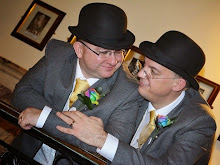
Wednesday, June 25, 2014
Me Vs Stephen Tall: An Open Letter About (Oh Joy!) The Orange Book
Stephen Tall today celebrates the tenth anniversary of the much-maligned, much-magnified and in my view surprisingly dull Liberal Democrat essay collection The Orange Book with a provocative article: “Why looking back on the 2005 Lib Dem manifesto depresses me. And why The Orange Book means the 2015 manifesto will be better.” So…
Dear Stephen, you’ll be delighted to know that you’ve provoked me into thinking (and so much that it would be overdoing it a bit to submit this as a comment to you). You may be less delighted to read that I didn’t agree with very much you said…
I might summarise your article as saying ‘The Orange Book came up with some new ideas and provoked lasting debate in the Liberal Democrats, while the party’s 2005 Manifesto was largely coasting along on old policies and not very interesting*’. I’d mostly agree with that – which shows the problem with short summaries, as I mostly don’t agree with your article, and where for me you fall down fatally is in basing all your arguments on short or partisan summaries rather than at any stage examining the documents themselves.
*[Though some might ask which of those two is more useful for a political party to campaign on in a General Election.]
It’s terribly tempting to demonstrate that today’s article isn’t up to your usual standards by cutting and pasting your own words: individually, most of the criticisms are defensible. Collectively, it’s shockingly lazy and lacks all credibility except when based on hindsight.
But I’ll provide some of the context you don’t instead.
My Own Biases and My Review of The Orange Book
I’ll start with a little about my own biases. I read both The Orange Book: Reclaiming Liberalism and Freedom, Fairness, Trust: The Liberal Democrat 2005 General Election Manifesto when they were new; I’ve not read either in any detail for a few years. In my much more active and much less ill past, I spent a few years as a ferocious critic of the Lib Dem policymaking process, getting more amendments passed by Conference than anyone save the party’s Federal Policy Committee… Then spent about a dozen years as a directly elected member of the party’s Federal Policy Committee, including some as its Vice-Chair, trying to write my amendments in at source rather than from the outside, and including work on three General Election Manifestos, of which the 2005 one was the last and in my view the least interesting (or most honed, for campaigning purposes).
One of my first substantial articles I wrote on starting this blog in early 2006 was what I think of as an even-handed review of The Orange Book (your mileage may vary). You can read it here in full, but here’s another partisan précis. I didn’t see it as anything like the coherent package it would suit its admirers and detractors to be; I thought its timing was a deliberate and cynical attempt to advance its authors rather than to advance its ideas; I praised David Laws much more than some of its contributors; I thought some chapters dull, silly or disturbingly authoritarian, but most in the Lib Dem mainstream; and I thought two chapters were absolutely crucial. One of them was by David Laws, defining Liberalism, which I said was well worth a read, mostly interesting, and wholeheartedly Liberal – with some significant caveats. The other was by Paul Marshall, who in your article comes across as your main source for framing both documents, and his introductory chapter was one of the most leaden failures in any book on Liberalism I’ve ever read.
In The Orange Book’s defence, the authors did at least get their fingers out and try to come up with some big ideas – and whether it’s truth or legend, they did win a reputation for setting off debate. That’s no mean feat, though I criticised crucial writers for “leaving [their] philosophical innovation stalled somewhere around 1908”. To be fair, although poor health gets in the way, it is also true that I’ve not only failed to launch the big idea for the party I keep meaning to, but that its philosophical innovation arguably hails from 1859. So the most remarkable thing about The Orange Book is that they did it, and then managed to get lasting attention for it.
Either way, when it comes to The Orange Book: Rewriting History, I was around for that history and require more than Paul Marshall’s highly spun hindsight as the sum total of evidence.
The Orange Book, the 2005 Manifesto and the Context
Stephen, you quote glowingly a speech by Paul Marshall long after the fact in which he puts down the 2005 Manifesto and praises his alternative by highly selective presentations of each. Let me provide a little more revealing context.
I called The Orange Book an alternative manifesto because in its timing and in its introduction (to say nothing of the editors’ spin all over the press) that is precisely how it was promoted. So it’s not unreasonable to make some direct comparisons. Way back when I reviewed The Orange Book myself, I said that Paul Marshall’s introduction was the weakest single chapter: a dully written and incoherent attempt to make an alternative manifesto of a series of disparate essays (to the obvious embarrassment of some of its authors), Mr Marshall showed more effectively than any other Lib Dem just how difficult it is to write a manifesto, because his attempt at one was so pitiful.
Not only was The Orange Book a shambles as an alternative manifesto, it was utterly useless in every regard (save to our enemies) as any basis for the actual manifesto. It was published to coincide with the party’s own pre-manifesto that was the culmination of two years’ consultation. I mean, how much “foresight” was that? Any ideas in The Orange Book, good or bad, could only be portrayed as ‘splits’ and completely useless as contributions. Imagine what the current manifesto co-ordinator – David Laws, I think his name is – would say if you were to publish an alternative manifesto in Autumn this year when his own carefully negotiated version had already been printed and circulated to every Conference representative? Had The Orange Book been published either a year earlier or a year later, it would have been timed to make a genuine contribution to ideas and been the target of far less opprobrium. In context, deliberately timed to get attention rather than to advance its ideas, it wasn’t taking part in a debate. It was merely willy-waving.
Then there’s the Manifesto itself. I’m sure you’ve read both the 2005 Manifesto and The Orange Book, but your article gives the impression that you’re taking Paul Marshall’s skimpy press releases as the entire basis of your critique of one and praise for the other. Well, I’ve said what I thought of Mr Marshall’s introduction to The Orange Book: now for the Manifesto, which I also read in full (many times, back then, as I was one of the many with a hand in writing it). Was it unambitious? Yes, in some places it was. There was a drive to cut down the length and the promises of 2001 and 1997, each of which I thought were more interesting manifestos, and I was exasperated at how hard I had to fight to get even a tiny box about our ideals into it, but as for “unrealistically high spending commitments”?
It turned out some of them were, in hindsight. In context, they weren’t. Like the 2001 and 1997 manifestos, they were based on months of hard arguing and hard costings to cut down our promises to what we could afford – as our (and the IFS’) understanding of the general economic framework went at the time. No other party bothered. It turned out that the general economic framework of the time was a bloated absurdity that vanished in a puff of debt, but no-one knew that yet. Let me turn back to sage, prophet and incredibly boring wordsmith Paul Marshall: hilarious that he now attacks that manifesto for “unrealistically high spending commitments” when his own alternative manifesto took exactly the same general economic framework as truth (just swapping what turned out to be “unrealistic” tax cuts for the spending, all based on an understanding of wealth we didn’t have).
One of my key criticisms of The Orange Book – unlike Mr Marshall’s conveniently partial claims today, from before the financial crash – was in its flagship approach to financial markets, one of the less convincing arguments written by David Laws. I wrote:
“He mentions opposition to monopoly and 1930s market failure, but that brief aside merely draws attention to this as his biggest blind spot. While many Liberal policies over the years have been directed against private monopoly, he fails to address other monopolies than state ones, or what to do in the event of other market failure – as well as raising the question, if he admits the market failed in 1930s (and that’s the only point at which he’s prepared to admit any such thing), does he have any alternative answer to such catastrophic failures or would he just have shut his eyes and hoped it would go away?”Which, though ‘I told you so’ is never very appealing, is why The Orange Book had no predictions and no solutions when a massive market failure inevitably came along all over again.
Neither did the 2005 Manifesto, you might rightly point out (though you didn’t, merely implying by elision that it lacked the foresight that The Orange Book had, and which I’ve just noted that it didn’t). What the Manifesto did have was a lot more than the ten points you published as if they were the Manifesto in its entirety. I’ve read through your article twice and I still can’t believe you’re writing as if that’s all there was, and certainly as if it was all you’d read. That’s bizarre, because you link to the whole thing, which sets out the costings right at the front and then has 38 more pages than the one you present as if it was the whole thing.
What Was the Point of the Ten-Point Plan?
Ironically, after a two-year consultation process in which the Manifesto was written between the Leader’s team, the Federal Policy Committee and the Parliamentary Spokespeople, the ten-point list was presented at the last minute by the Campaigns Department as a fait accompli, and none of the people who’d written the full Manifesto liked it. It was literally given to the FPC at the final meeting (again, after two years) to sign off the final draft of the Manifesto, and when FPC members started to move amendments – this one’s not a priority, this one doesn’t get across what the policy means, this one’s actively misleading, and so forth – we were told that we couldn’t change a single word because the posters had already been printed. So rather than a representative summary, even, of a far longer document, this list was something cobbled together in haste by the Campaigns Department without consultation because for the first time in any election the party literally had more money than it knew what to do with, as a very large donation (best not to say whose, in retrospect) had come in long after the local spending caps had come into force and so the only thing left to spend it on was posters.
I didn’t think they were very good, but whether they were or they weren’t, Stephen, what they certainly were not was the full Manifesto.
So that’s the context of the time. If you want to make up your own mind, the 2005 Liberal Democrat General Election Manifesto is here, The Orange Book is… Hey, where are all these libertarian pirates putting bootleg pdfs of it online? Well, I bought and read a copy, anyway, and you can still buy it at full price long past its sell-by date and bore yourself silly typing out long chunks to support your case. Just don’t make up your own mind on the basis of toytown spin and abuse from either side.
The Orange Book – The Legacy?
I wasn’t at Centre Forum’s meeting this week to – what? Celebrate? Commemorate? Build on? Bury? – The Orange Book, but I’d be fascinated to hear what people had to say, and to what extent that was based on the book itself, or merely on the legend. Stephen, you seem to be firmly a champion of the legend, and so your most interesting paragraph is your last, despite its assertions not being based on anything in the rest of your text:
“The Orange Book helped wake up the party, stimulating a much better quality of debate across the spectrum of views. Without The Orange Book, it’s doubtful we’d have the Social Liberal Forum. Without SLF, Liberal Reform wouldn’t exist. I like dialectic in political debate and the challenge and counter-challenge which often (not always, but often) ratchets up standards. Certainly it gives me confidence that our 2015 manifesto will be a marked improvement on its 2005 version.”I’m not convinced that it did. If anything, the self-indulgent timing of The Orange Book’s publication harmed its case and set back debate in the party. Most of it wasn’t of very good quality anyway. But I’m prepared to go along with your conclusion that it helped factionalise the Liberal Democrats into opposing teams shouting vituperate caricatures of each other – which is, obviously, always a sign of “a much better quality of debate”. Personally, I find both the self-identified “Orange Bookers” and the self-identified “Social Liberal Forum” and others depressing, lazy and unambitious for Liberalism – as well as each far smaller within the party than their self-importance would suggest. I agree that dialectic, debate and challenge and counter-challenge can ratchet up standards, but if carried out mostly by organised factions it can also lead to groupthink, entrenched positions and a lazy, never-ending exchange of misrepresentation instead of a thousand positive ideas blooming.
So here’s my own caricature: rather than arguments about the basis of Liberalism, what we all stand for and how we can inspire more people with it, much internal debate has become a values-free mud-fight about short-term economics, where one side is mean (but against debt) and the other generous (except to future generations), both say they are the only true Liberals while saying little recognisably Liberal, and neither has much to say that appeals to me.
Once again, my favourite contribution to Mark Pack’s “What do the Liberal Democrats Believe?” is on the basic conviction that unites social and economic Liberals:
“All POWER (be it government, business or other people) can both PROTECT and THREATEN LIBERTY.Stephen, what would you say that unifies rather than divides, and yet remains interesting? That’s the sort of inspiration I hope for from the 2015 Manifesto.
“Economic and Social Liberals put different emphasis on the BEST DEFENCES and the BIGGEST BULLIES.”
Yours always in hope, despite curmudgeonliness
Alex
Labels: Blogs, Books, David Laws, FPC, Ideas, Liberal Democrats, Liberalism, Manifesto, The Orange Book


Tuesday, March 25, 2014
Putting #WhyIAmIN Into What the Lib Dems Stand For 2014.07 #LibDemValues
Tomorrow, Liberal Democrat Leader Nick Clegg puts the positive case for being in the European Union, in the first of two debates with UKIP Leader Nigel Farage putting the negative case for Little-Englanderism (the other two ‘Leaders’ can’t decide, so they’ve bottled it). That makes two headlines for What the Lib Dems Stand For: “Stronger Economy, Fairer Society” and “IN Europe, IN Work”. So how do those two fit together? Here’s my go at something slightly more than a slogan, but still punchy. If you like it, please borrow it to stick on a leaflet or add to a speech. If you don’t, please send me something better!
- The Liberal Democrats stand for freedom for every individual – freedom from poverty, ignorance and conformity.
- To make that freedom real needs both fairness and economic responsibility: an economy that works, that encourages enterprise, and where everyone pays their fair share.
- So freedom from poverty requires responsible spending, not debt, built on fairer taxes where lower earners pay less tax and the wealthiest pay more; being in Europe to be in work, to fight crime and tackle climate change; and building green jobs for the future.
- Freedom from ignorance needs better education and training, so people have the opportunity to realise their potential.
- And freedom from conformity, supported by freedom from poverty and ignorance, means everyone should have the liberty to live their lives as they choose – without harming others; with equality before the law; with a better say, because no government always knows best.
- These values are why Liberal Democrats are working for a greener, stronger economy in a fairer society, enabling every person to get on in life.
Last year I wrote a series of articles on What the Lib Dems Stand For, looking for something to fit in a box on a leaflet or in a minute’s speech – something to enthuse and inspire Lib Dem believers, something to attract and persuade potential supporters, something that’s more than a slogan or a soundbite but short enough to get in one go.
I opened it up into a meme, and many other Lib Dems took part as well – you can find the links to where I’ve published theirs, too, below. That’s still open: if you can do better, whether saying ‘Change this little bit because…’ or suggesting your own from scratch, I want to hear from you, too (my email link’s on the sidebar. I’d like to hear if you make use of mine, too).
Especially now we’re sharing power, it’s important to assert our values. I wanted to answer: What makes us different, and makes us stay? How is that reflected in our priorities in Coalition Government? How does that pick out the central message of the Preamble to our Constitution? How does that expand on the party’s ‘core message’ slogan of “Stronger Economy, Fairer Society”? And how can we best express it in language that feels natural to us and anyone listening to us? All the while making a positive case for us, not just ‘…But the others are worse’? I’ve tried to do all that together. Does it work for you?
Adding ‘IN’
Last year I tried to combine everything at once, with the added challenge to make it short and to make it make sense, rather than just being a storm of buzzword-salad. It works pretty well for me telling the story of how the three big freedoms of our Preamble fit together with fairness, but even then I knew it had to leave some things out, and the biggest one I couldn’t seem to fit in was internationalism. And what’s our big theme for this year’s European Elections? Who could have guessed?
My main change today is… Adding more words. Compared to last year’s, below, it’s up 16, taking it further from my target of 150 to fit in a medium-sized box on a leaflet or just one minute in a speech. What do you think of “being in Europe to be in work, to fight crime and tackle climate change”? Does it work? Does it fit? Is it too specific compared to the more values-based rest of the text? I based it on our three main campaigning messages about Europe, because I couldn’t find a way of getting the ‘drawbridge down’ sort of values behind them to work in just a few words. Can you?
And yes, now it makes the “Freedom from ignorance” bit look a bit short, but I’m not adding even more. Though if you don’t like semi-colons and want to break it up a bit more to make it easier to read, the pedant in me doesn’t like it, but you can use full stops instead to make the “Freedom from poverty” and “Freedom from conformity” bullets punchier.
The ‘What the Liberal Democrats Stand For Challenge’ So Far
This aims to be something short and simple that Lib Dems members can look at and think, ‘Yes, that’s some of why we bother’, and that other people can look at and think, ‘Oh, that’s what the Lib Dems are for, and I like it’. Feel free to borrow it for a box on your Focus leaflets, to be part of your speeches, for your members’ newsletters, your Pizza’N’Politics evenings – wherever it’ll do some good. And here’s what I’ve done with it so far, including many other Lib Dems’ own versions…
Happy 25th Birthday, Liberal Democrats – and What the Lib Dems Stand For 2013.1
Why we should sum up What the Lib Dems Stand For, and how it’s developed over the years.
What the Lib Dems Stand For 2013.2 – a Challenge and a Meme #LibDemValues
Setting out my ‘What the Lib Dems Stand For’ based on the Preamble, practice and core messaging, and challenging other Lib Dems to come up with their own.
The Liberal Democrat What Do We Stand For Challenge 2013.3 – Eight Answers (so far) #LibDemValues
After receiving the first set of responses, rounding up eight different Liberal Democrats’ versions of what we stand for – so far…
The Liberal Democrat What Do We Stand For Challenge 2013.4 – What It’s All About #LibDemValues
Inviting people to use my short declaration of ‘What the Lib Dems Stand For’ and explaining what each bit of it means.
What the Lib Dems Stand For 2013.5 – Why I Am A Liberal Democrat #LibDemValues
This one’s very different – longer and more personal: how did I get here? Why did I become a Lib Dem in the first place? And why do I stay?
The Liberal Democrat What Do We Stand For Challenge 2013.6 – Another Eight Answers #LibDemValues
Another eight different Liberal Democrats’ versions of what we stand for in the second set of responses people sent in.
Last year’s slightly shorter version:
The Liberal Democrats stand for freedom for every individual – freedom from poverty, ignorance and conformity.
To make that freedom real needs both fairness and economic responsibility: an economy that works, that encourages enterprise, and where everyone pays their fair share.
So freedom from poverty requires responsible spending, not debt, built on fairer taxes where lower earners pay less tax and the wealthiest pay more, and building green jobs for the future.
Freedom from ignorance needs better education and training, so people have the opportunity to realise their potential.
And freedom from conformity, supported by freedom from poverty and ignorance, means everyone should have the liberty to live their lives as they choose – without harming others; with equality before the law; with a better say, because no government always knows best.
That’s why Liberal Democrats are working for a stronger, greener economy in a fairer society, enabling every person to get on in life.
Once again, there will be more.

Labels: Blogs, Education, Environment, European Politics, Ideas, Liberal Democrats, Liberalism, Memes, Nick Clegg, Tax, The Golden Dozen, Top Tips, UKIP, What the Lib Dems Stand For
Tuesday, September 17, 2013
The Liberal Democrat What Do We Stand For Challenge 2013.6 – Another Eight Answers #LibDemValues
Half-way through Liberal Democrat Conference in Glasgow, I’m turning from the hotly argued policy votes to essential principles and eight Lib Dems’ own individual, diverse, but unifying rallying cries on What the Lib Dems Stand For. Some are shorter, some longer, some I’ll link to for more, but all are recognisably Liberal Democrat. Here’s what Sam Phripp, Prateek Buch, Andrew Tennant, Dave Page, Maelo Manning, Nick Barlow, Andrew Brown, Chris Richards – and me – have to say: which inspires you? Try some in your local party, or on the doorstep, or your leaflets and speeches… And share yours, too!
I last published a round-up of responses to my What the Lib Dems Stand For Challenge immediately before our last Conference in March. Most of the responses below were published not long after that, so a particular thank you to all contributors who got in fairly quickly, and apologies for taking so long to compiling them all. Once again, don’t wait to be asked – if you think you can do better, or more personally, or simply more to your own taste, please send me your own idea or publish it yourself (and ideally let me know, so I don’t miss it). I originally challenged other Lib Dems to come up with roughly 150 words – though that was just for ease of use, so whatever length they fancy, really – summing up what the Lib Dems stand for, after first coming up with my own for people to borrow or blame, a synthesis of the Preamble, the party’s achievements in government and the party leadership’s latest messaging. You’ll find mine below, again, and once again, feel free to borrow it wholesale for your own leaflets, speeches or pizza and politics nights, or to say where I’ve gone right or wrong (or say that about the others, but I’m more comfortable inviting potshots at me than at guests). So here are the next eight, a good mix from across the party, some from people I know well and others I don’t, some more to my own taste than others, but every one a rallying cry from the Lib Dem tradition…
Sam Phripp – “A Voice For the Voiceless”
So Sam said… is the most recent “Why I’m a Liberal Democrat” piece I’ve read – Sam prepared it to form part of his selection speech as Lib Dem Prospective Parliamentary Candidate for North East Somerset, but I read it, liked it, so introduced myself to him at Conference the other day and asked if I could reprint some of it. You can read the whole thing on Sam’s blog, but here’s a crucial part:
“The reason I’m a Liberal Democrat, is because I believe Liberal Democrats are a voice for the voiceless - and I know it because I’ve been there.
“When I was young, successive Conservative governments vilified single parent families to the point that mothers including my own were given enough money to feed their children but not themselves.
“When I was growing up and realising that I wasn’t like other boys, Labour legalised Civil Partnership but still didn’t believe that I should be able to marry – actually, properly, marry – the person I love…
“The only people who come to bat, every single time, for people like that, people like me, people who are marginalised are the Liberal Democrats…
“If we don’t do it, nobody else will do it for us. That’s why I’m a Liberal Democrat, and that’s why I’d like to be an MP, because people deserve a voice and people need to have someone on their side.”
Prateek Buch – “The Freedom and Means To Live Fulfilling Lives Free From Poverty, Ignorance and Conformity”
As part of a series of articles on “Putting social liberal values into action”, Prateek gives his own short statement of values as an opening contribution:
“We believe the political economy should empower all citizens with the capability to secure for themselves the freedom and means to live fulfilling lives free from poverty, ignorance and conformity – and that where it falls short, we should promote social justice and tackle barriers of inequality in wealth, voice and power.”
Andrew Tennant – “An Individual’s Right To Self-determination and Control Over Their Own Life”
Andrew Tennant tweeted a shorter version still:
“Believing in an individual’s right to self-determination and control over their own lives, as well as how governed.”
Dave Page – “Increasing People’s Freedom To Enjoy Their Own Potential”
The ever-so-lovely Dave expands on a previous post to hone his appeal both to Lib Dems and to other people of a liberal cast of mind (and potentially Liberal cast of vote). While I’d urge you to read what he has to say in full, here’s his key message:
“The Liberal Democrats stand for increasing people’s freedom to enjoy their own potential, helping everybody to get on in life. We believe in meaningful representative democracy to balance people’s conflicting priorities, and in ensuring protection for the individual from the State and other powerful organisations.Dave’s title for his piece, “This Is What the Lib Dems is About”, always puts this fab track into my head. ‘Moo moo! Moo moo! S-L-F!’ as Dave would no doubt sing. “All aboard, all aboard, woah-oh!”
“We believe that nobody should be constrained by lack of opportunity, particularly by the circumstances of their birth. We believe that Government should set the rules by which society operates, so people are rewarded for hard work and innovation, but not for exploitation or pollution. We believe that people should be respected as individuals regardless of their gender, colour, wealth, sexuality, or any other quality – not as homogeneous groups defined by those qualities.
“We believe in accountable, democratic institutions giving people more of a say in their immediate lives and local communities, as well as more of a say in the issues too big for one person, or one country. We believe in solutions which get to the root of the problem rather than just addressing the symptoms.”
Maelo Manning – “Fairness, Equality and Community”
I’ve pulled out of the “LibDem Child” blog some of her positive case for the party:
“I believe the party stands for: ‘fairness, equality and community’… For Fairness, I am extremely thrilled at the decisions taken like raising the tax threshold and a commitment to green issues… For Equality – Everybody is given a fair start and supported in the necessary way for them to be able to participate in society. For example, schools in poorer areas are given extra support and guidance to help the pupils have a fair start in life, and the equal marriage bill… For Community – demonstrated at local levels by our superb councillors who are in tune with the needs of their local communities; and party campaigners.”
Nick Barlow – “Maximise the Happiness and Potential of Every Individual”
I recommend reading Nick’s full exploration of the party’s key areas and overall themes, but here’s the coherent message he hones them into at the end:
“We believe in a society that works to maximise the happiness and potential of every individual, one that works to give everyone the opportunity to live their life as they want, providing they do not harm others. We seek to create an open, liberal and democratic world, where power is spread around, people have a real say in decisions that affect them and fair and impartial justice is available to all. A liberal society should protect the environment, promote education, create opportunity, reward enterprise and encourage innovation. Everyone should be free to participate in society and we seek to both tear down the barriers that restrict them and help people to overcome circumstances that limit them. In a liberal society everyone should be free to live their lives, free of restraint by poverty, ignorance or conformity.”
Andrew Brown – “Promoting the Freedom of the Individual Within A Society In Which All Can Achieve Their Potential”
Andrew on The Widow’s World offers his own Lib Dem statement of belief:
“Liberal Democrats exist to promote the freedom of the individual within a society in which all can achieve their potential.
“Liberal Democrats have a fundamental belief in the equality of all regardless of income, wealth, status, gender or gender identity, disability, personal capacity or sexual preferences – and that this should be enshrined and supported in law.
“Liberal Democrats believe the role of the State is to facilitate the ability of individuals to reach and exceed their potential and to provide an underpinning of support for those who fail to do so. They believe that spending to meet these aims is of benefit to all and that the burden of taxation should be progressive but not punitive.
“Liberal Democrats are pragmatic, concerned with outcomes not methodology and resisting traditional dogmas of left and right in favour of evidence-based policy which demonstrably support our aims.
“Liberal Democrats support these aims in the UK, in Europe and internationally.”
Chris Richards – “It’s About Freedom”
Chris Richards takes an interestingly different approach, not starting from scratch, from the Preamble to the Lib Dem Constitution or the other inspirations others have taken but looking to a favourite Lib Dem publication, the ‘Values Paper’ It’s About Freedom. I recommend it, too, with co-authors including such impressive names as a long-pre-Leadership Nick Clegg and, er, Alex Wilcock (best to ignore a couple of recent defectors in there, though).
Chris chooses the opening of the paper’s conclusion to champion what the party stands for and I print that first, but I recommend also reading his whole piece, where he chooses many of his favourite passages and highlights some of those he thinks are particularly relevant today. I’ve picked out a small selection of those, too:
“It’s about freedom. That one word is the call for all Liberal Democrats. Liberal Democrats believe that maximising personal freedom is fundamental to a liberal society. We believe that freedom means the opportunity to make the most of our lives, while recognising that our actions must not prevent others from sharing those opportunities and that we may need to take active steps to extend freedom to all.”
“The freedom of the individual is, however, limited or non-existent if he or she is prevented by economic deprivation, lack of education, disadvantage or discrimination from exercising choices about how to live or from participating in the democratic process… Institutions are required which keep markets free and prevent monopoly. Other mechanisms are needed to ensure that individuals have access to the things which markets are unable to provide.”
“We reject the use of the state or the law to enforce beliefs… Liberal Democrats do not have a blueprint of how life should be lived, but we do have a set of principles with which to approach problems and decisions.”
“Our first political duty – particularly if we are ourselves in power – is to ensure that mechanisms to protect freedom are in good order, and power is as widely shared as possible.”
Alex Wilcock – “Society Should Be For Everyone, and Every Individual Should Be Free”
I started this whole thing with my own short rallying call, carefully crafted for consensus from the Preamble, our priorities in government, the party’s key message and a bit of me. Very on message, in volume and over time, and so that’ll be up again in just a minute. But last week, I decided to do what several other people have done and write a longer, much more personal story, of how my life experience led me to being a Lib Dem and how the golden thread of Liberalism runs through my life. So I’ve now done what I’ve done to other people’s personal pieces, and filleted it to pull out some of the key ideas:
“My first political memories are of shouting at bullies… With all the division in society, a political party should be for everyone, not hating half the people all the time – or even hating other countries – and that with what I was experiencing personally, everyone should have the freedom to live their own life, too. And that naturally led me to the Liberal Democrats, who were not just appealingly internationalist but, to their core, the only party saying that society should be for everyone, and that every individual should be free…
“Liberalism means that if you start with every individual, you can’t put any person on the scrapheap or hate them for who they are. The founding principles of Liberalism over the centuries – of individual freedom, equality before the law and controlling arbitrary power – are living, breathing, vital ideas that I’d discovered for myself in the desire to choose my own life, my belief that everyone should be treated the same, even as a little boy knowing that you had to stand up to bullies… Part of not favouring any one ‘side’ is realising that anyone can be a bully, or can be bullied – or, in philosophical terms, any sort of power can threaten liberty, but any sort of power can protect it, too. Whether it’s the state, or big business or big unions, or just other people, any of them can boss you around and anyone can help stop you being bossed around. So you can’t do away with any of them – and you can’t say any of them are right all the time, or be in their pockets. Which means aiming to create The Perfect Society will always be a disaster, but working at making a better society means there’s always more real life to be listened to and more work to be done…
“That’s why for me saying what we stand for is more important than any single policy. It’s important because unless we keep sight of why we bother, there’s nothing to inspire us. And it’s important to remember that we’re for everyone, that everyone should be free to live their own lives, and so we’re here to bring everyone together, as far as we can, and to stop people being pushed around, as far as we can… We’re still the only party that says society should be for everyone, and that every individual should be free.”
The Liberal Democrat What Do We Stand For Challenge (so far)
A very big thank you from me to all those who’ve taken part so far – both in today’s contributions, and back in March. I hope you encourage and inspire many others not just to read but to think and come up with their own versions of What the Lib Dems Stand For in turn. If that’s you this time, dear reader, please do! And then I might publish a third collection.
Once again, feel free to borrow my own message – below – and use it yourself. It’s my contribution to open-source Liberalism – getting across what we stand for in something more meaningful than a soundbite but still short enough to be no more than a minute’s speech or a box on a Focus leaflet. If you do make use of it, I’d prefer it if you let me know, but that’s not compulsory (I imagine the other contributors above feel much the same, but it’s probably polite to ask them first). So, synthesising the Preamble to the Constitution, the party’s priorities in government and Nick Clegg’s repeated mantra, here’s my on-message message again:
“The Liberal Democrats stand for freedom for every individual – freedom from poverty, ignorance and conformity.
“To make that freedom real needs both fairness and economic responsibility: an economy that works, that encourages enterprise, and where everyone pays their fair share.
“So freedom from poverty requires responsible spending, not debt, built on fairer taxes where lower earners pay less tax and the wealthiest pay more, and building green jobs for the future.
“Freedom from ignorance needs better education and training, so people have the opportunity to realise their potential.
“And freedom from conformity, supported by freedom from poverty and ignorance, means everyone should have the liberty to live their lives as they choose – without harming others; with equality before the law; with a better say, because no government always knows best.
“That’s why Liberal Democrats are working for a greener, stronger economy in a fairer society, enabling every person to get on in life.”
Happy 25th Birthday, Liberal Democrats – and What the Lib Dems Stand For 2013.1
Why we should sum up What the Lib Dems Stand For, and how it’s developed over the years.
What the Lib Dems Stand For 2013.2 – a Challenge and a Meme #LibDemValues
Setting out my ‘What the Lib Dems Stand For’ based on the Preamble, practice and core messaging, and challenging other Lib Dems to come up with their own.
The Liberal Democrat What Do We Stand For Challenge 2013.3 – Eight Answers (so far) #LibDemValues
After receiving the first set of responses, rounding up eight different Liberal Democrats’ versions of what we stand for.
The Liberal Democrat What Do We Stand For Challenge 2013.4 – What It’s All About #LibDemValues
Inviting people to use my short declaration of ‘What the Lib Dems Stand For’ and explaining what each bit of it means.
What the Lib Dems Stand For 2013.5 – Why I Am A Liberal Democrat #LibDemValues
The long version of my personal philosophical story, as quoted in brief above.
Two last points that suit this sort of round-up. Simon Titley of Liberator has been one of the party’s more outspoken critics of “a stronger economy in a fairer society”, though not conspicuously proposing any alternative. However, on the cover of last month’s issue, Liberator offered “one simple amendment” to make it “Fairer Economy, Stronger Society”. I don’t have a problem with the first part of that, but the second sends shivers down my spine. Together, they sound more like the authoritarian left to me than any kind of Liberalism; on its own, the second half could be any communal bully from the state to a village to unbreakable ‘tradition’, reactionary, conservative and the enemy of the individual. Maybe “Stronger Society” just has a different ring to those of us a strong society has almost always wanted to push around than to those society’s always privileged, but I’d want no part of that oppressively authoritarian, illiberal combination.
I do, though, recommend Lib Dem Blogger of the Year 2013 David Boyle – congratulations, David – in his look back at Jo Grimond’s most famous speech on its fiftieth anniversary, and well done to Simon Titley, this time, for reminding David of the hero of the Liberator crew back when they were exciting Young Liberals. I’d had it in my diary to cover too, but as I’ve been knackered, and ill, and it’s Conference, and as most importantly David’s written a much better article than I would have anyway – look out for the less famous (merely infamous) words of a Labour councillor – I’m very glad that rather than writing it up for one of my own ‘Liberal Mondays’ I can simply point you to David’s excellent “The Sound of Gunfire revisited”.
Labels: Blogs, Gay, Ideas, Jo Grimond, Liberal Democrat Conferences, Liberal Democrats, Liberal Mondays, Liberalism, Liberator, Memes, Top Tips, What the Lib Dems Stand For
Tuesday, September 10, 2013
What the Lib Dems Stand For 2013.5 – Why I Am A Liberal Democrat #LibDemValues
Another Liberal Democrat Conference starts this weekend, and once again I’m looking at What the Lib Dems Stand For. Before this Spring’s Conference, I published a series of articles challenging us to combine our principles, our priorities in government, and our Leadership’s message to tell other people we’re about and inspire ourselves to be enthusiastic about it. Tomorrow I’ll be publishing some more ideas of what we stand for written by other Lib Dems. Today, it’s something more personal: how did I get here? Why did I become a Lib Dem in the first place? And why do I stay?
If you scroll down below, you’ll find my short rallying cry designed for anyone to use – please borrow mine and use it yourself. Or, ideally if you’re quick, you can send me your own version. But as I’ve prepared to print the next round-up of other contributors’ ideas, I’ve noticed how much more personal many of theirs are, and I’ve been reminded what I said the last time I published that sort of compilation: that one day I’d have to challenge myself to be less on-message and consensual, and say what my Liberalism is by instinct, speaking straight from my head, my heart and my life.
There are lots of passions that make me tick, and lots of experiences that have formed my life and my Liberalism. Sometimes I’d think more of the quirkier elements (not least, Doctor Who), sometimes more of my family or friends. Today’s personal testament looks for the explicitly Liberal line through my life.
My Political Story – Why I Am A Liberal Democrat
My first political memories are of shouting at bullies. I didn’t think of this as political until a long time later, but that’s what it was [1]. With the fearlessness of the very young, I saw much bigger boys being mean and thought it wasn’t fair, and told them so. I didn’t do it often, but it stuck in my head because it seemed to be the right thing to do, standing up for the underdog. Luckily, a small boy shouting at them seemed to shame them rather than get my head kicked in.
I was less brave when I got into my teens and was bullied myself. It’s a quirk of my personality that finding the drive to stand up for someone else has always been far easier than defending myself alone: under personal attack, I tend to crumble into depression and want to hide. What forced me to be braver and brought back that burning desire to stop unfairness was realising I was gay. It was the 1980s, and I didn’t know anyone that was gay – or so I thought at the time. All I knew is that everything about society told me I was wrong and seemed to hate me for something that was simply me. Pretty soon I decided there was nothing wrong with me at all, and that it was the world that had to change, so I came out early and uncompromisingly. I wanted it to get better, for everyone I knew to know at least one gay person, for me never to hide – and I never have for nearly a quarter of a century, from workplace to election, from embrace to rejection. I might have got involved in politics anyway, but that decision made it essential.
At the same time, politics in the 1980s just seemed nasty. Labour had wrecked the economy; the Tories were building back bits of it so it was all right for some, but left a lot of other people on the scrapheap of massive unemployment. And it wasn’t just that both sides seemed like they were only interested in ‘their’ people – they always seemed to me that they just hated the other side, too, and class hate sickened me as much as racism or what I didn’t know yet was called homophobia. It probably helped that I had an American Catholic Mum and a Scottish Baptist Dad, so I’d always understood that people with different beliefs, different ‘tribes’, even different countries, not only could get on but really had to.
Those two feelings came together in a firm belief that with all the division in society, a political party should be for everyone, not hating half the people all the time – or even hating other countries – and that with what I was experiencing personally, everyone should have the freedom to live their own life, too. And that naturally led me to the Liberal Democrats, who were not just appealingly internationalist but, to their core, the only party saying that society should be for everyone, and that every individual should be free [2].
I didn’t have a political background, I didn’t have money, I didn’t have anyone pushing me to get involved. I just felt that I wanted to change the world, and that if everyone just sat around and waited for someone else to do it, it would never get done. So I joined the Lib Dems, and I did everything I could from delivering leaflets to eventually standing for Parliament. And even though when I first threw myself into campaigning for the Lib Dems we were on 4% in the opinion polls, I knew this was the only party that was offering real change, however long it took – why join another party to campaign for things to stay the same? And I kept campaigning for things to change within the Lib Dems, too. It was often an uphill struggle to get heard, and I made plenty of mistakes, but determination and ideas won me influence. Where I often felt I was having the most impact was when I was elected over many years to the party’s Policy Committee. In part, that was writing individual policies that formed part of several election Manifestos, and knowing in particular that I’d contributed to pushing equal treatment, respect and opportunity for lesbian, gay, bisexual and transgender people a bit further every time. But, for me, it wasn’t just the issues that really grabbed me, but the ideas.
I learned how to put my gut instincts into philosophy, and realised I’d been a Liberal all along. That Liberalism meant that if you start with every individual, you can’t put any person on the scrapheap or hate them for who they are. That the founding principles of Liberalism over the centuries of individual freedom, equality before the law and controlling arbitrary power were living, breathing, vital ideas that I’d discovered for myself in the desire to choose my own life, my belief that everyone should be treated the same, even as a little boy knowing that you had to stand up to bullies. It was Conrad Russell (a Liberal Democrat I got to know through the Policy Committee who became a friend and even a mentor) who said the point of Liberalism was to stand up for everyone against bullies, and that just lit up a lightbulb over my head. Suddenly, I could see that Liberal line through my life. It’s not just that a party owned by one group of special interests can never be fair – that it inevitably discriminates against the rest and divides society. It’s that part of not favouring any one ‘side’ is realising that anyone can be a bully, or can be bullied – or, in philosophical terms, any sort of power can threaten liberty, but any sort of power can protect it, too. Whether it’s the state, or big business or big unions, or just other people, any of them can boss you around and anyone can help stop you being bossed around. So you can’t do away with any of them – and you can’t say any of them are right all the time, or be in their pockets. Which means aiming to create The Perfect Society will always be a disaster, but working at making a better society means there’s always more real life to be listened to and more work to be done.
That’s why for me saying what we stand for is more important than any single policy. It’s important because unless we keep sight of why we bother, there’s nothing to inspire us. And it’s important to remember that we’re for everyone, that everyone should be free to live their own lives, and so we’re here to bring everyone together, as far as we can, and to stop people being pushed around, as far as we can.
So when, sometimes, being in government is frustrating or disappointing, and it is, because there’s not enough money to do what we want to do or because the Tories we’re in government with have different priorities, I can see that Liberal line of what we’re getting right, and why we’re doing it. No Lib Dem joins just to get into power. We do it to make a difference. It took perseverance for me inside the Lib Dems, but it took the whole party a whole lot more hard work and struggle to go from 4% in the polls to more than double our number of MPs and win a place in government – not the easy way, and not to do the easy things. No wonder Liberal Democrats take a long term approach on the importance of education to unlock people’s potential, and the environment to lock in fairness for the future – we had to work at it for a long time, so we’ve never gone for quick fixes. I’m deeply proud that this government’s the one that legislated for mostly equal marriage at last, but it’s the bigger ideas that matter still more. Worse than the 1980s, Labour had wrecked the economy again. But despite the damage being deeper and longer than it was when I was growing up, while unemployment is still too high it’s much, much lower than in the 1980s, now that Liberal Democrats are in government and not just the Tories. From apprenticeships to green jobs to tackling the banks, it’s not just rebuilding the economy as ‘all right for some’, but putting it back together differently. You need economic responsibility to make things work – but without fairness, too, society falls apart.
I think the government would be better if it was all Lib Dem and we could do more of what we wanted to do. Well, I would say that. But it’s also good to prove that people with different beliefs, different ‘tribes’, can make it work together as well. I look at the difference we’ve made, not just since the government was elected but compared to the 1980s when I grew up, and I’m proud of how we’ve changed things for the better: unemployment that much lower than the Tories ever cared about before the Lib Dems entered government, taxes for ordinary people that much lower with the Lib Dems while the wealthiest pay more than they did under Labour, green growth and protecting education so that the economy and opportunities will last into the future. I’m proud – but I’m not satisfied. I still want to change the world. But I can see how Liberal Democrats are doing just that, more slowly than I’d like and with a few wrong turns, but we’re still the only party that says society should be for everyone, and that every individual should be free.
The way the party sums that up now is that the Liberal Democrats are building a stronger economy in a fairer society, enabling every person to get on in life. Freedom. Fairness. Being for everyone. I find myself nodding, because the Liberal Democrats are still saying what made me join all those years ago, only now they’re putting a bit – a fair bit – of it into practice.
[1] I had a long conversation about my politics with my Grandma when I was in my twenties. She nodded, and said she could see I’d be political when – and this is one I’d not remembered – I was aged four and strutting about naked on a beach and told a big boy off for kicking down another boy’s sandcastle. I said she was probably right (though I bottled out of adding, ‘And obviously that’s why I’m a naturist now, too’).
[2] If you’ve ever wondered where my blog title “Love and Liberty” comes from, it’s my original two gut instincts distilled into three words. You can read the annotated version of most of my 1999 booklet “Love and Liberty” online too, where my concept of Liberalism is re-expanded into many, many more words.
The Liberal Democrat What Do We Stand For Challenge (so far)
If you’re quick, you can send me your own idea by tomorrow. Or just feel free to borrow mine and use it yourself (I’d prefer it if you let me know, but it’s not compulsory. Think of it as open-source Liberalism). The idea’s an ongoing investigation, collaboration and rallying cry about what the Liberal Democrats stand for, to challenge myself, first, then other Lib Dems to get across what we stand for in something more meaningful than a soundbite but still short enough to be no more than a minute’s speech or a box on a Focus leaflet. And to make things harder, I aimed for broad consensus by synthesising the Preamble to the Lib Dem Constitution, the party’s priorities in government and the party leadership’s latest messaging. Did it work? Here’s my go at that:
The Liberal Democrats stand for freedom for every individual – freedom from poverty, ignorance and conformity.
To make that freedom real needs both fairness and economic responsibility: an economy that works, that encourages enterprise, and where everyone pays their fair share.
So freedom from poverty requires responsible spending, not debt, built on fairer taxes where lower earners pay less tax and the wealthiest pay more, and building green jobs for the future.
Freedom from ignorance needs better education and training, so people have the opportunity to realise their potential.
And freedom from conformity, supported by freedom from poverty and ignorance, means everyone should have the liberty to live their lives as they choose – without harming others; with equality before the law; with a better say, because no government always knows best.
That’s why Liberal Democrats are working for a stronger, greener economy in a fairer society, enabling every person to get on in life.
Happy 25th Birthday, Liberal Democrats – and What the Lib Dems Stand For 2013.1
Why we should sum up What the Lib Dems Stand For, and how it’s developed over the years.
What the Lib Dems Stand For 2013.2 – a Challenge and a Meme #LibDemValues
Setting out my ‘What the Lib Dems Stand For’ based on the Preamble, practice and core messaging, and challenging other Lib Dems to come up with their own.
The Liberal Democrat What Do We Stand For Challenge 2013.3 – Eight Answers (so far) #LibDemValues
After receiving the first set of responses, rounding up eight different Liberal Democrats’ versions of what we stand for – so far…
The Liberal Democrat What Do We Stand For Challenge 2013.4 – What It’s All About #LibDemValues
Inviting people to use my short declaration of ‘What the Lib Dems Stand For’ and explaining what each bit of it means.
Then there’s today’s, and with a bit of luck there’ll be more tomorrow.
Labels: Blogs, British Politics, Coalition, Gay, Ideas, Liberal Democrat Conferences, Liberal Democrats, Liberalism, Memes, Personal, What the Lib Dems Stand For
Thursday, August 22, 2013
Carnival of the Lib Dems – A Celebration of Blog Posts
Tomorrow, nominations close in the “Liberal Democrat Voice Awards”. These have been thrillingly renamed, relaunched and expanded, but for me the greatest pleasure in them remains celebrating the brilliant flow of ideas by a carnival of Lib Dem voices on their own blogs. The shortlist I most look forward to is that for Liberal Democrat Blog Post of the Year – both because that always introduces me to some great writing I’ve not seen before, and because it’s so much easier to read a hand-picked selection of posts than read through the complete shortlisted blogs, Twitter pages or Facebook timelines.
I was sad to see this award dropped last year, and delighted that it’s back in the greatly expanded new array. And last year I resolved to do something about it, saying: “I will pick at least a dozen articles from at least a dozen different blogs from across the year that I think are among the best and plug them” here. I’ve been noting the most interesting posts to catch my eye – not necessarily the ones with which I most agreed – throughout the year, and as well as irregularly proposing them for Lib Dem Voice’s weekly Golden Dozen, I’ve spent the last couple of weeks poring over the lot (one reason I’m rather later with my selection than ideal). I hope in the three weeks before the winners are announced this will be part of showing just how marvellous Lib Dems blogging are.
So here, to celebrate the talent in the Lib Dem blogosphere and introduce more blogs is a journey through the year (rather than in order of preference) with two dozen of the Lib Dem finest. Pah-pah pah pah-pah-pah…
The first post I’d recommend might be in the ‘Best individual post’ category, or it might be in the ‘Best online campaign’. I’ll leave that to the judges. But last Autumn Jennie Rigg’s outstanding effort in putting questions to over a hundred candidates for the Liberal Democrat Federal elections made a mighty series of posts that shouldn’t be forgotten.
Jennie Rigg on Automated Attack Monkeys, Scalpel Mines, & Acid: “Questions for FCC and FPC candidates”
Chris Richards on On Liberty Now: “Time for Liberal Democrats to stop saying ‘No’”
Isn’t it deeply conservative to campaign only to prevent things? The Liberal Democrats should have positive ideas.
Jonathan Calder on Liberal England: “Nick Clegg needs to get crunchy again”
Nick needs to rediscover his old self as a thinker and libertarian, because the “centre” is defined by your opponents.
Zoe O’Connell on Complicity: “New Tory Policy: Pretending to protect children more important than protecting children”
Why education is better at keeping kids safe online than faith in the Daily Mail and Internet blocking.
Andrew Brown on The Widow’s World: “Dear Nick… An Open Letter on Closed Material Procedures”
A loyalist takes a stand on civil liberties.
Jennie Rigg on Automated Attack Monkeys, Scalpel Mines, & Acid: “Saturday Silly today comes courtesy of Andy Burnham MP”
Now Labour wants to ban Frosties – Jennie outlines some healthy alternatives. Not to Frosties; to bansturbation. Puritanism is never satisfied.
Jonathan Wallace: “The Lib Dems’ Battle of Stalingrad”
A vibrant image of how Eastleigh “was fought street by street, house by house, sucking in vast armies of activists battling it out.”
Councillor Gavin James: “How the Lib Dems should take on UKIP”
The three parts of UKIP’s support and how to take them on – by being Liberal Democrats.
Cicero on Cicero’s Songs: “The SNP tries to have its cake and eat it”
The SNP is now in favour of the pound while defaulting on its debts, British identity while leaving the Union, armed neutrality while staying in NATO, divorce while getting more love from the divorced partners, and it sees no contradiction in that. Cicero does.
Stephen Glenn on Stephen Glenn’s Liberal Journal: “In response to Simon Hughes”
Thoughtfully exposing the mass of contradictions in Simon Hughes’ attack on religious freedom and equality.
David Boyle on The Real Blog: “Violet, Winston and the meaning of Free Trade”
What Churchill’s thundering Liberal case for Free Trade in favour of the lower-paid tells us about how the Tories have warped the idea since.
Richard Flowers on The Very Fluffy Diary of Millennium Dome, Elephant: “No New Powers for the Security Services At Least Until They Explain Why They Failed to Use the Ones They’ve Got!”
A message to Alan Johnson on the Zombie Snoopers’ Charter – is totalitarian China the best role model?
Nick Barlow on What You Can Get Away With: “On political stereotypes and Doctor Who”
Who would have thought that polling voters about Doctor Who would reveal so much about the wildly differing social attitudes of different parties’ voters?
Mark Pack on Mark Pack’s Blog: “Liberal Democrat achievements in government” and “What do the Liberal Democrats believe?”
Not quite ‘blog posts’, but his twin infographics (disclosure: I made some suggestions on the second) are well worth a look.
Mark Thompson on Mark Thompson’s Blog: “Seven awkward questions for Liberal Democrats”
Still waiting for answers.
Nick Thornsby on Nick Thornsby’s Blog: “UK tax revenue and public spending 1997-2012”
Sounds boring, doesn’t it? But – shockingly – in the last 15 years, UK governments have only balanced the budget once, relying on massive borrowing in every other year, from a full decade before Labour could blame the international crisis. Sole credit year: +£16bn. Biggest debt year: -£186bn. No wonder the deficit’s taking a while to fix.
Jen Yockney on Either / And: “But he’s a TORY!”
On why it’s good for sexuality not to be a party political plaything and why both people who grumble that the latest out bisexual MP is a Tory and the Daily Mail have got it wrong.
Peter Wrigley on Keynesian Liberal: “ Wither amnesty for illegal immigrants?”
Contrasting Nick Clegg’s courageous debate performance with his unilateral retreat.
Sam Phripp on So Sam said... “A statement about my membership of the Liberal Democrats”
Sam gives his three top tips if you’re planning on leaving the party.
Jae Kay on Freedom Is Not The Problem: “Marriage Equality: Taking Stock And Preparing For The Future (AKA It Ain’t Over)”
After a year of heroic posts about equal marriage – and many more before then – this looks to what’s next.
Lester Holloway: “The Voice says Labour are losing the Black vote. Addressing Black voters might help”
A detailed analysis of the relationship between all parties and the Black vote – and what to do about it.
Caron Lindsay on Caron’s Musings: “What the hell are the Home Office playing at – and why are Liberal Democrats letting them get away with it?”
The Tories aren’t just re-toxifying themselves with their racist harassment of every non-white person but trying to toxify the Lib Dems too. It’s time for Nick to take the gloves off both because it’s right and for our survival.
Charlotte Henry on Digital Politico: “Anti politics leaves us all with egg on our face”
When our political culture is so warped and toxic that no-one can discuss it properly.
Carl Minns – Thoughts from Hull (A Liberal view from Hull): “How to tweet like a Lib Dem”
After columnist guides to tweeting like the other two, Carl redresses the balance with a guide to tweeting like a Lib Dem.
And finally… Alex Wilcock on Love and Liberty: “My Best Posts 2012-2013”
…It’s quite hard enough choosing one from other people’s!
If any of these blog posts excite and delight you, please consider nominating them for the Awards. Good luck to everyone nominated.
And if there’s a vital one I’ve missed, please add it in the comments! After all, my draft list started out twice as long, so there are plenty more where all of those came from…
Labels: Best of Love and Liberty, Blogs, British Politics, Conservatives, Labour, Liberal Democrats, Nationalism, The Golden Dozen, UKIP
My Best Posts 2012-2013
As my contribution to the Lib Dem Voice Awards, I’ve just put together a celebration of a great many posts from a great many other Lib Dem Blogs – so it seems an appropriate day to select my own latest ‘greatest hits’ package. Below you can find links and summaries for my best articles of the last year on politics, Doctor Who and one or two other subjects. Featuring What the Lib Dems Stand For, Liberal Quotations, Betrayal, Daleks and much more…! All showcasing posts written from the start of October last year to the end of August this year (a change from last year’s ‘Best of’ selection from September 2011 to September 2012). So, if I write any more this month, I may re-edit this to add something else which you can discover later…
My Best 2012-13: Politics
Nick Clegg’s Garden Cities – Thinking Big, But Are There Any Foundations?
Fisking a major speech from Nick – agreeing with him in principle, but doubting what would happen in practice. Two hard-headed tests for any major policy proposal: ‘Can we get it done?’ and ‘Will we get any credit?’
Eastleigh – Proof There’s No Such Thing As a Perfect Storm
Taking five lessons from the Eastleigh by-election, and asking two questions for the future.
Lessons From Coalition – The Two Biggest Problems: Betrayal and Betrayal
Available in two versions: for the in-depth article, click the named link above, while the supercompressed version was written for Lib Dem Voice.
Update: Syrian Intervention: Nick, Please Make the Hard Choice to Be Practical
Role-reversal where Nick Clegg’s party has to tell him we can’t have everything we want by wishing for it.
The Liberal Democrat What Do We Stand For Challenge
The best political pieces I’ve written in the last year are together ongoing investigation, collaboration and rallying cry about what the Liberal Democrats stand for. The basic idea is to challenge myself, first, then other Lib Dems to get across what we stand for in something more meaningful than a soundbite but still short enough to be no more than a minute’s speech or a box on a Focus leaflet. And to make things harder, I aimed for broad consensus by synthesising the Preamble to the Lib Dem Constitution, the party’s priorities in government and the party leadership’s latest messaging. Did it work? Here’s my go:
The Liberal Democrats stand for freedom for every individual – freedom from poverty, ignorance and conformity.
To make that freedom real needs both fairness and economic responsibility: an economy that works, that encourages enterprise, and where everyone pays their fair share.
So freedom from poverty requires responsible spending, not debt, built on fairer taxes where lower earners pay less tax and the wealthiest pay more, and building green jobs for the future.
Freedom from ignorance needs better education and training, so people have the opportunity to realise their potential.
And freedom from conformity, supported by freedom from poverty and ignorance, means everyone should have the liberty to live their lives as they choose – without harming others; with equality before the law; with a better say, because no government always knows best.
That’s why Liberal Democrats are working for a stronger, greener economy in a fairer society, enabling every person to get on in life.
Happy 25th Birthday, Liberal Democrats – and What the Lib Dems Stand For 2013.1
Why we should sum up What the Lib Dems Stand For, and how it’s developed over the years.
What the Lib Dems Stand For 2013.2 – a Challenge and a Meme #LibDemValues
Setting out my ‘What the Lib Dems Stand For’ based on the Preamble, practice and core messaging, and challenging other Lib Dems to come up with their own.
The Liberal Democrat What Do We Stand For Challenge 2013.3 – Eight Answers (so far) #LibDemValues
After receiving the first set of responses, rounding up eight different Liberal Democrats’ versions of what we stand for – so far…
The Liberal Democrat What Do We Stand For Challenge 2013.4 – What It’s All About #LibDemValues
Inviting people to use my short declaration of ‘What the Lib Dems Stand For’ and explaining what each bit of it means.
There’ll be more.
Last year’s theme for occasional Lib Dem blog posts was less positive – “Things To Remember About Labour”. I’ve written one more since:
Things To Remember About Labour #6 – Iraq
Liberal Mondays
I’ve been writing another occasional series, too. My aim with them was simply to pick an inspiring or intriguing Liberal quotation and publish it to start the week. Naturally, being me, with each of them so far I’ve instead used each line as springboards to talk around Liberal ideas they suggest to me.
Liberal Mondays 1: Alfred Russel Wallace #LibDemValues
Quoting the Victorian naturalist, natural selection theorist and Liberal, then going on to look at the 1996 collection Why I Am A Liberal Democrat. I notice that the party’s evolved from Jeremy Bentham to John Stuart Mill and Harriet Taylor and more – and a good thing, too.
Liberal Mondays 2: Conrad Russell – The Liberal Cause #LibDemValues
Examining in detail the first booklet I ever read by the Conrad, who became a friend and mentor. I’ll probably return to him in the future.
Liberal Mondays 3: John Stuart Mill and Harriet Taylor #LibDemValues
Probably my best of these so far: going to the Liberal text, On Liberty, to look afresh at its heart. In Lib Dem Focus leaflet style, Three Things To Remember; definitely not in Focus style, also one to think about.
Liberal Mondays 4: Ralf Dahrendorf Vs Utopia #LibDemValues
Looking at three separate quotes as a Liberal critique of Utopia.
Liberal Mondays 5: The World’s End Vs Utopia #LibDemValues
Where Ralf Dahrendorf left off, Simon Pegg and Edgar Wright pick up.
Update: Liberal Wednesday 6: Martin Luther King’s “I Have A Dream” #LibDemValues
On the fiftieth anniversary of one of the greatest speeches of the Twentieth Century, and how it echoes through history.
Three Problems With The Politician’s Husband
Bridging my politics and TV articles, I set out exactly why the BBC’s flagship new David Tennant drama was such a failure.
My Best 2012-13: Doctor Who
Doctor Who – The Evil of the Daleks (Campbell & Hadley’s Recorder Uncut)
I’ve written fewer Doctor Who reviews this year, but here’s one with a difference, answering questions from my friend Nick about one of my favourites. And what does it all have to do with John Stuart Mill?
Doctor Who 50 – Fifty Great Scenes
On top of two series of occasional blog posts on Liberal themes, I’ve been writing an occasional series to celebrate Doctor Who’s Fiftieth Anniversary. Taking Fifty Great Scenes, exploring what’s great about each of them in turn, and adding bonus quotations from other stories that seem to fit. Rather than list the lot, here are six of my favourites so far:
Doctor Who 50 Great Scenes – 50: The Eleventh Hour
Starting off the countdown with the two most important words in Doctor Who.
Doctor Who 50 Great Scenes – 47: The Rescue – The Powerful Enemy
Celebrating William Hartnell, the Doctor, and going all the way to Matt Smith
Doctor Who 50 Great Scenes – 45: Robot
The Doctor, Sarah Jane and Harry in the first story I ever saw, with a bonus that was another sort of first for me.
Doctor Who 50 Great Scenes – 44: Enlightenment
Ships where you don’t expect to find them and, as a bonus, one of my more creative moments: fashioning scenes from a favourite story into an epic poem and the cliffhanger that should have been.
The first (plastic) flowerings of each incarnation of the Master.
Doctor Who 50 Great Scenes – 36: The Krotons
Celebrating Patrick Troughton, Robert Holmes and the Double Act
I’ve also got back to my thoughts-from-the-beginning review blog Next Time, I Shall Not Be So Lenient! at last, so here are two from that:
William Hartnell and Patrick Troughton’s Doctor Who: Now You See It…
What happened to much of 1960s Doctor Who, and the different ways in which you can still experience it after all.
Doctor Who – Marco Polo Episode One: The Roof of the World
Beginning an episode-by-episode look at Doctor Who’s first ‘missing story’.
Broadchurch and How To Spot A TV Murderer
And finally, ITV’s goes-against-the-grain-to-say-it-but-far-more-successful flagship new David Tennant drama. Examining the surprisingly deep themes of murder drama Broadchurch – without spoiling whodunnit, but giving Richard’s and my Rules of Suspicion so you can spot the murderer for yourself in a host of different detective series.
Labels: Best of Love and Liberty, Blogs, David Tennant, Doctor Who, Doctor Who 50, Liberal Democrats, Liberal Mondays, Liberalism, Personal
Wednesday, August 21, 2013
Lessons From Coalition – The Two Biggest Problems: Betrayal and Betrayal
This article comes in two versions: in depth here, and the supercompressed version published as part of Lib Dem Voice’s Lessons From Coalition series.
All governments depend on events – some, like the LiberaTory Coalition, coming in when events were especially bleak. No lesson can predict all political outcomes. But whatever the economic and political weather, some lessons are plain.
The two biggest problems for any future coalition will be the breakdown of trust between the voters and the coalition parties, and the breakdown of trust between the coalition parties themselves. The Liberal Democrats have learned that all too well.
We know what the flashpoint issues for each during the current Coalition that still say ‘bitterness’ and ‘betrayal’ to many, too: tuition fees and Lords reform. On both, ugly reality got in the way of how coalitions ought to work. The challenge is to learn from them in order to foresee and avoid similar events – if we don’t find solutions to both problems, any future coalition will suffer the same poison.
If It Won’t Work, Walk; But If It Will Work, Walk In
We should aim to achieve things in government – that’s what a political party’s there for.
The theory of forming a Coalition is sound. If we don’t win a majority and no-one else does either, the Liberal Democrats must negotiate with other parties – ideally playing them off against each other to get more of what we want, if the votes tumble evenly enough to give us that chance. It’s the worst option apart from all the others. We should always oppose a ‘confidence and supply’ arrangement, which means nearly all the blame for none of the power to do anything. That leaves two options: a coalition, yes or no. For a political party rather than a debating society, the choice is straightforward. We should drive as hard a bargain as we can. If it’s impossible to reach agreement on enough of our priorities, we must be prepared to say no. But the corollary of that is that we must be prepared to say yes, too, if we can form a stable government with another party that delivers enough of our aims. When I spoke in favour of endorsing the LiberaTory Coalition, I was under no illusions, and neither was anyone else in the hall:
“Maybe it is the worst possible time to take power. But I don’t want us to wait until I’m wheeled into Conference aged 78, in another 40 years, to say, ‘Well, the economy’s crashed again and at last we’ve got another hung Parliament. Maybe we should try it this time’.”From the platform, Vince Cable made a similarly practical point:
“It’s going to be bloody awful. But it’ll be less awful because we’re there.”It’s never going to be easy, but it’s in the national interest – and it’s simply what a political party is for.
The Lib Dem Voice regular polling question ‘Would you rather form a coalition with Labour or Conservative?’ is based on a completely mistaken assumption. I’d rather we form a government on our own. If the voters don’t give us that, I’m still a Liberal Democrat, and I don’t follow the media narrative that I must be ‘really’ Tory or Labour, push comes to shove. I dislike both of them. My answer is not that I want to be a bit Labour or a bit Tory, but that I’d go with the one that’s prepared to be the most Lib Dem. Whichever way round they go, we should partner the party that compromises and not the one that’s arrogant enough to just demand we join them. That’s the principle; the simple common sense reason is that to prefer one side in advance is essentially an endorsement, one that sends voters streaming away to whichever side we’ve given the nod to before the election and loses all bargaining leverage afterwards.
2010 is the only case study we have. I’ll never like the Tories either, but the tiny band who pretend we should have formed a coalition with Labour (and Uncle Tom SNP and all, and still not got a majority) after the last election were out of touch with reality then and have rewritten history since. Both the number of seats that the voters gave to each party and the Labour Party’s own ‘negotiations’ made a coalition with Labour impossible – but I also remember what the Labour Party did with thirteen years of absolute power and saw them as no better than the Conservatives. I didn’t forget the war-mongering, evidence-sexing, amnesia-promising, freedom-crushing, LGBT-hypocrisising, rich-brownnosing, poor-taxing, crony-bribe-swallowing shameless Labour Government overnight in favour of a starry-eyed childish fantasy image of the ‘nice’ Labour Party that bears no resemblance to their continuing record. And I remember what they offered as the price of coalition: bugger all.
Next time will be different in ways we can’t know. The Tories may well prove ungovernable; Labour may realise that they can’t demand absolute power when more than seven out of ten voters oppose them. But there’s a simple lesson from 2010 about how to negotiate. Labour did not offer a Coalition. It demanded a mass defection. Despite the Lib Dems getting our second-biggest vote since 1928 and Labour their second-worst vote since 1918, Labour’s sense of entitlement pretended that they had the right to keep everything they wanted and Lib Dem voters should get nothing. Despite Labour winning eight and a half million votes to the Lib Dems’ seven million, they expected all Lib Dems to suddenly join the Labour Government to vote for everything we’d previously opposed, because our voters being 83% as numerous as theirs didn’t count. Well, that was a ‘privilege’ it was easy to turn down. There is no point whatsoever in joining a government only to do exactly what the other party would do anyway – otherwise, we’d all have taken the easy road and just joined one of the others years ago. One lesson for Labour from the LiberaTory Coalition is that the Lib Dems are not their battered spouse. As Andrew Hickey said most pithily, we are not Labour’s back-up plan.
The Tories had a larger vote still – ten and a half million – but they weren’t so tribal as to insist only their votes counted… Not when they didn’t have a majority, anyway. Of the four main priorities on the front cover of the Lib Dem 2010 Manifesto, the Tories agreed to three and a half of them (though the ‘half’ has since crumbled further), and Labour none of them. The main advantage of talking to Labour turned out to be that even the Tories couldn’t believe how arrogant Labour would be and assumed that they, too, must be bargaining in good faith, giving a boost to the Lib Dem-Conservative negotiations. I vividly remember self-important Tory grandee Sir Malcolm Rifkind complaining all over the TV that the Lib Dems were “harlots” for talking to Labour as well, a Tory predictably failing to comprehend so-called Tory principle of free-market competition to get the best deal.
So the theoretical lesson is that, short of a Lib Dem majority, the best outcome for the Lib Dems at the next election would be genuinely holding the balance of power (as we didn’t quite last time), with both other parties so hungry for power that they offer big compromises – like the Tories in 2010, only more so. That would give us the most power to bargain, and to choose the partner that would enable the greatest share of our Manifesto. The worst would be for the voters again to give us only one realistic choice, and for both others to behave like Labour in 2010 and offer nothing. Then I hope we’d have the guts to walk away.
Unfortunately, reaching even a good deal on paper is where the problems really start.
Compromise or Betrayal?
Voters don’t trust parties to do what they promise. Most of all, they don’t trust us.
The Coalition Agreement was a decent programme for government. The Liberal Democrats didn’t win the election. Fortunately, neither did anyone else. That gave us a chance at last to put some of our Manifesto into action after nearly a century of none of it. The LiberaTory Coalition promised government by principles of freedom, fairness and responsibility, all sounds Liberal ideals. We’d constantly made clear what our priorities were before the election, and three and a half of those four main priorities written on the front of the Liberal Democrat Manifesto were being delivered. Even in Coalition Government, even after Labour blowing the economy to bits and leaving an incredible debt to repay, and even having to compromise with the Tories over what they want to do, the Liberal Democrats have still put our own distinctive stamp on good things from government, not just lessening the bad. Raising the income tax threshold and cutting taxes for 23 million ordinary working people. The Pupil Premium to help out poorer schoolkids. Not just a stronger but a fairer economy, tackling the banks, record numbers of apprenticeships, green jobs and the new Green Investment Bank open for business. And tiny baby steps that soon tripped up on more open politics. Win-win-win-OK, lose a bit on the last one, surely?
Well, we all know what happened next. Somehow the narrative is almost entirely that to get nothing, zip, zero, nada done and help no-one at all would have been principled, while getting stuck in and delivering quite a lot of what we wanted to do is a betrayal. No-one’s interested in looking at policies as a whole: that’s too much effort. No-one complains when we moderate what the Tories want to do (despite the best efforts of baying Tory MPs who actually see what’s going on). But for the Lib Dems to make compromises in some areas to achieve wins in others is an unforgiveable sell-out. The irony, of course, being that this is the corrosive attack by Tory and Labour Parties who have identical policies on tuition fees, the Lib Dem effect on which was to make them far fairer to poorer students (and poorer graduates).
Without a way to challenge the idea that any compromise is betrayal, it’s hard to see how any future coalition can work, either.
In retrospect, David Cameron’s cleverest move in the Coalition negotiations was to have the nous to put his foot down and say the new government would have to keep his expensive but explicit promises, like protecting handouts to millionaire pensioners, even when they weren’t key commitments of the Tory Party itself. And Nick Clegg’s was to be willing to bargain away expensive personal promises because they weren’t at the top of the Lib Dem Manifesto. We all know by now how devastating the effect of Nick breaking his tuition fee promise has been, however improved the real as opposed to the political outcome.
The problem even for negotiations is that voters regard Labour and Tory as opposites and Lib Dems as somewhere in the middle – according to taste, a moderating or a blandifying influence. This is something Nick Clegg has done his best to amplify. It’s not enough on its own. It gives only weakly negative reasons to vote for us, when even Nick in the early days of the LiberaTory Coalition knew that it wasn’t enough to hold each other back, but to achieve big positive things, too. And it’s actively dangerous to future negotiations. It does nothing to explain our poor bargaining hand on the many, many issues where the other parties are identical and we oppose both: most famously, raising tuition fees, but also wasting billions on Trident and, increasingly for the Tories as they move back towards Labour’s far right position, attacking civil liberties.
The best case that can be made with this message is that the Liberal Democrats are in Coalition with the relatively moderate side of the Tory Party and pulling them to greater moderation in the process. While shrieking ‘Traitor!’ for the Lib Dems being an independent party and not their possession, Labour see no contradiction in voting again and again and again with the far right of the Tory Party to make politics more rabidly authoritarian. Which wouldn’t be so bad if it wasn’t that no-one else sees the contradiction in that, either, because it simply doesn’t fit the narrative that Labour’s illiberal gut instincts are just as extreme as the Tories’.
Agreements Are the Start, Not the End
Parties don’t trust each other to keep to their agreements. Most of all, we don’t trust either of the other two.
If Labour were the more unbearable immediately after the election, a large proportion of the Tories have been making up for lost time in the Coalition itself as their own sense of entitlement grows. And not just the far right MPs who are irreconcilable to any compromise with the Coalition, with their own Leader, or with reality, but – more subtly though in many ways more damagingly – many of the Tory Ministers who in theory are loyal to the Coalition. So what would be the point of making another Coalition Agreement with Mr Cameron if we know from experience that his Leadership is too weak to deliver on his fine words?
Both the letter and the spirit of the Coalition Agreement have slowly withered. A lesson from the LiberaTory Coalition is that agreement on policy at the start is not enough. For two inevitable reasons, any unequal coalition government will get more like the larger party as it goes along: the initial agreement will run out of steam as (and if) it gets delivered; the larger party having the mass of ministers will be able to respond day-to-day to events to its own tune. And those inevitables aren’t all. Large swathes of written promises and more of the principles on which the Coalition was proclaimed have simply not been delivered.
The LiberaTory Coalition has tested if the Lib Dems really meant our Opposition rhetoric about co-operation; through gritted teeth and pain, it turns out we do. It’s also tested if the Tories really meant their Opposition rhetoric – and their signed-up Coalition Agreement’s explicit promises – about the environment, freedom and decentralisation. It turns out they don’t. George Osborne consistently undermining a greener government, Theresa May’s indistinguishable-from-the-Labour-Party authoritarianism and Eric Pickles micro-managing every local council to his own bizarre prejudices only the biggest examples of Tory Ministers simply chucking the LiberaTory Coalition’s founding principles in the bin.
More openly, there’s been a repeated pattern of Lib Dem MPs faithfully voting through some horrible compromise closer to what the Tories wanted, then Tory MPs voting against the more Lib Dem-agreed proposals or Tory Ministers simply dropping them. Part of this is because the Lib Dems agreed to the Coalition en masse, while only the Tory high command ever gave their word. Part of it is simply that it’s in the Lib Dems’ long-term interest to show that Coalition can work, and in the Tories’ long-term interest (if not in David Cameron’s, who can’t afford to lead a failed government) to show that Coalitions fail. Polling may show that more voters believe the Tories haven’t kept to the deal, but I suspect they also don’t care. The “Betrayal” label still belongs to the Lib Dems.
This doesn’t mean that Labour have been blameless in Opposition. More headless. Labour’s years of shrieking fury against the Lib Dems for having the temerity to be a separate party, where they flung shamelessly homophobic abuse at the Coalition and voted against everything they claimed to support simply out of mouth-foaming hatred and a desire to see the Coalition fail, have made them – as under George W Bush – soulmates of the US Republican Party in its obsession with wrecking anything to do with President Obama, even if that means wrecking America.
It all throws into sharp relief the problem with Coalition Agreements. What happens if the other party simply breaks the agreement? Like tuition fees for the voters’ sense of betrayal, one totemic issue was the breaking point. David Cameron agreed to Lords reform, but a large pack of his MPs are feral animals who will vote against him, let alone against us. The Labour Party has pretended to support Lords reform for a hundred years, but on the one single occasion that an elected Lords was on the verge of being delivered in that time, not just a feral faction of them but the entire Labour Party collectively voted to defeat its own principles because, like spoilt teenage bullies, they couldn’t bear anyone else to get the credit. As on so many issues that they claimed to support in principle, in practice they treated Lords reform as a political football, with them as Lucy van Pelt. I don’t know which is worse, but I do know that that day made it seem impossible for the Lib Dems to trust either party in 2015.
Is There Any Hope For A Future Coalition?
The Lib Dems can’t just sit back and hope that press, public or other parties will all suddenly decide to treat us fairly.
That isn’t to say that others may not change their minds in a more helpful direction. To be fair to our opponents / dubiously potential partners, there are straws in the wind that each other party may be stepping back from the abyss, if not quite becoming creatures of reason and principle. To Ed Miliband’s credit, in recent months he’s finally been grown up and passed up opportunities to cut off his nose to spite his face (on, for example, Europe and mostly-equal marriage). It’s too early to say if this means the end of Labour’s all-consuming hatred, but it’s a start. And to David Cameron’s credit, he appears to be realising that he’d have to get his party to commit themselves in another hung Parliament as the Lib Dems did, rather than leave himself exposed when he leads and they choose later not to follow. But faced with two such major problems looming for any future coalition, we need to find our own solutions too.
The Lib Dem Leadership’s ‘we are the middle’ answer appears to be to abandon the big ambitions of either Lib Dem policies in general or even of the early days of the LiberaTory Coalition. It’s at best a sort of judo, to let the other two parties stand for something and then try to turn standing for anything against them by saying ‘Well, we don’t know what we want to do, but we’ll stop them getting that.’ To me, a Manifesto that doesn’t promise anything much that distinguishes us from the other two may guard against betrayal, but it doesn’t give people much of a reason to vote for us in the first place. It also seems to be tacitly accepting in advance that neither of the others can be trusted to vote for any of our own programme, and that all we can hope for is for them to get their own, just not as much as they’d like of it.
I don’t have all the answers, but here are three proposals for a start:
- To help define ourselves and our bottom lines, pick an enemy. Announce firmly and repeatedly that we would not enter any coalition of which UKIP is a part, and mean it. It’s not likely they’ll get enough seats for that to be a runner anyway, but they have a distinct image that both Tories and Labour are afraid of confronting. UKIP are our opposite: openness vs insularity; diversity vs bigotry; looking to the future vs complaining their way back to an imaginary 1950s. By defining them as extreme and standing against them, we get the rare bonus of making ‘moderate’ also ‘principled’ – as well as making it clear that there are some places we won’t go, and that we won’t just sell ourselves to anyone.
- We never know how much money any government will be able to spend – but it’s a safe bet that in 2015 the answer will still be ‘probably not much’. That means we should only make a small number of tightly focused, red-line expensive promises. But there are things we can shout about that don’t cost money – or even that save it. Make freedom more central to our commitments. That way we make money-saving more positive by not wasting money on more security-state bullying, and can show a powerful extra reason to oppose the others’ authoritarian splurges when cash is so tight.
- Any new Coalition Agreement should have explicit sanctions if a party doesn’t stick to it. As the institutional power of Ministers is at least as big a drag away from any agreement as an open rebellion, how about for every Parliamentary vote lost due to one side’s MPs, that side loses a Minister to the injured party? Even if that would be too frightening for them to sign up to, it might concentrate their minds on a better deal in the first place.
Labels: Blogs, British Politics, Coalition, Conservatives, Labour, Liberal Democrats, Liberalism, Nick Clegg, UKIP, What the Lib Dems Stand For