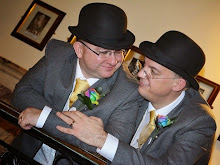
Saturday, May 08, 2010
All Four of Our Cast-Iron Priorities: Deal. Anything Less: No Deal.
In one line – all four of our cast-iron priorities: deal. Anything less: no deal.
In Full
I hate the Tories. I hate Labour. I don’t want a deal with either of them.
But we don’t have a Lib Dem majority, and we support a system that almost inevitably leads to coalitions. So we must listen to the voters and negotiate in good faith, because while we hate Labour and the Tories, the voters have given them larger chunks of power.
What happens if we don’t negotiate? A minority Tory government, sustained by the DUP. Can any Lib Dem honestly say that a Tory government made less horrible by Lib Dem participation would be worse for the country than a Tory government made more horrible by the Paisleyites?
So, the national interest is to bargain hard for a coalition.
Our party interest is not to touch it with a barge pole.
Clearly, we haemorrhaged votes at the last minute because voters say they like politicians talking to each other, but are terrified of us talking to ‘the wrong ones’ and were scared back to the Labour / Tory to stop Tory / Labour getting in.
If we deal with either party, we run the risk of splitting. And either way will help Labour, who deserve to be ground to dust after their appalling record.
Do a deal with the Tories and we give Labour a lifeline to be the only opposition.
Do a deal with Labour – however that would work, as we simply don’t have enough seats – and we give a lifeline to Labour to keep being in charge.
Either way damages us horribly.
How to Square the Circle
First, if we do a deal, it has to be for a formal coalition, for a fixed term, published out in the open. Otherwise the Prime Minister can just cut and run with a new election for party advantage, and we’re stuffed.
Second, we must learn from Scotland. We went into a formal coalition with Labour to get things done: we insisted on over 20 pages of over 80 firm commitments, so we not just got Liberal Democrat policies made real. We made Scotland better for it – and could point to our explicit achievements. We weren’t rewarded for it at the ballot box – but we weren’t hammered for it, as we would have been if we’d only propped up what Labour were going to do anyway. So any agreement isn’t secret, but written down for all the world to see and so the Tories can’t lie about it later.
Third, Nick’s made it very clear, as has our manifesto, what our bottom lines are. We get the four fairnesses, or there’s no deal. We should bargain for as much as we can of the rest of the manifesto – but if we don’t get those four bottom lines, we can’t possibly agree.
Cameron yesterday said warm words, but no detail at all – basically just the Tory manifesto bits that sounded a bit like us, but with no meat to it.
There’s no way that’s good enough.
Lib Dem tax cuts for low and middle earners, with increased taxes on the rich to pay for them.
Breaking up the banks and a green economy.
Solid money to support poorer kids in schools.
Big money out of politics, elected Lords and above all STV.
All those are hard for the Tories to swallow, but tough. They’ll have plenty of things we don’t like that we’ll have to give way on.
If we get a coalition with at least those four as a baseline, we would change Britain for good, and we can prove it to people. We will still be hurt, but we’d achieve something massive. It would be worth it.
If Cameron sticks to what he said yesterday, we should tell him we’d rather bring him down. Labour lied to us and the country for thirteen years over electoral reform. We would have to be lobotomised to listen to the same from the Tories.
They hate STV; we love it. Fine. Referendum, this Autumn, one question, for or against. Tories free to be against, us free to be for. Sorted. If they’re afraid to defend their system to the people, they’re weak and won’t afraid of the voters.
The Tories have just been given their fifth lowest share of the vote for 200 years. If they think that’s a mandate, it isn’t.
Cameron promises a “committee of enquiry” on electoral reform. That’s what Heath said in 1974. We told him to sod off, too (as quoted in The Independent today!).
Conclusion
Both Labour and the Tories are vile. But if we get our priorities, we get a less vile government. If we don’t, stuff it.
We should be very loud in saying – we told the voters every day what our four bottom lines were. We will stick to every one of them, and hope to deliver more of our manifesto, but recognise we have to compromise on that.
If the Tories say they can’t deliver, Nick should go for the jugular and attack Cameron as a weak prisoner of his extreme party:
“Mr Cameron – if your party want to act like spoiled children and won’t compromise, don’t pretend they aren’t extremists.Alex Wilcock
“If you can’t deliver your party in the national interest, don’t pretend you’re serious about governing.
“The voters did not give you the power to do whatever you like. Don’t pretend they did.”
Liberal Democrat member
Former Parliamentary candidate, 1997 and 2001
Former member / Vice-Chair of Lib Dem Federal Policy Committee, most of 1993 to 2007
I am, of course, also working on a long version which may be posted later setting out exactly what I think. But the headlines above summarise what I think should be done.
Labels: British Politics, Conservatives, Labour, Liberal Democrats


Thursday, May 06, 2010
Lib Dem Fair Taxes: The Reverse Poll Tax
And, yes, I know this one’s pathetically late, but come on – the Lib Dems will keep on campaigning on it, and the Tories will keep on slashing the poor to subsidise the rich.
The Tories Only Cut Taxes For the Wealthy – and Make the Rest of Us Pay
The poll tax was the Tories’ big new idea to take them into the ’90s. It was so shockingly unfair that it brought riots on the streets. Simple idea: instead of taxing people on the value of their homes, everyone would pay exactly the same. Sounds fair for a second… Until you realise people on the lowest incomes would have to pay just the same as a multi-millionaire. A tiny fraction of the ultra-rich’s income; a massive hit to someone working hard to make ends meet. No wonder that tax break for the richest brought down Mrs Thatcher as Prime Minister and forced the Tories to cobble together the mess that’s the council tax instead.
Today, exactly the same instinct that created the poll tax has risen to the privileged top of the Tory Party again. They just don’t learn. For three years, it’s been their main tax priority to cut inheritance tax for double millionaires. At a cost of £6 billion to the rest of us, only the richest 3,000 families in the country would get a tax cut of a quarter of a million quid each. Nice if you can get it!
Lib Dems Cut Taxes For Most – Wealthiest Pay More
In complete contrast to the Tories’ tax plans, the Liberal Democrat flagship policy in this election is a massive £17 billion tax switch. Everyone earning up to £100,000 a year would pay no income tax on the first £10,000 they earn. That means a tax cut of £700 for most people on low and middle incomes.
And to pay for that enormous cut? Five different tax rises at the other end of the scale: equalise capital gains tax with income tax, so people can’t dodge taxes by sticking their loot into property; giving everyone the same basic rate pension relief, instead of giving twice as much back to the wealthiest; a 1% mansion tax on any property value above £2 million; cracking down on tax avoidance, including specific measures on stamp duty and a new general law against measures designed to dodge tax; and taxing air travel per plane, not – as it is now – per passenger, so air freight pays its weight in tax and polluting planes fly full instead of half-empty.
Making Work Worth Working For
Everyone who’s ever worked on a low wage – and I know this, but I can’t imagine many Tories do – knows that one of the big problems is that benefits vanish just as your hard-earned cash starts to disappear in tax. It means you’re often hardly any better off working than not. No, if you earn under £10,000, you won’t get the full £700 – but you will get to keep what you earn, rather than see it pocketed by the tax man.
Labour prefers to make people dependent – taking money with one hand, giving tax credits back with the other… As long as you jump through the right hoops, and fill out the right forms, and wait for the money to come through, and hope it doesn’t get taken back because they made a mistake or changed their minds. They just love to control people – they just don’t understand that it’s better, simpler, and cheaper than all the bureaucracy just to have the self-respect of keeping your own money, not relying on the whim of government handouts. And to make sure they keep low and middle earners in their place, Labour have done the opposite of the Lib Dems taking people out of paying tax altogether. They’ve claimed not to increase income tax… But they doubled the tax on every single one of the lowest earners by scrapping the 10p rate. They raised taxes on income without saying the words by raising national insurance – which works in just the same way for most. And rather than lifting that threshold at which people start paying tax, Labour’s frozen it at just about £6,000, so that inflation alone means the lowest earners get clobbered for extra tax.
Tories Prefer To Hit the Poor Rather Than Rich Tax-Dodgers – Who’s Surprised?
The gap between the rich and the poor is bigger under Labour than it was under Mrs Thatcher. The lowest-earning 20% of people pay a higher share of earnings in tax than the wealthiest 20% under Labour. It’s the purpose of the Liberal Democrat tax switch to tackle that, to make taxes fairer.
I’ve written about the Tories’ very different tax-cutting agenda, instead to widen the gap between rich and poor. But the parties also have a different idea of who to chase hardest for money gone missing. I mentioned that the Liberal Democrats want to chase tax-avoiders. Well, let’s look at the figures. Tax avoidance that’s currently exploiting legal loopholes is estimated to cost the taxpayer nearly £50 billion a year: the Lib Dems’ plans assume that, by taking action to close those loopholes, at a conservative estimate about 10% of that would be scooped up – about £5 billion. That’s not counting getting harsher with not the dodgy dodgers but cracking down on definite criminals: illegal tax evasion costs taxpayers £15 billion a year.
So what’s the Tories’ priority? Not one word about wealthy tax dodgers. Instead, their right-wing dog-whistle posters shrieked “Let’s cut benefits for those who refuse work” and, after twenty years of every government cracking down harder on people who not just refuse to work but are too ill to work or who can’t find a job because the government’s stuffed the economy, how much more do you think can be squeezed by kicking the poor still harder? The Tories scream that they want to kick the poor. The Tories shout that they want to give massive handouts to idle millionaires. And while tax evasion costs taxpayers £15 billion a year… Benefit fraud costs just over £1 billion.
You might be more generous or more imaginative than I am, but I can’t think of a single possible explanation for the Tories attacking people who cost £1 billion and giving extra to people who cost £15 billion that doesn’t boil down to them getting all their funding from rich tax dodgers on the one hand, and wanting to grind down the poor and sick who can’t hit back on the other.
The Reverse Poll Tax – The Tax Cut Tories Will Never Agree With
In the election TV debates, David Cameron described the Liberal Democrat tax cut as “a beautiful policy,” but said that it couldn’t be afforded. That was a lie. You can pay for a £17 billion tax cut – by raising £17 billion more from the wealthiest, who currently pay a smaller share of their income than the poorest.
Well, we know why that’s almost literally unthinkable for David Cameron, don’t we?
The difference between Liberal Democrat and Tory tax cuts could not possibly be any clearer. And to return to the comparison with the poll tax…
Remember how the poll tax gave a massive tax cut to people living in huge mansions, while hammering people on tiny wages in tiny homes? The Tories today want to give a much, much bigger tax cut to people inheriting huge mansions – not even to people who’ve earned them. The Liberal Democrats today want to pay for a tax cut for ordinary people, in part, by taxing huge mansions.
Remember how the poll tax took the same amount of cash from everybody, so the rich gave up the tiniest fraction of their wealth and the poor were robbed of a huge slice of what they earned?
The Liberal Democrat tax cuts are the precise reverse of that. By giving back the same amount of cash to everyone earning between £10,000 and £100,000, it’s fair – because everyone gets the same – but helps you more the less you earn, which starts narrowing that gap between rich and poor where lower earners pay a bigger share.
The Liberal Democrats have said they want to give a tax cut of £700 to low and middle earners – which means that the lower down the scale you earn towards £10,000, the bigger the percentage gain to your wages.
The Liberal Democrats have said they want to cap all public sector pay awards, with the economy doing so badly, at £400. Again, a solid cash figure – again, that means that the lowest earners would get the biggest percentage increase, but better-off public servants (like MPs) couldn’t get a larger share.
Not all tax cuts are the same. The Conservatives’ instincts are still exactly the same as those that created the poll tax to help the rich. The Liberal Democrats’ instincts for fairness are exactly the opposite – helping the lowest and lower middle earners most. And, of course – unlike the Tories – the Lib Dem manifesto printed the figures to say how it would all be paid for.
There is all the difference in the world.
Labels: British Politics, Conservatives, General Election, Liberal Democrats, Tax
A Final Glance At the Manifestos
Labour?
The cover of their Manifesto mentions “A Future,” but it’s a retro-future, desperate to ignore all the failures of the past and imagine themselves safely back in a cosy socialist utopia (not one on offer within the text): the cover looks like it was drawn in the 1950s as an advert for Nuclear Families For A Nuclear Future. I’m gay, I don’t trust nuclear power, and I don’t want to go back to the ’50s – and I don’t like Labour always telling me their perfect niche into which I should fit (as ever, no new policies on LGBT equality – though Mr Brown personally attacked marriage equality. Their record is to wait for the Lib Dems to come up with them, vote them down, then pick them up a few years later when it looks like they’re ‘safe’). There are no new ideas – just, as ever, that Labour knows best, mixed with authoritarian dog-whistles like calling a chapter “Crime and Immigration” (but with cartoons, though. Surely no-one who uses crayons could be evil). The Why Vote Labour book makes the same approach still more explicit: it has the central stamp of approval from Gordon Brown’s foreword, but the deniability of being written by someone who’s not an MP; the Conservatives are attacked by implication in the book’s first paragraph, and by name in the second; and while there are many paragraphs allegedly written by other people, most of them are just identified by a first name and a town – like a made-up quote on a leaflet – and all of them are put carefully in their place, framed in boxes under orders as examples of the central Labour Truth.
But neither of these publications matters very much. Can you think of a single new policy that Labour’s been campaigning on? Not one. It’s all been about a tiny fraction of government spending that they can pick out as a potential Tory cut to make you scared, then either saying the “Liberals” will do the scary same thing or cosying up with “I agree with Nick” on alternate sentences.
The Conservatives?
The cover of their Manifesto offers an “Invitation to Join the Government of Britain”. Only the Tories could frame a populist appeal to every citizen in the style of a £500-a-head white tie do, as if assuming everyone goes to them all the time, like they do; only the Tories could invite everyone to participate in government, then spend their entire campaign taking fright and shrieking panicky scare stories about the awful danger of, er, anyone but the Tories forming the Government of Britain. So I admit I’m biased against a cover that might as well be a neon sign saying ‘We Don’t Mean It’. Open it up, though, and it does look more inviting. There’s none of the faux pas of the cover – instead, it’s a graphic designers’ paradise, easily the prettiest of the manifestos. And the mood music is early David Cameron: it feels more like a “liberal” Tory manifesto than any that have gone before. There’s no sign of the hard right policies that have appeared in desperation in speeches and posters as Tory support has sagged during the campaign – there’s little sign of much in the way of firm policies at all, but there are lots of nice full-page pictures of towns across Britain and in other countries, as if the Tories are taking credit for them, or possibly preparing to annex them.
The Conservative Manifesto was launched a couple of days after their Shadow Home Secretary was caught saying one thing in public and another thing in private about gay rights, yearning for the days of signs in windows marked “No Blacks, No Gays, No Catholics”. I wonder, I thought, if the manifesto does the same thing? Well, in panic at their plummeting gay vote, David Cameron… No, actually, he’d just made that awful fuck-up in a Gay Times interview and had to ask them to stop the camera, hadn’t he? Then he spun to the gay press that he’d begin the campaign on 6th April by mentioning gays in his first election speech, but having said that to the gay press, said “Black and white… Rich and poor…” but didn’t say “Gay or straight…” to the crowd and the TV cameras. Say one thing in one place, say something completely different to someone else. That’s the Tory way of speech – what are they like in print? So, amazingly, George Osborne was thrust out as a ‘safe pair of hands’ and promised to tackle homophobic bullying, at long last, and even came up with a uniquely Tory policy none of the other parties had mentioned and which I thought was a good idea and on gay rights. Credit where it’s due – that’s a first! He said they’d go some way (though, of course, not all the way) to quashing convictions of men who’d had sex with men that was only illegal because the law at the time was discriminatory. But… No. Again, the Tories say one thing to gays, but something else to other people. Because on the day their manifesto launched, “homophobic bullying” was put on the front page of their website… But it’s not in their manifesto. Nor is their other idea. Or any other pro-gay policies whatsoever. They do, though, have a nice pretty picture of Brighton, and mention how gay it is, because if that’s in a Tory manifesto it must all be down to the Tories. Somehow, I don’t think it works that way.
Oddly, the Why Vote Conservative book has a more coherent stamp to it, every word written by the same person and advancing an argument… But it’s also by a long way the most deniable of the three. Written by a Tory blogger, it opens not with a foreword from Mr Cameron but a disclaimer that he had absolutely nothing to do with it, nor any Tory MP nor employee. Gosh. So, they’re really keen to be pinned down on policy, then.
Oh, and in the last few days, David Cameron’s rushed out a “Contract” on Britain with a different set of policies again. Some of which were in the manifesto, and some on the posters (no, not the first set – nor the second – you know, this week’s Tory posters), and some presumably were just what Rupert Murdoch told him to say to try and salvage his investment.
It’s not clear which, if any, of these publications indicate what the Conservatives would actually do if given power – except enjoy it.
The Liberal Democrats
The cover of the Liberal Democrat Manifesto is quite plain – in both senses. “Liberal Democrat Manifesto 2010,” it’s labelled. “Change That Works For You – Building A Fairer Britain”. And the only other thing on the cover is, would you believe it, policy. Imagine that, for a manifesto? It sets out the party’s four key priorities about Fairness. The same ones Nick settled on last year; the same ones he made the centrepiece of his speech to Lib Dem Conference in March; which I picked out as the party’s key themes at the start of the campaign; the same ones he’s explained in every interview; the same ones I saw him give a barnstorming speech about on TV at his final campaign rally last night. Inside the manifesto, it explains those four key priorities in more detail, right at the front. Then sets out all the other policies, saying up front that the key priorities are the most important, but that they’d try to implement the rest too, depending on how much influence the Lib Dems win in the election (oh yes – and after several decades of being the party most committed to lesbian, gay, bisexual and transgender rights, even when they were wildly unpopular, there are commitments to plenty of them in there. Including, in the section on education, with tackling homophobic bullying, as well as that on “families of every shape and size,” the workplace, hate crimes…). Every single section has green tabs next to commitments to show how a green approach runs through every area of policy. And, at the back, there’s an index so you can find every issue you’re interested in more easily, and a full set of costings – the only manifesto that sets out how a single policy can be afforded. And this sets out the figures for every single commitment.
This is very odd, after the other two manifestos. Words and numbers, rather than just packing the pages out with pretty pictures (though there are a couple)? It’s as if the Liberal Democrats want you to know what they’re promising, be able to check the figures, and hold the party to them. Imagine!
Then there’s the Why Vote Liberal Democrat book. It has a foreword from Nick Clegg, and it’s written by Danny Alexander, the MP who’s Nick’s Chief of Staff and who also edited the manifesto. Well, I say it’s written by Danny… But, although it’s not afraid to say up front that all this is the Liberal Democrats saying exactly the same here as everywhere else – though, in fact, I prefer the more expansive Liberalism of Nick’s introduction here to the much shorter, more businesslike values page in the manifesto, a document boiled down to concrete promises on fewer pages with larger type – it’s not all written by Danny, and nor do other contributors only walk on as directed to give their name (or part of it) to a carefully spun paragraph. While Danny edits the book and provides the overarching theme, each chapter is written by a different Lib Dem spokesperson or supporter. Where the manifesto gives the bullet-point commitments, this explains the thinking and the philosophy behind them, not by central party diktat but in many people’s own words: MPs; councillors; a former senior police officer; a former Director of Public Prosecutions; actors like Colin Firth; musicians; and, yes, an out gay Lib Dem Parliamentary candidate – Ed Fordham, who I hope very much will win Hampstead today – writing about gay equality. It’s a party not of iron control and a single voice, but people working together and unafraid to speak out. It isn’t just the same as the manifesto – but it’s entirely in harmony with it, complimentary, not contradictory. They’re the only two publications from any of the three parties that actually work together persuasively to say why you should vote for them.
What the Parties Stand For
For weeks, I’ve wanted (but not had the energy) to write a piece on each of the manifestos, which I’ve finally got out rather late… And a piece comparing each of the parties’ key pledges announced at the start of the campaign, which – as the Lib Dems had four, Labour five and the Tories six – was going to be Torchwoodishly called ‘The 456 Are Coming’. Perhaps it’s just as well I never got to write the latter: while Nick Clegg and his party have been campaigning so determinedly on the Lib Dems’ Four Fairnesses that I suspect every Lib Dem and a substantial chunk of the public could name them, the other parties’ focus-grouped ‘pledges’ have formed such a minuscule part of what they’ve actually said that I bet they’d be news even to most of their candidates. What, I have to ask, is the point of campaigning to get elected if you don’t know what you intend to do? Are Labour and the Tories really only about power and nothing else? It looks like it.
All the Tories stand for is their sense of entitlement. They think they were born to rule, and they’re damn well going to do it, and do whatever the hell they like, even if only a third of people vote for them. Exactly what they want to do is still unclear: “liberal” Conservatives gave way to ferocious personal attacks on Gordon Brown; now the policies they’re campaigning on are of the hard right, while trying to scare anyone who thinks they shouldn’t have absolute power. Having changed all their policies and their approach several times just in a month’s campaign, it’s difficult not to conclude that they want power because they just want power.
All that Labour stands for is stopping the Tories. Seen their posters? Seen their broadcasts? Heard their speeches? They’re the only party in this election running an even more negative campaign than the Tories are. After thirteen failed years, they’ve got nothing left but scaring people into voting unenthusiastically but worriedly for more of the same. As I’ve observed of them so often, their one theme is, “We’re shit, and we know we are, but – ooh! The Tories! Scary!”
And what do the Liberal Democrats stand for?
The same as we did at the beginning of the campaign. The same as we did before the campaign. The same as we did last year. The only party that’s set out firm priorities, and stuck to them – not panicked and changed them from week to week, or just tried to define themselves by being ‘not the scary other lot’.
The Liberal Democrats stand for fairness:
- A Fair tax system, with no tax to pay on the first ten thousand pounds you earn – paid for by more tax from the richest and on pollution
- A Fair start for children, with a pupil premium for schools to invest in the least well off
- A Fair economy, rebalanced to stand up to bankers and with investment in new green jobs to start the country growing again
- Fair, clean, open politics, including fair votes, the ability to sack your MP if they let you down, no more unelected second chamber so no more cronies, and a Freedom Bill to scrap many of Labour’s unfair 4,300 new laws.
Labels: Books, British Politics, Conservatives, Gay, General Election, Labour, Liberal Democrats, What the Lib Dems Stand For
Time To Vote. Time To Get the Vote Out. And If You Have Any Spare Time… Lib Dems To Enthuse You
David Matthewman: Why I’m A Liberal Democrat
Among the very many other things I’d meant to do this election and never managed, I was going to write a series of articles about why you should vote positively for the Liberal Democrats. I am enormously grateful, therefore, to the lovely David Matthewman for writing many of the same ones that I would have liked to but didn’t (and in several cases writing ones that I suspect I agree with more than the one I would have written). They’re all excellent, but I’d particularly recommend his first one, which explains just how important one of the two or three Lib Dem policies I’d pick as my favourite really is. He and Richard Gadsden are excessively kind to me in his fifth piece (and Richard tells me something I didn’t know, and blush at), but if you’re short of time, I’d skip to his most recent two, on Fairness and Unpopular Causes, each of which are both inspiring and thought-provoking.
1 The Freedom Bill
2 The Banks, the Credit Crunch and Vince Cable
3 The Green Economy
4 Electoral and Parliamentary Reform
5 Fellow Liberal Democrats
6 Education
7 Fairness
8 Unpopular Causes
Oh, and if you’re still thinking of voting Labour, David has something to say…
…And so does Liz. Less scathingly.
…Oh, as does former British Ambassador Craig Murray. Horrifyingly.
But back to the positivity…
More Lib Dem Link Love
Did you see Nick Clegg’s personal guarantee in some of the newspapers? There’s a pdf of it here. Unlike other parties, we’ve been campaigning on exactly the same four priorities through the entire election. Almost as if we a/ mean them and b/ haven’t been panicking…
If you want to know more about those four priorities, Millennium Dome explains them in superb detail – and contrasts them with the Conservatives’ rival “plans” for “change”.
Like David, Freethinking Economist Giles Wilkes has written his own reasons to vote Lib Dem.
There was rather a good piece in the newly Lib Dem-supporting Guardian the other day along the same lines, too: Five (Other) Reasons To Vote Lib Dem. Historian Timothy Garton Ash is passionate about a Liberal vote for the Lib Dems as well. Go for it!
There are of course local council elections taking place across most of Britain along with the General Election tomorrow, and one of our most fabulous council candidates is the lovely Jennie Rigg. Among her many excellent pieces is one about the Tory press’ desperate ‘mudslinging’ that some Lib Dem candidates are – imagine! – individuals (fantastic fact: the “ventriloquist” candidate, the lovely Chris Young, also wrote the song Letterboxes that Jennie endorses with such feeling).
Speaking of mudslinging, the Independent’s cartoon yesterday about the desperate Tory attempts to expose the ‘horrifying reality’ behind the Lib Dems made me smile…
…As did Jonathan Calder, with one of the best headlines of the campaign.
The lovely Andrew Hickey tries to put partisan feelings aside – with some success – to explain what each of the parties stand for, and (with significantly less success) about tactical voting.
The lovely Chris Lomax writes passionately about the Lib Dems as the party of science. Geek The Vote is campaigning on it.
As I linked to several anti-Labour pieces above, in the interests of balance some Lib Dems are not wholly convinced by the Conservatives:
The Tories appear to being mysteriously (and illegally) aided by the
One top Tory candidate, hilariously, has complained that “If this was a safe seat we wouldn’t have to do this work.” Very deserving of your vote, then: “Big Society? …High Society, more like,” observes Liberal Vision.
Another Tory candidate, less hilariously, thinks gay people are possessed by demons. Jae Kay is unimpressed by the “liberal” Tories’ response to their medieval high-flyer (presumably not on a broom).
And finally, to concentrate your mind on your vote – Nick Clegg:
“It may just be a small cross on the ballot paper, but it is a big opportunity.”
Labels: Bigotry, Blogs, British Politics, Conservatives, Gay, General Election, Labour, Liberal Democrats, Liberalism, Nick Clegg, What the Lib Dems Stand For
Wednesday, May 05, 2010
General Election Pop Anthem Special
I’ve been horribly ill throughout the campaign, but today lifted my spirit if not my body with some music. In a strange way, it was inspired by this week’s Doctor Who DVD release, The Creature From the Pit, David Fisher’s witty novelisation of which has just by remarkable timing has just been broadcast over the last week on BBC7, read by Tom Baker (the final part’s tonight at half-midnight, but you can still catch most of it on iPlayer or, of course, buy the CD). No – I’m afraid none of the songs are about giant green blobs, but a point for each of the two key Liberal messages in the story, and a further one for which well-known Kate Bush single it made me think of, and why. This afternoon, then, I staggered to bed in horrible pain and curled up with Kate to sing me to sleep. While dozing, I remembered her fabulous, bonkers but politically unsuitable anthem Ken, which got me thinking of political songs, while Kate in general got me thinking of the wonderful ’90s Doctor Who New Adventures and their obligatory Kate Bush song titles. That collision in my brain demanded ’90s political anthems… So here they are.
The Levellers – One Way
I doubt the Levellers have any party affiliation, but if there’s any finer anthem that sums up Liberalism for me, I haven’t heard it (that techno remix of The Land having failed to chart). Where Labour and Tories want to give you goodies if you fit into their precise definition of a good life, and punish you if you don’t, Liberals think the government can’t know best for you, because everyone’s best is different. Who’s the only party backing a Freedom Bill to sweep away many of Labour’s bossy, vindictive, stupidly timewasting 4,300 new laws? Who’s the only party that wants to give a large tax cut to the vast majority of people, however they choose to live their lives, rather than the Tories’ bribe to people in the right sort of marriages and massive tax break for double millionaires? I agree with Jonathan Calder and – like Simon Goldie – I agree with Nick. Vote Liberal Democrat, and sing along! Or not, according to taste.
David Cameron – Common People
This is mean – though not remotely unfair – and isn’t a patch on proper Pulp. It does, however, make a point, and made me laugh.
Chumbawamba – Amnesia
“Do you suffer from long-term memory loss?”I know that it’s very on-message to talk about the hopes people had for New Labour back in 1997, and certainly, by comparison to the Conservatives today, Tony Blair had a wild storm of optimism around him. But, bitter old git that I am, I always loathed him – I thought he was a Tory from the word go, and though “I told you so” is never an appealing line, I’m not standing for election tomorrow, so I’ll point out that I did indeed tell people so. I said it at my count on election night 1997 (where I stood hand in hand with my beloved Richard on the stage, on the telly – yay!), coming an heroic third in a Labour-Tory marginal, an unemployed Lib Dem against a Labour millionaire. After congratulating her on her win, I warned everyone in the hall (in the sort of barnstorming speech I so rarely get the chance to make) that Labour would let them all down and be exactly like the Tories. I was shrieked and howled down by Labour – as committed to free speech as ever. Of course, I wasn’t entirely right: in so many ways, Labour’s thirteen years have been so much worse than the Tories. So Chumbawamba’s song here greatly appealed to me, though it wasn’t in tune with the times and I was just about the only person who bought it.
Labour? Tory? Just the same. If you’re thinking of voting for either tomorrow – just how overwhelming is your amnesia?
Or there’s the thing Newsnight got Right Said Fred to do, but there’s nothing sadder than a commissioned pop anthem, is there?
Labels: British Politics, General Election, Labservative, Liberal Democrats, Liberalism, Music, Personal, Tom Baker
Thursday, April 29, 2010
Free Doctor Who – Genesis of the Daleks CD Today
“Today, the Kaled race is ended, consumed in a fire of war, but from its ashes will rise a new race, the ultimate conqueror of the Universe, the Dalek!”The Torygraph’s been giving away Doctor Who CDs all week – tomorrow’s is Mission To the Unknown, a Doctor Who story without the Doctor where the Daleks are in control (if that grabs you, buy the much longer CD of The Daleks’ Master Plan, which brings in the Doctor and continues the story).
Genesis of the Daleks, though, is perhaps the most natural choice: it stars Tom Baker as the Doctor, the high point of his superb first season; as the title suggests, it introduces the Daleks’ creator, Davros; it’s one of the best-known, most-repeated Doctor Who stories, and in every ‘favourite story’ poll among fans comes either close to or at the very top. When I wrote my mini-guide to all the Dalek stories a couple of weeks ago, I picked it as one of my favourites, too. But it’s not just for its importance in Who history or its undoubted popularity that’s made it a natural choice for a CD giveaway. It’s that 31 years ago, it became the first Doctor Who story you could enjoy at home whenever you felt like it.
A couple of years before the home video revolution, and to coincide with the sequel being broadcast on TV, the BBC released Genesis of the Daleks on LP. It’s difficult to grasp how exciting this was at the time – even though a two-and-a-half-hour story was cut down to one hour, with no pictures, it was the first ‘proper’ home Doctor Who experience, and after I bought the LP in the Blackpool Exhibition I listened to it until I virtually knew it by heart… So often, in fact, that (before I became such an obsessive collector) it was also the first piece of Doctor Who merchandise I deliberately bought a second copy of, so I could switch discs on the record player as I came to be familiar with exactly where the scratches were on each copy. After listening to theirs so many times, many fans of a certain age still can’t help saying “This seems an opportune moment to end this session” at appropriate moments. And it’s that LP version, in effect – some of the cruder editing cleaned up, which is a blessing, but the thrilling cliffhanger in the middle removed, which is a pain – that’s being given away on CD today.
The Politics of Genesis of the Daleks
“Brilliant. Brilliant! It has detected the non-conformity.”Appropriately for the General Election campaign, this is one of the most political of all Doctor Who stories, and in at least three crucial ways. It’s a story about politics and political machinations, as characters outplot and outmanoeuvre each other – centrally, it’s about the rise to power of a charismatic fascist, and how he holds the seeds of his own destruction. Davros is in a strong position when the story opens, but he doesn’t have absolute power: most of the plot is about how he gains it, and the Pyrrhic consequences. While this is something that works far better on DVD – when there’s time to let the plot breathe – even in the truncated version it feels almost like an historical drama, clearly taking inspiration from Hitler’s rise to power, and ending in the bunker.
“Aliens! I must exterminate! Exterminate!”
The political speeches that pepper this story are also striking. I’ve listened to (and, indeed, given) so many speeches that most I hear in fiction seem to have a tin ear. This, though, has real oratory, with both the script and – particularly – Michael Wisher’s superb portrayal of Davros knowing just how speechmaking works. While the Doctor and many others declaim effectively, what’s really impressive about Davros is that, for a charismatic fascist to work, the story realises that he actually has to be both charismatic and persuasive, rather than mistaking just ‘speaking at length’ for ‘making a speech’. His arguments are horribly logical, passionate and resounding, not just a cardboard stereotype, and they’re properly structured, too – if you’re familiar with speechwriting, you’ll probably be aware of how to build up a phrase with the ‘rule of three’. Davros certainly is (even the Dalek’s speech at the end does it).
Perhaps most important of all is not just the political infighting, or the brilliant speeches, but that the story hinges on real, urgent political issues. Blatantly – and even more so on the DVD, where you can see the uniforms – the Kaleds from whom the Daleks grow are Nazis, and the essence of the story is to pit fascism against free will. The Doctor and the few sympathetic people tend to be characterised by doubt; Davros and all the others who do terrible things by absolute, chilling certainty, with the Daleks themselves conditioned to obey unquestioningly. And it’s the Doctor thinking for himself, asking what right he has to perform the mission he’s been sent on, that provides the story’s central moral dilemma. Notably for Liberal propagandists, the Dalek’s instinct to destroy is encapsulated in a hatred of non-conformity; perhaps disturbingly, some of the story’s weaker moments come with a ‘nice’ Kaled who lurches erratically from weapons developer to proto-pacifist revolutionary and tends to be rather more a walking, wooden plot function than someone who’s as electric in defence of compassion as Davros is on removing it. Then, three quarters of the way through the story, the Doctor and Davros discuss science, morality and the Daleks in a scene so gripping – aided by a brilliant score – that it’s still for me the single most quotable speech in the history of the series.
CD Versus DVD
“Daleks? Tell me more.”When you cut out more than half the running time and lose all the pictures, obviously you lose rather a lot, but strangely enough I still listen to my own CD from time to time for pleasure anyway (the LP long since having given way to cassette and then CD versions even before today’s giveaway). The sixty-minute edit has charms of its own; you can listen to it when out and about, of course, or simply when you have much less time, and it rattles along at a great pace, with Tom Baker providing an appropriately doomy narration (if with the occasional oddity). The DVD, of course, not only has the full, beautifully remastered TV version, but a host of special features – notably a lively commentary and two pretty solid documentaries.
Though there are many fewer speeches on the CD, some of them have a greater immediacy when you’re just listening to them – Davros turning on a scientist he’s framed as a traitor, for example, is a gripping scene on screen, with terrific direction and music building up to blazing effects as the brand new Daleks make their first ever extermination. Brilliantly, those watching cover their eyes, both communicating the scorching power of Dalek death-rays and symbolising the way they’re closing their eyes to what Davros is doing. And yet… Somehow, for me, when the scene is carried just by Davros’ escalating denunciation and the horrible sound of blasts and screams, the bareness of the sound alone is still more chilling.
The script jumps unevenly on CD, but it’s exciting; on screen, things have time to build, but there are a few longeurs (notably, for me, the odd scene where Davros and one of his scientists have rather stiffly written moral arguments about conscience, laying it on with a trowel). You miss the eerie power of the shattered, war-torn landscape that grounds the early part of the story, establishing its seriousness, and you miss the moody direction, with its war story power overlaid with medieval symbolism (a robed Death sending the Doctor on a mission; tattered, bound plague-carriers stalking the hills…).
Perhaps the most obvious losses are seeing Davros’ performance enhanced by a terrific mask, and the inspired lighting – or, rather, turning the lights down low – that frames so many scenes. Less predictably, the outstanding musical score works much better in the full TV version, simply because it’s allowed to play out and build up, rather than chopping and changing, though there are still striking moments on the CD – Davros’ ‘march’, for example, works perfectly on his first full ‘appearance’. I’m still torn, too, as to whether the edited version presenting Davros first as a commanding leader in front of the Doctor gives him the best entrance, or whether I prefer the DVD introducing him first in tantalising glimpses, whispering orders to destroy and announcing the beginning of the Daleks… Or, indeed, whether it’s better to pick up the Nazi analogy through Davros and the Kaleds’ actions and philosophy, or whether to see them smack in the middle of the screen wearing black uniforms and iron crosses!
Which you prefer comes down, really, to the time you have to enjoy it on any given day. The DVD’s certainly the best for me – but I still love the CD, too, and not just for nostalgic reasons. Sometimes it just seems to work better to finish the story with a Dalek shriek of triumph rather than the Doctor drifting away on a cloud of hope; sometimes it’s more satisfying to breeze through at speed and miss out everything to do with the hilariously unconvincing giant clams. Most of the time, I’d rather be spellbound by the whole thing and struck by the story’s most memorable image, as a dark metal Dalek looms, tank-like, against a violet sky. But either way, if you don’t have Genesis of the Daleks to start with, pick up today’s Torygraph. It’s worth it – and if it whets your appetite, you can always buy the DVD later.
Oh, and make sure you’re listening to Tom Baker reading the novelisation of Doctor Who – The Creature From the Pit on BBC7. It’s the third part today, but you can catch the first two on the iPlayer, and hear each day’s instalment at 2.30, 6.30 and 0.30. It’s a witty fable with a remarkably Liberal message – both in how to treat people, and in economic policy. I might even write a piece about that, too, but I’ve only got so much energy at once…
Labels: Daleks, Doctor Who, DVD, History, Liberalism, Newspapers, Reviews, Tom Baker
Wednesday, April 28, 2010
Lib Dem Poster Needed!
I’ve not had an election like this one, and really rather hope not to have one again: my health, never good, has crashed so badly that… Well, I won’t go into the grisly details, but during the last fortnight I’ve lost more than a stone while hardly moving. The extent of my exercise has been occasionally to force myself out to the newsagent usually five-to-ten minutes’ walk away, depending on how brisk I’m being; at the moment, it’s taking me fifteen there, and twenty back, by which time I’m lathered in sweat and can barely stay upright. So I’m feeling just a little bit left out of things, and can’t even eat to cheer myself up. Thanks, then, to the Lib Dem candidate who rang yesterday and pummelled my brain for suitably aggressive hustings lines, as that made me feel slightly better than completely useless and as I could do it from my sickbed and say ‘I’m terribly sorry, I’m going to have to stop now’ without actually falling over in front of them. Oh, and just for a laugh, I could only hold the phone to my right ear, as I’ve also lost most of the hearing in my left in the last fortnight (eardrops from doctor faring no better than the anti-nausea pills).
If you know us, please also be nice to Richard, who as well as having to cope with me is working his usual long days, then working for the Lib Dems at nights, and yet is still managing to be far less ragged than I am (while definitely ragged enough to worry me).
Anyway, if you could send us a poster, that would add to a sense that I’m somehow doing my bit. In fact, an ordinary-sized window poster for the street side would be handy, too. Staggering about our local area this afternoon I noticed that, despite ours being in theory one of England’s few thrilling four-way marginals, there is in fact just one solitary little poster on any nearby street. And even that’s in the Conservative candidate’s house, bless him! So help the Lib Dems surge to, er, parity.
Labels: General Election, Health, Liberal Democrats, Personal, Richard
Friday, April 23, 2010
Has Microsoft McAfee Just Wrecked My Computer? Or, In Short: Help!
An update to my PC on Wednesday evening seems to have stopped it functioning properly. Anyone got any ideas? Taking a break from how ill I am, yes, now my computer seems to have come out in sympathy. So why do I think it was an update that did it? Because as well as stopping most of my programs from working, whatever did it has slightly redesigned Windows XP along the way. Anyone else spotted anything like that? Because it's a complete pain from where I'm sitting: I'm typing this on Richard's laptop, as nothing much on mine is working.
There's a bit of a cautionary tale here: my PC's five or six years old and I have no idea where any discs would be if I needed to reinstall anything; and, yes, I definitely regret not having done a proper backup for about six months. But here's where I start:
On Wednesday evening, Chrome collapsed a couple of times while I was browsing, so - as I usually do in such circumstances - I restarted my computer. It may have taken a little longer than usual, but once it booted up, that's when the problems started. I could tell at a glance that something was odd: the taskbar looked slightly different. It had suddenly boxed off the icons at the far right. And, checking, several other windows and bars had the same - a redesign that put in extra little demarcation lines, and sharper boxes. Don't like it, I thought, but Microsoft's done more irritating things.
And then it did them.
I opened Chrome - it couldn't connect to the Internet. Hey ho, I thought, switch off the router and let it cool down, and meanwhile I'll clear up my desktop a bit, having let it get very cluttered with manifesto pdfs and other thrilling accoutrements I've downloaded there for ease of access in the last couple of weeks.
I couldn't.
Suddenly, my computer no longer lets me drag and drop. Or right-click to cut and paste. Or use keyboard shortcuts to do it. Well, that's very odd, and a bit worrying, I thought. Let me run a virus scan just in case. Oh - my computer won't let me open up my antivirus, neither from icon nor program menu. That's not helpful.
I slotted in a memory stick. Maybe it just couldn't shift things about on the PC itself? Nope. Still no use.
OK, one more idea - I opened up Word. "Blong," went my computer, without the loudspeaker being on. That's not happened before, I though. I opened up a file. "This document could not be registered" popped up. Well, that's not reassuring. But I clicked "Save As" and, thankfully, that managed to pop a copy onto that memory stick.
Oh, yes, and that oddly redesigned Taskbar? Word didn't appear on it. So it's less of a "Taskbar" than a "Bar" now.
Being able to use "Save As" was a relief, I'll grant you. I've written a lot of stuff, and I'd hate to lose them all. But as far as I remember from last week's virus scan, I've got more than 600,000 files on my machine. That's going to take an awful lot of "Save As".
...Or at least it would, if any programs other than Word seemed to be working. Most of them that I've tried simply don't open up at all. I tried opening Excel this morning to add to my records; oh, crap. Excel opens; "Blong"; up pops "Cannot use object linking and embedding"; but then the program crashes before I can enter anything, still less save it anywhere else. Oh joy. I can't replace any of those records, either.
I left my computer on all night last night; my Virus Scan usually starts about 5am, automatically, every Friday. I thought, though I can't start it myself, maybe it'll do it on its own. Nope. Sigh. But back to the redesign: do I actually think it's a virus? I do not.
Aside from all my stuff being on my own machine, of course, there are problems using Richard's laptop: I get RSI and tendonitis, and while my own chair, desk and keyboard are carefully aligned to minimise this, Richard's aren't; similarly, I tend to swap my mouse frequently to my much clumsier but less painful left hand, and can't do that with Richard's; most importantly, my beloved might occasionally wish to use his own computer (imagine!).
Yesterday I spend the whole day being very ill and feeling weak as a kitten. I still feel very weak, but after getting a significant amount of sleep last night I have just enough energy to write this up and think about dragging myself out to accident and emergency. I would very much like a simple way to sort out my computer without having to take it to accident and emergency, too - because I don't know who'd be able to do it properly, or how much it would cost, and because if I totter up to the Royal London at Whitechapel for them to prod me, the sizeable porn stock in my head will not be embarrassingly accessible...
Any suggestions would be very gratefully accepted.
Update: As the comments below make clear, it was indeed an update, but turned out to be all the fault of McAfee. I am massively grateful to Phil, and wish fiery death upon all their motherboards.
Labels: Personal, Technology
Thursday, April 22, 2010
What will the Tory excuse be this time?
So the question is, looking at Channel Four's "Ask the Chancellors" and the first Leader's Debate on ITV... what spin are the Tories planning to use this time? And will it be another U-Turn on what they said last time?
Those excuses in full –
- Vince only did well because he was in the middle and looked in control


- Cameron only did badly because he was in the middle and was picked on

- Osborne only did badly because he was on the side and looked sidelined
- Nick only did well because he was on the side and looked like the outsider
- Vince only did well because he didn't get asked any tough questions (by, er, Osborne)
- Nick only did well because he was fed questions that let him talk policy (by, er, Cameron)
- Vince only did well because the audience was stuffed with Liberal Democrats applauding and laughing
- Cameron only did badly because he couldn't connect to an audience who weren't allowed to applaud or laugh
- Vince only does well because the media have him on all the time and put him on a pedestal
- Nick only does well because people have never heard of him
- Cameron (elected Tory leader 2005) only does badly because he's been doing the job so long he's portrayed as yesterday's news
- Nick (elected Liberal Democrat leader 2007) only does well because he's not been doing the job for long enough
[that's enough useless Tory excuses, ed]
The only way that the Tories can plausibly complain that Nick's profile is because people have only just heard of him is if they are retrospectively condemning the media exclusion of Liberal Democrats over the last three years. And are they?
Labels: Conservatives, General Election, Leaders' Debate, Nick Clegg
Tuesday, April 20, 2010
Three Politicians Who Simply Aren’t Up To It
- Radio 4’s Today Programme this morning just before 8.30 had John Humphrys ask grumpy Tory Liam Fox how they were going to deal with the Liberal Democrat surge in popularity. “Complete positivity,” said Dr Fox, then made four hysterical attacks on Lib Dem policies (all betraying the right-wing old Tory policies he’s much happier with than Mr Cameron’s touchy-feely vacuity) before finishing by saying “And we have to get Gordon Brown out.” He rounded up his array of undiluted bile with the hilarious claim that that was the Tories’ completely positive agenda. Now, obviously, Dr Fox has absolutely nothing left to go on – but was Mr Humphrys actually being paid? A five-year-old could have laughed at Dr Fox, poked him and told him that “Complete positivity” can’t consist of nothing but attacks on other parties and having nothing at all to say about your own.
- BBC2 this afternoon had a clash between the three potential Home Secretaries, hosted by former Murdoch hatchet man Andrew Neil and a proper BBC correspondent at his elbow who actually knew some facts, and – to their credit – they’d got the format down much better than yesterday’s first go, with the same question to all three at several points so viewers can actually compare them. Lib Dem Chris Huhne was excellent: clear, strong and very on top of his facts, with a particularly impressive closing speech highlighting crime fighting that works and the Freedom Bill to sweep away Labour’s authoritarian record. Alan Johnson was there to defend Labour’s authoritarian record (and, though it’s very easy to slip over a word, I do it all the time and it’s very unfair to mention it, I did laugh when he described ID Cards as a “Manifesto mess”) – but I almost felt sorry for Chris Grayling. The BBC having hounded him down and dragged him from his safe house, he looked almost as grey and queasy as I do, and I’ve not seen anyone look more petrified on a TV political panel since the one I totally fucked up when I was 22. Then the poor man opened his mouth…
- By far the least capable, though, and the one I’d love to write about properly if I had the energy, was UKIP Leader Lord Pearson on Radio 4’s Election Call at 1.40 this afternoon. Where to begin? Well, he clearly didn’t know. It’s worth listening to the whole thing – it’s only twenty minutes, and I don’t know whether to feel glad that the BNP’s middle-class mini-me are going down the toilet, sorry that they’ll clearly be incapable of leaching votes from the Tories, or just incredulous at a Leader who’s not remotely up to the job. What would you think of a Liberal Democrat candidate in an absolutely, unimaginably no-hope seat – despite the opinion polls, there surely must still be some seats that Labour or the Conservatives just might win – who’s only just taken over at the last minute, perhaps because a prior candidate fell ill, who went to a local question time in front of a couple of dozen people and, every time they were asked a question about the Lib Dems, replied “I don’t know – I’ve not read our Manifesto.” A little sympathy, perhaps, but it’d be difficult to have much confidence in a vote for someone so lazy and clueless. That was Lord Pearson, earlier. A long-time Conservative activist, then Member of the House of Lords, one of the two Westminster Houses of Parliament. Several times, he was asked for UKIP policy, only to reply (even on people with disabilities, an issue he sounded personally decent about and professed to be interested in),
“I don’t know – I’m not a professional politician. I’m not sufficiently familiar with our Manifesto.”
Newsflash: you’re in the House of Lords. You are a professional politician. Just not one that anyone would give a job to. You’re a Party Leader, and you’re supposed to be the one people can call to account on your own policies! He went on: he complained that there weren’t enough questions on Europe – the callers are wrong; he got testy and didn’t know his facts; and, despite saying that immigration was one of only three policy issues he was interested in, when a Briton called to say he worked in France and – with millions of others working in the EU – would lose his rights to residency and reciprocal benefits if UKIP jerked us out of the world’s largest trading area. No, said his Lordship, they’d still have that. The man on the line just laughed: did he seriously think every other country would give us freebies when we’d torn up the treaty that granted them and thrown all their citizens out of the UK? Pearson’s utterly incredible reply:“We won’t throw anyone out.”
Was that a direct lie, or does the man who’s against “immigration” not even support UKIP’s only bang to drum, that there are “too many people here” from the EU? Or is he simply the most incompetent political Leader in the world?
And as it’s taken me a couple of hours even to write this much, I’m back off to my sickbed. I rang NHS Direct last night (five minutes of ID questioning, repeated three times over – very Labour) when, after a day of feeling like I might be on the road to recovery from the horrible extra stomach illness I’ve had since last week, I suddenly threw up again and was simply fed up with it. When they rang me back, two hours later, to go through all the same questions all over again, I felt reassured: it did sound like it was something that was slowly fading, and not too much to be worried about. They even told me to start eating properly again, and what (no chocolate, sadly). I ate (no chocolate, sadly). At 4am, I woke with a crippling pain in not so much my stomach as my entire torso, and managed to stagger to the bathroom for the most dramatic vomiting since the thing started. My twelve hours since then have essentially repeated the same pattern, of waking, crawling to the bathroom, sipping some water, crawling back, falling into a feverish sleep for half an hour to an hour, then restarting, with occasional breaks stretched out on the floor groaning as I tried to get up energy to do something really taxing, like clean the sink or find the painkillers. It’s not exactly been fun, but I have let occasional BBC news programmes wash over my sickbed.
My health means I’m not up to it – so I’m not asking for anyone to vote me this time. What’s their excuse?
So my level of engagement in this election remains, as I said above, frustrating. If you feel sorry for me and want to make me feel better, all I ask is one tiny little thing: just send a majority of Liberal Democrat MPs to Parliament and make Nick Clegg Prime Minister. There – that’s much less effort than sending a card, some grapes and a box of chocolates, isn’t it?
Labels: BBC, British Politics, Conservatives, Health, Liberal Democrats, Personal, The Today Programme, UKIP
Saturday, April 17, 2010
Daleks – The Top Twenty!
Well, Actually…
To date – between 1963 and 2008 – there have been twenty Dalek stories. That makes picking a top twenty a very easy thing to do… Except that two of them were remade as feature films with Peter Cushing, so I’d best not go into them right now. Nor all the Doctor Who stories that aren’t exactly about the Daleks, but brought us noticeable new cameo appearances from the blob-and-metal monsters: The Space Museum; Frontier in Space; The Five Doctors; The Waters of Mars…
Some of the Daleks’ most thrilling adventures, too, have been in media other than television. Many of Big Finish’s Doctor Who audio dramas have starred the Daleks or their creator Davros: Jubilee and Davros, in particular, are as good as almost anything that’s ever been on TV. Terra Firma and Brotherhood of the Daleks might just do strange things to your mind; then, of course, TV’s voice of the Daleks himself, Nick Briggs, created several epic Dalek Empire, starring such actors as Noel Clarke and, yes, David Tennant. Daleks have hit several books – though if I were you, I’d skip John Peel’s terrible two

So the top twenty I offer below is merely one dimension of the Daleks – if the dimension seen by millions. But first, if by some strange chance you’ve never met them… Well, watch BBC1 tonight at 6.30 (and BBCHD at 8.25)! And you can read my very best old-fashioned Doctor Who Monster Book-style introduction…
Who Are the Daleks?
The Daleks are the Doctor’s greatest enemy – the personification of war in the Universe. Though apparently like robots on the outside, they are living creatures and far from emotionless, with their war-cry to “Exterminate!” all other life. Every Dalek machine has heavy armour and a camera eye, mechanical arm and powerful gun, like a fearsome personal tank driven by the creature inside. They believe themselves to be superior to every other being in the Universe, and their intelligence and appetite for destruction gives them total confidence to proclaim in their harsh electronic voices:
“One Dalek is capable of exterminating all!”Once a human-like race called the Kaleds, they fought a terrible war with their neighbours the Thals, using everything from knives and bullets to chemical and nuclear weapons. Their planet Skaro was devastated, and both races were changed by mutation. The Kaled chief scientist Davros kept himself alive despite great age and injury, in a life-support wheelchair like the base of a Dalek. He became obsessed with similar preservation of his people. Hungry for power, he genetically modified the Kaleds into hideous mutants of great cunning and ambition, but conditioned to obey unquestioningly, to hate every creature that is different, and unable to survive outside protective travel machines he designed – the Daleks.
In one of the Doctor’s most dangerous adventures, the Time Lords sent him to prevent the rise of the Daleks, and saw how the Daleks shot their own creator because even he was not a ‘pure’ Dalek. But the Doctor decided he could not destroy the Daleks at their birth. Killing entire races is how the Daleks act, not the Doctor – and such a massive change to time could prevent too much good as well as evil from having happened.
The Doctor first met the Daleks long after their creation, when they plotted in their metal city to destroy the survivors of their enemies, the Thals. The Doctor defeated them, but he soon found that there were many other Daleks throughout time and space. The Daleks were the only other race to discover the full secret of time travel and, realising that the Doctor was a threat to them, tried to find and kill him as he travelled through time and space stopping their plans.

The Daleks even succeeded in conquering the Earth in the Twenty-Second Century, turning humans into zombie-like Robomen before being defeated by the Doctor. Their creator Davros also once operated on humans to create a new race of Daleks more loyal to himself, after he narrowly survived the first Daleks’ betrayal. Perhaps the Daleks’ most evil plan against humanity was to trick the Doctor into identifying “The Dalek Factor,” using it to alter the mind of every human into that of a Dalek who would obey and exterminate without question. Only the Doctor’s own cleverness turned the tables, giving Daleks free will through “The Human Factor” and plunging them into civil war.
No other monster has been such a terrible threat to all life in the Universe, so many times, as the Daleks, employing war, radiation and plague. When it suited them, they have enlisted alien servants such as the brutish, ape-like Ogrons, and schemed with greedy humans or with alien allies to advance their conquests. But whatever promises they may make, the Daleks hate all other life, and one thing is certain: all allies of the Daleks will be exterminated in the end.
With two great civilisations in the Universe both having control over time travel and one determined to dominate, eventually the inevitable happened. The Time Lords and Daleks fought each other in the last great Time War. Great tides of time damage swept the Universe, both races were destroyed, and it seemed only the Doctor survived. But there were Dalek survivors, too, with the Emperor Dalek and some of his most cunning acolytes hidden away to pose new and greater threats. The last time the Daleks appeared, the Doctor saw the destruction of a risen Dalek empire from which Davros and his creations had aimed to destroy the entire Universe except themselves. Was this the final end of the Daleks?
Often before they have seemed finally defeated – but they always come back for more…
The Top Twenty
In my own tribute to the traditional Dalek story, I’ve been horribly ill all week, so I’ve not been able to finish all the mini-reviews explaining why I think each Dalek adventure merits the position I’ve given it below. So please tune in for more, and I’ll have finished them before the same time next week. Update: …In fact, I finished by the end of Sunday. How about that? Read, enjoy, and disagree!
20 – Death to the Daleks (1974)
All Doctor Who is brilliant. But some of it’s more brilliant than other bits. If I was rating stories by the old “hit, miss or maybe,” I reckon that of the Doctor’s three biggest recurring enemies, the Master and the Cybermen might have a fairly even spread… But there’s something about a Dalek story that makes writers deliver. So many of them are stacked towards the top that it seems almost unfair to mention the handful that, when they do fall down, fall down hard (even the music here’s unspeakable). And yet even this most tired of Dalek stories has much to enjoy in it: ancient alien cultures falling to dust; Sarah Jane Smith; and the religious maniacs determined to wipe out their non-conformist naturist cousins (the ones who looked so thrillingly like living rock when I first saw their photos in The Doctor Who Monster Book as a kid). It isn’t out on DVD yet, but look out for it in the next couple of years and prove me wrong. Golden moment? The elegiac closing shots. Rather lovely.
19 – The Chase (1965)
Dalekmania gave Doctor Who its liftoff to initial mass success in the early ’60s, and they were great days for Dalek stories, too – William Hartnell faced the Daleks more often than any other Doctor, in an ascending spiral of excitement as their arch-enemy. There was one stumble along the way… The idea is to make the Daleks more impressive – first they took Skaro; then they were seen conquering our home as if the Nazis won World War II; now they can chase our heroes through time itself! Unfortunately, the analogy of a crack Gestapo squad hunting down the Resistance falls flat very quickly; a mixture of comedy that isn’t funny, sadly slipshod production and an hilarious ‘double’. But this, too, has its moments. While trying to play the Daleks for laughs in the middle doesn’t work, the opening episode’s light comedy ‘holiday’ opening with the Doctor and his friends is rather lovely, as is the story’s very end. And the climax, as the huge robot Mechanoids spit fire at the Daleks, is rather fab (even more so in those TV21 comic strips, where they’re a major space power and we can’t hear them). It’s just out on DVD, in a box paired with The Space Museum. Golden moment? It has to be the coda, as the Doctor’s companions Ian and Barbara return home in an inspired montage. My eyes get misty.
18 – The Stolen Earth (2008)
The epic finale to the 2008 season of Doctor Who, with more Daleks and returning companions than you can shake a stick at, and even more than one David Tennant. Topping the TV charts for the week, this was one of the series’ most massive successes. Well… For me, it looks glorious, and the first episode’s terrific, but the conclusion is an amazing lesson in how things fall apart. A magnificent cliffhanger turned into a great big cheating cop-out; the Doctor unable to answer Davros’ – Davros’ – moral arguments; the Doctor taking away Donna’s choice. Above all, perhaps, it’s that with the Daleks having been down (again) to one sole survivor, they then instantly regrew (again) like watercress to a huge new empire, destroyed (again) in the blink of an eye… It’s impossible to see the Daleks as a threat, or their defeat as an achievement [post-Victory: and I’m hugely relieved that their 2010 comeback didn’t make the same mistake!]. This has been released at least five times on DVD, paired with other stories and seasons. Golden moment? Sarah Jane picking up that transmission from space, and knowing exactly what it means.
17 – Planet of the Daleks (1973)
Terry Nation returns to write for the Daleks a decade after his glory days, and nothing’s changed. Well, the script hasn’t, at least. It’s almost a cheesier, dumber remake of some of the earliest Dalek stories, with none of the eeriness or subtlety – but with shaggy purple capes and added sexism! Made, in theory, as the second half of a ginormous epic, directly following Frontier in Space (with which it’s available in the Dalek War DVD box), it has the slight disadvantage that it doesn’t bother picking up the story at all. But there’s no hope for me – I quite enjoy it, particularly the early scenes where Katy Manning, playing the Doctor’s companion Jo, gets to ad-lib most of her lines and does a much better job for herself than the script does. Golden moment? The Daleks work out who the tall stranger who’s been causing trouble is. And brick themselves.
16 – Resurrection of the Daleks (1984)
A grim tale of mercenaries, death and Docklands, much of this looks terrific, it has a great score, and there are some very impressive guest stars. Unfortunately, the minor guest actors are often a bit shonky, and after a gripping first episode the plot falls apart. Half the cast never meet each other, nor the Doctor, still less have a clue what’s going on, while the Daleks’ plans get loopier by the minute. On top of all that (you can tell this isn’t a favourite trope of mine), the Doctor is unable to answer Davros’ – Davros’ – moral arguments. This one’s available on DVD both on its own and in a Davros boxed set. Golden moment? Despite having little to do in theory, the Doctor’s companion Turlough keeps stealing scenes – on hearing they’re headed back to Earth, I love his sarcastic “Best news all day”.
15 – Destiny of the Daleks (1979)
One of Doctor Who’s few direct sequels, this picks up after Genesis of the Daleks and has never really been forgiven by many fans for being nowhere near as good. Its big problem, I suspect, is that it’s such a mixture: funny and grim; beautifully designed and grotty; intelligent and impossibly dumb. Davros is rather a let-down, yet there’s some striking camerawork and sound design. Perhaps the biggest contradiction is that, although the first half tends to be very derivative and the second has intriguing ideas, it’s the ‘living dead’ opening episodes which rather work, and the ‘logic problem’ latter half that breaks up on daft details. This one’s available on DVD both on its own and in a Davros boxed set. Golden moment? I still find the tense build-up to the second cliffhanger rather thrilling, with its mixture of burial and exhumation.
14 – Evolution of the Daleks (2007)
I could probably have put my numbers 20-17 in any order; I could probably do the same for 14-11, too. This is the one that went down rather badly with most fans but, though for me the second half of the story (again) has a rather too easy resolution that doesn’t match the promise of the first, I love it for its ability both to build on Dalek stories of old and to do something very different. It’s 1930s New York, and the Great Depression has hit the Daleks in two ways: not only have they had a crushing material fall, but their leader is, quite simply, depressed. He thinks outside the casing to make himself a Dalek messiah – but the other Daleks stick to that old-time religion… All this, plus lashings of James Whale’s Frankenstein, and even musical theatre. This has been released at least five times on DVD, paired with other stories and seasons – I prefer to watch it with the preceding story Gridlock, as together they explore the same themes of loss and rebirth, heaven and hell, even (very visually) ‘up and down’. Golden moment? Dalek conspirators in the sewers, swivelling and whispering.
13 – Day of the Daleks (1972)
An intelligent story of temporal paradoxes with a great twist, in some ways this has quite a Moffaty flavour (as well as something of Planet of the Apes), and Jon Pertwee has one of his better stories as the Doctor, despite lashing out at MPs’ expenses and then drinking all the wine. It has a few faults: with interesting sets of both ‘fascists’ and ‘terrorists’ presented to us to dislike, it doesn’t maintain much ambiguity over which side the Daleks are on; and the Daleks are unimpressive, both in numbers and with very feeble voices. There are some very strong characters and ideas, though, and a fascinating story. It isn’t out on DVD yet, but look out for it in the next couple of years – I wouldn’t mind a talking book version of the novelisation, either, or even Nick Briggs overdubbing the weedy Dalek voices when the DVD comes out. Golden moment? The Doctor slouching at dinner like he’s at a Roman orgy and slapping down claims that a fascist police state:
“has never been more efficiently, more economically run. People have never been happier – or more prosperous.”12 – Remembrance of the Daleks (1988)
“Then why do you need so many people to keep them under control? Don’t they like being happy and prosperous?”
One of the first Doctor Who stories to have an exciting pre-titles teaser, and it still grabs you today. This is a favourite of many fans, an intelligent and complex story that doesn’t pull its punches on fascism – and brilliantly made, too, with great guest stars and terrific explosions. Why, then, might you ask, do I not put it further up my list? In short, the ending, which I think makes a horrible moral mistake, one of the most offensive in the series’ history. Watch it, and see what you think. This one’s available on DVD both on its own (make sure you get the “Special Edition” version) and in a Davros boxed set. Golden moment? The first cliffhanger, when after many hints in previous stories, we see for the first time clearly, absolutely, a Dalek flying up the stairs.
11 – Bad Wolf (2005)
A story that starts as hard-hitting satire on TV – daring to confront the viewers in a way the series really hasn’t since – and finishes with the most visually stunning Dalek invasion we’ve ever seen, as hundreds of fabulous Dalek saucers swoop through space. Added to that, there’s not just the conclusion to the tantalising “Bad Wolf” storyline, but also to the whole life story of Christopher Eccleston’s Doctor, moving at last from death wish to new life. Ironically, though the first half is made up of many different reality TV parodies and the second moves inexorably towards (another) final confrontation with the Daleks, it’s the first half that tells a more coherent story for me, and the Doctor never quite manages to come up with the ‘third option’ at the end. But it’s a strong story, nevertheless. This has been released at least five times on DVD, paired with other stories and seasons. Golden moment? I’m tempted to say plucky Lynda-with-a-Y’s hideously memorable extermination, but the more hopeful choice is the moment when it all comes together for the first cliffhanger – the Doctor, the Daleks and determination.
10 – Dalek (2005)
The perfect way to reintroduce the Daleks for a new audience – one Dalek, alone, weakened, yet outthinking and outfighting (and, of course, outflying) the arrogant humans who think they’ve got it under control. Both in psychology and by action, this is all about what a Dalek is, and once again, it’s a hit… Though I still prefer the Big Finish drama Jubilee, which has the same kernel of an idea at its heart, from Rob Shearman, the same author. If the Dalek is perfectly characterised, the effect it has on the Doctor and his companion is still more remarkable. It’s a fantastic day for Rose, and a terrible one for the Doctor. Faced with a nightmare returned from the Time War – and the viewers suddenly shown what that War was all about – he loses it. Here’s a curious contradiction: in the very first Dalek story, it’s in reaction to them that the Doctor gains his moral sense; finding one here pulls his morality completely out of shape. Intellectually, I appreciate the point of the Doctor’s guilt and horror tipping him over the edge, but emotionally, making him suddenly a macho bully who sneers at intellect turns me right off. Even the Dalek can see he’s gone wrong (or, in its view, right). This has been released at least five times on DVD, paired with other stories and seasons. Golden moment? The little boy in me loves the Dalek going on the rampage. With just a teeny smidgeon of disappointment that the death-rayed victims didn’t start leaving burnt shadows on the walls.
9 – Mission to the Unknown (1965)
The only Doctor Who with the Daleks, but without the Doctor. Guess who wins? The shortest Who story ever, it’s a one-episode teaser for nearly the longest, The Daleks’ Master Plan, and like many of the best pre-titles mini-adventures, it has James Bond in it. Well, nearly. Edward de Souza takes the lead (you thought Doctor-light episodes were new to this century?) as space special agent Marc Cory, discovering a sinister
8 – The Power of the Daleks (1966)
You can tell how good the stories from this point up are: the more you know them, the more you’ll realise how relentlessly plundered for ideas they’ve been. Having now seen Victory of the Daleks, you may be interested to know that – because this was the first story ever to introduce a new Doctor, Patrick Troughton – the Daleks are essentially here to convince us that he really is the Doctor. If that still doesn’t ring a bell, as part of their cunning plan here they present themselves to humans as helpful robots, intoning “I am your
7 – The Daleks (1963-4)
Perhaps the most important Doctor Who of them all, this was only the second ever made, and introduced the series’ first monsters. You know what they are – from the first, a metaphor both for Nazism and nuclear war – and they’re as much the reason Doctor Who is still here today as anything else, for which we must be eternally grateful to writer Terry Nation, inspired designer Ray Cusick and determined producer Verity Lambert, who got it made. But it’s not just important because of the effect the Daleks had on the series: it’s the effect they have on the Doctor. Their ruthless plans bring the Doctor out of his detachment to make a moral judgement, and that’s the formation of the character we know today. It’s a good story, but a sheer masterpiece of design to evoke an alien world: the eerie sound, the stunning architecture and, of course, the Daleks themselves. It isn’t perfect – many of the characters are shallow, and after a strong start the later episodes simply meander – but it’s still mesmerising. This is available on DVD as part of the Doctor Who – The Beginning boxed set, and the novelisation (the first, and one of the best) is now a talking book, rather splendidly brought to life on CD by William Russell, who played the Doctor’s companion Ian. Golden moment? The wonderfully gittish Doctor discovering his morals despite himself – memorably railing in brilliant, passionate close-up against “This senseless, evil killing…”
6 – The Dalek Invasion of Earth (1964)
A powerful series of images of the Daleks in a ruined London really sells this blatant ‘what if the Nazis had won?’ allegory. It doesn’t reach the same heights of design or imagination as the first Dalek story, but it’s more satisfying, probably because it keeps up the pace and has a climax that works instead of petering out, despite the Dalek plan to pilot the Earth around like an interplanetary dodgem being barking mad. Both the grimy resistance fighters and the Daleks’ tattered zombie Robomen are quite effective – their pet ‘Slyther’ less so. The Doctor’s missing for a few too many chunks of the action, but has some haunting speeches when he’s around, not least his closing goodbye. This one’s available on its own on DVD (with the special bonus that you can switch on new CGI flying saucers to replace the not-completely-convincing model), while the excellent novelisation is now a talking book, rather splendidly brought to life on CD by William Russell, with Nick Briggs as the voice of the Daleks. Golden moment? Many, but today I’ll go for the first cliffhanger, as the ruins of men stalk the Doctor through the ruin of a city – only for a Dalek to rise from the Thames behind him…
5 – The Daleks’ Master Plan (1965-6)
What can you say about a story so huge that it was originally broadcast over three months, and takes five hours now if you put the whole thing on? That’s it’s brilliant, happily, but sags in the middle – it’s almost a series of linked short stories, evoking a dangerous Universe but with an outrageous Christmas ‘comedy’ episode half-way. It really shouldn’t work, but this is The Chase done right: the devious Daleks, their alien allies and a fabulous human traitor hunting the Doctor to get back the key to their invasion of the galaxy. This epic pits the Daleks one last time against William Hartnell, their arch-foe, and sees both Doctor and Daleks at their terrific best. More than one of the Doctor’s friends die along the way – not least future Brigadier Nick Courtney – and death is never far away. Perhaps it would have been better off ditching some of the ropier episodes in the middle, but its sheer scale and the time we’ve taken to know the characters help it build up to an awesome conclusion. It’s one of those early stories the BBC carelessly burnt most of, but you can see three surviving episodes in the Lost in Time DVD, listen to it all on a narrated CD of the soundtrack (Mission to the Unknown is included), or sort-of watch it on the CGI-Dalek-tastic free Reconstruction. Golden moment? This story features the best statement of the Daleks’ arrogant superiority ever broadcast, but as I’ve already quoted that above I’ll go for the finale: the emotional punch of the climax is still harrowing today, with the Doctor seeming almost an elemental force as the series absolutely makes up its mind that he isn’t human…
4 – Doomsday (2006)
A rip-roaring season finale mixing two of the most popular Doctor Who themes: the Twenty-first Century stories’ action-packed invasion extravaganzas; and the mid-’70s favourite of the dead returning – this time, in four different scary ways. ‘Harmless,’ sentimentalised “ghosts” have a terrifyingly logical explanation as undead Cybermen storm through them; the British Empire itself threatens to rise again under the fabulous Yvonne Hartman; and, from beyond space and time, the last of the Daleks return. Which will win? The finance and technology of Torchwood? The massed millions of Cybermen? Or just four Daleks? There’s no contest – it’s almost a disappointment when they find more of them. All that, and Rose says goodbye (#1), though Jackie steals the show (despite an inspired last-minute scene-stealer from Donna to kick us all out of moping). This has been released at least five times on DVD, paired with other stories and seasons. Golden moment? That cliffhanger – the Cybermen have won. But guess who’s back to say it won’t be for long?
3 – Revelation of the Daleks (1985)
One of the most unexpected of Dalek stories, this delicious black comedy centres on Davros, a plotter, a poisonous tempter and a postmodern commentator on the action as he builds new ‘whited sepulchre’ Daleks from the bodies of the dead. A creepy, dreamlike – no, nightmarish – visual triumph, the horror at the heart of it is turning immortality into hell. Add perfectly cast guest stars, a touch of sex and politics, and what more could you ask for? Well, you might ask for more of the Doctor, but even though the script often sidelines him, Colin Baker’s striking performance still dominates as he strikes up a cracking rapport with Davros. This one’s available on DVD both on its own and in a Davros boxed set. Golden moment? A dead man entombed in a glass Dalek casing pleading with his daughter for destruction rather than become a Dalek…
2 – Genesis of the Daleks (1975)
Dark, gripping and brilliant, this is Doctor Who’s ultimate war story: the barren, shattered landscape after a thousand years of war is almost a character in itself; the Daleks are born out of a desire to end that war by any means necessary, and are never more blatantly Nazis; and the Doctor being sent by the Time Lords to stop them is today seen as the first strike in the Time War. Few stories are played with such gravity, and almost everything comes off – the odd giant clam aside – with Tom Baker’s Doctor perfectly playing the moral dilemmas (and ably assisted by Sarah Jane and Harry). The Daleks are used sparingly, but have the presence of tanks when they glide into view; the musical score is terrific; but what really counts is Davros and his story. It doesn’t take the easy route and have Davros completely in charge from the start, but using his wiles in a cleverly truncated portrait of a fascist’s rise to power, resembling an historical thriller, and Michael Wisher creates the part magnificently – intelligent, fanatical with extraordinary oratory. This one’s available on DVD both on its own and in a Davros boxed set; I remember it as the first Doctor Who you could ever re-experience at will, released as a heavy edited LP – that’s now a CD, and it’s another to be given away for free with the Telegraph in a week’s time (“Thank you, that’s what I wanted to know”). Golden moment? Davros engages the Doctor in scientific discussion, and the Doctor turns it into a moral debate. It’s probably still the most compelling scene in the whole of Doctor Who.
1 – The Evil of the Daleks (1967)
The greatest Dalek story of them all raises them from a physical to a metaphysical threat – malevolent spirits that plot to seed all humanity with “The Dalek Factor” in a darkly alchemical fairy tale. Patrick Troughton (Matt Smith’s favourite Doctor) is outstanding, and often disturbing, as he and the Daleks both lay secret plots against each other, both at their most devious, both going through the looking glass… Yet even the Doctor is taken for a ride by the Daleks this time. We see new sides of the Daleks: insidiously evil; child-like and trusting; the first appearance of the great Emperor. There’s even an apparently human servant of the Daleks with a strange magnetic force, saved by love, while another human falls into temptation. Passing from contemporary London to Victorian times to the Dalek City of the future for the epic climax, too, gives it a breadth of vision that is almost unbeatably ideal Doctor Who. Back in 1967 they knew how to do a season finale, too. It’s one of those early stories the BBC carelessly burnt most of, but you can see the one surviving episode in the Lost in Time DVD, listen to it all on a narrated CD of the soundtrack, or sort-of watch it on the rather fantastic free Reconstruction. Golden Emperor moment? Not just a terrific story, this is one of the most powerfully Liberal messages that Doctor Who has ever made. It’s the final cliffhanger where the Doctor defiantly stands up to the biggest bully in the Universe and sets out the battlefield between the Dalek Factor, to obey and to destroy, and the Human Factor – to ask questions.
Question authority. Don’t do what they tell you. And this time – the Daleks might be defeated.
So what do I think of Victory of the Daleks? Oh, I won’t know that for ages! I like to sleep on my Doctor Who reviews for a couple of decades. Well, I don’t rush things, you know? But if you want a brilliant and incisive assessment of exactly how wonderful it will be, catch Richard’s undoubtedly superb thoughts on it on Millennium’s Diary sometime in the next few days. I’m looking forward to it.
Labels: Big Finish, Comics, Daleks, Doctor Who, DVD, Liberalism, Matt Smith, Reviews, Top Tips