Wednesday, March 18, 2015
Fifty Things I Love About Britain
Fifty days until the General Election. Fifty days of nothing but ‘why Britain is terrible’. Labour say it’s terrible now they’re in, so put back in the people who made it terrible in the first place. Tories say it was terrible when they were in, so don’t let them back in. UKIP say Britain has been terrible ever since we let any of ‘them’ in and hang up their ‘No blacks, no Polish, no gays’ signs. And the Lib Dems say it’ll be a bit less terrible if we’re a bit in. So, today, only things I love about Britain.
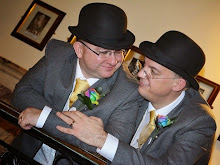
1 – My greatest Briton
…and Earthling, and citizen of the Universe, of them all, my husband, Richard Flowers
2 – Love and marriage
Having the right to marry the person I love, if they want to too, or not to marry at all
3 – That he did want to
…and that we did, after waiting only twenty years (to the day)
That’s all I need, really, but there are forty-seven more, including food, Doctor Who, more food, the Liberal Democrats (the whole bally lot of them), so much food… And that’s all just the other stuff that was at our wedding!
4 – Doctor Who
…of course
5 – Being a nation made up of several nations
…all distinct and all having each in common, and being a people that has always been made up of many peoples and still mixing in people from everywhere else
6 – Being a nation where we all have multiple loyalties and identities
…by definition, and not letting people tell us what one thing they think we are
7 – Being always open to change
…whether it’s new people in our streets, new words in our language (often from someone else’s) or newly being comfortable with lesbian, gay, bisexual and transgender people and all sorts of other people who no longer have to be like everybody else
8 – My parents
…My Mum, who wasn’t born here but has always put her all into wherever she is, and my Dad, who was born in Glasgow, did some more growing up in Watford, and made a life for his family in Stockport, because we’re lots of different places and all one country too
9 – Inspirational heroes
…The four greatest British heroic myths: King Arthur; Robin Hood; Sherlock Holmes; and World War II
10 – Doubt
…and asking awkward questions
11 – Great big cliffs
…and windmills on hillsides
12 – Great crashing waves
…and nudist beaches when it’s bloody freezing
13 – Picturesque villages
…like Aldbourne, East Hagbourne, South Oxhey, Little Bazeley-by-the-Sea, Summerisle (but I’m more of an Escape From the Country guy, so…)
14 – Thrilling cities
…like London, Manchester, Edinburgh
15 – Stockport Town Hall
16 – The Beatles
…and especially George Harrison who, like me, swung wildly from terribly earnest to taking the piss, but who unlike me played the most gorgeous slide guitar ever heard – plus the movie of Yellow Submarine
17 – Electronic music
…from the likes of the Pet Shop Boys, The Human League, Heaven 17 and Delia Derbyshire
18 – Kate Bush
…and whatever the hell she does
19 – Punk rock
…Especially Tom Robinson and, right now, Ian Dury and the Blockheads and the wish that I could make my lists scan as well as Reasons To Be Cheerful
20 – Dame Shirley Bassey
21 – The Avengers
…Possibly the most British thing ever, and which wasn’t just style and subversion but which mattered – introducing to a mass audience the idea of intelligent, independent women who flung men over their shoulders. A fantasy of Britain where old-fashioned tradition and high-tech, sexually equal modernity went hand in hand (a hugely successful Conservative-Liberal coalition, you might say)
22 – The BBC
23 – Quatermass
…combining British ingenuity and a wish to build rocket ships with sheer naked terror (but doing it anyway)
24 – The Clangers
…encouraging us to love the alien and gently laugh at ourselves
25 – 2000AD
…the comic, not the year, particularly, which turned out a bit samey
26 – Carry On Up the Khyber
27 – Alastair Sim
…in drag
28 – BRIAN BLESSED
29 – Shakespeare
…A great many of his lines, anyway (and Queen Elizabeth the First, at least according to Blackadder)
30 – The works of JRR Tolkien
…even the ones scribbled on bits of toast and painstakingly reconstituted by his son. Mmm, toast…
31 – Clasping strange new foreign foods to our bosom
…over the centuries, making them our own so we couldn’t imagine life without them, like – the potato – and tea – and chocolate
32 – Chicken Korma
33 – Roast lamb
34 – Scotch eggs
35 – Pies
…Pies. More pies. And especially appropriate today, Pieminister pies
36 – Margaret Thatcher, Tony Benn and Nicola Sturgeon
…and the gladly exercised right to say thanks but no thanks, never have, never will
37 – William Gladstone, David Lloyd-George, Paddy Ashdown, Nick Clegg and Jo Swinson
…and the gladly exercised right to say yes, and I will again
38 – Being more or less democratic for quite a long time
39 – Mostly giving up an Empire with less fuss than is usual
40 – The NHS
…which on balance makes me go “Aaargghh!” less than it helps stop me going “Aaargghh!”
41 – Fulfilling the UN target of giving 0.7% of our national wealth in overseas aid and development
…a target set a year before I was born. It’s only in the last couple of years that we’ve finally met it (one of only about half a dozen countries that does), and in the last few weeks set it in law created by the Liberal Democrats
42 – The gap between rich and poor narrowing
…at last, over the last five years, after widening hugely ever since the 1980s
43 – The Rule of Law
…meaning that those in power get frustrated by the law applying to them too
44 – Signing the European Convention on Human Rights
…And not just being part of it, but Winston Churchill commissioning British lawyers to create it, in order to protect and spread our values
45 – Traditional British values
…like creativity, eccentricity, tolerance, generosity, fair play, standing up for the underdog, and universal, indivisible freedom
46 – Not having ID cards
…or being snooped on by the state at will, and the Liberal Democrats constantly being on guard whenever everybody else suddenly thinks that would be a good idea
47 – Making lists instead of doing anything
…making tutting sounds instead of hitting anyone, and grumbling but never giving up
48 – Inventing the train and the Internet
…even when each sometimes goes off the rails
49 – Many of the things we used to have but don’t any more
…like welcoming immigrants, Woolworths, Texan Bars, how Blackpool was in my childhood memories, The Daleks’ Master Plan, Nick Courtney, Conrad Russell and my Grandad
50 – The future
…even more than those I’ve loved and lost, and that there will always be many, many more new wonderful, beautiful, innovative, unpredictable and aggravating but loveable things to put on a list.
And that any list will be quite different for you, or even quite different for me tomorrow (I thought the best way was to write the lot off the top of my head), but still blatantly and brilliantly British.
So in fifty days’ time, why not vote for a Britain that offers more things to love than merely against the bits you don’t?
Here’s Nick Clegg on things he loves about Britain. I applauded him delivering this speech on Sunday and suspect he may have spent a bit more time and thought crafting this version than I did mine, but I agree with most of his, too.
Labels: 2000AD, BBC, Brian Blessed, British Politics, Doctor Who, Food, George Harrison, Kate Bush, King Arthur, Liberalism, Personal, Robin Hood, Sherlock Holmes, The Avengers


Monday, July 29, 2013
Yaxley, Stilton, Ramsay – The New Shag, Marry, Cliff
You’ll be familiar with “Shag, Marry, (Throw Off A) Cliff” and all its bowdlerised* variations. It doesn’t do a lot for me: it’s judgemental, it’s shallow, and you never get the exact number of people to pass your shallow judgement on.
As Richard drove us through the wilds of Cambridgeshire on Saturday on our return from holiday, I had an epiphany for something more interesting: Yaxley, Stilton, Ramsay.
We were listening to The News Quiz, and as usual groaning or heckling at all the usual tired bollocks. But how to freshen up your reaction to faux-lefty faux-comics with stale material? It’s radio, so you can’t judge which one you want to shag. With their material so tired in just half an hour’s worth, they’d never stay fresh for a marriage (besides, you can kill or shag any number of people – so I’ve heard – but I for one have more exacting standards than a Radio 4 panel to select a partner for life). So isn’t it more fun just to decide, not to punish yourself by inflicting them on you, but what new and exciting ways of punishment to throw at those you’re judging?
As if by magic, the road signs gliding by above our heads kept flashing inspiration:
“YAXLEY STILTON RAMSEY”Perfect!
“YAXLEY STILTON RAMSEY”
“YAXLEY STILTON RAMSEY”
“YAXLEY STILTON RAMSEY”
Next time you find yourself listening to a terrible panel game, why not delight yourself with the much funnier idea of what to do with each of the most rotten participants?
Throw cheese at them!

(You know what Stilton is)
Throw a carnivorous time-pterodactyl at them!

(Ramsay the Vortisaur, itself a piece of political satire, features in Big Finish’s Doctor Who – Storm Warning and the following three stories starring Paul McGann)
Or, if they’re especially crapulent, throw a Death-Eater at them to curse them in all sorts of inventive ways!

(Yaxley the Death-Eater can be found being rather nasty in the later Harry Potter books and films)
It could be anyone. To take, oh, a random example, you might cry ‘Jeremy Hardavra Kedavra!’
Of course, you could just chuck the cheese and the vortisaur at him as well, to make sure. Up to you.
*But what does it say about the BBC’s attitude to marriage that it’s only as important as snoggage and hiding rather than sex and death, writes outraged of Tunbridge Wells? I demand the next series to be renamed ‘Snog, Date, Avoid’ and its post-watershed equivalent the serious ones. Well, I would, if I weren’t demanding a reformatting as ‘Yaxley, Stilton, Ramsay’ and my royalty payments.
Labels: BBC, Big Finish, Comedy, Harry Potter, Paul McGann, Radio, Top Tips
Thursday, May 30, 2013
EXCLUSIVE: BBC Defends Question Time Panel As Reflecting All Shades of Political Opinion
The BBC has once again shown its unquestionable political neutrality with tonight’s fair and balanced Question Time line-up. A BBC Spokesperson said:
‘No right-thinking person could disagree with the security industry having absolute power over every corner of our lives, so two panellists from the Snoopers’ Charter-supporting Labour Party and two from the Snoopers’ Charter-supporting Conservative Party, with UKIP for balance, reflects the views of all right-thinking people from neo-fascist to fascist. No Liberal view is possible (so we’ve refused to invite any). Any disagreement means you’re clearly a terrorist and, with our detector vans, we know where you live.’

With the biggest story of the week being the authoritarian Labour Party teaming up with the authoritarian Conservative Party to say they must go much further right – again – the BBC’s decision to exclude the Liberal Democrats from yet another Question Time beggars belief. By pretending that only the traditional party of the right, the party that’s urging them to be more right-wing, and the party that’s scaring them to death by being amazingly right-wing have anything to say about the Snoopers’ Charter they are gravely unbalanced.
This isn’t just about excluding the Liberal Democrats – again – who the BBC used to ignore because ‘They’d never get into government’ and now ignore because ‘They’re in government’. It’s about giving a completely one-sided view on major issues on which all the other parties range from deeply authoritarian to would-be totalitarian.
Labour’s former Home Secretary Alan Johnson called on Sunday for the Conservatives to reintroduce the Snoopers’ Charter with Labour support, clambering eagerly onto a soldier’s dead body to use as a platform. He is, of course, one of the guests tonight. And if you think “totalitarian” is hyperbole, he explicitly told Nick Robinson on The Andrew Marr Show that “these things are so much easier in China”. Your guess is as good as mine as to whether Mr Johnson’s eye-boggling totalitarianism is because he’s a former communist or a former associate of Mr Blair. Perhaps even his heavy-breathing desire to pry into the e-mails of every single person in the land comes from his time as a postman and a frustrated desire to open up everyone else’s post, now grown to maniacal proportions. Who can say? But whatever inspired his twisted psychological desire for control-freakery, that it’s there is a proven fact from his own mouth.
As Millennium Dome, Elephant said the other day about Mr Johnson’s disgusting opportunism in using a murdered soldier to feed his own neo-fascist wet dreams, he is not only wildly irresponsible to call for new powers before anyone’s been able to fully investigate what happened – but the security services themselves have admitted that they knew the suspects were suspicious and already had all the powers they needed to monitor them but didn’t have the person-hours to make them a priority:
“WHY, if the security services seem like they're saying that monitoring the THOUSANDS of people they ALREADY have powers to monitor is TOO DIFFICULT, WHY is the solution to monitor MILLIONS of people?!”The Conservatives are desperate to move to the right because they’re terrified of UKIP. The Labour Party have a long and disgusting record of being far to the authoritarian right in government, and are now calling in Opposition for government to be far more illiberal still. But then, everyone should remember what the Labour Party did with thirteen years of war-mongering, evidence-sexing, amnesia-promising, freedom-crushing, LGBT-hypocrisising, rich-brownnosing, poor-taxing, crony-bribe-swallowing shameless absolute power.
Only the Liberal Democrats opposed the Snoopers’ Charter and the sticky-fingered urges of securocrats to peek into and keep every electronic communication, followed naturally by every phone call, every item of post and ultimately every telescreened bedroom in Britain. The only thing that stopped it was that Liberal Democrat Deputy Prime Minister Nick Clegg directly vetoed the Snoopers’ Charter. The Conservatives wanted it. The Labour Party is gagging for it. By silencing the only voice that is not identically securocrat, the BBC is not merely being ‘unfair to the Lib Dems’ but simply not doing their job for the public.
Fossilised relics of previous completely fair and balanced Question Time line-ups can be found here , here and here.
The BBC complaints form can be found here. For viewers who aren’t Daleks, if you want to complain directly to the BBC about their consistent and outrageous political bias, obviously they’re frightened of their viewers being able to get in touch, you can’t do so by e-mail – though if anyone wishes to supply me with the personal e-mails of, say, the director and producer of Question Time, the head of BBC1, the Director-General or the BBC Trust, I will very happily republish them here – and must instead jump through five pages of hoops on their website.

Labels: BBC, British Politics, Conservatives, Daleks, Labour, Meddling In Things That Are Nobody's Business But Your Own, Pictures, Questionable Time, The Golden Dozen, Things To Remember About Labour
Monday, March 25, 2013
Total Lack of Thought For the Day: Cristina Odone Vs TV Ratings and Truth
Religious spin-doctor Cristina Odone has today used what she calls “a huge hit”, US TV mini-series The Bible, to attack the BBC, secularism and, basically, the whole 21st Century. Her propagandaggrandisement in today’s Daily Telegraph, the journal of pre-Enlightenment fantasy, rests on the twin absurdities that 13 million US viewers is “a huge triumph” and tells us anything about British religion or TV viewing.
Ms Odone’s bigging-up of the so-called “History” Channel ignores three important facts.
First, though she claims the BBC ignores religion, in fact the money of all licence-fee-payers by law has to pay for making religious programmes. By choice, happily, almost none of us watch them.
Second, she fails to mention that by any measure you like – church attendance, church buildings, opinion polls of belief – the USA is vastly more religious, and even more vastly Christian, than any country in Europe except the Vatican, and certainly has a wildly different religious make-up to the UK. Despite our having an established Church, again by law. It seems that on two for two, Ms Odone’s demand for people to be forced into religion in law not only irks the silent majority of us who the screaming zealots seize cash from and boss about, but it’s clearly doing no good for religion, either. So perhaps she should pause in her authoritarian diktat that the US so-called “History” Channel’s Bible series should be “compulsory” here, in schools, on the BBC, and presumably by strapping every viewer to A Clockwork Orange-style eye-restraining chairs.
Before introducing the third and most absurdly abused fact that will fisk Ms Odone on her own shaky ground, I should point out that I do not believe TV ratings to be any guarantee of quality, just as I do not believe majorities should be able to push around minorities (or, in this case, vice versa), even when by her own argument we should ignore the Godly Torygraph’s tiny readership in favour of the Satanic BBC’s many millions, causing her entire vindictive rant to disappear in a puff of logic. But as Ms Odone wants to command her beliefs to be “compulsory”, and as she’s using the dubious testament of television ratings as her foundation, this is the appropriate ground around which to march to bring her ludicrous fabrication tumbling down.Third, like any good spin-doctor Ms Odone cherry-picks the top viewing figure of 13 million for one “huge hit” episode (not telling us how far ratings have dropped since then) for the so-called “History” Channel’s Bible-story mini-series, just as the programme itself cherry-picks only the most popular bits of the Bible. She exalts this, again in her words, “huge triumph” to disprove the spooky, invisible US atheist conspiracy which televangelists and the lunatic far right make up stories of to raise so many millions. And yet, it surprises me by suggesting that, against all other evidence, perhaps big-budget Christianity in the USA isn’t looking that healthy after all…
The Facts – Ms Odone, Look Away Now (oh, she already has)
The USA is a country of 316 million people (I’m doing Ms Odone the favour of assuming that her pet series’ top rating only included the USA and not world-wide ratings, though as with all her ‘facts’, she isn’t clear). 13 million viewers is a “huge triumph” of, er, just 4.11% of the population. Ms Odone will no doubt tell you that’s an overwhelming majority. That doesn’t mean you should believe her.
By way of one simple factual comparison, the UK is a country of 61 million people. Cherry-picking one huge hit episode, Doctor Who – Voyage of the Damned (guest-starring Kylie Minogue), that was watched by 13.3 million people in the UK alone. That’s 21.11% of the population.
Much as I love it, Doctor Who is not my religion. In my view, it would be absurd and wrong to suggest on the basis of this factual like-for-like comparison that Doctor Who (or Kylie) is far more important than the Bible to the people of the UK, let alone extrapolate that Doctor Who – were it not for the evil conspiracy against it by US TV – is really, deep down, five times as big for the US population as Christianity.
Yet that absurd nonsense is exactly the way that Cristina Odone has extrapolated US viewing figures to scream that everyone in the UK should be ‘compulsorily’ bossed about. It seems that while UK schools’ compulsory religion does no good for most of us, sadly UK schools’ compulsory maths lessons did even less good for Ms ‘Dunce’ Odone.
Of course, it’s unthinkable that she knows that what she’s saying is a nasty, cynical lie to justify her outrageous authoritarianism, because, after all, she mentions the Ten Commandments. Though she claims no-one knows them any more, I do. And “Thou shalt not bear false witness” is one Ms Odone should know, too.
Ms Odone will no doubt point, scream and call for me to be burnt – ‘compulsorily’ – as I’ve just noticed that, as luck would have it, this is my 666th blog post on here.
Update: I’ve been fact-checked in an especially embarrassing way for a chap who bristles every time people misspell my own name. I apologise to Ms Odone for my mistake, and have corrected her Christian name from “Christina” to Cristina each time I used it.
Labels: BBC, David Tennant, Doctor Who, Kylie Minogue, Religion, Stupid Ideas, TV Ratings
Sunday, July 08, 2012
BBC Lèse-Majesté: Hollow Crown, Hollow Schedule and Hollow Laughter
Regular readers may be aware that I’m not exactly a fan of sport. However, I do understand that live sport will occasionally run over time and delay other programmes. In the olden days, when people were out they had to set their own video recorders and hope that the TV schedules advertised might bear some relationship to reality. In theory, these days the channel’s programmers can update the EPG for a delayed programme and everyone’s digital recorders will simply act on the new information.
This requires, as do all computers for the information you get out of them, that the people putting in the information aren’t completely incompetent.
A Dumb Box and Dumber at the BBC
There are many different varieties of digital recorder, so I won’t claim to speak for them all, but ours is fairly standard: it’s a dumb box that assumes its users are dumber, so there’s no manual override. In theory, this is to prevent someone setting a recording going, forgetting about it, and using up all the memory in one great lump. In practice, when TV stations are rarely known for sticking to the precise minute of their schedules, this would usually mean missing the end or the beginning of programmes, as almost all start a minute or two early or finish a minute or two late. There’s no option to press a button that says, ‘Keep recording until I stop, you bastard!’
To correct this obvious problem, the manufacturers do allow you to change the default setting on the machine so as to top and tail your timer recordings with a few extra minutes (ours is set to start three minutes ahead and finish five after; sadly, you can’t set it by channel so that the BBC gets the full five at the end for running over time, while channels carrying advertising finish on time so most recordings don’t end in an extended ten minutes of ads and unwanted programming). But this only applies to shows you’ve checked by EPG in advance; if you simply press “Record” for something going out live, it will stop recording the very second that the EPG (that again) says it’s scheduled to finish, and no amount of swearing at it will extend that.
Last Night’s Stopping and Starting
I tuned in a few minutes before 9 last night to catch BBC2’s broadcast of Henry IV, Part 1. Or not, as they were still showing Wimbledon. Richard was away; I was meant to be, but not well enough; fortunately, this meant I could at least stop our EPG recording from saving us the tennis. So it clicked on at 8.57, and I switched it off, and waited. Within a few minutes, the EPG had changed to indicate a start time for the play of 9.15. So I selected the new EPG, and our machine started again at 9.12. It was still tennis. I stopped it again. Within another few minutes, the EPG had changed again to start Henry at 9.30. By this time, people who claim that live sport needs special treatment were losing the argument: the simultaneous broadcast on BBC2 and BBCHD was showing a mixture of interminable post-game sports babble, bits of game in daylight (and so clearly not live, unless the Isle of Dogs has suddenly switched to a different time zone from Wimbledon) and even minutes-long shots of the stadium in darkness from high above, cars driving away from it. Yet 9.27 and then 9.30 passed, still with no move to the scheduled programme.
By 9.35, the EPG had updated yet again to suggest a start time of 10pm. So I reset my digital recorder yet again… But noticed something was wrong. Henry IV, Part 1 was scheduled to show from 9pm to 10.55; on the first new EPG, all the programme times for the rest of the night were put back by 15 minutes; on the second, by half an hour; but this time, although the start time had been altered to encompass the hour’s delay, the BBC munchkins setting the EPG hadn’t altered the end time, with the next programme claimed to be starting at the original 10.55. Even though this couldn’t possibly be true, unless they were going to play the two-hour Shakespeare at double speed.
So I spent the next quarter-hour on hold with the automatic voices at the BBC, which eventually auto-hung up on me ironically mid-way through telling me for the 463rd that my call was important to them. Because I could see what was coming, even if the people who were paid to couldn’t.
You see, if you set a recording by EPG, then it starts when the EPG tells it to, and finishes when that EPG tells it to. If the EPG changes later, it’s too late – the machine’s had its instructions. So when the EPG changed a few minutes after 9, for anyone who’d set in advance and their machines had started recording at the proper time, it was too late. And the same for when it changed at about 9.20, and then 9.35. Had the people paid to programme the EPGs changed them in advance of the due time, even by a few minutes when it was bleeding obvious that they needed changing, then recorders would have sat patiently waiting for the live EPGs to tell them to start.
And if they’d bothered to put the correct end time for the eventual 10pm showing before about quarter past ten, by which time it was of no earthly use, my recording wouldn’t had stopped on the dot of 11pm, as I’d predicted it would an hour and a half earlier but the incompetents at the BBC hadn’t.
So, despite trying not to watch the play because I was hoping to wait and watch it with Richard, I had to watch half-way through for the moment when it stopped part-way into Henry telling off Hal. Then look again at 11.55 because, of course, it finished 3 minutes late on top of all the other lateness, which meant that the manual recording I’d had to start of the second half had neatly stopped, again, at precisely the moment the EPG said it was due to stop, half-way through Falstaff’s soliloquy. Splitting the play into three separate recordings, all because the EPG programmers didn’t do their jobs properly.
Richard is now home, and we’re now watching the hastily-arranged repeat on BBC4. It was announced immediately after the chopped-about first broadcast. The EPG wasn’t updated until today, of course, so you couldn’t set up for it right then.
Some might say that you can watch these things on the iPlayer. Well, yes, but if I’m going to spend two hours watching something, I’d rather do it on my big screen with no blurring and no buffering, and that’s what EPG recordings are meant to be for. And if you wanted to watch The Hollow Crown in HD, you’re stuffed. If you’re very, very lucky, the BBC might eventually release it on Blu-Ray – but, irritatingly, despite now making so many programmes in high definition, and ‘protecting’ them from copying with signals that mean you can’t back most of them up, those programmes they do release are usually just on DVD and not Blu-Ray. So, congratulations again, BBC, for making programmes in HD and then going to such lengths to prevent people watching them or keeping them that way.
And if you think that’s a rant, you should have heard me last night. Patrick Troughton used to say he didn’t do theatre because it was just “Shouting in the evenings” – I think our neighbours might agree.
After all that, the infamous ‘tennis as insult’ scene in The Hollow Crown’s finale Henry V in a fortnight is going to see almost bitterly satirical.
Labels: BBC, Patrick Troughton, Shakespeare, Technology, Theatre
Monday, December 12, 2011
Old Is New Again: Doctor Who – Galaxy 4 and The Underwater Menace
The BBC website already has tantalising clips of Galaxy 4 Episode 3: Air Lock and The Underwater Menace Episode 2 to watch, with articles on how they were found both there and on the Radio Times site. If you know nothing about these two stories, be warned that each clip contains spoilers for its story’s key plot point – one implicitly, one directly – and so, unusually, do my reviews below. If you want to wait and see things for yourself, then, stop before the main headings. I will say that both stories, though very different in tone and setting, have monsters with two unusual things in common – and that both were designed to be four-part, ‘typical’ Doctor Who stories of the time and, incredible as it may sound, had comparatively significant cash spent on them to make them look good; it’s widely thought that this may have been more successful in one case than the other. And yet while Galaxy 4 is the one with a particularly well-respected director, of the two clips it’s the one from The Underwater Menace that’s compelling. That even makes up for this, the earliest surviving episode with Patrick Troughton’s Doctor, not being one in which he has his most famous hat – though he does get an outrageous replacement – nor a topless Ben. The clip from Galaxy 4, on the other hand, is visually interesting more in its design than its direction, so perhaps Julia Smith will win out over Derek Martinus after all. Now I’m wondering if the Chumblies are oscillating or merely wobbling (only seeing more of them will tell). Both clips, though, already display a little of what their stories are famous for: painful earnestness saved by Bill Hartnell in one, and an over-the-top mad scientist dragged to Earth by Pat Troughton in the other.
Missing – Presumed in the Skip
Half a dozen years ago, watching the whole of Doctor Who when there was considerably less of it – at both ends, it now happily transpires – I wrote reviews of all of William Hartnell’s stories as the Doctor and the first few of Patrick Troughton’s for an online discussion, and this seems an appropriate day to reprint these two for the first time where more than about half a dozen people can read them below, even if it’s inviting ridicule should things not look as they sounded. But how can I have reviewed these already without ever having seen them, you might ask, being born half a dozen years after their only airing in Britain? Well, I’ve written before about the BBC’s barbarous purges in which they destroyed many of their TV shows from the ’60s, creating what are now disingenuously referred to as “lost” or “missing” episodes. These two are the first surviving episodes to turn up for nearly eight years, since The Daleks’ Master Plan Episode 2: Day of Armageddon back in 2004. Until yesterday there were (or weren’t) 108 of them; now there are only 106 to go, and at least one of them would probably scrape into most fans’ top 100 to be found! Fortunately, for every single story, people recorded the soundtrack at the time, so you can now get the full adventures on CD with linking narration to make them clearer, while there are also many off-screen ‘telesnaps’ which mean we can get a fair idea of what the whole thing looked like for free, assembled into photonovels on the BBC website – and, unofficially, the two have been combined into Reconstructions, which you can get hold of for free as long as you don’t tell the BBC about it.
Of the six seasons broadcast in the ’60s that starred William Hartnell and Patrick Troughton as the Doctor, the middle ones were the worst hit; while most stories survive intact from each of Seasons One, Two and Six, there are only four complete adventures from Seasons Three and Five put together and, as I wrote earlier this year when publishing a review of Doctor Who – The Smugglers, not one story still exists in full from Season Four. These two finds don’t complete any stories, but they do offer an ‘orphaned’ episode for Season Three’s Galaxy 4, of which only a clip had previously been known to exist, and add another ‘orphaned’ episode to the already existing one from Season Four’s The Underwater Menace. Both are sure to be released on DVD next year, probably with soundtracks for the “missing” episodes (and, if we’re very lucky, perhaps partial Reconstructions or even, just maybe, animation for the now half-complete The Underwater Menace). Already today, you can buy the other material on the DVD collection Doctor Who – Lost In Time, which includes that extended clip from Galaxy 4 (peculiarly, presented in the middle of a documentary rather than as a menu item on its own) and the infamous Episode 3 of The Underwater Menace, or you can get the soundtracks for the whole stories both as separate releases and in newly remastered box sets, respectively Doctor Who – The Lost TV Episodes Collection No 1 (1964-1965) and Doctor Who – The Lost TV Episodes Collection No 3 (1966-1967). In which each is probably the weakest story…
For DVD reviews, this is usually the point at which I mention that back in September 2009, Doctor Who Magazine Issue 413 published “The Mighty 200” – 6,700 fans’ votes on all 200ish TV Doctor Who stories to that point – and how high they and I scored the stories I’m coming to. And they didn’t think much of these, but, hey, they’re the only episodes with arguably my two favourite Doctors that I have never seen, so my enthusiasm’s racing. Even if the DWM vote put Galaxy 4 down into 172nd place and The Underwater Menace even lower at 194; I might put each of them as much as ten places higher, but no more than that. At the moment, I’m much more ill than usual, and Richard had to wake me with the glad tidings yesterday afternoon; when I crawled from bed to watch the clips some time later, though, even my sounding like a Dalek couldn’t hide my excitement. I promptly rang one of my oldest friends with the news, who was audibly thrilled when I told him two episodes had been found. And then said, “Can’t we ask them to put them back where they found them?” when he found out which two. Yet still, the DVD releases can’t come soon enough! And remember, before you read on – spoilers…
Doctor Who – Galaxy 4
“I told them soldiers were no good for space work. All they can do is kill. But they wouldn’t listen. If you are to conquer space, they said, you will need soldiers. So here I am confronted with danger. I’m the only one able to think!”Season Three of Doctor Who is a strange one even by the standards of the series as a whole. Like the first two seasons, it’s highly innovative and experimental, but with a new production team (the first ‘new’ production team) it has a very different feel. Companions chop and change far more abruptly and the dangers the Doctor faces continue to get ‘bigger’, with this the first of many exploding planets, all making it an unsettling year – but the ideas get bigger, too, with a lot of ‘big concepts’. The downside is that the endearing characterisation and dialogue-driven drama of the first couple of years doesn’t always fit in with the new brooms. And Galaxy 4 is definitely a sign of things to come…Mini-Skirts Are In Fashion; Complexity Is Out
There are two ‘big ideas’ that everyone knows about Galaxy 4, from the skimpiest story summaries: the Rills are ugly but good, while the Drahvins are wicked but ‘beautiful’ (in a very ’60s way – the book’s cover of highly posed ‘beautiful space women’ against a blazingly pink sky is easily the campest thing ever painted by Andrew Skilleter); and, linked to that, the Drahvins are the nearest broadcast Doctor Who has ever got to the horrendous old sci-fi cliché of ‘the planet of women’. The trouble is, there’s very little else to know about the story, especially as there’s very little made of the ‘evil women’ side of the plot. Naturally, it’s a relief that Steven doesn’t snog them into being good (as is the norm in such stories in other series), and that they’re mostly just dim and for a good reason, rather than behaving as screaming girlies who happen to have large Freudian weapons (admittedly, Maaga bullies her soldiers and makes them cry, but at least she’s a strong character), but in the gaping hole left by the omission of sexist blather is… Not much.
It’s nice that for once Doctor Who is doing a story where ‘ugly’ doesn’t mean ‘evil’; right from The Daleks, the series has a strong current against fascism which is slightly undermined by, for example, the ‘good race’ being blond and ‘perfect’ while we know the others are evil because they’re mutated horrors with funny voices. Unfortunately, while the Rills seem quite an interesting piece of design from the two photos we have of them, all we ever hear is how ugly they are, as if we could miss the moral. Surely the Rills themselves wouldn’t think of themselves as ugly (one of the novels even suggests that Rill social advancement is based on their ugliness, which seems to miss the point)? It doesn’t help that the Rill has the plummiest voice yet heard in the show, which appeals to my own prejudices by suggesting Shakespearean ham, or possibly Lord Melchett. The Doctor has a great moment when he calls this giant alien monstrosity “Young man”, though – we could do with more of that. Their “warning” ammonia bomb is perhaps supposed to recall World War I gas warfare, but (coupled with the Rill’s stern, schoolmasterly tones in telling naughty Maaga to stay indoors) I can’t help but think of it as a stinkbomb. There’s also a teeny bit of a plot hole, where – before we find out the Rills are generous and friendly – they decide to blow up the TARDIS, for no good reason, especially as they’ve deliberately not attacked the spaceship of the Drahvins, who they know are hostile. It’s difficult to imagine any other reason for them to do this than faux-villainous plot convenience in advance of the ‘twist’.Hands Off My Chumblies
On the bright side, the particularly good Loose Cannon Recon both greatly improves the long clip that’s left of the story by putting it in context and proves that one of the reasons it’s so sad so much of Season Three was tossed into skips and burnt by the BBC is that it seems to have some lovely visuals. Ironically, the first two seasons’ dialogue generally makes them more suited to audio releases, while it looks like there are ‘lost’ higher production standards in the third, where every planetscape appears an improvement on The Chase. The Recon shows some superb design for the time, with great scenery and a very solid ship, as well as re-enacted scenes for the Chumblies, the cuddly little robots that the BBC once again hoped they could cash in on as much as the Daleks (plus someone ‘playing’ Bill Hartnell as, er, a hand waving a knobbly stick). They look quite jolly as they telescope up and down, so again it’s a shame that most of what we have of them is their irritating sound effect on the CD. Ah well [the rediscovered episode means I shall have to take back my observation that if I never hear another Chumblie “oooo-up-ooooom”, it’ll be quite soon enough].
In the end, this is a story with its eye on the big picture; the first planet destroyed in the series, much talk of galaxies, alien races and some rather nice scenery all there to illustrate a big ‘message’. You can’t fault its sci-fi ambition, but it’s as if they spent so much time making it seem ‘big’ that they forgot to fill in any of the details. The galaxy-spanning view makes little sense seen up close, when we realise that the name of the story merely refers to where Maaga comes from and tells us next to nothing, or that her mission to “conquer space!” (and before Sarah Brightman) seems a tad improbable in a backward ship with just a handful of more backward clones to staff it. Added to that, the sheer obviousness of the ‘point’ undermines itself; the story has its heart in the right place, but it goes on and on with little happening, and Season Two’s characters have given way to cardboard that spouts moral messages. It’s never actively bad, but it’s much, much too slight for its length. Photos of Drahvins and Chumblies may look camp and rather exciting, but as we’re drearily reminded, don’t judge by appearances – a simple moral for an even more simple story.


In mitigation, with its proto-Jagaroth spaceship and froody alien vegetation, and of course its (sigh) threatening dolly-birds and cute robots, this was clearly made to be seen, so perhaps the plot was secondary and it was deliberately designed as a ratings-grabber to look at? So will seeing it at last save or damn Galaxy 4? I can’t wait to find out. As then-companion Peter Purves has always said how much he hated this story, his commentary will surely be entertaining, too.
Looking back at it now, there is at least one way in which Galaxy 4 – ’50s B-Movie as it is, with its beehived alien Baaaad Girls – feels slightly ahead of its time. By mostly ignoring the gender reversal dynamics and focusing on Maaga, it’s an early example of TV’s Magnificent Bitch, even though she’s played by Stephanie Bidmead rather than Stephanie Beacham (now there’s a thought: Steven Moffat’s already had a Drahvin spaceship making a cameo last year in a story about a more grandiose but more improbable exploding Universe, undoubtedly because he likes women in micro-skirts, so if he ever does a full-on Drahvin story, how’s she for casting…?). For the most part, this makes it camply amusing at the expense of what little credibility it has – even the first episode title, Four Hundred Dawns, suggests she fuels her ship with her wooden compatriots (‘Throw another Dawn in the furnace! …I’m almost out of disposable Drahvins’, as Richard has it) – and it’s difficult not to imagine it turning up the Planet of Women dial to something like the Two Ronnies’ The Worm That Turned, not least because if it had been made in 1980 they wouldn’t have dared call the villain Maaga. Not only is her name often pronounced so it’s just a shade short of The Good Life’s anti-hero, but it’s uncannily similar to that of another blonde Leader, too.
And yet the scene I’m most keen to see from Air Lock – other than the surely unmissable spectacle of Rills reeling about – is one that’s always gripped me on audio, where Maaga gives a virtual soliloquy, barring the occasional dumb comment from one of her dumb subordinates. She starts off merely grumbling about them, and indeed gives her most infamous line, but it carries on to something much better, a proper bit of villainous spite, delivered in a gripping undertone:
“It may be that we shall kill neither the Rills nor these Earth creatures. Not with our own hands, that is. It may be better for us to escape in the Rills’ spaceship and leave them here. And then... When we are out in space… We can look back. We will see a vast, white, exploding planet... And know that they have died with it!”Her having an imagination is quite the best thing in it, which you could even take as a postmodern commentary that the special effects are never going to live up to your mental picture… And at the end, of course, we get to imagine in exactly the same way about her last moments – which might make it an even more postmodern commentary on the bloodthirstiness of the viewers, who watch all these things for their entertainment.
“But we will not see them die.”
“You will not. But I, at least, have enough intelligence to imagine it.”
Or she might just be being beastly.
Doctor Who – The Underwater Menace
“You’re not clumsy, Doctor. You did it on purpose.”The TARDIS lands at the entrance to what’s left of Atlantis and does Flash Gordon.
Of all the stories with missing episodes so far, this is the one where people seem most likely to want the surviving episode lost, too, as it might be better-regarded if only the short ‘censor’s clips’ had survived to suggest a grim and dangerous story about horrible operations, rather than the load of old codswallop we get to see in the surviving Episode 3 in all its ludicrous glory. Even fans who’ve never seen it tend to know that the final line of that involves the mad scientist exclaiming,“Nothing in the world can stop me now!”I’ve read several reviews excusing the story by saying this is the worst episode of the four, but that’s nonsense – both soundtrack and Recon make clear that Episode 1, for example, moves very slowly, the TARDIS crew act like idiots and it’s not even funny. Despite all that, it’s still possible to defend it, simply because the surviving episode is often fun. Is it good? Nah. Is it a pleasure to watch? Go on, go on…Good News For Troughton, Bad News For His Friends
Though at times he’s just as extravagant as in his first two stories, everyone wanting ‘the new Doctor’ toned down a bit is in for a stroke of luck. Opposite Joseph Furst’s Professor Zaroff, he seems relatively underplayed, and not only is he funnier than Furst, at least with the hero we’re laughing with rather than at him. He’s both sharp and funny, particularly when puncturing Zaroff’s plans: “Oh, have I dropped a brick?” or calling his bluff on the explosion being unstoppable and not requiring his finger on the button with “Miss your big moment? I think not.” He’s already getting other people to play on his strangeness, most entertainingly when the lovely Ben bluffs his way past a guard using the old ‘I’ve got a prisoner’ trick: “He’s just not normal, is he?” He tries to bring down Zaroff by suggesting the Fish People strike (a major contrast with Pertwee in The Monster of Peladon), but when it comes down to it, he’s back to what’s clearly already his usual way of foiling an evil plan: blow everything up, as he did on the Vulcan Colony the landing before last. With this strange mix of the gentle and the utterly destructive – ‘Better safe than sorry!’ he seems to think, to make sure the plan’s thoroughly knocked down – you have to feel relieved that Scotland survived in the previous story, or that he didn’t at least blow up the cells and scupper Trask’s boat. By contrast, he also tries to save Zaroff from his horrible end. Meanwhile, with the most ludicrous array of hats seen so far in the series, we see the Doctor delighting in a huge priest’s hat, wearing a fish mask on a stick, and dressed as a gypsy in groovy shades for a very funny ‘action’ scene in the market. You can see why he’s Matt Smith’s favourite Doctor. It’s also the last story he wears his arresting stovepipe hat that appeared in all his early publicity shots, and a little sad that the only surviving episode from one of the ‘stovepipe stories’ is devoid of it, with the telesnaps suggesting that the last person to wear it is Polly…
Although they get to do lots of dressing-up – rubber guards’ uniforms for Ben and Jamie, a shell suit for Polly – it’s not a particularly good story for the Doctor’s three companions. They start well, in a fun little TARDIS scene where everyone thinks about where they’d like to land (it’s difficult to know for sure without the proper episode, but this may feature the rare device of hearing someone’s voice ‘inside their head’ – used in The Moonbase, The Mind Robber and The War Games, but for only one story outside of Troughton), but once they go outside and everyone suddenly wants to explore, now Bill Hartnell’s gone, they rapidly run out of useful things to do after a one-off attempt to use foreign languages. Given that Ben and Jamie have basically the same ‘running around not saying very much’ part, already suggesting too many similar companions, it’s startling how much one-off characters Jacko and Sean are ‘extra companions’, doing companiony things like rabble-rousing the Fish People into striking. Did Geoffrey Orme just not like Ben and Jamie, even in their little rubber outfits? Ben may notice the threat, as he teases new boy Jamie like a younger brother. That’s nothing compared to the distressing fall for Polly, though, as she goes from being a fantastically capable companion to utterly useless here. She’s taken in by Zaroff’s ridiculous bluff to jump the priest Ramo (asking for Ramo to come over so he can “feel the aura of your goodness”), then while they fight she could easily pitch in, but shamefully just squats in the corner looking scared (at least she tries to hit him with a rock later on). Still, the two sexy blondes Ben and Polly look good together, and Joe Orton clearly fancied Jamie in the guard’s outfit, as he wanted to cast Fraser Hines as Mr Sloane on the strength of it!The Hats of Doom
Despite many attempts by Terry Nation, this is the closest Doctor Who ever gets to the original Flash Gordon film serial, and not always in a good way; the Fish People, the mixture of stereotyped religion and mad science, the hokey dialogue and design work (it’s difficult to believe the executioner with the mask and shell on his chest isn’t from Flash Gordon). Add in elements of Journey to the Centre of the Earth and a horrible physical transformation that’s even less convincing than that in Vengeance on Varos, and you’ve got a story that’s mostly not deliberately funny, but invites being sent up mercilessly by several of the actors and in Nigel Robinson’s novelisation. It’s the reverse of some Hartnell stories written as comedy and ‘straightened out’ in the studio, from a man who also wrote a very forgettable episode of The Avengers. It’s enlivened by Professor Zaroff and his occasional demented exclamations but, as he’s given the brilliant and detailed motivation of being ‘mad’, I can’t help thinking he should be more over the top. He’s not exactly Brian Blessed in full-on shouty mode – more just sniggering. It’s not a good story for Atlantean religion, either, with it all a big con (shock) and the fat priest Lolem apparently played by Christopher Biggins’ funny uncle in a huge hat made of curly bits of newspaper. His bitchy “May the wrath of Amdo engulf you!” to Zaroff is fun, though. At least it’s an exciting story for milliners. And shouldn’t the Atlanteans be able to spot the TARDIS crew aren’t local because they don't have silly eyebrows like everyone else?
The cliffhanger to Episode 1 doesn’t seem too bad, surprising you by not being about sharks after all but instead with Polly about to be operated on and a Fish Person peering in, but stick a load together in the ‘Dance of the Fish People’ and they’re jaw-droppingly silly. It’s probably the longest non-speaking sequence in the show up to that point, complete with strings and a terrible electric piano. The only time they look good is in a marvellously colourful DWM Time Team illustration of Zaroff and Nemo the octopus, though the Troughton’s not too good (with a huge nose that looks like a villain from TV Comic). Doctor Who writer Rob Shearman also has a particularly spectacular go at the story, which you may enjoy. The gormless King Thous gets one dignified line as the water surges into Atlantis at the climax, “The everlasting nightmare is here at last,” but the budget doesn’t really allow enough playing with water either, despite an effective image of the goddess Amdo ‘weeping’ as the idol gives way (I’m not sure about leaving nasty Mengele-figure Damon as the new visionary, though).
After all that you might be surprised that this ill-judged attempt to replace history with fantasy in the series was directed by the co-creator of EastEnders, so she probably didn’t put it high up her CV. Another echo of the future is that the whole Atlantis thing and the ‘villain from outside with the crazy destructive plot’ who ‘the ruler is chatted up by and realises is actually a bad thing and “the Doctor was right” too late’ ideas are blatantly ripped off for The Time Monster, which frankly makes you worry about Barry Letts… There is, at least, a great final cliffhanger into The Moonbase as the TARDIS goes out of control: “Do something!” “I seem to have done something!” but overall I’m left with two conclusions. It’s undoubtedly the lowest Doctor Who has aimed so far into the series… But though I don’t usually believe in the ‘so bad it’s good’ theory, this is at least ‘so bad it’s highly entertaining’!

The scene I’m probably keenest to see from the newly returned episode – given that it’s sadly not one with the stovepipe hat, nor a soaking wet Ben, nor with the probable inner-voiceovers – is probably the full version of the clip on the BBC website, which is delightful. This was only Patrick Troughton’s third story as the new Doctor, with the part only ever having been played by William Hartnell, and as I said above it does him a great favour by casting a villain next to whom he tones it down a bit, before finding his ‘mission statement’ in The Moonbase and then nailing his Doctor perfectly in the sublime The Macra Terror. And it’s fascinating to watch him in that minute that’s been made available, orbiting Zaroff in the background, watching, before he comes into close-up, all the while probing in a deceptively mild manner, hands held close to his chest in quite a Hartnellish mannerism, provoking the mad scientist into his second-most memorable outburst:
“Bang! Bang, bang!”So, if you happen to have any old friends and relatives with dusty film cans in their attics, why not check to see if they have any more episodes themselves? Oh, and those two unusual things the monsters from each oldly new episode have in common: neither breathes our air; and, unlike the human-looking villains in each story, neither are really monsters at all. You can also read a brief review of the episodes at the British Film Institute yesterday from a lucky blighter who was there.
In the meantime, Andrew Hickey has just reviewed another – far from missing – piece of Dr Who from 1965, while if your appetite’s been whetted for Christmas Doctor Who, there’s a cartoony Reconstruction of the deeply silly 1965 Christmas episode The Feast of Steven online (worth watching for its marvellous closing line), or – from the other end of Doctor Who – the Prequel to this Christmas’ The Doctor, The Widow and The Wardrobe.
Labels: BBC, Christmas, Doctor Who, Fandom, Matt Smith, Patrick Troughton, Recons, Reviews, William Hartnell
Wednesday, October 12, 2011
The Art of the Trailer
Mr Brooker’s acceleration runs from questioning how much the BBC spends on promotional trails with “I'm not talking about the on-air trails consisting of edited highlights” to frothing at the very idea of trailing programmes:
“All that time and money to advertise a show which everybody knows about anyway. You could hold a bit of cardboard with "STRICTLY'S COMING BACK" scrawled on it in front of the lens for 10 seconds and it would have 10 times the impact. Madness.”You know, I’m not sure it would. But either way, it certainly wouldn’t be as much fun to watch. So is it not really just “bespoke mini-movies” of “specially-shot glossy nonsense” that he’s against, but trailers in general? And isn’t it difficult to trail a live show like Strictly Come Dancing in advance with “footage from the shows themselves”, which he puts as an alternative? Personally, I’d go for more exciting trailers between programmes to keep us watching, and fewer simple cards saying ‘This is going to be on’ covering the end credits of shows, which is when they tend to appear on TV and wind me up.
The heart of his argument, though, is that he loves the BBC and thinks it’s throwing money away when it really needs not to. I love the BBC, too, and think it should always be alert not to throw money away – but, for me, the trailers aren’t doing that (and I’d much rather licence fee money is spent for something on screen, rather than managers’ salaries). Obviously, they’re encouraging people to watch programmes; not just letting us know they’re on, but creating a feel for them that makes us want to watch them. And that’s where I disagree with Mr Brooker:
“These things turn me silver with rage. Yeah, silver. I TURN SILVER. And they turn me silver not because they're bad – on the contrary, they're often very well made indeed – but because they have absolutely no right to exist in any civilised universe.”Well, that’s me told. But doesn’t that just boil down to ‘This is something I don’t like to watch. Make something to my taste instead!’ And shouldn’t the BBC be a bit more diverse than just Charlie Brooker’s personal taste?
‘Preposterous,’ you might say. ‘No-one watches TV for the trailers.’ Not entirely, perhaps. But the more that trailers are creative works in their own right, the more likely I am to enjoy them. Yes, that’s often about the anticipation, where tantalisingly edited highlights can make a fine trailer, often cut to specially selected music (oh no! That costs money to license!) – I thought the thrilling music on the Tinker Tailor Soldier Spy trailer really made it, for example – but there’s something about a “bespoke mini-movie” that often appeals to me more than the programmes it’s shown between. I realise regular readers may be amazed at this, but who says for something to be any good it has to go on a bit?
I don’t like every trailer, just as I don’t like every other sort of programme, but if you’ve never thought, ‘Ooh, that looks good,’ or ‘Actually, that’s better than the programme,’ I worry about your critical taste. Over the years, I’ve several times drifted in and out of watching Hollyoaks: sometimes it’s an unusually stylish and creative soap (I’m not an habitual soap watcher); sometimes the relentless teenery bores me and I turn off for a year or two. Recently, I’d picked it up again after a long gap after someone told me Jeff Rawle was in it as a quietly underplayed psychopath, and I’d started to lose interest again now he’s off in France. But I love the Hollyoaks – The Wedding trailer. In part, that’s because of the anticipation: hooray! Evil Jeff Rawle’s back. But largely, it’s because it’s nothing like Hollyoaks, and is almost certainly more entertaining than the episode it’s trailing. But so what? It’s a miniature masterpiece of Gothic camp, brilliantly conceived and put together. And, yes, it probably cost quite a bit of money. It’s probably driving Mr Brooker spare. Entertaining me as it does whenever I watch Channel 4, for me it’s money well spent.
Just in case you think that this is all about art, though, and that Mr Brooker is against one form on artistic grounds, it’s also, of course, about money. Not saving it – making it. ‘Oh,’ you might think. ‘Charlie thinks all these trailers make the BBC too commercial, and he’s got a point.’ But no. In fact, he’s against them because they’re not commercial enough:
“And it's not just madness in the short-term: what about legacy? If all that time and money and street-closing and dancing and filming had been used to create a show instead of an advert, they might've created something they could broadcast again, or sell on DVD, or flog to the Swiss and the Kenyans. Instead they blew it on a promo that'll air for a few weeks before getting tossed on to the ever-mounting stack of other never-to-be-shown-again adverts, which sit there gathering dust in nobody's memories…”A lot of trailers linger in my memory, as it happens – because that’s what they’re intended to do. Short, stylish, attention-grabbing? No wonder that for many people they’re more memorable than the programmes. But also, what contradictory rot. How does criticising a trailer as something that can’t be “broadcast again” and admitting it airs “for a few weeks” stack up? And should the BBC only ever aim to repeat, or sell, rather than produce something new, for ordinary viewers? Most BBC programmes are never shown again. Most BBC programmes are never sold to other countries. Most BBC programmes are never released on DVD. Yet trailers are shown many times – so, if it’s a financial argument you’re after, surely they often give more bangs for their buck than the programmes do? And, again, sometimes the trailers are better than the show – because some of us like some trailers as works of art in their own right.
Lost in the middle of his article, Mr Brooker makes some effective points about how cuts and pressure for “value for money” make it less likely the BBC will take risks, yet it’s taking risks that creates many of the best programmes. But that has nothing to do with the rest of his argument. After all, one of the examples he cites of a risky programme was Doctor Who, which the BBC thought an enormous risk in 2005 and almost everyone expected to fail. And what was the biggest way the BBC encouraged people to start watching it? A brilliant bespoke mini-movie, The Trip of a Lifetime. Which was then sold as part of the DVD, and which I still watch and enjoy today. How’s that for a legacy?
Labels: Adverts, BBC, Christopher Eccleston, Doctor Who
Tuesday, September 06, 2011
DVD Detail: Doctor Who – The Trial of a Time Lord: The Mysterious Planet
Back in 1986, the BBC high-ups had turned against Doctor Who. They cancelled it, then grudgingly allowed it back eighteen months later with a reduced running time, reduced budget and a series of directives from above that (as the excellent, if dispiriting, set of extras here reveal) were long on criticism and very short indeed in saying what they wanted instead. So when the punch-drunk series returned twenty-five years ago tonight with most of the executives wanting it to fail, it wasn’t a massive success. The Doctor Who production team fought back by giving all fourteen episodes one long story arc: in pretty much the most obvious and postmodern theme in the series’ history, the Doctor’s popularity is tested on a big TV screen while his corrupt superiors are completely stacked against him. It’s the ‘Trial’, symbolising a trial, and it’s sometimes a bit of a trial. So as to avoid swallowing the whole lot at once, it’s broken into several mini-stories as different parts of the ‘evidence’ (structured into past, present and future, inspired by A Christmas Carol), the first being sub-titled The Mysterious Planet. It’s possibly not the best of the Trial, but it’s probably the one of which I’m fondest… And what do other fans think of it? Back in September 2009, Doctor Who Magazine 413 published “The Mighty 200” – 6,700 fans’ votes on all 200ish TV Doctor Who stories to that point – and placed the whole Trial of a Time Lord 142nd (about right, to me) but these first four episodes at a lowly 165ish (I’d put it about thirty places higher).
While this ‘taster’ may not be short, incidentally, my policy in these is not to be too spoilery. So read on without fear of finding out too many key twists from the end.
That Golden Moment
“Listen… You are only a robot. The people out there – the work units, the organics, whatever you choose to call them – they’re living creatures, Drathro. They have a right to their lives.”

Everyone else rightly remembers this story for a special effects sequence that’s still striking a quarter of a century later, or for a star-studded guest cast boasting the likes of Michael Jayston, Lynda Bellingham, Tony Selby and Joan Sims. I remember it for all those things, too, but still more for Colin Baker facing off against someone you’ve probably not heard of in a big metal suit. Colin is a very theatrical actor, and one of the reasons I love his Doctor is that he’s at his best when giving speeches. Robert Holmes was the best of the Twentieth Century Doctor Who writers, and the two or three stories he wrote for Colin give him brilliant speeches that Colin rises to magnificently. The Mysterious Planet is the last more-or-less full story Bob Holmes wrote, and Colin gets superb material here particularly in the first episode – bubbling with enthusiasm then wistfully compassionate as he tells his companion that “nothing can be eternal” – and then again half-way through Part Four, trying to persuade a robot tyrant to let his people go, when the Doctor makes a mistake. Ironically, though you’d expect great speeches of a courtroom drama, not one of them is in the courtroom this time, despite this scene being fine advocacy from an actor who started as a lawyer.
And perhaps surprisingly, the character that I empathised with here even more than the Doctor was the robot tyrant, Drathro.
In September 1986, I was fourteen, and perhaps there’s something about being a bright teenager that leads to empathy with existential crises. The show was certainly in the middle of one, but from the very first time I saw this episode, I knew instinctively that Drathro was having one, too, and that that’s why the Doctor’s advocacy gets it wrong. I’ve never read another reviewer that came to the same conclusion; it may have been a theme of the script, or merely something that I read into it – making it a rare Doctor Who story that was rewritten better in my head as I was actually watching it – but ever since a man in 2000AD’s 1980 Robo-Hunter – Day of the Droids woke up, accidentally opened his face and discovered he was a robot, I’d been fascinated by existential questions. Long before I ever heard of the Turing Test, I was often on the side of robots in sci-fi, reasoning that if I didn’t know if they were sentient or not, perhaps neither did they, and that might be depressing them.
Drathro’s self-absorption is the (self-)centre of the story: the set-up of the two human tribes on the eponymous (or is it?) mysterious planet is a result of his rigid control; the threat of the black light explosion is down to his desire to take everyone with him; even his homoerotic servants Humker and Tandrell deserting him is triggered by his magnificent, hilarious reassurance that his armour means the Tribe of the Free don’t threaten him – “Their guns will destroy only you.” Drathro’s early observation that “organic” intuition often improves on his logic makes him sound slightly admiring and envious of the Doctor, while also seeking to control him – his existential crisis in a nutshell, like Taren Capel in reverse. He’s rather a good design, too, a massive robot with a curved head resembling both a signal receiver in a TV story about TV and a minotaur in a tale of a labyrinth (he looks even better next to his hench-robot, which is a bit rubbish). On the down side, he’s rarely directed to best advantage, but here he towers impressively over Colin as they debate on the crucial question of, if everything’s set to blow up, he should choose to be shut down five minutes early so that the five hundred humans he’s in charge of can live. And with Drathro entirely self-absorbed and far more charismatic than his vassals, it’s easy to miss just how appallingly he’s misused the power he gained through a state of emergency – it’s not just the explosive crisis presented here, but five hundred years in which he’s kept people enslaved by poverty, ignorance and conformity when none of it was necessary. Yet I still find him compelling.
The reason why I love the Doctor’s confrontation with Drathro to bits is that Drathro is tormented by not knowing if he’s self-aware or just programmed like that, which is why he has it in for the organics and why the Doctor’s tactless opening moral argument that he is “only a robot” is saying exactly the wrong thing. The brilliant Doctor winds him up, and the great big robot stops listening, because he doesn’t know whether he’s real or not and doesn’t like the Doctor rubbing it in. He’s such an underrated character, like Marvin the paranoid android done for real – a grumpy mechanical teenager with a marvellously flat, almost sulky delivery (Roger Brierley doing the voice, Paul McGuiness the physical acting).
And I’m certain, too, that the Doctor spots that he’s put his foot in it. His argument dances around Drathro, trying to find anything that will make him pay attention and think about anyone but himself. He offers a moral argument, then a logical argument, then one that’s both scientific and almost poetic; Drathro responds with a very ’80s Thatcherite argument, where he understands “value” only in the most limited sense, then with the sniffy thought that if no-one’s ever seen an explosion like this, well, there’ll be one soon. For me, it’s a major misstep by the script to suddenly inflate this internal debate with a threat to the world – the galaxy – the Universe!! – which seems less an exciting climax than a major loss of faith in the story’s ability to engage us so far, but I still think the misstep of dismissing Drathro’s personhood is a deliberate one: Colin plays it as if he realises what he’s said, and admits his humanity. Because he recognises that to be such a git, Drathro has to be a person – only an individual could be so selfish – and it’s at that point that Drathro’s earned the Doctor being angry at him.
“Hubris – false pride. A human sin. You’ve controlled your pointless little empire for too long – now you can’t see anything beyond it.”Though the Doctor’s honestly talking to him as a person now, Drathro is too sunk in depression to notice – until the Doctor’s friends (and uneasy allies) turn up trying to get in the back way, aiming to persuade Drathro with Great Big Guns. Drathro, who’s been sulkily planning to let everyone else in the story die, then takes hilarious umbrage when he thinks the Doctor’s been having him on and snaps out of depression to malice, hoping to food-process and microwave the intruders to death. His angry response has far more believable undercurrents than any other villain I can think of who presses the button on the giant mincing machine: whether it’s someone tormented with doubt about whether he’s only programmed or ‘real’ and is taking out his existential crisis on everyone else, a superintelligent teenager in a strop, or displaying the self-absorbed hurt and outrage of the terrorist who suddenly twigs that their hostage negotiator is not, in fact, taking a genuine interest in them as an individual after all.
In the background, Nicola Bryant’s companion Peri is great taking the initiative; usually fine guest star Tom Chadbon is inexplicably wooden; and a pair of galactic con-artists have some entertaining moments, quoting from old Who stories, setting up the clue that the ‘muscle’ may in fact be the clever one all along, and in the end providing the very ’80s twist that the Universe is saved not by logic, nor moral force, but by Arthur Daley (oh, no, spoiler!). Just a shame about the gunge tank. But it’s the Doctor and Drathro here that have always fired my imagination.
Something Else To Look Out For
That opening special effects shot? It does still look as fantastic as it did in 1986. Turning around a Time Lord space station that’s like a baroque cathedral among the stars, it was the most complex and expensive model sequence mounted for Doctor Who in the Twentieth Century. Typically, that segues into a scene scripted as a moody procession down a darkened corridor, which ended up having to be shot in an emergency outside a brightly-lit, very tacky door. And that’s the problem with The Mysterious Planet: it can’t help lurching between brilliance and banality.
The lead actors definitely lift it. Colin Baker’s Doctor is not just a great speaker but endlessly watchable, full of entertaining business. He and Peri are at last firm friends, too; engaging and enthusiastic together rather than the previous year’s bickering, in no small part thanks to the actors deciding their characters were going to mellow. While the Doctor’s coat is as garish as ever and his hair more so, Peri now has clothes someone might actually wear, which help her into a far better role. Colin has a very different but just as watchable relationship with Michael Jayston, together turning rather tiresomely written courtroom sparring electric – “The crime was in being there, Doctor!” The coldly powerful Mr Jayston is terrific casting, cutting through Colin’s florid charm (though some of the reason for that, when I gushed over how brilliant he is recently, must remain clouded by spoilerphobia); usually it’s only the Doctor or the villain who light up the screen, but in this case…
“Hear how the Doctor condemns himself with his own words.”The script sets the tone – of being all over the place. Among the few things on which Colin Baker and script editor Eric Saward (who does his bitching in a separate commentary to everyone else, due to his immense popularity) agree is that Bob Holmes was a brilliant writer, though this isn’t his best. Some of the snags are clearly down to Eric’s idea of the Trial, though that’s not the only structural issue. The problem with the Trial set-up emerges very quickly. Although that’s where we start in Part One, soon we’re drawn into the Doctor’s exploration of the mysterious planet, with atmospheric long shots, lighting and music in a dark ruin before Peri makes her shocking discovery (guess) and she and the Doctor share some beautifully elegiac scenes together. It feels like the story’s hitting its stride… And then, with a grinding gear-change, the Trial not only interrupts but sneers at it:
“Can’t we just have the edited highlights?”As if, fourteen minutes into a new series, the production team have lost all faith in it and can’t help ruining any atmosphere the story had built up. And throughout not fourteen minutes but fourteen episodes, this keeps happening. Most of the story works, but interrupting it with the Trial stops it every time it gets started – you can see why they killed off the Time Lords for the next big relaunch two decades later. It doesn’t help that the production values take a tumble once we get back below. After the effectiveness of the subdued lighting and ruined stair as the Doctor and Peri talk of dead worlds, the Doctor is plonked into a brightly lit studio that doesn’t look at all as if it’s suffered five centuries of privation, where he’s jumped by condom-clad men who appear to have been huddled waiting for their cue. The only thing that could make the tunnels look naffer is if a really pathetic vehicle were to trundle through it… Oh. You’ll know, if you watch it, what sort of place this ought to look like. It doesn’t (if only someone had taken a look at Doctor Who Magazine’s End of the Line).
Back in the script, several times there are sinister mentions of things that have already been revealed: both “the Immortal” and the fate of those in the Selection would have far more impact if we didn’t see them trolling along before we heard the terrible rumours, and that’s simply poor plotting. The case in favour of the Trial largely rests with its postmodern inventiveness, alternately playful, threatening and cheap, as various characters watch others on TV. It’s mildly amusing, but all the comments about violence, incoherence and dullness (“I would appreciate it if these brutal and repetitious scenes are reduced to a minimum,” “Why are we doing this?” “I tire of this empty banter”…) are surely rather Ratnerishly unwise, like singing ‘We’re ****, and we know we are’.
“Well, if the rest of his presentation is as riveting as the first little epic, wake me when it’s finished.”With subtler irony, while the Court accuses the Doctor of violence simply because he’s caught up in trying to stop it, pastiching Mary Whitehouse, Joan Sims’ Katryca notices that the Doctor not carrying weapons makes him “unusual” amongst star-travellers; the people sitting in judgement and picking holes don’t understand the Doctor, but the people he meets do. Similarly, while many comments are as unsubtle as people just saying ‘ooh, this isn’t very good!’ and hoping the audience at home will disagree or titter rather than nod and switch over, having Handbag and Handrail expound on syllogisms immediately before Drathro jumps to a great big syllogism of his own is a clever touch. Though why, exactly, is the screen that the jury watch for most of their time in the Court directly behind them, so everyone has to crick their necks and squint? Surely the most appropriate place for the screen is the fourth wall.
There’s more than poking fun at itself and Colin’s riveting set-piece speeches that make parts of the script shine, however. The pull-back reveal of Glitz and Dibber through the trees is one of the more stylish flashes, juxtaposing the newly relaxed Doctor and Peri pairing with the jarring dark comedy of a seedy, greedy version of the Doctor, a carelessly murderous traveller with immense but often misplaced self-confidence who keeps putting his companion down (the often dull text notes reveal that – rather than the excellent Tony Selby and Glen Murphy – the director had considered French and Saunders for the parts of Minder’s sociopathic future incarnations. I wonder if that’s why they did their sketch on the Trial set?). There are other clever juxtapositions, too – both sets of humans imprisoned by different dead dogmas while the Doctor tells us to “Never believe what is said” but find out for ourselves, and the different sets of hunters who swap places as to which is the threat to our heroes. The Reader of the Books (and, particularly, his books) is funny, and one of Bob Holmes’ best writing tics comes in, with snippets of a history that’s happened offscreen, though it’s a disappointment that the story of “the three Sleepers” is no sooner raised than it’s discarded.
Stolen Secrets
You might also ask, is it a miscalculation or a brilliant gag to do Planet of the Apes for laughs, on a BBC budget, with the climactic revelation ten minutes in? Other sources obviously date the story to 1986 – the Minder-a-likes blasé about mass murder to make a fast grotzit, touches of Spycatcher when elements are excised as “Against the public interest,” the post-apocalyptic Tribe of the “Free” being a tyranny led by a single shouting woman and her mumbling male advisers, with Joan Sims playing both Margaret Thatcher and Tina Turner – but there’s also a spray of naughty Doctor Who allusions. Not only does Colin get to spoof Jon Pertwee (and Peri respond “You’re alive. I knew it” rather than weep over his body), but Bob Holmes writes an outrageous remake of both The Ark in Space (far future, solar flares, Earth abandoned, sleepers, rigidly autocratic rule of survivors) and The Sontaran Experiment (robot with grabbing tentacles, abandoned Earth, Doctor staring right into monstrous villain’s camera) but mixed with The Krotons turned upside-down and made deeper and more layered (from the postmodern games to Drathro’s identity crisis).
I’ve criticised set design that suddenly tumbles from intriguing to just not looking like it gives a toss, but perhaps the biggest single fault is in the direction, which while not actively bad is mostly flat, simply lacking flair, pace and energy. Not even the explosions are up to the usual maniacally dangerous level of BBC enthusiasm. Thank goodness, then, for the music. Dominic Glynn provides a new version of the Doctor Who Theme which has less punch than the two previous versions, but an ethereal, almost water-like sound that suits the rippling titles and is particularly effective on the echoing fade into the story. He’s also responsible for the incidental music, which is some of the best in the series and quite the most consistently good thing about the production. It’s a great shame that, because the master tapes of the music for the next four episodes of The Trial of a Time Lord are the only ones from the ’80s which no longer exist, they chose to include no isolated score on any of these discs: I’d love to be able to play the elegy for Earth under the ground, the piping and the stately march for the Tribe of the Free, the driving music for the otherwise feeble L1 robot… The expansive music as Peri and Glitz yomp their way to the second cliffhanger, for example, is far more thrilling than the cliffhanger itself (a misfiring line that can be taken either as inappropriate despair from the Doctor or a postmodern statement that doesn’t raise a laugh). So the soundtrack, like Colin, is a highlight throughout.
“I did my best. I only hope it’s enough…”Despite flashes of brilliance, too much of The Mysterious Planet feels uninspired, almost going through the motions – not bad, certainly, but not good enough to grab the audience and stick the two fingers up to the series’ BBC enemies that it needed. Ironically, though the direction looked distinctly unadventurous even in 1986, new Who viewers coming to the DVD might find the ‘DVD commentary’ style of the Trial more modern, with the Doctor and the Valeyard even arguing about the deleted scenes.
Classified Material
Colin Baker and Michael Jayston are more harmonious in the 25-minute The Making of The Mysterious Planet (and Colin is a splendid raconteur and ringmaster for the commentary itself), with a strong line-up of interviewees for candid discussions, revelations, and disagreements with the script editor. It’s rather good, and joined by a remarkable host of extra features even on just this first disc in the set: eight and a half minutes of deleted and extended scenes, including the TARDIS materialising in the rain (I’m glad they lost the bickering), the Doctor pointedly pointing out there are ways to come upon knowledge that don’t involve the Time Lords and a sweet scene of Humker and Tandrell skipping off as a couple; ten minutes of trailers and continuity setting the story in the terrifyingly ’80s context of Roland Rat, Noel Edmonds (for the moment…), Paul Daniels, Russ Abbot and – also twenty-five years ago tonight – the very first episode of Casualty… There’s even a cameo from a future incarnation of the Doctor! Add to that some theme remixes and a scored photo gallery which go a little way to making up for the absence of an isolated soundtrack, Wogan, Blue Peter, Points of View (Anne Robinson before she did that to her face and a very badly-written slagging-off letter from a self-important fan. How unlike the home life of our own dear internet). For once, even the DVD menus are quite well put-together, and not too spoilery. PDFs include Radio Times features and a press pack from the time; interesting that the listings threaten the Doctor with “If found guilty, he will forfeit his remaining lives!” – as if some figure from the Doctor’s future would muck about with such things these days – and advertises the new video release of Day of the Daleks (which coincidentally blows its Dalek reveal mid-way through its first episode just as this blows Drathro’s – had neither story heard of cliffhangers? – and does a different bit of Planet of the Apes), when it’s now due out on DVD almost exactly a quarter of a century later. So whatever verdict you reach on the story, it’s a terrific DVD release.

The photos, incidentally, are from the Blackpool Doctor Who Exhibition. A major part of my childhood, it was closed in 1986, making The Trial of a Time Lord its last new season of Doctor Who. A new version opened in the 2000s, but the BBC closed it and flogged off the exhibits two years ago rather than preserve them for the nation. Philistines. So even in these glory days, some BBC brass are still tossers to Doctor Who.
Should you come across the novelisation, it’s not Terrance Dicks’ best, but quite interesting; with more of the original authors taking over in the mid-’80s after a long period in which Terrance had written almost all the Target series, it was his only book for Colin’s Doctor, so his only crack at a description, and a cracking one. It starts well but doesn’t really sustain the style (as well as displaying rather more typos than usual), though fans may note that the chapter title for the climax is The Big Bang – well, it’s better than last year’s, at any rate. Oh, and that opening line Mark Gatiss thinks he made up? It’s here.
“It was a graveyard in space.”As this “Taster” has – as usual – spiralled out of control, you’ll be relieved that I’m being contrary this time: usually I do a whole DVD release at once, even if it’s made up of several stories; The Trial of a Time Lord box set is in theory all one big story, but I’m doing only the first disc with the opening evidence this month. As the Trial continues, the Doctor seems to be his own worst enemy… While the mini-stories alternate between straightforward but perhaps forgettable, and memorable messes of conflicting ideas. So, Next Time…
The Mysterious Planet… In a Hurry
And finally… Richard and Millennium have a few things to say about this story, too. You might also like to read Millennium’s Mysteries of Doctor Who #1: Just What Is so Mysterious about Ravolox? which was the first in an extensive series that later returned with the (more spoilerish, as it covers the next ten episodes too) Mysteries of Doctor Who #15: What the TRUNK is going on at Dr Who’s Trial?
Less seriously than the elephant, and mindful that my articles tend to go on a bit, Richard has helpfully condensed the whole story into two scenes for your entertainment and delectation:
Scene 1: ext. woodland. THE DOCTOR and PERI enter
THE DOCTOR: I wonder what this Mysterious Planet is?
PERI: Oh golly, Doctor, it’s Earth, isn’t it?
THE DOCTOR: Er…
Scene 2: int. underground lair. DRATHRO – a giant robot – is pottering around. QUEEN JOAN of SIMMS enters
QUEEN JOANIE: SIDNEY!!!!!
DRATHRO: Ooh, I feel a bit funny.
DRATHRO collapses on top of QUEEN JOAN; SABALOM GLITZ – a spiv – enters
GLITZ: Ooh, look at those >deleted< They’ll be worth a few grotzits.
THE VALEYARD: (off) Nothing to see here, Sagacity, move along.
Roll titles
Labels: BBC, British Politics, Carry On, Charles Dickens, Colin Baker, Comics, Conservatives, Doctor Who, Douglas Adams, DVD, DVD Details, Michael Jayston, Music, Pictures, Richard, Speeches