Tuesday, January 16, 2018
Blake’s 7 – Cygnus Alpha
Forty years ago tonight, the third episode of dystopian BBC sci-fi Blake’s 7 was broadcast. For me, Cygnus Alpha is both where Blake’s 7 becomes Blake’s 7 and where it definitively spoke to me.
This article is a mix of review of that episode and personal perspective on Blake’s 7. A tale of religion, freedom and BRIAN BLESSED. Of how human nature has to embrace a lot of contradictions while totalitarian systems have to deny them. And of Richard and me, and Stockport and London.
Blake’s 7 is remembered after all these years because it opened more bleakly than any other TV sci-fi and finished more bleakly still. But along the way, it’s somehow still immensely enjoyable. If you’re not familiar with the series, here’s the story so far:
The Way Back opens on a future Earth under a drably authoritarian Administration like 1984 slogging on to centuries later. Roj Blake is an apparently ordinary person who finds his life is a lie, his memory is a lie and the whole system is a lie, which then lies about him in the most horrible way to destroy his credibility as a political threat. From suddenly awakened political activist to convicted criminal, he’s transported to prison world Cygnus Alpha with, well, a bunch of criminals. In Space Fall, their prison freighter London encounters en route a mysterious abandoned spacecraft and prisoners Blake, Jenna and Avon board and take it, but this crew won’t be a clean-cut bunch in starched uniforms. No, the people in uniforms are the ruthless galactic Federation Blake’s fighting, while his allies are thieves and murderers who don’t necessarily share his revolutionary ideals. Cygnus Alpha sees him get used to his spectacular ship the Liberator – while Avon and Jenna have to decide whether it’s going to be his ship. And taking the Liberator to future-Botany Bay Cygnus Alpha itself in search of new recruits to his crusade, Blake finds from the start that even the most desperate won’t necessarily flock to his cause…
Cygnus Alpha and Omega

“Come. Follow us. God has prepared a place for you.”
There are at least a dozen episodes – as early as The Way Back, as late as Blake – that you could point to and say, ‘There. That’s it. That’s what makes Blake’s 7 really Blake’s 7’. Of all of them, while it may not be the most dazzling, the most deep or the most distinctive, the most practical single point at which Blake’s 7 comes together as a series is Cygnus Alpha.
Cygnus Alpha is where it all came together for me, too, and not just for the obvious functional reasons that by the end of the story Blake has in place a dysfunctional crew, a super-functional ship and a messianic mission statement, ready to start.
I had started watching Doctor Who aged three, at the beginning of 1975 and the beginning of Tom Baker (with 1963 and 2005, one of the three perfect moments so far to join the series). It captivated me instantly and has shaped an enormous amount of my life, from learning to read, to my politics, to introducing me to the man I love. So when three years later another BBC science fiction series came along, a little bit later in the evening, a little bit more grown-up, I was determined to see it. Wasn’t I twice as grown up now, and allowed to stay up a little bit later too?
I can still see in my mind’s eye – perhaps wholly hallucinatory, after four decades of unreliable memory – the grubby, grim Radio Times picture of Gareth Thomas and Robert Beatty on a tower block roof or car park to promote the series’ first episode, and remember wondering what it would all be about. My other most vivid memory of The Way Back was also one that involved Robert Beatty’s character, but with absolute certainty: a brutal massacre that both thrilled and shocked me, and provided at the time the most compelling answer to what Blake’s 7 would be all about. That, and the nature of the charges framing Blake, tell me in hindsight that my Dad watched the opening episode with my brother and me while my Mum was listening to the radio in the kitchen. Had she come into the living room for either detail, there would have been the inevitable cry of “The things you let them watch!” (my Mum’s superpower in my childhood being to sense the most ‘unsuitable’ moment of anything on the TV to make her entrance) and that would have been the end of it. Though, despite her disdain for all science fiction, I do remember Mum positively choosing to come through for a couple of minutes each week after that to see what frivolities Jenna was wearing.

Aside: I wrote the passage above about the Radio Times picture back in 2014. Since then, I’ve at last seen again what was almost certainly the original entry that my memory mangled over the years. It’s actually of Gareth Thomas and Michael Keating, which makes more sense, but I can understand how I’d have watched the first episode, been enthralled, and put the two most important characters in it together, even if one of them was quite unlikely to be a continuing cast member by that point.
The photo isn’t even in a particularly identifiable setting, but I was born in 1970s Stockport with plenty of concrete and car parks around and clearly read ‘vaguely urban and like the places I know’ into the shot. After many years away, since I wrote the original version of this article I’ve also been living back in Stockport again – though the way back was less hard work than Blake’s. I moved back there with my husband Richard, who (unknown to each other at the time) was also watching Blake’s 7 all those years ago, and not that far away…
One of the absurd moments in Cygnus Alpha comes when, faced with the alien technological marvel of matter transmission, Blake and Avon immediately grasp it because – by an unbelievable coincidence – they had both worked on the same failed Federation “Aquatar” teleport project. “Small world.” They didn’t meet each other then. “Large project.” Not until the start of this series, with both of them on the prison ship London. I remember scoffing at two people with such different skillsets and backstories both having worked on the same useless project, never meeting, just so that years later the concept could come in so expositionarily useful in understanding technology that no-one on any world they knew had ever mastered. Absurd! A decade and a half after we each watched Blake’s 7 as boys, Richard and I found each other through our fluency in that series, Doctor Who and other tongues while I happened to be staying for a few weeks (or so I thought) in the East End. Our ‘Aquatar moment’ came not on the Liberator but on the almost as shiny and exciting Docklands Light Railway. What an absurd coincidence it would be for us to have both grown up in the same town but only to find each other in… London.
The Radio Times picture was posted by the quite extraordinary Twitter account @MakingBlakes7, which is the most brilliant continuing documentary project I’ve ever seen on Twitter. You can see that Radio Times Tweet by clicking here.
“Prisoners? New souls for the Faith.”
For this episode, it helps that it all looks rather stylish. I’ll admit that I often find something of the ‘that’ll do’ about Vere Lorrimer’s direction in his later work for the series, but here the night filming is striking and the projected backgrounds (yellow moon, forbidding citadel) as fantastic an effect as the series ever delivers. But it’s my Mum and Dad’s influence that really primed me to love Cygnus Alpha, though they’d roll their eyes at quite why. They’re both deeply religious, and I grew up going to two churches every Sunday, Catholic and Baptist. Add two competing versions of the same faith and a bright boy who read a lot, and I became steeped in religion, but at the same time asking a lot of questions and curiously open-minded about different flavours that all claimed to be the one true faith. Perhaps that’s why I was just as happy with two ‘rival’ sci-fi shows.
Doctor Who had gone through a year of dark religion that’s still to this day my favourite just before Blake’s 7 came along, and Cygnus Alpha spoke to me in just the same way. This was my world! Religion in all its scary but fascinating glory! My strange personal mix of free-thinking and immersion in dogma meant I was always more compelled by terror in the pews than Yeti in the loos. So, as much as day-after-1984 dystopia had grabbed my attention, it was Cygnus Alpha that was speaking my language and told me this was absolutely my sort of series.
“My word is law. My followers obey without question.”
For all that the Federation, like communist regimes of the time, has banned religion, Cygnus Alpha’s theocratic society is the Federation in miniature (though distinguished by a greedily ambitious figurehead rather than a faceless bureaucracy, Vargas prefiguring über-villain-to-be Servalan). The script is full of parallels between them, from the cruder version of Blake’s show-trial in this world’s “SO PERISH UNBELIEVERS” to the subtler point that, for all his cowardice, it’s Vila who’s still by nature the most wary of going along with authority, whatever form it takes – or clever juxtapositions like “the place of rebirth” and “Berthing sequence automatic”.
Perhaps the unambiguous connection of this theocracy with that already established totalitarianism is what gives the attack on religion such force. Even by the standards of science fiction using other worlds to get away with social critiques that would provoke too many complaints in a modern-day setting, this one pulls no punches (though the institutional child abuse was the Federation rather than the Faith). It’s not a case of using religious trappings to save on money or world-building, using historical window-dressing to tell a different story. One of the reasons this so appealed to little religious me was, ironically, what I’d expect to offend other believers most. It was about the ideas, not just the imagery. Underneath all the monk-like robes, the blasphemous crucifixion, the cruel crusader bust, the Inquisition torture imagery and echoing chants familiar from Gothic horror films, the script really is making a bitter attack on the very concept of organised religion.
“So you and those before you built your power on fear and ruled them with it.”

We saw back on Earth that the Administration maintain their power by surveillance and brute force, fear and drugs, suppression of ideas and the Big Lie. That mirrored totalitarian regimes of the time; now this mirror of the Federation in turn mirrors religious power. If there’s ever a daytime on this world, we don’t see it. Cygnus Alpha is symbolically in the Dark Ages, and for generations its people have been kept in the dark of ignorance. Just like Earth under the Federation, on Cygnus Alpha under the Faith you are always watched. Literally by guards in both, but where the Administration uses cameras everywhere, the Faith uses its God, explicitly invented as a tool of social control.
My husband Richard points out that the constellation of Cygnus is also known as the Northern Cross: both a religious allusion in itself and a reflection of the Southern Cross which is the symbol of Australia, a striking setting for a theocratic space-Botany Bay.
This mini-Australian mini-Federation doesn’t just swipe at religion in general but, true to its Gothic trappings, is as specifically anti-Catholic as any fevered Gothic text. It’s not just taking the fear of an invented death for the fear of an invented hell and proclaiming that the Faith is your only salvation. The Saruman-like hand is one of the production’s few symbols that isn’t obviously Christian, perhaps deliberately to make you focus on a fictional symbol and not on the words and their meaning: “Only from this hand comes life” coupled with a priest handing you a small, round, white thing to swallow that claims to be salvation but is in fact nothing at all? Could it get any more blatant? To look at the “life” held out and see a Trebor mint is to miss the point, but perhaps the very cheapness and obvious solution helps distract and avert complaints. Later dystopia V For Vendetta offered one poisonously satirical communion wafer, but this is a gob-smacking polemic against the whole idea of transubstantiation.
And the Curse of Cygnus (a near-homophone for ‘sickness’) catechised as divine punishment on every wretched inhabitant of Cygnus Alpha – all deserving it as either criminals in their previous life or descended from offenders by birth – from which they can only be saved through the Faith? That’s Original.
After this story’s impact, there’s no real follow-up to the theme; Blake’s 7 is never this savagely critical of religion again. It’s background colour in a few more stories, but they don’t have anything that feels so real. Cygnus Alpha does act as a prototype for more generic Blake’s 7 stories, such as generally the Liberator turning up at a planet of the week and bringing down the regime (or, in this case, leaving it in chaos and having to run away) or more particularly the primitive planet with a primitive people and a twist about something more advanced, usually involving a quarry and a more interesting B-plot in which the crew bitch at each other. Modern BBC sci-fi watchers might call that the ‘Utopia style’, though Russell T Davies’ Blake’s 7 homage brought an altogether rougher beast for its second coming. Perhaps the real thematic legacy of this episode isn’t equating the fierce religion of Cygnus Alpha with the totalitarianism of the Federation, though. Fittingly for my own complicated view of religion as both good and bad, there’s a parable here that’s closer to home.
“The architectural style is early maniac.”
These days I wonder if the whole thing’s not a great big warning about Blake.

If aged six, getting into the series, Cygnus Alpha confirmed that it was my sort of show, I was delighted by how it grew when watching the whole TV series right through again in 2014, aged forty-two. It wasn’t an episode I often chose to watch when I felt like a bit of Blake’s 7 (though I always loved it more than I expected when I did), but I’d thought it was one of the ones I had the clearest picture of in my head: the end of the beginning, fabulous Pamela Salem and Brian Blessed, evil religion plot with a different tone to the rest of the show, entertaining but a bit cheesy. It may well be all those things, but with a more critical brain and knowing the show well enough to put the whole thing in context, I suddenly felt there was a lot more to it.
Blake’s the hero and Vargas is the villain, so they must be opposites, right? Except that it doesn’t play that way at all. If the society of Cygnus Alpha is a mirror of the Federation, the extent to which its leader was not a contrast to but an explicit counterpart to Blake seems so striking that it’s hard not to see it as deliberate (with all the implicit consequences should Blake ever get into power that that entails). Blake getting a messiah complex in Series Two? This story more than any other reads like he’s been off on one since the beginning. Vargas and Blake face off, Brian Blessed and Gareth Thomas with similar intensity, their demands incompatible because the two of them both want the same thing: souls as currency to spread their belief, the power of their word, across the galaxy. Blake takes up his special handgun for the first time; the first to use it? Vargas. Avon’s warning to Jenna about Blake? “He’s a crusader.” Vargas rules by the Big Lie and forced ‘conversion’; Blake tells his followers they have a free choice, but keeps the truth from his first, sceptical disciples (“Did you see anything while you were down there?” “Not much”) and like Vargas gives the next batch of converts the choice of his way or death:
“Only from this hand comes life.”Three different characters this week all state that the prisoners have no choice, and in the end they don’t – whoever they follow, they’re still going to be followers.
Back on the London, Blake was willing to sacrifice himself so that his followers might live. Now we see the flip-side of that: if you’re not with him, you’re against him. He’s come to find new converts, but when they deny him in fear of the rival Faith, he rages at them instead: “You’re pathetic! …slaves! …I’m better off without you.” For all his rhetoric of freedom, Blake demands a positive choice to follow him – a leap of faith. Offering salvation to his own followers is one thing, but rather than sacrifice his messianic ideals he’ll let everyone else die. Vargas and Kara had watched the Liberator in the sky – a light in the darkness. They called it a sign, and it’s a guiding star heralding the new messiah, but we all know who that is, and it’s not the Blessed One whose hard certainty will be driving death after death in this series.
“A little more practice, we should be able to put you down with precision.”

In the context of the whole series, Avon’s appeal to Jenna that Blake would only use all the ship’s treasures to fight the Federation – though it turns out that Blake is never bright enough to realise how effective wealth would be as a weapon, and Avon is bright enough never to tell him – seems like foreshadowing.
“And he can’t win. You know he can’t win. What do you want to be – rich, or dead?”From almost the very beginning, you can see in hindsight warnings, prefigurings, fetches of much later events in the series, and perhaps it’s appropriate that this religious episode seems the most prophetic. Avon even aims his gun at Blake first chance he gets (though it’s only once he’s become a believer that he’ll fire). But Avon needn’t have been foresighted enough to see Blake coming down the road. I realise this time that he could just have watched where Blake’s been, already fighting to the last drop of their blood. Consider…
- Blake’s first rebellion, the series’ backstory: everyone else gets killed and he has his brain knackered.
- Blake’s second rebellion, the series’ opening: he only has to turn up out of vague interest and everyone else is massacred (while several children have their brains knackered).
- Blake’s third rebellion, last week: everyone’s rounded up and several of them get shot though, remarkably, most of them live. In chains.
- This week, Blake’s fourth rebellion: they’re only up against knives and knuckles on Cygnus Alpha, but he still manages to be one of only three survivors who leg it.
- Never mind the “Curse of Cygnus”; Blake is such a jinx that he only has to express a passing interest in a particular rebellion and 99% of them will die. On which subject, tune in next week…
“It didn’t answer any of your questions. More than that – it deliberately ignored them.”
There may be a certain irony in my having gradually given up belief in religion but gained a passion for politics in my teens, but I remain a free-thinker and just as ready to question my leaders as I was scriptures, and unlike Blake I’m more than wary of imposing my beliefs on others. For me, there was nothing like seeing how two competing church hierarchies that theoretically professed the same beliefs were both much more obsessed with control of individuals than individual belief to tip my own beliefs towards Liberal individualism, if not a hint of anarchism in observing that the best way to kill a belief is to set up a rigid structure to enforce it.
Though I wrestled with the theology for years afterwards, it was perhaps inevitably a confrontation with church authority which precipitated my eventual teenage crisis with religion. The surprise might be that it turned out to be with the smaller ‘free’ church rather than the more top-down hierarchy; the ‘Cygnus Alpha’ Baptists rather than the ‘Federation’ of Catholicism. Aged eighteen, I was teaching Sunday School for the kids; one Sunday I came in with a noticeable bruise and, asked what had happened by one boy, replied with the truth: I’d been walking down the road with my boyfriend and someone had hit us. The next week I found I wasn’t teaching Sunday School any more and that a tight-lipped “You know why” was the only explanation. My own moment of liberation came in realising not my fear, but theirs in their own repression; that they couldn’t bring themselves to talk to me, nor even do what a decent human being would do and ask if I was all right after I’d been attacked. The truth shall set you free, indeed, but not in the way they or I had expected it. That was the moment I lost all respect for that particular church because, after all, what was there to respect? And, fortunately, it wasn’t such a long walk back.
“That would have been very disarming if I didn’t know that you meant it.”

Zen and Jenna offer an intriguing alternative here, both a different angle on (explicitly non-Christian) religion and on what the series might have been had each of them kept such significant roles. How much does each affect the other when enigmatic ship’s computer Zen gets into its new pilot’s head? Jenna’s “to be completely known. It’s like – innocence” is more like a revealed religious experience than anything else in the episode, and without it, would she have hesitated to head off with Avon? Zen is characterised as a superior and evasive oracle with less obvious reactions – except one – but, taking its name and the ship’s from Jenna’s thoughts, does it make itself in her image?
“Wisdom must be gathered; it cannot be given.”Zen is a very different religious text to the certainties of Vargas and Blake, but how much of Zen’s resistance to direct is inspired by its pilot’s resistance to being dominated, as “the Liberator” it plucks from her desires suggests?
The best piece of bitching among the crew is an understated one from Zen, as it says in turn to the three of them:
“Welcome, Jenna Stannis.”It’s a masterclass in how to be an oracle while making it absolutely bleedin’ obvious what you think; Avon only gets a neutral reply when he prompts it. Clearly, it’s read his mind last week and Jenna’s here and decided it’s not going to like him well before he starts saying it’s “just a machine”. It’s a shame that Zen’s telepathy is lost to another crewmember long before it loses prime spot as ‘bitchy super-computer’. The series also swiftly drops this week’s attempts to pretend they know what they’re talking about on scientific ideas – Aquatar, negative hyperspace, the anti-matter interface – which is no great loss. It feels much more Blake’s 7 when the crew don’t know what they’re talking about, like Blake stumbling on using the teleport because he’s not used to it.
“Welcome, Roj Blake.”
That is all.
I do feel a little wistful about some of the other interpersonal dynamics that the story appears to set up: judging by Cygnus Alpha, there are now going to be three charismatic leads setting the direction, Jenna being the swing vote, with willingly violent killer Gan and his little friend Vila as wild cards, but it doesn’t work out that way… You can see here that Jenna has so much potential. Blake’s 7 began broadcast just as Star Wars first opened in Britain, so it’ll take a while for the film to start having any impact on the series, but compare and contrast even from the first the clean versus the dirty-handed rebels. One of this series’ great lost opportunities is still that its ‘Han Solo’ is a woman – which may be why she gets elbowed out of the way. But, still to come, Blake’s 7’s ‘Tarkin’ figure will be a woman too – and once she appears, their ‘Darth Vader’-equivalent won’t stand a chance.
“You’re a free man.”
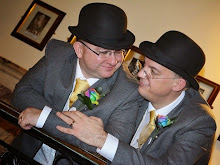
In 2014 I watched Blake’s 7 right through with my beloved Richard. But much as we enjoyed the series all over again, we’ll always remember 2014 for something much more significant to our lives together. We went back, not to the Dome – there’s one just across the river from our flat in London – but to Stockport. On our twentieth anniversary together, we got married at Stockport Town Hall.
I’d say that this was my personal triumph of freedom over dark religion, but freedom won for me so long ago that religion was barely a footnote. Though I still find stories powerful when they make strong use of religion, for good or ill, it’s only as I write this that I realise Stockport Baptist Church is a couple of minutes’ walk from the Town Hall. It’s not something that crossed my mind on the day (though I probably quoted Blake’s 7 at some point). When we made the most important decision of our lives, we were surrounded by believers in several kinds of politics and faiths and in none, including my very proud and happy Mum and Dad, but we chose each other and we chose all the people we invited for love and belief in ourselves.
The Apocrypha: Trevor Hoyle’s Blake’s 7
“Hands reached up and pushed back the cowl to reveal Kara’s evil, haunting beauty – a face that was disfigured by a kind of lustful greed… a smile that was rapturous and yet somehow obscene…”

There’s another alternative world of Blake’s 7, and of Cygnus Alpha. I was already a voracious reader when Blake’s 7 turned up, but though my memories of Cygnus Alpha are thoroughly entangled in Trevor Hoyle’s first Blake’s 7 novelisation (like the first VHS release, compressing the first four episodes), I didn’t return to it as nearly often as Target’s Doctor Who range. Wondering why, I accompanied my 2014 rewatch by buying the audiobook versions, with this part now read by Paul Darrow… And, yes, I can understand why; Hoyle’s writing style tries to be hard-boiled and usually just about hits pedestrian. The CD readers liven him up, but the main interest is the differences from the TV versions – it seems that the first book is from early drafts of the scripts, and without having seen most of the actors, while the Liberator is described backwards. My guess is that these are unadulterated script writer Terry Nation, before script editor Chris Boucher came along; there are notably fewer sharp one-liners and a much smaller part for Avon. The biggest point of interest, unexpectedly, may be his take on Time Squad, for a very different backstory to both Gan and the assassins (though Zen is far less intriguing); the biggest wasted opportunity that Hoyle seems to stick too rigidly to the scripts rather than, say, establishing Arco and Selman with roles in the London rebellion now the actors don’t need paying for an extra episode.
The very ’70s stylistic tic that most sticks out today, though, is that suddenly we’re plunged into an alternate version of Blake’s 7 where (speaking of adultery) every woman is there to be leered at. Men get sexually neutral or ugly descriptions – let’s hope he’d not seen poor Michael Keating when Vila’s a “gargoyle” – but every woman is objectified at length and, if they’re baaad girls, all the more titillating! I suspect this may have put me off when I was a boy, but hearing Gareth Thomas and Paul Darrow having to read all this first made me wince, then laugh. Though I’ll give Hoyle the benefit of the doubt that there’s an earlier Gareth Thomas series in-joke in there, I did actually laugh aloud as Paul Darrow purred:
“Avon casually looked round and then sat up straight, his eyes popping out of his head. His first thought was to wonder how a beautiful and sexy star maiden had managed to get aboard the Liberator and it took all of ten seconds to realise that it was Jenna, attired in the most magnificent – and rather revealing – space-age costume.”Or, ‘Why, Miss Jenna, you’re beautiful!’
Avon follows this by swallowing in “goggling admiration” and “real appreciation”, her with “impish seductiveness” as she’s “coyly” “posing for him”. Later, Cally will be a “young”, “stunning-attractive girl”, “incredibly beautiful”, “athletically supple”, and Blake will be unable to fathom why a “beautiful girl” should be wearing combat gear. Dear [ Blessed ]GOD![ /Blessed ] She will also have amazing eyes the like of which Blake has never seen but which the author won’t describe, so they might boggle out on springs for all we know. At least Blake won’t actually ask her what she’s doing in a place like this.
But where Hoyle really gets excited is the female villains, who are beautiful – but evil, but sexy – but evil! What a mix. And a minx.
“His companion turned towards him… and in the flickering firelight it was a face of evil, the lips twisted in a rapacious snarl, yet even so with a fascinating, hypnotic beauty.Oh, put it away. The strangest thing is that the Terry Nation draft of the script forgets about her at – forgive me – the climax, and so bizarrely does Mr Hoyle. You’d think he’d have been faster to write her an unconvincing last moment than the one Chris Boucher seems to have stuck in. ‘Only the love of a good violent criminal she’s kissed once could free her from being the Sexy Nun of Evil…’
“‘New souls for the Faith,’ said Kara in a throaty whisper, her eyes alight with sly rapture.”
Paul Darrow clearly enjoys all this schlock too, as well as capturing Gareth Thomas’ intensity rather well for Blake and compensating for half Avon’s part not having been written yet with a compelling emphasis on his own character’s lines that makes his every. Word. Twice. As. Avonnn. The whole thing is hammy as hell but very entertaining, and far more so than the prose deserves.
So it’s a good job that the TV version was so absolutely perfect – not perhaps entirely perfect as a piece of television, but perfect to broadcast directly into my six-year-old world and open up a new one.
“Let’s all go! Er… No, on the other hand, let’s all stay.”

Last year I found that I couldn’t bear blogging any more. I wish I could say that, with the pressure off, I’ve been able to write plenty of articles for my own pleasure and that this is the herald of more to come. I’m sorry. I haven’t. It isn’t. So this is perhaps a coda – something I’ve not previously published, but which isn’t technically new.
Cygnus Alpha and Omega was first published in 2015 in the book Blake’s Heaven, a collection of personal perspectives on every episode of Blake’s 7. I was delighted to be a part of it and surprised I managed to write something, though that delight has since been marred by the horrible circumstances in which the book has been withdrawn and which I don’t want to think about. But with the fortieth anniversary of the series this year, I re-read my contribution and decided it was worthwhile enough not to go to waste. It’s more personal than most of my writing, and I found as I was putting it together the first time that how resonant the themes – and some of the coincidences – were to my life. Well, bits of it.
I’ve spent a ridiculous amount of time re-reading, re-watching and re-writing in tiny perfectionist polishes preparing for tonight, some of it no doubt procrastinating to avoid having to make the decision whether or not to put something else on my blog. I have. I hope you enjoy it.
I am, at least, enjoying Blake’s 7 all over again. For what it’s worth, though Cygnus Alpha has its own special place for me, my particular highlights of the series are:
- Rumours of Death
- Star One
- Sand
- The Way Back
- Terminal
- Orbit
I’m sorry this isn’t my way back to blogging. For something cheerier, you might look up another great piece of BBC sci-fi; first broadcast on TV thirty-seven years ago this week – though, like this article, it had already done the rounds in other media – I find myself thinking of The HitchHiker’s Guide to the Galaxy Episode 3. Magrathea doesn’t properly revive from its long slumber, merely turning in its sleep to put a new spin on a previous work, but that too is about religion and, for all that I know how badly everything turned out, that it’s a cosmic joke and that the new beginning isn’t going anywhere, there is a moment at the end of that episode that still moves me more than almost any other piece of television. This piece of writing is nothing like that. But I am quite fond of the crinkly bits round the edges.
Labels: Bigotry, Blake’s 7, Books, Brian Blessed, Gay, Personal, Religion, Richard, Star Wars, The Hitchhikers Guide To the Galaxy


Wednesday, March 18, 2015
Fifty Things I Love About Britain
Fifty days until the General Election. Fifty days of nothing but ‘why Britain is terrible’. Labour say it’s terrible now they’re in, so put back in the people who made it terrible in the first place. Tories say it was terrible when they were in, so don’t let them back in. UKIP say Britain has been terrible ever since we let any of ‘them’ in and hang up their ‘No blacks, no Polish, no gays’ signs. And the Lib Dems say it’ll be a bit less terrible if we’re a bit in. So, today, only things I love about Britain.
1 – My greatest Briton
…and Earthling, and citizen of the Universe, of them all, my husband, Richard Flowers
2 – Love and marriage
Having the right to marry the person I love, if they want to too, or not to marry at all
3 – That he did want to
…and that we did, after waiting only twenty years (to the day)
That’s all I need, really, but there are forty-seven more, including food, Doctor Who, more food, the Liberal Democrats (the whole bally lot of them), so much food… And that’s all just the other stuff that was at our wedding!
4 – Doctor Who
…of course
5 – Being a nation made up of several nations
…all distinct and all having each in common, and being a people that has always been made up of many peoples and still mixing in people from everywhere else
6 – Being a nation where we all have multiple loyalties and identities
…by definition, and not letting people tell us what one thing they think we are
7 – Being always open to change
…whether it’s new people in our streets, new words in our language (often from someone else’s) or newly being comfortable with lesbian, gay, bisexual and transgender people and all sorts of other people who no longer have to be like everybody else
8 – My parents
…My Mum, who wasn’t born here but has always put her all into wherever she is, and my Dad, who was born in Glasgow, did some more growing up in Watford, and made a life for his family in Stockport, because we’re lots of different places and all one country too
9 – Inspirational heroes
…The four greatest British heroic myths: King Arthur; Robin Hood; Sherlock Holmes; and World War II
10 – Doubt
…and asking awkward questions
11 – Great big cliffs
…and windmills on hillsides
12 – Great crashing waves
…and nudist beaches when it’s bloody freezing
13 – Picturesque villages
…like Aldbourne, East Hagbourne, South Oxhey, Little Bazeley-by-the-Sea, Summerisle (but I’m more of an Escape From the Country guy, so…)
14 – Thrilling cities
…like London, Manchester, Edinburgh
15 – Stockport Town Hall
16 – The Beatles
…and especially George Harrison who, like me, swung wildly from terribly earnest to taking the piss, but who unlike me played the most gorgeous slide guitar ever heard – plus the movie of Yellow Submarine
17 – Electronic music
…from the likes of the Pet Shop Boys, The Human League, Heaven 17 and Delia Derbyshire
18 – Kate Bush
…and whatever the hell she does
19 – Punk rock
…Especially Tom Robinson and, right now, Ian Dury and the Blockheads and the wish that I could make my lists scan as well as Reasons To Be Cheerful
20 – Dame Shirley Bassey
21 – The Avengers
…Possibly the most British thing ever, and which wasn’t just style and subversion but which mattered – introducing to a mass audience the idea of intelligent, independent women who flung men over their shoulders. A fantasy of Britain where old-fashioned tradition and high-tech, sexually equal modernity went hand in hand (a hugely successful Conservative-Liberal coalition, you might say)
22 – The BBC
23 – Quatermass
…combining British ingenuity and a wish to build rocket ships with sheer naked terror (but doing it anyway)
24 – The Clangers
…encouraging us to love the alien and gently laugh at ourselves
25 – 2000AD
…the comic, not the year, particularly, which turned out a bit samey
26 – Carry On Up the Khyber
27 – Alastair Sim
…in drag
28 – BRIAN BLESSED
29 – Shakespeare
…A great many of his lines, anyway (and Queen Elizabeth the First, at least according to Blackadder)
30 – The works of JRR Tolkien
…even the ones scribbled on bits of toast and painstakingly reconstituted by his son. Mmm, toast…
31 – Clasping strange new foreign foods to our bosom
…over the centuries, making them our own so we couldn’t imagine life without them, like – the potato – and tea – and chocolate
32 – Chicken Korma
33 – Roast lamb
34 – Scotch eggs
35 – Pies
…Pies. More pies. And especially appropriate today, Pieminister pies
36 – Margaret Thatcher, Tony Benn and Nicola Sturgeon
…and the gladly exercised right to say thanks but no thanks, never have, never will
37 – William Gladstone, David Lloyd-George, Paddy Ashdown, Nick Clegg and Jo Swinson
…and the gladly exercised right to say yes, and I will again
38 – Being more or less democratic for quite a long time
39 – Mostly giving up an Empire with less fuss than is usual
40 – The NHS
…which on balance makes me go “Aaargghh!” less than it helps stop me going “Aaargghh!”
41 – Fulfilling the UN target of giving 0.7% of our national wealth in overseas aid and development
…a target set a year before I was born. It’s only in the last couple of years that we’ve finally met it (one of only about half a dozen countries that does), and in the last few weeks set it in law created by the Liberal Democrats
42 – The gap between rich and poor narrowing
…at last, over the last five years, after widening hugely ever since the 1980s
43 – The Rule of Law
…meaning that those in power get frustrated by the law applying to them too
44 – Signing the European Convention on Human Rights
…And not just being part of it, but Winston Churchill commissioning British lawyers to create it, in order to protect and spread our values
45 – Traditional British values
…like creativity, eccentricity, tolerance, generosity, fair play, standing up for the underdog, and universal, indivisible freedom
46 – Not having ID cards
…or being snooped on by the state at will, and the Liberal Democrats constantly being on guard whenever everybody else suddenly thinks that would be a good idea
47 – Making lists instead of doing anything
…making tutting sounds instead of hitting anyone, and grumbling but never giving up
48 – Inventing the train and the Internet
…even when each sometimes goes off the rails
49 – Many of the things we used to have but don’t any more
…like welcoming immigrants, Woolworths, Texan Bars, how Blackpool was in my childhood memories, The Daleks’ Master Plan, Nick Courtney, Conrad Russell and my Grandad
50 – The future
…even more than those I’ve loved and lost, and that there will always be many, many more new wonderful, beautiful, innovative, unpredictable and aggravating but loveable things to put on a list.
And that any list will be quite different for you, or even quite different for me tomorrow (I thought the best way was to write the lot off the top of my head), but still blatantly and brilliantly British.
So in fifty days’ time, why not vote for a Britain that offers more things to love than merely against the bits you don’t?
Here’s Nick Clegg on things he loves about Britain. I applauded him delivering this speech on Sunday and suspect he may have spent a bit more time and thought crafting this version than I did mine, but I agree with most of his, too.
Labels: 2000AD, BBC, Brian Blessed, British Politics, Doctor Who, Food, George Harrison, Kate Bush, King Arthur, Liberalism, Personal, Robin Hood, Sherlock Holmes, The Avengers
Saturday, May 12, 2012
The Avengers – The Morning After
No, this isn’t another post about the Coalition. It’s a strange and sinister 1969 tale of waking up in an English town to find it deserted… But why? With a script full of tension, twists and betrayal, eerie direction, terrific music and impressive guest-star turns from Peter Barkworth, Joss Ackland and Brian Blessed, The Morning After is one of The Avengers’ strongest and most gripping episodes. Steed is landed with an unexpected (and unwilling) ally and faces unexpected (and all too unflinching) enemies in this stylish mid-point between Seven Days To Noon and Doctor Who – Invasion of the Dinosaurs…
First broadcast in the Midlands 43 years ago last night (oh, all right, they showed it in London several months earlier, but it’s difficult to celebrate proper Avengers anniversaries when ITV regions all used to do their own thing), you can now find The Morning After on Disc 6 of The Avengers – The Complete Series 6 DVD Box Set, or Disc 35 in The Avengers Complete 50th Anniversary Collection. I’ve previously offered tips on which The Avengers DVDs to buy. You may be surprised, though, at how little Tara King appears in this episode from her season of the show; with Series 6 half as long again as any of the others, both Linda Thorson and Patrick Macnee had to have a couple of ‘holiday’ episodes each. I’m a huge admirer of Tara, as I’ve gone into before in The Avengers – Game and My Wildest Dream, but Steed’s new best enemy in The Morning After more than makes up for her absence, a help and hindrance who’s surely the best of the one-off Avengers.
Having written about Seven Days To Noon a week ago, it’s appropriate to recognise the debt this story owes to that film while still being very much its own show. For me, of all the closest variations on that central idea (the original, this, Doctor Who – Invasion of the Dinosaurs and The New Avengers – Sleeper) this is arguably the best, with a clear identity of its own and told with more economy, great visual style and an outstanding musical score. It turns the film’s central threat on its head, an idea which goes on to be swallowed whole by Invasion of the Dinosaurs; it’s probably a coincidence, but a satisfying one, that it deploys a minor young actor from the film, Joss Ackland, as a major guest star two decades later; and it may well be deliberate that it hires stock film shot for Seven Days To Noon to depict its own evacuation scenes, though intriguingly often off-cuts from the film rather than those used in the final version, such as a different edit of men hammering up an evacuation sign (Tat Wood put me onto this in his Doctor Who guidebook About Time 3, though take its thumbnail plot summary of this with a pinch and, for Homicide and Old Lace, a lorryload of salt). Its focus, punch and production values are way ahead of the Doctor Who, although that shares with Seven Days To Noon a greater political depth, while I’ve said before that Sleeper, while mostly enjoyable and looking impressive, is by far the least interesting of these, having no twists, nothing to say and, for all its attempt at ‘urban realism’, pulling almost all its punches (it even takes the near-comic relief gas from this episode and makes it the main plot). True, the others have over The Morning After the ambition and unsettling impact of a deserted London, though this story’s less iconic ‘everytown’ has its own claustrophobic effect. On which note…
The Avengers doesn’t do ‘continuity’ – but could a man in a clown mask raiding the Ministry of Technology and Scientific Innovation suggest an old enemy? No. It’s just yet another of those sort of openings, here at least done more briskly and impishly than in previous episodes, then jumping straight to a busy, noisy town somewhere in England, where Steed and Tara lie in wait for him (no spending half the episode working out how he got in or what he’s stolen). I told you this started with a fast-moving Bond mini-adventure, didn’t I? And already, it’s unsettling; Steed never carries a gun. But against quadruple agent Jimmy Merlin, an adversary as playful, as charming and as dangerous as he is, Steed jarringly arms himself. Our heroes get the jump on Merlin; he jumps back to fling down the new sleeping gas capsule he’s stolen; but Steed’s locked the door, so as the little rendezvous fills with gas, all three go down. There’s a thrilling freeze-frame for the title as the phone starts to ring and suddenly music crashes in, fast, bombastic and threatening.
The most gripping part of the story for me is on the morning after; Steed wakes first, the busy town suddenly silent save for a dog howling miserably. Only emphasising the silence, eerie music drifts into the scene, like the wind. Steed tries the phone – no connection. The same with the red callbox outside – from where he can see a car crashed into bins and abandoned. All around, things smashed and left, and not a soul. With Tara still deeply unconscious, Steed testily wakes a protesting Merlin and drags him down to the yellow Rolls, eager to hand him over now he’s captured. I love the banter between the two fabulous characters as everything the camera shows us makes us – and them – more worried, right from Steed cheerily telling Merlin to enjoy the view while he can: usually, in The Avengers, glorious countryside; here, the garage door. And Steed has to enjoy the drive while he can, too, as soon he runs into an empty truck used as a roadblock and has no choice but to handcuff the two of them together and start walking…
It helps enormously that all of this is out on location, on a sunny day, so you can see right down long, narrow, slightly claustrophobic streets. This was The Avengers’ most ambitious location shoot to date (later beaten in that, I think, by Sleeper), and for this eerie ‘everytown’ director John Hough carefully slices together non-contiguous parts of Watford, Old Hatfield and, particularly, St Albans, most blatantly when the streets suddenly give way to the Cathedral, zooming on the little pram and dollies left behind in its grounds. That always gives me a bit of a turn, as I remember the place vaguely from a single childhood visit with my Nana and Grandad (who lived in the other end of Watford), though the cathedral also offers some mirth if you watch carefully; as Steed and Merlin walk and talk, you keep seeing it poking up in the background in different shots, but never in the same place. You could say that it shows they’re going round in circles; you might just shrug that they’re cutting together lots of different locations; but it keeps looking like the cathedral is tiptoeing from side to side, stalking them.
Brian Clemens’ script is merciless, telling you nothing more of what’s going on than Steed and Merlin can see, and even as Act One draws to a close with eerie exploration shifting to sudden threat, there are no answers – just Merlin starting to ask some of the same questions as the audience. Where has everybody gone? And why? Was it an emergency? A mass kidnapping? War, plague, radiation…? Your mind races through all of Terry Nation’s favourite plot devices, not least because he’s script editor here (is this why he and Clemens fell out over who had the idea for Survivors? All so much more absorbing than Sleeper, which tells you what’s going in the pre-titles sequence). Even the bank’s deserted, notes fluttering everywhere, and no-one comes running when Steed sounds the alarm. Or do they? Now there’s a black, silent VW camper van gliding through the streets – robots? Remote control? Hypnotism? Then, just as Merlin and Steed explode into action, there’s that shockingly loud, thundering fanfare again, not a march but a dash, soldiers running through the streets to shoot a little man down as a “LOOTER!” And if you think the capital-lettered sign they toss onto him is shouting, the man giving the order to fire (camera appropriately zooming on his mouth in close-up) is Sergeant Brian Blessed!
Peter Barkworth, Merlin the spy before John le Carré, is a simply sublime guest star and, while I’d put My Wildest Dream just a touch ahead in the terrific episode stakes, Merlin makes a far better anti-Steed than the villain there. Charming and dangerous, tricky and devious, even more playful – sometimes gleeful – but far more cowardly than our hero, he doesn’t look as flamboyant (a straighter hat, a more buttoned-up look, a dark overcoat, as if he wants to stay unnoticed in the shadows) but has his own showiness, not least his conjuror’s-trick habit of producing whatever he needs from his sleeve. It’s a marvellous performance, easily the best and biggest of Barkworth’s four Avengers roles (one lost, a frosty businessperson in The Medicine Men, a well-mannered warrior in The Correct Way To Kill), dragged along, always complaining, never trustworthy – until Steed catches him out and leads him into the jaws of death. They make a very entertaining team. Look out for a particularly priceless exchange where each gives the other three reasons for investigating, or for running away, and just why Steed eventually uncuffs him…
With Linda Thorson recharging her own batteries for the week, Tara gets a couple of good moments – praised at the start, an impressive knockout punch later – but is largely asleep with a teddy (not Chilcott) and in a red and white trouser suit, which isn’t bad but makes her seem a bit young. For anyone missing an Avengers woman for a week, half-way through we meet Jenny Firston, played by Penelope Horner. She’s not bad, if a little flat, and after a rather undignified entrance has little to do save act as the exposition and then hide; if you’ve seen Doctor Who – Invasion of the Dinosaurs, you may just expect to find a plucky female journalist sneaking in for the scoop, and she even has a man called Yates teamed with her who isn’t much help. Her exposition is rather stylishly by television, though it slightly clumsily underlines that they’ve not given the ‘everytown’ a name: “This town has become a ghost area” seems very laboured, when anyone would naturally say ‘This has become a ghost town’.
But why has this ghost town been evacuated, and the fifty square miles surrounding it? Spoilers follow shortly…
Late ’60s Avengers episodes look gorgeous on DVD, shot on film and in colour, and with the current full-season (or complete series) box sets they’ve not only been cleaned up beautifully but have been given a few extra features – though, while the look of the episodes mostly beats Doctor Who hands down, the value added material is still some way behind. While almost every Doctor Who DVD release has a full set of commentaries, they’re rare for The Avengers, so it’s cheering that on this (one of my favourites) director John Hough is there to give his recollections, ably questioned by Jaz Wiseman. Hough’s direction is particularly impressive here; not quite as exuberantly inventive as Robert Fuest but still with a great deal of style, equally able in building atmosphere for the unsettlingly empty streets and then in giving it lots of pace and energy as the soldiers crash into the story.
John Hough has some intriguing insights into this story in particular – how to match Peter against Patrick as the two leads so that both could let their own charisma flow and battle each other’s characters without overshadowing each other, or how though it took more hard work than usual to create so much of the empty town, it was only one step up from the way The Avengers always eschewed extras to create its own world – but, with few commentaries about for the series, it’s mostly more of an extended interview than a bantering, story-led traditional commentary. It ranges over his four episodes as full director (he returned for one especially good New Avengers) and how he started off as second unit director, having got that post on The Avengers following The Saint after he and Ray Austin managed to swap jobs. He explains how the series doing it differently led to such high quality, with good words to say about the likes of Linda Thorson, Patrick Macnee, and most of all producers Albert Fennell and Brian Clemens. Though not about the Movie. And, like me, he admired Patrick Macnee’s special velvet collars, though unlike me he went to Patrick’s tailor and got one (it looks like you can see it in the Photo Gallery for Super Secret Cypher Snatch)!
So, now, are you ready for the spoilers on what was going on?
Much of The Avengers takes place in a highly stylised fantasy of Britain, sometimes called ‘AvengerLand’, with highly stylised characters within it. Here, the threat is more grim and real-world than usual, though it’s still informed by Avengers themes and, in the extensive location shooting, brings ‘AvengerLand’ further than it’s ever been before in transforming the real world. Rather than outlandish sets, rolling countryside or picturesque villages called Little Storping-in-the-Swuff, this ambitiously turns a whole town inside-out and into Avengers country, closer to most viewers’ experiences but more unsettlingly different at the same time. And it’s unsettlingly different for Steed, too, as rather than be sent in to investigate the mystery, here he simply wakes up in the midst of it and becomes a hunted fugitive, the full force of the authorities seemingly out to kill him, a reversal that gives him new oomph.
Army nuclear expert Brigadier Hansing has detected an atomic bomb secreted by one of the unfriendly governments who backed the old Eastern Hemisphere Trade Commission in town, and enforces martial law while he’s staying in the evacuated area to dismantle the bomb. Or is he? The conspiracy goes right to the top, with Joss Ackland as Hansing moving deftly from sternly efficient, to snarling brutal orders, to just a few notches below his full Hollywood-villain-boggler of later years. Hansing’s due to be pensioned off in favour of a computer and, as with so many Avengers villains motived by either amity or animosity towards technology, turns. His good old British nuclear shock troop platoons are lying drugged in their trucks while merciless mercenaries led by the excellent Donald Douglas and the even more outstanding Brian Blessed shoot anyone on the streets and Hansing supervises not the dismantling of an imaginary bomb but the installation of a real one, ready to blackmail the government with no time for evacuation once the town’s population returns (though while he’s in it for money and pride, it’s never made entirely clear just what his “Eastern Hemisphere” backers are aiming for. It might have been interesting to hear they intended to double-cross him in turn, and blow up the bomb anyway).
I should mention the final moment designed to defuse the tension, the traditional light-hearted ‘tag scene’; in Steed’s flat, it’s immediately rather jarring, as it’s the only scene since the pre-titles where we’ve not been trapped in that unfamiliar town. Unusually, there is a link to the main plot – something else Merlin’s stolen – but it’s not a particularly good gag and, for once, not particularly well done (dialogue or lighting). And though Tara’s back, in rather a shimmery frock, Steed’s tux is a bit much. If it ends on a slight disappointment, though, The Morning After’s still been one of The Avengers’ strongest episodes, and showing great confidence in doing something so different in tone so late in the series. That confidence even shows through in what might be the best moment of that tag scene: Steed, enjoying the TV, hears one hand clapping and sighs, “Sock it to me,” the catchphrase of Rowan and Martin’s Laugh-In, which was right then causing problems for the series when scheduled against it on US TV. It was very interesting to show even Steed fondly watching their opposition… But it was also stupid. Though I think it was more interesting than stupid…
First broadcast in the Midlands 43 years ago last night (oh, all right, they showed it in London several months earlier, but it’s difficult to celebrate proper Avengers anniversaries when ITV regions all used to do their own thing), you can now find The Morning After on Disc 6 of The Avengers – The Complete Series 6 DVD Box Set, or Disc 35 in The Avengers Complete 50th Anniversary Collection. I’ve previously offered tips on which The Avengers DVDs to buy. You may be surprised, though, at how little Tara King appears in this episode from her season of the show; with Series 6 half as long again as any of the others, both Linda Thorson and Patrick Macnee had to have a couple of ‘holiday’ episodes each. I’m a huge admirer of Tara, as I’ve gone into before in The Avengers – Game and My Wildest Dream, but Steed’s new best enemy in The Morning After more than makes up for her absence, a help and hindrance who’s surely the best of the one-off Avengers.
Having written about Seven Days To Noon a week ago, it’s appropriate to recognise the debt this story owes to that film while still being very much its own show. For me, of all the closest variations on that central idea (the original, this, Doctor Who – Invasion of the Dinosaurs and The New Avengers – Sleeper) this is arguably the best, with a clear identity of its own and told with more economy, great visual style and an outstanding musical score. It turns the film’s central threat on its head, an idea which goes on to be swallowed whole by Invasion of the Dinosaurs; it’s probably a coincidence, but a satisfying one, that it deploys a minor young actor from the film, Joss Ackland, as a major guest star two decades later; and it may well be deliberate that it hires stock film shot for Seven Days To Noon to depict its own evacuation scenes, though intriguingly often off-cuts from the film rather than those used in the final version, such as a different edit of men hammering up an evacuation sign (Tat Wood put me onto this in his Doctor Who guidebook About Time 3, though take its thumbnail plot summary of this with a pinch and, for Homicide and Old Lace, a lorryload of salt). Its focus, punch and production values are way ahead of the Doctor Who, although that shares with Seven Days To Noon a greater political depth, while I’ve said before that Sleeper, while mostly enjoyable and looking impressive, is by far the least interesting of these, having no twists, nothing to say and, for all its attempt at ‘urban realism’, pulling almost all its punches (it even takes the near-comic relief gas from this episode and makes it the main plot). True, the others have over The Morning After the ambition and unsettling impact of a deserted London, though this story’s less iconic ‘everytown’ has its own claustrophobic effect. On which note…
That Golden Moment
“Do you think the world’s ended, and they forgot to tell us?”The Avengers doesn’t do multi-part stories with cliffhangers – except that, made for an hour ITV slot in the ’60s, each fifty-minute Avengers episode usually splits into four ‘Acts’, each designed to come to a climax, then fade to black for the ad break. And the first Act of The Morning After is an outstanding example of the style, eighteen minutes opening with an exciting James Bond-style mini-adventure preview, then plunging into Steed’s forced exploration of a mystery in which he’s on his own – no briefing, no Mother to send him in, and no Tara to watch his back. And it’s as gripping for the audience as it is disturbing for our hero, building steadily until a sudden burst of action and the first death, inevitably, to keep you breathless through the adverts that aren’t there.
The Avengers doesn’t do ‘continuity’ – but could a man in a clown mask raiding the Ministry of Technology and Scientific Innovation suggest an old enemy? No. It’s just yet another of those sort of openings, here at least done more briskly and impishly than in previous episodes, then jumping straight to a busy, noisy town somewhere in England, where Steed and Tara lie in wait for him (no spending half the episode working out how he got in or what he’s stolen). I told you this started with a fast-moving Bond mini-adventure, didn’t I? And already, it’s unsettling; Steed never carries a gun. But against quadruple agent Jimmy Merlin, an adversary as playful, as charming and as dangerous as he is, Steed jarringly arms himself. Our heroes get the jump on Merlin; he jumps back to fling down the new sleeping gas capsule he’s stolen; but Steed’s locked the door, so as the little rendezvous fills with gas, all three go down. There’s a thrilling freeze-frame for the title as the phone starts to ring and suddenly music crashes in, fast, bombastic and threatening.
The most gripping part of the story for me is on the morning after; Steed wakes first, the busy town suddenly silent save for a dog howling miserably. Only emphasising the silence, eerie music drifts into the scene, like the wind. Steed tries the phone – no connection. The same with the red callbox outside – from where he can see a car crashed into bins and abandoned. All around, things smashed and left, and not a soul. With Tara still deeply unconscious, Steed testily wakes a protesting Merlin and drags him down to the yellow Rolls, eager to hand him over now he’s captured. I love the banter between the two fabulous characters as everything the camera shows us makes us – and them – more worried, right from Steed cheerily telling Merlin to enjoy the view while he can: usually, in The Avengers, glorious countryside; here, the garage door. And Steed has to enjoy the drive while he can, too, as soon he runs into an empty truck used as a roadblock and has no choice but to handcuff the two of them together and start walking…
“Any chance of making a deal?”And of course, in this strange setting, suddenly neither can get what they want. It’s a terrific sequence with superb cinematography as the two stroll through the deserted town, nothing but keening music to keep them company. And it’s a brilliant idea to use all the humour to build tension, every line played like a gag between them but juxtaposed with the emptiness yawning around them: the policeman’s helmet on the ground and in the foreground as we see them, tiny and lost, far beyond it; the high, old-fashioned buildings looming above them; the sack of spilled coal, the milk bottles, surely to Steed most disturbingly the abandoned pub with drinks left unfinished. And while both actors keep their tone light, their faces are at odds with their voices. Patrick Macnee’s Steed is determined but disturbed, keenly observing; Peter Barkworth’s Merlin jittery and increasingly desperate. Watch Steed knowing that “It’s lonely up there” merely reflects ‘here’; watch Merlin’s little face fall as Steed keeps raising and dashing his hopes.
“I shouldn’t have thought so, but keep talking.”
“Twenty thousand? In a Swiss bank? No names, no strings?”
“Pounds?”
“Yes!”
“Very sorry, old chap. Only deal in guineas.”
“Well, I could throw in a yacht.”
“I’ve had one.”
“My private plane?”
“It’s lonely up there.”
“String of Arab ponies?”
“Prefer palominos.”
“Well, how about… A villa? France?”
“Whereabouts?”
“St Tropez.”
“Prefer Provence.”
“Oh, for heaven’s sake, Steed – isn’t there anything you want?”
“Yes. There’s one thing I want very much. You – behind bars.”
It helps enormously that all of this is out on location, on a sunny day, so you can see right down long, narrow, slightly claustrophobic streets. This was The Avengers’ most ambitious location shoot to date (later beaten in that, I think, by Sleeper), and for this eerie ‘everytown’ director John Hough carefully slices together non-contiguous parts of Watford, Old Hatfield and, particularly, St Albans, most blatantly when the streets suddenly give way to the Cathedral, zooming on the little pram and dollies left behind in its grounds. That always gives me a bit of a turn, as I remember the place vaguely from a single childhood visit with my Nana and Grandad (who lived in the other end of Watford), though the cathedral also offers some mirth if you watch carefully; as Steed and Merlin walk and talk, you keep seeing it poking up in the background in different shots, but never in the same place. You could say that it shows they’re going round in circles; you might just shrug that they’re cutting together lots of different locations; but it keeps looking like the cathedral is tiptoeing from side to side, stalking them.
Brian Clemens’ script is merciless, telling you nothing more of what’s going on than Steed and Merlin can see, and even as Act One draws to a close with eerie exploration shifting to sudden threat, there are no answers – just Merlin starting to ask some of the same questions as the audience. Where has everybody gone? And why? Was it an emergency? A mass kidnapping? War, plague, radiation…? Your mind races through all of Terry Nation’s favourite plot devices, not least because he’s script editor here (is this why he and Clemens fell out over who had the idea for Survivors? All so much more absorbing than Sleeper, which tells you what’s going in the pre-titles sequence). Even the bank’s deserted, notes fluttering everywhere, and no-one comes running when Steed sounds the alarm. Or do they? Now there’s a black, silent VW camper van gliding through the streets – robots? Remote control? Hypnotism? Then, just as Merlin and Steed explode into action, there’s that shockingly loud, thundering fanfare again, not a march but a dash, soldiers running through the streets to shoot a little man down as a “LOOTER!” And if you think the capital-lettered sign they toss onto him is shouting, the man giving the order to fire (camera appropriately zooming on his mouth in close-up) is Sergeant Brian Blessed!
Steed and Merlin
“Your friend wasn’t very brave.”The Morning After is a great episode for Steed, as he carries most of it and almost has to carry unwilling burden Merlin – a much more sober than usual performance, though still with plenty of Patrick Macnee’s charm. Against the usual flamboyant parade of outfits, this time he’s in the same suit from the teaser right up until the last couple of minutes; this isn’t London, and there’s no friendly flat to pop back to for a change of clothes and a glass of champagne. Fortunately, the brown with that trademark velvet collar suits him, and he stays immaculate throughout, of course (even if it seems strangely improbable that, confronting Merlin at the start, he has a touch of uncharacteristic five o’clock shadow, but is as beautifully clean-shaven as always on waking a day later).
“He’s a big disappointment to me.”
Peter Barkworth, Merlin the spy before John le Carré, is a simply sublime guest star and, while I’d put My Wildest Dream just a touch ahead in the terrific episode stakes, Merlin makes a far better anti-Steed than the villain there. Charming and dangerous, tricky and devious, even more playful – sometimes gleeful – but far more cowardly than our hero, he doesn’t look as flamboyant (a straighter hat, a more buttoned-up look, a dark overcoat, as if he wants to stay unnoticed in the shadows) but has his own showiness, not least his conjuror’s-trick habit of producing whatever he needs from his sleeve. It’s a marvellous performance, easily the best and biggest of Barkworth’s four Avengers roles (one lost, a frosty businessperson in The Medicine Men, a well-mannered warrior in The Correct Way To Kill), dragged along, always complaining, never trustworthy – until Steed catches him out and leads him into the jaws of death. They make a very entertaining team. Look out for a particularly priceless exchange where each gives the other three reasons for investigating, or for running away, and just why Steed eventually uncuffs him…
“I’m too young to die!”Not a new man on the team but so fresh he sounds like it, composer Laurie Johnson adds to the feel of ‘The Avengers, but suddenly harder-edged’ with one of his very best original scores. After providing all the music for the Diana Rigg episodes, often reusing and reworking themes into old friends, Laurie Johnson had taken some time off while working on a musical, handing over several of the Tara King scores to Howard Blake. And that clearly recharged his batteries, as the soundtrack here is not just one of his best but strikingly different to his usual.
“You’re over 21.”
“If I were eighty, I’d still feel the same!”
With Linda Thorson recharging her own batteries for the week, Tara gets a couple of good moments – praised at the start, an impressive knockout punch later – but is largely asleep with a teddy (not Chilcott) and in a red and white trouser suit, which isn’t bad but makes her seem a bit young. For anyone missing an Avengers woman for a week, half-way through we meet Jenny Firston, played by Penelope Horner. She’s not bad, if a little flat, and after a rather undignified entrance has little to do save act as the exposition and then hide; if you’ve seen Doctor Who – Invasion of the Dinosaurs, you may just expect to find a plucky female journalist sneaking in for the scoop, and she even has a man called Yates teamed with her who isn’t much help. Her exposition is rather stylishly by television, though it slightly clumsily underlines that they’ve not given the ‘everytown’ a name: “This town has become a ghost area” seems very laboured, when anyone would naturally say ‘This has become a ghost town’.
But why has this ghost town been evacuated, and the fifty square miles surrounding it? Spoilers follow shortly…
Commentary and Conspiracy (Or – Spoilers – What’s It All About, Ackland?)
Late ’60s Avengers episodes look gorgeous on DVD, shot on film and in colour, and with the current full-season (or complete series) box sets they’ve not only been cleaned up beautifully but have been given a few extra features – though, while the look of the episodes mostly beats Doctor Who hands down, the value added material is still some way behind. While almost every Doctor Who DVD release has a full set of commentaries, they’re rare for The Avengers, so it’s cheering that on this (one of my favourites) director John Hough is there to give his recollections, ably questioned by Jaz Wiseman. Hough’s direction is particularly impressive here; not quite as exuberantly inventive as Robert Fuest but still with a great deal of style, equally able in building atmosphere for the unsettlingly empty streets and then in giving it lots of pace and energy as the soldiers crash into the story.
John Hough has some intriguing insights into this story in particular – how to match Peter against Patrick as the two leads so that both could let their own charisma flow and battle each other’s characters without overshadowing each other, or how though it took more hard work than usual to create so much of the empty town, it was only one step up from the way The Avengers always eschewed extras to create its own world – but, with few commentaries about for the series, it’s mostly more of an extended interview than a bantering, story-led traditional commentary. It ranges over his four episodes as full director (he returned for one especially good New Avengers) and how he started off as second unit director, having got that post on The Avengers following The Saint after he and Ray Austin managed to swap jobs. He explains how the series doing it differently led to such high quality, with good words to say about the likes of Linda Thorson, Patrick Macnee, and most of all producers Albert Fennell and Brian Clemens. Though not about the Movie. And, like me, he admired Patrick Macnee’s special velvet collars, though unlike me he went to Patrick’s tailor and got one (it looks like you can see it in the Photo Gallery for Super Secret Cypher Snatch)!
So, now, are you ready for the spoilers on what was going on?
Much of The Avengers takes place in a highly stylised fantasy of Britain, sometimes called ‘AvengerLand’, with highly stylised characters within it. Here, the threat is more grim and real-world than usual, though it’s still informed by Avengers themes and, in the extensive location shooting, brings ‘AvengerLand’ further than it’s ever been before in transforming the real world. Rather than outlandish sets, rolling countryside or picturesque villages called Little Storping-in-the-Swuff, this ambitiously turns a whole town inside-out and into Avengers country, closer to most viewers’ experiences but more unsettlingly different at the same time. And it’s unsettlingly different for Steed, too, as rather than be sent in to investigate the mystery, here he simply wakes up in the midst of it and becomes a hunted fugitive, the full force of the authorities seemingly out to kill him, a reversal that gives him new oomph.
Army nuclear expert Brigadier Hansing has detected an atomic bomb secreted by one of the unfriendly governments who backed the old Eastern Hemisphere Trade Commission in town, and enforces martial law while he’s staying in the evacuated area to dismantle the bomb. Or is he? The conspiracy goes right to the top, with Joss Ackland as Hansing moving deftly from sternly efficient, to snarling brutal orders, to just a few notches below his full Hollywood-villain-boggler of later years. Hansing’s due to be pensioned off in favour of a computer and, as with so many Avengers villains motived by either amity or animosity towards technology, turns. His good old British nuclear shock troop platoons are lying drugged in their trucks while merciless mercenaries led by the excellent Donald Douglas and the even more outstanding Brian Blessed shoot anyone on the streets and Hansing supervises not the dismantling of an imaginary bomb but the installation of a real one, ready to blackmail the government with no time for evacuation once the town’s population returns (though while he’s in it for money and pride, it’s never made entirely clear just what his “Eastern Hemisphere” backers are aiming for. It might have been interesting to hear they intended to double-cross him in turn, and blow up the bomb anyway).
“You have been found guilty of looting!”A shoot-to-kill policy is, of course, just not British – except when it is – and you can see the effect it has on Steed; not concerned for himself, but neatly underplayed doubt that they’re genuine and fear that they might be. It’s a conspiracy thriller quite unlike any other Avengers, full of twists and betrayal, and as well as cleverly subverting the motivations of Seven Days To Noon, when we see soldiers running along house-to-house searches they become far more sinister, the film’s subtext become the text. And, in villainous ’tache, it’s Brian Blessed who barks their orders, on the cusp of serious stardom, already known for Z Cars, still in a working class role, some great asides as he tells Steed he’s not a regular (he gets the drink; Steed doesn’t; he doesn’t drink like Steed does, though), but in an early example of SHOUTING!
I should mention the final moment designed to defuse the tension, the traditional light-hearted ‘tag scene’; in Steed’s flat, it’s immediately rather jarring, as it’s the only scene since the pre-titles where we’ve not been trapped in that unfamiliar town. Unusually, there is a link to the main plot – something else Merlin’s stolen – but it’s not a particularly good gag and, for once, not particularly well done (dialogue or lighting). And though Tara’s back, in rather a shimmery frock, Steed’s tux is a bit much. If it ends on a slight disappointment, though, The Morning After’s still been one of The Avengers’ strongest episodes, and showing great confidence in doing something so different in tone so late in the series. That confidence even shows through in what might be the best moment of that tag scene: Steed, enjoying the TV, hears one hand clapping and sighs, “Sock it to me,” the catchphrase of Rowan and Martin’s Laugh-In, which was right then causing problems for the series when scheduled against it on US TV. It was very interesting to show even Steed fondly watching their opposition… But it was also stupid. Though I think it was more interesting than stupid…
Labels: Brian Blessed, DVD, Film, Jon Pertwee, Music, Reviews, The Avengers, The Avengers Season 6, The New Avengers
Wednesday, November 16, 2011
DVD Detail: Doctor Who – The Trial of a Time Lord: Mindwarp
Mindwarp is one of the most extraordinary-looking Doctor Who stories ever made – sometimes brilliantly, sometimes just breathtakingly ’80s. Bright pink! Bright blue! Bright orange! And as well as the scenery, some of the people look like that, too. Today* is officially Peri’s birthday, and this was her final story with the Doctor, building up to a shock ending… Or is it? Add a memorable villain, guest stars who return with David Tennant, and behind it all, the Doctor’s still on trial: has the evidence here been falsified? Why is he behaving so strangely? And can he out-act Brian Blessed?
A couple of months ago, I wrote about the opening four episodes of Doctor Who – The Trial of a Time Lord… And, twenty-five years ago this evening, that superb cast led by Colin Baker and Michael Jayston was still in the middle of it. Before you watch Mindwarp, the second set of four episodes, you’re best off watching those earlier ones, The Mysterious Planet – not that you have to go out of your way to do so, as they’re all part of the same The Trial of a Time Lord DVD box set. The two mini-stories have much in common: the same ‘Trial’ framing device; the same lead actors; the same postmodern attitude to the series being on trial by hostile BBC executives, as I wrote last time. What’s different about this one is that it’s a much less straightforward narrative – to the extent that even the actors and director didn’t know what was supposed to be going on for some of it. And so it’s possible to slightly unfairly sum up the four mini-stories that make up The Trial of a Time Lord two by two: the odd-numbered stories as not very odd at all, but a bit forgettable; the even-numbered stories as memorable messes, full of interesting ideas but few of them complementing each other. I don’t know if this explains the bulk of fans’ relatively low opinion of Mindwarp (while a few think it brilliant), but it’ll do for mine (and why I have a very high opinion of some of it). Back in September 2009, Doctor Who Magazine 413 published “The Mighty 200” – 6,700 fans’ votes on all 200ish TV Doctor Who stories to that point – and placed the whole Trial of a Time Lord 142nd (about right, to me) but this second set of four episodes at a lowly 160ish (not far off for me either, though I might put it as much as ten places higher).
While this ‘Detail’ obviously goes into some detail, incidentally, my policy in these is not to be too spoilery. So read on without fear of finding out too many key twists from the end. Should there be such things (tip: if you’ve not seen this, don’t read the comedy sketch at the bottom).

In the caverns of Thoros-Beta, profit is in progress, with Lord Kiv and the self-styled Mentors piling up trade with other cultures – if necessary, by lethal force (or even by recycling old costumes). And while the wriggling other Mentors led by Kiv’s aide Sil have no love or loyalty for their leader, they’re desperate to keep him alive for his brilliant business brain, without which they might all end up dead or, worse than that, poor. But that very brain is fatally expanding within his slimy skull, and only the greatest – as he’d be the first to tell you – doctor in the galaxy can transfer it to a new frame. The first ‘monster’ we meet in the story is a forewarning of this, as well as a basically terrible piece of design kept wisely in the dark, then almost redeemed by the way people chat about him afterwards like he was Harold down the chip shop.
Colin Baker makes the most of a wildly inconsistent script, Brian Blessed is at his most BRIAN BLESSED, and Nicola Bryant is terrific as she approaches her end, but it’s stolen from all of them by Patrick Ryecart as Crozier, playing it so intense and deadpan that he becomes much funnier – and more sinister – than anyone else. Confined mostly to one set, dressed for citrus insanity in lemon and then orange, he’s somehow still the centre of the story. An obsessive rather than the ‘mad scientist’ that the brain transplant storyline might suggest, he’s marvellously self-centred, regarding anything bar his medical experiments as an utter waste of his time. And, though with brilliant touches of eccentric charisma, as Patrick Ryecart has explained his part, he’s more Nazi than nice. Clipped, staccato, disturbing and funny, you can see how he can go on to give such a great sit-com performance as the awesomely continuity-error-in-reality-named Captain Hilary Duff.
Kiv rambles wonderfully about his donor body-to-be having an primitive sting at the end of its tail – and how “I could, perhaps, sting all my assistants to death!” – as they prepare to operate; the Doctor camps up his pleasure at being allowed to monitor the equipment; Crozier eyes the Doctor like a wolf assessing a tailored suit (in a threatening plotline that, unfortunately, never goes anywhere, built up until suddenly dismissed in a late aside, as if they’d just thrown the script in the air and picked the bits up at random… Similarly, the nature of Crozier’s experiments changes at the last minute and makes a nonsense of much of the earlier dialogue); piercing music echoes; Crozier’s eyes narrow in a fabulously crazed single moment as he begins the operation. Later, Kiv will come round and see a thing of beauty; later still, Crozier’s eyes shine as he sees his ambition to conquer death within his grasp… But my favourite moment of him is tiny, arrogant, and perfect, and brilliantly down to Patrick Ryecart and a bit of business. Once the operation’s complete and the spectators have drifted away, Crozier is simply how we imagine every brilliant surgeon to be: dismissive and rude to his patient, and only caring for his own achievement. In a scene framed by a gorgeous effects shot of the arching roof of his lab, he’s sipping a cup of tea when his assistant, Alibe Parsons’ glamorous Matrona Kani, alerts him to something going wrong. Crozier takes this in at a glance:
Patrick Ryecart and Brian Blessed spar deliciously in rival interviews in the ‘Making of’ – the former saying the latter needs to be licenced, the latter that the former never knew his bloody lines (and, to show he’s watched it, tipping his tea. Patrick Ryecart is still as reliable today; he didn’t turn up to a convention earlier this year, and was represented on stage by a dummy in his orange surgeon’s gown to wicked lines from Alibe Parsons). Other stories found on the disc will reveal a moment when Mr Blessed, too, may not have got his own lines word-perfect…
While the postmodern commentary of the Trial impinging on the ‘main’ story got in the way on The Mysterious Planet, here it suddenly works better on a much more fragmentary story where the viewers, too, must be arguing about what’s really going on. Informed by Philip Martin’s groundbreaking series Gangsters (from whom it borrows Alibe Parsons), the hints of today’s interactivity make it seem far more modern. So while, for me, this isn’t the best segment of the Trial, it’s the one that makes best use of the overarching story in its own, with the interruptions resembling a DVD commentary in which cast members argue over the deleted scenes and try to salvage their own parts in a box-office disaster. It’s not the a clever noir-style plot the format could have led to, an unreliable narrator usually works better when the production end has more of an idea than the audience, and there are still riskily near-the-knuckle complaints such as calling it “inconsequential silliness” and “gratuitous,” but when the Valeyard counting the precise number of times the Doctor and his companions have respectively been in danger is a point-perfect echo of Mary Whitehouse, ticking off numbers of unsuitable incidents with no regard for narrative, and when Michael Jayston sarcastically invites us to watch “The Doctor’s next – frightening adventure,” you feel that they at least knew what they were doing better than Gerald Ratner.
The sparring between Colin Baker and Michael Jayston suddenly becomes more dangerous as the stakes rise: the Doctor becomes less playground and more lost; the Valeyard seems to know exactly where to twist the knife to stir up self-loathing in the Doctor; and his “Who else is there?” booming out of the sky is one of the few times he makes a telling point, a dramatic moment that almost anticipates the Doctor damning him as a second-rate god at the climax.
You can see how good Colin Baker is when the script deals him an almost crippling blow: as Colin glumly notes on the commentary, it takes him back to square one, completely destroying the character progression planned for his Doctor. Conceived as a ‘Mr Darcy’ who begins aloof and to whom we slowly warm, lead writer Eric Saward was utterly hopeless at writing that overarching story from the first, when The Twin Dilemma’s terrible writing blighted him. Just as finally, and far more thanks to the actor than his scripts, the Doctor has been mellowing, this story magnifies his ‘nice or nasty’ struggle without planning or revealing which bits are which. And the script editor had the nerve to blame other people? No wonder Philip Martin saw him as mentally fragile and “a bad guy pretending to be good” – which is when the lead writer should have stepped in to contextualise, rather than piss off. Mr Martin explains some of where he thought he was coming from on the commentary, but this is the first anyone’s heard of it – while the confusion of the Doctor being good, bad, mad or fake isn’t helped when none of the rest of the story can decide what it is, either (horror, comedy, sci-fi, barbarian swordplay, vivisection, a Dallas satire with green slugs as the Ewings, or a runaround with rebels?). On The Mysterious Planet, I talked about how seeing that when I was fourteen led to empathy with existential crises; something else I’d become very aware of at that age sprang to mind watching the ‘Doctor jiggles about too enthusiastically’ cliffhanger on broadcast, so I’ve always been amazed no-one said ‘Hang on…’ before it went out. What it looks like has always distracted me from the key turning point in the story, after which it’s anyone’s guess whether the Doctor’s in his right mind, in Brian Blessed’s, or simply invented. Though one scene, at least, is obvious, even if it was horrible for Nicola Bryant: the Doctor on the Rock of Sorrows saying ‘I am a wrong ’un and no mistake, I did it, guv’ like the notes of a provincial PC read out in court never fails to be a scream.
Nicola Bryant gets a far better deal from the script than her co-star, and rises brilliantly to the opportunity of something more stretching than being chained to a rock (though as I’ve just noted, she has that too). Betrayed and abandoned, Peri seizes control of her own fate at key points rather than just suffer or revenge, and Nicola gives a truly powerful final scene, explaining on the commentary that she’d seen anaemic exits and decided that wasn’t for her. All that, despite being stuck in an electric pink smock after finally being allowed to dress as a grown-up in the previous segment – though it goes with the bright pink seawater. With so many others dressed in the same colour, they could make a camouflage bathing party that would be camouflage only ever on that one world (or in the ’80s).
The scene where the Doctor and Peri land at the seaside – the shocking pink seaside, with the brilliant indigo rocks and bright green sky – is a striking one, and not just to your eyeballs. Though it is a glorious example of finally having the technology to turn a cold British beach into an alien planet, and really going for it (thrillingly for fact fans, Peri goes out as she came in, with a story filmed on a nudist beach. And though she spends most of this one fully clothed, in one arresting respect she finishes up wearing much less than she started out, and it’s a fantastic look she’s much happier signing than a bikini shot). It gives Peri some oomph, and sets up many of the themes of the story: gun-running for profit; the great gag of ‘liquefied’ for ‘liquidated’ from the killer capitalists; and the in-joke and foreshadowing in one of the “Dirty old warlord!”
Which brings us to that old pulp SF cliché of ‘What is this Earth thing called love’, about which the kindest thing that can be said is that I’d rather have that than the horrible, horrible ‘Planet of Women’ script it replaced and on which Doctor Who once again dodged a CD phaser (it must be that they gaze into each other’s eyes and see the same taste in eye make-up. I say ‘taste’…).
Like the story, the supporting actors are absurdly variable – a mixture of over the top and totally flat. The Samurai-ish warlord Yrcanos (in a story that’s far more racially mixed than most Who, to its credit, both in the actors and in the costume influences it plays with) is played by Brian Blessed, at one end of the scale – you may be able to guess which – while his companion in rebellion, Gordon Warnecke’s Tuza, is gorgeous but you’ll need to watch My Beautiful Laundrette to realise he’s not always wood from the neck up. I suspect that the Valeyard may have got bored with doing a director’s cut on the Doctor and tinkered with King Yrcanos, too, as I can’t say I’m sold on the notion of a bloodthirsty hereditary warlord suddenly becoming Che Guevara. Mind you, something needed to gee up the galaxy’s least lively rebels, who make the Tribe of the Free seem full of character and multilayered performances in top fashions (meeting them even brings Peri out in a rash of terrible dialogue, while the idea of twenty-year-olds being aged to death seems less about vampirism or time experiments than a bit bunged in before a cliffhanger and then forgotten about). It’s impossible, though, not to enjoy the bizarre inventiveness – and shouting – of Brian’s performance, and his grumpy concession:
For once, director Ron Jones – the bane of many ’80s Doctor Who stories – creates a bit of atmosphere here, though not consistently: ironically, his two strongest achievements are respectively in the dark and in chaos. The epilepsy-inducing strobes in the tunnels mostly come across as distracting escapees from the Top of the Pops studio, but they work brilliantly in the second (or sixth) cliffhanger, where a perfectly timed flicker of light enlivens an otherwise stock moment. Even better, though, is the climax to the final (or eighth) episode, half a dozen minutes in which everything at last delivers as Thoros-Beta collapses into a hellish clamour of claxons and lost souls and the Doctor enters his own private hell. With Nicola Bryant and Colin Baker each perhaps giving their finest moments, it’s a stunning evocation of everything falling apart without the actual production doing so.
Leading a fine set of extras, the twenty-minute The Making of Mindwarp is excellent and very entertaining, particularly – as above – Patrick Ryecart and Brian Blessed (of whom a career summary notes his subtle and varied roles, “And then Flash Gordon happened”). Half the cast do their Brian Blessed impressions; Brian does the Queen, asking him to say “Gordon’s alive!” before thoughtfully observing that with Yrcanos, like Vultan, he could let his hair down. It’s just a shame there’s no Nabil Shaban. And, wonder of wonders, before flouncing off in a strop, absentee script editor Saward for once even praises Colin’s performance, while Colin brightly observes:
The best anecdote, though, is obviously when Colin Baker is quoted – and asterisked out – in the mostly unthrilling text notes recalling how, at the visual effects-laden and stressful end for one day’s shooting, Brian Blessed cost a lot of money in setting it all up again next time by exuberantly forgetting the name of his slimy enemies in a way that will surprise few viewers of Fry’s Planet Word:
These photos, too, are from the Blackpool Doctor Who Exhibition. A major part of my childhood, it was closed in 1986, making The Trial of a Time Lord its last new season of Doctor Who. A new version opened in the 2000s, but the BBC closed it and flogged off the exhibits two years ago rather than preserve them for the nation. Philistines. So even in these glory days, some BBC brass are still Fuckerons.
Philip Martin’s novelisation is not a happy experience. The other stories of the Trial had been published a couple of years earlier, so you got the impression he was struggling with it – though there’s more material, most of it was probably cut from the script, as his overwritten and ponderous prose style suggests he’s much happier with writing for television. Unusually for a book, though it’s not a perfectly plotted descent in quality, it’s easy to identify the best of it – the first page, as the Doctor muses over his trial and struggles with disturbing flashes of memory (flash-forwards, in the context of most of the narrative – and the worst, which with eerie symmetry is the epilogue’s comedy ‘afterlife’. Even the cover’s a mess: not matching the style of the three other Trial novelisations, and a pretty horrible painting that’s almost certainly the worst from the normally almost photorealistic brush of Alister Pearson (compare it to his gorgeous cover for the whole season-length story on VHS a few years later, for example). Rather more effective follow-ups to the end of the story, incidentally, can be found in Colin Baker’s own graphic novel The Age of Chaos, Big Finish’s audio play Her Final Flight and, certainly the best work overall though with the relevant echo its most self-indulgent part, the superb New Adventures novel Bad Therapy by future Doctor Who TV author Matt Jones.
Though I usually review a whole DVD release at once, and though The Trial of a Time Lord box set is in theory all one big story, again there’s more to come. So, Next Time… Er, with all the “Next Times” I’ve found online too spoilery, why not try this hilariously ’80s fan trailer?
And finally… Richard and Millennium have a few things to say about this story, too. Millennium’s (spoilerish, as it covers the next six episodes too) Mysteries of Doctor Who #15: What the TRUNK is going on at Dr Who’s Trial? Less seriously than the elephant, but also with a spoiler at the end if you look carefully, Richard has helpfully condensed the whole story into three scenes for your entertainment and delectation:
Part Two: Mind How You Warp
*All right, technically yesterday by the time I published this, but these things take time.
‹Older
A couple of months ago, I wrote about the opening four episodes of Doctor Who – The Trial of a Time Lord… And, twenty-five years ago this evening, that superb cast led by Colin Baker and Michael Jayston was still in the middle of it. Before you watch Mindwarp, the second set of four episodes, you’re best off watching those earlier ones, The Mysterious Planet – not that you have to go out of your way to do so, as they’re all part of the same The Trial of a Time Lord DVD box set. The two mini-stories have much in common: the same ‘Trial’ framing device; the same lead actors; the same postmodern attitude to the series being on trial by hostile BBC executives, as I wrote last time. What’s different about this one is that it’s a much less straightforward narrative – to the extent that even the actors and director didn’t know what was supposed to be going on for some of it. And so it’s possible to slightly unfairly sum up the four mini-stories that make up The Trial of a Time Lord two by two: the odd-numbered stories as not very odd at all, but a bit forgettable; the even-numbered stories as memorable messes, full of interesting ideas but few of them complementing each other. I don’t know if this explains the bulk of fans’ relatively low opinion of Mindwarp (while a few think it brilliant), but it’ll do for mine (and why I have a very high opinion of some of it). Back in September 2009, Doctor Who Magazine 413 published “The Mighty 200” – 6,700 fans’ votes on all 200ish TV Doctor Who stories to that point – and placed the whole Trial of a Time Lord 142nd (about right, to me) but this second set of four episodes at a lowly 160ish (not far off for me either, though I might put it as much as ten places higher).
While this ‘Detail’ obviously goes into some detail, incidentally, my policy in these is not to be too spoilery. So read on without fear of finding out too many key twists from the end. Should there be such things (tip: if you’ve not seen this, don’t read the comedy sketch at the bottom).

That Golden Moment
“You’ll not die on me, you fish-faced monster!”If you’ve ever seen Mindwarp, you’ll know that there’s one completely awesome scene. And why I can’t mention it. But I can mention one of the key characters in it, friendly neighbourhood surgeon Dr Crozier – in whose laboratory the chaotic story keeps snapping into focus. As do an Alien and a throbbing brain. That means that another brilliant sequence takes place there, half-way into the third episode (or Part Seven of The Trial of a Time Lord), as he performs his first big operation on Lord Kiv…
In the caverns of Thoros-Beta, profit is in progress, with Lord Kiv and the self-styled Mentors piling up trade with other cultures – if necessary, by lethal force (or even by recycling old costumes). And while the wriggling other Mentors led by Kiv’s aide Sil have no love or loyalty for their leader, they’re desperate to keep him alive for his brilliant business brain, without which they might all end up dead or, worse than that, poor. But that very brain is fatally expanding within his slimy skull, and only the greatest – as he’d be the first to tell you – doctor in the galaxy can transfer it to a new frame. The first ‘monster’ we meet in the story is a forewarning of this, as well as a basically terrible piece of design kept wisely in the dark, then almost redeemed by the way people chat about him afterwards like he was Harold down the chip shop.
Colin Baker makes the most of a wildly inconsistent script, Brian Blessed is at his most BRIAN BLESSED, and Nicola Bryant is terrific as she approaches her end, but it’s stolen from all of them by Patrick Ryecart as Crozier, playing it so intense and deadpan that he becomes much funnier – and more sinister – than anyone else. Confined mostly to one set, dressed for citrus insanity in lemon and then orange, he’s somehow still the centre of the story. An obsessive rather than the ‘mad scientist’ that the brain transplant storyline might suggest, he’s marvellously self-centred, regarding anything bar his medical experiments as an utter waste of his time. And, though with brilliant touches of eccentric charisma, as Patrick Ryecart has explained his part, he’s more Nazi than nice. Clipped, staccato, disturbing and funny, you can see how he can go on to give such a great sit-com performance as the awesomely continuity-error-in-reality-named Captain Hilary Duff.
Kiv rambles wonderfully about his donor body-to-be having an primitive sting at the end of its tail – and how “I could, perhaps, sting all my assistants to death!” – as they prepare to operate; the Doctor camps up his pleasure at being allowed to monitor the equipment; Crozier eyes the Doctor like a wolf assessing a tailored suit (in a threatening plotline that, unfortunately, never goes anywhere, built up until suddenly dismissed in a late aside, as if they’d just thrown the script in the air and picked the bits up at random… Similarly, the nature of Crozier’s experiments changes at the last minute and makes a nonsense of much of the earlier dialogue); piercing music echoes; Crozier’s eyes narrow in a fabulously crazed single moment as he begins the operation. Later, Kiv will come round and see a thing of beauty; later still, Crozier’s eyes shine as he sees his ambition to conquer death within his grasp… But my favourite moment of him is tiny, arrogant, and perfect, and brilliantly down to Patrick Ryecart and a bit of business. Once the operation’s complete and the spectators have drifted away, Crozier is simply how we imagine every brilliant surgeon to be: dismissive and rude to his patient, and only caring for his own achievement. In a scene framed by a gorgeous effects shot of the arching roof of his lab, he’s sipping a cup of tea when his assistant, Alibe Parsons’ glamorous Matrona Kani, alerts him to something going wrong. Crozier takes this in at a glance:
“Cardiac arrest. His body’s – reacting to the drugs.”And in that gap in the middle of his sentence, in protest at being interrupted by what he clearly sees as his patient letting down his genius, instead of leaping to his feet he takes another sip of tea. It’s a perfectly calculated little moment, and the tiny stutter on the “F” as he calls his lord and master a “fish-faced monster!” allowing us just for a fraction of a second to think of another, more Brian Blessedy word, is the icing on the cake.
Patrick Ryecart and Brian Blessed spar deliciously in rival interviews in the ‘Making of’ – the former saying the latter needs to be licenced, the latter that the former never knew his bloody lines (and, to show he’s watched it, tipping his tea. Patrick Ryecart is still as reliable today; he didn’t turn up to a convention earlier this year, and was represented on stage by a dummy in his orange surgeon’s gown to wicked lines from Alibe Parsons). Other stories found on the disc will reveal a moment when Mr Blessed, too, may not have got his own lines word-perfect…
“The major thing was sort of replacing Brian Blessed’s brain. Which some people would argue is not a bad idea in real life – in fact, having replaced his brain, I think it might be what sent him up Everest without any oxygen.”
Something Else To Look Out For
While the postmodern commentary of the Trial impinging on the ‘main’ story got in the way on The Mysterious Planet, here it suddenly works better on a much more fragmentary story where the viewers, too, must be arguing about what’s really going on. Informed by Philip Martin’s groundbreaking series Gangsters (from whom it borrows Alibe Parsons), the hints of today’s interactivity make it seem far more modern. So while, for me, this isn’t the best segment of the Trial, it’s the one that makes best use of the overarching story in its own, with the interruptions resembling a DVD commentary in which cast members argue over the deleted scenes and try to salvage their own parts in a box-office disaster. It’s not the a clever noir-style plot the format could have led to, an unreliable narrator usually works better when the production end has more of an idea than the audience, and there are still riskily near-the-knuckle complaints such as calling it “inconsequential silliness” and “gratuitous,” but when the Valeyard counting the precise number of times the Doctor and his companions have respectively been in danger is a point-perfect echo of Mary Whitehouse, ticking off numbers of unsuitable incidents with no regard for narrative, and when Michael Jayston sarcastically invites us to watch “The Doctor’s next – frightening adventure,” you feel that they at least knew what they were doing better than Gerald Ratner.
The sparring between Colin Baker and Michael Jayston suddenly becomes more dangerous as the stakes rise: the Doctor becomes less playground and more lost; the Valeyard seems to know exactly where to twist the knife to stir up self-loathing in the Doctor; and his “Who else is there?” booming out of the sky is one of the few times he makes a telling point, a dramatic moment that almost anticipates the Doctor damning him as a second-rate god at the climax.
You can see how good Colin Baker is when the script deals him an almost crippling blow: as Colin glumly notes on the commentary, it takes him back to square one, completely destroying the character progression planned for his Doctor. Conceived as a ‘Mr Darcy’ who begins aloof and to whom we slowly warm, lead writer Eric Saward was utterly hopeless at writing that overarching story from the first, when The Twin Dilemma’s terrible writing blighted him. Just as finally, and far more thanks to the actor than his scripts, the Doctor has been mellowing, this story magnifies his ‘nice or nasty’ struggle without planning or revealing which bits are which. And the script editor had the nerve to blame other people? No wonder Philip Martin saw him as mentally fragile and “a bad guy pretending to be good” – which is when the lead writer should have stepped in to contextualise, rather than piss off. Mr Martin explains some of where he thought he was coming from on the commentary, but this is the first anyone’s heard of it – while the confusion of the Doctor being good, bad, mad or fake isn’t helped when none of the rest of the story can decide what it is, either (horror, comedy, sci-fi, barbarian swordplay, vivisection, a Dallas satire with green slugs as the Ewings, or a runaround with rebels?). On The Mysterious Planet, I talked about how seeing that when I was fourteen led to empathy with existential crises; something else I’d become very aware of at that age sprang to mind watching the ‘Doctor jiggles about too enthusiastically’ cliffhanger on broadcast, so I’ve always been amazed no-one said ‘Hang on…’ before it went out. What it looks like has always distracted me from the key turning point in the story, after which it’s anyone’s guess whether the Doctor’s in his right mind, in Brian Blessed’s, or simply invented. Though one scene, at least, is obvious, even if it was horrible for Nicola Bryant: the Doctor on the Rock of Sorrows saying ‘I am a wrong ’un and no mistake, I did it, guv’ like the notes of a provincial PC read out in court never fails to be a scream.
Peri’s Finest Hour?
Nicola Bryant gets a far better deal from the script than her co-star, and rises brilliantly to the opportunity of something more stretching than being chained to a rock (though as I’ve just noted, she has that too). Betrayed and abandoned, Peri seizes control of her own fate at key points rather than just suffer or revenge, and Nicola gives a truly powerful final scene, explaining on the commentary that she’d seen anaemic exits and decided that wasn’t for her. All that, despite being stuck in an electric pink smock after finally being allowed to dress as a grown-up in the previous segment – though it goes with the bright pink seawater. With so many others dressed in the same colour, they could make a camouflage bathing party that would be camouflage only ever on that one world (or in the ’80s).
The scene where the Doctor and Peri land at the seaside – the shocking pink seaside, with the brilliant indigo rocks and bright green sky – is a striking one, and not just to your eyeballs. Though it is a glorious example of finally having the technology to turn a cold British beach into an alien planet, and really going for it (thrillingly for fact fans, Peri goes out as she came in, with a story filmed on a nudist beach. And though she spends most of this one fully clothed, in one arresting respect she finishes up wearing much less than she started out, and it’s a fantastic look she’s much happier signing than a bikini shot). It gives Peri some oomph, and sets up many of the themes of the story: gun-running for profit; the great gag of ‘liquefied’ for ‘liquidated’ from the killer capitalists; and the in-joke and foreshadowing in one of the “Dirty old warlord!”
Which brings us to that old pulp SF cliché of ‘What is this Earth thing called love’, about which the kindest thing that can be said is that I’d rather have that than the horrible, horrible ‘Planet of Women’ script it replaced and on which Doctor Who once again dodged a CD phaser (it must be that they gaze into each other’s eyes and see the same taste in eye make-up. I say ‘taste’…).
Like the story, the supporting actors are absurdly variable – a mixture of over the top and totally flat. The Samurai-ish warlord Yrcanos (in a story that’s far more racially mixed than most Who, to its credit, both in the actors and in the costume influences it plays with) is played by Brian Blessed, at one end of the scale – you may be able to guess which – while his companion in rebellion, Gordon Warnecke’s Tuza, is gorgeous but you’ll need to watch My Beautiful Laundrette to realise he’s not always wood from the neck up. I suspect that the Valeyard may have got bored with doing a director’s cut on the Doctor and tinkered with King Yrcanos, too, as I can’t say I’m sold on the notion of a bloodthirsty hereditary warlord suddenly becoming Che Guevara. Mind you, something needed to gee up the galaxy’s least lively rebels, who make the Tribe of the Free seem full of character and multilayered performances in top fashions (meeting them even brings Peri out in a rash of terrible dialogue, while the idea of twenty-year-olds being aged to death seems less about vampirism or time experiments than a bit bunged in before a cliffhanger and then forgotten about). It’s impossible, though, not to enjoy the bizarre inventiveness – and shouting – of Brian’s performance, and his grumpy concession:
“Very well. Today, prudence shall be our watchword. Tomorrow, we shall soak the land in blood.”Again with the themes of The Mysterious Planet, only more so, Mindwarp moves from mere Minder-in-mass-murder to a full-blown critique of big business exploitation and capitalism as conquest, with Nabil Shaban again outstanding as Sil, the poison dwarf Mini-Me of Jabba the Hutt with a great tail and a fabulous laugh (which he was pleased gave at least one Doctor Who writer of my acquaintance nightmares). Returning from the previous year’s innovative if flawed Vengeance on Varos, he has considerably better design – suggesting, as with Kiv’s new body, that the Mentors become greener as they age – but a much less powerful part, becoming more the comic relief than the principal villain. Sil’s boss Kiv is a future returnee, with The Young Ones’ Christopher Ryan to become a Sontaran General opposite David Tennant (and, briefly, Matt Smith), while bored (occasionally amusingly so) head of security Trevor Laird comes back as Martha Jones’ dad.
For once, director Ron Jones – the bane of many ’80s Doctor Who stories – creates a bit of atmosphere here, though not consistently: ironically, his two strongest achievements are respectively in the dark and in chaos. The epilepsy-inducing strobes in the tunnels mostly come across as distracting escapees from the Top of the Pops studio, but they work brilliantly in the second (or sixth) cliffhanger, where a perfectly timed flicker of light enlivens an otherwise stock moment. Even better, though, is the climax to the final (or eighth) episode, half a dozen minutes in which everything at last delivers as Thoros-Beta collapses into a hellish clamour of claxons and lost souls and the Doctor enters his own private hell. With Nicola Bryant and Colin Baker each perhaps giving their finest moments, it’s a stunning evocation of everything falling apart without the actual production doing so.
Brian Blessed Versus the Fuckerons
Leading a fine set of extras, the twenty-minute The Making of Mindwarp is excellent and very entertaining, particularly – as above – Patrick Ryecart and Brian Blessed (of whom a career summary notes his subtle and varied roles, “And then Flash Gordon happened”). Half the cast do their Brian Blessed impressions; Brian does the Queen, asking him to say “Gordon’s alive!” before thoughtfully observing that with Yrcanos, like Vultan, he could let his hair down. It’s just a shame there’s no Nabil Shaban. And, wonder of wonders, before flouncing off in a strop, absentee script editor Saward for once even praises Colin’s performance, while Colin brightly observes:
“And for once, I wasn’t the most over-the-top person in it!”With this and the commentary between Colin, Nicola and writer Philip Martin, you can also enjoy tales of why Philip felt like an assassin, why he was told he couldn’t be political, which door cost more than Nicola, and how Colin observed BBC unions at work. In other extras, Lenny Henry stars as the Doctor in probably the ’80s’ key piss-taking clip, though it’s a shame they cut the sketch before his show’s end credits and lose him boogieing in the TARDIS (I wonder if anyone has the full version? Mine’s on a Betamax I’ve not been able to play for twenty years). I’m always unhappy when an ’80s Who story is released without the option of being able to listen to the musical score separately. Richard Hartley’s glistening and occasionally thumping incidental music here is the exception: it’s the only score of the decade for which the master tapes no longer exist, so it’s not cost-cutting nor lack of interest that means there isn’t one on this disc. I’m still miffed it’s the excuse for not making the scores for the other ten The Trial of a Time Lord episodes available, though. There’s an impressively comprehensive location feature, plus nine minutes of deleted and extended scenes which are interesting but don’t add much until the last couple, where Sil uses a vital word and Tuza half-remembers that there was someone else with him (with an appropriate idea of who it is from Yrcanos). Quite an extensive photo gallery, too, and thankfully the DVD menus helpfully don’t give too much away this time. My favourite extra, though, is the tiny additional commentary – for part of a later Trial episode – on A Fate Worse Than Death. Apologetic Colin. Appalled Nicola. Priceless.
The best anecdote, though, is obviously when Colin Baker is quoted – and asterisked out – in the mostly unthrilling text notes recalling how, at the visual effects-laden and stressful end for one day’s shooting, Brian Blessed cost a lot of money in setting it all up again next time by exuberantly forgetting the name of his slimy enemies in a way that will surprise few viewers of Fry’s Planet Word:
“Let’s find the Fuckerons!”

These photos, too, are from the Blackpool Doctor Who Exhibition. A major part of my childhood, it was closed in 1986, making The Trial of a Time Lord its last new season of Doctor Who. A new version opened in the 2000s, but the BBC closed it and flogged off the exhibits two years ago rather than preserve them for the nation. Philistines. So even in these glory days, some BBC brass are still Fuckerons.
Philip Martin’s novelisation is not a happy experience. The other stories of the Trial had been published a couple of years earlier, so you got the impression he was struggling with it – though there’s more material, most of it was probably cut from the script, as his overwritten and ponderous prose style suggests he’s much happier with writing for television. Unusually for a book, though it’s not a perfectly plotted descent in quality, it’s easy to identify the best of it – the first page, as the Doctor muses over his trial and struggles with disturbing flashes of memory (flash-forwards, in the context of most of the narrative – and the worst, which with eerie symmetry is the epilogue’s comedy ‘afterlife’. Even the cover’s a mess: not matching the style of the three other Trial novelisations, and a pretty horrible painting that’s almost certainly the worst from the normally almost photorealistic brush of Alister Pearson (compare it to his gorgeous cover for the whole season-length story on VHS a few years later, for example). Rather more effective follow-ups to the end of the story, incidentally, can be found in Colin Baker’s own graphic novel The Age of Chaos, Big Finish’s audio play Her Final Flight and, certainly the best work overall though with the relevant echo its most self-indulgent part, the superb New Adventures novel Bad Therapy by future Doctor Who TV author Matt Jones.
Though I usually review a whole DVD release at once, and though The Trial of a Time Lord box set is in theory all one big story, again there’s more to come. So, Next Time… Er, with all the “Next Times” I’ve found online too spoilery, why not try this hilariously ’80s fan trailer?
The Trial of a Time Lord… In a Hurry (Continued)
And finally… Richard and Millennium have a few things to say about this story, too. Millennium’s (spoilerish, as it covers the next six episodes too) Mysteries of Doctor Who #15: What the TRUNK is going on at Dr Who’s Trial? Less seriously than the elephant, but also with a spoiler at the end if you look carefully, Richard has helpfully condensed the whole story into three scenes for your entertainment and delectation:
Part Two: Mind How You Warp
Scene 1: int. laboratory. CROZIER, a mad scientist, and SIL, a slimy gonk, are discussing immortality. THE DOCTOR and PERI enter
THE DOCTOR: I wonder what Sil is up to?
PERI: Oh golly, Doctor, this is Sil’s home planet, isn’t it?
THE DOCTOR: Er…
Scene 2: laboratory, later that day. THE DOCTOR is attached to A MACHINE
SIL: Let’s Do the Time Warp Again!
MACHINE: [FX] Fizz Bang Wallop
THE DOCTOR: I’m BRIAN BLESSED!
Enter Brian Blessed
BLESSED: Ooh, how very dare you!
MACHINE explodes for no readily apparent reason
Scene 3: the TRIAL ROOM. THE DOCTOR confronts THE INQUISITOR
THE DOCTOR: You killed Peri!
THE INQUISITOR: Yes, we did, we really really did. [Miranda Hart-style to camera] We didn’t really.
Roll titles
*All right, technically yesterday by the time I published this, but these things take time.
Labels: Big Business, Books, Brian Blessed, Colin Baker, David Tennant, Doctor Who, DVD, DVD Details, Mary Whitehouse, Michael Jayston, Music, Pictures, Reviews, Richard