Wednesday, March 18, 2015
Fifty Things I Love About Britain
Fifty days until the General Election. Fifty days of nothing but ‘why Britain is terrible’. Labour say it’s terrible now they’re in, so put back in the people who made it terrible in the first place. Tories say it was terrible when they were in, so don’t let them back in. UKIP say Britain has been terrible ever since we let any of ‘them’ in and hang up their ‘No blacks, no Polish, no gays’ signs. And the Lib Dems say it’ll be a bit less terrible if we’re a bit in. So, today, only things I love about Britain.
1 – My greatest Briton
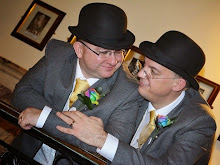
…and Earthling, and citizen of the Universe, of them all, my husband, Richard Flowers
2 – Love and marriage
Having the right to marry the person I love, if they want to too, or not to marry at all
3 – That he did want to
…and that we did, after waiting only twenty years (to the day)
That’s all I need, really, but there are forty-seven more, including food, Doctor Who, more food, the Liberal Democrats (the whole bally lot of them), so much food… And that’s all just the other stuff that was at our wedding!
4 – Doctor Who
…of course
5 – Being a nation made up of several nations
…all distinct and all having each in common, and being a people that has always been made up of many peoples and still mixing in people from everywhere else
6 – Being a nation where we all have multiple loyalties and identities
…by definition, and not letting people tell us what one thing they think we are
7 – Being always open to change
…whether it’s new people in our streets, new words in our language (often from someone else’s) or newly being comfortable with lesbian, gay, bisexual and transgender people and all sorts of other people who no longer have to be like everybody else
8 – My parents
…My Mum, who wasn’t born here but has always put her all into wherever she is, and my Dad, who was born in Glasgow, did some more growing up in Watford, and made a life for his family in Stockport, because we’re lots of different places and all one country too
9 – Inspirational heroes
…The four greatest British heroic myths: King Arthur; Robin Hood; Sherlock Holmes; and World War II
10 – Doubt
…and asking awkward questions
11 – Great big cliffs
…and windmills on hillsides
12 – Great crashing waves
…and nudist beaches when it’s bloody freezing
13 – Picturesque villages
…like Aldbourne, East Hagbourne, South Oxhey, Little Bazeley-by-the-Sea, Summerisle (but I’m more of an Escape From the Country guy, so…)
14 – Thrilling cities
…like London, Manchester, Edinburgh
15 – Stockport Town Hall
16 – The Beatles
…and especially George Harrison who, like me, swung wildly from terribly earnest to taking the piss, but who unlike me played the most gorgeous slide guitar ever heard – plus the movie of Yellow Submarine
17 – Electronic music
…from the likes of the Pet Shop Boys, The Human League, Heaven 17 and Delia Derbyshire
18 – Kate Bush
…and whatever the hell she does
19 – Punk rock
…Especially Tom Robinson and, right now, Ian Dury and the Blockheads and the wish that I could make my lists scan as well as Reasons To Be Cheerful
20 – Dame Shirley Bassey
21 – The Avengers
…Possibly the most British thing ever, and which wasn’t just style and subversion but which mattered – introducing to a mass audience the idea of intelligent, independent women who flung men over their shoulders. A fantasy of Britain where old-fashioned tradition and high-tech, sexually equal modernity went hand in hand (a hugely successful Conservative-Liberal coalition, you might say)
22 – The BBC
23 – Quatermass
…combining British ingenuity and a wish to build rocket ships with sheer naked terror (but doing it anyway)
24 – The Clangers
…encouraging us to love the alien and gently laugh at ourselves
25 – 2000AD
…the comic, not the year, particularly, which turned out a bit samey
26 – Carry On Up the Khyber
27 – Alastair Sim
…in drag
28 – BRIAN BLESSED
29 – Shakespeare
…A great many of his lines, anyway (and Queen Elizabeth the First, at least according to Blackadder)
30 – The works of JRR Tolkien
…even the ones scribbled on bits of toast and painstakingly reconstituted by his son. Mmm, toast…
31 – Clasping strange new foreign foods to our bosom
…over the centuries, making them our own so we couldn’t imagine life without them, like – the potato – and tea – and chocolate
32 – Chicken Korma
33 – Roast lamb
34 – Scotch eggs
35 – Pies
…Pies. More pies. And especially appropriate today, Pieminister pies
36 – Margaret Thatcher, Tony Benn and Nicola Sturgeon
…and the gladly exercised right to say thanks but no thanks, never have, never will
37 – William Gladstone, David Lloyd-George, Paddy Ashdown, Nick Clegg and Jo Swinson
…and the gladly exercised right to say yes, and I will again
38 – Being more or less democratic for quite a long time
39 – Mostly giving up an Empire with less fuss than is usual
40 – The NHS
…which on balance makes me go “Aaargghh!” less than it helps stop me going “Aaargghh!”
41 – Fulfilling the UN target of giving 0.7% of our national wealth in overseas aid and development
…a target set a year before I was born. It’s only in the last couple of years that we’ve finally met it (one of only about half a dozen countries that does), and in the last few weeks set it in law created by the Liberal Democrats
42 – The gap between rich and poor narrowing
…at last, over the last five years, after widening hugely ever since the 1980s
43 – The Rule of Law
…meaning that those in power get frustrated by the law applying to them too
44 – Signing the European Convention on Human Rights
…And not just being part of it, but Winston Churchill commissioning British lawyers to create it, in order to protect and spread our values
45 – Traditional British values
…like creativity, eccentricity, tolerance, generosity, fair play, standing up for the underdog, and universal, indivisible freedom
46 – Not having ID cards
…or being snooped on by the state at will, and the Liberal Democrats constantly being on guard whenever everybody else suddenly thinks that would be a good idea
47 – Making lists instead of doing anything
…making tutting sounds instead of hitting anyone, and grumbling but never giving up
48 – Inventing the train and the Internet
…even when each sometimes goes off the rails
49 – Many of the things we used to have but don’t any more
…like welcoming immigrants, Woolworths, Texan Bars, how Blackpool was in my childhood memories, The Daleks’ Master Plan, Nick Courtney, Conrad Russell and my Grandad
50 – The future
…even more than those I’ve loved and lost, and that there will always be many, many more new wonderful, beautiful, innovative, unpredictable and aggravating but loveable things to put on a list.
And that any list will be quite different for you, or even quite different for me tomorrow (I thought the best way was to write the lot off the top of my head), but still blatantly and brilliantly British.
So in fifty days’ time, why not vote for a Britain that offers more things to love than merely against the bits you don’t?
Here’s Nick Clegg on things he loves about Britain. I applauded him delivering this speech on Sunday and suspect he may have spent a bit more time and thought crafting this version than I did mine, but I agree with most of his, too.
Labels: 2000AD, BBC, Brian Blessed, British Politics, Doctor Who, Food, George Harrison, Kate Bush, King Arthur, Liberalism, Personal, Robin Hood, Sherlock Holmes, The Avengers


Monday, October 17, 2011
DVD Detail: Doctor Who – The Time Warrior
It’s nearly time for Sarah Jane Smith’s final adventure. She was with the Doctor when I was three and first fell in love with the series, and it’s been wonderful to have her back on screen for five years in The Sarah Jane Adventures (with CBBC showing every single episode this week. Time to catch up). So with today’s and tomorrow’s finale looming, I’m excited but never been so heartbroken at new Doctor Who. Time to go back, then, to 1973 and Doctor Who – The Time Warrior, where both Sarah Jane Smith and the Sontarans made their first appearance… Along with Dot Cotton and Boba Fett!
Jon Pertwee is the Doctor in The Time Warrior, opening his final season, the last before I started watching. It’s a highly regarded and influential story – not just introducing Sarah Jane and the Sontarans, played brilliantly from the first by Elisabeth Sladen and Kevin Lindsay, but a witty script from top writer Robert Holmes that takes us to Medieval England and sets the template for the series’ signature aliens-crashing-into-Earth-history story (effectively rediscovering the earlier The Time Meddler and giving the story a boot up the arse). And, like many Pertwees, it made a terrific book, too. I even recommended it as a Pertwee choice for my Eleven Faces of Doctor Who selection. But I have to admit, I think it falls a bit short of its potential. It’s very good – but a few plot oversights, a tired air throughout Pertwee’s final season, and particularly a director whose attitude seems to be ‘that’ll do’ (albeit boosted slightly on DVD by some shiny CGI effects) all combine to make it flatter than it ought to be. And that’s a particular shame for the Sontarans – for me, a childhood favourite monster, yet none of their stories quite lift into ‘outstanding’ (while top-ranking arch-foes the Daleks, the Master and the Cybermen all have top-ranking adventures to champion them). All that slightly apologetic tone may explain why, though back in September 2009, Doctor Who Magazine 413 published “The Mighty 200” – 6,700 fans’ votes on all 200ish TV Doctor Who stories to that point – and awarded The Time Warrior a sprightly 47th place, I’d put it at least fifty places lower, just about smack in the middle.
While this ‘taster’ may not be short, incidentally, though occasionally brutish, it would be nasty to be too spoilery. So read on without fear of finding out the ending.

Like a lot of the best drama or comedy (here, pitched neatly in between), the brilliant dialogue is all about people not listening to each other, and here they almost literally don’t speak each other’s language. Irongron and Bloodaxe carouse in cod Olde English idiom (lampshaded by Sarah’s “Let’s talk sensibly”), and don’t bother to try and understand the “crazed wench”; Linx is coldly analytical and alien, constantly realising that his medieval allies don’t have a clue and grasping instantly that Sarah Jane is not of their time; and Sarah Jane herself acts just like we would, suddenly thrust back in time – angry at being pushed around, a little afraid, but mainly trying to make sense of it all. And thankfully this isn’t Hollywood, so Sarah Jane doesn’t predict an eclipse, dazzle her captors with the wonders of nylon, nor show them how to breakdance.
Sarah Jane is spitting fire as she’s dragged in – “Get lost! That hurt, you fool!” – and then intelligent as she jumps to the obvious conclusions: play-acting, she thinks, and tells Irongron to “take off that ridiculous gear and go home to your butcher’s shop!”; a film set? No, no cameras; some kind of pre-theme park reconstruction?
The stranded Sontaran’s performance is scene-stealing in quite a different way to the brigands’ coarse humour and Sarah Jane’s brightness – abrupt, functional and dismissive, his clone warrior’s perspective on sex (ironically, less sexist than the Doctor) pleased Terrance Dicks so much that he’s used it again several times since. And he grabs the attention when he uses cold technology to force the truth from Sarah Jane. But just as you’ve suddenly sobered up to take the scene more seriously, Linx brings on the last player in this scene, a robot knight he’s built as part of his rent to Irongron. A remorseless, unstoppable metal killer, this should be the most terrifying part of the alien’s careless toying with human history. But instead of a gleaming suit of armour, the budget only runs to a quilted jerkin for a robot so fabulously rubbish that Linx’s ludicrously oversized remote control looks like it’s compensating for something. Too young to see it as a boy, I read about it with hungry excitement in the novel, and was mystified at the lack of a picture in the Doctor Who robot compendium The Adventures of K9 and Other Mechanical Creatures: the text had it, so what could possibly explain this disappointing omission? I mean, when I was seven or eight, a robot crossed with a knight in armour?! What could possibly have been more exciting, except a robot that was a knight in armour that was also a dinosaur? On which point, I couldn’t understand why there were no pictures from the next story, either. Such innocent days.
The Time Warrior starts thrillingly, setting out a new agenda for a new season – a stunning new title sequence (the prototype for Tom Baker’s), and boldly starting off not in the era’s UNIT comfort zone but in a medieval castle with a gang of scurvy cutthroats, then joined by a crash-landing alien warlord. It’s only when he realises that this bunch won’t be able to repair his ship that he reaches through time to capture modern scientists and, after a daringly long absence from the screen, we finally get to see anything resembling business as usual. When it’s the first fully-fledged trip back in time for five or more years, this is an outstandingly confident challenge to the audience – even if the overarching colour of brown in place of the previous year’s glam Technicolor is a more accurate hint to the mood of Pertwee’s final year. It’s just frustrating that an often audacious script so packed with witty dialogue suffers a time-serving BBC staff director with absolutely no spark, pace or energy.
Jon Pertwee gives one of his more engaging performances as the Doctor, and his character’s comparatively un-gittish. But then, with his TARDIS is working again, why is he acting like he’s still in exile? I’ve suggested before that it’s because by now he’s thoroughly institutionalised – this Doctor’s still staying where the Time Lords told him to go even when they’ve “forgiven” him, as if he’s lost all confidence in himself. He travels back in time not for pleasure, but to stop interference in history – naming and claiming his homeworld for the first time, he seems all too thoroughly ‘rehabilitated’ as he volunteers himself to the cause of the “Galactic ticket inspectors”. He’s now such a well-behaved little Time Lord that it’s surely time for a regeneration. Despite his establishment attitudes, perhaps I’m more on his side this time because he’s under fire from all sides – sometimes literally – with critiques not just from Linx and Sarah Jane but, amongst all Bob Holmes’ rude asides, few are as pointed as the Doctor hoping to save Sarah Jane – “I’ve got to go and find a young girl” – followed by Professor Rubeish saying on screen for the first time what everyone would say to that (and I’m with the Professor on wanting chocolate rather than an extended time-tour, too).
Infamous for his showy hand-to-hand combat, Pertwee here gets a huge fight sequence across the castle courtyard that’s assisted by the unusually large number of extras but hampered by the director’s static long-shots that demonstrate both that there still aren’t enough extras and that he’s running about in utterly aimless loops rather than trying to get away. Yet I still can’t help being excited by his casting a blazing torch into straw, and amused by Irongron’s description after Pertwee’s knocked him over:
Perhaps the most successful element of the story is that everything comes together first time for the Sontarans. Kevin Lindsay’s powerful performance makes Linx a character, not a monster, aided by a great part as scripted: he’s playing the third Doctor, take two, with an even more hirsute UNIT. An advanced alien with (contrived, improbable, but jolly handy) time travel capabilities stranded among warrior humans he thinks of as primitive and grumpy when they ask him to do them favours rather than get on with fixing his ship? And if you want a critique of the third Doctor, there are few so pointed as Linx being both a more effective scientific advisor and a more competent spaceship mechanic in an hour and a half than the Doctor managed in four years. His and his race’s background are deftly sketched in in dialogue – with more in the book – and, while the Sontarans were inspired by Teutonic soldiery, his way of marching in, ignoring the locals, planting a flag and claiming the planet is as much the British Empire as the Sontaran one. He’s a triumph of design, too, in costume, make-up and spaceship: that famous helmet coming off to reveal a head shaped just like it; that expressive face; that memorable golf-ball ship. I suspect they were all reasons why they were my favourite monsters as a boy, along with their brutality – all brilliantly simple designs that you could draw. So I have to admit they were the first major misstep for me in the Twenty-first Century series’ redesigns, despite excellent actors: making the Sontarans not rugby-player short and stocky but tiny and top-heavy ballet-dancer-legged; making their heads too small for their helmets and their armour too fussy; missing the point of a spherical ship and giving it a cockpit, rockets and go-faster stripes, so it can no longer veer off in any direction and boys can no longer draw it at speed. Here, the only false note for the first Sontaran is that his ‘gun’ is a great interrogation device but a pretty crummy weapon.
The story’s greatly helped by its location footage at a real fake castle, some of which looks gorgeous. It’s not much helped by the director often seeming to think just pointing the camera at the scenery and leaving it will make the best of it, not least in the big battle for Part Three. He has one good idea – with the two sides now established as the Doctor with Sir Edward and Linx with Irongron, the two aliens are playing chess with real pieces, and holding Linx in close-up as Irongron’s scruffy band try to storm Sir Edward’s castle in the background emphasises this. The trouble is, he doesn’t then make much of the Doctor on the battlements as the other ‘player’, and showing Irongron’s men in long shot again proves that, while there are more of them than in many Doctor Whos, there are nothing like enough. Even the script, though, falls down a little here: great at being witty, it’s not really thought through the pitched battle, with the grim Beau Geste idea of dead men at the embrasures (used to great effect in the following year’s series) made lightweight by having mere wooden ‘soldiers’ and the Doctor being better at tactics than strategy – he needed to combine his multiple ‘effects’ of full walls, Satanic attack and arrows, rather than spreading them out one by one so that anyone watching can see the trick of each. I suspect the joint reasons are so that the camera can gradually spin out the different stages of defence for maximum screen time, and that they didn’t want to show the Doctor killing people. But if that’s the case, mounting a medieval siege in the first place wasn’t the best notion. Called a “Norman ninny,” the Doctor doesn’t even pass muster as a Pythonian French Taunter. The script similarly bungles its sense of scale in Part Four, when the Doctor and Sarah Jane constantly yo-yo back and forth between castles with the same ease and in about the same time as Linx pops up and down the stairs. I wonder if the final two episodes might not have been better cut down to one, making a story already taut by Pertwee standards run at a proper clip? I know I shuddered at Barry Letts’ suggestion that because it was so enjoyable it should have been dragged out to six parts instead…
The DVD extras are pretty good, led by optional CGI that can’t do anything about the poor direction and jumpy editing but improves most of the lacklustre Linx effects (though disappointingly doing nothing with the dull teleport ‘fades’). The exception is a big explosion, where an inappropriate but exciting quarry blast is replaced by something that resembles a small dragon sneezing through some gates, with a notable absence of demolition. The excellent ‘Making of’ is shot mainly on location, with producer Barry Letts, lead writer Terrance Dicks and star Elisabeth Sladen (the same team as on the entertaining commentary) added to bit by bit by other players. Barry wins points for ensuring Sarah Jane was both brave and scared at the same time, but loses them for talking complete bollocks about historical adventures (as I’ve previously demonstrated), while Lis’ list for Sarah Jane’s character is a treasure. The nine minutes of photos, often famous ones, are only let down by having none from the Radio Times Doctor Who Tenth Anniversary Special that’s trailed on here – not even the iconic, story-specific ones of Sarah Jane being stalked by Linx. The text notes aren’t bad for Richard Molesworth, largely because of the masses of extra script there wasn’t room for in Part One, and with a script this good, it’s great to see more of it. After opening well, though, he irritates by noting the story’s surprisingly early start date (a “New Year” season beginning on the 15th of December) but giving us no idea why, by cutting and pasting repetitive details, and by a myriad silly errors that should have been proofread. The Dr Who Annual 1974 in pdf isn’t bad, with uninspired stories but some pretty decent artwork – particularly for the comic strips – that’s improved if you overlook the artist’s clear lack of authorised likenesses for anyone bar Jon Pertwee. I’m forced to admit, though, that the rather wittily edited Coming Soon trailer is my favourite extra on here: “The Key to Time is mine, miiine!”
Jeremy Bulloch does rather a good job reading the audiobook, the easiest way to get hold of it today, and it’s a real thrill to hear that Prologue. So why not pick this up, too? The TV version’s good – but the book’s better. You might also look out the DVD of Horror of Fang Rock from four years later: Bob Holmes’ revenge on Terrance for making him do homework about history; Terrance Dicks taking inspiration in the crashing spaceship and bringing to the screen the Sontaran’s arch-enemies created here only in dialogue; and even one of the same actors. And, of course, you should be watching The Sarah Jane Adventures. If you missed today’s repeats, Invasion of the Bane and Whatever Happened To Sarah Jane? are particularly outstanding to look out on iPlayer (or, indeed, the whole lot again next week on CBBC). But first, and last, there’s tomorrow…
Jon Pertwee is the Doctor in The Time Warrior, opening his final season, the last before I started watching. It’s a highly regarded and influential story – not just introducing Sarah Jane and the Sontarans, played brilliantly from the first by Elisabeth Sladen and Kevin Lindsay, but a witty script from top writer Robert Holmes that takes us to Medieval England and sets the template for the series’ signature aliens-crashing-into-Earth-history story (effectively rediscovering the earlier The Time Meddler and giving the story a boot up the arse). And, like many Pertwees, it made a terrific book, too. I even recommended it as a Pertwee choice for my Eleven Faces of Doctor Who selection. But I have to admit, I think it falls a bit short of its potential. It’s very good – but a few plot oversights, a tired air throughout Pertwee’s final season, and particularly a director whose attitude seems to be ‘that’ll do’ (albeit boosted slightly on DVD by some shiny CGI effects) all combine to make it flatter than it ought to be. And that’s a particular shame for the Sontarans – for me, a childhood favourite monster, yet none of their stories quite lift into ‘outstanding’ (while top-ranking arch-foes the Daleks, the Master and the Cybermen all have top-ranking adventures to champion them). All that slightly apologetic tone may explain why, though back in September 2009, Doctor Who Magazine 413 published “The Mighty 200” – 6,700 fans’ votes on all 200ish TV Doctor Who stories to that point – and awarded The Time Warrior a sprightly 47th place, I’d put it at least fifty places lower, just about smack in the middle.
While this ‘taster’ may not be short, incidentally, though occasionally brutish, it would be nasty to be too spoilery. So read on without fear of finding out the ending.

That Golden Moment
“What is this?”For my previous Jon Pertwee story, Colony In Space – influential as his Doctor’s first proper journey in space, as this is his first proper trip back in time – I picked a particularly short ‘moment’, just a few seconds of sudden cliffhanger. Today, I’m turning to Part Two of The Time Warrior for one of Doctor Who’s longest continuous scenes, a good six minutes that suggests some of the ageing director’s preference for theatre. What’s unusual (but rather great) about it is the way that, rather than cutting between different scenes to illustrate different characters, they all come on and go off as if the castle great hall were a stage: ‘Enter IRONGRON, a DRUNKEN MEDIEVAL ROBBER BARON, and BLOODAXE, his even stupider HENCHMAN, with SARAH JANE SMITH, a JOURNALIST – she is angry’; ‘Enter HAL, an ARCHER, held by BRIGANDS’; ‘Enter LINX, a SINISTER ALIEN WARLORD…’; ‘Exit SARAH JANE, on tiptoe’. And while the Doctor pokes his nose about outside, this central scene explores the two big new characters, the new monster and the new companion.
“Eh? Oh, just a girl, taken in the forest.”
“Girl? You have two species on this planet?”
“How say you?”
“The girl is not of your kind, Irongron. The hair is finer, the thorax of a different construction.”
“Oh, Hell’s teeth! Have you no girls beyond the stars? No women to do the lowly work?”
“Ah, I understand. You have a primary and secondary reproductive cycle. It is an inefficient system – you should change it.”
Like a lot of the best drama or comedy (here, pitched neatly in between), the brilliant dialogue is all about people not listening to each other, and here they almost literally don’t speak each other’s language. Irongron and Bloodaxe carouse in cod Olde English idiom (lampshaded by Sarah’s “Let’s talk sensibly”), and don’t bother to try and understand the “crazed wench”; Linx is coldly analytical and alien, constantly realising that his medieval allies don’t have a clue and grasping instantly that Sarah Jane is not of their time; and Sarah Jane herself acts just like we would, suddenly thrust back in time – angry at being pushed around, a little afraid, but mainly trying to make sense of it all. And thankfully this isn’t Hollywood, so Sarah Jane doesn’t predict an eclipse, dazzle her captors with the wonders of nylon, nor show them how to breakdance.
Sarah Jane is spitting fire as she’s dragged in – “Get lost! That hurt, you fool!” – and then intelligent as she jumps to the obvious conclusions: play-acting, she thinks, and tells Irongron to “take off that ridiculous gear and go home to your butcher’s shop!”; a film set? No, no cameras; some kind of pre-theme park reconstruction?
“Mind you, I think you’re overdoing the sordid realism a bit.”All that, yet still not quite as postmodern as Robert Holmes’ previous script, Carnival of Monsters. Another recurring Bob Holmes theme is that he doesn’t think much of Robin Hood: prefiguring his swipes at the legend in The Sun Makers and The Ribos Operation, here he has two Robins – Irongron the robber baron and his band of bloodthirsty outlaws, and Hal, the handsome archer in green… Who’s hauled before Irongron here after a failed assassination, for an interrogation full of (implied) sex and violence. No wonder Sarah Jane – Lis Sladen still brilliantly showing us her working it out in the background – is coming to the conclusion that things are as desperate as they seem even before Linx appears.
The stranded Sontaran’s performance is scene-stealing in quite a different way to the brigands’ coarse humour and Sarah Jane’s brightness – abrupt, functional and dismissive, his clone warrior’s perspective on sex (ironically, less sexist than the Doctor) pleased Terrance Dicks so much that he’s used it again several times since. And he grabs the attention when he uses cold technology to force the truth from Sarah Jane. But just as you’ve suddenly sobered up to take the scene more seriously, Linx brings on the last player in this scene, a robot knight he’s built as part of his rent to Irongron. A remorseless, unstoppable metal killer, this should be the most terrifying part of the alien’s careless toying with human history. But instead of a gleaming suit of armour, the budget only runs to a quilted jerkin for a robot so fabulously rubbish that Linx’s ludicrously oversized remote control looks like it’s compensating for something. Too young to see it as a boy, I read about it with hungry excitement in the novel, and was mystified at the lack of a picture in the Doctor Who robot compendium The Adventures of K9 and Other Mechanical Creatures: the text had it, so what could possibly explain this disappointing omission? I mean, when I was seven or eight, a robot crossed with a knight in armour?! What could possibly have been more exciting, except a robot that was a knight in armour that was also a dinosaur? On which point, I couldn’t understand why there were no pictures from the next story, either. Such innocent days.
Something Else To Look Out For
The Time Warrior starts thrillingly, setting out a new agenda for a new season – a stunning new title sequence (the prototype for Tom Baker’s), and boldly starting off not in the era’s UNIT comfort zone but in a medieval castle with a gang of scurvy cutthroats, then joined by a crash-landing alien warlord. It’s only when he realises that this bunch won’t be able to repair his ship that he reaches through time to capture modern scientists and, after a daringly long absence from the screen, we finally get to see anything resembling business as usual. When it’s the first fully-fledged trip back in time for five or more years, this is an outstandingly confident challenge to the audience – even if the overarching colour of brown in place of the previous year’s glam Technicolor is a more accurate hint to the mood of Pertwee’s final year. It’s just frustrating that an often audacious script so packed with witty dialogue suffers a time-serving BBC staff director with absolutely no spark, pace or energy.
Jon Pertwee gives one of his more engaging performances as the Doctor, and his character’s comparatively un-gittish. But then, with his TARDIS is working again, why is he acting like he’s still in exile? I’ve suggested before that it’s because by now he’s thoroughly institutionalised – this Doctor’s still staying where the Time Lords told him to go even when they’ve “forgiven” him, as if he’s lost all confidence in himself. He travels back in time not for pleasure, but to stop interference in history – naming and claiming his homeworld for the first time, he seems all too thoroughly ‘rehabilitated’ as he volunteers himself to the cause of the “Galactic ticket inspectors”. He’s now such a well-behaved little Time Lord that it’s surely time for a regeneration. Despite his establishment attitudes, perhaps I’m more on his side this time because he’s under fire from all sides – sometimes literally – with critiques not just from Linx and Sarah Jane but, amongst all Bob Holmes’ rude asides, few are as pointed as the Doctor hoping to save Sarah Jane – “I’ve got to go and find a young girl” – followed by Professor Rubeish saying on screen for the first time what everyone would say to that (and I’m with the Professor on wanting chocolate rather than an extended time-tour, too).
Infamous for his showy hand-to-hand combat, Pertwee here gets a huge fight sequence across the castle courtyard that’s assisted by the unusually large number of extras but hampered by the director’s static long-shots that demonstrate both that there still aren’t enough extras and that he’s running about in utterly aimless loops rather than trying to get away. Yet I still can’t help being excited by his casting a blazing torch into straw, and amused by Irongron’s description after Pertwee’s knocked him over:
“a long-shanked rascal with a mighty nose”.He’s then clobbered by Sarah Jane, which is a first – there’s a neat idea that she thinks he’s behind everything and then, rather than just argue with him a bit, forms a commando team to nobble him. The actors pull it off, though the script doesn’t quite (being rather tangled on how much she knows about UNIT, or the Brigadier, and coming a cropper on her having witnessed Lethbridge-Stewart being a mate). Well, perhaps it’s a satire on how journalists always have a fixed idea for a story and won’t let facts get in the way. The script’s almost a deconstruction of Day of the Daleks from a couple of years earlier (a story ironically with the working title of “The Time Warriors”, and out on DVD last month): another starting with the premise of a ghost story and turning into a trick of the time, this one saunters in with a brilliant new alien rather than not quite relaunching an old one, is far wittier if less intelligent in its playing with time, and rather than helpless Jo being tied up by guerrillas makes Sarah Jane a guerrilla leader in her first story. Doctor Who stories often throw the Doctor and his companion into a situation to cause chaos – brilliantly, here it’s for each other. The only drawback is that the director of this story makes Day’s look like Peter Jackson.
Sarah Jane Smith: Awesome From the First
“Well, I thought all this might be a good story. I’m a journalist. Sarah Jane Smith.”Sarah Jane Smith is a star from the word go, the insults she shoots at Irongron still unmatched for a companion’s ‘first confrontation with a villain’. She introduces herself to the Doctor as a journalist, an independent person investigating what UNIT’s up to of her own will, rather than being assigned to him to assist with the Brigadier’s investigations. And though her feminism’s occasionally so brashly written it’s dated, Lis Sladen pulls it off (and the punchline to downtrodden Meg in the castle kitchens is still brilliant, though Sarah’s ruthless “Look at that great spider!” will come back to bite her). In contrast, the Doctor’s oh-so-funny “fair sex” remarks just make him seem like a git, though he’s really at his most sexist in other ways than the one everyone points to: yes, he asks her to make a cup of coffee… But that’s after exposing her as a freeloading impostor who’s wasting everyone’s time and not doing the important scientific job ‘she’s’ being paid and given board for. So what else, in that context, is she qualified to do? Stowing away on the TARDIS and turning out to be brilliant, obviously, but not in a scientific way. No, it’s not the coffee that’s offensive in that scene, but two other underlying assumptions: the Doctor’s control freak hostility to Sarah Jane asking questions shows Pertwee’s incarnation, as ever, to be as terrible a scientist as she’s a good journalist; and that a space research centre should employ Sarah Jane’s aunt as a virologist when all the other scientists we see there are working on alloys and drive mechanisms. What’s the difference? Oh dear. Yes, they’re all men, but Aunt Lavinia’s specialism has to be ‘girly’ because ‘they can’t do engineering’. It’s difficult not to conclude that this scene’s sexist after all, just not in the bit you think it is.

Perhaps the most successful element of the story is that everything comes together first time for the Sontarans. Kevin Lindsay’s powerful performance makes Linx a character, not a monster, aided by a great part as scripted: he’s playing the third Doctor, take two, with an even more hirsute UNIT. An advanced alien with (contrived, improbable, but jolly handy) time travel capabilities stranded among warrior humans he thinks of as primitive and grumpy when they ask him to do them favours rather than get on with fixing his ship? And if you want a critique of the third Doctor, there are few so pointed as Linx being both a more effective scientific advisor and a more competent spaceship mechanic in an hour and a half than the Doctor managed in four years. His and his race’s background are deftly sketched in in dialogue – with more in the book – and, while the Sontarans were inspired by Teutonic soldiery, his way of marching in, ignoring the locals, planting a flag and claiming the planet is as much the British Empire as the Sontaran one. He’s a triumph of design, too, in costume, make-up and spaceship: that famous helmet coming off to reveal a head shaped just like it; that expressive face; that memorable golf-ball ship. I suspect they were all reasons why they were my favourite monsters as a boy, along with their brutality – all brilliantly simple designs that you could draw. So I have to admit they were the first major misstep for me in the Twenty-first Century series’ redesigns, despite excellent actors: making the Sontarans not rugby-player short and stocky but tiny and top-heavy ballet-dancer-legged; making their heads too small for their helmets and their armour too fussy; missing the point of a spherical ship and giving it a cockpit, rockets and go-faster stripes, so it can no longer veer off in any direction and boys can no longer draw it at speed. Here, the only false note for the first Sontaran is that his ‘gun’ is a great interrogation device but a pretty crummy weapon.
Mucking About In History
“Something very odd is happening here.”I’ve always loved the uniquely Who-ish historical anachronisms of aliens or time meddlers when the Doctor travels back to a well-known period of Earth’s history, meets both exactly the sort of people we’d expect him to and some outer space people we really wouldn’t and everything collides. And if the most successful part of this story is the outer space person, the most entertaining parts are Irongron the sozzled bandit who’s squatting a castle and his adoring sidekick Bloodaxe, whose cod-Shakespeare and utter cluelessness make them loveable. Particularly when one’s roaring for wine, and the other’s lost in admiration at his boss’s “cunning plan”. I’m not the biggest admirer of director Alan Bromly, infamously so lethargic that on his only other Who he was one of the series’ few directors ever to be fired, but I can’t fault him on casting David Daker in both his stories. Irongron’s just as brilliant a double act as the Brigadier to Linx, constantly rowing with each other (and the human constantly coming off worst). They’re far more memorable than effete wounded crusader Sir Edward, though you can’t help but spot that his feisty, plotting wife (given some of the best lines, and described by the producer as a “goodie Lady Macbeth”) is June Brown, now Dot Cotton, just as the archer she sends to kill the uncouth next-door-neighbour is Jeremy Bulloch, famous as Boba Fett (and a regular in Robin of Sherwood, though not with a bow). Most of the actors are so good you can almost forgive the gate guard auditioning for the prize of most wooden performance in Doctor Who.
“Oh, yes, well if I may say so, Doctor, that is not exactly news to me.”
The story’s greatly helped by its location footage at a real fake castle, some of which looks gorgeous. It’s not much helped by the director often seeming to think just pointing the camera at the scenery and leaving it will make the best of it, not least in the big battle for Part Three. He has one good idea – with the two sides now established as the Doctor with Sir Edward and Linx with Irongron, the two aliens are playing chess with real pieces, and holding Linx in close-up as Irongron’s scruffy band try to storm Sir Edward’s castle in the background emphasises this. The trouble is, he doesn’t then make much of the Doctor on the battlements as the other ‘player’, and showing Irongron’s men in long shot again proves that, while there are more of them than in many Doctor Whos, there are nothing like enough. Even the script, though, falls down a little here: great at being witty, it’s not really thought through the pitched battle, with the grim Beau Geste idea of dead men at the embrasures (used to great effect in the following year’s series) made lightweight by having mere wooden ‘soldiers’ and the Doctor being better at tactics than strategy – he needed to combine his multiple ‘effects’ of full walls, Satanic attack and arrows, rather than spreading them out one by one so that anyone watching can see the trick of each. I suspect the joint reasons are so that the camera can gradually spin out the different stages of defence for maximum screen time, and that they didn’t want to show the Doctor killing people. But if that’s the case, mounting a medieval siege in the first place wasn’t the best notion. Called a “Norman ninny,” the Doctor doesn’t even pass muster as a Pythonian French Taunter. The script similarly bungles its sense of scale in Part Four, when the Doctor and Sarah Jane constantly yo-yo back and forth between castles with the same ease and in about the same time as Linx pops up and down the stairs. I wonder if the final two episodes might not have been better cut down to one, making a story already taut by Pertwee standards run at a proper clip? I know I shuddered at Barry Letts’ suggestion that because it was so enjoyable it should have been dragged out to six parts instead…
The DVD extras are pretty good, led by optional CGI that can’t do anything about the poor direction and jumpy editing but improves most of the lacklustre Linx effects (though disappointingly doing nothing with the dull teleport ‘fades’). The exception is a big explosion, where an inappropriate but exciting quarry blast is replaced by something that resembles a small dragon sneezing through some gates, with a notable absence of demolition. The excellent ‘Making of’ is shot mainly on location, with producer Barry Letts, lead writer Terrance Dicks and star Elisabeth Sladen (the same team as on the entertaining commentary) added to bit by bit by other players. Barry wins points for ensuring Sarah Jane was both brave and scared at the same time, but loses them for talking complete bollocks about historical adventures (as I’ve previously demonstrated), while Lis’ list for Sarah Jane’s character is a treasure. The nine minutes of photos, often famous ones, are only let down by having none from the Radio Times Doctor Who Tenth Anniversary Special that’s trailed on here – not even the iconic, story-specific ones of Sarah Jane being stalked by Linx. The text notes aren’t bad for Richard Molesworth, largely because of the masses of extra script there wasn’t room for in Part One, and with a script this good, it’s great to see more of it. After opening well, though, he irritates by noting the story’s surprisingly early start date (a “New Year” season beginning on the 15th of December) but giving us no idea why, by cutting and pasting repetitive details, and by a myriad silly errors that should have been proofread. The Dr Who Annual 1974 in pdf isn’t bad, with uninspired stories but some pretty decent artwork – particularly for the comic strips – that’s improved if you overlook the artist’s clear lack of authorised likenesses for anyone bar Jon Pertwee. I’m forced to admit, though, that the rather wittily edited Coming Soon trailer is my favourite extra on here: “The Key to Time is mine, miiine!”

Humpty Dumpty flew in a ballRichard, after Chaucer
Humpty Dumpty had a big fall
All the thug’s horses and all the thug’s men
Got guns and shit.
Doctor Who and the Time Warrior
“Linx was his name. He was a microsecond from obliteration.”I’ve reviewed several of the Target novelisations recently, so I’ve already set out my view that most of the Pertwee stories are much better on the page than the screen; Doctor Who and the Time Warrior is no exception. Written by Terrance Dicks with Robert Holmes, it gets two massive and immediate boosts, first from Roy Knipe’s outstanding cover painting of Linx, and then from the extended Prologue, all that Bob Holmes completed before he thought it was too much hard work, but a thrilling action piece that provides much of the Sontaran backstory (and, I realised many years after first reading it, is the only Doctor Who book that describes an orgasm). Terrance Dicks rises to the challenge of this opening and makes what was already a very witty story a cracking adventure tale as well, enhanced by much more of the script than made it to screen, both in dialogue and in action (and young Eric’s heroic mission has always been appealing).
Jeremy Bulloch does rather a good job reading the audiobook, the easiest way to get hold of it today, and it’s a real thrill to hear that Prologue. So why not pick this up, too? The TV version’s good – but the book’s better. You might also look out the DVD of Horror of Fang Rock from four years later: Bob Holmes’ revenge on Terrance for making him do homework about history; Terrance Dicks taking inspiration in the crashing spaceship and bringing to the screen the Sontaran’s arch-enemies created here only in dialogue; and even one of the same actors. And, of course, you should be watching The Sarah Jane Adventures. If you missed today’s repeats, Invasion of the Bane and Whatever Happened To Sarah Jane? are particularly outstanding to look out on iPlayer (or, indeed, the whole lot again next week on CBBC). But first, and last, there’s tomorrow…
Labels: Bigotry, Books, Doctor Who, DVD, DVD Details, Jon Pertwee, Pictures, Reviews, Richard, Robin Hood, Sarah Jane Smith, Toys
Wednesday, September 16, 2009
Let’s Not Book A Room In Brigadoon
Have you caught any of BBC Four’s “This is Scotland” season? Because some of it makes you think, ‘No, it really isn’t’. A rare showing of Culloden was impressive, only a few weeks after I praised it, but as for last weekend’s outing for Brigadoon… It’s a textbook example of a story which, when someone tells it to you in a few lines, really captures your imagination – but which, when you actually sit through it, makes a terrible movie. An enchanted old village appearing from the mist just once a century… What could possibly go wrong? Go on, guess.
Perhaps it’s that I lack patience with musical theatre – I know, dock my gay points – except in rare cases, and that though Almost Like Being In Love is a good tune, the rest of the songs here are syrupy and go on for ever. Perhaps it’s the distracting accents. Now, every American producer knows that there are only three ‘English’ accents: upper class (evil, which permits intelligence, or inbred and very dim); Cockerney (lovable, poor and stupid); and Scotch / Oirish, which are of course the same (rustic, poor, quaint and stupid). In this quaint little story set in the quaint little Scottish Highlands, this realistic range of accents is on full display – while the heroes are, of course, American (think of it like An American Werewolf In London, except that they start singing instead of getting bitten. It’s horrific).
My main problem with the film, though, is that a mythic return to the Eighteenth Century is very much more attractive as a dimly imagined myth, and that when you’re invited to step into the past, you’d much rather it stayed in the past. While the village is supposed to have made a deal with God, it seems more like hell on Earth.
It goes like this. Back in 1754 – two centuries to the day before the story is set – Brigadoon was put under attack by witches, and prayed for deliverance. So they were snatched out of time to escape destruction, and the village now drifts back into reality for just one day every hundred years. So far, so intriguing. Unfortunately, in the film producers’ quest to expand an intriguing one-line idea to as long and turgid a movie as possible, they then strip as much magic as possible out of the story: audiences will swallow an enchanted village that lives one day a century without batting an eyelid, they reckon, but we couldn’t possibly ask them to believe in witches.
But if the big threat in the movie isn’t the return of the witches in a new sorcerous assault, or if it’s implied God didn’t save Brigadoon from an attack by real witches at all, what could the God-fearing people of the village have yanked themselves out of history’s progress to save themselves from?
Ah.
Well, there’s a clue in tourist Jeff’s line on witches, “Oh, we have ’em; we just pronounce it differently,” but the village’s raison d’être is made quite explicit by the schoolteacher: “Oh, I know there’s no such thing,” he says of witches – just women they didn’t approve of. Yes, Brigadoon is social conservatism gone mad. The terrifying ‘attack’ and threat of ‘destruction’ was not physical but their unelected leaders’ view of moral, and the religious maniacs cried out in their surety that they couldn’t win by persuasion, ‘Stop the world – we want to get off!’
The biggest surprise to modern audiences, more even than the jawdropping misogyny and wandering accents, is that the tourists are American and the scary intolerant control freaks living in another century British. Nowadays, surely the film would have to have visitors from this side of the Atlantic discovering a mysterious village in some landlocked part of the United States that vanished from reality for fear the gays are getting married.
Clearly, some of the filmmakers realised that this was a monstrously scary form of social conservatism even for 1954, because it’s deeply schizophrenic about its sympathies. It’s a huge romance, with one of our modern American souls falling in love with the place and one of its people – and who couldn’t fall for Gene Kelly and Cyd Charisse dancing around each other, and hope that love conquers all?
Well, his friend Jeff, for one, who as played by Van Johnson is a breath of urban, cynical sanity, with lines like “I’m a strange man, and you’re a mighty strange woman,” and “Is it formal, or shall I wear my Napoleon hat?” And then you discover that – jerking against the chain of the romance, the script and the enchanted hellhole – some of the young people are desperate to escape (and no, it doesn’t make a lot of sense to have people forgetting / missing the outside world so much after two nights for them, but I’ll let that pass), and it turns out that no-one can ever leave, or the whole spell will collapse. You can’t even do an ‘exchange’. Gee, thanks. How much more repressive can this set-up get? I’m glad you asked, because of course one of the poor desperate prisoners makes a break for it, and there’s a hunt. Which, inevitably, requires a killing, even if it’s accidental (and again, I sense the scriptwriter who’s in love with this conservative utopia wresting the script back from the one who isn’t for a moment to stop the village dictators being so blatantly the villains by deliberate murder).
The idea at the heart of Brigadoon is a powerful one, borrowed from a German folk tale and borrowed by many other stories in turn, even a secret location protected by a “Brigadoon Circuit” in one of the finest Doctor Who novels – though in Robin of Sherwood’s Cromm Cruac and Randall and Hopkirk (Deceased) : A Man of Substance, both splendid pieces of television, each village has more blatantly made a deal with a devil – but not only is the film dreadfully dull, its social and sexual politics are diabolical.
On the other hand, this is just the film you want to watch to make you appreciate the go-ahead, all mod cons, funky charms of Bournemouth, should anyone be heading there soon.
Perhaps it’s that I lack patience with musical theatre – I know, dock my gay points – except in rare cases, and that though Almost Like Being In Love is a good tune, the rest of the songs here are syrupy and go on for ever. Perhaps it’s the distracting accents. Now, every American producer knows that there are only three ‘English’ accents: upper class (evil, which permits intelligence, or inbred and very dim); Cockerney (lovable, poor and stupid); and Scotch / Oirish, which are of course the same (rustic, poor, quaint and stupid). In this quaint little story set in the quaint little Scottish Highlands, this realistic range of accents is on full display – while the heroes are, of course, American (think of it like An American Werewolf In London, except that they start singing instead of getting bitten. It’s horrific).
Welcome To Brigadoon – You’ll Never Leave
My main problem with the film, though, is that a mythic return to the Eighteenth Century is very much more attractive as a dimly imagined myth, and that when you’re invited to step into the past, you’d much rather it stayed in the past. While the village is supposed to have made a deal with God, it seems more like hell on Earth.
It goes like this. Back in 1754 – two centuries to the day before the story is set – Brigadoon was put under attack by witches, and prayed for deliverance. So they were snatched out of time to escape destruction, and the village now drifts back into reality for just one day every hundred years. So far, so intriguing. Unfortunately, in the film producers’ quest to expand an intriguing one-line idea to as long and turgid a movie as possible, they then strip as much magic as possible out of the story: audiences will swallow an enchanted village that lives one day a century without batting an eyelid, they reckon, but we couldn’t possibly ask them to believe in witches.
But if the big threat in the movie isn’t the return of the witches in a new sorcerous assault, or if it’s implied God didn’t save Brigadoon from an attack by real witches at all, what could the God-fearing people of the village have yanked themselves out of history’s progress to save themselves from?
Ah.
Well, there’s a clue in tourist Jeff’s line on witches, “Oh, we have ’em; we just pronounce it differently,” but the village’s raison d’être is made quite explicit by the schoolteacher: “Oh, I know there’s no such thing,” he says of witches – just women they didn’t approve of. Yes, Brigadoon is social conservatism gone mad. The terrifying ‘attack’ and threat of ‘destruction’ was not physical but their unelected leaders’ view of moral, and the religious maniacs cried out in their surety that they couldn’t win by persuasion, ‘Stop the world – we want to get off!’
The biggest surprise to modern audiences, more even than the jawdropping misogyny and wandering accents, is that the tourists are American and the scary intolerant control freaks living in another century British. Nowadays, surely the film would have to have visitors from this side of the Atlantic discovering a mysterious village in some landlocked part of the United States that vanished from reality for fear the gays are getting married.
Clearly, some of the filmmakers realised that this was a monstrously scary form of social conservatism even for 1954, because it’s deeply schizophrenic about its sympathies. It’s a huge romance, with one of our modern American souls falling in love with the place and one of its people – and who couldn’t fall for Gene Kelly and Cyd Charisse dancing around each other, and hope that love conquers all?
Well, his friend Jeff, for one, who as played by Van Johnson is a breath of urban, cynical sanity, with lines like “I’m a strange man, and you’re a mighty strange woman,” and “Is it formal, or shall I wear my Napoleon hat?” And then you discover that – jerking against the chain of the romance, the script and the enchanted hellhole – some of the young people are desperate to escape (and no, it doesn’t make a lot of sense to have people forgetting / missing the outside world so much after two nights for them, but I’ll let that pass), and it turns out that no-one can ever leave, or the whole spell will collapse. You can’t even do an ‘exchange’. Gee, thanks. How much more repressive can this set-up get? I’m glad you asked, because of course one of the poor desperate prisoners makes a break for it, and there’s a hunt. Which, inevitably, requires a killing, even if it’s accidental (and again, I sense the scriptwriter who’s in love with this conservative utopia wresting the script back from the one who isn’t for a moment to stop the village dictators being so blatantly the villains by deliberate murder).
The idea at the heart of Brigadoon is a powerful one, borrowed from a German folk tale and borrowed by many other stories in turn, even a secret location protected by a “Brigadoon Circuit” in one of the finest Doctor Who novels – though in Robin of Sherwood’s Cromm Cruac and Randall and Hopkirk (Deceased) : A Man of Substance, both splendid pieces of television, each village has more blatantly made a deal with a devil – but not only is the film dreadfully dull, its social and sexual politics are diabolical.
On the other hand, this is just the film you want to watch to make you appreciate the go-ahead, all mod cons, funky charms of Bournemouth, should anyone be heading there soon.
Labels: Bigotry, Film, Liberal Democrat Conferences, Music, Religion, Reviews, Robin Hood, Scotland, Utopia
Friday, February 27, 2009
The New Avengers – Dead Men Are Dangerous
12.30, tonight, BBC4 – stay up, set your DVD recorder or set your alarm! There’s been much to enjoy in BBC4’s repeats of The New Avengers, but tonight’s haunting Dead Men Are Dangerous is the one I enjoy the most. A beautiful, tragic character piece, with a disturbing opening sequence and a nail-biting conclusion, it’s the best episode by a long way. The series’ strangely friendly Cold War rivalries give way to the bitter, deadly rivalry of a friend. This is simply magnificent television.
Less off-beat – unless you count the distracting ‘Ooh, which Tory MP is that weirdly made-up actor of a cast of thousands meant to be? And why, with all the people they got right (Geoffrey Howe was uncanny), did they mess up John Sergeant so badly?’ effect – was last night’s Margaret, which I found rather gripping and even made me feel a twinge of sympathy for her. I can still remember exactly where I was when I heard the news of her fall, and who I was with; a Green who I’ve not seen for many years and a hard right Tory who shed a tear, then had a brief moment of rejoicing when news broke that John Major was to stand as the continuity Thatchianity candidate (within months he was snarlingly calling him a “bloody social democrat”). That second chap’s a Lib Dem these days… Still, looking back at that time, House of Cards still knocks spots off Margaret.
For me, though, the really stunning shows this week have been in the repeats. On Tuesday, ITV4 showed The Prisoner’s finest hour, Dance of the Dead, with its intricate plotting, insane ending and commanding Number 2 (though they mucked up the transmission); on Wednesday, ITV3 showed Robin of Sherwood’s greatest episode, The Greatest Enemy. The last half of that is still one of the most compelling and moving TV experiences I’ve ever had, and like Dance of the Dead – and unlike most ‘action’ shows where death is common but disposable – it’s an intelligent meditation on death. So, too, is The New Avengers’ Dead Men Are Dangerous with its lingering death and killer nostalgia, beating Dance of the Dead for twisty foreboding and vying with The Greatest Enemy for elegiac tragedy, all making three very fine series which have each had their very finest stories repeated within a few days of each other, remarkably. Next Friday (concluding the Monday after), as it happens, BBC3 is repeating the best story since Doctor Who returned to the screen in 2005. Human Nature is more about love than death, though death and, particularly, war still come through.
But back to tonight, and the main thing that comes to mind is that Patrick Macnee is simply outstanding in this story; funny, gentle, wounded, authoritative, even athletic – he’s lost some weight between seasons and looks really good on it, and he’s extraordinary whether standing mourning his destroyed memories to sombre brass or dashing desperately through the woods to trace a chilling loudspeakered message. His old friend turned jealous enemy Mark Crayford is an equally brilliant performance by Clive Revill, though Mark’s bitterness offers fewer layers for his character. The episode hinges around their two gripping face-offs, beginning and ending the story, each stolen by Steed’s heartbreaking reply to Mark’s challenge.
After so many New Avengers episodes in which an old friend of Steed’s lurches in and dies on the carpet, to be avenged by our heroes through the rest of the story, Dead Men Are Dangerous both gives that recurring theme its finest ever treatment and turns it on its head: while for once you can genuinely believe that Mark was Steed’s oldest and best friend, this time the old friend is dying because Steed shot him (reluctantly but efficiently, as you’ll see in the opening scene), and his death is to be avenged not by the Avengers but on them. It’s an especially fine use of the top Avengers cliché ‘a dead man who isn’t dead’, too, with a twist to that as well…
I love Dead Men Are Dangerous so much that I would love to spend hours on my usual sort of long, discursive review to tease out every subtle moment. And the ones with Gambit. But I’m having a bit of a time today – though not as much as Steed, obviously – so I’m having to write rather more quickly. Were I writing a longer review, there are all sorts of issues that I’d be discussing in detail. Instead, I’ll mention some of them to whet your appetite and see what they prompt you to come up with when you watch it:
Instead, I’ll finish with a word from someone else. I usually enjoy Cornelltoppingday’s The Avengers Dossier (originally published and pulped as The Avengers Programme Guide), but I very often disagree with them, not least on my favourite episodes. Just this once, though, our tastes converge, and their review puts it beautifully. If you ever chance across a copy of the book, do pick it up, but if you can’t find it, here’s a sharply edited extract:
“The only thing that can’t be replaced is the love and life of an old friend.”It’s been an interesting week for slightly or very off-beat programmes on TV, whether you call them comedy-thriller, sci-fi, fantasy, horror… I can never quite warm to the artificial umbrella of “telefantasy,” can you? Anyway, last Sunday we had the gripping penultimate episode of Being Human – a striking series that defies categorisation, and which I’m pleased to say has this week been recommissioned. Demons, on the other hand, had just one episode that hit the mark (the one with Mina’s vampire son) but several that were just rubbish, and after nosediving ratings ITV have this week cancelled the series. It should have been better, but the right series will be back.
Less off-beat – unless you count the distracting ‘Ooh, which Tory MP is that weirdly made-up actor of a cast of thousands meant to be? And why, with all the people they got right (Geoffrey Howe was uncanny), did they mess up John Sergeant so badly?’ effect – was last night’s Margaret, which I found rather gripping and even made me feel a twinge of sympathy for her. I can still remember exactly where I was when I heard the news of her fall, and who I was with; a Green who I’ve not seen for many years and a hard right Tory who shed a tear, then had a brief moment of rejoicing when news broke that John Major was to stand as the continuity Thatchianity candidate (within months he was snarlingly calling him a “bloody social democrat”). That second chap’s a Lib Dem these days… Still, looking back at that time, House of Cards still knocks spots off Margaret.
For me, though, the really stunning shows this week have been in the repeats. On Tuesday, ITV4 showed The Prisoner’s finest hour, Dance of the Dead, with its intricate plotting, insane ending and commanding Number 2 (though they mucked up the transmission); on Wednesday, ITV3 showed Robin of Sherwood’s greatest episode, The Greatest Enemy. The last half of that is still one of the most compelling and moving TV experiences I’ve ever had, and like Dance of the Dead – and unlike most ‘action’ shows where death is common but disposable – it’s an intelligent meditation on death. So, too, is The New Avengers’ Dead Men Are Dangerous with its lingering death and killer nostalgia, beating Dance of the Dead for twisty foreboding and vying with The Greatest Enemy for elegiac tragedy, all making three very fine series which have each had their very finest stories repeated within a few days of each other, remarkably. Next Friday (concluding the Monday after), as it happens, BBC3 is repeating the best story since Doctor Who returned to the screen in 2005. Human Nature is more about love than death, though death and, particularly, war still come through.
But back to tonight, and the main thing that comes to mind is that Patrick Macnee is simply outstanding in this story; funny, gentle, wounded, authoritative, even athletic – he’s lost some weight between seasons and looks really good on it, and he’s extraordinary whether standing mourning his destroyed memories to sombre brass or dashing desperately through the woods to trace a chilling loudspeakered message. His old friend turned jealous enemy Mark Crayford is an equally brilliant performance by Clive Revill, though Mark’s bitterness offers fewer layers for his character. The episode hinges around their two gripping face-offs, beginning and ending the story, each stolen by Steed’s heartbreaking reply to Mark’s challenge.
After so many New Avengers episodes in which an old friend of Steed’s lurches in and dies on the carpet, to be avenged by our heroes through the rest of the story, Dead Men Are Dangerous both gives that recurring theme its finest ever treatment and turns it on its head: while for once you can genuinely believe that Mark was Steed’s oldest and best friend, this time the old friend is dying because Steed shot him (reluctantly but efficiently, as you’ll see in the opening scene), and his death is to be avenged not by the Avengers but on them. It’s an especially fine use of the top Avengers cliché ‘a dead man who isn’t dead’, too, with a twist to that as well…
I love Dead Men Are Dangerous so much that I would love to spend hours on my usual sort of long, discursive review to tease out every subtle moment. And the ones with Gambit. But I’m having a bit of a time today – though not as much as Steed, obviously – so I’m having to write rather more quickly. Were I writing a longer review, there are all sorts of issues that I’d be discussing in detail. Instead, I’ll mention some of them to whet your appetite and see what they prompt you to come up with when you watch it:
- Several of what I regard as absolutely the finest Avengers stories feature an Avenger under some horrendous pressure targeted at them in particular; a strong element of this story, however, is that Steed has his friends around him, so he’s less isolated than Mrs Peel in The House That Jack Built or Tara King in Pandora.
- After getting hooked on The Avengers through intermittently catching Channel 4’s 1984 repeats, a couple of years later I spotted a few New Avengers slipping through the schedules (probably on ITV, as late-night schedule-fillers). Back then, I was still at school and could afford very few video tapes – usually just enough for Doctor Who – and so I only ever recorded two episodes of The New Avengers, both of which I watched repeatedly. Fortunately, this was one of them.
- This builds on and perfects various elements and themes seen in several previous New Avengers stories; I could, for example, make a list of incidental similarities as long as your arm with the rather fine House of Cards (how many can you spot? And, no, it’s not the Ian Richardson one I mention above), while thematically and plotwise it’s very similar – though far superior – to the rather disappointing To Catch A Rat.
- This was the first episode of the second series of The New Avengers, and despite building on what came before it has a very different tone; you’d expect the second series to feel very different from the first. In fact, it does, but not in a good way. Unfortunately, as well as being strikingly better than any episode from the first thirteen, it makes the remaining twelve from the second year look even worse than they are – a few are serviceable (next week’s is OK) but, on a steep decline from here to the end, some of them get pretty bad.
- There are some splendid guest stars, including Gabrielle Drake (that woman in the purple wig from UFO), Trevor Adams (that great bloke from The Fall and Rise of Reginald Perrin and Fawlty Towers, with my old name) and, of course, the extraordinary Clive Revill as the villain – who you may remember as one of the earliest Babylon 5 villains (sadly not in the one where a main character’s dying old enemy devotes his last days to getting even) and as the man who played Emperor Palpatine before Ian McDiarmid did, despite Mr Lucas later airbrushing his performance from The Empire Strikes Back.
- Steed, Gambit and Purdey are all superbly characterised and in each case we learn something new about them; each also reveals something about their tastes in alcohol. Steed’s is as refined as ever, but poor Mike evidently stretches no further than lager and the occasional stout, given that he thinks Purdey’s vodka and lemonade is a new invention. In fact it is, but neither because of the lemonade nor the vodka, but thanks to Purdey being rather more creative than that.
- Though I often wince at the sexual politics in The New Avengers, this has rather a mature and lovely three-cornered relationship between the leads, despite one of Gambit’s more unconvincing ‘conquests’ (at least the situation’s so absurdly improbable you may laugh)… But it also, unusually, has a touch of a very ’70s sort of homophobia – like the otherwise entertaining Carry On Abroad, it’s from a time when they could now feature a minor character who the audience will recognise as gay, but only because ‘they’ are swishy, weak, dishonest and generally unreliable (I once wrote a psychology paper about that). Here, improbably, there’s a fey gay thug. On the other hand, he isn’t too distracting, it could be more in the actor’s and dresser’s interpretation than in the script, and it may be there to distract you from the more subtle but far more powerful homoerotic undercurrent between the villain and Steed. As a hint to Mr Crayford’s character, listen to the James Bond theme Goldeneye.
- And Purdey offers a suggestion for Steed’s one and only failing, though in the villain’s eyes his one and only failing is in fact…
Instead, I’ll finish with a word from someone else. I usually enjoy Cornelltoppingday’s The Avengers Dossier (originally published and pulped as The Avengers Programme Guide), but I very often disagree with them, not least on my favourite episodes. Just this once, though, our tastes converge, and their review puts it beautifully. If you ever chance across a copy of the book, do pick it up, but if you can’t find it, here’s a sharply edited extract:
“This is by far the best episode of The New Avengers. The difference is in the fondness with which it’s written… Steed and Purdey have a bittersweet relationship with real heart. But mainly this is Steed’s story. The damage done to his property is horrifying, but he doesn’t care a jot as long as the people he cares for are safe. It’s all rather wonderful, and is written with a nostalgia and grace that could have got the show another season if this had been the new format. Very special.”
Labels: Being Human, Conservatives, Joanna Lumley, Reviews, Robin Hood, Star Wars, The Avengers, The Avengers Season 4, The Avengers Season 6, The New Avengers
Saturday, March 31, 2007
Torchwood Series One
To limber up for the new series of Doctor Who, Richard’s reviewed three recent books on Millennium’s Diary. I’ve been meaning to review the first three Torchwood novels, but – with all those heavy hints that Captain Jack will be back in Doctor Who soon – I decide to think about his series first. Earlier today, I resuscitated my (even more) Who-themed blog to take a look at what makes Doctor Who special. It’s given me a few ideas about the reasons Torchwood didn’t seem as special as it should, and, to my surprise, one of them was Captain Jack…
Torchwood was the first Doctor Who spin-off to make it as a TV series, so naturally Richard and I watched it. It starred John Barrowman as the immensely shaggable Captain Jack Harkness, the time-agent-turned-conman-turned-hero who’d been so successful playing opposite Christopher Eccleston’s Doctor, and he was running a branch of Torchwood, the fabulous secret alienbusters shown in the style of Dynasty in the terrific climax to last year’s season of Doctor Who. What could possibly go wrong? Well, it turns out, not quite everything, but the giveaway may be that, though we’ve bought the DVDs, they remain in their wrapping, even though I’d quite like to see the deleted scenes. I’m pretty sure I’ve only watched most of the episodes when they were first broadcast, and that’s unheard-of for something Whoish. As I’m typing, The Sarah Jane Adventures: Invasion of the Bane is being repeated on CBBC. It’s bright, colourful, witty and has a relishable villain and terrific monsters.
Torchwood has a leading man with real star quality, and Eve Myles’ Gwen is a great second lead. I was looking forward to it; I loved the trailers (“One man who can’t die / Four people who can”) and the music. And it was sold as “The X-Files meets This Life,” which put it right up to the minute for, er, ten years ago (perhaps they should have aimed for Spooks with googly monsters). But though it may be in the same universe as Doctor Who, it doesn’t share the same ‘worldview’. That isn’t because it’s ‘adult’. Doctor Who’s had times when it’s been aimed at all sorts of ages, and with any ‘family’ show there’ve been times when it’s fallen too heavily at one end of the range. I’ve equally enjoyed Doctor Who picture-books and Doctor Who novels that were only stocked in the children’s section until I took them to the counter and pointed out the lines that would have irate parents screaming the place down. What they shared was the Doctor. A traveller in time and space who can go to any planet in the past, present or future, who respects life rather than authority, and obeys no-one else’s rules. He takes joy in the wonders of the Universe, and would rather use his intelligence than carry a gun. Sometimes the series is dark and horrific, or light and frothy, or grim, or eccentric. It’s the perfect show to change mood if you didn’t take to the last story; you might like the next one, because it’ll literally be another world. Torchwood, on the other hand, is set in a sewer, and its depressed personnel only seem to go out in the dark, either to investigate depressingly horrible things or to have depressing sex with the people who make them depressed. But they have big guns.
I’m not sure I’d have watched this at all if it hadn’t been Whoish.
There have been some very incisive Torchwood reviews in the last few months. Richard reviewed every episode on Millennium’s Diary, and was probably a little too kindly. I’ve just re-read them all, and I can see how that happened. Reviewing each story in turn and wanting the best out of each of them, he gave each in turn the benefit of the doubt. After he finally excoriated one, he struck an apologetic tone in subsequent weeks. I remember that, after each episode, we’d talk about it (he sometimes quotes me), and we’d look for what was good about each – as if it was a weaker episode of a stronger series. It’s only in retrospect that we can see it’s more in the series than the episodes that the problem lies. James Graham, on the other hand, wrote a damning indictment of the whole lot that was probably a little too harsh. Still, it was bang to rights on a lot of points: he too thought The Sarah Jane Adventures much better; he identified the weakest link as writer / show-runner / co-producer Chris Chibnall; and he noticed that, while it was aiming to be a British Buffy the Vampire Slayer, it had foolishly modelled itself on Buffy Season Six, the one where no-one has any fun (they barely survived that mistake, and that was after building up five years of goodwill). There’s a lot of good in individual Torchwood episodes, as Richard identified. There’s a lot wrong in the structure of the series, as James recognised. But for me, the central problem was what should have been its main selling point: Captain Jack.
I suspect the producers of Torchwood had exactly the wrong idea about Captain Jack Harkness. He was created almost as a send-up of a Hollywood version of the Doctor – traveller in time and space, but a uniformed secret agent, impossibly handsome and with sex – but though he keeps the uniform, the looks and (it’s implied) the sex in Torchwood, and is now in charge of his own bunch of blatantly obvious agents, something vital’s missing. People went for Captain Jack because he looked like he was having as much fun as a human could have. It took the Doctor to make him heroic, but even before then he blazed with charm and confidence, and he absolutely loved what he did. And a lot of what he did was to have sex with anything alive, so long as it was gorgeous enough. He was the embodiment of exuberant sexual liberation. The Captain Jack we see in Torchwood might not have aged to look at, but he’s at least a hundred years older, lost, abandoned and hopeless, but bizarrely in charge and serious rather than a cheeky charmer. He’s at the heart of James’ ‘Buffy Season Six’ analogy: though he’s not been snatched out of Heaven, he’s been restored to life but life has lost its savour for him. He may do the same sort of things, but it’s just going through the motions, and even the sex is because he just wants to feel alive. In Doctor Who, the Doctor inspires people; in Torchwood, a human has been crushed by the responsibility of trying to be like the Doctor. This Captain Jack is suicidal, and even more depressed because, as he’s now indestructible, killing himself doesn’t work. Now, where’s the fun in that? And which Jack will be back in Doctor Who?
The flipside of this is that he provides the series’ themes. There are two that regularly spring out of the episodes, one about something fun that it makes gloomy, the other about something gloomy that it makes intriguing. The first? ‘Sex is bad’. It’s nasty, and shameful, and addictive, and the only reason to do it is to distract yourself from the things in life that are even more depressing. Well, gee; I knew Torchwood had been set up by Queen Victoria, but there’s no need to make it so obvious! The second theme is, thankfully, the best thing about the structure of the series. As Richard spotted in his reviews, it’s ‘the life after death show’. The start of that, clearly, is Captain Jack, returned to life and really not enjoying it (though Richard has a great theory in his first review on how coming back to life made him impossible to kill), but episode after episode looks at people or things surviving beyond death, and it tests from every angle whether there’s anything there at all. And those two themes tie into the feeling that there are two quite different series here, made for completely different audiences. One thinks ‘adult’ means a monster of the week, violence, swearing and cheap sex, and ‘story’ only gets in the way. The episodes of this series are aimed at heterosexual males of around fourteen, and are most strikingly written by Chris Chibnall. The other series thinks ‘adult’ stories should have stories to them, and tells sad, elegiac stories of people (human or not) and very human emotions. I’m not sure that that series has such a clearly defined demographic, but it’s the one that appealed to me.
1.08 They Keep Killing Suzie
By a long way the best of the first series, and the only really great episode. It opens with “Torchwood” daubed on a wall in blood over a pair of gruesome corpses; I remember thinking that it looked like, if you’ll excuse the pun, a bloody Chibnall. Except I was completely wrong, and it’s saying ‘Look at me!’ to Torchwood as a trap, not to the audience as all there is. Richard and I were surprised to get a brilliant story at this point, and it was just in time – after six weeks in, I think we’d finally stopped giving it the benefit of the doubt. This was a tragic, twisted noir (you know I like noir), the most nihilistic life after death story, but it showed that darkness could be intelligent and affecting, not merely offputting. At last, it made something of what we already knew about Torchwood, rather than just getting to a slow bit and thinking ‘time to bung in a Weevil’. It centres on an insane, inspired bit of planning, and Indira Varma is stunning. It’s such a pity she had to die; she’s so much better than anything they have left.
1.05 Small Worlds
The earlier episodes were the shakiest, so thank goodness for this tale of wicked fairies from Sapphire and Steel’s creator. All right, I wasn’t all that impressed by the design of the monster of the week, but the fearful concept behind them was something else, as was the bitter ending. The touching story of lost love is the series’ best stab at seeing Jack as someone human and flawed, in the Doctor’s place but unable to deal with it.
1.03 Ghost Machine
The first story to be really good, with more than a smattering of Nigel Kneale and Sapphire and Steel, it’s an emotional Halloween ghost story with great performances all round – even a good part for Owen, and someone who could be him long down the road, played with grubby despair by Gareth Thomas. Despite the serious themes, though, there’s a moment we just can’t take seriously. Neither lead actor is given enough good material, but both work when given the chance. Eve Myles, however, has one element to her acting that makes us laugh at inappropriate moments: her upper register. There’s something about her emoting that just appealed to us both back when she was in Doctor Who, wailing “It’s ungodly!” Here, she wails that she couldn’t stop the killing, covered in blood, and I’m ashamed to say we fall about. And there’s another bit of her upper register later in the series…
1.12 Captain Jack Harkness
A beautiful, unsettling story with another touch of Sapphire and Steel. Looking at which episodes work, perhaps Mr Chibnall should be sat down in front of PJ Hammond’s opus before being allowed to strike his keyboard again. Switching between now and the 1940s, this introduces the real Captain Jack – gay, heroic and lovely – and the fabulously sinister Bilis Manger, who may or may not be an anagram but ought to be. Top marks for the moment when Gwen looks behind her and dancers pass in front of her as the time zones blur, and for the way that the story of the original Jack is, appropriately, just about the only one in the series who seems to embody Jack’s original mission that sex is good and life-affirming.
1.10 Out of Time
The 1950s rather than the 1940s this time, but here’s an anthology within an anthology series, as three short stories of culture shock interweave. Owen improbably falls for Diane, played by an actress who seems to be cornering the market in ‘incredibly glamorous mid-20th Century sexually liberated women’, judging by this and The Chatterley Affair. We get to see Rhys’ bum, which is nice, though sadly not Jack’s; our leading man is in the story about suicide, and wishes he could join in…
1.09 Random Shoes
This is the cuddly ‘life after death’ story, with lots of great little observations in a Torchwood take on Love and Monsters. Eugene’s endearing, though curiously not very Welsh, and though the end could be taken as heart-warming or nauseating, “Happy Cock” still tickles me.
1.07 Greeks Bearing Gifts
Well, it’s a great whacking cliché of a title, and I made the mistake of watching Buffy’s Earshot soon afterwards, which has immensely more style. Oh, and there’s yet another addiction metaphor! A good relationship between Tosh and the alien, though, and it’s great to have a proper femme fatale.
1.01 Everything Changes
The first episode of the series is impressive in many ways, though the pleasingly noirish set-up is wrapped up in a far too much of a hurry. That anti-climax is its second-biggest problem; the biggest is that it seems like the first episode of a completely different series. Fun, fantasy things like the pterodactyl, Suzie and the glove, even the Weevils, or characters on more than one note like Owen’s implied date rape… The creator sets up mildly interesting ideas, and the lead writer drops them on the floor. What’s kept is a feeling that’s more broody than quippy, more Angel than Buffy, and where everyone’s addicted to something to escape from humdrum life. Even when their lives are vital. And, from the first, it’s utterly absurd that – after the huge Torchwood Tower, full of thrusting young things – this Torchwood doesn’t even have any support staff. I just don’t believe for a moment that five of them can hack it, which rather undermines the show from the start.
1.11 Combat
Yes, it’s Fight Club and macho, but far more thoughtful than most ‘fight’ episodes (just look at Babylon 5’s TKO, and wince). Writer Noel Clarke is lovely, of course, and bless him for all his protestations of how straight he is, when he writes the most eyebrow-raising homoeroticism in the series. For once, they don’t even forget the Weevils, and it’s interesting that Tosh tells Jack – using a Weevil as live bait for nasty humans – that he’d never do the same with a person. Of course, he did exactly that, baiting a Weevil with a human, way back in the first episode. On the down side, “In the darkness, something is coming” is so shoehorned you can’t help wincing. But masses of points for Gwen’s selfish doping of Rhys to “Say you forgive meee!” Yes, I’m afraid it’s another of her ‘suffering’ lines that we enjoy for all the wrong reasons. It’s now used every time one of us does anything mildly wrong.
1.13 End of Days
Roman centurions and stomping beasties, a sinister villain and a spectacular-looking season finale. The trouble is, it all adds up to something merely all right, and for the climax, that in no way cuts it; so, while not a bad episode in itself, for me it undermines the series by being an inadequate conclusion. Still, it’s by far the best of Chris Chibnall’s scripts. Yes, that’s right – we’ve got so far down the list we’ve reached his four stories, the rest from here down. Now, I don’t want you to think he has no talent as a writer. Just watch his episodes of Life On Mars; did you see the one with the ‘corrupt cop… or is he?’ as both Sam and Gene’s mentors are put to the test? Logic, character, a story… So it appears that it’s only in Torchwood that all he can create is empty spectacle. Rhys dies – then, with nowhere else for his character to go, has that undone by the big reset switch, making it utterly pointless (in drama, actions should have consequences; perhaps the biggest problem with this story). Jack goes all messianic, coming back to life after three days then being taken up, along the way forgiving doubting Owen. Sigh. With his own bit of ‘doubter’ nicked from Babylon 5. And the villain who’s evil because he’s evil, like the tackier outings for the Master. And, as the shape of it demands a Buffy-style ‘Big Bad’, the Rift tediously becomes a hellmouth, with a demon coming out and being – who’d have guessed? – easily overcome. Why exactly was it a brainless, lumbering beastie? In Doctor Who last year, The Beast had no mind because its thoughts had escaped elsewhere. Predictably, Mr Chibnall appears to have seen this, but thought no further than ‘Cool!’ at the way it looks. Richard’s review quotes me: “Alex suggests this is Torchwood all over – all the spectacle of Doctor Who but with its brain extracted!” I’ll stick with that.
Still, it’s better than the Robin Hood finale, which – after an uncertainly-toned series of occasionally interesting but more often laddishly brainless entertainment – was just shit, though at least its clumsy strokes at political parallels stayed on the side of the oppressed against the oppressor. …Unlike some forthcoming wingnut Hollywood excrescences I could mention. Yes, I know I shouldn’t slag off a movie without watching it, but really, have you heard about Nottingham?
1.04 Cyberwoman
First, I have to say that at least the Cyber-brassiere and Cyber-heels are hilarious, like something from a Chris Achilleos rock album cover painting, even though you have to suspend your brain to forget that Cybermen slice off sexual characteristics rather than exaggerating them. And that’s this episode – looks impressive, but no brain at all. They even kill off that pterosaur I liked, and without properly saying so. Bah. John Barrowman and Eve Myles remain solid leads, but this is where it’s most obvious that it’s being aimed at the horny straight fourteen-year-old, the most monster-of-the-week, and the first time of many that one of the dysfunctional Torchwood team cries out to be sacked. And no, I didn’t even mean Mr Chibnall, at that point.
1.02 Day One
With a lost, lonely young woman desperate for contact that means something, it sounds like it could be one of those meaningful, elegiac episodes. It isn’t. It’s the story where YOU SHAG UNTIL YOU EXPLODE! It’s an Angel-ish sexfest with a very slight plot, and not even a patch on Lonely Heart. I only gave it the benefit of the doubt because it was on opening night.
1.06 Countrycide
Richard’s great at spotting whodunnit. Stick on a murder mystery, and he’ll wrap it up far faster than the detective. Aside from the really, really obvious ones (spotting the victim and murder long before the first death in one of Chris Bulis’ Bernice Summerfield books; what is it with writers named Chris?), I’m rubbish at it. So when I tell you that I guessed the ‘twist’ in the pre-titles sequence, with the only surprise in how absurdly useless the team were and how risible Jack is as a strategic leader, you might understand how I wearied of it long before it was over. For the first five weeks, I’d given the series the benefit of the doubt, with stories ranging from poor to pretty good, but no absolute cracker nor absolute stinker to ‘decide’ which side I’d come down on. Sadly, this came along before They Keep Killing Suzie did, and I’d probably have a much more positive view of the series without it. It’s a feeble, derivative slasher movie in which things happen for effect, not for logic. I wouldn’t choose to watch a story with one lone, bloody, cannibal psychopath, but you could believe in lonely madness. A community of cannibal psychopaths with no rationale (Richard’s review suggests several), just because they are, and seeming normal to everyone else… Sorry, this is just bollocks.
Still, this inspired an amusing argument with a writer about the worst Torchwood episode – I argued for this, he was passionate about Cyberwoman – and the Torchwood Declassified drinking game for every time they talk about “going to a very dark place”…
Since Torchwood finished, ITV1 has shown its own version, intended as competitor to Doctor Who but far more like the spin-off. With Charlie Brooker comparing Torchwood to Scooby Doo, this really fits the bill much more; suitable for children, monsters of the week that disappear in a flash, and if Cutter wasn’t Freddie and geeky Connor Shaggy… But, like Torchwood, an improbable team loosely affiliated to the government chase monsters that no-one’s supposed to know about and that pop out of a rift in time, though at least Torchwood left incessant playing of “What’s that coming over the hill, is it a monster?” to its documentary shows rather than over actual scenes. Astoundingly, its characters – very ITV1 – were even more cardboard than Torchwood’s, though much less quirkily dysfunctional. The actors were more wooden, with the exception of the woman from S Club 7: yep, her part largely consisted of ‘get your kit off, luv’, but she developed a character without any help from the script. Even Connor the regular geek of the world’s least convincing set of young-people-conceived-by-the-middle-aged grew on me a little, though the ‘handsome’ men were so dull it was untrue, and the woman excitingly written out of history at the season finale – fair dos, it was well done – was erased so perfectly that neither Richard nor I can remember anything about her. Her rival for Cutter’s affections, the estranged ‘I’m a psycho bitch callous scientist’ wife, may have been a cliché but was worth watching for her joyful nastiness.
Yes, it was monster-of-the-week and ITV-drab, but from less promising material it did better than I expected, while Torchwood under-performed. Torchwood probably still came out ahead, but there should have been no probably about it. Primeval was much dumber, but it had a better idea of what it was about: a recurring villain you love to hate, and cool monsters. You can hardly go wrong with dinosaurs, after all. Well, actually, they did, especially the one with comedy teeth loping about the school, but the sea monster in the swimming pool looked great. So does Torchwood need more monsters? The little boy in my brain who thinks monsters are cool says yes, but the older me who saw what a mess they made of their monster-of-the-week episodes thinks that the more emotional, human stories were what the series did best. Either way, what Torchwood really needs for its second series is to make up its mind.
‹Older
Torchwood was the first Doctor Who spin-off to make it as a TV series, so naturally Richard and I watched it. It starred John Barrowman as the immensely shaggable Captain Jack Harkness, the time-agent-turned-conman-turned-hero who’d been so successful playing opposite Christopher Eccleston’s Doctor, and he was running a branch of Torchwood, the fabulous secret alienbusters shown in the style of Dynasty in the terrific climax to last year’s season of Doctor Who. What could possibly go wrong? Well, it turns out, not quite everything, but the giveaway may be that, though we’ve bought the DVDs, they remain in their wrapping, even though I’d quite like to see the deleted scenes. I’m pretty sure I’ve only watched most of the episodes when they were first broadcast, and that’s unheard-of for something Whoish. As I’m typing, The Sarah Jane Adventures: Invasion of the Bane is being repeated on CBBC. It’s bright, colourful, witty and has a relishable villain and terrific monsters.
“They tend to go in, guns blazing. I just think there’s a better way of doing it.”Gosh, it seems Sarah doesn’t think much of Torchwood either. I’ve watched her pilot story several times since it was originally broadcast, the same day the final episode of Torchwood went out. Like a lot of Doctor Who, it’s something entertaining I can sit back and enjoy. I’ve not rushed to pop a single episode of ‘rival’ Doctor Who spin-off Torchwood on since.
Torchwood has a leading man with real star quality, and Eve Myles’ Gwen is a great second lead. I was looking forward to it; I loved the trailers (“One man who can’t die / Four people who can”) and the music. And it was sold as “The X-Files meets This Life,” which put it right up to the minute for, er, ten years ago (perhaps they should have aimed for Spooks with googly monsters). But though it may be in the same universe as Doctor Who, it doesn’t share the same ‘worldview’. That isn’t because it’s ‘adult’. Doctor Who’s had times when it’s been aimed at all sorts of ages, and with any ‘family’ show there’ve been times when it’s fallen too heavily at one end of the range. I’ve equally enjoyed Doctor Who picture-books and Doctor Who novels that were only stocked in the children’s section until I took them to the counter and pointed out the lines that would have irate parents screaming the place down. What they shared was the Doctor. A traveller in time and space who can go to any planet in the past, present or future, who respects life rather than authority, and obeys no-one else’s rules. He takes joy in the wonders of the Universe, and would rather use his intelligence than carry a gun. Sometimes the series is dark and horrific, or light and frothy, or grim, or eccentric. It’s the perfect show to change mood if you didn’t take to the last story; you might like the next one, because it’ll literally be another world. Torchwood, on the other hand, is set in a sewer, and its depressed personnel only seem to go out in the dark, either to investigate depressingly horrible things or to have depressing sex with the people who make them depressed. But they have big guns.
I’m not sure I’d have watched this at all if it hadn’t been Whoish.
There have been some very incisive Torchwood reviews in the last few months. Richard reviewed every episode on Millennium’s Diary, and was probably a little too kindly. I’ve just re-read them all, and I can see how that happened. Reviewing each story in turn and wanting the best out of each of them, he gave each in turn the benefit of the doubt. After he finally excoriated one, he struck an apologetic tone in subsequent weeks. I remember that, after each episode, we’d talk about it (he sometimes quotes me), and we’d look for what was good about each – as if it was a weaker episode of a stronger series. It’s only in retrospect that we can see it’s more in the series than the episodes that the problem lies. James Graham, on the other hand, wrote a damning indictment of the whole lot that was probably a little too harsh. Still, it was bang to rights on a lot of points: he too thought The Sarah Jane Adventures much better; he identified the weakest link as writer / show-runner / co-producer Chris Chibnall; and he noticed that, while it was aiming to be a British Buffy the Vampire Slayer, it had foolishly modelled itself on Buffy Season Six, the one where no-one has any fun (they barely survived that mistake, and that was after building up five years of goodwill). There’s a lot of good in individual Torchwood episodes, as Richard identified. There’s a lot wrong in the structure of the series, as James recognised. But for me, the central problem was what should have been its main selling point: Captain Jack.
I suspect the producers of Torchwood had exactly the wrong idea about Captain Jack Harkness. He was created almost as a send-up of a Hollywood version of the Doctor – traveller in time and space, but a uniformed secret agent, impossibly handsome and with sex – but though he keeps the uniform, the looks and (it’s implied) the sex in Torchwood, and is now in charge of his own bunch of blatantly obvious agents, something vital’s missing. People went for Captain Jack because he looked like he was having as much fun as a human could have. It took the Doctor to make him heroic, but even before then he blazed with charm and confidence, and he absolutely loved what he did. And a lot of what he did was to have sex with anything alive, so long as it was gorgeous enough. He was the embodiment of exuberant sexual liberation. The Captain Jack we see in Torchwood might not have aged to look at, but he’s at least a hundred years older, lost, abandoned and hopeless, but bizarrely in charge and serious rather than a cheeky charmer. He’s at the heart of James’ ‘Buffy Season Six’ analogy: though he’s not been snatched out of Heaven, he’s been restored to life but life has lost its savour for him. He may do the same sort of things, but it’s just going through the motions, and even the sex is because he just wants to feel alive. In Doctor Who, the Doctor inspires people; in Torchwood, a human has been crushed by the responsibility of trying to be like the Doctor. This Captain Jack is suicidal, and even more depressed because, as he’s now indestructible, killing himself doesn’t work. Now, where’s the fun in that? And which Jack will be back in Doctor Who?
The flipside of this is that he provides the series’ themes. There are two that regularly spring out of the episodes, one about something fun that it makes gloomy, the other about something gloomy that it makes intriguing. The first? ‘Sex is bad’. It’s nasty, and shameful, and addictive, and the only reason to do it is to distract yourself from the things in life that are even more depressing. Well, gee; I knew Torchwood had been set up by Queen Victoria, but there’s no need to make it so obvious! The second theme is, thankfully, the best thing about the structure of the series. As Richard spotted in his reviews, it’s ‘the life after death show’. The start of that, clearly, is Captain Jack, returned to life and really not enjoying it (though Richard has a great theory in his first review on how coming back to life made him impossible to kill), but episode after episode looks at people or things surviving beyond death, and it tests from every angle whether there’s anything there at all. And those two themes tie into the feeling that there are two quite different series here, made for completely different audiences. One thinks ‘adult’ means a monster of the week, violence, swearing and cheap sex, and ‘story’ only gets in the way. The episodes of this series are aimed at heterosexual males of around fourteen, and are most strikingly written by Chris Chibnall. The other series thinks ‘adult’ stories should have stories to them, and tells sad, elegiac stories of people (human or not) and very human emotions. I’m not sure that that series has such a clearly defined demographic, but it’s the one that appealed to me.
The Episodes That Make You Think, ‘Actually, This Was Rather a Good Series…’
1.08 They Keep Killing Suzie
By a long way the best of the first series, and the only really great episode. It opens with “Torchwood” daubed on a wall in blood over a pair of gruesome corpses; I remember thinking that it looked like, if you’ll excuse the pun, a bloody Chibnall. Except I was completely wrong, and it’s saying ‘Look at me!’ to Torchwood as a trap, not to the audience as all there is. Richard and I were surprised to get a brilliant story at this point, and it was just in time – after six weeks in, I think we’d finally stopped giving it the benefit of the doubt. This was a tragic, twisted noir (you know I like noir), the most nihilistic life after death story, but it showed that darkness could be intelligent and affecting, not merely offputting. At last, it made something of what we already knew about Torchwood, rather than just getting to a slow bit and thinking ‘time to bung in a Weevil’. It centres on an insane, inspired bit of planning, and Indira Varma is stunning. It’s such a pity she had to die; she’s so much better than anything they have left.
1.05 Small Worlds
The earlier episodes were the shakiest, so thank goodness for this tale of wicked fairies from Sapphire and Steel’s creator. All right, I wasn’t all that impressed by the design of the monster of the week, but the fearful concept behind them was something else, as was the bitter ending. The touching story of lost love is the series’ best stab at seeing Jack as someone human and flawed, in the Doctor’s place but unable to deal with it.
1.03 Ghost Machine
The first story to be really good, with more than a smattering of Nigel Kneale and Sapphire and Steel, it’s an emotional Halloween ghost story with great performances all round – even a good part for Owen, and someone who could be him long down the road, played with grubby despair by Gareth Thomas. Despite the serious themes, though, there’s a moment we just can’t take seriously. Neither lead actor is given enough good material, but both work when given the chance. Eve Myles, however, has one element to her acting that makes us laugh at inappropriate moments: her upper register. There’s something about her emoting that just appealed to us both back when she was in Doctor Who, wailing “It’s ungodly!” Here, she wails that she couldn’t stop the killing, covered in blood, and I’m ashamed to say we fall about. And there’s another bit of her upper register later in the series…
1.12 Captain Jack Harkness
A beautiful, unsettling story with another touch of Sapphire and Steel. Looking at which episodes work, perhaps Mr Chibnall should be sat down in front of PJ Hammond’s opus before being allowed to strike his keyboard again. Switching between now and the 1940s, this introduces the real Captain Jack – gay, heroic and lovely – and the fabulously sinister Bilis Manger, who may or may not be an anagram but ought to be. Top marks for the moment when Gwen looks behind her and dancers pass in front of her as the time zones blur, and for the way that the story of the original Jack is, appropriately, just about the only one in the series who seems to embody Jack’s original mission that sex is good and life-affirming.
1.10 Out of Time
The 1950s rather than the 1940s this time, but here’s an anthology within an anthology series, as three short stories of culture shock interweave. Owen improbably falls for Diane, played by an actress who seems to be cornering the market in ‘incredibly glamorous mid-20th Century sexually liberated women’, judging by this and The Chatterley Affair. We get to see Rhys’ bum, which is nice, though sadly not Jack’s; our leading man is in the story about suicide, and wishes he could join in…
The Episodes That Make You Think, ‘Well, It’s All Right…’
1.09 Random Shoes
This is the cuddly ‘life after death’ story, with lots of great little observations in a Torchwood take on Love and Monsters. Eugene’s endearing, though curiously not very Welsh, and though the end could be taken as heart-warming or nauseating, “Happy Cock” still tickles me.
1.07 Greeks Bearing Gifts
Well, it’s a great whacking cliché of a title, and I made the mistake of watching Buffy’s Earshot soon afterwards, which has immensely more style. Oh, and there’s yet another addiction metaphor! A good relationship between Tosh and the alien, though, and it’s great to have a proper femme fatale.
1.01 Everything Changes
The first episode of the series is impressive in many ways, though the pleasingly noirish set-up is wrapped up in a far too much of a hurry. That anti-climax is its second-biggest problem; the biggest is that it seems like the first episode of a completely different series. Fun, fantasy things like the pterodactyl, Suzie and the glove, even the Weevils, or characters on more than one note like Owen’s implied date rape… The creator sets up mildly interesting ideas, and the lead writer drops them on the floor. What’s kept is a feeling that’s more broody than quippy, more Angel than Buffy, and where everyone’s addicted to something to escape from humdrum life. Even when their lives are vital. And, from the first, it’s utterly absurd that – after the huge Torchwood Tower, full of thrusting young things – this Torchwood doesn’t even have any support staff. I just don’t believe for a moment that five of them can hack it, which rather undermines the show from the start.
1.11 Combat
Yes, it’s Fight Club and macho, but far more thoughtful than most ‘fight’ episodes (just look at Babylon 5’s TKO, and wince). Writer Noel Clarke is lovely, of course, and bless him for all his protestations of how straight he is, when he writes the most eyebrow-raising homoeroticism in the series. For once, they don’t even forget the Weevils, and it’s interesting that Tosh tells Jack – using a Weevil as live bait for nasty humans – that he’d never do the same with a person. Of course, he did exactly that, baiting a Weevil with a human, way back in the first episode. On the down side, “In the darkness, something is coming” is so shoehorned you can’t help wincing. But masses of points for Gwen’s selfish doping of Rhys to “Say you forgive meee!” Yes, I’m afraid it’s another of her ‘suffering’ lines that we enjoy for all the wrong reasons. It’s now used every time one of us does anything mildly wrong.
1.13 End of Days
Roman centurions and stomping beasties, a sinister villain and a spectacular-looking season finale. The trouble is, it all adds up to something merely all right, and for the climax, that in no way cuts it; so, while not a bad episode in itself, for me it undermines the series by being an inadequate conclusion. Still, it’s by far the best of Chris Chibnall’s scripts. Yes, that’s right – we’ve got so far down the list we’ve reached his four stories, the rest from here down. Now, I don’t want you to think he has no talent as a writer. Just watch his episodes of Life On Mars; did you see the one with the ‘corrupt cop… or is he?’ as both Sam and Gene’s mentors are put to the test? Logic, character, a story… So it appears that it’s only in Torchwood that all he can create is empty spectacle. Rhys dies – then, with nowhere else for his character to go, has that undone by the big reset switch, making it utterly pointless (in drama, actions should have consequences; perhaps the biggest problem with this story). Jack goes all messianic, coming back to life after three days then being taken up, along the way forgiving doubting Owen. Sigh. With his own bit of ‘doubter’ nicked from Babylon 5. And the villain who’s evil because he’s evil, like the tackier outings for the Master. And, as the shape of it demands a Buffy-style ‘Big Bad’, the Rift tediously becomes a hellmouth, with a demon coming out and being – who’d have guessed? – easily overcome. Why exactly was it a brainless, lumbering beastie? In Doctor Who last year, The Beast had no mind because its thoughts had escaped elsewhere. Predictably, Mr Chibnall appears to have seen this, but thought no further than ‘Cool!’ at the way it looks. Richard’s review quotes me: “Alex suggests this is Torchwood all over – all the spectacle of Doctor Who but with its brain extracted!” I’ll stick with that.
Still, it’s better than the Robin Hood finale, which – after an uncertainly-toned series of occasionally interesting but more often laddishly brainless entertainment – was just shit, though at least its clumsy strokes at political parallels stayed on the side of the oppressed against the oppressor. …Unlike some forthcoming wingnut Hollywood excrescences I could mention. Yes, I know I shouldn’t slag off a movie without watching it, but really, have you heard about Nottingham?
The Episodes That Make You Lose the Will to Live
1.04 Cyberwoman
First, I have to say that at least the Cyber-brassiere and Cyber-heels are hilarious, like something from a Chris Achilleos rock album cover painting, even though you have to suspend your brain to forget that Cybermen slice off sexual characteristics rather than exaggerating them. And that’s this episode – looks impressive, but no brain at all. They even kill off that pterosaur I liked, and without properly saying so. Bah. John Barrowman and Eve Myles remain solid leads, but this is where it’s most obvious that it’s being aimed at the horny straight fourteen-year-old, the most monster-of-the-week, and the first time of many that one of the dysfunctional Torchwood team cries out to be sacked. And no, I didn’t even mean Mr Chibnall, at that point.
1.02 Day One
With a lost, lonely young woman desperate for contact that means something, it sounds like it could be one of those meaningful, elegiac episodes. It isn’t. It’s the story where YOU SHAG UNTIL YOU EXPLODE! It’s an Angel-ish sexfest with a very slight plot, and not even a patch on Lonely Heart. I only gave it the benefit of the doubt because it was on opening night.
1.06 Countrycide
Richard’s great at spotting whodunnit. Stick on a murder mystery, and he’ll wrap it up far faster than the detective. Aside from the really, really obvious ones (spotting the victim and murder long before the first death in one of Chris Bulis’ Bernice Summerfield books; what is it with writers named Chris?), I’m rubbish at it. So when I tell you that I guessed the ‘twist’ in the pre-titles sequence, with the only surprise in how absurdly useless the team were and how risible Jack is as a strategic leader, you might understand how I wearied of it long before it was over. For the first five weeks, I’d given the series the benefit of the doubt, with stories ranging from poor to pretty good, but no absolute cracker nor absolute stinker to ‘decide’ which side I’d come down on. Sadly, this came along before They Keep Killing Suzie did, and I’d probably have a much more positive view of the series without it. It’s a feeble, derivative slasher movie in which things happen for effect, not for logic. I wouldn’t choose to watch a story with one lone, bloody, cannibal psychopath, but you could believe in lonely madness. A community of cannibal psychopaths with no rationale (Richard’s review suggests several), just because they are, and seeming normal to everyone else… Sorry, this is just bollocks.
Still, this inspired an amusing argument with a writer about the worst Torchwood episode – I argued for this, he was passionate about Cyberwoman – and the Torchwood Declassified drinking game for every time they talk about “going to a very dark place”…
Primeval
Since Torchwood finished, ITV1 has shown its own version, intended as competitor to Doctor Who but far more like the spin-off. With Charlie Brooker comparing Torchwood to Scooby Doo, this really fits the bill much more; suitable for children, monsters of the week that disappear in a flash, and if Cutter wasn’t Freddie and geeky Connor Shaggy… But, like Torchwood, an improbable team loosely affiliated to the government chase monsters that no-one’s supposed to know about and that pop out of a rift in time, though at least Torchwood left incessant playing of “What’s that coming over the hill, is it a monster?” to its documentary shows rather than over actual scenes. Astoundingly, its characters – very ITV1 – were even more cardboard than Torchwood’s, though much less quirkily dysfunctional. The actors were more wooden, with the exception of the woman from S Club 7: yep, her part largely consisted of ‘get your kit off, luv’, but she developed a character without any help from the script. Even Connor the regular geek of the world’s least convincing set of young-people-conceived-by-the-middle-aged grew on me a little, though the ‘handsome’ men were so dull it was untrue, and the woman excitingly written out of history at the season finale – fair dos, it was well done – was erased so perfectly that neither Richard nor I can remember anything about her. Her rival for Cutter’s affections, the estranged ‘I’m a psycho bitch callous scientist’ wife, may have been a cliché but was worth watching for her joyful nastiness.
Yes, it was monster-of-the-week and ITV-drab, but from less promising material it did better than I expected, while Torchwood under-performed. Torchwood probably still came out ahead, but there should have been no probably about it. Primeval was much dumber, but it had a better idea of what it was about: a recurring villain you love to hate, and cool monsters. You can hardly go wrong with dinosaurs, after all. Well, actually, they did, especially the one with comedy teeth loping about the school, but the sea monster in the swimming pool looked great. So does Torchwood need more monsters? The little boy in my brain who thinks monsters are cool says yes, but the older me who saw what a mess they made of their monster-of-the-week episodes thinks that the more emotional, human stories were what the series did best. Either way, what Torchwood really needs for its second series is to make up its mind.
Labels: Doctor Who, Primeval, Reviews, Robin Hood, Torchwood