Tuesday, December 27, 2016
Five Reasons to Listen To Home Truths – Doctor Who 52 Extra: E (SE)
Introducing Doctor Who – Home Truths…
A ghost story for Christmas featuring one of Doctor Who’s shortest-lived companions as the heartbeat of one of its most intimate and personal tales. Jean Marsh recreates Sara Kingdom for this creepy Big Finish audio two-hander (3.05 in their Companion Chronicles series) where she poses a challenge to church, state and listener simply by being there. For all that she and the visiting Night Constable scoff at fairy tales, she embodies perhaps the oldest fairytale lesson of all…
“There’s a house across the waters at Ely where an old woman tells a strange story.”

Five Reasons To Listen To Home Truths (warning: spoilers lower down the list)
1 – Sara Kingdom.
From the beginning of December 1965 to the end of January 1966 – but also from the year 4000 – Jean Marsh played Space Security Agent Sara Kingdom in Doctor Who. It may have been a short time for her character on TV, but she made an impact. Ms Marsh is possibly the Doctor Who star with the most glittering career; Agent Kingdom was a startling change from the Doctor’s other companions; and the end of her story is still talked about today, even though it’s long gone and you can no longer see it, just listen. Sara Kingdom reluctantly teamed up with William Hartnell’s Doctor and his friend Steven Taylor, after first being sent to kill them – and in a sort of shocking sort of The Apprentice twist, killing another of the Doctor’s companions to get there, who haunts her still. In many ways she seems a New Adventures companion long before her time: hard as nails; personal tragedy and betrayal; always the shadow of the Daleks and death hanging over her; but some part of her always remains, because she travelled with the Doctor. Sara died an old woman, but there’s still no time after her travels for the Doctor for more adventures. So the most obvious way to bring her back is to give her an exciting Space Security Agent adventure before she ever met the Doctor (see “Lost Story” The Destroyers, also from Big Finish). Older, sadder, gentler, Home Truths is not the obvious way to bring Sara back…

2 – Is she or isn’t she?
“Hear the old woman’s story. Then decide her fate.”Fans argue. And one of the oldest fan debates in Doctor Who is whether or not Sara Kingdom counts as a ‘real’ companion. She travelled in the TARDIS. But only for one story. But it was a very long one. But not even for all of that. But she deserves it. And so on. Or in later years, are the Doctor Who stories that begin as books or, here, CDs ‘real’ stories? To ask the question is to miss something about stories, for me, and while I make lists and write about esoteric story points too, those two questions aren’t ones that engage me, so perhaps I’m predisposed to take one side within this story. Because Home Truths itself takes such questions and ambiguities and weaves a story out of the very criticisms that people are bound to come up with before they’ve even heard it.
So the story starts with Robert the Night Constable, the sceptical listener, arriving with the intention of judging Sara, not of enjoying her company. Jean Marsh is enchanting as she tells her story for him, remembering pain and excitement long ago, gently sparring with him as he concentrates on finding fault. Home Truths has much in common with Ghost Light, though with a very different feel in its sparse settings, adrift from any one time: the stories are confined within a house; there’s a hint of M R James, with a religious scientist investigating the unknown; and like the ultimate villain in Ghost Light and like the fans this story is challenging, Robert has a list of categories that count and, because she doesn’t fit into them, he can’t accept her. It’s not real if you can’t see it. Can he, and the sort of fans who police the list, give her a chance by listening? And so their frame story, and the mystery found by the Doctor, Steven and Sara, and the meta-story of the listeners interweave as he questions what to him are her unreliable narrative devices, and says that he won’t allow the bits that contradict his continuity of facts, without being aware of the gaps in any of his own assumptions, the ghosts of his own superstitions, even as he unconsciously echoes the old wariness of eating ‘fairy food’. He’s putting her on trial as a danger to church and state while not really believing in the church side of his role, but you can see how although he doesn’t like the superstition built into the law, following its rigid doctrine has warped his ability to ask questions and do his job. The rules have even made science into a dogma of its own rather than akin to his sense of enquiry – which makes her real threat more to his own worldview than to his world, and all the harder for him to listen without prejudice.
“Well? What’s it going to be?”
3 – Asking questions about human nature.
The discussion between Miss Kingdom and Robert isn’t just about the people in the stories she’s telling, but about how we’re all wired – and tangentially between the two of them, both night constables of a sort, the conflict between orders and individuality, duty and empathy, and how all choices have consequences for which we must take responsibility. You have to ask questions, even if it’s hard: Sara’s original sin and Robert’s choice can’t be passed off as just obeying orders, and perfection doesn’t suit humanity. These are ideas that go to my wider political fear that utopias never have room for people who complicate things and that if you don’t count, you can’t exist, just as the story within the story speaks to inner fears of thoughtlessness (or of thoughts). And, ultimately, throughout this poignant tale, Miss Kingdom in Jean Marsh’s beautiful voice is the soul of it all, someone with reason to empathise with murderers who don’t really wish to be murderers, and in reaching out to them, might save herself.
4 – Opening up more stories.
Sara Kingdom’s original story, The Daleks’ Master Plan, was Doctor Who’s longest TV adventure (subject, naturally, to debate). So it’s a cheeky ambition for Home Truths to put another story into the middle of it and open it out to be even longer, with a promise of more in there still. Author Simon Guerrier’s Doctor Who writing keeps coming back to William Hartnell’s Doctor, captured here in many facets – loving to explore, treating his companions as children but like a mischievous child himself, irritable when made to look foolish but almost serene at the end – and for Big Finish he’s created several rather marvellous adventures for the Doctor and neglected companions Sara and Steven (Peter Purves). Home Truths itself has two sequels (though not necessarily in that order), The Drowned World and The Guardian of the Solar System.
While the events of Home Truths are resolved as far as the Doctor, Steven and Sara’s travels go, not only is the story of Sara and Robert left unresolved, but the hints of the world they inhabit fire the imagination. It’s far in the future, but after war, flood and disasters we can only guess at. What might have caused the downfall of the civilisation after next? And how did another rise, seeing A Canticle for Leibowitz through a crooked glass, in the stern dogma of strictly defined church and science, though tantalisingly neither defined for the listener? Is this strangely past-future even Earth, or have names been carried over the stars like Robert across the fens? And why is he a Night Constable? Does this world ever see the light? Miss Kingdom herself tells Robert that she has a hundred stories to tell about the people who have stayed with her – though he’s deliberately asked to hear one he doesn’t believe. It’s no wonder that her conversation with him has more than a hint of Scheherazade, and the whole thing a sense of The Twilight Zone (a series in which Jean Marsh herself starred in another lonely two-handed psychological horror story / psychological character study).
5 – This creeps me out more personally than any other Doctor Who story.
“The corridor in which the woman lay led to a wide staircase, littered with flowers and paper-wrapped gifts. The Doctor examined the labels: they were wedding presents for Richard and Alex.”Did you ever think idly how gratifying it might be to find yourself in Doctor Who, in whatever small way? I imagine I did. As the fairy tales warn us, be careful what you wish for.
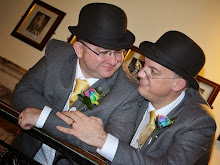
Home Truths author Simon Guerrier is a friend of ours and gave us a wedding present. Nothing of Home Truths, though, which is perhaps for the best (his lines that we weaved into our wedding reading weren’t from here, either). My husband is a careful driver, and the only time I can remember him swerving the car in shock was on a dark and stormy night coming up to Christmas 2008 and driving up to see our parents. The story is quite creepy enough, with the mysteriously, suddenly dead bodies of two newlyweds in their ideal home. We were already feeling for them, and then Sara Kingdom told us their names in track seven. Thanks, Simon. Of course, they’re not a perfect match: Simon’s been to our place and knows it is not in all honesty uncannily pristine; Alex has been gender-swapped (thinking about it, the story itself might have a trans character, from a certain point of view).

What Else Should I Tell You About Home Truths?
You can buy it on CD or download from Big Finish Productions here.
This is where I often mention things other fans don’t like about a story and turn them on their head, but I’m not as familiar with reviews for extra-televisual Doctor Who. So my contrary view on Home Truths is that the opening mystery and the aftermath are both brilliant, but some of what would ordinarily be the climax (to the ‘old’ story, at least) doesn’t engage me as much, though it captures the Doctor well and I can see how it’s a necessary bridge. Perhaps it’s just because in some ways it’s an extended ‘action’ sequence, which despite being a harrowing moment for Sara, those are always less effective on the radio, and though she has to ‘earn’ the resolution, I can see it coming and am impatient to get there once I think I know the answer (one of them, anyway).
Simon Guerrier is also the author, with Dr Marek Kukula, of a less fictional book on The Scientific Secrets of Doctor Who. A lot of people who don’t review his stories have nevertheless found this fascinating, so you might still find him popping up on the radio or at your local library to talk about Doctor Who and science and things, and he’s always worth listening to (and questioning). Whatever you think of this pair’s scientific views, at least they don’t wield them with the authority to unperson you if you disagree.
And, if you need one, my score:
8/10
If You Like Home Truths, Why Not Try…
More Sara Kingdom: The Daleks’ Master Plan. This is a thrilling epic from 1965-66, including in the middle Doctor Who’s first ever Christmas special episode (which isn’t very M R James at all). Unfortunately the BBC burnt most of it, but you can buy the whole soundtrack on CD, and see the three complete surviving episodes on the Lost In Time DVD set. You might also look out for Reconstructions online, which combine the soundtrack with photos to make the missing episodes easier to follow. I recommend Simon Guerrier’s sequels to Home Truths, too, and just this month he has a new Early Adventure out from Big Finish where the Doctor, Sara and Steven face the Sontarans as played by Dan “Strax” Starkey, bringing together some of the oldest and newest Doctor Who.
For more Jean Marsh, there’s the 1965 historical adventure The Crusade (for which most of the same limitations apply), and 1989’s Battlefield (all of which, thankfully, you can see on DVD or download from BBC Store). Ms Marsh plays different characters in all three stories, though all three have complicated relationships with their brothers – see especially her soliloquy at the end of Battlefield, her coldness in the middle of The Daleks’ Master Plan and a terrific The Crusade scene in which she tears strips off Julian Glover.
Labels: Big Finish, Doctor Who, Doctor Who 52, Fandom, Home Truths, Personal, Repeats Er I Mean Special Editions, William Hartnell


Wednesday, December 30, 2015
Five Reasons to Listen To Home Truths – Doctor Who 52 Extra: E
Introducing Doctor Who – Home Truths…
A ghost story for Christmas featuring one of Doctor Who’s shortest-lived companions as the heartbeat of one of its most intimate and personal tales. Jean Marsh recreates Sara Kingdom for this creepy Big Finish audio two-hander (3.05 in their Companion Chronicles series) where she poses a challenge to church, state and listener simply by being there. For all that she and the visiting Night Constable scoff at fairy tales, she embodies perhaps the oldest fairytale lesson of all…
“There’s a house across the waters at Ely where an old woman tells a strange story.”
Five Reasons To Listen To Home Truths (warning: spoilers lower down the list)
1 – Sara Kingdom. Back in 1965-66, Jean Marsh – possibly the Doctor Who star with the most glittering career – played Sara Kingdom. A Space Security Agent from the year 4000, Sara reluctantly teamed up with William Hartnell’s Doctor and his friend Steven Taylor, after first being sent to kill them – and in a sort of shocking sort of The Apprentice twist, killing another of the Doctor’s companions to get there, who haunts her still. In many ways she seems a New Adventures companion long before her time: hard as nails; personal tragedy and betrayal; always the shadow of the Daleks and death hanging over her; but some part of her always remains, because she travelled with the Doctor. Sara died an old woman, but there’s still no time after her travels for the Doctor for more adventures. So the most obvious way to bring her back is to give her an exciting Space Security Agent adventure before she ever met the Doctor (see “Lost Story” The Destroyers, also from Big Finish). Home Truths is not the obvious way to bring Sara back…
2 – Is she or isn’t she?
“Hear the old woman’s story. Then decide her fate.”Fans argue. And one of the oldest fan debates in Doctor Who is whether or not Sara Kingdom counts as a ‘real’ companion. She travelled in the TARDIS. But only for one story. But it was a very long one. But not even for all of that. But she deserves it. And so on. Or in later years, are the Doctor Who stories that begin as books or, here, CDs ‘real’ stories? To ask the question is to miss something about stories, for me, and while I make lists and write about esoteric story points too, those two questions aren’t ones that engage me, so perhaps I’m predisposed to take one side within this story. Because Home Truths itself takes such questions and ambiguities and weaves a story out of the very criticisms that people are bound to come up with before they’ve even heard it.
So the story starts with Robert the Night Constable, the sceptical listener. Home Truths has much in common with Ghost Light, though with a very different feel in its sparse settings, adrift from any one time: the stories are confined within a house; there’s a hint of M R James, with a religious scientist investigating the unknown; and like the ultimate villain in Ghost Light and like the fans this story is challenging, Robert has a list of categories that count and, because she doesn’t fit into them, he can’t accept her. It’s not real if you can’t see it. Can he, and the sort of fans who police the list, give her a chance by listening? And so their frame story, and the mystery found by the Doctor, Steven and Sara, and the meta-story of the listeners interweave as he questions what to him are her unreliable narrative devices, and says that he won’t allow the bits that contradict his continuity of facts, without being aware of the gaps in any of his own assumptions, the ghosts of his own superstitions. He’s putting her on trial as a danger to church and state while not really believing in the church side of his role and believing his known science as dogma of its own, so her real threat is more to his own worldview than to his world.
“Well? What’s it going to be?”
3 – Asking questions about human nature. The discussion between Miss Kingdom and Robert isn’t just about the people in the stories she’s telling, but about how we’re all wired – and tangentially between the two of them, both night constables of a sort, the conflict between orders and individuality, duty and empathy, and how all choices have consequences for which we must take responsibility. You have to ask questions, even if it’s hard: Sara’s original sin and Robert’s choice can’t be passed off as just obeying orders, and perfection doesn’t suit humanity. These are ideas that go to my wider political fear that utopias never have room for people who complicate things and that if you don’t count, you can’t exist, just as the story within the story speaks to inner fears of thoughtlessness (or of thoughts). And, ultimately, throughout this poignant tale, Miss Kingdom has reason to empathise with murderers who don’t really wish to be murderers, and in reaching out to them, might save herself.
4 – Opening up more stories. Sara Kingdom’s original story, The Daleks’ Master Plan, was Doctor Who’s longest TV adventure (subject, naturally, to debate). So it’s a cheeky ambition for Home Truths to put another story into the middle of it and open it out to be even longer, with a promise of more in there still. Author Simon Guerrier’s Doctor Who writing keeps coming back to William Hartnell’s Doctor, captured here in many facets – loving to explore, treating his companions as children but like a mischievous child himself, irritable when made to look foolish but almost serene at the end – and for Big Finish he’s created several rather marvellous adventures for the Doctor and neglected companions Sara and Steven (Peter Purves). Home Truths itself has two sequels (though not necessarily in that order), The Drowned World and The Guardian of the Solar System.
While the events of Home Truths are resolved as far as the Doctor, Steven and Sara’s travels go, not only is the story of Sara and Robert left unresolved, but the hints of the world they inhabit fire the imagination. It’s far in the future, but after war, flood and disasters we can only guess at. What might have caused the downfall of the civilisation after next? And how did another rise, seeing A Canticle for Leibowitz through a crooked glass, in the stern dogma of strictly defined church and science, though tantalisingly neither defined for the listener? Is this strangely past-future even Earth, or have names been carried over the stars like Robert across the fens? And why is he a Night Constable? Does this world ever see the light? Miss Kingdom herself tells Robert that she has a hundred stories to tell about the people who have stayed with her – though he’s deliberately asked to hear one he doesn’t believe. It’s no wonder that her conversation with him has more than a hint of Scheherazade, and that the whole thing feels like The Twilight Zone (a series in which Jean Marsh herself starred in another lonely two-handed psychological horror story / psychological character study).
5 – This creeps me out more personally than any other Doctor Who story.
“The corridor in which the woman lay led to a wide staircase, littered with flowers and paper-wrapped gifts. The Doctor examined the labels: they were wedding presents for Richard and Alex.”Home Truths author Simon Guerrier is a friend of ours and gave us a wedding present. Nothing of Home Truths, though, which is perhaps for the best (his lines that we weaved into our wedding reading weren’t from here, either). My husband is a careful driver, and the only time I can remember him swerving the car in shock was on a dark and stormy night coming up to Christmas 2008 and driving up to see our parents. The story is quite creepy enough, with the mysteriously, suddenly dead bodies of two newlyweds in their dream home. We were already feeling for them, and then Sara Kingdom told us their names in track seven. Thanks, Simon. Of course, they’re not a perfect match: Simon’s been to our place and knows it is not in all honesty uncannily pristine; Alex has been gender-swapped (though imagine the fuss if he’d killed the gays. And thinking about it, the story could have a trans character, from a certain point of view).
What Else Should I Tell You About Home Truths?
You can buy it on CD or download from Big Finish Productions here.
This is where I often mention things other fans don’t like about a story, but I’m not as familiar with reviews for extra-televisual Doctor Who. So my contrary view on Home Truths is that the opening mystery and the aftermath are both brilliant, but some of what would ordinarily be the climax (to the ‘old’ story, at least) doesn’t engage me as much, though it captures the Doctor well and I can see how it’s a necessary bridge. Perhaps it’s just because in some ways it’s an extended ‘action’ sequence, which despite being a harrowing moment for Sara, those are always less effective on the radio, and though she has to ‘earn’ the resolution, I can see it coming and am impatient to get there once I think I know the answer (one of them, anyway).
Simon Guerrier was also the author this year (with Dr Marek Kukula) of The Scientific Secrets of Doctor Who, and so was a guest on Radio 4’s The Infinite Monkey Cage Christmas Special last week. Whatever you think of their scientific views, at least they don’t wield them with the authority to unperson you if you disagree.
And, if you need one, my score:
8/10
If You Like Home Truths, Why Not Try…
More Sara Kingdom: naturally, The Daleks’ Master Plan, a fantastic epic from 1965-66, including in the middle Doctor Who’s first ever Christmas special episode (which isn’t very M R James at all). The BBC burnt most of it, of course, but you can buy the whole soundtrack on CD, and see the three complete surviving episodes on the Lost In Time DVD set. And I’d recommend Simon Guerrier’s sequels to Home Truths, too. For more Jean Marsh, there’s the 1965 historical adventure The Crusade (for which most of the same limitations apply), and 1989’s Battlefield (all of which, thankfully, you can see on DVD). Jean Marsh plays different characters in all three stories, though all three have complicated relationships with their brothers – see especially her soliloquy at the end of Battlefield, her coldness in the middle of The Daleks’ Master Plan and a terrific The Crusade scene in which she tears strips off Julian Glover.
Labels: Big Finish, Doctor Who, Doctor Who 52, Fandom, Home Truths, Personal, William Hartnell
Tuesday, March 31, 2015
Doctor Who Anniversary Special – An Interview With Martha Jones
Originally published in Wonderful Books’ The Doctor Who 8th Anniversary Special… To celebrate the tenth anniversary of Doctor Who’s return to our screens, and today the eighth anniversary of her first appearance in Smith and Jones, here’s my interview with the Doctor’s friend Martha Jones:

“I LEFT THE TARDIS WITH MY HEAD HELD HIGH!”
“I chose my vocation a long time ago, and even meeting the Doctor was never going to change that,” says Dr Martha Smith-Jones. “With a family like mine, you grew up learning to make your own mind up – or Mum made it up for you! But the Doctor certainly widened my career development, it’s fair to say.
“There aren’t many doctors who’ve been swept off into time and space and then come home to work for two different secret alien-fighting organisations. Even the Doctor’s only worked for one! I met my husband through him, of course, and now we deal with them ourselves. Though my Mickey has a slightly more aggressive approach. He shoots, I patch them up. Or him, more often.
“I’ll always be grateful to the Doctor. Some men only give you crabs – well, his were giant! No, no, don’t tell him I said that. He says they’re no such thing.
“After that year of the Master I just decided it was time to move on. I mean, I wasn’t going to keep trailing around with the Doctor for ever. I had my own life to lead. I left the TARDIS with my head held high! Of course, he was the one who came back. Not that it’s not nice to see him, but those Daleks were terrible… And doctors who wring their hands questioning euthanasia don’t know they’re born. They should try deciding whether to blow up the whole planet.
“We still meet up for a gossip, some of us who knew the Doctor. Not Colonel Mace, after Mum slapped him, but she gets on very well with Jack. Well, who doesn’t? Dad, too. I think he’s helped bring them closer. He’s so generous – he’ll take them for weekends away, and after the three of them get together they always come back with such a glow. Mickey pretends not to like him, of course, but secretly he does. Sometimes they go fishing. Mickey says he got a taste for it in that alternative Universe.
“And the Doctor? Oh, I’m completely over him. Hardly ever even mention him these days.”

Wonderful Books
Paul Smith has produced a fabulous array of Doctor Who publications, which you can find out more about at Wonderful Books (there’s a new one out this week). All of them look gorgeous and are immensely readable, but only some are completely factual – and I have to admit, the ones that most appeal to me are those with the most unfactual ‘facts’, the ones that are both deeply loving and taking the piss outrageously.
My Wonderful Books favourite is the one he didn’t write all himself, though it’s not because I’m one of the contributors. I’ve rhapsodised before about the Radio Times Doctor Who Tenth Anniversary Special, a treasured and tattered possession passed on to me when I was a boy and still perhaps the most thrilling Doctor Who magazine ever published. Before websites or guidebooks, this was the unique source of thrilling photos and details of stories all from before I started watching (that is, prehistory). So I was utterly thrilled when Paul asked me out of the blue to write a piece for his version in the fiftieth anniversary year.
Paul’s concept was to give it a similar feel and length to the original Radio Times Doctor Who Tenth Anniversary Special by recreating it as if celebrating not the fiftieth but the eighth anniversary of a Doctor Who series that started for the first time in 2005. And to give it the range of voices of the original’s interviews, he approached other fans to provide some of the artwork and comment pieces.
In the 1973 Special, double-page spreads about past stories alternated with newly shot double-page photo spreads and interview columns for past companions with pull-out quote headlines like “THE NUTCASE PROFESSOR SWEPT ME OFF MY FEET”. For a column like that, I was given only 350 words to play with – imagine – and a couple of other rules which I contrived to bend subtly (such as the ban on alluding to pre-2005 Who). I was asked which companion I’d like to write about, and though several tempted me – Rose and Jack were terrific in 2005, and I loved Jackie and Wilf – I instantly thought of Martha Jones, or rather Martha Smith-Jones as she is now. Had I written Mickey and Martha as a pair, obviously, he’d have mentioned Rose in every paragraph before saying he was completely over her (and had I written for Rory, it would have been a one-joke piece where he dies at the end of each paragraph and then gets better).
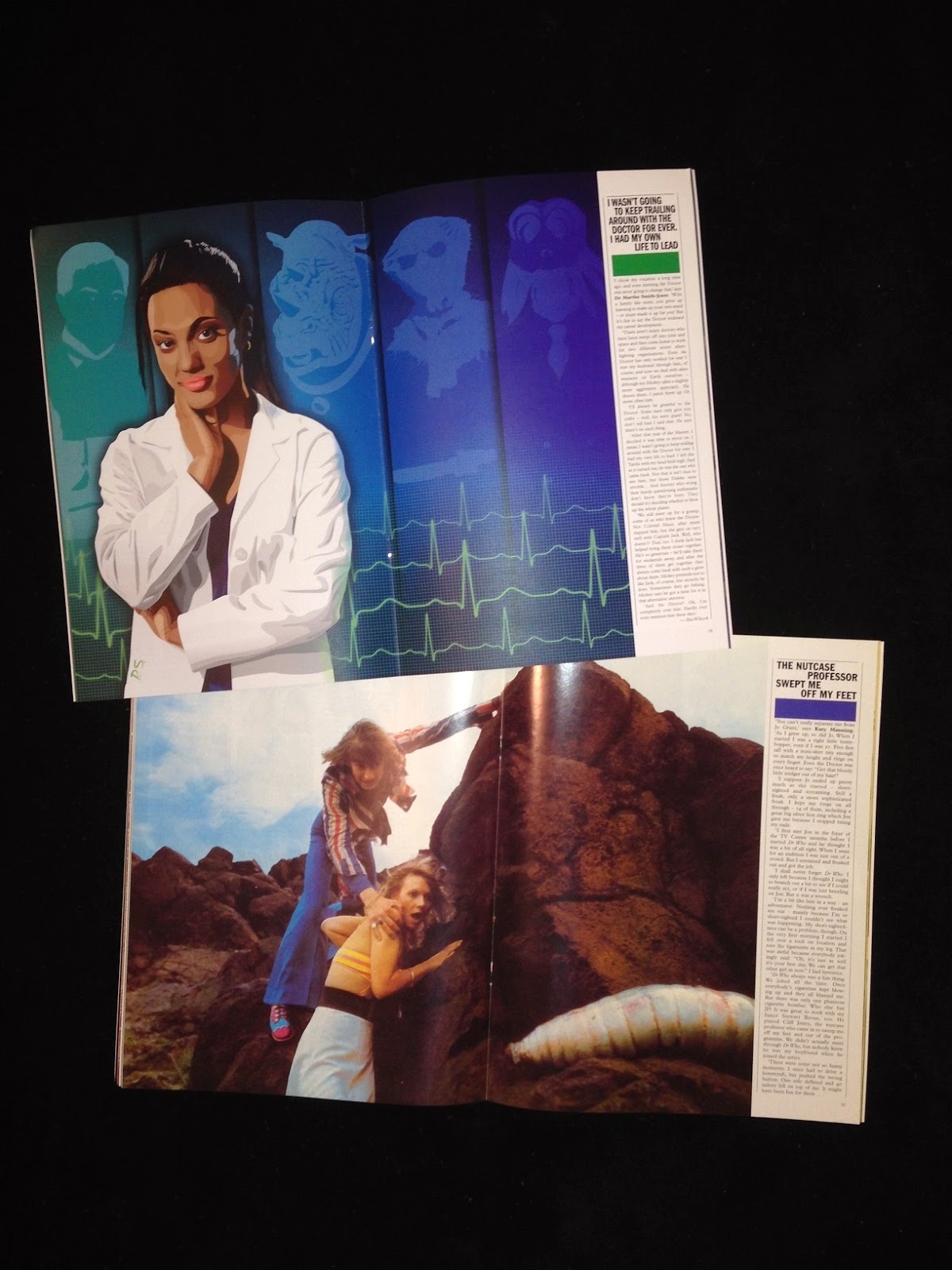
From her first appearance in Smith and Jones, eight years ago today – making it the most appropriate day to publish my own piece from the 8th Anniversary Special – Martha was a breath of fresh air for me. It wasn’t just Freema Agyeman’s performance and giving as good as she got to the Doctor (and him not being interested), nor just that she was the Doctor’s first full-time TV companion who was black (after Sharon, Roz and others elsewhere), but that she wasn’t going off with the Doctor only because her life was a bit rubbish. Martha is the only TV companion since Sarah Jane Smith with a decent, fulfilling, even exciting career – and for all of us who are so utterly gripped by the Doctor and his adventures, that’s a more inspiring example than the implicit suggestion that travelling in the TARDIS is only slightly better than being in a dead-end job you’re bored by or hate, or than having your parents killed in front of you (and going off with the first available surrogate dad). If you’re an achiever with a lot to give up, but the TARDIS is still so exciting you’d go off in it without a second thought – well, you would, wouldn’t you? And, for me, she has by far the most satisfying (and self-chosen) exit from the new TARDIS, too, again after impressive achievements in her own right.
Other contributors took their own approaches, writing critical assessments or celebrations of their chosen characters, but with the Radio Times Special so deeply ingrained in me, I knew immediately that I wanted to write an ‘After the Doctor’ interview in that style, for the character rather than the actor, and that though I was going to be tongue-in-cheek in several ways (her earnestness, the Doctor) as well, I was going to set out first to say ‘She’s a strong, brilliant character’. And while it may have taken some time to think of all the other words, then edit them all back down again, my starting point leapt into my head fully-formed on reading Paul’s initial email to me:
“I LEFT THE TARDIS WITH MY HEAD HELD HIGH.”Though, as you can see from the interview as published, Paul picked a different pull-out quote, though with a very similar feel.

As it turned out, Paul’s wickedly pointed ‘story summaries’ didn’t mention Martha at all, so mine was the only piece that featured her in the whole magazine, and I’m very happy to have done her justice (if thankfully not in an entirely strait-laced way). Happy anniversary, new Who and Martha Jones!
Labels: David Tennant, Doctor Who, Doctor Who Magazine, Fandom, Martha Jones, Obscure Doctor Who Jokes, Personal, Smith and Jones
Saturday, June 28, 2014
Which Website Is Attracting 86.3% of Parliament’s Bandwidth? Or – Showbusiness for Clickbaitors
The air of Westminster is today seething with wi-fi so overheated that some researchers have actually* been microwaved (*not actually. Actually that goes for much of this article). Personality politics is often dismissed as just a beauty contest; now, at last, politicians have a genuine* beauty contest about themselves (*no, seriously, against all reason this bit is completely true). Among usvsth3m’s array of “Fights”, you can now vote for “Which gentleman MP is the sexiest?” Other votes pit songs, films, cities and scary clowns against each other, but I know this one floats your boat (and the Doctor Who choices). Warning: this is a post-watershed blog post. …
The usvsth3m set-up is familiar from the well-known exercise, ‘Which of X and Y is best? There’s only one answer – FIGHT!’ and here people create lists of anything that takes their fancy, from which two items are pitted against each other at random each time you click. This sorts the list by what or who’s won the most head-to-head battles. Simple as that.
Two Lovely Pairs of usvsth3m Votes – and a Poll Where Lib Dems Do Best!
Of the many available, four have caught my eye and my mouse clicks: inevitably, two for politics and two for Doctor Who. The pairs curiously mirror each other. “Which gentleman MP is the sexiest?” offers a choice of 504 men combining in random pairs (if that sort of thing turns you on), so I doubt I’ve chosen between more than a tiny fraction of them, while “Which government minister do you loathe the most?” gives you a choice of 21 Cabinet Ministers, so it’s much easier to ‘collect the set’. Similarly, “What is the best Doctor Who story EVER?” suggests not only that television is the basis of all reality but also that the world will end before August Bank Holiday, but even so provides an eye-blearying array of 241 stories, while “Who’s the best Doctor Who?” offers only 14 versions of the Doctor to choose from, and not even (spoiler) Michael Jayston.
The most confusing to pick from if you have several tabs open and are on a hypnotised clicking spree between multiple pages – I know nothing of this – is the “Which government minister do you loathe the most?” which, as you can spot, is the only one of these four where you want your favoured candidate to score not towards 100% but towards 0%, like an especially pointless round of Pointless. This means it’s very easy to mix up who should be up and who should go down. At the time of writing, Iain Duncan Smith and George Osborne are hitting it out as the most unloved (not my picks, but high profile) at around 80% apiece, while Alistair Carmichael rejoices in being the only member of the Cabinet to score under 20%. Hearteningly, every Liberal Democrat scores below 50%, with the winner-by-which-I-mean-loser inevitably Nick Clegg, though still hated in only 45% of battles. So here at last is a poll in which the Lib Dems are doing comparatively well.
The main other conclusion I’ve drawn from this is that Iain Duncan Smith is a low-grade copy of William Hague, but lacking the looks, charm and redeeming social concern, and that Chris Grayling is a low-grade copy of Iain Duncan Smith, but lacking the looks, charm and redeeming social concern.
Favourite Doctors and My 85% Difference From the Average Fan
As for the Doctor Who choices… Well, at the moment I’m quite cheered by the results for favourite Doctor, which are significantly out of line with most polls and rather closer to my own views, though it’s possible this may change when more people vote on it. Not wishing to dwell on the unloved here, I’m delighted to see William Hartnell and Matt Smith currently in second and third place, and Colin and Sylv not inappropriately at numbers six and seven. The best story poll is the one in which I’ve voted least, counter-intuitively, as it’s the only one I could see myself going, ‘No, that’s wrong!’ and getting lost in it for days trying to affect the outcome of something completely meaningless (and even here the pictures matter: screengrabs, book covers, posters, many make the stories involved look much more or less appealing than they ought to be. I don’t think much of The Monster of Peladon, for example, but I have a Pavlovian response to Alpha Centauri, and as for The Smugglers…). At least, right now, my favourite story is doing about 25% better than in last month’s rather wider and more settled Doctor Who Magazine poll, so that’s something. But if I click 120 times, statistically it’s very likely to turn up in there for me to vote for it… No. No.
What I should do, I suppose, is post some of the more entertaining differences between what I think of various Doctor Who stories and how the average fan’s votes turned up in Doctor Who Magazine 474, just now disappearing from the shelves (but I’m sure you can find one, or buy the download). Should I? For the moment I’ll tease by saying that, out of 241 televised stories so far, my biggest differences either way with average fan opinion were one that I would have put 170 places higher – and another that I would have put 205 places lower! And both by the same author. Any guesses?
And Now the Main Attraction – Hot MP Totty
So, “Which gentleman MP is the sexiest?”… A serious project to bring sexual objectification to the attention of our lawmakers? A Parliamentary researcher with particularly varied tastes, or some other steamy clickbaitor? Or just taking the piss?
My own pet theory is that the poll has been created by the Labour Party in order to find an opinion poll that they can win: analysing the vital statistical correlation between the current top entries, the most plausible hypothesis is that all Labour researchers are under orders to vote and vote again for every member of the Shadow Cabinet. The null hypothesis would be that Labour’s Shadow Cabinet genuinely is a beauty contest, but while my tastes tend significantly away from society’s ideals of beauty, I don’t think I can be that out.
I found myself clicking on this quite a bit, though often with the ‘pass’ option, it being weirdly compelling more for my interests in politics than in men. Never have I been invited to pass sexual judgement on people with such a bizarre variety of internal reactions. All right, so some male MPs do indeed look attractive; others I recoiled from on looks alone. But for most of them, things were more complicated (or it would be their politics rather than their looks that made my flesh creep). For a start, I’d often vote for some of those with the most unflattering photos: I tend to look terrible in photos too, but it’d be interesting if someone did a (subjective) statistical analysis to see which MPs had had ‘good’ photos chosen for the site and which were clearly designed to put people off. Or which ones were just a little apart from the norm of Commons, conference or canvassing shots. What to make of the one covered in teddy bears? Did the person who compiled the list and pictures for the site have a particular thing for the sole MP pictured with his top off (and wood in each hand)? What have you got on your head, sir? Does anyone really think that being plastered from head to toe in Labour Party stickers is becoming? And how about the Tory posing by bales of hay, all the better to roll in it?
The disturbing thing about click, click, click is that very soon I stopped thinking about it. From being disturbed at being asked to sexually objectify people I may know, I quickly drifted into particular patterns to click through more quickly. Tending to vote the party line on Liberal Democrat MPs – tending to, with more than a few exceptions for more than a few reasons. Lib Dem readers, you may like to know that at the time of writing Duncan Hames is our highest-placed hottie, so congratulations, Duncan. The MP I’d have had top was disappointingly low (though while you’re down there…).
Or there were the wider political reactions. MPs of other parties that I’d met or heard speak usually got me clicking against them, because they’d moved from potentially off-putting to not on your nelly (with a few exceptions, like the backbencher I remembered as a nice old buffer who liked Doctor Who and might be surprised to get ‘sexy’ clicks as a result). Or the ones I’d never heard of but assumed if they were in the DUP they’d be downright unspeakable. Or the ones that are disgustingly homophobic – should I vote for them and send them a message to say so, in the hope that it would hurt them more than it would me? And of course that select bunch who, whatever their looks, I thought ‘unspeakable fascist’ and would vote against with anyone at all – though special points to the poll’s devisor, who managed to find a picture of Liam Byrne that seems to have captured his inner soul (an impressive feat in itself to find it).
Or there were the ones who were quite attractive and I didn’t know anything especially against them; or the ones who weren’t conventionally attractive but looked like they might be goers – several gentlemen’s eyebrows looked intriguing (as opposed to thinking of some, ‘He’s had lots of affairs – so he’s probably good at it’ or ‘He’s had lots of affairs – but I still wouldn’t touch him with yours’); or, I’m afraid, as my brain stopped processing images at all and I clicked ever more robotically, the names. I am of course in the top 0.1% of the population for being mocked about my name and should know better, but as words swam up before pictures I started thinking of Mr Crabb or Mr Clappison, not in my bed, or Mr Pincher, and with the court case so close, or wondering what filthy practice ‘Prisking’ is, or Mr Woodcock – does he have one? I’m sure the poor MP for Ogmore heard even more ‘jokes’ in the playground than I did. And looking at one of the currently highest-placed Tories, who by the vagaries of the algorithm popped up as a choice several times, I wonder if other people voted as I did for Mr Drax because he sounded like a Bond villain? And is it just me, or does Hugo Swire have the most Tory-MP-sounding name of any Tory MP? But when you start misreading names as ‘Tom Greatsex’ or ‘Michael Lubricant’ it’s just too close to Dilbert’s “You’ve ruined sex for everyone” and time to stop.
On the bright side, this is surely the most memorable tool yet for educating us on what the largely anonymous mass of Parliamentary Members look like – and encouraging us to be kinder to some – so I can recommend it as a valuable service to the public.
Labels: British Politics, Doctor Who, Doctor Who Magazine, Fandom, Polls, Sex
Thursday, February 28, 2013
Doctor Who 50 Great Scenes – 42: Day of the Daleks
“You went back to change history – but you didn’t change anything. You became a part of it.
“…You’re trapped in a temporal paradox! Styles didn’t cause that explosion and start the wars. You did it yourselves.”

Mysterious figures have been appearing out of nowhere to try and kill top diplomat Sir Reginald Styles before a crucial peace conference. The Doctor (Jon Pertwee), still exiled to Twentieth Century Earth and working with UNIT, is called in to investigate – who are the real villains? The combat-clothed would-be assassins? The brutal Ogrons pursuing them? Or, perhaps, in a story called “…of the Daleks”, could there be some other force behind it all…? Well, no, the involvement of the Daleks isn’t the big spoiler. The Doctor and his companion Jo are both drawn forward in time to a ruined 22nd Century Earth that’s little more than a giant Dalek slave-camp. The human resistance have utterly failed in taking the fight to the Daleks on an already shattered Earth… But their history tells them that Sir Reginald was a murderer who destroyed his own peace conference and triggered the world wars that left Earth easy pickings for the Dalek invasion. Using stolen Dalek time-travel technology, they’ve been travelling back to kill him first. Before you ask, this was a decade before The Terminator (and Harlan Ellison wrote an introduction to the US edition of the Doctor Who and the Day of the Daleks novel rather than an instruction to his lawyers, so clearly it was differently creative to the way The Terminator arrived at its plot). Though I do wonder if its starting point might not have been 1984 – that to control the past is to control the future, and not just by altering the textbooks?
It’s a story of contrasts: exciting and flat; intelligent and flawed. The final episode deploys the most of both, its first half largely made up of brilliantly escalating, compelling dialogue scenes that bring out the best in the actors, its second half the big action finish that director and budget fail to deliver perhaps most conspicuously out of all Who stories (something which the Special Edition tries hard to overcome, with limited success). I was first gripped by the novelisation Doctor Who and the Day of the Daleks some years later, which avoids some of the flaws of the television version and carefully walks the line between the human assassins being ‘terrorists’ or ‘freedom-fighters’ by generally terming them “guerrillas”. And while it’s easy to think of them as ‘freedom-fighters’ once their initial ambiguity is resolved into the knowledge that they’re fighting against the Daleks, at the story’s finest moment – a scene running from about seven minutes into Episode Four to a climax about five minutes later (or at the end of Chapter 12), in effect a perfect mid-episode cliffhanger – we come to question their fight all over again. They’re careless of human life and have little objection to killing or abandoning the Doctor – until learning that the Daleks fear him makes him in their eyes a weapon to be utilised. It’s the Controller of this sector of Earth, a Dalek-appointed bureaucrat, who shows the most humanity in his haunted tale of the wars that ruined Earth, and the brutalised fighters who’ve only ever known a Dalek Earth who show mercy only at the Doctor’s urging when they burst in to rescue our hero from Dalek suckers. Jon Pertwee’s Doctor and the Controller (Aubrey Woods (the Controller)) are both grandstanding performances at their best when suddenly focused down into quiet, intense dialogue scenes, and it’s the Controller’s despair more than the guerrillas’ determination that moves the Doctor, setting him on a vital train of thought once taken to the guerrillas’ base.
Once held by the human suckers, the Doctor’s given a simple proposition: they’ll send him back to the Twentieth Century, and he can kill Sir Reginald for them. But a lot of this makes the Doctor uneasy, and it’s not just the implicit feeling that murdering people in cold blood is the sort of thing the Daleks do and not him. Impatiently, the guerrilla leader tells him that, improbably, people still wrote history books through the wars, pinning all the blame on a power-hungry Sir Reginald, and that, improbably, they’d managed to find out that the Daleks had time travel and steal some of their devices, both a portable time machine and a large bomb. How convenient. Having met Sir Reginald and formed the impression that, while a dick, he’s no dictator, Jo and the Doctor each put their fingers on potential problems with this. He breaks it gently:
“But your history [No good for me – na, na, na na] could be wrong, you know?”She’s more blunt:
“But if this is true, Sir Reginald Styles must be completely round the bend!”It is notable that no-one seemed ever to have found any cells of fanatical Stylesists around the world ready to seize power as the bombs fell – in fact, the only cells of fanatics who might in some way be being manipulated by fascist dictators are the ones the Doctor is sitting in, and he’s already observed that
“Changing history is a very fanatical idea”.So, which fascistic fanatics who want to rule the world and have the power to change history do we know of, readers? Fortunately the dialogue is better-written than that and builds the drama to a peak rather than dropping quite such explicit hints, but Doctor Who’s deep-grained suspicion of ‘The ends justify the means’ (paraphrased in this scene by the Doctor) gives a very satisfying philosophical steer to the direction of the dramatic revelations. As the Doctor slowly brings out the truth with his questions, we’re reminded that one of the assassination cell was wounded and left for dead in the last attempt on Sir Reginald – both in dialogue, and in cross-cut images of him slipping into the cellar of the government mansion where the peace conference is due to take place… Complete with the bomb, taken along as a last resort.
If there’s no reason to think that Sir Reginald got his hands on some terrible new explosive and used it to blow up the peace conference – incompetently killing himself in the process – then somebody else must have done it. And, though it’s never made explicit, isn’t history always written by the winning side? While some of the story disappoints in the TV version, for me both on the page and on screen it’s one of Jon Pertwee’s finest moments as he pushes the logic of the guerrillas’ plans to its remorseless conclusion – a last suicidal attempt to carry out orders that doesn’t defeat the Daleks, but creates their future for them.
Always a favourite scene of mine, it’s relatively recently that it’s come to redeem what was one of those slight disappointments for me about the story: that it sets up what could be an intriguing mystery of motives as well as of time travel, but blows it too early. Presented with two apparently violent, villainous groups, camouflaged assassins taking orders from the moustached leader of their terror cell vs brutal ape-like aliens taking orders from an icy Controller (known only as the Controller), it not only offers a visual pun – guerrillas vs gorillas – but, in their mutual antagonism, a puzzle of which are the real ‘baddies’. Almost immediately, though, it’s revealed which side is working for the Daleks, and with that the mystery collapses into obviously evil Ogrons and quisling Controller vs misunderstood or misguided freedom fighters, making Jo seem dumb for clinging throughout to the opposite interpretation. And yet, the last time we watched the story, Richard wisely observed that this climactic scene and the ones following (which you’ll have to watch yourself) not only reverse everything the guerrillas know, but everything the audience knows about who’s really doing the Daleks’ evil work:
“All through this, Jo thinks that the Controller is the goodie, and the guerrillas are the baddies. And it turns out she was right all along.”It’s not without some controversy. This whole scene’s a major point of disagreement in the principal DVD documentary (of several). Lead writer of the time Terrance Dicks is quite right to say that the story needed it – arguing that if strange things happen, the viewers are unsatisfied if they don’t get an explanation. Barry Letts, often spot-on with his instincts as producer, here gets it entirely wrong, claiming that it shouldn’t happen in the last episode – the last episode should be action. So Tinker Tailor Soldier Spy should start by saying who the mole is, then just make time until an extended shootout? Particularly when the ‘action’ climax of this story is so infamously thin, it’s great to have such a memorable a mid-episode climax that depends on concept and actors rather than budget. As Ben Aaronovitch says, otherwise there’d be nothing of substance in Episode Four, though even he seems to wish there was somewhere else to put it. Not at all. I didn’t come to the story as a middle-aged, thoughtful Liberal, but a boy who drew ray-blasts all over my books because there were never enough in the illustrations (and it was one of Doctor Who and the Day of the Daleks’ pictures that taught me how to draw explosions). And even then, I was gripped by the big twist even more than by the fabulous Dalek battle in my head.

Day of the Daleks and the Time Paradox
This was really the first time that Doctor Who had brought together the philosophical and practical sides of time travel into what would now be called a “timey-wimey” story – previously, the Doctor had talked about the impossibility or undesirability of changing time, rather than us being shown its effects, while stories featuring more time travel than just ‘TARDIS arrives at beginning, TARDIS leaves at end’ had effectively made time a different form of space to chase about in. This moment of this story was the first time that time was really used as intelligent drama – as well as providing in itself a warning that getting stuck in timey-wiminess is bad, and that trying to resolve it by getting deeper into timey-wiminess is worse, and that you’ll have a miserable life in which everything becomes meaningless. I always took this as proof that, while if you came up with a really good one-off story in which it had consequences that would work as drama, you couldn’t possibly do it every week. Some might argue that Doctor Who later doing it every week disproves that rule – but probably not if they’ve watched it. Notably, the next time that the Doctor is pitched against the Daleks in a story about changing history, the Time Lords position him on the wrong side, leading to deeper philosophical argument, the Doctor no longer having a get out of jail free card for a moral dilemma, and arguably the start of the Time War which consumes both Time Lords and Daleks. Again, drama means consequences.
There have been many heated debates across the years about exactly how the ‘Dalek future’ that the Doctor averts comes about (not least round at a couple of leading fan-writers’ place one Christmas, when Richard and one of them debated it to the death while I and the other partner kept our heads down in the kitchen). I won’t go into it in metaphysical or philosophical depth, nor detailed temporal physics, but here are a few thoughts. When I was a boy, reading the story, it always made sense to me, possibly because my religious upbringing prepared me for the conceptual leap of some exterior cause with different, Creator’s rules. A lot of essays I’ve read seem to assume that the Daleks do the hard work of invading, then the guerrillas accidentally use Dalek time travel to create a paradox which spares them the trouble, after which the Daleks retrospectively doss about just protecting the new timeline; or that it’s a parallel universe, which nobody ever mentions (this is, instead, explicitly the time-travel version of the sort of story Inferno was, with Pertwee again at his best up against it); or that the Daleks just ‘found’ the wrecked Earth or that in some other way the paradox just started by itself and the Daleks found themselves a part of it.
The forty-one-year-old me has much the same reaction, albeit with longer words and paragraphs, to what I’m confident the seven-or-so-year-old me who first read the book would: that’s silly, far too complicated, and missing the point. Obviously, the Daleks are the baddies, and are almost as good at time travel as the Time Lords, and as the Doctor can’t change history then obviously this isn’t how history is supposed to go (unlike the Daleks’ first invasion, in about the same spot, but that’s another story). So the reason the Doctor can put a spoke in this particular timeline must be that the Daleks intervened to set it up in the first place.
“We have changed the pattern of history.”The time paradox is a closed system which goes round and round perfectly, once the Daleks somehow from outside the closed system just gave it a little starting push. As a boy, I pictured (perhaps in a mixture of science fiction, perpetual motion and theology) the Daleks lifting out a section of history as a bubble, intricately joining bits of it together and then setting it back in place to spin round and round. I can’t to this day explain the mechanics of that, but the conceptual image still makes perfect sense to me: the Daleks used their extremely clever time-travel engineering to bootstrap it and can then stand back while it circles for ever. It doesn’t matter that we don’t know exactly how it works, because the logic of the story and everything we know about the Daleks is that they’re behind it all, and unlike all those other ‘explanations’ that require there to be all those extra and often contradictory elements added to the story, my instinctive understanding has an Occam’s Razor about it and credits the Daleks with being clever. As well as appropriately making them the authors of their own destruction, as it’s only when they fearfully identify the Doctor as their enemy that makes the humans pay attention to him.
Richard wrote a more detailed and carefully considered analysis of what he sees as time paradoxes when considering What Does Timey-Wimey mean? in reviewing 2011’s Doctor Who – The Girl Who Waited on Millennium’s Fluffy Diary, as well as revealing that while a timey-wimey story may have been conceptually exciting to me as a one-off, when given nothing but so that no event means anything any more and Doctor Who disappears up its own timeline, my response is… Well, I may have given a hint there. But my Fifty aims to be positive, so I’ll stick to pointing you in Richard’s direction where, fascinatingly, despite having more of a head for high-level temporal physics than I do, he sees Day of the Daleks as philosophical rather than temporal engineering, driven by a plot in which the Daleks symbolise determinism and the Doctor free will. Rather brilliantly, this makes Day of the Daleks a battle between The Dalek Factor and The Human Factor, and a thematic sequel to The Evil of the Daleks after all. So the Doctor’s paradox trumps the Daleks’ not just dramatically but allegorically, when both quisling and terrorists – each thinking the other the enemy, but each raised with a Dalek mind-set – believe the ends justify the means and are equally surprised when the Doctor has compassion for the individual instead, in different ways the salvation of each of them (and of the world). Have a read.

Ray Cusick and the Daleks
Writing about any Dalek story this week is going to have a touch of melancholy, following the death of Raymond P Cusick. Doctor Who has been so extraordinarily lucky in so many of the people who’ve worked on it over the last half-century – actors, writers, designers of sound and landscape, and more – that even a shortlist of ‘If it weren’t for these people, the series wouldn’t be around today’ couldn’t be very short. But Ray Cusick would always be in the top tier: the man who designed the Daleks. There were others who were vital to them, too, including Terry Nation, Peter Hawkins and Brian Hodgson, but Mr Cusick created that iconic look and propelled the series to its first great success. He was an immensely talented designer, whether working on planets, historical periods or giant suburbia (and that’s just his Doctor Who work), yet he’ll always be remembered for creating the series’ first and still one of its most visually striking and coherently imagined alien worlds and Doctor Who’s first big monster.
There’s a touch of guilt for fans, too, in that the other thing he’s remembered for is as ‘Laughing Ray Cusick’, a way to cope with the reason that his interviews about the series were always unsmiling and with unhappy undertones, what became almost the series’ original sin – that while other people and the BBC itself made an awful lot of money out of the Daleks, the person who most deserved to didn’t. I hope he still found some pride in them. And it’s notable that in all the minor redesigns of the Daleks that have followed, to take them too far from the logic of Mr Cusick’s originals is to invite disaster. Bringing them into colour for the first time in the TV series, Day of the Daleks at least makes the right choice in making some of its Daleks gun-metal grey for a lasting suggestion of one-being tanks, yet it not only robs them of much effect by directing them very feebly but ignores the work of the original actors and sound engineers, as a result proving that messing up the vocal design can be almost as big a mistake as throwing out Mr Cusick’s shape. Notably, it’s the only DVD for which an alternative Special Edition completely redubs every Dalek line rather than just changing the special effects…
Bonus Great Doctor Who Quotation – The Trial of a Time Lord: The Mysterious Planet
I’ve always been curiously fond of the opening for the prosecution in the Doctor’s big Trial, and gave The Trial of a Time Lord: The Mysterious Planet as near to a rave review as it’s likely to get for the DVD, there choosing a Golden Moment of existential crisis. And there’s more to come in the Fifty, too. But one of the things I particularly like about it is that it lets Colin Baker really blossom as the Doctor, not just through him finding interesting things to do to distract you from the script, as in too many, but simply writing well for him – giving him good speeches and a good relationship with Peri. It was the last full script from Robert Holmes, master of the speech, the scary bit and the one-liner and probably the greatest Doctor Who writer of them all, here in the first of what will be quite a few of his lines featuring in my countdown.
It’s half-way into Part One, and the Doctor (Colin Baker) and Peri have discovered that the mysterious planet is, inevitably, a familiar one: ours, and two million years in the future, it’s gone down the Tubes. So, it’s another dystopian future Earth, but at least this one wasn’t created by the intervention of a bunch of Time-Warring superbeings with a magnetron. Er… Anyway, confronted with the ruins of Marble Arch Station, Peri is distraught; the Doctor, sympathetic but worldly (it’s not that long since he was faced with his own gravestone). It’s a beautifully elegiac scene for both of them, her reacting at the human level to the loss of her world, him taking the long view.
“Planets come and go. Stars perish. Matter disperses, coalesces, reforms into – other patterns. Other worlds. Nothing can be eternal.”
Extra Bonus Great Doctor Who Quotation – Father’s Day
The Doctor (Christopher Eccleston) has wise words about putting things in perspective.
“The past is another country. 1987’s just the Isle of Wight.”
Next Time… Duelling futures (it’s more timey-wimey, I’m afraid).
Labels: Christopher Eccleston, Colin Baker, Daleks, Day of the Daleks, Doctor Who, Doctor Who 50, Fandom, Ideas, Jon Pertwee, Obituary, Richard
Tuesday, February 26, 2013
Doctor Who 50 Great Scenes – 43: Paradise Towers… And Richard Briers
“It’s – it’s – aaagghh!”
“Yes, I know.”

I gave Paradise Towers a rave review when it came out on DVD, so I’ve already gone over it in some detail and even, for the first time in my Fifty, already celebrated this particular scene as a Golden Moment. So for added value for long-term readers, this version’s different. As with much great Doctor Who, there’s always something new to get out of it, and only a week or so ago, when already thinking about this entry, I realised there was another blatant source for the story that I’d previously not connected with it. Seeing some barking libertarian talking head on the telly, Richard’s and my mature response was to cast Carry On Up The Fountainhead (‘How d’you know she is?’ ‘What?’ ‘Randy!’). The Fountainhead word-associated to Fountain of Happiness Square, where the Doctor (Sylvester McCoy) and Mel first step out into dilapidated architectural marvel Paradise Towers. Something suddenly clicked in my head, and I suddenly realised that this tale of a solipsistic architect arrogantly careless of the people who might get in the way of his grand designs was more than a touch Carry On Ayn Rand already, cocking a snook at the ‘superior’. It was some time after that point that I realised the Great Architect Kroagnon’s name is half-derived from the grating architect Roark. Oh well. So much for brilliantly detailed analysis.
Anyway, arriving to see the sights of the acclaimed architectural triumph Paradise Towers, the Doctor and Mel find it’s a right old sight. The Doctor finds things to delight in, but Mel’s been listening to the fans:
“Just rubbish!”Their reactions are similarly divided on running into a gang of girls who’ve created names, crossbows and a culture from their surroundings: “Bin Liner,” declaims one as she sashays menacingly forward to introduce herself our heroes. The Doctor’s soon reciprocated and is caught up in a joyous dance with these Kangs… Mel stands grimly at the back. At crossbow-point. I always laugh at the exuberant wordplay, but in a more disturbing set of scenes in another part of the graffiti-covered, litter-strewn Towers cross-cut with these playful ones, we can see it’s not all fun and games.
“Nothing’s just rubbish if you have an enquiring mind.”
A Caretaker is moving nervously along a darkened corridor, walkie-talkie in hand, as much to seek reassurance as to make his report to his Chief (Richard Briers, at this stage only heard). I loved the dirty set design, the low lighting, the sinister silhouette against the window – in a properly crapulent ’80s tower block, it always felt like Doctor Who had finally landed somewhere close to home, both bringing the series up to date and making it that much more unsettling. And, of course, like so many blocks of flats, the Caretakers are bugger all use. Is he fixing the lights, cleaning the wall-scrawl, offering help and advice to visitors? No. He’s as scared as the rest of us. And it’s the running commentary of his fear that really makes this scene, with Joseph Young’s captivating performance of a minor authority figure out of his depth as he finds mounting evidence of murder, even as his boss’ voice keeps crackling testily back at him that nothing’s the matter. Even the sinister bass of the music adds to the atmosphere.
But if it’s not the Kangs fighting among themselves, what could have killed the young woman we saw scream her last in the episode’s opening moments? What should be on the side of the Caretakers, under their control, but have become a law to themselves and almost a mythical sight? Surely not the Mark 7 Megapodic Cleaners? And while in many Doctor Who stories the sight of them might have been saved for the cliffhanger, and in many Doctor Who stories that take themselves more seriously the sight of such an unconvincing robot might wound the story terribly, the essential absurdity that these are the cosy cleaners that have gone on the rampage prepares you for what is, basically, a very unthreatening hoover with ideas above its station. And when Mr Briers at last sounds sympathetic, his punchline – exactly on the line between horror and comedy – is pitch-perfect.
Poor Caretaker 345/12(3).
Bonus Great Doctor Who Quotation – The Face of Evil
It’s six minutes into Part Four: there’s a mad computer in denial; two tribes of believers on the point of losing faith; and the Doctor wisecracking while his new companion the local freethinker tries to kill him. Unusually, it’s not just because of his sense of humour. But never mind all that. This time, the quote really speaks for itself…
“You know, the very powerful and the very stupid have one thing in common… They don’t alter their views to fit the facts; they alter the facts to fit their views. Which can be uncomfortable, if you happen to be one of the facts that needs altering.”
Next Time… It’s about timey-wimey (oh, just shoot me for typing that).
Richard Briers
“I have played straight drama, which I love, but I eventually miss doing comedy because we are in such miserable times. And I do feel that my purpose in life is to cheer people up.”

Richard Briers was a figure from as far back as I can remember. Not always a comforting figure – even Tom Good had something slightly unhinged about him. I was most fond of him for Roobarb, who was just barking (and it’s sad to read that Bob Godfrey, the brilliant animator of those vibrating lines of Roobarb and Custard and all, has died in the last week, too). Grown up, I can still cackle at his drunken flirting with Margo, and came to appreciate his Martin in Ever Decreasing Circles – who I’d never warmed to when I was younger, but now see as a searing docu-drama about a typical Lib Dem local party committee member [in the commentary on a Christmas episode, the cast are asked about their most unusual roles. Richard Briers: “Mine was Doctor Who, a long, long time ago, when I played Hitler.” Peter Egan cuts in as Paul-to-Martin: “Oh, I don’t think you’d be miscast as Hitler… In fact, I think he’s a bit left-wing for you.” Richard-as-Martin: “I wish I’d never said anything now.” They fall about… The interviewer, of course, excitedly remembers Paradise Towers. Penelope Wilton modestly adds “I’ve been the Prime Minister,” which Mr Briers watched, and both her co-stars impressively get the literary reference to Sycorax. But I digress].
Mr Briers gave many brilliant straight drama performances, too – by one of those horrible coincidences that meant we’d never have put it on the following day, the night he died we were watching him in Midsomer Murders – Death’s Shadow. But he’s rather fine, and rather sad, in that, too; it’s a murder mystery, and a good one, so I shan’t tell you what he’s reacting to, but (my) Richard and I were each gripped by one particularly well-played reaction from him (17.20 and 1.34.58 in respectively, if you have it). And then there’s Paradise Towers.
Oh well. He’s not all bad in it – he is absolutely perfect as the foil nagging at the young Caretaker over the comms, then that moment of belated, inappropriate tenderness. He’s almost forced to be great when he and Sylvester swap roles as the Chief interrogates the Doctor. And he’s suddenly touching in peril at the end of Part Three. But, for the most part, he was ever after refreshingly candid that he ignored the producer and just wanted to have fun with it, so for much of it he is blankwallandcleaneringly terrible, albeit abetted by the designers festooning him as Hitler On Ice (in the words of some infamous review that escapes me). And yet, after two decades of fans glowering at him, he was a guest at the first convention I ever attended and brought the house down within seconds of coming on stage – by apologising for underplaying. I’ve never seen such instantaneous forgiveness.
So I want to say two things about Richard Briers in person. I met him twice, each time at the end of hours’-long autograph queues where most actors inevitably get tired and testy, yet he was never anything other than charming, enthusiastic and interested. The second time was an appearance at the Stamp Centre on the Strand, with his wife Ann Davies (who’s also lovely) and Tom Baker, where Tom was an old hand at these things while Richard was not only being the straight man to Tom’s booming rudery, but constantly looking about him with a delighted smile as if he couldn’t believe he’d got to his seventies without discovering such utter joy as being in a cramped shop packed with a never-ending queue for which he wasn’t even the main attraction. Was he a genuinely lovely man who really was personally interested and delighted in every single person he met? Or was he a brilliant actor who was able to fake it and extemporise interested things to say for four hours non-stop just because that would give all the queuers a happy experience to take home with them – which would also make him a genuinely lovely man?
One of the things I asked Tom (Tom Bad, perhaps I should call him, to make a distinction from the man signing my The Good Life set) to autograph that day was a photo I rather liked of him as the Doctor, with K9, from the 1980 story Full Circle. Unusually for a Doctor Who location shoot, the sun was blazing, and Tom’s rich red coat set among suddenly vibrant green leaves looked stunning, the whole image far more exotic than it had any right to be. He took it, and sat back.
“I seem to be in some sort of jungle.”Richard Briers leant over, fascinated, his eyes lighting up.
“You went all over the world in your show!”Tom snorted.
“All over Buckinghamshire!”

Not all actors – particularly ex-famous ones – took so well to being surrounded by people to whom they weren’t the lead. Back at that very first convention I attended, one actor – let’s call him Mr G— – had been a big soap star but had played only one minor character in Doctor Who, and was volubly aggrieved that his queue was much, much shorter than those for people he’d never heard of. Visibly more and more sour with the people he was signing for, when he stomped off at the end of his session Mr G— let rip in the green room, embarrassing most of his fellow guests with a tirade against “bloody anoraks” (that is, fans who didn’t properly appreciate him as the most important person in the hall, or perhaps the world). By contrast, I also once met Mr G—’s on-screen soap wife after she’d much later taken a role in an audio Doctor Who and, like Mr Briers, she came across as delighted and delightful in a similar setting. But back in that green room with Mr G—, for a few seconds there was silence. Then Richard Briers took a sip of tea, and looked up, with a mild but firm tone, to tell him:
“Those ‘anoraks’ are paying your wages.”So, farewell, Richard Briers. You’ll be missed. My condolences to Ann and the rest of your family and friends. And thank you for being a genuinely lovely man.
Labels: Carry On, Comedy, Doctor Who, Doctor Who 50, Fandom, Obituary, Paradise Towers, Personal, Sylvester McCoy, Tom Baker
Saturday, February 23, 2013
Coming Soon: Three Things I’ve Written For Other People
How To Write Something: It Turns Out, Only By Getting Writing (nagging helps)
I love writing. Except when I don’t. In that, it’s rather like a lot of things in my life for which my health or my fears get in the way. And it’s a rather lovely ego-boost to be asked to contribute to something. But also sometimes terrifying. I write for many reasons: for pleasure (it’s certainly many years since any of it was for money); to make a point that needs saying; because I’m not able to get out much and want to feel like I’m connecting with the world… But I also tend to put things off, because I’m too ill much of the time and there are other things I want to do when I’m not. This means that anyone who is kind enough to ask me to write something does so at their peril, even if I do often really want to write for them. At the least, they’ll probably have to nag a bit. At worst, I may have to steel myself to get past the gnawing terror that sometimes irrationally substitutes itself for the ‘Whee!’ feeling that someone being nice about my writing ought to evoke. It’s embarrassing to admit (as some of the people involved may read this) that there’ve been times when, on receipt of an invitation to do some writing for something that sounds impressive from someone I respect, my immediate reaction was not to beam at the compliment but have a complete crash of self-esteem, worry that anything I wrote would never be as good as the other contributors, and pretend not to have seen the mail or any follow-ups (the online equivalent of keeping the door shut, the curtains closed, and never going out, as it happens pretty much my life offline). Which I suppose is just my life-long tendency towards seeking perfection as procrastination turned pathological.
I’m still putting off writing a lot of things I want to do for me, but happily somehow in the last year I managed to say yes to four interesting things for other people and have actually delivered three. Woo hoo! It may be significant that I warned three of them that I’m terrible with deadlines and would need nagging, while the other, for which I had several exciting ideas, took a while to reply, then I took longer to reply to them, then… Well, I’ve not heard any news of that particular book coming out, and I hope I’m wrong in suspecting it may not get round to. So, here are the three for which people gently prodded me, available soon…

The Doctor Who 8th Anniversary Special
Interviewing Martha Jones for Paul Smith at Wonderful Books
With the vacuity of the official modern Doctor Who Annual creating a gap in the market, in Summer 2010 the Doctor Who Magazine team (responsible for previous much more readable Doctor Who Annuals and similar books) joined with BBC Books to produce the far more interesting, text-intensive and generally creative The Brilliant Book of Doctor Who 2011, first in a series which ran… Only two years, unfortunately. But it did inspire something even more creative, entertaining and beautiful – and not just because it was based in a Who period considerably more to my taste and the only Doctor definitely more to my taste than the present one.
The Wonderful Book of Dr Who 1965 was created by Paul Smith as an homage to The Brilliant Book, but packed with facts, interviews and images based not on Matt Smith’s first season in 2010 but on William Hartnell’s (and the series’) first in 1963-4. And not only did it look gorgeous and was immensely readable, but it was very funny. Because not all of the facts (and none of the interviews) were exactly factual, both deeply loving and taking the piss outrageously. And all available as a free pdf, the cheaper, prettier, faster version of the old fanzine (though he did a few print copies, too).
All this meant that I was especially delighted when Paul Smith contacted me out of the blue to see if I’d like to write something for his next project. I didn’t know him, but I’d thought his work was (obviously) wonderful. And that this was to be an homage to the legendary Radio Times 1973 Special for the fiftieth anniversary was the reason I had to go for it, if I could. I’ve previously enthused about the Radio Times 1973 Doctor Who 10th Anniversary Special as probably the most marvellous single Doctor Who magazine ever published. It wasn’t until more than a year after that that Doctor Who first captivated me, aged three, so when a family friend who’d kept his slightly battered copy gave it to me, it instantly became one of my most treasured possessions. Before websites or guidebooks, this was the unique source of thrilling photos and details of stories from before I started watching (that is, prehistory).
Paul’s concept was to recreate the Special as if celebrating not the fiftieth but the eighth anniversary of a Doctor Who series that started for the first time in 2005, with other fans providing some of the artwork and comment pieces. In the original, double-page spreads about past stories alternated with newly shot double-page photo spreads and interview columns for past companions with pull-out quote headlines like “THE NUTCASE PROFESSOR SWEPT ME OFF MY FEET”. For a column like that, I was only given 350 words to play with – imagine – and a couple of other rules which I contrived to bend subtly, and may explain when the publication appears. I was asked which companion I’d like to write about, and though several tempted me – Rose and Jack were terrific in 2005, and I loved Jackie and Wilf – I instantly thought of Martha Jones (or Martha Smith-Jones, as she is now).
From her first appearance in Smith and Jones, Martha was a breath of fresh air for me – not just Freema Agyeman’s performance and giving as good as she got to the Doctor (and him not being interested), not just that she was the Doctor’s first full-time TV companion who was black (after Sharon, Roz and others elsewhere), but that she wasn’t going off with the Doctor only because her life was a bit rubbish. Martha is the only companion since Sarah Jane Smith with a decent, fulfilling, even exciting career – and for all of us who are so utterly gripped by the Doctor and his adventures, that’s a more inspiring example than the implicit suggestion that travelling in the TARDIS is only slightly better than being in a dead-end job you’re bored by or hate, or than having your parents killed in front of you. If you’re an achiever with a lot to give up, but the TARDIS is still so exciting you’d go off in it without a second thought – well, you would, wouldn’t you? And, for me, she has by far the most satisfying (and self-chosen) exit from the new TARDIS, too, again after impressive achievements in her own right.
I understand that other contributors might have written critical assessments or celebrations of their picks, but with the Radio Times Special so deeply ingrained in me, I knew immediately that I wanted to write an ‘After the Doctor’ interview in that style, for the character rather than the actor, and that though I was going to be tongue-in-cheek in several ways (her earnestness, the Doctor) as well, I was going to set out first to say ‘She’s a strong, brilliant character’. And while it may have taken some time to think of all the other words, then edit them all back down again, my starting point leapt into my head fully-formed on reading Paul’s initial email:
“I LEFT THE TARDIS WITH MY HEAD HELD HIGH.”You can already see a tiny preview of the Martha Jones pages on the Wonderful Books site, and I believe the new Specials are now at the printer’s.

The Worldcon Guide To Doctor Who In London
Bigging up That London for Nicholas Whyte and the 2014 World Science Fiction Convention
“Of all the places the Doctor ever visits, which is the one he comes back to more than any other? Not ostensibly exotic locations such as Skaro, Peladon or New New Earth – even Cardiff – but London. And, paradoxically, since Doctor Who began recording in Cardiff, the Doctor has been drawn to London more than ever before. But then, when the Fifth Doctor exclaimed that he was being pulled towards the middle of the Universe, there was no way this was going to mean a thrilling return to Terminus. Inevitably in Doctor Who, the centre of the Universe is London.”Diplomat and prolific science fiction (and Northern Irish and European politics) blogger Nicholas Whyte rang me last year to ask me if I’d like to write a guide to London locations in Doctor Who. He’s one of the organisers of Worldcon 2014, taking place in London next August, and thought this would make a great advertising hook to encourage people to come to London from all over the world.
That seems, you might think, quite a long lead-up time, and it did to me, so pity poor Nicholas a few weeks ago when I’d not yet turned my notes into a proper guide and, it turned out, not this year’s Worldcon in San Antonio but the biggest US Doctor Who convention – Gallifrey One, in Los Angeles, which took place last weekend – was looming upon him and he needed leaflets to hand out. Which led to me finally getting down to the drafting over the course of about four days solid, and discovering that I had oodles of notes for some Doctors and rather fewer than others. My intention had always been to select one location for each Doctor, all across Greater London, to give a range of time and space. So imagine my hilarity when, thinking all I had to do was whittle down several possibilities for each, I found that for two of the less Londoner Doctors I’d pencilled in the same location and didn’t have a back-up. I won’t tell you what, or how I ended up finding an alternative for one of them – though I did for a wild moment consider making a point of it and choosing that same location for four different Doctors, if that’s a clue…
I’d been told to write for a word count in the low thousands and, being me, ended up at what might be considered the upper end of that – about 3,400 words. Nicholas was very complimentary about it all, and is going to put the lot up on the convention website – but it was never going to fit on a leaflet. So the last of my four days was spent cutting it down by more than half, to 1,600 words, at the same time substantially rewriting it to make it still work at that length and trying to keep in at least some of the jokes, on the grounds that while I found such other guides as Richard Bignell’s book Doctor Who On Location and the website Doctor Who – The Locations Guide invaluable research aids and recommend each, they’re best to dip into and not easy to read through as enticements. And, in an attempt to forestall Nicholas and the Worldcon London team from making it less readable, at about two in the morning I stuck the text into some text boxes, inserted a few photos and clicked “Save as pdf” to prove that it would all fit on a leaflet as was. I expected they’d find someone with any graphic design ability to turn the text into leaflets…
So my apologies to people who picked up the leaflets in Los Angeles last weekend and saw something scruffy from Word without any links on it, but at least I reckon the text was pretty good. If you’d like a copy of the pdf, email me (look at the sidebar), and at some point the extended version, which is a more entertaining read, will be up on the Worldcon 2014 website. In the meantime, here’s one of Nicholas’ reports from Gallifrey One, complete with the huge maps they hung up to make sense of my references. I won’t tell you all of my choices here, but the first is obvious:
“Daleks looming before the Palace of Westminster and St Stephen’s Tower – the Houses of Parliament and Big Ben – are the very image of democracy overthrown by fascism. Before crossing the Westminster Bridge toward the Parliament of the United Kingdom of Great Britain and Northern Ireland, look left along the Albert Embankment; if you see zeppelins and signs for Newport, you’re in the wrong London. Best get that settled before you set out. Pass Big Ben into Parliament Square, turn right into Parliament Street / Whitehall to follow in Barbara’s fast footsteps, and like her you’ll reach Trafalgar Square at the end. That in itself is a much-used Doctor Who landmark: Ian and Barbara return there for an exuberant homecoming in The Chase; a New Year rings in in The Daleks’ Master Plan; Nelson gets a redesign in No Future and has long since toppled by The Sontaran Experiment; Rose has lunch there with Mickey before meeting the Doctor; it’s conquered by the Daleks again in the game City of the Daleks; but Londoners can feel secure that in a thousand years’ time, Trafflegarr Square will still be there in Spaceport Five Undertown.”
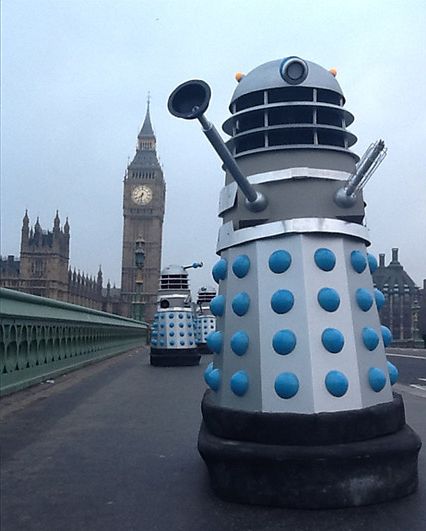
What Do the Lib Dems Believe?
Liberal Philosophy for a Mark Pack Infographic
While I don’t know if I’ve ever met Paul, and I know Nicholas a bit, Mark has known me more than twenty years. That means he knows my relationship with whooshing deadlines, so he’s the one who wisely met up with me for a couple of hours and prodded my brain for ideas rather than necessarily waiting for me to do the actual writing. Last year, Mark produced an Infographic on “Liberal Democrat Achievements In Government” free for any Lib Dem or reader to get across at a glance some of the influence we’ve had through the Coalition. His next Infographic is to get across what we stand for.
Mark and I have worked on and off together on a simple crystallisation of what the Liberal Democrats believe for decades, first inspired by the ’90s “core message” under Paddy Ashdown and Matthew Taylor (for which I was back in a senior enough position to get hold of much of the briefings). In recent months, there’s been work on a new one under Nick Clegg and Ryan Coetzee, and while Mark will no doubt be including that as part of his Infographic, we both wanted to come up with something a bit deeper: a mixture of history, philosophy, controversy and current priorities, the story of the Party and its soul, if you like, hopefully showing how they all fit together and giving something that all Lib Dems can nod at, whether for information or for inspiration. My intention, at least, is something that Lib Dem members can look at and think, ‘Yes, that’s some of why we bother’.
Though Liberalism provides a far more coherent and consistent philosophy for the Lib Dems than whatever shifting melanges animate the Labour and Tory Parties, it’s not without its problems in summing it up in brief – nor do I envy Mark in having to find images to illustrate concepts for his Infographic. I’m also grateful for him for pulling it together, not least because my series of ‘What the Liberal Democrats Stand For’ posts on this blog has mostly gone unwritten or in fits and starts, and I’ve not even finished republishing my original 1999 Love and Liberty pamphlet on here. So, Mark’s project is less ambitious, but it’s happening (hooray).
My best guess is that Mark is likely to publish the Infographic for Liberal Democrat Spring Conference in a fortnight, and I’m intrigued to see how it turns out. He did send me his rough notes last month, which I didn’t get round to helping with; he’s since sent me the first draft of the Infographic itself, to which I helpfully replied (having failed to do it at the more amorphous stage) with a close-to-complete redraft. Being me, and more a words than a graphics sort of person, that also raised the suggested word count from about 600 words to about 800, which I expect Mark to slash even if he wishes to take all my points on board. I know he’s circulated it to several other people, too, so I have excitingly no idea what the final version will look like – but I hope I’ll agree with it, and so will many of you.
At the risk of picking out elements that don’t make it through, here are a few teasers:
I’ve suggested the Infographic start with What the Liberal Democrats Believe in six words. But which six?
Mark is, amongst many other things, an historian, and one of the key staging posts for him in the Party’s history was the mid-Twentieth Century development of both Community Politics and Europeanism as important to our predecessor Liberals and Social Democrats. People often think these are contradictory, but they’re not – so here’s one of the lines I suggested to get across as briefly as possible why they’re part of the same thing:
“both challenged centralised power, saying decisions should be at the lowest practical level, from your local community for local issues to international co-operation on issues like trade and climate change.”And when many are trying very hard to say the Party’s split today between Economic and Social Liberals, for me this is greatly overstated. The extremes make a lot of noise, but most Lib Dems see themselves comfortably as both, or simply as Liberals. So here was my suggestion on how briefly to sum up the consensus, not just the differences, between members of the Liberal family:
“All Liberals believe in liberty, and that any sort of power (government, business, other people) can both protect and threaten liberty.Some may recognise my paraphrasing of my old friend and mentor Conrad Russell. And before long, you can see if any of this made it into the final draft!
“Economic and Social Liberals put different emphasis on which sources of power are the best defences or the biggest bullies, and on whether freedom or fairness is the biggest priority.”
Something Mark’s prodding brought me back to look at again was my own shortish ‘What the Liberal Democrats Stand For’ statement, which I first drafted in the ’90s and had slightly updated several times since to incorporate a flavour of whatever the Party’s key priorities happened to be at the time. As each version was limited to between 140-150 words, in the years that I was Vice-Chair of the Liberal Democrat Federal Policy Committee and would deliver its report to Party Conference, I even used to read it out as part of my speeches, on the basis that if any Party body should be concerned with what we stand for and communicate it to people, it should be the one that’s responsible for the Manifesto.
It’s some years since I last wrote a new draft of this, and I had a go, incorporating some of the new Ryan Coetzee messaging. It was the largest change (still kept below 150 words) I’d made since I first came up with it, and I’m not printing it here today because, after an appropriate pause for thought (and after Richard shaking his head), it seems too much of an ugly mash-up. Should I manage to get it to flow soon, I might publish it when the Infographic appears. In the meantime, if you’d like to chip in or just to see what the Lib Dems stand for for me, email me (again, link in the sidebar) and I’ll send you both the previous 2000s version and my latest attempt-in-progress.
And that’s it, at last. I hope you enjoyed the trailers, and that you’ll soon be able to see the main features. And just a couple of days ago, I was asked if I’d like to write something for another fan magazine I adore… But as I volunteered to do what’s probably the most popular bit, they may not say yes!
Labels: Conrad Russell, Doctor Who, Doctor Who Magazine, Fandom, FPC, Health, Liberal Democrats, Liberalism, London, Matt Smith, New Adventures, Personal, What the Lib Dems Stand For, William Hartnell