Saturday, July 11, 2020
Liberal Democrat Values: Mark Pack’s Three Answers
What do the Liberal Democrats stand for, and why vote for us?
That’s my lead question from several I sent to Liberal Democrat Leadership candidates Layla Moran and Ed Davey. I’m still awaiting their replies, yet have just had answers from a Lib Dem Leader… But probably not the one you’re expecting.
Doctor Mark Pack is Acting Co-Leader of the Liberal Democrats, an unexpected temporary addition to his election as Lib Dem President, so I sent him three of the same questions and he was first to respond. Thank you, Mark! Here are Mark’s pithy answers:
Question One:
People say all politicians are the same. Lib Dems have often seen moderation, working with others and compromise as virtues, to the point of the caricature that a Liberal is someone so fair they don’t take their own side in an argument. So what really motivates you?
When someone asks you on the doorstep, the hustings or on TV to sum up in a sentence or two what the Lib Dems, uniquely, stand for – and why anyone should vote for us – what do you answer?
We want to give everyone the best possible chances to live their lives as they wish, to be who they want to be and to make their own choices. Both Labour and the Conservatives are far too keen to tell people how they should behave, or to pick chunks of society who they don’t care so much about and to put different parts of our society at odds with each with other.
(That’s my English doorstep answer, of course. For Scotland and Wales, I’d talk also about nationalists, and how we want to bring down barriers, not put up new ones between people on our common islands.)
Question Two:
Two of the most heartfelt Liberal Democrat instincts are ‘Why can’t we all just get along?’ and ‘Stand up to bullies.’ Whether you call those ‘moderate and Liberal’, ‘caring and courage’, ‘love and liberty’, the party feels both, needs both, but they’re often competing as well as complimentary, so our balance between them changes with the times.
Which do we need most to lead on right now?
As your own blog’s name correctly captures, we need both. Each is dependent on the other. Love and liberty each flourish when the other is present. I wouldn’t make a forced choice between the two, just as I won’t pick vowels or consonants are the most important types of letter. It’s when both come together that the best happens.
Question Three:
Ask what the core of Liberalism is and the answer’s obvious: “It’s About Freedom”. So obvious, that was the title of the Liberal Democrats’ 2002 philosophy paper. Look at our other positioning papers and manifestos under Charles Kennedy – “Freedom In A Liberal Society”, “Freedom, Justice, Honesty”, “Freedom, Fairness, Trust” – Freedom led. Our constitution leads with “Liberty, equality and community”. But Leaders and campaigns since have made Freedom or Liberty invisible.
Are we afraid it’s not popular, not relevant, or have we just ceded it to the illiberal Right?
I’m enthusiastic about the concept of freedom while being cautious about the vocabulary. The word as acquired strong right-wing overtones. If someone saw a leaflet saying ‘I’m for freedom’ and had to guess the politics of the candidate before reading on, I strongly suspect most people would assuming the person is right-wing, a libertarian even perhaps. If the word freedom seems right-wing, I also suspect the word liberty sounds like a word from the past. You’re more likely to hear it in a historical Hollywood movie than in ordinary conversation.
So I don’t worry too much about word counts on either, as long as the concept comes through clearly in what we argue for – such as the future benefits of a close relationship with the rest of Europe that minimises barriers, and so protects people’s freedoms.
Lib Dems Believe – More Answers
I posted my three questions (with an extra two individually targeted ‘mean’ ones for Ed and Layla) here on Monday, along with some of my own commentary on where the Liberal Democrats are going and – to lower the bar for the candidates – the two absolutely worst answers I’ve ever heard on Lib Dem values and why to vote for us.
I was rightly challenged on this to share some of the best answers I’ve had, too. So you can read my eight-Tweet thread here in which I pick out some of my favourites, including answers directly to me from Lib Dems such as Lynne Featherstone, Caron Lindsay and Brian Paddick, and historical choices such as David Lloyd George and Roy Jenkins (and a friend has just shared with me his own new vision this week, which I hope to quote and promote when he publishes it).
During the 2015 General Election I posted every day on Lib Dems Believe with a variety of values, long and short, old and new, in which the same ideas and ideals came across over and over, though in a wide variety of different words. Most answers I’ve had tend, like Mark’s, to be pithy. My absolute favourite is of course the longest of all those I chose, an abridgement of one of Paddy Ashdown’s Leader’s speeches and still the most inspiring I’ve ever heard. I recommend it.
Finally, as I’m judging others it’s only fair I put my own answers up for judgement too. Over many blog posts on what the Lib Dems stand for over many years, the pithy values closest to my heart remain “Freedom, Fairness, Future” (which I evolved from the party’s “Free, Fair and Green” in the 2000s because alliteration goes a long way) and “Freedom from poverty, ignorance and conformity” (my more active rewording of the Preamble to the Lib Dem Constitution). My longer versions have changed much more, but this article includes both the latest written statement of values and my YouTube ‘Why vote Lib Dem’.
Here’s to the next set of inspiring answers!
Labels: Lib Dems Believe, Liberal Democrat Leadership, Liberal Democrats, Liberalism, Mark Pack, Paddy Ashdown, What the Lib Dems Stand For


Saturday, September 15, 2018
Time For Hard-Headed Realism On Immigration
Liberal Democrat members have attacked the proposed Migration paper A Fair Deal for Everyone for reasons ranging from fairness, to morality, to family, to economics. But for a political party, it has another fatal flaw. Its well-meaning, wishful-thinking naivety is just terrible politics. It’s time to get politically streetwise with a bit of hard-headed realism. Let’s ask the tough questions, get back to evidence-based policy and demand better.
Meaning Well and Wishing Are Not Enough
I’m sure the people who wrote the proposed paper for debate at Lib Dem Conference and its defenders mean well. I know and respect quite a few of them. And I can see how they got themselves into this mess. Two of the deepest Lib Dem instincts might be put simply as ‘Stand up to bullies’ and ‘Why can’t everyone get along?’ And most of the time those go hand in hand. But at times like these, when the country’s split, hate’s on the rise and things seem to be going horribly wrong, cracks can appear between the two. The proposed Migration paper feels upset at how nasty things have got – and I feel the hurt of that too – and wishes, really hard, that everyone would be nice to each other again. ‘Why can’t everyone get along?’ And so it compromises: a bit for immigrants; a bit for people who hate them and want them all gone. But in the real world, wishing doesn’t cut it, and there comes a time when you have to choose standing up to bullies instead of hoping they’ll turn nice if you only half-encourage them.
In thirty years of the Liberal Democrats, there can’t have been many more wince-inducing juxtapositions than one month ago. On August 14th, Lib Dem Leader Vince Cable said unequivocally that, hard as it might be, there was no room for racism in the Lib Dems. On August 15th, Lord William Wallace – a peer I have a lot of time for and usually agree with – gave an apologetic defence of the proposed Migration paper by saying that we have to pander a bit to racists otherwise they won’t vote for us (I paraphrase, but not unfairly).
The proposed Migration paper has the point of view that policy and the British polity should be kinder and gentler, wishing that people were nice, assuming everyone means well deep down and really agrees with us, and if they don’t yet then compromises in good faith will help them agree with us, and if nothing else maybe they’d vote for us after we tell them we agree with them, really, just a bit, and please, please, don’t hurt us. I can empathise. The problem is that the evidence supports none of it. I believe the Lib Dems backing these proposals mean well. But I’m realistic enough to know that not everyone else means well, and that wishing won’t make it so. The fight to make Britain better can be won. But it will take a fight, and if Liberals don’t put up a fight, who will? It won’t be won by acting as if we’re non-combatants who won’t take our own side in a quarrel, saying, ‘If you don’t want immigrants then you have a point’.
I don’t want to take this unduly personally, but when the proposed Migration paper puts forward a well-meaning compromise and I realise, ‘I’m the son of an immigrant and had this proposed Lib Dem policy been around when my parents met I’d never have been born’, it loses its appeal. That’s the trouble with compromising between haters and the people they hate; it always makes things worse for the ones who are already getting all the flak, but never goes far enough to satisfy those who want them gone. The proposed Migration paper proposes as a moderate compromise that I shouldn’t exist. What would I have left to give on the next compromise?
Stop wishing. Look at the evidence. Ask the difficult questions.
Look back ten, twenty, thirty years: the attitudes and policies and hostile environment against immigrants that are now ‘mainstream’ were confined to a few vicious hatemongers like the British National Party and then UKIP. How did we get here?
Has compromising bit by bit to defuse racists worked? Has mainstream politicians talking about ‘valid concerns’ increased harmony? Has fanning flames extinguished them? Has encouraging xenophobia quietened it? Has being too scared to confront lies made the truth more widely known?
I don’t blame people for thinking, once – maybe if we give a little we can avoid something worse. I do blame people who still stick to that hope when it has been tried over and over again and every time, the bigots have grown and strengthened as a result. Hostile immigration policy – hate crimes – Brexit – all these were unimaginable ten, twenty, thirty years ago. Compromising a little at a time has never stopped at a little. It didn’t work. That is the evidence. That is the unhappy fact. As the saying goes, one definition of insanity is doing the same thing over and over again, but expecting different results. The ‘wishing’ approach of the proposed Migration paper has been tested to destruction.
Pandering to racists only increases racism. Saying ‘I share your valid concerns’ doesn’t win hearts and minds – it just makes people in the middle say, ‘Well, if even the Liberals say immigrants are bad…’ while hardcore racists think we’re just mealy-mouthed politicians out to con them. And saying out loud – the shocking naivety! – that we have to pander to racists not because we actually agree with them but just to make them vote for us, so we’ll campaign on a promise that although we want to make things nicer for immigrants, because we recognise their ‘valid concerns’, we wouldn’t make things as nice as all that? That’s just treating voters as idiots.
Since the Brexit Referendum there’s been more hard polling evidence than ever before in British history on how social attitudes break around votes for parties. About 90% of the Lib Dem vote comes from people who also voted Remain. Voters who hate immigrants as their top issue? That’s UKIP’s big thing. That’s Theresa May’s big thing. That’s even Jeremy Corbyn’s big thing. Why on Earth would Lib Dems propose a Migration paper in the hope of appeasing appealing to such a crowded marketplace as what will only ever be the fourth choice of authoritarian racists? Let’s make an evidence-based call here: stop asking, ‘How do we get racists to vote for us?’ Because they won’t anyway.
Look at Labour’s record. Gordon Brown in 2010 trying to recover from “I agree with Nick” in the first debate by monstering him over immigration in the second and third (the third Leaders’ Debate was the one in which an audience member said “We’re not allowed to talk about immigration,” despite it being the only issue bar the economy featured in every debate, because hardcore racists are impossible to satisfy or to shake from their lies). Yvette Cooper attacked the Coalition from the right for not being tough enough on immigrants. Ed Miliband put immigrant-bashing on a mug. Brexit-backer Jeremy Corbyn tells lies about foreign workers stealing British jobs. Do Labour get ‘credit’ for being tough on immigration? No. Racist voters still think they’re too soft. Because there are always other parties that will go harder right to compete.
When I campaign, I try for every vote. If someone disagrees with us on immigration, they might still respect us locally for getting their potholes fixed. But if the economic and moral and principled case for a powerfully Liberal migration policy doesn’t persuade you, here’s the naked political calculation. We’re on 11% in the polls (at best). We’re not chasing an immediate 500-seat landslide. So to build up our vote, does it make more sense to make policy that’s weaselly and indistinct in the vain hope that’ll attract the people who are least likely to vote for us, when they can get red meat from several other parties? Or should we put our effort into attracting people who already agree with our values into voting for us?
It’s worth reading Andrew Hickey’s The Howard Rule – in which he proposes testing Lib Dem policy against Michael Howard’s once-infamous authoritarianism as Home Secretary – not just as a statement of principle, but as a reminder of just how far right all political parties have shifted in the last quarter-century. In the 1990s, he was appalling. Present his immigration regime today and it would scare the horses with its liberal openness.
Taking A Stand
We must do better than the proposed Migration paper. We can do better by demanding better of ourselves again.
One of my defining early political experiences was Paddy Ashdown leading the newly formed Liberal Democrats alone in standing up for the rights of Hong Kong British citizens. You might think struggling on a good day to hit 11% in the polls puts our party in the doldrums now, but back in 1989 a good day was hitting half that and the sheer relief of getting beyond the margin of error of nothing in the opinion polls. Standing up for a liberal immigration policy then let us hold our heads up. Margaret Thatcher’s Government steered the familiar Tory course of nationalism tempered by greed: standing by Britain’s promises to only the richest, offering citizenship by bribery. Norman Tebbit led a Tory rebellion against Mrs Thatcher to stop anyone with the wrong colour skin entering Britain, and the Labour Party piously opposed the idea of citizenship for the rich – then voted with Mr Tebbit’s Tory far right to stop anyone being let in at all. Mr Corbyn takes the same faux-ethical stance of economic populism as cover for immigrant-bashing today.
In April 2000, during a hard-fought by-election campaign where the Liberal Democrats were striving to take ultra-Tory Romsey, Charles Kennedy took on the immigrant-bashing Conservative campaign head-on. The Lib Dem campaign could have played down our Liberalism, played it safe, stuck to ‘popular’ issues and only challenged the Tories where they were perceived as electorally ‘weak’. Instead, the Lib Dem Leader took the huge risk of facing down the Conservatives’ asylum policy, in a speech in Romsey, where conventional wisdom was that saying the right thing would lose us the seat. We didn’t cower. We won. Charles said afterwards:
“The voters of Romsey were not beguiled by William Hague’s personal brand of politics – those based on fear and division… By concentrating on the negative, and pandering to the small-minded, he insulted the electorate.”Standing up for our principles heartens, rallies and recruits the people that none of the anti-immigrant parties can reach. And making the case instead of letting it go by default changes minds. We can persuade by telling it as it is – not by pretending and pre-compromising. How do we make racism less bad? Not by saying it’s right. Why can’t we all get along? Because some people don’t want to. Someone has to confront hate, say why it’s wrong, and don’t say they have a point when they don’t. But it’s not just about standing up to hate: it’s appealing to the better instincts of people for whom it’s complicated. Whose fears have been stoked by the Daily Hate, but who like their neighbours and were appalled by Theresa May over Windrush.
Liberal Democrats must make the case for immigration and for immigrants – because it’s right, because it’s the only way to turn back the poison, and because no-one else will. Immigration is good for the economy. But it’s not all about the money. Immigrants are the lifeblood of the NHS. But it’s not all about the work we get from them. Families should be able to be together because love is more important than money. Tabloids screaming lies about “open door” immigration, when it’s way tougher than anyone believes, has led to families being torn apart, but still most people think if you marry an immigrant they can stay. That would be a Liberal immigration policy. That’s the sort of appeal Lib Dems should make – not the proposed Migration paper keeping a price on family life.
Demand Better
Remember – these are only proposals to be debated and decided at Conference. It is not A Fair Deal. For Liberal Democrats, it is not a done deal.
Be politically streetwise. Look at the evidence. Tell the truth. Don’t pander to racism and don’t settle for wishful thinking that has been proven year after year only makes things worse. Vote to send the proposed Migration paper back so the Liberal Democrats can offer – can demand – something better.
This is a slightly longer version of my article published on Liberal Democrat Voice earlier today. I recommend going there to read Caron Lindsay’s The paper on migration, even amended, is not good enough. Her piece is brilliant, speaks from the heart on how to persuade people, and scathingly dissects the paper in detail.
Labels: Bigotry, Brexit, Charles Kennedy, Conservatives, Immigration, Labour, Liberal Democrat Conferences, Liberal Democrats, Paddy Ashdown, Vince Cable
Tuesday, June 02, 2015
Charles Kennedy
I heard at 7am the news that Charles Kennedy had died. It feels so terribly unfair. He had so many gifts and should have had so much more to give with them. And just as Liberal Democrats are starting to recover from the grief of the election, and find something to celebrate in such unlooked-for growth in our numbers (from 45,000 members to 60,000 since polling day), our family is plunged into the most appalling shared grief of all. My heart goes out to Charles’ immediate family too. I knew Charles as Leader, much less since, but I’ll miss him.
Like many Lib Dems, I started the day by pouring out some of my grief on Twitter and a comment on Lib Dem Voice – then a short piece on my Tumblr, which is where, essentially, I write and publish things quickly, before there’s time for insecurity to stop me writing. But I’ve decided that Charles deserves a proper thank you and memorial from me, too, which in my typical way means much the same I said earlier, but at significantly greater length.
A Great Communicator (but not in every way)
You’ll have read a great many tributes and obituaries. Like all Leaders, he had his good and his bad points – perhaps more of both than most. Charles’ greatest strength was that he came across as genuine, and decent, and more like an ordinary bloke than other politicians: today British politics has to make do with Nigel Farage, his anti-matter duplicate. Getting to know Charles over half a dozen years or so, as I’ll come to, he always struck me as the same in private as he was in public, and in private, too, he rarely let people see his bad days.
The one thing I’ll say that contradicts most of the pieces I’ve seen about Charles today is that I don’t think he was a great orator. He was a great communicator – probably the best the Liberal Democrats have had, though I reckon we’ve been blessed with three. But his greatest gift was in speaking directly, conversationally, not reading lines from a platform. I don’t mean he couldn’t deliver a speech – he could, and I saw many of them. Some stuck in my head for his principles as a call to action; some inspired me by turning those principles into a brave challenge. But platform oratory wasn’t his best platform, and if you want to read a review of one of his speeches with a favourable view of the content and a not entirely complimentary look at some of his vocal tics, I wrote one quite some years ago and still think I was right. That doesn’t matter.
I think it may well have been on introducing Charles for the first of the three speeches I mentioned above that a Lib Dem MP said something rather indiscreet that stuck in my head as much as the speech itself. Charles was relatively new in the job of Leader, and there was a wide assumption (not necessarily a fact) that he’d been more the choice of the armchair members than the activists – but also, by this stage, a widespread feeling of pleasant surprise that he’d made himself both a more explicitly Liberal leader and more distanced from the Labour Party than anyone had expected before his election (I remember one of his initial backers telling me sourly that I was probably more pleased with his victorious candidate than he was, and happily agreeing). So when Charles was introduced for his own Leader’s Speech with “I didn’t vote for him – but I’m ever so glad he won!” there was both a huge laugh and a sense from many, myself included, that we would have said the same if we’d been daring enough.
My Memories of Charles (and the Reverse Aesop)
I got to know Charles mainly on the Lib Dem Federal Policy Committee. I was an elected member throughout his Leadership, and for four years I was a Vice-Chair to Charles as Chair. He was the same in private party meetings as he was on the telly: a big change from Paddy Ashdown’s fight to the death on every issue – bringing people together, but passionate on the issues he really cared about. The converse was also true; the chance of my taking over the Chair for an hour when Charles suddenly discovered he had another urgent Commons appointment rose in direct proportion to the time FPC members spent droning on multiplied by the lack of interest he had in the subject. His slipping out rarely helped meetings to finish on time, as he was far more skilled in finding kindly ways to shut people up when they were blathering on than I ever was.
I used to joke at the time that in choosing Charles to succeed Paddy the party had done a reverse Aesop – calling for King Log after King Stork. That was a little unfair (to Charles, at least). He may not have wanted pitched battles on every line of policy, but I remember him usually making two different sorts of crucial contribution across the board. One was in spotting when policy was getting either too impenetrable or too up itself (not that he’d use those terms). In particular, he had a keen eye for the Lib Dem habit of setting up National Institutes for Well-Meaning Interference. Nobody else on the FPC was ever so good at puncturing pompous proposals, rolling his eyes at yet another new bureaucracy: “No more capital letters, please!” Part of that was what you might call Charles ‘remembering common sense’. But there was another element in there. Whether it was being a Highlander, an outsider, his temperament or his chosen ideology, he quietly disliked people pushing other people around.
Growing Into a Liberal Leader
I didn’t know Charles well enough to be able to say whether it was out of that instinct, or his political judgement as Leader, or it simply seeming the obvious thing to do, but his other ‘big picture’ contribution was more blatantly ideological – under Charles, the Liberal Democrats started using the words “Liberal” and “Liberalism” in the headlines, not just in the small print. The Liberal Democrats never lost our Liberalism; when during the election I was searching for inspiring Liberal quotes, short and long, for my Liberal Democrats Believe Tumblr (which, like so many things, I must get back to), one of the most inspiring speeches and probably the one I quoted at greatest length was one of Paddy’s Leader’s speeches, which is as brilliant an exploration of philosophical Liberalism as you could hope to find. But you’d rarely find the word on its own on a policy paper front page or in a shorthand description of the party.
I suspect that a lot of this comes down to simple history: Paddy had been a Liberal MP, and as the Liberal Democrats’ Leader for our first decade, he was careful not to ‘unpick the merger’. And so was everyone else who’d gone through that shambles of a time. Under Charles, the party was more at ease with itself, with the passage of time and the passage of members. Quietly, we had a Leader who would say of us, “We’re a Liberal party,” without anyone being under the impression he was expelling former Social Democrats; policy papers on what we stood for started proclaiming “It’s About Freedom” or “Freedom in a Liberal Society”, rather than the party’s early years of “Our Different Vision”, which I remember reading cover to cover and still being unable to say quite what it was.
I joined the new party immediately after the merger in 1988, because I’d been a teenage supporter but didn’t see why there were two separate parties and waited until it was official to sign up. For me and my generation of Lib Dem Youth and Students, it was natural to be Liberal Democrats, happy with a party born out of a merger, not wanting to go back to the structures and strifes of a party we’d never been members of, but of course we were ideologically Liberals too. Older members found it more difficult to separate the history and the philosophy, so it was something a lot of Lib Dems were very quiet about during the ’90s. It was obvious to me that Bob Maclennan – a former Leader of the SDP – was by far our most Liberal Home Affairs Spokesperson of the time, and similarly, when Bob was Party President in the mid-’90s he was the most senior figure to speak of our Liberalism, unabashed, one of many reasons I became an unlikely fan and friend. No-one could accuse him of digging up old rivalries or a Liberal Party takeover, and the same was true when Charles, another former Social Democrat, was elected Leader. He was able to talk about what we all stood for without it being divisive. Under Charles’ Leadership, the Lib Dems started to grow our own distinct philosophical rivalries, today spoken of more along Social Liberal and Economic Liberal lines, though neither (with a few exceptions!) as sharp as between our two predecessor parties. Most Lib Dems are both Social and Economic Liberals, and those who come down much more heavily on one side than the other are just as likely to have come from the old SDP as the old Liberal Party – but, like the vast majority of Liberal Democrat members, are most likely not to have been a member of either party that voted to merge into the Lib Dems nearly three decades ago.
So every time a ‘political correspondent’ talks about the ‘fault lines in the Lib Dems’ being based on the Liberal Party vs the SDP, they are almost without exception talking bollocks – just as it would have been absurd to characterise every internal debate of the pre-1988 Liberal Party in terms of Whigs, Radicals and Peelites who merged to create the Liberals in their turn. We are not our parents, and neither are parties. Charles, in his calm and consensual but crucial way, helped the Liberal Democrats to grow up.
Charles’ Principles and Passions
The much less quiet decision that Charles took, after much internal debate and soul-searching, and which came to define his Leadership, was to oppose the Iraq War. It’s often falsely remembered as a populist move. It was nothing of the kind. It was a terrifying plunge into doing the right thing when nobody else would, and we were vilified for it. In the run-up to the War, there were mass marches in opposition, but not largely by natural Lib Dems, and the massed fire of the media was all against us. When the invasion began, our opinion poll support took a dive. It was only much later, when it became clear to people not that the principle of invading another country against international law was wrong – people knew that, and were gung-ho anyway – but that the Labour Party and the Republican Party had created such an appalling, bloody mess, that support swung back our way. Remember that the Labour Party and their Tory and press cheerleaders called Charles and the Lib Dems “Traitors” and much worse for not going along with their illegal war of aggression.
If Iraq was Charles Kennedy’s defining issue by circumstance and brave decision in a hard place, perhaps his greatest passion was Europe. A committed and persuasive European, internationalist, democrat and reformer, while Liberal Democrats and many others who simply liked and agreed with him will miss Charles for too many reasons to count, over the next couple of years our loss will be a huge loss in the coming referendum. As well as the personal loss for his family and our wider Lib Dem family, both bereaved, it’s tragic to lose his voice when he’s so needed.
“I am a Highlander, a Scot, proudly British, and European. I’m proud of all four of these things, and I don’t see why I should have to choose between them or delete any of them.”You may well have seen today a letter from Charles replying to a voter with his judgement that, even though he’s blue, Gonzo’s a nice guy and his favourite Muppet. I can reveal that he rather liked Doctor Who, too, and that his favourite Doctor was always Patrick Troughton, so I’ve had the Mighty Trout’s most Liberal story on this afternoon. If you really want to celebrate one of Charles’ passions, though, put on some David Bowie to remember him by. There, he was a real fan.

Labels: Charles Kennedy, FPC, Iraq, Liberal Democrats, Liberalism, Obituary, Paddy Ashdown, Personal, Speeches, The Golden Dozen
Tuesday, April 28, 2015
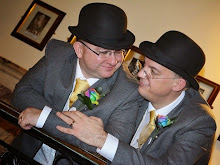
Two Married Men Say Thank You to the Liberal Democrats
On Sunday, Richard and I celebrated six months of marriage.

And two-hundred-and-forty-six months since we’ve been together.

We had to wait twenty years. We had to wait until the Liberal Democrats were in government.

So here’s a video we recorded on Sunday to say thank you to the only party that’s always been there for us, and always been there for lesbian, gay, bisexual and transgender people.
What We Said
We got married.
It was a fantastic day.
So many wonderful people celebrating with us.
And so much food.
We’ve been together a long time, and we’ve been to a lot of weddings, and there’s never enough food.
Trust us on this. If you ever get married –
– which is fantastic, by the way –
– then feed people and they’ll be happy enough that they listen to your speeches.
But the thing about us getting married is, we had to wait a long time.
A very long time.
Twenty years.
To the day.
It wasn’t that we had very strict parents.
Well, not much.
You see, I met Alex
And I met Richard
And we fell in love.
And we got together twenty years and six months ago today.
So we got married six months ago today.
Because we’re gay.
So it was a long wait.
In fact, we had to wait
Until the Liberal Democrats were in government.
In the ’70s, when we were born, only one party said as a matter of principle that they backed gay rights.
That was the Liberals.
In the ’80s, when we were at school, one party brought in Section 28, to put bashing the gays into law.
That was the Tories.
Only one party opposed Section 28 from the first.
That was the Liberal Democrats.
Labour were in favour of it.
Until they weren’t.
But they didn’t do anything about it when they had the power to in the ’90s.
Not for ages.
In fact the bit of Britain that first got rid of it was Scotland, in the early 2000s.
When the Liberal Democrats were in coalition there.
Labour had absolute power in Westminster back then.
But they didn’t bother changing the law for the rest of us until much later.
I remember the 1992 election, when one of the three big extreme things Jeremy Paxman sneered at a party leader for was supporting gay rights.
That was Paddy Ashdown and the Liberal Democrats, and he stuck to his guns.
Actually, Paddy doesn’t need guns, he’s dangerous enough with his bare hands.
That was Paddy Ashdown.
I remember the 1997 election, when one of the three big things the Daily Telegraph said a party’s manifesto was dangerously extreme for was supporting lesbian and gay rights.
That was the Liberal Democrats.
And eventually, in 2001, one party came up with the first ever Manifesto for Lesbian, Gay, Bisexual and Transgender People.
That was the Liberal Democrats.
And all the promises in there were in their main manifesto too.
That was the Liberal Democrats.
And they did the same thing again at the next election.
That was the Liberal Democrats.
And meanwhile the other parties either kept on hating the gays
That was the Tories.
Or just didn’t have the balls to do anything in case it put people off.
That was Labour.
Liberal Democrats proposed civil partnerships.
Labour and the Tories voted them down. They were both against it before they were for it.
And even then the Liberal Democrats wanted civil partnerships as a choice for both same-sex and mixed-sex couples.
But both Labour and the Tories have always said those can only be a second-class option for the gays.
The government spent thousands and thousands of pounds of taxpayers’ money in court opposing an equal age of consent.
That was the Labour Government.
They lost. And the government spent thousands and thousands of pounds of taxpayers’ money in court defending the ban on gays in the military.
That was the Labour Government.
They lost that too.
So when the Labour Party boasts that it equalised the age of consent
Remember that they only did it because they lost in court and the court made them do it.
So when the Labour Party boasts that it scrapped the ban on gays in the military
Remember that they only did it because they lost in court and the court made them do it.
The Labour Party’s boasts are like a burglar caught red-handed and then found guilty who then tries to claim credit for giving all your stolen stuff back.
When you know they’re the ones who nicked it in the first place and only the court made them do it.
And then when the Coalition was formed in 2010
Only one party leader had said he was in favour of equal marriage.
That was Nick Clegg for the Liberal Democrats.
And that year the first British party ever voted to back equal marriage.
That was the Liberal Democrats.
And eventually the Lib Dems persuaded the leader of another party.
That was David Cameron for the Tories.
And later than that, another party said there was no need to have equal marriage – but in the end came in third to back it once it was already happening.
That was the Labour Party. They were against that before they were for it, too.
And one party was badly split about it.
That was the Tories.
And a lot of their MPs said they backed equal marriage because it was a “gesture” to “detoxify their brand”.
That was the Tories.
So as it was only a gesture, we can think of a few gestures to make in return.
But this isn’t tagged as an explicit video.
And another party didn’t care, and hadn’t bothered doing it when they had absolute power for thirteen whole years, but they jumped on the bandwagon last and then tried to claim all the credit.
That was the Labour Party.
But at least this time they didn’t oppose it tooth and nail until the courts made them do it.
No. So that’s something, I suppose.
But when one party said that to make it all properly equal, let’s make the law equal marriage for trans people too, and open up civil partnerships to mixed-sex couples so everyone has more choices
That was the Liberal Democrats.
The other parties said
It’s complicated.
No thanks, you’ve had your gesture, that’s your lot.
That was Labour and the Tories.
So next time any important issue of lesbian, gay, bisexual and transgender rights comes up in Parliament…
You know what’ll happen.
Two parties will swing with the wind and just vote whichever way’s fashionable.
That will be Labour and the Tories.
Because they always have. So you’d better hope lesbian, gay, bisexual and transgender people happen to be popular that year.
Good luck with that.
And one party will vote for equality for everyone.
That’ll be the Liberal Democrats.
Because we always have.
Always will.
Because Liberal Democrats believe in freedom and opportunity for everyone.
Freedom for every individual
For everyone to have the liberty to live their lives as they choose
For fairness and equality before the law
I’m Alex
I’m Richard
Thank you, the Liberal Democrats, for changing the law so we could get married.
We had to wait twenty years
Some of them Tory years
Some of them Labour years
Without the Liberal Democrats in Government, we’d still be waiting.
For more about why we believe in the Liberal Democrats, take a look at Liberal Democrats Believe – a Liberal quote for every day of the election (and more)!
Labels: Conservatives, Gay, Labour, Lib Dems Pointing, Liberal Democrats, Marriage, Nick Clegg, Paddy Ashdown, Personal, Richard, Things To Remember About Labour
Saturday, July 06, 2013
Musical Quickie 1: Paint It Yellow Meme*
So, Nick Clegg and Mick Jagger: everyone’s quoting the 1967 description of Mick’s views as “straight John Stuart Mill”, but has he done what the rest of us haven’t and convinced Nick of the merits of Lib Dem drugs policy, or further? I only ask (as I did of Nick the first time I interviewed him, to his well-concealed delight).
Anyway, this is only a quickie, but will include the two cooler Lib Dem-pop crossovers and a terrible joke (I can almost hear you sigh). But first, Jennie Rigg’s meme to rewrite Rolling Stones songs for the Lib Dems: fab. I’m especially knackered and in lots of pain this week, so my creative energies are low, but click here to see some of the entries so far.
Just meandering for a moment – were I writing the detailed music-related article I meant to instead of this quickie, it’d be about Tom Robinson. So imagine I have, and that I’ve recommended the newly-released Tom Robinson Band Anthology 1977-1979 (though I want the stuff from 1989-1990 when I was going to their gigs).
Tune into a Tom special on Neil McCormick’s Needle Time on Vintage TV at 7pm tonight, because I won’t have written anything proper by then and you’d’ve missed it.
Back to the story of the week, which is Nick Clegg and Mick Jagger and co having dinner together. Which is cool. And Jennie’s plan to get Mick to guest at Glee Club. Which is terrifying.
Enjoy Hyde Park, Mick, and though today’s may not be as iconic, I bet you all play better this time… Though a better performance than Glee Club isn’t hard.
Rolling Stones Feat. Lib Dems – My Favourite New Entries
Jennie:
“I see a red door and I want to paint it yellow”
Jennie’s concept / Magister’s lines:
Sympathy for the Paddy
“So if you meet me, have some courtesy,
“Have some sympathy and some taste
“Use all your well learnt politesse
“Or I’ll kill you with one hand.
“Because I can, you know. Would you like to hear my joke?”
Nick Barlow’s all-too-familiar title:
Here Comes Your Nineteenth By-Election
But most of all the lovely Andrew Hickey’s massive wins with:
“I knowOh yeah – I meant to write about a possibly rogue poll that was way better for the Lib Dems than anything else recently, but possibly worthwhile as it was polling about something other than the usual. Remind me, reader.
“It’s only a rogue poll
“But I like it…”
And the outstanding…
“I’m canvassing apartments on the ninety-ninth floor of my block
“I knock on the door looking through the window and hoping the barking will stop
“Then out comes a guy who’s all dressed up like a Union Jack
“And says I’ve won his vote if I’ll just send those immigrants back
“I said, hey! UKIP! Get off of my round!
“Hey! UKIP! Get off of my round!
“Hey! UKIP! Get off of my round!
“Don’t hang around ’cause two’s a crowd”
Finally, Magister for Simon Hughes:
“Start me up!That’s one for me, too, obviously. Simon and I once did a pair of set-piece speeches to finish a Lib Dem Youth and Student Conference. Everyone missed their trains. Including me (remember, this article is a “quickie”).
“If you start me up
“I’ll never stop.”
On a more critical note, the Jumpin’ Jack Flash (probably my favourite Stones song, along with Saint of Me) suggestions have missed the points – they’re clearly about the wrong ex-MP. Surely…
“But I’m all right now, in fact, it’s a gas…should make you think of an even more recently ex-ed MP (and a certain Elephant denies all responsibility for that lyric).
“But I’m all right, I’m jumping lights – flash!
“Step on the gas, gas, gas”
Too shuhne?
That Cool Lib Dem-Pop Crossover Chart In Full
Nick and Mick’s new entry only at number 3, I’m afraid, below…
Number 2: Jeremy Thorpe and Jimi Hendrix – when they were both big
(Google for the cool pictures; I’d provide a link, but they all seem to be either scandals or rip-offs, so I’m disinclined to)
And a surprise Number 1: Norman Lamb and Tinchy Stryder
Because mortgaging your house to help launch an unknown rapper’s career and him making it big is significantly cooler than a photo-op or a meal, however cool the star.
*My urge for terrible puns means I was tempted to title this Paint It Yellow Sub-Par Meme, but it’s not sub-par. It’s fab. It’s also the wrong ’60s band, and though it has the major Glee Club advantage that it’s a song everyone can sing, since the Coalition we can no longer sing along to:
“We all live in a yellow squeaky-clean…”
Labels: Liberal Democrat Conferences, Memes, Music, Nick Clegg, Paddy Ashdown, Rolling Stones, Tom Robinson, UKIP
Sunday, March 03, 2013
Happy 25th Birthday, Liberal Democrats – and What the Lib Dems Stand For 2013.1
What the Lib Dems Stand For – 2006 Version
I don’t think every Lib Dem should say the same thing all the time – as if we could. It’s helpful, though, to communicate some of the same ideas and some of the same words, and for those who aren’t fussed enough to think through and distil our philosophy, but want one handy if they need it, here’s my contribution from half a dozen years ago:
The Liberal Democrats stand for freedom for every individual – freedom from poverty, ignorance and conformity.
Everyone should have the liberty to live their lives as they choose, without harming others.
For freedom to be real for everyone, it needs fairness: equality before the law, with public services funded fairly and the people they affect trusted to control them.
Freedom comes from good education, so people can make their own choices and realise their potential.
Freedom needs good health, which must be safeguarded by a decent environment both for people today and for future generations.
A free democracy needs open decisions, with as many people as possible having a say. Governments must trust the people before people will trust them.
To build freedom, fairness and a green future, we must pool our efforts in effective communities, locally, nationally and internationally.
That’s the important bit – my go at summing up the party’s soul, if you like, something that Lib Dems members can look at and think, ‘Yes, that’s some of why we bother’, and that other people can look at and think, ‘Oh, that’s what the Lib Dems are for, and I like it’.
If you read down, you’ll see how I came to it, how I made use of it, and why you should come back tomorrow and read my follow-up – because it needs a rewrite, not least because Lib Dems are now in government and because of the work on the new ‘core message’ under Nick Clegg and Ryan Coetzee: not changing the principles, but showing why they’re still relevant. It’s easy, in government, to get stuck in the mechanics and lose sight of why we’re doing it, and as policies change to reflect changes in real life, it’s all the more reason to plant a clear image of the sort of party we are, to inspire people to stick with us through thick and thin.
The Liberal Democrats’ 25th Anniversary and Our Founding Principles
I last wrote to celebrate the Lib Dems’ birthday when we turned twenty, talking more about my experience of what had enthused and supported me over the years (and how, early on, we were at 4% in the polls, near-bankrupt and coming a very distant fourth in elections, with no-one knowing what our name was, including us – all without being in government). Quite a bit’s changed since then. But one of the things I think I can help with today is joining up our lasting philosophy with the party in action, today.
Julian Huppert MP has a similar thought – he’s written today about “The Preamble, 25 Years On”. That’s the Preamble to the Liberal Democrat Constitution – a long statement of beliefs and policies that theoretically underpin the party as a whole. It’s usually reduced down to its most famous passage (40 words out of 800), quoted on every Lib Dem membership card, which doesn’t convey everything but which encapsulates the heart of our philosophy for many of us:
“The Liberal Democrats exist to build and safeguard a fair, free and open society, in which we seek to balance the fundamental values of liberty, equality and community, and in which no-one shall be enslaved by poverty, ignorance or conformity.”You can see, by comparing the two passages, how this excerpt from the Preamble has inspired my own statement of ‘What the Lib Dems Stand For’, but how I’ve also aimed to relate it to our policy priorities and how best to deliver those principles in practice. Some people respond to ideals, but others more to practical proposals – and that’s why we need to get across both. More, we need to show how each depends on the other.
So why are we so bad at doing that?
Why Bother Saying What the Lib Dems Stand For? And How Did I Go About It?
It’s immensely frustrating that of all the strong, clear, often excellent messages Lib Dems put out at so many levels – on local issues, on policy after detailed policy, and now struggling towards what we’re achieving in the LiberaTory Coalition – the one thing that we’ve never paid much attention to, and that even some Manifestos have left out, is what links it all together. Not everyone’s only interested in single issues, but inspired by a wider vision – and because unforeseen events always force parties to react without warning, doesn’t it make sense to give people an impression of your general philosophy, so they can be confident about what sort of reactions you’ll make?
I remember the clarity of our 1997 General Election campaign: that with Labour set on sticking to the Tories’ public spending plans, only the Lib Dems would make a real difference. Standing for Parliament for the first time, I campaigned hard on the investment in schools and hospitals that only we were committed to. But even then, I was dissatisfied with increased public spending (even saying how we’d pay for it) being our only message, and knew that if Labour did increase taxes (or, as it turned out, mostly mortgaged the future instead with massive, irresponsible borrowing even in a boom) and delivered on public services, which they eventually did, or if Labour sent the economy totally pear-shaped, which they eventually did, that message just wouldn’t cut it.
Though Liberalism provides a far more coherent and consistent philosophy for the Lib Dems than whatever shifting melanges animate other parties, it can be a hard task to sum it up, in detail or in brief – and I have to admit my series of in-depth ‘What the Liberal Democrats Stand For’ posts on this blog has mostly gone unwritten or in fits and starts, and I’ve not even finished republishing my original 1999 Love and Liberty pamphlet on here. What I did buckle down to communicating, though, was not the grand vision but the short story.
Sometime between the 1997 and 2001 General Elections, I decided to come up with something that summed up both what we stood for and how that explained our current priorities. Something that wouldn’t be wiped out by economic circumstances, or that by contrasts to other parties that meant ‘our core message’ would have to change when they did. Something that satisfied me – and, I hoped, other people. I aimed for about 150 words, in reasonably approachable language – something that didn’t just sound like a stretch from a textbook or a policy paper. Every year or two through most of the 2000s, I’d take another look at it and slightly update it to incorporate the party’s latest policy priorities or slogans, so that it flowed from our philosophy to the party’s current message and helped make sense of both.
When Would You Say What the Lib Dems Stand For?
At only about 150 words, my ‘What the Liberal Democrats Stand For’ was long enough to tell something of a narrative to follow, and short enough to use in all sorts of ways and places. Here are some of them:
- I put it in a box on an election leaflet when I stood for Parliament again in 2001 – alongside local issues, because some people would be stirred by practical action on their street, but others would respond to ideals.
- Appalled by so many manifestos for election to the Lib Dem Federal Policy Committee being utterly devoid of philosophy or principles, I regularly stuck it down one column of my own (and each time was elected near the top of the poll).
- I was often asked to make speeches to various Lib Dem groups and other groups on Lib Dems’ behalf, and would place it near the start to make my pitch – short enough to say within about a minute, and instinctively the starting point for any speech about the Lib Dems.
- I’d even include it in my speeches introducing the FPC Report to Conference in the four years that I was the Committee’s Vice-Chair, because I believed that if any Lib Dem body should be concerned with what we stand for and communicate it to people, it should be the one that’s responsible for the Manifesto. So my speeches established the FPC as about policy and philosophy, not just vacuous managerialism (and I was occasionally complimented on it by some of the few people who’d turn up at dead o’clock on a Sunday morning to listen).
One thing all my versions of this statement did was be positive. From the start, I made a definite decision not to put anything in it about Labour or the Tories – even though it’s much easier to define ideas by contrast, and even though it’s always fun for partisan politicians (and I am one) to knock the opposition. But there were three very good reasons I banned myself from falling back on the easy way. First, this is about us. We’ve got a clear, strong, Liberal identity – so no statement of values should just split the difference between other parties and have to be rewritten not if we change, but if they do. Second, it puts people off. It can be very satisfying within your own tribe to slag off your opponents… But people wavering between your lot and another understandably recoil if you tell them one of their possible choices is evil, and I laugh when the only message one of the other parties can offer at elections is ‘We’re rubbish, but they’re worse!’ I want to have something positive to say instead. And third – this is meant to be a short, simple summary of what we stand for, which has already got quite enough to cram in to very few words. Why give space in that to your opponents?
My health has gone downhill more sharply than ever over the past half-dozen years, so I’ve not been standing for any elections, making fewer speeches, and – writing longer articles mostly in the same place that it would be silly to repeat the same message in every time – haven’t been updating my 150 words during that time.
The last time I remember doing so was in 2006, which is the version I’ve published above. Our three campaigning priorities had been Education, the Environment and Health (see each of them in there); our three key words from the previous year’s Manifesto had been Freedom, Fairness and Trust (a word against which, even then, I’d argued against as a ‘Kick me’ sign, so look above for how warily I used it); and I was kicking against what was supposedly the new agenda for that Parliament. I felt an acute sense of frustration bordering on rage at an unforgivably dull policy paper that was meant to set out our aims and priorities – every word of it now long-since forgotten, an utterly missed opportunity to be the lasting rallying cry it should have been. Even at the time, it was barely noticed. I analysed that paper in detail for the newly created Lib Dem Voice, including my alternative ‘What the Lib Dems Stand For’, that latest version limited to 140 words not in anticipation of the creation of Twitter but because that happened to be the length of the piss-poor excuse for a statement of principles at the start of the paper, and I wanted to make a direct challenge to it, and to spur anyone else to see if they could do better. I also made an unkind speech taking the piss out of the paper to the mostly empty hall that summed up the enthusiasm the paper had generated; eventually, it went through by a large majority cast by all the people who’d filled in at the end for the more interesting next item on the agenda, but this Pyrrhic victory for the empty managerialists who’d written it was soon forgotten, just as most of those voting barely heard a word of the debate even at the time.
The next time that a major paper made any such attempt was 2009. It did so far more coherently in its detail and setting out our priorities, but was even worse in its philosophy: as I wrote in another fisking for Lib Dem Voice, it didn’t even have a piss-poor summary of what we stand for, instead referring to certainty about our values and being guided by them without ever stating what they are, making it the first completely value-free statement of values. I stood up and told Nick Clegg and Danny Alexander that I was deeply worried when they’d written a draft Manifesto in our name that stopped talking about “Freedom” and replaced it with “Safety” and “Strength”. You can watch my speech in which I pointed out just who that sounded like (you might think ironically, in hindsight). And, afterwards, I was told I had a point, and they’d listened, and the real Manifesto would be better – and it was, a bit, though I might have hoped that when it came to the first Manifesto since 1992 that I hadn’t been on the Policy Committee to write bits of it, I wouldn’t be proved to be the only member of the FPC who remembered to put in a little thing like “Freedom”. But ever since, that word’s been lost in the focus groups, and the concept too often lost in practice. So it’s definitely time.
Where Next? For Tomorrow
My ‘What the Lib Dems Stand For’ needs updating. It needs to show how we still stand for the same Liberalism – but how it relates to the current ‘core message’, and how it inspires our approach in government. It needs all three to answer the question ‘What are we about?’ Without being recognisably the same Liberal philosophy we’ve always stood for, why did we bother all these years? Without relating it to the message the national party’s putting out, how’s it going to catch on? Without relating it to what we’re doing in power, why listen, in the real world? I don’t believe in ‘Campaign in poetry, govern in prose’, which is just a fancy way of ducking the question.
That’s why I’ve been making a few attempts, in the last few weeks, at the biggest overhaul of my 150-or-so-word ‘What the Lib Dems Stand For’ since I first wrote it – because I believe it needs to do several things at once, and several more than it’s done before. And my first bash at it (as I knew even before I sent it to some of the Lib Dems I most trust, who shook their heads) was an ugly mash-up and just didn’t work. I don’t think I’ve got it right yet – but my latest version’s good enough to risk publishing.
So, please come back tomorrow, where I’ll set out my latest attempt at ‘What the Lib Dems Stand For’, and challenge you not only to tell me what’s good and bad about it, whether it inspires or irritates you, and, most importantly, challenge you to do better.
Labels: Coalition, Education, Environment, FPC, Ideas, Liberal Democrat Conferences, Liberal Democrats, Liberalism, Memes, Paddy Ashdown, Personal, Top Tips, What the Lib Dems Stand For
Monday, April 02, 2012
“I am a Liberal and I am against this sort of thing” – Time To Remember What We Stand For
Many Lib Dems, rightly, think it’s important when in Coalition to communicate more clearly what we stand for, so we’re not submerged at elections. Well, it’s even more important to remember what we stand for for the people inside the Coalition, and Lib Dem Ministers should take a moment to think about our history as their civil servants urge them to just act like “the Government” always acts. We all knew that the Tories’ discovery of civil liberties in Opposition would melt away once they had all the goodies of power back in their hands and all the whisperers of the security state back in their ears. We all know that one day it would be up to you, Minister. Today, Lib Dem Ministers, remember that you’re Liberals and what the fucking point of being there is.
The latest news on Government plans for new cyber-snooping powers are virtually indistinguishable from anything Labour came up with, or any other securocrat-written authoritarian rubbish that’s always put forward by “the Government”. Yes, Labour would have done all this instantly and it took the Coalition two years to go native. That’s not good enough. It’s not worth all the pain of being in Coalition to mildly delay being just like Labour. You’re even trampling the Coalition Agreement on which this Government was founded, signed in the heady days when the Tories still said they believed in freedom.
Hearing on the news that the Liberal Democrats may have some concerns but “support the plans in principle” is exactly the sort of thing that makes me wonder – for the first time – if we ought to vote down the Coalition. There’s a lot it’s done that I don’t like, and I daily feel personally scared by the approach to benefits (because I’m still waiting for my next ATOS summons). But there’s a difference between every choice being a nasty choice, every cut a painful cut, because Labour destroyed the economy, and signing off on something that isn’t forced on you by financial necessity but deliberately turning the Coalition into an authoritarian force for evil (and not saving but wasting more money to feed the securocrats’ wet dreams!).
I’ve often wondered what my own “Red Lines” would be. I’m not grateful to Lib Dem Ministers for drawing them for me.
A fortnight ago, Minister, Liberal Democrat Conference said exactly what we thought about governments thrashing civil liberties and spying on our privacy (and one of the key movers of that motion, Julian Huppert MP, is worried today). You were there, Minister. Had you already seen your briefings? Did you decide it was wiser not to hear the Conference pre-emptively tell you, “No, Minister”? Or did you simply nod, applaud, and then flush it out of your brain as you went back to your desk at the Department of Doing Things the Way Governments Always Do Them?
Today, some Lib Dems are willing to give you the benefit of the doubt. We like you. We’re glad you’re in Government. But it’s difficult for most of us not to start shouting when you say stupid things like “the Liberal Democrats support the plans in principle”. We do not. Millennium Dome, Elephant does not. Richard Morris does not. Jennie Rigg does not. Neil Monnery does not. Zoe O’Connell does not. Charlotte Henry does not. Mark Valladares does not. With every minute of this ticking time bomb, more Lib Dems will not. These are not just the usual suspects. If you want a party to come back to when you return to your constituency at the weekend, stop this thing now.
Freedom isn’t always popular. The securocrats are already shouting ‘Look – terrorists!’ and ‘Look – paedophiles!’ as if that answers every question. The papers and the Labour Party will be foaming at the mouth for more, more, more. But there is absolutely no fucking point in being Liberals if we don’t stand up for freedom.
Before the last General Election, I stood up and told Nick Clegg and Danny Alexander that I was deeply worried when they’d written a draft Manifesto in our name that stopped talking about “Freedom” and replaced it with “Safety” and “Strength”. You can watch my speech in which I pointed out just who that sounded like (you might think ironically, in hindsight). And, afterwards, I was told I had a point, and they’d listened, and the real Manifesto would be better – and it was, a bit, though I might have hoped that when it came to the first Manifesto since 1992 that I hadn’t been on the Policy Committee to write bits of it, I wouldn’t be proved to be the only member of the FPC who remembered to put in a little thing like “Freedom”.
Remembering Liberal Democrat history isn’t just about learning from the triumphs, avoiding repeats of the disasters and celebrating our tribe. It’s about remembering that the only reason we’re still here: the only reason Liberals survived after nearly a century of splits, near-oblivion, faltering revivals and then near-oblivion again is that we stood for something no-one else can ever be trusted with. Freedom.
Minister, don’t betray that trust, or you might just destroy your party.
Just a few weeks ago, Mark Park came to me with the idea of an article about Party history, one that would let people know that the arguments we have today are ones we’ve had before, that principles we hold today are ones we’ve held before, that splits we’ve had today are… As yet, nothing like as bad as we’ve had before. We threw around some ideas and – horrors – constrained by a tight word limit we wrote six bullet points for the party newspaper, Liberal Democrat News a week and a half ago. Last week, Mark republished it on Lib Dem Voice. But before I republish it myself below, today it seems appropriate to remember a seventh moment from our history – not from an MP, not from a Minister, but simply from an ordinary party member who threw back for a time what “the Government” always does.
Stopped by a securocrat and told to do what he was told for no reason other than that’s what securocrats always do, Clarence Henry Willcock (no, no relation) said
“I am a Liberal and I am against this sort of thing.”And freedom prevailed.
Nick, you once said he was one of your heroes. Let him be again. Remember your history. Remember what you stand for. Listen, again, to Lib Dems telling you that freedom is more important than strength and safety. Say “No,” Deputy Prime Minister.
Some Thought-Provoking Reminders of Our Liberal History
Paddy Ashdown once admitted to under-estimating the importance of a party’s history:
“A political party is about more than plans and priorities and policies… It also has a heart and a history and a soul”.Yet there is no “history of the party” training session for the keen Conference representative nor history briefings for new members. So here are six snippets from the party’s history to entertain, elucidate and illustrate our heart and soul in ways that should still strike a note today.
1. Impressive Firsts
The first Jewish Member of Parliament was Liberal Lionel de Rothschild, elected in 1847 but not able to take his seat until 1858. The first atheist MP was Liberal Charles Bradlaugh, elected in 1880 and finally able to take his seat in 1886. Both fought in Parliament and in multiple elections in order to establish their rights. Also, Robert Throckmorton, elected MP for Berkshire in 1831 as a Whig and then Liberal, was the first Catholic in Parliament for more than 300 years, following the Relief Act of 1829.
The first Asian MP was Liberal Dadabhai Naoroji in 1892. The first female Liberal MP was Margaret Wintringham in 1921, when she succeeded her deceased husband in a by-election. The first female Liberal MP without such a family route to Parliament was Vera Woodhouse in 1923. The first out gay Liberal Democrat MP was Stephen Williams in 2005.
2. Left/Right Confusion
Wanting to make deals with Labour isn’t historically associated with being left-wing. It used to be people seen as being on the party’s Liberal Party’s right (such as Richard Holme) who were keenest on deals with Labour. Conversely, being pro-market forces has not historically been associated with being pro-Conservative. During his time as Leader, Paddy Ashdown both pushed for a much more hard-edged free market attitude and also saw the Liberal Democrats as being part of a common centre-left political mission with Labour.
3. Disputes We’d Rather Forget
The longest and most bitter row after the Liberal Party and the SDP merged to form the Liberal Democrats in 1988 was not over philosophy, policy or even personalities – simply over the word “Liberal” (with no distinction between ‘social’ and ‘economic’). For a while, the new party was named the Social and Liberal Democrats; a mouthful, this was officially shortened to “the Democrats”. Most of the party rebelled and insisted on “Liberal Democrats”. It took several years, an all-member referendum and a constitutional amendment before the name simply became “Liberal Democrats”. Then everyone could get on with shortening it to “Lib Dems”…
4. Heroics We’re Happy To Remember
In 1989, with the new-ish party badly split, a very distant fourth in the European Elections and described by Leader Paddy Ashdown as within the margin of error of nothing in the opinion polls, the most unifying issue the party became known for was a liberal policy on immigration. With Hong Kong about to return to Chinese rule, the Lib Dems were united in saying that Hong Kong residents were entitled to British passports. In contrast, the Conservative Government said only the richest could buy their way in; the Labour Party voted with rebels on the Conservative far right to keep every single one out.
5. Policies That Have Gone From ‘Eccentric’ To Conventional Wisdom
In 1992, the three issues Jeremy Paxman threw against Paddy Ashdown in interviews repeatedly as proof that the Liberal Democrats were extreme and out of touch were Hong Kong passports, green taxes and (what were then called) gay rights. One issue passed; the others are now the mainstream.
6. Avoiding A Coalition Didn’t Work Last Time
The Liberal Party for a short time kept the Labour Party in office in the late 1970s after it lost its majority in the House of Commons. The so-called Lib/Lab Pact was seen by most in the party as at best a missed opportunity and at worst a failure as it did not contain a list of significant policy promises. PR for the European Parliament was lost as the deal only promised a free vote, not the support of Labour MPs.
* Yes, the Liberal Democrat tradition is lists of three things to remember. But there are two of us, OK?
Thanks to Mark Pack for the idea and the drafting, and to Oranjepan for reminding us about Robert Throckmorton.
Labels: Coalition, History, Liberal Democrat Conferences, Liberal Democrats, Liberalism, Meddling In Things That Are Nobody's Business But Your Own, Nick Clegg, Paddy Ashdown, Speeches, Stupid Ideas
Friday, September 09, 2011
How Paddy Ashdown Changed My Life (and How the Police Might)
“You’re not causing enough trouble.”The day before, I remember I’d met Paddy Ashdown for the first time, and had the first of what were to be a great many arguments with him. A set-piece Conference debate had called no cards against, despite quite a number being submitted; I remember that mine was one (another year before I got to make my first Conference speech, when I went into such a spectacular rant that I managed to talk over time. And cause our then Leader in the House of Lords to walk off the stage behind me), and that another was from someone who’s now a leading MEP. I strode up to Paddy afterwards and asked him if he thought that was right. He said he didn’t, and that I should challenge it – then blasted the arguments I would have used had I been called to pieces. Across the next decade, I had more rows with Paddy than I’ve had with any other Leader, but it’s those rows, and that first one, that earned him my undying loyalty, even when I thought he was absolutely wrong. When I was a mouthy young activist who no-one had ever heard of, there were plenty of party bigwigs I wanted to take to task, and more than a few refused to engage with someone as unimportant as me. Even when Leader, Paddy never looked down on ordinary members, and if you wanted to argue with him, he’d argue. And quite rightly, he never patronised you, either: if you were talking bollocks, he took no prisoners.
So why did Paddy admonish me and other Student Lib Dems that day in Bournemouth? That afternoon, there was a Conference debate on a policy paper called Science and Survival. I remember it vividly. Various party grandees, particularly those working in the House of Lords and in higher education, had used the paper to decree that the best thing for all young people was that they be required by law to be in education until the age of 18. I and a bunch of other Student Liberal Democrats, though most of us were just past 18 at the time, were quite aware of the party’s commitment to votes at 16, and thought that superannuated worthies commanding what ought to be voting adults what to do – ‘for their own good’ – was the sort of thing Labour did, and that Liberals ought to give a good kicking to. We pushed that clause to a vote; by my reckoning, we won, but that’s not what the chair of that debate thought, and he refused our shouts for a count of the votes.
Paddy’s Lesson
That evening, Paddy held a private meeting – as he used to every year – with all the Student and Young Liberal Democrats (as was) at the Conference. The practice was, he’d turn up (usually turning a chair round and slinging his jacket over his shoulder) and we could ask him whatever he wanted, no topics barred… But no cameras, no recordings, and absolutely no journalists. I still remember my satisfaction on getting sleazy Times hack Alice Thomson thrown out of one a couple of years later when she’d lied her way in; yes, I know, a Murdoch employee listening in on people by deceit? Who’d have thought.
But on that evening in Bournemouth, the first thing Paddy did was not answer a question, but put one to us. He’d been in the debate that afternoon, and he’d disagreed with us – but he thought we’d backed down too easily. We should have forced a proper count of the votes. And he saw that as symptomatic of the (then separate) Student and Youth wings of the party since he’d become Leader, and asked us why that was: “You’re not causing enough trouble.”
Imagine the mortification when your Leader – who knows that the founding principle of Liberalism was to control arbitrary power – is the one who had to tell the rebellious young people that they’re crap at it. But mortification wasn’t my only reaction. I made two resolutions to myself at that very moment: because this hadn’t been a failure of will, but of knowledge, that I’d find out what the correct procedure was for demanding a counted vote, and if necessary challenging the chair of a session [tip for next week: turn to page 63 in your Conference Agenda]; and that Paddy would never have to tell us that twice.
Over the next half-dozen years, the various Liberal Democrat Youth and Student bodies bombarded Conference with motions and amendments that took great care to get the procedures exactly right, and as a result had more of their policies passed by Conference than anyone else but the Federal Policy Committee. And when, in 1994, the Conference debated drugs and the monarchy – despite remarkably heavy pressure from many grandees for us not to – and the party voted (for the first time) to look into decriminalising cannabis, Paddy stomped off the stage and was heard to suggest that when I appeared in The Guardian and on air quoting his instruction to us to prove that it was us, in fact, who were the party loyalists and doing what the Leader told us, he didn’t think it was particularly funny (one BBC radio interviewer did, though; that line made him corpse in mid-broadcast. I can’t imagine why).
Who Needs Teaching A Lesson?
Today, it seems, the Liberal Democrat Federal Conference Committee are avoiding the awkwardness of people standing up in Conference and quoting the standing orders by allowing the police to break the Liberal Democrat Constitution that puts the so-called Conference Committee in authority in the first place and stop ‘troublemakers’ from coming in at all. Even people arbitrarily prevented from exercising their democratic rights in person, of course, should still receive their ballot papers when it comes time to rightly vote out of office every single cowardly illiberal spineless quisling craven renegade gutless undemocratic pathetic unconstitutional pusillanimous police state member of Conference Committee. As the elections are biennial and this is the ‘off’ year (in so many ways), I wonder if an emergency motion of no confidence could be moved in the lot of them*? Just a thought.
I wonder if Paddy would have something to say about that? I know a lot of other people do.
Oh, and – particularly if you’re a member of Liberal Youth – remember those wise words of Party Leaders gone by, never officially rescinded, and make sure that you obey the Leadership and never, ever give Nick Clegg cause to complain that you’re not causing enough trouble.


Update: Thanks to then Young Liberal Democrat Chair Sara Bedford for this photo from that very night, featuring Paddy, her, and then Student Liberal Democrat Chair Paul Simpson.
*Update: Excepting Justine McGuinness, who I am reliably informed was the only member of Conference Committee who voted against kowtowing to the police demands.
Labels: Liberal Democrat Conferences, Liberal Democrats, Liberalism, Meddling In Things That Are Nobody's Business But Your Own, Newspapers, Paddy Ashdown, Personal, The Golden Dozen, Top Tips
Wednesday, May 04, 2011
YES! To AV – 7
If you made a list of Britain’s most conservative, nasty, authoritarian, reactionary, greedy, tribal, power-hungry, illiberal, unpleasant, wealthy, self-interested, fearmongering, warmongering political rip-off merchants… But look! There’s no need to – the No campaign have saved you the trouble. It’s them.
And from their side, what’s the biggest threat they can muster? ‘We’re afraid of the Liberal Democrats!’ Well, I’m tempted to say, it’s about bloody time! But if you want big scary beasties – why not look to the ones who’ve always had all the power and all the money, not the little fighters who are trying to change it?
Rich Tories
The No campaign have got so many sleazy Tory millions rolling in to back them and so many lying newspapers on their side that David Cameron’s been ashamed every time he’s been asked to take responsibility for it all – even though it’s his party and his donors who’ve created the whole mud-slinging pile of bollocks. No wonder he’s been so desperate to keep under wraps who paid for posters like the infamous ‘be very scared, or the baby gets it’.
So congratulations to those Tory reformers who stick to their principles and support a YES! to the system that the Conservative Party uses in its own elections, even when most of them pretend it’s too good for the rest of us! I wish I could say the same about the honesty of their Leader, but here’s Andrew Rilstone on why David Cameron is a liar.
Poor Ed Miliband
It’s a shame that the Labour Party is split down the middle, as it is so often – or we’d long since have had the referendum they promised, had absolute power to deliver, but never did – between progressives and nasty old conservatives. I feel sorry for poor Ed Miliband, a prisoner of the dinosaurs stomping around him. The Labour Leader, Ed Miliband, supports the Alternative Vote – but most of his MPs want to keep their noses in the trough and ignore him. The last Labour Prime Minister, Gordon Brown, put AV in their General Election Manifesto last year – but most of the MPs elected on that manifesto are ignoring it, too. And the former Labour Leader Neil Kinnock is doing what poor Ed can’t and laying into the Labour dinosaurs who are helping the Tory campaign for a crooked, broken old system that’s helped the Tories more than every other party.
If you’re a Labour voter, why not vote YES! to help poor Ed Miliband?
Paddy Says – Make the Dinosaurs Extinct!
The greatest former Leader for me is still Paddy Ashdown. Unlike the sleazy No-mongers who pretended to speak for our armed forces in claiming our soldiers hate democracy, he’s been a soldier under fire. So forgive me for quoting what he said a couple of weeks ago – it packs a punch:
“I’ve been in politics for a long time. There’s nothing wrong with people of any age getting involved, from a teenager to a centenarian. We can all make a difference.Listen to Paddy. Send an AV asteroid crashing down on that bunch of frightened old dinosaurs lying to you because they’re terrified that the rotten system that put them into power for so long is about to crumble.
“But when almost every politician at the top of the ‘No’ campaign was already a dinosaur by the time I was first elected to Parliament in 1983, you have to wonder about the freshness of their arguments.
“Think of the changes Britain has seen during my lifetime – and theirs:
“We’ve joined the European Union. We’ve established a Parliament in Scotland and an Assembly for Wales. We’ve voted in proportional representation elections for both – a far bigger change than AV – and the sky hasn’t fallen in.
“And government, always the last to change under Tory and Labour alike, has often been the last to wake up to the incredible social changes that have changed Britain for the better.
“So when those old Labour and Tory hacks gang up to tell you to be afraid of a long-overdue but frankly much smaller change, it tells you far more about their fears than those of the British public. Of course they’re against change. They want to hang on to the present system because it makes life easier for politicians. Well I am more interested in a system that makes life better for the voters!
“I have always tried to appeal to the politics of hope. But too many votes have been decided by fear – and that’s all that the ‘No’ campaign dinosaurs can offer.
“Not one of them can stand up to say ‘Vote positively for First Past the Post – we know it’s a wonderful system!’ They know it’s broken – but they also know it gave them unbroken power – and that’s why they want to hang on to it.
“What could they say? ‘First Past the Post gives you strong government.’ Like that of John Major or Gordon Brown, then? ‘First Past the Post protects you from coalition governments.’ Well I happen to think that coalition Governments are not bad for the country – they’re good for it. But if you disagree then think of this: Australia has had this system for 70 years and has had fewer hung parliaments than Britain has?
“The ‘Yes’ campaign has a powerful message of hope – yes, the current system is broken. But you don’t have to be afraid that nothing can change, and you don’t have to be afraid of that change – take courage! We’re offering a change for the better.
“Here are some facts: in the last twenty years, the governments elected in British General Elections under First Past the Post have had the smallest shares of the vote in our nation’s history, down as far as absolute power on just 35% of the vote. That’s not a popular mandate, when two-thirds of the people voting vote against you.
“The Alternative Vote would make sure that every MP has the support of a majority of their voters. It wouldn’t make every government perfect. But it would give every MP at least the firm democratic basis that so many of them lack today.
“No wonder people are so turned off by politics, when most of them get MPs they voted against.
“At last, the Liberal Democrats in government are delivering a referendum to let the people – no that politicians – decide on making a positive change to a system we’ve said is broken for decades.
“The power for change is in your hands. Will you have the courage to take it?
“Don’t let old fears decide your vote. With the Alternative Vote, there’s hope that things can be better.
“Take courage. Make that change.”
No To All Those Lies (Part VI) – A Big Lie, But They’re So Crap the Biggest Number They Can Make Up Is 0.036%
All those Conservative millions have made it much easier for the No Campaign to send out so many lies, lies and more lies, while the poor little YES! campaign’s been strapped for cash. And who but the reactionary millionaires wanting to hang onto a system that gives them more power than their votes deserve who make up and keep repeating lies about the cost of a “Yes” – to distract attention from how much “No” can afford?
With the usual breathtaking chutzpah of a wholly negative campaign, the “No” millionaires made up a number, doubled it, then told everyone it was true. They make up numbers that everyone from the Electoral Commission to the Australian Government, which has been elected by AV for a century, tell you are absolute fiction (electronic vote counting machines? No-one needs them. Totally made up. They do use them in the USA, of course… To count the “first past the post” system we have now. It’s a good job the YES! campaign aren’t as big liars as the No-mongers, or they’d claim ‘keeping the current system means you’ll have to pay for vote-counting machines, even though we don’t use them and never have and no-one wants them!’). And then they tell us Britain can’t afford the numbers they’ve just made up.
They say that a “Yes” would cost £250 million (actually, they can’t add up even their own lies, but I’ll come to that in a minute), and that “We can’t afford it”. Well, even apart from their figure being almost completely made up… Is that the best they can do?
Not only is it a big lie – it’s a really crap lie.
The British Government is to spend £701 billion this year. The huge, immense, bankrupting, unaffordable figure that the No sleazy millions are scaring you with… Is just 0.036% of that spend.
Seriously, that’s not just a stupid and obvious lie, but a rubbish one. ‘An extra 0.036% of Government spending will bankrupt you all!’ Do they think nobody can count? And do they think we’ll all be swayed by the idea that dictatorship is cheaper than democracy?
And, as a third of their figure – the only bit that’s just about true (but still exaggerated) – is the cost of holding the referendum itself… OK – so, if “No” wins, that must mean the taxpayer doesn’t have to pay for the referendum. Are the sleazy No-monger millionaires offering to pay the cost if they win, then? Or is that just another lie?
The biggest and best of all articles about the two systems up for grabs in tomorrow’s referendum is by Tim Gowers. It’s detailed, fair – it gives the downsides to the system he favours, too – and it’s brilliantly argued.
You should put aside some time to read it for yourself, but here’s a scathing excerpt knocking down the lies about the cost:
“Here is how the NO2AV campaign breaks down the cost of AV.
“The referendum itself: £91 million.
“Electronic vote counting machines: £130 million.
“Explaining AV to voters: £26 million.
“This adds up to £250 million (or rather, they say it does — actually it adds up to £247 million). We can take that straight down to £156 million with the help of the following simple observation:
“THE REFERENDUM IS HAPPENING ANYWAY! DUH.
“Just to make that point clear, imagine that a group of friends want to go to the cinema. Some people want to see Avatar, which is the film showing in a single-screen cinema just round the corner. But others are not so sure, so they suggest catching a bus to a large multiplex cinema where there are three films that look promising, one of which is Avatar. This plan is agreed upon, and when they are at the multiplex a discussion ensues about which film to watch. The Avatar supporters argue that the cost of the bus fare is an argument against choosing another film, since it would have been possible to watch Avatar without a bus journey. The rest of the group laugh in their faces.
“£156 million is still a lot of money. Luckily we can take it down further: it is a straightforward lie that AV requires electronic vote-counting machines. That gets us down to £26 million.
“Does it take that much money to explain AV to voters? If so, could I please please be the one who is paid £26 million to say ‘Put the candidates in order of preference until you don’t care any more’?”
Not completely convinced yet to vote #Yes2AV? Try 1 of my other YES! reasons. Or 2, 3, 4, 5, 6 or 8…!
Labels: British Politics, Conservatives, Corruption, Labour, Paddy Ashdown, Referendum