Sunday, December 18, 2016
Another Health Bulletin
2016’s been a bloody awful year for anyone apart from fascists, and I’m not trying to say I’ve had anywhere near the worst of it. I’m just aware some people have been worried about me in the last few weeks, because my health’s been extremely worse than usual. So the main thing I should say is: as when I was hospitalised with the same thing two and half years ago, while it was intensely awful, it wasn’t life-threatening. Just, like all my other miserable chronic conditions, stopping any sort of quality of life. I was in hospital again, I’m out again, and I’m told it’ll take at least a month for the bonus pain and other suffering to settle down until my health is back to Alex-normal. Which is pretty crappy but which I can cope with some of the time.
After my worst ever year for health and – not unconnectedly – for writing, I made a determined effort in November and published a few blog posts. Even if they were mostly
The Gory So Far
When I ended up spending an entire holiday in hospital in mid-2014, I wrote about it a month later when I was starting to recover. Reading it back, it was a pretty good piece, though obviously deflecting all sorts of awkward questions and dark places with humour. I’m not at the stage where I can write anything like that yet, so if you want some of my better work, read it again. This is going to be more of a bulletin from the pit and less diverting.
Here are a sanitised few of the main details, then. I have several chronic health conditions which are there all the time. The biggies have been going for about two decades. Most years I seem to get a bonus one or two, which if I’m lucky will be temporary, but rather in the health equivalent of standing on a narrow plinth being given another cabbage, I’ve collected quite a few more permanent ones over the years and as a result had to stop doing most of life. Sometimes I can cope, most days I can’t do anything more than just about cope, and rather than rattle off the list (I keep four pages of prescriptions on my phone to show at all my hospital appointments) I have long-term things wrong with me literally from my head to my toes.
So when some other health problem hits me, it tends to hit me very hard and it takes me a long time to recover. 2016’s been my most incapacitated year of my adult life. It started with my being clobbered by various viruses in concert for rather more than the first three months of the year, so I went from the usual ‘didn’t get out much’ to ‘barely got out at all’ and haven’t really clambered steadily as far as Alex-normal for more than a week or so at any time since. None of this helps any of my usual conditions, none of which take a holiday, and while the rest of my psyche can’t find eagerness for any part of life my depression feeds eagerly on every physical downturn. Several other extras hit me in between, knocking me out completely for several shorter patches, one infection starting in June lingered about three months and half a dozen prescriptions, then came back again, but hasn’t been especially extra-painful most of the time, so, hey… And then came the hilarity of November.
Among the few things I’m grateful my body holds up on are that I don’t routinely get high blood pressure, and that while plenty of the prescriptions I’m on have several awkward side effects, I’m not actually allergic to any medications. Until last month, when I suddenly had a massive allergic reaction to an antibiotic I’d had several times, and when the tests I’m always having started to show my blood pressure soaring. The doctor was concerned enough that this was becoming a thing that I was booked on December Seventh to have a device fitted to monitor me for twenty-four hours. Of course, I’m now waiting for that to be re-booked, because it turned out I couldn’t make it to the surgery that day while interned in the Royal London Hospital.
“From what I can see of the people like me
We get ‘better’
But we never get ‘well’”
Paul Simon – Allergies
A&E
After a few ominous days of trying to ignore the signs, I woke at three in the morning on Thursday December First with a great deal of pain and dauntingly familiar symptoms. By five, after several different painkillers and failure to get back to sleep, I woke my long-suffering husband on his busiest day of the month and asked him to drive me to Accident and Emergency a few miles away in Whitechapel (in part as, though I thought I knew what it was and that was bad enough, I’d also been told before that the same symptoms could mean something very much worse). At least this time I decided to act much earlier in the condition and went armed with a clinical record I carry on my phone and can recite with the speed and accuracy of a soldier collapsing prone to attention with name, rank and number, which I suspect helped the whole thing to be pretty bloody awful but not reach quite the appalling crisis of last time.
One plus, at least: it turns out Thursday at 5am isn’t one of the busier times for A&E, so it wasn’t long before I was in a gown and a cannula and being SirDigbyChickenCaesared around on a trolley. No, there was another bonus, too: the cheery doctor who was the most reassuring part of the whole experience (after my beloved Richard). So he told me I was very ill, and was absolutely right to come to A&E, and that though he was giving me some antibiotics now and sending me home after five hours, it was quite likely things would get worse instead and that, if they did, I should come right back to A&E as first point of contact rather than trying to wait anywhere else in the system. But he was cheery while recognising my pain and fear, and he actually listened to me, and he paid attention to my clinical record, and he kept me informed, and he told me what I needed to do. I won’t go into later experiences in detail, but let’s just say each one of these attributes is a rare and precious jewel, so I wish I’d caught his name to thank him.
Diversion: Putting the F in TFL
At this point I would like to thank Transport For London for their imaginative rebuilding of Whitechapel Station. Since the Royal London itself was rebuilt, there is only one lane leading towards the nested north entrance of the hospital, but at least it was planned to face the entrance of the Tube Station across the road, so on my frequent visits for tests for all my Alex-normal chronic conditions all I and other patients had to do was go up two flights of stairs and through to the hospital in a direct line.
This year TFL has had the genius idea to move the station entrance to such a remarkable extent that, although the train I get out of still emerges directly below the pavement facing the hospital, anyone entering or leaving – a sick person, for example, one who might be in considerable pain or have difficulty walking – now has to go up several extra flights of stairs, walk the whole length of the station west and some way more, then leave at a point way back from the road, then walk to the road and round the corner and up the road before being able to cross the road into the narrow cleft to the hospital entrance. This adds a minimum of five minutes – as timed when late for an appointment and running – but more usually an extra ten minutes’ walk or much more for the more significantly invalided. Good show, TFL! Perhaps you could ask your staff to look out for anyone clutching a hospital letter and give us a good kick down all the additional stairs as a bonus.
Hospital Again
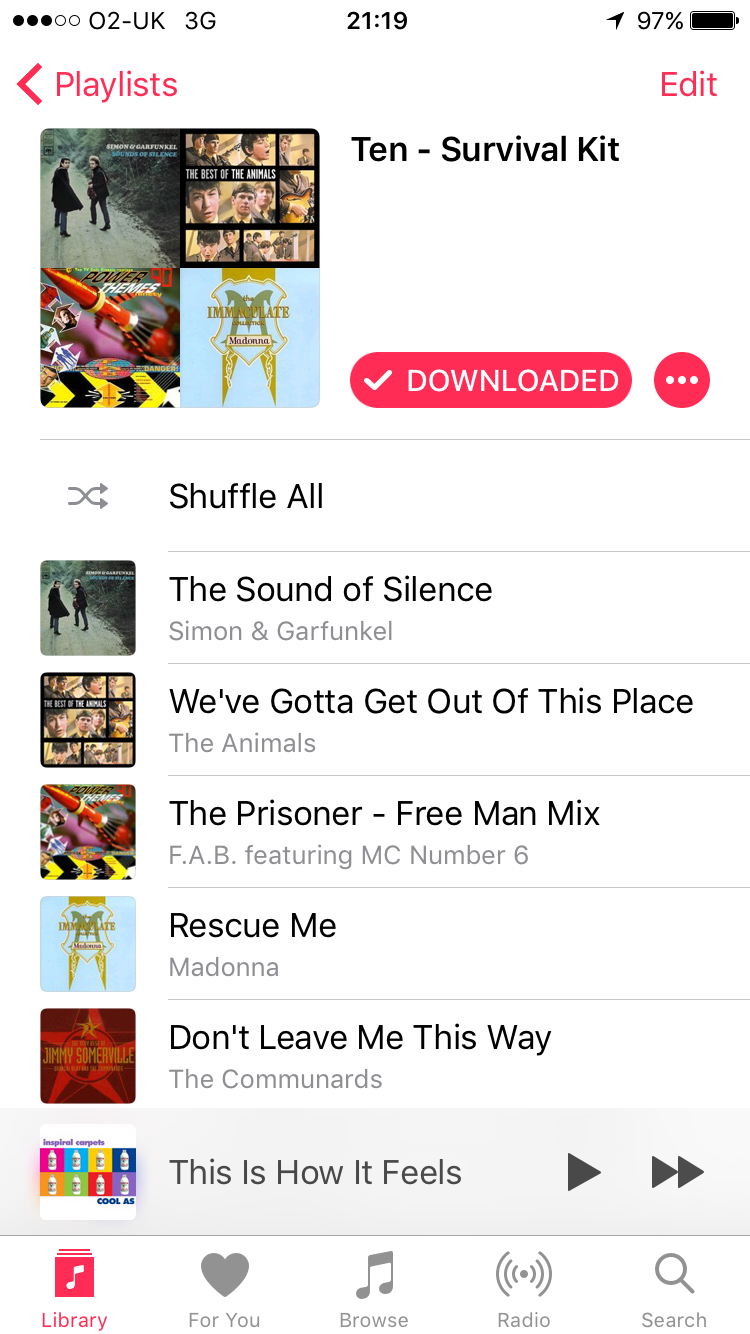
After two days of drugs, pain and exhausted attempts to sleep, obviously I had to face up to both feeling and very visibly being very much worse. I strongly suspected I would not just be sent away with stronger drugs this time, so packed such essentials as my tower of prescriptions and several books, as well as loading my phone with more books, Doctor Who stories, an extended playlist I’d prepared after the last time, and of course that still extraordinarily accurate and topical documentary Carry On Doctor. Plus recharger and plugs. As it turned out, I mostly read JP Martin’s Uncle tales, which I’d recently found as eBooks many years after consuming them at my school library.
On the Saturday afternoon Richard drove me back to A&E. I was there five hours, and I was not happy. This was a busier time and the cheery doctor only passed me in a corridor. There are few things so alienating and afraid as hours alone in a hospital room: my condition may not have been as bad as in 2014, but the communication was far worse. No phone signal in the deep places, either. When they eventually decanted me into a chair and wheeled me round and round and up and up to be admitted into a proper ward, somehow I wasn’t grateful for the excessive speed after the long wait – being dragged and bumped behind an orderly so that I received the maximum excessively painful jolts and couldn’t even see where I was going. I just managed to read the ward number as I whizzed past, but wasn’t helped by the sign headed “Visiting Hours” without any times marked on it.
And so I ended up laid out in a small ward so deep inside the hospital that not only did it not have any windows but that the nearest windows were along enough tangled corridors that I didn’t see natural light again until the following Thursday. This did not have a cheering effect. The evening wasn’t helped by having had literally no food all day and told that I’d missed the evening meal so all they could give me was a packet of biscuits, nor by it taking several requests and an hour to find out when visiting time was. I was finally able to send my distress call to Richard after it had officially finished, but he stayed until they threw him out, for which I was even more grateful than the half-hour in the middle where he legged it out to the nearest supermarket for their saggy surviving sandwiches. Which at that point were awesome (and my husband far more so).
I don’t really want to talk about the next four days. Richard came every minute allowed – and considerably more – that he wasn’t at work. He is the most wonderful man. Be nice to him. He’s frazzled and he needs it.
Thank you, too, for all the people who sent good wishes via his FaceBook, to several people who sent very kind messages (and I’m sorry I replied to so few), and to a friend who came to visit and was extremely nice even when I was at one of my worst points and was shakily and soggily poor company (not least for asking if I could cope with a visitor and then asking if it was time for him to go so I could be alone with Richard). Thanks also particularly to Nurse Tracy, who ran the ward at night over the weekend and was really good at it – the medical side, the reassurance side, and even the little things like bringing replacement gowns and wash-kits before you think to ask for them. If they don’t do that, ask for them. Which brings me to…

Things To Do In Hospital
If you ever end up in the same sort of situation, the most important thing is to fight to stay informed and to ask questions. Particularly if you have a medical history that you know and that they’ve not read (I’m still impressed that, along with two antibiotics that I’m still taking and still being knocked out by, one of the painkillers I was discharged with explicitly warns against taking if you have not one but two of my chronic conditions and, when a doctor suggested I risk it if I really needed it – obviously I really needed it – had as bad an effect as you might imagine).
If a doctor seems to contradict another doctor, ask and give evidence-based back-up to your questions. They probably won’t listen to you, but there’s a chance the next one will when they contradict again. I’m glad that they hit on the right treatments eventually, as a week after discharge I’m showing slow but noticeable signs of improvement, but when you have a different medical opinion and complete reversals every day you must pay attention, because there’s a strong chance you’re the only one who is. My particular winner was the specialist who came up with the best antibiotic but at the same time seemed fanatically in favour of a medical procedure that I’d previously been and was subsequently told would be a disaster. He was also the doctor who told me with utter certainty what had caused my condition and simply repeated himself in the most dismissive way possible when I asked how his off-the-peg assumptions squared with actual individual medical facts and clinical records that not just contradicted him but proved what he was saying was impossible, including those from two and a half years of follow-up tests and operations by his own department. I am not a trained doctor, but I am at least able to grasp that an operation in January 2015 and the continuing complications from it may indeed be among of the banes of my life, but they did not cause the condition that first hospitalised me in July 2014 and to which they were themselves all consequences. Perhaps I shouldn’t have been surprised by a doctor whose firm and unalterable convictions were based on time travel, but I wasn’t reassured by him.
If you’re at your lowest and weakest and most in pain, if two other patients strike up a loud and extended vitriolically homophobic conversation (one led it, but the other went along), you should probably do something. But I’m f**ked if I know how to summon up the spirit to do it rather than just both feeling more vulnerable and isolated than ever and feeling grateful you’re isolated in a corner constantly inside curtains and can try to pretend you’re not in the same room.
Cannulas are the work of the devil (they’re a sort of tap fitted into you so they don’t need to find your veins with fresh needles every few hours). I find they bruise hideously in the hand and much less so in the arm, but both will be painful all the time and far more so when they snag on your gown or as you turn in fitful sleep. When your blood pressure is measured every four hours of day or night, learn not to be too disturbed because there’s nothing you can do when each new nurse says, alarmed, “Did you know your blood pressure is very high?” and when it starts flashing and saying “Emergency” on the readout be patient when they switch to the other arm in the hope that reading will be a crucial few points lower and they don’t have to call a doctor. But especially, if your cannula is in the crook of your elbow, tell the nurse loudly every time and when they don’t listen, push the blood pressure armband further up your biceps before the pressure closes on the needle in your arm and risks breaking it.
If you’re cold, and in an air-conditioned ward with only a thin gown and a thin sheet you probably will be, ask for a blanket and keep asking when the nurse’s face suggests you have asked for a statue of yourself in an ermine wrap. If you are still cold, ask for another one. If you are to be trundled on your bed to another floor for tests, ask for blankets in advance. Assume that you might, for example, be about to be left in a much colder corridor for an hour and a half while waiting for the scanner. Whatever you are in for will not be improved by catching a chill. This might mean, for example, that you are shuddering uncontrollably while the doctor who’s just peeled back your gown and gasped, “Oh! That looks very painful” is trying to keep a steady hand, and that, for example, your temperature and pulse might rocket that night and the nurses have to give you extra medication while you ache appallingly and sweat your entire bodyweight.
Most importantly of all, fight your British instinct to answer ‘Are you feeling all right / better / comfortable?’ with ‘OK / fine / not too bad / embarrassed shrug’. You must gaze steadily at the medical professional and say the words ‘Very bad. I need some morphine.’ Or you will remain in an even greater level of pain than you will be when stuffed with painkillers.
Also get up the bottle – especially if the doctors have ticked you off for not drinking enough fluid after no amount you drink can make up for your massive dehydration after another night pouring sweat on a plastic mattress – to ask for more water and keep asking in the three hours after breakfast in which the jugs have been taken for cleaning and the nurses believe they will return instantly by house-elf while patients discover replacements will only arrive at the next meal. Unless you doggedly keep asking.
Doggedly keep asking.
And that’s it for what I’ll say. I’m out. I’m hoping not to go in again. I’ve had two short walks since I was released and both were so painful and exhausting I was knocked out for a couple of days afterward. I am still in a great deal of pain, somnolent from all the pills, and in either a foul or just a hopeless mood, and very grateful that my husband somehow puts up with me. My health has now been increasingly poor for twenty years and after this year I am very much more fed up with it than ever.
Here’s hoping that my personal 2016 goes into the bin and takes with it all the bonus health disasters so that by a few weeks into the New Year I can enjoy the giddily flourishing vigour of Alex-normal.
“All component parts are functioning normally, master.”
“I don’t believe it. I don’t believe it! All component parts functioning normally – ha! Puh. You mean to tell me that after all we’ve been through, the systems are functioning perfectly?”
“No – not ‘perfectly’, master. Adverb attributed was ‘normally’.”
K9 reporting on the Doctor’s broken-down TARDIS, Doctor Who – Full Circle
Labels: Carry On, Doctor Who, Health, London, Music, NHS, Personal, Pictures, Richard, Tube, Uncle


Saturday, August 23, 2014
KKLAK! RROAR! Doctor Who Takes A Deep Breath For More Dinosaur Invasions
Will Peter Capaldi know how to fly the TARDIS in an hour’s time? Take a Deep Breath!
We’re thrilled looking forward to the new Doctor, and an old monster. Sixty-seven million years old (today).

It’s not the first time dinosaurs have savaged London (and I’m not talking Boris vs Ken). Doctor Who history includes the 1974 story Invasion of the Dinosaurs, featuring Jon Pertwee and, as I’ve written before… Some problems. But it also boasts one of the most fabulous book covers (and onomatopoeic effects) ever devised.
Doctor Who: The New Adventures – Blood Heat is a more thrilling if more obscure 1993 story published as part of the brilliant continuing book range that kept the series and Sylvester McCoy’s Doctor alive in the 1990s. It even features Silurians, too! But the cover of Jim Mortimore’s novel, while thrilling, isn’t quite as awesome as that of Malcolm Hulke’s novelisation from 1976. So I’ve drawn a very subtle bonus feature to fix that. I think you’ll agree it was just what it needed.

I don’t know what tonight’s story will bring us, aside of course from another Tyrannosaur in the capital and a Doctor who’s at last not hiding his age, but I hope it’ll be every bit as exciting as its two predecessors. Now all they need is to commission a book version and a proper painted cover – both Chris Achilleos and Jeff Cummins are still around. There’s only one way to decide which… FIGHT!
KKLAK!
RROAR!
VWORP VWORP!
See it in an hour.
Labels: Blood Heat, Books, Deep Breath, Dinosaurs, Doctor Who, Invasion of the Dinosaurs, Jon Pertwee, London, New Adventures, Peter Capaldi, Pictures, Sylvester McCoy
Saturday, February 23, 2013
Coming Soon: Three Things I’ve Written For Other People
How To Write Something: It Turns Out, Only By Getting Writing (nagging helps)
I love writing. Except when I don’t. In that, it’s rather like a lot of things in my life for which my health or my fears get in the way. And it’s a rather lovely ego-boost to be asked to contribute to something. But also sometimes terrifying. I write for many reasons: for pleasure (it’s certainly many years since any of it was for money); to make a point that needs saying; because I’m not able to get out much and want to feel like I’m connecting with the world… But I also tend to put things off, because I’m too ill much of the time and there are other things I want to do when I’m not. This means that anyone who is kind enough to ask me to write something does so at their peril, even if I do often really want to write for them. At the least, they’ll probably have to nag a bit. At worst, I may have to steel myself to get past the gnawing terror that sometimes irrationally substitutes itself for the ‘Whee!’ feeling that someone being nice about my writing ought to evoke. It’s embarrassing to admit (as some of the people involved may read this) that there’ve been times when, on receipt of an invitation to do some writing for something that sounds impressive from someone I respect, my immediate reaction was not to beam at the compliment but have a complete crash of self-esteem, worry that anything I wrote would never be as good as the other contributors, and pretend not to have seen the mail or any follow-ups (the online equivalent of keeping the door shut, the curtains closed, and never going out, as it happens pretty much my life offline). Which I suppose is just my life-long tendency towards seeking perfection as procrastination turned pathological.
I’m still putting off writing a lot of things I want to do for me, but happily somehow in the last year I managed to say yes to four interesting things for other people and have actually delivered three. Woo hoo! It may be significant that I warned three of them that I’m terrible with deadlines and would need nagging, while the other, for which I had several exciting ideas, took a while to reply, then I took longer to reply to them, then… Well, I’ve not heard any news of that particular book coming out, and I hope I’m wrong in suspecting it may not get round to. So, here are the three for which people gently prodded me, available soon…

The Doctor Who 8th Anniversary Special
Interviewing Martha Jones for Paul Smith at Wonderful Books
With the vacuity of the official modern Doctor Who Annual creating a gap in the market, in Summer 2010 the Doctor Who Magazine team (responsible for previous much more readable Doctor Who Annuals and similar books) joined with BBC Books to produce the far more interesting, text-intensive and generally creative The Brilliant Book of Doctor Who 2011, first in a series which ran… Only two years, unfortunately. But it did inspire something even more creative, entertaining and beautiful – and not just because it was based in a Who period considerably more to my taste and the only Doctor definitely more to my taste than the present one.
The Wonderful Book of Dr Who 1965 was created by Paul Smith as an homage to The Brilliant Book, but packed with facts, interviews and images based not on Matt Smith’s first season in 2010 but on William Hartnell’s (and the series’) first in 1963-4. And not only did it look gorgeous and was immensely readable, but it was very funny. Because not all of the facts (and none of the interviews) were exactly factual, both deeply loving and taking the piss outrageously. And all available as a free pdf, the cheaper, prettier, faster version of the old fanzine (though he did a few print copies, too).
All this meant that I was especially delighted when Paul Smith contacted me out of the blue to see if I’d like to write something for his next project. I didn’t know him, but I’d thought his work was (obviously) wonderful. And that this was to be an homage to the legendary Radio Times 1973 Special for the fiftieth anniversary was the reason I had to go for it, if I could. I’ve previously enthused about the Radio Times 1973 Doctor Who 10th Anniversary Special as probably the most marvellous single Doctor Who magazine ever published. It wasn’t until more than a year after that that Doctor Who first captivated me, aged three, so when a family friend who’d kept his slightly battered copy gave it to me, it instantly became one of my most treasured possessions. Before websites or guidebooks, this was the unique source of thrilling photos and details of stories from before I started watching (that is, prehistory).
Paul’s concept was to recreate the Special as if celebrating not the fiftieth but the eighth anniversary of a Doctor Who series that started for the first time in 2005, with other fans providing some of the artwork and comment pieces. In the original, double-page spreads about past stories alternated with newly shot double-page photo spreads and interview columns for past companions with pull-out quote headlines like “THE NUTCASE PROFESSOR SWEPT ME OFF MY FEET”. For a column like that, I was only given 350 words to play with – imagine – and a couple of other rules which I contrived to bend subtly, and may explain when the publication appears. I was asked which companion I’d like to write about, and though several tempted me – Rose and Jack were terrific in 2005, and I loved Jackie and Wilf – I instantly thought of Martha Jones (or Martha Smith-Jones, as she is now).
From her first appearance in Smith and Jones, Martha was a breath of fresh air for me – not just Freema Agyeman’s performance and giving as good as she got to the Doctor (and him not being interested), not just that she was the Doctor’s first full-time TV companion who was black (after Sharon, Roz and others elsewhere), but that she wasn’t going off with the Doctor only because her life was a bit rubbish. Martha is the only companion since Sarah Jane Smith with a decent, fulfilling, even exciting career – and for all of us who are so utterly gripped by the Doctor and his adventures, that’s a more inspiring example than the implicit suggestion that travelling in the TARDIS is only slightly better than being in a dead-end job you’re bored by or hate, or than having your parents killed in front of you. If you’re an achiever with a lot to give up, but the TARDIS is still so exciting you’d go off in it without a second thought – well, you would, wouldn’t you? And, for me, she has by far the most satisfying (and self-chosen) exit from the new TARDIS, too, again after impressive achievements in her own right.
I understand that other contributors might have written critical assessments or celebrations of their picks, but with the Radio Times Special so deeply ingrained in me, I knew immediately that I wanted to write an ‘After the Doctor’ interview in that style, for the character rather than the actor, and that though I was going to be tongue-in-cheek in several ways (her earnestness, the Doctor) as well, I was going to set out first to say ‘She’s a strong, brilliant character’. And while it may have taken some time to think of all the other words, then edit them all back down again, my starting point leapt into my head fully-formed on reading Paul’s initial email:
“I LEFT THE TARDIS WITH MY HEAD HELD HIGH.”You can already see a tiny preview of the Martha Jones pages on the Wonderful Books site, and I believe the new Specials are now at the printer’s.

The Worldcon Guide To Doctor Who In London
Bigging up That London for Nicholas Whyte and the 2014 World Science Fiction Convention
“Of all the places the Doctor ever visits, which is the one he comes back to more than any other? Not ostensibly exotic locations such as Skaro, Peladon or New New Earth – even Cardiff – but London. And, paradoxically, since Doctor Who began recording in Cardiff, the Doctor has been drawn to London more than ever before. But then, when the Fifth Doctor exclaimed that he was being pulled towards the middle of the Universe, there was no way this was going to mean a thrilling return to Terminus. Inevitably in Doctor Who, the centre of the Universe is London.”Diplomat and prolific science fiction (and Northern Irish and European politics) blogger Nicholas Whyte rang me last year to ask me if I’d like to write a guide to London locations in Doctor Who. He’s one of the organisers of Worldcon 2014, taking place in London next August, and thought this would make a great advertising hook to encourage people to come to London from all over the world.
That seems, you might think, quite a long lead-up time, and it did to me, so pity poor Nicholas a few weeks ago when I’d not yet turned my notes into a proper guide and, it turned out, not this year’s Worldcon in San Antonio but the biggest US Doctor Who convention – Gallifrey One, in Los Angeles, which took place last weekend – was looming upon him and he needed leaflets to hand out. Which led to me finally getting down to the drafting over the course of about four days solid, and discovering that I had oodles of notes for some Doctors and rather fewer than others. My intention had always been to select one location for each Doctor, all across Greater London, to give a range of time and space. So imagine my hilarity when, thinking all I had to do was whittle down several possibilities for each, I found that for two of the less Londoner Doctors I’d pencilled in the same location and didn’t have a back-up. I won’t tell you what, or how I ended up finding an alternative for one of them – though I did for a wild moment consider making a point of it and choosing that same location for four different Doctors, if that’s a clue…
I’d been told to write for a word count in the low thousands and, being me, ended up at what might be considered the upper end of that – about 3,400 words. Nicholas was very complimentary about it all, and is going to put the lot up on the convention website – but it was never going to fit on a leaflet. So the last of my four days was spent cutting it down by more than half, to 1,600 words, at the same time substantially rewriting it to make it still work at that length and trying to keep in at least some of the jokes, on the grounds that while I found such other guides as Richard Bignell’s book Doctor Who On Location and the website Doctor Who – The Locations Guide invaluable research aids and recommend each, they’re best to dip into and not easy to read through as enticements. And, in an attempt to forestall Nicholas and the Worldcon London team from making it less readable, at about two in the morning I stuck the text into some text boxes, inserted a few photos and clicked “Save as pdf” to prove that it would all fit on a leaflet as was. I expected they’d find someone with any graphic design ability to turn the text into leaflets…
So my apologies to people who picked up the leaflets in Los Angeles last weekend and saw something scruffy from Word without any links on it, but at least I reckon the text was pretty good. If you’d like a copy of the pdf, email me (look at the sidebar), and at some point the extended version, which is a more entertaining read, will be up on the Worldcon 2014 website. In the meantime, here’s one of Nicholas’ reports from Gallifrey One, complete with the huge maps they hung up to make sense of my references. I won’t tell you all of my choices here, but the first is obvious:
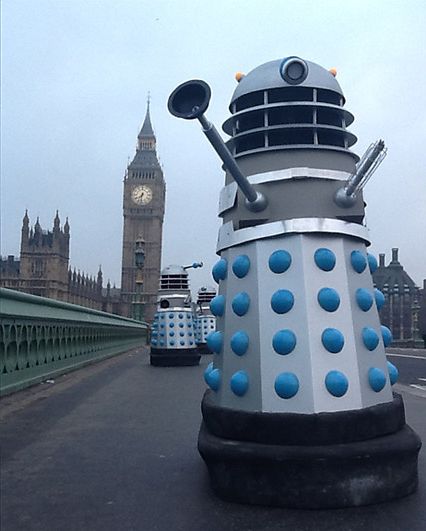
“Daleks looming before the Palace of Westminster and St Stephen’s Tower – the Houses of Parliament and Big Ben – are the very image of democracy overthrown by fascism. Before crossing the Westminster Bridge toward the Parliament of the United Kingdom of Great Britain and Northern Ireland, look left along the Albert Embankment; if you see zeppelins and signs for Newport, you’re in the wrong London. Best get that settled before you set out. Pass Big Ben into Parliament Square, turn right into Parliament Street / Whitehall to follow in Barbara’s fast footsteps, and like her you’ll reach Trafalgar Square at the end. That in itself is a much-used Doctor Who landmark: Ian and Barbara return there for an exuberant homecoming in The Chase; a New Year rings in in The Daleks’ Master Plan; Nelson gets a redesign in No Future and has long since toppled by The Sontaran Experiment; Rose has lunch there with Mickey before meeting the Doctor; it’s conquered by the Daleks again in the game City of the Daleks; but Londoners can feel secure that in a thousand years’ time, Trafflegarr Square will still be there in Spaceport Five Undertown.”
What Do the Lib Dems Believe?
Liberal Philosophy for a Mark Pack Infographic
While I don’t know if I’ve ever met Paul, and I know Nicholas a bit, Mark has known me more than twenty years. That means he knows my relationship with whooshing deadlines, so he’s the one who wisely met up with me for a couple of hours and prodded my brain for ideas rather than necessarily waiting for me to do the actual writing. Last year, Mark produced an Infographic on “Liberal Democrat Achievements In Government” free for any Lib Dem or reader to get across at a glance some of the influence we’ve had through the Coalition. His next Infographic is to get across what we stand for.
Mark and I have worked on and off together on a simple crystallisation of what the Liberal Democrats believe for decades, first inspired by the ’90s “core message” under Paddy Ashdown and Matthew Taylor (for which I was back in a senior enough position to get hold of much of the briefings). In recent months, there’s been work on a new one under Nick Clegg and Ryan Coetzee, and while Mark will no doubt be including that as part of his Infographic, we both wanted to come up with something a bit deeper: a mixture of history, philosophy, controversy and current priorities, the story of the Party and its soul, if you like, hopefully showing how they all fit together and giving something that all Lib Dems can nod at, whether for information or for inspiration. My intention, at least, is something that Lib Dem members can look at and think, ‘Yes, that’s some of why we bother’.
Though Liberalism provides a far more coherent and consistent philosophy for the Lib Dems than whatever shifting melanges animate the Labour and Tory Parties, it’s not without its problems in summing it up in brief – nor do I envy Mark in having to find images to illustrate concepts for his Infographic. I’m also grateful for him for pulling it together, not least because my series of ‘What the Liberal Democrats Stand For’ posts on this blog has mostly gone unwritten or in fits and starts, and I’ve not even finished republishing my original 1999 Love and Liberty pamphlet on here. So, Mark’s project is less ambitious, but it’s happening (hooray).
My best guess is that Mark is likely to publish the Infographic for Liberal Democrat Spring Conference in a fortnight, and I’m intrigued to see how it turns out. He did send me his rough notes last month, which I didn’t get round to helping with; he’s since sent me the first draft of the Infographic itself, to which I helpfully replied (having failed to do it at the more amorphous stage) with a close-to-complete redraft. Being me, and more a words than a graphics sort of person, that also raised the suggested word count from about 600 words to about 800, which I expect Mark to slash even if he wishes to take all my points on board. I know he’s circulated it to several other people, too, so I have excitingly no idea what the final version will look like – but I hope I’ll agree with it, and so will many of you.
At the risk of picking out elements that don’t make it through, here are a few teasers:
I’ve suggested the Infographic start with What the Liberal Democrats Believe in six words. But which six?
Mark is, amongst many other things, an historian, and one of the key staging posts for him in the Party’s history was the mid-Twentieth Century development of both Community Politics and Europeanism as important to our predecessor Liberals and Social Democrats. People often think these are contradictory, but they’re not – so here’s one of the lines I suggested to get across as briefly as possible why they’re part of the same thing:
“both challenged centralised power, saying decisions should be at the lowest practical level, from your local community for local issues to international co-operation on issues like trade and climate change.”And when many are trying very hard to say the Party’s split today between Economic and Social Liberals, for me this is greatly overstated. The extremes make a lot of noise, but most Lib Dems see themselves comfortably as both, or simply as Liberals. So here was my suggestion on how briefly to sum up the consensus, not just the differences, between members of the Liberal family:
“All Liberals believe in liberty, and that any sort of power (government, business, other people) can both protect and threaten liberty.Some may recognise my paraphrasing of my old friend and mentor Conrad Russell. And before long, you can see if any of this made it into the final draft!
“Economic and Social Liberals put different emphasis on which sources of power are the best defences or the biggest bullies, and on whether freedom or fairness is the biggest priority.”
Something Mark’s prodding brought me back to look at again was my own shortish ‘What the Liberal Democrats Stand For’ statement, which I first drafted in the ’90s and had slightly updated several times since to incorporate a flavour of whatever the Party’s key priorities happened to be at the time. As each version was limited to between 140-150 words, in the years that I was Vice-Chair of the Liberal Democrat Federal Policy Committee and would deliver its report to Party Conference, I even used to read it out as part of my speeches, on the basis that if any Party body should be concerned with what we stand for and communicate it to people, it should be the one that’s responsible for the Manifesto.
It’s some years since I last wrote a new draft of this, and I had a go, incorporating some of the new Ryan Coetzee messaging. It was the largest change (still kept below 150 words) I’d made since I first came up with it, and I’m not printing it here today because, after an appropriate pause for thought (and after Richard shaking his head), it seems too much of an ugly mash-up. Should I manage to get it to flow soon, I might publish it when the Infographic appears. In the meantime, if you’d like to chip in or just to see what the Lib Dems stand for for me, email me (again, link in the sidebar) and I’ll send you both the previous 2000s version and my latest attempt-in-progress.
And that’s it, at last. I hope you enjoyed the trailers, and that you’ll soon be able to see the main features. And just a couple of days ago, I was asked if I’d like to write something for another fan magazine I adore… But as I volunteered to do what’s probably the most popular bit, they may not say yes!
Labels: Conrad Russell, Doctor Who, Doctor Who Magazine, Fandom, FPC, Health, Liberal Democrats, Liberalism, London, Matt Smith, New Adventures, Personal, What the Lib Dems Stand For, William Hartnell
Saturday, December 08, 2012
Doctor Who 50 – Eleven More Great Scenes. And More
My idea is to pick a brilliant scene each week and set out just why it’s so brilliant – with a bonus quotation from the series each time that’ll mostly speak for itself. Many of the scenes will be from crucial moments in their stories, so watch out for spoilers (and today’s selection is particularly spoiler-heavy). All the Doctors will be there – just not necessarily in the right order. I’ll be counting down these marvellous moments roughly in order of preference, though not entirely: some might be there to tie in to a particular date, or spread out a bit so that similar scenes don’t all turn up in a row. Some scenes or sequences lasted mere seconds on TV… The longest up to a quarter of an hour. Most tend to be a couple of minutes long if you watch them, though who knows how long my write-ups are going to be.
The Fifty spread over this year will include my few absolute favourites – though not necessarily a ‘top fifty’. Looking at my instinctive choices, certain Doctors, certain stories, certain styles (not least speeches – and scary bits) came up much more than others. So, because I love the whole of Doctor Who, I’ve striven for more balance. The Fifty will include at least one scene from every year in which the series has first aired, and at least one from each of its TV seasons. There will be no more than one scene from each story featured (with one exception) – though the quotes will be more random and less calculated, some reflecting that week’s scene, others ones that just popped into my head, even if I’ve striven not to make them all from The Talons of Weng-Chiang. And I’m afraid this Fifty will be drawn only from the TV series, though I showcased a wider range at the last big anniversary with forty-five stories illustrating Why Is Doctor Who Brilliant? It was hard enough trying to weigh every scene in over two hundred television adventures, and I simply couldn’t have done it with what must now be thousands of different stories in all the many formats. Hopefully, these choices will be variety enough.
Most of all, I’ve picked scenes that I enjoy, and I hope you will, too.
I thought of hundreds of scenes before whittling them down to the Fifty. I could have done the Five Hundred… Except I’d never have managed to get them into any sort of order, still less found time to write about them all. Last week, I whetted your appetite for the forthcoming Fifty with Eleven Great Cliffhangers – though not quite the greatest, which you’ll see across the year – and, this week, Eleven Runners-up of various other descriptions, some to cast a different light, others which so nearly made the Fifty but for other choices already from their year, or their story. Inevitably, there are speeches and scary bits – but also special effects, some things that make me laugh, sentiment, excitement and more. Read on…
The Deadly Assassin
“Through the millennia, the Time Lords of Gallifrey led a life of peace and ordered calm, protected from all threats from lesser civilisations by their great power.
“But this was to change. Suddenly and terribly, the Time Lords faced the most dangerous crisis in their long history…”

First off: my favourite story of them all, beginning with the opening titles and a sombre introduction. This is less a scene than setting the scene, so it seems the perfect way to start. This arrangement of the fabulous Doctor Who Theme is still the best, ending in that marvellous stuttering echo as the titles fade, and the titles themselves the greatest titles ever made, a time tunnel swirling in different shapes and directions, carrying the TARDIS, the Doctor, the logo and credits through time and space and visibly inspiring the title sequence still used today. Then, for the first time, the story is introduced with a scrolling text read in the moody tones of the Doctor (Tom Baker). It promises something special. And it is.
The Doctor will crash into a premonition of death – and then, alone now, become a hunted fugitive in a city that was once his home… A film noir nightmare, political satire, dizzying virtual reality, reimagining the Master and the Time Lords, this will be the series’ most radical and creative story, both conceptually and visually (and upset Mary Whitehouse like no other). But it all starts with that unbeatable time tunnel. That’s Doctor Who.
The Dalek Invasion of Earth – Flashpoint
“One day, I shall come back. Yes, I shall come back. Until then, there must be no regrets, no tears, no anxieties. Just go forward in all your beliefs – and prove to me that I am not mistaken in mine.
“Goodbye, Susan. Goodbye, my dear…”

The first time the Doctor (William Hartnell) ever said goodbye to a travelling companion was to his granddaughter, Susan. And it’s been painful for him ever since. She’s fallen in love but feels she can’t leave him – so he makes the decision for her at the close of this story. It’s the beginning of so many times that writers have had to find a reason for someone to want to stop travelling in space and time, and one of the more plausible but sexist ones, being married off (an idea intermittently challenged by the Ponds); here it’s done with a little more conviction and a little more sexism than most, though the Doctor does show his love and pride in her and give her credit for looking after him as much as he’d looked after her. It’s William Hartnell’s beautifully played address to his grandchild that makes this so special, her shut out of the TARDIS, him standing at the console, both still smudged with ash from exploding Dalek mines. His stirring benediction falters slightly at the end, and he has to leave before he changes his mind. Susan walks slowly away from the vanished TARDIS, leaving her key in the ruins. The selection of part of this scene to open The Five Doctors cemented fans’ love for it, and when – after a decade of making speeches – I at last used a Doctor Who quotation in a speech of my own, I closed with this one. My voice broke at the end, too.
The Brain of Morbius
“How far, Doctor? How long have you lived?”

The brain of Time Lord war criminal Morbius has been restored to physicality in a hideous body of bits (and in an inspired twist not just on Frankenstein but on one of the ’60s and ’70s most often-used great TV threats). As the Nuns of Doom march to his castle in the final episode, bearing the traditional torches, the Doctor (Tom Baker) challenges him to a mind-bending duel: pitting their mental powers against each other to see which can force the other back through their lives to nothingness. Tom Baker and Michael Spice (plus Stuart Fell within the body) are both outstanding in their electric confrontation, Morbius arrogantly proclaiming himself “a Time Lord of the first rank,” the Doctor scorning him as a failed dictator, all set to one of composer Dudley Simpson’s finest moments, deep, stately chords offset with a spine-tingling counter-melody.
Two more things stand out. One is that the Doctor is fighting a desperate rear-guard action against of the titans of his race – what’s special about our hero is his choices, not his intrinsic power, and he’s overwhelmed by Morbius’ mental power: all he does is hold out long enough for the energies to be too much for Morbius’ new brain-case to bear, not the brain itself, and even that nearly kills him. We see Morbius thrust the Doctor’s psyche back through Pertwee, Pat, Billy… And through many previous incarnations as he hurtles back to his beginning. Contradicted or supported elsewhere as these may be (and some fans jump through such hoops to deny their intention), for me they’re a sign that Doctor Who can always surprise us, an enthralling sight and concept, and all that could make them more so is if the pre-Doctors were not members of the production team but old actors’ faces. Just imagine, say, Alastair Sim appearing, firing your imagination to see his black and white Doctor Who movies from the ’40s.
Remembrance of the Daleks
“BANG!”

Doctor Who always beat its budget to create memorable images that no-one else could show you, from the first sight of the TARDIS’ impossible interior and the first alien world, with its petrified forest and gleaming city, to monsters like suckered embryos with a ship that seems grown rather than made and a howlingly alive alien jungle, to eerily beautiful robots in an Art Deco vessel, or multiple Mona Lisas, or an Escher painting that encloses you, to crossing the striations of the timelines wearing a splash of red upon strangely monochrome stately gardens, right up to a would-be tyrant’s face disintegrating horribly or a dying world with a stormily alien sky. All that without yet breaking into the series’ Twenty-first Century stories – until my next choice down. Out of all of them, to champion Doctor Who’s most visually exciting moments I’ve picked two where the series makes an impact on London: one in 1963, when Doctor Who started; the next in the Twenty-first Century, when it continues. This is the one with streetfighting Daleks blasting the hell out of each other and the fuck-off bazooka Dalek.
The Doctor (Sylvester McCoy) is juggling two warring Dalek factions: the wily old gun-metal veterans; the glorious white and gold new Imperial stormtroopers. In Part Four, the veterans have captured a superweapon – but the Imperials don’t intend to let them get away and land an attack squad to take it. The first engagement sees an Imperial force retreat under a hail of fire from the more experienced warriors, one blown satisfyingly apart… Only for the Emperor to order the Special Weapons Dalek into position. Daleks have always been one-being tanks: this one, with its heavier, grimier armour and one huge gun, takes that to extremes. Simply obliterating every rival in its path, when it reaches the enemy base it blasts the gate apart in an enormous fireball, a blizzard of energy bolts slashing through the blaze before it settles. Some of the explosions staged here were so outrageous they caused an anti-terror alert (I love the BBC) – yet the battle’s still more exciting in the novel. Thrill to the Abomination!
Aliens of London
“BONG!”

I said before Doctor Who returned to our screens in 2005 that it would have to deliver not just impressive special effects – which everyone can do these days – but also memorable images with ideas behind them, and that year alone it delivered in spades, from looking at the Lady Cassandra’s beautiful flatness, to Daleks that were everything you ever darkly dreamed, to flying, shrieking time-eaters clawing at a church, to heads choking and splitting into gas masks, and since then keeping up the pace with a werewolf running amok in a stately home, the TARDIS bouncing along a motorway, a hospital on the Moon and right up to, yes, dinosaurs on a spaceship. But the most cheekily memorable image of that first new year? This is the one with the spaceship crashing into Big Ben.
The Doctor (Christopher Eccleston) has accidentally brought Rose back home not a day but a year after taking her on a trip through time and space, which has not gone down well. Both are at their most unlikeable as they bicker on a rooftop, and no-one else on Earth is going to believe Rose if she tries to talk about aliens and spacecraft… Only for a spaceship to fly straight overhead, trailing smoke, weaving across London and eventually crash-diving along Whitehall, smack into the clock topping St Stephen’s Tower, before belly-flopping into the Thames. Thank goodness it came along to snap them out of it, though their initial reactions are mixed… It’s the first and still best moment of its kind, as Russell T Davies enters his vocation to destroy ever major landmark in London. When Doctor Who does a story called ‘Aliens’, it looks like a bumbling comedy where they can’t even fly their ship… But the ominous truth is that they’re as greedy as a Ridley Scott corporation, and can destroy a whole planet much more quickly than something with sinisterly sexual gnashers.
The Talons of Weng-Chiang
“It’s good.”
“Oh. I’m so glad.”

With something to delight and something to offend everyone, The Talons of Weng-Chiang might just be the most enjoyable and quotable and thoroughly unsuitable for children Doctor Who story of them all. Obviously, I’ve loved it since I was five, and remember many years ago standing in a video shop with the latest VHS release and being unable not to overhear another small boy arguing with his mum about which Doctor Who video to buy. He wanted several; she would only pay for one. He was oscillating between two that I didn’t think were much cop, so I felt the urge to intervene, but made the most appalling error in being grown up: I asked her what sort of thing he liked. Of course, she didn’t know. So I knelt and asked which stories he had already and were his favourites. Having listened to the right person, I recommended Talons to him because it was scary and funny – and to her, on the basis that it was six episodes for the same price as four. I’ve often wondered if she left him alone with it, or came in, saw any of it and disapproved of the young man who’d suggested such appalling viewing.
One especially entertaining sequence comes half-way through Part Two. We’re on the dark streets of late Victorian London. The Doctor (Tom Baker) has been auditioning for (he can play the Trumpet Voluntary in a bowl of live goldfish) and sleuthing with theatrical impresario Henry Gordon Jago, not quite the bravest man in the Empire; his warrior tribe companion Leela has remained with premier pathologist Professor Litefoot, a crustily congenial old cove. Someone should pair these two guest artistes. And the villains have been crawling the kerbs in their carriage in search of the plot (spot the Porsche!). That plot revolves around monstrous appetites, so even the comedy scenes that pepper it have disturbing overtones – and this one enriches the main themes even as Litefoot finds the usual late-night cold collation laid out by his housekeeper and innocently offers Leela dinner.

You think writing about special effects is doomed? What about describing comedy? I’d urge you to buy this on DVD and watch it, because the comedy of manners between Leela – raised in an alien jungle – and a perfect Victorian gentleman never fails to crack me up. Expecting a lady, Litefoot’s face as she picks up a joint and just tears into it is priceless. He quails (there’s one of those on the table too). But politeness demands he can’t criticise or embarrass a guest, still less a lady, and when Leela’s own understanding of hospitality makes her express her satisfaction with the food, all he can do is weakly pretend pleasure. Faintly proffering a knife or fork, he sees her seize a carving knife, the better to hack the beef apart, and is left with no option as a good host but to put down the plate he would usually stack with a dainty selection of slices and, instead, grab a whole leg of lamb in both hands and bite. The culture clash in their next scene, when Leela drinks from the trifle bowl while Litefoot looks on queasily, has been known to make me cry with laughter. His last gasp of Victorian propriety comes in trying to save the tablecloth from Leela so as not to mortify the housekeeper come the morning – but before the night is out, it’s doomed to the Doctor. And by the end of Part Three, Leela’s enthusiasm for chomping on a leg has its own darker payoff…
Revelation of the Daleks
“It is our duty to eradicate all those who wish to pollute the purity of the Dalek race… If you ever loved me, Natasha, kill me! Kill me! …It is vital that the Daleks are supreme in all things!”

The Doctor (Colin Baker) isn’t the only one who wants to know what’s happened to his old friend Arthur Stengos; by half-way into Part One, Stengos’ daughter Natasha has broken into the galaxy’s biggest funeral home to find his ‘sleeping’ body missing and Daleks on guard. Overseeing all is Davros, remaking himself as the galaxy’s greatest doctor and promising eternal life – but of the kind that’s red-lit, tortured and underground. And the greatest horror for her is finding what’s left of her father growing into a Dalek, caught between his own self and one of Davros’ new breed of fascists. In a story of black comedy and dreamlike horror, this is the most nightmarish moment, a dramatic and visual triumph as Stengos is revealed in close-ups of eye and mouth, as if dismembered, and struggles to remember his love for his daughter when in his ranting New Order instead “The seed of the Daleks must be supreme.”
Stengos’ fate draws from perhaps the most memorable scenes in two of the greatest Doctor Who novelisations – a glass Dalek, a human slowly transforming into something ‘other’ and begging for death – each of which were too challenging (perhaps too expensive, certainly then too horrific) to portray in the original TV versions of The Daleks and The Ark In Space. And if you’re going to write as the David Whitaker or Bob Holmes tribute band, you’ve certainly got great tunes to play. As, if you didn’t think Natasha’s terrible choice was weird enough, does the resident DJ…
The Curse of Fenric
“Objects can’t harm us – it’s human belief. And you stopped believing when the bombs started falling.”
“I’m not frightened of German bombs.”
“Not German bombs… British.”
“On German cities. British bombs killing German children.”

In World War II, the Doctor (Sylvester McCoy) contests an ancient force of evil on the North-East coast. By the end of Part Two / half-way through the Special Edition of this most complex and layered story, the lively two young women Eastenders are made vampires, draining their self-righteous landlady then stalking through the graveyard mist to the local vicar. He tries to understand them… But they understand him much better. Reverend Wainwright flourishes his Bible, but they know it’s only faith that keeps them at bay – something with a stunning payoff later in the story – and that his is crumbling not under the horrors of the undead, but the horrors of war. Only the Doctor’s ferocity as he hurls himself in front of Wainwright makes them recoil, but they’ll return for him… Will he be able to find it in himself to triumph then? The Doctor and the bloodsuckers are almost forces of nature in this spellbinding scene that turns the traditional vampire story inside-out.
Love & Monsters
“You should take your jacket off.”
“No, I’m fine, I’ll just –”
“No, look, you must be boiling. Oh, look at your shirt. Sorry.”
“I – I – I’m fine. It’s all right.”
“I’ve ruined it.”
“No, honestly, i-i-i-it’s – it’s fine.”
“Take it off. I’ll put it in the wash.”
“Oh, come on! It’s only a little drop.”
“Oop! There now. Ruined.”

Elton Pope’s been fascinated with the Doctor ever since he was a boy, and never been happier than with a little group of friends with the same interests. By half-way into the story, though, someone’s rather taken over, organised them, given them ways to track the Doctor (David Tennant) and his friends, but things are less fun. And some of Elton’s group have vanished. Be careful what you wish for… And Elton wishes he could find Rose, so he tracks down her mum Jackie. Turns out he’s not quite as in control of his infiltration plan as he thinks he is. She keeps inviting him round to fix all the things that keep going wrong about the flat, and it’s got nothing to do with the way Elton’s shirt keeps accidentally riding up to show his stomach as he changes a bulb or his jeans showing off his arse as he looks at the washing machine. It’s a complete coincidence that her tops are getting tighter and skirts shorter, too. But just as she flings herself – or at least her wine, twice – at him, a call from Rose spoils the mood. She feels ashamed of her ulterior motives, and shows it; so does he, but doesn’t. He goes off for pizza to make it up to her, but it’s too late – she discovers what he’s after and she’ll protect them until the day she dies…
Camille Coduri’s Jackie has long been a brilliant comedy creation by now, shot through with tragedy; this is her finest moment, never funnier and never more moving as the cracks show of how much she misses her daughter and even Mickey. “Put the telly on if you want – can’t bear it silent.” The way Elton’s unreliable narration within his unreliable narration collides with her at her most turbo-charged is hilarious, then she and the script turn in an instant and break your heart. It’s inspired how ELO’s Turn To Stone gives way to Jackie’s choice of romantic music as she takes control of the scene from the man who’s been narrating it; her joyous sexuality is brilliant; then she lets her defences down only to find herself betrayed, anger punching through her loneliness to show how selfless and ferocious her heart is. Rose never sees it.
Genesis of the Daleks
“Today, the Kaled race is ended, consumed in a fire of war – but from its ashes will rise a new race: the supreme creature; the ultimate conqueror of the Universe; the Dalek!”

The climax to Part Three of this story, one of Doctor Who’s best, is an odd beast. On screen, the cliffhanger is a slightly underwhelming threat to the Doctor (Tom Baker). On the truncated LP (and now CD) release, the half-way cliffhanger comes a couple of minutes later, with the annihilation in fire of the Daleks’ parent species, the Kaleds, by their ancient enemies, the Thals (a model city with a sense of scale as, for once, the explosions take an age to die away). But it’s Davros, the half-Dalek creator of and would-be Führer of the new race, who actually betrayed the secret of their defences – to stop their leaders bringing the Dalek project to a halt. And in the originally scripted climax to the overrunning Part Three, moved back to begin Part Four, Davros uses the moment of shock for his scientific Elite (now the only survivors save for their mutated, battle-tanked progeny) to destroy his only outspoken internal critic. Ronson has asked awkward questions about the future of the Daleks and aided the Doctor’s escape; biding his time to respond, Davros now denounces Ronson as traitor and spy, ordering in his new Daleks to carry out their first ever extermination and promising vengeance on the Thals, too, then the absolute power and glory to which he aspires.
Genesis of the Daleks is packed with great moments, and another will make my Fifty. It’s the finest example in Doctor Who of actors and writers coming together to forge proper speeches, rather than just assuming ‘speaking at length’ makes great rhetoric. Others might choose the Doctor’s key moral dilemma – asking “Do I have the right?” – but this scene captivated me growing up and listening to it again and again on scratchy vinyl. The sheer power of Michael Wisher’s performance as Davros; the sheer ruthless chutzpah of the character; the sheer horror of Ronson screaming in denial. On screen, it’s the negative blaze around him and the sight of his colleagues backing quickly away, shielding their eyes, that stays with you; on LP and CD, the raw immediacy of the sound design, Davros’ harshly escalating triumph, the crashing march as the Daleks enter and their gun-sticks seethe. Gripping.
An Unearthly Child: The Firemaker
“This knife has no blood on it.”

Of all the Doctor Who stories criminally underrated by fans, for me this is the most unfairly overlooked – or, at least, 75% of it is. The first ever Doctor Who story, nearly everyone (rightly) looks on the first episode as one of the greatest pieces of television ever made, but nearly everyone else then goes on to do down the following three episodes, in which the Doctor (William Hartnell) and his as-yet unwilling companions plunge into prehistory and are caught up in the power struggles of a Stone Age tribe. Yet I’ve argued that these episodes are not only brilliant, but crucial to the show’s story. One outstanding scene comes at the beginning of the fourth episode, by which time the TARDIS crew have escaped the tribe with the aid of an old woman, only to be pursued by Za, one of the two rivals to be chief. Meanwhile, the cleverer but nastier rival, Kal, murders the old woman on finding them gone – and pins the blame on Za. With Za and our heroes captured together, things look bleak. But the Doctor brilliantly invents a genre tens of thousands of years early to beat Kal…
Kal’s great strength has been as a demagogue – Za learns how to adapt over the course of the story, but he’s comparatively slow. Yet as Kal waves Za’s stone knife before the tribe, weaving his story before them, the apparently frail old Doctor shows he can not only defeat a physically much stronger opponent with superior brainpower, but beat him at his own simple declamatory style and even muster the physical force to drive him out. It starts with the Doctor’s simple observation that Za’s knife has no blood on it, and from that point Kal unravels: he calls it a bad knife for not showing what it has done; the Doctor needles his vanity, saying it’s much better than his; Kal falls for it, proudly pulling out his bloody weapon; and the Doctor parades it around the tribe like a prize lawyer. Rousing the whole tribe against the strong fighter, he throws a stone at him and gets everyone else to do the same, making him retreat under a barrage of rocks.
This is simply a terrific scene. William Hartnell is outstanding, slipping effortlessly between quiet, naturalistic instructions and a theatrical display of Stone Age rabble-rousing, but it’s a brilliant idea, too: years before Columbo ever aired, Doctor Who invents the format. We’ve already seen the murderer, and the Doctor exposes him through a combination of psychology and forensic evidence. And while he’s settling the rivalry between Kal and Za, at the same time he’s settling with argumentative teacher Ian Chesterton just exactly who is the leader of the TARDIS crew, and the star of the show (he still is). Just as with the Twentieth-Century humans, the Doctor can speak their language and then get into their mindset and manipulate it, which makes you wonder just how much he’s talking down to our level, too. And I still love the idea of taking a standard of crime drama and reinventing it in an utterly different setting: within a few stories after this, the Doctor will triumph in another courtroom drama, this time on an alien world, and go on in another story to solve both a locked room mystery and a whodunit…
The TARDIS Can Go Anywhere – Super, Super Fun!

Even with these Runners-up I could easily have chosen many more – or even many more fifties. Do you remember the Doctor looking entirely at home in a steaming Victorian laboratory until the devils the owners made a pact with appear in the mirrors? Or the Doctor explaining the TARDIS at its most Victorian with the aid of boxes and points of view, and getting it absolutely right (nine times out of ten)? The Doctor and Amy lying in a field with Vincent van Gogh and seeing the swirling stars he sees; the Doctor echoing, “Do we have a deal?” on a diamond planet; the Doctor dining with a monster, consumed with comedy and tragedy; the Doctor’s shoes and mind clicking into place at exactly the same moment; the Doctor roaring defiance at a murderous, self-perpetuating oligarchy only for them meekly to admit they, too, can’t make the decisions? The Doctor fading but determined as he goes to find his other selves; another self the Doctor would rather not find deriding his tawdry quirks; a man who isn’t the Doctor dreaming of a life with the woman he loves; the Doctor’s people dispassionately putting him on trial for caring too much and ripping away his own self and those who care about him…?
What about Daleks rolling off the production line and shrieking their crusade to conquer and destroy – or as masters of a ruined London – or whimsically playing trains, suddenly made childlike; the Master wielding the devilish charisma of a revivalist preacher to demand his enemies be burned – or telling his allies what fun it is to watch the Clangers, or the Teletubbies; Cybermen bursting free from their tombs to plunging, echoing music and owning those who’ve come to free them – or being mass-manufactured from other victims whose screams are drowned by tacky pop? A masked sordid sex murderer’s monstrous disfigurement revealed; a treacherous monk’s inner fire revealed; a police officer’s two-facedness revealed; a monstrous violation of the dead revealed as the lost leader himself undermining his people? Rose’s father sacrificing himself in the hope that grace may yet save the world; King Richard’s sister defying him with the Pope; an ancient monk unleashing a terrible substance from another dimension to overwhelm the Earth; a carefree couple woken by sacred stones out for blood…?
Think of a suave businessman in a beautiful suit jeering at a tortured Cyberman driven mad, or sneering at a mild-mannered scientist to shoot him – then only laughing as holes appear in his shirt front; a deranged schoolboy taunting his headmaster with deadly science projects; a woman’s mind and then body destroyed by a greedy alien and a bombastic warlord; an interplanetary agent with a licence to kill finding, like each of those others, exactly what happens when the Doctor isn’t there? A deposed princeling surrounded by his dead warriors hearing nothing but the clamour of old battles as he charges to his own death; plague-ridden commuters collapsing at a busy London station while a Cabinet Minister staggers through the streets, spreading the infection; the US President’s appeal to our shared humanity echoing to the stars as a huge spacecraft looms over Earth; the Master becoming Prime Minister of Great Britain and smiling a public smile at a secret joke; the head of a secret UN space defence force curtly telling an impromptu press conference he knows nothing about a man from space…?
I could go on. I will go on! But while I didn’t have room to more than hint at some of those marvellous moments above, the Fifty that do make it are on their way… Every one, you may be relieved to read, much shorter than this week’s post. And each week, you can try and guess which one’s coming next! I even have a special prize ready for the person who guesses the most of them over the next year, should more than one of you try in the comments each week.
So:
Next Time… Two words. The basics.
Labels: Christopher Eccleston, Colin Baker, Daleks, David Tennant, Doctor Who, Doctor Who 50, London, Obscure Doctor Who Jokes, Pictures, Sylvester McCoy, Tom Baker, William Hartnell
Friday, August 10, 2012
London Seethes With Olympic Business – Exclusive Photos!
Yesterday afternoon our router decided it would compete with me for conking out in the heat, so aside from a few minutes this morning this is my first internet access for 24 hours (it’s like a desert, honestly). So here’s a piece of quick news I hope I can get up in time before it rolls over with its tongue in the air again…


Exclusive photos of the bonus shopping frenzy that the Olympics has brought to Central London!

You can tune in to the radio version of the documentary from which these pictures originate at 6.30 and 12.30 each evening on Radio 4 Extra.
In other news, while I don’t do sport, and I don’t do jingoism, long-term readers will know there’s one team I do root for – and another I cheer every time they get smashed. So go Team Beeb, and hurrah for the Olympics giving ITV their worst day ever!
Labels: John Wyndham, London, Olympics, Pictures, Triffids
Wednesday, May 23, 2012
DVD Detail – Doctor Who: UNIT Files Box Set
This year’s first Doctor Who DVD release, neither story in the UNIT Files is among the year’s strongest, though they’re both impressive as DVDs, with engaging and extensive extras. You can see the DVD Coming Soon Trailer here (spoilers for the conspiracy). Given their reputation amongst fans – one praised only by revisionists, the other not praised at all – it may be a surprise that each got the highest audience ratings in its season. Both stories have some superb location footage; both have uneven scripts, one a striking central story with quite a lot of quite thought-provoking politics but some pretty poor plotting (better-captured when reworked into a novelisation with an incredibly memorable cover), the other intriguing but often dumb; yet I have a massive soft spot for them both, and have hugely enjoyed the DVDs. Perhaps it’s because of fond childhood memories, or because both stories are as close as Doctor Who comes to doing The Avengers, albeit colliding with a more distinctively ’70s paranoia. So I was slightly chastened to see that I’d apparently marked them lower than other fans; back in September 2009, Doctor Who Magazine 413 published “The Mighty 200” – 6,700 fans’ votes on all 200ish TV Doctor Who stories to that point – which placed Invasion of the Dinosaurs at 131 and The Android Invasion at 123. Fond as I am of them, the list I made of my own preferences at the time put them respectively about forty and thirty places lower. So perhaps today I’ll convince myself as well as you that they’re worth a kinder look.
What you might expect of a UNIT box is stories set back when the Doctor was exiled to Earth, where the Brigadier would come in with a problem and the Doctor would set out to investigate it, aided by the chummy soldiers of the United Nations Intelligence Taskforce. That’s not the case for either of these (if you want a more ‘representative’ UNIT set, here’s one I prepared earlier as a selection for the Brigadier; you might perhaps swap out The Green Death for The Dæmons). Both of these come once the Doctor’s exile to Earth has been lifted and he’s only dropping in for a visit, the Brigadier himself – played by Nicholas Courtney, and central to the UNIT set-up – is only in one of them, and, even more startlingly, both times the Doctor becomes a fugitive, hunted by the army he expected to help him. So while they’re far from the best of UNIT, they’re certainly stretching them in different ways; you might call this the ‘UNIT Goes A Bit Iffy’ box set. The actual story titles, of course, tell you far more than that…
While this ‘Detail’ obviously goes into considerable detail, incidentally, my usual policy in these is not to be too spoilery, so you can read on without fear of finding out too many key twists from the end. That’s a problem with these two stories, as for each of them the major twist is given away by the title (at least it’s held back for Part One of the first one but, well, you can’t avoid reading it on the box). Each has one or two more twists, though both times there’s not much more to say past the half-way point; as a result, watch out for the menu on Invasion of the Dinosaurs, which gives away most of what’s left (I’d say ‘just press “Play All”’, though I’ll explain later why you may want to detour first), and for the spoiler sections I’ve had to include below, otherwise I’d have to shut up pretty early…
Doctor Who – Invasion of the Dinosaurs

Prolific writer Malcolm Hulke’s final story for the series, this started life as a political fable about Britain giving way under a Vichy-style government. Producer Barry Letts didn’t think this exciting enough, but he had a solution: the previous year, Doctor Who – Carnival of Monsters had featured the Drashigs, giant space dragons that looked better than they had any right to. So, clearly, this meant they could now do a story full of dinosaurs! And for the rest of his life, poor Barry told everyone how much he regretted it. Hulke, despite having featured dodgy reptiles in each of his annual scripts for Pertwee’s Doctor, was unimpressed by these ‘terrible lizards’ even at the writing stage – so brilliant scientist Professor Whitaker is Hulke’s Mary-Sue, constantly telling everyone that he’s got a great plot, but is pissed off at having to stick dinosaurs in it. And, to be fair to him, it is a great plot – much of it inspired by Seven Days To Noon and, separately, The Avengers – The Morning After, but with the added frisson of post-Watergate conspiracy thriller, some strong characterisation and a powerful, unusually complex political central idea that’s one of Hulke’s best. Unfortunately, Invasion of the Dinosaurs displays not just his strengths but his weaknesses as a scriptwriter, with a strong story stretched out so far that it snaps, in repetitive (and unimpressive) cliffhangers and the penultimate episode probably the most empty of plot in the entire series to that point. The key problem with the plotting is that he’s simply run out of anything to say by five minutes into Part Four, something that wouldn’t be so noticeable in a four-part story where he could then dash to the climax, but which here gives the impression that Hulke had delivered his first three scripts and then exclaimed, ‘What do you mean, it’s meant to be a six-parter? Oh, Christ.’
Of these two stories, though, Invasion of the Dinosaurs is certainly the one that gets the attention – because with an interesting idea and some disastrous special effects there’s always something to talk about (The Android Invasion is much less noticeable on either count). It’s also from a season of just five stories, mostly very mediocre ones, so people take what they can get, whereas the other adventure was part of a season of six stories, mostly brilliant, so people can afford to ignore one. It’s even talked about in one of the stories in the latest Doctor Who DVD release, Ace Adventures’ The Happiness Patrol, which starts with Ace asking the Doctor about his encounters with a pterodactyl and a Tyrannosaurus Rex. Lots of them (or the same one, every twenty-five minutes). And it has rather an impressive cast, with most guest stars – Martin Jarvis, John Bennett, Peter Miles – better-known for later appearances in much better stories, the exception Noel Johnson, who is superb here in a plot with considerably more dignity than his previous Doctor Who story…
That Golden Moment
“There’s no bus.”The eerie opening moments remain the story’s most visually effective, suggesting the coming debt to Seven Days To Noon (not least in a ‘moral’ motivation for at least some of those behind the threat) and, like The Avengers – The Morning After, having our heroes suddenly appear in an evacuated area where the authorities offer hostility rather than exposition (that one has the advantages of doing the story with more verve, one third the running time and no bloody dinosaurs). Though the sequence isn’t as creepily crafted as The Avengers’ equivalent, it has an added punch and immediacy through the deserted locations being so familiar – the first shots pan around an empty Westminster to establish a dead London. After the one-off episode title “Invasion”, we’re clearly supposed to think of aliens, and I wonder about a third source that may have inspired this, or if it’s just serendipity that so many of the sites and angles echo the series’ first ever major location filming for The Dalek Invasion of Earth. We see a dog eating out of a car that’s been left behind with its door open, then trotting off towards a couple of ruined houses; the camera pulls out from an abandoned satchel full of money, to broken milk bottles, to a milk float left carelessly in the road; it pans up from lonely toys on the grass to the TARDIS materialising in a park. Dwelling on this sort of domestic detail is rarely seen in Doctor Who, and for us now to see it but all smashed up, especially following on from the sights of familiar London landmarks gone wrong, has a powerful double impact.
“There’s no anything. No, nothing’s moving. No bicycles, no pedestrians, no cars, nothing.”
“Why?”
“Well, perhaps it’s Sunday. Great Britain always closes on Sundays. Come on – I think we’d better walk.”
Director Paddy Russell and her trusted film cameraman Tony Leggo deserve most of the credit here, going out guerrilla filming at 4am with neither BBC nor police permission, but Jon Pertwee and Elisabeth Sladen carry it well once they arrive, resulting in one of the best quarter-hours of the third Doctor’s period. New to travelling with the Doctor, Sarah Jane’s already got an idea of how unreliable he is – and he admits they’re back when they left… “Give or take a few weeks.” But what’s been happening in those few weeks? She’s a local – give or take her spots of Scouse, but she lives there and then, at least – and clearly feels the dislocation more than he does; she’s right, of course, that they aren’t back to normality. The more blasé he gets, the more the evidence piles up: the phones don’t work (which he, typically, takes as the opportunity for a put-down); there are no buses, just a lone, reckless driver who nearly hits them; when they walk to the nearest shops, the only sign of life is a looter – who threatens them and runs, but soon comes to a bloody end, his car caved in. Meanwhile, rather than soldiers being presented to us as the lovable bunch we know sitting around with mugs of tea, the jeep full of squaddies zooming by looks a palpable threat, with their big guns and someone hiding from them. It’s all gripping until the dinosaurs turn up, not just terrible but blown long before their scripted reveal at the cliffhanger (an inexplicable change the director fails even to try to explain in the special features).
This grim opening was rendered grimmer still for many years, until the DVD came out. The BBC’s infamous purges destroyed many Doctor Who (and many other TV series’) episodes from the 1960s; from Tom Baker’s first story as the Doctor in 1975 onwards, every Doctor Who episode exists in its original format. Jon Pertwee’s stories are in between both chronologically and in their state of repair, all originally made in colour but with many destroyed, leaving only black and white copies exported to countries which didn’t yet have colour TV in the early ’70s. Almost all of these have had their colour restored with painstaking work from fuzzy overseas recordings, but Part One of Invasion of the Dinosaurs is the most notorious exception, with fans often saying it looks better in black and white – though for me that’s less to do with monochrome moodiness than the relative lack of dinosaurs. Now, however, most of the colour has been recovered from patterns in the black and white copy, though it’s a bit patchy and lacking in blue. As a result, the hard-working but pedantic Restoration Team who clean up old stories for DVD release chose to start the story in black and white if you press “Play All”, not wanting it to look as if they’d not done a good job: if you want the muddily coloured version closer to the original, you must first select “Special Features” and then “Episode 1 Colour On / Off”. Which is a bit fussy. If they’re that pedantic, you’d think they’d be able to read that it’s called “Part One” on screen, wouldn’t you…
Something Else To Look Out For

I confess that I often find this season of Doctor Who – Season Eleven, Jon Pertwee’s last – rather weak and tired in comparison to others. There are times when both Pertwee and the production team give the impression they’re just going through the motions, and though not all the stories are bad, there’s no one adventure that I can point to and champion as ‘the terrific one’. So you might expect me to lay into this story – except that, for all that it often fails, it tries. It has ambition to do something different. And it suits Pertwee, who mostly gives an impressive performance, helped enormously by being out of his comfort zone. After four years as part of the establishment, it’s a refreshing change for both audience and, perhaps unwillingly, actor as his Doctor’s put in jeopardy by the army rather than bossing them around for most of it (though I could do without his sanctimonious sermonising going into overdrive in the final episode: the first, “There never was a golden age,” is well-played and to the point. But then there’s the second homily, which goes on rather longer. And the third…). Like season opener The Time Warrior, where he’s suddenly uprooted from his time and place with UNIT, and aided by new companion Sarah Jane Smith still having the sharp edges to her character, shaking up the format does the series good. Even the Doctor’s new Time Lord superpower at the climax is both appropriate and rather well done.
That’s not to say that the Doctor is perfect here – though there are several points where his arrogance is deliberately shown up (not least all the times that Sarah Jane’s right and he doesn’t listen to her), in others the actor’s over-indulged. An attempt late in the story to reinvigorate the ‘deserted London’ setting because they’ve run out of plot isn’t effective once we know all the mystery, and even the Brigadier visibly almost corpses at the sight of the Doctor’s (and Pertwee’s) new car. That’s nothing to the director’s reaction when presented with it, and it has been called “the world’s only vagina-shaped penis substitute”. Part Five’s extended chase sequence is for me the outrageous padding that others unfairly associate with Planet of the Spiders Part Two, not remotely advancing the plot, not a hint of mystery, and nothing left in the script. That can make it deeply tedious… Or, with my brain switched off, I can appreciate some impressive filming, effective music and inspired use of stock helicopter footage: there’s even a moment where the Doctor himself looks quite sinister, stalking his own pursuers like the Viet Cong. His other main new gadget is a stun-gun best known for a posed picture in which he holds it like a mandolin, though after much build-up on screen the special effect it produces is… Nothing. At least there’s an element of poetic justice when the Doctor suffers ‘guilt by gadget’ at one not completely coherent cliffhanger, though he also gets a magnificently self-unaware moment where he blows a whacking great hole in a roof and then claims he can’t bring the Brigadier because on his own he’ll be inconspicuous.
Sarah Jane Smith gets some strong moments in only her second story – and many frustrating ones, telling the Doctor that a desolate London’s wrong and being ignored, telling the Doctor about a suspicious scientist and being ignored, telling the Doctor about a nuclear generator and being ignored… But while the Doctor’s eagerness to be clubbable with more male and establishment figures than his companion gets its own comeuppance, Sarah Jane is already both less self-reliant and more impetuous; introduced as resourceful enough to break into a top secret base and impersonate someone for a scoop, here she waits for ages, asks if she can have a camera, rebels very slightly by taking one, then screams and forgets it – before rushing off into peril and escaping (rinse and repeat twice a week). She’s also firmly established as the Hypnotism Queen of Who, ironically under the influence in 55% of all her original stories despite their almost precisely bracketing a time without the Master. She does, however, get two outstanding moments. One’s a perfectly judged character scene between her and UNIT Captain Mike Yates in which the audience could easily side with either of them, Mike poetic about suddenly clean, empty London but Sarah Jane sceptical (“And nightingales in Berkeley Square?”) and missing the busy, dirty city that was. Mike Yates gets by far his best scenes here, with more later, while Sarah Jane’s other one comes much later and more sparkily when, rejecting that hypnotism, she ‘disruptively’ insists:
“I’ll say whatever I like!”The rest of UNIT, coming in later than usual, at first seem as cosy as ever and a bit slack. Brigadier Lethbridge-Stewart, in particular, has been sniffing the mind-rubbers again, calling the Doctor’s testimony “pretty unbelievable” despite all they’ve been through and, in a scene that better deserves the description “pretty unbelievable”, announces:
“I never thought I’d find myself blowing up Tube stations.”Colonel Lethbridge-Stewart, of course, spent quite a bit of time blowing up Tube stations in his first appearance in Doctor Who, but The Web of Fear otherwise has little in common with Invasion of the Dinosaurs, being a story in which Lethbridge-Stewart enforces martial law in a London already evacuated before our heroes arrive because of lost-world beasties on the rampage, there’s a secret base under Central London accessible via the Tube network, a traitor in the ranks and a devious plan behind it all for which the beasties are largely window-dressing [Miranda Hart look to camera]. Besides, this is only 1974, and that was set in 1975… Fortunately, he’s much more on the ball at other points, asking Sergeant Benton – who gets some unexpectedly watchable moments himself – the crucial questions, standing up to his superiors and with several droll lines. Or, at times, camp ones, as when he and the Doctor note that Sarah Jane’s gone (“She went off in the General’s car.” “Ohh!”) like a couple of gossipy old things across Les Dawson’s washing line, or when the Doctor invites him into the closet only to find his knob’s fallen off. Of course, the Doctor also gives a catty “Yes, I’m sure he’ll enjoy that” when Sarah Jane says she’s going to chat up Captain Yates, which seems almost to be saying ‘Mike’s gay’ to camera and makes me wonder just what Malcolm Hulke’s agenda was: from the War Chief trying to seduce the Doctor onwards, his stories (particularly his novelisations) have more than a few subtle little touches, and this story more than the rest – while some of the villains rant against “moral degradation” and “permissiveness”, Professor Whitaker is lightly coded on TV and, in the book, blatant. His ideal historical figures to talk to are Oscar Wilde and Noël Coward, while he repeatedly judges men (but not women) on how handsome they are, to the extent of Martin Jarvis picking up the subtext in his audiobook version and rather overdoing it with Whitaker’s reaction to the Doctor given an extra first word in the reading as “Ooh, he’s terribly handsome!”
The Terrible Lizards
The longest-cherished, least likely fan dream for the Doctor Who DVD range also judged the story on its looks. It was that, when Invasion of the Dinosaurs was finally released, it would replace the terrible lizards with lovely new CGI, so that casual viewers would stop laughing at them (and, more woundingly, us). The story’s producer, Barry Letts, had exactly the same wish, seeing them as a huge failure. But it was never going to happen: the DVD range’s occasional replacement CGI of adding a prettier glowy effect to a death-ray is simply on nothing like the level of rendering a menagerie of photorealistic Primeval-esque dinosaurs. I wish it could have been done, too, but short of finding a couple of million quid down the back of the sofa, it was impossible. Because when I was little, I loved The Doctor Who Monster Book and couldn’t understand why, otherwise packed with exciting photos of Who monsters from TV, for the dinosaurs it republished Chris Achilleos’ thrilling cover painting for the novel. Much as it mystified me that there was no picture of the previous story’s robot knight in The Adventures of K9 and Other Mechanical Creatures. It simply never occurred to me that this was because they looked rubbish. But they did.

Most of the ambitious range of dinosaurs here look pretty bad staying still, and far worse moving about (though never very much). Worse, the most-featured dinosaur – inevitably, the Tyrannosaurus Rex, as for obvious diegetic and extradiegetic reasons the selection covers the ‘most famous’ ones – is the worst of the lot, despite appearing repeatedly at moments of ‘threat’ and in far too many cliffhangers. It roars, it wobbles, it moves like a novice ice-skater; most infamously, at one point it has what was conceived as a Ray Harryhausen-style monster smash with a “Brontosaurus” (Apatosaurus). Instead, as they rub up against each other, they look like two inanimate pieces of rubber making out, and in one merciless fan video they were edited into place as part of Jurassic Park, as the scientists drive up and look on in wonder at their first sight of a prehistoric creature – with, playing over the snogging toys, the seductive tones of Je T’aime… Moi Non Plus. I wonder if the Radio Times illustration was sending it up even then, or if the artist’s own dinosaur sex was just lucky chance? Or there’s the close of Part Five, in itself an utter waste of space that almost redeems itself with the principal villain calmly explaining his vision, then moves into a ‘terrifying’ monster montage that culminates in a prolonged, wobbling, mouth-flapping T-Rex. What were they thinking? Even the script makes a mess of them: “Bullets are having no effect,” says a soldier. Why not? These aren’t alien beasties, and the fact that humanity has a destructive impact on other Earth species turns out to be one of the main points of the villains’ plot.
The pterodactyl is probably the best of them – shocking, sudden, and at least it moves about a bit, all of which are improvements on the camera just being frozen in incredulous horror while a beastie stands there and wobbles slightly, which is what happens with all the other dinosaurs. It still has its problems: introduced midway through Part One, it blows the surprise; “the best of them” still doesn’t mean ‘good’; it’s particularly hilarious when Pertwee later tries to fend it off with one of his old wigs; and, given that of all the dinosaurs it’s the one you’d expect to find it not just outside but swooping through the air, it’s a little odd that this pterodactyl is only ever seen hiding indoors in the dark. I bet you’ll always find him in the kitchen at parties, too.
The Plot – Spoilers
When I was a boy, Invasion of the Dinosaurs was simple to judge: the third Doctor, UNIT and Sarah Jane Smith obviously equalled a classic, and the excellent novel proved it. Many others felt the same way. When I grew up and the original story became widely available on video, its critical standing plummeted as fans ran screaming in terror from the dinosaurs. Then, over the past few years, it’s rallied again, with revisionist opinion saying that effects don’t matter, however terrible, and that in fact it’s a brilliant script. I know the lovely John Dorney, a talented actor, writer and reviewer, and his piece on Invasion of the Dinosaurs opens with a plausibly argued summary of the revisionist case:
“If you don't like Invasion of the Dinosaurs, I think you have your Dr Who priorities wrong.”This argument has two key weaknesses. First, there’s something slightly iffy about telling other people what their critical priorities should be, like an edict from the Reminder Room; not only would most kids say ‘It’s about the monsters’, but it acts as if reading a script is the same as watching a TV programme, as if Oscar Botcherby’s definitive Hamlet is identical to Kenneth Branagh’s and should be afforded the same applause. It’s also essentially saying ‘Barry Letts’ priorities were wrong’, which in this case is a perfectly tenable position, but it really starts with him rather than fans. There are some terrific Doctor Who stories with terrible monsters that a lot more people give a pass to because the monsters are essentially window-dressing that went a bit wrong; they don’t work, but they’re not central to the story and so it still does despite their brief appearance. Invasion of the Dinosaurs does not use dinosaurs as a momentary, disposable peril: it was commissioned as a showcase for dinosaurs; everyone in it goes on about the dinosaurs; it’s structured around repeated appearances by dinosaurs. They were, explicitly, the priority, which is why Barry Letts always singled them out for such pained criticism. Now, I often go against received ‘fan opinion’ and would love to go along with the revisionist case but, though I can find a lot to admire in it to balance ‘Worst dinosaurs evahhh!’, for me there’s another massive weakness in the revisionist argument, and that’s in how much it omits. Much of John’s case – and Matthew Sweet’s, on the main DVD extra feature – is to polarise: to put on one side the central concept (brilliant!) and on the other the terrible dinosaurs (bad but immaterial!), and to judge not the story but anyone shallow enough to weigh the effects over the ideas. But there’s more than that in between – there are two and a half hours of television, in which some of the direction is good, some not; some performances are strong, some not; and, crucially for me, some of the script and characterisation good, but a lot not.
“Doctor Who is all about the stories. The characters. That's why you should be watching. …Because it's got a great story.”
To be fair to John, he does go on to look at the story in more detail, and praises a key turning point here as one of “three great twists in Doctor Who history” (his first comes in The Enemy of the World, a story from which this one arguably borrows quite a bit too; I don’t know his third). And that twist is that – and here comes the spoiler, last chance to look away – UNIT’s Captain Mike Yates, a regular in the series for the last three years, is working against UNIT from the inside as part of the “Operation Golden Age” conspiracy. Though he’s reluctant to expose his old friends to danger, by the end he’s a starry-eyed true believer who doesn’t even worry if he himself survives: “I’m not important.” It’s a terrific twist, well-characterised and believable, with his having a conscience about one person, but not about billions, familiar to Stalin. The problem is, it takes place half-way through Part Two. Then the Government’s Minister in charge of the emergency while the rest run off to Harrogate, Noel Johnson as Sir Charles Grover, appears in the exact next shot and within a few seconds of the ‘traitor Mike’ revelation, and may as well be carrying a sign that says ‘I’m the next villain’. There’s also the Brigadier’s near-fascist superior, General Finch, so keen on a shoot-to-kill policy that it’s almost a sign that he sees everyone else as expendable… Outed by Mike, for no particular reason, a couple of minutes into Part Four. The Brigadier puts his finger on it:
“Is everybody in this conspiracy?”At one chilling moment the Doctor doubts even the Brigadier but, that paranoia aside, the script falls off a cliff just half-way through when it runs out of members of the cast to reveal as conspirators. It desperately needs another twist… And it has one, and a good one, but unfortunately that, too, has been blown by a few minutes into Part Four. Which is why the Doctor must spend an episode driving around to get as far away from the plot as possible, and Sarah Jane an episode running as far into the plot as possible so that she then has to escape from it. Again. By far the most effective cliffhanger is to Part Three, when – having been captured by the conspirators – Sarah Jane wakes up… From suspended animation. On a spaceship. Three months out in space. I’ll let that sink in…
While Sarah Jane is taken into the secret base beneath London – appropriately, a relic of the Cold War – and, sent to the spaceship, can’t do anything useful with the information, the Doctor finds his own way in… Only for no-one to believe him, which strains credulity. Even more driving around would be preferable to his actually having found the villains weeks before the end and then faffing about. Hulke does, at least, fix the gaping hole in his previous story and have the place covered with CCTV so that he’s spotted and the Kklaxons go off, while the sinister machine music is something novel from Dudley Simpson – but it all looks shoddy and makes the script’s failings literal by having the Doctor go round in circles and never get anywhere. Much as when, deeper within that base, Grover explains the plan to Whitaker, the man who invented the technology and who has been putting that plan into operation for weeks, then Whitaker demonstrates the technology to Grover, the man who came up with the plan and who has been overseeing the reaction to that technology for weeks. You’d think that with so many people in on it, they could have found someone who might not know everything already to do the exposition to.
The Politics – More Spoilers
That spaceship: a brilliant development, eh, sending the story somewhere different entirely? Unfortunately, this gobsmacking twist lasts about as long as it takes to read the previous paragraph, as no sooner is Sarah Jane welcomed to the People, a cult looking forward to settling a New Earth, than she realises it’s all a con, that the spaceship’s a fake, and that even if they’ve been taken in, they’re still not a nice lot. Though they’re often simplistically described as an example of the counterculture and ‘left wing’, while obviously informed by both, the script is in fact much more subtle than that, letting you see a much wider range of politics in them. If anything, the People more resemble Christian movements of the time with the religion taken out, the counter-counterculture: they’re rigidly hierarchical, not freethinking hippies; they’re uniformly middle-aged, middle class and white, with at least as much about them of fascism as of communism. Just because the current Green Party is on the extreme left, many critics carelessly assume the People must be the same – ignoring that the conspirator who formed them is a leading Government Minister, the very heart of the establishment, in concert with a top general to mount a military coup through martial law, which also might just send the teeniest of signals the other way. It’s part of the laziness that tries to fit all politics on a left-right economic spectrum, which as far as I can see has no bearing on the People; they are, however, clearly positioned on the liberal-authoritarian scale and the green-ungreen one. Ecological politics has been found all the way across the left-right axis (and opposed from all the way across it, too): the far left might see green economics to replace capitalism; liberals see environmentalism as linked to internationalism and opportunity for future generations; conservation is a value of old-fashioned landed Toryism; and of course many fascists see one type of ‘purity’ in concert with another.
I suspect it’s the impossibility of pinning green politics to any one point in ‘traditional’ politics that leads people simply to label it countercultural, but it strikes me that, within the story, that might have enabled a Cabinet Minister and deeply establishment politician who’s clearly at the top of a ‘traditional’ party to found the “Save Planet Earth Society” which could then act as a cult appealing to people from any political background, usefully dodging any left-right questions about society by setting up an entirely new world instead. And that appeal to ecologically concerned suckers across the board within the story, even taking in the Brigadier’s aide-de-camp, is exactly why the story can be an uncomfortable experience to watch for ecologically concerned viewers across the board. In 1974, the programme was usually siding with us, but the one time ecologists get into power, they behave just like the would-be totalitarian standard Who establishment always do; taking over the world, but in a patronising way. No wonder people find it easier to say, ‘Well, it’s just the far left / far right,’ rather than dealing with Hulke’s complexities that are actually saying to many viewers, ‘This could be you’. With their lack of concern for human life and love of bossing people about, for example, I find it most comfortable to think of them as New Labour. In retrospect, it’s also unsettling that the ‘greens stage fake disaster to frighten people’ plot (though the fakery is nothing to do with environmental damage) takes a similar line to today’s anti-green propaganda from US conservatives. Even without that, when the script simultaneously tries to persuade us of the harm humanity is doing to the world and that there’s very much a wrong way to go about dealing with it, it’s not surprising that any viewer might have a conflicted reaction to it. It’s certainly one of the series’ most in-your-face warnings against utopianism and the idea that the ends justify the means.
The celebrity recruits in charge of the ‘spaceship’ have given themselves Biblical names – Ruth, Adam, Mark – with both the act and style of renaming implying a religious cult without too-sensitive-for-BBC religion ever being mentioned (at least they don’t name their new world ‘Eden’, though they clearly think of humanity as fallen and themselves as the second coming). Self-styled leaders Ruth and Adam are even called the “Elders”. And while many viewers can’t help but notice Mark’s very impressively tight jeans, it’s Ruth who grabs the attention with not messianic but a rather more down to Earth sort of zeal (and try to forget her in ’Allo ’Allo ). While you may assume that Ruth is also known as ‘-Less’, it turns out that her actual other name was “Lady Cullingford”, a member of the House of Lords and probably an old-fashioned Conservative conservationist taking the most drastic possible ‘Get off my land!’ action. The People and the conspirators behind them are all deeply authoritarian, but Ruth positively revels in it, and at the time was presumably intended to smack of Mary Whitehouse (now, more Ann Widdecombe). Sarah Jane’s finest moment in the story comes challenging Ruth in a dark mirror of that conversation with Mike, with Sarah Jane once again defending modernity:
“Don’t you think that people have a right to choose what kind of life they want?”Note that of all the ills of modern life that Ruth wants to roll back, the environment’s not the main thing that riles her. When she talks about going to a place that’s still pure and undefiled, it’s not just technology she’s thinking of. She wants to be free of pollution, but much more so free of other people’s views – and when Sarah Jane is the serpent in her Eden, Ruth instantly starts persecuting the pure who aren’t pure enough. “Moral degradation, permissiveness, usury” weren’t key words restrained to the environmental movement but to people who felt that, like Lady Cullingford, after centuries of being on top, now other people were getting a look in, and they didn’t like it. It’s hard not to see these as code for ‘the gays and the Jews’ (maybe she’s not necessarily a Conservative; that sounds just like Ken Livingstone).
“People on Earth were allowed to choose. And see what kind of a world they made. Moral degradation, permissiveness, usury, cheating, lying, cruelty.”
The key to Ruth is that she’s terrified of losing control; even in her little bubble of hand-picked fanatics, all thought to be true believers, the presence of a single heretic exposes Ruth as having so little faith in her own creed that she fears Sarah Jane “could corrupt the whole of our group” and may have to be destroyed. For the moment, she has her locked up in the Reminder Room, where the soothing voice of Martin Jarvis (he’s their favourite, but, ironically, outside the spaceship, the violent henchman) reads endless columns by Polly Toynbee over TV images of humanity’s evils. It’s another of the story’s preoccupations with television – Sarah Jane looks at colour TVs, the Doctor’s watched on CCTV, and most significantly Tat Wood in his About Time 3 points out that the technology of time travel here is that of TV, with “roll-back” revealed as the ultimate plan… Though, of course, it’s also very much in tune with conservative dreams of rolling back the state and turning the clock back on modern life. But where are they rolling back to? While it’s tempting to want to see the dramatic irony of Grover and Whitaker appear in the Jurassic Period only to be gobbled up by an unconvincing T-Rex, making this story’s inspiring of Primeval’s main story arc absolutely explicit, Ruth does in fact make it clear that they will “guide” some “simple, pastoral people”, so they intend to boss around people anywhen from early homo sapiens to Stone Age humans, rather than corralling dinosaurs (in the novel, they compare themselves to the Pilgrim Fathers, and give Sarah Jane short shrift for suggesting “I don’t think the Red Indians liked the Pilgrim Fathers very much”).
The ultimate secret behind the fake ‘spaceship’ is that calm, reasonable Cabinet Minister Sir Charles Grover, convinced that humanity is destroying the Earth, has decided to ‘save’ it by the greatest genocide ever conceived. In many ways, he’s the best thing about this story – so quiet, reasonable and determined that he doesn’t regard himself as a monster, convinced he’s right and utterly chilling for it. The horrible truth of “Operation Golden Age” is that the dinosaurs are only a device to frighten people away from London – but that the time technology used to do so is crucial to the plot, and will be used to roll back time to a ‘purer’ age. Only the People still secretly in London will be carried back; the rest of humanity, and for many centuries previously, “would never have been born”. And the ‘spaceship’ at the dark heart of this plot has been created to ensure the “New Earth” will have an inspiring history and not one of terrible guilt. Sarah Jane confronts the People’s leader, concerned not just about mass murder but even about the People who castigated and imprisoned her:
“What you’re doing to those people is cruel. You told them they were going to a new world.”Grover’s ambition for “innocence” can only work if its People are kept in the dark about genocide. And here, even in the most powerful part of the script, there’s a problem. Never mind the stars looking suspiciously similar, nor the landmasses when they come to map them. They’ve cleared the whole of Central London even of troops, to stop absolutely any riff-raff being dragged along. So… What is in the “zone”? Yates’ lines suggest the time field will sprawl right across London, from Westminster to as far out as UNIT’s field HQ, close to Perivale. I can see that Lady Cullingford has her eye on a palace to strut about in, and with most of the People seeming pretty useless it would be a sensible practical step to crate around a pre-assembled city… Except that wouldn’t it be full of all manner of nasty humanity-created things that would corrupt their purity, even ignoring the biggest one – its very presence would be a great big prompt to ask questions (which is pretty much original sin for the Elders)? The other alternative is that just the people are transported (ignoring the usual questions about clothes and things)… Which would also make them ask questions. ‘Where did the spaceship vanish to?’ So, either ‘spaceship gone’ or ‘London present’. Either takes a bit of explaining.
“And so they are. But their new world is ours, swept clean and restored to innocence.”
Perhaps they’re just counting on the People not to clock anything; if ever there was one bit of sci-fi that inspired Douglas Adams to create the Ark Ship B, full of useless whingeing middle-management types conned onto a spaceship and sent off to patronise the cavepeople into changing the future of humanity, then surely this was it. And it does make the subsequent Dalek story even more worthless, pre-spoofing its Von Dänikenism with humanity aspiring to become its own ‘space gods’. The man who sounds most like he’s delivering Golgafrinchan lines from The HitchHiker’s Guide to the Galaxy (“I used to be a bank manager… I went into it all very thoroughly. I sold my house”) even turns up again in Doctor Who a year later, having fallen for literally the next bunch of eco-fascists to come along – well, perhaps it’s just the same actor, but it’s funnier to assume it’s the same man – in Robot, a more tautly delivered story that’s clearly influenced by this one. Which in is turn followed by The Ark in Space, another story in which the chosen are taken up from Earth in a techno-Rapture in order to create it anew, though that time it’s done for real.
Special Features and an Extra-Special Location Shoot

Remarkably for a story that’s nearly forty years old, the DVD release presents several deleted scenes – though, irritatingly, on the second disc, so you have to faff about swapping them – with some no great loss but one droll one where Grover’s charmingly perfect memory of “Miss Sarah Smith” is neatly undermined. Way back in 1999, in the days when the BBC regarded Doctor Who as a shameful joke rather than a ratings juggernaut, BBC Choice (pre-BBC3) repeated the whole story, largely to take the piss out of it, but including for the only time an extended edit of Part Three incorporating five cut sequences. Brilliantly, the sarky continuity man announced that Part Four was the one which has “Footage never before seen in public,” when in fact viewers alerted by this would have just missed it.
There’s a slightly odd commentary, with half the episodes a conversation between moderator Toby Hadoke and stiff old director Paddy Russell – though she warms up considerably for Part Five, where she stops talking about Doctor Who altogether and ranges across the rest of her fascinating career (the BBC’s first woman director). Toby refers to the “very left wing” baddies, which shows he’s not quite considered all the implications… The other half have a more standard commentary, featuring script editor Terrance Dicks, villainous scientist Peter Miles and turncoat Captain Richard Franklin, among others, starting off rather movingly the day after Nicholas Courtney’s funeral, which is even sadder in retrospect as they go on to praise Lis Sladen. The exception is Franklin, who tells a story about how funny he was, and Nick wasn’t, and how Nick then claimed credit. What a graceless hack (who, naturally, fails to see any connection between his character’s descent into deluded fascism and his own drift into ever-more extremist politics). Much more winning is Terrance getting in immediately on the dinosaur designers – “They said they could do it, and they lied. They lied in their teeth” – then expressing satisfaction that they went out of business, or Peter loving Noel Johnson as a “smoothie” villain like that “beautiful actor” Claude Rains. There’s even an especially fannish anecdote about a young actor called David Tennant… John Levene, not in any way an actor who nobody else will speak to, gets to do a bit of commentary too. Recorded separately. Supplied on a different disc.
Just this once, though, the text notes on the episodes are far more interesting than the commentary. All right, so there’s rather more jeep-spotting than I can bother with, and it starts off by mentioning that there was a separate Welsh transmission but not if that was included in the high audience ratings just given… But there are some marvellous snippets from the script, where Malcolm Hulke is persistently on the side of the dinosaur (making the Doctor implicitly the villain to the poor “victim” he wants to capture), with details of the many cut scenes and, before them, the original and very different storylines. There are amusing snippets of BBC indulgence – the TARDIS had just been renovated, for example, “at a cost of just over £10” – or the series’ history, such as the news that Pertwee was leaving having broken during transmission. The comment in Part Six about a single-frame close-up of Ruth isn’t right, though through no fault of the text notes; I noticed this clumsy edit on my old copy recorded from TV, but the Restoration Team have removed it for the DVD. Where the production notes’ researcher / writer David Brunt really comes through, though – and even makes Part Five worth watching, with this coming half-way into it – is having finally traced the never-to-be-revealed truth of who was originally cast as Sarah Jane Smith and then sacked. It’s a genuine scoop, and wittily set out, too.
Writer and broadcaster Matthew Sweet’s People, Power and Puppetry is a fascinating half-hour video essay, rather than a conventional ‘Making of’. While there are many of the expected views – Terrance Dicks the harshest on the dinosaurs, the late Barry Letts the most hurt – Sweet is firmly in the revisionist camp, walking the London locations as he puts the case for the defence, the message that a better world can’t be imposed. It’s one of the most authored pieces in the DVD range, and persuasive with it as he zooms in on the politics, the crossover between the Soil Association and the British League of Fascists, a form of holocaust where the time travel element means you don’t have to watch anybody die… Though he makes the usual assumption that the Golden Age is a trip back to the Jurassic, rather than preventing the Industrial Revolution. It’s lovely to get a snippet of old interview with Jon Pertwee in there, too. My favourite bit of gossip is Terrance Dicks recounting his one big row with old friend Malcolm Hulke: Mac outraged by changes to his script; Terrance an indulgent uncle telling the story from his own point of view, of how these writers take offence at “a completely trivial point,” “a difficult person, very sensitive, very tetchy,” who really should just calm down because wise old script editors know best. This is much funnier when you consider that it was during this very story that Terrance begins handing over that job to another writer friend, Robert Holmes, who takes over in earnest as Tom Baker takes over from Jon Pertwee. Writer Terrance provides the first script for new script editor Bob, and all is sweetness and light… Until his next script, a year later, which wise new script editor Bob famously decided needed a few changes of his own. So when it was writer Terrance’s script being dicked about with, did he take it more blandly? Guess.
Doctor Who Stories: Elisabeth Sladen Part 1 is a rather lovely interview that ranges across several of Lis’ early stories, accompanied by witty animations. The “CSO knickers” story and the Sontaran impressions are a scream. It’s a shame, though, that there’s no The UNIT Family Part Three, which should surely have been the companion piece to Lis’ behind-the-scenes stories for the late UNIT period, completing earlier features on the Inferno and Day of the Daleks DVDs. Other extras include a Photo Gallery, Radio Times pdfs (with a Peter Brookes cartoon of a smashing jeep and pterodactyl) and, as you may have guessed, a Now and Then piece on the London locations. With its sterling aid, I brought a triceratops back to Moorgate Station with my own timescoop… Only to discover that to take a photo of the most recognisable street from the most recognisable angle, I’d need to stand in the middle of the road. And in the middle of a building site. So, I went to the guy in the hard hat at the security gate and asked a small favour that he was unlikely to hear very often, brandishing the tools of my ‘special effects shoot’. He pissed himself, then ushered me in; while self-consciously positioning camera and terrifying beastie, I felt the back of my neck prickle. A semi-circle of goggling men in hard hats was behind me, trying not to fall about.
Doctor Who and the Dinosaur Invasion by Malcolm Hulke (and, more importantly, Chris Achilleos) – “KKLAK!”
Malcolm Hulke’s novelisation expends on much of the characterisation, giving us more of an insight into many of the main villains while thankfully shrinking down the second half and letting you see far more impressive dinosaurs in your head, demonstrating the novels’ Pertwee Gap at its most remarkable. Yet however compelling his prose and however convincing his reworking of the story to help the plot, for this one book that most beloved of Target novelists’ contribution is forever overshadowed by the cover painting.

The most famous – and infamous – example of Chris Achilleos’ work on the early Doctor Who novels, his bosses at Target were horrified by the Pop-Art sound effect and told him never to do it again. It was only years later that he started to hear from fans meeting him how thrilling it had been to them as kids, the caption, oddly, far more memorable than the actual pterodactyl. It’s a cool Pertwee and an awesome Tyrannosaur against the sun setting on London, but it’s the “KKLAK!” that we all took to our hearts (I still wouldn’t pay £105 for an A2 print, though). I once met Chris Achilleos and asked him about it; he was amazed people loved the cover and the word, it having caused him nothing but trouble, but he set me right on the pronunciation – and startled everybody else in the shop – with a very loud demonstration. I’d always thought of it as a sharp, percussive sound, the beak closing as it attempts to bite the Doctor, but it is in fact a shrill bird-scream, more of a ‘Kklawwwkk!’
Later editions of the book had different covers, but none had the same impact. The last, Alister Pearson’s 1993 edition, is the most striking of them; David Mann’s American edition for Pinnacle less so, despite the skulls (the US printing itself claims it features the fourth Doctor, but they’ve put in no effort to change him: he talks like Pertwee throughout, is still called a “great dressed-up twit”, and the only rewriting appears to be to Americanise the spellings and remove a “frock” from his coat, ironically as Tom’s Doctor was more often found in one than Pertwee’s). Jeff Cummins’ painting of a T-Rex in front of St Paul’s Cathedral is technically excellent but just not as exciting; intriguingly, like Hulke reworking his scripts into something much more satisfying in his novels, many years later Cummins’ cover painting for Doctor Who: The New Adventures – Blood Heat comes across as his having another go at the same idea, his second rearing Tyrannosaur in front of St Paul’s being far more exciting and dynamic. If only the Blood Heat dinosaur was going “RROAR!” as well, it would surely be one of the most-beloved of all Who covers! Following his gorgeous cover for 1975’s The Doctor Who Monster Book, incidentally, Achilleos went on to paint more dinosaurs for 1976’s almost as exciting The Doctor Who Dinosaur Book; both are worth looking out for second-hand, though the spin-off factual series Doctor Who Discovers… was never as big a hit, despite some fascinating topics.
The book itself opens with an unusual but neatly considered prologue – titled simply The Dinosaurs, it’s a factual account, ending in questions about their sudden extinction:
“Perhaps no one will ever know.This means that the memorable opening sequence to the story itself, though I always think of it as the Prologue, is actually the beginning of Chapter 1 and flows straight on into the TARDIS’ arrival; rather than just describe the empty streets of London, Malcolm Hulke vividly evokes the last few days of drunken Glaswegian football supporter Shughie McPherson, long-abandoned by his wife, abandoned by his friends as the emergency’s declared, and taking six bottles of whisky as his only companions for the four days until he staggers outside, and… Several critics have found this a remarkable leap in children’s fiction, but perhaps it’s because it was so inappropriate that it’s always stayed with me. At the other end of the social scale, before Sir Charles Grover’s secret agenda is revealed he too gets a little character moment that ought to ring multiple alarm bells for the reader – not only does it recall the villainous Stevens in Hulke’s Doctor Who and the Green Death novel but the second sentence, innocuous early in the book, is chilling once you’ve read his revelation at the climax of Chapter 8. He’s remembering a time before he went into politics:
“Certainly no one ever expected them to come back.”
“They were happy days when the future seemed full of hope. He wished he could have that time over again.”Later, he’s more cynical (or, perhaps, just more self-aware):
“Grover was pulling on the heavy trousers over his expensive suit. ‘Twenty years in politics has taught me that people only believe what they want to believe.’ He paused to think. ‘I suppose that goes for us all in a way.’”The book makes plain several of the TV version’s subtexts, and not just in Professor Whitaker being the most blatantly gay character in all the Target range. When Mike Yates reveals himself as a traitor to the Doctor and the Brigadier very long after he’s done so for the reader, we sadly lose the edge of Yates’ fanaticism but the Doctor’s biggest homily makes explicit rather than through the metaphor of Silurians his view that “you can treat people with different coloured skins as equals,” while the Brigadier gets a deft punchline to finish the chapter. Hulke ups his religious metaphors, too, closing the novel by suggesting that some Biblical visions may be sightings of aliens or time travellers (though not of Grover and Whitaker) and, along the way, underlining the Elders’ fanaticism:
“Adam, ignoring Sarah’s reply, continued: ‘We shall take the good, but leave the evil behind.’Mark, formerly an athlete, had here been famous for running the three-minute mile – a more plausible record for Sarah Jane to remember than the TV’s points of a metre jumps. And with Hulke favouring the production team’s concept of UNIT stories as some way in the future, this one’s clearly set many years after 1974: there’s a reference to John Stonehouse as a long way in the past and something a young journalist like Sarah Jane wouldn’t know about. He also slashes down ‘Part Five’ to just a few pages through a series of radio reports of the hunt for the Doctor, as well as dumping his ‘new car’ in favour of a more easily imagined motorbike. And, of course, he gets inside the dinosaurs’ tiny heads:
“‘And who decides which is which?’
“‘It’s all so obvious.’ Adam’s eyes began to look like those of a prophet who was in personal communication with God.”
“A giant stegosaurus was standing peacefully outside Westminster Underground Station contemplating the Houses of Parliament. It thought that the great grey buildings were other monsters; if it stayed very still perhaps they would leave it alone. Then a small and very mobile monster came hurtling round the corner making a lot of noise and smell. It stopped with a screech. An even smaller creature jumped out of it and threw something. There was a loud bang and a flash of fire that disturbed the stegosaurus’s peace of mind.The CD version – the easiest way to get hold of the book today – is read by Martin Jarvis, a superb choice for far more than having played the character “Butler” on screen. On TV little more than a sneering henchman, Richard always regrets that the one time in Doctor Who the Butler did it, so did everyone else. In the book, his role is greatly expanded, as well as being given a distinctive scar so that the reader can recognise him even as other characters don’t when he’s creeping about doing his dirty work. There’s a good pay-off to the scar, too, almost an anti-twist… And, of course, where on TV one of Butler’s more unusual hench-duties was to read the interminable sermons for the Reminder Room, in the audiobook this reaches marvellously metatextual heights: Martin Jarvis, known in the decades since as the nation’s favourite reader of audiobooks, now reads the audiobook of a story in which he originally starred, reading his own lines, and including Martin Jarvis reading in audiobook form the talking book lines that Martin Jarvis originally read within the story. Well, it tickles me, anyway. And he’s good at everyone else, too.
“‘It’s doing you no harm, Brigadier,’ shouted the Doctor. ‘Leave the poor thing alone.’”
Doctor Who – The Android Invasion

Prolific writer Terry Nation’s penultimate story and producer / director Barry Letts’ last hands-on story for the series, this is never as deep as Invasion of the Dinosaurs, but is shorter and much more fun. This time, producer Philip Hinchcliffe and script editor Robert Holmes asked back the two old hands as writer and director because that would let them do more work on other stories, and what could go wrong? The ideas are mostly shallow but exciting; the effects generally all right (a couple brilliant, a couple crummy); while the problem with the penultimate episode here is that it probably makes less sense than any other in the entire series to that point. Prompted by a friend to justify this claim, I once wrote a rather cruel 30 Holes in the Plot of The Android Invasion which, having already spent far too long on Invasion of the Dinosaurs, I’ll spare you here. On the bright side, there are plenty of twists and turns – it’s just that few of them make any sense, and most of those that do have already been given away by the title (improbably, the first android ‘reveal’ isn’t even kept for the cliffhanger, but about a quarter of an hour in, just like the first dinosaur; fortunately, it looks very much better). Just imagine it’s called something different, that you don’t know it’s androids, and put your brain in neutral, and it’s very entertaining, particularly with Tom Baker and Lis Sladen sparking off each other in a great partnership.
The story benefits from some gorgeous location shooting in a little English village, used to give the first episode a marvellous sense of the uncanny and unnerving. Most iconically, the Doctor is bound to the war memorial (with, of course, a ticking bomb) by a group of blank-faced mechanics / astronauts, an image that held me watching it on TV when I was four – it looked like it could happen in any village Mum and Dad took us to as kids – then was reinforced by the cover of the novel and, now, the DVD. Yes, for me the village of East Hagbourne is more evocative than even that of Aldbourne, and four years ago my lovely Richard drove us down a great many winding little roads to make a brief visit there. I’d love to go again and try the pub, but I fear it’ll take a lot of lemon meringue fudge and Lego to persuade him, particularly as he’s not nearly as fond of this story as I am. And while it goes some way to proving that the heart and soul of UNIT, despite being a large international organisation, really was the Brigadier – because while it’s meant to feel wrong, it feels much more wrong than it should simply because Nick Courtney’s not there – at least one bit-part actor gets a decent send-off. No, not John Levene; Dave Carter had taken many roles in Doctor Who over the previous decade, largely unspeaking and uncredited, but in these two stories he finally gets some lines and, here, a role in the climax. So let’s hear it for the Dave Carter Box Set!
That Golden Moment
There are many moments to love here, often better as moments, too, rather than knitting them into a plot. The fantastic cliffhanger to Part Two, suggested by producer Philip Hinchcliffe – the Doctor losing his temper and Sarah Jane losing face, easily the story’s most forceful moment? But that one’s a bit of a spoiler, so how about the Doctor and Sarah Jane coming into the picturesque village only to find it empty – then suddenly filling up? But, no, three Golden Moments in a row of unnervingly deserted streets might be a bit much. There’s another moment I love for its turning the familiar and trusted unfamiliar and wrong. Turn to Part Four to find several eerie mirrorings, not least of Part One – again, Sarah Jane rushes through the woods; again, she finds the TARDIS, a long pod nearby; again, she shows her relaxed rapport with the Doctor…? She gives a gasp as there’s a tap on her shoulder:
“Oh, Doctor, don’t do things like that!”In sudden full-face close-up, the Doctor looks very cold – then, having cautioned Sarah Jane, switches on a brilliant smile. Our heroes have been reunited, she’s glad to see him, and everything’s all right. Then Sarah Jane notices more signs of the incoming invasion, and makes ready to hurry to warn everyone… But the Doctor doesn’t seem in a hurry at all. It’s an electric moment.
“I’m sorry. I had to be sure. You see, there’s a replica of you around somewhere.”
“It would suit our purposes better if no-one was warned.”Behind him, the pod on the ground opens, coffin-like… And this time an identical Sarah Jane rises from it, face cold. The real one runs back into the woods as the fake Doctor helps his fellow android stand, then tells ‘her’ they have much to do as he strides towards us… Tom Baker gives a very different performance as his duplicate, distant rather than robotic, and the whole scene’s a lesson in how to be sinister even in summer sunshine and beautiful countryside. And with this story one in which Tom and Lis’ easy chemistry with each other is particularly strong, undermining it like this in the final episode is especially unnerving.
Oddly, at times Terry Nation seems to write better for the duplicate Doctor than the proper one: after being curiously establishment in his military-centred approach in Part One (as ludicrous as Liberal Democrats making excuses for the security state would be), here it turns out the ‘real’ Doctor has gone looking for the authorities before looking for Sarah Jane, then even shows the sentry his pass – surely suggesting it’s not the Doctor at all. Thank goodness Tom can tell which of him is which, as can the villains, one of whom at least gets the point:
“The data that was drained from the girl shows the Doctor’s long association with libertarian causes. His entire history is one of opposition to conquest.”
Something Else To Look Out For
The themes and influences of The Android Invasion are less political than those of Invasion of the Dinosaurs, but still vivid – perhaps most strikingly, while both stories were written by former Avengers writers, the earlier tale borrows from one Avengers episode in particular, while this deliberately evokes the ambience of The Avengers in general and a string of episodes from The Town of No Return to They Keep Killing Steed. Part One has an especially Avengersish feel, with strange goings-on in a sleepy English village and Sarah Jane at her strongest, even supplying information from her own area of expertise rather than leaving all the exposition to the Doctor. The traditional red phone booth enhances the sense of Britishness and of being filmed on the outskirts of AvengerLand, as does the village shop / Post Office (the sign actually says “A.V. & N.G. Kirby”, but at a glance…) – and when Nick Courtney’s place in charge of our heroes’ secret organisation is taken by Patrick Newell, you could almost call it ‘The Androids of Tara’. Add in strong dashes of The Prisoner and of creepy situations as far back as Quatermass II and Invasion of the Body Snatchers or as then up-to-the-minute as The Stepford Wives, and there’s a strange familiarity in… Well, the strange familiarity of a village and villagers that are nearly but not quite right.
Of course, a lot of the familiarity here is even closer to home. Writer Terry Nation may, unusually, not be using the Daleks (though you can find at least five infiltrating this disc), but he makes up for it by including many of his other favourite thingumajigs – android doubles (obviously), radiation, viruses, countdowns, twisted ankles, contrived separation from the TARDIS – while Barry Letts’ last hurrah in the director’s chair makes it seem all the more plausible early on that this is going to follow Spearhead From Space and Terror of the Autons into ‘The Auton Invasion III – This Time It’s St Mary Mead’ (even if the structure’s the other way up: hand-guns first, meteorites later), while the excellent audio play Brave New Town has even stronger echoes. Most strikingly of all the Doctor Who influences, there’s a lot of this that mirrors Terror of the Zygons, broadcast just three months earlier to open 1975’s Season 13, making these two the most nearly duplicated stories until Season 25 – though at least it’s thematically sound here, as both of these two stories are about duplicates. They also both feature a pub with a secret spy-camera, hi-tech hi-jinks with a big chunky cable in a cell, a spaceship launching at the same crucial cliffhanger, a playful offer of a lift in the coda and the Doctor tortured in technicolour agony, amongst much more.
The excellent Frank Collins identifies that torture scene here as part of another, much older, underlying influence. Tom Baker’s superb first three seasons under Hinchcliffe and Holmes played with many Gothic themes, most blatantly in the dark religion of their final season in charge but previously seeded throughout many less traditional settings than catacombs massing with evil monks. While many more shallow critics claim that ‘Gothic horror’ doesn’t apply to this story, Frank argues convincingly otherwise, based on the key Gothic theme of the doppelgänger and the sadomasochistically sexual overtones of torturing the hero. There’s betrayal, too (unlike in the other UNIT Files story, more from pique than conviction, though Frank describes it in more Romantic and spoilery terms); secret passages; and, though it may be stretching the point, a version of the doomed inheritance in which a radiation-soaked world carries its own legacy of death.
The Doctor and Sarah Jane
Season 13 is, for me, Sarah Jane Smith at her absolute best. At last paired just with the Doctor as they travel the Universe together (technically, this is a very UNIT-heavy season, but just watching stories like this shows you otherwise), Lis Sladen and Tom Baker have reached such a brilliant rapport that you can see exactly why the young journalist is the most fondly remembered of all the Doctor’s companions, and the one to return to first the series and then a new one of her own. Unusually, Terry Nation writes an excellent part for a woman, giving Sarah Jane a lot to do this time – even rescuing the Doctor, more than once – in contrast to his usual wet girlies or occasional butch stereotype. And though on top of his macho sci-fi scripts Terry Nation was an accomplished writer for both comedy and comedy-drama such as The Avengers, and script editor Bob Holmes is still the finest dialogue-writer ever to have worked on Doctor Who, the DVD’s text notes make it clear that an unusually large number of exchanges between the Doctor and Sarah Jane were rewritten by the actors in rehearsal. Their scenes in the woods that top and tail the story are particularly gorgeous, with the latter almost an Avengers tag scene. Though not quite as clothes-proud as a pair of Avengers, they both get striking new outfits here, too: him a sudden change from dark jackets to a more summery oatmeal, her a pink trouser suit with white accessories (coincidentally close to Romana’s main wardrobe in Terry Nation’s next and last script for the series).
Just take a look at Part Three for both of them in the villains’ base: Sarah Jane startlingly resourceful and dangerous (there’s a neat reverse in the writing, where something innocuous is meant to kill Sarah but she uses it instead to mount a wholly different attack, with both her and her target unaware of their respective dangers); the Doctor, shockingly, physically picked up and shackled in a garish video-effect torture porn chamber with his adversary promising him “a most – disagreeable death”, and particularly horrible it sounds, too; then both of them simply fantastic, Sarah Jane saving the day and the Doctor (and, indeed, an ad-libbing Tom Baker) dazedly mixing together Chekhov and Carroll in treacle. It’s inspired, exciting, and very funny.
“I feel disorientated.”There’s plenty of wit throughout the story, both in the script and in the performances, with Tom overcoming what sounds like a nasty sore throat to treat every threat with delight, from an “Oh! Hello” on being seized to “Those are the first friendly words I’ve heard since I got here” on being held at gunpoint (though the following chase has the camera unwisely show a machine gun shoot him squarely in the back to no apparent effect). The only point at which he doesn’t seem at all happy is ordering ginger pop. The Doctor’s ill temper is because he’s already told the landlord; Tom’s, clearly because he’s ordering ginger pop. What a let-down, after the sheer exuberance with which he exclaims:
“You’re in the Disorientation Chamber!”
“That makes sense.”
“Let’s try the pub!”The pub itself is at first deserted, full only of disconcerting clues, then filled with silent, still patrons, then, after a tense countdown to the stroke of noon… Doomsday? No. Just a set of drinkers who suddenly come to life and make Sarah Jane so unwelcome with their “We don’t have strangers here” that she postmodernly tells them how ridiculous they’re being. Perhaps this is entirely a postmodern story, where everything is deliberately designed to make sense only on the surface, to encourage you to think beneath it? Probably not but, even as the Doctor comes across as a bit dim for coming up with the wrong answers when the audience has been ahead of him from the opening credits, he’s still in with the postmodern swing, telling Sarah Jane not to worry – “Who’d notice me?” And so, between them, they carry many parts of the story that really shouldn’t get off the ground. Lis Sladen’s voice breaking on “Don’t leave me” almost makes you believe the TARDIS’ incredibly contrived “pause control”, but nothing else does – it’s not a web page that resets if you’ve taken too long with your password, and surely it can’t navigate by peeking around the Universe at random for what looks right?
With the Doctor and Sarah Jane so much fun, the UNIT boys who formerly co-starred with them… Don’t. That the Brigadier is missing is an early moment of tension that’s simply thrown away – because, in Nick Courtney’s absence, there’s nowhere for it to go save for introducing the appropriately-named Colonel Faraday. Patrick Newell’s Faraday is something of a disappointment; in theory great casting, like Patrick Macnee replacing Leo G Carroll in The Return of the Man From U.N.C.L.E. – The Fifteen Years Later Affair, but poorly written and with the actor looking rather poorly, too (not half the man his Mother was). Just how the man whose memory supplies all the security details knows the Brigadier’s away in Geneva at this precise moment is open to question, but then, asking almost any questions about the androids is unwise, whether it’s their taste buds, their scarves or their ‘invulnerability’ (comparing that boast with how many of them cop it, I suspect Oseidon of having really lax advertising standards). And it would have been funnier for them to have built a Doctor android that looks like Pertwee and, when Tom turned up, gone ‘Bugger!’ This is much less a UNIT story than an anti-UNIT story, a ‘UNIT Unbound’ where everything’s seen from the wrong angle. Invasion of the Dinosaurs might have one officer gone rogue, but here the whole organisation’s the problem, with little contact with the Doctor and of no use to the plot, its head gone AWOL and, jarringly, the last appearance of two friendly servicemen being as pitiless doppelgängers. The explanation lies in double-booked actors and slightly careless scripting, but if it had been a master plan to wean the audience off UNIT, it couldn’t have been more cleverly or cruelly structured. The villains even satirise the cosy old relationship of blustering scientific adviser and frustrated military man.
Behind the Androids
“Science, Chedaki! Science will make the Kraals invincible!”Who – or what – is behind this take-over? Intelligent machines rebelling against humanity? Home-grown mad scientists, mounting an invasion of the Earthmen? Or could all those distorted shots hinting at a hideous form – before the director fluffs their big reveal as ‘two of them having a chat’ – mean that there’s an alien threat behind it all? Well, yes. It’s the rough, ugly Kraals. Considering the other UNIT Files story, the Kraals have a bit of a look of a highly – well, moderately – evolved triceratops, but they’re really more like rhinoceroses. It’s one of those moments to weigh up different periods of Doctor Who: if you want a space rhino, the Judoon are a better design than the Kraals, but if you want a decent Sontaran, go to 1975, not the ballet dancers of 2008. Come to think of it, the Judoon don’t just make better rhinos but better Sontarans than the modern Sontarans, too. And just to complete the circle, next month a several-times-Sontaran is going to be playing a Kraal… This is one of the few Who stories that points up the tension between organic and mechanical but separates them – the grumpy Kraals and the passionless androids – rather than combining them in one body like the Daleks, Cybermen, Sontarans and others. Yet there’s a touch here, too, of Terry Nation’s first Dalek history: Martin Friend as Kraal leader Styggron is the original Dalek to whom cold, destructive science is the answer; Roy Skelton as his military subordinate Chedaki is the warlike but dumb original Thal, and of course he’s best known in Doctor Who for playing Daleks (you may recognise his voice from other famous TV roles, too; good, good. That is a good idea).
‘And Clarins will make us beautiful!’
Milton Johns is great fun as their human ally, the slimy traitor – he does a lot of those – Guy Crayford, which is handy, as his performance has a lot of ‘characterisation’ to paper over. He starts off cold and snippy; before long, he’s puppyishly explaining the Kraal plan, a strangely sympathetic sort of Stockholm’s Syndrome wheedling. And along the way, he’s so desperate to kill the Doctor that he seems almost feverishly psychotic – until Styggron finally decides to go along with him, at which point he becomes Mr Brainwashed Peacenik, clinging to a promise of no killing. The androids, which have even less will of their own, are just as bad, shooting at the Doctor only until he stops in front of them, at which they too, sportingly, stop in order to give him a ‘Take me to your leader’ moment (though Tom’s ad-lib is a better line). And as for the ‘too much information’ android who blabs at the finale… I won’t give my full list of 30, but Lawrence Miles’ and Tat Wood’s About Time 4 is representative of critical opinion: “Things That Don’t Make Sense: The Kraal plan. All of it. Where do we start?”
I’ll start and finish my more measured pick of nonsenses here with a couple of my favourites which are also (taking them more seriously) Terry Nation’s. Sarah Jane asks the Doctor about radiation: “Wouldn’t that make us ill?” “Well, it’s not that bad, yet,” then “Any level of radiation is too high,” as well as “Soon it’ll be uninhabitable.” These can’t all be true, but they’re all in the same scene. There’s also one of those Doctor Who viruses in a bottle where one drop could kill the whole human race (as I can’t help thinking each time I drip in my eye-ear drops) but which, when inevitably spilled, stays exactly where it’s required to be rather than even the most minute particles spraying out and killing everyone in the room – much the same as in an early ’80s story which shares a similar but much more dull plot and, remarkably, has very much less convincing androids. So you get the feeling that to destroy humanity, the androids are going to have to run about the world and personally touch everyone with individual drops of virus, like a deadly game of tag. For such a genocidal bunch, too, the Kraals seem very squeamish: they keep just tying up humans who they’re going to kill anyway, hope Sarah Jane will drink something nasty out of sight rather than killing her outright, and shy away from a tiny but crucial mutilation. As for the infamous twist at the end… Well, you won’t believe your eyes. Or his.
Barry Letts’ direction has many of his signature touches in it, the good and the bad: his rapid intercutting of heavy close-ups is very effective; his enthusiasm for the magic of matting-in by CSO bluescreen is as misplaced as ever. The great locations include one of the series’ more intriguing-looking big concrete installations, but it’s not improved by plonking a huge and hugely unconvincing dish on top. For three weeks now (plus two different courses of antibiotics, and one of eye drops in my ear – yes, you read that right; no, I don’t know why) I’ve had a painful and dizzying ear inflammation, a mixture of perforated eardrum, middle ear infection and outer ear infection, and as I feel it throb and swell I keep picturing it as a giant CSO tin ear sticking out of my head. Or at least one of Styggron’s. Sadly, the strange concrete outside isn’t matched by the studio corridors of the Space Defence Station, which are exceptionally naff (and the spyholes hilarious, particularly alongside CCTV). The Kraal base is quite interesting, like an old battleship not so much welded as melted together, though its jagged ‘teeth’ are insane as airlocks or blast doors. You might enjoy the patriotic red, white and blue flickering missile tube-like lights within – Top of the Pops did; I’ve seen a clip of them behind the Jam, a few years later. On a less tuneful note, regular ’70s Doctor Who composer Dudley Simpson had been at a high point in 1975, with his previous score – Pyramids of Mars – arguably a career best. Despite the odd eerie tickings and whirrings, though, he suddenly has an unfortunate off-day here, with most of his music overplayed and a particularly inappropriate kitchen sink bombast when androids – or even Sarah Jane – wander in the woods.
Special Features and Secret Daleks

The DVD commentary is once again hosted by Toby Hadoke, here with producer Philip Hinchcliffe, villains Milton Johns and Martin Friend and assistant director Marion McDougall (a “very great fan” who simply loved working on the series). Milton steals it with his anecdotes and his attitude, not least in remembering that he did a Patrick Troughton story with a good Doctor and an evil Doctor – that’s all of his, really, isn’t it? People still stop him at the National and ask about the series – one year he was very excited about doing a BBC Wednesday Play with a young Ian McKellen and an ailing Jack Hawkins, he says, but nobody remembered that three months after it went out, while everyone still watches Doctor Who. He praises Tom Baker, Nick Courtney, Paddy Newell and scary stories for kids, too. I like him. So does Toby. And Milton likes Toby liking him:
“I can take any amount of criticism, as long as it’s unalloyed praise. Like most actors.”Milton’s observation that “Give an actor an eyepatch and you can’t go wrong” sets Toby off on how much of this story has been borrowed by Steven Moffat; he’s right, of course, and though last year’s eyepatch was more plausible, I have to admit I prefer watching this to several of those. Shhh. Philip’s at his best cackling at scaring kid visitors, though mostly a little more downbeat, regretting not giving a better send-off to Ian Marter’s Harry Sullivan and being rather bleak about the Kraal design, thinking them too crude for surgeons – Martin disagrees, having enjoyed being frightening (and having a laser gun, which Toby really ought to know wasn’t one). But the last word has to go to Milton: the only notice he’s ever treasured was a Yorkshire paper calling his death in King Lear “baroque”.
A secret Dalek in the extras is Nicholas Pegg, who writes this disc’s production subtitles – not quite as striking as the previous set, but still an entertaining and informative read. He likes taking us through Terry Nation’s tropes; he doesn’t like a stock BBC backcloth. There are details of cuts, ad-libs and Kenneth Williams – as well as the most in-depth history of the non-speaking extras (including, naturally, one who was usually a Dalek) I’ve read on one of these. I think I recognise pretty, dark-haired, vividly blue-eyed “Young Farmhand” Simon Christie in his splash close-up as someone who got another shocked close-up as the Autons attacked, but the Spearhead From Space notes are less comprehensive… There aren’t quite any deleted scenes here, but we do get the soundtrack of several alternative takes from “The Enemy Within” (now, why didn’t they keep that title? Or any other?).
Two excellent half-hour special features vie for your attention. Nick Briggs, another Dalek, hosts The Village That Came to Life from East Hagbourne – and from the pub, with some of the children who mobbed Tom in 1975. It’s good for the producers, a little short on actors, nicely held together by Nick, but my favourite part’s still the first few seconds, done in the style of The Avengers. Ahhh. Life After Who with Philip Hinchcliffe, presented by his daughter Celina, is a terrific overview of arguably Doctor Who’s most successful producer’s extraordinary career, relaxed, informative and even having shelled out a bit of cash to get clips of some – but not all – of his later work. Private Schulz is a favourite of his and, I have to admit, one I’d love to see again now I’m old enough to appreciate it. But the most exciting extra for me, improbably, is a pdf for which there’s even an absurd TV ad – complete with, at last, a fully-fledged Dalek (with someone both expected and unexpected doing the voice). Yes, this DVD boasts not just Radio Times clippings but two whole sets of cut-out-and-keep Weetabix Doctor Who card ‘figures’ and games. I was thrilled by those as a boy – and not just me, as these fantastic new versions from Vworp Vworp! illustrate – despite loathing the cereal itself to the point that it was one of only two foods that physically made me gag. Shockingly, my Mum refused to buy a ton of the boxes and just throw the disgusting stuff away, so I only ever had a handful of them. Thank you, BBC DVDs!
Doctor Who and the Android Invasion by Terrance Dicks
I have a soft spot for the novelisation, too, though in a different way to the TV version; while television’s The Android Invasion is exciting, fun, and bright in one sense but definitely not in the other, the book is brisk, more serious, and tries to patch up a few of the holes… But has a terrific cover (Tom lashed to the war memorial again, memorably captured by Roy Knipe. And Styggron. Even the Pinnacle line-up’s pretty good) and an intriguing set of questions on the back blurb, only partly frustrated by every reader knowing the A-word before reading them:
“The Doctor and Sarah arrive safely back on Earth – or do they?By the time he came to this in 1978, Terrance Dicks was writing rather a lot of books and no longer fleshing them out very much: it’s down to what would be the standard 25,000 words and rather than additions (save for one cut scene being reinstated), surprisingly, loses a fair bit of what was on TV. Mainly, it misses – and suffers from missing – the ad-libbed banter between the Doctor and Sarah Jane, making the lines much less interesting and losing the whole lovely coda between them. That makes for the most abrupt ending of any Terrance book, replacing a relaxed stroll with a determined full stop of a final paragraph in which the old script editor wraps up the loose ends with a thud, just as he throws in a line just above it to fix the complaint everyone has about the Doctor android but that doesn’t bother me. Earlier on, he has the Doctor announce, “Let’s try the village inn,” which is somehow more old-fashioned and safer than letting Tom loose on the pub. And yet there are many deft touches – what’s under the mechanic’s visor, an aside on Kraal history, a very effective sequence as Sarah Jane is rushed to a nightmarish ‘hospital’, and one sly in-joke on when poor Tom’s a-cold:
“Why does the mysterious soldier march straight over a cliff – and then reappear unharmed?
“Why is a picturesque country village at first deserted – then filled with mindless zombies?
“And why are their best friends suddenly trying to kill them?”
“The Doctor squelched towards the village, thankful that at least some of his clothes were still dry. Luckily his Time Lord constitution was strongly resistant to colds.”

On the whole, it’s an efficient book rather than an outstanding one, but in the closing few chapters there’s another cut – or series of cuts – that shows Terrance has thought about the story structure as well as his flurry of plot fixes on the final page. It’s true that on TV there’s a tiny peek that gives away the ‘evil Doctor’ android too early, but Terrance goes quite the other way. Don’t look for my “Golden Moment” in his book, because it isn’t there; he clearly made the decision that the best moment to reveal the android Doctor to the reader was when it first confronts the real one, making a dangerous turn in the plot for him suddenly much worse, and so simply drops all its earlier appearances. This makes for one dramatic moment, but at the price of losing one of my favourites, several others… And rather arbitrarily having Sarah Jane vanish for a whole chapter. If I’d rewritten that bit, I’ve sometimes thought, I’d at least have written something for her to do in the meantime. But then, if I’d been rewriting The Android Invasion, I’d make a few more changes than that. Like some other stories I loved as a boy that don’t seem much cop now, wouldn’t it be fun to rework them and make the good bits shine? Revenge of the Cybermen, for example, I’ve had a think about; Underworld, I’ve even published some ideas for on here; but the one I’d most love to have the time, energy and creativity to take over is The Android Invasion. Starting with the title. Let’s see, now… What are Terrance’s chapters? Well, there’s Takeover, of course, among some of his more familiar ones (Hunted, Captured, The Countdown), but Strange Arrival has a ring to it, or Village of Terror for the traditional Doctor Who schlock. How about Hero’s Return…?
*I saw this photo and, as (spoilers) even the villains join in with the catchphrase this time, was instantly reminded to nick this joke. Then had to search about online to remember who made it first. Turns out it was the Wife In Space.
Labels: Books, British Politics, Doctor Who, Douglas Adams, DVD Details, Invasion of the Dinosaurs, Jon Pertwee, London, Pictures, Reviews, Sarah Jane Smith, The Android Invasion, The Avengers, The Brigadier, Tom Baker