Tuesday, March 31, 2015
Doctor Who Anniversary Special – An Interview With Martha Jones
Originally published in Wonderful Books’ The Doctor Who 8th Anniversary Special… To celebrate the tenth anniversary of Doctor Who’s return to our screens, and today the eighth anniversary of her first appearance in Smith and Jones, here’s my interview with the Doctor’s friend Martha Jones:

“I LEFT THE TARDIS WITH MY HEAD HELD HIGH!”
“I chose my vocation a long time ago, and even meeting the Doctor was never going to change that,” says Dr Martha Smith-Jones. “With a family like mine, you grew up learning to make your own mind up – or Mum made it up for you! But the Doctor certainly widened my career development, it’s fair to say.
“There aren’t many doctors who’ve been swept off into time and space and then come home to work for two different secret alien-fighting organisations. Even the Doctor’s only worked for one! I met my husband through him, of course, and now we deal with them ourselves. Though my Mickey has a slightly more aggressive approach. He shoots, I patch them up. Or him, more often.
“I’ll always be grateful to the Doctor. Some men only give you crabs – well, his were giant! No, no, don’t tell him I said that. He says they’re no such thing.
“After that year of the Master I just decided it was time to move on. I mean, I wasn’t going to keep trailing around with the Doctor for ever. I had my own life to lead. I left the TARDIS with my head held high! Of course, he was the one who came back. Not that it’s not nice to see him, but those Daleks were terrible… And doctors who wring their hands questioning euthanasia don’t know they’re born. They should try deciding whether to blow up the whole planet.
“We still meet up for a gossip, some of us who knew the Doctor. Not Colonel Mace, after Mum slapped him, but she gets on very well with Jack. Well, who doesn’t? Dad, too. I think he’s helped bring them closer. He’s so generous – he’ll take them for weekends away, and after the three of them get together they always come back with such a glow. Mickey pretends not to like him, of course, but secretly he does. Sometimes they go fishing. Mickey says he got a taste for it in that alternative Universe.
“And the Doctor? Oh, I’m completely over him. Hardly ever even mention him these days.”

Wonderful Books
Paul Smith has produced a fabulous array of Doctor Who publications, which you can find out more about at Wonderful Books (there’s a new one out this week). All of them look gorgeous and are immensely readable, but only some are completely factual – and I have to admit, the ones that most appeal to me are those with the most unfactual ‘facts’, the ones that are both deeply loving and taking the piss outrageously.
My Wonderful Books favourite is the one he didn’t write all himself, though it’s not because I’m one of the contributors. I’ve rhapsodised before about the Radio Times Doctor Who Tenth Anniversary Special, a treasured and tattered possession passed on to me when I was a boy and still perhaps the most thrilling Doctor Who magazine ever published. Before websites or guidebooks, this was the unique source of thrilling photos and details of stories all from before I started watching (that is, prehistory). So I was utterly thrilled when Paul asked me out of the blue to write a piece for his version in the fiftieth anniversary year.
Paul’s concept was to give it a similar feel and length to the original Radio Times Doctor Who Tenth Anniversary Special by recreating it as if celebrating not the fiftieth but the eighth anniversary of a Doctor Who series that started for the first time in 2005. And to give it the range of voices of the original’s interviews, he approached other fans to provide some of the artwork and comment pieces.
In the 1973 Special, double-page spreads about past stories alternated with newly shot double-page photo spreads and interview columns for past companions with pull-out quote headlines like “THE NUTCASE PROFESSOR SWEPT ME OFF MY FEET”. For a column like that, I was given only 350 words to play with – imagine – and a couple of other rules which I contrived to bend subtly (such as the ban on alluding to pre-2005 Who). I was asked which companion I’d like to write about, and though several tempted me – Rose and Jack were terrific in 2005, and I loved Jackie and Wilf – I instantly thought of Martha Jones, or rather Martha Smith-Jones as she is now. Had I written Mickey and Martha as a pair, obviously, he’d have mentioned Rose in every paragraph before saying he was completely over her (and had I written for Rory, it would have been a one-joke piece where he dies at the end of each paragraph and then gets better).
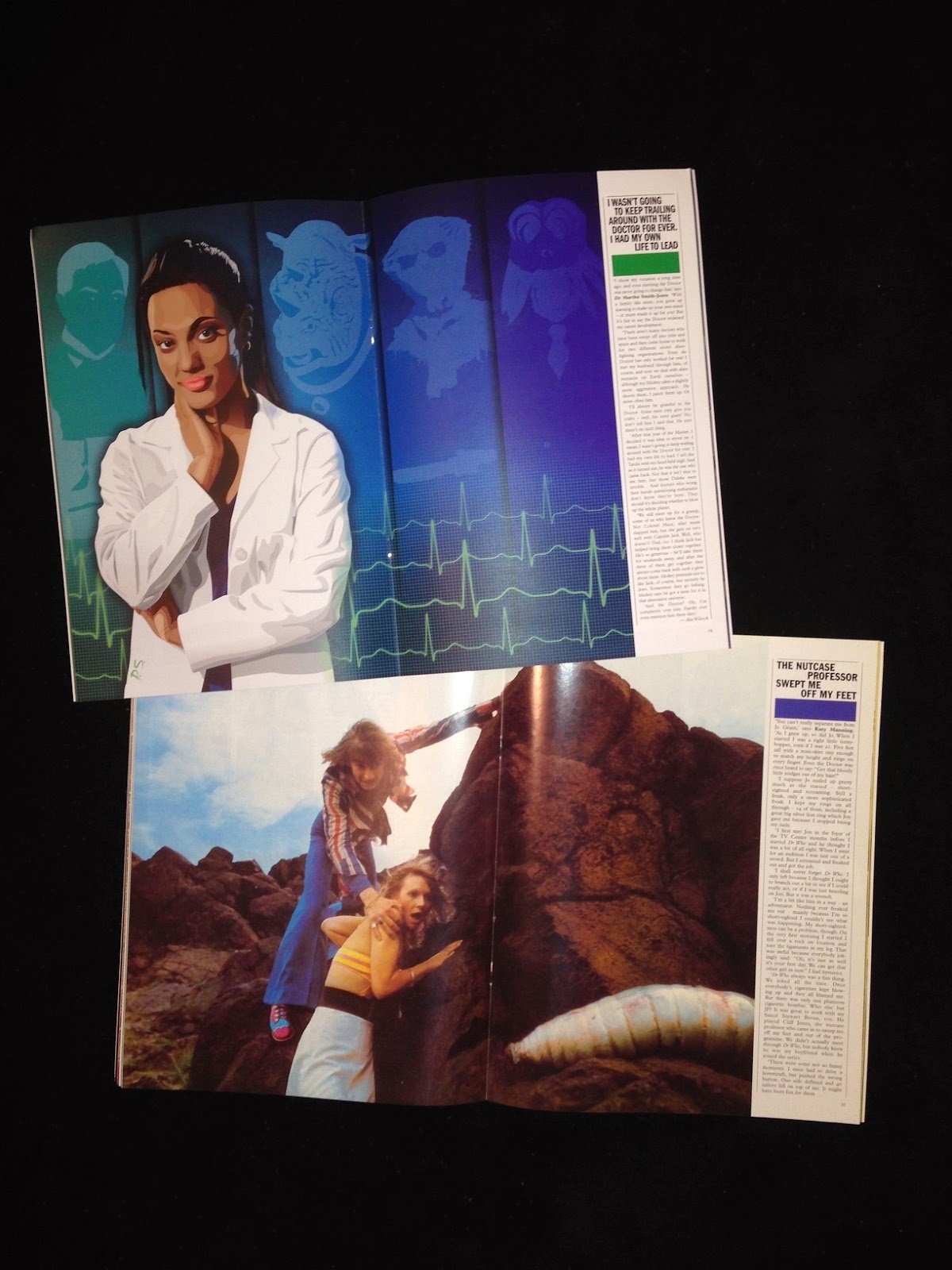
From her first appearance in Smith and Jones, eight years ago today – making it the most appropriate day to publish my own piece from the 8th Anniversary Special – Martha was a breath of fresh air for me. It wasn’t just Freema Agyeman’s performance and giving as good as she got to the Doctor (and him not being interested), nor just that she was the Doctor’s first full-time TV companion who was black (after Sharon, Roz and others elsewhere), but that she wasn’t going off with the Doctor only because her life was a bit rubbish. Martha is the only TV companion since Sarah Jane Smith with a decent, fulfilling, even exciting career – and for all of us who are so utterly gripped by the Doctor and his adventures, that’s a more inspiring example than the implicit suggestion that travelling in the TARDIS is only slightly better than being in a dead-end job you’re bored by or hate, or than having your parents killed in front of you (and going off with the first available surrogate dad). If you’re an achiever with a lot to give up, but the TARDIS is still so exciting you’d go off in it without a second thought – well, you would, wouldn’t you? And, for me, she has by far the most satisfying (and self-chosen) exit from the new TARDIS, too, again after impressive achievements in her own right.
Other contributors took their own approaches, writing critical assessments or celebrations of their chosen characters, but with the Radio Times Special so deeply ingrained in me, I knew immediately that I wanted to write an ‘After the Doctor’ interview in that style, for the character rather than the actor, and that though I was going to be tongue-in-cheek in several ways (her earnestness, the Doctor) as well, I was going to set out first to say ‘She’s a strong, brilliant character’. And while it may have taken some time to think of all the other words, then edit them all back down again, my starting point leapt into my head fully-formed on reading Paul’s initial email to me:
“I LEFT THE TARDIS WITH MY HEAD HELD HIGH.”Though, as you can see from the interview as published, Paul picked a different pull-out quote, though with a very similar feel.

As it turned out, Paul’s wickedly pointed ‘story summaries’ didn’t mention Martha at all, so mine was the only piece that featured her in the whole magazine, and I’m very happy to have done her justice (if thankfully not in an entirely strait-laced way). Happy anniversary, new Who and Martha Jones!
Labels: David Tennant, Doctor Who, Doctor Who Magazine, Fandom, Martha Jones, Obscure Doctor Who Jokes, Personal, Smith and Jones


Saturday, June 28, 2014
Which Website Is Attracting 86.3% of Parliament’s Bandwidth? Or – Showbusiness for Clickbaitors
The air of Westminster is today seething with wi-fi so overheated that some researchers have actually* been microwaved (*not actually. Actually that goes for much of this article). Personality politics is often dismissed as just a beauty contest; now, at last, politicians have a genuine* beauty contest about themselves (*no, seriously, against all reason this bit is completely true). Among usvsth3m’s array of “Fights”, you can now vote for “Which gentleman MP is the sexiest?” Other votes pit songs, films, cities and scary clowns against each other, but I know this one floats your boat (and the Doctor Who choices). Warning: this is a post-watershed blog post. …
The usvsth3m set-up is familiar from the well-known exercise, ‘Which of X and Y is best? There’s only one answer – FIGHT!’ and here people create lists of anything that takes their fancy, from which two items are pitted against each other at random each time you click. This sorts the list by what or who’s won the most head-to-head battles. Simple as that.
Two Lovely Pairs of usvsth3m Votes – and a Poll Where Lib Dems Do Best!
Of the many available, four have caught my eye and my mouse clicks: inevitably, two for politics and two for Doctor Who. The pairs curiously mirror each other. “Which gentleman MP is the sexiest?” offers a choice of 504 men combining in random pairs (if that sort of thing turns you on), so I doubt I’ve chosen between more than a tiny fraction of them, while “Which government minister do you loathe the most?” gives you a choice of 21 Cabinet Ministers, so it’s much easier to ‘collect the set’. Similarly, “What is the best Doctor Who story EVER?” suggests not only that television is the basis of all reality but also that the world will end before August Bank Holiday, but even so provides an eye-blearying array of 241 stories, while “Who’s the best Doctor Who?” offers only 14 versions of the Doctor to choose from, and not even (spoiler) Michael Jayston.
The most confusing to pick from if you have several tabs open and are on a hypnotised clicking spree between multiple pages – I know nothing of this – is the “Which government minister do you loathe the most?” which, as you can spot, is the only one of these four where you want your favoured candidate to score not towards 100% but towards 0%, like an especially pointless round of Pointless. This means it’s very easy to mix up who should be up and who should go down. At the time of writing, Iain Duncan Smith and George Osborne are hitting it out as the most unloved (not my picks, but high profile) at around 80% apiece, while Alistair Carmichael rejoices in being the only member of the Cabinet to score under 20%. Hearteningly, every Liberal Democrat scores below 50%, with the winner-by-which-I-mean-loser inevitably Nick Clegg, though still hated in only 45% of battles. So here at last is a poll in which the Lib Dems are doing comparatively well.
The main other conclusion I’ve drawn from this is that Iain Duncan Smith is a low-grade copy of William Hague, but lacking the looks, charm and redeeming social concern, and that Chris Grayling is a low-grade copy of Iain Duncan Smith, but lacking the looks, charm and redeeming social concern.
Favourite Doctors and My 85% Difference From the Average Fan
As for the Doctor Who choices… Well, at the moment I’m quite cheered by the results for favourite Doctor, which are significantly out of line with most polls and rather closer to my own views, though it’s possible this may change when more people vote on it. Not wishing to dwell on the unloved here, I’m delighted to see William Hartnell and Matt Smith currently in second and third place, and Colin and Sylv not inappropriately at numbers six and seven. The best story poll is the one in which I’ve voted least, counter-intuitively, as it’s the only one I could see myself going, ‘No, that’s wrong!’ and getting lost in it for days trying to affect the outcome of something completely meaningless (and even here the pictures matter: screengrabs, book covers, posters, many make the stories involved look much more or less appealing than they ought to be. I don’t think much of The Monster of Peladon, for example, but I have a Pavlovian response to Alpha Centauri, and as for The Smugglers…). At least, right now, my favourite story is doing about 25% better than in last month’s rather wider and more settled Doctor Who Magazine poll, so that’s something. But if I click 120 times, statistically it’s very likely to turn up in there for me to vote for it… No. No.
What I should do, I suppose, is post some of the more entertaining differences between what I think of various Doctor Who stories and how the average fan’s votes turned up in Doctor Who Magazine 474, just now disappearing from the shelves (but I’m sure you can find one, or buy the download). Should I? For the moment I’ll tease by saying that, out of 241 televised stories so far, my biggest differences either way with average fan opinion were one that I would have put 170 places higher – and another that I would have put 205 places lower! And both by the same author. Any guesses?
And Now the Main Attraction – Hot MP Totty
So, “Which gentleman MP is the sexiest?”… A serious project to bring sexual objectification to the attention of our lawmakers? A Parliamentary researcher with particularly varied tastes, or some other steamy clickbaitor? Or just taking the piss?
My own pet theory is that the poll has been created by the Labour Party in order to find an opinion poll that they can win: analysing the vital statistical correlation between the current top entries, the most plausible hypothesis is that all Labour researchers are under orders to vote and vote again for every member of the Shadow Cabinet. The null hypothesis would be that Labour’s Shadow Cabinet genuinely is a beauty contest, but while my tastes tend significantly away from society’s ideals of beauty, I don’t think I can be that out.
I found myself clicking on this quite a bit, though often with the ‘pass’ option, it being weirdly compelling more for my interests in politics than in men. Never have I been invited to pass sexual judgement on people with such a bizarre variety of internal reactions. All right, so some male MPs do indeed look attractive; others I recoiled from on looks alone. But for most of them, things were more complicated (or it would be their politics rather than their looks that made my flesh creep). For a start, I’d often vote for some of those with the most unflattering photos: I tend to look terrible in photos too, but it’d be interesting if someone did a (subjective) statistical analysis to see which MPs had had ‘good’ photos chosen for the site and which were clearly designed to put people off. Or which ones were just a little apart from the norm of Commons, conference or canvassing shots. What to make of the one covered in teddy bears? Did the person who compiled the list and pictures for the site have a particular thing for the sole MP pictured with his top off (and wood in each hand)? What have you got on your head, sir? Does anyone really think that being plastered from head to toe in Labour Party stickers is becoming? And how about the Tory posing by bales of hay, all the better to roll in it?
The disturbing thing about click, click, click is that very soon I stopped thinking about it. From being disturbed at being asked to sexually objectify people I may know, I quickly drifted into particular patterns to click through more quickly. Tending to vote the party line on Liberal Democrat MPs – tending to, with more than a few exceptions for more than a few reasons. Lib Dem readers, you may like to know that at the time of writing Duncan Hames is our highest-placed hottie, so congratulations, Duncan. The MP I’d have had top was disappointingly low (though while you’re down there…).
Or there were the wider political reactions. MPs of other parties that I’d met or heard speak usually got me clicking against them, because they’d moved from potentially off-putting to not on your nelly (with a few exceptions, like the backbencher I remembered as a nice old buffer who liked Doctor Who and might be surprised to get ‘sexy’ clicks as a result). Or the ones I’d never heard of but assumed if they were in the DUP they’d be downright unspeakable. Or the ones that are disgustingly homophobic – should I vote for them and send them a message to say so, in the hope that it would hurt them more than it would me? And of course that select bunch who, whatever their looks, I thought ‘unspeakable fascist’ and would vote against with anyone at all – though special points to the poll’s devisor, who managed to find a picture of Liam Byrne that seems to have captured his inner soul (an impressive feat in itself to find it).
Or there were the ones who were quite attractive and I didn’t know anything especially against them; or the ones who weren’t conventionally attractive but looked like they might be goers – several gentlemen’s eyebrows looked intriguing (as opposed to thinking of some, ‘He’s had lots of affairs – so he’s probably good at it’ or ‘He’s had lots of affairs – but I still wouldn’t touch him with yours’); or, I’m afraid, as my brain stopped processing images at all and I clicked ever more robotically, the names. I am of course in the top 0.1% of the population for being mocked about my name and should know better, but as words swam up before pictures I started thinking of Mr Crabb or Mr Clappison, not in my bed, or Mr Pincher, and with the court case so close, or wondering what filthy practice ‘Prisking’ is, or Mr Woodcock – does he have one? I’m sure the poor MP for Ogmore heard even more ‘jokes’ in the playground than I did. And looking at one of the currently highest-placed Tories, who by the vagaries of the algorithm popped up as a choice several times, I wonder if other people voted as I did for Mr Drax because he sounded like a Bond villain? And is it just me, or does Hugo Swire have the most Tory-MP-sounding name of any Tory MP? But when you start misreading names as ‘Tom Greatsex’ or ‘Michael Lubricant’ it’s just too close to Dilbert’s “You’ve ruined sex for everyone” and time to stop.
On the bright side, this is surely the most memorable tool yet for educating us on what the largely anonymous mass of Parliamentary Members look like – and encouraging us to be kinder to some – so I can recommend it as a valuable service to the public.
Labels: British Politics, Doctor Who, Doctor Who Magazine, Fandom, Polls, Sex
Saturday, February 23, 2013
Coming Soon: Three Things I’ve Written For Other People
How To Write Something: It Turns Out, Only By Getting Writing (nagging helps)
I love writing. Except when I don’t. In that, it’s rather like a lot of things in my life for which my health or my fears get in the way. And it’s a rather lovely ego-boost to be asked to contribute to something. But also sometimes terrifying. I write for many reasons: for pleasure (it’s certainly many years since any of it was for money); to make a point that needs saying; because I’m not able to get out much and want to feel like I’m connecting with the world… But I also tend to put things off, because I’m too ill much of the time and there are other things I want to do when I’m not. This means that anyone who is kind enough to ask me to write something does so at their peril, even if I do often really want to write for them. At the least, they’ll probably have to nag a bit. At worst, I may have to steel myself to get past the gnawing terror that sometimes irrationally substitutes itself for the ‘Whee!’ feeling that someone being nice about my writing ought to evoke. It’s embarrassing to admit (as some of the people involved may read this) that there’ve been times when, on receipt of an invitation to do some writing for something that sounds impressive from someone I respect, my immediate reaction was not to beam at the compliment but have a complete crash of self-esteem, worry that anything I wrote would never be as good as the other contributors, and pretend not to have seen the mail or any follow-ups (the online equivalent of keeping the door shut, the curtains closed, and never going out, as it happens pretty much my life offline). Which I suppose is just my life-long tendency towards seeking perfection as procrastination turned pathological.
I’m still putting off writing a lot of things I want to do for me, but happily somehow in the last year I managed to say yes to four interesting things for other people and have actually delivered three. Woo hoo! It may be significant that I warned three of them that I’m terrible with deadlines and would need nagging, while the other, for which I had several exciting ideas, took a while to reply, then I took longer to reply to them, then… Well, I’ve not heard any news of that particular book coming out, and I hope I’m wrong in suspecting it may not get round to. So, here are the three for which people gently prodded me, available soon…

The Doctor Who 8th Anniversary Special
Interviewing Martha Jones for Paul Smith at Wonderful Books
With the vacuity of the official modern Doctor Who Annual creating a gap in the market, in Summer 2010 the Doctor Who Magazine team (responsible for previous much more readable Doctor Who Annuals and similar books) joined with BBC Books to produce the far more interesting, text-intensive and generally creative The Brilliant Book of Doctor Who 2011, first in a series which ran… Only two years, unfortunately. But it did inspire something even more creative, entertaining and beautiful – and not just because it was based in a Who period considerably more to my taste and the only Doctor definitely more to my taste than the present one.
The Wonderful Book of Dr Who 1965 was created by Paul Smith as an homage to The Brilliant Book, but packed with facts, interviews and images based not on Matt Smith’s first season in 2010 but on William Hartnell’s (and the series’) first in 1963-4. And not only did it look gorgeous and was immensely readable, but it was very funny. Because not all of the facts (and none of the interviews) were exactly factual, both deeply loving and taking the piss outrageously. And all available as a free pdf, the cheaper, prettier, faster version of the old fanzine (though he did a few print copies, too).
All this meant that I was especially delighted when Paul Smith contacted me out of the blue to see if I’d like to write something for his next project. I didn’t know him, but I’d thought his work was (obviously) wonderful. And that this was to be an homage to the legendary Radio Times 1973 Special for the fiftieth anniversary was the reason I had to go for it, if I could. I’ve previously enthused about the Radio Times 1973 Doctor Who 10th Anniversary Special as probably the most marvellous single Doctor Who magazine ever published. It wasn’t until more than a year after that that Doctor Who first captivated me, aged three, so when a family friend who’d kept his slightly battered copy gave it to me, it instantly became one of my most treasured possessions. Before websites or guidebooks, this was the unique source of thrilling photos and details of stories from before I started watching (that is, prehistory).
Paul’s concept was to recreate the Special as if celebrating not the fiftieth but the eighth anniversary of a Doctor Who series that started for the first time in 2005, with other fans providing some of the artwork and comment pieces. In the original, double-page spreads about past stories alternated with newly shot double-page photo spreads and interview columns for past companions with pull-out quote headlines like “THE NUTCASE PROFESSOR SWEPT ME OFF MY FEET”. For a column like that, I was only given 350 words to play with – imagine – and a couple of other rules which I contrived to bend subtly, and may explain when the publication appears. I was asked which companion I’d like to write about, and though several tempted me – Rose and Jack were terrific in 2005, and I loved Jackie and Wilf – I instantly thought of Martha Jones (or Martha Smith-Jones, as she is now).
From her first appearance in Smith and Jones, Martha was a breath of fresh air for me – not just Freema Agyeman’s performance and giving as good as she got to the Doctor (and him not being interested), not just that she was the Doctor’s first full-time TV companion who was black (after Sharon, Roz and others elsewhere), but that she wasn’t going off with the Doctor only because her life was a bit rubbish. Martha is the only companion since Sarah Jane Smith with a decent, fulfilling, even exciting career – and for all of us who are so utterly gripped by the Doctor and his adventures, that’s a more inspiring example than the implicit suggestion that travelling in the TARDIS is only slightly better than being in a dead-end job you’re bored by or hate, or than having your parents killed in front of you. If you’re an achiever with a lot to give up, but the TARDIS is still so exciting you’d go off in it without a second thought – well, you would, wouldn’t you? And, for me, she has by far the most satisfying (and self-chosen) exit from the new TARDIS, too, again after impressive achievements in her own right.
I understand that other contributors might have written critical assessments or celebrations of their picks, but with the Radio Times Special so deeply ingrained in me, I knew immediately that I wanted to write an ‘After the Doctor’ interview in that style, for the character rather than the actor, and that though I was going to be tongue-in-cheek in several ways (her earnestness, the Doctor) as well, I was going to set out first to say ‘She’s a strong, brilliant character’. And while it may have taken some time to think of all the other words, then edit them all back down again, my starting point leapt into my head fully-formed on reading Paul’s initial email:
“I LEFT THE TARDIS WITH MY HEAD HELD HIGH.”You can already see a tiny preview of the Martha Jones pages on the Wonderful Books site, and I believe the new Specials are now at the printer’s.

The Worldcon Guide To Doctor Who In London
Bigging up That London for Nicholas Whyte and the 2014 World Science Fiction Convention
“Of all the places the Doctor ever visits, which is the one he comes back to more than any other? Not ostensibly exotic locations such as Skaro, Peladon or New New Earth – even Cardiff – but London. And, paradoxically, since Doctor Who began recording in Cardiff, the Doctor has been drawn to London more than ever before. But then, when the Fifth Doctor exclaimed that he was being pulled towards the middle of the Universe, there was no way this was going to mean a thrilling return to Terminus. Inevitably in Doctor Who, the centre of the Universe is London.”Diplomat and prolific science fiction (and Northern Irish and European politics) blogger Nicholas Whyte rang me last year to ask me if I’d like to write a guide to London locations in Doctor Who. He’s one of the organisers of Worldcon 2014, taking place in London next August, and thought this would make a great advertising hook to encourage people to come to London from all over the world.
That seems, you might think, quite a long lead-up time, and it did to me, so pity poor Nicholas a few weeks ago when I’d not yet turned my notes into a proper guide and, it turned out, not this year’s Worldcon in San Antonio but the biggest US Doctor Who convention – Gallifrey One, in Los Angeles, which took place last weekend – was looming upon him and he needed leaflets to hand out. Which led to me finally getting down to the drafting over the course of about four days solid, and discovering that I had oodles of notes for some Doctors and rather fewer than others. My intention had always been to select one location for each Doctor, all across Greater London, to give a range of time and space. So imagine my hilarity when, thinking all I had to do was whittle down several possibilities for each, I found that for two of the less Londoner Doctors I’d pencilled in the same location and didn’t have a back-up. I won’t tell you what, or how I ended up finding an alternative for one of them – though I did for a wild moment consider making a point of it and choosing that same location for four different Doctors, if that’s a clue…
I’d been told to write for a word count in the low thousands and, being me, ended up at what might be considered the upper end of that – about 3,400 words. Nicholas was very complimentary about it all, and is going to put the lot up on the convention website – but it was never going to fit on a leaflet. So the last of my four days was spent cutting it down by more than half, to 1,600 words, at the same time substantially rewriting it to make it still work at that length and trying to keep in at least some of the jokes, on the grounds that while I found such other guides as Richard Bignell’s book Doctor Who On Location and the website Doctor Who – The Locations Guide invaluable research aids and recommend each, they’re best to dip into and not easy to read through as enticements. And, in an attempt to forestall Nicholas and the Worldcon London team from making it less readable, at about two in the morning I stuck the text into some text boxes, inserted a few photos and clicked “Save as pdf” to prove that it would all fit on a leaflet as was. I expected they’d find someone with any graphic design ability to turn the text into leaflets…
So my apologies to people who picked up the leaflets in Los Angeles last weekend and saw something scruffy from Word without any links on it, but at least I reckon the text was pretty good. If you’d like a copy of the pdf, email me (look at the sidebar), and at some point the extended version, which is a more entertaining read, will be up on the Worldcon 2014 website. In the meantime, here’s one of Nicholas’ reports from Gallifrey One, complete with the huge maps they hung up to make sense of my references. I won’t tell you all of my choices here, but the first is obvious:
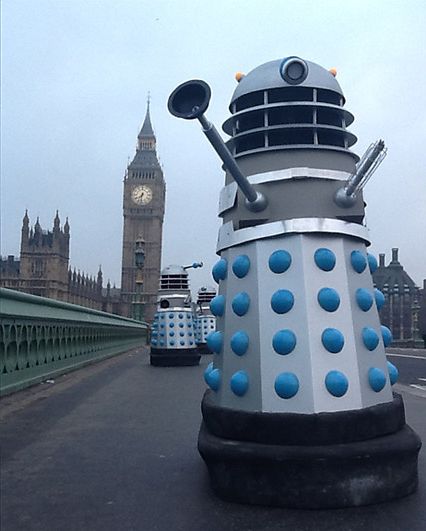
“Daleks looming before the Palace of Westminster and St Stephen’s Tower – the Houses of Parliament and Big Ben – are the very image of democracy overthrown by fascism. Before crossing the Westminster Bridge toward the Parliament of the United Kingdom of Great Britain and Northern Ireland, look left along the Albert Embankment; if you see zeppelins and signs for Newport, you’re in the wrong London. Best get that settled before you set out. Pass Big Ben into Parliament Square, turn right into Parliament Street / Whitehall to follow in Barbara’s fast footsteps, and like her you’ll reach Trafalgar Square at the end. That in itself is a much-used Doctor Who landmark: Ian and Barbara return there for an exuberant homecoming in The Chase; a New Year rings in in The Daleks’ Master Plan; Nelson gets a redesign in No Future and has long since toppled by The Sontaran Experiment; Rose has lunch there with Mickey before meeting the Doctor; it’s conquered by the Daleks again in the game City of the Daleks; but Londoners can feel secure that in a thousand years’ time, Trafflegarr Square will still be there in Spaceport Five Undertown.”
What Do the Lib Dems Believe?
Liberal Philosophy for a Mark Pack Infographic
While I don’t know if I’ve ever met Paul, and I know Nicholas a bit, Mark has known me more than twenty years. That means he knows my relationship with whooshing deadlines, so he’s the one who wisely met up with me for a couple of hours and prodded my brain for ideas rather than necessarily waiting for me to do the actual writing. Last year, Mark produced an Infographic on “Liberal Democrat Achievements In Government” free for any Lib Dem or reader to get across at a glance some of the influence we’ve had through the Coalition. His next Infographic is to get across what we stand for.
Mark and I have worked on and off together on a simple crystallisation of what the Liberal Democrats believe for decades, first inspired by the ’90s “core message” under Paddy Ashdown and Matthew Taylor (for which I was back in a senior enough position to get hold of much of the briefings). In recent months, there’s been work on a new one under Nick Clegg and Ryan Coetzee, and while Mark will no doubt be including that as part of his Infographic, we both wanted to come up with something a bit deeper: a mixture of history, philosophy, controversy and current priorities, the story of the Party and its soul, if you like, hopefully showing how they all fit together and giving something that all Lib Dems can nod at, whether for information or for inspiration. My intention, at least, is something that Lib Dem members can look at and think, ‘Yes, that’s some of why we bother’.
Though Liberalism provides a far more coherent and consistent philosophy for the Lib Dems than whatever shifting melanges animate the Labour and Tory Parties, it’s not without its problems in summing it up in brief – nor do I envy Mark in having to find images to illustrate concepts for his Infographic. I’m also grateful for him for pulling it together, not least because my series of ‘What the Liberal Democrats Stand For’ posts on this blog has mostly gone unwritten or in fits and starts, and I’ve not even finished republishing my original 1999 Love and Liberty pamphlet on here. So, Mark’s project is less ambitious, but it’s happening (hooray).
My best guess is that Mark is likely to publish the Infographic for Liberal Democrat Spring Conference in a fortnight, and I’m intrigued to see how it turns out. He did send me his rough notes last month, which I didn’t get round to helping with; he’s since sent me the first draft of the Infographic itself, to which I helpfully replied (having failed to do it at the more amorphous stage) with a close-to-complete redraft. Being me, and more a words than a graphics sort of person, that also raised the suggested word count from about 600 words to about 800, which I expect Mark to slash even if he wishes to take all my points on board. I know he’s circulated it to several other people, too, so I have excitingly no idea what the final version will look like – but I hope I’ll agree with it, and so will many of you.
At the risk of picking out elements that don’t make it through, here are a few teasers:
I’ve suggested the Infographic start with What the Liberal Democrats Believe in six words. But which six?
Mark is, amongst many other things, an historian, and one of the key staging posts for him in the Party’s history was the mid-Twentieth Century development of both Community Politics and Europeanism as important to our predecessor Liberals and Social Democrats. People often think these are contradictory, but they’re not – so here’s one of the lines I suggested to get across as briefly as possible why they’re part of the same thing:
“both challenged centralised power, saying decisions should be at the lowest practical level, from your local community for local issues to international co-operation on issues like trade and climate change.”And when many are trying very hard to say the Party’s split today between Economic and Social Liberals, for me this is greatly overstated. The extremes make a lot of noise, but most Lib Dems see themselves comfortably as both, or simply as Liberals. So here was my suggestion on how briefly to sum up the consensus, not just the differences, between members of the Liberal family:
“All Liberals believe in liberty, and that any sort of power (government, business, other people) can both protect and threaten liberty.Some may recognise my paraphrasing of my old friend and mentor Conrad Russell. And before long, you can see if any of this made it into the final draft!
“Economic and Social Liberals put different emphasis on which sources of power are the best defences or the biggest bullies, and on whether freedom or fairness is the biggest priority.”
Something Mark’s prodding brought me back to look at again was my own shortish ‘What the Liberal Democrats Stand For’ statement, which I first drafted in the ’90s and had slightly updated several times since to incorporate a flavour of whatever the Party’s key priorities happened to be at the time. As each version was limited to between 140-150 words, in the years that I was Vice-Chair of the Liberal Democrat Federal Policy Committee and would deliver its report to Party Conference, I even used to read it out as part of my speeches, on the basis that if any Party body should be concerned with what we stand for and communicate it to people, it should be the one that’s responsible for the Manifesto.
It’s some years since I last wrote a new draft of this, and I had a go, incorporating some of the new Ryan Coetzee messaging. It was the largest change (still kept below 150 words) I’d made since I first came up with it, and I’m not printing it here today because, after an appropriate pause for thought (and after Richard shaking his head), it seems too much of an ugly mash-up. Should I manage to get it to flow soon, I might publish it when the Infographic appears. In the meantime, if you’d like to chip in or just to see what the Lib Dems stand for for me, email me (again, link in the sidebar) and I’ll send you both the previous 2000s version and my latest attempt-in-progress.
And that’s it, at last. I hope you enjoyed the trailers, and that you’ll soon be able to see the main features. And just a couple of days ago, I was asked if I’d like to write something for another fan magazine I adore… But as I volunteered to do what’s probably the most popular bit, they may not say yes!
Labels: Conrad Russell, Doctor Who, Doctor Who Magazine, Fandom, FPC, Health, Liberal Democrats, Liberalism, London, Matt Smith, New Adventures, Personal, What the Lib Dems Stand For, William Hartnell
Friday, January 11, 2013
My Doctor Who Thirty-Eighth Anniversary and DWM
It’s one of the perils of writing for someone else’s publication that you face editing – and though under 250 words is a snip by my standards, it still got snipped. Now, usually I’d still be very happy to see it printed (and I am) without any pedantry to follow, but for me it loses something without my last line – which I’d intended as the point of the whole thing, and dropping it completely reverses the meaning.
One of DWM’s regular features is A Battle of Wits… in which Toby Hadoke and Johnny Candon, at least one of whom, improbably, I know to be a real person, debate obscure Doctor Who controversies and then invite readers to take sides. In last month’s issue, Toby argued that the best year ever to be a fan was 1983, because there was lots of stuff going on but you could only do it if you tried really hard, and though curiously he praised very little about the actual TV series that year, it was special because it had never yet been cancelled (so, Doctor Who was special because it was hard, and simultaneously because it was easy). Johnny, on the other hand, praised the series’ great return in 2005, because suddenly it was back, it was popular, and it was good. Whereas my instinct was the same as when I read Tat Wood’s long essay in About Time Volume 3 on why 1973 was, entirely factually, the greatest year ever for Doctor Who: marshal all the arguments you like to ‘prove’ it; it’s really not about the series, but about you. So, read on to the punchline:
My Letter in Galaxy Forum, DWM 456
So, Toby, 1983 was the best year to be a fan? [See A Battle of Wits in DWM 455.] How about 1975 as Doctor Who’s most brilliant year instead? A massive 35 weeks of new episodes – still the most in any year since the series went colour. Fantastic stories including two in every fan vote top ten (Genesis of the Daleks and Pyramids of Mars), a favourite of both twenty-first century showrunners (The Ark In Space), all part of the first full year of Tom Baker, the twentieth century Doctor that everyone remembers. For fan-pleasing returns, Daleks, Cybermen and Sontarans. For creativity in space and time, Davros, Sutekh, a fabulous Robot, an amazing jungle, Zygons and their ship that seemed grown, not made. Who can doubt that 1975 was the best? It’s completely objective truth!
My Original Letter
So, Toby, 1983 was a great year to be a fan because it was hard to do the fan things (A Battle of Wits… DWM 455)? Or because however good, bad or middling the series was, at least it was just always there? I find Johnny’s 2005 more convincing – a thrill beyond hope for old fans like me, a marvellous start for new fans, and one of the most marvellous seasons in the programme’s history. What could possibly beat it?
How about 1975 as Doctor Who’s most brilliant year instead – for fans and everyone else? For quantity, a whole 35 weeks of new episodes, still the most in any year since the series went colour. For quality, the fantastic stories include two still in every fan vote’s top ten results (Genesis of the Daleks and Pyramids of Mars), a favourite of both Twenty-first Century showrunners (The Ark In Space), all part of the first full year of Tom Baker, the Twentieth Century Doctor everyone still remembers. For fan-pleasing returns, Daleks, Cybermen and Sontarans. For creativity into space and time, Davros, Sutekh, a fabulous Robot, an amazing jungle, Zygons and their ship that seemed grown, not made. To take home, not just shiny new Target novels but even The Doctor Who Monster Book, with the most thrilling pictures ever.
Who can doubt 1975 was the best? It’s completely objective truth. And by pure coincidence, it’s when three-year-old me started watching. I bet Toby and Johnny were just as objective.
Now go out and buy DWM 456, which features an adorable* Doctor Who alphabet (surely begging to be a poster), a comic strip with one of their most memorable ‘WTF’ splash-panel endings, features on the both the last and the first of Doctor Who in the ’80s (both rather brilliant), and lots about the new (and, for me, much-improved) TARDIS design. Just don’t look at the spoilertastic pictures from the new version of The Reign of Terror (due on DVD on Richard’s birthday in a fortnight) if you don’t know the story…
*Favourites include 1975’s Zygons, obviously, Quarks, J is for Julian Glover, doing the sort of thing I do and cheating with two for R… But, most of all, another from 1975 made me go ‘Awwhhhh!’ H is for Harry Sullivan. From Trumpton.
Labels: Doctor Who, Doctor Who 50, Doctor Who Magazine, Obscure Doctor Who Jokes, Personal, Tom Baker
Saturday, June 02, 2012
Doctor Who – The Idiot’s Lantern
What a shame that William Shatner’s festive cover of God Save the Queen (as sung on Have I Got News For You a week ago) doesn’t seem to be available to buy, and so tragically won’t be the Number One it deserves to be this weekend. Never mind – I’ll just have to put on those jolly carousers the Sex Pistols instead.
The idea of DWM’s Time Team is that – starting right at the beginning of Doctor Who and more than a decade ago in real time – they get four regular reviewers to sit on the couch and watch every story (including, these days, the lovely Mr Will). And to one side, they feature comments sent in by readers. When I get round to sending in one-liners to Time Team, I watch the story to brainstorm a lot of quickie ideas so that, hopefully, that way at least one of them’ll be something no-one else has come up with. The latest issue’s the first for three Doctors that I’ve had comments in two consecutive issues, and a letter about Philip Madoc, too. Coo. A few years ago, I was encouraged to set up a blog printing all of these; well, all right, I need a bit of a prod to get that going, but it’s not going to happen tonight, so I thought I’d leap ahead and publish what I sent in last month (try and spot how much I’ve nicked from Richard’s review on Millennium Dome, Elephant). If you read my usual reviews, this is something very different… Shorter, punchier and – a consequence of trying to keep the word count down – much cattier. Or, at least, not dressing it up. Actually, when I watched this a month ago, I quite enjoyed it, and having not seen it for a few years, some of it seemed quite fresh. But not all of it…
The Idiot’s Lantern – Not the Time Team
The tone’s all over the place, it’s hardly original, and the Doctor’s lost the big picture… But Maureen Lipman’s scene-stealing fabulousness makes the most fun villain since the series came back. And showing her frock properly even justifies Doctor Who Confidential!
I’m no royalist, but “Are you suggesting that the Queen does the housework?” is a brilliant way to puncture ’50s sexism. And did you time this Time Team for the Jubilee specially?
It almost gets across the feel of 60 years ago, when TV was rare and the Royals aloof. Before it all just became meaningless, greedy, third-rate celebrities. And TV’s nearly as bad.
They should leave Billie out of half the story more often if it means she concentrates what she has into flashes of pure impishness – taking the mickey out of Eddie and vanishing like a sprite is the best she’s been all season.
Mr Gatiss likes his Autons, doesn’t he? Blank faces, Doctor’s lash-ups needing a quick fix, New Domestic Thing Turns Evil at Evil Signal from Transmitter of Evil… Filling in the rest with dashes of Quatermass and Sapphire and Steel. Still, it’s more original than Night Terrors.
The only bit that doesn’t feel nicked is the family, and that just because it’s not very good – it might name-check Corrie, but can’t do it. And as for Dad… Not as well-rounded and subtle a working-class character as Sam Seeley.
The Wire’s sheer fun but also a real threat – Mr Connolly should be scarier, if anything, a more immediate brutish bully, but his terrible ‘My old man’s a dustman’ schtick makes him just a prat.
Eddie’s fine to start with, deliberately overdoing it like a dad when he marvels that it’s like the TV people are in the room with you. Shame that that’s as underplayed as he gets.
It’s charming but not really threatening – too cosy, save that scene where the Doctor suddenly goes off the deep end. Usually he’s just all teeth and lack of curls, not psychotic.
Tommy seems much younger than he is – not just the actor, but after children in School Reunion and the Fireplace, suddenly this seems an oddly child-populated season. It doesn’t quite suit the horror.
It might be laid on with a trowel in Tommy’s soliloquy, but it’s good to have such an unambiguously Liberal message again – in the Wire and Eddie, the Doctor stands up to bullies, big or small.
In a story from a child’s perspective, I can see the arbitrariness of authority excusing Bishop flashing between violent fascist and trusty Dixon copper, but I still don’t believe it.
I know ‘Feed me’ has been done before, but how Paradise Towers is this? That line, the disembodied villain, the Doctor reversing the interrogation… Towers still seems much fresher and wittier, though I’d take Lipman over Briers any day.
Cosy and horrific; domestic and pomp and circumstance; perhaps the tone’s at its most uncertain when it tries ‘Lovely Fifties nostalgia’ and ‘Things shouldn’t live on beyond their time’ at once. The obvious love of TV while sending up ‘It rots your brain!’ is a fab juxtaposition, though.
Lipman does a great lip-smacking single megalomaniac villain, but there just aren’t enough characters or time to pull off a ‘Florizel Street’ soap – and it doesn’t help that each member of the family appears to be acting in a different series or, in the case of Dad, a school play.
Bizarre that a ‘smaller’ historical seems so much less believable than the more ‘important’ ones – is it because we don’t all know queens (well, not all), but we can all tell when a family isn’t convincing?
The Wire’s probably the most OTT villain since the series came back, while Eddie’s just like every brute who beat you up. He should be the real scary monster. But ‘arch’ beats ‘hammy’ hands down.
I don’t think much of the Doctor being blasé over the whole of London but psychotic losing Rose. Get over yourselves!
Oh, dear, the Doctor’s ‘armed’ and the sonic much too handy. But I forgive this for sending up the psychic with “The King of Belgium, apparently”. A scream!
So how exactly does everyone get their face back…? It’s just a bit too easy – ‘Don’t worry, once TV people leave, everything returns to normal’. A more modern take would say ‘TV people do you, move on, and you’re left in a right old mess’.
It’s quite an elaborate revenge on continuity announcers always talking over the credits, isn’t it? If only they were all that cool (and had such killer frocks).
Bizarre fact: this is the episode most likely to be repeated without the “Next Time…” at the end. So it lets the continuity announcers in quicker.
Alex Wilcock
Isle of Dogs
And a few from Richard Flowers
I love the Doctor constructing a video recorder out of spares whilst on the run. A perfectly Doctor Who moment.
Is Tommy gay? I only ask because the script slaps you around the face with the obviousness of it and then pulls the punch.
In spite of the proprietor being vaporised by the Wire, Mr Magpie’s business is going to go from strength to strength, seen to still be in business aboard Starship UK in the Thirty-whatever-ish Century. I guess catering to those early Betamax adopters really paid off!
Tonight, Richard and I are watching and greatly enjoying the story that followed The Idiot’s Lantern, The Impossible Planet / The Satan Pit. It’s the day before its sixth anniversary, for a story full of sixes; it’s time (slightly past time, probably) for the next Time Team… But, mainly, because we’ve just been to see Prometheus, which in no way recalled this story with its sensible black captain, industrial future chic, tepid comments about faith, giant carved face down in the darkness, Cthuliana and Alien feel. Completely different. I’d say what I thought of it, but I suspect someone else’ll be along shortly with something a lot more incisive and insightful than I’d be after one viewing…
Labels: Cthulhu, David Tennant, Doctor Who, Doctor Who Magazine, History, Republic, Reviews, Richard, The Idiot’s Lantern
Saturday, October 29, 2011
DVD Detail: Doctor Who – The Masque of Mandragora
Doctor Who’s finest season so far is its Fourteenth, a year of dark religion broadcast across 1976 and 1977. It opens with Elisabeth Sladen at the Doctor’s side for the penultimate time of her original run, and this story should feel secretly familiar to you if you’ve been watching her starring in The Sarah Jane Adventures. When BBC4 showed her final story (until all the others) this May, my review of The Hand of Fear included my overview of Season Fourteen and its uncannily echoing themes under producer Philip Hinchcliffe – who wanted to expand the show’s horizons – and lead writer Robert Holmes – who wanted to “frighten the little buggers to death”. The Masque of Mandragora isn’t the season’s height, but it lays out those themes like a declaration of intent, even down to setting itself during the Enlightenment: the leading battlefield is for and within the mind, here championing rationalism against a whopping great metaphor for superstition; characters and societies strive to grow up, with Marco’s fight here to outgrow his uncle mirrored on a grand scale in Mandragora’s desire to keep humanity as superstitious children; and religion underpins the story’s Gothic setting of new and old world despising and deposing one another. After a couple of years of exploring the themes in unfamiliar framings, masses of monks coursing through secret passages in late Medieval Italy made this Doctor Who’s most flagrantly Gothic story so far – only to be topped a couple of stories later as this portion of the series reaches its crescendo… Back in September 2009, Doctor Who Magazine Issue 413 published “The Mighty 200” – 6,700 fans’ votes on all 200ish TV Doctor Who stories to that point – voting The Masque of Mandragora up to number 85. I might put it ten or so places lower, largely because the competent but uninspired director doesn’t quite fulfil its potential, but either way it’s an excellent little story that takes one of the series’ firmest philosophical stands.
While this ‘taster’ may not be short, incidentally, my policy in these is not to be too spoilery, in order than you can read on without fear of finding out too many key twists from the end.
That Golden Moment
“It takes away from Man the only thing worth having… A sense of purpose, what else? The ability granted to every intelligent species to shape its own destiny. Once let Mandragora gain control, and Man’s ambition wouldn’t stretch beyond – beyond the next meal. It’d turn you into sheep. Idle, mindless, useless sheep.”The story’s most breathtaking moment for me has always been the cliffhanger closing Part Three, offering a memorably scary death, fabulous rolled Rs and a major turning point. But for most of those reasons, it’s too much of a spoiler to describe here. A couple of scenes from Part One spring to mind – the old Duke’s deathbed openly establishing one of the story’s key plots while more subtly setting out the other, the Doctor’s arrival at the court with a warning and quicksilver wit – but it’s a few minutes into Part Four that the Doctor muses on the philosophical battle that’s going to expand into the slightly ungainly finale. The science is a bit uncertain, but Tom’s dynamic, and the philosophy spot-on.
In 1492, “the period between the dark ages of superstition and the dawn of a new reason”, at the court of one of Italy’s most progressive Princes, two gatherings are planned: one, of the greatest scholars of the new sciences looking for that new birth of reason; the other, a bloodthirsty Roman cult aiming to climb out of its long death to hold Earth under its spell. Yes, it’s the battle of the worldviews, each with a champion from the stars – angel or alien, demon or energy force, according to ideological stance. And unlike the Mandragora Helix’s titanic booming voice, the Doctor has a sense of humour, which proves he’s on the right side. Even as he uses a primitive telescope to calculate exactly when the Helix will be in position to make its attempt, even as he asks for the simple tools he’ll need for his last dangerous gamble to draw off its power, even after he grimly tells Sarah Jane exactly what control by this alien force would mean were it to become humanity’s substitute for science… He goes to sleep standing up, steals the scene utterly from the poor discombobulated Prince and replies to his worry about putting off the (besieged) masque with gay abandon:
“You’re going to hold a dance?”The signal for the attack – or when the stars are right – is to be a total eclipse, foretold as “When Mandragora swallows the Moon…” Though it’s much less vivid now, this story was made only a few years after we had first landed on the Moon, when that was a potent symbol of our reaching outward; Mandragora swallowing it was not just a suitably mystical-sounding way to describe the eclipse, but a metaphor for what it would do to our aspirations. The story’s coda famously predicts that the Helix will be in position to try again five hundred years later – how disheartening that by the end of the Twentieth Century, nobody was going to the Moon any more, and humanity seemed to have lost interest in going anywhere else. Maybe the Helix did come back and succeeded in putting our ambition to sleep after all?
Something Else To Look Out For
Often said to be his favourite story, The Masque of Mandragora feels like producer Philip Hinchcliffe’s manifesto for what the Doctor’s about – he’s an intellectual, and everything about it says so: setting; plot; theme; TARDIS reinvented as wood-panelled study; even the new titles font (the stylish DellaRobbia, named appropriately for an Italian Renaissance artist, becomes the look of the programme’s credits through most of Tom; luckily not the similarly Italian-named Times New Roman, for which I have an irrational dislike). And yet he’s also a swashbuckling adventurer, turning his hand to duelling as easily as engineering, dashing through a crowded market and winding terraces that you might think Italian if you’d never seen The Prisoner, racing along on horseback in exciting stunts that you might think entirely convincing if you’d never seen Tom Baker. And if you want to relaunch the Doctor as a Renaissance man, where better than in the Renaissance? The story isn’t perfect – despite the philosophical power, lush feel and obvious inspiration from The Masque of the Red Death, it lacks some of the bite of the season’s finest stories to come, and of course the edge of the immediately preceding season finale, The Seeds of Doom; but as that story was set on going as far as it possibly could (if not necessarily in the right direction, as I posted in a somewhat overlong reply to TARDIS Eruditorum yesterday) thanks to its thrilling but ultraviolent director, anything would feel like it was pulling back a bit afterwards. So it’s a good job this is moving forward, too.
The new approach is greatly aided by Tom Baker’s performance, carrying off his serious and playful sides with equal assurance as his Doctor comes out of what had almost seemed a year-long sulk. The orange is mightier than the sword; a lion peeps over an altar; he gets to tell Hieronymous, “come off it – drop all that bosh”. He gets a great scene towards the end of Part One, taking responsibility for having taken the Helix to Earth – like Adam, or Prometheus – and trying to warn Count Federico and his court of the terrible danger. That should imply a grimly serious attitude from the Doctor, yet wonderfully as the toadies first wait to see the Count’s reaction, then laugh on cue with their lord, and he’s then presented with the local astrologer to test his credentials, we see the Doctor thinking on his feet – first cheerily convincing, then sharp and sombre when he’s not getting through (“Because you don’t have a future…”), then disgustedly swatting down all Hieronymous’ nonsense just to exercise his wits (“All it requires is a quick imagination and a glib tongue”). And it’s a great scene for Federico, too, in his casual power and ability to size up a character – if not to understand anything that challenges his worldview – even down to rewarding that mocking tongue with that prize so rarely given by villains, prompt execution (and it’s not his fault, of course, that it inevitably fails).
With the Doctor so heavily featured, Sarah Jane’s role is a little more muted than in some stories, though Elisabeth Sladen finds yet another – and perhaps her creepiest – way to play ‘brainwash woman’, as well as all the usual spikiness, exploration and not really taking to being laid out for sacrifice. Pre-empting The End of the World’s definitive Twenty-First Century explanation of how the TARDIS lets its crew understand any language, this story is infamously the one where Bob Holmes decided it was time to say out loud those questions everyone put to him in the BBC canteen, as not only does Federico notice the Doctor’s peculiar clothes but also Sarah Jane – or something else through her – asks how she can speak Italian. It’s rather out of character for Tom’s Doctor (if not Pertwee’s) to object to questions, but he takes this not as a sign of her journalistic inquisitiveness but a dark portent that she’s been hypnotised. Again. Even the TARDIS gets a new start, for both practical (as revealed in the extra features) and aesthetic reasons, with the chutzpah of pretending that its new dusty wooden control room was in fact an old one we’d seen previous Doctors potter about in. It’s an evocative design by Barry Newbery, at once a Sherlockian study and a little chapel (his arched Palace corridors, cleverly theatrical temple effect and simple but inspired way of disguising the Village Town Hall are great bits of design, too). Also of note on the production side, the screaming masks of the Cult of Demnos are very effective, particularly the cruelly opulent design for their leader, though Dudley Simpson’s musical score is a little too reminiscent of several of his earlier contributions (Pyramids of Mars in the sacrifice, The Ark In Space as Sarah Jane’s bewitched), if still with some lovely deep chiming as the Brotherhood plot or spidery percussive music while Sarah Jane’s stalking the Doctor, as well as rather a beautiful arching version of his Doctor’s Theme shortly after they land.
A Gothic Story
Tom Baker’s first three seasons, led by Hinchcliffe and Holmes, are often referred to as “Gothic Horror”; this story, and this first half of Season Fourteen, is the clearest point to get across what’s meant by that (if you have a copy of Doctor Who Magazine 282, you might also read Alan Barnes’ excellent article Tales From the Crypt). Though the Gothic elements start off very early in this three-year period, perhaps disguised by the relative late-coming of dark shadows and travels back to older times, they reach a peak here in dark religion, ancient tunnels and mad monks. Gothic scholars would instantly recognise that this story is all about the Old World versus the New Age with the Renaissance itself at stake, that it cuts a fine line between exploiting the supernatural and explaining it, and that it’s overflowing with the Gothic trappings of Medieval Europe, alchemy, tyranny (even by the wicked uncle of the rightful heir), dungeons, torture, ancient passageways and rituals… Though, ironically, the force of irrationalism is named for a play by that arch-rationalist of the time Niccolò Machiavelli, in one of many crafty references by writer and Renaissance academic Louis Marks (whose earlier Day of the Daleks also explored issues of free will versus determinism).
“You mean they could dominate Earth now through an ancient religion?”The anti-Catholic excesses of Gothic literature are here, too, if masked – which makes it ironic that I felt it was speaking to me at the time, brought up a good half-Catholic boy and as steeped in religion as this year of Doctor Who, if of a rather more modern sort than hinted at here. Of course, the evil Roman religion through which Mandragora will dominate the world is the “pagan” Cult of Demnos and not any vastly larger and more temporally powerful denomination from that city, but to ask the question ‘Why didn’t Mandragora pick the big one?’ is to realise that it’s less an opponent than a stand-in. It’s not a very opaque attack on organised religion: Federico blatantly has in place of a chaplain his “Court Astrologer” Hieronymous (named for the monkly Catholic preacher who effectively ruled Florence around this time), with a non-speaking ‘proper’ priest seen at the old Duke’s deathbed for approximately seven seconds purely, I suspect, for the producer to establish plausible deniability (the Doctor even hangs a lamp on this later with his “No priest available. Will a brother do?”); the Cult is a Latin-chanting mass of monks; and the leader of the Brethren standing in a pillar of fire from above to lay hands on his followers and pass on the unholy spirit seemed entirely plausible to my half-Baptist side. It’s tempting to believe, too, that ex-monk Tom Baker’s newly fired-up performance had something to do with his seeing exactly the same quality in the script, and understanding it all too well.
The TARDIS landing in the crystal spiral mountains of Mandragora – in the void – amid unearthly sound makes an intriguing start to the story, though if the sound design is more impressive than the visuals, they are at least memorable (and more so than the Mandragora energy on the prowl; the DVD range seemed oddly unwilling to offer alternate CGI for Hinchcliffe’s stories as it did for, say, similarly underwhelming effects on The Time Warrior). Resisting its dizzying hypnotic spell from the first by saying the alphabet backwards seems an appropriate mix of fighting it with learning and turning a catechism upside-down, too. But that’s only the prologue; it’s when we go to Italy that the story really kicks off, in the perfect setting for this battle of ideas.
“You can no more tell the stars than you can tell my chamber-pot!”It’s all beautifully filmed, with what appears to be a medieval Italian town (and works damned hard to stop you recognising it) and glamorous wooded paths (after rain, suggesting they’re British, with exotic rhododendrons which suggest childhood holidays to me, though admittedly no closer to the Mediterranean than Watford). There are even bustling street scenes! Doctor Who seems to mix rather well with Italy – The Romans and The Fires of Pompeii two thousand years ago, The Vampires of Venice and a bit of City of Death in roughly the same Renaissance period, while even the series’ first historical, Marco Polo, had a Venetian lead character. And though several of those later stories were in fact shot abroad and one even in Italy, this is still the one which for me feels most Italian, with its gorgeous architecture, lavish costumes and a setting that’s right at the heart of the story. Though it’s amusing that the DVD picture’s been cleaned up so perfectly that while Sarah Jane calls it “Nice, warm…” you can also see Tom’s breath steaming. Oddly, only one of the actors makes a stab at an Italian accent, the others ranging from RSC to fearful Cockney.
People usually kick against the aristocracy in Doctor Who, but its casual power is everywhere here without comment, from Count Federico’s chess match to nice Prince Giuliano casually ordering his companion to fetch wine. Only the outsiders the Doctor and Hieronymous fail to defer, and both are nearly killed for it. The court intrigue is very well choreographed, with different guards crossing over each other in a physical symbol of the intercutting political plots. The scene introducing the main characters over a death is especially well-written: the Count enters late for the late Duke, prompting a confrontation between him and his nephew Marco over whether he was “enjoying some sport” which clearly sets up the two rivals for the Dukedom; but while that’s the focal point, other, more important lines from subtly different opposing sides almost toss away what the story’s really about:
“Many do not believe it – but the decrees of Fate will be obeyed. We – have no choice.”Young Prince Giuliano (Gareth Armstrong) and his “companion” “dear Marco” (the now much more famous Tim Piggott-Smith) are Doctor Who’s first obviously gay couple, though the most suggestive scene is when he’s clearly rather taken with the Doctor at first sight: “A most uncommon spy…” No wonder that Marco spends much of the final episode, even after being broken by torture into awful betrayal, offering jealous put-downs on whatever the Doctor’s doing. And when he exclaims “We have weapons of our own,” his eyes flicker downwards on Giuliano. Really. With the theatrical look of a BBC Shakespeare of the time and the principal actors playing it like that, it’s appropriate that top Shakespearean scholar and Doctor Who DVD text note-writer Martin Wiggins famously compared Giuliano to Hamlet – murdered father, wicked uncle, reluctance to act – with this one stronger in rejecting superstition if generally more wet, and lucky to be in a story where Machiavelli’s Prince can lose (if not exactly by divine intervention), or he’d be deadmeat. Marco’s advice to him throughout is to be more firm – steady! – and ruthless, while the Doctor’s is to “Keep an open mind.” Giuliano has the makings of an enlightened Prince, and is certainly on the right side of the crucial fight here between free will and determinism, but you can’t help feeling that Mandragora and the Doctor turning up was the best thing that could have happened to him. Without them, there’d be Duke Federico.
“You’re alone, now, Giuliano. Your uncle is strong and ruthless.”
“You forget, Marco, I am Duke now… We make our own lives, Marco. Not the stars.”
“If you fail me, Rossini, you shall breakfast on hot coals!”I loved a good bloodthirsty R-rolling villain as a boy, and I still do today – despite so much fun on offer, Jon Laurimore’s Count Federico steals the show. He’s clearly having a whale of a time from the moment we first see him torching and tormenting the peasants, and he’s not just relishably hissable but one of the series’ most competent villains, only brought down in the end by in effect not realising what sort of story he’s in and that he’s actually irrelevant to the key struggle – things come to a climax where, were this a ‘pure’ historical, he actually wins, and the Doctor would be stuffed. His excellent guard captain, Anthony Carrick, is a sort of henchman in Yes, Minster, too (and here shows how villainous ID cards are by demanding the Doctor’s on peril of his life). Jon Laurimore’s given many of the best lines and does great work with them – Richard sighs fondly when I laugh like a hyena at “Before sunrise, I want to see Giuliano’s liver fed to the dogs!” – but he also has moments of surprising quiet, while his final is not just fear, but awe, a man who finally believes in something.
“You can kill me first.”
“No… But we may kill you afterwards.”
Will We Have Any More Trouble From Mandragora?
There’s a lot more to this story than just the story. The DVD special features are rather fabulous; the novelisation a little flat, but with its moments, and reinvigorated by its audiobook reading; it’s had perhaps as many as five different sequels in different media; and it’s even inspired some rather lovely artwork (most notably Alister Pearson’s gorgeous not-at-all papal reissue book cover, perhaps best presented on John Pettigrew’s DVD and video cover site, as is Mike Little’s less technically accomplished but memorable Tom hemmed in by screaming masks, while on the DVD you can see some striking paintings from the Radio Times in pdf – just don’t look too closely at the masked Cult leader’s glowing crotch on the DVD cover).
The novelisation Doctor Who and the Masque of Mandragora is by producer Philip Hinchcliffe, and while it’s not bad, his writing style doesn’t flow anywhere near as well as Terrance Dicks’, with the scenes and lines trimmed for length making it feel a little sparse. There are a few other changes, of varying effectiveness: the ‘straightening’ of Giuliano; a tensely snapping wire; Hieronymous’ escape employing more thrilling cauldron-dashing; and though the mention of the Pope works vividly for one stream of the story (“The Holy Father himself will kiss my hand for cleansing the state of San Martino” as Federico plots to frame his nephew as a worshipper of Demnos), it works against the other by muddying the waters on religion. Tim Piggot-Smith, though, is a powerful actor, who enlivens the CD reading of the novel with considerable panache and an interesting take on the Doctor, old but deep-voiced and authoritative.
As for the sequels, the promise that Mandragora would return in five hundred years’ time inspired several writers. The first and arguably the most ambitious was Doctor Who Magazine’s comic strip (and graphic novel) The Mark of Mandragora; Big Finish’s Sarah Jane Smith series had the Helix threaded through its whole second series, the most promising and the most disappointing of the sequels (scroll down this article to find my spoilerful explanation of its climax, or anti-climax); the BBC Books novel The Eleventh Tiger matched the Helix, unnamed and anachronistically, against the First Doctor; and most recently, generously name-checking the other three, Gary Russell’s novel Beautiful Chaos brings back the Helix against the Tenth Doctor, Donna and Wilf, and is a particularly good story for the Nobles. Unlike other new series BBC Books (monogamous hetero Captain Jack of The Not-Deviant-At-All Strain, I’m looking at you), but appropriately for the TV original, it’s also got a pair of gayers among all the couples, too. That leaves The Sarah Jane Adventures’ Secrets of the Stars, a rather good TV story first broadcast three years ago, a blatant sequel but with the serial numbers inexplicably filed off. I may be doing him an injustice, but though I can’t trace it I remember some years ago reading its (very talented) author Gareth Roberts snidely asking, “Why would anyone want to watch The Masque of Mandragora?” Well, to get paid for doing an uncredited sequel and a drag comedy feature on it, obviously. Which brings me to the DVD special features.
“I only found out recently that there were other Doctors.”This DVD features a particularly entertaining and informative commentary from Tom (“It was a wonderful time…”) Baker, producer Philip Hinchcliffe and his assistant Chris D’Oyly-John (revealing his favourite Doctor), all thinking it looks very good, and joined by Gareth Armstrong, who Tom now calls “Devastatingly handsome” but who at the time called him and Tim “Gert and Daisy”. Bless him – my favourite moment is when Tom sighs orgiastically as Lis Sladen’s dragged into the temple, then enthuses over how wonderful it is that she now has a series of her own. Though his opinion on HD TV, except for art, or engineering plans, or neurosurgery, is also a treat:
“We didn’t like to tell you.”
“I was watching something in high definition, and it was so boring, that I just counted the blackheads on the leading man.”The ‘Making of’, The Secret of the Labyrinth, is rather gorgeous, mainly shot on location in – gasp – it was Portmeirion all the time! Though, in the style of The Prisoner, you’ll soon spot that they didn’t take all of their interviewees there, with some pictured against backgrounds in the studio. It’s one of the best the Doctor Who DVDs have done, helped both by the number and quality of guests from behind and in front of the camera and by the visual style of it all. Gareth Armstrong, for example, now bearded, has aged very well, as well as being incisive; Tim Piggott-Smith still very enthusiastic about how ambitious it all is, disapproving of how young actors today don’t know how to wear a sword, and giggling at how “Tom was very naughty,” especially making him corpse under torture (and, after doing ‘his’ Doctor for the book, gives a very creditable Tom impression); Barry Newbery is great, and I think I’ve worked out that his (cleverly mirrored) detail for Giuliano’s room is taken from Carpaccio’s The Vision of St Augustine; Anthony Carrick has the best stuntman story (while the director remembers cigarettes in their codpieces); but, appropriately, it’s completely stolen by Jon Laurimore:
“It’s an actor’s delight, actually, to get hold of a part like that… Wonderful, wonderful character – he’s the epitome of all everything that’s evil in Renaissance history.”You can also watch a Now and Then piece if you can’t get enough Portmeirion, and there’s a nice feature on the history and design of the TARDIS, with Tom Baker, designers, writers and kids, and an interesting conflict between them – acerbic writer Robert Shearman thinks “You want to explore Narnia, not the wardrobe”, while Tom and Christopher H. Bidmead want whole worlds inside there; I loved Chris’ idea that “We still haven’t really seen the TARDIS,” but are just working our way towards what the TARDIS might really be. Gareth Roberts’ and Clayton Hickman’s spoof documentary Beneath the Masque divides opinion, but I thought several bits of it were funny (and not least because, like me, they like to quote the sinister Radio Times blurbs from the time. You get all of those here on pdf, too, of course, with an excellent interview with Philip Hinchcliffe promising “science fantasy and romance” for viewers up to 90 and some fabulous pictures). I’m afraid I laughed aloud at the ’80s video compilation, “Valerie Singleton”, “Andrew Pixley” and particularly the map of Wales. But – sorry, Gareth – the best bit’s still Jim Sangster’s “Tricky Action Engels”.
I wonder if it sparks like the Helix?
Update: A week later, I engage with different arguments about this story from TARDIS Eruditorum, in which she’s astoundingly far more biased than I am; by turns ignores, misquotes and misunderstands the text; constantly repeats unfounded assertions with ever more over-the-top name-calling as a substitute for evidence; and as a result misses the point entirely. I make my case in the comments. She sticks her fingers in her ears and re-edits her own post to try and make herself look marginally less daft. I eventually decide to stop, but I suggest you simply watch the programme for yourself and decide by empirical observation rather than magic thinking that ignores the words.
Labels: Books, Comics, Doctor Who, Doctor Who Magazine, DVD, DVD Details, Gay, History, Ideas, Religion, Reviews, Sarah Jane Smith, The Prisoner, Tom Baker
Thursday, October 20, 2011
DVD Detail: Doctor Who – Paradise Towers
Twenty-four years ago this evening, Sylvester McCoy and Bonnie Langford were deep inside Paradise Towers. It was Sylvester’s first season as the Doctor, and the stories – all still finding their way with a new Doctor, a new lead writer and a new approach – have never been widely loved, with the general view that each of his seasons was a dramatic improvement on the one before (and I’d mostly agree, up to and including the fabulousness of the New Adventures that his Doctor gave rise to in the 1990s). The major exception for me was this story: a near-perfect template for the Seventh Doctor, I’d have loved to have had more like it. When it came out on DVD this summer, I was delighted – but it’s only fair to warn you that many others instead condemned it to a 327 Appendix 3 Subsection 9 death. Some people say this divides fans… Nah. Most of them just hate it! Even when it was first broadcast, the then-cheerleading Doctor Who Magazine put the boot in in a quite unprecedented way: “distinctly tired”; “isn’t much fun”; “PREDICTABLE”; “OVER-ACTED”; “frankly embarrassing”; and “Actually, watching Paradise Towers made me rather angry”. The Magazine was still reflecting that view back in September 2009, when DWM 413 published “The Mighty 200” – 6,700 fans’ votes on all 200ish TV Doctor Who stories to that point – in which Paradise Towers languished at a dismal 193rd. As I’d put it well over a hundred places higher, this story might well be the biggest gap between my taste and prevailing fan opinion. Though I’ve previously written about three of the bottom ten and found the odd nice thing to say about even the one that would be in my bottom ten, Paradise Towers is the only one of that “bottom ten” that absolutely shouldn’t be anywhere near there, where most fans are utterly wrong, and which should instead be celebrated.
While this ‘taster’ may not be short, incidentally, my policy in these is not to be too spoilery. So read on without fear of finding out too many key twists from the end. Which is just as well, as honesty compels me to warn you that, brilliant though much of this story is, the ending doesn’t quite live up to its promise…
That Golden Moment
“It’s – it’s – aaagghh!”I was gripped from the first scene when this was first transmitted; ‘proper’ Doctor Who grammar, this, starting your sentence with a capital letter and your episode with a capital crime. But while the opening scenes juxtapose death in the Towers and curious bathos in the TARDIS – if the story were made today, you can easily imagine them as a pre-credits ‘teaser’ – the montage a little further into Part One considerably furthers both the adventures of the Doctor and Mel and the mysterious deaths.
“Yes, I know.”
Arriving to see the sights of the acclaimed architectural triumph Paradise Towers, the Doctor and Mel find it’s a right old sight, and run into a gang of girls who’ve created names, crossbows and a culture from their surroundings. I still can’t help laugh when the charismatic Annabel Yuresha sashays menacingly towards our heroes and declaims, “Bin Liner.” Nor at their inventive wordplay, or when she, a Red Kang, bitchily asks, “What is Mel’s colour?” Sylvester’s great introducing himself, too. But in another part of the graffiti-covered, litter-strewn Towers, there’s rather less jollity.
A caretaker is moving nervously along a darkened corridor, walkie-talkie in hand, as much to seek reassurance as to make his report. I loved the dirty set design, the low lighting, the sinister silhouette against the window – in a properly crapulent ’80s tower block, it always felt like Doctor Who had finally landed somewhere close to home, both bringing the series up to date and making it that much more unsettling. And, of course, like so many blocks of flats, the caretakers are bugger all use. Is he fixing the lights, cleaning the wall-scrawl, offering help and advice to visitors? No. He’s as scared as the rest of us. And it’s the running commentary of his fear that really makes this scene, with Joseph Young’s captivating performance as a minor authority figure out of his depth as he finds mounting evidence of murder. Even the sinister bass of the music adds to the atmosphere.
But if it’s not the Kangs fighting among themselves, what could have killed the young woman we saw scream her last in the opening moments? What should be on the side of the caretakers, under their control, but have become a law to themselves and almost a mythical sight? Surely not the Mark 7 Megapodic Cleaners? And while in many Doctor Who stories the sight of them might have been saved for the cliffhanger, and in many Doctor Who stories that take themselves more seriously the sight of an unconvincing robot might wound the story terribly (not that you might in any way be thinking of, say, Colony In Space), the essential absurdity that these are the cosy cleaners that have gone on the rampage prepares you for what is, basically, a very unthreatening hoover with ideas above its station. And the punchline – exactly on the line between horror and comedy – is pitch-perfect.
Poor Caretaker 345/12(3).
Something Else To Look Out For
Sylvester McCoy is immediately endearing as the Doctor, Martin Collins’ sets are spot-on, but for me the best thing about Paradise Towers is the script. Stephen Wyatt was a new young writer at the time, and still does a lot for radio (I caught his excellent two-hander Strangers On A Film on Radio Four a couple of weeks ago), and his invention, dialogue and basic desire to stick it to architects and jobsworths really shine. The innovation of sticking Doctor Who in a dirty old block of flats is one that the new series has often followed in the last few years, and while this is very ’80s as you watch it, in Who terms it’s still very much ahead of its time, with the script well-suited to the feel of Russell T Davies in particular. And yet the buried evil on the (High) rise again could be straight out of Philip Hinchcliffe’s early Tom Baker Doctor Who – this is one of two 1987 stories that feel like folk memories of Pyramids of Mars (imprisoned grandiose killer breaking out through possession and robot servants) – while the sheer camp entertainment could easily fit into the Graham Williams’ stories for the middle of Tom Baker (in which sense, this is probably my favourite Season 17 story). Pity Eric Saward, who as recently departed lead writer had become a one-man Bob Holmes tribute band, yet on his first attempt Stephen Wyatt delivers a script whose love of language, worldbuilding, inappropriate humour, scary horror and even cannibalism captures the spirit of Bob so perfectly (without even trying to) that it walks all over Eric. Yet for all that, it doesn’t stuff itself with references to other Doctor Who stories, just gets on with telling one.
The TARDIS crew do very differently out of this story: it feels like the real start of one, and the last nail in the coffin for the other. It’s Sylvester McCoy’s second story as the Doctor, and this makes a far better start for him – his performance is quirky, inventive and very watchable, while a new habit of fast-talking bafflegab works better for him than the previous story’s misquotations (and to the later delusions of godhood, indeed). He’s got a great scene where he talks his way out of imprisonment, despite the director’s slow pacing making it less tense and funny than it should have been, and another literally reversing the position of interrogator and captive (not the only bit of this story that turned up in 2006’s The Idiot’s Lantern). You can already see how this Doctor will work so well in his later stories and the New Adventures, the whole setting not far from lead writer Andrew Cartmel’s urban nightmare Cat’s Cradle: Warhead, for example, with the added bonus that it’s far funnier and that the ‘Dark Doctor’ is not yet plotting from the start to make Kroagnon peck himself to death with his own cleaners, even if an over-elaborate trap is already in evidence.


Bonnie Langford’s Mel, on the other hand, is very entertaining, but the story’s very cruel for her. Bonnie works her socks off here, but in that shocking outfit and with a near-pathological character you can’t help but see the Doctor as fidgety for a new companion. And look! Right on cue, lots of streetwise teenagers with improbable slang and a taste for explosives. He clearly thought Kangs were best, too. I was one of many who criticised Bonnie at the time and failed to see the talent she’s shown so often since – not least in Big Finish’s Doctor Who stories again starring her – but the show at the time tried too hard to make her play a caricature of her own image and not a character. This is her best story for all the wrong reasons, showing everything about her that’s utterly unreal: a prim young woman among feral girl-gangs and dangerously polite old ladies; law-abiding, stuck with caretakers who don’t care; and an over-enthusiastic optimist who, when all the optimism’s gone sour, simply looks unhinged. It’s not kind, but it’s very funny. Can you really believe Mel perking “It’s great!” and “Fantastic!” about an advert for a housing estate? “I can’t wait!” There’s enthusiastic, and there’s demented. Having arranged to meet at the pool – inevitably feared and revered as “The Great Pool in the Sky” and forbidden under pain of death, complete with a stunningly camouflaged cleaner robot for which I’ve nicked a famous DWM gag – she elevates this to an obsession as she makes her way towards it through three episodes of urban degeneration.
Build High For Happiness!
The various residents – tribes, really – of Paradise Towers are where the script alone can’t quite bring it all off. This story has the same director as the previous year’s The Trial of a Time Lord: The Mysterious Planet, and while the direction still has a lot of problems, he’s noticeably improved, with moody moments and some striking high shots. The set design here is quite a bit better; the costume design quite a bit worse. But it’s in his casting that you most wonder if he’s not still a bit shaky, because few Doctor Who stories have such an uncertain mix. It’s not unusual for, say, some big-name guest actors to ground a story while cheaper, younger actors try to make up in enthusiasm what they lack in experience; this is one of very few stories where that almost seems to be reversed. Some actors here are terrific; some miscast but doing their best; one simply taking the piss.
It’s time to take the plunge and come to the Chief Caretaker as played by Richard Briers, the figure at the centre of every terrible review this story has ever had. He inevitably reminds me of my recent review of Colony In Space, but where that alluded to The Good Life, this is Ever Decreasing Circles – and where that story, as I wrote, subverts Doctor Who’s love of the ancient evil awakening theme, this one gives it new life until, well, the ancient evil takes on its new life. A fine actor who decides he’s just going to enjoy himself as a literal Little Hitler, his best scene is that I mentioned where he interrogates the Doctor and you can see Sylv almost physically dragging a more contained performance out of him. He also works in the turnaround cliffhanger to Part One and the nearly-terrific cliffhanger to Part Three (going on just a little too long), one of the few points when the story leaves black comedy behind and it becomes genuinely unsettling. But then comes Part Four. It’s a shame that the script weakens here, as it means rather a lot of wheels comes off when suddenly Mr Briers gives one of the most blankwallandcleaneringly infamous performances in the series (at the time, Pyramids of Mars had just been released on VHS, and I remember vividly the unfortunate contrast of both actor and make-up for very similar roles in a not dissimilar story). Compare the appropriately named Joseph Young, like several of the caretakers miscast for what are clearly meant to be a decrepit old bunch and yet superb. Still, I can’t help but forgive Richard Briers for going off the deep end because he’s such a lovely man: I’ve met him twice, each time at the end of hours’-long autograph queues where most actors inevitably get tired and testy, yet he was charming, enthusiastic and interested. It also helps that at the first ever convention I attended he not only brought the house down by apologising for underplaying, but privately took a complete git of an actor down a peg. This man had been a big soap star but only a minor character in Doctor Who, and was volubly aggrieved that his queue was much shorter than those for people he’d never heard of. After embarrassing most of his fellow guests with a tirade in the green room against “bloody anoraks”, fans who didn’t properly appreciate him as the most important person in the hall, there was silence (by contrast, I also once met his on-screen soap wife, who was delighted and delightful in a similar setting). Then Richard Briers took a sip of tea, and looked up, with a mild but firm tone, to tell him: “Those ‘anoraks’ are paying your wages.”
At the risk of sounding sexist, the women here are generally far better than the men. The Kangs are great fun even if you can’t ignore their being perhaps the most ’80s roles ever created for TV – with their massive spray-painted wigs, it’s like Toyah versus the Bangles – and give the story much of its energy. They get many of the best lines, but also the story’s most creepily powerful tableau, a funeral without a body that makes us as mystified, horrified and drawn in as Mel, the audience like her thrown into the Towers’ twisted cultures at the deep end. Then there are the older twin-set-pearls-and-suspicious-cooking-arrangements ladies, far more politely behaved but ultimately far more subversive as they come into their own in the second episode, where the cliffhanger is an absolute scream. It’s an ideal opportunity to compare ‘young people today’ with readers of the Daily Mail (and just observe how the ‘police’ are far more interested in bullying graffiti artists than investigating mysterious deaths. Well, except for one of them, but you already know what happens to him).
The political attitude of Paradise Towers, then, is obviously one of the elements that make it appeal to me so much – and that make it so very much Doctor Who. The series has always been about standing up for people doing what they choose against huge, monolithic fascist authority that wants to force them into shape; the Daleks were often almost as much about tower blocks and the council as about the Nazis. Now Doctor Who’s doing a show about tower blocks and the council, it brings it home to the viewers by having pseudo-Daleks – like so many Dalek-substitutes, the cleaners are a flop, if here at least they have the excuse that they’re cleaners. It would be stretching it to say that local authorities being so slow to take any sort of action is satirised by most of the action sequences being so slow and feeble, though. In Paradise Towers, there are two rival authorities that boss people around and see them as inconvenient: one, that people are messy, and bossing them by the rules; the other, that people are in the way of a grand single vision. Either way, the story is quite a Liberal line of attack, even down to a ‘why can’t we all get along’ appeal. Add in a study of social alienation, a touch of the final Quatermass (breakdown of society in an urban nightmare a bit into the future, brutal authority that doesn’t have a clue, old people looking out for themselves and feral youth gangs), and of course lesbians who are simply delicious, and it’s very much to my taste. Build high for happiness!
‘Making of’, Music and Me
The extras for the DVD are mainly led by musician and sound engineer of the period Mark Ayres: although he didn’t do the music on this serial, it’s a significant part of the background story; he leads the ‘Making of’; and he chairs the commentary almost as an ‘In conversation with Mark Ayres’ piece. Nowhere is this more evident than on Part One, where the entire commentary is between him and writer Stephen Wyatt, which is an interesting change of style (I particularly enjoyed Mr Wyatt’s mention of the theory that the Yellow, Red and victorious Blue Kangs represented the political parties, and that the extinction of the Yellow Kangs was now outdated as they’re in government). They’re later joined by Resident Judy Cornwell, who’s marvellously anti-authoritarian and great on how sweet and nice old people aren’t, and plain-speaking sound designer Dick Mills. There are eight minutes of deleted and extended scenes, the ’80s segment of the Girls! Girls! Girls! documentary on the Doctor’s companions (thought-provoking points by Janet Fielding, amusing computer graphics, but definitely missing Nicola Bryant). I enjoyed the main ‘Making of’ documentary, too, which adds Richard Briers, lead writer Andrew Cartmel, David Snell – of whom more in a minute – and actor Howard Cooke, who’s aged rather well and gives an interesting account of his role as wet “Musclebrain” Pex. At the time, the obvious problem with him was that he didn’t have the pecs, but it’s easier to forgive the miscasting in hindsight: he doesn’t look the part, but he can act it, right from an opening scene that adds to the bizarre culture shock of the Towers (and which I quoted the last time I raved about this story), through the gradual disintegration and eventual redemption – or is it? – of his character. So why didn’t the director pick someone who looks like a massive musclebound Rambo? Mr Cooke could act, and none of the muscles they saw could (surprise!).
1987’s new musical discovery for Doctor Who was Keff McCulloch, whose frenzied drum machines have a fair bit to do with Season 24’s unpopularity. Even my love of Doctor Who incidental music often comes a cropper with him. And yet I’ve always sneakingly enjoyed some of the soundtrack for this story, even the crassly OTT overcompensating for the cleaners. The Paradise Towers score is infamous for another reason, though – the original composer, David Snell, was actually sacked after he’d completed it because the producer thought it wasn’t up to scratch. And after decades of reading about this, the extra I was most eager for was Mark Ayres’ painstaking restoration of that score as an optional alternate soundtrack. The ‘new’ old soundtrack is… odd. It’s almost sound effects, or at least sounds repeating (rather than themes) for different situations, sometimes overcoming the dialogue, and too often either silent or one-note overwhelming. It’s not ‘strange sounds’ – like The Daleks, say – but nor does it offer tunes. It’s somewhere in between, repetitive motifs to atonal bleepings, and strangely unsatisfying. Again, it makes me warm unnaturally to Mr McCulloch. Both musicians were clearly inspired by the creepy funeral, though, as the broadcast chimes are effective and Mr Snell’s low, slightly eerie tones for it work rather well too, and he sets a much better tone for the Kangs bullying Pex than Keff’s bouncing. By contrast, he badly overdoes the music for the fizzade, which you’d think was the monster (it doesn’t help that I’d always strangely liked the broadcast “Drinksmat Dawning” segue into the Chief and his little pet). Even The Sea Devils didn’t offer such a high-pitched buzz for the cliffhanger that would have children and dogs scurrying for cover. I’m very glad to hear this score at last, but commissioning another was the right decision. I have to make a minor complaint that there isn’t – yet again – an isolated score available on the DVD, let alone the two they could have included, but as five separate audio tracks would be a bit much I reckon they have more of an excuse than usual.
With author Stephen Wyatt the person whose involvement in this story I most admire, his was the voice I was most interested to hear in the extras, and he’s very informative. I was fascinated by his starting point for it – not just his experience of living in crappy tower blocks and dealing with petty control freaks, but about what he’d like to see in the series, too, thinking that it never had dirty corridors like those he walked, and that it had got to the point where you had to know everything about Doctor Who in order to watch it. And perhaps he had a point in thinking Doctor Who had got far too up itself to be watchable; in the previous year, the series had had fourteen episodes, taking A Christmas Carol to start off with and finishing without satisfactorily resolving most of the questions, absolutely definitely killing off one of the lead characters and then bringing them back, with another recurring character turning out to be a mysterious future relative, and the whole thing mucking about with the Doctor’s past, present and future, with a woman he meets in the wrong order. [Miranda Hart look to camera]
Rather disconcertingly, I once met Stephen Wyatt through his ex, who was my ex’s disturbing landlord. Said disturbing landlord heard I liked Doctor Who and promptly rang Stephen up and handed the phone to me. This was twenty years ago, and I’d not met authors before, nor spoken to them, so I was more than a little stilted and had no idea what to say when suddenly presented as demanding his attention over the phone. He asked me which story of his I preferred, and couldn’t believe it was this one – his other Who script is widely fêted, this widely hated – so I told him that, no, it wasn’t always delivered very well on screen, but I still loved the script. He also asked, cautiously, if I was his ex’s new boyfriend, which I was very quick to deny. If you can find a copy of Mr Wyatt’s novelisation, by the way, it’s rather good, though with less of a light touch than his script: he fleshes out a lot of the details, and my favourites Tilda and Tabby get an appropriately fairy tale buildup (“Surely not”) and witty asides.
The photos, incidentally, are more from the Blackpool Doctor Who Exhibition. A major part of my childhood, it was closed in 1986 with a new version opened in the 2000s, but the Philistine BBC closed it again and flogged off most of the exhibits two years ago rather than preserve them for the nation.
Why Max Normal Isn’t
I’m sorry, but I’ve got to get this off my chest. Paradise Towers was the first fruit of new lead writer Andrew Cartmel’s desire to see Doctor Who become more like some of the wilder comics of the time, and it often has a bit of a 2000AD feel about it. Like 2007’s even more fabulous Doctor Who story Gridlock, you can see some of The Ballad of Halo Jones here, with Paradise Towers itself a slightly sanitised version of Judge Dredd’s massive citiblocks (and all at least more upbeat than Doctor Who Magazine’s memorably wrist-slitting-tastic End of the Line). And because of that, and the bloke in the bowler hat in Gridlock, the one character people always seem to talk about (rather than, say, the more appropriate Swifty Frisko) is one from the early years of Judge Dredd. His name was Max Normal, he wore a bowler and a pin-striped suit, and every single Doctor Who fan who mentions him misses the point entirely (I suspect even Russell may have made the same mistake). To pick on About Time 6 unfairly purely because it happens to refer to him while comparing Gridlock and Paradise Towers and so a piece I read today while trying to avoid saying the same as everyone else, the ironically-named Max Normal is not “vigorously-average”.
I suppose if you’ve never read a strip in which Max Normal – “the pinstripe freak” – appears, it’s easy to mistake the name and the look of this inhabitant of the crazed world of the Mega-City of early 22nd-Century East Coast America for some sort of boringly ordinary character. That means you’ve missed the triple joke: when he first appeared in 2000AD in the late ’70s, people in suits and bowlers were ‘normal’, and shocked by the small numbers of young people dressed as punks – in Mega-City One, everyone looks like a punk, and are shocked at a young rebel dressed outlandishly in suit and bowler when nobody else does; it’s the 22nd Century, so this is like someone dressing as Beau Brummel today; and he’s Judge Dredd’s informer, who talks jive, so he’s also Huggy Bear incongruously turned white and dressed like an old City stockbroker, which is just as outrageous an outfit in Mega-City One as Huggy Bear’s pimptastic look was in old Bay City.
Which is why Max just isn’t Normal. Perhaps the much-anticipated About Time 7 can correct this misapprehension when it comes to Gridlock itself?
Labels: British Politics, Comedy, Comics, David Tennant, Doctor Who, Doctor Who Magazine, DVD, DVD Details, Fandom, Music, New Adventures, Pictures, Quatermass, Reviews, Sylvester McCoy